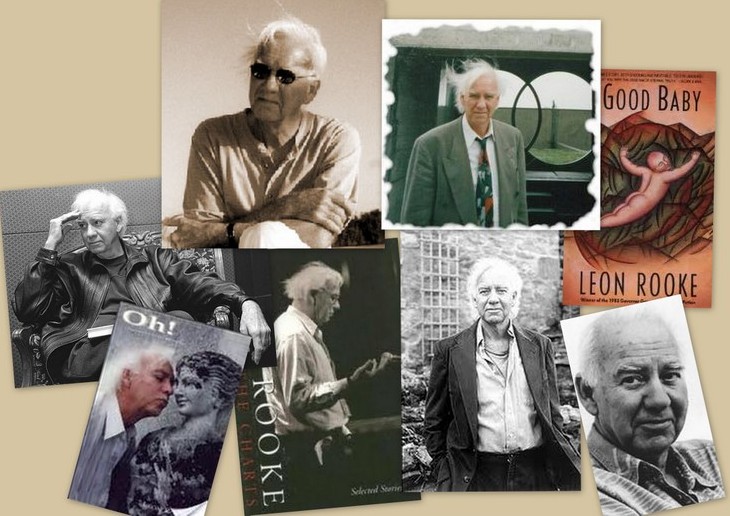
Leon Rooke has always been an inspiration and a muse. He has written some of the most delightful short stories I have ever read. Also those truly amazing novels Shakespeare’s Dog and A Good Baby, which, if you haven’t read them, you have to read (I have written an essay on the latter, which you can find in my book Attack of the Copula Spiders). And then, late in life, as if he hasn’t done enough damage already, he takes up painting and turns out passionate, sensual, witty canvasses that exude desire, subversion, irony, and an acute adoration and attentiveness to the feminine — unapologetic, insouciant, even scabrous. Oh, Leon! A man who follows the electric current of creativity wherever it leads. A model for us all.
dg
Beale Street Memphis, 2013 (oil on canvas, 16 x 20 in.)
SPACE The Manicurist, 2012 (oil on canvas, 30 x 20 in.)
SPACE
Beach Girls 1, 2013 (acrylic on canvas, 8 x 10 in.)
SPACE
Sirens, 2013 (oil on canvas, 16 x 20 in.)
SPACE
Brideshead Revisted, 2012 (acrylic on canvas, 60 x 36 in.)
SPACE
Red Hair District, 2013 (oil on canvas, 18 x 24 in.)
SPACE
Untitled (Holland), 2013 (oil on canvas, 12 x 16 in.)
SPACE
The Magistrate, 2013 (acrylic on canvas, 48 X 60 in.)
—Leon Rooke
————————————-
Leon Rooke exhibits his paintings at the Fran Hill Gallery in Toronto. He has published more than 30 books, including novels, short story collections, plays, anthologies, and “oddities,” and more than three hundred short stories. Rooke’s many awards include the Governor-General’s Award for Fiction (for Shakespeare’s Dog, 1985), the Periodical Association of Canada Award for the English-Language Paperback Novel of the Year (for Fat Woman, 1982), a Pushcart Prize (1988), the North Carolina Award for Literature (1990), and the Canada/Australia Literary Prize in 1981, for his body of work. Also the W. O. Mitchell Literary Award, for his writing and his mentoring, and the ReLit Short Fiction Award. Rooke has taught at more than a dozen Canadian and U.S. universities. He lives in Toronto.
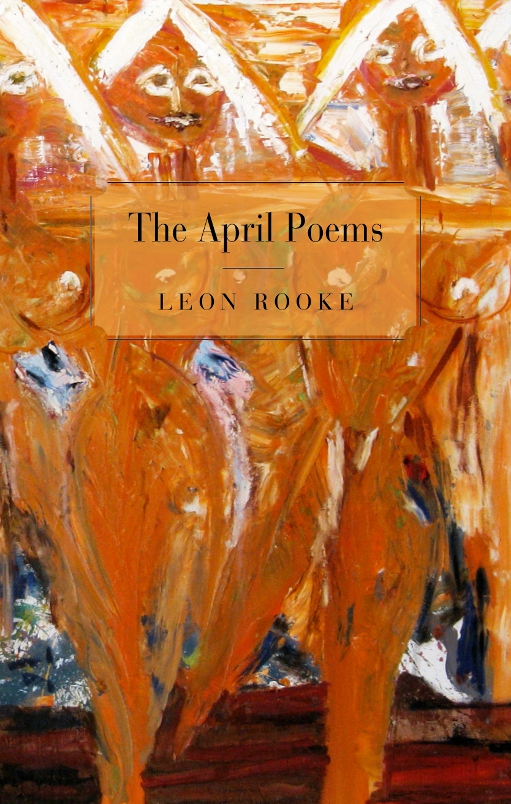
These are a scatter of The April Poems, not many, and Leon Rooke has a whole book of them coming out in, well, April, with The Porcupine’s Quill. April is the eponymous heroine of this book, these poems, the words of which Leon channels with oracular aplomb.
April always wrote in a good clear hand:
Grass is first to hold the snow.
Blue lilac on my window did grow.
The girls drove me crazy today,
So did so and so.
April has three daughters who drove her crazy and still do, her past is dubious and fraught, but former admirers dog her with passion.
next time you’re in trouble
breathe deeply and I’ll be on your bumper
like a hurricane.
Rooke writes with a mix of the vernacular, the colloquial, and the intimate informal, salted with speech rhythms from his North Carolina roots and an aphoristic flair that makes every line a surprise and a delight right up to the point, the quintessential Rooke moment, when the words become other than what they seem and he reaches for some extraordinary truthful mystery.
Dear Tate: It is a lie that beautiful words have disappeared. I have myself a trunkful
in the attic, and thousands more buried underground. April has a stash in small jars
in the pantry, falsely labeled Spices. The girls hide theirs in nine teacups in the three
doll houses, No Admittance To Anyone, Many fine words, luminous phrases, died
on the battlefield. Pirates stole many. Coiled serpents, oiled evangelists. The Pentagon
has ten thousand, no food, no water, locked up in distant prisons. In some cities
ebullient words thrive – Moose Jaw, Sioux City – living on chocolate eclairs, butternut
bread, turnips. They are home before dark. They dislike fanfare.
The cover image is from one of Rooke’s own paintings, a sampling of which you can find on the NC Art page.
dg
§
39. April and the Bad Bees
A woman in the laundromat said to April, The bees are truly nasty this year.
April was quite at a loss in what manner to reply, then noticing the speaker was addressing another woman to her rear, though only because this other woman
replied to the first, Yes, I have never seen them so bad as this year. I do not believe
these are our standard-type bees. No, these are mating bees, said the first, both
women then settling heavy glances on April and her triplet daughters occupying
a three-seater pram. April inserted another quarter in the drier. The women sat in
green plastic chairs, talking away about the nasty copulating practice of these
repugnant bees, being quite explicit, even vulgar, even pornographic, was April’s
thought, not liking either the glances coming her way, as though she personally
was to blame. They swarm a person, this one woman said, they hold her down
until all have had a go at her, and then they swarm away and do the same
to someone else and no one says a word. Yes, the other said, it is even worse
at my house. They tie us to the beds, they sup on our toes, they regard us as slaves, even the mites have noticed. Whereupon the women fell silent for some few moments,
content to watch clothes swirling in the driers. April’s triplets whimpered.
Then the one woman said, What I think is that this queen bee business
is a lot of rubbish. No queen in her right mind would permit such appalling
behavior. You think it is a king, then? asked the second. Why, of course,
came the rejoinder, some nasty despot king, have you not known them by the
thousands? The two women at this point rutting a final malevolent glance
upon April, then lifting their wings and flying off into abysmal night.
40. April’s Clunker Car
conked out on a high rise
not that far from Indian Country,
where she knew people. A tow-truck guy,
there in an instant, said he’d noticed her condition
round about the Tonawanda River
up by Singalong, the best part of three days ago.
April in the cab beside him, he confessed
he’d been on her tail pretty much the whole of her life.
I ought to have married you and not that other party,
he said, not to claim I could have done any better
at the time and not that there’d been any chance
of getting out of the thing
without losing my kids.
They are doing okay, he said,
about the same as yours.
Nice to see you holding up so well.
Yup, well, here you go, he said,
pulling into a hustling hub,
next time you’re in trouble
breathe deeply and I’ll be on your bumper
like a hurricane.
41. On the Ropes
Love needs new shoes
but is out of work.
Last night love was arrested, Drunk, Your Honour, leaning against a lamppost.
Did she resist your advances? Yes, she did, now you mention it, plus she spat on my boots, vile language, too.
Take her to an alley, the judge said,
beat her to a pulp.
Love staggered away blind
hot wires barbed in her breast
some bones broken
and now naked of foot
in fact naked head to toe
bleeding rather a lot.
Not that anyone much looked:
pretty autumnal day
old bruised ugly broad
bent like that.
42. April’s Deep Remorse
has as cause three grown-up daughters
who last night received a lifetime ban
from the Epicure on Queen Street.
They claim innocence: we were meek ravens with barely a chirp. It was that theatre bunch
settling old scores, flit and flame
and hands up the dress. Troubled Gertrude,
hemlock ear, Cassandra’s bitter tongue: your mistresses do nothing but eat ice cream all day! You would not cross the room to spit if my very heart was on fire! Your Master splits His own tongue! His flaws are greater than the sum of yours!
Seven police cars racked the chains on twelve. Lady, didn’t I just arrest you? The Epicure
is the latest haunt hobbling April’s troupe.
Not even the Brunswick House
will have them. We can’t go anywhere. Devout Muslim, Devine Bastards, kicked us out. Ratsuck Tim Horton’s too
43. April Affirms She Married Well
I was his pearl of a girl
his twenty-piece orchestra
with perfect legs
his long hedge with naughty blooms
lithesome gypsy curse
spritely gin fizz
his bright sun
bursting …….every pane
44. Thou Beside Me Singing
April’s friend, Tate, wanted to know
where went the lofty rhymes, the shimmering radiance
in a poem’s long ago. He liked those words cadenced light as a bird,
say one of those that can hold still against raging wind, stop and start
words from an eloquent brain, a humming bird, April thought he meant.
Fancy syllables espaliered onto a page
like a peach tree clutching a drain? Yeah, something like that,
Tate said, but making sense, you know, ordinary sense, like
I don’t have to get out my Ph.D. Pretty words, like you’re the critic,
where did they go? ………………………………………+ ……April always wrote in a good clear hand: ……Grass is first to hold the snow. ……Blue lilac on my window did grow. ……The girls drove me crazy today, ……So did so and so. ………………………………………+
April said to Tate, I keep my best words in a drawstring bag around my neck. ………………………………………+
Those were the days.
She didn’t say when. ………………………………………+
She was ever at us, this intelligent woman poking the hornets’ nest. ………………………………………+
Don’t wake the triplets. They’ll never get back to sleep.
Those girls sleep too much.
If you had to chase them you wouldn’t think so.
I wore myself out chasing you.
Liar, liar, what’s on fire. ………………………………………+
Tate is waiting. Tate, the dolt. Dear Tate: It is a lie that beautiful words have disappeared. I have myself a trunkful
in the attic, and thousands more buried underground. April has a stash in small jars
in the pantry, falsely labeled Spices. The girls hide theirs in nine teacups in the three
doll houses, No Admittance To Anyone, Many fine words, luminous phrases, died
on the battlefield. Pirates stole many. Coiled serpents, oiled evangelists. The Pentagon
has ten thousand, no food, no water, locked up in distant prisons. In some cities
ebullient words thrive – Moose Jaw, Sioux City – living on chocolate eclairs, butternut
bread, turnips. They are home before dark. They dislike fanfare.
—Leon Rooke
———————-
Leon Rooke has published more than 30 books, including novels, short story collections, plays, anthologies, and “oddities,” and more than three hundred short stories. Rooke’s many awards include the Governor General’s Award for Fiction (for Shakespeare’s Dog, 1985), the Periodical Association of Canada Award for the English-Language Paperback Novel of the Year (for Fat Woman, 1982), a Pushcart Prize (1988), the North Carolina Award for Literature (1990), and the Canada/Australia Literary Prize in 1981, for his body of work. Also the W. O. Mitchell Literary Award, for his writing and his mentoring, and the ReLit Short Fiction Award. Rooke has taught at more than a dozen Canadian and U.S. universities. He lives in Toronto.
Leon Rooke is an old and dear friend. He was in my head long before I met him because of his books, Shakespeare’s Dogin particular in those days, a novel that has stuck with me as a license and an inspiration — William Shakespeare as observed by his dog (who is telling the story), a brilliant book, a tour de force of point of view construction, an example of how literature thrives by making things strange. I put Leon in Best Canadian Stories regularly (as often as Alice Munro) over the decade I edited that anthology. I’ve reviewed his books at least a half-dozen times. I wrote an essay about his (also brilliant, eerie, and wonderful) novel, A Good Baby, which you can find in my book of essays, Attack of the Copula Spiders. Rooke was born in North Carolina but lives in Toronto. He has an actor’s voice and presence and is an amazing performer of his own work. He’s also a painter — we have been lucky enough to publish images of four of his paintings on NC.
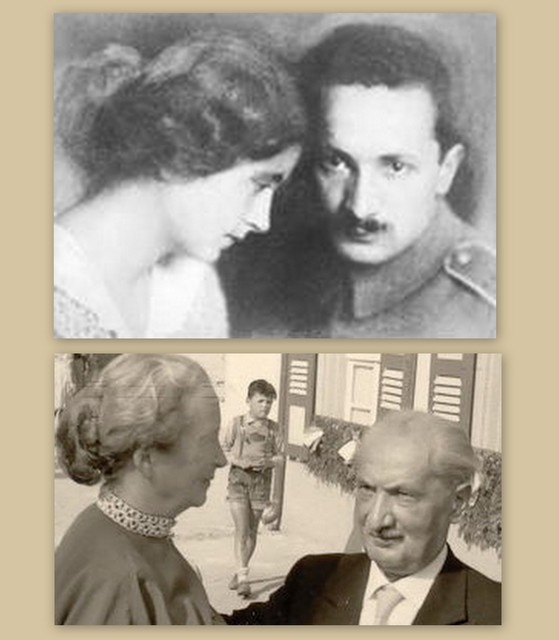
In “Heidegger, Floss, Elfride, and the Cat” Leon Rooke gives us Heidegger with his pants down (metaphorically), straining to compose the impenetrable prose of Being and Time while shuttling to and from his lover’s house and fending off the jealous and passive-aggressive intrusions of his long-suffering wife (I have inserted photographs of the real Heidegger and Elfride below). All this is relayed through someone named Floss, another one of those odd point of view inventions Rooke is so good at. In this case, Floss might be a philosophy student reading Being and Time in a library or he might be Heidegger, or rather, I think, Heidegger’s Being (which we might have called his Soul in the old days). Heidegger, of course, can’t know Floss, but Floss knows everything about Heidegger. And when the story is done, Floss trundles home to his wife and kids (being Heidegger’s Being is like a job). And, of course, it’s very late and I might have got this wrong.
Brendan Riley review in Review of Contemporary Fiction:
This is not literary craft reduced to statistical formulae and write-by-the-numbers word-bytes. Glover’s admirable ability and patient willingness to cast a careful—not cold—eye on what makes sentences hum and flow is fueled by a vital, infectious fascination with words, enabling him to reveal the inspired, alchemical, verbal concatenation at work in the most alluring and memorable fiction writing.
A Canadian author’s book on writing went viral on social media recently, leading to thousands of would-be fiction writers searching their manuscripts for “Copula Spiders.”
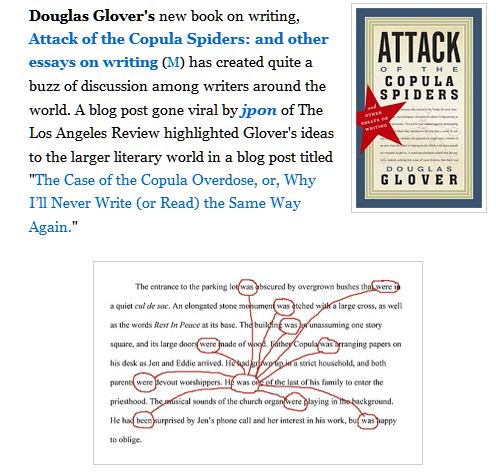
Douglas Glover’s book Attack of the Copula Spiders (Biblioasis) coins the term to refer to the multi-appendaged mess created by circling and linking all of the variations of the verb “to be” in a paragraph. (Copula is a term for the link between subject and predicate of a verb.) Excessive use of sentence constructions like “he was happy” or “the building was unassuming” lead to “flaccid and uninteresting prose,” he writes.
Joe Ponepinto, book review editor of the Los Angeles Review, brought Glover’s ideas to the literary world in a much-circulated blog post subtitled “Why I’ll never write (or read) the same way again.”
I reviewed a book a while back that has stayed with me for many months and has affected the way I write and read, and it’s opened my eyes to a weakness in much creative writing, even in published books. Douglas Glover’s Attack of the Copula Spiders (Biblioasis, 2012) criticizes many aspects of fiction, but saves its most withering scorn for the rampant and indiscriminate use of copulas.
I hear you asking, “What’s a copula? I admit I had to look it up. Webster’s definition says: “the connecting link between subject and predicate of a proposition.” In most cases, this refers to a form of the word “be.” But what does that mean to us everyday writers? It means banal, didactic, often passive sentences, almost completely lacking in action or depth.
As Glover says: “A copula spider occurs when a student uses the verb ‘to be’ so many times on a page that I can circle all the instances, connect them with lines, and draw a spider diagram. Now there is nothing grammatically wrong with the verb ‘to be,’ but if you use it over and over again your prose is likely to be flaccid and uninteresting.”
Close reading doesn’t get much better than this. Glover expertly unpacks the logorrheic hilarity of Bernhard’s text without ruining any of the fun.”
§
November 24
Attack of the Copula Spiders named one of the top non-fiction books of 2012 by The Globe and Mail.
“[By] by the time I reached the penultimate chapter, a brilliant examination of, among other things, the catastrophic meeting of the 15th-century book cultures of Europe and the oral cultures of the new world, I had decided that every literate person in the country should be reading Glover’s essays.” — Charles Wilkins
Governor-General Podcast Interview with Sky Hornig in Calgary during Wordfest in mid-October.
The Governor-General Podcast Interview – Douglas Glover
via Douglas Glover – CJSW – Calgary’s Independent Radio 90.9 FM.
§
September 29
A few months ago I read a book by Douglas Glover titled Attack of the Copula Spiders. At the time, I didn’t even know what a copula was. Once I understood, I spent days fixing copula-laden writing, and sweated over every sentence I wrote to make sure I was using more active verbs. In time, though, those fixations fade into the subconscious, which is where they belong. The key to good writing, I believe, is not to ignore rules and not to obsess over them. It’s to incorporate the ones you believe are true into your writing psyche so that you are aware of them without thinking about them. — Joe Ponepinto, Book Review Editor at LA Review. Writer, editor, teacher. Occasional curmudgeon. Dad to henry, the coffee-drinkin’ dog
§
September 29
§
September 5
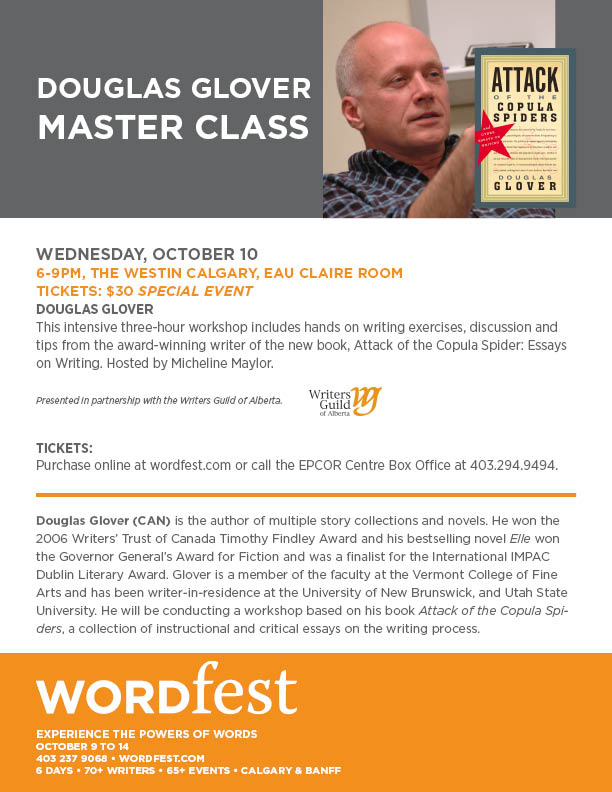
If I had to guess what events will sell out first, my money would be on the Douglas Glover Master Class. He’s a spectacular Canadian writer who has kindly agreed to do a three hour class on the mechanics of good creative writing for WordFest patrons. The best part about it? It’s only 30 bucks per person. What are you waiting for? Follow this link and buy tickets now!
Shelagh Shapiro interviews dg on his new book Attack of the Copula Spiders at Write the Book, Shelagh’s long-running radio show, which, by the way, is fast becoming an institution in its own right, a vast trove of writerly advice and experience. Listen to the interview on Shelagh’s site or download the podcast — it’s also available at iTunes.
I’m reading “Attack of the Copula Spiders” by Douglas Glover. i remember him trying to drill the matters in his first piece, “How to Write a Novel,” through my thick brain back in Saratoga Springs in the early 90s. It was the best advice I had ever gotten on making a novel. Really, it still is, and I’m glad to see it again in other than my own scrambled notes.
§
July 6
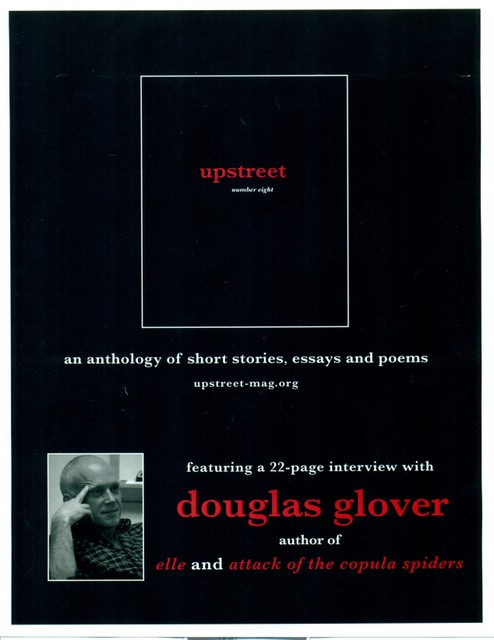
Vivian Dorsel interviews Douglas Glover in upstreet 8.
Dorsel: What do you emphasize in your teaching of writing?
Glover: Reading. The first thing I give students is a reading rubric and an analytical check-list to begin to reform their reading skills. As I say in Attack of the Copula Spiders, we live in a post-literate age. On a certain level that book is about the act of reading. I am pushing a critical aesthetic that is a bit like New Criticism and a bit like Russian Formalism; but, to my mind, as a writer, it just seems reasonable and immeasurably expands comprehension. You read a story and pay some attention to how it’s put together and, beyond the illusion of fictional narrative, you suddenly engage with the text on a whole other, rather exciting, level of grammar, rhythm and meaning. You begin to see connections that hitherto you vaguely passed over supplying your own dreamy connotations (as you’re taught to do in high school). We’re at a moment in our culture when differences in the ability to read and comprehend a text are critical.
I can’t remember the moment when I actually invented the phrase “copula spiders,” I only foggily recall circling over and over again all the “to be” verbs and then noticing that I could make a diagram on the page and that the diagram resembled a spider (with far more legs than it should have). The real issue, the shocking point, is that when you teach writing you are basically teaching the same student over and over again. It doesn’t matter whether the student is writing nonfiction or fiction or that the student thinks the burning piece of paper in his hand is the next War and Peace because he has put his heart into it and it comes out of his own original personal thoughts and is different (he believes) from anything ever written before (or in the future). The shocking thing is the uniformity of mediocrity. The shocking thing is that intelligent adults can’t think of another verb to use (actually most students jog along with a verb repertoire of about five: to be, to look, to sit, to stand, to see—absolutely the most popular verb choices).
The crucial connector here is to realize that part of the reason proto-writers don’t notice they are doing this is because they don’t know how to read. Eighty percent of what I do every semester is teach students how to read like writers, that is, with attention to structure and the felicities of well-written prose. So the two aspects of my book are necessarily joined: you can’t teach people to write simply by telling them what they are doing wrong; you have to show them where it is done right, that is, you have to show them how to read.
Once you learn to read you can teach yourself how to write. Literature is an encyclopedia of technique.
§
June 5
“The best essays in this collection come further in as Glover, like a physicist dissecting atoms, breaks down the prose of several great writers of the past few decades. A successful fiction writer in his own right, he wants not only to identify the techniques of stylists such as Alice Munro, Mark Anthony Jarman, and Thomas Bernhard, but to understand the grand logic behind the structures, the God-like plans that such geniuses hatch to produce their greatest works. Although this is not specifically a “how-to” book, Glover’s analyses in Copula Spiders prove far more insightful than traditional criticism, and by extension far more helpful to writers who are serious about approaching perfection in their craft.” — Joe Ponepinto @ The Los Angeles Review
§
June 5
It’s a great book. Look for my review in the next issue of Broken Pencil. — Nico Mara-McKay @ nicomaramckay.com
§
June 3
The first bad review; always a landmark. DG taken to the barn and whipped with limp squibs by Daniel Evans Pritchard at The Critical Flame, a young man apparently lacking a sense of humor and a delusional optimist who seems to think all those e-books coming out are worth reading. Without a trace of irony, he quotes, um, a Gallup poll to tell us the state of literary culture in America. At least he spelled my name right (although he didn’t manage to copy Mark Anthony Jarman’s name with the same accuracy — Mark suddenly becoming French in the translation — Marc Anthony Jarman). Tiresome as it is, I herewith issue my usual challenge to a duel.
§
May 21
Such was the pace of my conversion, that by the time I reached the penultimate chapter, a brilliant examination of, among other things, the catastrophic meeting of the 15th-century book cultures of Europe and the oral cultures of the new world, I had decided that every literate person in the country should be reading Glover’s essays and was fixing to present them to my eldest daughter, who is about to begin literary studies at UBC.
Glover is at times rather detached in his assessment of the value of storytelling. And yet there is a subtext to his work, a sense that if a story is to have life beyond the intrinsics of its existence, it must, sooner or later, ease up to the imponderables at the heart of what it is to be human. As Joni Mitchell said of songwriting, if at some point a song’s lyrics don’t extend themselves into a larger orbit, “it’s all just complaining.” Charles Wilkins, The Globe and Mail
Attack of the Copula Spiders is a practical guide for anyone interested in writing. Glover’s first chapter, “How To Write A Novel,” alone is worth the price of the book. Telegraph Journal SalonBooks
§
Caroline Adderson, author of A History of Forgetting: “Just ordered it. The essay on “Meneseteung” alone is worth the price.”
§
April 13
“These essays are not just for writing students, however. Whatever heightens student awareness of craft also sharpens the awareness of the general reader who has no desire to try his or her hand at writing but would like better to understand literature. Glover has an essay on Alice Munro that is of value to any short story writer but also should be required reading for anyone interested in Canadian fiction.” Philip Marchand in the National Post
§
April 10
“You should have a look at Douglas Glover on what may be the Mexican classic, Pedro Paramo, which was once described to me as “Mexico’s Joyce.” (The essay appears in Glover’s recent Attack of the Copula Spiders, which looks to be a great book of literary essays.)” — Scott Esposito at Conversational Reading
§
April 9
“Thoughtful and erudite books such as Attack of the Copula Spiders are always useful as roadmaps for developing better readers and writers. Now if we could only get the world to read them carefully.” George Fetherling review in Quill and Quire
Douglas Glover interview re Attack of the Copula Spiders on The Danforth Review.
§
Douglas Glover’s Craftwork talk on the novel at the Center for Fiction — based on “How To Write A Novel,” one of the essays in Attack of the Copula Spiders
How to Write a Short Story: Notes on Structure and an Exercise (see examples of student stories written from the exercise here and here)
The Drama of Grammar
The Mind of Alice Munro
Novels and Dreams
A Scrupulous Fidelity: On Thomas Bernhard’s The Loser
§
February 5
UK Guardian reviewer and columnist and editor of the magazine 3 a.m. Andrew Gallix quotes from Attack of the Copula Spiders.
(This is in his Phantom Book category, related to language theory and a modernist aesthetic. dg is up there with Walter Benjamin, George Steiner and Herman Melville.)
“…a great essay by Douglas Glover about Thomas Bernhard’s novel The Loser (it is serialized from Attack of the Copula Spiders and Other Essays on Writing, published by Biblioasis. The essay makes a fine rundown of the various rhetorical devices that makes Bernhard Bernhard. So if you ever wonder how he manages to attain those typically Bernhardian effects, look here.” Scott Esposito @ Conversational Reading
I spent the summer of 1968 in Freiburg. Martin Heidegger was still alive, living in a retreat in the Black Forest in an odor of disrepute on account of his Nazi sympathies during the war. I had a fantasy that I would meet him hiking in the woods. I never met him. I did meet Friedrich Von Hayek, the great economist, but he was easy; he had an office at the university and I walked in one day with a mutual acquaintance and shook his hand. My brush with history, my personal relationship with the god of Paul Ryan and the austerity-cats of the Republican right.
Heidegger is a particularly difficult philosopher to read because he thought he was inventing a new language to talk about the thing he couldn’t talk about. You can’t tell sometimes if he is being mysteriously impenetrable or just impenetrable as in opaque. He had a vast nostalgia for Being which he thought of as something we couldn’t access by perception or thought. This vast nostalgia seems sometimes to have been more felt than reasoned; he was of that generation who still mourned the passing of the Greek gods. He also slept around a lot and had a more or less open marriage with his wife, Elfride. Somehow his nostalgia for a thing you can’t reach and his many love affairs seem comically and humanly self-contradictory. He is ripe for literature.
Leon Rooke is an old and dear friend. He was in my head long before I met him because of his books, Shakespeare’s Dogin particular in those days, a novel that has stuck with me as a license and an inspiration — William Shakespeare as observed by his dog (who is telling the story), a brilliant book, a tour de force of point of view construction, an example of how literature thrives by making things strange. I put Leon in Best Canadian Stories regularly (as often as Alice Munro) over the decade I edited that anthology. I’ve reviewed his books at least a half-dozen times. I wrote an essay about his (also brilliant, eerie, and wonderful) novel, A Good Baby, which you can find in my book of essays, Attack of the Copula Spiders. Rooke was born in North Carolina but lives in Toronto. He has an actor’s voice and presence and is an amazing performer of his own work. He’s also a painter — we have been lucky enough to publish images of four of his paintings on NC.
In “Heidegger, Floss, Elfride, and the Cat” Leon Rooke gives us Heidegger with his pants down (metaphorically), straining to compose the impenetrable prose of Being and Time while shuttling to and from his lover’s house and fending off the jealous and passive-aggressive intrusions of his long-suffering wife (I have inserted photographs of the real Heidegger and Elfride below). All this is relayed through someone named Floss, another one of those odd point of view inventions Rooke is so good at. In this case, Floss might be a philosophy student reading Being and Time in a library or he might be Heidegger, or rather, I think, Heidegger’s Being (which we might have called his Soul in the old days). Heidegger, of course, can’t know Floss, but Floss knows everything about Heidegger. And when the story is done, Floss trundles home to his wife and kids (being Heidegger’s Being is like a job). And, of course, it’s very late and I might have got this wrong.
As far as I know, no animals were harmed during the composition of this story (despite what happens to the poor cat).
dg
§
Lights that flickered, curtain at a certain pitch in the summoning, the rendezvous with Frau Blochmann now concluded, Heidegger clamps his trouser legs and bicycles home.
Floss withholds opinion on the Master’s affair with the eminent colleague, which he knows will continue another few decades. What he wonders is what Elfride will say when the philosopher king comes through the door. That Jewish bitch again? Or will she say nothing, having just dispatched her doctor friend through that very door. This love business is a bit tiring, is Floss’s thought. Get back to work, he tells Heidegger. Not that such is required. After swallowing a bit of Elfride’s tasty stew Heidegger will be at his desk. Being and Time, thinks Floss, page 355. Quote, Resoluteness, by its ontological essence, is always the resoluteness of some factical Dasein at a particular time.
Floss, in his cramped library carrel, has no argument with that. Well and good. Floss and resoluteness and Heidegger, Floss believes, are one and the same.
They are together, he and the Freiburg sage, working the deep trench.
Heidegger now writes, quote, The essence of Dasein as an entity is its existence.
Without entity, no essence: well and good, remarks Floss to himself. Particles afloat in space, what purpose they?
Quote, The existential indefiniteness of resoluteness never makes itself definite except in a resolution. Page 346.
Here Floss wants to say Hold the phone. Floss wants to put his foot down.
Floss’s mind is rapidly scribbling notes to himself. These notes are scratching like a dog inside Floss’s brain. Hold the phone is but one of the dog’s bones.
Floss’s index finger is rapidly scanning the lines, speed-reading Heidegger as the master composes. Are not he and Heidegger that close? Are they not twinned with respect to Being and Time? Are they not brothers?
Floss can quote aloud, at any time, Floss can, any one of Heidegger’s current or future thoughts. The text is spread open on the desk for company only.
Photographic. That’s what Floss’s mind is.
Never mind that he has scribbled into his notebook the erroneous page reference. His hand did. Floss’s mind knows the difference.
Not 346. 355. Floss has jumped ahead. He always knows where Heidegger is going; often he arrives at the destination while the King of Thought is still clearing his throat.
Quote, Only by authentically Being-their-Selves in resoluteness can people authentically be with one another.
Ah! Floss thinks. Let’s not get too, you know, personal. Like.
In Floss’s view this statement is another Hold the phone. This is Heidegger fighting a headwind.
That someone has just this moment walked into Heidegger’s study is radiantly clear to Floss. Being with one another is an untypical Heidegger sentiment. The Master has been thwarted in his goals. Ergo, the line’s impurity.
Who is the culprit this time?
Excited, Floss thumps his knees.
Elfride, of course.
This is Heidegger being influenced by Elfride. This is the wife calling the tune. It is Elfride saying, If you are going to be with me, then be…with me.
Floss can see Elfride hovering over the great man’s shoulders. He can see her whisking dandruff from the great man’s shoulder with a tough whisk broom.
—Don’t mind me, Elfride is saying.
Heidegger doesn’t like any of this. Naturally, he doesn’t. Her very presence fills him with distaste. She has destroyed his flow of pure thought. Be with one another? How has that monstrous phrasing got onto his page?
Four a.m. Heidegger never sleeps, that explains him. But must Elfride do her dusting at this hour?
Floss thinks not. Floss thinks Elfride must have something up her sleeve.
—Dearest soul, the great man says — can’t you go away? Can’t you leave the room and quietly close the door?
—You know what happens if I don’t dust, don’t you? Elfride says.
Heidegger doesn’t know what happens if Elfride doesn’t dust. He is pretty certain Elfride means to tell him.
—Can’t you make a guess. Oh, go ahead. Go out on a limb.
Heidegger is thinking he has always been out on that limb. He was out there first on the limb with the Jesuits when he was a boy, then with Husserl, the so-called father of phenomenology; he was out on the limb with Elfride, then with Hannah, then with Elfride and Hannah jointly. And don’t forget colleague Blochmann. Occasionally the Stray Other. Now he is back on the limb with Elfride. Elfride is dusting the limb.
—I do not intend to engage in your theatrics, dearest soul, he says. I intend to sit here and work on this passage on page 355 until I get it right.
—It’s right, dear one, Elfride says. I’m here to tell you it is already right. You get it any righter, then I won’t know what to do with myself.
Floss, hearing this exchange, leans back in his tight carrel chair. He crosses his arms over his chest. He closes his eyes.
“Don’t let me interrupt you,” Floss says.
Heidegger spins his head. Elfride ignores Floss. Floss is a pest; he pops in at inconvenient times; otherwise, he is nothing to Elfride.
—Keep out of this, Floss, she says.
Heidegger sighs. These sighs are magnificent. They express his full contempt of those who would make the philosopher’s already impossible task that much more difficult.
Elfride, normally the most anchored of women, is subject to flights of fancy. Now she’s whisking her broom at vacant air. She has even given that vacancy a name: Time Being. There was a time, Floss recalls, when Elfride was more besotted with Heidegger than some now assert is the case. It is all that Hannah’s work. Months before Elfride and her future husband met Elfride had carried in her pockets notes destined for the magician of Frieburg. Don’t deny it. Yesterday I saw you looking at me. Or: Last week I blocked the doorway and without a word you swept by me. Or: I beseech you. Love me. She still retains these undelivered disintegrating missives under lock and key in a wooden chest buried beneath the floor. They prove her love. They prove her love existed prior to his. This makes her proud. Not even the great can be first in every regard. These notes will be published after her death. The instructions are contained in a sealed envelope affixed with her granddaughter’s name. Not in this envelope or in the locked chest is the narrative describing the gypsy fortune teller’s role in their haunted lives. Well, are not all lives haunted, Floss, who has never loved, reminds himself.The gypsy said to Elfride, On the first rainy afternoon, following your economics class, stand beneath the first blooming tree your steps venture upon. The lover meant for you will appear. Cold rain dripped, afterwards she caught a cold that endured through many weeks, and periodically through each wheeling year, this existing as nothing because love’s astonishing light penetrated the drooping boughs and stormed her heart. Heidegger, under a black umbrella, indeed appeared. Through wet lashes he imagined he saw a dying tree where nothing had stood days before.
—You. What is your name?
—Elfride Petrie.
—Why are you standing in the rain?
—Waiting for you. I am your fate.
Heidegger believed in fate as he did in Plato, with suspicion, particularly with regard to the monumentally salient question What is truth, but he was impressed. She was also pretty, though with rain pouring over her face he would reserve opinion on that. Yet when this schoolgirl fitted her body against his, his heart which was three quarters stone fragmented and certain sounds issued from his mouth never until that moment heard by himself or by any other. Fortunately only children on a dilapidated school bus, there to witness ancient Marburg splendours, were present, and they were too distracted to absorb any image of the historic coupling. This was because rain had become sleet, sleet had become snow, which in minutes had blanketed the lovers, flakes ascending and descending a second and third time, and then repeatedly, in abstract harmony with their movement. Floss, who was there and could have sought the better view had he been that kind of person, was mostly concerned with Heidegger’s black umbrella which gusting wind ripped into sundry pieces, the cloth flitting hither and yon like unruly crows, if crows were ever to attempt flight in such weather.
Heidegger has put down his writing pen. He is leaning back in his chair. He is crossing his arms over his chest. He fits his tongue beneath the upper lip; he can see clearly his thick Fuhrer’s moustache. The sighting gives him strength, although he distinctly prefers his own. He is reminded that theirs is a nation-building task. The moustache renews him in the impossible goal.
He sighs anew, leaning further back. He closes his eyes.
His sighs now, however, are obviously feigned. They exist merely as an admonishment to his wife. Feigned, they express his resignation. His disappointment with married–the assailed– life. The sighs are meant to convey to Elfride that he has given up. How can he work with a loudmouth duster in the room, chattering non-stop?
Gone from his head is that trail he was tracking re resoluteness.
But that quickly does his mind seize again upon the trail. His shoe soles hit the floor. His burden has lifted. The pen flies into his hand. Once more he is at work. He is already scribbling again.
He is scribbling, Floss thinks, quote, The resolution is precisely the disclosive projection and determination of what is factically possible at the time.
Hold the phone, Floss is thinking. The projection is termed disclosive only because the thought has just this second revealed itself to the sage. Ditto, factically.
But Heidegger is breaking his pen’s point underlining this significant line. It is imperative that the line be printed in the italic. If the line is not set in the italic then readers fifty years from now, speedreaders like that dunderhead Floss, will fly right by it. They will be blind to its pertinence, as he himself is blind to the dust, the dandruff–as he would wish to be blind to Elfride’s galling presence.
—That’s good, Martin, Elfride says. I love that factically possible line. It makes me break out in a cold sweat.
Indeed one of them in the room is sweating, though it isn’t Elfride. Heidegger is sweating because writing a new philosophy, bringing the axe to old traditional philosophical walls — that, mein Fuhrer, is hard work. Plus, there’s the other problem: the window, the cat. How hot and stuffy this room is. If he raises the window, he will be wasting heat. Heat the Volk must not waste. Only a Jew saboteur would waste the nation’s heat. So he is stymied on that front. Yet — and now he is getting to the essence of the situation — yet if he raises the window, the simple solution sans heat, the loathsome cat which always plops itself down on the sill, will come in. Thus, he keeps the window shut. He sweats.
Architects, he thinks, truly are a repellent tribe. They can get nothing right.
Floss swings in his chair. His shoe soles strike the floor. He sees Elfride poised. Resolute Elfride is ever on the job.
—Were you saying something, darling? says Elfride. It isn’t the architects, it’s me. Don’t blame the architects for your stinginess. Blame the war. Or better yet, yes, blame me.
She parades curvaceously around the sage’s desk.
—Although of course, she says, you would be perfectly justified if you blamed the cat. I’m with you there. I hate that cat. That cat is the ugliest creature I, for one, have ever seen. Are you for two — if I may phrase the question so? — in thinking that cat is the most frightful creature ever to walk on four legs?
—Three, Heidegger says. If we are to speak of the cat, then let’s speak precisely. The cat has but three legitimate legs. The fourth, as you can distinctly see, is so foreshortened as to scarcely exist.
—Foreshortened? says Elfride. Do you mean to say the leg in question existed that way in the womb? Perhaps in the very exchange of seed? Oh, I think surely not foreshortened, because I clearly remember that leg was perfectly normal until you crushed it when you caught the cat coming through your window.
Heidegger lowers his head. He kneads his brow. He is thinking, I have stayed up all night for this?
He is thinking, Hannah, thank God, was not a chatterbox. Her head was on my chest whenever I spoke.
—Yes, darling, Elfride is saying. As much as I despise the creature, it is criminal what you have done to that cat. You all but pressed that cat flat. Martin, I hardly know what to say. I hardly do. I am speechless, listening to your infirmity on the subject of that cat.
Floss sees the philosopher’s eyes narrowing. He sees him looking with utter hatred at this wholesome, proud, meandering wife. Heidegger’s defence collapses. Elfride has described the scene exactly as it occurred.
—It was an accident, Floss says.
—It was purely accidental, Heidegger says.
Elfride snubs this excuse. She whisks it away with her broom.
Floss has his attention elsewhere. He is focusing on the sleeping cat. The cat, to his eyes, has altered itself somehow. That the cat suffers deformity is true enough. But it is no longer the bony, undernourished cat. The cat has been eating. It has found food somewhere. The cat is fat.
As for Heidegger, already he is scribbling again. Quote, When what we call “accidents” befall from the with-world and the environment, they can be-fall only from resoluteness.
Floss forsakes his study of the cat. Hold the phone, he says. Hold the phone. Hello, hello. Bravo, my friend.
But Elfride’s broom is stabbing the air.
—You could kill the cat, Elfride is saying. Yes, my lamb, you could finish the job. Then you could raise your window, if only for a moment. Surely not a great deal of our precious heat would escape if you raised your window for one mere moment. Our war resources would not be sorely depleted. Fresh air, Martin! Glorious health! With the window open, even so little as a tidge, you would not be forced to wrestle there in heavy sweat. You could be comfortable. Surely your work would go better if you were comfortable. Kill the cat, my good soul. With the cat dead, your Being and Time will be concluded in nothing flat.
—Enough, Elfride. Enough!
—Shall I kill the cat for you, Martin? I would be happy to kill the atrocious cat if you tell me you believe I should, and can morally justify my performing the act. Issue the cleansing command. Think! She is only a cat.
—She? That cat is female?
—Oh master, groans Floss.
—Yes, and rather resolute, by the look of her.
Heidegger sinks low into his chair. He hoods his eyes.
—Are you done, Elfride? Dearest soul.
—Done?
—Yes, done. If you are not done, Elfride, then I am leaving my desk. I am leaving my house. I will walk this night all the way to my cabin in Todtnauberg, if that is what it takes to be quit of your tongue.
Floss, at his desk gnawing a fingernail, allows himself a smile. The sage is tempting fate with this mention of the cabin, of Todtnauberg. He has stepped with both feet into Elfride’s trap.
—Todtnauberg? Elfride says. Your cabin? But, darling, the cabin is mine. True. I gave it to you. But quit my tongue? Oh, heavens, you can’t mean I have disturbed you. I rattle on, certainly, but only because I know how much my rattling improves your mood. If I did not rattle, you would go about eternally under your famous black cloud. You would never be able to look anyone in the eye. Your students would hardly hang on to your every word. Oh, I think it is fair to say, Martin, that without me and my tongue, and my Nazi boots, and just possibly the cat’s presence at your window, you would never get your work done. You would never write a line. Most assuredly your opus would never be completed. Fame would elude you. Not a person outside Frieburg would ever have the pleasure of hearing your name. You can admit that to yourself and to me, can you not? I’ll not hold it against you. You do not have to prove yourself to me, not ever. Certainly not the way you had to prove yourself to that schoolgirl, Hannah Arendt. And to take her to my cabin in Todtnauberg to prove it, well, my word!
—So that’s it, is it? That’s what this eternal dusting is all about. This mouth disease. So you can harp night and day on my little Hannah fling.
—Little, darling? What would poor Hannah think if I repeated to her what you have just said? Did you not write to her that she was your life? Did she not reply that you were her every heartbeat? That your paths would haunt each other until the death? Oh, I think so, darling. I believe those were the two sweethearts’ very words. ‘My homeland of pure joy.’ Was that not your latest encomium?
Floss applies a handkerchief to his eyes. His eyes are wet. They ever get so each time he sees Hannah and Heidegger together in the cabin at Todtnauberg. Strolling together after class under the singing trees. The decades of love to come. How thrilling it must be, Floss thinks, to possess these loves.
Still. Still, Floss altogether shares Jasper’s view when it comes to that Hannah relationship. Resolute, yes, but messy, messy. Cataclysmic love: Hannah defending him at the French de-Nazification committee hearings: scrambling to hawk his manuscripts to Columbia: through the years never one syllable from the master’s mouth as to the beloved’s own work which he read in secret and secretly believed ephemeral if not deliquescent. Her head ever lowered to his chest.
Elfride is thorough. Not all has been said:
—Or perhaps the precipitation in your eyes has as cause your forthcoming tart Princess Margot of Saxony-Meiningen. Will your rendezvous signal this time be flashing lights or will it be your shades hanging at a certain depth, as was the case with banal Hannah? Which? Will she hand-copy your every hour’s text, as I do?
Floss is astounded. He is giddy with excitement. He has not heretofore perceived that Elfride’s capacity to see into the future matches his own. He sees her now, as one day she doubtlessly will, hands clasped in an unrecognized lap, confused by the vague sense of warfare between aching joints, an old woman of 92 awaiting death in a caretaker home. Will she see her two sons on Russian soil, prisoners of war? Has she yet seen the Delphic oracle rescuing from rubble manuscripts housed in what previously was a Messkirch bank? Hiding them in a cave?
Not at the moment, in any case. At the moment what both Elfride and Floss are seeing is the Master frantically bicycling 16 miles to Todtnauburg, flinging off his clothes, now dressed only in an absurd Tyrolean cap, Elfride, Hannah, the Princess, and scores of other women panting in pursuit, flinging off theirs. For Floss, madness promotes the vision. For Elfride, a confirmation of enduring love.
A thousand letters, cards, over the decades, informing Elfride where his Divineship is, not one suggesting who he is with. What a challenge this marital devotion, these conjugal splits. Send in your party membership, dearest soul, thinks Floss. In resoluteness is strength.
“Get back to the cat,” Floss tells Elfride. Forget Hannah. The cat, after all, has meaning; it is both a real and a symbolic cat. In light of the great man’s post-war silence on the issue of certain atrocities, personal betrayals, I could tolerate additional intimate details re his treatment of the cat.”
—Shoo, shoo, says Elfride. Stop harassing me.
Heidegger is distracted. Once more, Elfride is communicating with vacant air. But perhaps this is good. Perhaps her nasty obsession with Hannah has for the moment exhausted itself. Elfride, he thinks, with her everlasting can of worms. Essence of spite. Why can’t my two great loves, my sprites, be friends? I must see to that, however imbecilic it may appear.
He looks at the cat, asleep on the window sill. Even curved like that, one can see the leg’s deformity. The crippled spine. The cat should be killed. It is doing that cat no favor to let it live.
He would give Elfride the order. He would say to her, Elfride, kill the cat! Do it now.
But he and she are locked in this struggle. They are irresolute. The cat, if it is to die, must die under Elfride’s own initiative. If he were to give the order, the cat would ever survive intact in his memory. Whereas, if she killed it outright, slicing its throat with a knife from the kitchen or beheading it with the hatchet on a woodblock in the back yard or merely trampling it to death, then the cat would be gone forever. It would disappear totally and entirely from his mind and from the world. Its essence would have been annihilated, its entity denied.
He thinks: what Elfride is hoping is that the weather will get extremely cold this winter — Frieburg under ice, the cat stiff as a rock in the freeze. Certainly there is not the remotest chance that she will allow the cat inside the house.
Unless she does so in punishment of me. Unless she does so out of revenge for my taking Hannah to Todtnauberg. Such a stupid impulse, despite its having led to excruciating reward.
One, it had led Hannah out of drabness. It had transformed her overnight into a bewildered passionate vehicle of sex. Wrought, her mind had unloosened, her brain cells uncoiled.
God forgive me the moments I even have wondered she wasn’t the better thinker than me.
Heidegger is close to tears. The shame of this.
—Oh, she’s bright, Martin, Elfride says. I have never denied you her brightness. But — she snaps her fingers — she isn’t you.
Floss leans back in his chair. He removes his glasses, polishes them. Elfride’s face is flushed. Always, with that flushed face, any wild remark is apt to burst from her mouth. He wants his glasses clean, that he may see her clean, when next she speaks.
“Tip the scales, Elfride,” Floss says. “Show the great man how bright you are.”
—Martin, darling, Elfride says. She is laughing. —Look what I am doing!
Martin has been cleaning his glasses.
Floss, putting on his glasses, sees Heidegger putting on his.
As for Elfride, Elfride is at the study window. She is poking the cat with a stick. Heidegger keeps the stick there for that very purpose. Enter a line in Being and Time, then jump up and poke the cat. Enter another, poke the cat. Day after day, poke the perfectly stupid, ever returning cat. That is how his opus is being written: Elfride’s dusting, Eflride’s interventions — but whenever alone he has been poking the cat.
So Floss figures. Floss has figured it out. Just as he has figured out — flipping the pages, speed-reading the familiar text — the nature of the breeze. He must wipe his fingertips of glycerine, that’s how much speed he needs. He has learned the dark secrets of this book. Floss knows precisely each line, each phrase, where Heidegger has got up, flung himself across the room, picked up his stick — tortured the cat.
But today, to Floss’s mind, there is something different about this cat.
“A moment, Elfride. Consider. In my view, that’s a pregnant cat.”
But Elfride is in action. Elfride has the stick. She is poking the cat.
—-Da!(poke) Da!(poke) Da!(poke) Da!
The cat is squalling; it is meowing, hissing. Clawing the glass. It can’t get in, it can’t get out.
Heidegger, cannot, will not, look. He turns his back to this scene. He claps hands over his ears. Elfride is capable, reliable. When the deed is done she will dispose of the corpse. He need never be appraised of the how or where. Philosophy need not concern itself with a being’s single specific fate. It has steered fathomless circles since the Greeks established the course. Well done, Greeks. Now those old walls must crumble. With certain exceptions, work to date has been rubbish in the wind. The ground is soggy, diseased, repellent: it releases a fetid odour. Original thought is now required. Already the cat’s presence, Elfride’s resoluteness, is slipping from his mind. The pen flies into his hand; it flies across the page. Quote, ‘Irresoluteness’ merely expresses that phenomenon which we have interpreted as a Being-surrendered to the way in which things have been prevalently interpreted by the “they”. Sweat pours down his cheeks. He pauses. He wonders if he may permit himself a footnote excluding Plato, Holderlin, Nietzsche from this “they”. Probably so. Why promote their cause?
He works on. He is unaware that Elfride’s Da! Da! Da! has catapulted into shrieks. Something about the cat. Something about something inside the cat. Let her deal with the matter. The cat is a household problem. That’s what marriage is for. For wives to deal with them.
Floss isn’t fooled. He knows Heidegger’s deeper thought: This wife, this hellcat, distorts the providence of being.
“Do you wish to whack the cat, Martin.” Elfride is whacking with each shriek.
Floss cannot sit still in his chair. His every nerve is shot. He cannot witness any more of this. He is shouting at Elfride, “Put down the stick! Filthy Hun, put down the stick!“
Already she has dropped the stick. Blood has splattered on the carpet, on her lovely night-dress. Her hands are covering her face. On the sill the dying cat is wrenching its body one way and another. Gore is leaking from the torn fur. Blood pools on the window sill. A slimy wedge of kitten protrudes beneath the crooked tail.
Never mind. Soon, reaching towards sixty, Heidegger will be out on the hinterlands with young and old, digging trenches to delay the advancing enemy. Floss hurriedly assembles his books. He hitches the backpack over one arm. Rushes down the stairs. The library is exceptionally well lit. Fluorescent tubes quiver and spit. In the entire building no other individual is stirring. The universe is silent. Dawn has arrived, an ascending quilt. His own cat will be crying. His cat will be saying, Why have you not been here to let me purr in your lap? What have you been doing? His wife and children will be in tears. Where have you been? Who are you? (Dearest soul), resolute being, explain yourself.
— Leon Rooke
———————————
Leon Rooke has published more than 30 books, including novels, short story collections, plays, anthologies, and “oddities,” and more than three hundred short stories. Rooke’s many awards include the Governor General’s Award for Fiction (for Shakespeare’s Dog, 1985), the Periodical Association of Canada Award for the English-Language Paperback Novel of the Year (for Fat Woman, 1982), a Pushcart Prize (1988), the North Carolina Award for Literature (1990), and the Canada/Australia Literary Prize in 1981, for his body of work. Also the W. O. Mitchell Literary Award, for his writing and his mentoring, and the ReLit Short Fiction Award. Rooke has taught at more than a dozen Canadian and U.S. universities. He lives in Toronto.
Here’s a treat, a brand new video, from Exile Quarterly in Toronto, of dg’s old friend Leon Rooke reading one of The April Poems. Just the thing for a Saturday afternoon. In this one, the canary eats the cat. Who can resist the cat’s tail lying on the floor of the canary cage? (Check out Leon’s earlier contributions to NC—a short story and a series of paintings.)
Fiction breaks barriers people assume are sacrosanct. I was watching Wes Craven’s A Nightmare on Elm Street the other night, fascinated mostly by the conceit of the world of dream invading the waking world of so-called reality and vice versa. Leon Rooke has a story called “Magi Dogs” in his recent collection The Last Shot in which a real dog walks into a painting.
I had no sooner finished my new painting, White Cottage with Green Shutters, when a dog poked its nose in the door, looked me over with only the mildest interest, then without further ado trotted up the painting’s cottage path, yawned, and at once dropped down asleep by the front steps. I was glad I hadn’t given the cottage an open door or the dog likely would have walked right inside.
The story develops in sections along several armatures but eventually returns to the painting and the dog.
The dog is pacing the cottage path, she turns and looks me over as I enter the studio, I draw fresh water from the tap and place the tin can on the floor, she quickly laps up all the water, wags her tail, then trots up and scratches at the cottage door, these deep whines in her throat. With chalk I throw in a few quick lines to open a makeshift door, the dog pushes through and runs straight to the divan.
For a long time I sit on the model’s hard chair looking at the dog, thinking that if one dog arrives this can only mean others may follow, which leads me to something else I have been frequently mulling over these recent days, Anjou’s insistence that from time to time the mind must be excavated, emptied, so that it may discover a solace fundamental to its journey.
What storytellers know is that grammar has nothing to do with truth, that the throw of grammar leads into the light of the imagination. Dreams can invade reality, dogs can take up residence in paintings (and bring their friends).
As it happens, besides being a great storyteller and novelist, Leon Rooke is a painter of brash, dynamic pictures on display at the Fran Hill Gallery in Toronto. There are homages here (obvious in the title), also bits of narrative, often ironic (also signaled in the titles), exuberant colours and bold eroticism. These pictures are exciting to see and ponder against Rooke’s words, his stories and novels which trend always toward that point where the mind empties and opens itself to “a solace fundamental to its journey.”
dg
The New Quebec, 2010
oil/canvas, 24 x 48 in.
Collection of Sybil & Morris Fine
It’s a huge honour and pleasure to introduce to Numéro Cinq my old friend Leon Rooke who, all my writing life, has been an inspiration and a forerunner. This amazing story–“Son of Light”–appeared in Leon’s 2009 collection The Last Shotfor which I wrote a review that ran in the Toronto Globe and Mail. There is possibly no better way of prefacing this story than to give you the review, the whole thing.
Leon Rooke is a Canadian from North Carolina with a list of books as long as your arm. He’s a national treasure, a huge and kindly promoter of younger writers, a Shakespearean reader of his own work–have I mentioned prolific? He writes out of a wagon load of traditions which include the American post-modernism of Barthelme, Coover, Gass and Brautigan and the school of southern bombast (William Faulker, Barry Hannah and Flannery O’Connor–and by “bombast” I don’t mean a negative; I mean the high-flown stentorian style of the great southern preachers, rhythmic, hammering, mellifluous and grand).
Rooke eschews the dreary wet wool blanket of conventional realism, salting his stories with magic, myth, vituperation and improbability. Often, out of the most dark and moribund situations, he wrestles a startling and uncanny beauty, an affirmation of life, a stunning reversal that does not bespeak any faith or philosophy but a joy in the exuberant play of language. Like his contemporary Alice Munro, he writes outside the box, he writes to push idea of story to the limits and beyond. You sometimes read a Rooke story just for the exhilaration of seeing whether or not he can carry off the high-wire experiment he has launched.
In his new book The Last Shot, you will find stories in the southern style (in the Appalachian demotic of his novel A Good Baby), also parables, myths, burlesques, tirades and tender, wistful love stories. The famously reclusive J. D. Salinger appears in one story, haunting the garbage dump where his refuse ends up to make sure no one steals it. In another story, a magical (or literary) plague of moths invades a Mexican village and delivers a kind of aesthetic grace; it ends “…I felt for the first time what a glory it was to be alive in such a dazzling, incomparably fantastic world.” In “Magi Dogs” a painter paints a dog into a picture of a house and the dog comes alive. In “Lamplight Bridegroom 360″ a mysterious angel robs a bank, mystifies a crowd of witnesses, and delivers the money to a woman dying in a hospital so she can pay for treatment. Somehow the bank staff doesn’t even know it’s been robbed. In “How To Write A Successful Short Story”, Rooke hilariously sends up creative writing how-to books and conventional ideas of story (all those the ideas and theories he actually avoids) and incidentally tells a story.
Lately, Rooke seems to be interested in the technique of intercalated stories: I don’t recall seeing him do this before in quite the same way. Stories interrupt and delay other stories. The darkly comic novella “Gator Wrestling” is a novella mostly because of the this structure–the heroine Prissy Thibidault just wants to get across town and see the gator Rufus Seed Junior has caught but Rooke interrupts her journey and her story to tell the stories of just about everyone in town before he allows her to get to Junior’s house and see a mob prodding the somnolent gator with paddles till it ups and rips off Acy Ducey’s arm. Then, in Rooke’s version of Aristotelean peripeteia, magic unfolds: Rufus Seed Junior and his entire family, who have always wanted to go to Africa, turn “a lovely light chocolate”. We refrain here from drawing allegorical conclusions–Rooke is not writing a politically correct racial parable; mostly he seems to be having fun playing with stereotypes and attitudes.
I deeply admire the story “The Yellow House” (I included it in Best Canadian Stories when I was the editor) which sets up camp in a dreamy, fairy tale universe (part-allegory, part Italo Calvino of, say, Cosmicomics): there are two houses across the road from each other; in one, every one is sickly, melancholy, hopeless and dying, with an expansive cemetery attached and one “untidy” peach tree (sort of an inverted Garden of Eden); in the other, everything is bright, cheerful, loving and yellow. One day, for no reason except love, a boy from the yellow house walks down through the cemetery to pick the peaches, then he approaches the sickly house and proposes to the last remaining sister Precilla and kisses her fingers.
Suddenly, in a burst of Rookean afflatus, things get better, the sick house is flooded with yellow light, health blooms, sex is about to happen. “Out at sea, storm clouds were forming, tumbling and turning. A tumult of wind swept low over the water. Over the roof of the yellow house could be seen schools of silver fish in flight inches above the water. School upon school of these silver fish, all flying.”
It makes no sense to ask precisely what this means–something about the mystery of love and the delight of story-telling: in stories, grace can strike like a bolt of lightning and fish can fly over houses.
But maybe the best thing in this book is “Son of Light”, a gorgeously written pseudo myth about creation and death (whose name, in the story, is Dark). “I am death, Dark thinks. I could change you utterly.” The passages in which Dark haunts a mysterious desert oasis, sleeping unseen amongst the nomads for company, are an extraordinary blend of the Biblical, inarticulate dread and amazing intimacy. Only Rooke could write death (Dark) as a lonely young man stuck in a desert, curious and affectionate towards humans who are only partly aware of his presence, awestruck, mistrustful, yet somehow able to live with him.
There is something here, some magic Leon Rooke does with a twist of his hand, a complex image of the relationship between life and death, strangely humanized and desperate, comic, sweet, uncanny and so achingly beautiful you wish it were real.
dg
/
BABY DARK
His presence on earth was not a known thing: Dark, the baby. But out here on the long plain, the flat horizon around him like one thinly-sliced peel of orange, he lived well enough. Well enough, that is, to keep living. Dark could sniff where there was water. He could sneeze, and there was water. Where water was he dropped anchor. Anchor and seed, seed from a full pocket. Animals came, first one, then many. Birds dropped down. Grasses grew. Strange fruits. And, from to time, in the beginning to his distress, people.
All these desert oases–not that many–were his. His work, we should say. Proprietorship as such did not interest him; the occasional nomads appeared; they appeared first on the long straight, trudging single file, cresting one solitary dune after another. Onwards to the oasis. Where the first dropped down, over time dropped down the many: their parched black bodies falling in a heap. Skin hard as leather. What did they do with themselves before this oasis existed? Well they would not have come this way would they? An oasis exists, one heads for it. How otherwise may this long plain be traversed? Let us not be silly.
They crouched in Dark’s water, studying the depths as though for monsters. What is that? A water lily. What does it do? It flowers. And then you eat it? They sat so for hours. They sat on rocks, in his palm trees, on the groomed sand he each morning raked with his fingers. They watched each other and the horizon. If a storm was to blow in, if a cold front threatened, they shouted the announcement, arms flailing. In what seemed initially to Dark’s mind to be gibberish. Some time passed before his ears–unaccustomed to any sound except wind, storms, heat so charged it had its own many tongues–consented to think twice about the jumble issuing from their mouths. They spoke a kind of bejangled song, often dirge-like–until one learned to make in one’s own ears specific tonal adjustments. Then–amazing–it was music.
Against the night’s cold they wore skins, frayed furry jackets, lamb it was. Or kangaroo, wallaby–the hides of tree monkeys to the south. Kangaroo were plentiful out here, together with foxes, wild dogs, sand rats, but where had they acquired lamb? Otherwise they went about largely naked. A wrapping of skin which flapped over the groin, occasionally over the buttocks. Over the head. Looping down the neck’s backside. Bones looping the ankle, the neck. White-ringed eyes to lessen the sun’s glare. Their bodies for the most part were tall and leanish, some might say emaciated. One was aware of bones–a frailty?–in a way that one normally isn’t. Tall? Well, he rid himself of that view soon enough: once he had placed himself beside them.
Who’s there? they would say. In that high-pitched squall their voices clung to when frightened or angry. Or were they merely inquiring, as a fox might? They looked tall only because such meagre flesh adhered to their bones.
Dark rushed to no judgement on this. He was scarcely more than skeleton himself.
Large flat feet with over-large toes, toes all but horned: eyes that were ever in drift towards the horizon. They marvelled at certain cloud formations: caravans of bodies not that much different from themselves. Their children, Dark noticed, even-those new-born, had coarsened skin. A child fresh from the womb was immediately pounced upon. The soles of the feat were beaten, the pinkish hands dipped in briny liquid. Brow and scalp roughened.
Dark held these infants sometimes in his arms, if their mothers were otherwise occupied. How strange! He had never before beheld an object so incredible buoyant. He probed inside these babies’ mouths. Into every orifice. Surely these bundles were not of this earth. It was like holding…nothing. Until it moved. Until it squiggled. Until it wrestled itself over, clutching for something. Well he knew what it clutched after. He had witnessed the deed often. The creatures attempted nursing at whatever object picked them up. Always hungry: how interesting. Propped against rock or tree, they would attempt to nurse that. It was funny. Dark liked it. True, a pup in the wild would do the same. Still, the instinct engaged him.
He could watch these newly-born–mesmerized–these elongated black lumps–for hours.
They seemed never to cry. He remembered with chagrin his own crybaby years. His own fondness for the teat. Crossing impossible hills–wind, rain–an endless freeze. The Death family, eternal voyagers. Nomads themselves. Endless freeze, yet a warmth that also seemed to go on forever. Take it, sugar. Take the sugar. It was not that long ago. Ages, but what were years to his kind’s reckoning?
A single season that time of his youth was: so it seemed to Dark now.
These bonesome nomads had a hardiness he lacked. A backbone he never had acquired. Yet they followed the sun–they tramped onwards–much as his own parents must have done.
Here they came. First one dark shape on a far dune. Hanging there. Gesticulating. Arms flaying like a beetle upended. Quaint, Dark thought. What transpires there? Then another cresting a more distant rise. The same flaying arms. Hither, come hither. My nose smells water. Onward, one dune after another, those solitary marchers–until, unbelievable, here were the many. All falling in a heap where the first had tumbled down.
Finished, you would think. By thirst, famine, disease–by whatever. Then the one eventually crawling on hands and knees from the heap, scuttling on all fours until some benign impulse arrested his progress. Slowly rising. Other heads lifting. Then a full crawl of black bodies. Finally, all in assembly, upright, gibbering and jabbering.
Often the nomads would unfold their cloth, their poles, tent themselves from the throbbing heat. Unfold their goods. Amazing, the multitude of goods. How were these objects transported, when they travelled so denuded?
A mystery.
Well was he not himself a mystery?
More and more the mystery. Over years–how many?–it came to Dark that he was interested. These nomads, they beguiled him. How could such bones–blackened as cooked rabbit, bony as plucked bird…how could they prevail? How was it they had come to imagine they could?
Sometimes they remained a night, remained several nights. Never more than a week, two weeks. A month–six?–at the most. Where were they going? What strange purpose drove them forward. To what purpose, what end? What was out there? Or there was this: often he would see them out on the dunes, first the one, then the next. He would drop more seeds, find more water. Prepare for their arrival. But where had they got to? He would himself advance over the sand to meet them–not easy!–and espy them miles and miles in the distance. Crossing the long straight, cresting a dune–advancing his way, yes!–but at a certain point, at one specific dune on the long plain, each arriving party veered. Turned away. Why? There they went, heading off elsewhere. He knew these dunes, knew better than any. A thousand times he had traversed them. Nothing was out there. No oases beyond his own. A thousand miles of desert, desert almost without end. Where were they going? Month upon month, and where were you? In a place no different from that place in which you had found yourselves the day before. Nothing to eat, no water to drink, nothing to see except the same stretch of sand, the same sky, the same nothingness. Desert waves, boiling sun. Kangaroo, foxes, dogs, yes–but fewer by the year. And no water. No vegetation other than the rare scrub bush. A tuft of…had this once been grass? Bones. A bird carcass now and then. Flinging itself along through bands of pulsing heat until, exhausted, the wings of a sudden fall still. Down comes bird.
Yet there these nomads went. The space was theirs, he supposed. Always had been. It must be occupied, surveyed anew, found and found again. Might an intruder such as himself otherwise establish domain? No, they cared not a whit about him. His like had always been present. His like explained the barrenness, the lifelessness, the hard grabbling for whatever stock came to hand: the odd growth of thistle here, the patch of grass there. A running hare, a bird, a fox, a snake, a frog, a turtle, a dog. Gristle uprooted from the sand. What more was required? What more had ever been theirs?
But they did come. A relief. Dark had come to desire, even prefer , their company. Often he remained with them in their tents–frayed cloth held aloft by thin sticks–intrigued: they spoke little, laughed rarely. At the antics of small children playing. There’s a beetle crawling over the sand. Let’s pour sand over this poor crawling beetle. When the beetle at last emerges–befuddled, lost, disoriented–they laugh. Let us heap more sand on the beetle, that we may laugh again. An entire day a child might do this–intent as scholars, the beetle’s fortitude against the abysmal heavens as relentless as their own.
Searching for lice in one another’s hair, grooming that hair, was likewise a serious business. Many bones, twigs, the odd stone, rolls of dead leaves, twists of rusting wire, were to be seen in these heads of hair. Each item carefully laid aside until the cleansing was done. Then washed with spittle and, as carefully, restored.
Any evidence of color was disavowed. Vermilion, any color with a reddish hue, most particularly. At his oasis, any leaf so saturated was discussed endlessly. Then buried. Buried deep. A man or woman, never a child, might spend an entire day digging, digging. Remove this leaf that it may never again be seen. Let the hot sands deal with this. Should it possess an afterlife, let it not be ours.
So, too, a child whose nose dripped the color. Bury him in hot sand until the color ceases. Then whip him so that hereafter
he may not make us endure the ordeal.
The dead were unhappy. It was their blood coloring the leaf.
It amazed him: all those laws laid down. From where? Excuse me, but what is your source?
They smiled, discussed the issue, when a wild dog howled in the distance. Who goes there? By twilight, already they were asleep. Side by side, often in piles, limbs entwined, with no sorting arrangement he could decipher. You slept where your body fell.
They ate little. In fact, next to nothing. A fire, in the general scheme of things, was not required. Fire, on a whippingly cold night, offered its rewards, generally without respect to supper. What would they cook? Could air be cooked and eaten? Perhaps. In fact, very likely. In fact, what else could so winsomely convey the fragrance? Was this not how he had been feeding?
But these nomads had not the knack. They carried sharpened sticks, tools for hunting. Lures, traps. But out here? Certainly there were desert foxes, moles, kangaroo–but how often in this wasteland did one see them? Spiders, aphids, mites. By day, sun baked the land relentlessly. By night, whistling wind, a near freeze. You could be sure that if a thing moved it was not a thing alive. Not a thing that could be eaten.
Dark they saw and did not see: it was that kind of business. He would be drowsing, the heat invited such, would open his eyes, and one or more gaze would be upon him. An elder, sometimes a child, often women, poked with a stick that space which he filled. No matter. Sticks could not harm him; their thrusting was a nuisance, no more. They made no attempt to rid themselves of him entirely. His presence was an oldish thing: it was dangerous, the sticks, the gazes, but they could not refrain from expressing their discontent.
Perhaps they understood the water, the grasses, the fruits–this oasis–was his creation and they sojourned within it by his pleasure. It could be. Or it could be that this had not occurred to them. Perhaps they believed the oasis had cast itself onto the sands in the same manner that they had been. He was an entity apart from them. A being in whom blood did not course as it did within themselves, but a being nevertheless. May it keep its distance, may it not sojourn into our flesh, may it do its hunting elsewhere: that is all they asked.
Many of these people Dark now knew from memory. He knew their names. Since his own infancy, in a manner of speaking, they had been arriving; now many were old. So he felt himself to be: old, abandoned, all but useless. He did not regard these interlopers–that they certainly were–as his friends, not exactly. Yet he admitted to queer satisfaction: he liked them. Liked their newborn, their aged, their in-between. He was entranced that their personalities adhered to such meagre variance over the years. A new tribe arrives, how much it is like the previous one? Yet in this regard they could surprise him. They could indeed. Uncanny, their presences in regard to this. Such a multitude of paths they struck, yet how frequently the paths circled back. A youth, now grown old, how the mantle of youth still clung to him. Look at that old man sitting in the sand playing with his beetle. Amazing. Well was he exempt?
Notwithstanding this: many, mean and unkind, pure devils in childhood, were gentle and caring later on. What explanation here?
He remembers from his own youth a storm at sea: lightning bolts by the hundreds, each striking simultaneously: like a tree upended, lightning along every limb, igniting from every bough, the sky lit from horizon to horizon. Days on end, no relief. Thunder so fierce its origin seemed to be within you, of and from those scuttling about the heaving deck. Fires everywhere, bodies picked up and flung into the sea. Six times he had himself been struck by lightning, all within the space of seconds. Lightning skating on water, the sea boiling.
All hands lost. The ship shattered into a thousand pieces.
His work? How could that be, when he was himself floating? Fish of a silvery hue drifted around him in untold number: schools of death; among them, lumbering black sharks split apart far within the depths.
*
Dark has endured similar storms here. Lightning without cessation, wind and rain without end. Wind strips away your being, rain soaks inside, lodges in the heart. Parts of himself are out in the desert, being nibbled at by sand rats, insects: excuse me, what’s this? Edible? No.
During these storms he now huddles within himself, shivering, locked in his own tight embrace, still as snakes coiled on cold chimney hearths. Lower than snakes, elsewise why his exile here?
His mother soothes him, opens her blouse. Fits a swollen nipple to his lips.
Eat. Sleep. Think nothing. Mother is here.
He wants to go home. Where is home?
A while ago at his oasis an old woman, arriving sick, so misaligned in her features that her sickness might have been diagnosed as leprosy, had died during the tribe’s stay.
Their eyes devoured him. You! they said. Ugly one!
He was innocent. He was not even certain he would remember how. He had in fact, out of curiosity, the intrigue of elements now beyond him, held the old woman’s hands as she slipped away. She had looked into his eyes, at first fearful, then nodding. Yes. Yes, she said. You are innocent. I absolve thee. Such a relief that was to him; his eyes moistened, he would have called her back had he the means. He was not her nemesis. Her nemesis was within.
Clean her body with sand. Elevate the face to the southerly direction. Oil the soles of the feet. Fold a bone within each hand. Seven times encircle her body. Each time snip away a cutting of hair, a cutting of nail, a snippet of cloth. Wedge of skin cut from the thighs, should the dead be unmarried; from the belly, if she is.
In the desert, a dog slunk near him, no more than its own space away; it whined miserably, regarding him through scarred eyes. In the distance other dogs watched. The dog inched forward, lay its head in his lap. Foam leaked for the ears and mouth. With a jerk of the head, the dog died.
I’m innocent, he thought. Death arriving as light from the primeval void, light’s speed versus known and unknown obstruction.
I must quit this place, he thought .
The tribe ventured north. He trekked along for the company. They came to rocky shelter whose inhabitants greeted them as though with little comprehension. They ate. Music of a peculiarly Old World kind was played–a somewhat barren sound, reedy, as though it had long been confined to earth.
He loved the cold caves they slept in. A very beautiful young girl slept beside him an entire night: his eyes open, watching the dark. Listening to her heartbeat. She knew someone was beside her–initially she was on guard, without being precisely frightened. Once during the night, she raised up, lifted her thin arms, yawned, then collapsed back into sleep.
He must himself have slept a long time–years perhaps. He waked to a feeling of emptiness, cold and trembling, unable to think where he was. The word ‘tomb’ came to him. Then, ‘entombed.’ That brought a laugh, and he felt better.
He was hungry, starving in fact, but whenever was that not the case? Insects were crawling over him. They must have believed him dead; if, that is, insects held beliefs–which thought brought on another smile. It was at this point that he realized he was enjoying himself. He held aloft one of those insects: a hard dull shell the color of the stony world it inhabited: all those wheeling legs, the waggling head, the bulging eyes–yes?– and found himself entertaining a ludicrous, if wondrous thought. What if he could mate as insects might?
In the cave the nomads had been digging a well. The digging had been going on for thousands of years. Workers were lowered by rope into darkness. If you listened carefully you could just hear the resounding hammer and chisel. No more than two could work at a time, and the best workers had to be down longest. No one wanted to be thought of as a best worker and for this reason they were habitually complaining about how worthless they were when it came to hammer and chisel. Workers who remained too long were blind for days and days. They emerged, walking in circles, babbling. Tumbling over. Blindfolds were affixed to their eyes. They had to be led by hand to food and water. They seemed to know no one. They believed a black cloud hovered about their heads; they succumbed to panic and flayed at the blackness. They had to be restrained, locked up, put into a cage, or they might do harm to themselves. They spoke of coming across strange parties down there–parties whose outside was inside, who flaked into nothingness when touched, a nothingness that then took shape inside themselves. They screamed through the night. Occasionally they did not emerge from this madness, and were ever venturing out upon the sun-drenched dunes. Disappearing.
No one could accurately assess the depth of the great well. Each measurement had a radically different result. A thousand years digging. Why?
The hours of the day admire their every tick. Each second is a thrill.
The day’s heat was tight knobs of air. You would see out over the desert a massive army trudging your way. But it was heat walking. Heat walked under your shade and the shade burst into flames. Flames out on the dunes, where the very air had caught fire. The very sands did. One’s very eyelids did. Red ants strode the horizon. Fire plants bloomed in the sky: a red forest. Clouds aflame.
He caught a cold, caught worse, and for months curled up into a corner, whining softly, in embrace of himself. Bats hung by day around him, at dusk, first one, then a second, then all in harmony stirring their wings–gone.
A letter was found. Who knows how long it had been buried in the sand? The paper disintegrated in his hand. This hardly mattered. Deciphering ancient texts was old stuff to him. Where he was defeated was in capturing the tone.
Come home, the letter said.
THE HOSPITALLER
In the city, at Dark’s favored hotel, the hospitaller rushes from his office to greet him. He bows effusively, smiles with the excesses of one in rapture. The hospitaller invites him inside his tiny office. Offers coffee, tea, a biscuit. A glass of plonk, my esteemed friend, or is it too early? Something stronger? This man, like Dark himself, is not native to these parts. He is a newcomer, like the Sikhs, the Germans, the Chinese with their restaurants, the Asians with their taxies. A hospitaller, he knows the importance of a grand welcome. Kiss the lady’s hand, marvel at the arrival of the hatless gentlemen from the desert. Let the man know that his heart beats only for such arrivals: in your absence I have been as a man sick with fever, afloat in apathy, aswim in self-pity. Incomplete. Now, my friend, you are here, and the sun has returned to its proper orbit. Here, let me take your coat. Loosen your tie, rest your feet on this stool.
Travelling so takes it out of one, I’m an innkeeper, do I not know? It tires one, it bags the bones–but, ah, the exhilaration, those new worlds, each of which must be conquered.
All the same, alas, dear friend, we have no vacancy, none at all. How wearisome, I am abject, my apologies! If only I had known you were coming, if only–dare I offer this criticism–if only you had called in your reservation.
The usual, then?
Why, yes, of course the usual. What you must think of me! That I, a newcomer like yourself, in exile, so to speak, like yourself, would turn away a traveller of your distinction! The traveller must be rewarded, must he not? Where would our universe be without the traveller? Marco, Marco Polo, did he not set the pace? Is he not our model, are we not in his shadow? Even you, signor, a foremost globe-trotter. Another glass, then, for our unparalleled Marco–cheers, skol, salud, salute, bottoms up! If we did not have business to summon us, I would say let’s empty the decanter.
The hospitaller’s sofa, then, as usual?
Of course, my sofa. The honor is mine. In there, the little toilette where you may shower and shave, the small shelf where you may stow your belongings. The same peg to hold your coat–oh my, oh my, is it ever dusty. Oh, you travellers, the endurance, the struggle, wind, snow, and rain, but the road is ever there, is it not, it ever beckons. Marco Polo, what travails were sent his way. But ever onwards, onwards, is that not the theory. Onwards, for what awaits us around the next curve, dear me, those spices, can we help being chilled with wonder! But forgive me this prattling, I see you are exhausted. Such long days, such long nights, and nothing but bedbugs, bad water, dust in the nostrils. Tomorrow, by all means tomorrow you must tell me of your sojourn in the desert. The desert, it changes one’s perspective, no? But later, yes later. For now, stretch out on my long sofa, pure leather, black as miner’s black lung, beautiful, is it not? Here, let me slip off your shoes, I shall have them polished. You need tending, sire, no question, you are looking bony, ragged, lustreless, if I may use that word. Near death, if I may speak frankly. But a wee catnap and you shall be yourself again. I’ll lower the lights, if I may, let me spread over you this soft coverlet. There you are, yes, close your eyes. That scalp will need looking after, you know, it’s baked, your poor noggin is a sea of blisters. You really must wear a hat, you know. Our friend Marco without his hat, what would he have accomplished? Signor, why did you not follow his example?
Ah, my voice tires you, my apologies, my pleasure in seeing you yanks my tongue one way and another. So sleep, my friend, rest the weary bones. Then onwards, onwards, side by side with dear Marco, eh? I understand, a man of your calling may not tarry, may not dally. My heart will ache, I shall brim with sorrow at your absence. But you will return, will you not? Of course, you are the hospitaller’s glory, without you what purpose would I serve? Until the next time, then, signor! A private room shall we waiting, I promise you, I shall keep the reservation open. Yes, always open, what, in this day and age, that a being of your distinction should be compelled to inhabit a stable?
What? Excuse me, signor, did I hear you correctly? You wish to go home? I am distressed, signor, I will weep tears, but it is as you say: even our friend Marco must from time to time return home. For restoration, to shore up one’s vitality, to see the family, to net our grievances–one or the other. It will be our loss, signor. As you say, your heart has too long been riding the bumpy wagon. Are those tears in your eyes? No worry, we all have them. Shall I say it, signor? Your work here has not gone unnoticed. Your presence has been remarked upon, and not, alas, always agreeably. People talk, you know. Callous remarks are passed. But take no notice, signor: beings such as ourselves, are we ever applauded in our own backyards? And yet, signor: a single drop of moisture on the dry tongue, is that not sweetness of a kind to keep us steadfast, even fertile, in our labor? The beetle on the green leaf, is he too not in part the dreamer? The cloud passes overhead, does not the worthy traveller say Hello, as to a fellow sojourner? So, go home, yes, signor: by all means make the journey. Was this not the motivation for dear Marco’s incredible journey? That his mother should kiss him?
Be assured, signor: the hospitaller shall make all arrangements. Putt-putt, yes, a ship, this is your one available choice. Unless you have learned to walk upon water. No? Then sleep the sleep of an innocent child, old friend. Leave all picky details to me, your hospitaller.
*
Dark, in his sleep, already walks the ship’s deck–the sea easy, a bright moon hanging. To see the world through the eyes of his blind hospitaller, he thinks: how strange that must be. I steer myself by the sound of another’s breathing, the hospitaller had said to him at their first meeting. On a city street this was, in the long, long ago–Dark lost, after an endless time drifting–the hospitaller’s hand a sudden gentle touch at his elbow. By my lights, this is among the heart’s major duties. But you do not breathe, signor, so it was with difficulty that a blind hospitaller could find you. And now that I have, as I am sightless, it must be you who guides me across this noisy street. Take my arm, signor.
Your arm? What was I previously touching, hospitaller?
My heart, signor. Mind the curb now.
*
Let us stroll along together for a while, signor. Like our friend, Marco, arm-in-arm with a spice merchant, negotiating terms, let’s say.
How did you come to be blind, hospitaller?
Who knows, signor? Every hospitaller is, that is how matters stand. Long ago,
a nail driven
through a board
split that board
A blind man
passing by
was first to notice
so it came to pass that every hospitaller, as a condition for employment, must be blind. Marco Polo, recall, told his crew his ship’s flag must flutter against wind. Otherwise the world’s true spice capitals would elude them.
I do breathe, hospitaller. Your exhalations are my inhalations. As your breath crests a wave, mine is the stilled water in wait between.
No, signor. This not breath.
SHIP AHOY
What a surprising cargo: in the ship’s hold are bags and bags of pomegranates.
Mice and their ferocious kin nose among the bags, nip the ripening fruit. For nourishment, they prefer the burlap. Dark secures a space for himself among the lumpy bags, here his head, there his feet. The vermin sniff his calloused soles, probe the thick curvature of his nails. They lift their gleaming, scornful eyes: why are you here? What business do you have with us? We want cheese, peanut butter, bacon, New Zealand beef. We want to lick grease, sing songs, dance. Pay attention. Open your eyes. Talk to us. Explain yourself.
Or it may be that they mistake him for one of their own. It is not as though they are given to civility even with each other. Only when cornered by a seaman with a broom is their affinity with common humanity displayed.
Water sloshes along the boards, wetting him. Back and forth, slosh, slosh.
No matter.
Scum, algae, wasp dens, dirtdauber lairs, seaweed, moss, barnacled growths–up there, light spilling between boards, a tropical fern– occupy the walls. A trapped bird flutters endlessly about–in misery, in consternation, scummy-eyed, the head bloody, feathers sparse.
No matter.
Dark rises sorrowfully: his bones ache, movement is a torture. The bird obligingly flies into his cupped hand. He strokes the bird until its tremors cease. Such a quick, urgent heart. It could be the hospitaller is right: he has no heart to beat such as this. A rat glares at him. No favoritism, the rat says.
Daylight. Blinding daylight, he must rub his eyes.
The bird crouches in his open hand. The small heart palpitates, wind ruffles its mite-ridden feathers. I don’t know why any of this has happened to me. Were I a thinking bird I would take up my situation with a higher authority.
Even up here away from the hole, in cutting wind, one can smell the lush aroma of pomegranates.
The bird lists away; it steers a faltering course before wind halts its progress altogether. It hangs motionless there, fighting the wind. Why will the creature not turn, let the current sweep it away? Matters are not as they should be. Must every breath be an ordeal? The bird’s wings close, wind releases its grip, the bird plummets. This it recognizes, this it knows. It has been here before: this is mere acrobatics, a question of instinct, something in the bones. Time to soar. But all at once the bird is swooping past him. It flits back into the familiar black hole.
Dark’s feet feel entangled as though by ropes.
Now rain. Hard rain. So much rain.
He remembers seeing once, in the desert, in rippling heat thick as lava pouring along a shelf, a fleet of tall ships skimming the sand. Then the ships one by one burst into flames.
One time, a scrap of paper flew up into his face. Worn by wind and time, tissue-thin, bleached by sun. Indecipherable.
The nomads encamped at his oasis were absorbed with his table, the table where sometimes sat to think deep thoughts. They sat on his table, eating their food. Each had to crawl beneath it to study the table’s underside. They turned over the table and laughed at the four legs thrusting into air. Like woman, someone said. They shook the legs, laughing. They counted the legs. Like two womans, someone said. They laughed harder. An elder dropped down, mounting the table. Not like two womans, he said. No one laughed. They looked with unforgiving silence at the table. After a few days they scorned it and him. The table to them became invisible.
In the ship’s forward hatch a seaman obsessed with walls is placing love inside a very small box. Carefully, as though he holds a precious vase. Now he is wrapping the box in material so much the color of his own flesh he seems to be without hands. He will pitch his little box over the side when no one is looking. That is how certain kinds of love are dispersed into the world, he tells Dark: an open sea, no one looking.
Out on the sea the waves lash out. Foam spews from every mouth. The waves curse the wind, which curses them. Each wave curses the day it was born. The wind loves what it is doing.
Just look, wind says, at those hideous waves. The waves will have nothing to do with each other until they strike shore, where they will attempt to chew every predecessor into tiny bits.
Look at that stupid box. Where does it think it is going?
Look, there’s Dark looking at us. He looks as beaten about as we are: he can hardly hold up his head.
He dreams. It amazes him, these other worlds that slumber inside him. The rabid dog crawling up to settle its head on his lap. Uninvited. Stroke me, the dog said.
In a forward cabin, the skipper too is resting his head, closing his eyes. Thinking, If only I knew where I was going. If only.
The Captain is plunged into solitude. That is why he is drinking. Something like this always hits him midway a journey. He is lulled into grief precisely at that point in a journey when a thousand ports are scant hours apart in terms of the time necessary to reach any one of them. The Captain is certain his cargo–pomegranates, how strange!–would be welcomed at any port visited. Shore leave for his crew would take much the same form, whatever the port: the same bars, the same black eyes, the same whoring.
The Captain dreams himself a sweetheart in every port. How mystical, how practical, is he different from any other seagoing individual? Well, hardly.
In the very port just departed the mistress he loves, loves deeply, will already be forgetting him. Another year until Who’s-its return, she will be thinking as she unrolls the bolt of fine silk he has dropped on her bed. Ahead, another he is himself just now beginning to remember.
He loves all of these women, loves them deeply–most of all those that exist only in his head. Over there a port and over there another port and over there a hundred other ports. Such and so many nautical miles to one, to another: scarcely any difference.
Docking is always for him the hard part. He has never got the hang of docking a ship of this size. A junior officer must take the helm. It is good training for them. They like the job. No one suspects.
Except for that curious passenger down in the hole, asleep among the pomegranates: the Captain is fairly certain this passenger knows the score. Their eyes have met.
But the passenger is listless, he exerts no authority. His power to influence matters will not be exercised on this trip. Like any other passenger, Dark is only leaving one place for arrival at another. He desires only a smooth crossing. No storms at sea, no failures in the engine room. Steady as she goes: he wants that.
The Captain pours more whisky into his glass. Shadows flit here and there. The ship rocks, relaxes back, rocks: boards buckle and groan: it knows how it must behave, and the sea too is, for the moment, merciful.
The ship cuts through the waves. It has no doubts. It is not a ship that has known heartbreak. Pomegranates, the ship is thinking. How beautiful.
A seaman sings in the crew’s shower room.
Sometimes I feel, sings the seaman. He sings with a throaty woman’s voice. All hands hold still when the seaman sings in the woman’s voice. They sit or stand alone, heads hanging, bereft and bedraggled, like rags about to be thrown overboard. Only when the seaman’s singing voice dies will they again be swashbuckling men of the sea. An interesting story is told about this seaman whose singing voice is like a woman’s. In Naples, in Odessa, in whatever rough dock bar, in whatever port city he has shore leave, he swaggers into these bars in his thick seaman’s coat, his black seaman’s cap and steel-toed seaman’s boots: he shouts out, And how are all you fine homosexuals this lovely evening?
Sometimes I feel, sings the singer, like a motherless child. But the seaman’s song must wait, since there happens at this time in Dark’s voyage the incident of the seaman who loved walls.
INCIDENT OF THE SEA MAN WHO LOVED WALLS
“What does the wall say? If it is raining, or cold, or a no-nonsense wind blows, the wall says, Would someone please close that window. The wall speaks politely for the most part. If someone arrives with mop and broom it says nothing. It puts on a gloomy expression, not wanting you to note its pleasure. At night the wall stands there thinking deep thoughts. It is prey to nostalgia. Sometimes–not that often, mind you–lust comes over it like a smile over the madonna. The walls have eyes and ears is a line you might have heard. But this is not strictly true. A wall has a nose, though, and smells you as you pass. I’ve heard them sneezing from time to time. There was a wall I once knew which could run faster than you or me or anyone. Certainly faster than other walls. Walls marry each other. They mate for life, just as does the occasional seaman, animal, or bird. If I ever was to fall in love with a wall I would want to marry it. It goes without saying that walls come and go. They go up, they come down: that’s the natural law of walls. A wall will fall on you, if you’re not careful. They would like to, that goes without saying. A wall hardly knows its own strength. Walls hate trees, whereas they have a warm respect for dogs, for cats–cats most particularly. You can hear their giggles, their pride, as a cat walks a wall. Walls are thirsty. They have a drinking problem. A wall is distrustful of other walls perceived in the distance. What’s that wall up to? You will hear this whispered to you as you pass by. Outside walls and inside walls have nothing in common, a fact which may strike you as obvious, but I mention it to you because the matter goes deeper than that. What does a wall say? If it is raining, or cold, or a no-nonsense wind blows, the wall says, Would someone please close that window. It speaks politely for the most part. Walls abominate each other. Wars have been declared. If at the end of these wars no wall is left standing, neither outside wall nor inside wall–of course they are both outside walls now–neither will say it is sorry. They have no regret about being seen as heaps of rubble. Regret is not a word in their vocabulary, which is small. Stop. Go. Listen. Quit that. Give me ice cream. Close the window please. Such as that. They are dense to the point of idiocy, or so claim a number of experts in the subject. They have little ambition. Education, travel, the arts–they could care less. But they’ll comfort you on a cold night. They’ll stay beside you when no one else will. They lead long lives. They rarely fall ill, which is why wall physicians are in such short supply. Death’s walls, however: no personality.”
*
A long way from home, sings the seaman with the woman’s voice. But the seaman now is stepping from his shower, he is drying himself with a thin blue towel: his ears, between his toes, his scrotum. Not in the slightest does he resemble a woman: burly, big-thighed, compact as a discus-thrower. He is humming, he softly hums, but no one has even the smallest interest in his womanly hums. Like I am almost gone, is his hum. A long way from home. Who cares? Shut up. Because there is beginning now the incident of the seaman trickster.
INCIDENT OF THE SEAMAN TRICKSTER
A seaman in the crew’s sleeping quarters does cap tricks. Find the cap, I pay you ten dollars. The cap cannot be found, you pay me one single. How can a party lose? There the cap is on the man’s head. Dollars flutter in every crew member’s hand. The trickster seaman’s arms whirl, he pirouettes along the floor. The arms fall slack. The cap is gone. The cap is nowhere to be seen. His money is collected.
Again, find the cap. Twenty to one, how can you lose? There he stands, under his cap, grinning. Okay, thirty to one, which of you is ripe for the plucking? Bills flutter, every crew member participating. Okay, but this time none of that spinning, don’t spin. Fine, no spinning. The hat is on his head, there it is. Every eye watching. The seaman is encircled by the crew, how can they lose? The man winks, his mouth opens, his tongue darts out. His ears wiggle. The cap remains on his head. He jiggles buttocks, walks a slow circle. Stoops. Stands. The cap has gone. Cries go up. You mean fucker! You cheater!
Find the cap, says the man. Or pay up.
But the crew must search his body. They must remove his every stitch of clothing. He stands naked before them, grinning. No hat. They search the floor, the walls. His cap is nowhere to be found.
“Fifty to one,” he says. “Make it easy on yourselves.” There the cap is on his head.
At midnight he is still going. Crew members have pledged to him their coming year’s wages. Fifty thousand to one, the odds now are. We are desperate. The rules have changed. The capman remains naked. He is bound by ropes hand and foot. He sits on a paint can in a tub of water.
“The trouble,” someone says, “–is with that cap.”
Sure, that’s the problem. What do you mean?
“It’s a what-do-you-it, that cap. An optical illusion.”
“But we saw it. We touched it.”
The capman, a muscular Japanese, sits naked and immobile in his tub of water. Grinning. That cap restored to his head; waiting the next turn.
“Let him do it without the cap,” a voice suggests.
“What do you mean?”
“He starts off capless. No cap. We have the cap. But when he’s done the cap must be back on his head.
This idea is applauded.
“Can you do it?”
“Sure thing. Even bet. My fifty against your fifty.”
I.O.U’s flutter. Every cap of every crew member is removed from the room. The entire crew decides it too must strip. They must all be naked. The trickster’s cap is secretly hurled into the sea.
“Ready?”
“Ready.”
The grinning trickster closes his eyes. His cheeks flare. The tongue darts. The men watch, utterly silent. Nothing is happening. Time passes. Such a long time passes. Every man is aware of the ship’s creaking, of this and that swell, the ship’s roll, the hum, vibrations from the engine room. Their destiny: a year without wages. What will their wives say? How will their children survive? To lose their wages on drink, the long binge, a spell in the brig, this a wife can understand. Such is her fate. But for a cap? Merciless Father, what have they done? But now all is not lost. Something can be recouped from their misfortune. Nothing is happening. The muscular Japanese is sweating. His eyes bulge. The little rat has out-foxed himself. They’ve got the little rat cornered.
“I want to raise the ante,” the little rat says.
“What? “
“Sign over your entire lifetime’s wages to me,” he says, “if I can make the cap return to my head.”
“And what do we get?”
“The satisfaction of learning how the trick is done. You can sign-on on other ships. Make your fortune.”
The crew talks this over. Debates rage. Finally it is decided. They will do it. They scribble these declarations upon scraps of paper.
The seaman’s body turns red, turn’s blue. Muscles ripple. Something is happening along the capman’s scalp. A vague whiteness is there. Something–can it be a cap?–is forming on his head.
Yes, there it is, that terrifying cap that a moment ago was hurled into the sea.
“Pay up,” he say. “Untie me.”
They stare at him. They stare at his awful cap.
Untie me, he repeats.
Not one among them will step forward. How they hate him. He owns their lives, but he is tied there, trussed up like a rat, with his bowl of I.O.U.’s. Finally someone does move. He strikes a match. He holds the flaring match over the assembled I.O.U.s.
The seaman trickster grins.
“Ah, but if you do that,” he says, “I shall own your souls.”
The man with the match hesitates. Seamen are superstitious folk, given to hallucination, rope dreams, dark nightmare. They know the sea is deep, the sky a mystery.
Even now, a mystery is unfolding. The trickster’s bonds are slackening. One by one ropes are falling like dead snakes about his feet. His grin has changed into a thing malevolent.
“The burning would not free you,” he tells them. “Nor would your knives inside my body.”
The seamen know that the man speaks the truth. They are helpless. Their fate is settled. Such is the destiny of every seaman sooner or later. This has nothing to do with disappearing caps. Their lives were never their own. Souls, less so.
*
Morning. One, after so many. Seamen rush about like bodies released from an asylum. Swash this, swash that, wrap rope to a hundred irons. Hurry up now. Gulls, other seabirds, laze in meditation over the ship, over the water, over one another. A bell rings. Whistles toot. Engines seek the deepest bass.
Secure the hatchets. Ready the anchor. Steady now.
Hail, Capitan! What shore?
Passing the Captain’s quarters, Dark sees a hooded figure just then emerging. A start of surprise. The figure is one of his own, though still a novice. Hardly more than a boy. But ardent in his enterprise, eager–Dark sees that. One of the old-fashioned kind. Dark can almost see the scythe in the boy’s hand. From the very air blowing through the cracks around the Captain’s door he can smell the boy’s work inside that room.
The boy at least has the grace to hide his head. He darts past. Then he is on the water, skimming that water to shore: black cloud above the foam.
Dark opens each porthole in the Captain’s cabin. He spreads pomegranate seeds over every space. Full fruits he stashes in the pockets of the Captain’s clothes. Bag after bagful he rolls under the Captain’s bunk. Linked fruit top the Captain’s charts. Dart likes the Captain. He interests him.
The Captain, pallid, stands by his junior officer at the helm. He watches the helmsman’s every move. At the dock a throng of people are waiting. The Captain is old: too many oceans. Soon enough he will know who has come to greet him.
HEART WING
The laboratories.
What guides Dark’s footsteps? How does Dark know? In no time at all he is entering the laboratory grounds. Security cameras, inside and out, might have caught a shadow whipping past. What was that? What? That shadow, there it is again. Well, whatever it was, it’s gone now.
I am death, Dark thinks. I could change you utterly.
Elevators frighten him; he takes the stairs. Locked doors prove no difficulty. Now he strides a long white corridor, shielding his eyes from the glare. So many lights, so much glare.
What is that pulsing? A sign, HEART WING. There to his front, a pair of swinging doors. Another sign, LONGEVITY UNIT. He sees endless aisles, tables placed end upon end, stretching a vast distance, the working surfaces covered with vials, tubes, bubbling liquids, microscopes. Cultures under glass. Workers in identical white tie-ons, most of them stationary, bent at these same tables, at these same microscopes. Scribbling onto color-coded tablets: white, yellow, blue.
His kind.
They work in silence, save for a vibrating hum emerging from the floor, the walls. The hum slows, ceases. He must exist as its cause. All turn now. Some rise, juggle spectacles, reduce a flame, slide one way and another this or that item. A hush settles. All are looking at him. They gawk, they murmur to each other. Smiles replace the quick frown. A few look away, down a far aisle. This or that one utters exclamation. Dark hears a voice–clear, precise, meant to be obeyed: Someone go tell Light her son is here. More whispering: a mutter. But now they are turning away: work calls them. So much work, so many years.
A woman’s heels are clattering. Not clattering, not heels exactly…a subdued sound, in fact, softest rubber. But in this hush, with these ears, in this pulsing, in the absence of the beating heart, every sound is magnified.
And here she is. Here someone is. Running his way. A screech. Another screech: his name. Daaaarrrkkk! The sound goes through him, hits the wall, bounces and echoes. His name. How long since he has heard it spoken? Such quivering in how she calls that name. Such heartbreak, such joy. Over there: a dart of whiteness along a far aisle, now that way, now this!
There she is, here she comes. Smiling, and such a smile. Dark feels his own face cracking open. He is leaving himself, he will fade as a shaft of darkness, a weightlessness of dust sifting beneath the floor.
“You’re here!” she cries. “You’re home!”
Arms enfold him.
Mother.
—Leon Rooke
(“Son of Light” appeared originally in The Toby Press edition of The Republic of Letters, compiled by Saul Bellow and Keith Botsford)
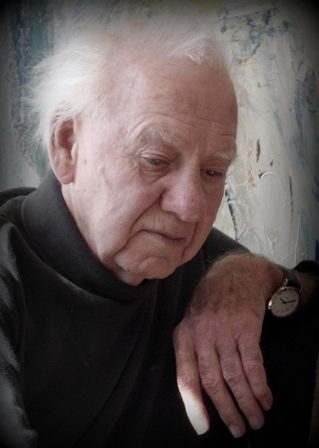
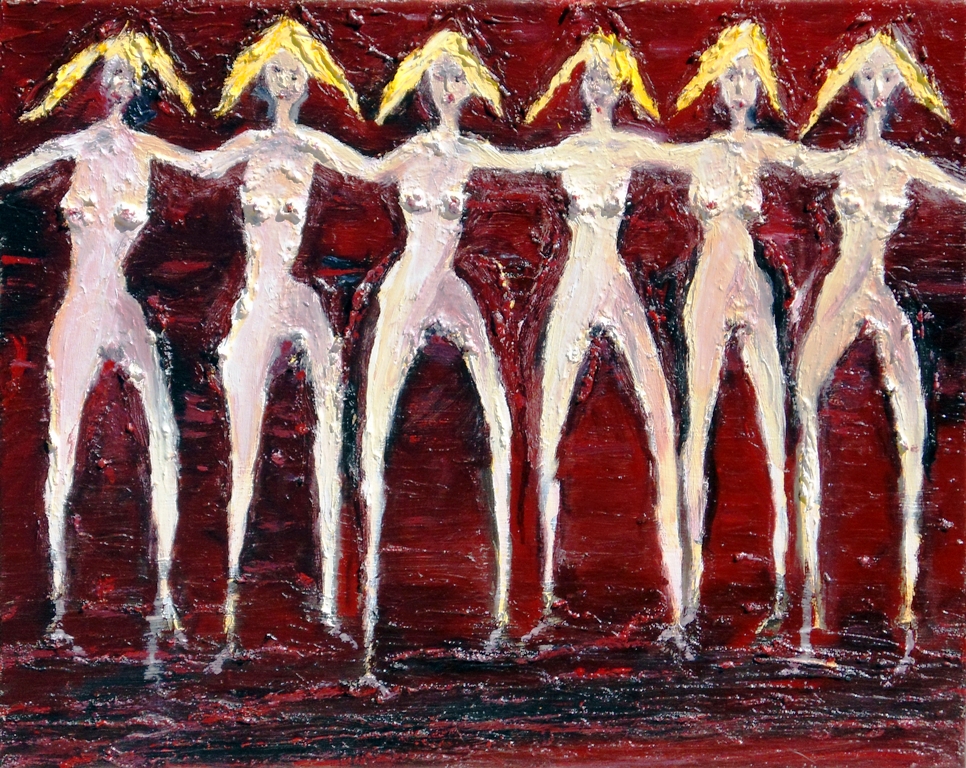 Beale Street Memphis, 2013 (oil on canvas, 16 x 20 in.)
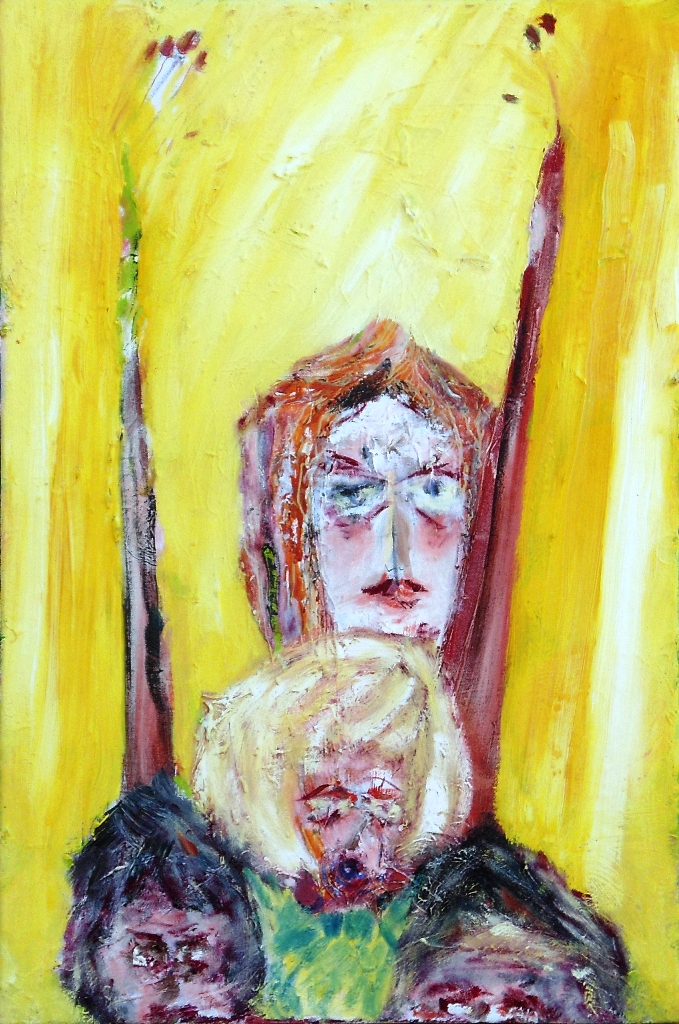 The Manicurist, 2012 (oil on canvas, 30 x 20 in.)
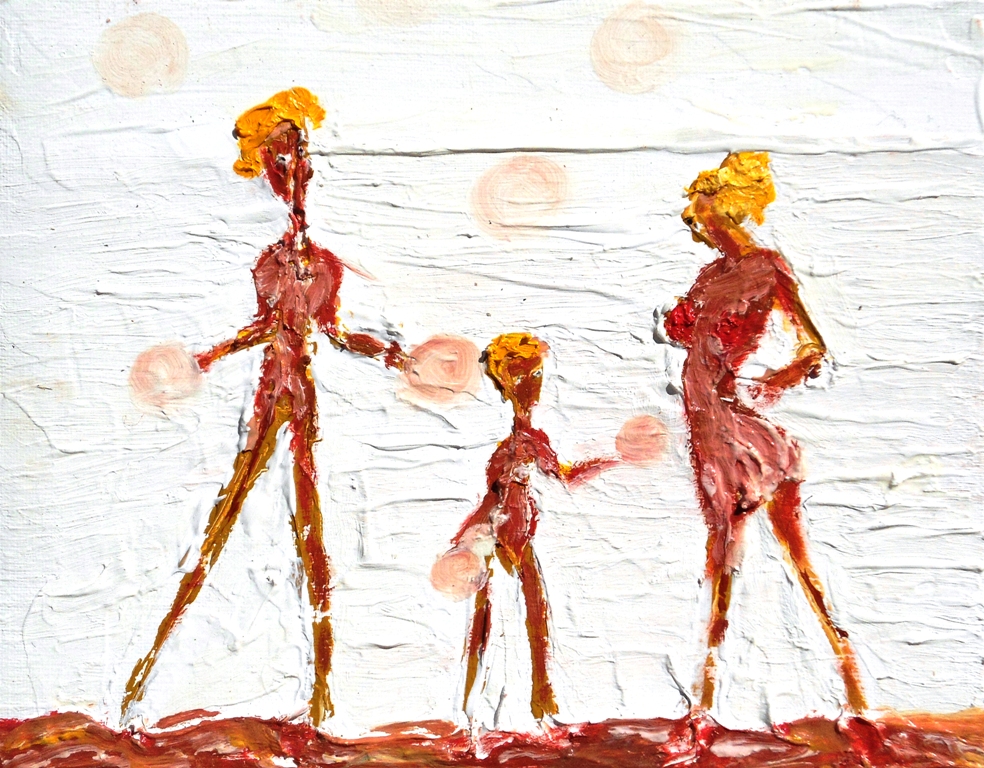 Beach Girls 1, 2013 (acrylic on canvas, 8 x 10 in.)
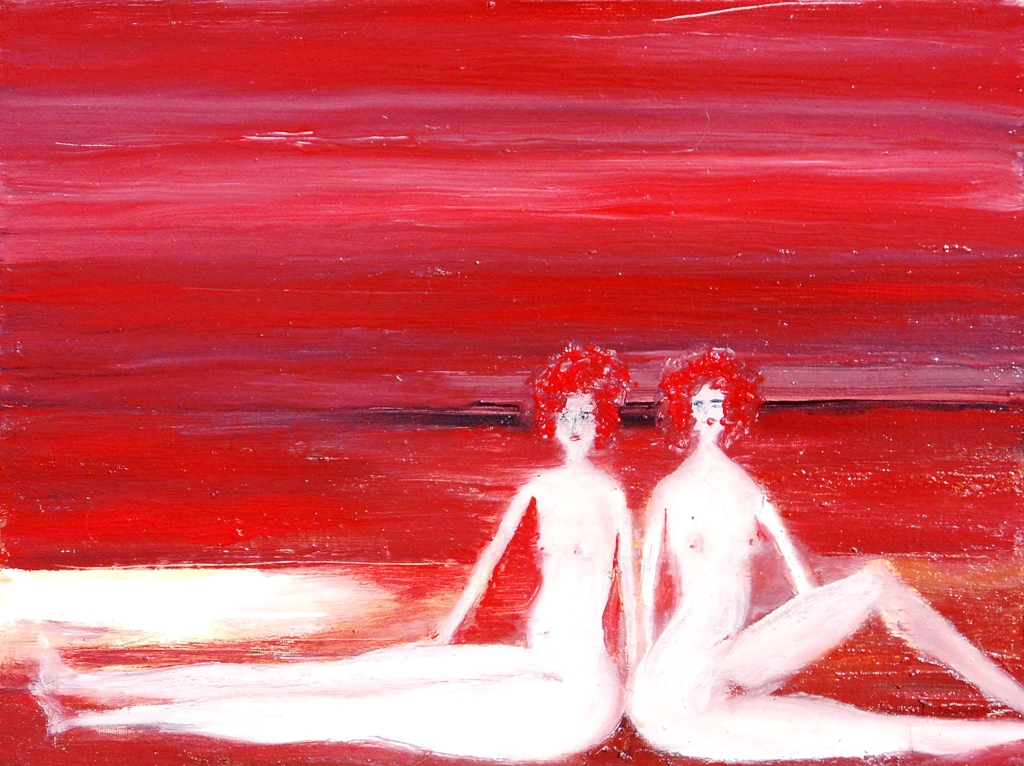 Sirens, 2013 (oil on canvas, 16 x 20 in.)
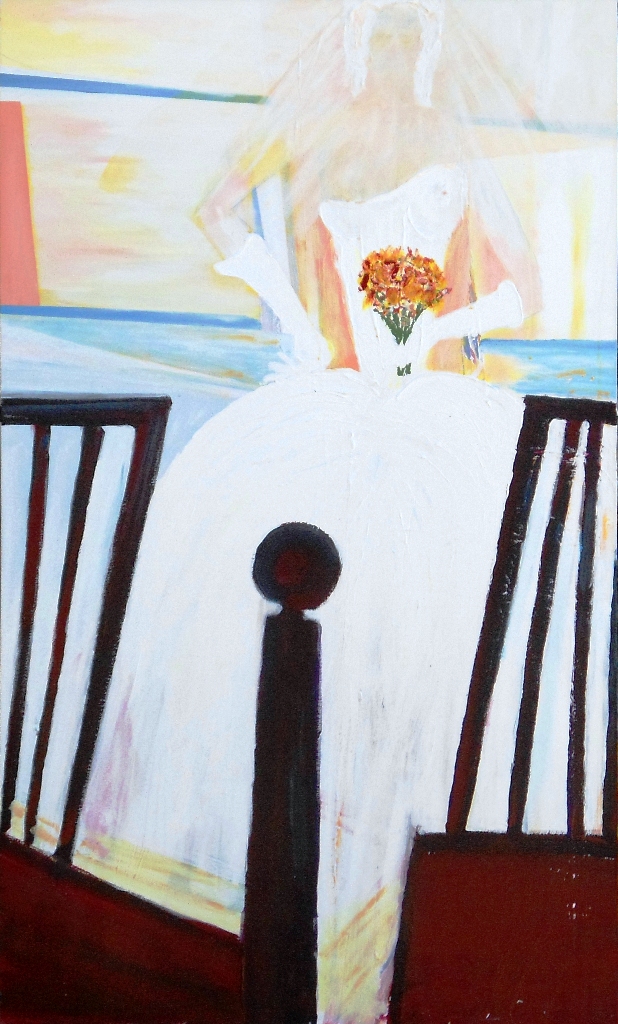 Brideshead Revisted, 2012 (acrylic on canvas, 60 x 36 in.)
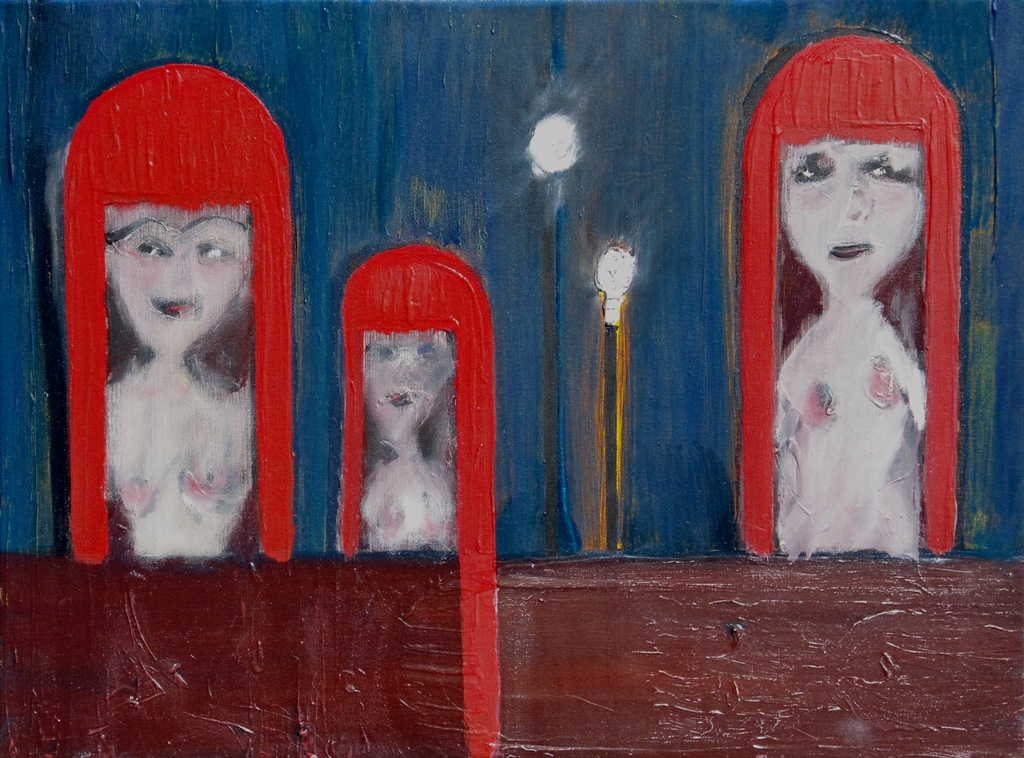 Red Hair District, 2013 (oil on canvas, 18 x 24 in.)
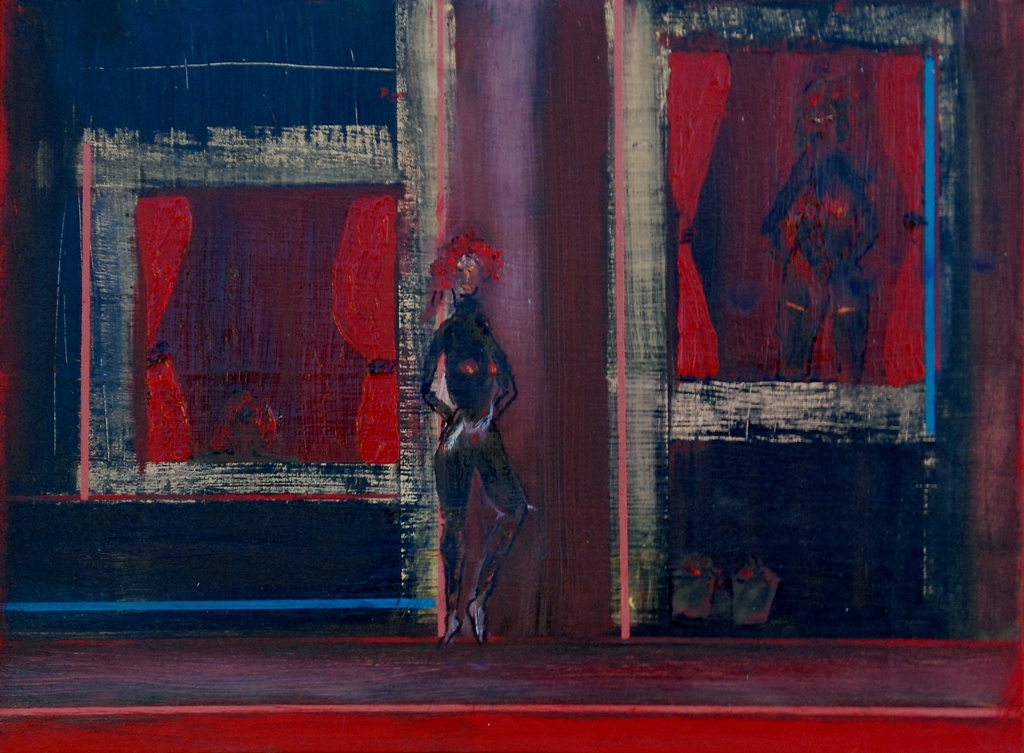 Untitled (Holland), 2013 (oil on canvas, 12 x 16 in.)
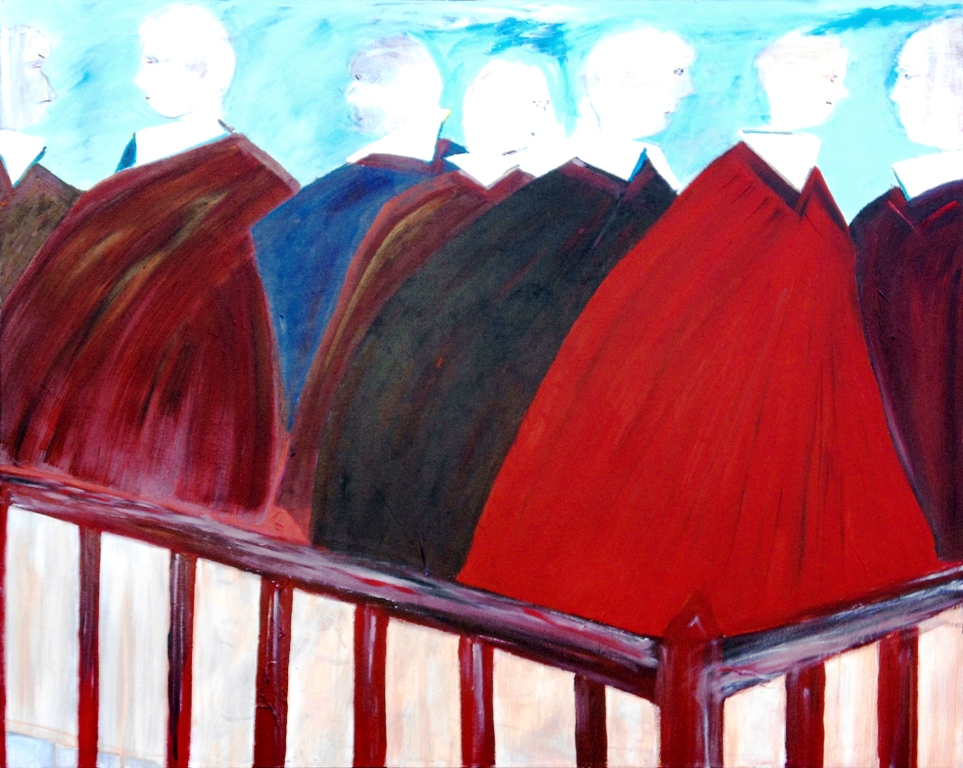 The Magistrate, 2013 (acrylic on canvas, 48 X 60 in.)