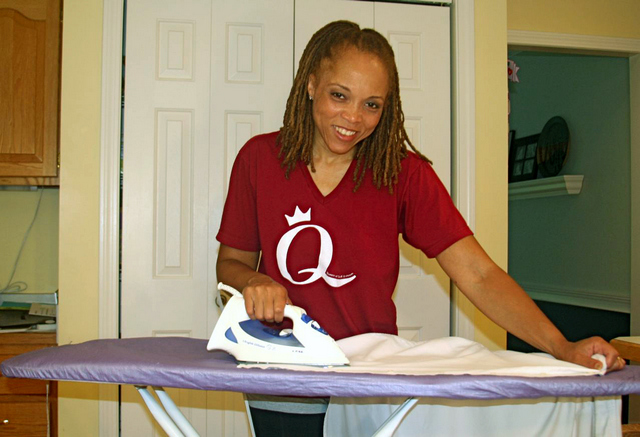
Sophfronia Scott has written a gorgeous yet uncategorizable memoir that is in part a tale of her brush with the celebrity Lena Horne. But that is only the instigation; their conversation lead both Horne and Scott to tears, to memories, to fathers and to white shirts and ironing boards. In capturing her memories of learning to iron and her father’s white shirts, Scott captures a moment in African-American cultural history that is poignant and complex as hell. Father-love, oppression, African-American male pride, daughter-love — all these and more.
Sophfronia Scott is a new friend, as it were, a second-semester student in the Vermont College of Fine Arts MFA program, also a published novelist with, already, a long career as a freelance and woman-of-letters.
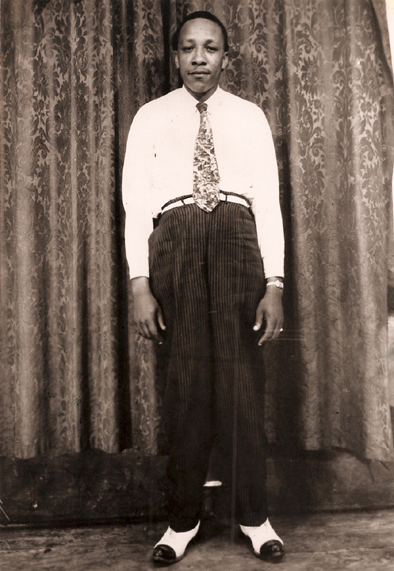
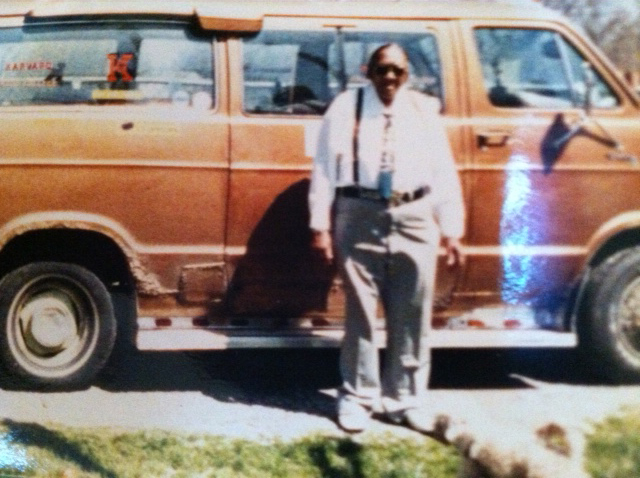
The two photos are of Scott’s father. One was taken in the 1940s, the other somewhere between 1988 and 1990. The author photo at the top is by Tain Gregory, Sophfronia’s son, age eight.
dg
—–
When my friend Jenny answered her cell phone that day she had said, “I’m walking with Jake and Ella and Grandma in Central Park. We’re only a few blocks away, come join us.” Jake was Jenny’s pre-school age son, Ella was her dog and Grandma? Well, Grandma was Lena Horne—singer, actress, icon. I said okay, hung up the phone and kept walking but I was pretty sure I’d left part of my brain back on the corner of East 68th and Fifth Avenue. At that point Jenny and I had been friends, dear friends, for close to two years but I’d never met the legendary Lena. Her public appearances, even at family functions, were few. Our mutual friends spoke of her with hushed awe, wondering if they would ever get the opportunity being presented to me then. They talked about the possibilities of being tongue-tied, not knowing what to say, of coming off as being less than fully charged in the mental department. As I walked toward the park I took on all their anxieties, just assuming they were my own. I felt like the suede jacket I broke out each fall suddenly looked shabby, and the scuff marks on my boots were rising up all white and too obvious.
I found them, stroller, dog, women, taking up most of a footpath near the East 70s. Jenny introduced me and when Lena said my name “Fronie-Fronie,” as I’m known in their family, the fear inside me melted. I recognized the lilt of her voice, but not from her recordings or her movies. She sounded like someone I loved. I heard the tones of my father’s sisters as I heard them in my childhood: slow and elegant and beautiful.
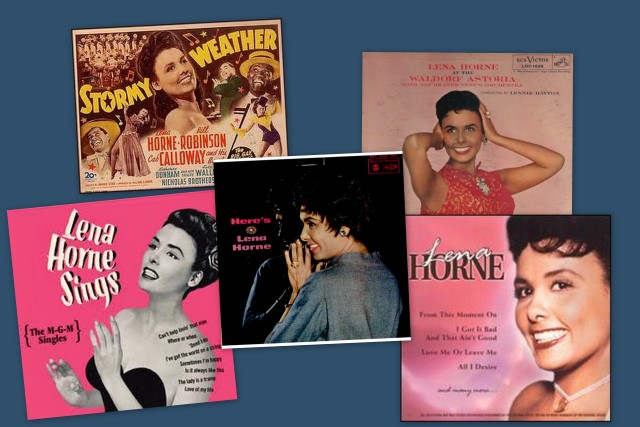
I don’t remember what she wore—unusual for me because at the time I was mad for fashion—but I remember the glow of her skin, the way her chin tilted up to examine my face. Maybe she marveled over my freckles or the reddish brown shade of my dreadlocks. From the intensity of her gaze, though, I gathered she seemed to be searching not for prettiness but for content. She wanted, I think, to see what was in my brown eyes. I remember bearing her weight as she took my arm and we walked while Jenny pushed Jake in the stroller and supervised the leashed but ever-roaming Ella.
I like to believe she spoke to me as she did then because she had soon realized I was not like her granddaughter’s other friends, urban and modern and lovely, but for her out of reach in terms of connections and references. Lena was born in 1917. My father, by then deceased, had come into the world in 1919 so I had grown up with her language, with her references. Talking to her was not that different from talking to my own father in our living room as he used to sit in his recliner. In fact Lena asked me about “my people” and I told her about my father coming from Mississippi and my mother’s family from Tennessee, and how they merged in Ohio but raised me and my siblings as though no one had ever left either of those southern spaces, right down to my father’s whippings and demeaning words that stung even more than the physical strikes. My sisters and I were taught to cook and clean and iron as if they were the only endeavors that could ensure our survival as women. By the time I was 18 and leaving for college I was so angry I vowed never to return. I didn’t tell Lena that part.
That’s how the ironing talk started. She seemed intrigued that I had learned so young and surprised that I still did it. My husband was, and is, terrible with an iron and it never occurred to me to send the shirts out to be laundered and pressed as every male in New York City, even those who couldn’t afford it, probably did. Lena, I learned, had married young, just 19, and to a man who, much like my father, insisted on his wife producing ironed shirts, fresh biscuits, and perfect needlework, but she had been taught none of it. It had been important to her to try, I could see that as a little frown creased Lena’s brow. Her own father had been absent most of her childhood and she seemed to have wanted the chance to show this kind of diligence for a man she loved. For a moment Lena released my arm and her pale hands, at waist level, swept through the air in front of her. “I used to weep over that man’s shirts,” she said. I nodded and we stood there together at an imaginary ironing board. The yellow leaves over our heads and under our feet provided the light for our work on that overcast day. “And they were all white shirts, right?” I asked. I remembered my father’s own white shirts as I heard Lena answer, “Yes.” We stood there, the shirt large and voluminous in Lena’s small hands, the white cotton hopelessly scorched.
Lena had squeezed my heart and I wanted to cry because I could feel how much she had loved her husband, how much she must have tried. I knew what it was to have such obvious proof of failure. I too had burned my father’s shirt (and coffee and biscuits and collard greens). But I had been able to make adjustments—so many adjustments—until I had eventually mastered most domestic tasks and could present my father with perfect shirts and perfect biscuits. It never occurred to me what it would have been like never to be able to do it, to never be able to show love in this way. Of course I wouldn’t have said that when I was ironing my father’s shirts. But I remembered the complete sense of pleasure and satisfaction when my father pulled on a shirt without making a critical remark. Maybe I even felt proud of the way he had looked. I wanted to tell Lena right then how to iron that shirt. Years later it still seemed to matter, and I felt Lena would have listened, that she still wanted to know like it was the answer to an essential, but long-elusive riddle.
To this day I have never read any proper instruction for how to iron a shirt. I suppose if I Googled “how to iron a shirt” I would find enough information, with video included, to bring me to the level of the ironing elite. But I feel what I learned from my mother’s hands is old magic—I don’t want to meddle with it.
I can tell you I start with the collar, unbuttoning it if it’s that kind, and laying it as flat as I can on the ironing board. I press it end to end. Ironing the small parts of a shirt is when you’re most likely to get burned. You have to hold the part close to the iron while you press and your fingers are simply in harm’s way. A burn rises quickly, a living red capsule on the surface of your skin. You think it will never heal because that’s how much it hurts when it happens. Ice is better than butter, I’ll tell you that now. Butter and burns is an old wives tale.
Working with steam is a blessing. I didn’t have a steam iron when I was a kid and my arms often ached with the effort of exerting the right pressure to smooth out the fabric. Ironing is so much faster now with steam. (When I got older my father bought us a Press-O-Matic, a smaller version of the huge rectangular ironing machines you see at the dry cleaners, but that’s another story and a different set of burns.) Next I pick up the shirt and lay it on one side of the front with the buttons face down and running horizontally in front of me. I iron that, then the sleeve on that same side. Sleeves are tricky because of their roundness. They don’t lie flat well so I will usually iron a sleeve and turn it over to find a funky crease I didn’t mean to create running like a new slash down the arm. Once I fix that I move to the other side and the other sleeve. Then I lay the back of the shirt out with the neck area fitted as much as possible over the narrow end of the ironing board. I press the back and all the little nooks of the back of the neck. I run the nose of the iron around inside the cuffs and then I’m done.
It takes a lot of love to iron a shirt you will never wear. When I see a man wearing a meticulous shirt I wonder who loves him, who has taken the trouble. Or did he have to send the shirt out because no one does?
Thinking about my father now I tend to focus more on the love and less on the anger. In many ways I have forgiven him. Such forgiveness is possible, I believe, not because he is long dead, but because of these unexpected moments of grace reaching across generations reminding me of this: the reason I hurt so much then was because I cared so much then—and still do. As I look back on that autumn afternoon and how Lena took my arm again as we continued our stroll through Central Park, I can see how in that moment I was in my 30s, Lena was in her 80s, but we were both girls ironing the shirts of the first men we ever cared for, and hoping they could feel our love pressed hard into every crease.
—Sophfronia Scott
—————————————-
When Sophfronia Scott published her first novel, All I Need To Get By, with St. Martin’s Press in 2004, one prominent reviewer referred to her as potentially “one of the best writers of her generation.” Her work has appeared in Time, People, More, Chicken Soup for the African American Woman’s Soul, NewYorkTimes.com and O, The Oprah Magazine. Sophfronia is currently a masters candidate in fiction at the Vermont College of Fine Arts. Her short story, “The Night Viera Kissed Her,” will be in the Fall 2012 issue of Sleetmagazine.com. She blogs at www.Sophfronia.com.