Nov 082016
 

I have praise to offer that you can trust if you are looking for something good to read that spins your head in spare American prose that cannot be safely stashed in any genre. —Lawrence Sutin

.

My Private Property
Mary Ruefle
Wave Books, 2016
128 pages, $25.00

.
As I am a friend of Mary Ruefle, I will not pretend to be an objective reviewer, if there is such a thing. But as I loved her writing before I ever knew her, I am no mere shill. I have praise to offer that you can trust if you are looking for something good to read that spins your head in spare American prose that cannot be safely stashed in any genre. Ruefle kneads imagination and thought together into a delicate yet chewy dough that rises into brilliant little lyric rolls and pastries. The kicker is that, after eating your fill with delight, you may find yourself unsettled. Nothing you think makes sense any more because Ruefle’s language has untamed your mind.

In the two longest pieces in the book, “Pause” and the eponymous “My Private Property,” Ruefle makes use of diametrically different forms. “Pause” is made up of multiple short sections that are sometimes only a single sentence. “My Private Property” is one long paragraph that goes on for fifteen pages. “Pause” is about menopause of which Ruefle writes in bile-filled warnings as one who has moved on to “happy old age” with its “grace and gentle words, and ways that grim youth has never known.” The essay thus encompasses the lifespan of woman, as viewed by Ruefle, with menopause serving as the liminal passage out of the past of human ties, procreative ties, that have inhibited one’s creative evolution—“there are no longer any persons on earth who can stop you from being yourself.” “My Private Property” is about shrunken heads in all senses, not only the fearful physical shrinkings but also the bejeweled, bedaubed and photographed miniatures favored by every human culture as a form of remembrance. Ruefle takes in colonialism at its worst, the sketchy consolations of her own psyche, and the tenderness of loss and death. Having seen the Congo Museum in Brussels as a teenaged student abroad, she recounts in vividly accurate prose the shock of waking up, as an adult, to the history behind the museum’s sanctimonious cultural acquisitions—“wealth acquired by force of so filthy an unspeakable an evil our heads cannot fathom it and have no single word for it, but must resort to endless corridors of words, each corridor turning into another corridor a thousand miles longer than the last in our hopeless search for some inner chamber of understanding that does not exist.”

The inadequacies, the pliabilities, the mutabilities of language are frequent points of exploration for Ruefle, who well knows the roles of both writer and reader in language games. In “Lullaby,” Ruefle sketches in a Daoistic manner the pleasures of succumbing to somnolence, an oft-overlooked effect of artistic receptivity, be it to music, the visual arts, or writing. The examples Ruefle employs are the classical composer Brahms (his Lullabies), the Swiss sculptor Giacometti (his supple elongated figures) and—the surprise choice—the American writer Henry Miller. Ruefle’s portrayal of her hypnagogic psyche taking in Miller is a model of how, languidly and hilariously, to disarm a male language harangue without disturbing one’s composure: “I often fall asleep while reading him. When he uses that hard word cunt again and again, it finally becomes something soft, so very soft, which is startling because a cunt really is soft, it’s a warm, soft, wet-while-young place, a spot really, given the size of the universe, the way a star is a spot, but there are so many of them—I mean cunts—who can keep track?”

Scattered throughout the book (untitled on the pages themselves, though single-word color labels—Blue; Purple; Black; and so forth—are given in the table of contents) are a sequence of eleven short takes on sadness keyed by color—the other shades being gray, red, green, pink, orange, yellow, white, brown. These allow Ruefle to display her gift for imagistic writing as emotionally compelling as Expressionist paintings. Ruefle does not stray into psychological judgments of the natures of her sadnesses. By using precise details that are not strictly tied to color scheme (so as to avoid becoming too matchy-matchy), she rivets the reader by revealing the prismatic secrets of her sadness spectrum. Take, for example, green sadness, which is, among other moments in Ruefle’s imagination, “the funeral silence of bones beneath the green carpet of evenly cut grass upon which the bride and groom walk in joy.” Because vivid, specific details inherently (given the nature of human consciousness) contain multiple emotional valences, Ruefle’s pieces take on a trans quality. Ruefle’s note at the back of the book is astonishingly accurate: “In each of the color pieces, if you substitute the word happiness for the word sadness, nothing changes.”

To be fair, something does change. With the substitution, each piece remains subtle, vivid, and true. But the reader discovers that happiness and sadness happen in the same colors, which we can paint howsoever our minds allow. My one complaint about the design of the book is that I think the color-sadness pieces should have been given a sequential section of their own so as to foster their cumulative impact, rather than be scattered here and there between other writings.

My single favorite piece in My Private Property is a short work entitled “The Sublime.” In it Ruefle employs a trick often employed by poets though relatively seldom by prose writers. One chooses a title that serves, as it were, as the answer to the riddle of the ‘secret’ meaning of the piece. In this case, Ruefle describes a literally hair-raising drive over hair-pin mountain roads. The closing line: “Could see from the corner of my eye that there was an incredible view, but couldn’t look.” Again, as in the color-sadness pieces, Ruefle allows us to see that first-rate writing reveals more than we can possibly expect, which is why we read.

—Lawrence Sutin

N5

Larry Sutin

Lawrence Sutin is the author of a novel, When to Go Into the Water (Sarabande 2009), two memoirs, A Postcard Memoir (Graywolf 2000) and Jack and Rochelle: A Holocaust Story of Love and Resistance (Graywolf), two biographies–of Philip K. Dick and Aleister Crowley, and a historical work on the coming of Buddhism to the West. In addition, his erasure books can be seen at Lawrencesutin.com. In 2014, he and his wife Mab Nulty founded See Double Press, devoted to unique interfusions of text and image.  Its first two titles are Mary Ruefle’s An Incarnation of the Now and his own The Seeming Unreality of Entomology.  An essay written and illustrated by Lia Purpura is coming out in Fall 2016.  For more, check out seedouble.press. Sutin teaches in the creative writing programs of Hamline University and the Vermont College of Fine Arts.

.
.
Feb 082015
 

Lawrence Sutin

.

I hate this question because it admits of many answers that each have some sense, if not certainty, to offer.

There are persons who feel that it’s morbid to think about it, a hindrance to engagement with life. There are persons who feel the exact opposite—there always are, on any question, and we as a species could do better at seeing this as a sign of hope rather than a signal for war—and pointedly face their fear of mortality, become devoted to risky behaviors from climbing mountains to snorting coke because you’re going to die anyway, deal with it by using the fear for what it’s good for, fuel. There are persons who have had their dearly loved ones die and their answer is that there’s no hope of their ever thinking about anything else. Others see death as cosmic drama—the gateway to eternal salvation, damnation or reincarnation. Others look forward to death because they’re convinced it’s lights- out oblivion, a blissful rest from life. Still others say that we’re all dead already and just don’t know it, the afterlife is here and now and you can call it heaven, hell, the bardo, the liminal, the astral, the timeless dream in which the universe become us and us it. A sizable subgroup avoids thinking of their own deaths but relishes thinking of the deaths of those they hate.

All of these views are thoughts I’ve had, but none of them quite answer the question I’ve posed with its focus on when. No one would seriously hold that any person who has come of age could manage never to think about death, so we all would agree that we have to think about it sometimes. To what standard shall we set our mental clocks so that we might devote ourselves efficiently to the task? But what do I mean by efficient and what has it to do with when? I mean by efficient that sort of thinking—and I include feeling as a particularly wrenching sort of thinking—that enables us to live well with the knowledge of death. Now, as just what so enables us is intertwined with our time of life, we return to when as the crucial point. When? For how long and how often? And should it ever stop?

By seeing the complexity of the question I am trying to spare myself the problem of answering it. The complexity itself is the answer, I could say. As few of us know when we are going to die and those few—the terminal and the condemned—who do know are likely to think of death without wondering if they’ve found the proper time, that leaves the feckless majority of us not knowing or wishing to know when we will die and not knowing when we should start or stop thinking about it.

But I think that many of us think about it incessantly without knowing we do, if not unconsciously than implicitly, and always with a mind to how we should spend the time we have, a sack of coins that seems never to empty when we are not thinking of death. Joy and boredom both make time burgeon. So we choose certain jobs, certain loves, even certain sorrows, because given the time we have we naturally choose what we can’t escape.

I recently visited my daughter Sarah in Seattle, where she is living with her fiancé–they are both in their early twenties–and wondering where their lives might best lead. When she goes about her day she sometimes has to drive over Lake Union upon the venerable, girded and cantilevered Aurora Bridge—six tight lanes of two-way traffic with no central barriers to take the brunt if a driver happens to wander into the opposite flow.   One spacy swerve in any of the lanes of the Aurora Bridge—on which if you head south will lead you to the Pacific Highway and ultimately all the way to Mexico—when traffic is moderate or heavy which is every day and cars would crush each other one by one for hundreds of yards. I should add that, since its construction in 1932, it has been a favored site for suicides—over 230, second amongst U. S. bridges only to the Golden Gate in San Francisco.

But the old Aurora Bridge with its rattling compression can make you think about death even if you hope to stay alive. That’s the effect it has on my daughter Sarah, who would avoid the Aurora if she could, but given the algae-like spread of the Seattle streets the lost time she put into avoidance would haunt her as the silly cost of fearing to think about death. Sarah does not want to be driven by fear and so she drives the Aurora and does her time thinking.

I have gone along with her on this ride—it’s just the two of us—expressly to watch her and talk with her as she makes the crossing. She’s material to keep my hand moving over this page you now read. She has my brown curly hair only lots more of it. She also has my penchant for anxiety and I would not have wished that for her. I ask how this bridge-drive is impacting her and she says she has to concentrate on her driving to keep her nerves from setting her on fire.

Does she think there is life after death? She does not. What she wants when she is dying is to be able to say that there is nothing left to be done, her design projects completed, her loved ones protected. But she acknowledges the paradox that, were someone she loved dying, a solace to her would be if they would ask her to do something yet unfinished for them. That would take her out of missing them for the time it took to do it.

Suicide?   She doesn’t want to commit it. I breathe again. But in her young crowd the question of preferred method comes up now and then—it’s their way of thinking of death, I’m guessing, with the fantasy of control over their own demise without yet having undergone the agony that makes you yearn for an end—and she felt she needed to come up with an answer. Helium seemed to be easy as such things went. All the while Sarah’s face is serious, her espresso eyes fixed and galactic, the mask of a goddess of life and of death who has no choice but to dwell and rule in both realms.

How afraid are you of death? How often do you think of it when you’re not on this goddamned bridge? Finally I put these questions point-blank and she senses my fear along with hers. She says she tries not to think about it but she does, not a lot, but it never goes far away, she doesn’t think it does for most people.

We have crossed the Aurora Bridge and I am now far more unsettled than Sarah because, at my bidding, my daughter has talked about death to me and I feel I have spurred her to show fear that I wanted to see for the tawdry sake of answering the question of when. But I don’t want Sarah to have any fear of death, none. I want her to be free from every mental crevasse I have fallen into, death’s certainty being an especially deep one. I also don’t want to lie to her when she reads this by hiding the fact that I often imagine happily a future world in which she is vibrant and I am gone. I meditate to accept impermanence but I pray that Sarah’s death will come after I’m gone. I would love it if we could see each other in the afterdeath realm or reincarnate as puppies in the same litter, but I suspect what will ensue is a chain of genetics that will dance through descendants as it has through us. And all of them will think about death and none of them solely when they chose.

So the answer to when might as well be never once you’ve thought about it hard. How else to avoid crossing lanes by recalling we’re tiny sacs of life knocking about without and within, a car or a heart valve could veer and kill us. Our souls would have no idea if they were staying or going as death happened, they would have expected us to have thought about that but we haven’t, not clearly, nothing we have ever thought about seems to answer to this death we will find ourselves dying when there is still a great deal to do and our loved ones need us, loved ones always do. Think of them and not death while you can.

—Lawrence Sutin

.
Lawrence Sutin is the author of a novel, When to Go Into the Water (Sarabande 2009), two memoirs, A Postcard Memoir (Graywolf 2000) and Jack and Rochelle: A Holocaust Story of Love and Resistance (Graywolf), two biographies–of Philip K. Dick and Aleister Crowley, and a historical work on the coming of Buddhism to the West.  In addition, his erasure books can be seen at Lawrencesutin.com.  He teaches in the creative writing programs of Hamline University and the Vermont College of Fine Arts.

.
.

Sep 112013
 

OLYMPUS DIGITAL CAMERA

Today we have Lawrence Sutin’s gorgeous and thoughtful essay on Vladimír Godár courtesy of Taylor Davis-Van Atta, founder and publisher of the new & brilliantly conceived print magazine Music & Literature. The third issue, just out, concentrates on the work of Gerald Murnane, Vladimír Godár and Iva Bittová. Godár is, of course, a sentimental favourite here because of his astonishing “Sonata in Memory of Viktor Shklovsky,” Shklovsky being in many respects the spirit of place at Numéro Cinq. In an earlier piece at NC, I wrote: Theoretically Shklovsky is the inspiration behind much of what we try to do here at NC, art as device, art as content filtered through a mesh or organization or system of techniques. This sonata is lovely and tortured. It brings to mind that wonderful phrase in Joyce’s “The Dead” — “thought-tormented music.” Read the essay, then look up the magazine.

dg

What does Vladimír Godár’s music sound like? The candidates for comparison that I’ve seen mentioned range from Claudio Monteverdi to Arvo Pärt. I could add further names—Igor Stravinsky, Valentin Silvestrov—but the comparisons hardly matter. The music of Godár sounds, to me, like the music of a time in which religious ritual has died and what was prayer is now dramatic exclamation, what was faith is now the enthrallment of beauty. The old ritual forms are often invoked by Godár, for those forms still hold music well, but Godár’s music is a renunciation of piety and a restoration, a worship, of the anguish needed to awaken our souls.

So Godár’s music sounds to me, at its happiest, even, with hallelujahs faint as angels comforting a child, like anguish. Anguish, like piety, requires form for full expression so as to be released, fulfilled within the ear of the listener, set free to circuit the mind and body, wordlessly to instill the balm of Solomon’s magic ring inscribed “This too shall pass,” a profound mindfulness, everything passes, but caught within poignant melodies and intense rhythms the anguish passes in its guise of the exquisite beauty of necessity.

That is the theme, I think, of Gilgamesh’s Lament for bass and cello. In his album liner notes, Godár tells us that he “came to the conviction that it was vital to work with the original text.” As that text is in Akkadian, Godár enlisted the aid of a scholar of ancient Semitic languages to create a phonetic version to be sung. Why not instead employ a Slovakian translation? Why deprive his native audience of its native tongue? The answer seems to me to be that Godár hoped for the exact tonalities that Gilgamesh might have let loose over the corpse of his dearest friend Enkidu, a primal man, for the sake of whose companionship Gilgamesh, the warrior-king of Uruk, forsook marriage. To feature these tonalities is to call back to the past as far as one can musically.

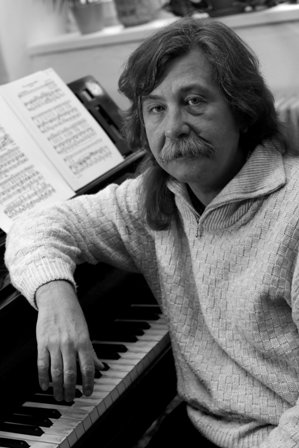
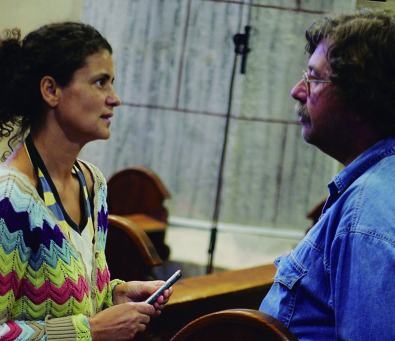
Iva Bittová (left) and Vladimír Godár (right) are both featured artists in the latest issue of Music & Literature 3.

Godár observes that he finds what is commonly titled The Epic of Gilgamesh “more theatrical than epical,” due to the prevalence in it of direct speech. The direct speech of Gilgamesh is directed at a god, is a plea, a loud private prayer. In Godár’s setting it becomes a chamber lament played in low darkness with no one to hear but the audience hidden both from the musicians and the god. The solace in the lament is that anguish is ancient and always in essence the same. Gilgamesh must submit to the fact that death awaits not only the friends of great kings but great kings themselves. Yet he did not consent to place Enkidu’s body in the grave until, after seven days of grieving, he saw a maggot crawl out of his friend’s nostril. And his speech is more tantrum than submission. Godár’s music does not seek to convey the tantrum of the text, for that is the business of the text. The music captures the slow cadences of anguish. In this, Godár, who lectures on the history of aesthetics, follows (as I see it) the indications of Gotthold Ephraim Lessing’s Laocoon: An Essay on the Limits of Painting and Poetry, in which Lessing argues that the visual arts (and, I would say, music as well) must capture anguish by means of beauty and not by slavish adherence to human reality, which means that, in the famous statue of Laocoon, the seer of Troy, and his two sons wrapped about by thick poisonous serpents sent by Athena to protect the secret of the wooden horse of which Laocoon was warning, all three must possess noble stoic features (even though, as they are naked, the visceral anguish is conveyed by their constricted muscles) rather than contorted howling faces which would have ruined the effect intended—the catharsis of seeing appealing, rather than hideous, persons die. In like manner, Godár did not wish to scream out Akkadian as that would have negated the echo that his call to the past had elicited—Gilgamesh even in anguish would not have shrieked at the god, for the god, Enlil, a god of storm and violence, was already angry at both Gilgamesh and dead Enkidu (it was Enlil who had issued the sentence of death) for their hubris in killing the monster Humbaba who guarded the cedar forest beloved of heaven. Further yelling would have done little good; Enlil had shown his intent and his power. So in Godár’s music the vocal tonalities ascend just a bit, enough to be heard on high, then fall to the earth from the weight of their pain and form stones of sound for Enkidu’s grave. In terms of the phonological insights of the Prague structuralists of the 1920s, admired by Godár, the jagged contrasts of the Akkadian phonemes are an onomatopoeia (like the barcarolle form, suggestive of a rocking boat, employed by Godár in a chamber work for violin) as unique as the brickwork of the fortified walls of Uruk, a wonder constructed by Gilgamesh’s order, a wonder that, as he says in the epic’s conclusion, will survive him.

Viktor Shklovsky

The Prague structuralists were influenced by the works of the Russian Formalist (St. Petersburg branch) Viktor Shklovsky. Godár’s Sonata in Memory of Viktor Shklovsky was originally inspired, the composer tells us, by the desire to create “the form of a structured rhetorical composition… This I did not manage to realize, but I think the vestiges of the original conception can still be discerned in the work’s final incarnation.” What Godár meant by this in terms of this sonata I have no idea, but the topic is a naturally playful one for me. Shklovsky is famous for his insistence that creative writing depends upon the knowing use of devices, skillful techniques, by the artist. To write a good story, one needs to understand how to structure it so that it takes the readers out of their worlds and into the text. That structure has nothing to do with the writer’s personal psychology or politics; it belongs to the realm of aesthetics, which Shklovsky aspired to make more empirical, modeled somewhat after scientific research. But the negation of politics as an artistic criterion—and the implicit affirmation of unfettered artistic freedom—had never been a popular view in Russia, not in the days of the Tsar, and not in the days of Stalin.

What I gather Godár means by a structuralist composition shows itself most clearly in a work such as Mater. A theme—woman, mother, the eternal feminine—serves to elicit his music. Godár makes his choice of devices—liturgical, literary, folkloric, a Magnificat, a James Joyce poem, Yiddish songs—from throughout time and without regard to their original cultural contexts. (Consider Godár’s Querela Pacis (“The Complaint of Peace”), dedicated to Erasmus, the author of an eponymous 1521 work, with quotations from that work set by Godár to the form of mantras.) The aesthetics of music survive with ease the present shift from the church into theater, the concert hall, films such as those for which Godár writes scores. It is the music, the tones, that are enduring, not the beliefs that they are regarded as serving at a particular place and time. The same will be true two thousand years from now. I look forward as far in time as The Epic of Gilgamesh is now distant from us, when samplings from Godár’s Mater bypass the ear to trigger direct neuronic signals to deep space travelers to enfold themselves with kindness through the long night.

GodarCD2

It would be a purist philosophical idealism to conceive for the universe a higher, truer ear beyond our realm. To this ear, music would always be only music. There would be no need for structuralism because the intertwining meanings that inform music as they do all phenomena become irrelevant in the higher truth realm in which the ear abides happily without a head, because all music is interrelated as the medium, sound, is one. No matter what one played for the ear, it would form a kind of infinite occasional oratorio, as best I can conceive it. But here on earth the choices of Godár are vibrant and welcome. But as a grateful, musically untutored listener to his works I cannot say, though I seem to have written about it, that Shklovsky’s devices or anyone’s structuralism much matter to me. His music moves slowly, intensely, yearning for the primal ground of Gilgamesh, the tonal grace of the psalmist David. The itinerary is to my liking, the notes take me to places Godár could not have had in mind. Music can be given forms, but listeners can slip free of those and escape with the notes out the window.

— Lawrence Sutin

————————-

Vladimír Godár is known as a composer of symphonic, chamber, vocal, and film music, and as a writer of a huge number of texts on music and art.

Lawrence Sutin is the author of two memoirs, two biographies, one historical work, and one novel. He teaches at Hamline University and the Vermont College of Fine Arts.

Music & Literature 3 brings to light the life’s work of three artists who have to date been denied—by geography, by language, and by politics—their rightful positions on the world stage. The Australian writer Gerald Murnane, a rumored Nobel Prize candidate, has been deemed “a genius on the level of Beckett” by Teju Cole, who opens this issue with a spirited exchange of long letters with the Aussie great. For the first time, Murnane’s entire catalog is introduced by top writers and critics, and we glimpse his three remarkable archives, which the author insists will remain unpublished until after his death. “The Interior of Gaaldine,” the infamous text that explains his fourteen-year absence from the world of fiction, rounds out more than 120 pages of new material on and by one of our finest yet little-known Anglophone writers. The issue’s second half is devoted to the Slovak composer Vladimír Godár and his unlikely collaborator, the Moravian violinist-singer Iva Bittová, who honed their crafts under the pall of the Communist regime and who only in recent years have begun cultivating worldwide audiences. Now, for the first time, Godár’s artistic writings as well as his manuscripts are available in English, alongside a portfolio of photographs and an oral history of Bittová’s career, as told by some of her closest collaborators and artistic partners. The issue is now available for purchase here.