“You should choose the finest day of the month and have yourself rowed far away across the lagoon….”
—Henry James, Italian Hours, 1909
.
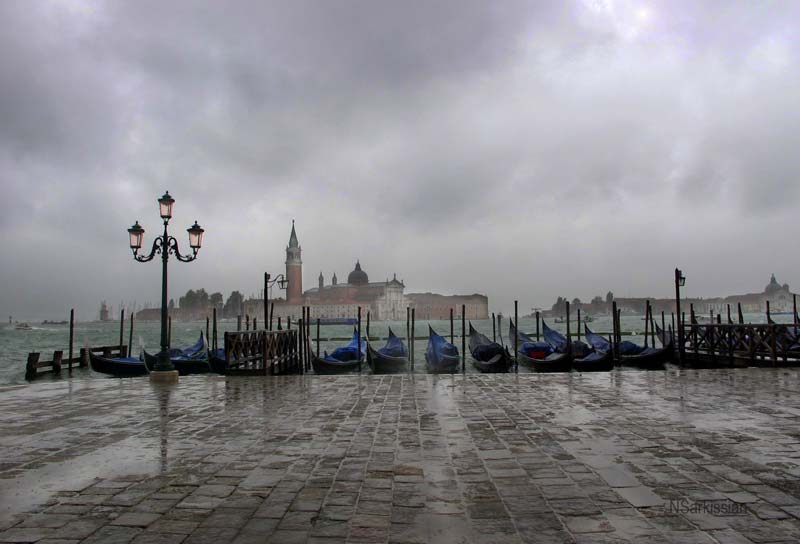
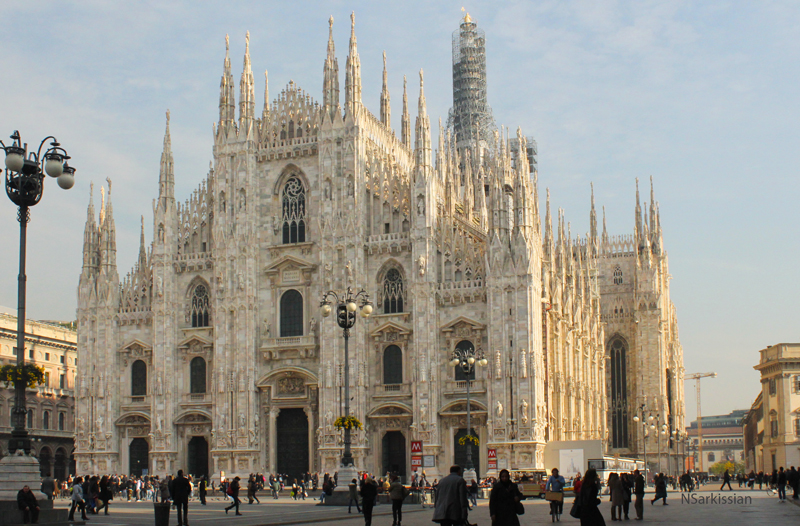
It’s five a.m. in Milan and my alarm rings. Outside I hear rain beating on my windows. I mute the clock and sling a leg out of bed. I’m going to Venice on the 6:30 train even though the entire Italian peninsula sloshes like an overflowing bathtub.
I stumble for the shower—some hot water to wake me up. And then for the espresso maker. Soon I’m ready and out the door. Dark clouds spit raindrops like shrill warnings. The wind upends my umbrella.
On the train, map open, I review my Venetian attack. So many have been to Venice, photographed Venice, written about Venice—from Michel de Montaigne to Byron and Dickens and Browning and Ruskin and Henry James and Mark Twain and Hemingway (and many in between and afterward) and I’m following in their footsteps.
.
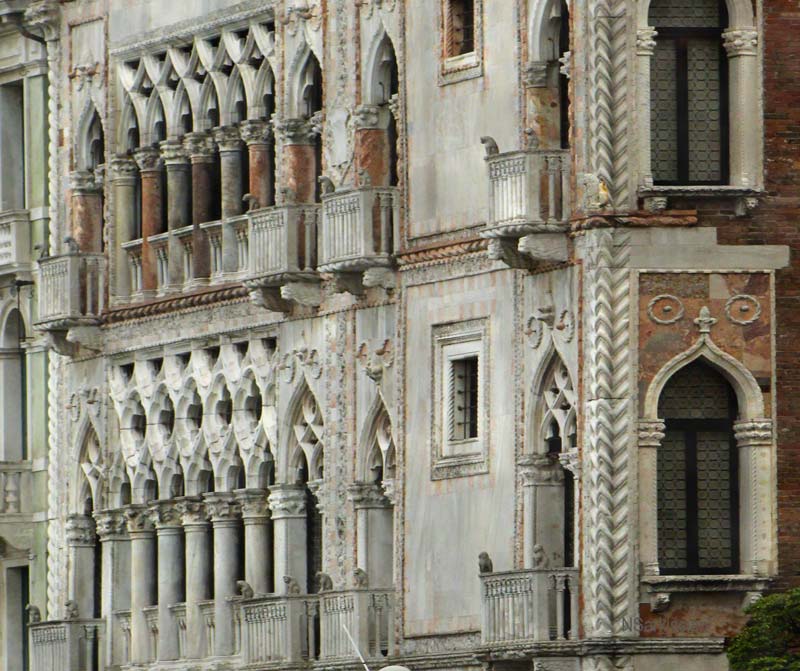
Cà d’Oro — “A noble pile of very quaint Gothic, once superb in general effect.”
—John Ruskin, Stones of Venice.
.
- .
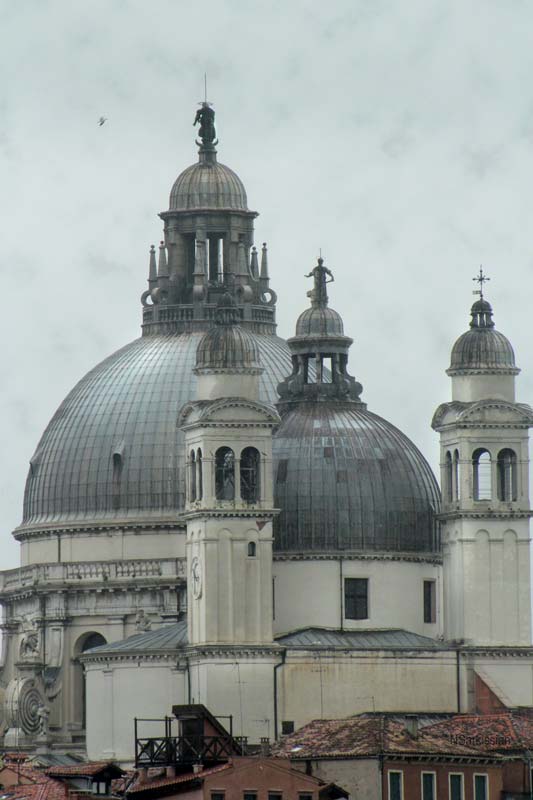
Santa Maria della Salute — “…the grace of the whole building being chiefly dependent on the inequality of size in its cupolas, and pretty grouping of the two campaniles behind them….”
—John Ruskin, Stones of Venice.
.
Today I’m on the trail of Henry James and John Ruskin. Both men loved Venice and visited it often. Ruskin documented his passion for the city in several tomes, most notably the Stones of Venice, a three-volume best-seller when it was published mid-century (1851-1853). In the later part of the 19th century, James wrote a series of essays for journals about his stays in Venice (as well as other Italian cities) which were compiled into the 1909 Italian Hours.
I plan to take pictures of the palaces and churches and squares both men loved as well as those they abhorred, and accompany the photos with their words. I locate the Cà d’Oro, a palazzo Ruskin liked, and circle it on the map for easy reference later. I find Santa Maria Formosa, a church whose architectural flights disgusted him, and circle that too. And I star the location of the Ducal Palace, a building both men loved. I plan to chug along the Grand Canal in a vaporetto, not an elegant vessel, but serviceable and cheap when compared to the eternally classic gondola. From a perch in the prow I’ll take photos. I’ll have more than ten hours; I arrive in Venice at 9:30 am and my return won’t be until 7:50 pm. With so much time at my disposal I’ll be sure to get my shots right. And while I’m shooting, I’ll spend a marvelous day like others I’ve spent in the city. I’ll revel in the light, the merging of sea and sky, the shining domes, the golden lions glinting from columns, from lintels, from façades.
Although. From the sound of the reverb on the roof of the train—fortissimo like Ligeti’s The Devil’s Staircase—the rain doesn’t seem to be abating. And we’re in Padua with just one more stop to Venice. But I won’t worry yet. A lot can happen in a few kilometers. And no doubt the rain won’t hold too long in Venice. After all, this is the city that James said was mutable “like a nervous woman whom you know only when you know all aspects of her beauty. She has high spirits or low, she is pale or red, grey or pink, cold or warm, fresh or wan….” [Italian Hours.] So if flighty, changeable Venice starts out wet, she’ll soon turn dry. Right?
Just as I’m quitting the train station the storm worsens. I fling myself onto a vaporetto for cover without paying attention to which one. And so, instead of threading through the Grand Canal that snakes through the city’s protective embankments like I planned, the boat I’m on veers wide, toward the wind-tossed sea. Waves soon blast over the bow. Water drums in at a slant. My hair is soaking but at least my camera’s (relatively) dry; I thought to wrap it in a plastic shopping bag before leaving the train.
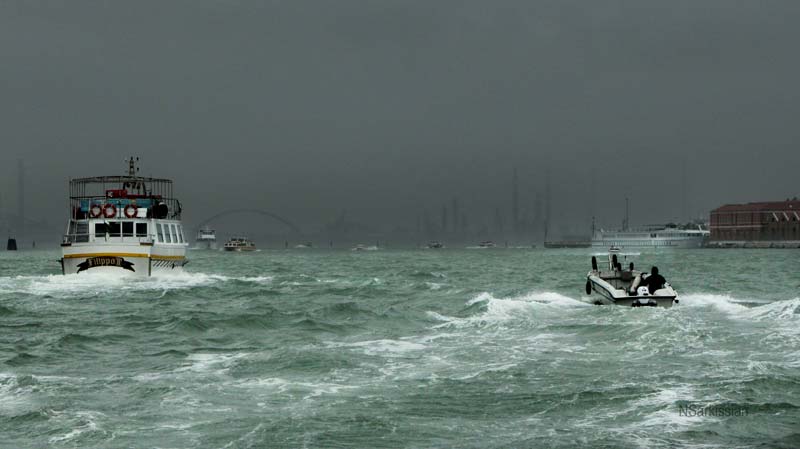
Like an ungainly walrus, the boat plows onward through the swell, past the fish market, some cranes, a garbage vessel. It carves a leftward swathe in the green sea near smokestacks, circles the city’s outskirts and finally, approaches those genteel structures that have entranced visitors for centuries. I spot the onion-shaped outlines of St. Mark’s five domes, off in the soggy distance. No inimitable views in my viewfinder quite yet, but as soon as I’m in the vicinity I’ll nab some. That is, rain permitting. Right now it’s lashing those of us foolhardy enough to stand in the prow. I see that droplets now splotch my lens; I need to clean it, pronto, but have nothing dry at hand.
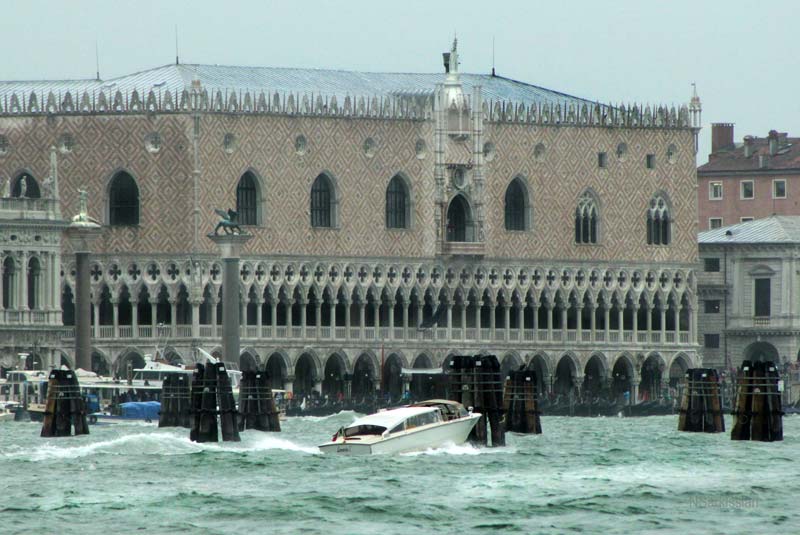
.
The Ducal Palace — “the central building of the world….”
— John Ruskin, Stones of Venice
.
The boat rounds the Isola della Giudecca. St. Mark’s Basin churns with waves and whizzing motor boats. There I spot the mouth of the Grand Canal, gaping like a toothy eel. There’s Santa Maria della Salute with her stately steps, a large white pearl gleaming in the mist. And San Giorgio Maggiore with its Palladian façade and soaring campanile, a gushing brick and marble proclamation. And on the opposite shore, the Ducal Palace, Ruskin’s model of all perfection in architecture, “the central building of the world.” [Ruskin, Stones of Venice] But I’m not immortalizing anything with my camera yet. I’ve got the water-splotched lens twisted off and, in spite of the downpour, am switching it for one that’s clean.
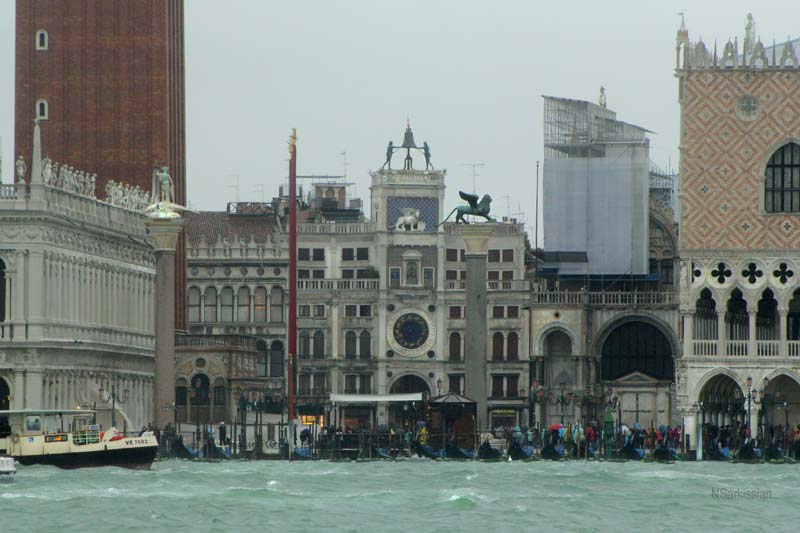
.
View of the Piazzetta — “We pass into the Piazzetta to look down the great throat, as it were, of Venice …”
—Henry James, The Grand Canal
.
When the boat stops at San Zaccaria, not far from St. Mark’s, I hop off and flick my umbrella open. I navigate slick alleys to the Campo Bandiera e Moro where I find the Palazzo Badoer, “a magnificent example of 14th century Gothic, circa 1310-1320, anterior to the Ducal Palace showing beautiful ranges of the fifth-order window….” [Ruskin, Stones of Venice].

.
A magnificent example of 14th-century Gothic….
—John Ruskin, Stones of Venice.
.
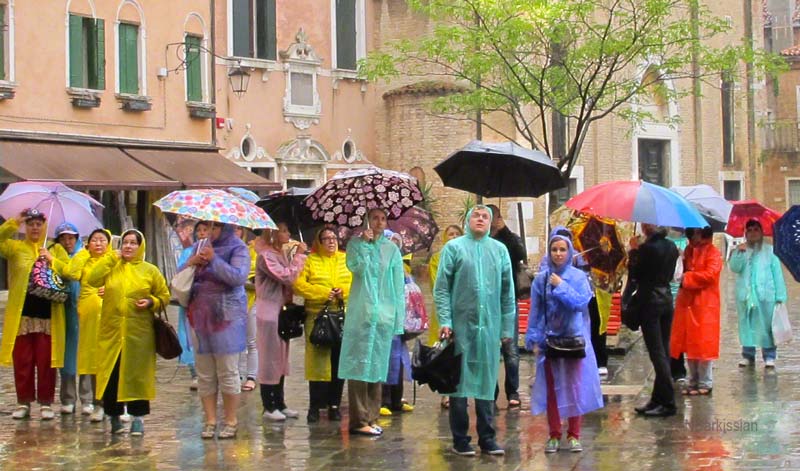
But a tour group stands between me and my picture. Like me, they were caught ill-prepared for the weather and have bought bright raincoats from a street vendor. Unfortunately their plastic wrappings seem to keep them dry because they continue to stand listening to their guide with rapt attention. While I wait I find myself agreeing with James who wrote: “The sentimental tourist’s sole quarrel with his Venice is that he has too many competitors there. He likes to be alone; to be original; to have (to himself, at least) the air of making discoveries. The Venice of to-day is a vast museum where the little wicket that admits you is perpetually turning and creaking, and you march through the institution with a herd of fellow-gazers.” (Italian Hours).
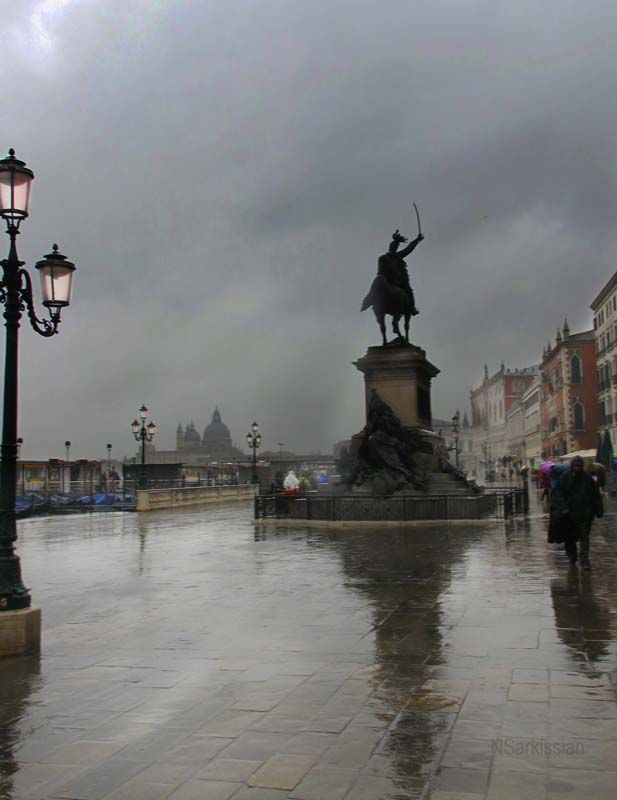
.
Riva degli Schiavoni — [From his rooms here] “the waterside life, the wondrous lagoon spread before me…”
—Henry James, Italian Hours.
.
Then I head down the glistening Riva degli Schiavoni toward the center of the universe—the Ducal Palace and St. Mark’s. As I go, my shoes squelch—not rainproof after all—and my coat flaps like wet wash on the line. My camera’s dry inside my shirt but then, in a rush of air, my umbrella flips its underbelly and entrails up. Flapping, I grab at the nylon and wrench it down but not before I douse myself.
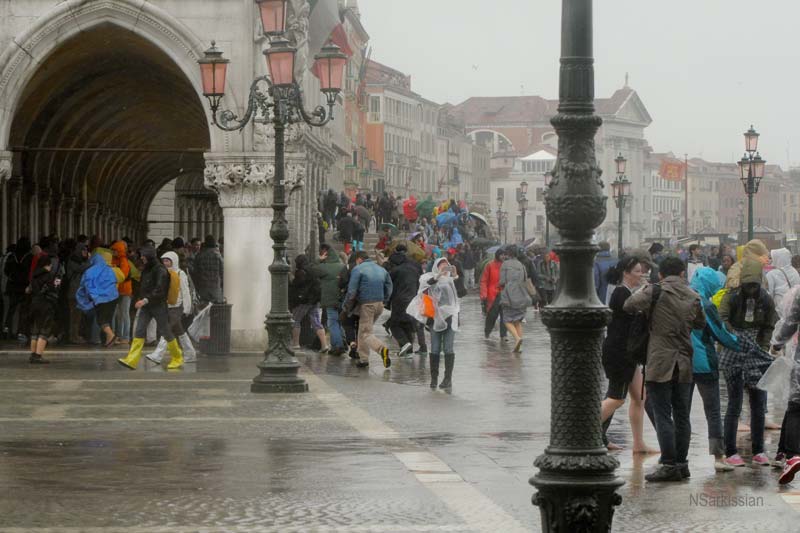
Dripping, I decide to abandon my plan—at least temporarily—of tracing Ruskin’s and James’s footsteps through the city. Under the loggia ringing the Palazzo Ducale, I merge with a horde of fellow Venice-gazers standing in line for the Manet exhibition: a way to stay dry and warm. No photographs are allowed of the interiors of the sumptuous rooms of the Ducal Palace themselves, but the courtyard is fair game.

.
Courtyard view — “Within the square formed by the building is seen its interior court (with one of its wells)….”
—John Ruskin, Stones of Venice.
.
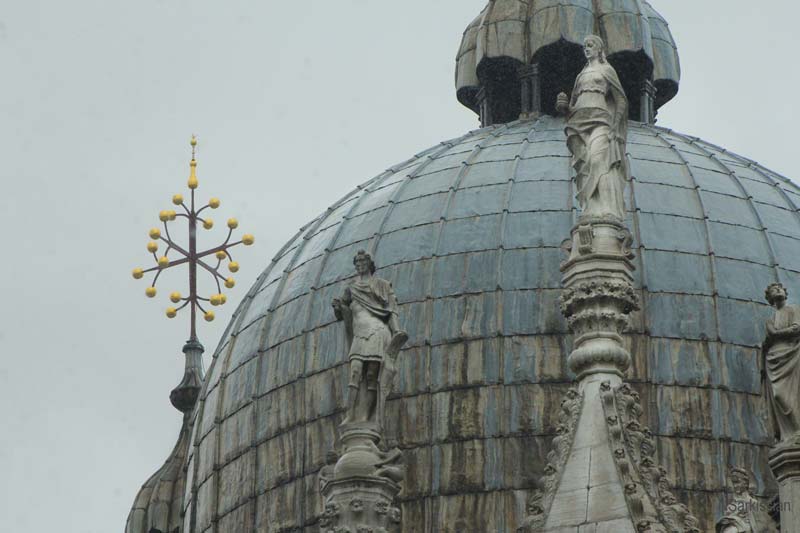
.
A dome and pinnacles of St. Mark’s from the Ducal Palace courtyard — “All European architecture, bad and good, old and new, is derived from Greece through Rome, and coloured and perfected from the East. The history of architecture is nothing but the tracing of the various modes and directions of this derivation.”
—John Ruskin, Stones of Venice.
.
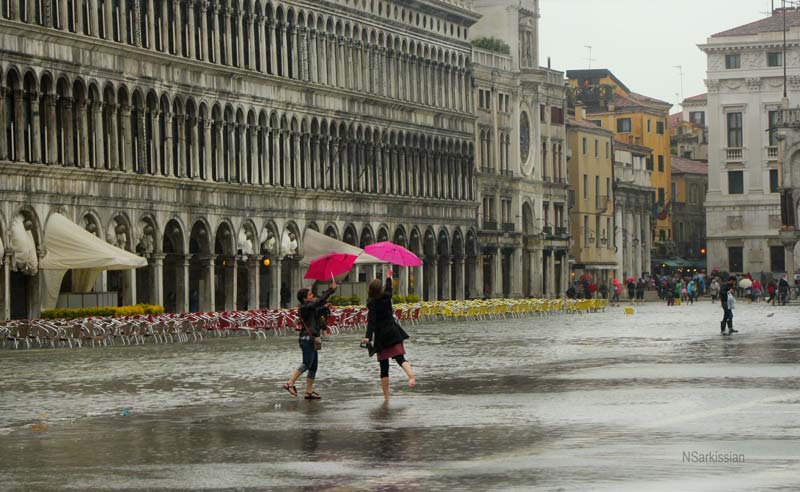
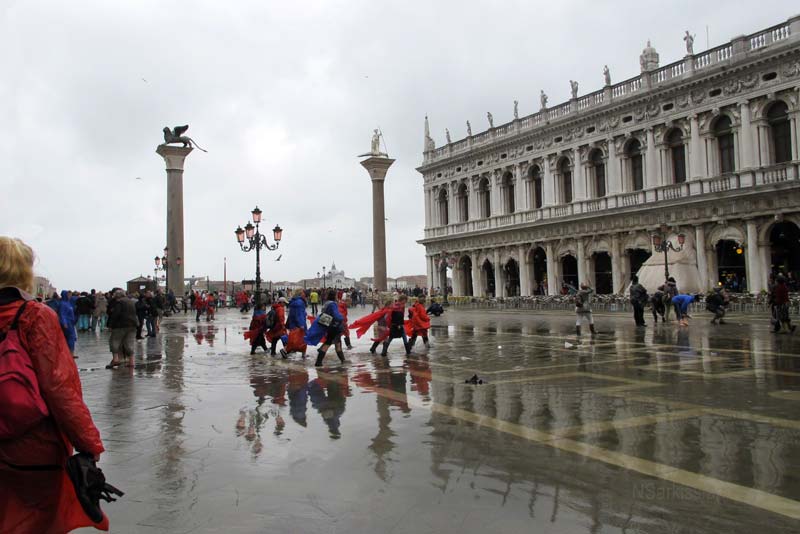
After an elbow-to-elbow tour of the small show and a bit of yellowed mozzarella and wilted lettuce in the teeming cafeteria, three hours later I emerge into St. Mark’s Square. The rain has stopped. With the reprieve from the wet grimness of the morning, a charge of excitement pulses through the crowd outside, a jumped up beat, verging on hysteria. And I see that many of the hooting visitors are stripping themselves of their shoes. Because now the square is filling with the sea.
.
St. Mark’s lion and St. Theodore atop columns in the Piazzetta — “Whether St. Mark was first bishop of Aquileia or not, St. Theodore was the first patron of the city; nor can he yet be considered as having entirely abdicated his early right as his statue, standing on a crocodile, still companions the winged lion on the opposing pillar of the piazzetta.”
—John Ruskin, Stones of Venice.
.
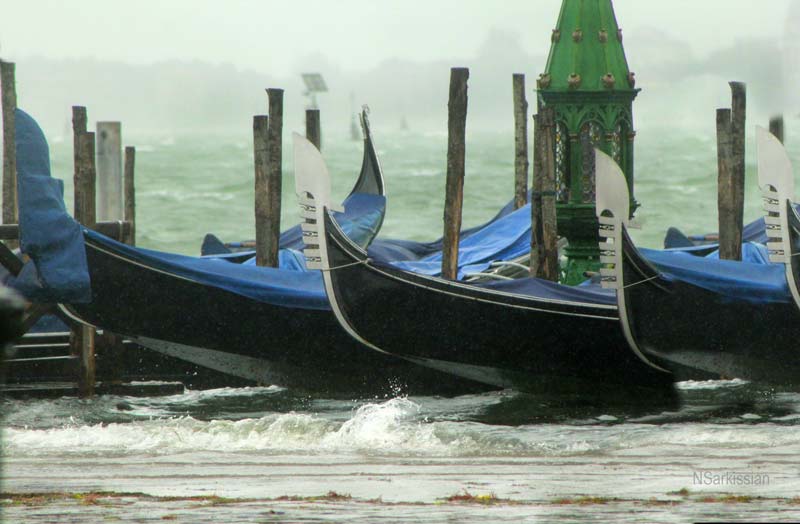
Wind whips water over the embankment fronting the lagoon. Water bubbles up from holes in paving stones. I dodge the deepening rivulets, looking for higher ground while people around me dance and splash in the greening stuff that smells like rotting mackerel.
It starts to rain again. On the raised platform of the Library, under the loggia there, I find refuge from the flood. Protected by the arcade that’s higher than the level of the water, I skirt around one side of the square marveling at the show of people prancing through the water. And when I’ve had my fill, an hour later, I decide to catch that vaporetto I’d missed in the morning. I’ll go back to my original plan and take photos of palazzi along the Grand Canal. But there’s no way off the Library’s plinth. It has turned into an island. Rising water maroons me.
.
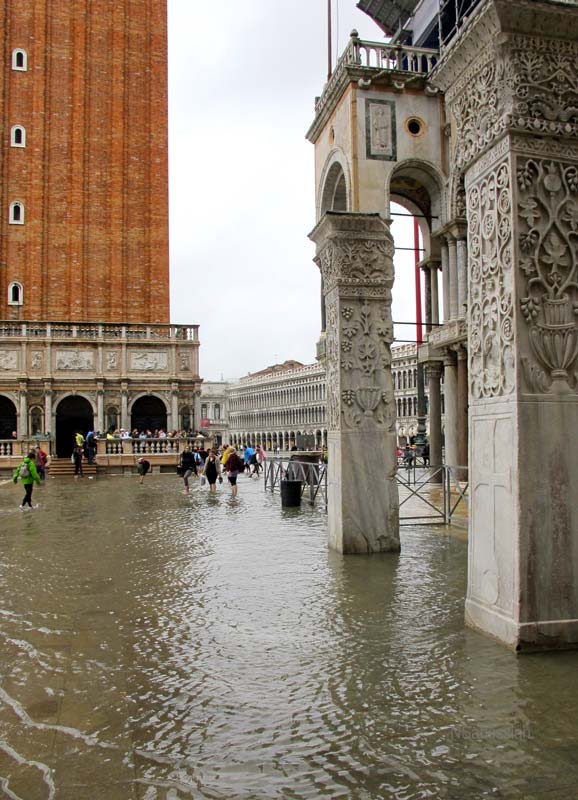
View with the Pillars of the Piazzetta — “The two magnificent blocks of marble … [that] form one of the principal ornaments of the Piazzetta, are Greek sculpture of the sixth century.”
—John Ruskin, Stones of Venice.
.

A shopkeeper in a fancy jewelry store says the water will still keep rising. “Forecasts vary,” she says, “but we could get another 10 or 20 centimeters.” I can’t tell if she’s serious. She tells me to take my shoes off, roll up my pants and brave it. “This is nothing. In November the water rose to my waist,” she says, scoffing. “Bidet level,” she adds, batting her waist with her palm.
But I don’t want to wade through stinky deluge even if it is only ankle-deep. The water’s cold too. I’m cold. I want my boots. Why didn’t I wear my boots?
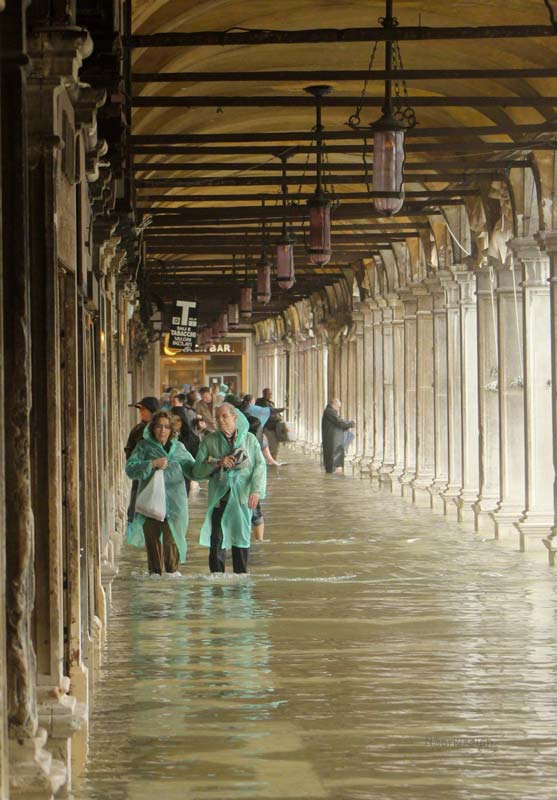
“Where can I buy some cheap rain boots?” I ask.
“I told you,” she says, rolling her eyes. “We’re cut off. Cheap boots are at the Rialto. And the way to the Rialto is flooded.”
.
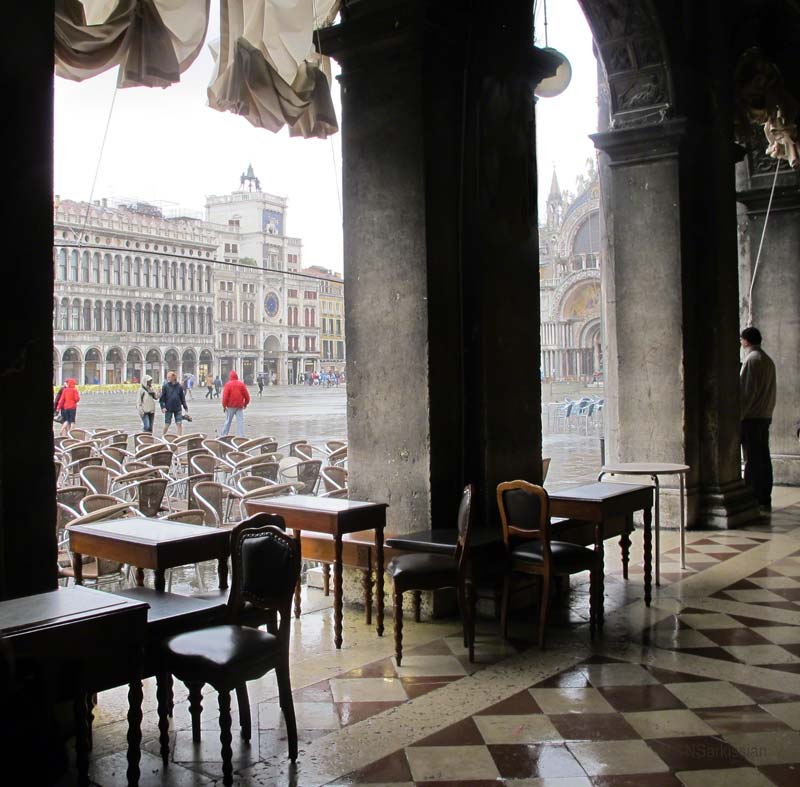
Florian’s café — “I sat in front of Florian’s café, eating ices, listening to music…. The traveler will remember how the immense cluster of tables and chairs stretches like a promontory …. The whole place … under the stars and with all the lamps, all the voices and light footsteps on marble … is like an open-air saloon.”
— Henry James, Italian Hours.
.
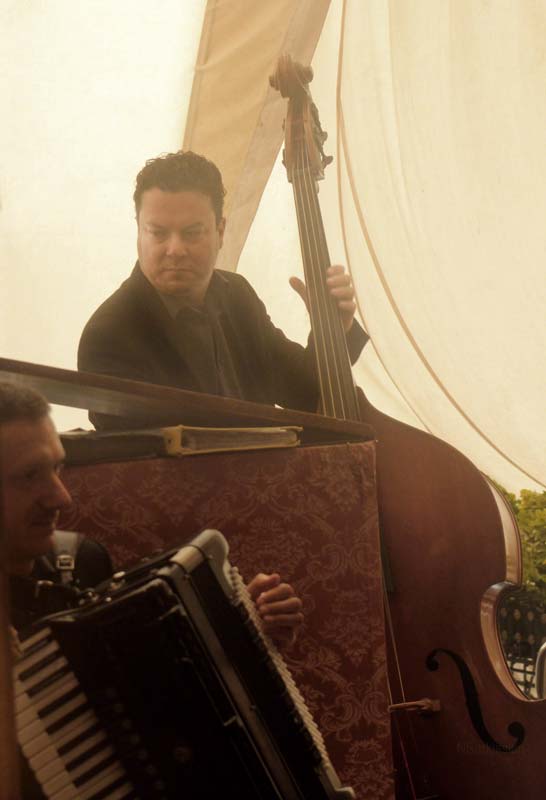
I wander away, wondering what I should do. At Florian’s—where James and Hemingway and who knows who else once sat—I pause to listen to a quartet under a white canopy play the Titanic theme song. The bandleader has a sense of humor. I linger, reading the menu but nix a warming cup of cappuccino (over $10) as too expensive. Traipsing on, I watch people wade through water that is now over their ankles. The shopkeeper was right. The water’s still coming in. I’ll never get off my island unless I take my shoes off.

But then I overhear a couple in new blue boots telling another couple with plastic bags tied around their feet that a boot sellers is a stone’s throw away. “Round the square,” they say, “cut through that glass shop at the end of the arcade. Go out the back door,” they say. “The alley beyond was still dry moments ago.” They stick their feet out so that their boots can be admired. “Only 12 Euros each.”
Having listened to their directions, I dash off—ahead of the bag-clad duo.
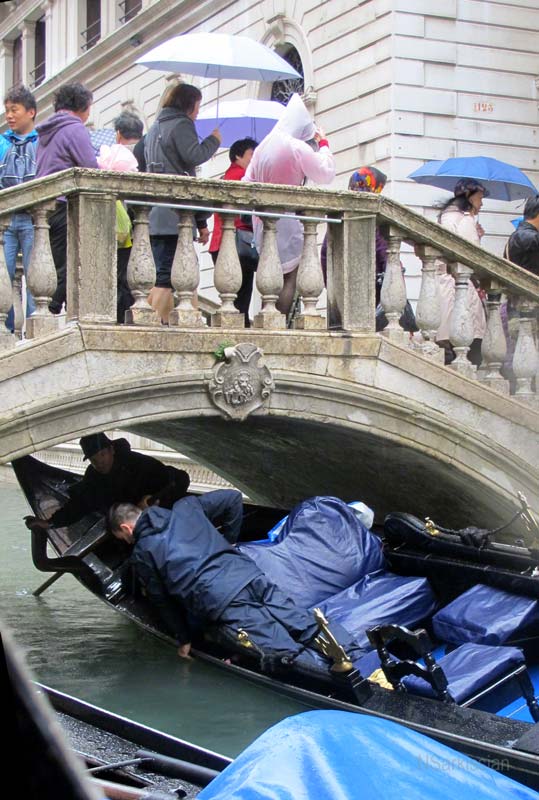
I find the glass shop. The owner frowns as I cut through to the back door and out into the alley behind. The alley’s puddling, but still traversable. It flanks a canal. In the canal water is rising. And in the canal there’s a gondola jam—gondoliers clog a passage under a bridge racing to bring tourists and boats back in. But they must lean and tilt their craft: 40 degrees, 50 degrees, 60 degrees. They risk spilling occupants and belongings. Tourists on board scream with glee, as if they are at a museum-cum-amusement park, which, as James noted over 100 years ago, they are. And I suddenly realize that for most of the day most of the gondolas have stayed lashed at their moorings; only the audacious have been out and about.
Leaving the stream of paddling boatmen, rounding the corner, I find the store with blue boots in the window. The price has gone up to 16 Euros. I stand in line, and, when it’s my turn I pay the extra without complaint. I’m just glad they have my size.
Newly booted, I splash to the embarcadero where I wait for my vaporetto. When the boat comes, I check my watch. It’s almost 7 pm. The hours have slipped by too fast. I’ll have time for just a one-way ride down the Grand Canal and a few shots of some of the palaces and churches I set out early this morning to admire.
.
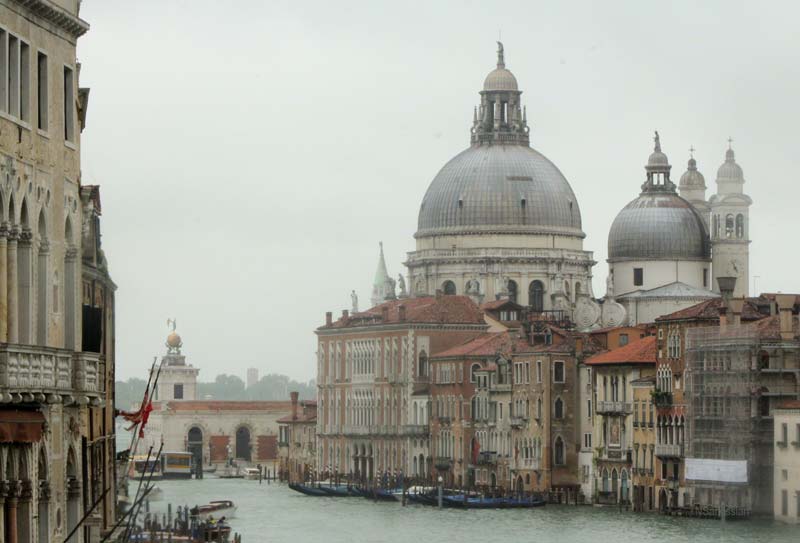
The Grand Canal – “The noble waterway that begins in its glory at the Salute and ends in its abasement at the railway station.”
—Henry James, Italian Hours.
.
I sink into a wet seat—it’s sprinkling. I think how this day’s touring of the city has been different from others I’ve spent. Drenched in Venice by Venice. Inundated. With James and Ruskin for company.
The boat groans forward. Foam flies over the bow. We leave Santa Maria della Salute behind and wind our way down the Grand Canal. Beautiful old palaces rise up, their lacy windows turning luminous with evening lights. Venice always inundates I think as we surge past. One way or another.
.
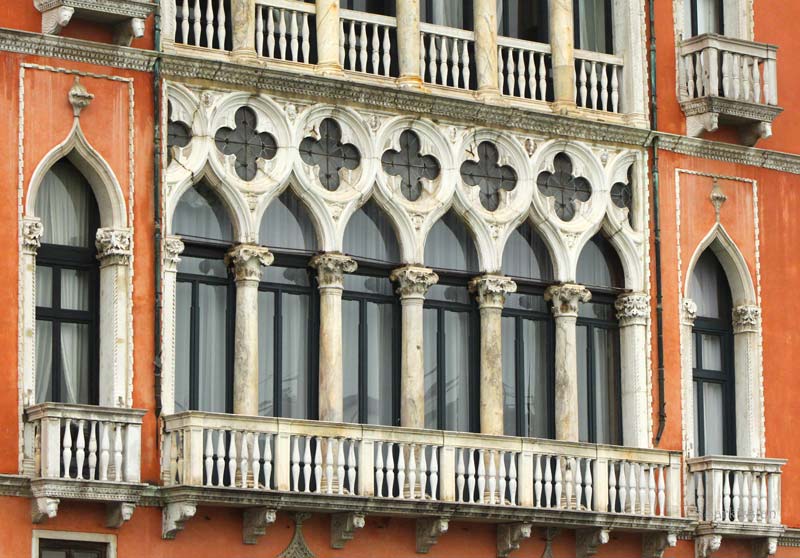
Palazzo Pisani Moretta — “[the] capitals of the first-floor windows are … singularly spirited and graceful, very daringly undercut, and worth careful examination….”
—John Ruskin, Stones of Venice.
.
.
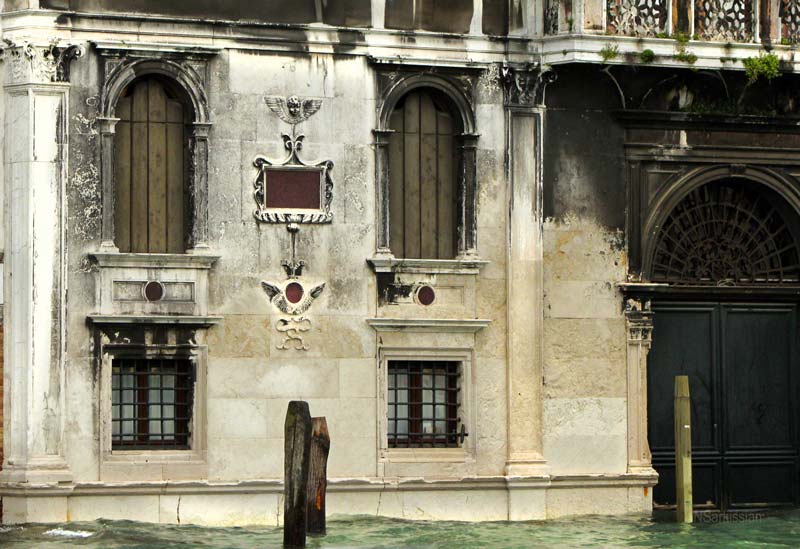
Palazzo Contarini delle Figure — “I must warn [the traveler] to observe most carefully the peculiar feebleness and want of soul in the conception of their ornament which mark them as belonging to a period of decline….”
—John Ruskin, Stones of Venice.
.
I spy a Renaissance building with fanciful decoration coming up–the Palazzo Contarini delle Figure. I hoist my camera and click.
.
I would endeavour to trace the lines of this image before it be for ever lost, and to record as far as I may, the warning which seems to me to be uttered by every one of the fast-gaining waves, that beat, like passing bells, against the stones of Venice.
— John Ruskin, Stones of Venice
There is nothing new to be said about Venice certainly [.…] I write these lines with the full consciousness of having no information whatever to offer. I do not pretend to enlighten the reader; I pretend only to give a fillip to his memory [of Venice]; and I hold any writer sufficiently justified who is himself in love with his theme.”
—Henry James, Italian Hours.
.
—Natalia Sarkissian
———————————————————
Natalia Sarkissian has an MFA in Writing from Vermont College of Fine Arts and has been an editor and contributor at Numéro Cinq since 2010. Natalia divides her time between Italy and the United States.