Mar 062017
 

By the way, no one in this novel is clearly named or called Jesus. Only the title teases that one of the characters is—perhaps—the historical Jesus. Perhaps post crucifixion, perhaps not? Perhaps this isn’t the historical Jesus at all—perhaps Coetzee is  playing a game on us. Perhaps not. But the reader can’t help looking for parallels. —Jason DeYoung

The Schooldays of Jesus
J. M. Coetzee
Viking, 2017
272 pages; $27.00

.
I.

“T his is how it is. There is no before. There is no history. The boat docks at the harbor and we climb down the gangplank and we are plunged into the here and now. Time begins. The clock starts running.” Ironically, this here and now is the afterlife.

Characters eking out lonely lives in an unrecognizable historical situation or in an altogether invented milieu are classic narrative approaches in J. M. Coetzee’s novels. But where The Childhood of Jesus and The Schooldays of Jesus differ is that its characters have no past. They have come to this novel “world” washed clean of their former lives, without their memories, and given new names—given new ages! One might arrive a child, another a 41-year old male. They are set on their new paths with their new names to find new work or new caregivers. They are forced to learn to read and speak a new language, and given only the most modest of starts in a place called Novilla—a “no town,” where “things do not have their due weight.”

Perplexing and certainly stranger than Coetzee’s other works, these novels continue the departure from his more well known realistic fiction found in such novels as Disgrace or Age of Iron. Indeed, his new works are less concerned with standard storytelling altogether. As David Attwell describes in his critical biography J.M. Coetzee and the Life of Writing (2015), after Coetzee won the Nobel Prize in 2003, the “simple urge to represent” no longer seem to interest him, instead he is currently engaging in “secondary-order” questions such as, “What am I doing when I represent? What is the difference between living in the real world and living in a world of representations?”

These “secondary-order” questions have appeared as meta-fictional adventures in recent novels, such as Elizabeth Costello and Slow Man. But for the current set of novels, he has dropped the meta-fictions for something different, something more abstract and foreign. These characters are new: new to these pages, new to the world itself depicted within these pages, coming up against all this new world’s original customs and beliefs. Its literary touchstone is more Don Quixote and less Matthew, Mark, Luke, & John.

For all their newness, however, these novels are as narratively straightforward as they come, broken into regular chapters and standard scenes, written in Coetzee’s economical, direct prose.

II.

In The Childhood of Jesus one of the first things that becomes apparent is that the majority of its characters are without desires or passions—they are on whole contended individuals. Hard manual labor is done without complaint or imagination, food is primarily bread and water, and sex isn’t a notable consideration because, as you see, it doesn’t “advance us,” as one character explains. Of this dry world it is said: “[I]t is so bloodless. Everyone I meet is so decent, so kindly, so well-intentioned. No one swears or gets angry. No one gets drunk. No one even raises his voice.”

This is Simón, the point-of-view character for both The Childhood of Jesus and its sequel The Schooldays of Jesus. Simón is literally fresh off the boat, arriving on the same ship as Davíd, a young boy whom he takes care of, yet Simón is not his father. While on board the ship, the boy had lost a letter that explained who he was and who his mother is. And one of the main plots of The Childhood of Jesus is a quest to find Davíd’s mother, which turns out to be a woman Simón just “thinks” or “believes” to be said mother. And Simón’s “feeling” feels as random as it sounds. The woman, Inés, eventually accepts that she is indeed the child’s mother despite having no recollection of the child. Remember each person arrives in this world “washed” clean of their previous life, without memories, without connections.

The setting for The Childhood of Jesus is a fictionalized town where everyone is expected to speak Spanish and where housing is provided for. There isn’t much pleasure outside of football, and Simón can’t even find spices at the grocery to make the food better. The novel itself is episodic but can be broken down into three broad movements: arrival, search for Davíd’s mother and her acceptance of that role, and finally setting up Davíd’s education. The Childhood of Jesus ends with the three characters on the run from the law, because Novilla’s officials want Davíd in a special school for children with mental deficits, either mental or emotional. Davíd is without a doubt a special child, yet he doesn’t have deficits. He is playful, willful, and hates authority.

By the way, no one in this novel is clearly named or called Jesus. Only the title teases that one of the characters is—perhaps—the historical Jesus. Perhaps post crucifixion, perhaps not? Perhaps this isn’t the historical Jesus at all—perhaps Coetzee is playing a game on us. Perhaps not. But the reader can’t help looking for parallels.

III.

The Schooldays of Jesus takes on the same episodic structure as its prequel, and can seem scattered and unfocused at its outset. But at its core The Schooldays of Jesus is the examination and dramatization of concepts related to education. Its opening chapters establish that Simón is the primary agent of education for young Davíd. He is the one who explains and defines the child’s understanding of the world, but as the novel progresses, we see both characters attending school, and we hear Simón philosophizing on the educational values of confronting immoral men and, indeed, the final “showdown” is a debate between measurable science and artistic passion.

The novel opens as the three main characters arrive in Estrella (another city “which has no sensation, no feelings”), where they hope to lay low and avoid the Novilla authorities who might or might not be looking for Davíd. The three end up on a farm, where Simón and Inés pick grapes, while Davíd plays with the other children, slowly becoming the leader of the group. The “gypsy” life doesn’t suit Simón or Inés but it certainly suits Davíd, whom they’ve “never seen so active, so full of energy.” The owners of the farm take particular interest in Davíd and suggest to Simón and Inés that this highly intelligent and gifted child be sent to school. As it is explained, there are four choices in Estrella: public education, which Simón and Inés tried in Novilla to disastrous ends, or the Academies—singing, dancing, and Atom. Davíd chooses dance, despite having no interest in dancing whatsoever.

At the Academy of Dance, however, Davíd becomes awestruck by his teacher, Ana Magdalena Arroyo, who is an ethereal beauty, with the kind of splendor that “stands up to closest scrutiny”; Davíd also takes quickly to the school’s cockamamie philosophy of “dancing the numbers.” “Just as there are noble metals and slave metals, there are noble numbers and slave numbers,” Ana Magdalena explains. “You will learn to dance the noble numbers.”

This numerology, this cosmology is explained over and over in the novel without much success—both Simón and the reader are left flummoxed. “The numbers are in the sky. That is where they live, with the stars. You have to call them before they will come down,” we are told. But “you can’t call down One. One has to come by himself.” This mystical rubbish leads Simón to declare Ana Magdalena to be a preacher: “She and her husband have made up a religion and now they are hunting for converts.” To which Inés undercuts Simón’s assertions by saying that is how you “teach small children.” In her previous life in Novilla, Inés says she too taught small children. She gave each letter of the alphabet a personality, “making them come alive.” The novel is unremittingly dialectic.

The relationship between Inés and Simón is fraught, tenuous, and unsatisfying on both accounts. They are indeed on opposite poles. There isn’t a modicum of chemistry between the two. In fact, they seem repulsed the other. In the apartment they share, Simón feels more like a lodger than an equal member of the family. Simón at every turn pushes Davíd to accept Inés, but she is a “hard-hearted” and clumsy mother. When Davíd moves out to become a boarder at the Academy of Dance, Inés is quick to suggest Simón find a place of his own.

After a rather subtle introduction, a character named Dmitri begins to insert himself into the lives of the three characters. Dmitri is an attendant at the museum next door to the Academy of Dance, and he, in is own words, “worships” Ana Magdalena: “I am not ashamed to confess it.” Dmitri is a man of passion. The children love him; he often has a pocketful of sweets for them after school. Simón reflects on Dmitri thusly: “How wholehearted, how grand, how true Dmitri must appear to a boy of Davíd’s age, compared with a dry old stick like himself!” Indeed, Dmitri is set up as a counter beat to Simón’s pragmatism. Lovely Ana Magdalena, however, treats Dmitri coolly. And initially, Dmitri doesn’t seem all that important to the novel, but in a “crime of passion” he kills Ana Magdalena.

After the death of Ana Magdalena, the story turns to an examination of how we are to know someone else, how are we to know someone’s true identity. In regards to Dmitri, Simón repeatedly warns Davíd that he doesn’t know why Dmitri takes him into his “confidence”—a word that reappears frequently—because “you don’t know what is going on in his heart.” After Dmitri’s subsequent trial and conviction, Simón, Inés, and Davíd try to reassess and reassemble their lives. In the messy aftermath, Simón takes a writing class of all things. He reveals (with near-comic results) in business letters and résumé cover letters that he has come to a “crisis” in his life, and that meeting Dmitri (whom he dislikes and, from a moral point of view, despises) “has been an educational experience for me.” He continues, “I would go so far as to list it among my educational qualifications.” To be sure, these are the schooldays of Simón as well!

IV.

Critics haven’t praised these novels quite the way they have Coetzee’s previous work, calling them “dry as sawdust” and an “ascetic allegory.” I personally enjoy the direction these novels are taking: they’re attempting something different in a landscape glutted with novels and stories just trying to exist within an established tradition. They remind me of Coetzee’s early novels—In the Heart of the Country, Waiting for the Barbarians, and Life & Times of Michael K.—with their rather alien environment and imaginative leaps.

In something more traditional, Dmitri’s trial and conviction might have make for a proper ending, but here the narrative is pushed forward to complete the novel’s theme, and the ending is more cerebral, a showdown between a man of science and a man of art, vaguely concluded on purpose, perhaps in agreement with Camus, who wrote: “solely the balance between evidence and lyricism can allow us to achieve simultaneously emotion and lucidity.”

Richly enigmatic, The Schooldays of Jesus leaves off precisely where another volume might be necessary to give us our final answers. The two novels are so much about this shaky lad and dad relationship that you want to see how it comes out in the end.

—Jason DeYoung

N5

Jason DeYoung
Jason DeYoung lives in Atlanta, Georgia. His work has appeared or is forthcoming in numerous publications, including Booth, Madcap Review, Corium, The Austin Review (web), The Los Angeles Review, New Orleans Review, Monkeybicycle, Music & Literature (web), and Houghton Mifflin Harcourt’s Best American Mystery Stories 2012. He is a Senior Editor at Numéro Cinq Magazine.

.
.

Aug 012016
 

Rikki Ducornet photo

 Brightfellow combusts with beautiful words and sentences. It builds a narrative that burns clean to reveal the complexity of our self-made identities and misplaced desires. —Jason DeYoung

Brightfellow1

Brightfellow
Rikki Ducornet
Coffee House Press, 2016
$15.95

.

The prized vision in Brightfellow is that of youth and innocence, where the dream of life is perhaps the purest, strongest, and most vibrant. Over and over we are shown this vision along with how the adult characters long to return to this state, yet they are most twisted by life events: by cruelty, by misunderstanding, by repression, by the denial of the imagination. It is a convincing portrayal by Rikki Ducornet of what she writes about in her slim volume of essays, The Deep Zoo (a skeleton key, if you will, to how she thinks and creates): “The betrayal of infancy is ubiquitous, and its forms are many.” Our main character embodies perhaps the deepest betrayal—the denied childhood.

Brightfellow is a dynamic short novel by one of our most linguistically creative writers. I don’t believe I’ve ever come away from one of Ducornet’s novels uninspired. They are all marked by a fecundity and richness, yet not overwrought. She is the author of nine novels—including most recently Netsuke (2011) and Gazelle (2003)—as well as collections of short stories, essays, and poems. She has twice been honored by the Lannan Foundation, and she is a recipient of an Academy Award in Literature. She is also a gifted visual artist and collaborator, which Numéro Cinq was pleased to highlight in July.

Like much of Ducornet’s work, Brightfellow packs multitudes into a small number of pages. The cast of characters is few, but Ducornet’s craft is so practiced that it feels like a larger novel. Brightfellow is divided into two sections. Part one is brief, running only about sixteen pages; part two takes up the rest of the novel. The first part recounts a few particular childhood memories of the main character, Stub[1]. We meet him when he is six years old, in the midst of imaginative play, an adventure he has devised of crossing pitfalls and evading animals he envisions into the linoleum. He is a lonesome boy, but happy. His mother is a local radio personality and his father is a traveling seed salesman. Of this time the narrator writes: “If you could peel him like an orange you would find laughter all the way through.” Yet there is suffering, too. Stub’s mother shakes him when she is angry, and his father, whom he knows will never hit him, is distant. When both parents are home we are told that Stub’s “secret life” is silenced.

Around this time, Stub’s parents hire Jenny, a young woman who has spent some time in a “madhouse,” to be his afterschool nanny. She is strange and vibrant—she easily enters the imaginative worlds Stub creates for them to play in, and she tells the boy of some of her hallucinations. Their play will become so intense one day that Jenny ignores the phone when Stub’s mother calls to check up on them. This becomes the reason, perhaps, for sending Jenny away. But Stub is a child, with a childlike understanding of the world and a limited understanding of how adults operate. All he knows is that his playmate has been sent away, and later, his mother, who will want “more of the world, more of life,” will leave too. “And there they are, Stub and his dad, sitting in silence face to face, the favorite green and white dishes scolding and cold to the touch, the linoleum purged of magic…”

We catch up with Stub years later in Part Two. He is now living in the shadows on the campus of the university nearby. He isn’t a student, but just someone who haunts the university. When asked who he is, he claims to be someone else. In truth, he is there researching Verner Vanderloon, an author Jenny introduced him to years ago. He lives by hook and crook—stealing food, stealing money when he can, going through the garbage at the end of each semester to retrieve the nice things well-off students toss. It’s hard to fix a time in this novel, but it is pre-internet, set after a dimming war, television is in black and white, and the Marx Brothers are still of interest and easily present in conversation.

Two people come into Stub’s life—one by observation, the other by accident. The first is a little girl around eight years old named Asthma, one of the professors’ daughters, who is “my own fairy child,” as Stub writes in his journal. “I hope to know her as well as…I know every pop and snap the library makes in the dark after hours and the taste of canned minestrone when you have spooned it into your mouth for twenty consecutive days.” For Stub she is a marvel to behold—imaginative, innocent, energetic. In Asthma, Stub believes that if “he could play beside her, he would recover all that is lost, all that was taken from him—so long ago now—when Jenny was sent away and all the games they had played together were reduced to the worst feeling of absence.”

The other character Stub meets is Professor Emeritus William Sweetbriar, ‘Billy.’ As with most encounters with professionals on campus, Stub invents a spur-of-the-moment identity for himself. He tells Billy that his name is Charter and that he’s from South Wales, and he affects a slight Australian accent. He tells Billy that he is on a Fullbright, there to study Verner Vanderloon’s archived papers and writings. Billy, a sympathetic and kindly old professor (also gay) takes a shine to the young scholar, and insists that he come by for dinner, which leads to Stub (who is now known in the text as Charter) moving into Billy’s upstairs. Billy lives on the “Circle,” where many of the professors live. Astonishingly, by proximity and angle, the upstairs apartment provides Charter an unobstructed view of Asthma’s room.

What we see between this point and the final (but brief) cat-and-mouse game that culminates the novel, is a kind of doubling of shaded relationships—Asthma is to Stub as Charter is to Billy. These relationships don’t necessary take on an erotic coloring (or if they do, it’s faint and something not necessarily recognizable in a common sense), in fact the erotic is often denied. These relationships are built instead on imaginative play; characters are nourished by other character’s imagination, vision, creativity. Billy is enlivened by Charter’s fanciful tales of Verner Vanderloon’s more esoteric and obscure writings—all of which Charter invents. Charter/Stub is enchanted by the earthiness and wonder of Asthma: “[He] relished the proximity to her skin, her little ears, her impossible eyelashes, a vague smell of piss, of violets. He thinks she is oblivious to her beauty, which is like a flame. He thinks, That is what angers Blackie. This flame. (Blackie is Asthma’s hateful mother.) Despite the intimacy of these details, however, it doesn’t seem to be erotic love Stub feels, but the “child’s promise,” which is described as “immeasurable.”

Running like a dark wave through the novel are quoted passages from Verner Vanderloon’s works. Vanderloon was a reclusive professor at the same university, his coevals being well-known scholars such as Levi-Strauss and Geertz. Known to be eccentric and irascible, his sociological writings describe a “dark” and “cruel” world; campus legend has it that at his retirement supper, he’d asserted “our species is doom to perish cursing its own boundless absurdity.” Some of the works cited by Vanderloon are quite kooky—as this fictionalized academia takes a disrespectful view of his work—but in one quoted section we grasp something at the center of Brightfellow, which offers a philosophical backdrop to the novel:

Vanderloon divides mankind into two constants: the one who ‘knows how to play, are full of mirth and fellow feeling, and the ones who are killjoys and combustible. Play, he writes, is a powerful form of magic—sometimes white, sometimes black. But always it is born of invention and intuition. Play is about becoming human, just as it is also about becoming a lion, a tugboat, a galloping stallion. The hallway that leads away for the child’s room and into the depths of the house is a river, a glacier, a bridge to the moon’

It is this passage that Charter dwells upon while gazing at Asthma from his window, knowing that he would “never get closer to life,” despite entered the “fabric of things” by creating the fiction of Charter. He laments that his new identity will not get him closer to “true life,” which he wants. Yet what he doesn’t know is that many of the other characters live a fiction. Mirroring Charter’s struggles are the sketched subplots of the other professors living on the “Circle”—each one isolated by desire, circumstances, misunderstanding, and envy. In Brightfellow, a portrait emerges of a lonesome boy surrounded by other lonesome people, their loneliness unbeknownst to one another—not one understanding, as Dr. Santa Fofana puts it toward the end, that the “world is a dream.”

As I mentioned above, Ducornet’s prose is consistently fun to read for it rhythmic qualities and primal exuberance. There is a kind of uplift to her writing, even if it’s dark; and there a potency and passion in its more quite corners too, where she sprinkles in a odd detail or gives a new name to the mundane. It’s somehow elemental and lights the mind. Here’s a lively passage, just as Charter is becoming a little more comfortable in his new skin:

How good it is to smoke a cigarette, one’s back against a solid wall, the breeze playing in the leaves, the Circle silenced, each window the promise of a shadow-puppet play. Pathos and terror, black comedy, tenderness and loss, fire and ice, pleasure and punishment—all this surging and ebbing in those ruthless, wondrous, persistent rooms. Such sweetness! Such menace! He looks on as lives grow stale, are renewed. As kittens grow into cats; as betrayal rustles the sheets, rolls under the crib, and comes to rest there; as Death catches a glimpse of a maiden and cannot turn away.

“Beautiful words are the mind’s animating flame,” Ducornet writes in her essay “The Deep Zoo.” A delicate and airy novel, Brightfellow combusts with beautiful words and sentences. It builds a narrative that burns clean to bare the complexity of our self-made identities and misplaced desires. Albeit a tragic short novel, its scope revals a hopeful glimpse into one of the things that make us human—our ability to imagine.

—Jason DeYoung

NC
Jason DeYoung

Jason DeYoung lives in Atlanta, Georgia. His work has appeared or is forthcoming in numerous publications, including Booth, REAL: Regarding Arts & Letters, Corium, The Austin Review (web), The Los Angeles Review, New Orleans Review, Monkeybicycle, Music & Literature (web), and Houghton Mifflin Harcourt’s Best American Mystery Stories 2012. He is a Senior Editor at Numéro Cinq Magazine.


[1] You’ll notice the character names in this novel are downright Dickensian: Stub, Pea Pod, Goldie’s Rod, Verner Vanderloon, Jiggs Wiznet, William Sweetbriar, and (my favorite) Dr. Santa Fofana.

Apr 092015
 

IMG_3722

.
IMG_0821

.

Late-Night Caller

LAST NIGHT, EXACTLY WHEN nothing was happening, I got a call from someone who couldn’t speak. He mumbled into the phone. His mumbling was fast, superabundant, and I think at one point he tried to tell me that he ‘never sleeps a wink.’ I said ‘Yes’ as many times as I could. And then there was a shift in his tone, a shift toward anger, toward annoyance, toward outrage, and it was all directed toward me. I told him to stay calm, to stay where he was, and that I would meet him in the next few minutes. I told him he was in distress. He ‘unhummed’ confirmation. When we hung up, I was relieved and grateful that in his distress he didn’t try to mutter an address to me. He was certainly a man without a tongue.

.

Val

In high school, I had a friend named Val and I believe she intentionally exposed her crotch to me one afternoon by propping her legs up and holding them just so her soccer shorts billowed, allowing sunlight to penetrate the fabric. She flashed a shaded panty-less groin in my direction while twitching her legs back and forth. Leaning back to take in the sun while our friends sat nearby unobservantly, she gave no knowing smile or wink. Cunning or clueless? How could I not look? This is what I remember of Val from high school: nonconformity concerned her the utmost. She read how-to books on the subject, she chose her boyfriends by their eccentricities, her face was trussed up with piercing and chains. But her crotch was normal, as perfect as anyone could find. She had great teeth, too.

.

Generosity

Pauline from next door said, ‘I’ll tell you the truth.’ I said, ‘Please don’t. Please don’t.’ We turned to face the T.V. to see a pugnacious cartoon selling soap hoot a good-humored halleluiah at the shine his soap wrought. We were watching a doc about priapism. Her choice. I’d wanted to watch something on nest building. I thought fondly about a tiny down of hair that ran from the top of Pauline’s cheek to the curve of her jaw. Pauline said it was all mental. ‘What is?’ ‘The truth, silly.’ ‘I said enough.’ Pauline arched an eyebrow in a disagreeable way and didn’t say another word until the end of the show, and then I said goodbye. And she hiccoughed a nearly honest goodbye, too. Her personal perfume stayed behind until morning, smelling it vigorously before starting my day.

.

Take Cover

For years I’d lived where lights polluted the sky, occluding the stars from view. As far as I was concerned stars could have blinked out existence, and I would have been one of the last to know. Then one summer I went to Canada to stay for a week, for rest, for recovery, fortification. I met a woman there who was from Boston, and like people who live in cities we stayed outdoors more than normal, and we walked faster than other people on the streets. She had dazzling shanks. One night near the end of my stay, a night I thought I might try to kiss her, we found ourselves at a public picnic table, where we slowed, and got all reflective and confessional. We shared a bottle of rum, our fingers touched—a crisp-lit moon (an authority on romance, if coldly) hung before our eyes and felt just for us. We were feeling young, selfish; we were feeling that nothing in our lives had been our fault. We felt a prefiguring. Who looked up first, I don’t remember, but we thought we saw a shooting star. It crept across the sky, and we said we’d never seen something so amazing as a falling star in ‘slo-mo,’ as if it knew we both wanted this night to last as long as it could. A homeless woman walked by and looked up and said, ‘Fucking satellite. Spying. Reading our brain waves. Stealing our thoughts! You kids better take cover.’

.

Mother’s Cats

My mother asks things like: ‘What are you going to do with your time?’ And I say something like: ‘Live?’ She corrects me: ‘Work.’ When I go to her house, I wake up puffy around the eyes, nearly blind, and tongue-tied. I think it’s her cats. She has four. She says: ‘You overact.’ Of course, I have no retort. Nothing much happens at her house except the occasional cat fights. She likes to brag about how well-balanced her life is now that she has just her cats and no husband (my father).

.

Speechless

This time I was trying to be serious when the man with no tongue called back. I told him not to ring me again. He grumbled. I asked him what made him think he had the right number. He hummed and grunted. I couldn’t agree or disagree with him, and felt nothing short of stupidity.

.

Tough, Tragic

I saw Val some time ago with her daughter—a skillful and cold child, who furrowed her brow like an adult when I asked her name. Val appeared tough, tragic, and terrifically dressed in slacks and a low-cut shirt—no longer so concerned with nonconformity. As she dithered to keep her other guests busy, I tried to make polite conversation, but I got lost frequently in words as I wondered if Val’s vagina had changed after childbirth. Would I even recognize the once-prime image from my adolescence? I took a beer she offered me and nearly asked, ‘Can I see inside your pants? Again?’ I’d plan also to say, ‘I imagine its image is vastly more important to me than it is to you.’ Which could be possible, I thought, knowing how seldom I looked at my own crotch. But I held my tongue, as it were. Everyone else at the party was being polite. And so what if Val’s genitals were changed? So what? I saw it. Glimpse it. I’m sure I understood its power even then.

.

Au Pied De Cochon

I took my Canadian love interest to a fancy restaurant, where we saw three men each wearing the same label on their shirts—a lightening bolt with a name written across it. They sat hunched, haunches to haunch. They were so close their smell had to be one. They scarf up meats, exotic meats. They ate tail, head, foot, tongue, eyeball. These men were hungry and their server was proud to bring them more. ‘I just love your enthusiasm,’ their server said, grinning at the slobbering bunch. They looked up, grunted, and put their faces down once again. ‘What on earth?’ my Canadian-love-via-Boston-brown-eyed darling said, eating a slice of pie with stonecutter patience. This spoiled our evening, somewhat. I told her my plans for law school. But nothing could take her attention from those men. So, I didn’t go to law school.

.

Fingers Around My Neck

‘The meanest dogs live in the smallest cages,’ Pauline said. ‘Still it felt like fingers around my neck,’ I reminded. The tongue-less man had shown up at my front door, frothing mad and ferociously mute. How had he come, car or carriage? He wielded a worn farm-knife, the kind you might clean a chicken with and then dice potatoes. To Pauline I said: ‘And then I held out my arms and said Welcome home. And then he throttled me, tossing the blade aside. He throttled me.’ ‘Obviously a man of action,’ Pauline said, admiringly, and then asked: ‘What then?’ I said: ‘I threw him off. He hit his head. I grabbed the knife and held it to his throat. He looked like some homegrown hillbilly hayseed, like he was from some small town.’ And then that was when Pauline said, wisely: ‘The meanest dogs live in the smallest cages.’ ‘Where is he now?’ she asked. ‘God knows.’ ‘Truth?’ ‘Not right now, Pauline. Not right now.’ I don’t think she felt insulted. She profited a can of cheese whiz toward my mouth, which I took smilingly. I think Pauline’s great. She stays so up-to-the-minute with our friendship.

.

Jamestown

Recently I spent a weekend with my mother touring historical sites. We strolled down one of the streets of God’s original world and came to a shop where they sold old-fashioned puppets. ‘You need to find yourself a girlfriend, Jake. You need someone.’ Grim was my mood over this. We each held up a puppet to our face, their little wooden limbs clacking together. ‘I’m not a virgin, mom.  There was Mavis and Molly and Maggie and Magda,’ I said to my puppet. ‘Of course you’re not. Of course you’re not,’ she said to hers, ‘besides, son, one of these days you’ll be married and you’ll be so bored by sex your eyes will fall out.’ ‘Did my father’s eyes fall out?’ ‘Yes, yes they did. When he died he was as blind as a mole.’ We left that shop, walked down the cobblestone path, dodging the great piles of horseshit. Perhaps I do overreact every time I get around my mother? Perhaps I project my overreactions onto her? Perhaps she just acts the way she thinks I want her to act? She tugged on my arm and pointed to a very large man in a mechanized wheelchair. ‘Don’t ever get fat,’ she whispered. ‘Don’t kill yourself, son.’ I don’t know if she meant those two things went together. A child in my mother’s presence still, I thought kindly about being on my best behavior, which must be both insufferable and pride-inducing for her. Not that I haven’t said unkind or unclean things to her. But I wonder if all this dancing around the subject wasn’t hurting me somehow. Mother and I always want to be our best for the other, which brings out, you know, irony.

.

Our Last Night

‘It’s not going to happen, is it?’ the woman from Boston said to me on our last night. ‘Why would you want it to happen?’ I asked, knowing that I had nothing to offer her except a small adventure. ‘Why wouldn’t you want it to happen?’ she retorted; she was desperate for something to happen. ‘What made you think we could make it happen?’ I said; I felt hopeless and depressed, the way I get when anything important could possibly occur. ‘Why not make it happen? It is our last night,’ her final words on the subject—the opening, the invitation, the entry. In the end, nothing happened. Something happening had become too heavy. When we parted at the hotel it felt like something important was missing. Pecks were exchanged. I’ve not spoken to her for years; I have to wonder if she seethes with as much disappointment as I do.

.

Questionnaire

1. Do you feel your life is without purpose?
2. If so, explain fully. Use complete sentences.
3. Would you prefer your spouse or love ones to die before or after you?
4. Have you ever been willfully blind? Explain.
5. What is your most personal demon? Give it a name.
6. What makes you think you’ve answered the proceeding questions correctly?
7. Mind your thoughts, in geological time?
8. Which memory means the most to you?
9. Name the bones you’ve broken.
10. Now the organs.

.

Showdown

The man without a tongue came to my door again, while I was filling out a questionnaire. For personal reasons, that is. This time he carried a broom and as soon as I opened the door he jabbed the broom’s bristles in my face. It felt like a thousand dull needles. He hummed and grunted the most terrible things to me. At one point I thought he called me a ‘whiskery pervert,’ but I couldn’t be sure. Nevertheless, I was soon on the floor, my face submerged in broom bristles. The tongue-less man, standing over me, howled. Why had I become the center of this man’s attention? I wished Pauline had been there to see this lunatic, perhaps she could have observed him and come up with a reason since the tongue-less man couldn’t explain for himself. He grunted and cried and garble-cursed and moaned and blubbered while jamming the broom into my face. I knew for certain that if I didn’t move quickly I would eventually loose an eye or both. I scrambled to my feet and rushed to other side of my den where I had a paint-by-number canvas on a homemade easel. I used the canvas as a shield. What was there to talk about? taking charge of my situation. Who needed a questionnaire? It was action and impediments to our will that makes us come alive (Pauline might have said this in her better moods; she was the smartest person I knew). I swung my paint-by-number canvas at the tongue-less man and he swatted at it with his broom. Things and thoughts were happening, quickly. And it is while we are fighting that I recognize that I’ve been assembling my whole life, mending back together something. My mother ever-so-often tells me how after she had me she was never ‘right again.’ Imagine the wrong. The tongue-less man clobbered me. I let him. I threw my paint-by-number canvas aside. As I allowed him to scar my face with the broom, I saw through his intermittent brush strokes the faint outline of an unfinished satellite, as if its image was flickering.

.

Tap

Veiled hunger, awkward leer, constant insipid smile: this is how I see myself as a young man, around the same time I saw Val’s cunt. (I cannot decide if I like that word or not, but what else to call it? The situation deserves a better word than its bloodless clinical substitute.) The man without a tongue rests on my couch. I suppose he’s homeless. He makes a tapping noise when he wants my attention. Sometimes, I swear, I think he’s asking me to go to church. My face wasn’t cut by the broom; slightly abraded, yes. My mother called asking how things were going. I lied and said nothing was happening, that I was painting and that I had plans to go out the following evening with a new friend. ‘Jake, whose there with you?’ ‘No one.’ I tell her I’m planning to make a phone call, though. ‘To whom?’ ‘To a woman in Boston.’ ‘Don’t be off-color, Jake.’

.

Ba-ba-ba-bam-boo

I called the young woman whom I had a near-fling with in Canada. I heard her child in the background, cooing and saying ba-ba-ba-bam-boo. As we talked, I cleaned out my medicine cabinet. I took out pills I’d not taken in years, swallowed them. I bandaged myself where I had no cut or abrasions: preparing myself, I guess, for whatever pain I might feel after the conversation. ‘You ever fill out questionnaires?’ I asked her. She said she did before she had her daughter, but not now. ‘Why? Is it because you think you’ve got it all figured out? Your child gives you some insight?’ ‘Maybe. Or… I guess I just don’t feel the need to question myself. I don’t want to disturb my thinking, perhaps. Children need consistency. I can’t crack open my skull and start searching for new answers this late in the game. I’ve got to go with what I know.’ ‘Do you wished something had happened?’ ‘God, Jake, don’t start it.’ Silence. ‘After childbirth was your vagina scarred or deformed?’ Silence. ‘Is that any of your business? Is that why you called?’ ‘No. I’m just curious.’ ‘Well, it’s fine. It’s fine.’ She sounded distant and hurt. We talked some more. She told me about her husband. I told her about the tongue-less man who lives in my apartment. She told me that it sounds weird. I told her his speech is weird. ‘I’m going to send you a painting I’m working on, of a satellite.’ ‘Oh, that would be nice,’ she said; she said it like I just told her I want to read her a poem. ‘Do you remember the satellite in Canada?’ She said she does, and then we dropped the subject and talked some more. She said vague and unimportant things, and I did similarly. We were both feeling out the conversation, searching for a stopping point. And then she said, ‘Ta.’ I went back to my painting. Now, I don’t think I’ll send it to her after all. Like Val’s vagina, the painting means more to me than it does to her, symbolically, of course. I take out some tapes and I pop one in the stereo. I hear the tongue-less man down the hall humming and growling to the lyrics. I had no idea he was a music lover. ‘Ta,’ she had said. And I think, ‘Ta-ta-ta-ta-ta-ta-ta-ta.’

.

Theatre

This morning I woke up thinking about the future. Ol’ Tongueless was scrambling eggs. He had written me a note: ‘Not killing you. Leaving today. Please don’t be afraid to speak to me. Invited Pauline over for breakfast.’ He had beautiful, jaunty handwriting. Why he had he waited until now to pass me a note? Maybe I’d ask Tongueless to stay. We three sit, eating omelets, talking about my conversation with the woman from Boston. I was still bandaged from head to toe and had awful hangover from the all the pills I’d taken. ‘What to do you think?’ I asked Pauline. ‘Do you think I would have been better off not calling at all?’ ‘Honestly?’ I sigh, ‘Yes.’ ‘You done good, Jake. You done good.’ Tongueless yarbbled and waggled his jaw in agreement. Bodily, we laughed, the picture of happiness. Pauline patted my leg under the table, and left her hand there. She was my best friend, the smartest person I knew. Idly I wondered what she looked like naked. Why not, she already knew me through and through; and she’d become fast friends with my one-time potential murderer.  Looking at Pauline across the table, she smiled, an open smile, not knowing what I was thinking. Things could really start happening now.

—Jason DeYoung

,
Jason DeYoung lives in Atlanta, Georgia. His work has appeared or is forthcoming in numerous publications, including Booth, REAL: Regarding Arts & Letters, Corium, The Austin Review (web), The Los Angeles Review, New Orleans Review, Monkeybicycle, Music & Literature (web), and Houghton Mifflin Harcourt’s Best American Mystery Stories 2012. He is a Senior Editor at Numéro Cinq Magazine.

.
.

Mar 112015
 

AVT_Edouard-Leve_8970

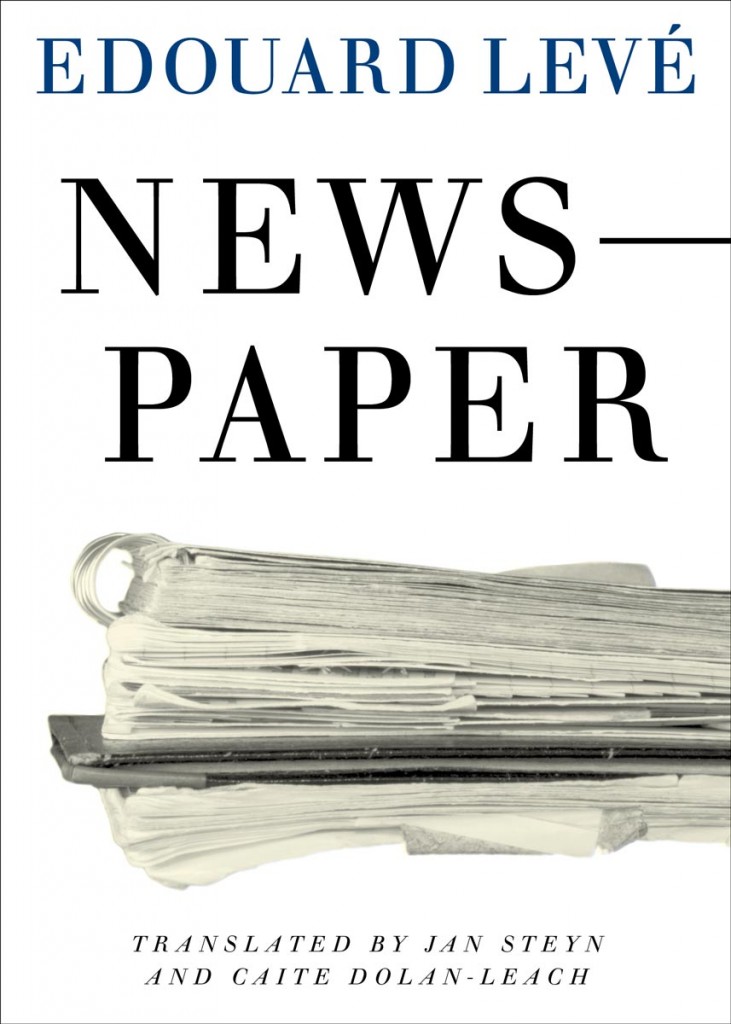
Few proper names appear in the book. No dateline attends the stories. Locations generally unspecified. It’s a newspaper, sans columns, a readymade novel, one event follows another. And like any daily newspaper, Newspaper can be riveting reading, and at other times dry (deliberately so) to the point of numbing.
—Jason DeYoung

Newspaper

Newspaper
Edouard Levé
Translated by Jan Steyn & Caite Dolan-Leach
Dalkey Archive Press, 2015
$13.95

.

“Approximately twenty people have died in a suicide bombing at a seaside resort hotel.”

“Two young people, ages sixteen and eighteen, are being investigate for the rape and murder of a sixty-night year old grandmother.”

“High-speed trains are once again running late.”

“A simulated airplane crash has gone badly wrong.”

“Internet site seeks numerologists and astrologists. Work from home, flexible hours. Urgent.”

“The rains that have been sweeping over the west since early this morning are moving across the region.”

Such is the news in Edouard Levé’s Newspaper, a 124-page fictional newspaper packaged as a book. Organized into eleven sections—International, Society, Economics, Science & Technology, Classifieds, Weather, Sports, Arts & Culture, etc.—each part is comprised of individual news stories or items of interest. Few proper names appear in the book. No dateline attends the stories. Locations generally unspecified. It’s a newspaper, sans columns, a readymade novel, one event follows another. And like any daily newspaper, Newspaper can be riveting reading, and at other times dry (deliberately so)  to the point of numbing.

Newspaper is Edouard Levé’s second ‘novel’ but his fourth book to be translated into English and published by Dalkey Archive Press. The first book was Suicide in 2008, followed by Autoportrait in 2012 (which I reviewed for Numéro Cinq) and Works in 2014. Owing a self-acknowledged debt to George Perec, a founding member of the Oulipo (short for Ouvroir de littérature potentielle—”workshop of potential literature”) Levé’s work is often formal experiments that reframe reality and bring into focus the fragmentary nature of memory. In his books Suicide and Autoportrait, he writes pointillisticly, without the traditional patterns and techniques of fiction, and the sentences seem written down at random. Works is a catalogue of 533 ideas for future art works—some he completed, most he didn’t (Levé committed suicide in 2007). What these singular books explore is a kind of aesthetics of the incomprehensible as it acknowledges the multiplicities within its author and his world.

As a book, Newspaper plays with some of these same ideas, and stands as an intriguing testament of life in the early aughts (it was first published in France in 2004). Themes of power and death and terrorism dominate the international news. Suicide, murder, rape, pedophilia, robbery, white-collar crime fill out the local news. The economic report is all about interest rates and household consumption, worker strikes and worker rights, money laundering and a downturn in the market. Science & Technology fills us in on meningitis scares and radiation exposures, experiments with human cloning and risings in average yearly temperature. And so on, with the banality of good and bad weather, triumphs and letdowns in sports, the weirdness of the classifieds ads, births and deaths, the smallness of arts and culture reporting. Finally the book peters out with its Entertainment Guide and Television listings. How do you want to spend your time? Naval sculptures in the morning, a film about parallel universes in the afternoon, and tonight we can check our lottery number at 8:25 before getting to the sports update and then falling to sleep while watching the nine o’clock movie. What’s it about? A woman who is “a member of a narcotics agency, [who] picks up a little extra money serving as bate for the vice squad.” I hear she’ll be scantily clad and heavily made up.

It could easily be today’s paper.

Like most of Levé work, Newspaper leads to speculation about how to read it: it is one thing that pretends to be another after all, and the mind wants to resolve this discrepancy. Before the publication of his novels, Levé was better known as a conceptual photographer. His photographs were often composed scenes that were not as transparent as their titles would suggest, as in his collection Pornography in which models, fully clothed, contort into sexual positions, or his collection Rugby, a series of photographs of men in business attire playing the titular sport. In both, the photos represent an action but are not the real thing. As Jan Steyn points out in the Afterward to Suicide: “We cannot see such images and naively believe in the objective realism to which photography all too easily lays claim: we no longer take such photos to show the truth.”

eEdouard-levésperet1Edouard Levé, Pornography

The college-like, frame-by-frame structure of a newspaper surely appealed to Levé’s sensibilities. In Autoportrait he says his own memory is like a disco ball, and in Suicide he goes a bit further in explaining his understanding of perception:

A dictionary resembles the world more than a novel does, because the world is not a coherent sequence of actions but a constellation of things perceived. It is looked at, unrelated things congregate, and geographic proximity gives them meaning. If event follow each other, they are believed to be a story. But in a dictionary time doesn’t exist: ABC is neither more or less chronological than BCA.

As with a dictionary, the daily newspaper is a fragmented view; instead of the potentialities of words, however, it’s a portrait of worldly and local events. Just as with his photography, Newspaper rejects “objective realism,” ironically by posing as something we often consider (perhaps incorrectly) to be the realest of the real. But the map isn’t the territory. Newspaper is an artifact that represents the on-goings of the world… as determined by whom?  In many ways, Newspaper reminds me of Alfredo Jaar’s Newsweek.

As a formal experiment, Newspaper is worth reading. Unlike common novels, its impartial and unadorned prose evades interpretation, while still revealing a human comedy. Here are two examples:

…The former dictator is coming back into style. The municipality, in agreement with the hotel-owner’s union, is promoting this image, hoping that this ‘fashionable’ dictator will attract tourists to the area. The leader’s former residence, which was commandeered from a rich family whose son committed suicide rather than collaborate with the regime, has been transformed into a five-start hotel wherein delighted tourists pay the equivalent of one month’s salary to spend one night in the ‘big man’s’ bedroom suite. The national poet responsible for writing all the dictator’s speeches lived nearby; his former chateau welcomes two hundred thousand visitors each year.

The government has stepped down from the power and the departing prime minister has formed a new cabinet. This new government, in which the prime minister is also the minister of defense, no longer includes any deputy prime minister. The ministers of home affairs and of foreign affairs have switched roles. The ambassador to an important nation has become the new head of diplomacy, and the home affairs minister’s chief of staff is now himself the minister.

Yes, there’s humor here, yet it doesn’t come with a gentle touch, but as an unsteady a last resort. By removing the context from these stories (and removing himself as a narrator) Levé shows a kind of stark gory truth about people—their avarice, chicanery, vice. There are very few stories here about kindness or selflessness. But the daily newspaper doesn’t report that anyway. Conflict, hopefully bloody, is what readers want, right? All the same, words like terrorist, minister, dictator are tossed around, but we are not made privy to who decided upon these terms, and the lack of history and understanding puts us at odds with what we’re reading. Ambiguity turns this world on its head. One of the things Newspaper seems to ask is do we really have understanding of our world or just a craving for spectacle.

In a small essay called “Approaches to What?” George Perec writes: “Has the newspaper told us anything except: not to worry, as you can see life exists, with its ups and its downs, things happen, as you can see.” Perec had a scornful view of daily newspapers, and I wondered while I read Newspaper if Levé didn’t feel similarly. The ‘novel’ didn’t move me in any way except toward the bigness of life and its confusion and its ultimate banality. What Newspaper provides is an oblique view of a ghostly and incomplete world. We all know more goes on that what is reported. What’s been left out? I cannot say whether I liked Newspaper. It’s not that kind of book. Like and dislike don’t really seem to matter, just as with a regular newspaper—generally criticized for its coverage and less as an entertainment.

—Jason DeYoung

NC

jason

Jason DeYoung lives in Atlanta, Georgia. His work has appeared or is forthcoming in numerous publications, including Booth, REAL: Regarding Arts & Letters, Corium, The Austin Review (web), The Los Angeles Review, New Orleans Review, Monkeybicycle, Music & Literature (web), and Houghton Mifflin Harcourt’s Best American Mystery Stories 2012. He is a Senior Editor at Numéro Cinq Magazine.

.
.

Jan 062015
 

Rikki Ducornet photo

Subversive at heart and acutely perceptive, The Deep Zoo celebrates the knowledge that “Nature loves order, the beautiful, and the anomalous.” It plies us to savor the spiritual and the scatological, and not to wither in moral certitude.  —Jason DeYoung

 Layout 1

The Deep Zoo
Rikki Ducornet
Coffee House Press, 2015
119 pages, $15.95
ISBN: 978-1566893763

.

The Deep Zoo is a seed! From this seed come our initial impulses and multiplicities. Our Deep Zoo is the place from which we dream. It is this place from which you came, the place from which you interpret the world, the place from which you create. As Gaston Bachelard, Rikki Ducornet’s favored philosopher, says, “daydreams illuminate the synthesis of immemorial and recollected. In this remote region, memory and imagination remain associated, each one working from their mutual deepening.” The Deep Zoo galvanizes us. It is potency.

The author of nine novels, three short story collections, five works of poetry, and the winner of countless awards, Rikki Ducornet has long been a star shining brightly over contemporary literature. Her writing, however, often runs counters to its trends. Refusing to be part of established realism—which she skewers for its “inescapable redundancies”—she looks for something more inward, an art that fulfills the promise and richness of the imagination. Much like Robert Coover (whom she notes as influential) Ducornet’s preoccupations are mythology and metamorphosis, and it is this richness and delight in play (an art in-and-of itself) that attracts me to her work.  (Rikki Ducornet is also an accomplished painter to boot and shows internationally.)

The daughter of a Bard College professor, with extensive travels throughout the world, including Algeria, Japan, France, and Palestine, she is steeped in worldly texts and to call her an American writer seems nearly inaccurate. The depth of her knowledge and comfort with diverse subject matter is daunting, and in The Deep Zoo alone she deals with Egyptian mythology, Werner Herzog, United States foreign policy, Marquis de Sade, and Islam among others. The opening words of The Deep Zoo might well-convey the wonder and direction of this slim volume:

In the tradition of Islam, the first word that was revealed to Mohammed was Igrá (Read!) The world is a translation of the divine, and its manifestation. To write a text is to propose a reading of the world and to reveal its potencies. Writing is reading and reading a way back to the initial impulse. Both are acts of revelation.

Comprised of fifteen essays, most of which are no more than six or seven pages long, the entire text of The Deep Zoo runs only 119 pages—work cited and acknowledgements included. But while its page count is trim its capacity for insights and range of thought between its cover is sprawling.

The collection leads with its title essay, limning Ducornet’s philosophical point-of-view toward art and literature. “The Deep Zoo” acts as a kind of foundational text, a lens to view her work and the other essays through. She writes that the Deep Zoo is a way of seeing, “the recognition of a pattern that informs the mind.” From this arena of unlimited encounters come the artist’s vision, the writer’s text. Ducornet believes in the power of language to clarify, to articulate the ineffable—its most ancient task. A writer’s duty is to “access memory, reverie, and the unconscious—its powers, beauties, terrors, and perhaps above all, its rule-breaking intuitions, and to celebrate … the mind’s longing to become lighter, free of the weight of received ideas and gravity-bound redundancies.” Often her rapturous prose leads to some heady moments.

Although the essay trades in concepts that might seem somewhat abstract, the following essays reveal what Ducornet means by Deep Zoo through examples. She explores the “mixto” paintings of Linda Okazaki and the restless sculpture of Margie McDonald. She finds ineluctable life in the flickering imagery of Werner Herzog’s The Enigma of Kaspar Hauser, and delights in the gnostic vision of David Lynch. With her keen eye for the amalgamated and strange, she takes great care to highlight works awash in estrangement. In each piece of art work she analyzes, she looks for the emblematic seed, the forces which “fall into sympathy with one another,” which engenders the work, often finding them in “intangible things,” such as in Omensetter’s Luck, or in the singular “banality” of death in de Sade’s 120 Days of Sodom.


last_run_1983_smallerLinda Okazaki, Last Run

Many of the essays in The Deep Zoo recount stories of Ducornet youth, where ones Deep Zoo originates. She traces her own Deep Zoo back to a dead fox she found in the woods when she was a girl; a swarm of yellow bees around its belly. She calls this “a species of animated calligraphy”; it transformed what otherwise might have seemed horrible into a thing of beauty. In other essays, she describes more practical matters to her art. In “Water and Dreams,” Ducornet gives her clearest view into the workings of her mind and writing. Originally written for Rule of Thumb (ed. by Michael Martone), it is an analysis of her novel The Fountains of Neptune. Here Ducornet dismantles the work to spotlight the rhythms and currents running through it: a demonstration of the mechanics of the Deep Zoo. She writes that The Fountains of Neptune “is punctuated by the water’s meteoric forms… consciously associated in order to suggest the many moods of the sea.” Before writing it, she says she made lists of water and sea images, but during the process of writing, she allowed the novel’s “intention [to] evolve from within,” so “the entire process had a weather of its own.”

No, Ducornet’s advice isn’t as brusquely pragmatic as ‘write what you know’—I doubt she’d send you chasing your own tail like that. Instead, her advice is far more freeing. Subversive at heart and acutely perceptive, The Deep Zoo celebrates the knowledge that “Nature loves order, the beautiful, and the anomalous.” It plies us to savor the spiritual and the scatological, and not to wither in moral certitude. Indeed, it accomplishes what the best books I’ve read always do. It opens its reader to new concepts and stirs new ways of thinking. As Ducornet has the Marquis de Sade say in her novel The Fan-Maker’s Inquisition: “What is reading if it is not dreaming? The best books cause us to dream; the rest are not worth reading.”

bainbridge2Margie McDonald, Sea ‘scape

Taken with and obsessed by the paradoxical and the mysterious, Ducornet’s honors the mutable heart of life, refuses to label the body as “fallen” or “vile,” and clearly worships the “divine.” Yet her outlook is clear-eyed and scientific, too. She won’t abide magical thinking or a good wallow in obscurity. At once a political book The Deep Zoo is also playful, as the essays do not follow any preordained structure and seem often to move with the currents of their author’s mind. One of the intriguing features of Ducornet’s essays is that they often end with smart quotations from writers she admires. But in fact, she has written a very quotable book herself, and I want to conclude here by sharing some of Ducornet’s own wise words:

It is the hidden significance of things that both explains and propels us forward with an eager intelligence. The paradox of hidden knowledge is that it recognizes—in ways that are wordless and intimate—an embrace as old as time, older than language. And yet it is also the force that leads to the impulse of word-making.

§

If naming and listing leads to a certain disarticulation of the world, it also articulates the experience of the ineffable; it allows us to consider and articulate causes and effects and even to cherish the anomalous, because when known patterns are disrupted, we are forced to consider (and to reconsider) the meanings of things.

§

I think of a novel as an unfolding landscape, an entire country waiting to be deciphered.

§

The creative impulse, Eros breathing and dreaming within us, is radical to the core.

§

The human imagination poses searching riddles, and the moment it does, poetry and science, philosophy and cosmology are born.

§

Hating and fearing the body, we turn away from knowledge of the other

§

Thankfully, art pays no attention and continues to subvert pieties and expectations, to rile fuddy-duddies and ride a brighter air.

§

A world worth wanting cherishes the risks of wildness.

—Jason DeYoung

g

jason

Jason DeYoung lives in Atlanta, Georgia. His work has appeared or is forthcoming in numerous publications, including Booth, REAL: Regarding Arts & Letters, Corium, The Austin Review (web), The Los Angeles Review, New Orleans Review, Monkeybicycle, Music & Literature (web), and Houghton Mifflin Harcourt’s Best American Mystery Stories 2012. He is a Senior Editor at Numéro Cinq Magazine.

/
/

Oct 122014
 

daniel-kehlmann-5

Brisk, utterly readable, yet with philosophical drifts drawing from Zeno to Kant to Baudrillard, F is a powerful, unassuming novel exploring the contours of absence and the hallucination of truth, while refreshing the family novel with wonderfully drawn characters and plots awash in humor and irony. It is an unusual novel with familiar faces. —Jason DeYoung

F

F
Daniel Kehlmann
Translated by Carol Brown Janeway
Panthenon, 2014
$25.95, 256 pages

F is “for people who don’t trust family novels,” Daniel Kehlmann said recently in an interview. F is for fate and family and father and fake and fraud and forgery, too. Brisk, utterly readable, yet with philosophical drifts drawing from Zeno to Kant to Baudrillard, F is a powerful, unassuming novel exploring the contours of absence and the hallucination of truth, while refreshing the family novel with wonderfully drawn characters and plots awash in humor and irony. It is an unusual novel with familiar faces.

Daniel Kehlmann is famous in Germany, roughly a wünderkind, with something akin to the American readership of Donna Tart. His first novel was publish when he was twenty-two, while he was working on a doctoral thesis on the sublime in the works of Immanuel Kant. His novel Measuring the World (2005) became the best selling novel in Germany since Patrick Süskind’s Perfume (1985). Just thirty-nine, he’s written five other books, many of which have been translated into English by Carol Brown Janeway, including Me and Kaminski and Fame. But he doesn’t have the readership in America that he might deserve. The superb F might change that.

Broken into six sections, each part of F operates both as its own story and within the context of the novel. The opening scene sets up the family dynamics. Arthur Friedland is taking his twin son’s—Ivan and Eric—from a current marriage, and an older son, Martin, from a previous marriage, to see a traveling hypnotist show. Arthur is something of a stay-at-home dad who writes novels no publisher will take. He has a particular itch for quoting Nietzsche and a child-like disposition for arguing with his sons about animated movies and Yoda’s speech patterns.

The boys are set at odds by marriages and brotherhood. Martin is clearly intelligent but shy with his younger half-brothers whom he looks upon distrustfully because of their close bond. Eric, already at thirteen years old, is well-aware that his father is pitied by others for his failure and unemployment, and has resolved not to be like Arthur. Ivan is steeped in insecurities, worries about talent and intellectual gifts, and wonders how people without them “put up with their existence.” These opening pages subtly portray a fractured family, members who don’t know one another very well.

At the show, the hypnotist will call Arthur to the stage. Arthur will tell him that he cannot be hypnotized. But something happens, because after the show, Arthur will leave his family. In fact, he leaves them so swiftly, Martin is left stranded.

When we next meet the brothers, it’s some twenty-five years. Each brother gets his own section in F, and each section takes place on one day—8 August 2008. Martin is the first brother examined. Overweight and obsessed with the Rubik’s cube (an obsession he’s carried from youth), he has gone into the priesthood, yet his reason is too strong, and he’s not entirely certain he has faith in God. Eric has pursued money, but has committed fraud through a pyramid scheme, and he’s on the verge of being caught by his biggest investor. Lastly, Ivan has become a painter, who begins to paint pictures for a mediocre artist, yet Ivan adds innovative turns into the artist’s work, and this strange form of forgery grows the older painter’s reputation and makes him famous. With patient characterization and expansive narrative, Klehmann dramatizes each son’s fakery, each man’s simulation of their profession. The irony the brothers share is the belief that others—colleagues, family—can “see through them,” see their dishonesty and their small “wounded” selves. Of course, their sham is too convincing, their fake is too good.

Moving in and out of the novel’s story lines is Arthur who since leaving his family has gone on to write a number of successful, experimental novels, one so bleak and powerful as to cause a few of its readers to commit suicide. Whether it was the hypnotist’s doing or Arthur’s true character, we are never made privy to why it is he left his family. The hypnotist holds that a person under hypnosis will never do something he or she doesn’t want to do, but it’s a strange moment in the book, full of uncertainties and doublespeak, when the Great Linderman puts his hand on Arthur’s shoulder and says: “This is an order, and you’re going to follow it because you want to follow it, and you want to because I’m ordering you, and I’m ordering you because you want to me to give you the order. Starting today, you’re going to make an effort. No matter what it cost.” The “effort” referred to is Arthur’s ambition to be a novelist, the profession he tells the Great Linderman he’d failed at doing.

Perhaps he wanted the order, perhaps not? But unlike his sons, Arthur doesn’t have the same pretensions—he is not faking. Later in the book Martin will confront him about it. “Obligations,” Arthur says, “we invent them when required. Nobody has them unless they decide they have them.” Still, he will tell Martin that he had to learn to live with the guilt and regret of leaving.

Inspired by the work of Roberto Bolaño and magical realism, the novel acknowledges without examination a supernatural or otherworldly presence within our own. Martin is convinced that the devil attacks him on the subway; Eric sees cloven feet disappear around hedges; Ivan is met several times by different people trying to tell him his future. Ivan’s experience with the supernatural is particularly interesting and delves into the book’s more metaphysical issue. Is fate true or an illusion? F’s response in this instance is that it is true, as the universe is trying to tell one of the twins “not to get involved with the three,” which turns out to be the novel’s wicked subplot. As we are told in the beginning, the twins lose track of which one is which. The universe, however, doesn’t know the boys accidentally switched places (Eric and Ivan might not know it either) and thus the message goes to the wrong brother, and for one of the twins life ends tragically.

Although the central questions of the novel are the same ones we’ve been dealing with since our beginnings, F handles its material with originality and modern sensibilities, offering responses to the questions about fate and meaning, but not real answers. As Kehlmann himself has said: “Novels are all about ambivalence.” While F is built on traditional plot mechanics, it does have some experimental turns. For example in the third section of the novel, we have a short story written by Arthur about a linage of fathers. Working from his own generation back to the Middle Ages, it operates like the information dump found in traditional family novel. While Kehlmann might be satirizing the tradition, the actual story (which does disregard traditional plot structure) tells something far more horrifying about our lives—when they are all written out, they’re all unhappy in the end, that if our ancestors hadn’t survived there would be “others in our place, others who regarded their existence as inevitable.”

Yes, something of Tolstoy’s comes to mind here, but this is also integral to the novel’s overall ambiguity, and Kehlemann’s storytelling. Fate is part-and-partial with the sublime and ineffable. As Ivan asks late in the book: “What if you could read the universe? Perhaps that’s what is behind the terrifying beauty of things: we are aware that something is speaking to us. We know the language. And yet we understand not one word.” (By the way, the only ancestor in Arthur’s story who lived contentedly was a man who accepted that God had sent him on a “mysterious path” which he walked without complaint.)

Daniel Kehlmann said that with F he wanted to write a character-driven novel, a novel for which he had no clear destination for, just a general notion of wanting to write about three brothers and their various social milieus. The success of F lies partly in the fact that it is one of those rare philosophical novels that doesn’t shackle its story to a preconceived theory but sets its characters adrift with their own conflicts and demons, allowing them to have their own life-altering insights, even if those insights are contested, if not made fun of, by the other characters. Told slowly with gradual assemblage of deceptive details which are revealed in the end to be masterfully constructed, F is the best kind storytelling, filled with doubles and switchbacks, it constantly playing with what we know and what we think we know to bare witness to how many lives are built on that shakiest of foundations: faith.

—Jason DeYoung

 IMG_3723

 IMG_3723

Jason DeYoung lives in Atlanta, Georgia. His work has appeared or is forthcoming in numerous publications, including REAL: Regarding Arts & Letters, Corium, The Austin Review (web), The Los Angeles Review, New Orleans Review, Monkeybicycle, Music & Literature, and Houghton Mifflin Harcourt’s Best American Mystery Stories 2012. He is a Senior Editor at Numéro Cinq Magazine.

Jun 112014
 

Jody Bolz

Shadow Play recounts in untitled and narrative poems a journey across Asia taken in the mid-1970’s through the contemplative eyes of its narrator decades later. At its core is the dissolution of a young marriage and the imagined discourse the narrator has with her former husband about the mystery of love, whether it ends or not. Her perplexity over the question leads the narrator to conclude that “Love’s a puzzle. A test. / A miracle, I guess.” Inconclusive perhaps, but hard won, as she argues with herself through the conjured voice of her former husband. As far-flung as Shadow Play is in setting,  it’s also domestic and close to the heart. These are poems with the intelligence and vigilance that Paul Valéry says might serve to represent and restore what “cries, tears, caresses, kisses, sighs, etc., try obscurely to express…”  Herewith is an excerpt of Jody Bolz’s novella in verse, Shadow Play.

—Jason DeYoung

bolz

.

Shadow Play

On the train across Java
we slept in a knot:
my head in your lap,
your head on my back,

two hundred miles
through the tropical dark
in shuddering third-class.
At every major stop,

a skirmish of shouted light—
vendors hawking tea and rice
to sleep-drugged passengers—
receded in a rush,

the jasmine-scented silence
sweet and abrupt.
When the station’s speakers
keened their exit song,

the train lurched on.
Whirr of palm and banyan,
gibbous moon, skewed night sky—
green stars above the village mosque

jumped and scuttled by
in deranged constellations.
We stretched, switched positions:
your hair red as rose stalks

against my faded dress,
my braids strict shadows
on your moonlit back,
our fractured dreams resettling….

Outside Bandung at dawn,
I shook my buzzing limbs,
cracked our dusty window open
to mountain air.

A boy wrapped in a shawl
shot past in the brightening field.
One child, then another—
a horde of barefoot children

in tattered pastel sweaters
raced beside the tracks,
calling out for coins,
for candies,

falling far behind us
by the time we reached
their shanties: tin roofs
at the rail-bed’s edge—

doorways set in sloping walls,
a threshing floor,
an open sewer.
As our train slowed

a pregnant girl,
waist-long hair undone,
stepped out of a hovel
fastening her sarong.

We passed her without speaking,
tugging at the taut string
of our marriage
as it rose over rice-fields,

climbing into monsoon clouds,
swaying there—spiraling—
not some thing,
not a child’s kite:

our common life, flown
above another Asian city
in the year we made a home
out of our bodies.

§

I’m shaping a mosaic
out of broken bits…
not exactly a gift.
Not exact—

a waking dream of India,
brazen as a blue-skinned god
rank with rotting marigolds
or silent on a riverbank:

the Hooghli in Calcutta—
sludge-gray, chest-deep water
blossoming with saris.
Young matrons bathe together,

an old man squats and strains near
a woman filling copper jugs.
A bloated ox, stiff legs up,
slips by under sail,

a vulture on its belly
coiled in slick entrails.
We linger on a bridge,
transfixed by the blind beak

gently teasing white from pink.
The rotting vessel
slowly shrinks,
then floats out of view.

What corpse am I
scavenging for you?

§

You’re offering me a metaphor?

But—we were there.

You’re looking for something more.
What is it?

I’m not sure.

We have other lives now.

This isn’t a betrayal.

How can you tell?

§

Twenty years ago, you woke me
in a hut near Brujenkhola
reeking smoky thatch and goat dung.
Beyond the unglazed window,

full night on the valley floor,
featureless, obscure—
but you pointed to the sky.
Your shoulder pressed mine.

A triangle of coral light
hovered in the blue-black dark:
the mountain
we’d walked days to see,

fish-tailed Machha Puchhare,
flaring like a sun
an hour before dawn.
We lay on our bedrolls,

awake, and watched the light grow.
Later, after clay-red tea,
we gathered up our packs,
paid our host and said goodbye.

The inn-keeper’s deaf daughter
waved, chasing her sister,
as we started for the river.
Ten minutes to a narrow bridge

across the Seti Khola,
wooden slats half rotted—
cables frayed, too far apart
to grab with our arms out.

We had to walk a line of boards
nailed loosely down the center,
bisecting our vision
of pale-green glacial water

in its bed of chalky boulders
more than twenty feet below us.
You tapped your toe
against each plank

and made your way across,
agile as a gymnast,
hands see-sawing for balance.
After heart-stopping seconds,

you yelled above the rapids’ roar
Wait there and dropped your pack.
Faster, you retraced your steps
to bring me back,

coaxing from three yards ahead,
Take a step—
now take another.
Don’t look at the river
.

Head throbbing,
I stepped staring
at the battered boots
that moved in jerks

above the milky current:
one foot, then the other,
stepped—and stepped again—
until I stepped on land.

We shouted and kissed there,
laughing as we sprawled on shore
guzzling water,
brown and iodine-bitter.

Soon we were singing,
climbing the stony track
through thick rhododendron,
juniper, yew.

By noon, dry and dizzy,
we trudged into a clearing
where an angel was waiting
in a whorl of dusty sunlight.

Poised on the ridgeline,
a shirtless boy, eight or nine—
beautiful despite one blind-blue eye—
held out a bowl of oranges

Suntalla, sahib?
and they glowed like gold.
We bought as many as he’d sell,
tore away the bitter skins

with stinging fingertips.
Back to back
in the shade of a banyan,
we sat eating oranges

as if nothing could harm us,
no crossing part us.

§

You’re policing failures.

We spent fourteen years together—

And the next fourteen apart.

Which proves the first a failure?

You forget that you loved
someone else for most of that time.

I loved you.

And—

I was eighteen when we met.

I was a child too.

Now you’re close to fifty.
Why don’t you forgive me?

—Jody Bolz

.

Jody Bolz was born in Washington, DC, and attended Cornell University, where she studied with A.R. Ammons. After receiving her MFA, she worked as a journalist for two major conservation organizations (The Wilderness Society and The Nature Conservancy) and taught creative writing for more than 20 years at George Washington University. Her poems have appeared widely in such magazines as The American Scholar, Indiana Review, North American Review, Ploughshares, Poetry East, Poetry Northwest, Prairie Schooner, and Southern Poetry Review—and in many literary anthologies. Among her honors is a Rona Jaffe Foundation writer’s award. She edits the journal Poet Lore, founded in 1889, and is the author of A Lesson in Narrative Time (Gihon Books, 2004).

Jun 102014
 

DSC_0580-Version2

Meditative and passionate, Shadow Play works its way toward an approximate answer to the question it opens with, a quotation from Roland Barthes: “How does a love end? —Then it does end?”
—Jason DeYoung

bolz

Shadow Play
Jody Bolz
Turning Point Books, 2014
$16.20, 77 pages
ISBN: 978-1625490575

.

T

o imagine talking to a former lover about shared history is ordinary, but in Jody Bolz’s new book, Shadow Play, she takes this common lover’s discourse a step further when her narrator conjures the voice of her ex-husband to the page to recount the exhilaration and eventual dissolution of their all-too-young marriage. In this examination of estrangement, through the scrim of memory in lyric and fragmented narrative, its characters perform a complex and, at times, spectral dance, rich in emotional immediacy.

A novella in verse, the first poem in Shadow Play gives the impression that what is to come will be a standard book of poems. Brightly drawn, untitled, it’s a story of a train trip through Asia, where the narrator and her husband “slept in a knot” for “two hundred miles.” In these sensuous and vivid lines, their love and marriage is secure, a “common life, flown / above another Asian city.” Yet happiness is short-lived, and the second poem drops us from this nimbus of young love as the narrator lays bare her intentions, which portend more vexing complexities:

I’m shaping a mosaic
out of broken bits…
not exactly a gift.
Not exact—

Reflective, this second poem rummages through a mixture of images of beauty and death (“rotting marigolds,” “sludge-gray” river waters “blossoming with saris,” a “bloated ox, stiff legs up, / slips by under sail”) and ends with the lines: “What corpse am I / scavenging for you?” The person addressed is the former husband.

Careless interrogation perhaps, but it becomes the catalyst that sets this book on its path. This insult summons the voice of the husband to challenge the narrator’s memory and aim: “You’re offering me a metaphor?” he asks.

The second voice, which Bolz says in the interview below “ambushed” her because it “wasn’t a conscious choice,” is a commanding presence in the book, at times refusing the narrator’s remembrances, reminding her that they “have other lives now,” and that she might not know what she is doing combing through their past. The unbidden voice of the living ghost (as it were) of the ex-lover propels Shadow Play into a multi-layered conversation between past and present, as it alternates poems in dialogue form with the narrative staple of the book’s beginning.

Artifice arguing with artifice, the made-up voice of the husband isn’t the narrator’s puppet. He is actively resistant, perceptive, and mature, so unlike the “giddy” boy he was in Asia. But he is still a voice, one the narrator has created, and acknowledges as a creation. Shadow Play is aware of itself, taking as its primary device wayang kulit, Indonesian shadow theatre, where puppets are manipulated behind a white screen on which their shadows are cast. As Shadow Play progresses, it becomes a kind of theatre, the narrator’s voice modulated and thrown in an effort to see “what’s true.”

Our story’s over
despite what we remember
[the husband says]

So forget it—or revise it.
But what if it survives us?

Meditative and passionate, Shadow Play works its way toward an approximate answer to the question it opens with, a quotation from Roland Barthes: “How does a love end? —Then it does end?” For even in present day, happily married in Maryland, the narrator finds her heart in the East, longing to remember:

I turn away
from hearth and garden,
marriage bed and childbed—
I turn back

to lean over a map
of the country where I’m young,
my parents strong,
my luck untried.

I’m looking for a route
through time…

She retraces her past, falls deeper into memory, until returning to Asia:

Everywhere the terraced fields,
tropical and prosperous:
the moon is coming back,
rice is ripening.

But still the voice of the former husband won’t let her have her sweetest reminiscences, and often undercuts the beauty of her narratives: “How like you to contend with Time— / no challenge too absurd.” In denying her craft, he denies her philosophy. Indeed, by the middle of the book, he is drumming up scenes for their wayang, asking to revisit episodes from their year in Asia, and then asking her to speak of Ithaca, New York, where they met, and of other men and of the narrator’s betrayal. Invigorating and intricate, Shadow Play refreshes once again Sartre’s conclusion that “the order of the past is the order of heart.”

Although the proximity and urgency of two voices in Shadow Play dominate the text, to pay too much attention to their recitative dialogue would be at a loss of the music in the poems about Asia, lyrics that rise from the book with gorgeous images and insight:

I’ve never heard a sound
as sad and as sure,
though this is my voice
chanting for Shiva:

a big stone shape
enshrined at Prambanan.
Whoever carved the face
must have been surprised to see

how gracefully, implacably,
it registers each death
and stands accountable—
how smooth the lips and eyelids,

how lovely the look
of all that besets us.

Shadow Play ends with a poem originally published with the title “False Summit.” Yes, the book ends offering metaphor—“One minute we were climbing, / next minute we looked up // and the world had changed / ….another summit.” Carrying us close to the sky once more, the book’s attempts at reckoning ask us to recognize the lover’s discourse as the translated affair it is: a “trick of perspective,” light and shadow. A book of dreams, Shadow Play organizes itself within the wisdom of experience, knowing that despite impermanence and suffering, longings are what move us through our lives and how we remember.

—Jason DeYoung

wayang_kulit_javanese_jawa_schattenspielfigur_marionette_shadow_puppet_gift_da15_2_lgw

.

Over the last few weeks, Jody Bolz and I exchanged a few emails regarding Shadow Play, its origins, its road to publication, and what compels us to read something that is imagined. Jody is a wise and generous poet, teacher, and editor, and her story of studying with A. R. Ammons and her insights on editing the poetry journal Poet Lore are not to be missed.

Jason DeYoung (JD) Can you talk about the origins of Shadow Play? It’s a very different sort of poetry book with a secondary voice coming on the scene to challenge the primary voice’s narrative authority.

Jody Bolz (JB) Years ago, I had a semester off from teaching college and was writing in the “quiet room” of the local library, hoping to draft some new poems.  I began working on the opening pages of Shadow Play (a narrative about riding a night train in Java) without knowing that the poem was a point of entry into a book-length manuscript.  What startled me was the way the poem opened out at the end into a broader view of a longer journey, both literal and psychological. I felt unsettled, as if I’d started to explore something beyond my reach.

In the days that followed, I wrote about another emblematic moment from that journey in Asia—an afternoon along the Hooghli River in Calcutta, during which a dead ox floated by with a vulture on its belly. Again, the poem made a sharp turn at the end, posing an emotionally charged question: “What corpse am I scavenging for you?”  It was clear to me then that I was writing some kind of sequence—that the second poem had followed from the first, and that its ending demanded some kind of response. I didn’t know where I was going with any of this, but I was eager to find out.

The next day, something unforeseen (unforeseeable?) happened as I was writing in the library. Having revised the poem about the Hooghli River, I was struggling to move forward from its confrontational finale, and I turned the page and stared at it for a minute or two before writing a single line:

“You’re offering me a metaphor?”

It was a question in response to a question, a question in another voice. It ambushed me, which is to say it wasn’t a conscious choice. Is there such a thing as a subconscious choice?  In any case, that was when I began to see how I might continue this exploration. I had no idea, then, that the manuscript I was starting would have two intertwined “through lines”—the arc of a narrative (the story of a journey in Asia) and the arc of an argument (the shadow dialogue between the two people who took that journey)—but I was all in.

Narrative time

JD: At your reading at Politics & Prose, you mentioned that you were working on this book before your previous book, A Lesson in Narrative Time, was published.  Why do you think Shadow Play took longer to finish?

JB: It didn’t take very long to write, but it took forever to publish. I finished the first draft within six months, and after a year or two of revising, I felt ready to send it out. Without my knowledge, a couple of writers to whom I’d shown it nominated it for an award from the Rona Jaffe Foundation, and I was lucky enough to receive a grant. This was way back in 1998 (the last century…the last millennium, in fact!), and the recognition gave me hope the book would find its way into print.

I submitted it over and over in those early years, and though it was picked out a number of times in contests (as a semi-finalist or finalist) and often received encouraging comments from small-press publishers, no one said “yes.” Those who said “almost” praised the lyricism of the narrative portions but found the passages of dialogue baffling. One editor suggested I write a play instead. The general advice was: cut the dialogue, and then we’ll see.

By that time—well, maybe all along—I was committed to the book’s form. I saw it as integral to the story. Maybe the whole project was a failed experiment, but I wasn’t going to pull it apart. Writers I respected, novelists and poets alike, had found it inventive and engaging. They’d said it was the kind of book that teaches a reader how to read it. Disappointed that no publisher had taken it, though heartened that sections were appearing in literary magazines as stand-alone poems, I stopped sending it around. I wrote and published A Lesson in Narrative Time—another book-length sequence, but one without the genre-muddling issues that the Asia book presented.

In recent years I resurrected the manuscript, changed the typography a bit, gave it a new title (there had been three or four others), and put it in the mail again. When I discovered Turning Point Books, an imprint that focuses on narrative poetry, I thought it might be a good fit—and it was.

ACCESS TO WATER AND SANITATION IN DEVELOPING COUNTRIESHooghi River, India

JD: The secondary voice in Shadow Play (which is a voice the narrator conjures) says at one point “this whole episode is pure pretense,” yet we keep reading, we keep reading this narrator who is essentially talking to herself about lost love.  In one of your emails to me you wrote that “the notion of speaking ‘as if’ to the other person, while realizing you are talking to yourself, was significant.”  Why is this significant?

JB: I think that’s the most important question one might ask about this book—or, perhaps, about literature in general.  What compels us to read something that was merely imagined?  In Writing the Australian Crawl, William Stafford talks about the nature of authority in poetry (as opposed to the nature of authority in the sciences, for example) and suggests that whatever authority you have as a poet “builds from the immediate performance, or it does not build.” If a line or an image or a posture feels false, we close the book.

From the earliest exchanges in Shadow Play, the reader knows the second speaker is a projection. He accuses the narrator of making him up, saying, “This voice is another trick” (she disagrees and calls it “artifice”)—but what matters is the authenticity of the argument, however internal. As the book progresses, the dialogue becomes more forceful and eventually dominates the story line. In a way, the shadow conversation enacts a partial answer to the book’s opening question: “How does a love end?”

If you’re asking why the ventriloquism is significant to me, I’d say it’s significant because it enabled me to write a book about the mystery of estrangement. It offered immediacy and intimacy while admitting that immediacy and intimacy no longer exist. A friend who’s studied Jungian psychology recently told me about the concept of “active imagination”—and from what I’ve read about the practice, it sounds like wide-awake dreaming in an effort to understand oneself or resolve problems. I think the imagined dialogue in Shadow Play has a kinship to that process.

AR_AmmonsA. R. Ammons

JD: In every bio of yours I’ve read you mention that you studied with A. R. Ammons. He must have had a profound influence on your poetry (perhaps your life). Could you talk a little about his influence on you?

JB: I met Archie Ammons when I was a sophomore in college. If I hadn’t studied with him and learned from his example, I’m not sure how my writing life would have evolved. I’d always loved literature and had written poems and stories since childhood, but at 19 (in the Age of Aquarius…) I was open to so many things—and I might well have followed interests in other fields (anthropology, psychology). His relationship to poetry was something I responded to immediately. He didn’t posture, and he had no patience with those who did. He was an unconventional creative-writing teacher, more Zen master than editor-coach. He’d guide us by pointing us toward our best work, even if that meant nothing more than placing a check mark beside the one successful line in a poem. Archie taught by example, showing us what a life in poetry looked like—revealing its out-of-the-way beauty.  To hear him read your poem aloud was an astonishing, and sometimes humbling, experience. He didn’t sing, of course, but his voice was melodic and slow and had a beguiling lilt (he was from North Carolina). You could hear what was right with the poem, and you could hear what was wrong. He always listened to us read our own poems aloud twice: first for the music and then for the meaning.

Late in my junior year, I began to find a few students in our workshop unbearable. I thought they were posing as world-weary geniuses though they were clearly rank beginners. I went to talk to Archie one afternoon to say I’d be missing class the next day, though I can’t remember whether I made an excuse or admitted I was going nuts and needed a break. In any case, he got the message. He spoke in general about teaching writing workshops and said he found it reassuring to view every poem—however weak, however false—as revealing of character and, in that sense, true. I wasn’t sure I understood the claim well enough to agree with it, but I stopped fretting about authenticity in the classroom and almost enjoyed regarding puffed-up poems as “true” expressions of phoniness.

I stayed on at Cornell for graduate school, and at some point during those two years, I began to feel I didn’t have the discipline or the drive to be a poet. I wondered out loud what it all meant (writing poems)—what it could mean to me in my life. He listened and nodded, but there was something in his demeanor, however gentle, that suggested I was over-complicating the question. And then he answered with a question of his own:

​“Isn’t poetry just a matter of paying attention?”

I felt something shift in my chest. I knew he was using the idiom “paying attention” in a new way, and though I couldn’t take it all in at once, I recognized myself in its message. Being a poet wasn’t a career choice or even a choice.  It was a way of being in the world.

JD: One of my favorite questions to ask writers is what is their definition of the “job” of writer, because they each have their own.  What’s yours?

JB: What Ammons said about “paying attention” comes very close to my definition of the job. Writing, for me, is a way of moving through my own bafflement, of making connections and attempting to make sense of my experience—or, at least, to give my confusion a meaningful shape. Henry James wrote that a writer should be someone “on whom nothing is lost.” That’s the job description as I see it.

As I’ve often said in connection with my work as an editor of Poet Lore, poetry provides us with a record of human feeling, while history provides us with a record of events. Everything we’ve ever felt, everything we’ve loved and struggled to protect, everything that’s thrown us down or allowed us to recover will eventually be lost—but poetry can hold all of it and more.

photo1387

JD: You co-edit Poet Lore with the poet and teacher E. Ethelbert Miller, and have been doing so for more than 12 years. How’s Poet Lore doing? And does editing a poetry magazine influence your own writing?

JB: Poet Lore’s doing well. Maybe someday we’ll manage to break even!  No, really—our readership is growing steadily, and we’ve been receiving welcome attention recently as we celebrate the journal’s 125th anniversary in print. There was an article in The Writer’s Chronicle early in the year, and this spring book critic Ron Charles wrote a wonderful piece in The Washington Post about Poet Lore’s history and the challenges of editing a poetry journal. That kind of media interest has given us a big boost. And we’ve been encouraged by the many poets who’ve become ambassadors for the cause and are helping us spread the word.

I don’t know whether reading 1,000 yet-to-be-published poems each month, looking for the few we’ll take, has changed my own writing in terms of subject matter or style; but that discipline has given me a broader, deeper education about what’s possible in poetry. I’m a closer reader after 12 years as a journal editor—a more patient reader—and I feel lucky to have a role within in a community of engaged and engaging writers, hundreds of whom I’ve corresponded with over the years.

Ethelbert and I have joked that we’d probably reject our own work if it showed up on our desks—but it’s truer to say that we’re careful to read poem by poem, rather than poet by poet, and that we do our best to make choices without regard to reputation. We’re proud to have published many gifted young poets for the very first time. Among those is Reginald Dwayne Betts, who sent us poems while he was serving time in prison for a juvenile offense. How did we manage to pick him out? We read his work with the respect it deserved.

That sense of discovery keeps us going—as does our partnership as co-editors, which is an invigorating delight. Despite the necessary scut work (the copyediting and proofreading and subscription-pitching and fundraising), keeping Poet Lore going in its second century is a fascinating job—and I’m grateful to be doing it.

—Jody Bolz & Jason DeYoung

Jody Bolz was born in Washington, DC, and attended Cornell University, where she studied with A.R. Ammons. After receiving her MFA, she worked as a journalist for two major conservation organizations (The Wilderness Society and The Nature Conservancy) and taught creative writing for more than 20 years at George Washington University. Her poems have appeared widely in such magazines as The American Scholar, Indiana Review, North American Review, Ploughshares, Poetry East, Poetry Northwest, Prairie Schooner, and Southern Poetry Review—and in many literary anthologies. Among her honors is a Rona Jaffe Foundation writer’s award. She edits the journal Poet Lore, founded in 1889, and is the author of A Lesson in Narrative Time (Gihon Books, 2004).

Jason

Jason DeYoung lives in Atlanta, Georgia. His work has appeared in numerous literary journals, most recently in Corium, The Los Angles Review, TheNewerYork, New Orleans Review, Monkeybicycle, and Houghton Mifflin Harcourt’s Best American Mystery Stories 2012. He is a Senior Editor for Numéro Cinq Magazine.

Feb 032014
 

Marcom 2

A few months ago, Micheline Aharonian Marcom emailed thanking me for a review I wrote of her new novel, A Brief History of Yes, which you can read an excerpt from on Numéro Cinq. It was thrilling to get an email from an author whose work I admire so much. While writing the review, I’d become fixated with each of her novels because of their remarkable mixture of passion and formal inventiveness. They often recall for me passages of William Faulkner and Clarice Lispector. Gorgeous and original novels, they seek obsessively the ineffable within language. Here’s an exemplary passage from her most recent novel:

And yes is the hillside grove; the invisible songbird inside of it. Yes the three-legged dogs in the white clay city. The blue pushing the sky out like a girl pushes from behind her mother’s skirts with her hand to see what she has hidden from only moments ago. His feet, bony, ugly and black, and her toenails painted with lacquer a red or brown. Water. The water in the glass. The clear glass, the clear water. Water and the glass the same color which is clear and the word clear which doesn’t say the yes of the color or the isness of all the life in the color or nothing in the glass holding water oxygen like refracted on the glass which is the image on glass of the window, the blue peeking sky, fingerprints, greasy and earthy, so that the glass doesn’t fly off into ethereal metaphors and the girl herself, Maria, in the glass: thin stretched-down face, dark eyes, the right darker than the left, the right hand lifted in prayer, in benediction, and the mouth smiling now, open, saying, singing herself.

—A Brief History of Yes (Dalkey Archive Press, 2013)

After her initial email, I took the opportunity to ask her some questions about her novels, her working habits, and artistic vision. As Marcom says below she takes her obsessions with “stories that go untold” as the subject of her work and turns them into inquires. She has explored the Armenian genocide in her first three novels (Three Apples Fell from Heaven, The Daydreaming Boy, and Draining the Sea) and female sexuality in her most recent work (The Mirror in the Well and A Brief History of Yes). In each of these books, she proves herself again and again to be a writer with an unremitting gaze, depicting acts both tender and monstrous that push her characters to places—whether internally or externally—that is beyond or without language. Our interview took place over email in late 2013.

Herewith is an interview with Micheline Aharonian Marcom.

—Jason DeYoung

§

Jason DeYoung (JD): You’ve written a trilogy on genocide and now you are writing (or have written) a trilogy of ‘domestic dramas,’ as you’ve described them. What is it about trilogies that attract you?  How do they serve you as an artist?  And are there trilogies that have influenced you?

Micheline Aharonian Marcom  (MAM): I don’t think, in either case, I knew or planned to write a trilogy—it was more that when I was finishing my first novel I realized that everything I wanted to think about would not “fit” into one book, and also the second one began to emerge in my mind. I realized, or decided at that point, that naturally there would follow three books, following three generations of Armenians, and in some manner, following my own family’s timeline and geographical movements (although neither the second or third book in that trilogy is biographical). Whereas the second trilogy I wrote, what I think of as a “domestic” one spiraling around women narrators in relations with men, and the questions of love including its big themes—adultery; unrequited love; the forces, drives and mania of eros—I didn’t realize until I had probably written the third one, The Nothing on Which the Fire Depends, that these were in fact three and in some kind of relationship to one another, and hence a kind of trilogy. Beyond those six novels, I have written three others which are not trilogies…so perhaps it had more to do with the subject matter into which those books inquired more than anything else. And three is an old and stable number: a triangle…the trinity. It is the “culmination of manifestation” as the Dictionary of Symbols says: nothing can be added to it.

JD: You said in your interview with Context that “books… ‘make’ writers into the writers that they are.”  Could you talk about or describe what you mean by this?

MAM: I often tell my students that the books they are writing, especially, perhaps, the first one, “makes” the writer. When I was writing Three Apples Fell From Heaven that book was so beyond my ken, my skills, what I thought I was capable of, and so it pushed me—the material mattered so much to me, not only because it was the story of my own family’s survival of the Armenian genocide, but I also felt a responsibility to the unknown dead whose stories had not either been widely told. So there was high bar in the writing of that book, a steep learning curve.  And language already didn’t feel like it could hold the stories, the losses, but it had to try to do so. I had to try my best and the book, as it emerged, responded in some way: perhaps this is the great mystery of making books: that the writer does her best, studies craft, reads and reads and reads, “everything,” as William Faulkner exhorted us to do—and she writes and fails and writes more—to fall into the rhythm of the stories and the “voices” and find, ultimately, and make, a book’s final form. Writing for me is akin to how I experience consciousness: it contains its highs and lows—the spiritual and the very mundane—one must, after all, sit in one’s chair and write and revise for years on end, it’s a quiet, unadventurous vocation, and yet the gods do come in…inspiration is also part of the process.

brief-history-yes

JD: I just finished up a large project on Joseph McElroy, and during my research I came across his essay on 9/11 and in it he asks himself “what knowledge have I that’s of any use.” This statement really shook me because (as I took it) here is one of the great fiction writers of the Twentieth Century asking what his role is in the face of this tragedy. But his question got me thinking again about the role of the writer, and the many definitions I’ve read; two that come quickest to mind are E. L. Doctorow’s assertion, “The ultimate responsibility of the writer is to witness”; and William T. Vollmann’s “We should portray important human problems.” Each writer seems to have a personalize definition of the “job.”  What’s yours?

MAM: I respect William T. Vollmann’s work tremendously and am, I think, in great accord with what you’ve quoted from him how a writer “should portray important human problems.” Writing for me is inquiring.  And what I inquire into has varied and continues to vary as my interests broaden, my concerns are raised, my heart and mind are involved…my obsessions reveal themselves.  I am always interested in stories that go untold, are censored, denied, erased: the interstitial stories, the ones, also, that many turn their heads from, where shame is a form of censorship.  I suppose you can see these “obsessions” already in my earliest novels: the genocides of Armenians and the Ixil-May in Guatemala, but they are also evident in Mirror with its story of unhindered uncensored female sexuality, and in my latest novel, The New American, about an undocumented Guatemalan-American college student who is deported to Guatemala and returns to California riding on cargo trains with other Central American migrants. I guess you’d say I only write about things that feel urgent to me, that I believe matter. But this also includes small things—like the hummingbird I wrote about that came and sat on my back porch, or the orb spider who spins his web anew each night in September in the garden. Natural beauty matters also.

JD: From what I can gather from looking at some other interviews with you, you are a deeply read person. I’m always curious about author’s reading habits and how they read. Do you have a method to your reading, to the texts you study? Are you looking for anything in particular?

MAM: I’d like to be a deeply read person, I love books, and there are so many I haven’t yet read or read only one time. When I began writing and studying more seriously in my late twenties I read everything—the old, the new, the recently released, etc. Now I find I am only more or less interested in reading books that are masterful, that are “at pitch”…something which years of reading means I can now sense more quickly.  With the books we call classics we trust that there is this “aesthetic achievement”: they’ve lasted and been lauded for a reason.  With newer books one must trust one’s own instincts and follow one’s own predilections, because time cannot yet help us. But I am always so happy to discover new writers and new books! And basically toward this end I ask writers and critics and deep readers I know for recommendations. I try to read widely, across time and space. I’ve never understood reading only one’s peers in one’s own country. But I also think of someone like Montaigne who read fewer books, great ones, over and over again—that seems to have tremendous merit as well: reading deeply. Many books won’t stand up to a second reading, after the plot is discovered, all the energy falls out of the book—it’s why a second read (and third and fourth) tells you so much, reveals so much about a text.

mirror

JD: One of the striking characteristics of your writing—and something I admire—is your exploration of the body, as in A Brief History of Yes, the lover’s concave chest; in The Mirror in the Well, the woman’s cunt; and, of course, Draining the Sea has a lot to say about the body and bodies. Some of it is beautiful and some ugly (but there’s a freedom and warmth toward that ugliness, too, of giving it witness). What role might the visceral, the body, the flesh play in your work?  This question is in part inspired by two sentences in A Brief History of Yes: “Have you not seen your Christ on the cross? And why does the Protestant deny the image where the knowledge can be felt.”

MAM: In his wonderful essay “A Propos of Lady Chatterley’s Lover,” and in response to fierce criticism of that novel, DH Lawrence wrote: “The body’s life is the life of sensations and emotions. The body feels real hunger, real thirst, real joy in the sun or snow, real pleasure in the smell of roses or the look of a lilac busy; real anger, real sorrow, real love, real tenderness, real warmth, real passion, real hate, real grief.  All the emotions belong to the body, and are only recognized by the mind.” In response to your question, I would say that I have long been and remain interested in the real, and intuitively and sometimes consciously, as Lawrence says it here, I know that the real is experienced in the body. It’s how we know anything. He goes on to say: “The Christian religion lost, in Protestantism finally, the togetherness with the universe, the togetherness of the body, the sex, the emotions, the passions, with the earth and sun and stars.” Perhaps that’s part of my “writing the body,” my interest in writing the whole, the “togetherness.” I have long thought that there ought to be a word in English that encompasses to think-feel, this seems to me how we come to know things, and then just recently I realized that the Latin word “sentire,” which in English we define as “to realize” and is the root of words like “sentiment,” actually does mean that! Think-feel.

JD: You’ve spoken about your novels being inquires, and that you write by instinct, but at some point formal concerns must become a priority. Can you talk a little about that point? Does the work expand or contract at this point? How do you think about the patterns in your work?

MAM: I always am thinking about form, and patterns. It is not an afterthought, but concurrent with the making of a book. I follow what I think of as “heat” as a writer. Write scenes as and where I feel energy, I guess you could say. Over time, the mind makes patterns and the form begins to become apparent. But I make a lot of conscious and deliberate decisions about form, I’m the artist and I know it’s my job to hold the reins of the book, fine-tune it, order it, etc.  To that end the editing process can be a very long and detailed one. First drafts I’m kind of free-wheeling, but later I batten down the hatches and read and edit and revise until a book is finished. Until every comma is where I want it. Every word. To the degree I am capable of.

JD: You’ve written “social” novels and “domestic” novels, can you give any insight about the process of writing the two, the differences? Do you value one over another? Or are they the two sides of one coin, meaning one cannot exist without the other?

MAM:I write what I feel like writing, what I feel called to write, what is urgent.  The only real difference between the “historical” and “social” novels I’ve written is that the former usually require a significant amount of research and travel, whereas the latter have needed less. Although as I say that, I then remember how I traveled to Portugal to write A Brief History. I also did a lot of research about Lisbon and fado music and listened to fado regularly as well as studied icon painting and its history and went to museums to look at them, and then at some point found myself studying bird migration and hermit thrushes. So in some ways all of my books go hand in hand with some things I’m researching and learning about. I suppose it’s not only that writing is inquiring for me, it’s also that I’m curious and like to know better than I do and books are one way for me to deepen my various interests of the moment and plus everything I’m interested in tends to make its way into my books!

marcom-draining-the-sea

JD: You are (or have been) a teacher. What is the one teachable component to writing? What would most students say you teach them?

MAM: I’ve been teaching for twenty-five years, one subject or another—I was a teacher before I became a writer actually. For the past eleven years I’ve been teaching in an MFA program, working with creative writers. I teach writing from my own experience as a writer.  The biggest influence on my teaching style was my former teacher, Ginu Kamani, who taught me to “apprentice” with books. The one teachable component to writing? Read! Love books and read read read—the books are the teachers. I think my students might say that I encourage them to be their own best editors, to train themselves to be their books’ best readers, and to trust themselves: the work is theirs, and only they can do it and only they can determine if it’s done to their satisfaction.

JD: Any new work forthcoming?

MAM: My sixth book, The New American, will be published by Simon & Schuster.

—Micheline Aharonian Marcom and Jason DeYoung

Micheline Aharonian Marcom is the author of five published novels. The first three—Three Apples that Fell from Heaven (2001), The Daydreaming Boy (2004), and Draining the Sea (2008)—take as their subject genocide, and operate loosely as a trilogy. Her new novel, A Brief History of Yes, is the companion novel (and the second in a new trilogy) to The Mirror in the Well.  She is the recipient of a Fulbright Fellowship, the Whiting Writers’ Award, the PEN/USA Award for Fiction, and a Lannan Foundation Literary Fellowship.  She lives in Berkeley, California

MarchelineMarcom


Jason DeYoung lives in Atlanta, Georgia.  His fiction and other writing has appeared recently or is forthcoming in REAL: Regarding Art and Letters, Music & Literature, New Orleans Review, The Los Angeles ReviewNuméro Cinq, and The Best American Mystery Stories 2012.

IMG_0683

Dec 042013


JM1


The first book I reviewed for Numéro Cinq was Joseph McElroy’s Night Soul & Other Stories. It was a book that shook me like few other have. Its sentences were often long, articulated in a style that was erudite and meticulous. But length and erudition wasn’t all, these sentences frequently seemed to syntactically dislocate, or bloom formally and then mutate colloquially, or grow fractal-like with a multitude of subordinate structures resisting simplicity to achieve a kind of nonhierarchical fiction.

The complexity and range of these stories were beguiling, like a new experience, displacing what I thought fiction could do. At the time I knew very little about Joseph McElroy’s fiction, and in my naiveté I compared the stories in Night Soul to wooly, homemade machines; I compared them to a radio slipping between stations. But here’s how novelist Kathryn Kramer says it: “[A]s you wend your way through some of McElroy’s sentences, you find, not so much yourself, as yourself in the process—yourself not lost through diffusion but enlarged through connections.”[1]

While reading for that review I stumbled upon this from Joseph McElroy in which he writes: “What can happen? my stories ask, as I ask of my life and yours. Not only what did happen.” This in many ways helped me to read and appreciate McElroy’s fiction more, understanding that his imagination didn’t stop at the aesthetical, but pushed beyond.  “The Man with the Bagful of Boomerangs in the Bois de Boulogne,” a story from Night Soul & Other Stories, is available on Numéro Cinq to get a little of the flavor of what I’m talking about.

Joseph McElroy is the author of nine published novels, including Cannonball (2013), Actress in the House (2003), Letter Left to Me (1988) Lookout Cartridge (1974), and the twentieth-century classic, Women & Men (1987). He has also written a book of essays and three plays. Dzanc Books will be reissuing several of McElroy’s books in the coming year, including the aforementioned collection of essays, Exponential, in e-book form, and his second novel, Ancient History: A Paraphase, in paperback.  He is the recipient of the Award in Literature from American Academy of Arts and Letters and a fellowship from the Guggenheim, Rockefeller, and D. H. Lawrence Foundation and twice from the National Endowment for the Arts. Now in his early 80s, he doesn’t seem to have lost any steam for writing remarkable prose. Cannonball, his most recent novel, has the robustness in style and execution that characterizes his work without a hint of looking back, but with an enthusiastic pressing forward.

Over the last few weeks, Joseph McElroy was gracious enough to take some questions.  We talked on three topics: his unique writing style, Cannonball, and his upcoming books. As you’ll discover, Cannonball is about many things: conspiracies, competitive diving, bogus religious texts, the United States’ most recent war in Iraq, and more.  So, in the way of offering some guidance through the interview, I’ll just mention a few facts. Zach is the novel’s narrator.  At the beginning, Zach is a teenager, and he befriends Umo, a 300-plus pound (possibly illegal) immigrant after seeing Umo dive so elegantly at a community pool.  Zach’s father is the coach of a local swimming club and he has ambitions of coaching a swimmer to the Olympics. Zach brings Umo to see his father, thinking that Umo is the one who’ll help his father. The Chaplin who is mentioned below becomes important mid-way through the novel after Zach has enlisted in the army, receiving a somewhat mysterious offer to be a photography specialist despite his lack of talent as a photographer.  Zach meets the Chaplain twice: once during training and a second time after an explosion at a palace in Iraq. Zach discovers the wounded Chaplain holding what appears to be ancient Scrolls “purporting to be a first-hand first-century live interview with a Jesus” in a water system running underneath the palace. Zach takes from the Chaplain a scrap of the Scrolls, which is later used to prove their inauthenticity.

I’ll leave it that and let Cannonball’s author speak.

—Jason DeYoung


Jason DeYoung (JD):  Your style of writing has often been described as difficult, challenging, demanding. Your sentences are often mysterious, long, and multifaceted; they are often wonderfully exuberant with words, too.  You seem to be interested in pushing the English language to “do more.”

Joseph McElroy (JM): I’m only using it for myself, to get at whatever it is I think I’ve found or I’m up to. It’s a great language, the Germanic and the Latinate and Shakespeare’s new words and Anthony Burgess in A Clockwork Orange—the novel and its glossary. American English, too, no matter what people say, the variety of vocabularies overlapping and migrating like people who happen to come to you at a big moment or even who deny you something. When I was teaching at Hopkins in 1975 I wrote down a bunch of short statements about the sentence and said them aloud in class, however gnomic they might have sounded, and felt badly afterward but was told that what I said was OK. I have added to that list, maybe there are forty of those statements. Maybe I’ll publish it and be paid for it someday.

I think about the sentence as drawn between a need to get somewhere and end and then not to end if it can find its continuing shape in what comes next. Thurber on Henry James wanting to say everything at once. Proust both thinking summarily of a whole narrative of things all in one sentence with particulars and wonderful generalized coups of insights, the last sentence of “Swann in Love where he concludes with a longing, almost corny, but shattering climax, that Odette wasn’t even his type—his genre (in the French); James Joyce a great composer of syntactical fragments and of long sentences—in Ulysses xvii, especially on water, where the seriousness, the comprehensive well-informedness implied humorously and lovingly by Joyce in Leopold’s science and municipal technology become also the ongoingness of the sentences, the  “prose” as well as Leopold’s happiness to be giving this young guy Stephen some hospitality in the middle of the night boiling water for tea. Sentences are like home for me, even a wilderness, yes, to seek what I have perhaps found. Eudora Welty, Donne  (his sentences in the poems), poor Cheever recalling DeQuincey in Bullet Park, Jane Austen (the mind of all those fine ironies all at once in her sentences), Nabokov in Pale Fire (even granting a truth in Nadezhda Mandelstam’s charge that the expatriate never achieved maturity), Henry Adams in The Education, the nursing mother whales we look down and see suspended in the watery vault “eyeing us” in Melville’s close to miraculous Grand Armada chapter—sentences so many of our younger memoirists running off at the mouth would do well to have heard and given some thought to— Intricate the passage and the sentence are my unit, pretty much, and can be sometimes several thoughts enfolding one another, passing through one another like neutrons or my reciprocal fortunate memories—and is Melville not a thinker?

JD: But how do you see your style?  Do you see it as those things, as I mentioned?

JM: A rhythm of amazement and precision, risk maybe sometimes like Faulkner’s in Absalom or As I Lay Dying, his best—blunt elusiveness like Beckett’s?  Beckett maybe in The Letter Left to Me.

JD: Could you talk a little about the evolution of your style, how you developed it, influences, philosophy?

JM: Philosophy? Read it all, Barthelme advised. Haphazard. Dos Passos and the collage of informational forms in the USA trilogy made a huge impression. Japanese legends of warriors, black armor. Great Expectations, the great sources in a kid’s helpless snobberies, the first novel I ever took apart and analyzed, I mean a teacher in second year high school told me to—I mean I saw that this story was a thing made and could be studied as to how it worked. Technique, structure. I can’t think where my style came from at the moment. Science reading. The fear of not gathering what I wanted into a sentence. Don’t trust the writer answering this personal question. Sentences, though.

JD: Well, how do you think about sentences?  How do you know when they’re done and what are you looking for?

JM: I thought I had to curb my syntaxes when I was ten or eleven years old and writing stories. It wasn’t till I was in college that it occurred to me that the structures of my sentences might be truer than… —I wonder if the highly inflected Latin I had four years of in school in an amiable way suggested to me that I might find truthful structures in English while positioning parts of a sentence as if I were working with declensions, dative, ablative, accusative, a nominative toward the end, say, of the sentence. I have only a little graduate school German, whatever I kid myself I get in facing-text renderings of Rilke—so I never thought about holding the verb off till the end.           

cannonball

JD: Cannonball is your ninth published novel. What are some of the discoveries you made while writing (these could be technical or emotional or something else) or what surprised you the most about writing Cannonball?  This question is inspired by those wonderful three sentences in your essay “Socrates on the Beach”: “Writing is thinking. Getting somewhere. Even into ignorance.”

JM: Sounds like you want to take readers away from the book itself, but no, not you, Jason.  “Ignorance” I mean here is an achievement, right? Limits crashed into for now, a dark space you fall into. But limits which if you live in them are like the next question, which is even, Why the need of questioning?

Cannonball takes the mess afflicting its characters to a new stage and is clear about it.  Some of it is learning how things began. Why the huge, in fact corpulent Asian probably “illegal” teenager who can dive so astonishingly well came into Zach’s life to begin with. It’s all there. How things happen. Something’s at stake for the reader. This is my most uneasy-feeling or darkest book. More than Lookout Cartridge. My only really dark book, upshot after upshot, though with a young voice that itself isn’t dark.

Stanley Elkin, in the days of carbon paper—was it that early?—said somewhere more or less that your American novelist makes his POV hero six or seven years younger than himself; this is what is known as Carbon 14 dating, Stanley explains. My hero, and at the end of it all he is something of a hero, is six decades younger than I and I’ve been happy to hear from some young readers (they’re all younger now) that Zach is convincing. He’s a remarkable witness, for all he doesn’t quite know. You have to look at what happens. People sometimes they come to you at the right time asking you for what is needed. What does William James say about this in the Varieties of Religious Experience: What actually happens. It’s right there. What do we learn from the Chaplain? What are we to make of it? And what of him is saved by Zach—one of the best surprises in the story. Somewhere between Catch 22 and The Red Badge of Courage, I’ve heard said of Cannonball. That doesn’t come too close. Closer to Crane if I have to compare. But Crane? Hemingway admired The Red Badge—who said: You make it up out of what you know—though he didn’t know much about women and men together.

“Surprised,” you said? I was surprised how the closeness between brother and sister developed. What it has to do with the war and diving. I let the characters be. That means make the scenes speak. Brother and sister in the car toward the end, things changing between them slightly – one of the best things I have done. Each new book asks the reader to read what it says. Many readers would rather talk about something else. The father is seen by one reviewer as an absence. But we know a lot about him. Maybe for some readers each scene the father’s in might seem to leave out some dumb confessional explanation by him of himself some reader thinks is needed. It’s not. The son Zach doesn’t know him too well, perhaps.  Zach tells what he knows. The father seems to find fault with the son. But not only.  What the main character Zach sees gives us even richly these extraordinary limitations of the father character.  He recedes but not into indefiniteness. Proust would have given us a wonderful analysis of the man. I might have in another novel. Proust the greatest novelist of the twentieth century, so much closer to me than these other names I hear myself placed with and am so unlike.  Doesn’t mean I write like him. In this novel, did father sacrifice son to get what he wanted? The father probably doesn’t see it that way. Attentive reader grasps the question. By the time of his enlistment Zach makes his own choice.  But he’s invited to enlist, remember, and if you read, you can find how he came to be invited. The reader might try accepting the characters as given. All the information’s provided—a lot, and often I would say American information.  The chaplain, what happens to him and before he recedes, all that he leaves us with. Lazarus. Zach’s half-unknowing influence on events. Government thinks one character is alive but isn’t, another dead but isn’t.

lc

JD: I’m interested in the idea that you wrote Cannonball out of your “anger about the Iraq war,” as you mentioned in another interview.  Were your emotions purged or lessened by writing the novel? Or is the point of writing with these strong emotions meant to be a transference of sorts of your emotions onto the reader? And if that’s so, do you agree that writing is a “hostile act,” as Joan Didion called it so many years ago?

JM: Transferred into the story, I would say. Story stands between the reader and the writer: there it is, for the reader to take or leave, and not for the writer to explain, much less explain where it came from. Writer probably does not entirely know. I say the Scrolls, one source. An American curse, mouthing some Christianity lipservice to justify any damn thing we do as a nation. So from archaeology and weapons of mass destruction and confirming all our self-promotions comes an ancient transcript torn and fragile and part-lost derived from what we know and what we do purporting to be a first-hand first-century live interview with a Jesus not at odds with American success myths. Lawrence meant something else when he said “The essential American soul is hard, isolate, stoic, and a killer.” But the cruelty in a whole segment  of our politics (right wing? the word “wing” is misleading) is hard to believe. [2]

I guess the Scrolls are near the source of Cannonball. But springboard diving another point of departure definitely.  Perhaps never quite been done like this before in a novel.  Even the calculus of it at the very end connects it to the war and the brother and sister and the Hearings about Competition.

For me there are no individual beginnings for a novel—several points of departure, impulses, subjects scattered out there, that I let myself be at sea with or in orbit around or they in orbit half out of reach around me and gradually the subjects gather their relations. The diving accident, as the reader will understand, draws so many of the book’s elements together; but so does the brother-sister relation; and friendship; and the Scrolls, and so on.

JD: What about “hostile act”?

JM:  What exactly, and who, am I, as you put it, agreeing with? Anger could be out of control. Anger could be a clarifying force. Writing is fighting, I think Nietzsche said. Only as it’s trying to think something through. It’s meditation, too. I have it both ways. There are the sentences and there are the people.

201105140057260.LgWomen-and-men

JD: One of the more interesting facets of your style is the confluence of simultaneous events for instance early in Cannonball, Zach, the narrator, is shooting onto film one of Umo’s dives, while at the same time Zach is being told about a question Corona’s wife has asked E, Zach’s sister; but also there is a “breaker fluke,” and the power flashes, and on to that an “old woman” “materialize[s]” to speak.  This is all captured in an 18-line sentence.

JM: (An 18-word sentence would have been better.) It’s an embrace a love a prayer but to whom(?), so many parts of one in-motion act—vision like a dive you might want to see all the parts of but at the same time as William James in that late book refutes Zeno’s infinitely dividing up the space traversed so supposedly you never get there?

Everything at once may make hash of causality. It’s also the way we can feel—not overwhelmed so much as in touch with a lot suddenly, our decision-making all but dissolved or some aesthetic thrill at the changing core of things if there is one. A reader might note that a character close to Zach is interested in what happens right before an event; another what comes right after. A nose for how things happened. Something to do with photography, too—what seems to take Zach to the War, Army’s employing him for that. Reader might follow why. Zach’s not a pro. Really not much of a photographer. Though maybe that makes the photography more interesting. It’s not photography that takes him back to the War the second time.

JD: In a lot of Cannonball, sports and war and religion are all mixed up, and it is in many ways a political novel.  Do you believe that sports are (or can be) a replacement or placeholder for war?

JM: Sure. Who doesn’t? Conflict coming at you unavoidable—doesn’t mean that knife-fighting is the ultimate moral test as Cormac McCarthy, a great landscape writer, would have us believe, who dismisses Henry James. You have to decide how far the always interesting pressures of a competitive sport can take you. Character-building as coach says, whose own character may have been stunted by it; it lives in fantasy—but imagination, finding new combinations and possibilities is our social and ethical genius if we would seek it in ourselves. Diving, soccer, karate—art? Maybe, or some texture or task like how to live. Football takes brains, all those playbooks, but the allegiances and simple-mindedness and insane fandom, God.  Preoccupation with sports makes us trivial but it’s dramatic, too. Degrees of difficulty in competitive diving measure beauty too. Never apart from the behavior of the water.  Yeats, the “fascination of what’s difficult” —Orwell, the overcoming of something difficult in writing, hence a density. Someone says “difficult” —of art—but “difficult” is never spelled out, it’s conveniently left indefinite, it’s never voiced as a word that refers to a clear idea or standard, though it pretends to in readers’ mouths. What are we willing to look for in other people?  Intricacies of courage.

Joseph_McElroy,_Ancient_History,_cover

JD: Ancient History being re-released just a few months after your most recent novel, why Ancient History: A Paraphase and not, say, Hind’s Kidnap? Or is the latter forthcoming?

JM: Partly an accident of publishing; Hind’s Kidnap is coming out as an e-book, and I hope for a print reprint.  A young writer friend of mine thinks Ancient History (1971) has a lot to say to young people now, so we pushed for a print reprint.  Jonathan Lethem wrote an intro.  What publishers choose to bring back, it’s all something of a lottery.

JD: I’ve read that your next project is a nonfiction book on water.

JM: It’s been in progress nine years. Almost done. I don’t think there’s anything like it. One small side of it visible in an essay that appeared recently in New England Review, “Wetland Reflections,” about a made wetland in lower Bronx River. I’m interested in what water is to us.

JD: Any other new work?

JM: Sceenplay. Children’s book. Libretto.  A novel called Voir Dire begun in 1991.  600-some pages so far. An excerpt published a few years ago. And another novel at last getting finished was the first effort I ever made to understand what I was doing—being made to move by outside forces yet somehow within their restrictions making my world move—sorry about that word “world” —and what awaited (though not necessarily me). You sign up for what you think the job is and it turns out to be something entirely different. More to it, you know, than that. It gives me the chills how that novel is still clear in my mind. I started it around 1948, do you believe me? Been sort of writing it since I was 18. It’s getting done by Spring.

—Joseph McElroy and Jason DeYoung

JM2

Joseph McElroy is the author of nine novels including A Smuggler’s Bible, Lookout Cartridge, Actress in the House, and Women & Men.  He has also published a book of short stories—Night Soul & Other Stories—and a collection of essays—Exponential.  He received the Award in Literature from the American Academy of Arts and Letters and fellowships from the Guggenheim, Rockefeller, and D. H. Lawrence Foundations, twice from Ingram Merrill and twice from the National Endowment for the Arts.  He was born in Brooklyn, New York in 1930.

Jason DeYoungJason DeYoung lives in Atlanta, Georgia.  His fiction has appeared or forthcoming in REAL: Regarding Art and Letters, New Orleans Review, The Los Angeles ReviewNuméro Cinq, and The Best American Mystery Stories 2012

Footnotes    (↵ returns to text)

  1. Kramer, Kathryn, “Dr. McElroy, Homeopath: What One Goes to Him For,” The Review of Contemporary Fiction. Spring 1990. Vol. X, No. 1. Page 80
  2. The full D. H. Lawrence quotation from Studies in Classic American Literature: “The essential American soul is hard, isolate, stoic, and a killer. It has never yet melted.”
Sep 162013
 

8b6e706af447569923e364c8eb1a27df

Vice: Are plots, or things that stand in as plots in your texts, completely incidental products of language, or is there an underlying scaffolding at any point?

Life is plotproof, muddled, desultory, irreducible to chains of cause and effect. It’s sweaty and rampantly sad. It’s a motion of moments. There’s no line of any kind other than the one that runs from birth to thwarting to death. As a reader, I drop out of a novel or even a short story as soon as I sense that the writer has a scheme and is overarranging things. I’ve had it with the masterminded. That’s just my own prejudice, obviously, but I’m the same way about humor: I don’t want to wait through a setup for the punch line: I want one one-liner after another: I want the upshot, I want everything to feel final from the first, I want the conclusion. I don’t need to know what it took to get there; I only need to know that there’s nowhere else to go. In my fiction, life sweeps over people as they sum themselves up on the fly. There’s no backstory for them to take shelter in. They can’t luxuriate in ancestry and hand-me-down handicaps. They’ve never once felt as if their bodies were earmarked for life. It’s all they can do to just view each other’s ruins and blurt out their apercus in nothing flat. There’s nothing more to it than the fact that in every moment everything’s over all over again. It’s not as if there were something to be had from life. And there isn’t one thing to lead to another, because there’s only ever just one thing—maybe it’s a man rubbing a woman’s feet every night, often for hours on end, the woman keeping her socks on while he rubs, thick socks, happily and athletically striped and reaching almost to the knee, and the man not minding having something to do with his hands, which otherwise would only be falling asleep, because he’s over in Japan teaching business writing to homesick Americans, even though he doesn’t know the first thing about business writing, and the woman is just another American, of appealingly clouded mind and projective hair, nothing else going on between the two of them except for the foot-rubbing, though she is growing on him, but only as if she is literally appending herself to him, and what she’s screaming about at the top of her lungs is either only the fact that she’s in a faraway place but doesn’t feel far away or the fact that just because she means something doesn’t mean anything other than that with any luck she will one day probably get away with calling the man a friend.

Read the rest here. Via Vice

—Jason DeYoung

Sep 162013
 

vollmann

Going off the grid has always been an American aspiration. From the Quakers who fled English persecution, to David Koresh, who vainly hoped to build his own world in Waco, Texas, to that earlier generation of Texans who with the help of the US Army tore themselves away from the feeble Mexican grid, bringing half of Mexico with them, our people have set their faces hard away from the order and authority of others. What could express this ideal more faithfully than the pulps? James Fenimore Cooper’s Leatherstocking Tales retail the now quaintly preposterous exploits of a self-sufficient woodsman who, with his loyal Chingachgook, adventures deep into near-virgin forest, where he does unto noble and fiendish redskins as they deserve, and then, after mostly triumphing in this American endeavor, heads for the delectably unknown West, so as to die in sight of the Pacific. Zane Grey’s Riders of the Purple Sage brings its hero and heroine into a beautiful valley whose entrance they seal off forever to save themselves from the murderous lechery of Mormon elders. How convenient; how easy! Once we have escaped the grid, won’t it be dreamlike? “Deerslayer determined to leave all to the drift, until he believed himself beyond the reach of bullets.”

Americans love to believe in happy endings; they will settle for happy interludes. One indication that Gulliver’s Travels was not written by an American is that the fairy-tale lands discovered by its narrator are parodies of, and commentaries on, his own society. How un-American! Irony only weighs us down. This fact imparts to our best nature a kind of nobly hopeful ambition; it likewise enables the “ugly American” side of us to be arrogant and cruel in its self-righteous claims. Emerson did remark, in tune with Gulliver, that “travelling is a fool’s paradise,” but he still believed that “the bountiful continent,” much of which then (1844) remained very much off the American grid, “is ours, state on state, and territory on territory, to the waves of the Pacific sea.” The ours is significant. When Americans go off the grid, they often like to take possession. Hence Emerson’s invitation. Instead of haggling with the eldest son for a share of some shabby old farm shadowed by finitude’s despotism, Americans could survey and plat their own grids, break their own soil, reinvent themselves, and get rich. One stellar reason to get off the original grid is that we ourselves don’t control it, which must be why we’re poor. In new lands, how could new lives not come to be?

Read the rest here.  Via Bookforum

—Jason DeYoung

Aug 152013
 

stig

Herewith is “Us.” I’ve chosen this excerpt of Through the Night (Dalkey Archive Press), translated by Seán Kinsella, to illustrate the power of Sæterbakken’s prose, particularly his narrative voice and control of the moment. “Us” comes early in the novel, and is perhaps the origins of Karl and Eva’s eventual separation. But as this section makes clear, Karl poses many existential questions on love and fidelity, which are paralyzing, and for him unanswerable. This rather prismatic questioning of life is repeated throughout the novel, adding to the novel’s overall tension and psychological terror.

Jason DeYoung

cover

Us

“Do you think the two of us will always be together?”

We’d eaten a late dinner, and I was pouring Eva some wine from a newly opened bottle, after she had, surprisingly enough, asked me to check and see if we had one. I felt a smile cross my face as I stood in the closet with the bottle in my hands, Eva had that carefree air about her, the one she usually had, in fact, when circumstances suited her, and as I stood in the kitchen cutting off the bottle’s seal with the tip of the corkscrew, I couldn’t help but smile again, as if it were our very first night together.

“Do you think the two of us will always be together?”

The question gave me a start and I tightened my grip on the bottle, anxious about where she wanted to go with this. Why did she ask? Because she figured, no matter which way she looked at it, that the answer had to be yes? Or because she figured, no matter which way you looked at it, that the answer had to be no? And I thought about how often the questions we asked each other were in reality the questions we wanted to be asked ourselves.

“Do you think the two of us will always be together?”

I looked at her. Her neck, her shoulders. So beautiful, everything! Sometimes in the evenings I massaged her while she watched TV. I felt like a sculptor when I did it. This was what a sculptor must have felt, I imagined, when he had finally gotten a piece just as he wanted it, standing there running his hands over his finished work. And, in fact, she now placed her hand on her own shoulder, there at the table, and began to rub at it, without being aware she was doing so, which was usually an expression of exhaustion, self-pity, of wan despair, but which now seemed more like a self-caress.

“Do you think the two of us will always be together?”

In order to avoid answering, I raised my glass and clinked it against hers, and asked for her own opinion on the matter. The subject could hardly be coming up out of the blue, it occurred to me, when I actually thought about it: it was only a few days since one of Eva’s old friends, whom she hadn’t heard from for years, had called her up and described in detail—they’d been on the phone for almost three hours—the last few years of her marriage, a marriage that had lasted since the days she and Eva had been at school together, but was now over, as it had turned out that her husband, who had been her childhood sweetheart, was jumping into bed with practically every woman who had come his way, most recently with his sister-in-law, something that of course had come out, by and by, and had in turn triggered an absolute avalanche of confessions. This friend told Eva that she felt that her entire life had been ruined. All those years she’d regarded him as her one and only, believing him to be regarding herself as his . . . She’d said she would have felt better if she’d been the one who had done it, if she’d been the one who had lied and cheated, the one who now had to put up with the accusations, the one racked with shame and regret. She’d embarked on a few reckless escapades after she’d found out, she confided to Eva, as a revenge of sorts. But it was too late. There was nothing to be gained from it, neither for her nor for him. Nothing for her to win, nothing for him to lose. Everything was ruined. And she had never even had any fun of her own!
“Do you think the two of us will always be together?”

I looked at Eva. I remembered when I had gone back to her place for the first time, how amazed I’d been at how neat and tidy it was. It was like a household already, just as though the apartment was furnished for the life she wanted but had yet to acquire. It was a home, just standing there waiting for its family to arrive. And I remember thinking with horror about my own one-bedroom apartment, which she still hadn’t been to, how hopelessly juvenile and unfinished it would appear to her compared to all the things she kept around her. The chairs she had were comfortable to sit in, in the kitchen she had good quality knives on a magnetic strip above the range. She wasn’t a student! She was a complete person! There was something extremely appealing about it. I’d been filled with admiration as I looked at her standing there with a bottle of wine in each hand, asking me which I’d prefer; I wanted to move in with her right away, abandon everything I had, take nothing along, just advance to the start, her start, and begin there, over again.

So what did I think? Did the fact that I hesitated, that I didn’t have a ready-made answer, mean that the answer was no? Or was it just that I hadn’t formed any particular opinion yet? In which case it must mean that one outcome was just as likely as the other? Why hadn’t I thought it through properly? Was it because I was so certain that nothing would ever happen that could threaten us, our relationship, the vows we’d made?

I looked at her, the lovely renewed Eva. The just right level of tipsy Eva. The slightly nonchalant, amenable Eva. Whenever I dreamed of her, she was wearing the red dress she’d had on the first time we went out, to that Chinese restaurant. Yes, I think the two of us will always be together, I thought. What else could we possibly want? Her hair, which had grown and was long, fell across her face every time she turned her head, but it was as though she wanted this to happen, since she liked to rake her hand through it, gather it, pull it back behind her ear in a fresh futile attempt to fix it in place, the most beautiful of power struggles.

I looked at her and thought: Now it’s turned into the kind of night where anything can happen. Now we can say anything, anything that comes to mind, without either of us being hurt. At this moment we can take anything. And I remembered a film I’d seen, where you could enter another dimension through a hole in the atmosphere that was only open at certain times, and even then only to those who knew the secret formula. It was there now, the wormhole. It was right in front of us, the possibility to say anything we wanted, exactly what we had on our minds, without the need to take anything else into consideration. At this moment we ourselves didn’t need to be taken into consideration, neither of us. Right now we were the opposite of jealous. At this moment we were equally strong and could tolerate everything.

There and then I felt the need to do it, reveal something, confess something, anything at all, in order to affirm the new intimacy that had arisen (and that would soon vanish again), the candor that now existed between us (and that I knew would soon close again, like a flower that only blooms at night, which folds together as soon as the first rays of the sun fall on it). I despaired. Did I really have nothing to say? No, it seemed that I didn’t. No confessions. No admissions. Nothing to answer for. My conscience was clear. I felt ashamed at the thought. Because it was true, there really was nothing. Nothing other than some altogether insignificant episodes, some embraces that perhaps lingered beyond the merely amicable, some too-close dances, some fleeting touches, one or two kisses that were so innocent that I’d only make a fool of myself if I told Eva about them.

I thought: What in the world have I actually gotten up to in all these years?

A thousand thoughts, a thousand possibilities tumbled around in my head—I had to act quickly, our night was in danger, it could collapse at any moment, and if it did, then nothing could save it from the wan abyss, from the greedy maw of everyday life—but none distressing enough to take advantage of this opportunity, this potential for a new sort of relationship between us. No, to my horror, I had to face the fact that I had nothing to say. My God, if only I’d deceived her one single time! And I cursed myself, my honesty, my excessive caution. My sole sin: omission. Time was up, but there was nothing. She was ready, and I had nothing to offer her.

And a new anxiety pierced through me. What if she now came out with something? What if she now felt the same as I did, that the time had come to admit things, and that she, in contrast to me, actually had something on her conscience, something she now wanted to take the opportunity to unburden herself of? How then would I deal with that? I didn’t have anything to offer her in return, nothing of my own to balance the books with. And for a moment I felt helpless, terrified of what I might hear. I looked at her, waited for her mouth to open, for her to say the words, in an oddly toned voice, which would constitute the introduction, accompanied by a somewhat fearful glance, uncertain of exactly how open she could be.

“Why did you fall in love with me?” she asked before I could think of anything to say, and what I initially took as being a tender thought, a romantic invitation, was in reality, I realized, as I was about to answer, a challenge, a provocation, there had been something aggressive about the way she’d posed the question that only sank in afterward, like a delayed sting. And before I had time to answer, she continued, “Why us exactly? Why didn’t we both end up with other people? Why is it the two of us, in particular, sitting here?” And then she made a gesture with her hand: surrounded by all this. “Why you and me exactly? Why did you decide that I was the one? What was it that made you take that decision?” I searched for something to say, something to stay her with. Because I could see where this was going. But I couldn’t think of anything. And why should I? She wasn’t looking for answers anyway. Her eyes had that slightly glassy look about them, as if they weren’t being used to see anymore.

“Why?” she asked again, pausing before she continued, “Why did you marry me? Why didn’t you wait until you met somebody else? What was it that was so special about me? Was it really impossible for it to have been, just as easily, someone else? Did it only just happen to work out that way, that it was me? Was it just that I was at hand, that I was around when you thought the time was right?”

I said her name, but she didn’t hear me. She was far away. How am I going to get her back? I wondered. If I can’t get her back now, the evening will be lost. Then it was as though she came to life, her cheeks were crimson and a flame danced all the way up along her neck, it looked like her collarbone was on fire, the way her skin flushed and tightened over her throbbing veins.

“Am I the love of your life, Karl? The love that only comes along once in a lifetime? Am I?

“And does it only come along once in a lifetime? What do you think? Maybe it comes along a few times? Or is it something you can use up? What do you think?

“What about you, Karl? Could you love more than once? Is there anything left in you? Or have I taken it all?”

I should have stopped her, defended myself. But the way she’d worked herself up, I knew the only way to get her to stop would be to let her exhaust herself. She was like a riverbed in a spring flood. Any obstacles in her path would only increase the pressure.

“Why don’t you answer me? I’m only asking a few simple questions. What else can I do but ask when you don’t give me anything to work with? You never answer! What is it you don’t want to say? Are you hiding something? Are you hiding something from me, Karl? Are you keeping secrets from me? You don’t have any secrets you’re keeping from me, do you, Karl?”

She looked out of her mind, with her flaming red neck and the purple blotches all around her eyes and cheeks.

Then her head tipped forward, her face hidden by her hair. I didn’t know what to do, only that I’d be wise to wait a little longer before doing it. It looked like she was asleep, but I knew that her eyes were open, that she was sitting there struggling to collect her thoughts. Yes, best to wait, I thought. I took her hand, it was freezing. I warmed it up in my own, and after a while I felt it twitch a little. And then, at long last, she lifted her head and looked at me, fixed her eyes on mine, tried to lift herself up using only our eye contact as a prop. And now the glassy look had vanished, now her eyes sparkled, the light deepening, her look of despair finding expression, her lips regaining their color, the person in her returning, all her wrinkles and lines slipping back into place.

I stood up, still holding her hand, got down on my knees in front of her, and stroked her hair. She sat there for a long time just looking at me, smiling, rather contritely, it seemed. Then she grabbed me by the arm and stared into my eyes with an almost parodic over-seriousness: “Whatever you do, Karl,” she whispered, “whatever you do, don’t lie to me! Do you hear me? I think I’d be able to forgive you almost anything. No matter how idiotic. But not if you lied to me. Not if it turns out that you’d lied to me. Will you promise me? Promise me that you’ll never, ever lie to me?”

I promised, swore a solemn oath. Unconditionally, right there and then, I promised. I felt a pang of conscience as I said it. But then it vanished. Does it matter what you say, what you promise? I remembered how scared I used to be, at the time we were first getting to know each other, of her demands. It was as though she wanted us to live in a way the era in which we lived simply wouldn’t allow us. It was as though marriage was one of the antiques she’d collected, one she felt a particular attachment to. We had friends who’d already divorced and remarried, it was like a perpetual round dance, fueled by the same desires and the same disappointments at every point in the circle. They sought out marriage in order to realize their dreams, and they broke out of marriage in order to realize their dreams—which is to say, they married and divorced for the same reason. All the same, it didn’t occur to me to protest against the old-fashioned boundaries Eva set. Maybe she was right? Maybe it needed to be that strict if it was to mean anything at all? What would be left of fidelity once it was broken? All or nothing, wasn’t that how it had to be? If it happened once, what was to prevent it happening again? Was breaking your marriage vows five times any worse than breaking them twice? Is it better or worse to go to bed with ten different people or to do it ten times with the same person? Is the sin made greater when it’s repeated? Does fidelity even have any meaning in cases where it’s not absolute? And what value does it have if it’s going to be violated someday anyway? The smallest crimes are the largest. By perpetrating them you demonstrate that you are capable of anything.

What had bothered Eva’s friend wasn’t that her husband was unfaithful, but that she herself hadn’t been. Since she herself had refrained, when he did not, all of her years of fidelity became an object of shame. Her entire attitude, her devotion, her marital investment were all taken from her in one fell swoop. Her life-choice became a mockery, retroactively. Her outlook held up to ridicule. Her commitment a waste of time, when all was said and done.

Eva sat staring at me, with a look of either joy or despair, it was hard to say which. Then she tossed her head, sighed heavily, and shook off whatever it was that either delighted or distressed her. All at once she seemed completely sober. The transformation was almost uncanny, as if she’d only been pretending to be drunk.

“Does it make any difference,” she asked, watching me from inside that part of her brain she’d managed to keep on dry ground, away from the alcohol that had been flowing through her, “whether you do it or not, if you really want to do it?”

I asked her what she meant.

“If you meet someone you find attractive, someone you’d like to go to bed with, someone you know you could go to bed with, if you wanted, and then you don’t, out of consideration for me, have you been unfaithful to me anyway? What difference does it make, if it leaves you thinking about how nice it would’ve been to do it? Is there any difference? Does it affect our relationship any less, if you don’t go through with it? Is there less damage being done to our marriage if we do it in our heads and not in reality?”

For the umpteenth time that night I was again at a loss for words. All the same, I was aware that I was enjoyed talking to her about this. I liked the danger of it, the delicacy of it, liked the fact she was on a roll, that she was challenging me, I liked the way it all gushed out of her, how months of constantly recycled thoughts were suddenly being given vent, how everything that was usually concealed was now frolicking so openly between us. Oh, darling, why don’t we do this every night? Why don’t we sit like this, night after night, filling the cup till it overflows, talking about ourselves and our relationship, repeat things we’ve said a hundred times before, tell each other stories we both know by heart, let the familiar mill grind down the corn of our solidarity? Why does such a long time have to pass between each time we do it? Why does such a long time have to pass between each time we find our way to one another like this? What’s the point in everything we do if it doesn’t lead us here, the only place worth being? This is what we live for! This is the purpose of everything we do! The nights that make our days pale by comparison, which bathe our intimacy in a glow, the nights when it’s obvious and evident we can sit across from one another and tell each other everything. Why don’t we do this all the time? Why isn’t every night like this? If there’s a price, then let’s pay it: forty days of silence for one voluble night! As though it all runs by clockwork, gears turning us so slowly, impelling us, cogs that have to make a full revolution before their teeth again connect, slip into one another in precisely the right way, falling into the position needed to set the clock striking. And then come the beautiful, delicate sounds. And everything becomes melodious and obvious. Before the cogs move on, beginning the next long, slow revolution.

“Eva?”

“Yes?”

“I love you.”

—Stig Sæterbakken, Translated by Seán Kinsella

Aug 142013
 

stig858


Equal parts fantasy, horror, and domestic drama, Through the Night is a confident and spacious novel, touching on familiar themes in Stig Sæterbakken’s work—grief, loss, isolation. It tells the story of one man puzzling out his incessant and insidious sorrow over his son’s death against a surreal backdrop of terror. It is a novel with a stirring combo of artistic ambition and moral ambiguity, steeped in the spirit of Céline, Beckett, and Kafka. —Jason DeYoung


cover


Through the Night
Stig Sæterbakken
Translated by Seán Kinsella
Dalkey Archive Press, 2013
259 pages, $15.00

GOD PLEASE FUCK MY MIND FOR GOOD snarls the disquieting music in the rather sinister nightclub Neusohl near the end of Through the Night. EVERYTHING’S BACKWARD! EVERYTHING’S BACKSWARD! the song urges. Our narrator, Karl Christian Andreas Meyer, a fractured, grief-pierced family man, is here to get the key to the house where “hope turns to dust.” In reversal of the typical quest story, Karl is questing for pain, a long-desired punishment for his familial betrayals which he believes led to his son’s suicide. This house is where you’ll be confronted with your greatest fears, where cocky, self-assured men are carried out, turned into babbling ruins and devastated by what they’ve seen. Karl hopes to see his son once again. As we’re told, punishment is a sort of medicine.

Equal parts fantasy, horror, and domestic drama, Through the Night is Stig Sæterbakken’s final novel. Compared to the other two translations of his work Dalkey Archive Press has published, Through the Night is downright baggy narratively and straightforward. The other two, Siamese and Self-Control, are taught, claustrophobic novels, pushing against the smallness of the lives of their characters, with very little in the way of backstory. In fact, Self-Control reveals so little of its protagonist’s history that when it does in its final sentence readers are confronted with near-total reassessment of whose story they have been following. Although Through the Night touches on familiar themes in Sæterbakken’s work—grief, loss, isolation—it spreads out. It’s a confident and spacious novel, with a narrator seeking a kind of genealogy of guilt while limning his own stratums grief.

Before he took his own life in 2012, Stig Sæterbakken was renown as one of Norway’s best living novelists—as well as one of its most infamous.  As a writer, Sæterbakken insisted “that literature [be] a free zone, a place where prevailing social morals should not apply…[that] literature exists in a space beyond good and evil where the farthest boundaries of human experience can be explored.” His novels investigate much of what is unflattering about human behavior. In Through the Night there is no filter on the narrator’s thoughts, and because of this the novel is unyieldingly intense and heartbreaking—we see how startlingly pathetic, confused and human Karl is.  It is a novel with a stirring combo of artistic ambition and moral ambiguity, steeped in the spirit of Céline, Beckett, and Kafka.

Through the Night opens after the suicide of the narrator’s son, Ole-Jakob. Karl’s betrayal is hinted at but not revealed in these opening few pages, instead we are lulled by Karl’s narrative voice, thoughts on sorrow and escape, and we witness how distraught his family has become after Ole-Jakob’s death. Eva, Karl’s wife, cleaves the family’s television set with an axe in response to Karl’s binge viewing. Stine, his daughter, goes mute after the funeral until finally she breaks her silence with GOD DAMNED FUCKING SHIT and a stream of more complex profanities. “I felt a pang of happiness,” Karl says, “the first sign of life from someone we’d thought was lost to us.” This first section also sets up the lore of the mysterious house. Karl’s friend Boris[*] Snopko, a sort of failed novelist, tells the story:

Boris told me about the mysterious house, someplace in Slovkia, he didn’t know excacly, where if you contacted the right person and paid a sufficient amount of money, a staggering sum apparently, you were given a key and a scrap of paper with an address on it, where you, if you were to let yourself into the house at exactly that time, would be confronted with your greatest fears….where hope turns to dust.

The first section concludes with the retelling of Prince Unknowing, a fairy tale Karl told Ole-Jakob as a bedtime story. Although Karl’s profession is dentistry, he published Prince Unknowing, a story about a young man who is unaware of his royal heritage. The title of the novel comes from Karl’s tale. When the prince is reunited with his father, he asks “Will you look after me, no matter what happens?”  His father, the king, replies: “You have nothing to fear, may son….No matter what happens, I will be there to look after you. No matter where the road my take you, I will be by your side to protect you. Through the night and into the day.”

Alas, Karl is no fatherly king. But the retelling of Prince Unknowing sets up a motif in the novel.  Secondary stories abound in Through the Night.  Plots of films are retold, Karl attends a showing of The Ape Planet, a kind of art student attempt at avant-garde theatre, and there are two novelists—Boris and Karl’s sister—whose novels are recounted. As Karl says early in the novel about his television viewing: “I’d become part of that second reality, where pain doesn’t exist.” The stories are a form of escapism, but strangely enough they also add a sense of mimesis to Through the Night, acknowledging that Sæterbakken’s characters  live in a world where they too tell stories to one another to explain their lives.

The second section of the novel takes up the history of Karl and Eva’s marriage, the birth of their children, and the eventual extramarital affair Karl has. Because of the novel’s first person point of view, culpability for the collapse of Karl and Eva’s marriage is put into question. Yes, Karl has an affair, but Eva initially questions their marriage and fidelity. Either way, after Karl’s return from his “fairy tale affair,” as Eva calls it, disharmony reigns in the Meyer house, and Eva, Stine and Ole-Jakob are emotionally wounded and distrustful of Karl. In an act of inexplicable and extreme teenage defiance Ole-Jakob steals his parent’s liquor and then their car and drives it head on into a tractor-trailer. After Ole-Jakob’s death, Karl thinks:

I had gone from knowing everything to knowing nothing. I hadn’t seen that my boy was in danger. Whatever was needed in order to keep things going had deserted him. He’d gotten to the end, and I wasn’t there to hold him back. Was that why he did it? Because I didn’t have any idea? Because I didn’t have a clue about what was going on? Was that his way of saying it, of drawing the attention of the whole world to it, that I hadn’t understood goddmaned fucking shit? Was it was his final protest against the unsuspecting bastard of a father he’d been saddled with?…And I though of the beautiful girl who had been on her way to meet him an who would have kissed him and said that she loved him and made it impossible for him to wish for his own death.

After the funeral, Karl leaves his family again, this time traveling to Redenburg, Germany, which he calls Christmastown—“as I couldn’t help but call that place, overwhelmed by all the details, all the finesse, that served to reinforce the idyllic impression of a closed world free of anxiety and suspicion.”  In Redenburg he meets Caroline, whom at first he thinks is trying to kill herself by jumping off a bridge (in fact Karl sees potential tragedy everywhere he looks).  She is a photographer, working on an exhibition of photographs paring images of water with facial wrinkles. Caroline is also the name of one of characters in Prince Unknowing and Redenburg shares numerous similarities to the illustrations in the published manuscript, all of which lead Karl to feel an affinity for the small town, and it releases him somewhat from his guilt. He listens to a harpist in the town square, and realizes it’s the “first piece of music…[he’d] been able to perceive as beautiful” since his son’s death. He agrees to Caroline’s request to take his picture and sees her on multiple occasions, as she becomes an emblem of survival for Karl after she recounts her brother’s suicide. These opening few chapters of part three are off-plot but reveal the state of Karl’s soul, so to speak. Enticing as it is, however, Karl cannot stay in Redenburg: “it all seemed hopeless from beginning to end, everything I’d gotten myself into, in the enchanted hope of finding another life, another place, in believing in a fresh start, in believing in anything at all….Dear Ole-Jakob, can you forgive me?”

With the idyllic Redenburg behind him, he starts his quest for the house. He travels to Slovkia, finds the nightclub Neusohl and its owner Zagreb, who has the key to the house at Skubínska Cesta 64. Neusohl is a shit-smelling club and Zagreb turns out to impossible to read. Is he evil or good? By this point it doesn’t matter really, as Zagreb’s little speech on ‘reality’ reveals:

God may be a bastard. But someone is watching over us, I don’t think anyone can be in any doubt about that. The Black Death. The Holocaust. AIDS. Hurricanes and typhoons. People have turned religious over far less. Auschwitz and Hiroshima and the Gulag, they’re God’s winepresses! He uses them to crush us and squeeze out the juice needed to survive, Imean for the ones who’re left!…If you look at it like that, the house is no more mysterious than what’s going on around us all the time, it’s just that the house is on a smaller scale, actually.  It can’t compete with the world, after all…Look at whatever’s waiting for you there, whatever it might be, as your own private miniature Holocoust!

Sæterbakken’s descriptions of the interior of the house are exquisite; if it were a film, it would be a long-take, five minutes or more of silence, image after image of a home devoid of life. He takes us through each of the rooms and the attic. We see how common, drab, almost dull this house of horrors is. Atmospherically, however, it’s stunning with the plumbing emitting a “plaintive howl” and “the light from the lamp in the staircase growing dimmer.” At first Karl finds nothing in the house and assumes “the only thing [the others had] found, and which made them lose their minds, the ones who’d been in the house before me, was themselves, their own spooky emptiness, I thought, overwhelmed, suddenly, by a despair so intense that I couldn’t manage to restrain a scream, drawn-out and as unfamiliar to me as a the voice of another man.”  Against the advice of everyone he has spoken to about the house, Karl falls asleep, and it is upon waking that his true horror is revealed to him.

Bleak, complex, and precise, Through the Night is a masterful novel of ones man puzzling out his incessant and insidious sorrow.  The surreal textures of the novel provide a backdrop of terror for Karl’s existential questioning: how much is he to be blamed for the end of his marriage, how much is he to blamed for Old-Jakob’s death, how does one heal after the death of a child. Mid-way in the novel, the narrator thinks: “It was over. Yet it continued.” What this “it” is isn’t clear. His marriage, his sorrow, his existence? A fate worse than death is life seems to be the conclusion. In the end Karl’s all-consuming guilt takes him. The novel’s last pages speak ambiguously about a fire that Karl swears he did not set. But there is no clear fire in the novel only a neglected frayed cable in his son’s room, but there is longing for obliteration; Karl frequently wishes that his home would burn down, he desires to drown, he wishes to “arrive without a trace.”  Obliteration, as he sees it, is the only escape from his labyrinth of moral shame.

—Jason DeYoung

——————————————-

Jason DeYoung lives in Atlanta, Georgia.  His fiction has appeared or forthcoming in REAL: Regarding Art and Letters, New Orleans Review, The Los Angeles ReviewNuméro Cinq, and The Best American Mystery Stories 2012

Jason DeYoung


Footnotes    (↵ returns to text)

  1. There seems to be a definite nod to Andrei Tarkovsky in Through the Night.  Boris is one of the names of the Strugatsky brothers who wrote the novel Andrei Tarkovsky’s Stalker was based upon. The movie tells the story of three men traveling to another mysterious room, this time in a place called the Zone, where their greatest desire would be granted. Other similarities with Tarkovsky—notably all the fire and water imagery in Through the Night—make enticing fodder for consideration.
Jul 092013
 

Marcom 2

I have secret writers: or writers I want to keep secret. At the same time, want to tell everyone who will listen to go read their work. Micheline Aharonian Marcom is one of those writers. She is not an easy read by any means, even when she writes with short sentences, they are often heartbreaking and frequently morally and socially ambiguous. She is a writer of the heart—a heart in conflict with itself—and A Brief History of Yes (Dalkey Archive Press) is a very sincere novel. Modern cynicism won’t be welcomed. As in her previous novel The Mirror in the Well, I think she is trying to rehabilitate words that have lost their meaning through overuse or cliché.  Words like “love,” “lover,” and “beloved” abound in this novel, and at one point her protagonist poses the question—“What is love?” The modern reader winces at this point of inquiry because to his/her ears it’s hokey and played-out—it’s pop music lyrics appearing in a serious novel. Yet to read Marcom’s book is to ponder the question without prejudice and with seriousness.

Herewith are the opening five chapters of A Brief History of Yes.

Jason DeYoung

brief-history-yes

.

1.

So that, yes, here are the two lovers again, and their love affair spans a calendar year—August to August, dry season to dry season—and like the songbird who remains a short while in the hillside grove before he departs for the south—the lovers arrive and pass their season together and then pass on to other lovers and another season in the following summer, or autumn for the hermit thrush who returned to the girl’s hillside grove in October from the North two months after the end of the love affair, made his yearly urgent unstoppable migration, stays his three weeks, and the earth revolving around the sun, and the songbird singing his ingrained blood song and moving toward his final winter destination as the weather permits and decrees.

.

2.

He is tall, blond-haired, blue-eyed. She is tall for a Portuguese, and dark-eyed, dark-haired. She is called Maria like so many of the women of her generation for the mother of God, and he bears a deformity across his chest where the bones and cartilage did not form properly across his heart when he was a child—“There was the possibility of a surgery when I was a boy,” he tells Maria after they have removed their clothes for one another for the first time, the naked body, and made love in August and she sees his concave chest area, the hollow, in the summer eve in the window light of his bedroom, “a surgeon offered to break each rib bone in my chest and to place a steel rod through the cartilage below the sternum.” He is a man with a concave chest, he is someone who needs love she thinks when she sees him naked on this first occasion; or: he is someone who has not had it, his heart tight and duly too hemmed in by the chest cartilage which holds closely to the muscle. “My parents did not force me to have the surgery,” and he says that he is grateful to them now, “for there could have been complications,” he tells her while they lie on the wide bed in his city apartment, “the procedure has since been improved upon, and now to correct the deformity the surgeon will place an enormous magnet below the skin and one on the top of it also, here, and thereby make a force to pull the chest bones outward,” he smiles, and Maria smiles also: her brown eyes, his blue, the colors magnetic, the invisible chords which draw this particular woman, a Portuguese, across the ocean from her city on the Tagus to this man in his city by a large salt-water bay in America. I made a journey to your country to find you, she doesn’t tell him. It is also true that she has lived in his country for twenty-five years and there have been many lovers before him and a husband also, and an eight-year-old son from her marriage and I’ll fix your heart, she thinks, a little arrogant in the way that she thinks it, as women sometimes are in their desire to fix and alter and abrogate the male (I’ll wash your feet for you); my own muscle to pull yours hidden outward.

Twelve months later in August, the blue-eyed lover will tell the Portuguese girl that he would like to end their affair, “I love you, Maria, but I am not in-love with you,” he will say to her on the telephone. She cries into the black machine after he says the not-in-love-with-you words. “But last week,” she tells him, “when you said” and. And she will think at that moment on the telephone and their bodies separated by miles, by the bay waters, by the ineffable, not of him but of his ill-formed and moderately collapsed chest bones, the concavity of his body which unprotrudes below the satellites of his sternum, of love and property—and of his conventional and moderate ideas (and hers always immoderate) of love and property, for it is a small fact like a small nuisance (a small corrosive fact) that her blue-eyed lover is a rich man and his monies sit in accounts where the numbers only move skyward, and many things rise up for her lover except for his breast bone and cartilage contused and dimly knitted and hunkered down over muscle, except for love. And like a boy alone on his child’s bed, the boy who hit his head against a wooden headboard in his inability to sleep and find ease each night at bedtime, and so rocked and hit the body against wood for the rhythm it made the sleep it then brought, her lover not-thinks but learnt that succor is found in these lonely collisions. His mother told Maria of it once, “I could hear him alone in his room when he was a boy. He’d hit his head against the black board of his bed and rocked himself thereby to sleep each night.” I couldn’t stop it, I could not help him, his mother did not say to Maria, but the quiet blue-eyed, anxious-failed-look of the mother said it to the Portuguese girl: the too tightly knit mother for whom all things must needed to be proper and in their place and observant of all of the codes of the moral Protestant upper classes and the codes placed thereby above the son (which needs which desires, his terrors) when he was a boy and the mother was filled with all of her strict and proper (not love) ideas of love.

.

3.

The lovers take a walk on the beach in the third week of their affair, months before Maria met her lover’s mother, months also before he mentioned to Maria on a walk in a dark wood how he used to put himself to sleep each night by rhythmically rocking and hitting his head against the wall of his headboard when he was a child. The lovers walk together on the long beach, although they do not walk hand in hand, for the blue-eyed lover does not like to hold the hand of his beloved, “It makes me uncomfortable,” he says. The lovers walk and the waves crash against the sand and the sea water is cold and they tell each other the stories that lovers will tell at the beginning of an affair, he of his family on the Eastern Seaboard, of his schooling (although he will not yet confide that he and his family are of the upper class, just as he does not confide for many months: eight: how many women he has fucked and the prostitutes and the casual encounters he makes via the dating services; I distinguish virgin and whore), “My mother was a brat,” he says. And Maria is surprised and taken aback at the casual and critical manner in which her lover speaks of his mother, and to someone whom he has only just met, and they are walking unhand in hand on the beach, her shoulder presses against his at certain intervals.

And Maria tells her lover of her parents and of her childhood in Lisbon, and of the summers they spent at the village house in the Alentejo when she was a young girl, and of how she emigrated to America twenty-five years ago with her mother when she was fifteen years old.

Later at a Japanese restaurant he will say, “I am not like everyone else.” Or Maria says it, “I am unlike the others,” and the two lovers smile at each other: his blue and hers brown smiling look, thinking that we have found each other, that here you are: recognition in a flash of light of dialogue a phrase handed out between two perambulators first on a beach and now sitting in a Japanese restaurant, “Yes,” she says; yes he also; and the yeses make light, make something to yes to, to love alongside of in time.

.

4.

In January at her lover’s house, in her lover’s bed, Maria dreamed of the old village house in the Alentejo and of ghosts. A ghost stood in the living room in her dream, as he stood in the old house when she was a girl, and it was a frightening, lurking feeling to see him again, and the winds, the waters of the Atlantic rested tightly upon his brow, and he was a fisherman who died too early and then returned and would not leave the village house and says to Maria that he is lonely, alone, cold, and sad, that can she help him. Then Maria is in the house she lives in now in the dream, by the hillside grove of trees, except that it is a house down the street from her lover’s house and in her lover’s city and she is alone (as she was often alone in the village house in the Alentejo) and there is a different ghost and no, she says, she won’t allow it inside of this clean house. Then she walks into the garden and there is a newly dug grave, whose grave? she wonders, and sees in the dirt hole a decaying corpse but does not cannot recognize the man. And she and her lover did not fight last night, in fact there is love like a river between them now, and moves down stronger, wider than the Tagus and with pleasure—she loves him, he doesn’t leave her now, I love you, he says into the space they make between their chestbones in bed and naked.

Last night they touched their knees one to the other, and she told him a story about the beginning of their love affair and he told her how when he saw her walk into the bar the first time that he saw her (what did you think? she asked), he thought that she was beautiful. Ah, she said, I am happy now. I am happy also, he said. And the two lovers went to sleep side by side and she fell into sleep so deeply and soundly that upon waking she didn’t know where she was, only the remembered houses with ghosts and bright colors, the dead fisherman from the sea in the Alentejo in her dream in the past. Who, she wondered, and what. And does the corpse return, does death.

.

5.

He and she stand at a threshold not holding hands; they stand apart, they break apart. He says, “Maria, you are not right for me. We are no match, not a good match” like an unlighted object. Or: “Maria, your English breaks down sometimes and incorrectly turns a phrase or long vowels: why can’t you put it together more correctly.” Or: “Maria, you could laugh more; you could laugh into my ear tonight late and why don’t you laugh more and play with me and are all the Portuguese as you are—sadder?” And, “Maria, I need a happy girl, a girl for whom to be happy and to laugh come easily like a clean and organized house: easy for a woman to make it so,” (and to fix my buttons, resole my shoes, cook the meal, hold the unheld heart, laugh me up into the rising thermals; in this house all of the insides of kitchen cabinet drawers are orderly and clean and happy.)

Maria made a story about the lover and he was blond and blueeyed and he arrived into the village house in the Alentejo in a lonely white clay city at night inside a bar with twin palms painted onto the sign hanging outside of the bar premises, palms for victory and auspicious futures. You were sad; whiteshirted; I saw you could save you, Maria says in the story she made; in my country I saved thousands of men. And today she is poised on the threshold and she is going to pass through into another place without the lover, for the lover has berated her, he has turned from love, he has said to her not this. (What has the girl said; what story wrought from iron from past-tense muscles? What no?)

There are three-legged dogs in the white clay city, they jump up and down onto their lone back appendage. There is a girl, Maria is dark-eyed, dark-haired, some say that she could be beautiful in the night if the lights have not risen over the steep crevices of the lonely mind; inside of the The Twin Palms Bar where the lovers first met in August, she is the most beautiful. In the August of the following year, she is afraid. “Lover,” she turns to look at him, “Lover, do I pass over the threshold without you? Will you, will you not, miss me? (long for me?)” This is the beloved’s poorly phrased question, Maria says: “Lover, the world began with a yes.”

Sometimes I have wondered, she thinks, if in the realm of the lover, the beloved, some things must be felt, some powers wielded with knife, with mace, and it matters not who wields the weapon: just that the invisible energies of the lovers move around the girl, the boy; he berates her; she cries; she walks out of the room from him; he says you are not right for me; she says that he is blind; she then he then he then she. As if the invisible forces must have their due; as if the old gods have not disappeared into ether, although their stories no more read told or understood than the three-legged dogs, the limping and howling taciturn mongrels of the white clay city, they can dance only on the one extant hind leg.

But today, Lover, she says, we have not spoken in more than a century. The winds have passed over and into tree branches outside my window; there is a house on a hill across the saltwater bay in another city, it has windows; doors; a songbird which returned today to the grove of trees adjacent to it. Do you hear it singing? Maria asks her young son in the morning. She has not yelled her lover’s name; her son has not cried this morning to see the maenad, his mother, avenging with her black cape her black nails and ugly old eye-looks. I am old now, Maria thinks, since my lover and I parted ways.

Do I call you? What will I say to you? Return to me, for I am afraid at the loss of your scent, your blue-eyed look when it is filled-to with desire on the occasions that your fear was abated; your feet and the curvature of the nails on your feet, your hands (I could wash your feet). But which sacrifice? Have I not listened? Have I not been myself, and who is she: Maria? The beloved? A woman from Portugal’s capital city. A sexually voracious she-ox? The suffering one. Mother of god. And inside of the maze of my own thoughts and ideas, Maria thinks, did I lose the girl who said I am free I laugh the joy comes on like the next awaited season.

—Micheline Aharonian Marcom

.
.

Jul 082013
 

MAM1

A Brief History of Yes is seemingly a novel about a break-up, but it is also about an inestimable loss of something, something nameless, ancient, beyond or before language. It is a homesick novel. —Jason DeYoung

brief-history-yes


A Brief History of Yes
Micheline Aharonian Marcom
Dalkey Archive Press, 2013
119 pages, $14.00

A Brief History of Yes is a weeping novel. Its cohesion is mourning. Ineluctable sorrow manifests in its structure and grammar, in its sounds and imagery.  Its subject is one woman’s obsessive grief and despair after a break-up. But it would be impertinent to think of A Brief History of Yes as a trite break-up novel. In prose, in thought, in raw emotion it defies expectations, seeking in its disregard of traditional novel form to describe in the “language of the heart” the misery of having one’s ideals and ideas of love confronted and dashed by a lover. And Micheline Aharonian Marcom’s abiding interpretation of this language is reaching and relentless and unrestrained.

Micheline Aharonian Marcom is the author of five novels. The first three—Three Apples that Fell from Heaven (2001), The Daydreaming Boy (2004), and Draining the Sea (2008)—take as their subject genocide, and operate loosely as a trilogy. For Marcom the role of the artist is to be “concerned with the things as they are: not as they ought to be,”[1] and in these first three novels she depict characters in all their warmth and coldness, hopefulness and despair. They are intense, deeply felt novels, uninhibited by subject or style. Her new novel, A Brief History of Yes, is the companion novel (and the second in a new trilogy)[2] to The Mirror in the Well. Marcom describes these new novels as “domestic,” and they are ostensibly about love affairs. The Mirror in the Well explores physical love, ecstasy, and (very openly and beautifully) female sexuality. As Marcom told The Rumpus, in The Mirror in the Well “I wanted to write a book, in effect, from the female sex, where the word ‘cunt,’ that fine and strong old Anglo-Saxon word from Old Norse, is, I hope, a little bit rehabilitated as a word…the taboo on its use upended.”

While The Mirror in the Well burns with the rapture of an illicit affair at the edge of love, A Brief History of Yes wallows in the fizzling of a break up at the edge of madness. Its main character, Maria, is a middle-aged woman of mixed heritage—Armenian and Portuguese. She is divorced and has an eight-year old son.  She is difficult to characterize since much of the novel focuses on her inexpressible emotions and internal conflicts (at one moment she summons this disheartening reaction: “I would not like this feeling that I have now, which is a feeling without a name, not a feeling even…”). She is passionate, a woman who “loves love,” and she is flawed—she believes quite wrongly that her lover is some sort of savior.  The lover is an engineer, and we have Maria’s understanding of him to rely upon: “a man who is reasonable above all things (above love).” Between the characters lie a multitude of insurmountable dichotomies and intractable psychological wounds: Maria is from a Roman Catholic family, he: a Protestant; Maria is metaphorically the heart, the lover is the head (in fact, he has a concaved chest as if no heart can lie beneath his ribs); they are both haunted by parental abuses—she by her father’s, he by his mother’s. The polarities continue as she says “yes” to everything, while he says the decisive “no.”

It is a relationship ill-fated from the outset as Maria intuitively knows, yet she continues to believe that they were brought together because she “called” to him, as her grandmother had “called” for her husband, Maria’s grandfather. There is a mysticism that runs through this novel. Ghosts, daemons, and old-world gods inhabit Maria’s mind—holdovers from her heritage, perhaps. But they’re not to be dismissed. They give her depth and soulfulness whereas her lover denies his deeper passions and seeks “only…playful and happy girl[s] to sleep with and to love.”

The interplay of gods and spirits relates to the overall time structures of the novel, too. From the first sentence there is a sense that for the next 119 pages the reader will hear a tale that has been told before, that is perhaps both ancient and modern: “So that, yes, here are the two lovers, again…” (my itals.) Marcom steeps herself in an heirloom narrative—unrequited love—and time is elusive and recursive in A Brief History of Yes. In the timeline of the novel, the earliest chapter is just a few months before the lovers meet, and the latest one is three months after the break-up. With each chapter we shift forward and backward, shuffling vortex-wise around the night of the break-up.

Jean-Paul Sartre writes on Faulkner’s The Sound and the Fury that “the order of the past is the order of the heart,”[3]. While apt words for Faulkner’s novel, they also apply here. From the start we know that the couple has parted. We know that they were together for one year—from August to August, from “dry season to dry season.” But time is something that resides in this novel like a capricious god, giving it a semblance of arc, and Marcom does a superb job of placing the actual break-up scene close to the middle of the book. But in many ways time becomes odd, sometimes superfluous—“There is no today”—and at other moments of dire importance. We are locked in Maria’s festering memory. Some chapters straddle two timelines, some depict scenes that never occurred, and at the crux of the novel there is a breakdown of reality all together—“she pulls her own heart from her chest…” Maria in fact “puts scene together” to see what “unhappiness looks like.” At times we cannot be certain of what we are shown. Maria is smarting from grief, bewildered, and Marcom shows us how “trauma is a repetitive mode of the mind,”[4] giving the reader less of a narrative and more of a stratum of grief. Marcom is writing “into” her character’s emotion. And the suspense of the novel is whether despair will take Maria under or will she be washed ashore—“Madness either destroys you at the abyss, or from there a new form is made; something else is born.”

In counter beat to Marcom’s rendering of this language of the heart, palpitates a plaintive, commiserating music, echoing Maria’s emotions. The song of the hermit thrush reoccurs through out the novel. It is a bird, Harold Bloom writes, that “behave[s] … like a person in mourning, withdrawing from the world when overcome by grief.”[5]  It is a stunning image for Marcom to apply, and creates an enticing allusion with the fourth section of Walt Whitman’s “When Lilacs Last in the Dooryard Bloom’d”:

In the swamp in secluded recesses,
A shy and hidden bird is warbling a song.

Solitary the thrush,
The hermit withdrawn to himself, avoiding the settlements,
Sings by himself a song.

Song of the bleeding throat,
Death’s outlet song of life, (for well dear brother I know,
If thou wast not granted to sing thou would’st surely die.)

Yes, Whitman is grieving Lincoln, but Maria views the break up as a death too: the lovers have “died to one another.” The thrush’s “death carol” (Whitman) is an “ingrained [song], what sounds and song-form were made in his species millennia ago” (Marcom). Grief is old, the thrush’s warble is its serenade:

And the thrush: two ounced the song filling the tiny lungs the hillside grove and hills in the distance his brown small body brown feathers black eyes and pink grabbing feet he hops up and he cannot be seen while he sings, hides as he sings, and seeing him he does not look like a god, Maria thinks: small brown not-beautiful bird but for the melody and in his song all of the world, its beauty, its growth and decay.

Music appears elsewhere in the novel and entwines itself with language. Marcom has called her novel a “literary fado,” comparing the novel to a style of Portuguese music that is mournful, characterized by sentiments of resignation and melancholy. “Song is always a nostalgic form, the past is always its guide—the longing for home,” she writes. By the end of the novel, Maria is a woman in exile—her ex-husband and son celebrate Thanksgiving without her, her lover doesn’t want to see her, she is hundreds of miles away from her mother, even further from her native home of Portugal. Amália Rodrigues’ “Fado Português[6] plays on the radio. It is around this time the word saudade emerges:

In English you don’t have this word, and there’s no accurate translation of it. Is it nostalgia? Or yearning for the absent one? Or the love that remains after the beloved has gone? All of this could be saudade.  Have you not seen your Christ on the cross? And why does the Protestant deny the image where the knowledge can be felt.

I love that, “where the knowledge can be felt.”  It is without words, obscure, similar to the hermit thrush’s song, to Whitman walking with the “knowledge of death,” to the elegiac voice of Amália Rodrigues, to Maria’s internal place where she goes when she is feeling pain, a place without language. In fact, A Brief History of Yes, and most of Micheline Aharonian Marcom’s work, is a challenge to the sufficiency of language.  She strives through neologisms and disarticulated and run-on sentences to press the English language to do more. And despite the third person perspective, A Brief History of Yes is ultimately a private narrative, built out of one individual soul’s language, unhinged from collective rules of punctuation and meaning and time:

It is the early morning of the American holiday of the mythical meeting of the Indians and the English, and Maria is not celebrating today, she doesn’t cook the holiday fare and in any case her son is with his father in another city celebrating, eating, and the old husband fucking his American wife with the horsy face and there is nothing chosen or wrong with a horse’s face, Maria thinks, my face today is lined, aggrieved, unmalleable, and the icon suspended above my bed when I was a girl, the small palm-sized image Mãe hung on the wall above my headboard of the Madonna and Child, one of grandfather’s early icons, of the small unreal-looking Jesus child, the stiff, small-faced, thin-faced mother of Christ inviting, eventually, Maria’s own face today years later when she took the photograph of herself and saw the grief of the lost son, lost lover, husband, and father in it.

A Brief History of Yes is seemingly a novel about a break-up, but it is also about an inestimable loss of something, something nameless, ancient, beyond or before language. It is a homesick novel. As the title suggests, this is a history of a word, of the word, not a love affair or a couple or a life. “Lover, the world began with a yes.” (The echo with the Christian Bible is unmistakable, compounding the sense that Marcom is working with material that is old, elemental to the human condition.) Without yes there is nothing, we are told. It is from the Old English, the “single present subjunctive of beon, to be.”  Without yes there is no life, no richness of feeling, no good, no bad: no heartbreak, but no love.  It is yes that starts the affair, and it is yes that Maria ultimately returns to for self-salvation.

There are few living American writers who write novels as challenging, mesmerizing, and intriguing as Micheline Aharonian Marcom. She proves herself again and again to be a writer with an unremitting gaze, and her work wounds and leaves behind sacred scars as they show us a love for humanity’s spectrum—its gorgeousness and wretchedness. Since she takes on as her subject the ineffable in her characters, her novels are difficult to talk about and convey. Her characters often go to a place—whether internally or externally—that is beyond or without language. And, if they themselves have no language for their feelings, what is our hope in being able to speak about it? We offer our silent commiseration, our imperative as sincere readers. Often I sense there is something in the novels that aches to re-experience the charge and mystery of myth, and as with A Brief History of Yes, her novels read like poetry. Structured, yes, but full of sequences that don’t succumb to the dictates of prose, passages that go on unpunctuated and grow wild on the page. It is a style honest to Marcom’s characters and to her own challenge to push language, a style that brings forth originality and worthy of love.

Jason DeYoung

——————————————-

Jason DeYoung lives in Atlanta, Georgia.  His fiction has appeared or forthcoming in REAL: Regarding Art and Letters, New Orleans Review, The Los Angeles ReviewNuméro Cinq, and The Best American Mystery Stories 2012

Jason DeYoung


Footnotes    (↵ returns to text)

  1. Shushan Avagyan, “Interview with Micheline Aharonian Marcom,” Context, No. 22, Dalkey Archive Press, Date?
  2. “I think of it as a trilogy because I’ve written three ‘domestic dramas,’ different from the historical books which preceded them.” Micheline Aharonian Marcom in interview with Taylor Davis-Van Atta, “A Conversation with Micheline Aharonian Marcom,” Music & Literature, Issue 1, page 144
  3. Jean-Paul Sartre, “On The Sound and the Fury: Temporality in Faulkner,” We Have Only This Life to Live: The Selected Essays of Jean-Paul Sartre 1939 – 1975, New York Review of Books, 2013, page 21
  4. Taylor Davis-Van Atta, quoting Micheline Aharonian Marcom, “Marcom & the Possibilities of Language,” Music & Literature, Issue 1, page 164
  5. Harold Bloom, Walt Whitman, Chelsea House Publishing, 1999, page 92
  6. For those who are interested, this song is based on José Regio’s poem Fado Português.  Even if you cannot read Portuguese (as I cannot) a quick web translation reveals the precision of Marcom’s choice in this song with its reoccurring lines: que, estando triste, cantava, / que, estando triste, cantava.
May 022013
 

fruelundin top

Herewith is a story by Simon Fruelund translated by K. E. Semmel.

K. E. Semmel is an old friend and former colleague from my days at The Writer’s Center in Bethesda, Maryland. He is not only a dedicated and talented fiction writer in his own right, but a hard working and skilled translator as well, having translated and published four books of Scandinavian fiction in the last five years, including two books by Simon Fruelund, Karin Fossum’s The Caller, and Jussi Adler Olsen’s The Absent One. (He’s wrapping up a fifth book this summer.) K. E. Semmel also serves as the Development and Communications Manager at Collegiate Directions, Inc., a non-profit dedicated to helping low-income children attend four-year college. I have spent many Sunday afternoons with him and his family, watching our sons play, drinking Belgian ales, talking books, and trying to love baseball as much as he does, so it is with pleasure that I bring to Numéro Cinq one of his translations.

Simon Fruelund is the author five books of which two are available in English: his novel Civil Twilight (published by Spout Hill Press) and a soon-to-be released collection of short fiction titled Milk and Other Stories (Santa Fe Writer’s Project). Alan Cheuse, book critic for National Public Radio, recently wrote about Fruelund’s work:  “[he] is a master of the short form, importing some designs from our own Raymond Carver, applying them to the interstices of the European everyday, and making them his own.”

“Albatross” is typical of Simon Fruelund’s style. A sparse, subdued story about two brothers, one of whom sets fire to his father’s rye field. With unassuming details and carefully fine-tuned images, “Albatross” is the type of story that sneaks up on you, and I found myself thinking for days after first reading it about the boy/arsonist perched atop the silo watching the adults scramble to put out his fire and harvest their grain. As K. E. Semmel has written: in Fruelund’s work “truths and experiences are intimated” in “quiet, inconspicuous way[s].” “Albatross” will appear in Milk and Other Stories.

—Jason DeYoung

Milk

My brother sat on the couch reading a magazine. I aimed at him with my lighter pistol and pulled the trigger. The flame rose straight up, almost five inches high, but he didn’t react.

—Catch!

I tossed the lighter at him over the coffee table. He dropped the magazine and threw himself toward the lighter in order to save the couch and curtains and wall-to-wall carpet. He couldn’t find it and started pulling the pillows down on the floor.

—Jeppe, you dick. Where’d it go? You’ll burn the house down.

The lighter lay on the floor right at his feet. I stood and walked over. The flame had gone out as soon as I’d let go.

—Here, I said and handed it to him.

—You’re an idiot, he said, refusing the lighter.

I stuffed the lighter in my pocket and left the room. I put on my boots and jacket and walked through the empty stalls and out the other side. We’d not been outdoors for two days. The afternoon sky was clear and blue, and I tromped toward our neighbor’s place. Svend the Hen was scorching his field; he’d lit rows of straw on the opposite side, and the fire now ran in parallel tracks over the crest of a hill. He was busy plowing a security barrier so the fire wouldn’t leap over onto our field, which hadn’t been harvested yet. He brought the tractor to a halt and opened the cab door.

—Get in.

I grabbed the handrail inside the door and hoisted myself up.  Svend the Hen had his shotgun across his thigh, the barrel snapped open and draped over his leg. I sat on the wheel guard, and the tractor started with a jerk. Svend the Hen’s short silver hair poked out of the corner of a green cap. He didn’t say anything. He plowed another row along the barrier to our field.

—So, he said.

I could see how the effort of talking stretched his cheeks, how his lips twitched in the attempt, and how he sat chewing on what he would say. As if he had to put his tongue and lips in order first. As we reached the end of the row, he turned the tractor and began a third row.

—So…They’re on vacation or what?

—Yeah, I said.

—What about the other hen?

—He’s at home.

—Well, well, then.

He always called us hens—maybe because he didn’t have any kids of his own. Some said he fucked his cows, but I had never believed it.

—Well then, he said again after a minute.

He smiled for an instant. Not because he liked to, but more because he couldn’t help himself, I think. Or maybe because he was proud that he’d managed to get his tongue in the right position in his mouth, moved his lips and all that. His teeth didn’t look too good, and you couldn’t mistake the smell. Maybe everything’s going rotten in there, I thought. He turned the tractor up near the shrubbery and drove with the plow raised in the direction of the fire. He took two bullets from a box on the front window and stuck them in the shotgun, still with one hand on the steering wheel. As we reached the first burning column, he turned the tractor so we were driving along the front. He opened the door and asked me to steer. The air was heavy with black dust, and it was hot as hell. We’d almost reached the end of the field before anything happened. He aimed and fired in almost the same instant. I barely registered what had happened.

—God damn, he mumbled.

I saw a hare leaping away.

—God damn, I said.

At that moment I saw another hare. Svend the Hen fired and this time he got it. The hare rolled a somersault, then lay completely still. He stopped the tractor and opened the door on my side, and with a nod of the head let me know what he wanted me to do. I hopped down and ran over to pick up the hare. I grabbed its legs and swung it around high over my head. The flames came closer; it was a wall of heat moving in my direction. I ran back to the tractor and tossed the hare to him.

—Get in, he said.

I shook my head.

—I gotta go, I said.

He closed the door, touched his fingers to his cap, and a moment later he was off in a cloud of black smoke.

I looked around for a place where I could get through the fire. I found an opening then made a running start and leaped through. When I came out on the other side, my face felt stiff and my hair smelled charred.

The ground was black and scorched.

At the end of the field, I found a smoldering chunk of a tree. It was a branch from an oak that stood near the border of our land. I picked up the cold end and went toward our side. Near the track separating the two fields, I stopped and looked around. The rye should’ve been harvested a long time ago; in many places the stalks lay horizontal to the ground. Ours was the only field, as far as I could see, that didn’t have stubble, or wasn’t already plowed up. I stood there a moment considering the pros and cons. They can kiss my ass, I thought. Then I threw the branch as far as I could into the field.

I hiked across Svend the Hen’s field. I headed down through the bog, followed the railroad tracks a short distance, and then walked through a small stand of spruce.

I’d reached the main road when I heard the first fire truck. It drove toward me at high speed, and a moment later the second one followed. I could see the firemen putting on their gear. I tramped along the road meeting one car after another—curiosity-seekers following the fire trucks, I think.  I also saw someone on a bicycle. I could hear the sirens approaching from every direction.

Along the way I passed a large white farm, and I saw a man and a woman hastily getting their children inside a car. After a few hundred feet, I passed a Dutch barn stuffed with hay, and half a mile later came to a wide field of barley that hadn’t been harvested.

Before long, I could see the first houses in what passed for the area’s biggest town. Towering up over all the houses was a grain silo. And I could see the brownstone school building with its white windows.

Just as I got to town, the local cop drove toward me in his blue Volvo. I waved at him and he waved back, and then he was already long past me.

I crossed the road, and soon stood in front of a broad chain-link gate. Three trucks were parked in the lot, but there was nobody around. I clambered over the gate and walked toward the silo. Small piles of grain lay here and there, and the smell was sweet and good. I put my hand on the outer wall; it felt warm. I went around the silo and found a door behind the building. With a hard jerk, I got the door open and went inside. I stood in a pretty narrow shaft; on the wall were a number of shiny steel stairs, and far above, I noticed a small circle of blue light, which I guessed was the sky.

I started crawling. It was really hot inside the shaft, and when I reached the halfway point, I had to stop and take my jacket off. I tied it around my waist, but that only made crawling more difficult, so I let it fall. I continued up; the higher I got, the warmer it was.

When I finally crawled onto the roof, I was soaked through with sweat. I pulled my shirt over my head and looked toward the south.  I could see a huge black cloud of smoke; under it, an orange glow. I couldn’t see the flames. In the foreground, I could see a combine that’d now begun to harvest the field I’d just passed.

I looked at the parking lot below; the three trucks were slightly staggered and resembled toys on display. The houses in the town were unusually close, but they still seemed small. Patio furniture filled the square yards, but there were no people. Furthest away was the train station, and I could see the red train waiting for the regional train.

I turned toward the north and saw a blue glare, which I knew was the sea. Then I turned toward the south and looked at the red glow.

Soon after, I sat down. I flicked my lighter and watched the flame. I fell into a trance and sat that way for a long time. At some point I realized I was freezing. I stood and put on my shirt, but it was cold and damp. I stared toward the south: As far as I could see the flames were burning out.

I moved to the hatch and started crawling back down.

I headed back the same way I’d come. Outside the town limits, I passed the cop. I waved, and he waved back politely. I passed the barley field and greeted the farmhand, who leaned up against the grain wagon smoking. I passed the Dutch barn where two boys shot at a target with a bow. There were lights in the stalls at the big farm, and I could hear the sound of a transistor radio through the open door.

I followed the main road and walked through the little stand of spruce, followed the railroad tracks, and walked through the bog.

It had grown dark by the time I finally made it home. At a distance I could see the light in the living room. I shuffled forward through a thick layer of gray ash. The fire had burned up most of the field; it hadn’t been brought under control until about 150 feet from the house.

When I walked inside, my brother sat on the couch watching television. He looked up.

—Where have you been? he said. There was a fire in the fields.

—I know that, I said.

I looked at the screen. I could see a big white bird lying on a nest: an albatross.

—There were a lot of people here. The cop was here, too. He was over talking to Svend the Hen. He seemed to think it was his fault.

I walked into the kitchen and poured a bowl of cornflakes. When I got back, my brother had changed the channel to some kind of quiz show; from a few notes you were supposed to guess the name of a song or a piece of music. I sat down in the seat opposite him.

They played a few bars of a song.

—“Strangers in the Night”! my brother called out.

We waited for the answer.

—You see, he said.

I pulled the lighter from my pocket, and this time I didn’t flick it—I just tossed it over to him.

—Catch! I said.

He flicked it and saw that the flame was only an inch high. He looked at me and then set it down on the coffee table.

—They say he fucks his cows.

—Yeah, I said and watched the screen.

They played a few bars of a new tune.

—Can’t we watch the show with the albatrosses? I said.

—Okay.

For a long time, without saying a word, we watched the program about the enormous birds. The narrator said they could fly up to a 600 miles a day. They sailed on the wind almost without moving their wings. We saw how they dived after fish, and we saw an albatross egg that was the size of a honey melon.

At some point, my brother turned his head and looked at me. I didn’t look at him, but I could feel his gaze; he watched me for a pretty long time. Then he turned his attention back to the screen.

—Promise you’ll never do that again, he said under his breath.

—Simon Fruelund

————


f bottom

Simon Fruelund is the author of five books, among them Milk and Other Stories, Civil Twilight, and Panamericana. His work has been translated into Italian, Swedish, and English, and his short stories have appeared in a number of magazines across the U.S, including World Literature Today, Redivider, and Absinthe. For nine years Fruelund worked as an editor at Denmark’s largest publishing house, Gyldendal, but is now writing full time.


Kylebearded

K.E. Semmel is a writer and translator whose work has appeared in Ontario Review, The Washington Post, Aufgabe, The Brooklyn Review, The Bitter Oleander, Redivider, Hayden’s Ferry Review, World Literature Today, and elsewhere. His translations include Karin Fossum’s The Caller and Jussi Adler Olsen’s The Absent One. He has received multiple translation grants from the Danish Arts Council to support his translation of Simon Fruelund’s fiction.

Also available Civil Twilight

civil twilight


Feb 052013
 

800px-Forfatter_Stig_Sæterbakken

Self-Control is a disquieting novel of Beckettian stasis that simmers in that prolonged “state of emergency that answers to the name of Humankind.”  Its narrator, inexplicably possessed by sadistic thoughts, off-putting desires, and weaknesses, lives in a constant state of dissatisfaction in a world that seems to take little notice of him. He is man intoxicated by his own pain, an agony that has dulled him to the point of despair, and throughout the novel we witness his (initial?) efforts to confront his reality only to have them thwarted either by those closest to him or by his own self-control.   —Jason DeYoung

1642

Self-Control
Stig Sæterbakken
Translated by Seán Kinsella
Dalkey Archive Press, 2012
$13.50
154 pages

In response to the question how can we enjoy something sad, Stig Sæterbakken writes in a short essay titled “Why I Always Listen to Such Sad Music”:

I believe disharmony and asymmetry correspond to a disharmony and an asymmetry within us, because we ourselves are not whole, or complete. Because we are never fully and completely ourselves. Because our lacks, our weaknesses, and our fears make up an essential dimension within us. Because our wounds are meant not only for healing, but also the opposite, to be kept open, as part of our receptivity to that which is around us and within us. And because there is also relief in this, not to be healed, not to be cured, melancholia satisfies us by preventing us from reaching satisfaction, it clams us by keeping our anxiety alive, it gives us peace by prolonging the state of emergency, the state of emergency that answers to the name of Humankind.[1]

Self-Control is a disquieting novel of Beckettian stasis that simmers in that prolonged “state of emergency that answers to the name of Humankind.”  Its narrator, inexplicably possessed by sadistic thoughts, off-putting desires, and weaknesses, lives in a constant state of dissatisfaction in a world that seems to take little notice of him. He is man intoxicated by his own pain, an agony that has dulled him to the point of despair, and throughout the novel we witness his (initial?) efforts to confront his reality only to have them thwarted either by those closest to him or by his own self-control.

Influenced by writers such as Poe, Celine, and Georges Bataille, Stig Sæterbakken doesn’t write pretty books nor does he write novels that close with an upstroke of sweetness.  Instead, his novels remind us that there are fates worst than death, namely life—long, horrifically normal life, in which people do not know you and you do not know yourself.  Life in which we cannot find congruence with one another, even though that is what we yearn for the most.

Before he took his own life in 2012, Stig Sæterbakken was renown as one of Norway’s best living novelists—as well as one of its most infamous.  As a writer, Sæterbakken insisted “that literature [be] a free zone, a place where prevailing social morals should not apply…[that] literature exists in a space beyond good and evil where the farthest boundaries of human experience can be explored.” His novels investigate much of what is unflattering about human behavior—evil, which he called “the most human condition of all.” [2]

This exploration of evil bled over into his professional life as the Content Director of the Norwegian Festival of Literature in 2008, when he invited the controversial author and Holocaust denier David Irving to be the keynote speaker for the 2009 festival. The Norwegian press demanded Sæterbakken disinvite Irving and even Norway’s free speech organization Fritt Ord asked that their logo be removed from all of the festival’s publicity. Sæterbakken refused.  He called his colleagues “damned cowards.”  Although reviled by some as a stunt, the David Irving invitation has been seen by others as within keeping with Sæterbakken’s examination of evil.[3]

For all this talk of evil, however, Self-Control is not an evil novel—or I do not perceive it to be—but it does delve into unattractive human behavior, specifically our indifference to the pain of others.  Self-Control is the second novel in Sæterbakken’s S-trilogy, so called because the title of each book starts with an “S”.  The trilogy starts with Siamese, which Dalkey Archive Press published the first English translation of in 2010, and concludes with Sauermugg (not yet available in English). The S-trilogy novels are linked by their exploration of male identity problems, and a “disgusting descent into the hell of human flesh”[4]

Outraged by the complete indifference and self-centered behavior of the people around him, Andreas Felt, the narrator of Self-Control, begins a series of deliberate actions to defy the social norms he sees as the barriers between us. His rampage (of sorts) starts with a lie he tells his daughter that he and her mother are divorcing, a lie that is spontaneous, meant to puncture the “cool…arrogant attitude” his daughter has adopted. Only briefly does his daughter seem touched by this news.

During the second scene of the book, Andreas carries his rampage into his boss’s office.  His boss is a man “five to ten years” his junior, and Andreas thinks to himself that their whole relationship is built upon formalities: “we only need to leave the premises and go to another place…in order to see how ludicrous…how implausible” it all is.  He walks into the office and without provocation calls the man a “little shit” and a “miserable bastard.” He tells him that he is “one of the worst imaginable types of creeps that crawls on the surface of the earth,” reminds him that he got his job through fraud, and that he “probably couldn’t put two words together if someone came up and asked what it is we actually do here.”

Andreas expects dismissal or some sort of reproach.  Instead his boss says simply: “My wife is very ill.”  His boss wants to discuss his wife’s illness, not Andreas’s tantrum.  As with his daughter, Andreas’s expectations are rebuffed, this time by an exchanged of one outpouring of pain for another.  A quick search through this slim novel (154 pages) reveals that the word “expect” shows up fourteen times, and its close cousins “usual” and “usually” appear fourteen times and sixteen times respectively. Self-Control is a novel that shows how our lives are ruled by the “familiar” (a word that appears eleven times), by “habit” (a word that appears eight times), by route and routine (a variation that appears six times).  Granted it is a translated text—but this is a novel of spurned expectations.

What Andreas wants is for our usual, familiar, habitual behavior to go away—a full extirpation of all our hideous decorum. Of a houseguest, Andreas says: “His discretion has always irritated me.”  He imagines leaping upon this man and biting his nose; this thought he says, “cheered me up.” As Georges Bataille writes: “Society is governed by its will to survive…and based on the calculations of interest… it requires [savages] to comply with…reasonable adult conventions which are advantageous to the community.” [5] In Self-Control, characters are govern by social norms, and will not tolerate Andreas.  Where he breaks with custom, others rebuke with conventionality.

Reappearing like a compass heading throughout the novel is the disappearance of a sixteen year-old girl.  The girl goes missing on the same day as the novel begins and lends a sense of imminent tragedy to the narrative.  But the presiding sense of doom in the novel also manifests in Andreas’s almost worshipful attitude toward disaster and catastrophe. When observing his colleague Jens-Olav, who has lost his wife and house and most of his possessions in a recent fire, Andreas thinks: “I didn’t know if it was compassion or envy I felt most. Grief like that…I couldn’t imagine to think of it as anything other than liberation, liberations from all the trivial things that otherwise have such power over you.”  At other times, he lies in bed fantasizing about living through war.  He also desires misfortune on others: “I thought that if I could only mange to find out who [carved an obscene word into the lavatory wall at work] then that person would undergo a transformation, right before my eyes, and it would be a lasting change.”  But his obsession with tragedy is part and parcel with his desire for change. Late in the novel while watching a movie in a theatre for the first time in years, he thinks:

I didn’t want it to end. I wanted a new beginning. Everything over again…fresh and unfamiliar…without any clues as to how it was going to go…what was going to happen…no end. Only beginnings. One after the other. That was the way I wanted it. To know that everything was in front of me. That nothing was decided.

Andreas covets his own sovereignty, but he is fearful of taking real action toward obtaining it. Instead he longingly looks upon tragedy as a source of freedom—“It was as though I was close to exploding with joy over something that in reality was dreadfully sad.”   This promise of tragedy invades his decision making as he put faith into chance occurrences: “if [the traffic light] changes to green while I can still see it then a disaster is going to take place” (page 12); “if a taxi drives by the department store next…then I’ll call [home]” (page 86); “if the next person who goes by the window has a hat on I’ll make the call” (page 90); “if a female newsreader comes on the radio at the top of hour I’ll leave [my wife]” (page 153). When he finally sees someone who has what he wants it is a bum seated a few table over from him, farting:

[T]he power in the eyes of a man who has given up on everything…at least that was what I thought I’d seen in them…one who has nothing left to lose…who has no interest in the workings of the world…and so take people for what they are, not for what he wants them to be… a look so pure and hard and clear that I felt it in the pit of my stomach. Inferior, I felt completely inferior… I felt like a fool, like someone whose development has been at a standstill since his youth and has never been corrected, who’s never been made aware of the grotesque disparity between reality and his perception of reality.

For all his desire to “freshen” life, to be “transformed,” to change the “usual” course of things, Andreas is a man boxed in by self-control, too.  If the reader stops listening to Andreas’s flat, rather monotone torrent of thought for a moment, and thinks about his actions, what we discover is that he is really very similar to those around him.  After he rants to his boss, his boss confesses that his wife is ill.  Andreas can’t show any compassion toward the man, who so clearly desires it, but he does asks “politely” what’s wrong with her, and many of the other “usual” questions one perfunctorily asks when told such news.  During a diner party, Andreas’s guest so plainly wants to enliven the mood. Andreas refuses to play along.  After a meal in a restaurant, where Andreas over tips the waitress, the waitress begins to go on and on about how hard her work is, and she wants to show Andreas the kitchen, which is a terribly confined space, where a sick person, wrapped up like a larva, lingers in a corner.  Again, the social norms are tested—what he seems to want—but our flummoxed narrator retreats.

I’m resisting the urge to spoil Self-Control, because there is a profound silence in it—an important character who doesn’t speak. What I will say is that the final sentence of this novel reveals that one of the worst tragedies that can befall a person has already happened to Andreas, and the end of Self-Control blossoms with complexity only suggested on the previous pages. It is a line that attacks and shakes you from compliancy in Andreas’s nightmare. It is testament of Sæterbakken’s great skill as a writer, too, that he manages to withhold its information for so long and uses it to obliterate our perception of his narrator, to show how insidious Andreas’s stasis is and perhaps how impossible to overcome.

                                                            —Jason DeYoung

——————————————-

Jason DeYoung lives in Atlanta, Georgia.  His fiction has appeared most recently in Corium, The Los Angeles ReviewNuméro Cinq, and The Best American Mystery Stories 2012

Jason


Footnotes    (↵ returns to text)

  1. “Why I Always Listen to Such Sad Music” by Stig Sæterbakken. Literature & Music. Vol. 1, Fall 2012.
  2. “Stig Sæterbakken—Between Good and Evil” by Gabriella Håkansson, Transcript.
  3. I am not trying to defend Sæterbakken’s decision or ethics here, but to give a sense of his character. He does seem to be a person who lived by a code near to Terence’s “I am a human and consider nothing human alien to me.”
  4. “Stig Sæterbakken—Between Good and Evil” by Gabriella Håkansson, Transcript.
  5. Literature and Evil, Georges Bataille. Trans by Alastair Hamilton. Marion Boyars, 1988.
Dec 052012


George Singleton lives in South Carolina and teaches at South Carolina Governor’s School For The Arts & Humanities. He is the author of two novels—Work Shirts for Madmen and Novel—one book of writing advice, and five books of short stories, including The Half-Mammals of Dixie, Drowning in Gruel, and Stray Decorum. In 2009 Singleton was a Guggenheim Fellow, and in 2011 he was awarded the Hillsdale Award for Fiction by The Fellowship of Southern Writers.

It was a real treat to talk to George Singleton, a writer I’ve admired since early 2004, when the friend I was with at Davis-Kidd Booksellers in Nashville, Tennessee, put a copy of The Half-Mammals of Dixie in my hand and told me how great it was. I sat there in the store and read “It Itches, Y’all,” a story about a kid whose life is ruined after staring in an educational video on the prevention of head lice.  His life-ruining line: “It itches, y’all.”

While talking to Singleton, he reminded me of what another Southern writer, Harry Crews, once said, “Stories [is] everything and everything [is] stories… It a way of saying who [you are] in the world.” George doesn’t have answers to questions—he has stories, stories to illustrate the question and dramatize it. From everything to his stray dogs to his Whitmanian list of items on his desk, George Singleton is the real deal—modest, funny, individualistic—a writer hell bent on preventing you from becoming a rhinoceros.


Jason DeYoung (JD): Let’s talk about how Stray Decorum came about.

George Singleton (GS): I have to go all the way back to about 2005 or 2006.  I had this copyeditor who was great, but he had to go off for a while.  He subcontracted my manuscript out to an eighty-five-year old woman who used to work at The New Yorker.  So, she sends back my manuscript—this was for a novel called Work Shirts for Madmen—and she had really changed a lot, especially the voice. One of the big things she changed was when one of the characters said something like, “I only want to go home and take a nap.”  She’d change it to, “I want only to go home and take a nap.”  She kept changing that “only” word—I didn’t realize how often I used it, and evidently incorrectly. And she wrote about the third time I’d used it: “Do you people in the South not know this rule of grammar?”  So then next time she marked it, I wrote “I want only to kill you,” off in the margins.

Well, as I was correcting her corrections, I’d been writing stet. stet. stet. forever.  [Stet being an editorial term for “let it stand.”]  And I mean forever. A bunch of them.  Like if I’d written, “I ain’t got no money.” She’d corrected it to “I have no money.” (Sighs) I’d write: “stet.”

And so I decided to write a bunch of stories about this character named Stet.  And I wrote like fifty of them, and about thirty-five came out in magazines, and I got a collection together, and I sent them to my agent—about 450 pages of short stories.  She said,  “No one is going to publish this.  (And, by the way, George, I don’t even want to try to sell another collection of yours until you write a novel I like.)”  So, I said, “You’ve never liked anything I’ve written, so I break up with you.”

Now I’ve got a new agent—her name is Kit Ward. And she said, “No one is going to print 450 pages of short stories. But you’ve got all these dog stories.” And I said, “I’ve already written a God-damn dog-story book, you know, called Why Dogs Chase Cars.”  And she said, “You can write another one, you idiot.”

So, she’s the one who got Stray Decorum together. And then next year No Cover Available will be coming out, which will be the rest of the stories.

JD: Let’s talk about opening paragraphs. In your story “I Think I Have What Sharon’s Got,”—one of my favorites—you start with what amounts to a page-length paragraph, in which you smash together about eight or ten topics. How do you think about opening paragraphs?

GS: Sometimes, when I’m starting off a story, and I don’t really know what I’m going to write, I’ll just start writing real fast, like a 500-word sentence or something, just to see what comes out of my walnut-size brain. A lot things will show up.  And then I go back, in that 500-word sentence, and say, “Okay, where’s the main conflict?”

What I want to do, most of the time—and it’s kind of cheating—is just get some of that journalistic who, what, where, how, why into the first paragraph, so that the reader will say “I see the direction of this story, and I’m comfortable with that.”  Normally, I do a reader-friendly first paragraph.  Except “I Think I Have What Sharon’s Got” doesn’t follow that model. (Laughs)

JD: I’ve been reading David Byrne’s How Music Works.  In it he talk about how music is often written sonically for the particular space—a club, a cathedral, a car stereo.  Do you have a particular reader in mind when you write, a particular place you have in mind for that reader to be in—including perhaps a particular “head space”?

GS: The reader I have in mind is probably me. And I’m just writing, thinking this may not get pass the vacuum.

I’m not sure there are a whole lot of people out there—and I hope there aren’t—who are like me. So, my reader, in my mind, is a liberal, probably a democrat, probably scratching his or her head, going what the hell is going on in America—this doesn’t make any sense.

You know, I went to see a production of this play, The Crucible. And I thought, this is what’s going on right now in America: People caught up in a fervor. Reminds me of Ionesco’s play, Rhinoceros, where everyone is turning into rhinoceroses.  Why can’t we step back and say, “This doesn’t really make any sense.” The reader I’m looking for is that person: the one who is stepping back saying, “This world isn’t making a whole lot of sense.”

JD: And how do you think about structure and building a story?  What’s your “habit of art”?

GS: Consciously I don’t sit down and think, “okay, word 4,000, I need a climax.” Normally, what I’m doing is in my opening paragraph is trying to get the reader accustomed to the water’s temperature and then I usually start off with some dialogue between two characters, and that causes some kind of action, some kind of conflict going on. And then I just kind of see where it goes.  Rarely do I know where it’s going to go, except I usually have a vague sense of the ending.  For instance, if I start a story off in a used car lot, it’s either going to end in a used car lot, or with the characters talking about a used car lot, or driving pass a used car lot.

JD: So, how much revision do you do?

GS: I sort of rewrite the whole time, rereading what I wrote the day before, and then rewriting as I reread.  And then I’ll send it off to a magazine. And the editor will say, “I love the beginning but the ending sucks.” And I’ll send it to another magazine, and they’ll say, “Hated the beginning, but I loved the ending.” And then I’ll go, “You sons of bitches.” And then I might tinker with it some more.

JD: You’ve published five books of short stories and two novels, are you still being influenced by writers you read? And, if so, who are the most recent?

GS: Yeah, of course. When I read a short story and go “God-damn, I wish I’d thought of that,” that’s my highest compliment.  I read like crazy. Just finished a collection by Dan Chaon, and went, “These are great stories.” I’m reading an advance readers’ copy of Jamie Quatro’s new book, I Want To Show You More, and I keep saying, “God almighty, that’s a great story” after I finish one. I read a book of essays by John Jeremiah Sullivan called Pulphead, which has a great voice.  But also my buddies like Ron Rash and Tom Franklin.  I read a lot of people who aren’t similar to me. They’re kind of darker, more gothic, and usually not very comedic.  Lewis Nordan is just great.

JD: While we’re on books, what book or books are you an evangelist for?

GS: The Complete Flannery O’Connor I reread over and over.  And, oddly enough, John Cheever, who from a technical point of view is just brilliant.  A lot of times, I’ll ask while writing, How am I going to go from point A to point C?”  And how I do it is a section break, and how Cheever does it is just seamless. But there’s a bunch more—William Gay, Cormac McCarthy, Raymond Carver—and they all, in a way, feed me well.

JD: Some of your best stories, in my opinion, are about fathers and sons, and in these stories the father is usually off-kilter somehow.  I’m thinking here of “The First to Look Away” and “Perfect Attendance” in Stray Decorum but also some stories in previous collections.  What is it with fathers and sons?

GS: When I was about forty years old, I wrote my very first dad-and-lad story, and The Atlantic took it. And I went, Jesus Christ, why hadn’t I written any of these stories before?  They’re so easy. I can dip into the well of my childhood since my father was kind of eccentric.  My father died when I was twenty-four, and he had gone through a shitload. He’d had cancer in 1960 when he was thirty-five, he’d fallen forty-five feet into the hold of a Merchant Marine ship when he was thirty-eight, breaking his hip and back and a number of other bones.  He was a morphine addict. He was an alcoholic.  He had all these artificial hip operations.  And he was kind of nuts—in a good way, though. He made sure I met people in different stations in life. We were a lower-middle class family. So, I don’t have to use much imagination to remember these feelings of a kid—a little bit embarrassed by his father, a little bit curious about what his father is doing—which makes the dad-and-lad stories easy to write and fun.

JD: In “Perfect Attendance” the father gives his son several pieces of advice, one of which is “always have a dog with you…get a stray… don’t go buying some kind of fancy pedigree.”  Is this good advice?

GS: That’s probably just autobiographical. (Laughs) In my experience, stray dogs—and I’ve had a zillion—have been loyal, smart, and not finicky. They’ll eat anything. They’ll eat the worst dog food—George Jones Dog Food or whatever.  Also, it makes me feel better about myself for taking in a stray instead of buying some thousand dollar spaniel. Strays have just been good.  Like us, they seem to be animals who are doing the best with what they’ve got.

JD: You talk about rifle writers and shotgun writers in Pep Talks—which are you? Is one better?

SG: Not sure either’s better.  I’m a shotgun writer because I’m just writing story after story. If I were a baseball player, I’d be a solid .250 hitter.  A rifle writer will bat .500, but it takes a long time. I’m not going to spend six months writing a story, which I think is crazy.

JD: In Pep Talks you tell your reader to keep certain items on their desk—an Allen wrench to remind yourself to tighten up sentences; a picture of a chimpanzee to remind yourself to proofread; a whetstone to remind yourself to keep your wits sharp.  What’s on your desk?

GS: (Laughs) I’ve got my father’s first artificial hip.  I’ve got something called a Cherokee marble that I found in the Reedy River.  My father’s old pocket watch.  I’ve got something… (Laughs) Oh, man, I shouldn’t tell you this. Okay, this comes from a printing press, and it’s from where you put the letters up, and this thing is called a butt plug, and an Allen wrench goes into it to hold the frame onto a printing press. I have a mouthpiece to a tuba I found on Kure Beach. My old stopwatch. A knife. But you know what I’m missing? My grappling hook. I think my dog sitter stole it. Let’s see… A baseball signed by Charlie O’Brien, saying “catch you later,” which kind a cracks me up.  Old feathers.  A Playboy Mansion swizzle stick. An old cat’s paw. A bunch of dog chews for when the dogs come back here.  I have an arrowhead.  My zippo lighter, pens, a dictionary, my father’s other (second) artificial hip—he had a lot of artificial hip operations. I’ve got the top off of something called Begonia Salad that I got in Kentucky—I think they meant baloney salad.  Up above me I have a Howard Finster plywood cutout of Santa Claus, and on it, it says “Santa in the kids’ world. He only teaches kids to be good. He is just another toy.” I don’t know what that means. (Laughs) Is that enough?

JD: Yeah, thanks. I heard that for The Half-Mammals of Dixie you hung around flea markets. Were there places you hung around for this collection?  There are a lot of original bar scenes in this book.

GS: No, not really.  I don’t go to bars anymore, like in town.  If I’m out of town, I’ll go to a bar.  So, I try to get out of town four or five times a week. (Laughs)

No, these stories just kind of came to me.  It’s funny you should mention that about the flea markets, because I’m kind of out of ideas, and have been thinking I should go hang out in bars. But basically I get ideas in Wal-mart, K-Mart, Bi-Lo, which is the closest grocery store. I’ll just walk through there, pick up on the odd things people are saying, and I’ll go, “Oh, I’ve got to go home and write.”

JD: You’ve written and talked about how literary fiction doesn’t sell well.  Why do you think the figures for literary fiction stink?

GS: I don’t know, but I came across this guy the other day who has this novel out, and it’s a detective novel (and I’m not going to say his name or anything).  It’s the worst written thing in the world, and this guy was telling me how to write. He said, “What you want to do is take out all of your adverbs”—which I don’t use that often—“and you only want to say ‘said’ when writing dialogue.”  And then I looked in his book, and everything was “he sputtered,” “he opined,” nothing was like “he said.” So, what the guy was telling me he didn’t do himself. And this book of his is selling well.

My only theory on this… my only analogy is that people in the United States eat a lot more baloney than they do filet mignon, but that doesn’t mean baloney is good for you.  For some reason, people read and eat a lot of baloney.  And I know that sounds highfalutin, and I feel bad about it, but sometimes I just go “Good God, what are these people buying?!” And it’s bad.  And it’s going to get worse because all the independent bookstores are dying off, the newspapers are dying off along with their book review pages. There’s just going to be people going into a big chain outfit and buying whatever they see on that big stand, saying “I’m a big rhinoceros and I’m going to do what all the other rhinoceroses are doing, etc.”

JD: I’m going to ask forgiveness for this next question in advance. You have a lot of scamers in your fiction—at times it seems everyone is on the make.  Is fiction writing a kind of scam?

GS: (Laughs) Man, that’s a good question. (Pause) I guess in a way it is.  You’re trying to put something out there in the world; you’re trying to say, “Hey, this is something you need to read.” Just in the same way, like in an info-commercial, you’re saying, this is a pill you need to take, or this is a chair you need to sit in. In a weird way, it is.  It’s like holding a Tupperware party.  And I’m saying, buy this book, because this is going to be more laughs than you’re going to have otherwise.  Man, I’ve never thought out it like that. Geez, thanks a lot. I’m going to commit suicide—I’ve been a prick all my life. (Laughs)

JD: I didn’t mean to make you re-think your life. But it reminds me of what Annie Proulx says, “I try to make the stories I write interesting and entertaining. I don’t write to inspire social change.”

GS: What I think is that there’s a weird continuum.  If you had a big spectrum, you’d have entertainment on one end and knowledge on the other end, and somewhere in the middle you have what I’m trying to do.  I’m trying to make you laugh and teach something about humans.  I’m trying to get in that middle area.

—George Singleton and Jason DeYoung


Dec 042012
 

In George Singleton’s new sly collection of short stories, Stray Decorum, strays take human form—from a paranoid gambler to a kinky sociologist, from a braless hippie to a down-on-his-luck basket weaver and other manner of humans in between—especially those we love and fight.  With his fathers and wives, inventors and barflies, Singleton reminds us over and over that not just the lesser animals can be strays, but we too can be just as shiftless and discarded as the wooly mutt digging in the garbage.   —Jason DeYoung

Stray Decorum
George Singleton
171 pages
Dzanc Press, 2012
$15.95

“Your good, heroic characters are mixed-breed, lovable, loyal mutts adopted from The Humane Society. Your antagonists are AKC-registered purebreds with all the quirks, limitations, and personality flaws inherent to such inbreeding.”[1] Such is George Singleton’s aphoristic writing advice. Such are Singleton’s sympathies for strays.

What’s a stray? A domestic animal wandering at large or lost, right?  In George Singleton’s new sly collection of short stories, Stray Decorum, strays take human form—from a paranoid gambler to a kinky sociologist, from a braless hippie to a down-on-his-luck basket weaver and other manner of humans in between—especially those we love and fight.  With his fathers and wives, inventors and barflies, Singleton reminds us over and over that not just the lesser animals can be strays, but we too can be just as shiftless and discarded as the wooly mutt digging in the garbage.  And what of the actual dogs in this collection? They are all strays, beasts without pedigree, sired by men without direction, raised by women of grit.

George Singleton has published a total of eight books—two novels, five collections of stories, and one book of writing advice. While his novels make for outstanding reading and his book on writing is one of the funniest how-tos I’ve read, it’s Singleton’s short fiction that always leaves a mark on me.  Most of the stories in Stray Decorum were originally published in such journals as The Georgia Review, Oxford American, and Ninth Letter. Stray Decorum is the first half of a longer series of short stories, and Dzanc Press plans to publish the second half in 2014 in a book titled No Cover Available.

Although born in Anaheim, California, George Singleton was raised in Greenwood, South Carolina, and he is a Southern writer who understands his rural characters well: “For the record, I would rather be in a bar with a possible gun toter on the loose than with a drifter book critic.”  And his fiction brings to mind the work of Barry Hannah, Tom Franklin, and William Gay.

Singleton graduated from Furman University in Greenville, South Carolina, with a degree in philosophy and attended the University of North Carolina at Greensboro for his MFA.  He currently teaches at the South Carolina Governor’s School for the Arts & Humanities.  In 2009, he was a Guggenheim Fellow, and in 2011 he was awarded the Hillsdale Award for Fiction by The Fellowship of Southern Writers. (By the way, you can go here to hear Singleton tell his Rube-Goldberg-like beginnings as a writer.)

Stray Decorum leads off with a story called “Vaccination.”  Here are the opening few sentences:

My dog Tapeworm Johnson needed legitimate veterinary attention.  It had been two years since she received annual shots. I read somewhere that an older dog can overdose on all these vaccinations, and I have found—I share this information with every dog owner I meet—that if you keep your pet away from rabid foxes, raccoons, skunks, bats, and people whose eyes rotate crazy in their sockets, then the chances of your dog foaming at the mouth diminish drastically. I also believe that dogs don’t need microchips embedded beneath their shoulder blades…

Wry, opinionated, suspicious first person narrators dominate this collection (though there are a few stories in the third person). Within these stories the reader is secluded with a narrator who is convinced of certain concepts or views that are askew from those around him.  Most of the time, their world-view derives from isolation, as in “Vaccination,” the narrator’s only companion is his dog, Tapeworm Johnson.  Of course, the madcap conflict of the story comes from him meeting another isolated, off-kilter person: “What should a divorced basket weaver do when tempted by a microchip-believing hippie woman intent on drinking before noon?”

With his narrative sensibilities grounded in Samuel Becket and the Romanian playwright Eugène Ionesco, many of George Singleton’s stories are predicated on absurd themes and he locates his narrative pathos beneath the humor in human misery. In “Durkheim Looking Down,” a pair of couples try to hide their proclivities and eccentricities from each other, only to have their deepest fears revealed during one drunken night—spoiler, the couple that wear the no-bark collars to bed turn out to be the normal ones. Absurdity takes fuller shape in “The First to Look Away,” when a father conscripts his son’s fifth grade class to dig a moat around the family’s log cabin.  He tells his son’s teacher that the children are there to “dry mine” for rubies. The Mao-quoting school principal cheers the children from the moat’s edge: “‘To link oneself with the masses, one must act in accordance with the needs and wishes of the masses.’”  Digging disinters several of the father’s childhood dogs, and as the father grieves afresh for his losses, his son sees his father’s humanity for the first time.

Excess absurdity gets toned back in some of these stories, and we see Singleton’s talent and sensitivity for writing finely textured works about human misfortune and spirit. In “What Are The Odds?,” the narrator goes out searching for his missing dog sitter who has stolen his social security card and driver’s license.  Unemployed, addicted to playing the lottery, unhappily married the narrator wonders, “What are the odds of someone wanting to steal my life?” And in “Perfect Attendance,” the best story in the collection, a boy who has never missed a day of school his whole life takes a second look at his loser father and the podunk community he grew up in and realizes that perhaps they are not as bad as his mother would have him believe, that always doing “right” and getting your pats on the head aren’t what living is about.

For all of its deadpan humor, non-sequiturs, and oddities, Stray Decorum is overall a collection about feeling that often-overwhelming desire to be accepted and understood.  And the final story in the collection, “Humans Being,” may contain the best paragraph in the whole book that clearly defines the stray’s vision:

I could see, for once, in the future, where I’d drive around in my truck with this great dog who would be loyal and trusting. We’d cruise around the entire country, erasing what young men and women thought necessary to exclaim, or about their territory, or unrequited love. I would tell Tennessee to stay on the bench seat, and she would. We’d go through drive-through windows and I’d buy her hamburgers without onions or condiments, plain hot dogs, the occasional stand of French fires.  I envisioned our taking a vacation together and driving to the coast where she could chase gulls and dig for whatever mollusks relished living underground.

Here, we get the humor and compassion that defines Singleton’s fiction. In this story the narrator’s wife has left him, and he’s living in a house full of his ex-brother-in-law’s stuff.  He is without. Not shelter, per se, but loyal companionship.  In the story, a woman comes to his house under the pretenses of looking for her runaway dog, but she is really there to get something that belongs to her from the boxes filling the narrator’s home.  The dog returns, but it’s clear that she has no strong love for this animal. The narrator sees something of himself in this dog who has the “eyes of a good nun, of a grieving Appalachian widow, of a disappointed vintner.”  He trades the woman her gold panning equipment for this downtrodden pooch.  It’s a symbolic trade—wealth for loyalty.  He fantasizes early in the story something like this could happen between him and the woman, but as she reminds him in a sentence that takes on double meaning—“It’s you and me against the Humans.”  And that is what binds these stories together: the restless need we feel for wanting to be found.  The wisdom of this collection is that we can find a home amongst the strays.

—Jason DeYoung

—————————

Jason DeYoung lives in Atlanta, Georgia.  His fiction has appeared most recently in Corium, The Los Angeles Review, and The Best American Mystery Stories 2012.


Footnotes    (↵ returns to text)

  1. Pep Talks, Warnings & Screeds, George Singleton. Writer’s Digest Books. 2008.
May 142012
 

Part of the genius of Zona is Dyer’s skill at taking art and turning it on himself and his reader to reveal the exquisite longing of the heart. Dyer does what all great writers do: he makes you interested in his subject matter, he makes you excited to learn more.          — Jason DeYoung

Geoff Dyer
Zona
Pantheon, 2012
$24.00, 228 pages

Geoff Dyer is a British-born essayist and novelist. While he has written a number of smart novels—probably his best being Jeff in Venice, Death in Varanasi—his nonfiction (written mostly as book-length essays) is thought of as especially original and brilliant. Dyer’s broad intelligence and charm make the work addictive. He has a gift for putting oddly diverse cultural touchstones—Hakim Bey to Wordsworth, Thievery Corporation to Miguel De Unamuno—together with his own offbeat insights to create keys to contemporary culture (and personal understanding).

In a recent Bookforum interview Dyer was asked if was fair to say that his work is written in part “against clichés of genre, clichés of convention.” Here’s what he said:

Oh, indeed. Absolutely. That’s one of the reasons why I’ve drifted away from fiction as a reader as well as a writer…[S]ome novels can actually be conceived at the level of cliché. The whole idea of what we want from a novel sometimes is for it to conform to a very familiar set of conventions.

Dyer’s nonfiction often falls within two categories. While he has written books on serious subjects such as The Missing of the Somme (about World War I) and the Ongoing Moment (about documentary photography), he also has a cannon of playful and irreverent books such as Yoga for People Who Can’t Be Bothered to Do It (a collection of travel writings) and Out of Sheer Rage (a quasi-memoir devoted to Dyer’s own desire to write a “sober academic study” of D. H. Lawrence —he never does; he just writes one about wanting to write one).

Zona­—a book devoted to writing a gloss on Stalker, a ’70 Russian art-house film—seems to belong somewhere in that whimsical column. With his trademark wit and whine, Dyer humorously summarizes the rather humorless Stalker, lovingly interpreting it through a combination of autobiography, literary theory, and cultural criticism, opening up a rather difficult film so that even non-cinéastes can find pleasure and meaning in it.

Stalker, released in 1979, is Andrei Tarkovsky’s sixth full-length movie, and it’s loosely based on Roadside Picnic, a science fiction novel written by Arkady and Boris Strugatsky.  As the opening caption of Stalker sets things up: something has happened—a meteorite crash or alien visitation(?)—which has led to the creation of the Zone, a place “troops where sent in and never returned.” The boundaries of the Zone are now outlined with barbed wire and cinderblock walls and militarized.  The movie depicts an illegal expedition lead by the eponymous Stalker who guides two characters simply known as Writer and Professor into the Zone.

Somewhere within the Zone there is a room that that will fulfill your most deeply held wish. The Writer and the Professor want to go to this room.  The Professor and Writer both want something like greatness. Writer, in particular, wants inspiration, and Dyer can’t help but identify with him:

[Writer] is washed up. Finished. Maybe by going to the Zone he’ll be rejuvenated. Man, I know how he feels.  I could do with a piece of that action myself. I mean, do you think I would be spending my time summarizing the action of a film almost devoid of action—not frame by frame, perhaps, but certainly take by take—if I was capable of writing anything else? In my way I’m going to the Room—following these three to the Room—to save myself

Reading Zona is not unlike being with a friend who talks excitedly over movies. The actual pages are often halved with the top half occupied by Dyer’s “take by take” summary and with the bottom occupied with an abundance of footnotes—which cannot be dismissed and have equal prominence. In Zona, Dyer keeps hitting the metaphorical pause button to tell about his childhood, the movie, his insights into it, its history, Tarkovsky himself, or share bits of cinematic-lore, such as how Mick Jagger remarked that Godard was such a “fucking twat,” speaking of the experience with the filmmaker on the documentary Sympathy for the Devil.  It’s all very noteworthy and compelling.  As Dyer writes: “In a sense this book is a catalogue or compendium of proposals for potentially interesting studies.”

After a journey through a landscape that is “completely weird and completely ordinary,” the three characters arrive at the Room’s door. At the entrance, Stalker tells Writer and Professor to think back over their entire life. Writer seems to be the one who’ll enter first.  But he stops.  He cannot go.  Why?  Donno. Even Tarkovsky confesses in a 1980 interview that he didn’t know why*. In fact, neither Writer nor Professor can enter the room. (Note: I’m not spoiling the movie here.)

For Tarkovsky the existence of the Room “serves solely as pretext to revealing the personalities of the three protagonists.” And as a person who is following these three characters in the movie, Dyer stands at the door, too.  Unable to make a decision whether to enter, Dyer meditates on desire, faith and belief: “Is one’s deepest desire always the same as one’s greatest regret?”  Is this why Writer and Professor cannot enter the Room, since they will have to face their true selves? As Tarkovsky puts it: the Room fulfills “a hidden vision lying deep within the heart of each person” because they don’t ask the Room for what they want, the Room will just know.  At the Room’s threshold, Dyer bares his own desires and begins to question their validity.

There is such sincerity and allure in Dyer’s prose that the reader ends up following him to the Room as well, and his interpretation of the film leaves a lasting impact. As the author questions his wants, you can’t help but to question the faith you have in your own desires, and if obtaining them will make you happy. And this is part of the genius of Zona, Dyer’s skill at taking art and turning it on himself and his reader to reveal the exquisite longing of the heart.

Dyer does what all great writers do: he makes you interested in his subject matter, he makes you excited to learn more.  Tarkovsky is a difficult filmmaker—in pacing and in image—and his films demand thoughtful viewing and patience, something that’s becoming increasingly more difficult—even for Dyer—because of our diminishing attention span. But he laments, “a lot of what’s being shown on the world’s screens—television, cinemas, computers—is fit only for morons.” I cannot say whether it’s a good idea to see Stalker first or read Zona first.  I saw the movie before reading Zona, and it helped me to hold the thread of Dyer’s synopsis while reading the footnotes.  But I wonder what it would be like to experience the book without knowing the movie, experiencing Zona as “book” instead of something like companion piece, because there’s something so dreamy in how Dyer describes his personal vision and experience of watching Stalker, and entering his Zone, a “place of refuge and sanctuary. A sanctuary…from cliché.”

— Review by Jason DeYoung

——————————–

Jason DeYoung lives in Atlanta, Georgia. His work has recently appeared in Corium, The Los Angeles Review, The Fiddleback, New Orleans Review, and Numéro Cinq.

*All quotations by Andre Tarkovsky come from Andre Tarkovsky: Interviews, ed. by John Gianvito, University Press of Mississippi, 2006.


Apr 222012
 

“There’ll be no plot,” Andrzej Stasiuk writes in Dukla, “with its promise of a beginning and hope of an end. A plot is the remission of sins, the mother of fools, but it melts away in the rising light of day. Darkness or blindness give things meaning, when the mind has to seek out a way in the shadows, providing its own light.”

Andrzej Stasiuk
Dukla, $13.95
Dalkey Archive, 2011
184 pages
Translated by Bill Johnston

“There’ll be no plot,” Andrzej Stasiuk writes in Dukla, “with its promise of a beginning and hope of an end. A plot is the remission of sins, the mother of fools, but it melts away in the rising light of day. Darkness or blindness give things meaning, when the mind has to seek out a way in the shadows, providing its own light.” Rigorous and striving in his efforts to communicate a personal and complex vision, Stasiuk’s doesn’t dither with plots in the traditional sense. Read slowly and taken intimately, however, Dukla teaches one how to see. With delicate and precise prose, Stasiuk’s narrator seeks a “resurrection” of his experiences, experiences that at once seem universal but all take place on a small stage—in a small town, in a creek bed, in a roadside ditch.  With a narrator drawn to light and with just about every paragraph brimming with glowing descriptions of things high and low, I often thought of Allen Ginsburg’s “Footnote to Howl” while reading Dukla and wondered if its narrator knew it—“Holy… everything is holy.”

One of Poland most acclaimed writers and winner of the NIKE, Poland’s most prestigious literary prize, Andrzej Stasiuk is best known for his travel essays, but he has also written fiction, literary criticism, and journalism. After Stasiuk was dismissed from secondary school, he got involved with a pacifist movement and then spent time in the Polish military, from which he deserted.  For leaving his military post, Stasiuk spent one and a half years in prison, where he wrote his first book The Walls of Hebron (1992), a collection of short stories. Dukla was published in Poland in 1997, and Dalkey Archive Press published Bill Johnson’s translation of it in 2011.

Dukla is broken into three sections.  The first is a ten-page, predawn travelogue across central Poland; second is the title novella; and the third is a collection of eighteen sketches related predominately to nature. Because of its genre-defying mixture and lingering, lyrical prose which edges often into poetry, Dukla reminds me of William Vollmann’s The Atlas or Péter Nádas’s Fire & Knowledge.  The title novella, Dukla, is one part modern travel piece to Dukla, a small Polish resort town on the Hel Peninsula of the Carpathians, describing its sights and its people.  The other parts are cobbled philosophical and metaphysical insights regarding the workings of the mind, time and space; and the narrator’s memoir of childhood experiences in Dukla.  The narrator seems particularly driven to revisit his past—as it relates to a first love he had in Dukla—and to visit the tomb of Maria Amalia, an eighteenth-century ruler of Poland, perhaps because it’s Dukla’s centerpiece of culture.

As in the quotation I open with, Dukla’s makes no effort at standard narrative structure. Stasiuk reconfirms multiple times that “there won’t be any plot.” For Stasiuk common plot is for the middle mind, terror given a name, it “offers protection from madness.”  His writing seeks perception without artificiality, which in turn creates the delight in reading Dukla. He as thrown off the artifices that protects from madness, and in achingly sincere and hyper-lucid prose Stasiuk’s lays bare his thoughts and perceptions.  The guiding structure in Dukla rests with his metaphysical ideas, repeated insights, and a desire to write, notably about light:

I always wanted to write a book about light. I never could find anything else more reminiscent of eternity. I never was able to imagine things that don’t exist. That always seemed a waste of time to me, just like the stubborn search for the Unknown, when only ever ends up looking like an assemblage of old, familiar things in slightly souped-up form. Events and objects either come to an end, or perish, or collapse under their own weight, and if I observe them and describe them it’s only because they refract the brightness, shape it, and give it a form that we’re capable of comprehending.

The narrator never explicitly says that Dukla is the book he “always wanted to write,” but given the attentiveness to light and darkness throughout the book, one can guess that writing about light is what he’s doing.

The tension in Dukla is between the narrator’s imagination and reality.  Reality is very messy for the narrator, which leads him to want to write about light, as he says elsewhere in the book:

For a long time now it’s seemed to me that the only thing worth describing is light, its variations and its eternal nature. Actions interest me to a much lesser degree.  I don’t remember them very well.  They arrange themselves in random sequences that break off without reason and begin without cause, only to snap unexpectedly once again. The mind is skilled at patching up, tacking, putting things in order, but I’m not the smartest guy in the world and I don’t trust the mind, just like a country bumpkin doesn’t trust city folks, because for them everything always arranges itself in neat, deft, illusory series of deductions and proofs.  So, light.

He derides the imagination saying that “the imagination is incapable of inventing anything,” it’s “powerless,” and “doesn’t actually exist.”  Yet there is an unresolved contradiction in the book.  As the narrator lets slip early on: “Light can’t be described, all that can be done is to keep imagining it afresh.”  This tension between Stasiuk perceived reality and imagination textures the book, distorting the text into a fata morgana of the narrator’s devotion to the image—that is, of what he actually sees—and the spiritual imagining of what he experiences.  An example of this is best captured in the novella’s most memorable scene, a moment when “the imagined mingled with the real.” The narrator remembers when he was a child visiting Dukla in the summertime and falling in love with a very tan girl.   At a party he watches her dance and then begins to “feel” himself entering her:

I felt myself entering into her body, not in the banal, sexual sense, but literally slipping into her taut brown skin; my hands filled her arms all the say to the fingertips, which I wiggled as if putting on gloves, and my face moved in the warmth of her smooth insides and became her face, and eventually my tongue became the inside of her tongue, and the same happened with everything else, with the red kingdom of tendons and muscles and white strips of fat, and in the end she was entirely pulled over me, and I was wearing her to the furthest recesses of fingernails and hair.

Another important instant such as this occurs toward the end of the novella, in which the narrator imagines a resurrection of Maria Amalia from her tomb only to have this vision vanish as another woman (a real person, not a phantom) enters the church. These magical, imagined(?) events are then put into juxtaposition with the clear observations of reality, sights which seem remarkable in their fidelity, as in his observation of this family:

In the dark shelter that resembled a ruined arcade there was a family sitting and waiting for their bus. No one was talking.  The children copied the stoical gravity of their parents.  The only thing moving were the little girl’s legs, which swung rhythmically above the ground in their white stockings and shiny red shoes with golden buckles.  In the emptiness of the Sunday afternoon, in the stillness of the bus station, this motion brought to mind the helpless pendulum of a toy clock unable to cope with the burden of time. The girl had slipped her hands under her thighs and was sitting on the. The glistening red weights of her feet were rocking in an absolute vacuum.  Nothing was added or taken away by the swinging.  It was pure movement in an ideal, purified space.  Her mother was staring emptily ahead. A yellow frill bubbled under her dark blue top. The father was leaning forward, his arms resting on his spread knees, and he too was peering into the depths of the day, toward the meeting point of all human gazes that have encountered no resistance on their path.  The woman straightened her hands where they lay in her lap and said, “Sit still.”  The girl froze immediately.  Now all of them were gazing into the navel of the afternoon emptiness, and it was all I could do to tear myself from that motionless slumber.

Dukla’s meditative quality lends itself to quoting large chunks, and I want to share another favorite image from the book.  Here the narrator, now a 36-year-old man, has found the shower he watched the tan girl bathe in twenty years before when he was a child:

I went into the last stall and closed the plastic shower curtain behind me.  Just like before, the sun was shining through the narrow horizontal window. The cracked tiles gleamed like semitransparent gold. It looked as though something lay behind them, that another world began there.  The place smelled of wet wall and of the sadness of somewhere where so many strangers had stood naked….Greasy water had pooled in the drain, with a white flake of soap and a clump of hair.

One of the gifts of Dukla is that it contains multitudes—often times you start to wonder what it is you’re actually reading—and this review could have been easily crafted to highlight its philosophical aspects or its lyricism or the narrator’s obsession with time—“the present is weakest of all, it spoils and disintegrates faster than anything.”  But Stasiuk’s precise use of images and sensory details, his eye for “clumps” of hair in the drain, these specific and well-defined observations for the things in the world, and how he makes them glow with their “own light,” is what seems strongest in the collection. Read slowly, his prose gives measured respect to space and genuine witness.  He allocates as much attention to the image of the tanned girl—who “among the famer’s daughters [of Dukla] this barefoot vagabond looked like the child of kings”—as to the detritus in the public bathroom—“dust, cobwebs, scraps of newspaper, broken glass, disintegrating red oddments of iron, rubble, and dried shit.”  Isn’t what we value almost as interesting as what we throw away? Stasuik thinks so. Holy. Everything is holy.

As with the novella, the eighteen sketches that conclude the book overflow with a preponderance of captivating images. These sketches, however, take a clear-eyed view of nature both its allure and—most often—its moments of cruelty.  Stasiuk always makes note of the kind of light and the time of day or year that illuminates these “landscapes [that] breath death.” In the “Rite of Spring,” Stasiuk narrates the epic struggle of spawning frogs—a sign spring has arrived.  In “Crayfish,” Stasiuk and his friend save crayfish from a drying creek-bed under a sky that had “burned itself a mirror.” Moving them is in vain because later the second stream eventually dries up, too.  And in my favorite of these short pieces, “Green Lacewings,” Stasiuk describes “gold-bugs,” which “in the evening, when we lit candles, these scarcely visible [bugs] would flutter from dark corners, from crevices in the wooden walls, and speed toward the flames, till in a final flare even their outline was lost.”  Taken together these short pieces written in radiant prose tally a zero sum, silhouetting the pointlessness to life, that even we (humans) cannot escape nature. A dusky point of view to be sure, but somehow Stasiuk conveys beauty, whether it’s in the pale hue of an upturn frog’s belly—its choked-up guts “unraveling” from its mouth; or the “luciferous shimmer” of frost. (And now I hear Wordsworth’s admonition about “getting and spending.”)

Dukla is a communion. Throughout the book there is a theme of the narrator trying to enter things, or become part of something, whether it’s ingesting sand or entering the flesh of another person or stumbling into an area where wolves killed a doe.  Over and over we read that the narrator is trying to reconcile and become one with his world through words. As the narrator says while walking though Dukla, “I decided to describe everything.”  The resort town of Dukla and the ditch where the frogs are spawning and the early morning drive through Poland is everything, and “everything suggests that the soul is a fiction of the mind, which is trying to use it to equal the visible world.”  The word dukla in Polish means an exploratory mineshaft, and Stasiuk has gone deep into his own thoughts and memories, and tried to communicate what is real in light and dark. It is a wondrous and mysterious vision, and represents one author’s serious effort to enter his world—hallowed, real and imagined.

–Jason DeYoung

——————————————

Jason DeYoung lives in Atlanta, Georgia. His work has recently appeared or is forthcoming in Corium, The Los Angles Review, The Fiddleback, and New Orleans Review. His story “The Funeral Bill” will appear in the 2012 edition of Houghton Mifflin Harcourt’s Best American Mystery Stories. He is an assistant fiction editor for upstreet.

Dec 232011


Everything Starts With Language: Gary Lutz’s divorcer

A Review by Jason DeYoung


Gary Lutz
divorcer
Calamari Press, 2011
117 Pages, $13.00

Gary Lutz’s seven stories in divorcer are preposterous—in the best possible way. They disobey logic, scorn common storytelling technique, and frolic with destabilizing off-plot descriptions that are at once powerful and confounding. Yet Lutz never loses sight of his character’s emotions and how they squirm to “get around to” their lives.  He respects his characters—despite the grim maze of humiliations he puts them through—by giving them some of the best writing out there to take breath in. Built from an intense, ferocious vocabulary, Lutz’s fiction decries the mere functionality of language. Each unnerving story uproots expectations and delights with showing the reader the sun of a new approach in sentences that range from the overgrown to the monosyllabic to the fill-in-the-blank.

divorcer is Gary Lutz’s third full-length collection of stories (Stories in the Worst Way from Calamari Press and I Looked Alive from The Brooklyn Rail/Black Square are the two others, and A Partial List of People to Bleach is fourth collection, which was published as a pamphlet from Future Tense Books).  Lutz lists Barry Hannah, Sam Lipsyte, Christine Schutt, and F. Scott Fizgerald as influences, and he is a former student of Gordon Lish, who published many of Lutz’s early stories in the legendary The Quarterly, the avant-garde journal Lish ran between 1987 and 1995 (publishing (and introducing) such writers as Don Delillo, Nancy Lemann, Thomas Lynch, Tim O’Brien and Numéro Cinq’s Capo di tutti capi Douglas Glover).

Continue reading »

Oct 072011
 

0

Immersed in Mystery

Joseph McElroy’s Night Soul and Other Stories

Reviewed by Jason DeYoung

0

Night Soul and Other Stories
By Joseph McElroy
296 pages, Dalkey Archive Press, $14.95
ISBN-10 1564786021
ISBN-13 9781564786029

Night Soul and Other Stories  comprises twelve short stories, each dynamic, powerful, and original. But be forewarned, these stories are not coin-operated narratives that payoff with an oh-so-satisfying clear resolution. No, these stories are more like sophisticated, homemade devices, buzzing and wooly with wires, transmitting a multiplicity of signals—patterns of meaning that confuse as they compound.  Often harried by warped syntax, convoluted time, and the chaos of the narrator’s (or character’s) mind at work, they’re not typical well-made short stories. McElroy will not tolerate the prejudice that fiction needs to bow to Clarity. He is the type of writer who will ask, Why can’t a story be an expanding fractal-like mediation on the mysteries of a single event or question?  And then asks, why stop there?  In short, McElroy’s fiction is difficult.

Joseph McElroy is a long-standing member of the Society of Fat Books (a phrase used by William Vollman).  His masterpiece is Women and Men, a novel that clocks in at over a thousand pages, and he is often compared to William Gaddis, Thomas Pynchon, and, more recently, David Foster Wallace. Night Soul is McElroy’s first collection, and the stories date from early in his career up to the present, allowing a thirty-year perspective on his writing.  Though the chronology of when these stories were written isn’t made clear in Night Soul (aptly McElroy-ian), you can see how he has stayed focused and interested in certain concepts, or how he replays a technique to different effect. Throughout the collection there are stories that dovetail thematically and share variations on plot and image.

Most of the central characters are lonely men, at a point of transition.  Their lives are often times inverted from those around them, and this eccentricity informs (deforms?) their personalities—“[D]id it matter who he was, going to work when others are going home?” McElroy’s character asks in “Silk, or the Woman with the Bike.”  In the same story, the main character says, “I’m in materials,” which is another commonality these characters share—their deep interest in things. They obsess with wood, plastics, bicycles, canoes, and the everyday detritus of living.  A character in “Silk” maintains a list of things found on the floors of subway cars. These men, however, present tidily enough to the outside.  They enjoy working, which helps ground them in a world they find incomprehensible.

Over and over characters grasp for meaning, but invariably it slips away. In the story “Character,” for instance, the narrator retells a boyhood summer during which he holes up in a toolshed, where he carves a whaleboat. At the beginning, the narrator warns us that this “isn’t a story maybe” and “part of something else.”  And he’s right.  The real story is that his father, a famous anti-war activist, might have to serve jail time, and the boy’s mother is cheating on the father with one the family’s neighbors. Instead of following this action, we follow the boy’s frictional encounters—as they relate to his carving—with the reality outside the toolshed. When alone he is certain the carving is a whaleboat, over which he works and worries the wood, rhapsodizing descriptions of it.  When a dull-witted neighbor interrupts the boy’s whittling, it becomes a “hunk of wood…wasn’t a boat any more.”  When he talks to his father about it, the boy doesn’t know what the carving is or will be, but he recognizes its power: “In my palms I was making more than a boat. I think now, What could be more than a boat or more than me? I felt what I was making must be more than a boat. Or must turn into more. I was stuck, and responsible, and doomed, but excellent, no more than I deserved.” When the neighbor’s daughter visits, it transforms into a “pretty amazing little hull.”  Finally, when the mother’s lover looks at it, he say there is “hard and soft maple, both of them hardwood….[the model boat] was the soft variety.”  The boy’s meaning, or its potential meaning, is dispelled by the lover calling the boat what it is. And this outcome reminds me of a Gilbert Sorrentino story in which the narrator decries we’re surrounded by optical illusions (“Pastilles,” The Moon in Its Flight).

The characters’ search for meaning is generally sought in parallel to their desire for human connection.  And language, they believe, is the key to connection. We see this in the title story. A father begins to note of his infant’s babbling. Every eh, uh, gree, ih becomes important to him. He yearns to communicate with the child.  It becomes almost a duty.  McElroy writes: “He is going to know his son’s language.  It is a son’s language.  You can do that much.”  In another story, “The Man with the Bagful of Boomerangs in the Bois de Boulogne,” the narrator desires to communicate with a boomerang thrower in the famous Pairs garden.  He wants to ask the thrower how he got started, but he doesn’t “possess” the French to “accost” the thrower. Instead of learning French in any kind of reasonable way, he dreams (invents) a second thrower, one he can practice his French on. He invents a fiction to confront his reality—a kind of test-drive for how to handle real-life.  And in the dream, he finds the “French with which to accost the person” he’s made up just as someone knocks at his door and wakes him. The stilted conversation the narrator eventually has with the actual thrower is rather dull and inconclusive.

And “inconclusive” might be the most accurate words to describe these stories.  They are troubling and unsettling in their inconclusiveness, which is the overall take away from this book; if Night Soul is united by anything, it’s by its message that life is uncertainty. In an interview (available on YouTube) McElroy defines difficult as “corrugated and complex, perhaps a more adequate image of the life we’re living.”  Elsewhere he writes: “Writing isthinking. Getting somewhere. Even into ignorance.” (“Socrates on the Beach: Thought and Thing“—this is a must read for writers, by the way.)  And he portrays this particular vision throughout Night Soul. In “The Unknown Kid” a daughter asks her father repeatedly why he bothered to have her.  She receives only a mildly satisfying answer. The father, meanwhile, is puzzled by his daughter’s homework: “math where you didn’t really get right or wrong answers.”  In “No Man’s Land,” one of the more political stories in the collection, the puttering lead character constantly wonders, “what is my job.”  Uncertainty takes hold in the punctuation of “Mister X.”  Many sentences tie up with a baffling “(?).”—“Plavix against heart attack and stroke (?).”  And a few of these stories read like the monologue of a person in distress, re-explaining or over-explaining an event, but they can’t quite find the will to shut up about it, mainly because they keep discovering that the more they talk, the more words they use, the more their meaning doesn’t exist when it comes in contact with reality.  As one character says: “All this really happened, and I am trying to get it right.”

This is not to say that the book isn’t playful or darkly humorous. In “Mister X,” a punctured bike tire sends the main character to an acupuncturist.  “Annals of Plagiary” tells the transactional nature of language as a hydrologist’s (inaccurate) flourish of metaphor in a report written early in his career becomes the inspiration for a mixed media artist’s riverside “installation” of garbage.  And in “Particles of Difference,” McElory sets up a conflict between Vic and Flyet, who “buzzes” be let in Vic’s apartment, but he’s “not somebody you let inside your house.”  I don’t know if it’s a stretch to conjecture whether McElroy was inspired by the Victor flytraps but I love thinking that he was.

McElroy’s writing is big. The prose in Night Soul is stuffed to the point of exploding with insights and minutiae that showcase both a meticulous eye and an encyclopedic mind.  These stories contain multitudes.  Dipping into this collection is like putting one’s ear up to a radio that’s slipping its station.  You hear nitwit rock, nattering wonks, scratchy Mussorgsky and then something in between; you sense something odd and beguiling in the mix of static, words, and music. Of course, it’s gone before you can make heads-or-tails out of it. I know it sounds like I’m complaining, but I’m not.  I really enjoyed these stories for their challenge and for all their strangeness, which inspires. They have what Viktor Shklovsky says art should have—texts that makes the familiar strange, which allows the reader to experience the world afresh.  “The shock of the new.”  And though I often felt like Homer watching Twin Peaks while I reading Night Soul, I’m okay, happy even, to put my ear up to the radio speaker and immerse myself in the mystery of what I’m hearing.

———————————-

Jason DeYoung lives in Washington, DC.  His fiction has appeared or is forthcoming in The FiddlebackLos Angeles Review, New Orleans Review, Harpur Palate, and Numéro Cinq, among others.

James McElroy author photo by Peter Chin.

Jun 152011
 

.

Here’s a fascinating interview with the great Canadian ex-pat (she lives in Paris) short story writer Mavis Gallant. Gallant’s stories used to appear regularly in the New Yorker; she was one of those blessed few (like her fellow Canadian Alice Munro) to be “on retainer.”  This splendid addition to NC’s growing collection of interviews comes courtesy of Jason DeYoung—it was originally published in Writer’s Carousel, May/June, 2004. It’s a pleasure to be able to make it widely available. (Find Gallant’s books here.)
dg

.

Knowing What Happens: an Interview with Mavis Gallant

Interview by Jason DeYoung

.

Jason DeYoung (JD):  How did Paris Stories and Varieties of Exile come about?  What was the thought behind getting those books together since both books contain mostly stories you’ve published in previous collections?

Mavis Gallant (MG): I didn’t have anything to do with it.  They were edited.  One was edited by Michael Ondaatje [Paris Stories] and the other by Russell Banks [Varieties of Exile].  They are published by the New York Review of Books.  They publish books, you know, as well as putting out the journal. And, they asked if I would be interested, that Michael Ondaatje would write the introduction and choose the stories. I said yes.  I had nothing to do with it or complain about.

The second book was to be called “Montreal Stories,” but that doesn’t work in the United States because people won’t read anything that has Canada in the title.  With any suggestion that it’s Canadian they’re allergic to it.  So in the US they chose the title [Varieties of Exile]; in the Canadian edition—because there’s a Canadian publisher, too—they used the title I wanted.  I wanted “Paris Stories” and “Montreal Stories” because they seemed to go well.

I was the one who suggested Russell Banks because with something about Canada in the United States you have to be very careful.  I knew that he had Canadian connections.  He has three Canadian grandparents.  I wanted an American whose work I admired, which is the case with Russell Banks, and who knew something about Canadian writers and Canadians.

JD:  As an American, I had no idea that there was such an “allergy” to Canadian writers.

MG:  Well, the Canadians have the reputation in America of being very dull.  If people know my name at all, they know I’m a writer—and that’s forgivable. (Laughs)  But when I used to say I’m Canadian, people would look trapped.  And there’s that feeling that they’re very dull and that Canada is a very dull place.   Actually it was true years ago, but it’s not true now, so they haven’t kept up.

JD: In your short story, “Varieties of Exile,” Linette says that “anything I could not decipher I turned into fiction, which was my way of untangling knots.”  How autobiographical is this line?

Continue reading »

Aug 192010
 

Jason DeYoung

It’s a pleasure to offer here this shocking and deeply comic little story by my former student and recent VCFA graduate Jason DeYoung (above with his son Harrison). “Mariska’s Tongue” was originally published in Gargoyle, No. 53 (2008).  It reads like a cross between a segment from The Twilight Zone and something Donald Barthelme or Julio Cortazar could have written. Chief among its charms is the evidence herein of a deeply disturbed mind at work (would that we could all find our inner cannibal and let it out on the page).

dg

/

When I saw it on the menu, I knew I had to have it.  Tongue. When the waiter came to fill my water glass, I asked him what kind of tongue was it. “Human,” he said. I believe I gasped a little like some expectation had been fulfilled.  I was not nonplus, however.  The waiter had answered curtly, and when he picked up my water glass, he parried my eyes, and I sensed he didn’t want to give any explanation for this item.

In general, on a menu the indelicate items appear below what are the best things at the restaurant, maybe in the lower left column or tucked in among more mundane, unsatisfying things—squash salad, yuck. There is a rule I have: Order what the restaurant specializes in.  For instance, if it’s a steakhouse, order steak.  I do not stray from this rule, typically.

Everything conspired against ordering the tongue, the listing for which occupied a section of the menu that fully conveyed that it wasn’t the restaurant’s specialty.  The tongue dish wasn’t cheap either at $25.00 a serving, and I was short on cash.

Looking up, I saw that the waiter was still filling my water goblet; the dark hair on his rock-colored fingers looked like hunched, over-fed horseflies, and his eyes were narrowed on the goblet’s sliver-clear rim.  “Do you recommend the tongue?” I asked, when he was finished pouring.  “For some,” he said.  He was terse and respectful.  He turned on his heels and limped back into the kitchen.

I looked again at the un-dramatic listing for tongue, and then put my menu down and sipped a little of the ice-water.  How could I not take this opportunity to have human tongue?  My god, what would it be like, taste like? What would it be served with?  I looked back to the menu.  It would come with a side tomato salad and wild rice.

When the waiter returned and asked if I was ready to order, I said, “I’ll have the tongue.”

“And how would you like it cooked, sir?”

“How do you suggest?”

“It is very lean meat.  I would said medium rare, for you.”

“For me?”

“Yes.”

“What does that mean?  For me?”

“With respect, you do not seem to be the type to eat his meats cooked at a rare temperature.”

I smirked at the waiter, and asked him how he knew I didn’t eat rare meat, thinking he would give some observation about me, something keen and complimentary, something I’d secretly cultivated about myself but that no one else had picked up on or said anything to me about.

He tapped his nose with the ball end of his pen and gave an overly familiar smile: “You are a tourist, sir.  I can smell a tourist.”

What gall! “I live here, in the city, the same as you,” I stammered.

“Very well. Rare tongue,” he said, without missing a beat, without a hint of reproach.  He was obviously practiced at giving obsequious responses to petulant outrages.

“No, no.  I do not eat my meats rare. I want it medium rare. I’m not a tourist.”

“Of course.” He limped back to the kitchen.

I sat there stewing, wondering if I should just leave. I furious over the waiter’s presumptuous attitude, and how he’d said tourist like it was an insult.  It was true, in a way.  I’d just moved here from a stay in Russia.  I’d just broken it off with this curly-headed, overweight Russian woman I’d been with since my second year out of college.  Though she was much older than I, she wanted me to marry her, but she had terrible habits that I couldn’t stand, such as that she plucked her gray pubes and collected them on the dark tile sink counter as if she was planning some wig or weaving.  I’d say, “Mariska, what the hell!  You think there’s some hair fairy for the middle-aged?  What’cha gonna do when you got a whole gray bush?”  She’d say, “I do not und’rstand you ‘Merry-cans.”  Then she’d come over and rub my head and press her sweat-moist jelly body to mind.  I liked her.  She was generous and loving.  But have you ever seen a collection of glossy gray pubes plucked from a soft bed of blond hair?

The waiter returned finally, his face much swarthier than I remembered, my meal plated in the dishes he carried.  He sat the plate and bowl down without care, but not without decency—they didn’t rattle as they settled. There before me was a heat-swollen, grilled tongue that sizzled and smell wonderfully, nestled within tan long-grain wild rice with a side tomato salad.

I tried to put Mariska out my head.  But she was there now, she was on my mind, and though I don’t know why, the tongue reminded me of her all the more.  Its length, its readiness, its presences was too much like Mariska.  In some grime outpost of my imagination, I thought of it as Mariska’s tongue.

I stared at it, a long, un-sliced meaty tongue.  Its sizzles subsided.  I needed a moment, so I started with the tomato salad and then nibbled on the wild rice around it.  But I was starting to have difficultly bringing myself to look at it. A human tongue.  No, no: a human’s tongue. Right there on my plate. Sanctioned by the restaurant, and by the state, I suppose.  I looked around at the other patrons in the restaurant.  I didn’t see another serving of tongue on anyone’s plate.  They all had companions, and they all looked contented.  As I scanned the room, I saw only one other person alone, and he sat two tables across from me.  He had a jowly toad’s face, and winked knowingly at me as I noted his meal.

I stopped looking around and finished my side dishes. I even sopped up the oil and vinegar in the bottom of the salad bowl with bread before I took a long glance at what I thought of as Mariska’s tongue.  It took on the stale, wizened appearance of something you’d want to flush.  It just made me think more about that jolly gal who loved me, and who I knew would take me back without a second thought.

I’d left her, I thought at the time, like an outlaw.  On the night of our first anniversary, we went to a Turkish restaurant and ordered everything we desired on the menu.  We ate our feast with the speed and intemperance of trough-fed pigs.  Afterward we went home for a bread pudding I’d made earlier that day.  As she kissed the back of my neck and swore her love, I stirred together a simple syrup to go on top of the bread pudding.  We test tasted the syrup many times.  She giggles, “You have stuff on you face.”  “Your,” I corrected, and let her lick the syrup from my cheek. As she moved back, I caught an unflattering glance of her.  Her face looked beaded in blemishes and jaundiced. I stepped back.  She was a crone in the poor Russian lighting. She giggled. I hurried her through dessert, making her drink as much imported Cognac as I force down her throat.  She could hold her liquor, and it just made her more randy.  The drunker she got the more clearly her flaws presented themselves to me—every stray hair, every small blemish, all of the imperfections coalescing into something utterly grotesque that unpleasantly spread across a glowing face-palette of ruddy flesh. Before she got a chance to force me to bed, I slipped into the kitchen, tucked the un-tallied rubles she kept hidden in a container in the refrigerator into my satchel, and bolted for the apartment door, all the while she was refreshing herself for me.  I ran practically stark mad across the winter grey courtyard of her Soviet-era apartment building under the gloom of the midnight sun.

“Is there something wrong, sir?”  I look up and there was that laconic and insulting waiter, hanging over me like a gawking spectator.  I could see the dirty black hairs that jutted out of each dark nostril like the soot-covered bristles of a chimney sweep’s broom.

“How can you serve this kinda thing?”

“It is what you requested, is it not?”

“Aren’t there laws against serving human flesh?”

“Not in this country, sir.”

“What about natural laws?  What about the laws of decency or respect.”  Sweet, plump Mariska, welcoming and jovial, weighed heavily on my mind.

“Please sir, temper your voice.”

“Fuck my voice. You served me a human tongue!”  The other patrons now looked up.

“But that is what you ordered.”

He had me there.  I had ordered it.  Just because it was available to me, I still had the choice not to order it.  But I loved the exotic.  Exotic.  Poor Mariska.  She was Russian, and I was not (I’d fuck a Martian).  I looked back down at the tongue.  It was dry now except for a thin layer submerged in its own bloodied juices.

“Sir,” —the waiter was unflappable, by now I’d be calling me all sorts of ugly names— “can I get you something else.  Perhaps a stiff drink?  A hamburger or a steak?”

“That drink sounds good.”

“Of course, and consider it on the house.”  He turned and limped toward the bar.  He left the dished tongue there in front of me.  I pushed it away.

But I won’t lie.  Across the table, out of my immediate reach, it seemed to attract me. I wanted it. I pulled it back and picked up my knife and fork. I steadied myself over it.  It was here, after all. There was no giving it back to the owner to have it reattached.  I closed my eyes.  Natural laws be damned.  Rebel, rebel: the outlaw moaned in my head.  And just then I felt a hand clap me on my back.  “You from out of town or something?”

I look up to see the man who’d winked at me making his way around to the chair at the opposite end of my table.  He sat down slowly—he spoke slowly.  “You don’t cut tongue,” he said with the grace of man who had never been hungry.  “That’s not how you eat it.  You take it in your hand.” He demonstrated by outstretching his fingers like he was holding a large invisible hotdog.  “You show it respect.  Someone will never speak again for your gullet’s pleasure.”  His broad, moonlike face smiled over the table at me. He was the type of man I admired, the kind who never seemed to suffer damp wrinkles in his shirts or a moment of uncertainty while making plans.  I did as he instructed. I picked up the char-stiffened meat; its tip hanging slightly wilted. “Yes, that’s right.”  The man gave me a proud smile. My god, his teeth were prefect.

Like a last kiss from a lover, I put the tip of the tongue in my mouth and tasted its juices.  Spiced and sweet.  The waiter arrived with my whiskey, as I was about to sink my teeth into the tongue.  He stood there with a slight smirk on his face peering at me.

What can I say?  I ate it.  Sweet Mariska on my mind the whole time.  The outlaw in my head singing a happy saloon song as every bite of that tongue was chewed and tongued by my own and pushed down my throat. As I ate it, the waiter told me that the best tongue comes from those in their twenties, after salvia had tenderized it, but before it toughens.  “Yet, generally, what is served here is of somewhat lower quality.”  I wouldn’t know the difference, I told him.

I got to know the waiter and the other patron a little. We made paced and protective conversation. The broad-faced man had traveled through Russia, too.  I told him a little about Mariska.  He said, “I do love the Russian woman.  Dirty in the sack, dirty in the kitchen.”

The waiter asked how the tongue was.

“It was very good.  It reminded me somewhat of skirt steak, but with a more workaday texture.  It was really quiet exciting to eat, however.”  Sated and enjoying myself, the guilt I felt over Mariska and eating human tongue had vanished. “I was a little surprised that I had difficulty eating it at first.”

“Most do. You shouldn’t worry so.  And I apologize about the ‘tourist’ remark.”

It was like we were old pals now.  I’d learned both their names and knew they were both unmarried, like myself.  “Would you like to see how we prepare tongue?” the waiter asked.

“Would I!”

They took me to the kitchen.  I considered this a rare treat, much like the tongue.

In the kitchen, a pair cooks dithered over stoves and prated to one another. I couldn’t hear what they were saying. Their aquiline, heat-scarred faces were ruddy in the brightly lighted kitchen.  The waiter walked to a prep station in the rear of the kitchen and lifted what looked to be garden sheers.  He scrutinized their cleanliness.  He took a small sponge, rubbed out a spot on the tool, and then beckoned me to come closer.

“This is what we use to remove the tongue.”  He held aloft the large pair of cutters. “We have to make sure it is clean to avoid infection.  We’re not in the murder business, you know.”

“Intriguing,” I said. “So you remove the tongues, here, in the kitchen?”

“Yes, and this is what we use to hold the tongue.”

“Whoa.” It was a pair of pliers with imbedded spikes that sparkled like polished jewels.  He held both tools.  The cutters were in his right, the pliers in his left.

“If you like, I could demonstrate on you.”

“That’s okay.” Not taking him seriously in the least.

“But sir,” he came closer. “Someone gave up her tongue for you.”

“But I’m not that giving.”

“But she was.  And that is how it works.  You get tongue only if you give it.”  The waiter lunged toward me. “You tourists never know the rules!”

I ran for the door only to find the moon-faced man and the two ruddy-cheeked cooks standing in front of it.  “Out of my way!” was the last thing I said.

—Jason DeYoung

/
/
/