Aug 222012


Jacob Paul is a former actor, a VCFA graduate, and a ferocious mountain climber. His first novel Sarah/Sara was one of Poets & Writers top five first fictions in 2010. Excerpts from his second novel, A Song of Ilan, won the Utah Writers’ Contest in 2008 and the Richard Scowcroft Prize in 2007. Herewith we offer a jubilant and thoughtful appreciation of David Grossman’s See Under: Love wherein Jacob mulls over, among other things, the strangeness of just sitting down and writing about a book you love. After reading this brief essay you’ll wish that more people would  take the time and do the same. (Photo of David Grossman via Wikipedia.)

dg
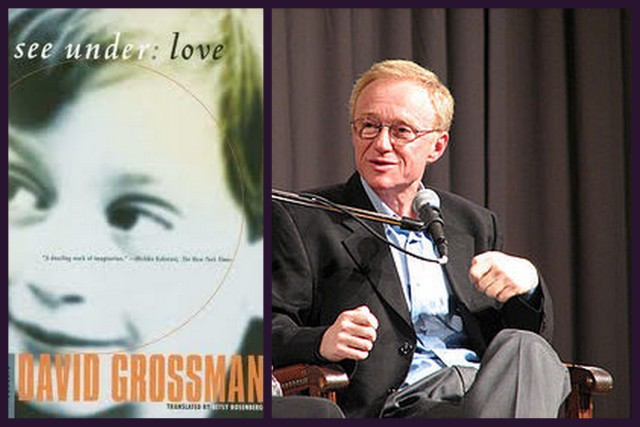
There are several different impulses that make me want to write about a book. Rarely, though – unless the catalyst is a review copy in the mail – is my impulse to just write about how rad a book is – in fact, doing so – unless the catalyst is a review copy in the mail – seems faintly ridiculous. Nonetheless, after reading David Grossman’s See Under: Love, my compulsion to translate adulation into typed language overwhelmed me. My good friend Scott had told me that Grossman had written the book for me, and I’m fairly sure he’s right, even though I was maybe fifteen when the book was published, which by the way, is the wrong age to read See Under: Love. I read it right after I finished writing (I think it’s finished anyway: time and publishers will tell) a novel about the inaccessibility of the Holocaust, and the consequent impossibility of writing about it. Grossman’s book accomplishes everything I wish I could do in mine (including making the argument that postmodernism actually is the Holocaust, not a response to it). It’s tempting to say all the things the book is: a series of experiments, a constant repetition of the same story told in different forms, an anti-postmodernism, an exercise in horror that advocates for love and ends with a prayer that is an encyclopedic entry under ‘payer,’ the most beautiful book I’ve recently (or in memory) read…Or to say how it makes me feel: like the argument for creating beauty is not in conflict with a Platonic striving to be closer to the truth, this after a decades of calling bullshit at sentimentalizing or redemptive accounts of the Holocaust, of which See Under: Love is neither.

But I ought to begin more mundanely, with a synopsis: The novel is really big, 458 oversize (for paperback) pages with words seemingly occupying every corner (I know, this is what all pages do, but it just seems like there are more words on these pages than usual). The book is broken into four experiments. To the extent that they contain a linear chronology, it’s of Shlomo, the Momik of the first section’s title, a child of Holocaust survivors who grows up in a Tel Aviv neighborhood of survivors. In the first section, Momik is a nine-year-old kid whose parents won’t discuss the Holocaust, though it looms everywhere. The section’s action begins with the return of Momik’s great-uncle, who Momik calls Grandfather Anshil, a man so broken by the camps that he is very nearly catatonic, certainly incapable of caring for himself. Anshil is the author of a once-popular children’s book series about The Children of the Heart, a band of heroes who celebrate diversity (in the band’s ethnic composition) and battle injustice. Momik comes to believe that Anshil has told a last, lost story to the commandant of the camp in which he was interred, a Herr Neigel. In Grandfather Anshil, for whose care he is responsible, Momik sees an opportunity to learn the nature of the Holocaust, which he thinks is a beast (and calls, The Beast) that haunts his parents and neighborhood. To do so, he researches the Holocaust at his local library, interrogates his neighbors, and ultimately assembles a museum of horrors in his apartment building’s basement to which, in the section’s finale, he brings Anshil and the several other utterly broken survivors from his neighborhood. When they realize what Momik has assembled, they begin keening and wailing. Momik recognizes his mistake, and recognizes “with all his nine-and-a-half-year-old alter kopf intelligence that it was too late now”(86).

This move, to attempt to compose, to attempt to learn the last story of a victim is repeated in milieu ways in each section, but by the time these stories are told, it is always already too late to reverse the mistake of thinking they might be told. In our desire, as readers, to hear these stories, we become as guilty as Momik, who grows up into the writer Shlomo – whose attempts to write about the Holocaust constitute the subsequent three experiment – who tries wrestle a last story first out of Bruno Schultz, an actual writer whose death in-ghetto-by-Nazi is tragic and absurd even by Holocaust standards, and then from Anshil himself; we become as guilty because we fall in love with the language and sentiment and action in each of the experiments, and somehow, that’s as morally problematic, as tainting, as Anshil’s realization that Herr Neigel is his last great audience, and that he needs that audience, wants it, even though it has killed his wife and child, kills thousands of Jews every day. In a way, we’re guilty of wanting life and beauty, and the novel makes us feel that guilt by allowing us to experience both beauty and lust for life, for continuance despite the Holocaust – something even the most heartless of the Nazi characters Staukeh, Neigel’s second-in-command, refuses to do, consistently trying to kill himself after the war, even though he has no remorse for his actions.

See Under: Love is one of those books that one constantly wants to quote to ones lovers and friends, either because it is beautiful, or because it seems to answer some other question that arises in conversation. But every section I try to quote ends up causing me to start reading, in the interest of context, further and further back until I find myself starting with the first two sentences:

It was like this: A few months after Grandma Henny was buried in her grave, Momik got a new grandfather. This grandfather arrived in the Hebrew month of Shebat in the year 5317 of the Creation, which is 1959 by the other calendar, not through the special radio program Greetings from New Immigrants which Momik had to listen to every day at lunch between 1:20 and 1:30, keeping his ear open in case they called out one of the names on the list Papa wrote down for him on a piece of paper; no, Grandfather arrived in a blue Mogen David ambulance that pulled up in front of Bella Marcus’s café-grocery store in the middle of a rainstorm, and this big fat man, dark but like us, not a shvartzer, stepped out and asked Bella if she knew anyone around her called Neuman, and Bella got sacred and wiped her hands on her apron and said, Yes, yes, did something happen, God forbid?

And in that second sentence is everything anyone ever need know about the world of Holocaust survivors, right down to the vague racism imbedded in the use of the term ‘shvartzer.’ And since it’s inappropriate to read several hundred pages to a friend (or lover) so that she (or he) might hear, properly, one special section, I hope all of you will allow me not to have to, because you’ll run out, right now, and buy and read this book pronto, so that you will have already read the preceding words, and we can sit and marvel at them together, guiltily.

— Jacob Paul

———————————–

Poets & Writers counted Jacob Paul’s debut novel, Sarah/Sara, as one of the 2010’s top five first fictions. His writing has also appeared in Hunger Mountain, Numéro Cinq, Massachusetts Review, Western Humanities Review and Green Mountains Review.

Apr 272010
 

jacob-10-09_115-edited

Jacob Paul is a former student of mine, a VCFA graduate, a ferocious mountain climber, and the only person I know who was in the World Trade Center when the planes hit on 9/11. 

This is a hot-off-the-press excerpt from his first novel Sarah/Sara, a book that reflects Jacob’s own orthodox Jewish upbringing, his love of Nature’s astringent extremes, and, yes, the haunting mystery of political terror and death.

dg


August 10

What will become of me? Yesterday, I skipped out on Shabbat. I wrote all day, cooked over my stove, didn’t da’aven. Basically, the only violation that I could conceivably have done, but didn’t, would have been to travel in my kayak.  And that’s the one thing it might have made some sense to do (though the fog was really too thick to travel; it seems to be fog season here). Today, on the other hand, I da’avened three times, morning, noon and night (the distinctions between which I’m coming to accept as any sense of ongoing wonder at this unmitigated day bores me now).  It makes no sense.  I don’t transgress smartly.

And here is the other thing that doesn’t quite jive. Those days on which I da’aven, do follow my structure and order, are my best; and yet I so rarely bother to pray anymore. But really, today was a perfect day. I woke up on time; promptly washed my hands and said the bruchah for that; doused myself in mosquito repellant; said Shemah and Shemonah Esrai; ate, saying bruchahs before and benching afterward; rowed out past the breakers in the fast sea like I am trained; pulled ashore for lunch saying bruchahs before eating, benching afterward, and then saying Shemah and Shemonah Esrai before getting back in the boat.

The afternoon session on the water was equally productive. I felt strong and elected to row rather than sail, blissfully blanking my mind in an exegesis of physical endurance. A small pod of white whales breached intermittently on my left – generally a common sight but anomalous in the dense fog – atomizing a sardine-scented mist that drifted in wisps of otherwise indiscernible wind and precipitated along the lee side of my boat and myself. I really stink now.  And then past that interlude, and late in the day, I rounded a rock-corniced jetty, a jumble of leaning shattered gray rock testifying to a lost glacier’s ocean border. On its far side, a concavity of black sand beach steeply shelters the facing side of a frigid trickle rushing through tundra from the hills. I set up camp on a step in the beach’s curve well above the high-water mark. Above the beach, all still passes for summer, but the sun will set soon, and once it starts to do that, darkness grows like a bad habit, staying out a little longer each night until it loses itself in a months long binge of black night and effervescent celestial light and death-cold.

I prepared a dinner of rice and beans cooked with butter and rehydrated eggs and ate it wrapped in flour tortillas. Gradually, while I ate, lifting fog uncloaked a broadening landscape. Finished eating, I benched and da’avened for the third time, leery of saying nighttime prayers proscribed for sometime after three stars come out, in what passes for broad daylight here. Finished with the day’s obligations, feeling good, swaddled in fleece, top, bottom, head and toes, and able to see the landscape for the first time in a while, I delicately felt my way down the deep rut my hull carved on the way up to what passes for surf here, my down booties finding there slightly less tenuous purchase than on the rest of the steep slick sand.

Near the waterline, the grade relented and I comfortably walked along surf-scum tailings towards a large flat rock I’d noticed on the way in.  The rock was about four feet high, and I easily climbed on top of it. Scanning the now-visible horizon, my intention was to lose myself in a meditation on my mother. I perused the ocean in front, beach and jetty to the left, mountains behind, wondering what she might think if confronted with this brutal landscape, empty of people, jagged and raw and colorful. She’d made fun of it for years. I continued my revolving watch. To my right, where the beach abruptly ended in a scrub of brush, I saw the glint of glass. I focused. Yes, the low sun caught something amber and reflective. I thought, well here’s evidence of people; trash is everywhere. I thought to go pick it up and pack it out, but figured that with all the corroded oil drums I’d passed and not thought to remove, what difference could this infinitely smaller relic make?

But I have all the time in the world, in a certain sense. There’s nothing for me to do, really, once I’ve rowed for the day. I was under no obligation or discipline to stay on my rock, thinking about my mother, and staring off into space (literally, when the clouds clear, the horizon here ends in space. I’m confident of it).  So I sort of slid-slash-jumped off the rock, smashing out twin bootie prints that seeped water like a rotten hull, and picked my way across to the shrub.

I have to say, I’ve never felt so self-consciously awkward as I did walking over, completely unobserved, to investigate this oddity in the bush. After several weeks of purposeful motion, this luxurious amble made me feel guilty. And how innocent and clear my mind was then. Because this is what I found in the shrub: my whiskey.

Abba and Eema, if you guys are watching over me, please explain what this all means. Am I being tested? Am I meant to hurl the bottle back into the surf whence it reemerged having so successfully followed me here? Am I supposed to carry it out as trash? Or am I being regranted the right to drink having had a recovery of sorts these past several days? Or is the world in fact entirely random as my mother believed? No, I’m way to creeped out to believe that this is entirely accidental.

And have I mentioned how pissed I am that in two week’s hard effort rowing – has it been two weeks since I cast off the booze? I should check this journal – I’ve made no better time than a drifting bottle. Though, in my defense, I have at my best rowed twelve hours in a day while this bottle has plugged ahead twenty-four seven, no rest stops for it. Or has it? Can’t it be possible that it too washed ashore from time to time, only to be sucked out by a changing tide, all the while wondering whether it would be better to go backwards or forwards or just stop for once and for all? Could it not have in fact been carried by a playful polar bear great long distances?

Ursus Marinus may well have seen that glinting, highland confection and taking it for a reflective bauble playfully pushed and batted it along the frozen shoreline, carrying it like a dog’s toy baby on long northward detours to ice floes past the 85th parallel. Perhaps he showed it to his friends, and in the face of their ridicule – what ferocious white bear, god of the natives, carries a manmade, glass liter bottle around with him – abandoned it back to the waves. Or maybe he had it beside him as he lurked on top of a seal’s breathing hole and when making that fateful lunge, slipped, tragically on the smooth, rolling glass, and succeeded in losing at once both libation and dinner. And maybe the seal, inquisitively trailing the stream of bubble accompanying the bottle’s temporary plunge, pushed its savior along the bottom of the ice until it reached open sea again, bidding it alas farewell, safe home, good journey. Or maybe the bear stashed the bottle here temporarily. Or maybe it wasn’t a bear at all but some people in a boat, or on a beach, who found my whiskey and expecting some special message in that buoyant bottle instead found the best of clan McCallan, aged in oak twelve years. And those people, as they passed this piece of shore, stashed the bottle for safekeeping (unlikely, the bottle hardly seemed stashed, it looked as if it had been entrapped on the backwash of wave, held back in a sieve of stunted willow as the water dropped. No, if in its journey it encountered other humans, they did not willing leave it there. And yet, they may have parted with it as willingly as I, taking that piece of dangerous trash far out into the ocean and dropping it, hopefully to never return.

Or perhaps Hashem, creator the universe, simply ceased the bottle’s existence once I cast it from me, and now, for reasons only known to the divine, has recreated it in my path.

I don’t know.

I also don’t know whether to have a drink or not.

I don’t think I’ll throw it back just yet.

August 11

Like a donkey after a carrot, I followed The Whiskey bottle duct-taped to my bow all day. It sits there, glowering, an ever-watchful, never-sleeping bowspirit; baruch Hashem.

/

August 12

White-knuckled, not-sleeping, hanging-on-for-dear-life, tehillim-reciting me is still here. And so is It, unopened. Baruch Hashem.

But I passed a long abandoned sod and wood hut today. Something I expected to see far more of than I have. I stopped there for lunch. A track where the last visitors hauled boats out persisted above the waterline. I reached and circled the hut. Behind it, meadows broken by rain-pools stretched back at a gentle but increasing slope into the foothills of the mountains, which are growing ever nearer. In a week or so, I expect to reach their near-confluence with the ocean, which will be the closest I come to the tree line on this journey, one of only two stops in towns, and the Canadian border. The hut’s roof was well set into the small rise of land on which, and undoubtedly, from which, it was built. It faced out towards the water. I went inside, an easy feat in the absence of doors. Ancient cigarette filters – lone survivors of butts long pilfered for remnant tobacco – mixed with bits of fur and random decomposition on the floor.  The space would have been claustrophobic had the front opening been closed and the sod washed away from the wood walls. In other words, restored, the hut would have been quite unpleasant.

Yet there were conveniences and comforts that made sense for a small outpost on a near empty arctic shore. The center of the floor was carved in lower, the way snow caves are, so that cold air sinks out of the structure. The walls were well shaped to accommodate sitting backs and stacks of fur. A small oil fire in here would be very warm. No longer. This place is like nature now. For decades, passing itinerants, what few there are, have probably used it to get out of the wind, maybe cook a meal. But no one vests an interest in maintaining the hut, or what others like it persist. No one counts on it as a point of return. No, nomadic arctic life is a failing experiment, even amongst those born into it. What am I doing here?

—Jacob Paul

From Sarah/Sara pages 98-103, courtesy of Ig Publishing, Copyright 2010

/
/