Feb 012015
 

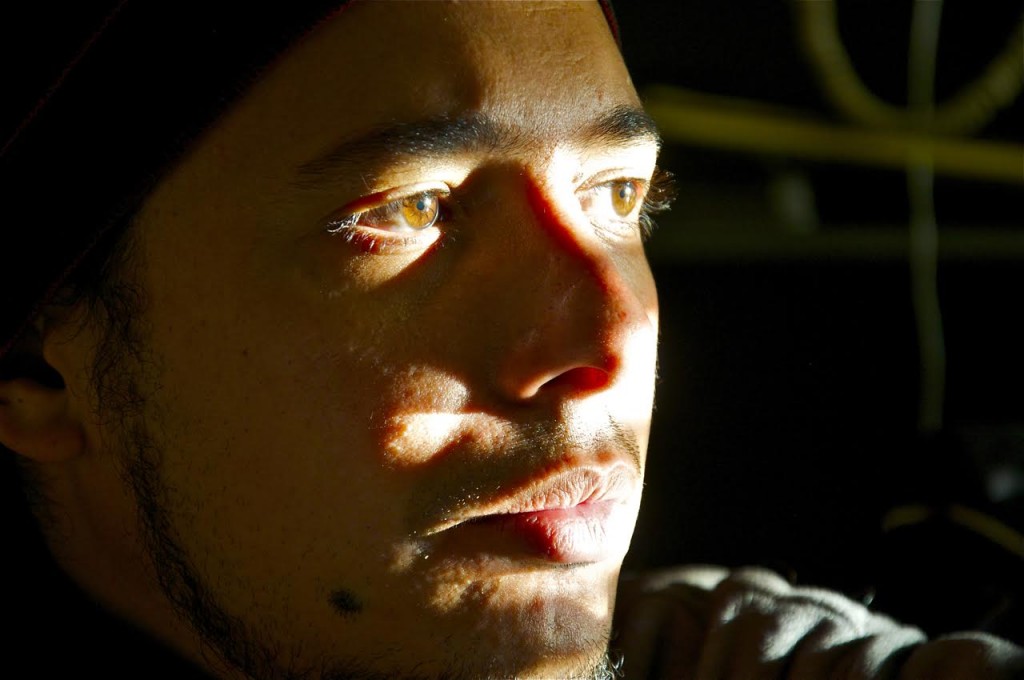
OndjakiClose

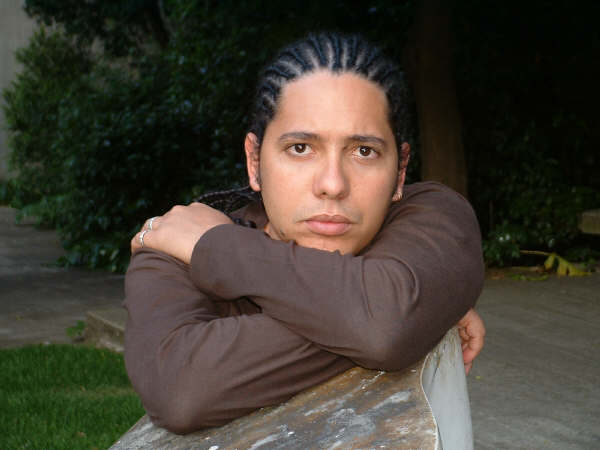
This past summer, I reviewed Angolan author Ondjaki’s novel Granma Nineteen and the Soviet’s Secret right here at Numéro Cinq. I loved the book, which read like a fun kid’s action/adventure film from the 1980s, and thanks to modern technology, Ondjaki and I began chatting on Twitter after he saw the review. Over time, our conversation—a direct message or email here and there across several months—turned into an interview, which is transcribed below. 

— Benjamin Woodard


Benjamin Woodard (BW):
What drew you into wanting to become a storyteller?

Ondjaki (O): ​I really don’t know. I guess each time someone asks this, a writer lies. I happen to like short stories, tales, and literature in general. One gets caught up in this “thing” of reading, and then eventually comes the writing.​

BW: Granma Nineteen… is only your third work translated into English. How interested are you in having your work translated? Is it important to you to have your stories reach a non-Portuguese speaking audience?

O: I am not that worried about that. I mean, I really think these things [translations] happen as they do, when they do. It’s important to me to be happy with a short story, a poem, a book. Of course translations open new doors. I don’t mean that I don’t care, but “important” could be a strong word. I see it as I write, and then some translations happen. I am happy with the result so far.​

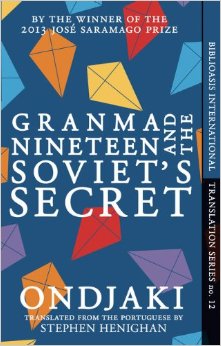
Granma

BW: You mention “being happy with a short story, a poem, a book.” What kind of process does a piece go through before you consider it finished? Does it vary?

O: I think it does. And many times I guess it’s a shot in the dark. When and how can one say “it’s ready”? I’ve had things that took me a year or two to “become” ready. And I also have pieces that took five years. Sometimes, when you’re just “preparing” (which I think is also writing), the idea can linger for more than five or ten years. In the end, you have to be happy with the result. But trying to be happy now, and forty-three years from now, it’s a long shot in the dark future…

BW: Branching off of this, you’ve amassed a rather large library of published work already in your literary career. Is seems you must have quite a bit of discipline when it comes to writing. Could you expand on your writing schedule?

O: You cannot imagine how I am laughing right now. Discipline? Me? I don’t think I recognize the word. Not when it comes to writing. I really do a tremendous effort to “wait” for the right moment. I keep working things in my mind, but as for the writing moment I tend to think there has to be some sort of magic. Or not. I convince myself that I write when “everything in me” is ready. I do not mean to bullshit, it’s just what I feel. For now. That’s why, in fact, I love short stories more than the rest. They tell me when they want to show up. Novels, yes, they require some sort of schedule, but it’s more just being available. Waiting. Like when you go fishing or hunting: it’s not about the amount you catch. It’s about the quality of the waiting time. I am still a beginner, but I “began” to understand that it’s important to wait. Just wait. The poem will come. The short story will come. Or not. I think writing is also about learning to be untroubled with both of these results.

BW: What was your literary exposure growing up? The boys in Granma Nineteen… seem to have a steady diet of 1980s adventure films, and their story reads like a children’s adventure film. Do any of these forms of media come into play with your writing?

O: I remember, after Asterix and some stuff like that, reading some “serious” Brazilian authors (Erico Verissimo, and then Graciliano Ramos), and Gracialiano was so powerful and “dry” and sad. But I liked it right away. After, don’t ask me why, I chose to read Sartre. Two or three years later, Garcia Márquez would be the most important of writers. Now, about the movies, I actually forced myself to remember certain films for the book, and that’s also to honor those days in which fiction also came into our lives through cinema and television. By fiction, I mean movies, but also soap operas. And I am aware that these were very important for my generation, so it’s also for them that I include some scenes or movies. It’s also for me: I actually would like to be there right now. If I could use a time machine only once, I know where I would go: a magical place, dusty, yellow, called the 80’s. That’s me. Still today.
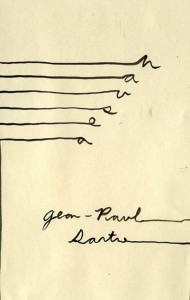
Nausea

BW: How old were you when you read Sartre? That seems pretty intense for a kid to read.

O: I think I was around fourteen. It was…somehow it was different. I remember I got two books at the same time, Márquez and Sartre’s Nausea. I did like Nausea’s main character a lot. He was lonely, he was weird, he seemed to me like a sad real person. I am not sure how much I got from that book then. It does not really matter. Every book is different each time we open it. Not so much the book, necessarily, but we are different readers in different moments of our lives. And I was in that sad mood at fourteen. Right after or right before that, I read The Hermit, the only Ionesco novel. Another sad character, another strange book. It made sense during those days. I am not sure I know why. I am not sure I want to remember why.

BW: Who do you look to as an example of a great writer?

O: I think books are more important than writers. But, right now, I guess there are three names I could not leave out of this answer: Ruy Duarte de Carvalho (Angola), Raduan Nassar (Brazil) and Erri De Luca (Italy). Any of these three (and two are still among us) should have won the Nobel.

BW: What makes you say that “books are more important than writers”? Do you mean that they are bigger than the authors who construct them, or more influential?

O: They are bigger, for sure. It’s what’s within the books that counts the most. Not the writers. It’s the body of a poem, not the hand who wrote it. It’s the memory that we have of a tree or a mountain, not so much the tree itself. Maybe the important part of a book is what you feel (or what you become) while you’re reading it. Do you feel a change in your skin or smile when you read something? Can a few (or a thousand) words change what you feel, what you are? Can a poem convince you that you can fly for thirty-seven seconds? Did you think that you could fly for thirty-seven seconds and a book made you fly for forty-nine seconds? It’s always about the meeting point between you (the reader) and the book. Sometimes, so many times, magic happens in that place.

BW: Does travel influence your writing at all? Am I correct in thinking that you now live in Brazil?

O: I think I live in Brazil now. This is where I stop most of the time. I travel a lot, I try not to, but sometimes I do travel a lot. I don’t know how it reaches my writing. I really don’t. I tend to like meeting new people and seeing cities, but sometimes it’s too much. Too many eyes, too many voices, too many airplanes. So lately airports are strange places for me. They make me sad, especially when I am returning from any place I call home. Luanda is still home for me. It’s a place that stays inside, though I’m not sure if it’s still the real Luanda. I don’t write exactly about the places I visit. Usually it’s more about the remains of those places in me. People. Moments. Trees. Colors. Shadows. Dreams. Hands. Shoes. Fogs. (Secret: sometimes I think I live somewhere in a lost bridge between now and the past.) I spend too much time not in the present. And I pay the price.

— Ondjaki and Benjamin Woodard


Ondjaki
was born in Luanda, Angola in 1977. He studied in Lisbon and Portugal. Ondjaki is the author of five novels, three short story collections and various books of poems and stories for shildren. He has also made a documentary film, May Cherries Grow, about his native city. His books have been translated into eight languages and have earned him important literary prizes in Angola, Portugal and Brazil. In 2008 Ondjaki was awarded the Grizane for Africa Prize in the category of Best Young Writer. In 2012, The Guardian named him one of its Top Five African Writers. Good Morning Comrades marked Ondjaki’s first appearance in English. Granma Nineteen and the Soviet’s Secret, launcing Spring 2014, is his newest English translation.

Woodard Bigger

Benjamin Woodard lives in Connecticut. His recent fiction has appeared in Cheap PopdecomP magazinE, and Spartan. In addition to Numéro Cinq, his reviews have been featured in, or are forthcoming from, Kenyon Review, Necessary FictionPublishers WeeklyRain Taxi Review of Books, and other fine publications. You can find him at benjaminjwoodard.com and on Twitter.

.
.
Jul 032014
 

Ondjaki

Granma Nineteen and the Soviet’s Secret succeeds both through its deconstruction of the adventure story and in its full embrace of the genre … one can only hope that more of Ondjaki’s work finds its way through the translation process. His is a voice the entire world should have the pleasure to experience. — Benjamin Woodard

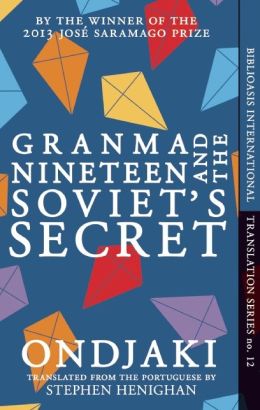
9781927428658_p0_v2_s260x420

Granma Nineteen and the Soviet’s Secret
Ondjaki
Translated from Portuguese by Stephen Henighan
Biblioasis
192 pages ($18.95)
ISBN 978-1927428658

.

Angolan author Ndalu de Almeida, who writes under the mononymous pen name, Ondjaki, is something of a literary wunderkind: at 36 years of age, he has already published 20 books, won the José Saramago Prize for Literature, and been named one of Africa’s best writers by The Guardian. And yet, though celebrated throughout his homeland, Europe, and South America, he remains relatively unknown in the English-speaking world. This is unfortunate, for the newly released Granma Nineteen and the Soviet’s Secret, a devilishly simple-yet-sturdy tale of childhood and revolution (and just the third work of Ondjaki’s to appear in English), proves how behind the curve we English-speakers are: so often doused by literature hampered by the overly serious, Ondjaki’s writing, full of humanity, vivacity, and character, is a whimsical breath of fresh air.

Skillfully translated by Stephen Henighan, Granma Nineteen is set in Luanda, Angola in the 1980s, years after Angola’s independence from Portugal, but firmly entrenched in the country’s long civil war (which mostly occurs off-screen), and follows the daily lives of the residents of Bishop’s Beach, a community of mostly children and grandmothers. The story is told through the eyes of a young, nameless boy, as he and his friends (in particular Pi, or 3.14) wander the neighborhood and mingle with a menagerie of delightfully nicknamed locals—Comrade Gas Jockey, Crazy Sea Foam, Dr. KnockKnock—and equally interesting Soviet troops, who occupy the land in an effort to support the ruling political party. The troops are also overseeing the construction of a massive, rocket-shaped mausoleum to house the corpse of fallen President Agostinho Neto, and it’s this structure that sparks the novel’s conflict: rumors arise that the Soviets plan on dynamiting, or “dexploding,” several homes in the beachside community to expand the tomb. Hearing these whispers, the children decide to take on the Soviets, planning a secret attack on the mausoleum in hopes of driving the invaders away before their land is destroyed.

The novel opens in medias res: there is an explosion in Bishop’s Beach, and as the dust begins to settle, it appears as if the neighborhood’s giant mausoleum has started to crumble. From here, Ondjaki leaps backward in time to tell the story leading up to this moment. It’s a well-worn trick, the flashback, one often used in action films, where the viewer is immediately dropped into the action, only to then step back and learn about the situation. Adding to this, Granma Nineteen’s premise certainly reads as if it lifted elements from the plots of many children’s adventure films from the 1980s (think The Goonies, or Explorers, or Red Dawn). But what’s intriguing about Ondjaki’s story is how fully aware it is of these familiar tropes. Rather than existing as a paint-by-numbers adventure, the novels functions as almost a commentary on the formula, with Ondjaki’s narrator constantly referring to the films he and his friends take in at the local cinema as they plan their attack. These children know how movies work, and apply this knowledge to create an adventure. For example, the first time the gossip of dynamite being smuggled in by the Soviets is raised, 3.14 says, “In cowboy movies dynamite is for blowing up trains, houses or even caves, to find gold” (18). This reference to cinema continues two pages later, when the narrator spies on the mausoleum from his bathroom. He turns off the light to remain invisible to the outside world. “I’d learned this from a war movie,” he says (20).

By constantly having his characters live out and reference moments from their favorite films, Ondjaki’s narrative succeeds on two fronts: first, a steady verbal rhythm is created. The word “movie” appears 26 times throughout the thin volume, and with each mention, the reader is simultaneously transported back to the previous mentions (a flashback-within-a-flashback, if you will) while also propelled forward within the narrative. This creates a wonderful looping rhythm to both the piece and the language within. Secondly, these moments reinforce to the reader the fantasy that is the novel: Only in a film would a ragtag group of youngsters take on a military force with nothing but their wits and courage. And this is where Ondjaki’s flashback structure also helps cleverly underline the narrative as that of playful, rambunctious popcorn. Knowing the mausoleum will be ruined at the beginning of the story allows the reader to fully embrace the events that lead up to the explosion.

In using a child’s perspective, Ondjaki writes a political rally cry of a novel without ever having to dedicate space to heavy political rhetoric. Angola in the 1980s was a cog in the Cold War, but these ideas mean nothing to a child. As such, while Ronald Reagan is mentioned, it is through the beak of a parrot as the children launch their attack:

We ran forward, then went in stealthily along the side of the veranda so that Granma wouldn’t call us. The yard was dark. The parrot His Name shouted out to expose us: “Down with Amer-ican imperialism.” We made an effort not to laugh: the words came from a television commercial that hadn’t run in a long time. Just Parrot finished off: “Hey, Reagan, hands off Angola.” (143)

Instead of talking politics, then, Ondjaki’s protagonist and his friends stumble through their adventure chatting about the things that ring true to children: cheating in games, the proper way to make fun of a superior, and the queasiness of the fairer sex. These are children who threaten to “smash your face in” (36) one moment, and then barter the next, as in when 3.14 and our hero attempt to procure a pair of pliers from Madalena, another child:

“You guys…You talk and talk and you don’t say anything.”
“You’re the one who’s not replying.”
“What was the question?”
“The question was about the pliers.”
“There must be a pair in the toolbox.”
“You can’t just lend them to us?”
“‘Just lend them’? Just how?”
“Just like that.”
“And if they catch me in Granma’s stuff. Aren’t they ‘just’ going to give me a thrashing?”
“No, Granma will only give you a kind of thrashing.”
“I can go see if they’re there.”
“Thank you, Madalena.”
“What’s this thank-you stuff? Thank you is what you say to the Comrade Teacher in school. Here there’s going to have to be salt for us to eat with green mangoes.”
“But haven’t you got the key to the pantry?”
“No. It’s in the display cabinet.”
“And the key to the display cabinet?”
“It’s in Granma’s room.”
It was agreed: salt in exchange for the pliers. Later she showed us a huge pair of pliers with a plastic grip that would be great for cutting an electric cable. We had already seen this in movies and everybody knew that to cut electric cables you had to be wearing shoes, wrap the pliers in a piece of cloth and not have wet hands or feet. (39)

Ondjaki rarely employs dialogue tags in exchanges like this, which adds to the chaotic nature of the moment. This chaos highlights an interesting concept: The reader doesn’t really need to know when 3.14 or the narrator or Madalena is speaking, for in the land of children, it’s less about who is speaking, and more about the end result of the conversation. Want conquers all. And here, Ondjaki also returns to the motif of cinema, lending the dialogue an association with the rapid-fire tête-à-têtes found in the screwball comedies of Preston Sturges and Howard Hawks. Again, the escapism of the children influences their lives.

In the end, Granma Nineteen and the Soviet’s Secret succeeds both through its deconstruction of the adventure story and in its full embrace of the genre. Added to this are Ondjaki’s quirks—the children wonder if Crazy Sea Foam has a pet alligator, the titular grandmother earns her moniker after losing a toe—and his uses of magical realism—one of the grandmothers turns out to be a ghost—which combine to build a story unique in its straightforwardness. In finishing Granma Nineteen, one can only hope that more of Ondjaki’s work finds its way through the translation process. His is a voice the entire world should have the pleasure to experience.

 — Benjamin Woodard

 .

Woodard

Benjamin Woodard lives in Connecticut. His recent fiction has appeared in, or is forthcoming from, Cheap Pop, decomP magazinE, and Cleaver Magazine. In addition to Numéro Cinq, his reviews have been featured in Necessary Fiction, Publishers Weekly, Rain Taxi Review of Books, and other fine publications. You can find him at benjaminjwoodard.com and on Twitter.

/
/