May 312015
 

Mark Jarman Story- St. John RiverMark Anthony Jarman

…in the end the strength of the writing itself is like magic, few authors can pull this off, and the final impression is absolute: Italy – dry, beautiful, graffiti strewn, tourist ridden, sexy, fake – and the narrator – lost, bored, amused, searching, lustful – are far too complementary and this is no haven for lost souls seeking redemption, and no one will be rescued from firestorms of ash and lava. —Lee D. Thompson
cover

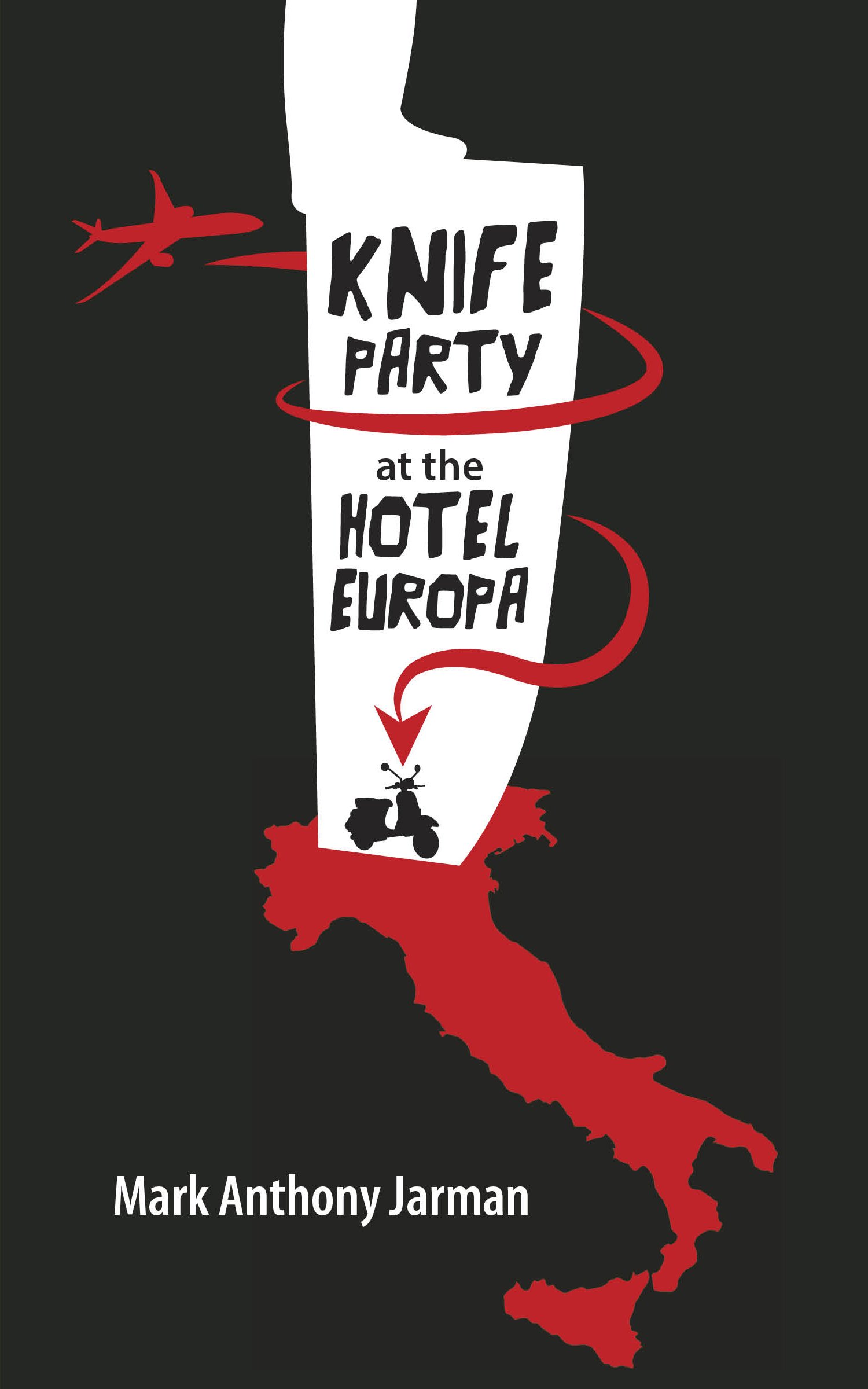
Knife Party at the Hotel Europa
Mark Anthony Jarman
Goose Lane Editions
HC 285pp.; $29.95

.
The twelve short stories in Mark Anthony Jarman’s fifth collection, Knife Party at the Hotel Europa, form a strange, wandering, quite aimless narrative that runs throughout the book. I almost wrote “throughout the novel,” because by a third of the way in, as characters and settings reappear, it begins to feel like a novel, though not a typical novel. The sections do work as short fiction, and Jarman, one of Canada’s most-respected short story writers, is no stranger to the form, and the stories here have all appeared separately in journals or online. So, is this a story collection, or a novel? Well, it’s a bit of both, really, and it also feels like a travelogue, though this is no Fodor’s Guide to Italy.

Not that I think it’s important what category Knife Party at the Hotel Europa fits into. This lack of definition is part of the appeal and likely Jarman’s design.

As is the aimless narrative, the wandering narrator.

This narrator, who is never named, this I in Italy, is in turns all mind, and all… cock.  Can I say that? Well, I already have. He is on a vacation, or in exile (it’s hard to tell), renting an apartment in Italy, where there is something he is trying to forget (so says a gypsy woman). He’s down, he’s dour, he has unconvincing thoughts of snuffing himself, but he’s invited to join an ‘art group,’ a tour run by one Father Silas, who owns an illegal art school in Italy and is a friend of the narrator’s aunt. The nature of the art group or school is never really specified (but you’re in Italy, so there’s art, and there are tours), but does act is a kind of binding thread to the collection, as do the few recurring characters on the tour. We never get to know Father Silas, or Ray-Ray, or Tamika much, or the narrator’s dear aunt, but we need bearings, even if the actual viewing of art seems of little importance to the narrator (but he catches on, follows, drifts away). Adding to the man-adrift theme is the narrator’s current life-mess: he’s middle-aged, in existential crisis, separated/divorced from his wife, reeling from the loss of an all-consuming affair with Natasha (who had cancer, but also left him), and suffering a general lack of direction.

The book’s themes are ones of wandering, of gypsies, tinkers.

And decay, and false idols.

It’s a dense, rich book, but the opening story, “The Dark Brain of Prayer”, hides little:

My tainted life, my travels: vaguely free to travel to Italy, Ireland, Death Valley, to ski distant peaks on a whim, mobile, but always a trade-off, no stable home life, no one to depend on. Perhaps because no one can depend on me?

A strong story in its own right, “The Dark Brain of Prayer” also serves to situate the reader in the narrator’s life. We see that he’s Canadian, lives in a city with streets called Queen and King and travels to towns with names like Sackville.  These touches serve to keep us close to the narrator, who, like Jarman, appears to live in Fredericton, New Brunswick, a city of flooding rivers, fiddleheads, and crab-apple blossoms.

“Butterfly on a Mountain” follows. It’s meditative, mostly plotless, meandering, funny. And, importantly, we meet Eve. She’s all old world temptation to his new world snake.

Eve is the narrator’s cousin, though their relationship is never explained beyond that, she lives in Switzerland  and she comes in and out of the stories (in the recursive Eve entries and with the occasional return also of Natasha we can see how the collection has been purposefully linked, though it’s not quite a novel, but right, that’s not important), meeting up with the narrator, and they stray from the tour, and she, inevitably,  becomes his lover (but there’s no sin here, sin in their minds having been worn to rubble like ruins in Rome). Eve is well drawn, sophisticated, educated, unpredictable.  The narrator can never get to know Eve, he muses, just as he can never get to know Italy. But he is, once again, infatuated, and Jarman’s stunning prose captures it all.

The bone-green air between the tree trunks, the green shadows between the trunks; who owns that property? I feel Eve owns any part of the world where my eye strays.

Introduced to Eve, we come to the book’s glittering gem, the harrowing, surreal, and utterly believable story “Knife Party”, a nightmarish, drug-induced excursion to a party of strangers, of cocaine and Italian testosterone and a crazed neighbor with a staple gun. There’s a menace throughout the story, and as the title lets us know, it won’t end well, but Jarman’s ability to introduce both humour (“I want to start a new dance craze […] do the Lazy Lawyer, do the Dee-vor-cee dividing his assets into shekels.”) and suspense (“The neighbour makes it to the door, but falls in the hall like a Doric column. He has bled out. […] Spying blood and a body, the woman dials her silver phone, whispers, Madonna save us.”)  gives the story a gory, car-crash appeal. We can’t turn away; it’s too lurid, too new. Too life affirming?  A strange thought, but in the quieter, meditative story that follows, “Hospital Island (Wild Thing)”, a retreat to Rome, the narrator does feel this trauma has somehow lessened the impact of the loss of Natasha, providing “gruesome perspective,” he says.

But disaster now follows the narrator and Eve, as if they’ve been cursed in their journey (in fact, the narrator is cursed by a gypsy woman in the opening story, though he complains that her curse is far too unspecific to be believable). They flee the knife party into the night, only to stray into the next story, another of the book’s highlights. “Adam and Eve Saved from Drowning” is a story that muses on Canadian soldiers and tanks in World War II rolling through Italy, on a dear uncle killed in battle in Ortona, and where our less-than-adamant narrator and his Eve stroll upon a Roman explosion, a mail bomb at an embassy and man’s lost hand, and where, later, a brilliant day of sea kayaking leads to a small cove and men fishing men from the sea, fishing drowned boat people, migrants to a country that allows so many migrants, yet seemingly welcomes none. The bodies are lain upon the shore:

Men with mustaches and suitcases with wet sand glued to their black coats; this crescent beach was not their destination, but now they are stopped on the sand, their mouths stopped, now they are at their destination. Their skiff sank in riptides, and long lines of spray, their hands let go and their mouths let in sea and sky.

This is a turning point. At the end of the story, Eve leaves at handwritten note under his door while he’s away, writing that while the thought of never seeing him again is intolerable, it might be best. “You do make me happy, but I can’t seem to feel calm.” The narrator then muses:

Eve said I was detached, difficult, maddeningly stubborn.

I thought I was easygoing.

It’s this introspection that gives the book much of its uncanny appeal. Do we even like the narrator? Yes, we do; everyone does.  Throughout Knife Party at the Hotel Europa we see a mind at work, a mind that’s endlessly male, musing, heat-addled, a mind made vivid through Jarman’s jazzy, poetic, associative prose. We see his mind’s inner workings, the intimate thoughts, the fantasies, the reveries, the trivia. In a book of travels, Jarman often goes farther afield in his head than on the map, and the book at times takes on the feeling of a confessional stall.

Take, for example, the final section/story, “The Pompeii Book of the Dead”, a near novella-length story that for all its surreal touches, has the feeling of non-fiction, but it’s as if Orwell, before writing one of his book of travels, came across a clump of peyote and found narrative liberation. When approached by a prostitute in Pompeii (at a cafe called Irish Times), the narrator muses:

I flirt with the Croatian maid, I flirt with the cryptic Spanish woman, I stare at my cousin’s form, I stare at every waitress. Then a woman and I share a tiny table in Italy, in Europe, on the planet, and for a handful of Euros I can do certain things for a certain time. How perfect it no longer seems.

There is a young American traveler, an attractive Iraqi refugee, there are women at every corner, in every dream. But Jarman, before getting too deep in his narrator’s self analysis, pulls us into a surreal section involving the narrator and several small statues (come alive from his apartment windowsill and which include a distractingly priapic Priapus) and sends us prowling the alleyways for deep-fryer grease with this ridiculous gang of lard thieves:

The Italian PM must pay his estranged wife a hundred thousand Euros a day; how can he have that much and we don’t? The grease in our alley reeks. Lewd Priapus is with us, but he is not doing well, is not popular, his huge phallus gets in the way of lugging the sloppy plastic drums.

Why does this work? Why can certain writers lead us down a path of folly and not lose our interest? There’s something always on the cusp with Jarman’s fiction, beauty quickly turns to horror, play turns tragic, reality loses all meaning, and we accept that this world, his world, is unstable. It makes for thrilling reading.

In this final story, a masterpiece of pacing, tension, and setting, we also have Jarman’s most haunting touch, the narrator’s observation of a young Italian couple in love. They could have been plucked off a postcard, or tourism billboard. He observes their tenderness, their perfectness as they lie on a bench above a cliff, and wonders if anyone (Natasha) had ever been as tender with him. But he forewarns us, tells us they will die when his tour bus collides with their scooter along the Amalfi Coast. When the scene comes pages later we still hope for another outcome. Surely he won’t? But the young lovers die horribly, almost tragicomically. Jarman seems to be saying there is no postcard Italy, just as there is no postcard love, everything is throwing itself into the sea.

So Knife Party at the Hotel Europa is not a  novel with a happy conclusion, and it shouldn’t have one. The narrator does appear to have learned something about himself, but it’s a vague, sloppy realisation. He is who he is.

Does the book have flaws? At times Jarman’s riffing may be predictable (not in what’s written, but that it’s coming), something that works for an individual story can seem repetitive after 285 pages. The tendency to go off on tangents till reason falls off a cliff, or add an absurd third thing to a previously serious list, might wear on a reader. But in the end the strength of the writing itself is like magic, few authors can pull this off, and the final impression is absolute: Italy – dry, beautiful, graffiti strewn, tourist ridden, sexy, fake – and the narrator – lost, bored, amused, searching, lustful – are far too complementary and this is no haven for lost souls seeking redemption, and no one will be rescued from firestorms of ash and lava. Like Pliny the Elder rowing to Pompeii, there’s not much he can do to save the situation, but it’s quite the spectacle and well worth watching.

—Lee D. Thompson.

.

Lee D, Thompson.

Lee D. Thompson was born and raised in Moncton, New Brunswick. His fiction has been published in four anthologies, including Random House’s Victory Meat, New Fiction from Atlantic Canada and Vagrant Press’s The Vagrant Revue of New Fiction, and in more than a dozen literary journals across Canada and the US. Lee’s first novel, S. a novel in [xxx] dreams, was published in 2008 by Broken Jaw Press. An e-book, Diary of a Fluky Kid, appeared with Fierce Ink Press in February 2014. In addition to writing fiction, Lee is a guitarist and songwriter who records under the name Pipher..

.

Sep 272013
 

The first big (the Toronto Globe and Mail) review of Savage Love, and it’s beautiful, intelligent, well-written and perceptive (if I do say so myself). I could not have asked for a better reading. I am touched. The reviewer knows my work well enough to gauge the differences between my last book of stories and this one, the modulations of theme, and so on. He does a wonderful job of illustrating the emotive range of the texts. It’s rare to get this kind of adult attention, let me tell you.

dg

Douglas Glover is a distinguished member of the tribe of Nabokov. Glover is as gifted a writer as Canada has ever produced and the source of his strength is the ferocious quirkiness of his sentences.

Glover’s new story collection, Savage Love, is an astonishing book only partly because of the loopy and incessant inventiveness of his narratives. The 22 stories range daringly in space and time, taking us from a stomach-turning battle scene during the War of 1812 to a contemporary farm family whose sheer wackiness, condensed into 25 pages, puts to shame any eccentric clan one can think of, whether it be J.D. Salinger’s Glass family or Wes Anderson’s Tenenbaums.

These stories are rich in plot, full of love triangles, murders and descents into madness. The appalling events Glover describes might, in the hands of a lesser writer, seem like mere attention-grabbing sensationalism. Yet his stories leave a genuine emotional scar, because the words he uses are sharp enough to claw into us.

Read the rest at Douglas Glover comes out swinging, prose first – The Globe and Mail.

Sep 182013
 

1. I live in a virtual world outside my real country and in a place where I get my mail addressed to another place entirely. For lack of a literary community, I invented one: the online magazine Numéro Cinq. It started out as a student blog for a class I taught, then it became a literary blog, then it became a magazine. It keeps shedding its skin. It’s a community. I have re-found old friends, formed new friendships, become a patron for new writers, resuscitated the forgotten, changed people’s lives for the better and made myself a very busy person.

Read the rest via Five Things Literary: The Virtual Literary World, with Douglas Glover | Open Book: Ontario.

Sep 102013
 

Here’s the second in a series of short essays about writing sentences that I am putting together for the National Post in Toronto this week as part of the promotional fanfare leading to the publication of Savage Love. Yesterday I did but-constructions; today we have the rhetoric of lists. Here’s a teaser; it was just published earlier this evening.

dg

    The first technique I learned and applied consciously was the list. This was in an early story “Pender’s Visions” that begins with a line – “Pender is a bottle, a glass, a table, a gun, a house.” The line becomes a refrain through the text, only to modulate in the last section of the story into “Pender, a bottle, a glass, a table, a gun, a house, a world…”

    This was, as I say, a first attempt (no apologies for being young), but you can see the rhythmic effect of a long series that becomes a structural effect by the repetition of the line throughout the text, and then becomes a thematic effect by the modulation of the series at the end. The modulation is especially significant because a series (of vaguely like entities) creates reader expectation, and the reader always enjoys having his expectations tweaked.

    Rabelais was a gargantuan list-writer. In an early chapter of Gargantua and Pantagruel, he gives a paragraph long list of plant matter the boy Gargantua uses to wipe his butt. “Then I wiped myself with sage, with fennel, with dill and anise, with sweet marjoram, with roses, pumpkins, with squash leaves, and cabbage, and beets, with vine leaves, and mallow, and Verbascum thapsus (that’s mullein, and it’s as red as my _____)–and mercury weed, and purslane, and nettle leaves, and larkspur and comfrey. But then I got Lombardy dysentery, which I cured by wiping myself with my codpiece.”

    This is complex and hilarious, hilarious because it is a long silly list that contains some very odd choices. Pumpkins? Note also that list makers pass on conventional punctuation and grammar. Instead of a series of items separated by commas right to the end, Rabelais modulates to comma-and breaks, then reverts to the earlier convention, then goes to comma-and to the close of the sentence. A lot of “ands.” Rhythm is everything in a list, but you don’t want the rhythm to send the reader off to sleep.

    Rabelais also disrupts the list with the Latin name for mullein and inserts a comical parenthetical (breaks voice, as it were) and comments directly to the reader, creating a syntactic drama that breaks the rhythm temporarily. Then he adds a but-construction (see my previous column) that gives the list a plot. Instead of an endless repetition of the same wiping act, the boy gets dysentery (with an ethnic slap at Lombards). Then we come back to wiping.

    This is brilliant list writing because it’s outrageously funny, rhythmic, and has plot. The basic principles are all there: list, rhythm, disruption (by changing up series members, by grammatical disruption, by authorial interruption, by but-construction), and plot.

Read the rest at the National Post.


Sep 102013
 

Gordon Lish, known as Captain Fiction in the days when he edited fiction at Esquire Magazine, was my editor for my novel The Life and Times of Captain N. (Knopf, 1993). As I recall, Lish wrote the flap copy for that book, and he sent me to bill hayward to have my picture taken for the cover. Gordon also published a story of mine in The  Quarterly, “Swain Corliss, Hero of Malcolm’s Mills (Now Oakland, Ontario), November 6, 1814″ (it’s in my collection 16 Categories of Desire). Both bill and Gordon have now graced the pages of Numéro Cinq, and we’ve published Jason Lucarelli’s astonishing essay on Gordon Lish and his concept of consecution not to mention the radio interview I did with Gordon, yea, these many years ago. Gordon graciously consented to write a cover blurb for my book of stories, Savage Love, just now on the brink of publication. He sent me this page — he doesn’t use email (mostly he sends handwritten messages on blank white USPS postcards). It is typical of Gordon, ebullient, incantatory, celebratory, exotic, and dramatic. It was too long for the book cover, but he was graceful about letting me cut it, despite his admonition to the contrary at the bottom. Here are his words as they appear on Savage Love:

I, your admiring reader, report myself ever again restored to find in hand the company of your righteous sentences, shout hooray, shout hooray, even splendid, splendid, splendid (borrowing from the great poet Jack Gilbert), like loins, he wrote, like Rome, he wrote . . . .

And here, resplendent in all its glory, is the original, which, in fact, I like much better and for which I am deeply grateful.

dg

scan0024-001


Sep 072013
 

Fresh Air resident “bookies”—CBC book columnist Becky Toyne and CBC Books producer Erin Balser—joined Mary to recommend some of the hot fall books..

Listen to the radio clip audio (runs 7:22)

Erin and Becky’s recommendations:

DOCTOR SLEEP by Stephen King
BLEEDING EDGE by Thomas Pynchon
OH, MY DARLING by Shaena Lambert
KICKING THE SKY by Anthony De Sa
SAVAGE LOVE by Douglas Glover
THE LUMINARIES by Eleanor Catton


Aug 302013
 

Savage Love Cover

This reading is courtesy of Dan Wells and Biblioasis, who published my essay book Attack of the Copula Spiders last year. I’m very much looking forward to seeing Dan again and the Biblioasis Bookstore and also to standing on the Windsor side of the river and looking across at Detroit, the largest bankrupt city in America. (Actually, the truth is that it’s always a stirring sight. I used to drive to Detroit to look at the collections at the Detroit Institute of Arts, which was founded in better times.) Biblioasis is a great Canadian publishing house; Dan Wells is a hugely energetic and innovative literary entrepreneur. As you’ve read along with NC, you’ll have noticed translations and excerpts from several Biblioasis books.

dg

On September 16th Biblioasis is proud to present an evening with Douglas Glover (Savage Love; Goose Lane, 2013) and Catherine Bush (Accusation; Goose Lane, 2013).

Douglas Glover’s new collection of short fiction demonstrates once again that the GG- and Writers’ Trust Award-winning author is a master stylist and more. Also featuring four-time novelist and national bestseller Catherine Bush, this event is a must for fiction-lovers and aspiring writers alike.

Location: 1520 Wyandotte St. East
Hours: 7:30 pm
Email: info@biblioasis.com

via :: Biblioasis :: FRESH LIT (Not Canned) :: The Best in IndieLit.

Aug 092013
 

Christ Church Cathedral, Fredericton

Lucy and I are heading to Fredericton, New Brunswick, in September for a gig as Writer in Residence at the University of New Brunswick (I am going to be the writer, Lucy will be the dog in residence). I’ll be there until May more or less. There will be no disruption in service to NC readers, except for the usual disruptions. I will dedicate a page on NC to my activities as WIR, readings, special workshops, parties, masked balls, protests, riots, police arrest reports, and such. No doubt many of you will be chartering jets and buses (bring your passports).

New Brunswick is familiar ground to me. I taught philosophy at the University of New Brunswick in 1971-72. I worked as a reporter at the Evening Times-Globe, a daily newspaper in Saint John, 1972-73, my first (of many) newspaper jobs. I was the Writer in Residence for a year at the university in the the late 1980s. The Saint John River Valley is a beautiful and mysterious place to me. I particularly love walking home down University Avenue late in the evening on a fall night. And I have many friends there. My longtime, loyal, and beloved publisher, Goose Lane Editions, is located in Fredericton. I’ll be living in Mark Anthony Jarman‘s vast warren of a house on Waterloo Row (another denizen is NC Senior Editor R. W. Gray). NC’s famous weight-lifting poet Sharon McCartney also lives in Fredericton. As does Gerard Beirne among others including several contributors to the NC at the Movies slot.

dg


Jul 172013
 

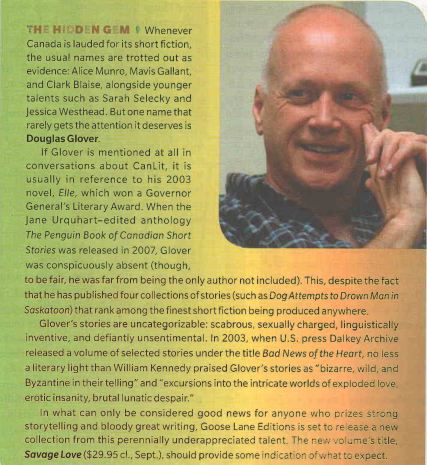
This is just out. Print edition of Quill & Quire in Toronto. It’s very nice but, of course, I wasn’t born under a rock. What is this constant mantra: the unknown Douglas Glover? Why is it that people can only remember that they have forgotten me? There is some deep phenomenological issue to be explored here. Or possibly a medical trend?

Re. the photo: This is one of set of photos taken during a writing class at Davidson College. I had assigned the class an exercise: write a sex scene. They were reading them out loud, hence the uncharacteristic expression of quizzical delight on my face. I learned things during that class that I never wanted to know.

All this is beside the point. You can pre-order my book at immense savings.

p.s. I like being called “scabrous.”

dg

Quill and Quire preview of Savage Love by Douglas Glover

Jul 192011
 

Editor’s Note: Sharon McCartney’s poem “Katahdin” (below) has been selected by Carmine Starnino for inclusion in The Best Canadian Poetry in English 2012. The series advisory editor is Molly Peacock.

Sharon McCartney is an old friend, one of the Fredericton, New Brunswick (the centre of the universe—let’s be clear), literati, also a graduate of the Iowa Writers Workshop, also a prolific, prize-winning poet. These are poems about the body and transcendence, about the contradictions of love, about flying yet being buckled down—the normative tensions we all feel, in spades. Sharon is the author of For and Against (2010, Goose Lane Editions), The Love Song of Laura Ingalls Wilder (2007, Nightwood Editions), Karenin Sings the Blues (2003, Goose Lane Editions) and Under the Abdominal Wall (1999, Anvil Press). In 2008, she received the Acorn/Plantos People’s Prize for poetry for The Love Song of Laura Ingalls Wilder. It’s lovely to have her poems grace these pages. (Author Photo by Gabriel Jarman)

dg

Antiques Road Show, Kathadin & Other Poems By Sharon McCartney.

Antiques Roadshow, Katahdin & Other Poem

By Sharon McCartney

.

Giardia

The dog’s crushed mien, ears underslung, brow
low, as if he anticipates a cuffing, so mortified
by his unbidden inner turmoil, intestines bubbling.
He refuses his meat, corkscrews his torso, nose to ass,
as if to ask, Why? What does this mean? Or simply
to snap away the itching chigger of ignition. But
the root’s too deep, the inbound cysts redoubling
in subdermal subterfuge, his bowel’s womb warmth.
Poor sad thing. Empathy won’t cheer him, but I do
know how it feels, pain without meaning. Nowhere
to look but within. Whatever the cause, the impurity’s
source, he took it in, bad river water, morsel of carrion,
just as we all ingest delusion, denial, self-deceit,
the insalubrities that corrupt our gut and send us lurching,
chest-clutched, to the nausea of defeat, unmasked,
that demon in the mirror who points a digit and laughs.

.

Leg Press

Nearly prone, heels pushing ceilingward,
then ceding to gravity, to fear, knees descending
to sternum, a worthwhile grind in the hamstring.
The new pain is all self-inflicted, like gouging
a wound, a willingness to suffer and in that
extremity, transcendence, freeing oneself from
triviality. The bodybuilder says, pain is weakness
leaving the body. Each day a different muscle group,
yet always seeking symmetry, balance. He knows
it’s not what you lift, how many pounds, but how
you lift it, that the range of movement is what
quickens the muscle to consciousness. The bulge
of the quadricep surfacing like that awful awareness:
my love did not have to die, but I had to kill it.
.

Reverse Fly

Gravity’s the man beneath me, anchoring
me to the up-tilted bench, seductive, sweat-
beaded embrace that engages the rhomboid,
the rear delt. Not the weight, itself, but the force
that bestows weightiness, disheveled hombre
whose romantic fantasy feeds me, who would
drag me down if I did not resist, 17.5 lbs. in
each fist, straining back and away. Gravity’s
that urgency, the abyss of desire, divine madness
somewhere within that makes me not only gasp
for his illicit kiss in the dark, husk to husk, back
to wall, but also to beat him off, to disever.
Not the struggle, but the strength unearthed,
molten matter of nickel and iron inwardly spinning,
adamant and unrelenting, endless and unfathomable.
.

Katahdin

Why couldn’t I love him? He was all good morning
beautiful and you deserve to be spoiled, bringing me coffee
in bed, balancing the cups in that prissy way. Why couldn’t
I ignore that? His air of resignation, slumped behind the wheel,
always just under the speed limit, docile yes officer at the border.
Nothing on him to give those in authority what they want.
To my, this isn’t going anywhere, he said, well, I like what I see.
His respect for social order, corporations, the business section.
Not rights, but responsibilities. His regret for the years I spent
smoking dope. A whiz with engines, quadratics, but not overly
analytical. Something about beer, pizza and women, he said.
And mountains, escorting me to the top of Katahdin, a mile
high, on a lucent autumn day, a small Gore-Texed crowd
dazzled at the summit, taking in Chimney Pond, the knife
edge. But all I wanted to do was get back down.
.

First Flight in Five Years

No need for fear, nor hope, flight’s
timelessness coursing through me,
humming with the engine’s overture,
acceleration fueling euphoria as I dare
myself to look down, all of the paralytic
restrictions of the past, my anxiety of
incompleteness, grasping, as far away
now as the frost-heaved tarmac below,
wings tilting, banking, that wonky view
imparting a new perspective. Free of the
binary logic of groundedness, the be or
not be, pull and release. Yes, I’m buckled
in, book on my lap, as caged as the flock
of finches stowed, oddly, in the cramped
aft of this commuter aircraft, but I’m also
out there, aloft in the thin air, the updraft
of ambiguity, delimitation, giving in and
giving up and the transcendence of that,
birdsong, enginesong, dermis and hull,
indivisible as we ascend and turn.
.

Antiques Roadshow

But for his pearl buttons, he’s a dead-ringer
for my long-gone father, silver mop swept back,
comfortable paunch, blue hint of bemusement
in the iris. Arrives with an old Indian blanket
he’s slung over the back of a rocker forever.
Says it belonged to Kit Carson once. Dignified
in his discomposure, shifting on his toes.
He’s pleased to tell the story, his link to immortals,
but too proud to grasp. The appraiser’s apoplectic,
choking, his voice cracking, “Did you see my face?”
It’s a Ute “first phase” chief’s wearing blanket,
the purest form of Navajo weaving. Priceless
in its simplicity, yet the bidding would start
at half a million. More if the Carson link’s proven.
It’s like glimpsing my father crying in the garage
so many years ago to see this man’s unconcealed
confoundment. Overwhelmed, he confesses,
“There’s never been any wealth in the family.”
Now there is and all he can do is weep.
.

—Sharon McCartney