Herewith a rare and exceptional treat for Numéro Cinq readers, two writers — Billie Livingston and Susie Moloney — in conversation; an interview ostensibly, but at a certain point the convention breaks down and they just talk. Both are prize winners, both are too young to be at the peak of their careers but both on the hyper-ascendant. They are from opposite sides of the literary tracks, so to speak, one literary, the other a superb horror novelist, but they respect and like each other. Ebullient, witty, brash and challenging — they take us on a breakneck tour of the relationship between genre and literary faction, on the strange business of writing, and the love of art.
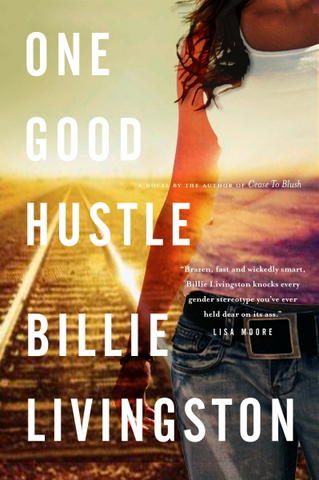
I first met Billie Livingston last year when I was on the jury for the Danuta Gleed Literary Prize. Billie won. And this is what the jury said about her story collection Greedy Little Eyes: “In this collection the writer’s eyes are wide open, taking in the world and then reflecting it in all its strangeness and beauty. She pushes edges, teeters on brinks, creating the exhilaration that comes only with taking risks. Her characters are real people in a real world who achieve break-out velocity and recreate themselves by signal acts of courage and self-definition. Frequently, her plots hinge on a demand for justice in a world clouded with calculation and evasion, resulting in a collection as strong in content as it is in style.” Billie is also a novelist and poet — her third novel One Good Hustle is coming out later this month.
Susie Moloney is the hugely popular author of four best-selling horror novels including The Thirteen: A Novel just out in March, described in the Toronto Globe and Mail as “a gonzo, mirror-universe, occult version of The Stepford Wives, with a dash of Stephen King thrown in.” The reviewer goes on to say the book is “a compellingly uncanny narrative, binding the tropes of small town paranoia and cliquishness with the chokehold of family obligations and religious fervour, and the very real claustrophobia of poverty and desperation” which sounds so uncomfortably close to my own life that I am afraid to pick up a copy (though I will).
It’s a huge pleasure to give these two authors a place to talk on NC.
dg

BILLIE: As writers you and I are slotted into different categories in the publishing world. You’re considered a “genre” writer (horror) and I’m a “literary” writer (whatever that means). We don’t appear in the same festival events, we’re not asked to sit on the same panels—It’s as if we’re different animals at the zoo and we might rip one another’s fur off if we come in close contact. Meanwhile readers, for the most part, don’t use those terms and don’t give a damn what they mean. The idea is that literary works are complex and multi-layered (dull and plotless) whereas genre work is about romance and scary capers (shiny and trivial). John Updike said the term “literary fiction” was created to torment people like him who just set out to write books. What do you think? Does this kind of grouping effect you? Please you? Limit you?
SUSIE: You know, I answered this about three times, and deleted all three responses, because what it comes to is this: I love labels when I’m buying a book, and I hate them when I’m writing one.
There’s something juvenile about ghettoizing storytelling. It’s separation, stereotyping: blondes are dumb, jocks are bigots. As Stephen King said when he was accepting his National Book Award—that’s right, a horror writer won the NBA in 2003—he said, “When readers are deeply entranced by a story, they forget the storyteller completely. The tale is all they care about.” That’s some ninja chastising there. You can hardly tell he was schooling those folks. But he was. In fact, I think his whole speech is somewhat of a canon for how we’d like to be seen, us genre writers.
I think the greater issue with genre v literary, is, who gets to decide if something is literary or not? It should be the reader, and I would bet you’re right, the reader doesn’t give a shit. The Wendigo is one of those horror concepts that comes up in literary fiction. Is that because it’s mythological? So, if I write about the Wendigo, is it still literature if I call it a dead cannibal? What if my Wendigo is succubus?
Ray Bradbury, Edgar Allen Poe, Stephen King—they all wrote horror fiction designed at source to make you pull the covers up over your head. They’re also damn good writers. The kinds of writers you “take in school,” as my grandmother used to say. She had great respect for anything you, “take in school.”
I’m curious to hear the other side of this. Do you guys, you smarty pantses, ever peer over the fence at us genre writers and moan while we walk our comically large cheques to the bank? Or is it just us cupping our hands around our eyes and staring through the candy story window at your black-tie galas where you pick up shiny statues (that we immediately believe will make an awesome murder weapon in our next tome)?
BILLIE: Do we moan? That’s about all we do. And rend our garments. The only people who moan more than the literary fiction crowd are the poets. We look at your big barrels of genre money and shriek, “Nobody understands me! Maybe they’ll recognize my artistic genius when I’m dead.” Then we wonder how hard it would be to fake our own demise.
SUSIE: Ha ha. You poets! Always with the funnies. In any case, I’m with King on this one. The reader doesn’t care. Not when the book is in her hands.
As for literary novels being dull and plotless, you’re being too hard on your own people, and I thank you for that.
The real thing is here, how come you get all the accolades when you’re mining your own backstory, and I get fewer even though I have to go through all the extra work of making it all up? From scratch. What about that? Is it easier to mine your own stories, or is it easier to just go to the therapist and make the rest up?
BILLIE: So, let me get this straight, the way you figure it, I just cut and paste from my diary and call it fiction, whereas you, clever girl, pull from the thin air of your magical mind?
SUSIE: Yes. That’s exactly what I think.
BILLIE: Ha! You’re just yanking my chain. Any writer who claims that there is no autobiographical component to his or her work is either a liar or an emotional chicken. I think it’s true of fiction and non-fiction writers. I think it’s true of biographers! I was struck with that when researching Cease to Blush. If you read two or three biographies about the same historical figure, each will be very different. People can’t help but see through the lens of their own lives and, because of it, even biographies begin to suggest more about the biographer than their subjects.
SUSIE: Okay, I’ll cop to some autobiographical elements to my work, probably most obviously in The Dwelling. But I leave it to the reader to discover which of the stories is the most autobiographical. Did I have sex with a ghost? Am I dead and living in the walls of a house? Did my computer try to make me kill myself? Or was it all autobiographical? Hmmm.
That first person voice you use gets me every time. It’s so intimate. You can’t read “I” statements and not get personally involved with the character.
Do you think of them as inspired by real life, ripped from your own personal headlines, so to say, not a memoir, but memoir-ish? The memoir has been huge for a few years. If you had a drinking problem or had killed a man in Reno just to watch him die, you would kill with a memoir.
BILLIE: The most autobiographical book I’ve written was, as one would expect, my first. My family was rather disconcerted to recognize bits that mirrored our lives juxtaposed with scenes that bore no resemblance to anything in memory. But it’s a novel not a memoir, and as they say, sticking to “truth” can limit the larger truth that fiction reveals. Which is why it’s so dreamy and lovely to go into that trance-like state when writing… it’s as though the ghost of Christmas past is being the docent of my own weird story gallery. The thing too is, you come to a point when you realize that what doesn’t kill you makes you stranger. So why not mine the strangeness and make art out of it, baby. If I could paint worth a damn, you better believe I wouldn’t be doing landscapes.
I’m fascinated with the way you use the close third person. Particularly impressive in The Dwelling, as there were different stories within the story, so the voice changed as their particular worlds unfolded. Each character’s mind is woven through the voice and yet it still allows for a kind of omniscient overview. I have a hard time writing in the third person. It’s as though I can only feel characters when I can hear them in my head and when I do they always say, “I.”
SUSIE: There also seems to have been a real uptick in novels with a first person narrative. Have you noticed a correlation between memoir, first person narrative and the rise of social media? Do we just want to listen to stories that are about “I”?
BILLIE: Haven’t noticed an uptick in first person narratives— I see more third-person! (Perhaps we each notice “the other.”) There has definitely been an obsession with memoirs though. Seems a lot of people have a craving to catch a glimpse of “this all happened.” And publishers, in a cynical ploy to extract cash from the rubberneckers, have bought lot of vaguely autobiographical novels and repackaged them as memoirs.
SUSIE: That’s probably some of the beauty of writing genre fiction. The truths that the author believes and would like to promote or at least mention in passing are buried under piles of corpses, or bricked up in the walls and allowed to scream. We get to use really broad metaphors, because when there’s a monster, for crying out loud, it’s probably representing something. I mean, it’s a monster. That’s often, however, when the horror fiction genre writer (full title) is underestimated. At first blush, that monster might well be the crushing helplessness of man versus the industrial complex … but it might also be something more human and heartbreaking and universal. Maybe I’m overreaching. This last couple of years I’ve noticed another uptick: the number of dead children in Susie Moloney stories. Maybe you’ve all noticed. I know that it’s because my youngest is mostly grown up now and it’s a loss. I was a single mom for most of his life, and we were pretty tight. It’s been like an amputation (look for the broader “amputation” metaphor in future stories). Anyway, that’s a universal, heartbreaking truth that all mothers understand, and it’s been subtly marked in most of my work. Or so I like to think.
BILLIE: Your recurring themes are hanging out! Ha! I see dead children…. and children in peril, motherhood and the fear of maternal failure, suburbia, isolation and the horror of “you made your bed, now lie in it.” I think all of those things come to the fore in your most recent novel, The Thirteen. On its surface it probably has the breeziest feel of your books — I mean it’s fun and playful in its satire of suburbia — but, it’s been compared to The Stepford Wives which has become an iconic shorthand for women who are so desperate to fit in that they become more like obedient pets. The women in The Thirteen have a more hungry and defiant desperation to be successful wives and mothers. When you wrote it, did you set out with that theme in mind or did you just tell the story and let the themes fall where they may?
SUSIE: Well, I’ve been a reluctant suburbanite. I was raised in the suburbs mostly, and so when I went back to Manitoba to lick my wounds, I think I subconsciously retreated to a childhood I wanted to remember (never happened) to raise my youngest son. It’s just easier in the ‘burbs. The schools, parks and community centres are all there, everyone is more or less the same. There’s no challenge, really, to living there. Or so that was the great dream when I bought my house.
There is challenge there, turns out. I didn’t really fit in. I had a potty mouth. I kept my wine in a go-cup. I homeschooled for the first two years. I didn’t have a job—not one you could see me coming home from. The thing that saved me from utter insanity, were the women. It might have been some true divine intervention there, but I happened to have great neighbours, each of them just a little different in their way. The woman across the street from me was bat-shit crazy, I swear to god. Up a little from her was a lady who had a monkey. A gay couple lived one house over. My closest neighbour became my best friend. But the story of The Thirteen started out as a short piece about the crazy woman across the street. I started to wonder what would happen if a witch went crazy and was no longer of use to her dark god. It started off a lot of fun, but turned very serious in the end, kind of a “chickens coming home to roost” thing.
At the heart of that story—whether it shows or not—is the feeling of being an inadequate parent. Wanting your child’s life to be smooth and successful, and how little power we have to make that so. Every bad decision–that seemed like a good, well-thought out decision at the time—not working out, and it being All Your Fault. Such power we tiny little mothers have! To ruin whole lives! Oh my. The book started out as a wish-piece, to wave a magic wand, or compact with the Devil, to make our lives flawless whatever the cost.
Also I fucking love the suburbs. So much grass.
BILLIE: One thing I’ve noticed too is that religious faith comes up in your work, but it’s not as the boogieman, the way it often does in a lot of contemporary fiction. There’s a general sense among those who consider themselves intellectuals that belief in any sort of deity is the hallmark of a moron. Religion definitely comes up in my own work, in part because, like it or not, it is something of a cornerstone of who we are and how we live. I also tend to write about people who are broke and who are outsiders and the church is often the only community to step up to the plate with the down and out. As a kid on welfare, that was certainly my experience. It was the church-crowd who consistently offered help and who were happy to be a second family–A superstitious, loony family sometimes, but still, their doors were open and they gave a damn. Did you grow up with much in the way of religion? I get the sense from your writing that you have a soft spot for it.
SUSIE: Oh I love religion. I was raised orthodox heathen and my first exposure to religion was through a Catholic friend. I went to church with her a few times. It all seemed so glamorous and fulfilling. Like you, I appreciated the fact that it was a community and you could be part of it. And there was wine. And the BODY of Christ. You know that old saw, “Home is the place where they have to take you in (sic)?”
BILLIE: Robert Frost! He’s always good for an aphorism that sums it up nicely. Home is the place where, when you have to go there, they have to take you in. Sounds like church to me. Or at least what the church should be.
SUSIE: It seemed like that sort of thing to me. I wanted to have a place where they had to take me in, just because I was part of it.
When I was a teen mom, I was born again. I lived in Winnipeg Regional Housing at the time, and the born again-s seemed to sweep the whole block, like germ warfare. In retrospect, it was a pseudo-religion, a kind of pop-god era in my life where Jesus was your bud, your boyfriend, the guy who would carry you over the sand so no one knew you skipped work and went to the beach (only one set of footprints, eh?) The soundtrack was Amy Grant and Michael Smith and Petra. It was fun. Mike Warnicke and his “book of do’s,” not “book of don’ts.” I went to a bunch of churches, all my friends were hyping their churches. I was kind of a buffet gal. It was all great until I went so some church in some community centre basement on Edison Avenue and met the minister there. I was carrying my beautiful toddler, the centre of my life. My friend introduced me to the pastor and he looked at my kid and said, “Where is this baby’s father?” Turned out he wasn’t looking for an address. That was kind of the end of religion for me.
BILLIE: Wasn’t it Ghandi who said, “I like your Christ, I do not like your Christians.”? The born-again judgment was what ultimately drove me out of that church too. And the theology: very literal, not terribly nuanced. Of course, it’s the parade of those very things that I love when I read Flannery O’Conner’s writing. She always seems able to get to the heart of the simultaneous impulse toward redemption and revenge.
I still do take a pleasure in church hopping though. Churches, synagogues, temples…I like going to different places of worship, and listening for the poetry that illuminates or challenges in a way that hadn’t occurred to me before.
SUSIE: I know what you mean. God and spirit and the wonders of the possibilities, all of that has hung around.
Telling that story makes me feel naked and 18 again. So, while I hate to belabour this point, but frankly, I love this point: I find that your voice is so real and so intimate that as a reader, I can’t help but feel naked and vulnerable while I’m in that world. Your voice melts into the page and ceases to be a separate voice. It’s my voice. Is that what all writing is supposed to do? All of it doesn’t, but yours does. And I have an example of this, two really, one funny.
I loved, just loved One Good Hustle, which is newly released and I think, my new favourite Billie Livingston novel. It’s about Sammie and her mother Marlene and a tough patch (your PG-13 elevator pitch). There’s a moment when Sammie pulls the drugstore hustle, very cool, very doable. That was the problem, it was so doable. I was reading that section and for the next few hours I just had this feeling that we were going to get caught. You know, me and Sammie. Because we ripped off that drugstore. But of course, “we” didn’t, Sammie did, but that coal of guilt in my belly was real. That’s my funny example, and a true story. Ha.
On a more upsetting note, the night Sammie goes to pick up her mother from that place, with the people—I’m being deliberately cryptic so not to deprive your readers of this, a very glorious/gruesome scene—she’s with a friend, and mortified. The friend claims to be less mortified. That scene was so raw, so human that while reading it, the instinct is to look away. While that never actually happened like that in my life, the discordant feelings of defense, protection, rage and humiliation are so perfectly executed that later when I was thinking about it, for a moment I thought it a part of a story from my own life. With complete acceptance—oh I remember this one time when I had to pick up my dad at …
Except, it didn’t happen to me. But it stabbed into me so thoroughly, the wound so clean, that I was independently humiliated for hours later. (Thanks). I think that is that first person voice, exactly. It’s so intimate and naked, that it must be my own. The power of first person—or maybe that shiv, as wielded by you—is so sharp, so fine, so accurate, that it just becomes the “I” statement that I, the reader, have been too terrified to speak out loud.
BILLIE: I have a compulsion to argue with compliments but I’ll stick a sock in it and say, thank you from the bottom of my heart. I’m a bit relieved that the scenes you mentioned were made up – ie not ripped from my own personal headlines. I probably shouldn’t say that. Is there any point to saying what is true? Discerning what “true” means is a bit of a rough hustle in itself. Is a story “made up” if it comes from the closet where something similar is buried under the dust bunnies? John Irving has come up with story after story that involves Maine, wrestling, teachers, bears and a hirsute woman. These are such a part of his mental furniture that regardless of how differently he treats them, we know by now that they are a significant part of his personal truth.
I can’t help thinking that labels like genre and literary (and their various sub-categories) mainly give comfort to critics and academics— who love to invent rules. Neither of us went to creative writing school and we are in the minority in that regard. Early on, I used to wonder if there might be some special information that I wasn’t privy to. Were you concerned about formal instruction when you set out to write your first novel? Did you give much thought to “voice” and “structure” or did you just wing it?
SUSIE: My first novel was a complete wing. I had just finished reading a novel that I particularly liked. I believe it was Margaret Lawrence’s A Bird in the House. Do you remember that book? A beautiful family dynamic study. When I was finished, I wanted to continue the feeling of being in the story—and so I wrote my own. No kidding.
The voice, style, structure, all of it was instinctive. I was writing like a reader. For better or worse, that’s still my process. What I read has changed somewhat, it’s probably broader than it was when I was a teenager, and my life experience of course is off the fucking charts—for better or worse—and so it’s getting harder to “wing it.” It certainly takes longer.
What about you? Is it instinct? Your work flows so effortlessly, as I mentioned earlier, it’s like listening to the voice in my head, I always know what you mean. It seems like you must sit down and put the end of the quill in your mouth, give a quick eye roll to acknowledge the muse and then … write a book. Is that it? Has it ever taken you literally years to sort something out to the point where it makes it into a story?
BILLIE: I do a lot of meandering and babbling before I find anything close to a story. It’s almost like I weave a giant tarp and then I stare at it and wonder if it was really meant to be a dress. Or a skirt. In which case I have to go back and cut away everything that doesn’t look like a skirt.
I hadn’t met any writers before I started my first book. I kept writing in circles for close to four years until I came up with this idea of different POVs – one of them being the voice of authority, which would involve government documents. I did worry a bit. “Are you allowed to do this? Is this just weird and silly?” I decided to apply to the Banff Centre for the Arts, in part to get over my fear of big institutions and authority and, in part, because I felt a craving to talk to someone who had written a book. When I was accepted into their five-week program I was so sure it was a clerical error that I started bawling at the airport, afraid they’d send me home when I arrived.
SUSIE: And in that vein, we’re both from that unschooled school of writing. So are we outsiders, practicing outsider art? http://en.wikipedia.org/wiki/Outsider_art
I personally love the label art brut to describe my work, and certainly, my circumstances.
BILLIE: Art brut. So raw and yet sophisticated! Sure, I’ll go for that. Even if it is French for “finger painting sociopath.” I definitely felt like an outsider at Banff. Most of the other program participants had graduated from a creative writing program and they spoke in a kind of academic patois that I didn’t understand. They often talked about what you should and shouldn’t do in fiction and poetry. I probably used the phrase “Oh yeah? Tough,” a little too often in response. Halfway through the program I had the great fortune of sitting down with Rachel Wyatt, the program director, and telling her about my idea for a novel, the (to me) crazy structure. And she said in her sweet English goose of an accent: “Write it. There are no rules!” She jumped up and plucked novels with unorthodox structures off her shelf to show me. I loved the hell out of Rachel.
SUSIE: I have never been to Banff as an artist. Back in the day I used to apply to things, but I would rarely be accepted, and I suspect it was because I don’t fit the “literary” form, although my partner—a playwright–says that it’s because you have to apply again and again, which appears to be a sort of dues paying thing.
BILLIE: He’s right. You do have to apply a lot. I think part of it too is learning the type of phrasing and presentation these places like to see. They are institutional bodies and yet they do act with a kind of human ego. If you squint, they’re almost like petulant lovers asking, “Why do you want to be with me? What’s so great about me?” So, if you want to court the Banff Centre or The MacDowell Colony, you tell them how much they mean to you and what you could learn from them. It also helps to send work that is as polished as you can get it. Otherwise, it’s as if you’ve come a-courtin’ with a stain on your shirt and spinach in your teeth.
SUSIE: I don’t have the energy to do that, frankly. Rejection sucks, ha ha. I’ve had my own Rachels over the years. People who read my stuff and commented and gave me guidance based on the quality of my writing rather than the subject matter. I also believe that your Rachel is right: there are no rules. You can be sure that if there were, I would be following them. My process is so bizarre and painful that I would love a few rules. Every year I think about applying to some creative writing course and starting from scratch, seeing if there is some kind of magic information that I’m missing. That’s the tragedy of being an outsider, I’m always thinking I’m out of the loop, even if I suspect that by now, I’m in it. My agent wants me to have another book by end of summer. Some writers are writing TWO books a year. Two!
Seems most agents want their clients to do that, because that’s how books get on the bestsellers list. When you’re reading the list and you go, who the hell is that, chances are it’s somebody who had 27 books to their name. Are you feeling this kind of pressure to produce?
Billie: The “genre” and “literary” difference again. In the “literary” universe, they don’t want us putting out more than one book every two years. With the lit stuff, publishers rely heavily on press and the potential for awards to drive sales rather than the kind of buyer’s momentum that comes with genre fiction. With literary fiction, there’s a terror that if you saturate the media with someone’s name and picture one year, no one will review another of her books the following year.
I assume writers who churn out semi-annual quickies must have a template in mind and they just rearrange the events and change the names. Which is fine if its easy and fun and all you want is to help people pass time in a crowded airplane. But if doing that leaves you feeling empty and unchallenged and untapped, then I say fuck it, go home to your soul. Otherwise you’ll start to feel like a five-dollar whore. Not that there’s anything wrong with whores — why some of my best friends….
SUSIE: I will include myself in that, if by “whore” you mean someone who will write for cash. For me to write that fast, I think I would give up a lot of what defines my prose, my (ahem) deep characterizations and what I feel are pretty rational motivations, regardless of whatever supernatural backdrop I’m using. I tried to write really fast, pump something out, but I found that I lost my way doing that. It gets to where I have no idea who these people are anymore, and I have no idea what story I wanted to tell. Turns out, I just can’t pump them out. I’d love to be Stephanie Meyer, or even just the Susie Moloney people think I am, ha ha. I need my downtime, the time it takes to recharge that internal battery that allows us to fall into that beautiful trance state where all the good shit happens. I need to live in their world. Hell, I need to research their world! My current character is an insurance adjuster, and let me tell you, everything I know about insurance burned in the fire.
BILLIE: No kidding. I think one of the biggest surprises to me was that even when I was working with material that was second nature, as I was with Going Down Swinging, I still felt the need to research. I went to AA meetings (though I’d been dragged to dozens as a kid), went to Jehovah’s Witness Kingdom Hall meetings, (I’d been to many of those as a kid too) and met with social workers to get a sense of things from their prospective (I couldn’t count how many social workers I had growing up). That kind of personal involvement feels like something I need to do in order to feel any kind of authenticity when I write. I’ve been working on a story about a woman who turns to spiritualists in her grief and I’ve gone to half a dozen spiritualist services in order to listen to mediums and watch them in action. Are you that way? Do you have a need to immerse yourself in the world of your characters? Your portrayal of Glenn the real estate agent was so believable that I assumed you must have flogged houses at some point in your work history – specific details, and dialog that rang true and helped flesh out the way she dealt with that world and her colleagues.
SUSIE: Spiritualists! I’m terribly impressed. I love a good medium. I went to see the Antiques Psychic in Calgary a few years ago to find my mother. She died when I was very young then I wrote about it and tried to sell it to The Walrus. They never got back to me. I bet they get back to you (and that right there is the difference between literary writers and genre writers).
By the time I was writing The Dwelling, I had bought my first house, sold it and then was buying another. When I was looking for what would be my second house, I really knew what I wanted and so I spent about 3,475,987 hours with my realtor, walking through other people’s houses. It was sad after awhile, all these people selling their houses. I tend to get very attached to places, and leaving them is always sad. After awhile I just saw all these people leaving their homes and offering them to me. I think that came out in The Dwelling.
BILLIE: It did. One gets the sense that the Dwelling feels lonesome, dejected, and misunderstood, that it wants people to embrace it. Of course, in this situation, the only way to be one-with-the-house is death. Just one character was capable of loving that house in the way it needed to be loved.
SUSIE: Few people ever mention the underlying sadness in Dwelling, but I think it’s there because of that. As for my realtor, she was terrific about showing me the game. I hung out with her at her agency, I went on open houses with her. I pretended to be her assistant on a couple of calls.
Right now I’m writing about demons, “literal” and personal. It’s a metaphor. (I hope.) And it takes place is a very large city, hmm, like New York. I’ve tried to get a sense of the undercity here, there’s a lot of steel and concrete, a lot of isolation and abandonment of whole areas, and there can be hopelessness, at least to the person passing through. I’m calling that research. And I’m claiming my Metrocard on my taxes next year.
BILLIE: Demons— That could be really fascinating in a big city. One of the things I’ve learned, being married to a former seminarian, is the origin of some of these old words like Satan. In Hebrew Ha-Satan translates as “The Accuser,” which, for a fiction writer, is much more interesting than a red guy with horns and a pitchfork. More frightening is the idea of an insidious voice that says, “You’re a loser. You’re incapable of anything worthwhile so why don’t you just lie down and never get up again.” Those thoughts, if left unchecked can be really monstrous –especially in the strange isolation of a megacity like New York.
It occurs to me that the house in the Dwelling uses the sadness of its inhabitants in order to coax them more deeply into itself. The lonely accuser! In The Thirteen, your most recent book, there is a more overtly Satanic figure – the Accuser is the dark beastly man who encourages the belief in these women that on their own, they aren’t good enough.
That’s what I love about theology and mythology— hours of amusement! They help me tap into the basics of who we are though. We’ve told these stories for thousands of years, trying to make sense of our fears and madness and we keep dreaming up new ways to tell them.
SUSIE: Exactly! It’s all demons. They might be less obviously demonic in the literary world, more shaded in grey. Your characters from Going Down Swinging, Cease to Blush, One Good Hustle, Marlene, Sammie, Eilleen, and Vivian are all running from, and running into demons. Alcohol, isolation, despair, abuse, neglect, all universal demons.
OMG. Billie. I’m you.
(Cue music by John Williams)
— Susie Moloney & Billie Livingston
———————–
Susie Moloney is the author of the award-winning humour column, Funny Girl. She is also the author of four novels, including the 2011 Globe and Mail Best Book, and winner of 2012 The Michael Van Rooy Memorial Award for Fiction, The Thirteen. She lives in Winnipeg and New York City.
Billie Livingston published her critically acclaimed first novel, Going Down Swinging, in 2000. Her book of poetry, The Chick at the Back of the Church, was a finalist for the Pat Lowther Award. Her novel, Cease to Blush was a Globe and Mail Best Book as was her story collection, Greedy Little Eyes, which went on to win the Danuta Gleed Literary Award and the CBC’s Bookie Prize. One Good Hustle will be published July 24, 2012