Nov 012016
 

torino2-018-beterAn Apology for Meaning, Artist’s Book, Genese  Grill

 http://wp.me/p1WuqK-kRQ

.

My real delight is in the fruit, in figs, also pears, which must surely be choice in a place where even lemons grow. —Goethe, Italian Journey

My formula for greatness in a human being is amor fati: that one wants nothing to be different, not forward, not backward, not in all eternity. Not merely bear what is necessary, still less conceal it—all idealism is mendacity in the face of what is necessary—but love it.  —Friedrich Nietzsche, Ecce Homo


In Torino, Italy, once called Augusta Taurinorum in honor of the bull sacred to Isis, goddess of fertility, where Nietzsche went mad, embracing a beaten horse and weeping, dancing naked in his room, and practicing Dionysian rites of auto-eroticism; where, before his collapse, he enjoyed the air, the piazzas, the cobblestones, and the gelato; where the ladies chose the sweetest grapes for this reluctantly German philosopher, it is easy to feel the sensual, life-affirming, Pagan roots of myth-making, to understand those humanistic allegories that sing of life, love, pleasure, and appetite. At the opera, I heard Tosca sing, “Vissi d’arte, vissi d’amore” (I lived for art, I lived for love). I indulged in long wine-drenched lunches on unseasonably-sunny piazzas, and gazed at gleaming artifacts from ancient times in dark museums. There was a secret restaurant where a small fierce woman named Brunilde roughly took my order, displayed magical cakes with her wide toothy smile, briskly removed the empty plates that once held the most delicious food I’d ever eaten, brought me a shot glass with grapes soaked in absinthe with dessert, if I pleased her by ordering it, but growled me out the door if I was too full or too stupid to partake of her pride and joy. I was in residence at the Fusion Art Gallery on Piazza Amedeo Peyron, presided over by the wise and warm painter, Barbara Fragnogna, who told me about the market across the way which sold beautiful mushrooms, wild strawberries, and bread sticks huge, juicy olives. When I wasn’t eating, or wandering in museums, I was building an elaborate book which folds and unfolds, and is painted and glued and stitched, and “gold-leafed” with foil wrappers from the many gianduji chocolates I enjoyed. I threw off the layers of the Vermont winter to feel the wind and sun on my body, and was reminded of how much our conclusions about what life means are influenced by the relationship between our own physicality and the material world which surrounds us.
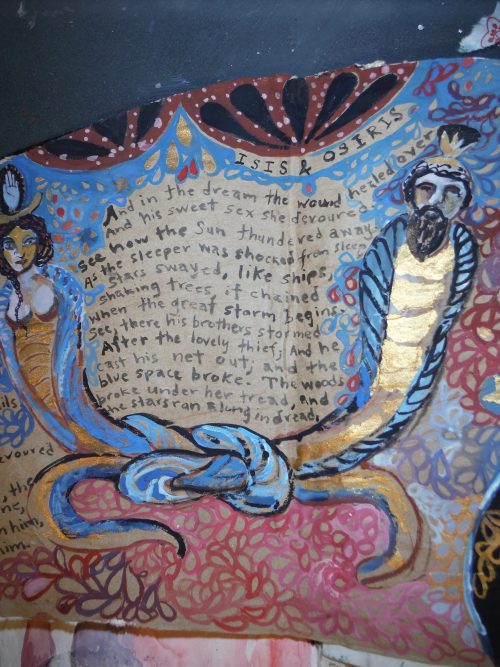
isis-and-osirisPage from An Apology for Meaning, Artists’ book by Genese Grill

Meaning is not something that we need to artificially superimpose on the objects and events of the world through some transcendental narrative or morality. It is not something we need to be taught or coerced into seeing by external social construction or manipulative indoctrination. If one is healthy, has an appetite, and senses for seeing, hearing, tasting, and touching, beauty will be everywhere, as “the promise of happiness” or, indeed, in the knowledge of happiness’s fleetingness or absence. We are given the gift of colors and sounds, of textures and of temperatures. And if all else fails, this should be enough reason to be grateful for life. In addition to this inherent meaning, this meaning without thought and evaluation, our intellectual response to the physical facts of the world makes us dream, imagine, and invent ever new celebrations and laments. These expressions will survive and proliferate insofar as other humans resonate with them. And what resonates will be made manifest in real made things, in built places, in enacted experiments. This is a discourse and manifestation over millennia, from the ancient cave paintings to today: humans trying to make sense of the terror and tenderness of the world. We do not despair, we artists and “creative subjects”. Nor do we invent meanings that attempt to twist the facts of nature: Gravity and Mortality are real. Instead, we work with what there is, and endeavor to embrace it in all its fractured glory. Thus, also, the things that we make with our hands, out of paper, pigments, wax, string, fire, earth, water and air, will fade, crumble, dissolve in good time. They are already fragile, already very imperfect, already mostly forgotten. And yet, their fleeting presence is of the utmost importance.

I am sitting on a bench in a church entranceway. A gray, cool, dreamy late morning. Some high school students, girls and boys, gather at the other end of the stone courtyard, gossiping, talking, laughing. Old people, alone, walk in and out of the church. It is a Monday, and most shops here are closed, their metal gratings pulled down. Dirty pigeons coo. In the back streets, a gentle squalor; clothing hanging from lines; abandoned bicycles resting against elaborate gates. On the walls, scraps of political agitation, left and right, shreds of old posters, graffiti scrawls. People talk, but I don’t understand. Markets everywhere, with abundance: artichokes and more artichokes, wheels of cheese, sausages, chickens, lamb shanks, lemons. People smoke and joke, are grim or warm. On my walk here I passed a waitress carrying a tray of espresso down the street from a café out of sight, and a silver piece of paper blew to the ground. I picked it up and handed it to her. Grazie, Signora. An elegant lady walks up the church steps now, in perfectly matching brown and gold, soft brimmed hat with gold trim, a brown cane, brown coat with fur collar, a purse of gold and brown plaid, little brown shoes, dark sunglasses. All her belongings and all her faith perfectly intact from another era. Trucks rumble by; otherwise it is quiet, peaceful. Balconies preserve foliage from the summer, not quite dead, but not quite blooming, vines dangling; a single bruised yellow rose lilts; while back in Vermont everything is covered in snow and ice. This is a life. Anywhere is a life. How different, how similar is it to and from mine, from or to yours? And how does it happen that it evolved to be like this here and some other way somewhere else?

As Goethe noted in his famous Italian Journey, an experience of difference both enunciates one’s individuated self and dissolves it. Visiting another world, you imagine that you might have been, could have been, still might be, sort of someone else, leading a different life in a different country, in a different language, with a different family, lover, children, vocation. Your certainties, the things you took for granted, are called into question. You would be more comfortable not examining them, not questioning: why do you and your fellows do what you do? Are these differences a result of customs, habits, social constructions, error, accident, nature? Are they the result of our upbringing, something atavistic in our blood, or determined by the atmosphere, the landscape, or the history that surrounds us? The external differences—are they petty? Do they alter from the outside who we are inside? Or are they representative of who we are, from the inside out? Ask a novelist or a method actor how much each gesture, each phrase, each seemingly minor choice reveals about identity. The way we eat, how much beauty we need, or how much labor, leisure, love, rigor, sleep, poetry, space, air, skyline, horizon, practicality, recklessness.

And now I am experiencing the differences, the strangeness here in Torino, among people for whom all of this is natural, normal. I enjoy this sense of difference, to a point, as most of us do. We seek it out, we are sometimes sick to death of our own lives and want to gaze at, play at others’ lives; but only for a spell. It can be tiring; one feels alien; sometimes wants to cry out of frustration because everything is so confusing and the simplest things seem impossible; and the people look at you like you are an idiot and you are in a way. You are an adult who does not know things that a child knows.

I get lost often. Sometimes a piazza will have four different entryways with a statue in the middle. Who can remember which way one entered or egressed from? Since I am not usually in a hurry, I wonder why this should matter to me. Maybe because we want always to seem like we know where we are going and as if we already have everything we want. And this has something to do with desire and the desire for love, which is sometimes shameful. As a stranger one wants something. Is looking for something. Has left home to find something that one does not already have. Desire is the need to become one with what is foreign, to take it into oneself and to be embraced by it as well. As Ann Carson tells us in Eros the Bittersweet, we long to be one with the other, but when we have assimilated what was once strange, it is no longer the other and no longer serves its purpose. Knowledge comes only at the cost of desire fulfilled; we can only seek out more and more things, people, places, books, mysteries we do not yet know, have not yet seen or solved or read so that we may experience that supreme thrill of coming to know again and again. We crave difference, but we also cannot keep from looking for likenesses. We seek both everywhere. And the new experiences we have are continually threaded back into what we already know.
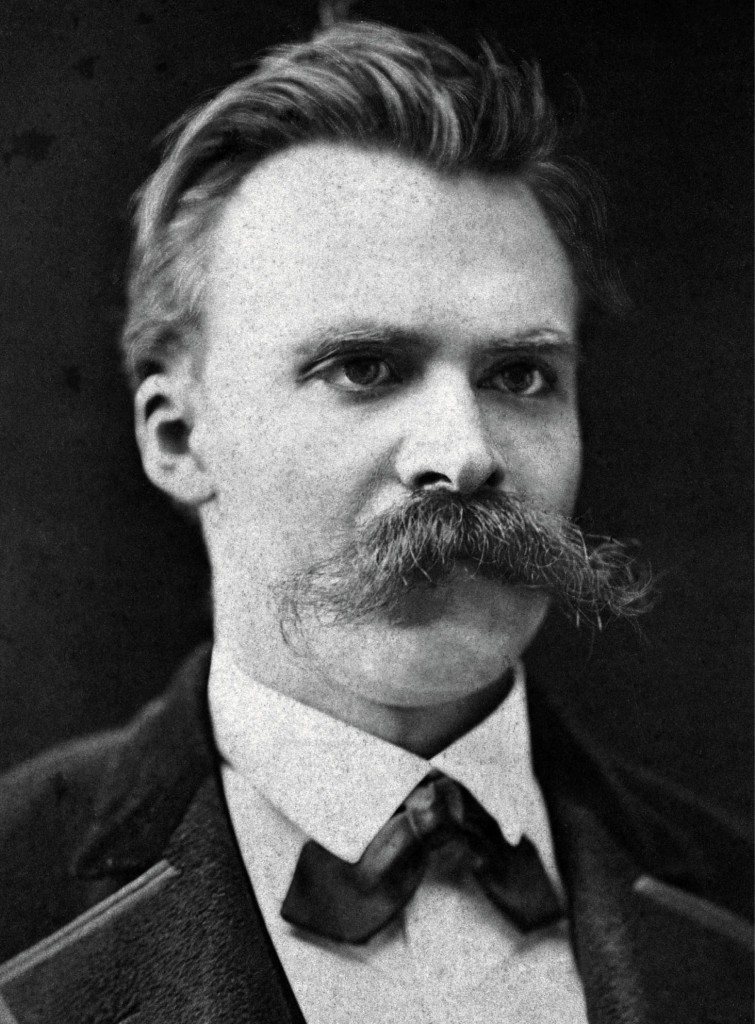
NietzscheNietzsche ca. 1875

In the Egizio Museum in Torino I am astonished by the way the ancient Egyptians had the same instinct for symmetry as ours; for placing each depicted object or vignette centrally within a frame; for aligning each hieroglyph in a uniform square of space; for leaving the most graceful and harmonious negative space between the hand of the man holding a slaughtered bird by its neck and the fronds of the plant in a vase by his side. A sense of what is beautiful, evidently, is at least somewhat natural and universal. And the works of art or ritual made with this sense of what is beautiful still resonates with a mysterious significance, even if we today cannot fully understand or believe in the things that were sacred to the people who made them. Translation across time and cultures is needed for a more thorough comprehension of these artifacts, but something very powerful, something powerfully familiar is present even without a struggle. What we want is to maintain the strangeness, while approaching a comprehension. What we must avoid is to diminish difference in the interest of a complete and total homogeneity.

I am operating in a language I barely know, but I do make myself understood, more or less, with the few Italian words I mispronounce and the few I manage to understand. A good part of the pleasure of communication is in the frisson of partial misunderstanding, in the incommensurable distance between one mind and another, struggling to approximate a shared vision (as in the erotic desire to become one with the unknown). Translation is necessary even without a language barrier, and we all do our best to reveal and also to conceal our meanings from each other. It is a dance. Sometimes clumsy, but sometimes surprisingly beautiful. The differences between language, as Steiner suggests, may be a result of a human need to differentiate one group from another, to keep secrets, to individuate from what may be a basically universal commonality. There are twin drives to compare and contrast, to find analogies, metaphors, likenesses; and to delineate differences, incompatibilities, untranslatables.

Today our basic assumptions about correspondence and difference are paradoxical. On the one hand, there are those who insist that everyone is equal, the same, indistinguishable (or that they should be, were we to look beyond external, physical differences). On the other hand, these same people tend to insist that it is impossible to understand the other; that there are no universals; that there is no shared sense of value; and that language barely helps us to communicate with each other at all, since it is so very distant from the things it claims to signify as to be more deceptive than descriptive. Both of these assumptions depend on a denial of the importance of the physical world; on a denial of any meaningful relationship between nature and cultural norms, between the physical world and the language that describes it; between the human brain and its sensory apparatus; and, finally, between one human brain and another. In reality, things and people are self-similar and they deviate from sameness; but even the deviations do not prohibit some approximation of understanding.

Those who deny difference and simultaneously insist on incommensurability are trying to do two contradictory things at once: 1. to strip away differences that might cause conflict or justify hierarchies or discriminations, resulting in a neutering and neutralizing homogeneity, and, 2. still paradoxically denying that these newly neutralized beings will be able to understand each other despite the pervasive removal of the characteristics that seem to have caused all the trouble in the first place. Perhaps the unspoken hope is that the neutralization and leveling, the moral rejection of the physical world (beauty, ugliness, pain, pleasure, difference) will eventually really result in a homogeneity so complete that, even if we no longer have anything interesting to say or any unique artistic expressions to make, we will at least make no more war, at least harbor no more resentment or hate against the “other”—because there will be no more other. And no differential qualities whatever to get in the way of perfect passive niceness. On the one hand, we are ignoring the inevitable consequences of our neutralizations, neglecting to weigh how much difference makes life rich and strange and fascinating. And, on the other hand, by critiquing conceptualization, deconstructing symbolic archetypes, and undermining the significance of language, we are denying the natural affirmative instinct for finding likenesses and correspondences.

On one level, seeing shapes and patterns where they are not “really” present may be called “pareidolia,” most often ridiculed as a psychosis that sees Madonna and Jesus faces in rock formations and baked goods, endeavoring to prove through argument and scientific study that the piece of fabric housed in a crypt in Torino once was wrapped around no one other than Jesus Christ. The Shroud Museum has rooms filled with “evidence” of why we should believe the shroud belonged to Him: there are blood stains from where the crown of thorns would have been; stains in the shape of wounds suffered when he was tortured, an exemplar of the instrument with which he would have been scourged. The fact that there is just one wound mark where his feet would have been is explained by arguing that both feet were punctured, one atop the other, with but one nail. There is no mention in the museum of the carbon dating done on the fabric, which dated it to a time much later than Jesus’s supposed death; but there is an example of the loom upon which the cloth might have been woven and an example of a crown of thorns, which is arched like a dome and not open like a wreath. Image after image is presented to convince the skeptic that the shroud belonged to Jesus. At first it is hard to even see the shapes that would suggest any face or any body, but, as if one were gazing at one of those magical illusion pictures, if one looks long enough, the desired shapes begin to come into focus—and fade just as quickly into indistinguishable marks again. Desired shapes: the shapes one wants to see.
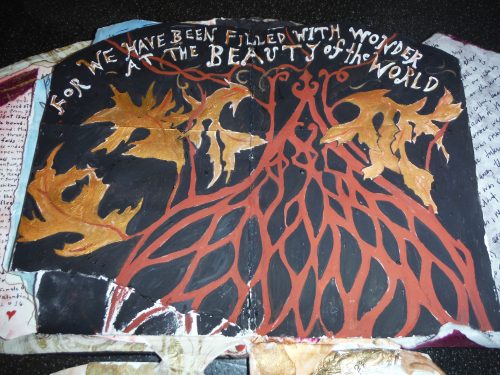
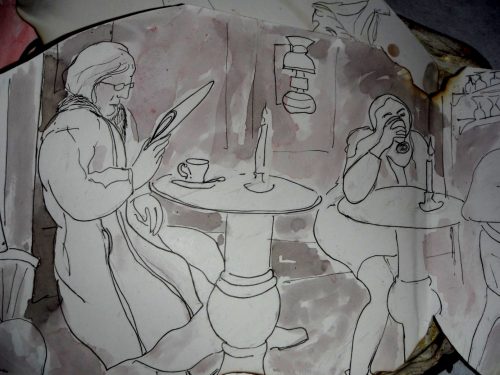
torino4-019Page from An Apology for Meaning, Artists’ book by Genese Grill

Fresh lovers often insist that they are “exactly alike,” noting that they both amazingly like chocolate or were born on a Friday as signs that they are made for each other. And even someone as wise and experienced as myself may choose to be deluded into reading into signs that may not be there at all, thinking that the intern at the artists’ residency is making eyes at me, when really he probably just looks at everyone like that. He had told me tales of rituals in his home town where someone would dress up as Dionysus in animal skins and horns, a bag of blood hidden under the pelts, and someone else would chase after him and “kill” him, spilling blood all over the streets. But what did that mean?

Of course, all of our seeing is a process of selecting out that to some extent overlooks the fact that reality is a mass of non-delineated color and light, a mass of shifting molecules temporarily huddled into seemingly distinct shapes and entities. We can question whether the things we see are really rightly to be delineated as separate or if our particular arrangements of what belongs with what or who belongs with whom are comprehensive contextualizations or merely constructed biases, wishful thinking, or limitations. We can say the same thing about words and the concepts that they form—that words are a crime against the multifarious differentiation of reality, that they name and delimit what is really irreducible and unnameable. Names and words and categories pull some things together with other things, leaving other things out, and ignore the qualities of the named and categorized things that do not fit in with the given names—qualities that might render these things more fitting to be named and arranged in different categories altogether. Is the creation of a concept a form of psychosis, hallucination, wishful thinking, pareidolia?

When we note a pattern, say, of bird or insect movement, of repeating forms in nature, in fairy tales, or of habitual actions in our own lives, are we ignoring all of the elements that would render the categorized thing, action, or thought unfitting to be classed within the desired arrangement? Or is there really a way to establish that something is enough like something else to conclude that it is a pattern and thereby attempt to draw meaning from it? Of course, this is essentially the scientific method, but we use it indiscriminately every day, without the necessary “controls” to make our experiments scientifically viable. And science itself is subject to the same kind of criticism: even if its trials are well-documented and avail themselves of responsible criteria for investigation, the scientists have, as we well know, already decided to ask some questions over others, thereby determining what kinds of answers might be found.

But here is the crux: we do all this because we want, we need to draw meaning. And we draw meaning most readily from things that repeat or seem to repeat, from something that seems to be universal or at least not a mere exceptional random aberration. It might be absolutely accurate to say that (at least on a molecular level) everything is everything and thereby all patterns and all names and all conceptualizations are inaccurate and limiting, that the only accurate vision of reality is of a moving mass of colors and light without delineation or individuation. Babies start by seeing that way, but over time begin to recognize (or is it imagine) shapes, distances, faces. Carl Sagan writes that pareidolia itself might be an evolutionary adaptation, since those babies who were able to recognize faces responded to expressions, inducing them to smile, and make eye contact, so that they were cared for, and thus survived. This is rather suggestive, because if we were to consciously try as a culture to repress conceptualization, arrangement, and the meaning-making that rests on this patterning process, we would end up being unable to communicate with each other, and we would simply not survive as either individuals or cultures. Autistic children have a hard time making the kind of eye contact that Sagan suggests was good for survival. And many say that we are now becoming a culture of autism, one in which people do not communicate, one in which people are trapped in their own worlds without the ability to share experience, emotion, ideas. Thus, although the process of making arrangements and making concepts does perforce leave things out, although it may sometimes be inaccurate, although it may sometimes look like psychosis or pareidolia, it is far better to make provisional arrangements and to use language and concepts (always acknowledging that they can change and rearrange) than to exist always in an undifferentiated sea of colors, sounds, and non-shapes, unable to communicate.

But after visiting the Shroud Museum in Torino (the actual cloth is carefully hidden inside its box, only to be taken out on rare jubilee days), I do not believe that the shroud of Turin belonged to Jesus. The form of the body suggested by it is simply not sinuous and beautiful enough to satisfy our mythic desire for him. The image that the experts draw from the bloodstains is of a bulky square-shouldered man, not at all the sweet beloved of the visionary mystics as depicted in paintings over centuries. Just as the scientists who discovered the shape of the DNA molecule knew that they had finally found it because the double helix was the most beautiful configuration, so we can see that the shroud did not belong to the son of God because of the gracelessness of its traces.
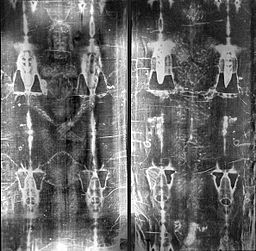
256px-full_length_negatives_of_the_shroud_of_turinFull length negatives of the Shroud of Turin

There has to be a difference. Difference is thrilling, is frisson, is friction. If there were no difference, no distinction, no discrimination, no delineation, we would see nothing. Everything would be one blended morass, one moving, shifting mélange of everythingness. No shadows, no lights, no textures, no patterns or deviations. So we like to go away, discover new things, challenge ourselves, compare and contrast the familiar against the strange in order to understand, again, our expanded selves. And yet we find ourselves in a constant emotional oscillation, a cycle swinging between comfort, tedium, restlessness, curiosity, desire, risk-taking, danger, exposure, discomfort, exhaustion, home-sickness, comfort, tedium…ad infinitum.

Thus we come to the necessity of maintaining some borders at a basic level, personally, and then globally. We need secrets, mysteries in order to remain where we are, among our fellows in our homes, in our romantic relationships; or else it is as if we were running rampant around the neighborhood, around the world, continually searching for newness, making so many things the same as we unite with them, making everything homogeneous and known all too quickly. A promiscuous lover is someone who has not learned how to mine the depths of himself and his beloved; is quickly bored; doesn’t have enough inner resources to discern the depths hidden in his lover; thus he moves on quickly in order to stimulate his poor imagination. Curiosity, desire, conquest of new ideas and intellectual territory, all have their value: but they should not be gluttonous. If we are to feast, let us leave time for regeneration of resources; let us make sure we properly savor what we are sacrificing and devouring. The communion of the self with the other cannot be celebrated so swiftly that all differences are leveled out, sanded away, consumed by the Moloch of desire for newness. This touches on the problem and pleasure of materiality. The basic limitation of resources; that they are not infinite. You can melt down idols to make new ones, but then the old idols no longer exist. How can we contrive to keep the old ones and erect new ones, too? Of love we can barely speak in this regard: the old lovers are replaced by new ones, yet they remain, one hopes, still within us, and we within them, in traces, some very potent, as we continue to consume and appropriate and expand, becoming new ourselves and shedding strangeness as we go, exploring our anti-selves, the characteristics we harbor that are anathema to our primary identities and the identities of our native lands and cultures.

After writing The Sorrows of Young Werther, and serving many years as advisor to the Duke of Weimar, Carl August, Goethe “stole” away at three in the morning, from his friends, his duties, and his romantic (but non-sensuous) relationship with Charlotte von Stein, to sojourn in Italy for two years. There he found himself in contrast to the differences he experienced, searched out the ancient remains of classical Rome, learned about architecture at the foot of buildings designed by Palladio, learned to see by looking at Italian paintings, developed his concept of the universal Ur-Pflanze from which all plants metamorphose (Alles ist Blatt), and enjoyed, above all, the weather and the fruit. His wonderful account of his adventures includes detailed descriptions of the geology, flora, and fauna of the countries he passed through), along with evaluations of artifacts, architecture, painting, and peoples (he burdened down his pack with rock specimens as well as heavy books). Referring to the Greek god, who could not be conquered in wrestling matches as long as he remained in contact with his mother, Gaia, Goethe writes, “I see myself as Antaeus, who always feels newly strengthened, the more forcefully he is brough into contact with his mother, the earth”.

The Germans have always harbored a romantic longing for the physicality of Italy, “the land where the lemons bloom,” as Goethe writes, as mythic antithesis of everything Germanic (stoical, cold, disciplined, abstract). Nietzsche sojourned to Torino, a Dionysus on the River Po, in conscious ex-patriot spirit. What meanings did he find there, that philosopher with a hammer who famously denied the existence of “Das Ding an sich,” and called on us to bravely consider the abysmal probability that there is no meaning or purpose to life whatsoever? He certainly meant that there was no predetermined meaning or God-given purpose, no purpose ordained by a God. But he did not mean to repudiate the ways in which the world can be meaningful (affirmed, celebrated, enjoyed). For his rejection of the “thing in itself” was decidedly not a transcendental call to celebrate merely the disembodied life of the alienated mind out of touch with the physical world (a thing in itself, surely, despite Berkeley’s skepticism, and despite the inability to know it absolutely or objectively beyond phenomena). Here in Torino, this city so beloved by Nietzsche, while I am struggling with the question of meaning, I feel compelled to come to terms with him on this question. We are in agreement on the central importance of the material sensuous goodness of the world and on a deep suspicion of any ideologies which aim to affirm something in contradiction to the facts of this real.
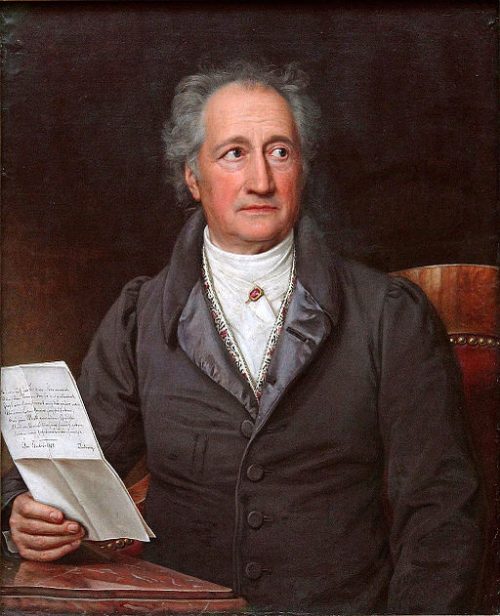
goethe_stieler_1828Goethe by Joseph Karl Stieler, 1828.  (Public domain)

Ecce Homo, which he wrote while in this city, begins with a serious discussion of the vital importance of digestion, weather, and music, all experienced by Nietzsche (and clearly by Goethe as well) as fundamental physical requirements for living the right life. The theological-metaphysical questions are deemed unimportant at best, treacherous deviations at worst.   Thoreau, whose first chapter in Walden is called “Economy,” planted beanstalks as the most efficacious conduits to a realm where one might best consider “higher laws”. It makes one wonder what would have happened to Thoreau had he visited Italy (he traveled a great deal, he noted, in Concord). Would he have abandoned his dietary restrictions against drinking coffee? Might he have succumbed to the animal spirits and fallen in love? Margaret Fuller, who translated that comprehensive man of spirit and sense, Goethe, complained about the disembodied tendency of her friend Emerson (and Thoreau was even less sensual than his mentor), did travel to Italy and fall in love, gave birth to a probably illegitimate child, and participated in the Italian revolution. If she had not tragically drowned on her return home, she might have infected all of Concord with a new European sensuality! Just imagine. Nietzsche, who admired Emerson greatly, who was just about as abstemious and celibate as Thoreau, still knew how to reason from the hands to the head, as the bard of Concord counseled—and from the stomach too, though, it would have to be a strong one.

Love of Fate meant for Nietzsche a love of life exactly as it is, which seems to suggest a belief in a thing in itself after all…the world in itself, as it is—mediated by our senses, our tastes, our interests, our desires, yes, but not subject to utter transformation of its basic realities: mortality, gravity, pain, beauty, brilliance, energy, stupidity, music, pleasure, illness, cold, sunshine. Darwin explained all of this in his own way. We don’t live in a friendly universe. The world cares not a fig for our personal happiness, though our genes may well fight mightily for their own generation. And the connection to Spinoza, greatly admired by Nietzsche, may be helpful: the world was not made for us humans, and thus should not be judged according to how well it does or does not serve our aims and desires. The world is good in itself. Is god, is divine in itself, whether we are experiencing petty miseries or committing atrocities. The world is beautiful, even without the concept of beauty invented by humans. We are to look at the world from the “perspective of eternity,” which is not a transcendental perspective, but, rather, one which provides an angle beyond our own particular immediate interests. Objectivity? Well, not quite. With Nietzsche we can speak of a perspective from the mountain top, as far away from the flatland as possible, but with a knowledge of the subjective world of taste and senses. Nietzsche writes, in The Twilight of the Idols, “One would have to be situated outside life, and on the other hand to know it as thoroughly as any, as many, as all who have experienced it, to be permitted to touch on the problem of the value of life.” For, if our reflections seem all-too mercurial, shifting, and arbitrary from the perspective of eternity, closer up they are instinctive and healthy tastes, responses to and engagement with the world.

As subjects, creative subjects, we make of this world as it is what we can. We cannot help but make meanings about it. But let these meanings be in metaphoric harmony with the real facts of nature. Let us make and preserve myths which help us to understand, to celebrate and to weep over the true facts of human existence, and its true pleasures and pains. Gilgamesh is struggling with the death of his friend. He searches for a way to be immortal, to conquer death. But when he thinks he has found it, a snake eats the magic herb he has foolishly left on the shore while he swims. Thus, although humans must be mortal, a snake can continually shed its skin. A true myth. The kind of fiction that Nietzsche railed against was of another kind: a false fiction, one that repressed the reality of death, repressed natural instinct and pleasure, repressed sexuality and the will to power, repressed beauty and energies and great health and desire in the interest of a transcendental Idealism offering an afterlife, and some sense of pious righteousness in exchange for all that made life meaningful. The myth of Christianity he would battle with the myth of the beautiful drunken god: Dionysus versus the Crucified One. Thus, he aimed, not to do away with all myths (that, in fact, was Socrates’s great sin, according to Nietzsche), but to celebrate the myths that are in accord with the true facts of life. Steiner quotes a cryptic passage from Nietzsche’s notebooks: “God Affirms; Job Affirms.” And glosses that Nietzsche was referring to his idea of the aesthetic justification of the world. The world of wonder and beauty. Look at what I made, says God to Job. I made the Leviathan. I am an artist. Don’t talk to me about your petty troubles.

And here in Torino, Nietzsche, enjoying a rare respite from his chronic pain, in withdrawal from Wagner, the Wagnerites, the Germans and their obtuse Idealism and Morality, enjoyed the sunshine and the air and the food and the gelato (but not the wine); enjoyed the graciousness of the people; and the lightness of Carmen (Torino was “tutti Carmenizzatto”). The world that Nietzsche celebrated was not so much a world of the future, a world of future higher men, but a revival of Renaissance and Pagan values. Not at all the postmodern insipid relativity of values with its snide rejection of beauty, nobility, genius, aristocratic individualism.
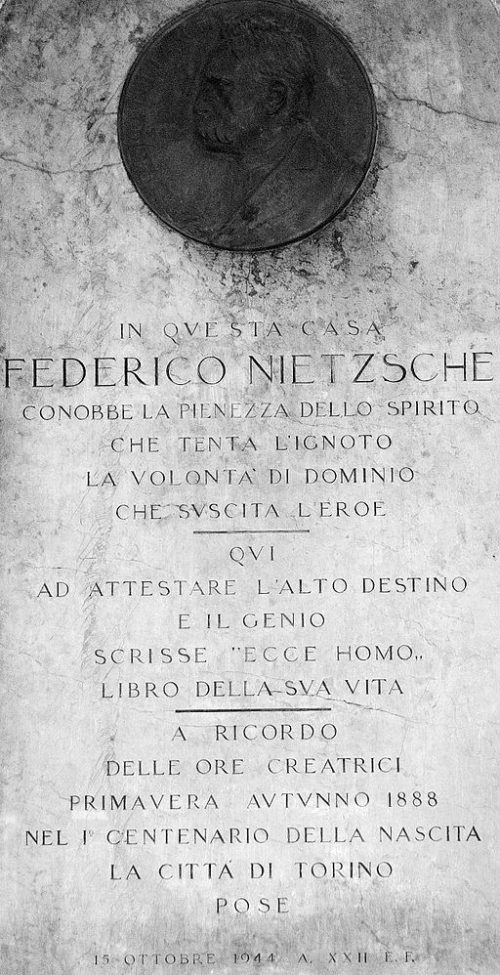
512px-friedrichnietzscheturinNietzsche dedicatory plague in Turin

Meaning has been attacked from two sides: on the one hand by the commercialization and commodification of life, by the simulacrum covering up an abyss of shallowness and the emptiness that is left over after the orgy of sensationalism, as humans become more and more bereft of any real connection to nature, human relationships, history, culture, beauty, pleasure, divinity, sacredness. On the other hand, it has been attacked by the cold lizards of theory, who feel nothing themselves but only touch us with their clammy hands so that we too feel a chill and cannot sense the heat in what naturally should move us. These theorists even dare to claim Nietzsche as their own. Because he questioned the idea of a transcendent meaning, aiming with his iconoclastic hammer at the ideology that denied the real meanings of the world, they use his words as an attack on meaning altogether. Because he called for a transvaluation of values, they use his words as an attack on values altogether, missing his joyous celebration of the values of nobility, of the Renaissance, of ancient Greece, of great art and great men, of genius and beauty and rapture. Indeed, he had a hammer (though sometimes it was a tuning hammer for a piano, not a bludgeon), and there was smashing to be done. He was a great destroyer, who called himself “Dynamite.” But he destroyed only as a preliminary to creation. The epigones took up his hammer and began smashing even the idols Nietzsche himself had venerated. They smashed veneration altogether. And in their adolescent giddiness, in the din of their mob fury against what was once great, in their ressentiment, they did not hear the most important part of his message: the axes must be turned into chisels, to carve new idols, new values, new words, new forms, new metaphors, ones that honor what is vivid and beautiful in life, ones that affirm the instincts and the senses.

In a museum in Torino I saw a painting of Santa Lucia, her bloody eyes on a plate. She was a good pious girl, promised in marriage to a pagan, whose mother was ill. She was called by an angel to devote herself to Christ instead of the Pagan fiancé, and in exchange, her mother would be cured. She willingly did so, refusing to bow down to the Emperor, and giving her dowry to the Church instead of her future husband. For this, some say, her eyes were gouged out. Or else she cut them out herself so as not to be attractive to her husband-to-be. She is lovely and fierce in the paintings, and probably the man they had chosen for her was a brute and not to her taste; and her devotion to Christ healed her mother; but can we not think of a better story for her? Is this really a model worthy of imitatio? So many of these maiden saints, who refused arranged marriages and gave themselves to the disembodied fantasy of the beautiful, scantily-clad Christ instead, were exercising the only power they had, and for this they are admirable. They found, by these religious subterfuges, one way of protecting themselves from drunken brutish masters in the form of husbands, pimps, and fathers. But their virginity was no great prize. Can we not imagine stories for them with better endings? Lovers to their tastes, freedom to choose, to adventure beyond the convent or house-wifely walls? Instead of continuing to venerate the lives of these pious girls, we would do well to imagine new vitae for them, lives lived in rebellion, not against Pagan Emperors and sexuality, but against the control of their bodies and souls by male authority figures, lives lived in full flowering of their sexuality and pleasure-loving instincts, in celebration of female desire. We must make new saints, and also revive old models worthy of veneration from the archives of history, woman and girls who knew light and dark, pleasure and pain, flesh, the devil, and the divine sweetness of the embrace of a beautiful, living beloved body. Poor Santa Lucia. We pity her and regret the loss of her beautiful eyes. And then, in her honor, we go looking for traces of other myths or at least a few fallen figs from some controversial historic feasts, to savor from the safe distance of a relatively tame and unromantic time.
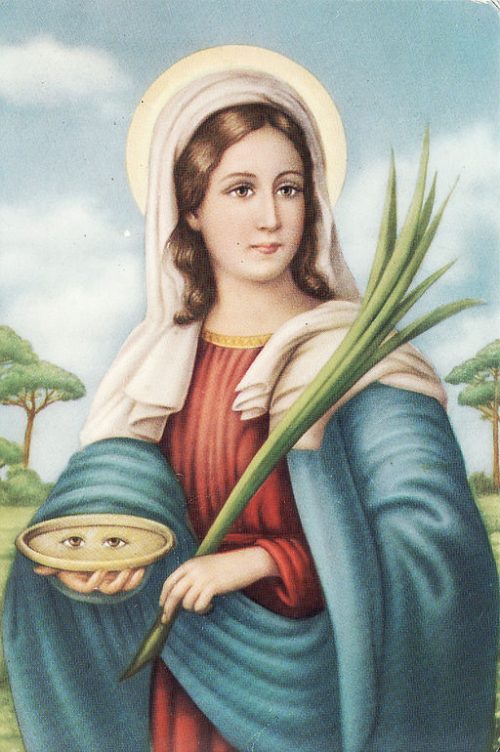
512px-santaluciaPainting of Santa Lucia, Syracuse Italy

I am on my way to Gardone Riviera, on a pilgrimage to visit Il Vittoriale, the monumental house, shrine, and garden of Gabriele D’Annunzio, Italian novelist, poet, patriot, lover, and aesthete. When I mention him to people here they sometimes seem uncomfortable; because he was wild enough to disregard the Treaty of Versailles and take over the island of Fiume to turn it into an artistic utopia; because of his relationship with Mussolini; because he represents or seems to represent many things that are nowadays in bad odor. To get there I have to take a train to Milan and one to Brescia and then a long bus ride.

It is a misty, cool, warm morning in February, and confusions proliferate: about trains, ticket machines, banks, language, customs. They seem to do everything differently here, but for them that is how it is done. Then I realize that even in my own milieu I am strange. That I am strange, wherever I go. An artist is outside of society, but also very inside it. Inside of life. Observing, but also feeling through and for everyone and everything. After writing that down I wonder if it is arrogant, as if I were suggesting that regular people don’t feel, are not conscious. No, it is not that, but rather that their attention is mostly elsewhere, and ours is so often concentrated on reflection, on the symbolization of everything. Watching gestures and configurations, listening to emphases and choices of words, noticing formal variations and repetitions. As Suzanne Langer notes, to use symbols (rather than just signs) is to talk about the world, not just to denote it, not just to deliver information, but to consider how things are, and even why. And as artists, our lives are consumed by symbols and symbolic interpretations. The entire phenomenal world is to us a sort of symbol-picture of something else. No, not of another world, as Plato would have it; not a bad copy of some perfect original, but actually a symbol-complex of itself.

The phenomenal nature of the physical world means to us. But we don’t make of it what isn’t there, but see in it all that there is to be seen in it. Well, not everything at once—that would be too much, that would be a jumble. But we see many things, one after the other, from different perspectives, in correspondence; we have many ways of seeing meaning in what is. We are curious about how things are made; where they came from; how they were invented; what human need they answered; what history they contain; what natural materials; what natural miracles are evident in their existence; what they tell us about human and animal life, past and present, about desires, fears, curiosities, mistakes, kindnesses and cruelties, despairs and foolish hopes. Thoreau, allegedly an arch anti-materialist, collected and used objects to trace history… as artifacts of material culture, looking, always, for the law and the deviation. Goethe, a naturalist and collector of botanical, geological, and artistic specimens, traced the variety of the plant world back to one original Ur-Pflanze, and then envisioned the entire world of objects and behavior as an allegory for this constant development, this constant Becoming (Werden), from out of the essence of Being (Sein).

All artists mine objects, physical acts, stories, events, speech utterances, places, buildings, man-made and natural, for their significance, for traces of how and what we have dreamt of and done battle for; for their own qualities and also for the way in which they are allegories for other things, feelings, events, experiences; for the way they seem to echo and repeat. When we see repeating patterns we naturally sometimes think we have learned something about life, some tendencies or natural laws…and, despite the doubts shed upon such instinctive correspondence nowadays, often it is true. But it would be foolish to take only one or two experiences and construct a final story about life. The largest, broadest vision would be necessary to oversee all the conflicting narratives before coming to any conclusions. Life is brutal, life is tender. Humans are brave, are craven; are polygamous, monogamous; people of habit, craving change; we like to deviate and to stay close. So, whenever we try to maintain just one thing we discover another side or possibility, but not to the extent that everything cancels everything else out. We may still come to provisional conclusions about the nature of the world, society, our lives, about what works and what does not; in fact we must. But let these not be rigid or polarized, let us not base hasty conclusions solely on either the sum of the good or the sum of the bad experiences. A little hope is healthy, as is a touch of denial, since sometimes things turn out better than one expects, even in the worst of circumstances. As much horror as there is, there is also always good. Neither can be cancelled out by the other. We must see it all. Read it all into what we find before us. Find a way to embrace it all. Amor fati—Love of fate.

I arrived at Gardone Riviera too late in the afternoon for a tour of the house, so began my visit to D’Annunzio’s Il Vittoriale degli Italiani with a sunset stroll around the “most beautiful garden in Italy”. From my Neo-Classical hotel, with its palm trees, classical columns, and reproductions of Roman sculptures, I walked up the steep winding paths and stairways to the grounds, past little houses perched amid orange trees and covered in vines, until I found the gate and entered D’Annunzio’s strange dream: grottos with idols; walkways beneath portentous archways; a sudden St. Francis of Assisi; a fountain encircled with gorgon heads; a lofty monument to the heroes of Fiume; a giant boat docked on land; columns topped with statuesque nudes. A sign before a sun-dappled little garden made up of rocks, small columns and upright missiles, informs the visitor that this is the most sacred spot of all. The “little lake for dancing” is at the bottom of a steep ravine, reached only by winding down hundreds of small stone steps. The large amphitheater is encircled from behind by tall cedars and the snow-capped Alps, and its stage has a gleaming Lake Garda as its backdrop. I imagined Isadora Duncan, one of D’Annunzio’s many lovers, walking there—as if on the water—in consummate Classical grace.
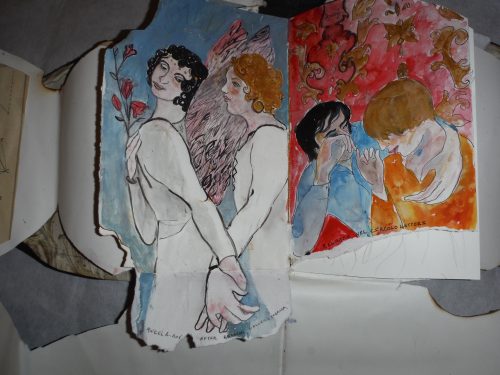
torino2-015Page from An Apology for Meaning, Artists’ book by Genese Grill.

That night I wandered around the out-of-season resort town, looking for somewhere to dine, lighting upon Caffe D’Annunzio itself, one of the only places opened, where three or four locals were crowded around a counter drinking wine. I nursed a negroni on the closed-down patio while wondering what Il Vittoriale means. Why, I wondered, should it make us uncomfortable? D’Annunzio had a sense of the heroic about him that is out of fashion today. A sense of superiority and sacredness, a will to power, a contempt for lowliness, sickliness, vulgarity, cowardice. People may mock D’ Annunzio’s mythologizing, moralistically decrying his frequent bad behavior, I think—or perhaps this is the gin and the absence of a restaurant—, but at least his impulses were signs of life, of appetite. D’Annunzio might well be censured or ridiculed for his celebration of militarism and his association with Mussolini , for his many lovers (whom he adored, but also treated atrociously), for his many dogs and his race cars, for the consciously elaborated mythology of himself as a demi-God, for a combination of wounded pride and delusions of grandeur—except that he was a great writer, and his grand lifestyle enriches our collective imagination.
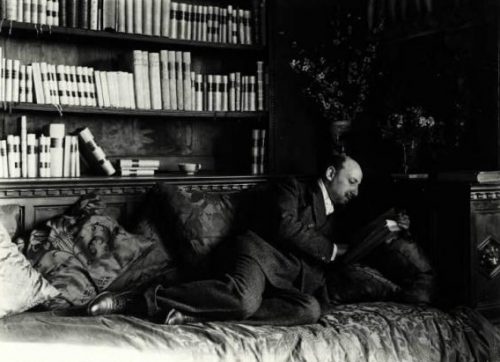
 

nunes_vais_mario_1856-1932_-_gabriele_dannunzio_sdraiato_mentre_leggeGabriele D’Annunzio Reading by Mario Nunes Vais (1856-1932)

Compared to the lukewarm morality of today, our smug conformity and communal piety, D’ Annunzio’s mythic theatricality exercises a certain attraction. Considering all of this, I found myself laughing out loud at the mad, mad world, strolling on the closed-down boardwalk. I was dwarfed by a 19th century edifice, crowned with a bright yellow Renaissance-style tower with the words GRAND HOTEL emblazoned in golden-tinted mosaic. It was a huge sprawling place where Churchill and Mussolini, and many other mortally-flawed heroes and villains stayed. Like most everything else here, the historic hotel was boarded up until May, and the boardwalk was surreal, empty, but for a lone palm tree swaying on the promenade. In my drunkenness, with the help of a kind stranger, I managed to work the cigarette machine I found on the way back to my hotel, and smoked a rare cigarette—which, in its rareness, got me even higher—and wondered about the difference between aesthetic individualism and fascism. The cigarette, in its naughtiness, helping me to flirt with the decadent charms of immorality.

Aesthetic individualism is associated with culture, beauty, delicate sensibilities, the collection and preservation of fragile artifacts, and an internationalism that revels in the multiplicity of the creative imagination; fascism is nationalistic, collectivist, brutally destructive, anti-intellectual, a danger not only to human beings and their ethical freedom, but also to the beloved precious buildings, artistic and historical artifacts so admired by the aesthetic individualist. So why would they ever, why do they sometimes keep common cause? In the case of D’Annunzio, we have a man of letters whose only real political affiliation was with the Party of Beauty, but who in fact did collaborate with a man who would subsequently become a fascist dictator. But even before Mussolini came to be Il Duce and to be called by D’Annunzio “an evil clown,” their relationship was strained. They came together at the start of World War I, over a shared vision of a new Roman Empire, a romantic ideal that called for the re-annexation of Trieste, Fiume, and other territories that had once belonged to Italy and which, they both agreed, should once again be theirs. D’Annunzio roused his countrymen to enter the War and to defend the French culture under siege, with speeches and street theater, and fought on the front lines. But after the Treaty of Versailles failed to reward the Italians for their sacrifices in the war, he took history into his own hands, and, with a ragtag militia, easily took Fiume back for the Italians, to the cheers of the mostly Italian populace, and tried to found an artistic utopia with a democratic constitution there. Mussolini kept himself scarce and watched from afar as the dream foundered over the course of a little more than a year, only later to seize Fiume from the Austrians himself, this time, much to D’Annunzio’s displeasure, to make it part of a fascist state. The fascists were frequently embarrassed by D’Annunzio’s eccentric sybaritic antics, his poetry and his displays of what they considered “feminine” voluptuousness; his nude sunbathing and worship of art. His association with workers’ collectives agitating for unions and civil rights also complicated matters. When D’Annunzio was not being swayed by the democratic socialists, or being lured into shady dealings by the fascists, he was doing whatever he fancied, collaborating with composers on operas, writing plays for his lovers, writing sumptuous novels and books of poems about his lovers, spending money he did not have on beautiful books and objet d’art, and making love. He felt that Mussolini had abandoned him at Fiume and that he did not give him the credit he deserved for bringing Italy into World War I; but Mussolini the dictator saw to it that a national edition of D’Annunzio’s complete works was published and that the extensive quixotic renovations of Il Vittoriale be funded in part by the Italian government. D’ Annunzio, in turn, dedicated his house and grounds to the Italian people as a monument to the soldiers who dared to take Fiume with him. It was also a retreat. Although he had dabbled sensationally in politics and war, he was, by nature, an aesthete who enjoyed comfort and sensuality. Luxury, he wrote, was as essential to him as breathing. He liked to sit at the feet of lovely women, and shower them with flowers, leaf through ancient leather-bound books and recite poetry in the dark. Over the course of a five year period, he once wrote over 1000 letters to one woman alone. They don’t make men like D’Annunzio anymore. In the mostly empty dining room of my hotel, there were none to be seen, so I gave myself to a large piece of black forest cake with whipped cream, and the conversation of the owner and his friends, who tried to get me to drink more and more champagne and spoke to me in a mixture of broken English and mostly incomprehensible Italian. Somehow I stumbled upstairs alone, somewhat nauseous, and had a nightmare about D’Annunzio. Or was it a dream?

The following day I made it into the sanctum sanctorum, D’Annunzio’s house. In the entryway to what he called “the Priory” stands a column to divide the guests into welcome and unwelcome. The many creditors would have to wait on the right, the women, mostly artists and poets and actresses, would be ushered in on the left to a room filled with incense burners and a helicopter blade hanging from the ceiling. The lucky ones would be brought to the music room, cocooned in dark tapestries. D’Annunzio had lost an eye in the war and was sensitive to light. Besides, music requires concentration of the mind. The floors are covered in carpets and pillows, for lounging or making love; busts of Michelangelo and Dante, his ‘brothers’, stand like witnesses. Books and music folios line the walls, surrounding life masks, sculptures, lamps of blown glass fruit, leaded windows, an organ, lyres, lutes, bells. The predominant tones are red, gold, and black. From the music room we proceed to a writing room, with a large desk, where D’Annunzio died, and a medicine cabinet filled with drugs. Over the doorway from the writing room to the bedroom, we read: genio et voluptati —genius and voluptuousness. The bedroom is called The Room of Leda and overflows with chinoiserie and silken fabrics and cushions. But genius is not all pleasure and happiness. Consider the Leper Room, for meditation on the death of his mother and Eleanore Duse, which features a bed in the shape of both a cradle and a coffin, “the bed of two ages”. Two leopard skins are draped over the steps leading down from the bed. A painting of Saint Francis embracing the leper hangs near the bed. We are to understand that D’Annunzio considers himself a leper in the eyes of society, in exile here after his failed attempt to raise life to its rightful gloriousness despite the philistine, luke-warm good behavior of his fellows. In his Italian Journey, written back when words like lofty, harmonize, exalt, true, and noble could be read without embarrassment, Goethe commented on the poor reception granted to a number of Palladio buildings:

How poorly these choice monuments to a lofty spirit harmonize with the life of the rest of mankind…it occurs to me that this after all is the way of the world. For one gets little thanks from people when one tries to exalt their inner urges, to give them a lofty concept of themselves, to make them feel the magnificence of a true, noble existence.

Alas, Goethe saw the tendency of things, already at the end of the 18th century. Though I wonder what he would have thought of D’Annunzio’s taste. The Relics room is a syncretic temple to all religions, mixing sacred objects with profane military paraphernalia. There are elephants, bronze Buddhas, medieval crosses, rows and rows of Catholic statuary, and a Fiume flag on the ceiling. Over the doorway is written: “Five Fingers, Five Sins”. Out of the original seven, D’Annunzio had excluded lust and greed. These two were not deadly sins, but virtues in his creed. A broken steering wheel on the altar, which once had belonged to an English racecar driver friend, symbolizes the religion of risk. His workshop, the only room in the house to let in natural light, can only be entered by prostrating oneself beneath a low ceiling and taking a few small steps. The writer had to humble himself before his muse, his great love, the actress, Eleanore Duse, whose bust sits upon his desk, covered with a silk scarf so her beauty would not distract him from his work. La Duse, as she was called, earned the full adulation that Il Duce was denied.
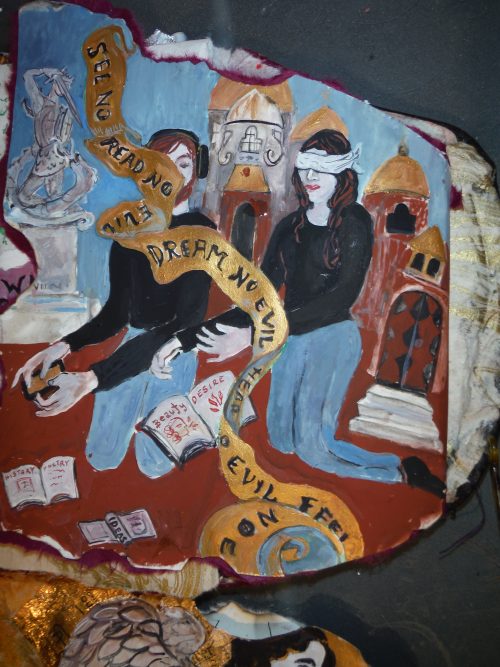
torino4-037Page from An Apology for Meaning, Artists’ book by Genese Grill

D’Annunzio called his house “the book of stones,” and like all good books it is filled with symbols. Everything means something. And the many mottos written on ceilings and round the rims of rooms and over doorways help us should we falter in our interpretation. And yet, I probably will be trying to understand it all for a long time to come. Certainly, although it would be simpler to outright reject grandeur and beauty, because of its sometimes questionable provenance, I cannot moralistically deny myself the intellectual and sensual pleasure it brings. And yet, the provenance and history of objects is significant and fraught with tangled skeins of so much seeming good with so much seeming bad. I will continue to be curious about all the life and the history that can be gleaned from material remains—portals to other worlds and times—and to embrace the wild contradictory nature of humanity with an amor fati—love of fate—communing, even if need be, in occasional discomfort, with all kinds of ghosts, neither assuaging nor simplistically censoring the transgressions of these haunted spirits.

What would D’Annunzio have thought, however, had he known that the souvenir shop outside the grounds would feature not only snow globes with little miniature Il Vittoriales and coffee mugs emblazoned with his face, but also a section devoted to his special friend and nemesis, Mussolini, offering brass knuckles and ominous riding crops for sale? Would he have approved? I would like to think he would he have considered it an impudent intrusion, actuated by purely capitalist vulgarity, a treacherous re-writing of his more nuanced story, rather like the posthumous revision of Nietzsche’s biography by his Wagnerite sister. (Elisabeth-Forster Nietzsche, as is well known, attempted to posthumously present her brother as a proto-Nazi, he, who in reality despised the Germans and who called in his last days for the death of all anti-Semites. The Mussolini display made me feel queasy, so I quickly exited the little shop and walked down the hill to beautiful Lake Garda, which Goethe, on his visit, had called “magnificent,” trying to separate the marvelous and admirable Italian writer from his unsavory companion. I caught the afternoon bus out of town, and made it back to Torino by late the same evening.

I spent my last week wandering around gazing at everything, saying goodbye with my eyes, entering dark churches on rainy afternoons and returning to museums I had already visited. I abandoned my foolish infatuation with the intern from Sardinia. It had been a case of pareidolia after all, or a matter of witchcraft. I visited Brunilde one more time, who had been angry at me after the last lunch for refusing dessert, a strawberry delicacy which the blackboard claimed was “the cake of love.” Probably she had cursed me, and my refusal to eat the cake was the cause of my romantic failure. This time I was all alone with her in the little restaurant. We talked despite my faulty Italian and her non-existent English, and she even gave me the name of another restaurant, scribbling it on a little piece of paper, which I did not lose and used the following day. I knew better now: I would do whatever she said and eat whatever she suggested. Lunch was orecchietti with spinach pesto and a mouth-watering cutlet swamped in delicious artichoke sauce, a glass of red wine, sparkling water, and for dessert a divinely magical zabaione with roasted almonds, an espresso, the traditional shot glass of absinthe-soaked grapes, and something extra this time, to mark my initiation: a little jar of sugar cubes soaked in liquor and spices, which I did not know really how to eat or drink. She became frustrated with me and took it away, “Only the sugar, only the sugar;” but she had accepted me, just the same, this woman whose gruffness was a legend, but whose favor I had longed for. I was sure she was a witch, and that she could help me or hurt me. After the espresso, I paid the bill, but was short some 60 cents. She waved me away; it was a mere trifle between such good friends. I wished her a beautiful life, una vita bella, and Brunilde the fierce blew me a kiss! I was blessed.
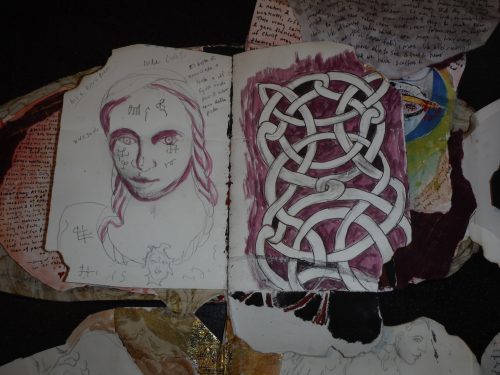
torino4-030Page from An Apology for Meaning, Artists’ book by Genese Grill.

On the way to the airport, the Alps, covered in snow, were visible behind the utilitarian architecture at the edge of the city. All along the street, shutters opened and green curtains were extended from inside to out and draped over the little balconies. From a tall building, a white sheet, like a small cloud, was shaken out in the fresh morning air in the wind and sun. Church spires rose up, shopkeepers brought out boxes of fruit for display, and old men in gray caps trundled along the sidewalk, newspapers tucked in the pockets of their old tweed jackets, ready to be unfurled along with the far-off world at the nearest caffè. The time had come to leave, and the following were my last words with which I armed myself for a return to the American landscape of ironic nihilism, that nihilism born in part of a fear of the complexity inherent in material objects and in the often painful distance between dreams and reality which they reveal:

Whosoever today does not respond, does not resonate to the stirrings of beauty and the energetic life force of the world as it is, who is not filled with wonder at its teeming multifarious richness, who mocks those in the past who have made objects and symphonies and wrote poems to celebrate the intricate, elaborate, strange, cruel, and tender rhythms of life, must be dead of spirit. In the Palazzo Madama museum, after bathing in sunlight streaming into a room of baroque golden splendor from a grand window, I entered the tiny tower housing a collection of small treasures, and any lingering doubts about meaning were immediately purged from me. I knew that the doubters were blind, deaf, and dumb. These intricate treasures were immediate palpable evidence of the perennial human need to celebrate the real delights and dangers of nature and civilization. Carved ivories, etched gems, blown glass, cast bronze. Fancy— made out of the real substance of the physical world, its colors and textures and qualities. I was thus armed to do battle against the skeptical intellectuals and their social construction blasphemy. I knew: Whosoever does not love Nature and the artifacts of humankind’s love of matter (colors, curves, sounds, textures, words, flavors, rhythms, light, light, light!) may as well be dead. Such a one is bereft of heat, of senses, of love, of lust, is a lizard of theoretical idiocy; just as much a repressor of the instincts and the body and nature as any inquisition or poison-spider priest. Philistine sophisticates, parading as the new intellectuals and new anti-artists, may you chortle on the dust of your own dreary scoffing. We others, we naïve ones, have been filled with wonder by the beauty of the world.

—Genese Grill

.grill-genese-grill-with-artists-books-cropped
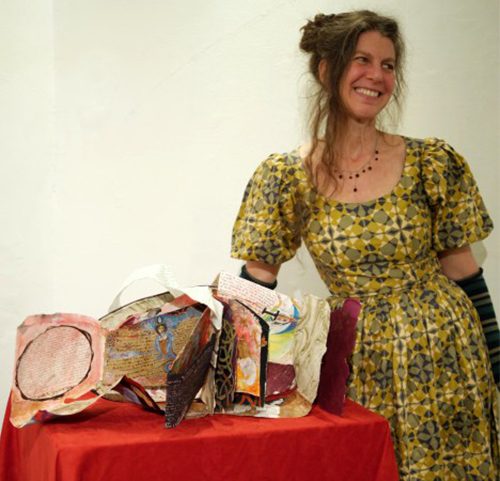
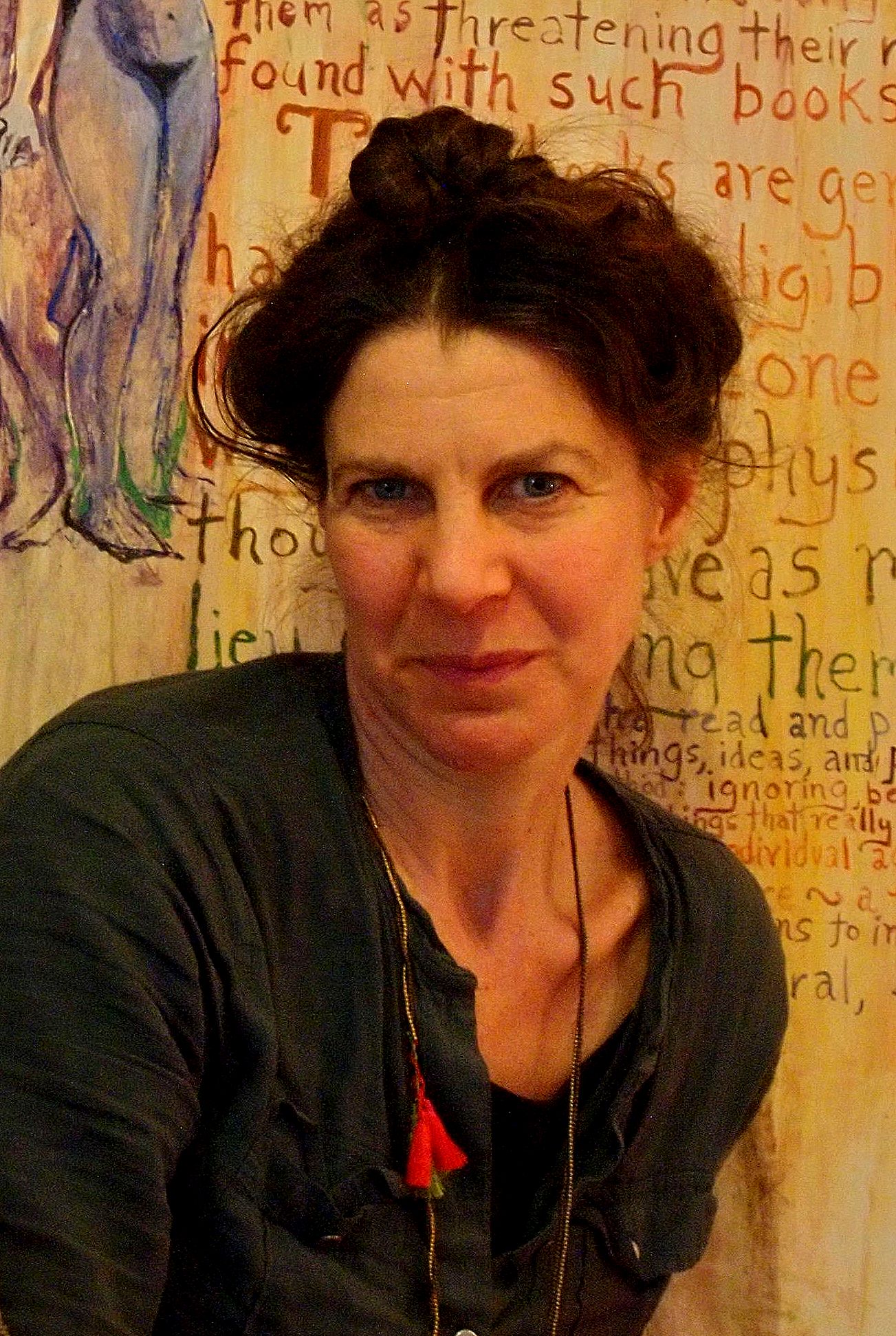
Genese Grill is a writer, translator, and book artist, living in Burlington, Vermont. She is the author of The World as Metaphor in Robert Musil’s The Man without Qualities (Camden House, 2012) and the translator of Robert Musil’s Thought Flights (Contra Mundum Press, 2015). She has just finished a collection of essays entitled Portals: Reflections on the Spirit in Matter, which is looking for a nice publishing house in which it might live. Essays from the collection have appeared in Numéro Cinq, The Georgia Review, and The Missouri Review, and one of them won the 2016 Jeffrey E. Smith Editor’s Prize for Nonfiction. She is proud to be on the masthead of Numéro Cinq as special correspondent.

.
.
Apr 302015
 

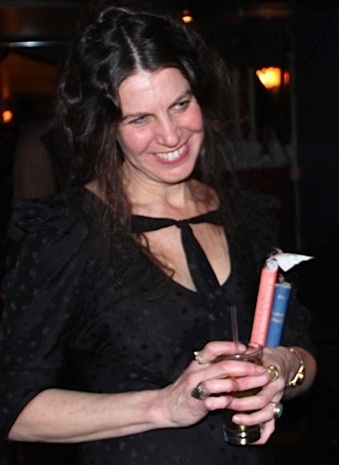
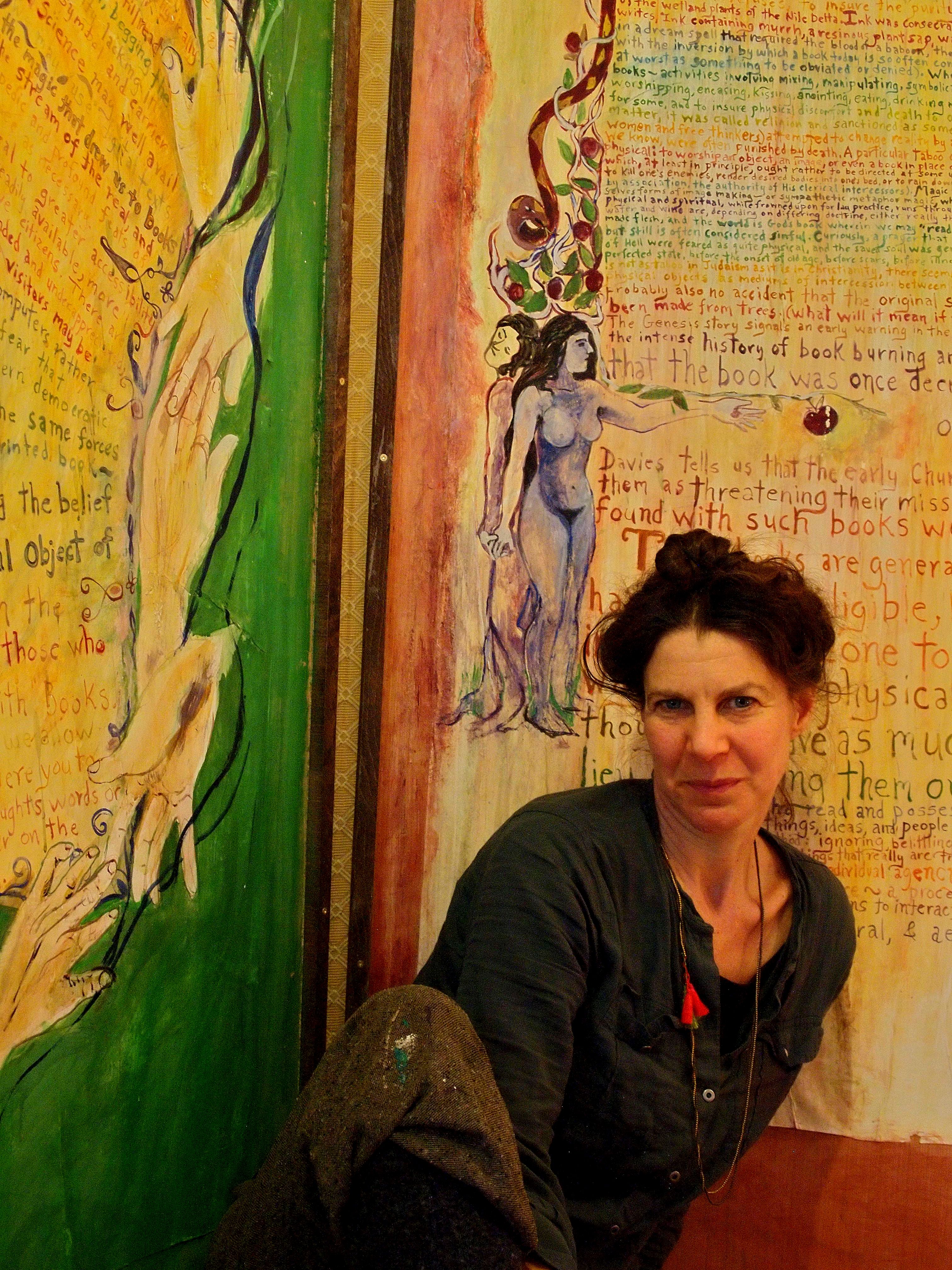
Genese GrillPhoto by Rebecca Mack

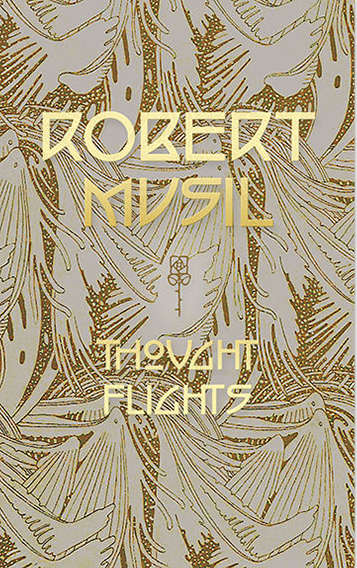
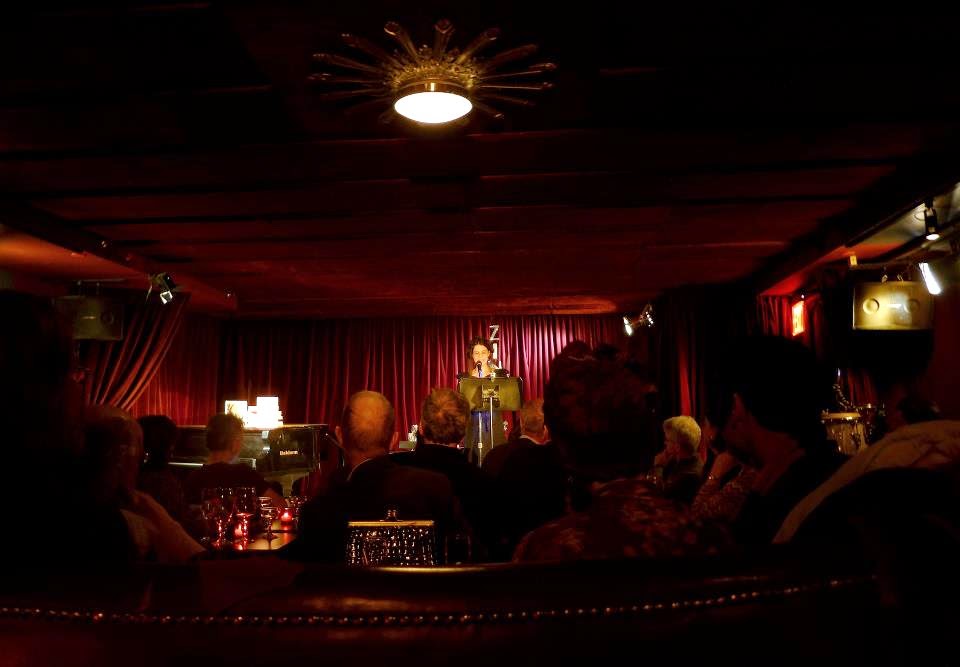
Last September Genese Grill published two short Robert Musil essays she had translated here at NC — Robert Musil: Speed is Witchy! & Intensivism — Translated by Genese Grill. That led to a book offer from Contra Mundum Press. And, Lo! the book is out or nearly out. It’s called Thought Flights. Launch party and reading are in New York at the Zinc Bar May 10, 5pm. Save the date. Book your flights. It’s a big event in Musil-Land, and NC readers were there at the beginning. A great honour for us to have Genese on the masthead.

Cover

Here’s the invite and address:

Please join us for a book launch party and reading of my new translation of Robert Musil’s small prose, Thought Flights (Contra Mundum Press, April, 2015) at the glamorous Zinc Bar, at 82 West Third Street, New York, on Sunday, May 10th, at 5 p.m., accompanied by Stephen Callahan reading from Seities, his collection of prose pieces in progress.

—Genese Grill

And check out Genese Grill’s NC Archive Page for all her contributions to the magazine.

.
.

Feb 022015
 

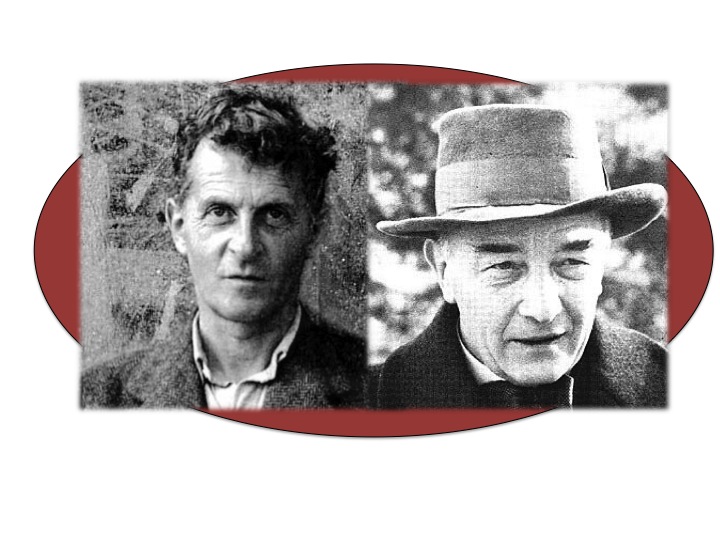
WittgensteinandMusilRobert Musil (1880-1942) was an Austrian novelist, philosopher, student of mathematics, physics, behavioral psychology and engineering with mystical tendencies, and the author of the great unfinished experimental novel, The Man without Qualities. Ludwig Wittgenstein (1889-1951) was an Austrian philosopher whose thoughts on logic, mathematics, language and ethics have been extremely influential in both philosophical and artistic circles. He is the author of the Tractatus Logico-Philosophicus (1921) and many unfinished works, including Philosophical Investigations.

Disclaimers: 1. I do not pretend to be an expert on Wittgenstein. These, my observations, come from a mere few years of study of a philosopher who deemed that even his closest peers did not understand him. By comparing my interpretation of his ideas to those of Robert Musil, I am merely suggesting connecting strands, and possible shared concerns, and generally avoiding here (in the interest of space and time) the very real and complex differences between their world views. 2. Since I have spent decades studying and writing about Musil, I have concentrated mostly on Wittgenstein in this essay, assuming a general knowledge of Musil which is probably quixotic at this point in his ill-fated English-language reception. Hopefully the hints and references to his ideas and works will lead the reader back to the primary sources and also to my more thorough treatment of things Musil in my book, The World as Metaphor in Robert Musil’s &c.,&c. . 3. This essay could only be “completed” if I allowed it to be just that—an essay, or “essai,” a trial, and not at all a finished work of writing. It is an attempt to pull together many, many related but still insufficiently synthesized ideas. It will take a lifetime to get all of this into some truly presentable shape.

— Genese Grill

.


“Necessity is nothing but Existence, which is given through the Possibility itself.” — Immanuel Kant,
The Critique of Pure Reason

“It is reality that awakens possibilities, and nothing would be more perverse than to deny it. Even so, it will always be the same possibilities, in sum or on the average, that go on repeating themselves until a man comes along who does not value the actuality above the idea. It is he who first gives the new possibilities their meaning, their direction, and he awakens them.” — Robert Musil, The Man Without Qualities

“It is clear that however different from the real one an imagined world may be, it must have something—a form—in common with the real world.” — Ludwig Wittgenstein, Tractatus Logico-Philosophicus

“Thought is surrounded by a halo—Its essence, logic, represents an order, in fact the a priori order of the world: that is, the order of possibilities, which must be common to both world and thought…prior to all experience [this order] must run through all experience; no empirical cloudiness or uncertainty can be allowed to effect it—it must rather be of the purest crystal…” — Ludwig Wittgenstein, Philosophical Investigations

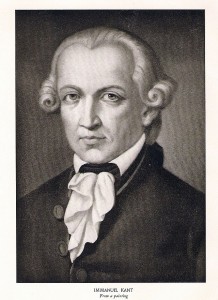
One of the most troubling challenges of living in what is nowadays assumed to be a relativized subjective universe is never knowing for sure whether what one sees, understands, or experiences is the same as what someone else sees, understands or experiences. What once was conceived to be solid shared reality, describable with definable words and measurable by standardized tools, has, since Kant (and, over the next century, in the wake of Einstein, Darwin, Nietzsche, and Freud), been deemed increasingly fragmented, uncertain, and relative. After philosophers spent centuries wrestling with the question of what could be known about the world and the related question of what, in fact, reality is, with or without the intervention of the subjective experiencer, the so-called “linguistic turn” in twentieth century philosophy took this question a step further by concentrating on the role played by language in describing, creating, delimiting, or expanding our experience and knowledge of the real. Modernist art and literature wrestled with these problems of knowing and communicating and earnestly strove to find ways to build bridges between the individual alienated person and the shared world of nature and culture. To put it simply, Kant was looking at the limits of thought; Wittgenstein at the limits of language. But both were concerned with the way philosophy had hitherto claimed to know or say certain things (of a metaphysical sort) that in their opinion could not be known or spoken of with certainty. Despite these reservations about the possibility of knowing or speaking certain things, neither Kant nor Wittgenstein rejected the realms of ethics or metaphysics as valuable aspects of experience.[1] And Musil made it even more clear than Kant and Wittgenstein (through his experimental fiction; through showing, not theorizing or merely saying) that aesthetics was the realm wherein one could begin to know, experience, and articulate those things which could not be grasped otherwise. He called this realm the realm of essay, of the ethical, of the aesthetic, of the other condition, and, despite his training as a mathematician and scientist, despite his tendency toward philosophical precision, he valued this realm above all others, choosing to write a novel rather than a scientific treatise for reasons with which Wittgenstein would probably have concurred. But the philosophical question of what could or could not be known of the shared world of phenomenon, and, thus, expressed in language (what kind of language became a heated question in Modernist poetics) haunted writers in the early twentieth century.[2]

Another philosophical conundrum discussed by Kant and then revisited by Modernist thinkers was the related question of ethics and the nature of the willing, determining self. For Kantians, as Anthony J. Volpa notes in his biography of Fichte, “At issue was whether selfhood as autonomous agency was an illusion and indeed whether the very notion of an integral self dissolved if the individual was merely one more object in a web of causes” (46). A hundred years later neo-empiricists like Ernst Mach (whom Musil critiqued and praised in his doctoral dissertation) were definitively denying the nature of the integral self and casting doubt on the individual’s ability to determine his or her shared reality—for quite other reasons and with quite other consequences than earlier thinkers. While in Kant’s time the debate was one between a divine determinism and the free will of the ethical individual, in contemporary philosophy the debate is between a random chaos or a mechanistic universe and a treacherous social construction wherein the individual plays no meaningful role. What exercised Musil and Wittgenstein was the quest for some direction for individual ethical behavior; and the search for some conduit to meaning amid the increasing fragmentation and uncertainty. In contrast to the abstract philosophizing of many logicians, Musil and Wittgenstein were, like the transcendentalists before them and the existentialists to follow, engaged in exploring philosophical questions that could help human beings figure out how to live.

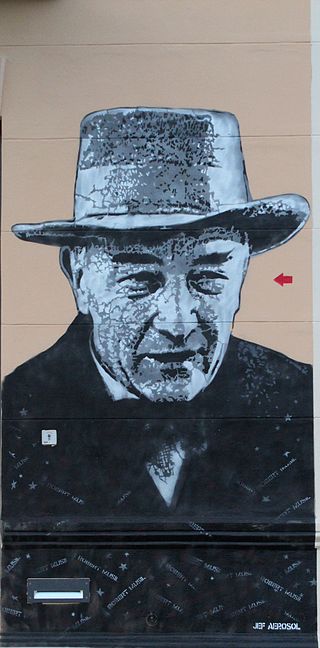
320px-Klagenfurt_-_Musilhaus_-_Robert_MusilDepiction of Musil at the Musilhaus in Klagenfurt

According to Allen Tiher, in his Understanding Robert Musil, “Musil saw no place for human concerns in Mach’s limited positivism…in critiquing Mach he was already thinking of science’s uses for humanity…[Musil was] troubled by Mach’s idea of truths as mere fictions…” (34). Tiher goes on to say that Musil’s critique of Mach in many ways works as a critique of Wittgenstein’s belief that language could only depict the substance (not the core) of reality (“propositions mirror the exact part of facts, though nobody could ever point to exactly what they might be…all that can be meaningfully said is what can be mirrored in propositions in language”) (Tiher 42). Musil wanted to at least consider the possibility of knowing the thing in itself, whereas Wittgenstein may have been more skeptical about such certainty. Yet Tiher also points to commonalities between Musil and Wittgenstein, noting that both “yearned for a reality beyond the limits of positivist propositions and functional relations” (42). Both Wittgenstein and Musil “reacted to Mach’s limitation of knowledge to the realm of functional relations” (42). Wittgenstein wrote in the Tractatus, 6.52 “We feel that even if all possible scientific questions have been answered, the problems of life have still not been touched at all”. Tiher concluded that “Both conceive of aesthetics as a ‘showing’ of ethics, and of ethics as the realm where values are as real as any other aspect of reality” (43).

Early twentieth century Machian positivism inspired a new set of concerns for contemporary artists, writers, and philosophers, who were struggling with what they called a crisis of language (like the Kantkrise of an earlier generation of artists) amid a greater crisis of values. Did the breakdown of some certainties mean that anything was possible? Or rather nothing? Or were there natural parameters or boundaries, some sort of a priori order to things?[3] In the wake begun so long ago, today many heirs of two generations of skeptical inquiry err on the side of a radical openness and relativity of values to which Kant, Wittgenstein, and Musil would not have subscribed.

Many 20th century thinkers and artists, following the spirit if not the law of Kant’s ethical aesthetic imperative, believed earnestly in the possibility of redemption through art and an ethical conduct of life born of the friction between experimental empirical assessment and some sense of essential but shifting truths, between personal and shared reality, between repeating patterns and new arrangements, and between established archetypes or forms and new metaphors and synthesis—in short, in a kind of proto-aesthetic existentialism, whereby the artist and thinker expands the possibilities of the real (through seeing for the first time what was always there)without denying reality’s concrete parameters. These thinkers and artists were dealing with a struggle between necessity and arbitrariness, a priori truth and creative agency, asking such question as: What do we have agency over, what not? And how do language and art function in this interchange between what is necessary and what is possible or even merely constructed? How does the word or image “make” the world (as Musil and Wittgenstein suggest repeatedly), how does language respond to the world, answer the world? Is it like a call and response? A mirror, a warp, a description or re-creation? A betrayal, a social construction, a deception? Are certain facets of reality best described by showing, not naming, as Wittgenstein suggested and Musil modelled? Or is it impossible to know, and then impossible to describe or communicate at all?

While it has been the fashion for the last half century at least among sophisticated theorists and artists to maintain that nothing whatsoever can be determined, communicated, named, or delimited, past masters of precision and soul were capable of carefully examining what in fact still remained in the shared universe that could be established to be repeatable, certain enough, objectively measurable, and to what extent language could in fact be used to communicate not only what was solid, but even those more tenuous shifting internal subjective states that made up so much of the content of the art and literature of the psychologizing 20th century. The distinction between a world where nothing at all can be determined and one in which only certain things can be has been too often slurred over. The difference between a world wherein language means nothing and one in which language can approximate and approach meaning is considerable; and it takes patience and daring to dwell in this uneasy borderland, exemplified by Robert Musil and Ludwig Wittgenstein.

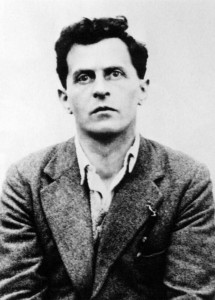
ludwig-wittgenstein-nacido-en-viena-austria-1889-fallecido-en-cambridge-reino-unido-1951-125700_w1000Ludwig Wittgenstein

These two thinkers lived almost side-by-side on Rasmofskygasse in Vienna for about a year sometime between 1920 and 1921, possibly without ever making each other’s acquaintance. They were both snobs who craved discourse; both were scientists who had more faith in art than in philosophical logic; both were individualists who were suspicious of collectivism and resisted joining groups or being categorized into positions or ideologies[4]. They both rejected externally-imposed morals and social judgments in favor of a personal rigorous ethics and conduct of life. They both had ambivalent relationships with the scientific positivists of the Vienna Circle. In contrast to the members of this circle, both wanted to connect philosophy and science with aesthetics and ethics and make it meaningful for human life[5]. Both resisted theory in favor of experimental empiricism. Both had mystical experiences as soldiers in World War One, leading to puzzling relationships with something they both sometimes called “God”; both were mathematicians suspicious of mathematics; both were engineers and inventors; empiricists and idealists; pragmatists and utopians. Both looked to anthropology to present alternative possible ways to live; both loved Dostoevsky; both worked and wrote in a non-linear,[6] inter-disciplinary fashion; both liked to go to the movies. Both of them were obsessed with using language precisely; but both rejected language skepticism, while acknowledging the limits of language and knowledge; and both saw metaphor as the best possible mode of expressing certain experiences and truths. Both were so committed to the experimental method and a resistance to closure or final solutions that they were almost pathologically unable to finish their works. They are exemplars of a special breed of idealist-realists—a group of people who throughout history have simultaneously hugged the surface of the real “what is” while reaching for the ideal “what could be”; thinkers who have labored to establish what can and cannot be known or spoken, thinkers who have eschewed what Musil called “Schleudermystik” (wishy-washy mysticism) and Wittgenstein called “transcendental twaddle,” and, at the same time, kept at bay a nihilistic relativism or void of all values. (Other thinkers in this cadre include Thoreau, Blake, Novalis, and Nietzsche).

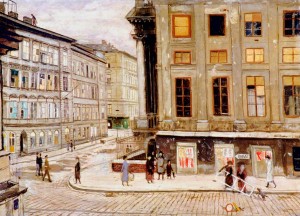
(c) Bridgeman; Supplied by The Public Catalogue FoundationThe Rasumovsky Palace, Vienna, Corner of Rasumofskygasse and Geusaugasse, by Carel Victor Morlais Weight

To harbor some belief in a repeatable recognizable shared reality and a language that serves well enough to communicate what we think, want, and care about is to fundamentally take responsibility for our place and agency in the world. The opposite tends toward an adolescent “whateverism” wherein everything cancels itself out and wallows in bankrupt cynicism. In contrast to this hollow sophistication, Wittgenstein and Musil are related to the transcendentalist age of self-improvement and both earnestly struggled with determining what was the right way to live. Their “sense of possibility” (Musil’s phrase) and skepticism about social conventions and abstract propositions about right and wrong was not the same as absolute license, total openness, or self-indulgence. Looking back to Wittgenstein and Musil, we find an alternative to the total relativity of values and vacuum of meaning—a veritable model of existential responsibility and an ethics grounded in a complex analysis of what can and cannot be known, expressed, or experienced—an ethics, in short, grounded in aesthetics. Ironically, the refusal to accept any shared reality today in some philosophical circles has led to a situation similar to the age of faith. While in the latter the realm of truth was found in scripture or metaphysics, in both cases truth is not recognized in the real exigencies or material experience of life. In both cases truth is an abstraction, although in one this abstraction is to be mistrusted while in the other it is to be uncritically believed. High Modernism marked out a middle zone between skepticism and non-critical acceptance of abstract generalities and ideals. This middle zone is difficult to navigate, but it is imperative that we abide here in uncertainty to catch the shirt tails of agency as reality flies past our subjective indifferent gaze.

We have come so far from that comfortable pre-Kantian world of shared beliefs, and we have heard so much skepticism about shared reality that we have almost become blind to the palpable real that is right in front of us, to the facts of our shared existence—birth, death, seasons, dusk, bodies, beauty, the night sky. Many contemporary theorists would have us scoff at the possibility of experiencing anything real at all, or at the possibility of using words to describe what we feel or see. But they must be blind themselves, and lacking fundamental sense organs, to arrive at such a bankrupt state of existence wherein nothing at all is real and no combination of words can resonate with an external or internal event. I have a young friend, so steeped in the allurements of this “philosophy” (it should be called love of no-truth, not love of truth, since, according to its basic tenets there is no truth to love) that he feels the need to create a new mythology, a trumped-up mythological meaning, since there is, he fears, no real one anymore. But wait! There is still meaning, there is still a real world, and words can still be used to celebrate and lament it! And this meaning will come from our sensual, aesthetic, experiential contact with the real, mediated through the mind, the senses, language, and images, the only tools that we have. Herein we may have some glimpse of the meaning behind the pronouncement (which we find in both Musil and Wittgenstein) that “ethics and aesthetics are one”. For aesthetics does not merely connote fantasy and fiction but sense experience, a living palpable conduit between the abstracted mind or pen and the real breathing, smelling, scintillating, churning world. How we see and experience and the way in which we formulate what we see and experience depends on sensations, formal arrangements, and the process and poetics of space, time, and shifting perspectives. And these perceptions determine our actions and judgments about how to live.

Wittgenstein is thought to have changed his ideas on the relationship between language and reality in between his writing of the Tractatus and the Philosophical Investigations, maintaining later that language is not necessarily a picture of the world, but, rather, that language determines what we see and, in effect, makes our world. But neither position is based on a radical separation between the mind as language-maker and the reality that it attempts to describe. Instead, it is a matter of interpreting, and expanding or limiting (waxing and waning, to use Wittgenstein’s terminology), our perspectives. According to David Pears, Wittgenstein, “abandoned the idea that the structure of reality determines the structure of language, and suggested that it is really the other way around: our language determines our view of reality, because we see things through it” (13). As my friend Dharman Rice put it, Kant’s theories suggest that the mind is not a camera simply recording what is out there, but rather has something to do with choosing, selecting, and arranging the phenomena it encounters. According to Kant, phenomena are transmitted or filtered through transcendental schema or structures of the mind (space, time, etc.); according to Wittgenstein, this arranging occurs through the process of language use. I scoured Kant in vain to find an answer to the question of whether this means that what the mind sees is an illusion, I could find no definitive answer (probably because it is the wrong question. Kant is not concerned with what is or is not there, but rather to what extent we can determine it). It seems to me that he does not assume that the filtered view is false. It is merely filtered. The same seems to be true for Wittgenstein. What changes in between the Tractatus and The Philosophical Investigations then is not Wittgenstein’s conclusion about a priori reality, but his process of arriving at a conclusion at all. In fact, one could say that there are really no conclusions, only a process. While in the Tractatus he relied heavily on what he came to see as a priori givens or logical abstractions, in the Investigations he is modelling a process of experimental empiricism, a method quite close to Musil’s aesthetic of experimental essayism, one which resists theory and final conclusions in favor of what Musil would call “partial solutions” or the “utopia of the next step”.

According to Ashok Vohra in his Wittgenstein’s Philosophy of Mind, this process is not a refutation of realist philosophy, although a realist might consider it to be. Wittgenstein,

[M]aintains that acceptance of any proof is an act of ratification which is independent of any previous acts of ratification. Nothing that we have done in the past forces us to ratify, or to withhold ratification from the proof which we are now being offered. This sounds absurd, because we naturally assume that the meanings of the terms used in the proof of the would-be theorem or equation must have been fixed in advance. But what Wittgenstein is suggesting is that their meanings were not completely fixed in advance, and that their full meanings accrue to them bit by bit when the later ratifications are made or withheld. (136)

In other words, the human mind continually participates in making and acknowledging a shifting changing world. This is an alternative to the chicken and egg question of whether the mind makes the world or the world the mind. The answer to the riddle is that the mind and the world constantly work together to fashion a meaningful approximation of reality. Further, of course, the mind is a part of the world, a part of nature, and thus should not be so very different from what it sees and records as to prohibit correspondence!

Immanuel_Kant_3Immanuel Kant

C. N. Wilson explains in his book, God’s Funeral, that Kant “was trying to marry the twin truths: namely, that by the very process of perceiving and knowing, we invent our world; and also that this world has a reality of its own.” In a note, Musil summarizes the paradox: “Kant: Concepts without observation are empty. Observation without concepts is blind” (Mann ohne Eigenschaften, 1820). In another formulation he explores the question of how the phenomenological world interacts with the human mind: “In truth, the relationship between the outer and the inner world is not that of a stamp that presses into a receptive material, but that of an embosser that deforms itself in the process so that its design can be changed into remarkably different pictures without destroying its general coherence” (Mann ohne Eigenschaften, 1435). In a conversation about ideality and reality with some high school students from The Walden Project here in Vermont, two of them came up with a marvelously helpful image: the ideal is like a light shining on the real, but it has to be plugged in to the real to shed light in the first place. The real, without imagination, ideas, dreams, or light, is nothing but a mechanical mass; the ideal, without the real, would have nothing to shine on.

In answering the related questions of what is determined and what determinable, or what is essence and what existence, what transcendental and what existential, or how much do our perceptions contribute to shared reality (beyond doubts about knowing the thing in itself), both Musil and Wittgenstein were pragmatists of sorts, who believed that we know the world well enough to avoid burns, bumping into tables, walking into walls, and well enough to understand basically the words others use. They also, as scientists, must have seen that the mind was not separate from Nature in some Cartesian sense and that such a natural structure or lens would probably see in a fashion more or less consistent with the reality of nature. As David Pears writes, describing Wittgenstein’s general perspective, “When the field [of observation] is extended to the limit, there does not seem to be any possibility of discovering that thought and reality might fail to fit one another[…]. [T]he fact is that in certain general ways thought and reality must fit one another”.[7]

Prop 5.6—5.641 of Wittgenstein’s Tractatus states: “The world is my world’, ‘I am my world. (The microcosm)” and “The subject does not belong to the world; rather it is the limit of the world’. But this need not contradict his emphasis on what Thoreau would call “fronting the real”. This is, in effect, the same paradox of Emersonian Self-reliance and the Kantian categorical Imperative and its subsequent iteration in existentialism: what is true for me is true for all men; what I do determines what others do; existence precedes essence. Our actions change the world; our perceptions expand and contract it; reality waxes and wanes depending upon the words we use to describe it; but that doesn’t mean that we change the basic coordinates of nature. Proposition 3.032 states: “One can depict something that contradicts logic in language just as little as one can present a figure in geometry whose coordinates contradict the laws of space; or give the coordinates of a point that does not exist.” And, again, in proposition 3.033, we read: “One used to say that God could create anything except something that contradicted logical laws— in other words, we couldn’t say what an illogical world would look like.” And yet, certain strictures, like grammar and some mathematical rules, are arbitrarily limiting. And there are socially-constructed morals and prejudgments that inhibit a fresh experience of the real. These must be resisted and continually tested. Musil wrote: “The period and the semicolon are symptoms of stasis. We don’t make them because we learned to, but because that is how we think. And that is the danger in them. As long as one thinks in sentences with end stops, certain things cannot be said; at most they can be vaguely felt. Infinite perspectives (moving inward) would have to be expressed like infinite rows” (Notebooks II, 822). As such, the way we use language to talk about our world can limit or open up what possibilities we see in it.

Perhaps the answer to the alleged problem (Wittgenstein would probably say that there is not even a problem to begin with!) is that knowledge of reality does not comes solely from empirical experience (as opposed to a priori essence), but that it comes from a process of synthesis and the constant creation of fresh, repeating—not rigid and unexamined—metaphor. A metaphor which, chez Wittgenstein, always points outside itself by virtue of its very nature as metaphor. Both Wittgenstein and Musil repeatedly make the distinction between living language and dead cliché, and this distinction is linked to their common cause of experimental empirical ontology and the processes called, respectively, the utopia of the next step (Musil) and re-ratification (Wittgenstein), whereby nothing is certain until one takes into consideration what comes next, or, until one re-tests it within new circumstances. Musil writes: “Living word full of meaning and correspondence in the moment, bathed in will and feeling. An hour later it says nothing although it says everything that a concept contains.” And Wittgenstein writes in his Philosophical Investigation, “Every sign by itself seems dead. What gives it life?–In use it is alive. Is life breathed into there?—Or is the use its life?” (432e).

Instead of adhering to one polarization of the empiricist/Platonist spectrum, Wittgenstein (like Musil and Nietzsche too) posits another kind of process of world-making (one that acknowledges a reality outside of abstraction, language, and theory), one which involves a conscious awareness of our use of language and image to create a good deal of what we consider reality and truth. The trick, as Nietzsche explains in his “On Truth and Lying in a Supra-Moral Sense,” is to never forget that the metaphors which we invent to describe and see the world are not rigid absolutes in themselves, but rather living, self-generating, shifting approximations or, to use Wittgenstein’s term, “family resemblances” rather than exact representations— likenesses, overlapping commonalities.

Although there are multifold possibilities of how language may be used to describe reality, there are not infinite possibilities. There are limits; and these limits are the limits of logic, reality, nature, experience and shared human and social life. And these limits have very important consequences in Musil’s and Wittgenstein’s world views for determining a conduct of life. In fact, both of these individualistic—one might even say anti-social—thinkers, were deeply concerned with questions of society and the problem of solipsism. Wittgenstein’s rejection of the idea of a private language is one answer to the Modernist question of artistic solipsism, and touches on a central problem never solved by Musil: how might the mystical experience of “the other condition” depicted in his unfinished novel expand from the private specialized realm of two people to become a social utopia for the many? And how do his insane characters (Clarisse and Moosbrugger) serve to both destroy and invigorate common language with their private idiolects (Clarisse, in one very Wittgensteinian scene in the Nachlass chapters of the novel, tries to remove the meanings from words by taking them out of their natural order, by repeating them, by underlining them). One of Wittgenstein’s answers to the problem of solipsism is his conclusion that, as Vohra writes, “the real relationship between words and physical phenomena is not contingent but essential, and that language is not the product of one person, but has evolved with human life” (6). Although we do have private (i.e., nontransferable) sensations, they are stimulated by public, shared phenomena (the objects of observation) (Vohra 16-17). The necessity of communicating with others is served by a union of aesthetics and ethics, requiring an awareness of reality taking the special case into consideration rather than an abstract impersonal morality. Individual responsibility is born in each new moment— in concert with others. As opposed to an alienated despair or nihilism about the ability to ever share values, ideas, goals with others, Kantian, Wittgensteinian, Musilian individualism breeds ethical consciousness when it includes other-directed awareness. Anti-individualistic collectivism, on the other hand, can be the seedbed of a lack of self-responsibility. In the Philosophical Investigations, Wittgenstein suggests that the problem with the idea of private language is its lack of practical social consequences. A private language is like one’s right hand giving one’s left hand money (80) or the absurdity of a person giving “himself a private definition of a word” (80). What would understanding be, what consistency? It would be, Wittgenstein writes, like “… a wheel that can be turned though nothing else moves with it, is not part of the mechanism” (81). “Imagine,” he continues,” someone saying: ‘But I know how tall I am!’ and laying his hand on top of his head to prove it” (82).

There is a real world outside of or in correspondence with the mind, and its parameters do limit and guide what can and cannot be correctly said. Wittgenstein “holds the view that one who attempts to use a private language not only fails to communicate his meaning to others, but also does not have a meaning to communicate even to himself; in other words, he does not succeed in saying anything at all” (Vohra 38). Sensations, while they can be kept private, are communicable (Vohra 52). A private language is category mistake, according to Wittgenstein, that ignores the social nature of language. Language is a set of activities, and practices, defined by certain rules, and uses, “a form of life” (Vohra 66). As such, the individual has a social and ethical responsibility to use language in a way that corresponds to a shared social reality. While today some theorists might see this as a treacherous crime, or a sort of social coercion applied to the idiosyncratic non-contingent mind, Wittgenstein and Musil probably saw it as a pragmatic and workable means to attempt to communicate ideas and feelings. People who imagine Wittgenstein as the patron saint of silence and the impossibility of communication may be surprised to read this rather characteristic statement from the Philosophical Investigations: “The sign post is in order—if, under normal circumstances, it fulfils its purpose” (35 e). Inexact, he suggests, does not mean unusable.

And while Musil too (following Nietzsche’s metaphor theory in On Truth and Lying) is clear about the fact that metaphors are inexact, that, in fact, every time we make a metaphor we are perpetrating a sort of crime against the true differentiation of each entity or idea, he is equally clear that this process of inexactitude and imprecision is just what humans must do in order to bring “beauty and excitement” into the world. Making metaphors is a form of human-generated, reality-generated meaning-making which continually resists ossification, cliché, and fixed ideas. It is an ethical and aesthetic process of existential engagement in expanding (without denying) the boundaries of the real, of nature, of truths in their varied, shifting relativity. And this expansion of boundaries—what Wittgenstein called waxing—works in tension with the constriction of the already known and accepted, the already established conventions (a waning), as well as with the eternally reverberating archetypal and naturally recurring realities of shared human life (trembling aliveness of ancient energies). In the Tractatus, Wittgenstein writes: “6.43 If good or bad willing changes the world, it can only change the limits of the world, not the facts; not the things that can be expressed in language…. In brief, the world must thereby become quite another. It must so to speak wax or wane as a whole.”

All philosophical theories are rooted in pictures (metaphors); and every already-known picture must be continually uprooted by the introduction of a new picture, a new metaphor: once a simile or metaphor has been accepted, it is too often taken for granted, no longer seen as a picture but taken as a reality or an exact representation. The creation of new metaphors is necessary not only for the successful creation of new meaningful art objects, but, moreover, for the enlivening and generation of ethical life through living language and living forms. Wittgenstein writes: “The means whereby to identify dead forms is Mathematical Law. The means whereby to understand living forms is analogy” (qtd. in Monk, 302). Monk glosses: “In understanding ethics, aesthetics, religion, mathematics and philosophy, theories were of no use” (304). In lieu of theories then: art, the realm of the individual case.

Each poetic pronouncement or artistic expression is at once a free act, individual voice, new note, an addition to and a conversation with, response to, answer to what has already been. And it can only be understood within such a linked context of history, cultural discourse, and shared experience of the world and its cultural products. Rampant skepticism, anti-intellectualism, and obfuscation lead only to careless, speechless, inarticulate grunts and irresponsible confused beings. Art, again, is often the best medium for communicating what cannot be shared otherwise and it models a process of generative re-visioning and a creative tension between what is and what can be, between the abstracted whole and the individual unique non-repeatable experience. Wittgenstein writes: “We speak of understanding a sentence in the sense in which it can be replaced by another which says the same; but also in the sense in which it cannot be replaced by another. (Any more than one musical theme can be replaced by another.) In one case the thought in the sentence is something that is expressed only by the words in these positions. (Understanding a poem.)” The use of poetic language, the ongoing conversation of form and image is a fruitful correspondence between particular individualized once-in-a-world empirical experience and a store of family resemblances, likenesses, and shared cultural and natural reverberations.

While sometimes the most valuable aspects of these human experiences (shared or alienating as the case may be) cannot be easily imparted, what can be shown but not said (in art rather than logic) is nevertheless sometimes stammered (one tries to say it, denotes it, suggests it, points to it) before it disappears. As Kafka wrote, “Truth is the light on the shrinking grimacing face”. We try to bring the wordless phantoms up from the depths or catch the rush of a flying experience of nature with words that are all too clunky, all too general. But they serve. They have to serve. And sometimes they serve brilliantly.

Wittgenstein apparently saw himself as “a disciple of Freud because of Freud’s use of similes: ‘It’s all excellent similes’, he said in a lecture on Freud’s work; and of his own contribution to philosophy: ‘What I invent are new similes’” (Monk 357). And Wittgenstein’s late philosophical technique even seems a bit like the technique of modernist fiction. The playing of “language games,” according to Monk, was a “method of inventing imaginary situations in which language is used for some tightly defined practical purpose. It may be a few words or phrases from our own language or an entirely fictitious language, but what is essential is that, in picturing the situation, the language cannot be described without mentioning the use to which it is put. The technique is a kind of therapy, the purpose of which is to free ourselves from the philosophical confusions that result from considering language in isolation from its place in the ‘stream of life’”(330). Wittgenstein’s anthropological approach has a good deal in common with the process by which fiction helps us to think about ourselves and our social assumptions by presenting alternative or slightly oblique visions of reality. This is, of course, a technique which Musil utilized expertly. Monk’s description of Wittgenstein could be a description of Musil the possibilitarian whose protagonist Ulrich was always imagining how things could be different; who was working on a utopian novel imagining all sorts of different ways to live; and whose short prose piece “Cannibals” describes a society of flesh eaters in a way that mirrors our own moral justifications for things that might be seen as aberrations: “By imagining tribes with conventions or ways of reasoning different to our own, and by constructing metaphors different to ones commonly employed, [Wittgenstein] tries to weaken the hold of certain analogies, certain ‘similes that have been absorbed into the forms of our language.’ He attacks, for example, the Platonism that regards logical propositions as analogous to factual propositions. ‘Isn’t there a truth corresponding to logical inference?’ he makes his interlocutor ask. ‘Isn’t it true that this follows from that?’ Well, replies Wittgenstein, what would happen if we made a different inference? How would we get into conflict with the truth? […]The point here is that the criteria for correct or incorrect reasoning are not provided by some external realm of Platonic truths, but, rather, by ourselves, by ‘a convention, or a use, and perhaps our practical requirements’” (Monk 381).

Wittgenstein’s new method in Philosophical Investigations rejected the earlier essentialist method of the Tractatus as metaphysical. His theories, he deemed, did not match real language or real experience (Pears 105-7). The generalizations arrived at intuitively were not results of empirical investigations…and, “he had wrongly assumed that the multifarious uses of language must have a high common factor [a generalized abstraction]. The truth was more complex: each resembled each other in many ways [family resemblances]” [and thus, he] “turned his investigation onto the multifarious differences” (107). Wittgenstein’s new method mirrors Musil’s:  “[I]t is empirical…it shows great respect for the particular case and …it is more like art than science, because the nuances of particular cases are not caught in any theory, but are presented in careful descriptions of actual linguistic practices…”(105).

Such an experimental method is actually a conduct of life—one requiring an open-endedness resistant to closure or absolute solutions. Demanding, in fact, a constant new re-visioning of fresh circumstances and combinations and a radical skepticism about received ideas and established categories. Wittgenstein’s work method was quite a lot like Musil’s, whose Nachlass is thousands of pages of versions, alterations, notes, sketches, and cross-references. Wittgenstein, according to Monk, would begin by writing remarks in a notebook; then he would select the best of these, write them out, “perhaps in a different order, into large manuscript volumes. From these he made a further selection, which he dictated to a typist. The resultant typescript was then used as the basis for a further selection, sometimes by cutting it up and rearranging it—and then the whole process was started again. Though this process continued for more than twenty years, it never culminated in an arrangement with which Wittgenstein was fully satisfied, and so his literary executors have had to publish either what they consider to be the most satisfactory of the various manuscripts and typescripts…” (Monk 319).

The work of philosophy, the work of the artist, in Musil’s and Wittgenstein’s sense, is a job with no end. One can never arrive at a conclusion. Monk explains: “This conception of philosophy, which sees itself as a task of clarification that has no end, and only an arbitrary beginning, makes it almost impossible to imagine how a satisfactory book on philosophy can be written. It is no wonder that Wittgenstein used to quote with approval Schopenhauer’s dictum that a book on philosophy, with a beginning and an end, is a sort of contradiction” (326). Musil, who never finished his magnum opus, would have concurred. In fact, as long as one lives, the work of being a human being is likewise an open experiment. We can never rest, but must always strive for the utopia of the next step, ever re-ratifying what we thought we once knew. “Ethics and aesthetics are one.”

— Genese Grill


Genese Grill

Genese Grill is an artist, writer, German scholar, and translator living in Burlington, Vermont. Her first book, The World as Metaphor in Robert Musil’s ‘The Man without Qualities’: Possibility as Reality (Camden House, 2012), explores the aesthetic-ethical imperative of word and world-making in Musil’s metaphoric theory and practice and celebrates the extra-temporal moment of Musil’s “Other Condition” as a transformative aesthetic and mystical experience informing a utopian conduct of life.

.
.

Footnotes    (↵ returns to text)

  1. Wittgenstein speaks of a certain kind of experience, similar to Musil’s mystical “other condition,” in which “I wonder at the existence of the world. And I am then inclined to use such phrases as ‘how extraordinary that anything should exist’…another experience…the experience of feeling absolutely safe. I mean the state of mind in which one is inclined to say, ‘I am safe, nothing can injure me whatever happens’”. Monk writes that Wittgenstein “went on to show that the things one is inclined to say after such experiences are a misuse of language—they mean nothing. And yet the experiences themselves ‘seem to those who have had them, for instance to me, to have in some sense an intrinsic, absolute value’. They cannot be captured by factual language precisely because their value lies beyond the world of facts” (qtd. 277).
  2. In my book, The World as Metaphor in Robert Musil’s “The Man without Qualities,” I wrote:

    Hofmannsthal’s “Lord Chandos Brief” gave voice to the modernist skepticism about the ability of logical or literal language to express subjective experience; but Wittgenstein provided a theoretical framework for articulating individual emotional and ethical experiences through the poetic image (that is, metaphor) rather than through dialectical rational language. What philosophy and science could not describe or explain might be approximated through the realm of art. The work of art, alongside its associated realm of ethical thinking, is marked out as a realm especially conducive to the expression of particulars, and thus escapes the inherent inaccuracy and generalization of rational and scientific conceptualization or logical abstraction. On the other hand, the selection process necessary for art makes it a form of abstraction as well, and as such it is capable of presenting illusions of completion and harmony. Marjorie Perloff, in her book Wittgenstein’s Ladder, wrote: “Wittgenstein would have had no answers to these and related questions. On the contrary, his writing of ‘philosophy’ as if it were ‘poetry’ dramatizes the process of working through particular questions so as to test what can and cannot be said about literary forms (e.g., poetry), concepts (e.g., barbarism), and facts of life (e.g., death)” (i)

  3. In The World as Metaphor, I wrote: “Wittgenstein wrote that the central question that exercised his entire life’s work was: “Is there, a priori, an order in the world, and if so, of what does it consist?” What, in other words, is the nature of the order of the world and what is the role of the human subject in maintaining, producing, destroying, or rebuilding our shared reality? And while the easy answer is that Wittgenstein negated the possibility of an a priori reality, declaring instead that humans construct their shared reality out of language and perception, the fact remains that in many pronouncements he suggests that there might actually be such an “essence of the world,” one that we simply cannot access or express. “What belongs to the essence of the world,” he writes, for example, “cannot be expressed by language” (31). Making meaning of the world, whether through discovery of, or invention of, patterns and recurring forms, seems to be a requirement for survival, an aesthetic operation conducted upon possible random chaos to make life bearable. Gunter Gebauer explains, quoting Wittgenstein: “Only if we see the world in the proper perspective are we filled with ‘enthusiasm . . . (But without art, the object is a piece of nature like any other’); this occurs through a particular method of description. With the help of the art of description, the wonderful side of the world can be grasped” (35). Conversely, Gebauer continues, “Wittgenstein also knows the moments in which he loses this vision of the world,” when he has, “‘done with the world,’ he has created an amorphous (transparent) mass, and the world in all its variety is abandoned like an uninteresting junk closet” (34–35). This description is eerily reminiscent of many of Musil’s descriptions of a world miraculously flooded with, and just as suddenly drained of, meaning. In keeping with Musil’s constant allegorical comparison of world and word, this process of meaning and meaninglessness is most often described by him as the difference between living and dead words. The living word, like the living world, does not mean anything definite or fixed, but is imbued with meaning by the creative subject. The dead word, or “concept,” like the petrified world of received ideas and unexamined “facts,” is always the same word/world, no matter what one brings to it”.
  4. “The search for essences is, Wittgenstein states, an example of ‘the craving for generality’ that springs from our preoccupation with the method of science…’The tendency is the real source of metaphysics, and leads the philosopher into complete darkness”…”Wittgenstein’s avoidance of this tendency—his complete refusal to announce any general conclusions—is perhaps the main feature that makes his work difficult to understand, for without having the moral pointed out, so to speak, it is often difficult to see the point of his remarks”. Ray Monk. Ludwig Wittgenstein, The Duty of Genius, 338.
  5. Wittgenstein gave this explanation of the anti-positivist intentions of his Tractatus in a popular lecture to the “Heretics” club: “My whole tendency and I believe the tendency of all men who ever tried to write or talk on Ethics or Religion was to run against the boundaries of language. This running against the walls of our cage is perfectly, absolutely hopeless. Ethics, so far as it springs from the desire to say something about the meaning of life, the absolute good, the absolute valuable, can be no science. But it is a document of a tendency in the human mind which I personally cannot help respecting deeply and I would not for my life ridicule it…” (qtd. in Monk, 277).
  6. Philosophical Investigations. Foreword: “My thoughts were soon crippled if I tried to force them on in any single direction against their natural inclination—and this was, of course, connected with the very nature of the investigation. For this compels us to travel over a wide field of thought crisscross in every direction…The same or almost the same points were always being approached afresh from different directions, and new sketches made…” (ix).
  7. David Pears, Ludwig Wittgenstein, Viking Press, 1970, 31.
Apr 032014
 

OLYMPUS DIGITAL CAMERA

Why do we write? Why bother to write? I remember the advent of Game Boy, the beginning of the current culture wherein the signal gesture is eyes downcast concentrating on some hand held device, and thinking, well, it’s all over now. Readers gone, illiterate sons, no point. But then my sons grew up to be writers and one persists. And we started the magazine (so that now, when I see someone bent over a phone, I think, ah! another reader — okay, wishful thinking). But the question persists, always persists — why write?

Genese Grill, who in February contributed to Numéro Cinq her insightful and erudite essay on Marcel Proust and Robert Musil, herewith delivers an apologia (ancient form — nothing to do with apologizing) for writing, a passionate, persuasive, eloquent (not to mention well-written) defence of the realm of writing. Read it and rush to the barricades (or get out your laptop and start writing). This essay is the preface to a book of essays in progress. Genese (have I mentioned that she is an artist, also a scholar and a translator of Musil?) also created a room-sized hand-painted accordion book with one of the essays painted on the panels; we’ve included images of that as well (photos by Rebecca Mack). Because in this day and age, as we see over and over in Numéro Cinq, the word is art.

dg

When so many others have written before us, illuminated, explained, shown, arranged, described the world and human existence, when so many others more eloquent, more learned, more witty, more poetic have polemicized and preached about what is important, about how we must live, about what is wrong with society, with our lives, with our thinking, when the world is arguably in countless ways even worse now despite all the words, when it is even less humanistic, more materialistic, less poetic, more utilitarian, when humans seem even less connected, more isolated, even after generations of  writers have toiled to share their insights and to inspire to a better existence —we persist in writing, in feeling that writing might be a meaningful way to save the world, save our souls, to right the wrongs, make up for  disappointments, overcome alienation and despair.

In addition to all of these common complaints lodged against writing, there are even people who believe that reading and writing belong to a hopelessly corrupt past, that they are the tainted remains of a paternalistic Enlightenment attempt to control people’s thoughts by an elite which, the theory goes, misguidedly or even treacherously posed as reformers, teachers, fellow human beings. Such theorists, in the spurious interest of freeing mankind from the discipline, authority, and standards of the old world, have contributed greatly to the denigration of so much which makes life worth living. They have aimed—when they aimed at culture—at the wrong enemy; and if today’s citizens are more free than they were two hundred years ago, we need only ask, as Nietzsche did: free for what? To go to the mall whenever they please? To never challenge themselves at all? To live lives where natural and artistic beauty, reflection, relative silence, awe and wonder are present in only the scantiest proportion compared to the fragmented technocratic busy-ness and consumerism that has become the norm? Is there no other way to get free?

Are great books really something to defend against, to ridicule, to knock off a pedestal? Or have they not always, mainly, been a powerful force of liberation, often a critique, often a means toward humanizing, toward inspiring tenderness and compassion? Ironically, the great books of the past seem to have increasingly induced a sort of revolutionary fervor which has itself taught people to doubt, to deconstruct, to denigrate books themselves. The educated Marxist professor snarls at the great works of the past like an ungrateful cur or a parasite who has forgotten who first taught him the word freedom. Like Caliban, who complains that Prospero taught him language, the ingrate only knows how to curse the magic of culture. But poor Caliban, the reader may object, is Prospero’s colonialist slave, so he may well begrudge his master’s “kindness”. Quite right, my skeptical post-modern reader, quite rightly read. Yet who but Shakespeare taught us this?

OLYMPUS DIGITAL CAMERA

Now that people read so little it is even more difficult than ever to measure the “use” or benefit of writing (leaving aside for just a moment the all-important  non-utilitarian aspects of writing). We might even ask why, if writing is efficacious, it has not succeeded in ensuring a practicable love of reading in our society, where, apparently, the average person reads but one book a year—at most. If we really want to change the world, if we really want —indeed, even in a maligned Enlightenment tradition—to inspire reform, reach people, impart urgency, does writing a book make sense?  Who will read it? What will it do? Won’t it just be ignored?

Do words and ideas impact the world at all, or are we raising our voices like that passionate orator Mynheer Peeperkorn in The Magic Mountain, howling at the edge of a riotously loud waterfall, our words hopelessly drowned out by the spray and sensation of a force — in our case of media, convenience, technological  sensationalism, consumerism, novelty and speed—a force far stronger than all our dusty fusty intellectual intensity and our airy ideations?  Why do we persist in writing when writing seems sometimes to make so little palpable difference?

Do we continue out of a self-indulgent personal love of a way of life that has now become solipsistic or stubbornly antiquarian? Because it is what we like to do or because it is the only thing we know how to do?  Or can it be that the act of writing itself—yes, real writing, inscribing, on paper, with ink, for printing  in books that one can hold in one’s hands—is now something of a revolutionary act in itself, an act that is more than just an empty fatalistic last gesture in honor of some lost world?

 I wager that, yes, to write books, to read and treasure books and ideas and intellectual discourse is a revolutionary act (if somehow simultaneously reactionary).  I might even venture that one of the reasons reading is so out of fashion is not that it is boring and ineffectual but because it has the power to function as a sort of flaming conscience illuminating the “bad faith” of a general state of denial and a neglect of higher ethics and spiritual aesthetic values.  As Kafka suggested, a really great book is like an axe that breaks the frozen sea within us.  Do today’s humans care to be thus destroyed, broken down, burnt up, challenged? Whether they do or no, it is imperative that we strain and strive to rouse to wakefulness whoever is still even the least bit conscious, even if it means pouring a bucket of cold water upon our fellow humans and, yes, even upon ourselves in  our most comfortable and ethically lazy hiding places.  To write is to challenge the negligent, disinterested, laissez-faire status quo.  Culture, in the coinage of my friend Stephen Callahan, is the new Counter-Culture.  We may not win the war, but we have no choice but to fight, or write, as the case may be.

OLYMPUS DIGITAL CAMERA

But let us return to the aforementioned non-utilitarian aspects of writing and reading. These aspects are inextricably bound up in everything which is to be gained or lost along the way.  Outside of the content and import of what there is to be said and argued and persuasively insisted, the experience of writing (reflective, committed, difficult, grappling, ruminative, essayistic, careful, aesthetic, emotional) and the experience of reading (in relative quiet, with respect to the considered ideas of another human being,  critically, with margins, with emotion and inter-subjectivity, with devotion) bears its own weight and its own significance in the context of today’s fragmented and casual society. In other words, the way in which we read and write is directly commensurate to the way in which we construct meaning and measure value in our lives, our world, our history, our future, our fellow beings.  Reading and writing are two very representative practices that demonstrate the essential dynamic relationship between spirit and matter.  Ideas and words, living and breathing in books and sentences, synthesizing, dissecting, and re-animating realities, influence and engender our physical world. By altering these practices or marginalizing them, we are, in essence, altering the very way we conceptualize, share, proffer, process and manifest ideas. Thus I begin with an underlying assumption about the ability of spirit to matter in questions of matter and in hopes of breaking internal frozen seas on an individual and universal level, one reader at a time, one tiny fissure, one tiny idea at a time.

Writers all sometimes believe that they have something new and important to say that has not been said in quite the same way and quite the same context as before.  Other times they fear they have absolutely nothing at all of value to add. Even our own “freshest” ideas are but reanimations and reworkings of mostly the same things that have fascinated us since the beginning of our personal consciousness. We think we have come upon something new only to find it in much the same words in a notebook from a decade ago. Yet the slight variations of syntax, the context into which we have now placed an idea, may make worlds of difference, may be the small strand of hay that breaks the proverbial camel’s back.  A small idea may be waiting, hidden in a large book, for the right reader, just like a despairing romantic inside a country house deep in the woods, with just a candle in the window, is waiting for a surprise visitor.

Something another writer has said may make us furious, or egg us on to verbally spar; we may be exhausted by received ideas, by the sort of questions which seem to leave only two possible and unsatisfactory possibilities as answers. We may think we know how to pose a new question altogether or provide a third or fourth answer which, as Cummings hoped, asks its own new question and so on and so on. I am reminded of the utopian visionary Charles Fourier, whose preface to his opus The Four Movements claims that he alone, finally, after so many centuries, has discovered the single most important secret to human happiness that no one, not one person ever, has even begun to imagine before him.  An outrageous, majestic, beautiful and absurd claim! Nevertheless, it is true that each new voice may add something invaluable to the conversation. Imagine how bereft the ensuing centuries would have been had Fourier not had the courage of his crowing and had kept his revolutionary ideas to himself?!  This French visionary is an apt exemplum of the way in which spirit works on matter, because his ideas were, in fact, directly influential on actions. The words that he committed to paper in a tiny room in Paris formed a good part of the basis of American utopian communities (like the late Brook Farm), even if a slightly puritan-tinged interpretation of his phalansteries and phalanxes left out some of his wilder and more improbable imaginings (the sea that would turn to lemonade, the evolutionary development of human tails, the benefits of unhindered passional attractions).

OLYMPUS DIGITAL CAMERA

On the train to Concord Massachusetts to attend a transcendentalist conference, I met a fellow scholar and we fell quickly into a surprisingly heated argument about whether or not the intellections of the abolitionist movement had had anything significant to do with the ending of slavery. This fellow maintained that all the ideas, all the writing, all the speechifying, all the newspapers and broadsheets of the period had really had no significant influence on the success of abolitionism  in comparison to that effected by the Northern soldiers’ experience going into Southern states and seeing the horrors of slavery with their own eyes.  While it certainly makes sense that this real life experience was revolutionary, it seemed rather odd to me to deny that ideas and words had contributed to changing things.  The eye-witness experiences of these soldiers were, in fact, written down in letters home or in essays for Northern journals; and other first-hand accounts, by escaped slaves, penitent owners, or in fictional accounts, such as Uncle Tom’s Cabin, surely crystalized vivid experiences into words, ideas, and theories.

Why then did my fellow traveler want so much for it to be so that words did not do anything, that ideas were ineffectual in history?  I knew why I wanted the opposite to be true. I needed, with every fiber of my being, to believe that ideas changed the world, for better or for worse; and he, whose dislike of Emerson turned out to be no accident, needed to believe the opposite. He wanted to take the power out of the hands of the educated classes, and away from the individual, self-reliant, supposedly elitist genius, and place it in the many hands of the illiterate soldiers, or into the slippery hands of fate, as Tolstoy tries to do in War and Peace, where he argues, implicitly in his story and explicitly in his essayism, that history is not made by individual choices or heroes, but by the random forces of accident.

But this dualistic split between the elite educated classes and the illiterate masses is, to my mind, a dangerous and largely unexamined construct that demands unpacking and re-visioning.  Is it really necessary to throw out culture and intellect because one portion of humanity has traditionally had a unique access to it? Would it not be better to work toward providing more members of society with the skills and the agency to critically consider philosophical, social, and aesthetic ideas and to participate in a meaningful and reality-relevant conversation about how we are best to live and function as a society? Anti-intellectualism seems to be a persistent American trait which somehow is inextricably bound up with the mythology of democracy. But is the vilifying of culture really a helpful response to our current problems?

My desire to believe in the efficacy of ideas and writing combines a commitment to the preservation of high culture and committed scholarship with a conviction that the realm of ideas and words should never be something to which only one class of people has access.   I am also certain that such culture is best, most lively, most meaningful, when kept in the closest possible contact with our real lives and experiences, not separated into mere abstractions or de-contextualized from social practices or the lives of others. I believe that almost anyone can learn to read, write, and think and that the insights and depth of consideration to be gained through the process of wrangling with the written word is a richer and fundamentally different process than that to be acquired through the more casual and relatively non-committal process of conversation (though speech might also meaningfully aspire to more careful and sacred consideration). I also maintain that almost anyone has the power to change the way the whole world sees and acts and lives, with little more than curiosity, some learning, and some passionate discipline, and that the words and ideas of any one individual can and do and will move others immeasurably.

In my years as a community college instructor I have seen with my own eyes how even those students with little to no academic preparation, students who are struggling to hold two jobs, go to school, and raise children on their own, can and do become immediately passionately engaged in the philosophical, social, and aesthetic questions which need to be considered before beginning to live a considered, ethical, and socially-responsible life. While it is of course easier by far to engage in philosophical and poetic activity when one is not under the constant strain of putting bread on the table or buying a new pair of shoes for one’s children, to thus conclude that only those who have easy access to leisure can participate in reflection, critical thinking, and spiritual aesthetic experience is really the worst form of cynicism—one which hides a treacherous snobbery under its supposedly compassionate condemnation of the alleged elitism of culture.

For to deny anyone the right or responsibility to participate in the communal reflection on and creation of the world is to me a crime. To do so is to deny that person his or her humanity. Instead of silencing further those whose concerns and ideas have all-too-often been traditionally undervalued, this is a call to innovative and  positive inter-action rather than continual  complaint about the restrictive and technocratic megalithic structures and systems that seem sometimes to confine and define us; a call to utilize the language and the raw material given to us instead of stubbornly calling foul and refusing to participate in a system, history,  and culture that are, indeed, deeply flawed and haunted by ghosts and demons of all kinds. This communally created labyrinth of oscillating desires, repressions, rebellions, resistances, and generativity remains, despite or even by virtue of its darker shadows, also a culture rich in beauty, humanism, tenderness, striving, passionate inquiry, imagination, and myriad evidences of the most ecstatic forms of life and love.

OLYMPUS DIGITAL CAMERA

The conflict between intellectual culture and popular action had of course been rehearsed before we 21st century humans repeated it on the suburban train out of Boston—by former now-famous Concordians. The transcendentalist movement notoriously split off into two factions comprised, on the one hand, of individualist thinkers and writers, and, on the other, of engaged activists and communal utopians.  But this narrative of a clean split is quite misrepresentative of the complexities and overlappings that really obtained.  Bronson Alcott, possibly the least grounded of all the Concordians, felt impelled to actually experiment with his ideals in the real world, and founded the Fruitlands community, which eventually foundered on an unworkable proportion between the physical and the spiritual realms.  George Ripley founded Brook Farm, which made a formidable attempt at bridging the gap between ideal and reality.  Both utopian communities featured excellent progressive schools and were fundamentally attempts to give working people access to higher learning and to give the all-too dainty middle and upper class intellectual the chance to get his or her hands dirty. Hawthorne quickly learned that he could not get any literary work done after a day’s toiling in the fields; but others found the combination of matter and spirit salutary if not precisely conducive to the creation of great works of literature. Finding the right balance of body, mind, and soul is never easy.

Hyper-educated “bluestockings” like  Elizabeth Peabody and Margaret Fuller (who claimed she had the headaches of a genius)  suffered myriad physical pains in their striving for intellectual transcendence (but Margaret, at least, finally ran off to fight a real revolution in Italy and take on her first lover, supposedly an Adonis with limited intellectual talents). Elizabeth educated herself prodigiously, wrote, edited, taught, and ran the most intellectually exciting bookstore in Boston, while simultaneously supporting and caring for a large and unruly family of siblings and various unstable and sick relatives. Her two sisters, Mary and Sophia, won away from her the only possible suitors she entertained (Nathanial Hawthorne and Horace Mann).  It may be difficult to measure the effect of her genius (despite her own share of headaches) on the real world, but I think, although largely unappreciated, it was not minor after all was said and done.

The abolitionists (spear-headed by fiery women strategists) kept spreading the word, with and without the intellectual authority of rousing speeches by Emerson and Thoreau; Thoreau built a real house in the woods, instead of just writing about an imaginary one, but scorned the jailers who tried to imprison his soul within the walls of the Concord jail one night (because his soul, his conscience, his mind was free) ; committees and clubs were founded; gardens were  planted; journals begun, printed, proliferated, and abandoned; walks were taken; hands were grasped;  love was and was not consummated;  letters were written and sometimes not sent; and, as Emily Dickinson cryptically noted from nearby Amherst, “people must have puddings”.

Bronson Alcott’s inability to take the physical world into consideration (exemplified by his comic attempt to move his family home without putting a foundation under it) was counteracted by his daughter Louisa’s intense focus on ensuring material security (with Little Women, she earned more money from her pen than any other writer of the period, with the possible exception of  Harriet Beecher Stowe); but her traumatic experience with an inept spiritualist father may have kept Louisa from ever daring to enter into conjugal relations with a man. When a visitor asked if there were any animals laboring on the farm at Fruitlands, Louisa’s mother famously answered, “Only one woman,” but of course there were more women than one: the daughters helped too.   Ironically, Louisa’s practical innovations were all in the interest of avoiding more physical labor by providing herself and her family with the financial support necessary to dream and imagine. In a similar strain, Thoreau began his peon to transcendence with a chapter entitled “Economy”—an economy calculated to afford its readers with a  model most conducive to musing, intellectual activity, aesthetic experience, walking and communing with Nature, the World All, and the timeless reverberations of morning moods.

The painted trays, quilts, and pies made by abolitionist women supported the more ineffable traveling lectures given by escaped slaves as well as the writing and publication of propaganda journals and the legislative process of lobbying and advocacy.  The theories and words of social intellectuals were answered by the actions of smugglers on the underground railroad and even more violent physical acts of daring such as the raid on Harper’s Ferry—or perhaps the actions inspired the words;  quilts and pies and gunpowder and risked lives worked in tandem with ideas, words, and ideals.

The idea craves and creates action and manifestation; the experience and the action are object lessons, rituals, or manifestations that inspire ideas and fresh conceptualization.  The experimental enactment is spurred on, checked, re-evaluated, and given meaning by the idea, the vision, the transcendental imagination.  Material choices are made on the basis of spiritual values and spiritual values must be made on the basis of certain unavoidable material realities. Of course there are times in history or in one’s personal life when actions may be taken that fly in the face of physical practicality and prudence, when a person literally sacrifices his or her bodily comfort, convenience, or even existence for an idea or ideal. For ideas and values that are not lived or have not touched and changed or colored our lives and perceptions may as well not have been thought or written down at all.

OLYMPUS DIGITAL CAMERA

We write in the hopes that our words could mean something to someone, somewhere, across time and space. Has Walden made a difference in the world? Have Thoreau’s words been heeded? On the one hand, when we see the mass of men and women in quiet desperation who prefer to go on with their accumulating and wage slavery rather than consider living a different way, his words certainly do not seem to have mattered much. When we see the persistent and total destruction of the ecosystem, we may wonder about the power of his statement:  “Thank God they cannot cut down the clouds”.  For, as if in refutation of a cryptic oracle, they (or is it even we?) really have managed this seemingly impossible feat, as clouds are visually cut down by skyscrapers, airplanes, and countless towers of technology.  On the other hand, we know “many a man has dated a new era in his life from the reading of a book,” as Thoreau himself noted in his chapter on reading.  We ourselves know how much certain books have meant to us, how they have changed our lives both materially (in terms of conduct of life) and spiritually (in terms of directing how we see the world).

Like the awkward anti-heroes of a fairy tale, like Dumb Hans or the Goose Girl, we write as if we were attempting to complete some impossible task against all odds. We are climbing the mountain of glass, separating the millions of lentils from the millions of stones, weaving gold out of straw before dawn, trying to guess the magic word in three days, and scooping the ocean out with a leaky thimble, day after day, decade after decade, on the chance possibility that some drop, some one word or phrase of what we write, will get through to someone, make us, make a possible reader feel less alone, confirm our own suspicions, solicit a response, an echo, a challenge, across the watery abyss.  And if it sometimes seems as if writing has made no impact at all on the rushing, raving world, let us at least consider that it might have been an even uglier, an even colder, an even more callous world still, without the absurdly Sisyphean labors of writers and thinkers who have constantly brought all their small weight to bear against the weighty downward slide, who might, in fact, be the ones responsible for keeping total chaos, destruction, and utter indifference at bay—just until now.

 If we were to let up at long last, give up, resign ourselves to silence — I dare not even suggest what might happen, what horrific indifference and simulated emptiness might ooze into every last crack and bury  us alive, unable to remember the slightest thing, unable to form sentences or consider our actions, unable to value, denounce, celebrate, or dream.  We may never know what nasty nightmare our often thankless little efforts keep at bay.  But let us, at the very least, write in thanks and tribute to those who have persisted in the past, against such odds, in believing that writing, that ideas, that visions and images, do matter.  One thimble-full of salvaged words, one pearl of sweat or salt tear, one drop of ink, made of belief, commitment, made of love of humanity, of history, of culture, and of nature, no matter how humble, no matter how seemingly quiet, inarticulate, or out of tune, no matter how seemingly unheeded, may be precisely the enlivening, moistening alchemical liquid needful to keep the well of inspiration from going dry once and for all.  Was it in despair or in hope that Robert Burton in his Anatomy of Melancholy counseled thusly: “Writers! Open the vein!”? Did he mean we had better end it all? I like to think, rather, that he meant we ought to write as if our own life blood, all our experiences, thoughts and feelings, were flowing onto the page, that we might die even in the midst of writing—in making visible and hopefully intelligible— whatever it is we have within us.

—Genese Grill, with photographs by Rebecca Mack

.G photo for BBF

Genese Grill is an artist, writer, and translator living in Burlington Vermont and the author of The World as Metaphor in Robert Musil’s ‘The Man without Qualities’: Possibility as Reality (Camden House, 2012). “Apologia” is part of a collection-in-progress entitled, Keepsakes: On Matter, Immateriality, and the Making of Meaning. She currently is pursuing the mad task of possibly re-creating the world through metaphor by building and inscribing a giant room-sized hand-illuminated accordion book portal containing an essay from this collection, and by working on a series of translations of previously unpublished Robert Musil writings (to be published by Contra Mundum Press beginning in 2015).

Feb 062014
 

Desktop43Proust & Musil

Today, a truly fascinating essay on Marcel Proust and Robert Musil, on À la recherche du temps perdu and A Man Without Qualities, that starts with a comic anecdote about Musil’s annoyance at being compared to that “nibbling mouse” in Paris and goes on to a parallel use of a certain technique, the “extratemporal” moment, the moment outside of time. Both Musil and Proust make a special case for the mythic or transcendent quality of metaphor, both write to infinitely expand the minute. Genese Grill is that wonderful combination, a scholar and an artist; and she does that lovely thing poets can do: she enacts in her prose the subject of her essay; she juxtaposes two quite different authors and in that moment of tense suspension creates a spectacular moment of clarity and insight.

dg


But it was also like a metaphor, where the things compared are the same yet on the other hand quite different, and from the dissimilarity of the similar as from the similarity of the dissimilar two columns of smoke drift upward with the magical scent of baked apples and pine twigs strewn on the fire (Musil MWQ 153).[1]

In a diary entry from the late thirties or early forties, Robert Musil complained that people were comparing his work to that of a contemporary French novelist, and that their comparisons were rather like equating the unshakeable will of a lion with a nibbling mouse.[2] The lion — Musil himself — admitted elsewhere to having read no more than ten pages of this mouse’s voluminous work in his life, afraid presumably of being tainted by either influence or, more probably, the rumor of association. And yet, from the farther distance of three quarters of a century, from a more thorough reading of Proust than Musil’s own ten pages, one may begin to draw some lines of association, to make a metaphor, as it were, of these two separate persons. Neither Musil nor Proust, despite their famous exactitude about language, bothers, to note a relevant though minor similarity, to distinguish between different sorts of figurative language, referring indiscriminately to metaphor, simile, synecdoche, metonymy, and anthropomorphism as simply metaphor, likeness, or association. For the purposes of this discussion then, at the risk of offending grammarians, metaphor will refer — as it did for these authors — to any process of association between objects, things, persons, experiences, events, or times.

Admitting that, as Musil’s character Ulrich both warns and wonders, metaphoric association always involves a level of inaccuracy, a process of leaving out, and a necessary optical illusion of sameness where myriad differences prevail, we may begin to force these two different authors for the space of this short paper into a slightly uncomfortable proximity, in hopes that such temporary and perhaps over-bold imprecision will be fruitful.  This process involves a reduction of a complex arrangement of details to broad strokes, generalities, universals.  “Every concept,” wrote Nietzsche, “comes into being by making equivalent that which is non-equivalent […] by forgetting those features which differentiate one thing from another”.  “Truth,” he continued, is a “mobile army of metaphors, metonymies, anthropomorphisms” (Nietzsche 877-878).

And Ulrich, explaining to Diotima that she, like an author, always “leaves out what doesn’t suit [her]” argues that “all concepts upon which we base our lives are no more than congealed metaphors,” — which doesn’t contradict his previous statement that “by leaving things out, we bring beauty and excitement into the world”(MWQ 625-626). Proust’s definition of Beauty, provided in a letter to Madame de Noailles, describes this optical illusion similarly: “It’s a kind of blending,” he writes, “ a transparent unity in which all things, having lost their initial aspect as things, have lined up beside each other in a sort of order, are instilled with the same light and are seen within each other. I suppose,” he concludes, “this is what is called the gloss of the old masters”(qtd. In Tadie 443). And, in The Remembrance of Things Past, the narrator admits the necessary reduction and abstraction which takes place in the translation of reality into fiction, confessing that he has reduced the whole environs of Combray to a few outlines, “like the decor one sees prescribed on the title page of an old play, for its performance in the provinces”. “As though,” he continues, “all of Combray had consisted of but two floors joined by a slender staircase, and as though there had been no time there but seven o’clock”(I 33) .

In this regard, every work of art — and every personal judgment about reality — as a result of selecting out and reduction or — one might even say, abstraction, is a process of metaphoric association, or, to use the terminology which Musil and Proust mostly chose to ignore, a process, more specifically of synecdoche, whereby a part only of reality is presented as a representation or symbol of the whole.  A work of art, then, is a sort of selective microcosm of places, events, persons, experiences, and details of all kinds, an attempt to symbolically contain all of time within the boundaries of its form. In a novel the size of Musil’s or Proust’s, however, we see art straining to stretch a map somewhat like the mythical one Borges describes in a short sketch–a map which was so exact that it covered over the entire territory it attempted to describe. While traditionally, novelists have selected only those elements which, as Hamlet notes, “serve to swell the progress of a scene,” Musil and Proust, in the almost willfully lethargic non-action of their characters, raise the question: how would a novel look which described all of the moments in between the action, or a map which depicted all of the places leading up to or receding from the usual focal points of a journey?

Their moments of attention are quite different than what our readerly expectations have been trained to await.  These moments, moreover, do not necessarily line up like purposeful dots to form an easily traceable path. Musil and Proust present us with an emphatically different methodology for arranging and thinking about our lives and about the possible narration of experience. This methodology rests, I submit, in the metaphorical qualities of what I will call the extratemporal moment–a recurring motif in both novels wherein two objects, places, persons, times, or experiences are temporarily associated with each other, lifting the experiencer and the reader into a realm outside of the time of the novel, and, what is more essential, to a realm which is outside of time altogether. For both Proust and Musil, the consciousness of an extratemporal reality is connected with mystical and mythical ideas about an eternal realm untainted by the scourges of time and death, and, for Musil–more specifically–of the realm he calls the millennium–a thousand years of heaven on earth–wherein an eternity is thought to be contained within a moment. “A thousand years is nothing more than the opening and closing of an eye”(MoE 1233 ); but all of Musil’s novel enacts this relationship of the moment with eternity. “For Proust,” writes Gerard Genette in a footnote, “lost time is not, as is widely but mistakenly believed, ‘past’ time, but time in its pure state, which is really to say, through the fusion of a present moment and a past moment, the contrary of passing time: the extra-temporal, eternity” (ff.7, 226). Genette continues, quoting Proust’s  Jean Santeuil: “As if our true nature were outside time, created to taste the eternal” (ff.8, 226). Another way to taste the eternal, perhaps a little easier than attaining to the millennium or falling into a mystical trance, is through the creation or experience of a work of art. Proust’s narrator’s discovery of a vocation through the sudden realization of correspondences is, of course, a manifest illustration of this theory of metaphor. The creation of a work of art, in other words, depends upon the involuntary association of two separate entities; metaphor is, for both of these authors, the means to the extratemporal, to the eternal moment.

In precisely a “moment” within The Man Without Qualities, wherein two concepts, “violence and love do not have quite their conventional meaning” it occurs to Ulrich that “life–bursting with conceit over its here-and-now but really a most uncertain, even a downright unreal condition–pours itself headlong into the few dozen cake molds of which reality consists” (MWQ 645). The fact that two concepts temporarily lose their conventional meaning here, and that they do this within a moment, is another reflection of the fruitful nature of metaphor; but,  paradoxically,  the insight which is born is that metaphor can be reductive as well as rich in possibilities. These few dozen molds which constitute one way in which people and authors metaphorically translate reality are clearly somewhat restrictive; they seem to limit rather than expand imagination and, by association, the possibilities of literature and life.  Perhaps we have to differentiate between the “congealed metaphors” which Ulrich mocked in his discussion with Diotima, metaphors which are more like clichés or tired concepts, and another fresher, more immediate species of newly minted juxtapositions.

In a particularly complex chapter wherein Ulrich confronts the imposing beauty of an old church and with it the tension between petrified forms, traditions, definitions and the creative energy of a fluid force he calls “mist,” metaphor is precisely the open sesame to seeing things differently, to creatively de- and re-constructing the fixed meanings and historical course of the world.  Ulrich sees the church as an old matron, “sitting here in the shade, with a huge belly terraced like a flight of steps, her back resting against the houses behind her.” “It was only seconds,” relates the narrator after a long digression on time, beauty, and change, “that Ulrich stood outside the church, but they rooted in him and compressed his heart with all the resistance of primal instinct against this world petrified into millions of tons of stone, against this frozen moonscape of feeling where, involuntarily, he had been set down” (MwQ 136).  A metaphor, followed by insights which “flashed on Ulrich with surprising suddenness,” is in this case a fruitful and expansive momentary experience which stops the flow of the narrative and undoes reality by merging two possible objects abducted from the world of real and solid things.

Proust’s narrator, describing Elstir’s paintings of seascapes, describes further metaphor’s ability to take from things their initial characteristics or qualities:   “The charm of each of them,” he explains, “lay in a sort of metamorphosis of the things represented in it, analogous to what in poetry we call metaphor, and that, if God the Father had created things by naming them, it was by taking away their names or giving them other names that Elstir created them anew” (I 628). More famously, in the waiting room at the Guermante’s mansion, inundated repeatedly by a series of metaphoric correspondences and sense-memories (paving stones, clanking spoons, textures of cloth) which make him believe for the first time that he can write, the narrator notes the sudden transmutation from real world to the realm of fairy tale. After wiping his mouth with a napkin that is like unto a towel from his past life, he explains that, “immediately, like the character in The Arabian Nights who unwittingly performs precisely the rite that calls up before him, visible to his eyes alone, a docile genie, ready to transport him far away, a fresh vision of azure blue passed before my  eyes…”(II 993).

The sudden perception of a correspondence between two separate entities transports both Ulrich and Proust’s narrator from their present time-bound world into the extratemporal like magic; such correspondence cannot, according to both theorists of metaphor, be bidden, it cannot be logically prepared for; but when it comes, it comes with a beatific force to temporarily blot out everything else. While there may, then, be only limited petrified realities (heavy and fixed as stone) or formal arrangements out of the pragmatic necessity of the pursuance of normal life and the continuation of some semblance of narrative, there seem to be infinite possibilities for the extratemporal legerdemain of metaphoric displacement—to effortlessly topple centuries of tradition, discombobulate time lines, or to magically translate a dreamer from a post-WWI Parisian drawing room to a hovering trans-historical magic carpet.

Metaphor–the act of making equivalent that which is not equivalent is a sort of a category mistake, a deviation.  And, more importantly for the creation and valuation of literature, metaphor, as Paul Ricouer wrote, “bears information because it ‘redescribes’ reality.  Thus,” he  continued, “ the category mistake is the de-constructive intermediary phase between the description and the redescription” (Rule 22). Metaphor, in other words, being inherent in the creation of any fictional world, involves something like a critique of the real world as prerequisite to a redescription .  By connecting Ricouer’s work on metaphor with his work on narrative and time, we may note that fictional time, in his conception, is a metaphoric redescription of cosmological and historical time which explores “the resources of phenomenological time that are left unexploited or are inhibited by historical narrative […] These hidden resources of phenomenological time,” Ricouer continues, “and the aporias which their discovery gives rise to, form the secret bond between the two modalities of narrative [fictive and historical]. Fiction,” he concludes, “is a treasure trove of imaginative variations applied to the theme of phenomenological time and its aporias”(Time 128).

While all novels thus bear a metaphoric relationship with reality, in The Man Without Qualities and Remembrance of Things Past, we are not only presented with two simple or self-contained redescriptions of the world; in addition to performing the normal metaphorical function vis à vis reality, metaphor in these works takes on a more specialized role, that of presenting further imaginative variations to the basic imaginative variation of each fictional world itself; this double undoing reflects strikingly back upon life from the realm of literature by its explicit questioning of all attempts to make order and to tell stories in a strictly linear order.  As Musil wrote in response to a criticism leveled against the relative plotlessness of his novel, “The problem: how shall I come to narration, is as much my stylistic problem as it is the life problem of the main character”.[3] Both novels, furthermore, wage their own wars on normal reality: Ulrich, when asked what he would do if he could rule the world for the day, announces, “I suppose I would have no choice but to abolish reality” (MWQ 312); Marcel, for his part, declares that art alone can reveal to us “our life, life as it really is, life disclosed and at last made clear, consequently the only life that is really lived…” (II 1013).

While metaphoric processes within these two books repeatedly stem the flow of the narratives (such as they are) and, within the already disjunctive and non-linear procession of their lengthy, never-ending and never finished scope, present momentary and extra-spatial distentions, they also serve to call attention to the extra-temporal process of metaphoric thinking which is the basis of both literature and life.  Metaphoric thinking is, thus, an alternative to what Ulrich describes as longing for “the simple sequence of events in which the overwhelmingly manifold nature of things is represented, in a unidimensional order, as a mathematician would say, stringing all that has occurred in space and time on a single thread, which calms us; that celebrated ‘thread of the story,’ which is, it seems, the thread of life itself”.  Although, he continues to muse, people love the illusion of this consequent ordering of cause and effect, and look to it “as their refuge from chaos,” he notes that, “he had lost this elementary, narrative mode of thought to which private life still clings, even though everything in public life has already ceased to be narrative and no longer follows a thread, but instead spreads out as an infinitely interwoven surface” (MwQ 709).   In a modernist novel which has lost that “elementary, narrative mode,” one can see the function of metaphor as the creation of an almost infinite number of expanding thought moments, decentralized centers, if you will, within the “infinitely interwoven surface,” which assert convincing alternatives to the comforting illusion of the “thread of the story”.  “Then there is a center,” writes Musil in a late draft, “and all around it other centers come into being” (MoE 1524, trans. mine).

Ulrich asserts repeatedly through the novel that he wants to live life like a character in a book, removing what he calls “the fatty tissue of life”; and Proust’s narrator describes a state of mind wherein a supposed real character, his lost love Albertine, is perceived as a fictional personage. He posits a world “in which Albertine counted so little […] perhaps an intellectual world, which was the sole reality,” and a world in which his grief would be, “something like what we feel when we read a novel [wherein we would] think no more about what Albertine had done than we think about the action of the imaginary heroine of a novel after we have finished reading it” (II 374-5).

In both cases we are right to pause, for Ulrich and Albertine are, in fact, already characters in books!  But —and this is the important question here — what sort of books?  Books, it should by now be clear, which by undermining material reality, may reach the more essential — the eternal — Proust’s “sole reality” or Musil’s life without the fatty tissue, books wherein the thread of the story, otherwise known as the plot, is very tenuous amid the heady atmosphere of swirling timelessness and the dense non-action of thinking, amid the constant distention of extended metaphors and recurring metaphoric moments of mystical aesthetic experience. The books in which these characters would live if they were real are, presumably, the sort of books which they do live in as fictional, books rather more like those favored by Virginia Woolf in her essay Modern Fiction, which, rather than recording plot, tragedy, love interest, or catastrophe, describe life as it really was after the turn of the century, as a subjective experience of “myriad impressions–trivial, fantastic, evanescent, or engraved with the sharpness of steel.  From all sides they come, an incessant shower of incomparable atoms; and as they fall, as they shape themselves into the life of Monday or Tuesday, the accent falls differently from of old; the moment of importance came not here but there”.  “Life,” Woolf famously continues, “is not a series of gig-lamps symmetrically arranged; life is a luminous halo, a semi-transparent envelope surrounding us from the beginning of consciousness to the end” (106).

That the metaphoric moment, for both Proust and Musil, constitutes a means for the arresting and dilating of time, a sort of escape from the normal reality of the novels themselves, should be examined in light of the length of these novels; the tension, in other words, between these recurring moments and the stretch of pages that persists. Judith Ryan, in her excellent book on early psychology in the modern novel, writes that “The early 20th century writers’ attempt to embed depictions of such moments into the novel, rather than reserve them for lyric poetry as the Romantics had done, was symptomatic of their view that these special states were part and parcel of reality, not something beyond it” (223).[4] The difficult question explored by this formal challenge concerns the relationship of these exceptional moments of experience with the necessary continuation of normal time and some semblance of linear narrative.

How are these moments to be valued within these novels?  How are we to understand the narrator Marcel’s statement that the pleasure which these metaphoric moments of contemplation had given him at “rare intervals” in his life, “was the only one that was fecund and real” (II 998)  or that he “would have sacrificed [his] dull life in the past, and all [his] life to come, erased with the India-rubber of habit, for one of these special, unique moments”(II 395)?  Can we begin to take seriously the challenge waged against reality by the mystics with whom Ulrich and his sister Agathe go to school, who saw that in certain states of consciousness, “the ordinary world, with its apparently so real people and things that lord it over everything like fortresses on cliffs, if one looks back at it, together with its evil and impoverished relationships, appears only as a consequence of a moral error from which we have already withdrawn our organs of sense”?[5] Or must we, still stuck in the paradigm of positivism, linearity, and the illusion of permanence which these novels explicitly aim to dissolve, deem Musil’s experiment with the “other condition” a failure because Ulrich and Agathe’s idyll in paradise does not endure any longer than an infinite moment?  Or conclude that Proust’s world of literature is merely an untenable aesthetic dream because its ultimate judgment on life favors transcendent moments experienced solipsistically and in an infinite circle?

Perhaps one last metaphor will provide us with a provisional answer (in a world of partial solutions and eternal non-closure) to at least the question of Musil’s ultimate conclusions about the viability or value of “the other condition” of these extratemporal moments. If we boldly make a metaphor of Musil’s and Proust’s novels, comparing along with all we have already discussed in all too swift passing their strikingly similar methods of continual drafting, of experimental overlapping versions, of non-closure, we may pause to wonder if Ulrich’s development, from something like what Gilles Deleuze called Proust’s narrator’s initial “apprenticeship to disillusionment”, might likewise have been towards  the discovery of vocation and the autobiographically shadowed next step of beginning to write the novel which we have just read.  In other words, as Proust’s own life is metaphorically echoed in his novel (through displacements, gender shifts, and palimpsests of a-chronology); so is Ulrich’s story very similar to his author’s, who, like his character, was an army man, an engineer, and a mathematician; and who had found, like Ulrich, a twin who was not really a twin in his wife Martha. Gene Moore in his book on Musil and Proust interprets that Musil wanted to depict in this way the “cultural suicide” of his age and, by association, the failure of his dream of “the other condition”. The culmination in war might, instead, be merely the next step in the metaphorical narration of Musil’s own experience–a next step with surprisingly positive connotations for Musil, who experienced a powerful near death experience while on the battlefield which serves as one model for the ecstasy of the other condition.

That “War,” as Musil writes in a late novel draft, “lasts a month and sex a night,”[6] is not an argument against the reality of either. Nor does Proust’s narrator’s patently absurd attempt to eternally imprison Albertine (La Prisonierre) within his rooms, to catch and hold beautiful youth, translate to a negation of the relative meaning of that which must necessarily, by its nature, be fleeting.

That neither Musil nor Proust depict the duration of these moments of exceptional experience is precisely the point; for “real essences,” in a post-Einsteinian universe, are neither solid nor consistent; real essences are in flux; they change depending upon the conditions, the atmosphere, on our relative relationship to them, depending, most of all, upon their association or temporary metaphoric relationship with other essences.

Ulrich, hundreds of pages before he even so much as thinks of his forgotten sister Agathe, says that he will either have to write a book or kill himself, and then again in later notations for the end of the novel, confesses that his three choices in life were: “Suicide, writing books, going to war” (MwQ, 1757). Perhaps — if you will humor me in my metaphor for a moment or two more, Ulrich’s answer to the impossibility of holding the moment in the real world, of maintaining a sense of conviction, desire, love, or beauty, can be glimpsed in the reflection of Proust’s novel, wherein the narrator discovers, after returning from a long convalescent exile during WWI, that all of his friends have grown so suddenly old that he believes at first that he has arrived at a masquerade party where the guests are wearing powdered wigs and face make-up.  “For I knew,” the narrator relates — pointing to the inevitability of death, “what these changes meant, what they were the prelude to”(II 1045).  The only answer, of course, could be the creation of a lasting work of art, the writing of the book which Musil would spend the rest of his post-war life writing—the book he was working on the day he died.  “Truth,” Proust writes, “will begin only when the author takes two different objects, establishes their relationship […]and encloses them in the necessary rings of a beautiful style […] makes their essential nature stand out clearly by joining them in metaphor, in order to remove them from the contingencies of time[…]”(II 1008-9).

Which must be why Proust himself, on his death bed, furiously dictated his experiences of dying to his secretary to be transposed into the still unfinished novel as the death scene of another character!  Even — or perhaps especially — in death, literature was more important than life. “Little patch of yellow wall, little patch of yellow wall,” mutters another perishing character in Proust’s novel, sucking in his very last glimpses of beauty before a Vermeer painting: “And finally,” Proust writes, “the precious substance of the tiny patch of yellow wall.  His giddiness increased; he fixed his eyes, like a child upon a yellow butterfly which it is trying to catch, upon the precious patch of a wall”(II 509) For there in this little patch of color, not, after all, in remembering the people he had loved or lost or been betrayed by, not in reviewing the fleeting heroic actions, the failures and successes of idle scenarios or delusive desires, but there, in a metaphoric transubstantiation wherein paint becomes an image of a wall becomes prose becomes the uncatchable, elusive, fluttering yellow butterfly which is mortality, there is the extratemporal moment, eternally though ephemerally trembling…not something that lasts, alas, but, on the other hand, the only thing that does.

—Genese Grill

Works Cited

Borges, Jorge Luis. “On Exactitude in Science” Collected Fictions. Trans. Andrew Hurley. New York: Penguin, 1999.

Genette, Gérard.  Figures of Literary Discourse. Trans. Alan Sheridan. New York: Columbia U P, 1984.

Moore, Gene E. Proust and Musil: The Novel as Research Instrument. Garland Series in Comparative Literature. New York and London: Garland Publishing, 1985.

Musil, Robert.  Briefe [Letters]1901-1942. Ed. Adolf Frisé with help from Murray G. Hall. Reinbek bei Hamburg: Rowohlt, 1981

Gesammelte Werke: Der Mann Ohne Eigenschaften. Reinbeck bei Hamburg:  Rowohlt, 1978.

Klagenfurter Ausgabe (Klagenfurt Edition; KA): Annotated Digital Edition of the Collected Works, Letters and Literary and Biographical Remains, with Transcriptions and Facsimiles of All Manuscripts. Ed. Walter Fanta, Klaus Amann, and Karl Corino. Robert Musil-Institut, Alpen-Adria Universität Klagenfurt, Austria, 2009

Tagebücher (TB).  Reinbeck bei Hamburg:  Rowohlt, 1983.

The Man Without Qualities (MWQ).  Trans.  Burton Pike and Sophie Wilkens.  New York,   Knopf, 1995.

Nietzsche, Friedrich.  “On Truth and Lying in a Non-Moral Sense”. Trans. Ronald Speirs.  The Norton Anthology of Theory and Criticism. Ed. Vincent P. Leitch. New York: Norton, 2001.

Proust, Marcel.  Remembrance of Things Past.  Trans.  C.K. Scott Moncrieff.  New York : Random House, 1934, 2 volumes.

Ricouer, Paul.  Time and Narrative, pt. II.  Trans.  Kathleen McLaughlin & David Pellauer. Chicago: U of Chicago P, 1990.

The Rule of Metaphor: Multi-disciplinary Studies of the Creation of Meaning in Language. Trans. Robert Czerny ; with Kathleen McLaughlin and John Costello. Toronto/Buffalo : U of Toronto P, 1977.

Ryan, Judith. The Vanishing Subject: Early Psychology and Literary Modernism. Chicago:  U of Chicago P, 1991

Tadie, Jean-Yves.   Marcel Proust: A  Life. Trans. Euan Cameron. New York:  Penguin,  2001

Woolf, Virginia. ‘Modern Fiction’. Collected Essays. London: The Hogarth Press, 1966, 3 vols., II.

Genese Grill is an artist, writer, German scholar, and translator living in Burlington, Vermont. Her first book, The World as Metaphor in Robert Musil’s ‘The Man without Qualities’: Possibility as Reality (Camden House, 2012), explores the aesthetic-ethical imperative of word and world-making in Musil’s metaphoric theory and practice and celebrates the extra-temporal moment of Musil’s “Other Condition” as a transformative aesthetic and mystical experience informing a utopian conduct of life.

G photo for BBF

Footnotes    (↵ returns to text)

  1. Musil, Robert. The Man without Qualities (MwQ).  Trans.  Burton Pike and Sophie Wilkens.  Knopf: New York, 1995, 153; Gesammelte Werke: Der Mann Ohne Eigenschaften (GW, MoE) 145: “Aber so wie in einem Gleichnis, wo die Dinge die gleichen sind, dawider aber auch ganz verschieden sind, und aus dem Ungleichnis des Gleichen wie aus der Gleichnis des Ungleichen zwei Rauchsäelen aufsteigen, mit dem märchenhaften Geruch von Bratäpfeln und ins Feuer gestreuten Fichtenzweigen, war es auch”.
  2. Robert Musil: Tagebücher [Diaries]. Ed. Adolf Frisé. Reinbek bei Hamburg: Rowohlt, 1976, 934.
  3. From a letter probably written to Bernard Guillemin, January 26th, 1931. Robert Musil: Briefe [Letters]1901-1942. Ed. Adolf Frisé with help from Murray G. Hall. Reinbek bei Hamburg: Rowohlt, 1981, 498 (translation mine).
  4. Judith Ryan. The Vanishing Subject: Early Psychology and Literary Modernism. Chicago: U of Chicago P, 1991
  5. GW 5: MoE, 1642 (translation mine).
  6. Klagenfurter Ausgabe (Klagenfurt Edition; KA): Annotated Digital Edition of the Collected Works, Letters and Literary and Biographical Remains, with Transcriptions and Facsimiles of All Manuscripts. Ed. Walter Fanta, Klaus Amann, and Karl Corino. Robert Musil-Institut, Alpen-Adria Universität Klagenfurt, Austria, 2009, Transkriptionen und Faksimiles, Nachlass Mappen, Mappengruppe II, Mappe II/2 “NR-23-”, Notizen zur Reinschrift 23-36, 2/11/16, NR 33-3/Studie zum Problem Aufbau-3: “. Letzte Zuflucht Sex u Krieg: aber Sex dauert 1 Nacht der Krieg immerhin wahrscheinlich 1 Monat. usw.”
Nov 182013
 

Totentanz

I just discovered the post and this site through the good offices of Judith Stout on Twitter (@judithstout1). The blogger is Genese Grill, author of The World as Metaphor in Robert Musil’s The Man without Qualities: Possibility as Reality, and the site is full of fascinating items. And this is just a taste of what Grill has to say about Musil and stupidity; she has written a full length paper which you can read here in the journal Studia Austriaca.

dg

While looking for images of Death I discovered that not only is stupidity often a woman, but death (which is not a feminine noun in German) often is too. In this image (Totentanz by Karl Ritter, 1922) she may merely be death’s lure, if not herself the one condemned to die. Well, woman, at least, is effective, rousing to life, to frustration, to anger, challenging passive man to sin, to madness, leading him to distraction, destruction, eventually to death.

Read the rest at Robert Musil: “Attempts to Find Another Human Being”: Stupidity, Being Towards Death, Art (on Dostoevsky’s Idiot).