May 172017
 

When asked if Compass is a political novel, Énard replied affirmatively, but said its politics are unifying, to show our dependence on each other for growth and to emphasize the strength in great diversity. —Frank Richardson
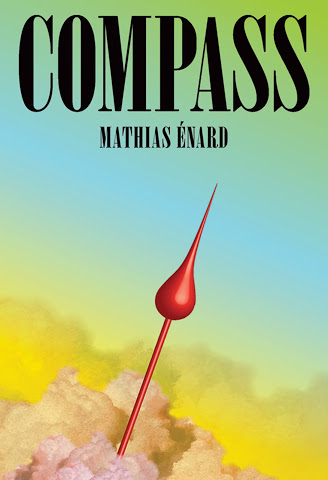
Compass
Mathias Énard
Translated by Charlotte Mandell
New Directions, 2017
$27.95, 448 pages

.
On a drizzly December night in Vienna, a solitary man stares out his window, his agonized reflection another self with whom he feels interchangeable, as indistinct as the water molecules within a droplet condensing on the glass. The window vibrates with Shahram Nazeri singing a poem by Rumi, and the shadow self becomes interlocutor in an internal monologue that will last through a sleepless night—a night of remembrance, regrets, and desire—a night in which a dying man considers his past and present.

But Compass (Boussole)—Mathias Énard’s ninth published work and third novel to be translated into English by Charlotte Mandell; winner of the 2015 Prix Goncourt and longlisted for the 2017 Man Booker International Prize—is not only a novel of memory and identity, it is a novel that celebrates centuries of cross-cultural exchange between the East and West: a vital novel, arriving when we need desperately to be reminded of the strength in diversity, of the reason in embracing the other.

Born in 1972 in Niort, France, Mathias Énard studied Arabic and Persian languages at INALCO, has traveled widely in the Middle East, and is now a professor of Arabic at the University of Barcelona. His multi-award-winning 2008 novel Zone (reviewed by Numéro Cinq’s Mary Stein), a stream of consciousness meditation on the cycles of war, finds a perfect companion in Compass, where the interconnected lives of fictional and historical musicians, writers, explorers, and asylum seekers are woven in a great tapestry of thought, a balm for one man’s soul and an appeal for peace to all.

.

The Blind Owl

The man at the window, Franz Ritter, a forty-something professor of musicology living alone in Vienna, should be reviewing a student’s dissertation, or better yet, sleeping. But this will not be a night for sleep, even if he didn’t suffer from chronic insomnia, a symptom of his undiagnosed disease. We are plunged directly into the stream of Ritter’s consciousness and his first-person narration in a page-length sentence. The exhausted professor has received a disturbing communique from his friend Sarah, a scholar of oriental literature and a specialist, like him, on Middle Eastern culture.

Sarah, who has a “passion for monstrosities” and a “penchant for the lower depths of the soul,” has sent him an old-fashioned offprint of her most recent academic article, an article whose frightening subject Franz will spend the rest of the night contemplating. For Sarah, writing from the distant jungles of Sarawak, Malaysia, isn’t just another “orientalist” colleague, she is the unrequited love of his life.

Franz gives himself up to thinking about Sarah, whose guiding philosophy is that “there is no such thing as chance, everything is connected.” He struggles to find some significance in the article which arrived without an enclosed letter. The Sarawak article sends him to sifting through every trace of her he owns: books, photographs, academic articles, letters—all become fuel for his fervent reconstruction of his memory of her. Excerpts from this archive, printed in different fonts, are sometimes accompanied by photographs, reminiscent of the novels of W. G. Sebald.

The first excerpt from Franz’s memorabilia comes from Sarah’s doctoral thesis, Visions of the Other Between East and West. Her thesis, significantly, concerns Sadegh Hedayat and his novel The Blind Owl—a novel that inspired Compass and with which it shares many parallels. Apropos his unrequited feelings for Sarah, Franz begins reading her thesis at the opening sentence of The Blind Owl: “There are certain wounds in life that, like leprosy, eat away at the soul in solitude and diminish it.” Like Hedayat’s narrator, Ritter is ill, feverish, obsessed—a man whose only interlocutor is his own shadow. Ritter isn’t writing a story as a conscious attempt to arrive at some general conclusion, but we follow his internal monologue and thus learn his history with Sarah, his desires, his regrets, and, along the way, a vast history chronicling the interconnectedness of Eastern and Western culture.

Franz’s sleepless night takes place on December 1, 2014, in Vienna, the apotheosis of European music cities and Hugo von Hofmannsthal’s “gateway to the East.” Although the novel’s chronological time follows the course of the night and Franz never leaves his apartment, his a-chronological reconstruction of his past with Sarah ranges from their first meeting seventeen years prior in Hainfeld, Austria, to other locations and time points throughout their shared history. The cities of Paris, Vienna, Damascus, Aleppo, Palmyra, Tehran, Istanbul, and others, serve as nexuses in the web of Ritter’s recollection.

Throughout the 451-page novel, Énard uses paragraphing and chapter breaks to indicate interruptions in Ritter’s thought. Ritter periodically notes the hour, and nine of these times are labeled chapter headings: 11:10 p.m., 12:55 a.m., etc. Furthermore, as Ritter’s meditations weave through his subjects, to entertain himself he composes a whimsical, imaginary book he titles On the Divers forms of Lunacie in the Orient with subdivisions such as “Orientalists in Love” and “Encyclopedia of the Decapitated.” These pseudo-chapters serve as a second set of breaks (including a table of contents listing them); however, these divisions are only part of the stream of his thoughts and always arrive mid-sentence, although they do provide opportunities for Énard to shift the focus of Ritter’s contemplations.

Ritter displays a prodigious erudition as his thoughts glide from one subject to the next. Nevertheless, he is modest to the point of self-deprecation and disparages academics (often hilariously). Whether he’s feeling nostalgic, contemplative, or even despairing, Ritter’s tone is engaging, especially when uses the first-person plural: “let’s try to breathe deeply, let our thoughts slide into an immense white space . . . let’s mimic death before it comes.” We share his space through his thoughts; we turn the pillow with him, listen to his neighbor’s dog, read Sarah’s letters, and look at her photographs.

One of the greatest strengths of the novel is the seamlessness with which Énard effects shifting between use of the present and past tense: the present tense for when Ritter describes his puttering around the apartment and current thoughts; and the past tense which Ritter uses to narrate his recollections. Adding to the verisimilitude of a man talking to himself, his interior monologue also includes rhetorical questions that range from the mundane (“Where did I put my glasses?”) to the philosophical (“What is universal?”). Naturally, these questions often serve as segues for new associations.

The narrative is necessarily discursive in so far as the story is Ritter’s mind unleashed. But rather than an unhinged, amateur historian like the narrator of Zone, here Énard gives us a scholar with an encyclopedic knowledge of music, literature, and history. In Zone, an endless run-on sentence mimics the protagonist’s disturbed mind, and as such complements his identity, i.e. form follows function. In Compass, the style Énard chose to depict Ritter’s consciousness serves greater goals; he wants to mimic consciousness but also create a platform for illustrating the cross-cultural influences of East and West. The interior monologue of a scholar is as appropriate for the content of Compass as the interior monologue of a war criminal was for Zone.

Strict autonomous monologue—exemplified by the “Penelope” chapter of Joyce’s Ulysses—presents thought undisrupted by characters reporting their actions using action verbs and the first-person pronoun. Énard never pushes his style to such an extreme, and Ritter’s internal monologue departs from a high-mimetic mode in several ways, including Énard’s use of (mostly) conventional punctuation, Ritter declaring his perceptions and reporting past events with dialogue, and the inclusion of objective, external documents (e.g. Sarah’s texts).

Despite his insomnia, Ritter does give indications that he falls asleep, or at least enters a semi-sleep borderland where dream mingles with his conscious memory. According to Ritter’s mental state, Énard modulates the narrative distance, using more conventional syntax during Ritter’s lucid moments and fluid, run-on sentences for those times when Ritter is either in a semi-dream state or emotionally disturbed (excited or angry). The shifting between these narrative modes, especially as Ritter’s subjective recollection is shaped by his perception of objective documentation, is a tour-de-force in the representation of consciousness.
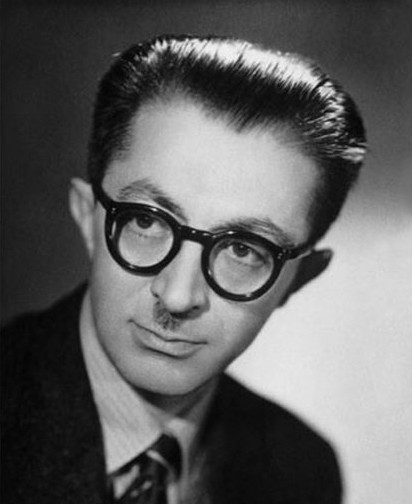
Sadegh Hedayat, 1951

Alterity

Throughout the night, Ritter seeks refuge in music[1] and each selection triggers a new set of associations. After all, he is an expert in the history of music, and so it is not surprising that whether he hears Berlioz or Beethoven, he will know their (and everyone else’s) stories. He knows that Mozart used a Turkish march for his Piano Sonata No. 11; he knows that Goethe’s West–östlicher Divan was inspired by the poetry of Hafez; and he knows that Schubert, Mendelssohn, and Strauss (among others) composed music for Goethe’s poems.

Énard favors run-on sentences whenever Ritter becomes indignant, as he does when he thinks of Félicien David, whom he describes as the “foremost Orientalist musician, forgotten like all those who have devoted themselves to body and soul to the ties between East and West” (paralleling how Ritter sees himself):

I’ve shown that the revolution in music in the nineteenth and twentieth centuries owed everything to the Orient, that it was not a matter of “exotic procedures,” as was thought before, this exoticism had a meaning, that it made external elements, alterity, enter, it was a large movement, and gathered together among others, Mozart, Beethoven, Schubert, Liszt, Berlioz, Bizet, Rimsky-Korsakov, Debussy, Bartók, Hindemith, Schönberg, Szymanowski, hundreds of composers throughout all of Europe, over all of Europe the wind of alterity blows, all these great men use what comes to them from the Other to modify the Self . . .

Alterity, otherness, is a concept Énard introduces conceptually on the first page with Franz confronting his reflection in the rain-soaked window, and a few pages later, specifically, in the excerpt from Sarah’s thesis. The relationship between oneself and the other—the central theme of the novel—emerges repeatedly though the patterns of interconnected musicians and writers, through the histories of Franz and Sarah, and through Sarah’s articles and Franz’s preternatural memory. Énard continually circles back to this concept, giving textual realization to Sarah’s philosophy of interconnectedness.

Occasionally there is a storm of references and Ritter will meditate on a dozen or more historical characters in the span of a page. For example, on a single page we learn of Joseph von Hammer-Purgstall’s attending a soiree in Vienna, hosted by Antoine and Thérèse Apponyi—friends of Chopin, Liszt, Sand, Balzac, Hugo, and Lamartine—at which Beethoven plays as Europe celebrates peace after the exile of Napoleon, whose army stormed the Orient beyond the Balkans:

Knowledge rushes behind the soldiers and the merchants, into Egypt, India, China; texts translated from Arabic and Persian begin to invade Europe, Goethe the great oak started the race; long before Hugo’s Les Orientales, at the very time Chateaubriand was inventing travel literature with his Itinerary: From Paris to Jerusalem, as Beethoven is playing that night for the little Italian countess married to a Hungarian surrounded by the finest costumes in Vienna, the immense Goethe is putting the final touches on his West-östlicher Divan, directly inspired by the translation of Hafez that Hammer-Purgstall published . . .

Such barrages of names and works are not the norm, and Ritter’s associations usually move at a less frenzied pace. But it is these associations that make the novel more than just a catalogue of facts. The philosophical and moral foundation of the novel—specifically articulated through Sarah’s guiding mantra—is that everything is connected in a meaningful way; that without the one, you would not have the other. Énard presents Compass as a metaphor itself—the story as a compass with which to get our bearings, and if the needle seems to spin at times, it should only serve as further reminder that regardless of the direction in which we look, everything and everyone is connected.

One the many pleasures in reading the novel is discovering (or rediscovering) new writers and musicians. Ritter’s description of the premiere of Félicien David’s symphony Le Désert, for example, traces its immediate influence:

The desert invades Paris—“by unanimous opinion, it was the most beautiful storm music had ever produced, no maestro had ever gone so far,” Théophile Gautier writes in La Presse, describing the storm assailing the caravan in the desert; it’s also the premiere of the “Danse des almées,” the Dance of the Almahs, an erotic motif whose subsequent fortune we know, and surprise of surprises, the first “Chant du muezzin,” the first Muslim call to prayer that ever sounded in Paris: “It’s at that morning hour we hear the voice of the muezzin,” Berlioz writes in Le Journal des débats on 15 December, “David limited himself here, not to the role of imitator, but to that of simple arranger; he erased himself completely to introduce to us, in its strange nudity and even in the Arabic language, the bizarre chant of the muezzin . . .”

Comparisons of Compass with The Thousand and One Nights and with Proust (and Ritter thinks about both) are not only inevitable, but necessary. And some historical figures you might assume should be present—Khayyam, Rumi, T. E. Lawrence—all have their place. But Énard excels in his revelation of the unexpected: musicians like Félicien David and his student Francisco Salvador-Daniel, the influential diplomat and translator Joseph von Hammer-Purgstall, or the journalist and explorer Annemarie Schwarzenbach (one of Sarah’s heroes and whom her character parallels).

Raymond Bonheur, Félicien David, c. 1835

Where East Meets West

When Franz opens Sarah’s thesis at the novel’s beginning, we hear in Sarah’s voice what could serve as a prologue for Compass:

we propose to explore this crevice, to go look inside the cleft, to enter the drunkenness of those men and women who have wavered too much in alterity; we are going to take the little man by the hand to go down and observe the gnawing wounds, the drugs, the elsewheres, and explore this between-space, this bardo, this barzakh, the world between worlds into which artists and travelers fall.

In Zone, Énard used a train trip for his frame story to explore history, much as W. G. Sebald used a walking tour of England or Claudio Magris[2] a boat ride down the Danube. Here, Franz’s delving through his collection of Sarah’s writings is the framework for Énard’s excursions into the links between East and West. These authors all share an exceptional talent for storytelling and revealing, with a poet’s voice, the history of people and place.

While Compass is not plot-driven in a conventional sense, Franz’s retelling of his relationship with Sarah is a compelling narrative, complete with its own mysteries: Why is he so ashamed? Do they have a sexual relationship? What is the nature of Sarah’s enigmatic Sarawak article? Considering Franz’s discursiveness, these questions are like a Javier Marías mystery, namely it’s about the journey, not the destination, although the destination will unify and underscore the novel’s intricate image patterns.

Sarah is Franz’s idée fixe, his emotional compass—she gives him direction. How ironic then, that she gifts him an actual compass, a reproduction of one owned by Beethoven, but with a flaw—it’s designed to point east. Metaphorically, Franz is to Sarah as West is to East. He is marooned in the west, in Vienna, famous as a central hub for the Orient Express, while Sarah recedes ever farther to the east, to India and Malaysia. The name “Ritter” is German for “knight,” and Énard conceived of a medieval romance for the two. Franz’s quest is for Sarah, his unreachable love; hers is for “a long road to the East . . . ever further towards the Orient in search of something indefinable.” When he remembers their time in Aleppo—a painful memory that fuels his feelings of shame—he thinks:

Time has reasserted its power over the Sissi House; the Baron Hotel is still standing, its shutters closed in a deep sleep, waiting for the throat-slitters of the Islamic State to make it their headquarters, transform it into a prison, a fortress, or else blow it up: they’ll blow up my shame and its ever-burning memory, along with the memory of so many travelers, dust will settle again over Annemarie, over T. E. Lawrence, over Agatha Christie, over Sarah’s room, over the wide hallway (geometrically patterned tiles, walls painted in high-gloss cream); the high ceilings will collapse onto the landing where two great cedar chests rested, coffins of nostalgia with their funereal plaques, “London-Baghdad in 8 Days by Simplon Orient Express and Taurus Express,” the debris will swallow up the pompous staircase I climbed on a sudden impulse fifteen minutes after Sarah decided to go to bed around midnight: I can see myself knocking on her door, a double wooden door with yellowing paint, my fingers right next to the three metal numbers, with anxiety, determination, hope, blindness, the tightness in the chest of one who is undertaking a great endeavor, who wants to find the being guessed at under a blanket in Palmyra in an actual bed and pursue, hang on, bury himself in oblivion, in the saturation of the senses, so that tenderness will chase away melancholy and greedy exploration of the other opens the ramparts of the self.

This passage shows how Ritter’s thoughts flow from current events to historical figures to the specific memory of his anxious sexual overture; the refrain of the relationship between the self and the other frames the memory. The Baron Hotel is now a refugee shelter and the Zenobia Cham Palace Hotel in Palmyra (another significant location of the novel) and the nearby 2,000-year-old Temple of Bel, once viewable from its terrace, have been destroyed.

§

Porochista Khakpour writes in her introduction to The Blind Owl, “we are taught to read a novel all over again—in its pages there exists a collection of codes, variants, repetitions, cycles . . . .” Such is the case with Compass. As dawn approaches, Franz reads an account he wrote of his and Sarah’s time in Tehran and the story of Sarah’s thesis advisor, Morgan. Morgan’s story is also a tale of unrequited love and serves as a mirror for Franz. Franz describes the process of rereading himself as a strange sensation, and he is “attracted and repulsed by this former self as by another.” He concludes that “Being exists always in this distance, somewhere between an unfathomable self and the other in oneself.” As a unifying dual concept for the novel, alterity means not only seeking an understanding of others, but of the other in ourselves.

East and West are words of convention and it seems archaic today to speak of an Orient and an Occident. Besides, every country has its own idea of “east.” Of course, such divisive denominations persist, somewhat out of convenience perhaps, but surely also from our natural tendency to separate ourselves into families, groups, tribes, and nations. When asked if Compass is a political novel, Énard replied affirmatively (WDR), but said its politics are unifying, to show our dependence on each other for growth and to emphasize the strength in great diversity.

At his lowest, Ritter despairs of the human condition: “The human species isn’t doing its best these days,” now when the “stench of stupidity and sadness” are omnipresent. But, when have we ever done our best? During the Renaissance? The Enlightenment? We’ve always burned people alive, beheaded them, gassed them, and Énard doesn’t fail to remind us. Ritter’s despondency notwithstanding, the novel offers the opposite message: that cultural diversity stimulates great art and music and literature; and that, despite our exceptional talent for butchering one another, we also help one another, and we learn from one another.

Compass is dedicated to the people of Syria.

—Frank Richardson

N5
Frank Richardson lives in Houston and received his MFA in Fiction from Vermont College of Fine Arts. His poetry has appeared in Black Heart Magazine, The Montucky Review, and Do Not Look At The Sun.


Footnotes    (↵ returns to text)

  1. Compass is a music-lover’s delight with over forty references to specific works. Fitzcarraldo Editions assembled a playlist available here: Compass playlist.
  2. ]Franz and Sarah argue about the “Austro-centrism” of Danube.
Jan 142017
 

javier-marias-author-photo-1

We all have secrets we would never divulge and secrets we wish had never been revealed. That we cannot fully know another is axiomatic, that we deny our own history and the histories of others, commonplace. Where, then, is the place for truth? —Frank Richardson

thus-bad-begins-jacket-photo

Thus Bad Begins
Javier Marías
Knopf, 2016
$27.95; 448 pages

.
We all have secrets. We all have secrets we would never divulge and secrets we wish had never been revealed. That we cannot fully know another is axiomatic, that we deny our own history and the histories of others, commonplace. Where, then, is the place for truth? We live in a time when the Oxford Dictionaries awarded “post-truth” word of year. Javier Marías’s new novel, Thus Bad Begins, tells the perfect story for an age of relativism, for it is filled with characters who deny their pasts, who conspire to create glowing public images despite their crimes, who distort the truth for their own agendas, and who flatly reject known facts to preserve their peace of mind and their illusion of a stable, happy present.

Born in Madrid in 1951, twelve years after the Spanish Civil War, Javier Marías grew up in a society of secrecy, a country where secrets meant life or death. Javier Marías published his first novel in 1971, at the precocious age of nineteen. Since then he has published thirteen novels, two short story collections, a book of literary biographies, and writes a regular column for the Madrid newspaper El País. His books, with sales in the millions, have been translated into over forty languages and have won numerous prizes. Quickly following the commercial and critical success of his 2013 novel The Infatuations (reviewed by Numéro Cinq’s Laura K. Warrell), in a brilliant translation by Margaret Jull Costa, Thus Bad Begins examines our relationships with those closest to us—our spouses, our lovers, our friends—and asks how much we can know about them and, more disturbingly, how much we want to know.

The Voyeur

Set in Madrid in 1980, Thus Bad Begins is the first-person recollection of Juan de Vere, now ostensibly a writer living in contemporary times. Covering about a year of his young life, when he was 23, Juan de Vere—a quintessential Marías narrator given to meditative digression—reflects on the time he spent working for the almost famous film director Eduardo Muriel, his intimacy with his employer’s family, and his mission to investigate the lecherous and enigmatic Dr. Jorge Van Vechten.

The 448-page novel is divided into eleven numbered chapters, each with between four and eight subchapters of approximately equal length. The first subchapter of chapter one begins like many others, with Juan’s contemplations, which serve as thematic passages. Juan’s style is discursive, speculative, analytical. He explores his past through his prose and often loses himself in extended, lyrical observations. Here especially Marías employs his signature complex sentences, some stretching to a page in length. For readers familiar with Marías’s fiction, this will come as little surprise, and in this novel he once again creates a dense psychological representation of the narrator through the intricate syntax of his long sentences.

“Young de Vere,” as his employer calls him, is hired as a personal assistant whose duties range from translation to taking dictation to organizing Muriel’s library. Juan has an almost eidetic memory and quotes people verbatim. An effective conceit, Juan’s quotes serve two purposes: first, they move conversations forward in unexpected ways, and second, the repetition helps link the chapters and serves as a thematic refrain.

Marías’s first-person narrators often sound like third-person objective observers, and Juan’s chronicle subtly switches point of view and tense as he segues between his thoughts in the present, what he imagines he thought in the past, and what he suspects were the thoughts and feelings of others. Juan’s tone, while earnest and sincere, tends to be conspiratorial and occasionally evasive. A self-effacing Marías protagonist, Juan claims “there is nothing original about me” on the first page and near the end he states “there is nothing original about my character,” by which he means, in a suspiciously metafictional sentence, his character in the novel. As much an epistemological mystery as a plotted mystery, the problem of truth is a major theme of the novel, and Marías’s blending of fact with fiction finds in Young de Vere a perfect narrator.

When Juan’s duties become so time consuming that he spends nights in the Muriels’ guest room, he soon gains his first insight into the couple’s marriage—one of the principal mysteries of the novel. Juan, a sensitive, compassionate young man who admires his employer, is unnerved by the jarring contrast between Muriel’s normally charming and ingenuous behavior and his inexplicably cruel verbal abuse of his wife, Beatriz, abuse which she appears to absorb with a calm, long-suffering resignation.

Muriel and Beatriz sleep in separate bedrooms and one night she comes to her husband’s bedroom door. In classic Marías fashion, the narrator becomes voyeur and Juan watches while Beatriz pleads with Muriel, declaring he is the only one she loves and reiterating what she must have said many times, that she can’t believe he has broken off their relationship “over some stupid thing that happened ages ago.” But what she calls a “stupid thing” Eduardo finds unforgivable, and he brutally rebukes her. After witnessing the exchange, Juan concludes:

There are some things about which it’s best just to have your suspicions, as long as these are not pressing or unbearable, rather than pursue some disappointing or painful certainty that, as Muriel had more or less said, would oblige you to go on living, meanwhile having to tell yourself a different story from the one you had lived with up until then, always supposing it was possible to cancel out or replace what you had already lived. Or even cancel out or replace what you had believed, if you had believed it for a long time.

And so Juan begins to explore the idea of denying the truth, of avoiding reality and hiding in the comfort of ignorance.

spying-eye

The Directive

Paralleling the mystery of the Muriel’s relationship, a second mystery grounds the primary plot: Juan’s investigation of his boss’s good friend, Dr. Jorge Van Vechten. Soon after he hires Juan, Muriel informs him that he has been told a disquieting story about his friend, a story that, if true, would mean the doctor had “behaved in an indecent manner towards a woman or possibly more than one.” Deeply troubled by the hearsay, at first Muriel denies the possibility of it being true, but eventually his curiosity wins out and he charges his young assistant with an unusual directive. He asks Juan to invite Van Vechten when he and his friends go nightclubbing. Muriel wants Juan to gain Van Vechten’s confidence, to “draw him out” by boasting of his sexual exploits, and if Juan doesn’t have any, no problem, he should invent some. Muriel knows his friend well enough that such company and conversation might, coupled with a generous amount of alcohol, loosen his tongue enough for him to divulge his secrets.

Although Juan’s morals are at odds with his assignment—he finds it odious to pretend to be someone he’s not with the deliberate aim of betrayal—he doesn’t want to disappoint Muriel, and in an ironic twist, a voyeur becomes a reluctant hired spy. As Muriel predicted, it doesn’t take long for Juan to confirm his suspicions about Van Vechten’s true nature.

Juan’s description of the doctor, however, is not confined to reporting his words and actions. Marías exquisite portraits are a distinguishing quality of all his novels. Muriel, Beatriz, and Van Vechten are all drawn in the finest, most purposeful detail. Marías’s portraits begin with physical features (coupled with commentary) and then broaden to include the character’s character:

Van Vechten did indeed have very blue eyes and the kind of blond hair which is still memorable in a country where such hair color is much more common than people think and admit . . . . [his] features suggested a triumphant, expansive nature, as did the way he behaved in public: with enormous confidence, perennial good humor, too perennial not to seem somewhat false . . . . Alongside that good humor, one sensed something voracious and troubling, as if nothing ever entirely pleased him, as if he were one of those people for whom nothing is ever enough, who always want more . . .

The portrait moves from the concrete to the abstract to the general. Once he has shifted to describing “one of those people,” Marías’s narrator now tangentially reflects on who “those people” are, generalizing the particular and extending the theme beyond the story and the specific details of character and plot.

Fact and Fiction

From the first page, Marías blurs the boundary between fact and fiction, and one device he uses is having his narrator address the reader. Juan isn’t a passive observer, a disinterested narrator; his fate becomes entwined with those he observes. Midway through the novel, Juan confesses he has his own secret, one he promises to reveal later: “And when I tell that secret here (except that here is not reality), you will all have to keep my secret . . .” Such coy pronouncements about the reality of his text are not uncommon for Juan, and his reticence evokes the impression of a man riddled with guilt who, although he wants to confess, cannot bring himself to accept the truth.

Like Shakespeare’s use of a play within a play in Hamlet (from which the title Thus Bad Begins is derived) Marías employs the literary device of a story within a story as another means to blend fiction and reality, and he does so using real people. During the scene where Juan delivers his first Van Vechten report to Muriel, the actor Herbert Lom is present. Lom is perhaps best remembered for playing the insane Dreyfus opposite Peter Sellers in The Pink Panther films. Inspired by Juan’s report, Lom tells the true story of producer Harry Alan Towers (with whom Muriel is also working), principal culprit in a sex-scandal in the 1960s involving Mariella Novotny and John F. Kennedy (before he was elected President). And Lom and Towers aren’t the only real people in the novel: Marías’s own uncle, the B-movie director Jesús (Jess) Franco is important to the plot and actor Jack Palance is featured in a scene. While Lom’s story may appear extravagantly digressive, the details cleverly parallel plot elements and expand image patterns; furthermore, the use of real people and historical details adds verisimilitude and is another way Marías generalizes the particular. Marías weaves fact with fiction so seamlessly it is impossible to tell them apart; indeed, this is thematically important since the narrator is often reflecting on the nature of reality verses fiction; thus, this intersection of the real with fiction becomes a thematic mimesis.

The story Lom tells is reminiscent of the anecdotes that W. G. Sebald used in his narratives. Marías admires Sebald’s writing and corresponded with the late author. Another thing they have in common is their use of photos. Thus Bad Begins contains two photos, one of Mariella Novotny and one of a painting by Francesco Casanova (brother of the infamous Giacomo). The latter is significant for the dominant image pattern of observation, particularly with a single eye. The painting features a mounted cavalryman looking over his right shoulder; you can only see one of his eyes. Muriel, blinded in one eye, wears an eyepatch. Being a film director, he is always looking through a camera, a single lens. And Juan, as if calling upon a muse, makes numerous references to the “sentinel moon” observing “with just one eye open.”

cavalryman-2Francesco Casanova, Cavalryman, n.d

Making Time

Laurence Sterne, one of Marías’s influences, wrote in Tristram Shandy “Now there is nothing in this world I abominate worse, than to be interrupted in a story.” How ironic, considering Marías has been criticized for his discursive style. His famous tangents might indeed appear, upon cursory reading, to interrupt the momentum and create suspense artificially through simple postponement. However, Marías continues in a long tradition—including Sterne and Proust—in his use of such digressions; he said in an interview “I’m going to make time that doesn’t have the time to exist, exist” (The White Review). Marías endeavors to create time as we experience it in memory, slowed to the speed of dwelling on signature moments, the ones we return to obsessively—as Juan does. Marías does use scene and summary in a conventional sense—scene for a slower pace with critical detail and summary for skipping quickly over moments of less importance—but he creates the Proustian time he spoke about through Juan’s meditations.

Part of Marías’s secret to creating time is his exceptional use of thematic passages. Ranging from a paragraph to several pages, the thematic passages are Juan’s attempts to understand his past; through his reflections he explores his thoughts and actions and seeks to make sense of the world. For example, when remembering an afternoon he spied on Beatriz, Juan muses:

“Hers is such a woeful bed,” I thought, “that she has to visit other beds . . . she looks for substitutes, as almost everyone does, very few of us ever find what we yearn for, or if we do, we don’t hang on to it for very long, and who knows how long she managed to hang on to her happiness.” We strive to conquer things, never thinking, in our eagerness, that they will never definitely be ours, that they rarely last and are always susceptible to loss, nothing is ever for ever [sic] . . .

Marías often uses such shifts from direct internal monologue of Juan’s thoughts of the moment to a timeless present rich in aphorism when Juan’s voice is subsumed by a broader, universal voice. The shift in voice is often paired with shifts in point of view, as here where he shifts from first-person singular to first-person plural. Adding depth of these thematic passages, Juan asks many rhetorical questions, as in this example where he ponders about love:

Why should we be loved by the person we have chosen with our tremulous finger? Why that one person, as if he were obliged to obey us? Why should the person who troubles or arouses us and for whose flesh and bones we yearn, why should he desire us? Why should we believe in such coincidences? And when they do happen, why should they last?

Juan’s rhetorical questions not only generalize the themes, but they link scenes in image patterns and serve as prompts that propel the narrative forward.

Another dimension of the thematic passages is that they often contain long, lyrical sentences, another Marías hallmark. He strives to create a musicality with his sentences, to carry readers as if they were “on the top of a wave” (Literary Hub). In his excellent introduction to A Heart So White, Jonathan Coe notes Marías’s spare use of punctuation, often relying solely on commas to separate independent clauses. However, unlike that novel from 1992, in Thus Bad Begins Marías uses a variety of punctuation to create the musical cadence he desires. For example, here Juan’s speculations about himself segue into second-person aphoristic generalization and then third person supposition in a stream of consciousness:

Or perhaps that isn’t what I thought, but only how I remember it now that I’m no longer young and am more or less the same age as Muriel was then or perhaps older; it’s impossible to recover the inexperience of your inexperienced youth once you’ve moved on considerably; once you’ve understood something, it’s impossible to not understand what you once didn’t understand, ignorance doesn’t return, not even when you want to describe a time during which you either basked in or were the victim of ignorance, and never trust anyone who tells you something with a falsely innocent look on his face, feigning the lost innocence of childhood or adolescence or youth, or who adopts the gaze—the icy, frozen gaze—of the child he no longer is, and the same is true of the old man who speaks out of the years of his maturity rather than out of the old age that now dominates his entire vision of the world . . .

Although he does use semicolons, without the full stop of a period this sentence mimics thought in so far as our thoughts are also an uninterrupted stream.

Thus Bad Begins offers a new perspective on the expanding universe of Javier Marías’s Madrid, his own Yoknapatawpha County, where familiar but always fresh characters struggle with the vagaries of life.

Marías describes his writing process as working without a map, but with a compass, a talisman Muriel carries and rubs between his fingers whenever he is “filled by doubts.” In the last major scene, Muriel worries the compass as he explains to Juan his behavior toward Beatriz in exchange for Juan keeping silent about Van Vechten. Muriel tells Juan:

We lose far too many people in a lifetime, they either drift away or die, and it doesn’t make sense to get rid of those who are left. So what if he committed some vile deed in the past or took advantage of someone or other? Here, during a very long dictatorship, almost everyone did at some point. So what?

We all have secrets, but Muriel’s denial raises difficult questions. Which secrets can be kept and which must be told? Should we always admit the truth, or only when it is convenient, when it won’t be painful? Juan, replete with his own secrets, learns caution, for his experience shows him the price of denial and the price of honesty. Marías’s novel doesn’t offer easy solutions but reminds us that one of the most perilous decisions we can make is to practice deceit, for thus bad begins.

—Frank Richardson

N5

Frank

Frank Richardson lives in Houston and received his MFA in Fiction from Vermont College of Fine Arts. His poetry has appeared in Black Heart Magazine, The Montucky Review, and Do Not Look At The Sun.

.
.

Oct 092016
 

ra2

Alameddine uses the structure of his novel—as Proust did—to recreate the impression of memory. The Angel of History, with its fragmented, alternating, multiple points of view and multiple plots is a structural triumph, not in spite of these qualities, but because of them. —Frank Richardson

the-angel-of-history

The Angel of History
Rabih Alameddine
Atlantic Monthly Press, 2016
304 pages, $26.00

.
What if you were Satan’s chief delight? How chilling, how disturbing, how psychosis-inducing would it be to discover Satan—yes, the actual devil, Mephistopheles, the Morning Star, Lucifer—said that you rejuvenated his jaded heart? Who would want to know that? In The Angel of History, Rabih Alameddine’s newest novel, we learn the answer to this question, for Jacob, a Yemeni-born poet and survivor of the AIDS epidemic, is Satan’s delight, and the fallen angel makes it his mission to rescue Jacob from forgetting his past.

The Angel of History is Rabih Alameddine’s sixth book and fifth novel. Born in Amman, Jordan, he spent his youth in Kuwait and Lebanon. After moving to the United States, he first pursued an engineering career, but gave that up for painting, and then writing. In 1998 he published his first novel, the critically acclaimed Koolaids, a blistering indictment of war and a harrowing examination of the ravages of AIDS. His other novels include the experimental I, The Divine: A Novel in First Chapters (2001), The Hakawati (2008), which draws on the tradition of Arabian fables, and the bibliophile’s delight, the sublime An Unnecessary Woman (2014), which won the California Book Award Gold Medal for Fiction and was a finalist for the National Book Award.

Now fifty-six, Alameddine spends his time between San Francisco and Beirut. Once again exploring the subjects of AIDS and war in the Middle East, with The Angel of History, Alameddine gives us provocative storytelling at its finest, a fabulist tale that explores how we grieve and how we succeed and fail in confronting our most painful memories.

Jacob’s Elegy

Ya‘qub, the protagonist and narrator of two-thirds of The Angel of History, arrives one rainy night at a crisis psychiatric clinic in San Francisco determined to be admitted. The fifty-something Ya‘qub has used the Americanized ‘Jacob’ since moving to San Francisco in the 1980s as a young man. Jacob explains to the triage nurse that he has been suffering from hallucinations again and is depressed. His employer had suggested he seek counseling, but it wasn’t until Jacob saw a report of another U.S. drone-strike on a Yemeni village, this time his mother’s hometown, perhaps the one where he was born, that he finally broke down. He needs an emotional holiday, and his ideal version would be three days in the psychiatric unit of Saint Francis Hospital with a nice Haldol-Ativan cocktail served with a chaser of Lexapro—after all, drugs had helped before—something to quiet the voices, something to deaden the pain, something to turn out the light of memory.

The majority of the 300-page novel is arranged in three titled sections—“Satan’s Interviews,” “Jacob’s Journals,” and “At the Clinic”—each of which is divided into twelve chapters, many with titled subchapters. Alternating in sequence, the three major sections present three parallel plots from multiple points of view providing a nonlinear reconstruction of Jacob’s history.

A poet who earns a living as a word processor for a law firm, Jacob lives alone in his San Francisco apartment except for his large black cat, Behemoth, whom he named specifically after the infernal feline in Mikhail Bulgakov’s The Master and Margarita—another novel featuring a well-tailored Satan. Jacob suffers survivor’s guilt. All of his friends, including his beloved partner Doc, died from AIDS-related diseases twenty years ago during the height of the epidemic in the late 1980s. Overcome with anguish for his lost friends, Jacob hasn’t been able to write poetry for some time, but his old muse, his “angel of remembrance,” Satan, has returned.

The primary plot of the novel, set in the notional present and narrated by Jacob in the “At the Clinic” chapters, covers his breakdown the night he seeks admission to the hospital. Jacob’s narration is often in a stream of consciousness style, mimicking thought, as in this example where he explains the reappearance of Satan in his life:

It has been getting worse, Doc, I don’t seem to be able to cut him off, I am all wound with adders who with cloven tongues do hiss me into madness, it wasn’t always this bad, I went along for years doing rather well, didn’t hear his voice, but then one day he reappeared, and he’s been getting more demanding, more irksome, hissing, hissing, and I get headaches, I fear the return of the great migraine storms, I need a break, Doc, I need a break.

Devastated when his friends died, Jacob spent time as an inpatient in the same hospital to which he is once again applying. He had thought he was stable, he had thought he had escaped the trauma of history: of losing his friends and his mother and the memories of his childhood. As he writes in his journal, always addressing Doc:

While my mind processed the chaos that passes for thought in the early morning, I had cracked five eggs by the time I realized I was about to make you an omelet as well. Decades may have passed and sometimes it feels like only yesterday that we had our breakfast together. . . . I’d had a life since you left . . . I did yoga . . . I went to art openings . . . I watched bad television shows . . . I was living, I thought I was content, I was told I was happy. I did a marvelous impression of a man not crushed by dread.

Moments such as these reveal Jacob’s deep grief and give the impression of a hollowed out life. Jacob’s tender admission evokes the tone of Christopher Isherwood’s A Single Man, another novel that addresses living day-to-day with heartache for a lost partner.

“Jacob’s Journal” is part requiem, part confession, and it is also where we learn what Jacob remembers about his mother, a teenage Yemeni maid who became pregnant by the equally young son of her wealthy employers in Beirut. Kicked out, she becomes a homeless wanderer through squalid desert villages where she is forced into prostitution. Mother and child finally settle in a Cairo whorehouse for the most stable and in many ways happiest time of Jacob’s childhood. But these memories have been repressed, or lost, or ignored for too long. Jacob writes about his childhood:

You, Doc, wait, I need someone to hear this, listen to me. . . . I don’t know why I tell you all this about me, I need to, I guess, but with this need to tell comes the concomitant desire to forget everything . . .

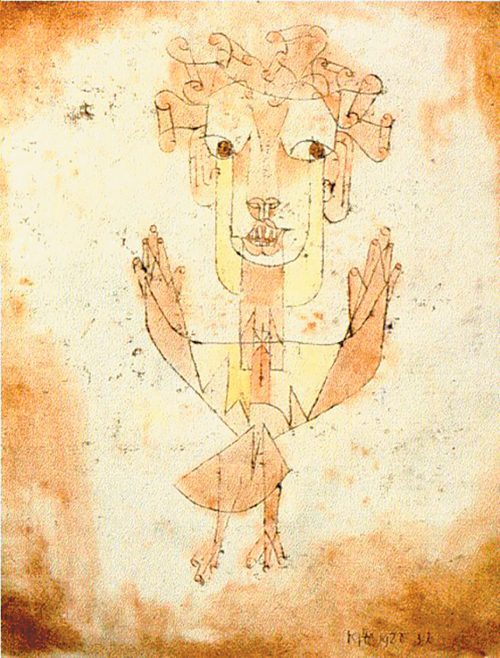
An assiduous Satan has been working against Jacob’s “desire to forget,” and Jacob’s journal and ensuing breakdown have been the result. In an allusion to Walter Benjamin’s commentary on Paul Klee’s Angelus Novus, Jacob tells a bartender, “I am your angel of history”; namely, a being who sees the past as a single, unalterable catastrophe.

Paul Klee: Angelus Novus, 1920Paul Klee: Angelus Novus, 1920

Angels and Ministers of Grace

The most significant subplot of The Angel of History unfolds in “Satan’s Interviews” and involves Satan’s attempt to rescue Jacob from forgetting his past. One of the most entertaining, often hilarious, and clever parts of the novel, “Satan’s Interviews” features third-person omniscient narration, usually limited to Satan’s locus of perception.

Being supernatural, Satan simultaneously coaxes Jacob to leave the clinic and hosts interviews with his son, Death, and a group of Catholic saints at Jacob’s apartment. The devil has a long tradition in literature, with some of the most memorable and most human versions found in Milton, Goethe, and Bulgakov. Alameddine’s Satan is eerily human with a voice as beguiling as one might expect from the personification of temptation. Jacob does a fine job describing Alameddine’s Satan (in a sly metafictional stroke) when he writes in his journal how Doc “endowed the devil with wickedness and perseverance, you made him fun, witty, intelligent, frisky, lively, ironic, and above all, petty, all too human, like us.” But for Jacob Satan is Iblis, Islam’s whispering jinn, a sulking, lonely creature with nothing better to do than torment him.

Satan is a fully realized character, complete with his own conflicts and a clear desire: he wants Jacob back. During Jacob’s first hospitalization he was drugged to near catatonia, and after leaving the hospital he spent many years on antidepressants and a variety of pharmaceuticals, both legal and otherwise. Satan doesn’t want his favorite whipping boy tumbling down that rabbit hole again.

In the first of “Satan’s Interviews” Death—whimsical, mocking, irreverent—asks his father why he is intervening in Jacob’s life now; Satan replies: “Because he has been sleepwalking through life since his friends died, because he has been so lonely without me, because his poems were getting more and more boring, his dreams more banal, and worst of all, he began to write stories.” However, it could be worse, Satan concludes, horror of horrors, Jacob “could write a novel.” Satan’s motivation, ostensibly for the benefit of Jacob’s art, is, not surprisingly, purely selfish: Jacob “rejuvenates my jaded heart” Satan confesses to Saint Blaise. Furthermore, Satan tells Jacob that it was him, not the saints, who saved Jacob from AIDS:

funny you should credit the silly saints with healing you, and not me, Death came for you and I intervened . . . I sat him down, told him your soul was mine, a long time ago I claimed you, you child of pestilence, you squashable worm . . .

And this is part of Satan’s interest in Jacob, namely Jacob’s squashability—most clearly reflected in his sexual history. Jacob’s experience with sex begins violently when a customer of the Cairo whorehouse demands that the ten-year-old paint henna on his penis. In his Lebanese boarding school Jacob is beaten and repeatedly humiliated by bullies. As an adult in San Francisco, jealous of Doc picking up another man, Jacob visits an S&M club where he is whipped—and it will not be his last indulgence in masochism.

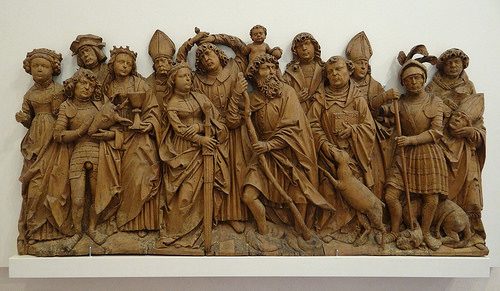
Death asks Satan if he is going to interview “the others”—meaning the saints that Jacob prayed to as a child and as an adult until AIDS took everyone from him. In a Catholic tradition dating to the Black Plague, there are a group of fourteen saints—known as the Fourteen Holy Helpers—who are prayed to for specific maladies. Satan doesn’t interview all fourteen, but he does call upon them, remarkably, for assistance. It seems that Satan has done his job all too well in helping Jacob remember and now he needs help in keeping Jacob sane and off memory-impairing medication. Death, whose job is to offer the cup of forgetting, the waters of Lethe, expects Jacob will choose him, and so the dance between remembrance and oblivion begins.

In his depiction of the saints, Alameddine shows us compassionate but weary caregivers, for eternity is long and people exasperating. The interviews also offer humorous, welcomed breaks from Jacob’s somber memories. For example, Satan is unnerved by Saint Denis holding his decapitated head in his lap and insists he return it atop his neck, and Saint Margaret mocks Satan by holding a balloon of a baby dragon, for according to legend, Satan, in the form of a dragon, swallowed her but then choked on her cross. It is Saint Margaret who asks Satan to bring Jacob back to poetry: “A poet is tormented by the horrors of this world, as well as its beauty, but he can be refreshed, reborn even; he can take to the sky once more.” Saint Catherine sympathizes with Jacob’s past choices, she feels he only “did what he had to do during the time of sunder, he girded himself against the dirge,” but in the present she agrees with Satan’s assessment: “We must wake him and hazard the consequence. We must offer the apple.”

14-helpersTilman Riemenschneider workshop, The Fourteen Holy Helpers, c. 1520

War All the Time

In addition to the three major divisions of the novel, there are three sections labeled “Jacob’s Stories,” each containing a single short story independent of (but harmonizing with) the novel’s plot. The elegiac tone of Jacob’s journal changes to bitter resentment when he thinks of the humiliating final stages of his friends’ suffering, and his anger, inflamed by the interminable carnage he witnesses in the land of his birth, is vented in his stories.

Alameddine displays a formidable gift for satire in “Drone” and “A Cage in the Penthouse.” The latter, reminiscent of George Saunders’s equally acerbic “The Semplica-Girl Diaries,” features a wealthy couple who keep a caged Arab as a pet in their Manhattan penthouse. In “Drone” we see U.S. drone strikes through the point of view of a sentient, self-righteous attack drone named Ezekiel.

 Through Jacob’s thoughts and his stories, Alameddine reminds us how easily wars are forgotten. Indeed, one of the epigraphs is from Milan Kundera (a writer who has had much to say about war and memory): “The struggle of man against power is the struggle of memory against forgetting.” War tears through the countries of the Middle East daily, and for Alameddine—who grew up in Lebanon and spends much of his time there—this subject runs through his fiction like a scar.

Finding Time Again

The Angel of History shares more than a few characteristics with that paragon of memory novels, Proust’s In Search of Lost Time, and Jacob’s past is what Satan and the saints are there to help him find and keep. Alameddine’s talent for nonlinear narrative—evident in Koolaids where the Lebanese civil war is starkly juxtaposed with the AIDS epidemic—shines brightest in The Angel of History with its exquisitely interlaced chronology, multiple plots, and points of view.

“Jacob’s Journals” presents a conventional memoir: Jacob thinking about his past. “At the Clinic” is more complex; here Jacob is thinking about his present, past, and future, but the narration feels like an extension of his journal, as if the events of his night at the clinic are added to his journal in the future. Satan’s interviews take place concurrently with Jacob’s night at the clinic but tell the story of Jacob’s mother and his childhood through the saints’ recollections. Satan’s imperative to the Fourteen Holy Helpers is clear: “What I hear he remembers . . . Remind him of himself.” Each interviewee recalls different parts of Jacob’s history which Satan then channels to Jacob. The ingenious conceit of the interview chapters is that, given the supernatural nature of the interlocutors, time is irrelevant and all the interviews can be simultaneous in an eternal moment. Furthermore, in these chapters Alameddine uses third-person, taking advantage of a wider range of point of view. These shifting times and points of view reveal Jacob’s memories in manner much like the actual process of remembering, a process during which we often take two steps back for every step forward.

Alameddine leaves little doubt about his admiration for Proust’s fiction in An Unnecessary Woman. Here as well, Proust informs Alameddine’s novel, from the simple homage—naming Jacob’s roommate Odette—to more direct references. For example, Jacob has moments of involuntary memory, such as in a grocery store where “the mephitic aroma of disinfectant assaulted my senses, and you jumped the levee of my memory. Proust had his mnemonic madeleine, but bleach was all ours, Doc, all ours.” Note, Alameddine doesn’t miss an opportunity to layer his images, here alluding to Mephistopheles. But to emphasize such references, as fun as they are, would be to neglect the genuine beauty of how Alameddine uses the structure of his novel—as Proust did—to recreate the impression of memory. The Angel of History, with its fragmented, alternating, multiple points of view and multiple plots is a structural triumph, not in spite of these qualities, but because of them.

§

In An Unnecessary Woman, Aaliya pleads with writers to “Have pity on readers who reach the end of a real-life conflict in confusion and don’t experience a false sense of temporary enlightenment.” Rabih Alameddine is not a fan of epiphanic endings, and you won’t find one here. The Angel of History asks questions and raising issues for which there are no simple answers. Is ignorance bliss? Can we deny our past? Should we try? The Angel of History tasks us with the necessity of facing our memories, even the most painful ones, for to neglect them is to surrender to Death, to drink from the river Lethe, to become complacent drones (pun intended). Alameddine’s book is a statement on memory, on surviving loss, on war and disease and how we cope with them, and finally on art; and that poetry, or any art, cannot exist in a memoryless (and thus painless) vacuum.

On his walk home from the clinic through the nighttime streets of San Francisco, Jacob stops to write impromptu poems and statements on storefronts he remembers from happier times; on a No Parking sign he writes:

You all dead
I still walk
Therefore I am
I know it is so
For I long
I long for solace
How does one find such
Among so many ashes?

Jacob’s question cannot be resolved in a single moment of enlightenment, and like him, we too must confront our losses, for there is no solution to grief other than learning how to live with a shadow of hell.

—Frank Richarson

N5

Frank

Frank Richardson lives in Houston and received his MFA in Fiction from Vermont College of Fine Arts. His poetry has appeared in Black Heart Magazine, The Montucky Review, and Do Not Look At The Sun.

.
.

Sep 142016
 

di Benedetto

Di Benedetto precisely evokes themes of alienation and absurdity through Zama’s futile supplications for promotion and the humiliations…. Evocative of history without being a historical novel, Zama shares in a rich tradition of existentialist fiction. — Frank Richardson

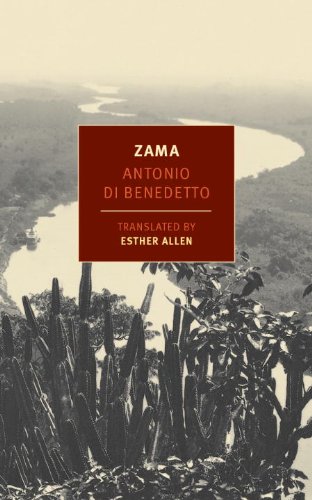
zama

Zama
Antonio di Benedetto
Translated by Ester Allen
New York Review Books Classics, 2016
224 pg, $15.95

.
Adead monkey, drowned but undecomposed, washes against a pier where a man stands, alone, separated from his family by half a continent of jungle, desperate to escape, dreading the suspicion he will share the same fate as the corpse drifting in the water. And so we meet Don Diego de Zama, the eponymous antihero of Antonio Di Benedetto’s most celebrated novel. First published in Argentina more than sixty years ago, Zama—extolled by Julio Cortázar, Roberto Bolaño, and Juan José Saer—is now available for the first time in English courtesy of NYRB Classics and master translator Ester Allen.

Born in 1922 in Mendoza, Argentina, to parents of Italian descent, Antonio Di Benedetto studied law before turning to journalism. In 1953 his first short story collection, Mundo animal, was awarded a prize by the Sociedad Argentina de Escritores, juried in part by Jorge Luis Borges. His first novel, Zama, appeared in 1956 and was followed by the novels El silenciero (1964) and Los suicidas (1969; made into a film in 2005). A collection of his selected stories is forthcoming in English from Archipelago Books and a film adaptation of Zama is due out in 2017.

Antonio Di Benedetto traveled the world and lived a life as incredible as any fictional character, including, unfortunately, the horrors he suffered under the Videla dictatorship. For reasons unknown, he was imprisoned after the 1976 military coup d’état and held for eighteen months, during which time he was tortured and stood in front of a firing squad four times (a terrifying experience to have in common with Dostoyevsky, his literary role model). Ester Allen’s insightful preface includes the remarkable story of Di Benedetto’s release, in part due to efforts by Heinrich Böll and Ernesto Sábato. A testament to his spirit, Di Benedetto continued to write stories in prison, stories he published as the collection Absurdos in 1978 while living in exile in Spain. He wouldn’t return to Argentina until 1984 and died in 1986 in Buenos Aires.

Castaway

Don Diego de Zama, the protagonist-narrator of this first-person tale of existential descent, is a castaway in the midst of a crowd. Appointed by the Spanish Crown as a court councilor in the remote colonial outpost of Asunción, Paraguay, Zama’s greatest desire is escape—preferably by promotion. Zama reports to the provincial governor (Gobernador), but despite his high rank, the Gobernador treats him with disrespect since Zama is an americano, a criollo—of Spanish descent, but born in South America—unlike the other Spanish-born officers living in the small community. Ironically, the fact that Zama works for the Spanish government alienates him from the americanos. Isolated from his family, isolated within his own community by prejudice, and given his own admitted “nonexistent capacity for making friends,” his hope for escape becomes for him a “long soliloquy,” a record of his frustration and fear and anger and pain as the years tick by and he falls farther and farther away from his expectations and dreams. He sums up his situation:

Here I was, in the midst of a vast continent that was invisible to me though I felt it all around, a desolate paradise, far too immense for my legs. America existed for no one if not for me, but it existed only in my needs, my desires, and my fears.

Di Benedetto precisely evokes themes of alienation and absurdity through Zama’s futile supplications for promotion and the humiliations he endures at his bureaucratic job—themes similarly explored by Kafka, to whom Di Benedetto is frequently compared. Called to the Gobernador’s office, Zama is “condemned” to wait in the antechamber, “writhing with impotence,” “humiliated” at being of “apparent equality of status” with a group of locals waiting for an audience with the governor. The irony of the situation becomes clear when the Gobernador tells Zama that he has summoned him to deal with the troublesome old man and young woman with whom he has been waiting. When told, he storms out past the petitioners and into his own office where he broods:

First they would have to grow weary of waiting for their audience with the governor. They would bestir themselves and approach the secretary, only to be informed that it was the learned councillor they should see. Then they would wait another long while before they were received at last and came to the realization that the learned councillor was none other than myself, that is, the very man in whose presence they had already wasted an irrecoverable half hour.

Zama will reap what he sows, for he too will “grow weary of waiting,” he too will “bestir” himself (and to the point of madness), he too will dwell on “irrecoverable” time. The 198-page novel comprises 50 numbered chapters distributed in a 3:2:1 ratio across three sections labeled by date: 1790, 1794, and 1799. These sections represent discrete states of mind for Zama and the dwindling ratio mimics Zama’s psychological dissolution as he spirals toward destruction.

Terribly alone, Zama’s only preoccupation besides leaving is sex. The 1790 period of the narrative is dominated by his almost hysterical lasciviousness for any woman, and his pursuit of conjugal relations is simultaneously pathetic and comical. Zama does miss his wife, but he also convinces himself that “No man . . . disdains the prospect of illicit love.” His primary would-be paramour, Luciana (the wife of a colleague), when she realizes his interest in her, strings him along, teasing him with promises, then kisses, then the hope of a midnight assignation. She deliberately fuels Zama’s expectations with no intention of ever consenting to his desires. When Luciana won’t have him, he tries Rita, the daughter of his host, despite a growing paranoia that people are laughing at him behind his back over his overt concupiscence. One night, in passing a random woman in the street, he is convinced she’s attracted to him and follows her home. A comically absurd moment ensues when the woman’s dogs emerge to defend her and Zama, believing himself her deliverer, attacks them with his sword in a seizure of quixotic lunacy.

Zama’s conflicts drive him to constant contradiction. The episode of anger at work distracts him from the aid he promised an injured native woman. When he learns that the help he finally sends is in vain, he feels “so disoriented that my unease and remorse were visible, my guilt at neglecting a human being . . . .” He sees himself as a faithful husband, yet behaves lecherously. He sees himself as a good Samaritan, yet neglects the ones he would help. He sees himself as dignified, but behaves pettily. While we can assume he began his exile with some of the character traits that define him, his isolation exacerbates some and creates others and all are amplified as months turn to years. Don Diego de Zama is no hero, but he is a complex, vibrant character through which Di Benedetto ingeniously illustrates the contradictions and flaws that make us human.

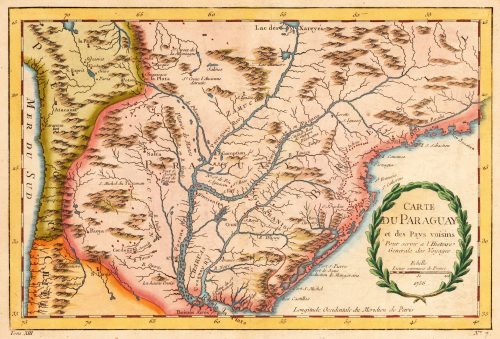
paraguayNicolaus Bellin, Carte du Paraguay et des Pays voisins Pour servir a l’Historie Generale des Voyages, 1760

Descent

By the end of the first part, almost all of the people Zama knows have left Asunción. Four years pass and 1794 opens with Zama in the same town with the same job, but living with a Spanish widow, Emilia, with whom he has a son, born “sickly.” But Don Diego has only changed for the worse, and his namesake becomes symbolic as neglect reduces him to an animal-like state:

Propelled by his knees and his filthy little hands, the child moved about on the dirt floor. With no one to clean them, his nostrils dripped, and the two streams of snot had reached the upper lip . . . The little one rubbed his face, smearing the snot around with a dirty hand . . . His viscous little fingers then dug back into the dirt, which made a revolting mud. . . .

My son. On all fours and so filthy that in the twilight he was indistinguishable from the earth itself: a kind of camouflage. At least—like an animal—he had that defense.

When Zama’s wages are overdue from Spain he must sell almost everything including his sword. He soon abandons Emilia and his son and moves to the cheapest lodgings he can find where he exists in the fog of his own expectations; thinking only of the future, the present decays into hallucination. Neurotic and at times feverish, he is alternately lucid and confused, lost in fantasy. Zama’s oneiric narration during this period is similar (though not nearly as stream of consciousness in style) to the surreal “Report on the Blind” section of Ernesto Sábato’s 1961 novel On Heroes and Tombs. Sábato’s character Fernando, obsessed with a conspiracy of the blind, plunges into the depths of his unconscious, metaphorically represented by the sewers of Buenos Aires; Di Benedetto’s Zama, plagued by an interminable isolation created by forces both without and within, loses himself in fantasies of women. The internal forces prove most destructive, a fact Zama will eventually realize when he reflects that “the search for freedom . . . is not out there but within each one” (Di Benedetto’s italics). In an essay on Sábato’s novel, William H. Gass wrote that Sábato “believes deeply in the reality of evil, in the hell that each man is . . . whereas for the kingdom of heaven, or the reality of the good, he has only hope.” In his isolation, Zama creates his own hell and the possibility of a heavenly future remains only a hope.

Leaves of Existentialism

Zama shares many of the themes associated with existentialism, including, but not limited to estrangement, anxiety, despair, and the absurd. His alienation from family, colleagues, and community is self-evident, and although Zama’s “soliloquy” gives the reader a sense of his anxiety and despair, Di Benedetto doesn’t rely on Zama’s exposition alone. In his afterword to Di Benedetto’s Animal World, Jorge García-Gómez notes the parallels between Di Benedetto’s fiction and Kafka’s in their use of animal imagery to elucidate a character’s existential state. For example, while Zama contemplates the drowned monkey—a striking image itself—a fellow officer joins him on the pier and tells him of a fish that “the river spurns, and the fish . . . must wage continual battle against the ebb and flow that seek to cast it upon dry land.” Disturbed by his colleague’s story, Zama walks into the jungle where, minutes prior to spying on a group of bathing women, he imagines a puma and reflects “on games that were terrible or that could turn terrible.” In another example, while adjudicating the case of a murderer, Zama discovers the man believed he had grown a bat wing and in a frantic attempt to cut it off, had, in reality, stabbed his wife to death.

And, there are insects.

Zama the predator (puma) becomes symbolic prey when Luciana tells him of the pompilid wasp nest she found in her room; female pompilids prey on spiders, paralyzing them with venom so that the wasp’s young, when they hatch, will have something fresh to eat.

waspPompilid Wasp

Another layer of Di Benedetto’s representation of Zama’s psyche is his prose style. Allen wrote that that recreating Di Benedetto’s prose was a great challenge, that the style of Zama is “sui generis: choppy, oblique, veering and jolting from sentence to sentence, often rather opaque, a bit mad.” All the more perfect for this novel, for capturing the nature of this character’s consciousness. For Zama is oblique, he does veer from thought to thought, from plan to plan, and he is certainly more than a bit mad.

When his psychological state is most strained, sentences are separated by line breaks as if to punctuate the manner in which Zama experiences his world—through curt, dour moments, isolated inside his own mind:

I slept very late.
I did not leave the room until I sensed an absence of light outside.
I perceived the moon, like a woman seated on the horizon, naked and fat.
I went to the rear yards.
I searched for something to chew on in the kitchen garden but it was much neglected and had no fruit trees.
I drank maté in the kitchen.
I was not thinking of the dead girl. By now she was far away. I remembered the blond boy. He had reappeared now, with four years gone by, under incomprehensible circumstances. I did not devote much thought to him. . . .
I was isolated, besieged, defenseless.

In the final part, 1799, Zama joins a company of soldiers sent to apprehend a local bandit, Vicuña Porto, and as the company rides deeper into a heart-of-darkness jungle, the prose becomes even terser:

The wind would topple the cross. Later, someone would carry off the stone.
Bare earth.
No one.
Nothing.
I shuddered, without moving.
This could not be. This could not be for me.
I must go back, expose myself to this no further.
Give up the search.

With all the white space on the page and the pauses between lines, you can almost hear Zama taking deep breaths between each thought.

In style, Zama is similar to Camus’s L’Étranger. Camus’s novel also features a disturbed first-person narrator, and although Meursault and Zama have different stories, characters, and motivations, nevertheless they assume a similarly abrupt tone, and what both characters do not say often echoes as loudly as what they do.

§

Evocative of history without being a historical novel, Zama shares in a rich tradition of existentialist fiction. For much of his life Antonio Di Benedetto lived in Mendoza, a self-imposed outsider apart from the literary scene of Buenos Aires. Through Zama he gives us a glimpse into the human condition that is alienated, absurd, comical, desperate, afraid, and yet, hopeful. Zama’s life is one of unfulfilled expectations, one of waiting, reflected in Di Benedetto’s epigraph: “A las víctimas de la espera / To the victims of expectation.” At the end, during a moment of clarity, Zama thinks:

. . . that uncertain though I was as to our goal, I became possessed of the certainty that my fate would be the same anywhere.

I asked myself not why I was alive but why I had lived. Out of expectation, I supposed, and wondered whether I still expected anything. It seemed I did.

Something more is always expected.

Something more is always expected. But isn’t this one of our greatest strengths? Unfulfilled hope is not hope in vain. One thing is certain, we can be grateful that Antonio Di Benedetto’s novel will now reach generations of new and eager readers all replete with their own great expectations.

— Frank Richardson

N5

Frank

Frank Richardson lives in Houston and received his MFA in Fiction from Vermont College of Fine Arts. His poetry has appeared in Black Heart Magazine, The Montucky Review, and Do Not Look At The Sun.

.
.