Jun 082017
 

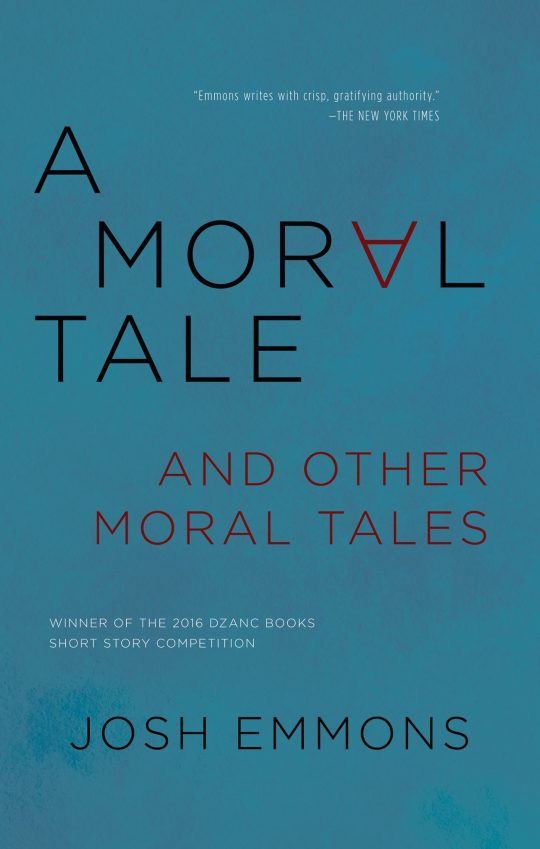
A tiger has lost his pride and seeks direction from a snake crushing apples in a tree. I’m not usually one for animal parables. But in this moral tale, the fifth in Emmons’ collection—A Moral Tale and Other Moral Tales—the elegant prose, precise plotting, and ingenious dialogue transform a relatively straightforward—and often comic—exchange between two species into a remarkable meditation on futility and free will. —Michael Carson


.
The tiger stopped at a break in the rain and realized he was no longer on the path he’d been following. He scratched the side of his belly against a coleus bush, shook free of the water coating his back and legs, and studied the ferns and mosses growing all around him, a blurred patchwork of greens. He listened for the rasp of Cousin, which like a gnat’s buzzing at his tail had annoyed him all through the hunt, and for the whelps of Sister’s underweaned cubs, and for the irregular footsteps of 2nd Cousin, but heard nothing.

“I’m six furlongs west of the den,” he thought, catching the scent of the dead opossum. “At most nine.”

He was tempted to scoop up with his tongue an ant dragging a webbed mass of tsetse flies, but refrained. What could be seen of the sun seemed to shift and ripple in the sky like its reflection in disturbed water. Was he west of the den, or north? Perhaps he was northwest. Cousin, despite his uselessness in a kill, had a perfect sense of direction, and the tiger felt his absence. Not long ago, for example, Cousin had found the way home after a two-day journey through alien trees that had marooned them in an unfamiliar glade, where they were so famished that Aunt had proposed eating 2nd Cousin.

“Sister!” he called out. “Niece!”

The chittering whir of life in the forest slowed and then sped up again.

“Can I help you?” came a voice from above.

The tiger looked up and saw a snake wound around the gnarled branch of a tree that curved at its base into thick tumorous roots burrowing underground. “Yes, you can go up to a good vantage point and look east for a pride of six tigers. One has a limp, another is missing both ears, and a third has no tail.”

The snake’s mouth opened slightly.

“They can’t be more than a furlong away. Maybe two.”

After making a complete revolution around its branch, the snake glided toward the trunk and then up to another branch. “What happened to your left eye?”

“It was removed by a great rhinoceros. You’re not high enough there to see any real distance.” The tiger sat on his haunches and felt the sharp pain in his groin that had troubled him since the last famine. He covered the furless patch on his stomach with his right foreleg, and the long, sparsely plotted whiskers on his face hung like wilted plume grass. “The rain must have disoriented them. They’ll be desperate to find me. 2nd Cousin already suffers from nerves. Go to the topmost branch and scan the area and you are sure to spot them.”

The snake projected a third of its body into midair and peered up at the tumescent sky. “There is an eagle circling.”

“You are too large to be carried off by such a small bird.”

“Just as you are too powerful to be maimed by a rhinoceros?”

The tiger considered leaping up to seize the snake in his mouth but suspected, with his injury, that he couldn’t.

The snake remained motionless.

“If you don’t help me,” said the tiger, “I will find them on my own and then return to kill you.”

With its tail the snake plucked an apple from a leafy nest and squeezed until it liquefied and streamed to the ground. “Before you arrived, I saw six tigers to the southeast, standing in an attitude of respect around a young tiger half again your size. When he trotted away they followed him in single file, and there were a tail-less male and limping female among them.”

The tiger protracted his claws deep into the earth and objects around him grew less distinct. His heart beat erratically. “You saw a different pride that coincidentally and superficially resembled mine.”

“Yes, certainly.”

“There is no possibility of one being the other.”

“I didn’t mean to suggest there was.”

After a minute in which he shivered as if still wet—a ringing in his inner ear, a cold hard trill, made him wish for the sun’s full return—the tiger squinted at the snake and said, “You are lying about what you saw. It is your nature to trick noble animals, as you did man.”

The snake dropped what remained of the apple to the ground, where it landed on a pile of rotting cores around which flies were buzzing ecstatically, and slid down to hang suspended with its tail coiled around a short spiky branch. From close up the tiger could see its skin reticulated into a network of fitted, glistening scales that were honeycombed with tiny red diamonds. A change occurred in the opossum scent; a new bloody aroma mingled with the old decay, as though its body had just been torn open; he could almost hear skin being ripped away and flesh stripped from bone.

“I will not tell—”

“How old are you?” asked the snake.

“I will not tell you again: either go up and look for my companions or prepare to die.”

“You shouldn’t blame them for following another tiger now that you can no longer procure food or protect them.”

The tiger rose from his seated position and paced back and forth unsteadily, trying to determine how high he could jump without further straining his groin muscle. If the snake descended another two branches and then lowered its head and relaxed, he’d have a chance. “I can procure enough food for twenty tigers; at this very moment I am hunting prey. As for guarding them against danger, in the last six months I have fought off two jackals, a wombat, a marbled cat, an olingo and a sambar deer. The few among my pride who have been injured during that period understand why I was unable to prevent it, such as, during our encounter with the rhinoceros, my own loss of an eye. They are loyal in a way that you, a solitary creature hated the world over, cannot understand.”

The snake seemed to consider this and then said, “I wonder how a sambar deer, or a marbled cat or an olingo, could threaten a tiger. An olingo! The smallest cub could swallow one whole without thinking. Though the real question here is why your pride has waited so long to abandon you.”

The tiger sprang up at the tree from a meter away, felt a sharp bolt of pain, and fell to the ground.

The snake said, “Despite your obvious helplessness, if your former pride comes this way its new leader will have to kill you. The old must ever make way for the young.”

The tiger turned away and tensed his muscles and clenched his jaw and didn’t make a sound. From between his legs agony radiated out in regular, insistent waves. It would soon subside. He watched a chameleon blend into a fern stem as hardy as a shoot of running bamboo; the wind moaned and the sky darkened two shades with the sun’s full retreat behind layered clouds. He felt a drop of rain, heavier and more deliberate than any in the shower that had fallen earlier. The opossum scent was faint. He said, “I look forward to meeting this other tiger. Before ending your life, I will beat him in front of you so that you can see your error.”

The snake plucked off another apple and reduced it, as he had the one before, to pulp. “Let us stop this absurd talk of you harming me, because the only animal you can hurt now is yourself. It would be best for you to accept this and everything to follow.”

The tiger said, “Do you want to know why you are everywhere despised?”

The snake said nothing.

“It isn’t just your willful insincerity, the way you manipulate the truth and consider honesty to be a sign of mental frailty, as though animals who treat each other fairly are too stupid to do otherwise, but rather that, unable to build anything yourself, you concentrate on destruction. I almost pity you.”

“Then we might start a mutual pity society.”

“Friendless, heartless, and deluded into thinking cleverness worthier than love and affection, you could vanish and no one would miss you.”

The snake’s head rested on its coiled body, ten feet off the ground. “And how are you any better off, since your life has come to the same solitary end?”

“I am not solitary or at an end.”

The snake looked meaningfully at the empty space around the tiger. “It’s especially unfortunate because your solitude is not the result, as mine is, of your possessing taste and refinement in a place that values neither, but because when young you used brute force to dominate all the creatures of the earth. Those you didn’t eat you frightened, displaced or ignored. How love and affection, which you claim to value, have operated on or through you beyond the limited confines of your immediate family, is a mystery.”

“Having limited sympathy is not the same as having none at all. Everyone privileges his own and his relatives’ survival above that of others.”

The snake’s forked tongue moved up and down in its open jaw at an invisible speed. “Whether or not that’s true, you’re exceptional insofar as power and compassion are directly correlated; the more one has of the former, the better able one is to bestow the latter. You, being all-powerful, have the potential to be all-merciful. You have chosen not to be, however, which is both convenient and beneficial to you, and which eliminates the moral advantage you might otherwise have had over me. In fact, it is safe to say that your obligation to help instead of hurt weaker animals equals or even exceeds your capacity to do so, making it the greatest mandate in the forest now that man is gone, something only a monster could ignore. And yet you think that having been born a tiger you can pursue your pleasure regardless of its cost to others.”

The tiger caught no more scent of the opossum. He did not need to keep listening to the sophistry of a snake when somewhere in the vicinity Cousin and Aunt and Sister and Great-Niece and Niece and 2nd Cousin were either huddled together, too hungry to move or cry out, praying to the hidden sun for his return, or under the influence of a young pretender stealing what belonged to him.

As he considered where to look for them, a rustling sound to the east preceded the appearance of fifteen zebras galloping across the clearing in a westward direction, followed immediately by a herd of long-necked giraffes. The rain was falling steadier now and vast puddles formed on the ground. Then from opposite corners of the clearing two new sets of animals emerged—from the southeast peacocks, and from the northeast rabbits—to unite on the path trampled first by the zebras and then by the giraffes.

“Where are they going?” shouted the tiger to the snake, who had ascended to the topmost branch and was staring into the distance.

The snake didn’t answer for several minutes, during which bunches of toads, rhinoceroses, goats, horses, gorillas, short-haired cats, mice, beetles and marmots filed past, until finally, with an unreadable expression, it returned to its perch on the fourth lowest branch and said, “They are headed west.”

“But why?”

Rain poured down so heavily now that the tiger felt a uniform pressure on his back. A flock of geese flew above while an assortment of chimpanzees and foxes and deer raced by. The puddles converged into an unbroken pool. Next came wolves and bears and badgers and lambs, and it was a marvel to see the peaceful—the non-murderous—lockstep of predators with their prey.

The tiger said to the snake, who still had not answered, “Is there higher ground to the west, or perhaps a fire to the east?”

“No.”

“Then what did you see?”

“Earlier you said that I delight in destruction and trick noble animals such as man. I’ll tell you what I saw, but first you must hear something.”

The rain fell insistently and the tiger was too weary to protest.

“When Eve came here she was a child. Not biologically, but in temper and intellectual development she was little better than the clay from which she and Adam were formed. I lived on the ground then, and ate a sparse diet of mice and other small fry, with little interest in this tree. Eve used to stand where you are now and ask herself whether she should or shouldn’t eat its fruit. Her life was tiresome, she’d say, without variation or intrigue or intensity of feeling—everything she did produced the same dull note—and eating the fruit would change that. Unless it wouldn’t. What if, she’d say, an unpredictable life of alternating pain and joy and mystery was as unsatisfying as the one of regular contentment and predictability she currently led? What if the afterwards were different from the before in kind but not in substance? And while the prospect of death might invest life with greater meaning than it currently possessed, on the theory that something’s value rises in proportion to its scarcity, it might do the opposite and fill her with a sense of life’s futility.”

The water level had reached the halfway point on the tiger’s legs, and he decided to start walking west with the blind hope of finding his companions, who might intercede on his behalf with their new leader. There was no reason to stay here.

The snake said, “One day, after months of ignoring me, she asked what I thought she should do. Stay and suffer in a familiar manner, with an inevitable increase in boredom as time passed meaninglessly, or eat the fruit and be banished to a place and mode of being that might as easily be worse as be better, and that would come to an end? She couldn’t ask Adam because he wanted nothing more than to love and admire creation; he wouldn’t condone her eating the fruit of this tree because he was not dissatisfied. I told her that if that were the case she could do no wrong that would not also be right.”

The tiger’s stomach now grazed the water’s surface, along which a thousand raindrops ignited in tiny explosions that added to and overlapped and canceled one another out. A memory came to him of standing on an open plain during a heat wave when he was young, under a bleached white sky dirtied in the distance by specks of vultures circling over the elk he had just slain, at which time, stupefied but not yet made frantic by thirst, and for a moment on the other side of a small hill from the others, a single droplet of water had fallen on his nose. There had been no clouds or birds above him, and no rivers within sight to produce this moisture. He’d licked it away and in the fraction of relief it afforded him he’d felt his yearning for more spike to an unbearable degree, and he’d had a vision then of endless water, of a flood like the one now arising, and he’d understood that the leadership responsible for taking the pride so far from a fresh drinking supply, and which just moments before had failed to help him bring down the elk, needed to be replaced.

“Do you know what she did then?” asked the snake.

The tiger could clearly see his father’s body perched that evening at the mouth of the cave where the pride was sleeping, his muscles thin and shrunken, his ears perfectly still, lost in a memory of the world as someplace new, when the cycle of rise and fall was not yet known.

“She walked away and never returned.”

A strong current ran through the water. The tiger’s feet were firmly on the ground, though he couldn’t say for how much longer they could stay there. The rain stripped leaves and pine needles from the trees around him and left bare branches stabbing the blackened sky. A bolt of lightning lit up the clearing in a white flash as the tiger bent down to lap up a mouthful of water, which tasted of loamy soil and bones and aloe and bark and insects and iron and sap and stone and the dust of an ended drought, diluted by tears and thickened by blood. As he drank more the tiger became thirstier, with every drop coming from nowhere and the last of its kind.

“To the west,” said the snake, now on a lower branch, “not far from here, no more than two furlongs away, is a giant ship. A gangway connects the ground and its deck, and is being used to convey up pairs of animals. Even in your condition you could reach it in time.”

The tiger kept his eyes down and drank away his recent hunger and the whelps of Sister’s cubs and the illusion that there would never be a young tiger half again his size. He swallowed his father’s murder and the years he’d led his pride through a shrinking forest and the moment he’d known that his confidence was built on a decaying foundation. He consumed the love and hatred that had once given him vitality, and the times when his survival had been in question, and when it had been a foregone conclusion, and when it had been a matter of neither indifference nor consequence.

The snake came down to the lowest branch and extended its head to within a foot of the tiger’s and said, “We could go to the boat together. I could ride on your back and navigate.”

The tiger didn’t look up or stop drinking. There was so much more to take in. He’d only just begun.

—Josh Emmons

N5

Josh Emmons is the author of two novels — The Loss of Leon Meed (Scribner, 2005) and Prescription for Superior Existence (Scribner, 2008)and the short story collection A Moral Tale and Other Moral Tales (Dzanc, 2017). Read a review of A Moral Tale and Other Moral Tales here by Numéro Cinq‘s Michael Carson

N5
May 062017
 

In this piece, Moore explains how Ted Morrissey’s postmodern work on Beowulf has opened his mind to fresh interpretations. Far from thinking everything about the poem has been answered, Moore shows, first, that when a critic approaches a work with new eyes the result can be invigorating, and second, that the trauma enacted in these old verses have relevance to our world. —Jeff Bursey

.

Not having studied Anglo-Saxon since grad school, nor having kept up with Beowulf criticism in particular, I’ll take Ted Morrissey’s word for it in The Beowulf Poet and His Real Monsters that most recent criticism on the Anglo-Saxon poem remains fixated on old-fashioned philological study. While these textual issues are important—especially when one’s interpretation hinges upon a proposed emendation or the accurate identification of the dialect of a certain word—Morrissey’s illuminating monograph demonstrates the advantages of bringing newer critical strategies to bear on the poem, especially “postmodern” ones that might seen incompatible with this premodern work. Looking at Beowulf through postmodern eyes fosters a greater appreciation of the craftsmanship and subtlety of this masterpiece.

For example, one the earliest theorists of postmodernism, architecture critic Charles Jencks, argued that po-mo works are characterized by “double-coding,” whereby the artist appeals to both popular and elite audiences by encoding for the latter group subtle allusions, references, and ironies that will probably go unnoticed by the larger popular audience who focus on the more obvious and appealing aspects of a work. In his essay “What Was Postmodernism?” (electronic book review, 2007), Brian McHale gives as an example animated movies like Aladdin, which “appeal to children through slapstick and cuteness, and to their parents through pop-culture allusions and double entendres that go right over youngsters’ heads.” Beowulf strikes me as a deliberately “double-coded” work, with exciting fights scenes that would delight the scop‘s mead-muddled audience, but at the same time encoded with theological and political issues, intertextual references to other works, and some dazzling wordplay for the benefit of the connoisseurs and intellectuals of his time. Double-coding is also in effect as the poet ostensibly tells a tale set in Denmark and Sweden in the sixth century but that is also (if not really) about England in a traumatized period several centuries later, a transhistorical strategy that would probably go over the heads of the tipsy masses but would not be lost on the more sober thanes in the hall. The popular aspects of a double-coded work will always appeal to a larger audience; Howell D. Chickering Jr. speculates that “Beowulf’s tragic third fight with the dragon was more frequently read than his earlier adventures, since folio 182, where this adventure begins, is quite worn out” (Beowulf: A Dual-Language Edition [Anchor Books, 1977], 246). In contrast, Hrothgar’s serious sermon on pride (lines 1700 ff.) shows little sign of wear.

Postmodern works also flaunt a heightened self-consciousness about their status as artificial literary creations, metafictionally drawing attention to the artist behind the work. No one would mistake Beowulf for a chapter in the Anglo-Saxon Chronicle, partly because the poet frequently draws attention to himself and to his artistry. On a half-dozen occasions, the first-person “ic” pops up to remind the reader that the tale isn’t telling itself, but is rather a dramatized reconstruction of what the scop has only heard. The scop is self-consciously aware that he is performing his story, not merely reporting it, and highlights this process at line 871, the morning after our hero’s first encounter with the monster Grendel. The anonymous author self-consciously introduces his stand-in into the proceedings, whereupon this wordsmith

found new words,…..bound them up truly,
began to recite…..Beowulf’s praise,
a well-made lay…..of his glorious deed,
skillfully varied…..his matter and style. (trans. Chickering)

Suddenly the reader realizes the previous 870 lines have not been a historical account of Beowulf’s actions but a fanciful re-creation—a literary performance; the poet, having “unlocked his word-hoard” (l. 259), has armored himself with words to perform a glorious linguistic deed to rival if not outdo Beowulf’s wrestling match of the night before. For the story of Beowulf’s deeds, you can read the Cliffs Notes; the poem is a performance of the story, a showy display of the poet’s wrestling match with words in which he emerges triumphant. (Beowulf only tears off an arm.) Look at me, at my prowess, the word-warrior proclaims, not at Beowulf, whose own later account of his fight with Grendel (lines 2069 ff.) is deliberately bland in comparison. One of the few interesting things about Robert Zemeckis’s comically crude film version of Beowulf (2007)—aside from the golden splendor of Angelina Jolie—was Beowulf’s postmodern awareness that he was the protagonist in a work-in-progress to be called The Song of Beowulf.

The poet’s innovative, unconventional use of words is another feature associated with postmodernism, as Morrissey argues in his second chapter, and which he goes on to align with the obsession with diction that trauma victims display. I was previously unaware of trauma theory, but Morrissey argues convincingly that this branch of postmodern theory shines new light on several murky aspects of the poem, on what some readers call its disjointedness and downright weirdness. Beowulf enacts on both a formal and verbal level the effects of trauma on a people (and on a gifted poet) subjected to centuries of warfare, sickness, and disorder, resulting in a poem closer to nightmare than elegy. Morrissey shows how other postmodern strategies illuminate the poem, and respectfully suggests these new approaches can supplement, not supplant, the more traditional philological approaches. Those earlier approaches have for too long treated Beowulf as a period piece, but these new approaches give the lay a startling relevance in the 21st century: I am writing this at the end of 2012, after the quick succession of Hurricane Sandy, the slaughter of children in Newtown, Connecticut, and fears of going off a fiscal cliff have somewhat traumatized Americans—who are not as bad off as the Anglo-Saxons of the Dark Ages, to be sure, but are now in the appropriate mood to appreciate the traumatized world of Beowulf.

—Steven Moore

.

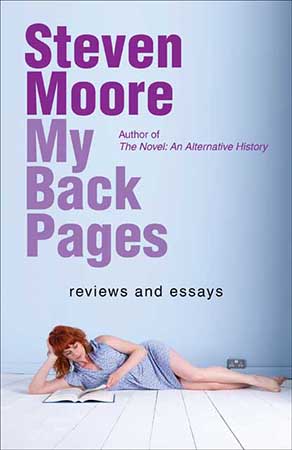
Steven Moore is the author of the two-volume study The Novel: An Alternative History (2010, 2013), as well as several books on William Gaddis. His new book, My Back Pages: Reviews and Essays, is just out with Zerogram Press.

.
.

May 042017


.Marissa woke as intended to the sound of the unearthly chant: qui sedes ad dexteram Patris, miserere nobis. She sat up on her prayer mat, hands folded across her heart, breathing as she had been taught, sharp intakes of air through the nostrils, pulled down to the bottom of her belly, then harshly expelled. The rushing sound of her breath flowed in and out between the long sustains of the singing. Ten breaths brought her alert. What had been the dream she was just dreaming? — but she was not meant go toward it now.

Quoniam tu solus sanctus. Tu solus Dominus.

Now breathing normally, forgetting even that she breathed, she lowered her hands from her heart and let them lie palms open on her inner thighs, in the cross of her legs on the prayer mat. Her palms were full of heart warmth, as if they cupped warm fluid in the dark. The darkness was not total, though. A weak light flickered in a high corner, casting a horned shadow across the floor and the far wall where it broke on the black felt that sealed the window. She brought her memory to bear on the First Sin, which was that of the Angels—wanting to recall and understand all this in order to make me more ashamed and confound me more, bringing into comparison with the one sin of the Angels my so many sins, and reflecting, while they for one sin were cast into Hell, how often I have deserved it for so many…. In doing so she also concentrated on a point of warmth halfway between her navel and her vulva, as though blowing softly on a coal—this practice belonged to a different discipline yet she believed it might aid this one.

Qui tollis peccata mundi, miserere nobis the sin of the Angels, how they, being created in grace, not wanting to help themselves with their liberty to reverence and obey their Creator and Lord, were changed from grace to malice, and hurled from Heaven to Hell; and so then qui tollis peccata mundi, suscipe deprecationem nostrum but here Marissa’s mind hung up on the word hurled which somehow attached itself to a weakness in her meditation, whispering itself into meaninglessness, tawdry as the hidden disc on which she’d looped a Gregorian Qui Sedes, setting the player with a timer to rouse her from her idle dreams at midnight, false as the yellow Christmas bulb tucked on top of her tall corner cupboard which hurled the shape of its fineals across the room like horns. Mocked by her own monkey mind she trembled in frustration, hurled back and repulsed from the meditation even as she continued hopelessly to struggle, to move the feelings more with the will.

The music stopped, but she didn’t notice, and the light was gone too, something had changed, monkey mind was fussing over these changes but quickly completely she managed to smother it, turning her being into the new thing, whatever it was, or rather being snatched into it by three points, the one below her navel and the two aching points of her breasts. Across total darkness curved a sliver of light like a shooting star, going down and down, hurled down. 0, 0, 0, she thought, with unutterable sorrow, she is lost. Away in her room, which somehow her being had after all departed, her hands were fluttering in her lap. Far away in the other realm, among its splintering materials. Lost to me. To herself. Not to herself.

The spark went down a long way into darkness, but it did not go out.

§

“The eye of our intention,” Claude was saying, with the rasp and flare of a match as he scraped it on the striker. He leaned forward across his folded knees to light the candle between them on the wooden floor. Marissa looked down on the top of his bony, close-cropped head, sprouting a silvery down like dandelion seed. He wore his favorite sweater, a black crewneck riddled with tiny moth holes. The sight of it gave Marissa a peculiar watery feeling, like looking at a puppy before its eyes had opened.

She too was kneeling, sitting on her heels. It was a remarkably painful position if held for long. Claude had inured himself to it during a sojourn in Tibet. He tilted his baldish skull, whose shadow shifted on the wall behind him. In the dim his eyes seemed to acquire an ascetic slant.

“…makes the difference.” He breathed slowly. “Between an Exercise and ordinary trance.”

The eye of our intention. Claude had told her not to think of him as pastor or confessor, nor to call him Father, although he was a priest. He was her guide, through the Exercises. Like–

But he did have an intuition for her intention if it faltered. For her confusion, when she was confused. He looked at her now across the flickering candle flame, as if withholding a hint of a smile. As if somehow he knew the odd interruption of her Exercise two nights before: the image of a meteor hurtling down into the dark. The eye of her intention had wandered then—Marissa knew it, would not willingly admit it.

“Set and setting,” Claude announced.

Marissa rolled a little on her already-aching knees. “What are you talking about?”

His smile became visible now. “You know, we used to cooperate with other religions sometimes.” By we he meant the Jesuits. “Not here so much, but sometimes in the East. Considerably. Maybe too much. As if whatever religious practices were really all about the same thing—the Divine but in a different aspect.”

“And so?” She returned his smile with her mouth, eliciting, her eyes turned down.

“Set and setting is a phrase from the LSD culture,” Claude explained. “There’re a hundred ways to enter a trance. What happens inside it depends on your expectations and your guidance. The cultural surroundings, so to speak.”

Marissa raised her eyes from the candle to his face. “But you still believe,” she asked him.

“Lord, I believe!” Claude said, raising his open hands. “Help thou mine unbelief!”

They laughed. The room, which was drafty, grew a little warmer.

Claude said, “Shall we begin?”

§

The candle was a fat white cube, unscented, its four walls faced with thin slices of agate. The reddish-brown whorls of the cross-cut stone warmed with the interior light. Shadows of their two kneeling figures loomed in the corners of the ceiling. A voice resonated, Claude’s, not-Claude’s. … to bring to memory all the sins of life, looking from year to year, or from period to period. She was careful not to look at him first, to look at the place and the house where I have lived; second, the relations I have had with others; third, the occupation in which I have lived.

It was equally possible that Claude sat simply mute with his lidded eyes and his lips slightly parted and the voice she heard was an inner one, a fusion of her study and her familiarity with his tone.

§

Fourth, to see all my bodily corruption and foulness;

§

Fifth, to look at myself as a sore and ulcer, from which have sprung so   many sins and so many iniquities and so very vile poison.

§

She heard these phrases, as her eyes turned backwards in her head, and yet she was having trouble with the composition, which in this as in the previous Exercise seemed difficult because abstract.


to see with the sight of the imagination and consider that my soul is imprisoned in this corruptible body, and all the compound in this valley, as exiled among brute   beasts:

§

Her eyes, turned backward in her head, saw no such thing.   Nevertheless she was somehow aware how the candle was a barrier between them like a trench full of burning brimstone—why must it be so? The spark she saw tumbling into darkness now had a shape, a bright rectangle like the form of a small mirror, flickering and turning as it fell. The mirror image was a face, a long Modigliani oval, with something streaming away from its edges like hair or snakes or blood. Animal persons rushed at her from the walls of the cave: bison, bear, a mastodon.

§

an exclamation of wonder with deep feeling,

going through all creatures, how they have left me in life and  preserved me in it; the Angels, how, though they are the sword of the   Divine Justice, they have endured me, and guarded me, and prayed for   me; the Saints, how they have been engaged in interceding and praying   for me; and the heavens, sun, moon, stars, and elements, fruits, birds,   fishes and animals–and the earth, how it has not opened to swallow me   up, creating new Hells for me to suffer in them forever!

§

Now she struggled up through syrupy layers of this dark somnolence; her eyes burst open as she broke the surface. She hoped she had not groaned or cried aloud. The candle flame was ordinary, small. Across it, Claude seemed to look at her quizzically. She knew that much more time must have passed in this room than in the cavernous space where she had been.

Blood rushed painfully through her cramped legs as she cautiously unfolded her knees. An aurora of gold speckles swirled across her vision for a few seconds before it cleared. Claude’s regard was knowing now; he knew she had seen something unusual with her inward eye, while she knew that she could recover and understand it when she would, and that she would not tell him now.

Claude came up from the floor like a carpenter’s rule extending, long arms, lean legs in his black jeans.

“All right?” he said.

“Yes.” Marissa’s smile felt warped on her face. “All right.”

Claude looked as if he would offer a hand to help her rise, but didn’t. She got her feet under her and rose on her own. It was difficult to understand the awkwardness of their leave-takings, which were frequent after all. She had seen Claude spontaneously embrace fat foulmouthed drunken women from the rez. The space between their bodies seemed a chasm now. He reached across it, briefly clasped her hand, then let it go.

§

From the next night she could recall no dream but on the third morning she woke with a comprehension of what she had seen in the dark furrow where her Exercise had strayed. “But you know,” Claude seemed to be saying to her in the space of her mind, and she did know now, exactly. It hurt but she was more glad of the pain than not. She was proud to have figured it out on her own. She had something to bring to him now, like a treasure, her confession.

Early, but Claude was an early riser, and Marissa saw no reason to wait. Though they had not planned any meeting this morning, she might if she went quickly catch him for a bit before either of their workdays were due to begin. She dressed quickly, dragged a brush through her dark hair. No make-up, she decided with a tick of hesitation, for she didn’t normally wear it to work.

Her ancient little Toyota pickup rolled over the side streets of Kadoka till its windshield framed the church. Over the white lintel was affixed an electrified image of the Sacred Heart, exploding the burning cross from its upper ventricles, its Valentine contour wrapped in yellow-glowing thorns and weeping a tear of marquee-light blood. Marissa loathed this artifact and wished that Claude would have it removed. His predecessor as parish priest had raised the funds to install it.

Adjacent and connected to the church by a passage of coal-blackened brick, the small seminary where Claude resided was three-quarters empty, most of its windows dirty and dark. Vocations had dwindled on the rez, where a few handfuls of young men once had seen the Church as a portal to a better life. Of course, especially since the scandals, vocations were a problem nationwide…. An ambulance was parked alongside the seminary, its back doors open, siren quiet, red lights revolving slowly. On the far side of the white marble steps Sister Anne-Marie Feeney stood solid as a fireplug, her orthopedic shoes set apart on the pavement, cool wind twitching the black cloth of her habit.

Marissa’s mind could not yet construct the thing she wished to be other than it was, but as she got out of the truck she was already thinking, if I got up on the other side of the bed, put my right shoe on before my left, if a butterfly flapped its wings in China, if then if— A pair of shoulders hunched in a white scrub top appeared in the doorway, backing awkwardly toward the first step, while leaning forward into a load.

Sister Anne-Marie registered her presence and waved her imperiously back with her brick-red calloused hand. Marissa continued to advance; the nun pointed more insistently at something behind her. Her lips moved but Marissa heard nothing. She looked over her shoulder and saw that she had left her driver’s door hanging open across the bike lane which the town had recently established by dint of drizzling a line of white paint across the pot-holed pavement. Sister Anne Marie, who transported herself on a rust-red Schwinn three-speed, was militant on the subject of the bike lane.

Marissa turned back and slapped her door shut –irritably, though knowing herself in the wrong. She advanced again toward the seminary door, where the two paramedics had now emerged with their stretcher and the long figure laid out motionless upon it, covered from head to toe with a white sheet. With no particular urgency they rolled the stretcher in. No eye contact with Marissa or the nun.   Sister Anne-Marie had caught Marissa’s elbow in her blunt grip—had she looked like she would throw herself onto the, onto the—? But now the attendants had closed both doors and were climbing into the front of their vehicle.

She dipped into her front pants pocket and touched the rosary he had given her. This other sequence of events was so clearly present to her still; she arrived to find Claude sweeping the seminary steps, one of many banal tasks he claimed for himself around the grounds of the church. He looked up, mildly surprised, but already more pleased to see her than not, his smile still not quite perceptible as Marissa glanced at her watch and stopped herself from quickening her step. She did not have to be at work for forty minutes so there was time to go around the corner and have a cup of dishwater coffee at the donut shop there—time and so much to tell, and finally someone she could safely tell it to.

The sun broke over the peaked roof line of the church and flooded the sidewalk where they stood with light.

She had apparently missed a few things Sister Anne-Marie had been saying, “… a mickey valve, a mighty valve—oh I can’t remember exactly what but Father said it wasn’t serious, the doctors were watching it, supposed to be.”

She looked at the ugly electric sign. Claude’s heart had a hole in it then, if it had not blown up. Marissa brought her eyes down to the nun’s face, which was the same color and texture of the abrasive blood-red brick of which the older parts of the town were constructed. Take away the wimple and she might have been looking at the face of a career alcoholic, one of the sterno-strainers. Oh, it was only high blood pressure in Sister Anne-Marie’s case, she knew.

“I didn’t know,” she heard herself say.

“Father didn’t tell many people.”

And now Marissa searched the nun’s face for something along the lines of suspicious knowledge (an insight she had carefully denied herself)—an unspoken What makes you think you had a right to know, you little minx? Instead she found only a gentleness she could not bear.

“Child,” said Sister Anne Marie. Marissa broke away from her and walked stiff-legged to her truck.

§

Early to work, she leafed through her dossiers, barely seeing them with her parched eyes. It was supposed to be a paperwork morning; she had no appointments till late afternoon. Just Jimmy Scales, and he was not likely to show. Marissa knew he had skipped his court-ordered pee test and that she would most likely be spending a piece of her afternoon writing him up for it. The molded plastic chair across from her desk, where Scales sat sullen and uncommunicative for forty-five minutes every two weeks. It would be a paperwork day, then, not just a paperwork morning—well, she could catch up on some of those files. A break midmorning, telling her beads in her pocket while she watched Peggy smoke her weak, toxic cigarettes. Yoghurt or a stale packaged salad for lunch. She could populate her whole future with such banalities, as if instead of being doled out one at a time the events had all fallen out of their box.

She yanked the sheet with Scales’s basic stats on it out of the grubby folder and dropped the rest of the folders back in the metal file drawer. Peggy ran into her in the entryway, coming in as Marissa went out.

“Where you off to?” Peggy said.

“After Jimmy Scales,” Marissa told her.

“What? Would that be a rational act? He didn’t even miss his appointment yet.”

“No,” Marissa said. “But don’t I know he’s going to—am I Nostradamus or what?”

“Girl, you look you seen a ghost.” Peggy was wagging her head slowly. “No, you look you are a freaking ghost.”

§

At a gas station on the north bank of White River she stopped and bought a pack of Marlboro Reds and tossed it on the dashboard. She’d done that before when she quit smoking—once for a whole sixteen months. An unopened pack on the corner of her desk proved she was stronger than her addiction and that her clients might even be stronger than theirs. A parable in pantomime. Sometimes she had given the pack to a client, in the end.

At the border of the reservation she pulled over to enter Jimmy Scales’ reported address into the small GPS unit improvisationally mounted on the cracking dashboard of her truck. It came up somewhere west of Sharp’s Corner. Marissa wasn’t familiar with the area. She knew her way to the IHS hospital on East Highway 18, and to Oglala Lakota College, where she had briefly worked in the health center.

She missed the turn she should have taken at Scenic and drove blind across a narrow waist of Badlands National Park. On the far side she kept following 44 as it twisted south into the rez, and presently found herself passing through Wanblee. The wreckage of a couple of houses torn up by a tornado lay scattered over three acres of ground south of the roadway. A little further was a white frame church, with a quaint wooden belfry, photogenic. She pushed down the thought of Claude.   There’d be a funeral. When would it be? Her future….   A handful of boys in droopy shorts and shirts were popping skateboards off the concrete stoop of the church.   One of the more daring rode crouching down the welded pipe stair rail and survived the landing. Swooping in a wide turn over the asphalt parking lot, he glanced incuriously at her truck as it rattled by.

Her dry eyes burned. West of Potato Creek she began to overtake a pedestrian. Slender, with glossy black hair so long it swung around her hips. A half open backpack swung from her shoulder by one strap. She turned, lifting her chin, and signaled not by raising her thumb but pointing her hand peremptorily to the ground, as if to command the truck to stop.

Inez. Marissa’s heart lifted slightly. She leaned across to pop the passenger door. Inez slipped off the backpack as she climbed in, then shrugged out of the denim jacket she was wearing.

“Wow Miz Hardigan, whatcha doin’ all the way out here? Can you gimme a ride down to school?” Inez wore an orange tank top and the round of her belly pushed a gap between its hem and the waistband of her jeans. In her slightly distended navel glittered a small bright stud. She had not stopped talking: “I’d been late to comp class if you didn’t stop—“ she pointed at the corner of a rhetoric textbook sticking out of her backpack– ” I dunno it’s kinda boring anyway I thought I might switch to the nursing program anyway, Miz Hardigan you musta done nursing, right? Hey, can I take a cig? Hey, cool truck, I always liked ‘m, my uncle used to have one once back when they were sorta new.”

Marissa nodded at the pack on the dashboard. It was not like Inez to chatter this way. Marissa knew her as calm and slightly mysterious. She had already peeled the cellophane from her pack and lit a cigarette with a lighter she squeezed out of her jeans pocket, then let it burn down unnoticed between her fingers, as she picked obsessively at some invisible something between the hairs of her left forearm.

Oh Christ, Marissa thought. Do you know what that’s doing to your baby? Do you know what… she didn’t say anything. She couldn’t have, as there was no chink in Inez’ prattle for her to have slipped a word into before they reached the entrance of the college.   Marissa dug in the pocket behind her seat and fished out a scare-you-off-meth brochure…. Unfolded, it displayed the stages of a twenty-year-old woman aging forty years in two. Inez shoved it into her backpack without really seeming to see it at all, but she gave Marissa a hurt look from her wiggly eyes as she hopped out of the truck and slammed the door.

In a devil’s elbow beyond the college, Marissa narrowly missed a collision with a horse-trailer, though the road was otherwise empty and their speeds were low. She pulled onto the shoulder and sat there, shaking with the fading tension, watching the trailer recede in her side-view mirror. A painted rodeo scene flaked from its back panel: cowboys and Indians, horses and bulls. Marissa saw that Inez had dropped a lighter on the passenger seat when she got out. The blue translucent plastic showed a quarter full of fluid. And the cigarette box lay on the dash, cracked open. Another few months into a meth habit and Inez would have automatically stolen it.

Marissa got out of the truck to smoke her first cigarette in over a week. The blast of unaccustomed nicotine dizzied her so much that she had to brace a palm on the warm ticking hood of her vehicle. In one corner of her mind was the thought that this was not really a pleasant or desirable sensation. In another: Now I am going to cry. But she didn’t cry.

Sharp’s Corner was no more remarkable than Wanblee had been. The GPS led her west onto a gravel road that soon degraded itself into a packed dirt track. Where the track petered out into blank open prairie, the GPS unit went dark. Marissa had a state map in her glove box, but on that the reservation proved to be a nearly blank white space, like the African interior on the maps of Victorian explorers. Her tires were worn and it would be idiotic to break down out here; if the GPS had failed her cell phone probably wouldn’t get a signal either.

Nevertheless she drove on. The prairie was neither as featureless nor flat as it first seemed. There were billows and hollows full of thorny scrub and small twisted trees. In one of these pockets appeared a tin roof streaked brown with rust. Marissa steered toward it, thinking that she might have blundered onto the Jimmy Scales’ domicile after all.

She set her parking brake and got out. The small house sat half in, half out of a thicket of evergreen brush, at the bottom of a dish in the prairie, scattered with sharp white stones. It did not exactly look abandoned, but the door hung open in a way that dismayed her. She started to call to the house but did not. To the left of it the rusted carcass of an old Mustang stood on blocks and beside it a washing machine so ancient it had a wringer bolted on top. A dented aluminum saucepan lay upside down among the stones.

The sky darkened abruptly, though it could scarcely have been noon. Marissa looked up to see a black squall line hurrying from the west, dense inky cloud that blotted out the sun. She could no longer remember why she had come here. Out of the thicket to the right of the house came an old man with long white hair, wearing a green quilted vest with the stuffing coming out from its parted seams. He shook a rattle at the end of one bony arm and made a thin keening sound with his voice. Although he did not seem to see her he was coming toward her certainly, as if everything in this day, in her whole life, existed to carry her to this moment and him to her. When he had reached her, his free hand took hers.

Marissa said, Why?

You have a hollow in your heart, the shaman said. Or maybe he said hunger. The rattle shook in his other hand. Hunger. Hollow. Now Marissa was weeping, with no sound or sobbing. She only knew because the water from her eyes ran into the neck of her shirt and pooled in the shell of her collar bone.

Go to it now, the shaman said. Don’t hesitate.

—Madison Smartt Bell

N5

Madison Smartt Bell is the author of twelve novels, including The Washington Square Ensemble (1983), Waiting for the End of the World (1985), Straight Cut (1986), The Year of Silence (1987), Doctor Sleep (1991), Save Me, Joe Louis (1993), Ten Indians (1997)  and Soldier’s Joy, which received the Lillian Smith Award in 1989.  Bell has also published two collections of short stories: Zero db (1987) and Barking Man (1990).  In 2002, the novel Doctor Sleep was adapted as a film, Close Your Eyes, starring Goran Visnjic, Paddy Considine, and Shirley Henderson.  Forty Words For Fear, an album of songs co-written by Bell and  Wyn Cooper and inspired by the novel Anything Goes, was released by Gaff Music in 2003; other performers include Don Dixon, Jim Brock, Mitch Easter and Chris Frank.

Bell’s eighth novel, All Soul’s Rising, was a finalist for the 1995 National Book Award and the 1996 PEN/Faulkner Award and winner of the 1996 Anisfield-Wolf award for the best book of the year dealing with matters of race. All Souls Rising, along with the second and third novels of his Haitian Revolutionary trilogy, Master of the Crossroads and The Stone That The Builder Refused, is available in a uniform edition from Vintage Contemporaries. Toussaint Louverture: A Biography, appeared in 2007Devil’s Dream, a novel based on the career of Nathan Bedford Forrest, was published by Pantheon in 2009. His most recent novel is The Color of Night.

Born and raised in Tennessee, he has lived in New York and in London and now lives in Baltimore, Maryland. A graduate of Princeton University (A.B 1979) and Hollins College (M.A. 1981), he has taught in various creative writing programs, including the Iowa Writers’ Workshop and the Johns Hopkins University Writing Seminars. Since 1984 he has taught at Goucher College, along with his wife, the poet Elizabeth Spires. He has been a member of the Fellowship of Southern Writers since 2003. For more details, visit http://faculty.goucher.edu/mbell

.
.

Feb 102017
 

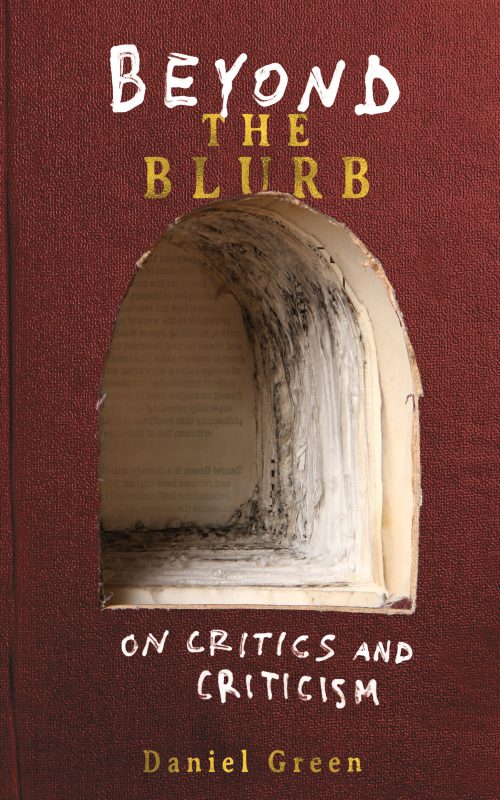
Dan Green


Ebook-1563x2500


As a young man, Daniel Green had hopes for academic criticism, but as this excerpt — take from his essay “Blogs and Alternative Literary Criticism” — shows, he had to set those hopes aside, as more and more academic criticism tended to subordinate literature to political and theoretical agendas. Later, weblogs, too, disappointed him because they pursued sensational or trendy books instead of considering literary works in depth. —Jeff Bursey

.
I aspired to become an academic critic precisely because so much general interest criticism was focused on the “mushy middle” of literary fiction and avoided the books I was most interested in reading. Academic journals were much more likely to feature experimental and unconventional writers (some journals concentrated exclusively on such writers) and gave them more than the cursory treatment afforded by most book reviews. Academic criticism no longer manifests these virtues, however. It is as agenda-ridden as literary journalism, although its agenda emphasizes a different kind of propriety, the propriety of political and cultural analysis (in its way similar to the kind of analysis favored by the New York Intellectuals). And while academic journals continue to offer longer and more sustained commentary, this commentary is more concerned with context—historical, culture, theoretical—than with the text, the latter serving only to illuminate the former. Academic criticism of contemporary fiction no longer provides a more rigorous, expansive, open-minded alternative to the popular reviewing media. For text-based criticism, the general interest book review is what we’re stuck with.

At one time I held out hope that the “literary weblog” would provide a plausible alternative to print book reviewing. I still think that, in theory and potential, blogs could still be perfectly good sources of serious literary criticism. There is nothing in the nature of the cyber medium that precludes the blog from being the publishing vehicle for serious writing of any kind. If serious critics, facing the likely demise of newspaper and magazine reviewing in the not distant future, turn to the cyber/blogosphere as an available substitute, literary criticism will flourish well enough. Such book reviewing sites as The Quarterly Conversation and Full Stop have already demonstrated that online reviewing can be just as credible as print reviewing, in many cases going far beyond, both in length and in critical heft, what is offered in all but the most studious general interest print publications. They are also much more likely to cover experimental and translated works and books from independent presses, which are at best sporadically reviewed in mainstream print book review sections. Unfortunately, it cannot at this point be said that the literary blog has validated hopes it might sustain a form of general interest criticism that could replace, perhaps even surpass, what is left of print criticism. There are indeed some very good literary blogs offering worthwhile criticism, but on the whole the literary blogosphere has become largely an echo chamber for book business gossip, pseudo-literary trivia, and the establishment perspective. Literary blogs have become not an alternative to the established critical order but part and parcel of it.

Those blogs now calling themselves “book blogs” in particular have pledged themselves to this order. Mostly devoted to superficial appraisals of potboilers and best-sellers, these blogs actively seek to be conduits of publishing propaganda (in the guise of “promoting” books). They have apparently become the most popular type of “literary” blog, and if “book blog” eventually becomes the name applied mostly to such weblogs, the future of literary criticism online is bleak indeed. But even those still self-identifying as “literary blogs” have settled in to an overly cozy relationship with both publishers and the print reviewing media. (Many of the bloggers have themselves sought out reviewing opportunities in the print media, as if the ultimate purpose of creating a literary blog was after all to attract enough attention to catch on as a newspaper reviewer). While in general one does get from literary blogs a fuller sense of the diversity of fiction available to readers (more emphasis on independent presses) than from the print book reviews, too many of the posts devoted to specific books are discussions of the newest and hottest from mainstream publishers. Much time is spent obsessing over lists of various inane kinds (the Top 10 ____), and in preoccupation with prizes, the dispensing of which apparently substitutes for criticism absent the real thing.

Literary blogs are (unwittingly, I hope) abetting the capitalist imperative to get out “product” as quickly as possible. New books appear, are duly noted, presumably consumed, and then we’re on to the next one. While sometimes lit bloggers consider an older title, it’s usually by an already established author or a “classic” of one sort or another. Little time is spent considering more recent books that might not have gotten enough attention, or assessing a writer’s work as a whole. Once the book has passed its “sell by” date, nothing else is heard of it and every book is considered in isolation, as a piece of literary news competing for its fifteen seconds. The more potential readers come to assume that this is the main function of lit blogs, the less likely it is that the literary blogosphere will have any lasting importance. Literary blogs might let you know who reviewed what in the New York Times, but that The New York Times might not be the best place to go for intelligent writing about books is not something they’ll have the authority to suggest.

—Daniel Green

N5

Daniel Green is a literary critic and sometime fiction writer. His reviews, critical essays, and fiction have appeared in a variety of publications, both online and in print. He has a Ph.D focusing on postwar American fiction and an M.A. in creative writing. His website is http://www.thereadingexperience.net/tre/

.
.

Aug 012016
 

Brightfellow1

Herewith is a passage from Brightfellow in which its main character changes identities. No longer is he known as Stub—a strange and lost figure—but as Charter, a young, Fullbright scholar. The identity of Charter is a lie, of course, but in this brief section, he sees the possibilities and promise of becoming someone new. Asthma is a daughter of one of the other professors who lives on the Circle. She has captured the imagination of Stub/Charter, who believes she is the key to recapturing his lost childhood. —Jason DeYoung

.

Everything changes. Because Billy, Professor Emeritus, lonely, long in tooth, all angles, all elbows and knees (and he has always been this way, graceful and unwieldy at the same time, his broad shoulders holding it all together), open-faced, of sunny disposition, an optimist, wearing a cotton shirt the color of Dijon mustard, hunts down Charter Chase and finds him.

“There you are!” he says. “I’ve been looking all over. Been prowling the stacks!” He puts out his hand and they shake, like gentlemen. Billy cuts to the chase. “Charter,” he says, “I’ve been wondering about . . . well. About your digs.Are they adequate?”

“Ah . . . well . . .” Charter laughs uncomfortably. “You know what it is like to be a poor student, but—”

“Of course I do!” Billy cries. “Indeed I do! So here’s the thing, son,” and he pats Charter on the shoulder paternally (or so Charter supposes, having never received anything like this from his father). “I live alone, ” Billy continues as they make their way together down the steep library steps and into the full light of day. “The house is far too big. I barely enter the upstairs. There’s an entire living space up there, bedroom, bath, study.” They approach Faculty Circle and he points to one of the several gracious faux-Tudor houses with pitched roofs and screened-in porches. The stucco façade is a pleasant shade of sand, the wooden window frames painted a rich chocolate. “The place is shipshape of course. Nicely kept up by buildings and grounds. But I imagine you are familiar with the Circle.”

Charter is not only familiar with the Circle, but with Billy’s house. It was Billy’s countertop that had once provided him with a cooling pie. Charter nods. Says, “Yes. The Provost had a little get-together for the foreign students a while ago—”

“Of course!” Billy considers his rehearsed delivery. “Uh,” he says. “Here’s the thing. Here you are, a Fulbright scholar far from home living—or so I imagine—in inadequate housing and, well, surely you can see where I am coming from.”

“Sir. I do. I do. I do not dare . . . it’s too kind, far too kind.” Charter runs his fingers through hair he knows is in need of some attention, and which Billy addresses at once.

“Have you, have you . . . been to an American barber?”

“No, sir—”

“Billy.”

“No, Billy. Short on funds and as you can see I am personally not too handy in that direction.”

“I’ll take you to town. I know a good man there. Now, the upstairs is nicely done up.” They stand together on the Circle now, looking at his house, which shares a lawn and a lilac hedge with Asthma’s.

“Terrific closets. Full use of the screen porch,” Billy says, “the kitchen. Do you cook?”

“No—”

“Of course not. You are busy. With Loon! Who could have imagined this! My own days of being busy are over. I’ll cook for the two of us. I am bored cooking for myself. Losing touch! Look at this scar.” He throws a hand into Charter’s face. “Trimming a radish.” He thrusts the tip of a thumb into his mouth and sucks it. “I am, therefore, in all simplicity, no strings attached, proposing a proper dwelling, nicely done up by Margaret, who blessedly is gone to Wisconsin and out of our hair, yours and mine. One of the perks of being a college professor—in case of divorce, the professor cannot give the spouse the house! My campus digs are…on the house! On the house!” He laughs almost to tears, raving as they pace together around the Circle. I’ll get the upstairs tidied up and then, Charter, it’s yours. In the meantime, come for supper. Are you free?” Charter nods. “Six. I’ll show you your digs, get the cleaning lady—she’ll be here later in the week—to give the place a thorough…Do you need help moving?”

“Sir, Billy. You will be amazed by the little I have. My things, such a nuisance, but it’s o.k., really, were lost in transit. The authorities… nothing doing!” (Already Charter was picking up on Billy’s manner of speech.) “Nothing doing! But, hey! I get by! On a shoestring, of course …”

“That’s my boy!” Billy slaps Charter on the back. “Till six!” And off he goes.

Charter has a new good-looking back pack purloined from Hum Hall at the final semester’s end a month earlier: solid canvas duck, color of good tobacco, hand sewn, leather trim and straps—a Brunchhauser! He will pick up a pair of serviceable rubber-soled leather boots, heavy for the season but good for walking the woods, a top-of-the-line sweater, and two handsome striped shirts, all currently in a gym locker. He makes his way to the gym and showers, thinking: This could be good. Despite the risks. The heavy price if discovered. Then, suddenly ecstatic, he roars. That night he writes:

The chapel bells guide my hours. To their chimes (every fifteen minutes!) time unspools, the seasons and their constellations spill across campus like a sea. I set off for Billy’s a few minutes before six and arrived just as the bells chimed:

Doing! Dang! Doing!

Doing! Dang! Doing!

As I walked up the Old Boy’s path holding my head high, I considered the nature of destiny. A garden snake rode the grass beside me, the smell of garlic and tomatoes stimulated every nerve in my body, and a flock of swifts disturbed the quiet blue of the sky: And let fowl fly above the earth in front of the vault of Heaven. (Vanderloon quoting the Bible.)

*

Billy could not be happier having popped the question (a silly way to put it!). Once, he had popped the question to Margaret (fatal mistake!); this time he has simply offered a few vacant rooms to a young scholar. But loneliness has been leeching the marrow from his bones and as he tends to supper, rinsing greens thoughtfully, stirring spaghetti sauce, exuberance overtakes him. The boy, he is certain, will be an easy, grateful companion. He needs attending to; there’s something unfinished about him; he’s wounded somehow, much too thin, older than his years. Billy will feed him the meals he does best: spaghetti, beef with gravy—solid American middle-class fare—along with some of the great dishes of Normandy he came to love during summers spent abroad. Billy also bakes a pie. (Once, he had baked a perfect rhubarb pie that had volatilized as it cooled on the counter. He liked to say it was a miracle: That pie was so flawless it went to Heaven! But things did have a way of going missing on the Circle. Goldie insisted it was poltergeists.)

Billy sets the table. He grates the Parmesan, sets out a small bowl of red-pepper flakes, and sprinkles a pinch of oregano into the sauce for its final fifteen minutes. Precisely at six Charter arrives and the two sit down to supper, the one facing the other. Looking into a deep white dish brimming with hot noodles and large meatballs sweating juice, Charter is moved nearly to tears.

“Biblical!” he exclaims.

“Why biblical?” Billy wonders.

“It’s ambrosial and…gives off beams of light!”

“You’ve been reading too much Loon,” Billy jokes. “I’ve only served you a dish of spaghetti.” Yet he is pleased. “Curious you say that, though…” He tells his young guest about the vanishing pie. Charter blushes, but briefly. Billy’s innocence in the matter is evident. “Are you religious?”

“No,” Charter tells him. “Although I like to consider just how horny Noah’s toenails were when he hit six hundred.”

“Moses had horns…,” Billy muses and then confides: “I am a private sort. Reclusive you could say. In this way I am much like your friend Vanderloon, although he has taken it to extremes. Perhaps campus life breeds recluses. Well. What I mean to say is you will find it quiet in the house. You will be able to work undisturbed. The Circle could not be more conducive to study. Well…there are the children and they have their games, but still…they really don’t create much disturbance. Let me show you your room!”

What impresses Charter about the house first of all is that there are no photographs, no family pictures on the mantel or sideboard, no dead parents, ancestors, pets. Apparently Billy is not only wifeless, he’s childless. This is comforting. If there had been photos everywhere Charter would have felt like an intruder. But he thinks instead that he can do well here. He will enter into a serious study of Vanderloon’s ideas, not just collect them as one collects curiosities. Not just wander in the books aimlessly.

The house is spare; apparently Margaret had brought along a great deal of family furniture that left the house when she did. Billy has gone for a certain modernist minimalism, uncommon on the Circle. The few pieces he has acquired are angular, blond, the lamps as disquieting as space aliens. On the walls are a few framed museum posters, someone named Rothko who Charter thinks must have been a house painter, and a Dalí that causes him so much anxiety he will stay clear of it during his tenure in the house. An inscrutable Boz Heiffer.

Together they climb the stairs and reach a hallway lit by a clearstory: the light! Billy leads him to a large room furnished with a desk and chair, a reading chair, and a number of those peculiar lamps, each one pointing at them accusingly. “Ah!” Billy laughs. “The cleaning lady, I don’t know why…” He redirects them into a more serviceable angle.

Above the desk is a large window. Stub’s heart leaps; his ears are ringing; he feels like singing: the room has an unobstructed view of Asthma’s own.

—Rikki Ducornet

This excerpt is reprinted by permission from Brightfellow (Coffee House Press, 2016). Copyright © 2016 by Rikki Ducornet.

N5

ducornet01_body

Rikki Ducornet is the author of eight novels as well as collections of short stories, essays, and poems. She has been a finalist for the National Book Critics Circle Award, is a two-time honoree of the Lannan Foundation, and is the recipient of an Academy Award in Literature. Widely published abroad, Ducornet is also a painter who exhibits internationally. She lives in Port Townsend, Washington.

.
.

May 042014
 

CaptureGiulio Mozzi via www.wuz.it

“I read Giulio Mozzi’s first book with real enthusiasm. What struck me most was his everyday language. Even when his subjects rely on metaphor, his words are plain, and so turn mysterious.”
—Federico Fellini

Giulio Mozzi’s This Is the Garden is an astonishing debut short story collection that English readers can now enjoy thanks to Open Letter Books. First published in 1993 (and winner of the Premio Mondello) and translated this year by Elizabeth Harris, these short stories all play in some way in the garden of the mind, the sandbox of introspection. Reminiscent of the work of Borges and Kafka, Mozzi’s psychologically acute, trenchant prose explores the self-conscious idiosyncrasies of the troubled mind. 

The story below is “Claw,” in which Mozzi imagines the later years of Yanez, the right-hand man of well-known Italian fictional pirate Sandokan. The once-infamous Yanez, known as the Tiger’s white brother, has now for years sat peacefully in his small, square, and white house, relying for subsistence and cigarettes on the daily visit of a woman from the nearby village. He sits in his small, square, and white house, smoking his cigarettes and looking meditative—but we do not believe he is meditating. The villagers react to the arrival of their “first real Englishman,” a threatening missionary who claims to be a saint sent by God. The villagers wonder how their own outsider Yanez will react. You can read my review of This Is the Garden by clicking here.

—Tom Faure

Capture

.

T

he house is small, square, and white. The roof is flat. The door, centered on the eastern side, is just a curtain with red and yellow flowers. The other sides have one square window, also centered. There’s no glass in the windows, just yellowing, loosely woven cotton rags nailed to the wood like mosquito netting. The house sits on a slight rise in the middle of the plain, and anyone looking out the windows could see a long way. Down the slope from the door, there’s a water pump. A leather razor strop hangs from a couple of nails in the pump’s wooden handle. A small washboard rests against the pump. The house has just one room. A hundred feet to the west, there’s a small shack for bodily functions. The house has a packed dirt floor. Two feet off the floor, a built-in shelf or bench runs along all four walls, interrupted only by the doorway. At the center of the room, there’s a wooden table, a single chair. A few things sit on the shelf: a bowl with a set of flatware, one fork, one knife, one spoon; a covered metal bucket with a curved handle and inside, a thick soup or mash; a basin with a few soap chips and a brush; a tiny, round mirror in a metal frame, a straight-edge razor resting on the mirror; a small rectangular basket with a lid, probably for linen or clothing; a rolled-up mat. On the table, there’s a white enamel pitcher with a blue rim and next to it, a slightly flared drinking glass, the bottom thick, rounded. The glass is cloudy, tinted pink. On one corner of the table, there’s a canister of cigarettes with a lighter. There’s a white man sitting on the chair. He has on khaki trousers and a light, collarless jacket, also khaki, but faded nearly white. He’s extremely thin: those clothes were meant for someone more muscular. The man’s face has a few deep lines. He doesn’t have a hair on his head. He could be fifty, someone who’s spent his life outdoors, but you can tell he’s extremely old because he’s so unnaturally thin. Another way you can tell his age: he barely moves. The man sits, facing the door, smoking. He’s not looking at anything in particular, or maybe he’s focused on the red and yellow curtain stirring just slightly in the breeze. The man sits rigid on the chair, left hand in his lap, right hand resting on the table, holding the cigarette, bringing it to his lips now and then. This man is Yanez, the Tiger’s white brother, and this ground where his house stands is far, far from any sea, in a part of India that appears on British maps as just a milk spot scratched with a few uncertain paths that could be swallowed up at any time by thriving forests or flooding rivers.

Once a day, in the morning, a woman comes from the village (which is close, just past the line of trees to the south), and she carries the bucket of food, and once a day, in the evening, she takes the empty bucket back again. Yanez has lost his teeth and his sense of taste; the bucket holds a milky broth with small bits of meat, boiled vegetables, rice. When he started eating only from the bowl, he gave the woman his metal plate but kept the fork and knife in case a large piece of meat needed cutting. Over the years, his throat has nearly closed. The woman also brings him soap and cigarettes when he runs out and sometimes a lantern wick or a piece of flint for the lighter. Sometimes the woman brings Yanez a shirt or a pair of pants, used, but still good enough to wear. She’s the only one who goes inside his house. Anyone could, but no one does. Yanez hasn’t asked to see anyone in years. For what the woman gives him, Yanez gives her nothing in return. When he dies, his few belongings will clearly go to her. But no one will live in the house—no one in the village can live outside the village. Yanez only leaves the house to fill the pitcher at the pump, or to wash his few clothes or to wash himself, pouring water over his body with the soup bowl; or else he’ll go to the small outhouse and relieve himself. To work the pump, Yanez must lean on the handle with all his slender might. Once a year, around the time of her wedding anniversary, the woman goes to Yanez’s house with her three sons dressed in their newest, cleanest clothes. She has her sons wait by the door, she pulls back the curtain, and Yanez looks at them a while. Years ago, there were two sons, and before that, one. Yanez looks at the young man, the youth, the child, and after a while, he smiles. Then the woman drops the curtain and sends her sons away. They’re healthy, handsome boys, and she’s a healthy, handsome woman—she hasn’t really changed with age. Yanez has never seen her husband. Years ago, Yanez went to the village by himself sometimes for supplies. The villagers knew who he was, but they never asked him any questions. The woman went to his house for the first time after they all realized no one had seen Yanez in nearly twenty days. She went once a week in the beginning; for years now, she’s gone every day. The two times she was in labor, her mother-in-law took her place, but didn’t go inside the house; the bucket of food she left outside the door in the morning was there by the door in the evening, empty. Yanez has given the woman two gifts: the metal plate, and on another occasion, his one book, a volume the size of his hand, three fingers thick, an English merchant vessel’s log of a voyage along the eastern coast of China.

The book was filled with small pictures: strange animals, strange plants, strange buildings, men and women with narrow eyes and strange clothing. The woman’s sons spent hours on boring or rainy days staring at those pictures, imagining all the strange and wonderful things he must have seen in his long, long life—this thin, silent man that people spoke of as a hero, a sea voyager, a great hunter of man and beast, brother in spirit to the Tiger. One day, before the youngest could even walk, the two older boys crept as close as they could to Yanez’s house and hid in the high grass and brush and watched Yanez leave his house with a torn shirt, the basin, the brush and soap. They watched him strain to pump a little water in the basin and wash the shirt, scrubbing it on the small washboard with the soap and brush. Then Yanez pumped a little more water, rinsed the shirt, and hung it over the pump handle to dry. They were quite impressed that he’d done this women’s work so easily, and they decided he could do anything at all. They never told anyone about their expedition and only admitted it to their little brother a few years later, after he swore a thousand oaths of secrecy. Their little brother knew he’d been made part of a great mystery, and he always kept his pledge.

No one knew what went on in Yanez’s mind. Some of the villagers thought he’d grown old and simple. Others thought he passed the time, in the absolute silence of his house, remembering his great adventures, his friends and brothers in spirit killed by accident or men, the thousand places where his name had been pronounced with reverence or rage, friendship or fear, love or loathing. When he first arrived from an unknown place and built his isolated, small white house, even then, Yanez was silent. He only said his name. And apparently, though he’d never been to this or any other nearby village, he knew his name would be enough for whatever he needed. And he needed little. He barely spoke, only if he needed something. When he still went to the village marketplace, he barely spoke a word. For years, the rumor had been that Yanez had died, but then he arrived in the village. The village boys imagined he’d taken refuge in this safe and tranquil place to plan his next great adventure. And they waited for him to tell them that they had to choose: either the safe, boring life of the village or the brief, glorious life of the hero.

But Yanez never told them. After almost a year of talking, meeting, stalling, the most spirited boys finally gathered up their courage and went to his house. They sat by his door and waited. Yanez came out almost at once, and then the boys spoke to him, taking turns, speaking passionately, for a long time. They recalled his great adventures, told him of their own desires to win glory in this life and honor in the next. Any adventure would do—it didn’t matter—it would be a glorious adventure, and they were ready for victory or defeat, because defeat at the hands of an overwhelming enemy would also bring glory on earth and honor in the heavens; they didn’t know their enemy, but they weren’t afraid; they’d fight anyone in his name, on the plains or in the mountains, in the rocky desert or the woods, even on the ocean that no villager had ever seen, but they knew it must be like a river with just one bank, and they weren’t afraid of any river or riverbank. Yanez stood in the doorway and listened, paying close attention to each boy, fixing his eye on the one who spoke, and when they’d all said their piece, and it was clearly his turn, the minutes passed in silence, and then he bowed stiffly and stepped behind the curtain. The boys spent a long time talking about this silent answer, what it could mean. Some boys started belittling Yanez, almost mocked him. Suddenly his race mattered. Others said, “The Tiger’s Claw has broken,” and they were sad. It took a few years—time for the village boys to become village men—before most of them realized what Yanez’s answer meant. The village was isolated, distant, and no one had ever seen an Englishman, but there still wasn’t a home without something made in England that had passed through a thousand peddlers’ hands. One villager, though quite suspicious, bought a sack of seeds from a bragging peddler, and it yielded thirty times the normal crop; from that year on, the children grew stronger. Some of the young men who longed to travel had gone off with peddlers to villages closer to the English, and they came back with stories of English medicines that cured almost anything and tools and machines that helped with every sort of labor. Who could resist the English when they brought such useful things? The village men wanted to consult with Yanez—he’d know everything about the English, everything good and bad—he’d fought them for so long and, really, was almost one of them, and the men wanted to know whether it was right or wrong to let the English take the village, even with fertile seeds, and strong medicines, and useful tools. The men talked a long while, but in the end they never went to Yanez—it was absurd, really—they could never keep something out that made life so much better. And then, around that time, a small caravan of peddlers arrived and brought the village its first real Englishman.

He was extremely robust, both muscular and fat, dressed all in black, with strange hair the same color you saw behind your eyelids when you closed your eyes and faced the sun. The Englishman’s hair shone in the sun, seemed almost to course with blood—not the dark blood of the body—a thinner, brighter blood. The Englishman could almost speak their language, but he used strange-sounding words, and once in a while, he’d go on and on when he was really saying something fairly simple, the same way children ramble when they’re first learning to talk. In the village square, the Englishman’s voice thundered that he was a saint of the English god, come for their own good, to save their souls from certain death, a death they’d all soon face, he insisted, if they refused his help. The village elders met for a long time, and finally they went to the square and told the Englishman they truly didn’t understand how a god, even the English god, could want or even allow men to die whom he hadn’t known existed until yesterday. The English saint laughed and said he admired the village elders for their intelligence and thought their answer was especially appropriate, coming from men who had understood the best ways of thinking when considering gods; but, he added, perhaps he hadn’t made himself quite clear, or the elders hadn’t quite understood. He asked permission to stay a while in the village, and they agreed. For a year, all the children, women, men, and elders listened every night while the English saint told stories about his god and the people to whom his god had first appeared. The English god treated his people (who weren’t English yet) like any good, stern father might treat his young son bursting with energy, both good and bad. When his people made mistakes, he punished them severely, and when they behaved, he rewarded them with his moderation. In the end, the English god wanted to teach his people a definitive lesson about the one true path, so he came down to earth as a man, yes, a real man who left his home and family when he was thirty and traveled around teaching the true path and living off the charity of others. Was he a buddha? the village asked. No, he wasn’t a buddha: he was god. An avatar? Something like that. A person could get along with this English saint; his topics were interesting and sparked debate. And he knew so many other useful things: how to cure certain childhood diseases, how to get an even larger yield from English seeds. The village men thought the god of the English saint seemed just and good, though they weren’t sure what to make of this idea of one god only; they might be willing to admit that he was a great god, and maybe—and this was extremely delicate—even a god more dignified and powerful than all the rest; but the English saint just kept insisting, ignoring all the evidence, that his was the one true god, and this, the village elders thought, was virtually insane; this pretense, this boundless pride was so out of character for a god who seemed so just, and kind, and good.

The English saint had been there almost a year, when much to everyone’s surprise, Yanez—who hadn’t left his house in years—showed up one night in the village square. He asked for the Englishman—so this was why he’d come. The English saint was astonished to see him, though Yanez didn’t say his name, at least in public, and somehow no villagers had mentioned it, either, so they’d kept Yanez hidden almost a year by just not saying anything. The English saint and Yanez wanted to be alone; they shut themselves away in the room of a house, and someone spying on them through a crack in the planks said Yanez dropped to his knees before the English saint, and stayed on his knees for over an hour, almost whispering—you couldn’t tell what he was saying—and the English saint listened, face attentive. You couldn’t see Yanez’s face, but his voice, that voice you couldn’t understand, that was the voice of a crying man, a man pleading to a vast superior, even pleading to a god. After a long time, the English saint and Yanez came out from the house, the saint in front, looking as if he could scarcely believe what he’d seen with his own two eyes; behind him came Yanez, his face, as always, revealing nothing. Together they went to Yanez’s house; meanwhile, in the village, people were making up stories; some were furious that Yanez had bowed down to this English saint, who maybe wasn’t so saintly after all; some said if the Tiger’s Claw welcomed the English saint into his home, the English saint must be good; but then others wondered if this applied to him and him alone, or whether all English saints were good (the English saint had said there were many saints like him spread all over the world, commanded by a saint of saints who lived in a very ancient city with a name that rolled beautifully off the tongue . . . Rome); and then what about the rest of the English—saint or otherwise—were they good, too? They discussed this in their homes; later, in the village square; finally, in the council of the adults and elders; and since they couldn’t send a delegation to Yanez and violate his privacy, they went directly to the English saint and questioned him in the square for an entire day, the people crowded all around him. They wanted to know—and the English saint could see the change right away—they wanted to know what his intentions were, not as a saint of his god or a saint in general, but as an Englishman, if he was there on his own or if he’d been sent by other Englishmen, and if anyone else, saint or otherwise, might be coming; quite simply, they wanted to know who he was, this man who’d made Yanez kneel down and cry and plead, this man who could break the Tiger’s Claw with just his presence, or better, who was so powerful, the Tiger’s Claw had come down to the village of his own free will, to be broken. But their questions served no purpose. The English saint still seemed like a good man, English, yes, so different from other men, but a good man all the same.

He’d lived in the village nearly a year and told wonderful stories. He’d taught the children new ways of doing figures. He’d taught the boys and men how to make English seeds yield more. He’d taught the women how to lower a child’s fever. He’d talked with the men and elders about the gods, about suffering and death. He’d laughed at births and cried at deaths, always in good measure. But he’d humiliated Yanez, they all said or thought. That isn’t true, someone stood up and said: Yanez humiliated himself. Following this day of questions came a night of talk, and in the morning they all said: Yanez humiliated himself. It was a surrender, not a defeat. The English saint could stay.

After his confession, Yanez barely slept. When it grew dark, he would unroll his reed mat and lie down, but he barely slept. He’d always been a light sleeper, but he slept often. Now he lay stretched out on the mat with his eyes closed, not sleeping, and this was like sitting and staring at the curtain moving slightly in the doorway, and really, if staring at the curtain was doing nothing, staying awake with his eyes closed was doing even less. He had only a short time to live, and he wanted to live every second of it, awake. He’d made himself a bet: if the priest absolved him and kept his confession, then god existed and was good and great, because only a true, and good, and great god could do great deeds with small men; and Yanez knew that he’d committed many large sins and pardoning them was a great deed, but above all, Yanez knew that even the smallest sin was enough for damnation, so even pardoning the smallest sin, and saving a soul from damnation, was a very great deed. If the priest refused to absolve him, then he had every reason to doubt the priest’s god. Yanez always knew the only one he could really count on was himself. He’d sailed a hundred seas, built and destroyed cities, been king and beggar, Portuguese and Oriental, loather and lover, friend and foe, only to find in the end that salvation comes not from what you take or lose, but from the gifts you’re given and keep forever. Yanez had been given three gifts: the friendship of the pirate Sandokan, the Tiger of Malaysia; the friendship of the woman who brought him food; and, maybe, the friendship of god. Sandokan had been dead for many years now, but their friendship wasn’t dead. They were friends together and friends apart, and now the great distance between them didn’t matter at all. Sandokan died young and handsome, as he should—a life like that couldn’t end with a frail body, a toothless mouth, a nearly closed throat, and soup trickling down your chin. This was Sandokan’s gift: the lesson that all lives are different, and each ends as it should. The woman was alive and gave Yanez almost everything, asking almost nothing in return; she fed him, honored him, named her sons for him. Yanez didn’t mind the woman’s devotion; he knew the woman considered this to be right because of what he was: an old man who needed her. Yanez knew the woman honored him for his age and for the wisdom gained with age. That’s why Yanez wanted to gain some wisdom, after so many years of life, because it was all he could give the woman in return for all her silent care. His desire for wisdom was the woman’s greatest gift. The English priest came just when Yanez realized that, for all his effort, wisdom was slipping away, because, quite simply, he wasn’t worthy: he’d wanted to live a thousand lives instead of one, the right life, his life. Perhaps the priest had the power to free him from all those superfluous lives, to strip him down to the least, the poorest. This power, perhaps the priest had it, and Yanez went to the village the day he felt strong enough and weak enough to find out. Now Yanez lies stretched out on the reed mat, awake, eyes closed, and he feels like a newborn child in a basket of rags who doesn’t know yet that he has arms, legs, a belly, and a back, who sees those limbs waving all around him without knowing that they’re his. Yanez grabs his left hand with his right; he clasps his hands, knits his fingers; he touches his face, his neck, his chest, his belly, and his thighs; he squats, hugs his knees, caresses himself, lightly kneads his lower back; he counts his toes, touches his hard soles, the backs of his knees; he hugs his shoulders, touches his throat, the back of his neck. He struggles to his knees, as he’s done only a few times by choice and as he was forced to do as a child. On his knees, almost without thinking, he prays, he gives himself.

Now he can die. When god’s claw decides to strike him.

—Giulio Mozzi, Translated by Elizabeth Harris

Giulio Mozzi was born in 1960 in the small town of Camira Vicentino in Northern Italy. He is the author of over two dozen books of fiction, poetry, and writing craft, and is credited with helping to launch the careers of numerous young writers in Italy. “The Apprentice,” a story from This Is the Garden, appeared in the anthology Racconti italiani del Novecento, edited by Enzo Siciliano for Mondadori Press. Mozzi lives in Padua.

§

harris

Elizabeth Harris‘s translations include Mario Rigoni Stern’s novel Giacomo’s Seasons (Autumn Hill Books), Giulio Mozzi’s story collection This Is the Garden (Open Letter Books), and Antonio Tabucchi’s novel Tristano Dies (forthcoming with Archipelago Books). Her prizes include a 2013 Translation Prize from the Italian Ministry of Foreign Culture (Rome), a Banff Centre Translation Residency, and a PEN/Heim Translation Fund Grant from the PEN American Center.


Aug 182013
 

Ann Ireland

Part way through the opening chapter of Ann Ireland‘s novel The Instructor, the narrator remarks that her putative lover (and art teacher) is like “a scout for some enemy camp, logging facts for a future ambush.” To me, this is about as exact a description of love as I have ever come across. La-de-dah romantics tend to ignore the fact that two people are distant countries, speaking foreign tongues, and that the progress of love is a sort of invasion that is always followed by hasty translation, colonization attempts, power struggles, and, often, retreat. Alice Munro, who wrote the jacket blurb for the novel, gets the picture. The Instructor, Ireland’s second novel, has just been reprinted by Dundurn Press, and we have the honour of publishing the first chapter here for the occasion. The novel tells the story of how 19-year-old Simone Paris falls for her much older art teacher, Otto Guest, on the first day of classes — and what ensues. Ann Ireland is a sophisticated observer of human affairs (of all sorts), and she is deceptive: she tells a good story, sure enough, but she also eschews relationship stereotypes by drilling into the complex undercurrents and finds uneasy answers.

dg

Chapter One

MY DEAR OTTO:

See my hand shaking like crazy? It’s not because I’m scared, not in the least. Though two hours ago I was so damn nervous and fidgety I scurried to the outhouse every ten minutes, then worried you’d choose that instant to roll up the hill. There I’d be, popping open the door of the little pagoda, while you leaned against the door of your car, grinning.

I jammed crackers in my mouth, thinking I needed the salt.

Why was I in such a state?

After all, you were history.

The phone call had come out of the blue. “Let’s have tea, just the two of us,” you said, your voice so low and intimate I glanced over my shoulder just to make sure you weren’t standing there.

My own voice, when it found itself, was guarded.

“Late afternoon is best. I’ve got meetings.”

That sounded important.

It is important. We’re running through the slate for next year’s program and I’ve been fighting for that New Music trio to be given the residence position.

“Why do you want —” I said, too late, into the dead phone. As was your habit, you’d hung up without warning. I was shaking then too … for this was my chance to show you what I’d become, how I’d devised a life of my own.

To begin with, the vehicle was all wrong. Come on, Otto, a brick-coloured Honda? It had to be a rental.

When you slipped out of the car, legs first like some starlet, I let out a sigh. For it was you, in the flesh and life-size. You strolled up the dirt path jiggedy-jog, legs bent at the knees, hands thrust deep into your pockets, so loose-limbed I swore you were about to keel over. Your face, grinning widely, so sure of its welcome, grew bigger and bigger — and still I didn’t move a muscle. I was nailed to the position I’d decided on since yesterday’s phone call: arms crossed, back sloped against the doorjamb of the cabin, wearing a black tank top that bled into the darkened interior. Like some Walker Evans photo, I decided, most of my hair drawn back with an elastic, the rest sweeping over my face in the lake breeze.

“Very nice, Simone,” you nodded, missing nothing. A cigarette dangled from your lips. I let you come right up until our toes touched.

“Hello, Otto.”

Of course we embraced, though perhaps a little stiffly. My face got buried in the base of your neck and it seemed to me I’d spent a lot of time gazing into the hollow of your throat where the pulse tapped silently. My fingers curled around the cloth of your collar — threadbare, soft denim — and I was whisked without warning to the hill outside San Patricio: hard earth and scrubby cactus, burros grazing. The heat and dryness made our skin crack and fissure, mimicking the landscape. We’d hiked all afternoon toward the peak where the cross stood, passing only gruff men in straw hats tending goats, then, as we neared the top, no one at all. It was your idea that we couldn’t look down till we reached the summit.

“No cheating, Simone.”

You wanted the vista to hit us in one overwhelming stroke — no dribs and drabs, no gradual seeping in. I scrambled up ahead the last few feet and touched the wooden cross, then turned to look. I felt myself teeter toward the land, which rolled out in all directions, a vast tanned skin of parched mountain and plain declining toward the horizon in minute gradations of brown. The town, with its clay roof tiles, sprawled up the walls of the valley. The sounds were more precise in distance, less cluttered by our own noises: dogs yelped and howled in the endless loop of call and response, while ancient buses groaned up the hills. A woman was calling to her children, her voice spinning effortlessly through the miles of open space. For once I forgot you were there until suddenly your arms swooped around my waist and tugged me in: this same shirt, I swear, my eyes batting against this hollow of a throat.

“I would hardly have recognized you.” You reached up and pulled off your cap, regulation New York Yankees model. Your hair, always bushy, had been flattened, and when you ran your hand through it I saw extra streaks of grey.

“Come on, Otto, it hasn’t been that long.”

“Four or five years.”

“Six, actually.”

“Really?” You seem genuinely astonished. “You look fantastic.”

I had to smile.

Of course you’ve got twenty-five years on me — and look it. What’s happened to your eyes that used to be so clear and sharply focused? And I have to say this, Otto, your jawline is starting to ripple toward the neck. You seem thinner, more brittle, though I felt the little pot belly when our bodies pressed together. An unexpected squish.

“I look like hell, I know it.”

“I wasn’t going to say that.”

“But you were thinking it, dear.”

Dear. That rankled.

We continued to stare at each other, you jiggling change, me stock-still. And I thought, nothing’s happening. The butterflies that had been charging through my stomach all morning seemed to have been drugged. Do you understand what I’m saying, Otto? You stood a foot away and I felt a big fat zero.

“Going to let me in?”

“Of course. Sorry.”

You pushed past and I let you poke around the cabin, lifting objects off the mantel: the cracked coil pot, an Indian basket, the black-and-white photo of Father digging the outhouse hole. The woodstove received special attention, and you lifted the burner and peeked inside. I wouldn’t have been surprised if you’d reached in and touched the ashes, but you just looked, as if deciding whether I’d chucked something in there to burn. After, you strolled past the coffee table, picked up the book of feminist film criticism, flipped through, and I got the distinct impression you knew it had been selected for display. My cheeks heated up. Your hand swept over the tops of chairs and bookshelves, leaving streaks of shiny wood. Why did I feel you were a scout for some enemy camp, logging facts for a future ambush? I stiffened; the nervous feeling kicked in again. It was almost a relief; this was how I expected to be with you.

I decided to make tea and handed you the kettle so you could fetch water from the outside pump.

“This place is great!” you enthused on your return. “Your dad made it?”

“With my mother.”

“It’s like …” You tilted your head. “The house where the seven dwarfs lived. A cartoon cabin.” You hunched under the door frame. “Bet your old man is exactly five foot six. Everything’s scaled to that height.”

Right as always.

I found of box of lemon biscuits and tossed them on the table. You began to make short work of them, knocking two at a time into your hand, while crumbs scattered down the front of your shirt.

“Where’s your mother now?” you said, dropping onto a chair.

“She moved into a condo in Etobicoke. Nice view of the lake. She loves it.”

“And your dad?”

“He died three and a half years ago.”

“I’m so sorry.” You winced and briefly shut your eyes. “I didn’t know.”

“Of course not: how could you?” I pulled away from your reaching hand and watched you swing your legs so you could follow my movements around the room. You didn’t speak, and I knew you were hoping I’d say more about him. Your face waited, creased in sympathy. I measured tea into the Brown Betty pot and rinsed out two mugs. I collected the plastic honey jar from the shelf, then poured milk into a tiny pitcher. I would not give you this chance to pry me open. The spoons received a quick wipe on the towel.

You watched each gesture avidly.

“Then will you at least tell me what you’ve been doing with yourself?”

I let out a breath, staring at the back of my own hand as it closed over the teapot handle. You could still do it, make me achingly visible to myself.

“What do you want to know, Otto?”

“Everything. The works — every second since you left me.”

“You think I’ve been writing it all down, waiting for the day you’d turn up again?”

You smiled quickly. “Haven’t you?”

I flushed, because in a way I had. Lived my life and at the same time wondered what you’d make of it, anticipating your comments, your chuckles, and of course, the withering asides that had the effect of turning whatever I was doing — or whoever I was with — into something faintly comical.

“Well?” You leaned forward, following the motion of my fingers as they wrapped around the copper tray. “There must have been plenty of men sniffing around.”

You wanted all the details, fixing me with your eyes until I’d find myself describing the colour of the sheets, the texture of skin and hair. I set down the tea tray, the smell of Earl Grey a consoling presence, and pulled up a chair.

“Anyone serious?” you persisted.

“What’s this all about, Otto?”

“Curiosity.”

“Is that all?”

You hesitated only a second. “Of course.”

I stared into your face looking for signs: irony, amusement … but could read only the wide-eyed innocence you’d chosen for display.

I could tell you about Raymond, the dancer — but stopped just as I saw the edges of your mouth tighten. Already I was turning Raymond into a story, a series of tiny tropes to make you howl with delight and commiseration.

I shook my head, half laughing at my narrow escape, trying to shake that eager stare, at the same time bathing in its intensity.

“No, Otto, it’s my turn.”

“Your turn?”

“That’s right. My turn to ask questions.”

“Ahhh,” you exhaled noisily and pushed your chair away from the table. You lifted your chin toward the window and a glazed look came over your face that I instantly recognized: the Shift. The moment of withdrawal. Suddenly, with the practiced move of an old-time actor, you launched, full-tilt, into a monologue.

Something about light refraction that you’d read in a scientific journal. “Great diagrams, and a nice sequence of time-lapse photos …” Your legs splayed and you crooked an arm over the back of the chair.

The room shrank.

“… This guy’s theory knocks away all our notions of how we see, how our eyes gather and process light.”

I was supposed to lean into every word.

Instead, I gazed at you in amazement; you’d known, hadn’t you, exactly what I’d been about to say? The more you blabbed, underlining every third word with your finger on the tabletop, the sadder I felt.

And I was bored, Otto.

That was a first.

“… So you just change the angle of dispersal.” You hiked a cigarette from the package and positioned it just so on the table. “What appears to be pigment is really nothing more than mirrors!” You giggled with delight.

“Otto —”

“Think what could be done —”

“Ot-to —” singing it now like “Yoo-hoo.” Nervy. You weren’t accustomed to being interrupted in full flight.

Finally you tugged your gaze away from the open window and looked at me.

“I want to know why you’re here.” I was proud of that, the simple declarative statement.

Our stares hooked for an instant, then, incredibly, you drop-ped right back into the soliloquy as if I’d never uttered a word.

“… bombard them with photosensitive materials …”

I saw exactly what was going to happen, how you’d leave with nothing said and that it would drive me crazy and I’d spend the next six months berating myself, reconstructing the scene. So I pushed my chair back and brazenly set my face close to yours.

“Why are you here, Otto? Don’t natter on about goddamn light refraction — mail me the article!”

Your cheek muscles worked up and down. Your stare was flat, as if you were overhearing some foreign language. Then you chuckled, flicked an ash off your cigarette, and said, “You haven’t yet told me what you’ve been up to.”

You weren’t going to be snared by an amateur.

“It’s been six years, Otto.”

“So work backwards.”

Of course. Time is a fluid concept, its direction determined by a tilt of the glass.

“I’m director of the Summer Arts Festival.”

A quick smile. “Good for you.”

“As of two years ago.”

“Still making art?”

“No time.” I made a dismissive gesture but felt the familiar pang.

“Of course not. You have a real job. Someone has to run the country.”

“It’s a big operation,” I heard myself insist. “We cram two months full of chamber music, author readings, dance performances, workshops, and classes. Our budget’s doubled in two years and most of that is local money.” I sounded like the Chamber of Commerce.

You nodded. Smoke drifted from your nostrils and made its languid way toward the ceiling rafters. You were enjoying this. And why not? I was right where I had always been: desperate to please and impress you.

“I’m on a roll,” I declared. “They do everything I want. When Krizanc, chairman of my board, starts to rant about ‘market-driven programming,’ I tell him we have to create our audience. Not let the audience create us. Make them drowsy with something familiar — then kick open the gates. Blow them away!”

Who was this talking?

All these years of careful filtering, reclaiming my voice — and now this: the mimic reborn.

Late-afternoon sun pressed through the window and I leapt to tug the curtain. “It’s all in the presentation. Make them think they’re on the cutting edge right here in Rupert and it becomes a point of pride. They expect art to be tough; they want it to be.”

Your word, as in “tough-minded,” “tough-thinking.”

“Bravo.” You hooked a chair with the toe of your boot. “Sit down, Simone, you’re very flushed.”

I obeyed, hating the way I felt, overheated and sticky, pulse racing.

“My half-dozen years haven’t been nearly so fruitful.”

I forced myself to look straight into your face. “What have you been doing?”

One of your famous pauses.

“I stayed on,” you said at last.

“In San Patricio?”

You nodded.

“What on earth did you do there for six years?” I was shocked; it never occurred to me that you might have stayed on. All this time I’d been walking down Spadina Avenue in downtown Toronto every chance I got, glancing up at your studio window, wondering if you were in there with your ripped-up magazines and glue stick.

“Got drunk most days. Made a truckload of bad drawings. Then one morning I got sick of the sun and the smell of rancid cooking oil and started to drive north.”

“And?”

“That’s it.”

“What about your ex —”

“Wife? Carmen’s out of the picture, except where Kip is concerned.”

Your son. He’d be twenty-one by now. Older than I was when I stepped on the plane to come home. “What’s he up to?” You always loved to talk about your son.

Your fingers wrapped around your teacup, the nails chewed to bits. “I saw him this morning. Not so good, Simone. Not so good.”

I stared.

“They’re adjusting his medication. Makes him screwy, his equilibrium is shot. The kid can hardly walk.”

“Medication? What are you talking about?” My self-consciousness vanished.

“He gets seizures.” Your eyes scanned the room without focusing. “It began five or six years ago. Of course, you’d have no way of knowing.”

“What kind of seizures?”

“He goes months without any problem, then suddenly, keels over wherever he is: the gym, a crowded subway.”

“Jesus, Otto, I had no idea.”

“Of course not.”

“It doesn’t have anything to do with” — I struggled to sound casual — “that time he fell off the boat?”

“What?”

You sound genuinely mystified.

“In San Patricio, on the lake.” I prodded, already wishing I hadn’t brought it up.

You stared at me, fully engaged for a few seconds. “I don’t see how. He wasn’t under more than a minute.”

Right.

“The worst of it isn’t the seizures,” you went on. “Which happen maybe three, four times a year. It’s his attitude that stinks. Yesterday, at the hospital, he made his neck go all floppy, then titters, ‘What a shame your kid’s a crip.’ Crip my ass!”

The table shuddered as you smacked it with your hand. “Ninety-five percent of the time he’s perfectly okay. There’s guys a lot worse off than him — blind! Imagine being blind, or deaf! But you don’t see them hanging out on Queen Street, playing skinhead, cadging cigarettes and spare change. He snorts PAM out of a goddamn baggie …” You took a deep breath and snapped open the top of your shirt. “He’s quit three schools, got caught boosting a pair of Doc Martens from the Eaton Centre …”

Had you driven two hours to spout off against your son, ask my forgiveness for being such a lousy father?

“I’m sorry, Otto.”

“So am I.” Your tone was aggressive, as if you were determined I’d know the worst of it. “I thought if I stayed far away in some hill town everyone would be better off, that I was so fucked up it would overwhelm them. Pure ego.” You laughed. “Which I’ve never been short of.”

I didn’t deny this. “He lives with you, or Carmen?”

“He’s in a halfway house for kids who screw up. They huddle out on the sidewalk most of the day, smoking, or they’re taking courses in something called ‘Life Skills.’” You snorted. “He asked after you, just as I was leaving today.”

“Me?” My mind was racing.

“He wondered if you were ‘still on the scene.’”

“What did you say?”

“That I hadn’t seen you for years. That it wasn’t meant to be.” Your knee pressed against mine. “He’s convinced you saved his life, that time he pitched overboard.”

I reddened. “That’s absurd.”

“Even so, he likes the idea that you pulled him from the brink.”

“But it’s not true!”

“He thinks it is.”

First your knee, now your thigh. Uneasy, I shifted, but didn’t move away.

You reached for the cookie box and shook it. Empty.

This wasn’t the scene I’d be picturing, far from it.

Hell, I was feeling sorry for you. I’d been prepared for anger — even desire, but not this.

“Sometimes I used to feel you two were conspiring against me.” You spoke with studied casualness. “When you came in from riding those underfed nags, Kip was so flushed and healthy-looking — I used to wish I had that power.”

Power? I had to laugh. So you were jealous, Otto. This notion would have pleased me once. Now I just felt drained. The numbness crept back. Here we were again, using Kip as our topic, and I was supposed to pretend I cared. I reached for the tea things and scraped cookie crumbs onto a saucer.

A long time ago I was reaching for you to tear the world open. Now, in your presence, I felt hemmed in, claustrophobic.

“I need to live in Toronto again, to be near Kip.”

“That makes sense.” I didn’t hide a yawn.

“Last Saturday I picked up the newspaper and who did I see but you — with this most professional smile planted on your face. Very impressive, Simone.”

“You saw that?” I couldn’t help feeling pleased. The Globe had done a feature in the Arts section, underlining how the Summer Festival had “revitalized” the area and pinning much of the success of its “fresh, young director.”

“I thought, She looks so damn competent — pretty too.”

I crumpled the cookie box and tossed it toward the trash.

“I’m flat broke, Simone. Benny says the art market’s shriveled, nothing’s moving, nothing he can do for me.”

Benny — your dealer.

“There’s a recession, Otto. Even in San Patricio you must have heard about it.”

“I need a job.”

“Right.” I still didn’t get it.

“So —” You followed me to the sink with your saucer and cup. “You’re running this nice little festival. You could fit me in, as a teacher, artist-in-residence. I’m flexible as an old shoe, and more to the point, I’m desperate.” A smoke ring escaped from your mouth and hung in the air.

“As a teacher,” you continued, “I’m the best there is. You, if anyone, should know that.”

I dumped the leaves into the compost bowl. Now I understood why you’d come.

“We always got along well.”

I stared, mouth open.

You were jiggling a set of keys: Budget Rent A Car. At least I was right about that. “Think about it. Drop me a line, or call, as soon as you get a moment. I’ve got my old studio back.”

* * *

The little Honda bucked down the hill until its muffler scraped highway asphalt.

Then you cranked your window down and shouted into the hot still air: “You must feel very safe here!”

I opened my mouth to protest — “Who the hell wants safety?” — then remembered: they were your exact words, uttered years earlier.

It was a scruffy copy of Lassie Come Home, borrowed from the Rupert Public Library, and as I turned each page my fingers buffed scabs of peanut butter and petrified snot.

I didn’t even notice the sun was falling and I was losing my light. I simply tilted the book a little more every few minutes — until a word stopped my eye mid-sentence.

What was this word?

She.

Lassie, I’d just discovered, was a “she.”

The book dropped between my knees. Lassie, the hero of the tale, was actually a heroine. That was like those other despised words: poetess, actress, cowgirl — images of women in fringed skirts, riding sidesaddle, squealing with terror. How could I identify with the girl version of the real thing? How can fantasy be populated by underachievers?

—Excerpted from The Instructor

Copyright © 2013, Ann Ireland. All rights reserved. www.dundurn.com

———————-
Ann IrelandAnn Ireland is the author of four novels, most recently THE BLUE GUITAR, which has been getting excellent reviews all across Canada. She coordinates the Writing Workshops department at the Chang School of Continuing Education, Ryerson University, in Toronto. She teaches on line writing courses and edits novels for other writers from time to time. She also writes profiles of artists for Canadian Art Magazine and Numéro Cinq Magazine (where she is Contributing Editor). Dundurn Press will be re-publishing Ann’s second novel: THE INSTRUCTOR over the summer of 2013.
Aug 152013
 

stig

Herewith is “Us.” I’ve chosen this excerpt of Through the Night (Dalkey Archive Press), translated by Seán Kinsella, to illustrate the power of Sæterbakken’s prose, particularly his narrative voice and control of the moment. “Us” comes early in the novel, and is perhaps the origins of Karl and Eva’s eventual separation. But as this section makes clear, Karl poses many existential questions on love and fidelity, which are paralyzing, and for him unanswerable. This rather prismatic questioning of life is repeated throughout the novel, adding to the novel’s overall tension and psychological terror.

Jason DeYoung

cover

Us

“Do you think the two of us will always be together?”

We’d eaten a late dinner, and I was pouring Eva some wine from a newly opened bottle, after she had, surprisingly enough, asked me to check and see if we had one. I felt a smile cross my face as I stood in the closet with the bottle in my hands, Eva had that carefree air about her, the one she usually had, in fact, when circumstances suited her, and as I stood in the kitchen cutting off the bottle’s seal with the tip of the corkscrew, I couldn’t help but smile again, as if it were our very first night together.

“Do you think the two of us will always be together?”

The question gave me a start and I tightened my grip on the bottle, anxious about where she wanted to go with this. Why did she ask? Because she figured, no matter which way she looked at it, that the answer had to be yes? Or because she figured, no matter which way you looked at it, that the answer had to be no? And I thought about how often the questions we asked each other were in reality the questions we wanted to be asked ourselves.

“Do you think the two of us will always be together?”

I looked at her. Her neck, her shoulders. So beautiful, everything! Sometimes in the evenings I massaged her while she watched TV. I felt like a sculptor when I did it. This was what a sculptor must have felt, I imagined, when he had finally gotten a piece just as he wanted it, standing there running his hands over his finished work. And, in fact, she now placed her hand on her own shoulder, there at the table, and began to rub at it, without being aware she was doing so, which was usually an expression of exhaustion, self-pity, of wan despair, but which now seemed more like a self-caress.

“Do you think the two of us will always be together?”

In order to avoid answering, I raised my glass and clinked it against hers, and asked for her own opinion on the matter. The subject could hardly be coming up out of the blue, it occurred to me, when I actually thought about it: it was only a few days since one of Eva’s old friends, whom she hadn’t heard from for years, had called her up and described in detail—they’d been on the phone for almost three hours—the last few years of her marriage, a marriage that had lasted since the days she and Eva had been at school together, but was now over, as it had turned out that her husband, who had been her childhood sweetheart, was jumping into bed with practically every woman who had come his way, most recently with his sister-in-law, something that of course had come out, by and by, and had in turn triggered an absolute avalanche of confessions. This friend told Eva that she felt that her entire life had been ruined. All those years she’d regarded him as her one and only, believing him to be regarding herself as his . . . She’d said she would have felt better if she’d been the one who had done it, if she’d been the one who had lied and cheated, the one who now had to put up with the accusations, the one racked with shame and regret. She’d embarked on a few reckless escapades after she’d found out, she confided to Eva, as a revenge of sorts. But it was too late. There was nothing to be gained from it, neither for her nor for him. Nothing for her to win, nothing for him to lose. Everything was ruined. And she had never even had any fun of her own!

“Do you think the two of us will always be together?”

I looked at Eva. I remembered when I had gone back to her place for the first time, how amazed I’d been at how neat and tidy it was. It was like a household already, just as though the apartment was furnished for the life she wanted but had yet to acquire. It was a home, just standing there waiting for its family to arrive. And I remember thinking with horror about my own one-bedroom apartment, which she still hadn’t been to, how hopelessly juvenile and unfinished it would appear to her compared to all the things she kept around her. The chairs she had were comfortable to sit in, in the kitchen she had good quality knives on a magnetic strip above the range. She wasn’t a student! She was a complete person! There was something extremely appealing about it. I’d been filled with admiration as I looked at her standing there with a bottle of wine in each hand, asking me which I’d prefer; I wanted to move in with her right away, abandon everything I had, take nothing along, just advance to the start, her start, and begin there, over again.

So what did I think? Did the fact that I hesitated, that I didn’t have a ready-made answer, mean that the answer was no? Or was it just that I hadn’t formed any particular opinion yet? In which case it must mean that one outcome was just as likely as the other? Why hadn’t I thought it through properly? Was it because I was so certain that nothing would ever happen that could threaten us, our relationship, the vows we’d made?

I looked at her, the lovely renewed Eva. The just right level of tipsy Eva. The slightly nonchalant, amenable Eva. Whenever I dreamed of her, she was wearing the red dress she’d had on the first time we went out, to that Chinese restaurant. Yes, I think the two of us will always be together, I thought. What else could we possibly want? Her hair, which had grown and was long, fell across her face every time she turned her head, but it was as though she wanted this to happen, since she liked to rake her hand through it, gather it, pull it back behind her ear in a fresh futile attempt to fix it in place, the most beautiful of power struggles.

I looked at her and thought: Now it’s turned into the kind of night where anything can happen. Now we can say anything, anything that comes to mind, without either of us being hurt. At this moment we can take anything. And I remembered a film I’d seen, where you could enter another dimension through a hole in the atmosphere that was only open at certain times, and even then only to those who knew the secret formula. It was there now, the wormhole. It was right in front of us, the possibility to say anything we wanted, exactly what we had on our minds, without the need to take anything else into consideration. At this moment we ourselves didn’t need to be taken into consideration, neither of us. Right now we were the opposite of jealous. At this moment we were equally strong and could tolerate everything.

There and then I felt the need to do it, reveal something, confess something, anything at all, in order to affirm the new intimacy that had arisen (and that would soon vanish again), the candor that now existed between us (and that I knew would soon close again, like a flower that only blooms at night, which folds together as soon as the first rays of the sun fall on it). I despaired. Did I really have nothing to say? No, it seemed that I didn’t. No confessions. No admissions. Nothing to answer for. My conscience was clear. I felt ashamed at the thought. Because it was true, there really was nothing. Nothing other than some altogether insignificant episodes, some embraces that perhaps lingered beyond the merely amicable, some too-close dances, some fleeting touches, one or two kisses that were so innocent that I’d only make a fool of myself if I told Eva about them.

I thought: What in the world have I actually gotten up to in all these years?

A thousand thoughts, a thousand possibilities tumbled around in my head—I had to act quickly, our night was in danger, it could collapse at any moment, and if it did, then nothing could save it from the wan abyss, from the greedy maw of everyday life—but none distressing enough to take advantage of this opportunity, this potential for a new sort of relationship between us. No, to my horror, I had to face the fact that I had nothing to say. My God, if only I’d deceived her one single time! And I cursed myself, my honesty, my excessive caution. My sole sin: omission. Time was up, but there was nothing. She was ready, and I had nothing to offer her.

And a new anxiety pierced through me. What if she now came out with something? What if she now felt the same as I did, that the time had come to admit things, and that she, in contrast to me, actually had something on her conscience, something she now wanted to take the opportunity to unburden herself of? How then would I deal with that? I didn’t have anything to offer her in return, nothing of my own to balance the books with. And for a moment I felt helpless, terrified of what I might hear. I looked at her, waited for her mouth to open, for her to say the words, in an oddly toned voice, which would constitute the introduction, accompanied by a somewhat fearful glance, uncertain of exactly how open she could be.

“Why did you fall in love with me?” she asked before I could think of anything to say, and what I initially took as being a tender thought, a romantic invitation, was in reality, I realized, as I was about to answer, a challenge, a provocation, there had been something aggressive about the way she’d posed the question that only sank in afterward, like a delayed sting. And before I had time to answer, she continued, “Why us exactly? Why didn’t we both end up with other people? Why is it the two of us, in particular, sitting here?” And then she made a gesture with her hand: surrounded by all this. “Why you and me exactly? Why did you decide that I was the one? What was it that made you take that decision?” I searched for something to say, something to stay her with. Because I could see where this was going. But I couldn’t think of anything. And why should I? She wasn’t looking for answers anyway. Her eyes had that slightly glassy look about them, as if they weren’t being used to see anymore.

“Why?” she asked again, pausing before she continued, “Why did you marry me? Why didn’t you wait until you met somebody else? What was it that was so special about me? Was it really impossible for it to have been, just as easily, someone else? Did it only just happen to work out that way, that it was me? Was it just that I was at hand, that I was around when you thought the time was right?”

I said her name, but she didn’t hear me. She was far away. How am I going to get her back? I wondered. If I can’t get her back now, the evening will be lost. Then it was as though she came to life, her cheeks were crimson and a flame danced all the way up along her neck, it looked like her collarbone was on fire, the way her skin flushed and tightened over her throbbing veins.

“Am I the love of your life, Karl? The love that only comes along once in a lifetime? Am I?

“And does it only come along once in a lifetime? What do you think? Maybe it comes along a few times? Or is it something you can use up? What do you think?

“What about you, Karl? Could you love more than once? Is there anything left in you? Or have I taken it all?”

I should have stopped her, defended myself. But the way she’d worked herself up, I knew the only way to get her to stop would be to let her exhaust herself. She was like a riverbed in a spring flood. Any obstacles in her path would only increase the pressure.

“Why don’t you answer me? I’m only asking a few simple questions. What else can I do but ask when you don’t give me anything to work with? You never answer! What is it you don’t want to say? Are you hiding something? Are you hiding something from me, Karl? Are you keeping secrets from me? You don’t have any secrets you’re keeping from me, do you, Karl?”

She looked out of her mind, with her flaming red neck and the purple blotches all around her eyes and cheeks.

Then her head tipped forward, her face hidden by her hair. I didn’t know what to do, only that I’d be wise to wait a little longer before doing it. It looked like she was asleep, but I knew that her eyes were open, that she was sitting there struggling to collect her thoughts. Yes, best to wait, I thought. I took her hand, it was freezing. I warmed it up in my own, and after a while I felt it twitch a little. And then, at long last, she lifted her head and looked at me, fixed her eyes on mine, tried to lift herself up using only our eye contact as a prop. And now the glassy look had vanished, now her eyes sparkled, the light deepening, her look of despair finding expression, her lips regaining their color, the person in her returning, all her wrinkles and lines slipping back into place.

I stood up, still holding her hand, got down on my knees in front of her, and stroked her hair. She sat there for a long time just looking at me, smiling, rather contritely, it seemed. Then she grabbed me by the arm and stared into my eyes with an almost parodic over-seriousness: “Whatever you do, Karl,” she whispered, “whatever you do, don’t lie to me! Do you hear me? I think I’d be able to forgive you almost anything. No matter how idiotic. But not if you lied to me. Not if it turns out that you’d lied to me. Will you promise me? Promise me that you’ll never, ever lie to me?”

I promised, swore a solemn oath. Unconditionally, right there and then, I promised. I felt a pang of conscience as I said it. But then it vanished. Does it matter what you say, what you promise? I remembered how scared I used to be, at the time we were first getting to know each other, of her demands. It was as though she wanted us to live in a way the era in which we lived simply wouldn’t allow us. It was as though marriage was one of the antiques she’d collected, one she felt a particular attachment to. We had friends who’d already divorced and remarried, it was like a perpetual round dance, fueled by the same desires and the same disappointments at every point in the circle. They sought out marriage in order to realize their dreams, and they broke out of marriage in order to realize their dreams—which is to say, they married and divorced for the same reason. All the same, it didn’t occur to me to protest against the old-fashioned boundaries Eva set. Maybe she was right? Maybe it needed to be that strict if it was to mean anything at all? What would be left of fidelity once it was broken? All or nothing, wasn’t that how it had to be? If it happened once, what was to prevent it happening again? Was breaking your marriage vows five times any worse than breaking them twice? Is it better or worse to go to bed with ten different people or to do it ten times with the same person? Is the sin made greater when it’s repeated? Does fidelity even have any meaning in cases where it’s not absolute? And what value does it have if it’s going to be violated someday anyway? The smallest crimes are the largest. By perpetrating them you demonstrate that you are capable of anything.

What had bothered Eva’s friend wasn’t that her husband was unfaithful, but that she herself hadn’t been. Since she herself had refrained, when he did not, all of her years of fidelity became an object of shame. Her entire attitude, her devotion, her marital investment were all taken from her in one fell swoop. Her life-choice became a mockery, retroactively. Her outlook held up to ridicule. Her commitment a waste of time, when all was said and done.

Eva sat staring at me, with a look of either joy or despair, it was hard to say which. Then she tossed her head, sighed heavily, and shook off whatever it was that either delighted or distressed her. All at once she seemed completely sober. The transformation was almost uncanny, as if she’d only been pretending to be drunk.

“Does it make any difference,” she asked, watching me from inside that part of her brain she’d managed to keep on dry ground, away from the alcohol that had been flowing through her, “whether you do it or not, if you really want to do it?”

I asked her what she meant.

“If you meet someone you find attractive, someone you’d like to go to bed with, someone you know you could go to bed with, if you wanted, and then you don’t, out of consideration for me, have you been unfaithful to me anyway? What difference does it make, if it leaves you thinking about how nice it would’ve been to do it? Is there any difference? Does it affect our relationship any less, if you don’t go through with it? Is there less damage being done to our marriage if we do it in our heads and not in reality?”

For the umpteenth time that night I was again at a loss for words. All the same, I was aware that I was enjoyed talking to her about this. I liked the danger of it, the delicacy of it, liked the fact she was on a roll, that she was challenging me, I liked the way it all gushed out of her, how months of constantly recycled thoughts were suddenly being given vent, how everything that was usually concealed was now frolicking so openly between us. Oh, darling, why don’t we do this every night? Why don’t we sit like this, night after night, filling the cup till it overflows, talking about ourselves and our relationship, repeat things we’ve said a hundred times before, tell each other stories we both know by heart, let the familiar mill grind down the corn of our solidarity? Why does such a long time have to pass between each time we do it? Why does such a long time have to pass between each time we find our way to one another like this? What’s the point in everything we do if it doesn’t lead us here, the only place worth being? This is what we live for! This is the purpose of everything we do! The nights that make our days pale by comparison, which bathe our intimacy in a glow, the nights when it’s obvious and evident we can sit across from one another and tell each other everything. Why don’t we do this all the time? Why isn’t every night like this? If there’s a price, then let’s pay it: forty days of silence for one voluble night! As though it all runs by clockwork, gears turning us so slowly, impelling us, cogs that have to make a full revolution before their teeth again connect, slip into one another in precisely the right way, falling into the position needed to set the clock striking. And then come the beautiful, delicate sounds. And everything becomes melodious and obvious. Before the cogs move on, beginning the next long, slow revolution.

“Eva?”

“Yes?”

“I love you.”

—Stig Sæterbakken, Translated by Seán Kinsella

Mar 262012
 

Herewith an excerpt, a chapter called “The Raid” from Eugene K. Garber’s novel O Amazonas Escuro (Swank Books), an ebullient parody, a philosophical inquiry, and a tale of revenge set in the jungles of the Amazon but written, yes, strangely and beautifully, in legal outline form adapted from Ludwig Wittgenstein’s Tractatus Logico-Philosophicus (which book I studied to an unhealthy degree as a graduate student at the University of Edinburgh, so I feel on familiar ground though I don’t suppose many other people will). Welcome to the eccentric and startling refractions of Gene Garber’s mental/literary universe, an assemblage, as it were, of the author’s obsessions: oral storytelling, myth and Western philosophy. We are here in the literary tradition of Coover, Barthelme, Hawkes and Gass, the four horsemen of American experiment (called variously metafiction, postmodern, & other equally limiting and not altogether helpful epithets). Of his work, Gene has said, “Readers may be interested in my passionate and perhaps curious fascination with the tale (as opposed to the realistic short story) and especially with tales that make metaphysical probes. The crux of the matter is, I suppose, that I am more interested in myth than history, more arrested by archetype than individual—an aesthetic position fraught with terrible dangers.”

Gene Garber is an old friend, a former colleague, even, briefly, I guess, my boss, when I hosted The Book Show at WAMC in Albany, when the show was sponsored by the New York State Writers Institute (this was some time before the last Ice Age, if I recall correctly). He started life in Alabama but  is now a Distinguished Teaching Professor Emeritus of English at the University at Albany, SUNY, and will INSIST on spending his winters in Key West. His 1981 collection, Metaphysical Tales received the Associated Writing Programs Award for Short Fiction. His collection The Historian received the Triquarterly William Goyen Prize. He is also the chief author of Eroica, a fascinating multi-artist hypermedia work in progress.

dg


Prologue

The ethnographer K lives with the Roirúa-peo in their woshana, a circular compound with reed walls and thatched roof, near the east bank of the upper Negro, which joins the Solimões at Manaus in Brazil to form the Amazon. His careful reports have earned him great credit among anthropologists who favor the etic (objective) analysis of culture. Among those who favor the emic (interior) experience of culture the tenacity of K’s claims have earned him the paradoxical position of an invaluable archenemy.

The Raid

1. The world is all that is the case.

1.1 K is an accomplished linguist.

1.2 K has constructed a grammar and lexicon of the language of the Roirúa-peo. Colleagues attest that his phonetic transcriptions are ear perfect. Consequently, his exchanges with tribal members are free of significant distortions. Nevertheless, his dialogues with Korakama are difficult. Korakama is the tribe’s mystery man. The story is that he was born from an anaconda and grew up with monkeys. Then he went downriver among many peo and even non-humans. One day he walked into the woshana. His body had been painted with beautiful designs by Yara, the river goddess. Nobody touched him.

2. The facts in logical space are the world.

2.1 Korakama is a master rhetorician.

2.2 Korakama keeps his arguments near his hammock in cubby holes only he can see. He takes them out carefully, rubs them until they shine and puts them under his tongue. K’s knowledge of rhetoric is limited. He believes in logos, not ethos or pathos; logic, not topoi and commonplaces. Etic. Korakama’s cubby holes constitute a myriad of topoi, each cubby stuffed with luminous propositions, red, green, blue, and many compounds. “You cannot give your dead free to the Mureka-peo,” he tells the Roirúa-peo tribesmen. His words fly to their ears like darts feathered with blue toucan plumes. “The ghosts of Pydora and Rwoto and Sinaw and Mismuo are crying out to be released by payment of blood. Do you not hear them?”

“Eyo cototo! Eyo cototo!”

3. The way a picture attaches itself to reality is by reaching directly into it.

3.1 Korakama has three pots of rhetorical colors—red, green, and blue.

3.2 Korakama mixes the colors and throws them into the ears and eyes of the tribesmen before they can blink and then he paints. “You who pulled the spears out, did you not follow with your eyes the red life running out? Did you not see their ash after the pyre, gray and without life? Did you not see their wives fall down weeping? What kind of men see their brothers’ smoke go up into the sky and lie in their hammocks doing nothing? Soon you will be blind as grubs. You will not see the spear points come over the woshana wall or the Mureka-peo take your wives.” Korakama’s words are even more dazzling than the figures painted on his body.

4. It is said that God cannot create anything contrary to the laws of logic.

4.1 K asks Korakama if the gods have created more than one world.

4.11 “This is a question only a non-human can ask.”

4.12 K understands why he is a non-human among the Roirúa-peo. He is ghastly white. Hair grows on his body as on a monkey’s. His skin stinks. His fecal matter breeds green flies.

4.13 “I must ask the question anyway.”

“There are many worlds, but we do not know them because we live in this one.”

“Have you ever seen another world?”

“Yes.”

“Was it like this one?”

“Yes, only upside down. The river flows to the mountain and the rain falls up.”

“Do you know anybody that lives there?”

“No. They are the ones that walk on their heads.”

“Then the Mureka-peo live with you in this world.”

“Yes, but they kill us. We must kill four of them and take three women.”

“Why do you want women of the men who kill you?”

“The women will not kill us. If they do not work we will rape them and kill them.”

5. An audio tape, the musical idea, the written notes, and the sound-waves all stand to one another in the same relationship that holds between language and the world.

5.1 K tapes all important conversations.

5.11 K listens to the tape of Korakama telling about the other world he has visited. Meanwhile, out in the center of the woshana men are pounding their chests and shouting angrily. Then suddenly they are quiet, struck motionless in various bellicose postures. Bowakawo is in the center of the woshana holding a spear up high. Korakama is standing by his hammock. K understands it is he that has created this tableau vivant of war.

5.12 “Why did you make the men stop still?”

“I did not do it. The spirit did it.”

“What spirit?”

“Listen.” Slowly the tribesmen begin to move one by one. The music of war rises and throws a loud mantel of sound over the woshana—pounding of chests, humming and hunhing, thrashing of spears. Then from its concealment behind Korakama’s back comes a machete. He slaps the flat of the blade against his thigh.

“Where did you get the machete?”

Korakama laughs. His teeth are yellow. “From some non-humans. I traded a woman, good and young.”

6. In order to judge a logical proposition we have to station ourselves outside logic, that is to say, outside the world.

6.1 K goes on the raid with his camcorder.

6.11 K will not carry a spear or kill any Mureka-peo or take any women. K will station himself outside the world of the raid. He will record it. Then he will judge the logic of its propositions. Etic.

6.12 There are twenty men, some armed with spears, some with bows and arrows. Bowakawo leads. Korakama is in the rear just ahead of K and just behind Rosowara the shaman, who brings his hollow reeds and a supply of ebene. When the time comes he will blow it into the noses of the warriors so they can call up Hekura.

Before K begins to record, he looks through the optical zoom of the camcorder at the backs of the warriors as they course the jungle floor. There is a lighted green border that frames the field and defines the world K is not in. Etic.

7. If a god creates a world in which certain propositions are true, then by that very act he creates a world in which all the propositions that follow from them are true. Similarly, he could not create a world in which a proposition was true without creating all of its objects.

7.1 If bloody visits and reprisals are part of an ongoing protein war, as K believes, then they will continue indefinitely unless an abundance of protein is found or the technology for acquiring protein is radically improved or the consumers of protein are vastly reduced by, say, an even more virulent form of malaria than that which regularly afflicts the peoples of the upper Amazon.

7.11 Suddenly there is a shout at the head of the column of warriors, which then veers off into the forest. Bowakawo has spotted a fallen tree now rotted and punky and full of grubs. The warriors, digging with spears and arrows, pluck out the grubs, pull off their heads and entrails, and eat them voraciously.

7.12 Korakama gives a grub to K. “Even a non-human will like grubs.”

K eats the decapitated and eviscerated grub, which is still wriggling. It tastes creamy and sweet, something like a raw oyster. “Very good, Korakama. And now that you have enough to eat, you will not have to kill any Mureka-peo.”

Korakama smiles. “I know that non-humans have Hekura that give them speech that does not mean anything.” He laughs raucously. Milky white grub juice spills from the corners of his mouth and lands precisely in the middle of a coil of red paint that spirals around his navel.

8. Free will consists in the impossibility of knowing actions that still lie in the future, which we could know only if causality were an inner necessity like logic.

8.1 “Will you say to Bowakawo that it is not necessary to kill and kidnap Mureka-peo?”

“No, because this is begun right. If a thing begun right is stopped, your penis dies.” Korakama grimaces. “The penises of non-humans are different. You can go back now and have women in the manioc garden while we are gone, but do not take them into your hammock. That is different.”

K shakes his head. “I do not want women.”

“Now you like boys but you will soon want women. This is the way of non-humans that come to the river.”

“What will the judgment be if one of your warriors is killed?”

“They will say it is a bad raid. But I cannot know that time.”

“Do you think it would be better not to go into a time you do not know?”

8.11 “I will tell you something of time but I do not believe a non-human can know it.”

“Tell me.”

“Once everything was gray. A god that was a woman bled and color came. Then time was a river without banks. You could go anywhere in it without bumping into anything. Then things got divided. Eels and anacondas and men in canoes came and cut the water apart. Time had banks and falls and swiftness. Gray mists came and hid dangers. You could die no matter how fast you ran. That is how it is now. Only Rosowara can go into the old time but not long. He can see it only a little way. You say one of our warriors can be killed. Rosowara can not see that in this time of divided waters. We must do it.”

9. How can all-embracing logic, which mirrors the world, use such peculiar crochets and contrivances? Because they are all connected with one another in an infinitely fine network, the great mirror.

9.1 K knows that the path from the woshana of the Roirúa-peo to the woshana of the Mureka-peo is virtually a straight line, like a well executed argument.

9.11 After the feast of grubs the warriors do not reassemble in a column to resume their march. They burst apart slobbering grub milk, laughing wildly as if they had ebene in their nostrils. They fan out into the forest yelping like dogs. A warrior spots a monkey and gives the call to action. “Eyo cototo! Eyo cototo!” Others come running. A swarm of arrows flies up at the monkey, which falls to the ground dead. The creature is held up triumphantly by the tail. It is the size of a human infant.

9.2 All of this K records in his camcorder, neatly framed in luminous green brackets. When the exultant clamor at last subsides, the warriors gather up their spent arrows from the forest floor. Several are lodged in the tree. A nimble young man climbs up and frees them. Some of the arrows are particularly valuable. They were shot at the moon in eclipse and gathered in the morning, their accuracy guaranteed.

9.21 K will plumb the logical connection between the raid and these seemingly curious diversions, grubs and monkey—no doubt closely related to the logic of protein.

9.22 Before dark they come to a lagoon where a loosely packed school of small piranhas swim in desultory circles. An older warrior pricks his wrist with his spear and drops blood into the water. A sudden alertness electrifies the fish and propels them into an atrocious thrashing. Korakama leaps forward with his machete and slices through the roiled mass. Within moments the water becomes a vortex of cannibalistic red so bright it spills over the green brackets in K’s camcorder.

9.23 K will plumb the logic of these discursions—grub, monkey, and fish.

9.24 Shortly after nightfall the party of warriors reaches the woshana of the Mureka-peo. Quietly they surround the manioc garden and lie in wait. The underbrush is sparse. Each warrior must choose and arrange his cover carefully. Bowakawo inspects each covert, occasionally directing Korakama to cut with his machete some foliage to improve concealment. Then all settle down.

10. If there would be a logic even if there were no world, how then could there be a logic given that there is a world?

10.1 K knows that in a matter of a few hours much blood will be spilled.

10.11 The logic of grubs is protein.

10.12 The logic of the monkey is rehearsal.

10.13 The logic of piranhas is blood.

11. Death is not an event in life: we do not live to experience death. If we take eternity to mean not infinite temporal duration but timelessness, then eternal life belongs to those who live in the present.

11.1 It is not the job of the ethnographer to anticipate but to observe. Etic.

11.11 K looks through the green frame of his camcorder. All is dark, the top of the Mureka-peo woshana a barely perceptible shadow against the black forest. All is quiet, supper inside the woshana done, the people asleep in their hammocks.

11.12 K recoils from blood. When he sees it, the tastes of salt and metal suffuse his mouth.

11.13 K falls into a dream state though it was his intention to stay awake all night. In the dream he climbs toward the future as if the intervening hours were a wall woven of bamboo and palmettos. He tries to pull the passing hour down off the wall by its tail, but its prehensile fingers and toes are too strong for his hands, which are slick with blood. It continues to climb.

12. How things are in the world is a matter of complete indifference for what is higher. God does not reveal himself in the world.

12.1 Just before dawn Rosowara goes quietly around with his hollow reed and blows ebene into the nostrils of all but K, who waves him away.

12.2 The sun slices into the manioc garden.

12.3 The Mureka-peo men and women come to empty their bowels and to complete trysts that are not permitted in their hammocks.

12.4 K looks through the green frame of his camcorder.

12.41 K’s nostrils, all unwilled, betray the impartiality of the recorder.

12.411 The odor of feces is rank and vegetal.

12.412 The odor of semen is rich and pungent.

12.413 The odor of blood is like corroded iron.

12.5 The spears are sharp and draw howls and blood. The arrows are piercing and draw shrieks and blood. But there is nothing in the garden like Korakama’s machete. A head severed from its body does not howl.

12.6 Korakama and Bowakawo are true to the plan. When four men lie dead and three women are chosen to be taken away, the rest are allowed to escape back to the woshana. And then the Roirúa-peo warriors and their captives run like river rapids. The women are struck across the mouth and understand they must run silently.

12.7 The forest floor streams across the green brackets of K’s camcorder like a rampaging river of earth and grass. He turns it off, slings it over his shoulder, and keeps running. Rosowara runs ahead of him. K’s shod feet are clumsy. He cannot keep up with the barefoot coursers. He stumbles and falls to his knees. The odor of decayed vegetation rises immediately and offends his nostrils. A thick welling of salt rises in his mouth. He has bitten his tongue. Far ahead the Roirúa-peo warriors take up their shout of triumph. They have no thought of him. Soon they will pour through the gate of the woshana amid cries of exaltation. Korakama will sever the air with his machete.

K must get up and run. Warriors of the Mureka-peo may be in pursuit. He rises to his feet but staggers, weakened by revulsion. He slogs slowly toward the woshana like a leaden drunk. As he approaches the manioc garden, light lances his eyes. He squints and slogs on. It seems long minutes before the gateway of the woshana opens before him like a carious mouth mumbling reeds and dust. Though he is grimed and stinking he must steady himself and stand erect as though he were human. He will walk with a certain insouciance, as though he has merely stopped by the way to snack on some grubs.

13. It is not how things are in the world that is mystical, but that the world exists.

14. What we cannot speak about we must pass over in silence.

—Eugene Garber

———————————–


Jun 172011
 

Winterbach
Of The Book of Happenstance, a novel from the award-winning South African author Ingrid Winterbach, our reviewer wrote: “The Book of Happenstance is about memory and death, yet paradoxically so, for the novel is ebulliently alive, ironic and smart. The characters seem hyper-linked to Google and Wikipedia; the book is full of spontaneous eruptions of intelligence, and that is fun to read.” Here’s a delightful excerpt from a new translation hot off the presses at Open Letter Books. Read the whole Numéro Cinq review here.

dg

Capture


The dead move along their own orbits, like planets. Like celestial bodies they encircle me in their elliptical courses. My mother, not urgently present in my thoughts for a long time, now appears in my dreams night after night. Her soft, elliptical path is at its point of closest proximity to me, and each of her appearances ushers in a great sadness. I see her lying in a small room, with only a bed and a tiny window. She is sleeping. She is abandoned, she is sick or dying. There is something indescribably desolate about her sleeping form under the blanket. There is something about the blanket which lends it an unbearable emphasis. I cannot hold on to the dream to reflect on it. Even worse is when I know that I have dreamt of her, but cannot remember the dream.

If Marthinus Maritz should describe an orbital course, it would be that of a distant, cold planet. Would he be one of the outer planets? Neptune with its howling winds? Uranus with its aeons of darkness, where time gets infinitely extended? Saturn, so light that it could float on an enormous lake? Or Pluto, the smallest, coldest, darkest, and most distant—the only solid outer planet, with its surface of ice and methane, a frozen rock?

Sof phones again late one night, shortly after we had sat in the car looking out over the sea in the manner of Mrs. C and Vercueil. At least this time I am not asleep. I am still immersed in my unravelling, in my laborious journey through evolutionary and geological history. I am still trying to make sense of the magma ocean, of iron pools, of the cooling earth crust, of the crystallising of the earth’s mantle. (How in God’s name should I conceive of all these processes?) My eyes are burning. Much more than a therapist (and here I have to differ from my lover), I need a geologist to guide me step by step through this inaccessible and treacherous terrain.

“Am I disturbing you?” Sof asks.

“No,” I say.

“I’m thinking of taking a lover,” she says and clears her throat slightly.

What can I say to this? Have you anyone particular in mind? Who is the lucky man, or woman? Nowadays anything is possible, and I am not yet familiar with the ambit of Sof’s sexual preferences.

“Who is it, Sof?” I ask.

“It is my children’s paediatrician,” she says, and gives an exculpatory little cough.

“I see. What does he look like? She? What kind of person is this—a kindred spirit, a concordant fellow being? Is there a future in it for the two of you?” I am tired, the nightly acquisition of complex knowledge is taking up much of my energy.

“He’s a cripple. I think he had polio as a child. He has reddish hair. He has heavy eyelids that flutter slightly when he speaks, as if he can open his eyes only with great effort,” she says with the unmistakeable tremor of erotic excitement in her voice.

“That has to be irresistible,” I say.

I know the type; I am familiar with the erotic persuasiveness of a russet complexion. (Perhaps I should never have terminated the relationship with Felix du Randt.) As regards the other afflictions, I do not need much convincing, since I have been beguiled by a variety of aberrations and deviancies—physical as well as psychological—myself. Consider the bony brow and the blunt death’s-nose. I should have re–mained true to Felix du Randt. He would have been a good man for me. He would have kept me on the straight path, the virtuous way. I would have been less exposed to temptation and spared many woes. My impressionable spirit would have been less contaminated. I am suddenly under the impression of the lifelong burden of emotional sullying (from the French souiller, to soil, Theo would have pointed out).

“It is!” Sof says. “It was the fluttering, half-mast eyelids that finally did the trick.”

“When was the deal clinched, so to speak?”

“This afternoon.”

“What is the next step? Where will you meet? Will you go dancing? No, sorry, I guess that’s not an option.”

“I’m meeting him in his consulting room on Friday afternoon after five. We will take it from there.”

“Sof,” I say, “this is unexpected. I don’t know what to say to you. I wish you luck. Happiness, ecstasy if needs be.”

(If I had the choice now between the bitter excitement of a drawn-out erotic intrigue and the grind and risk of writing—to which Becket refers as the “bitter folly”—which would I choose?)

“I’ve just read an interesting article,” Sof says with a little cough. She is embarrassed; she wants to change the topic. “All writers are actually pursuing a single ideal, namely the universal.”

“I’ve always thought the universal to be suspect.”

“It is,” she says, “but it does not make the striving of writers less valid. All writers intuitively know this—the one who gets a grip on the so-called universal attains the upper hand. The trump card. Whatever. I thought it would interest you.”

During this time Theo sometimes leaves the office in the afternoon for an hour or two to attend auctions. He returns with a feverish glint in his eye. In this state of heightened excitement he listens to Schubert’s piano sonatas to calm himself down. He breathes deeply, closes his eyes, and surrenders himself to the music. Only then can he resume his work.

Did you see lovely things? I ask cautiously. (What is the ironic undertone doing in my voice?) Beautiful, he says, but does not elaborate.

Enamoured of something? His heart set on objects of beauty? With that I am well acquainted.

His hands are not small, but well-formed, like his wrists. His nails are somewhat fan-shaped, the way I like them. He is no longer a young man. The well-defined, youthful male form has begun to soften. The eyelid is softer, it looks more vulnerable, as does the skin of the neck—I know how desirable I find that in my lover. The hair on his chest (what is visible of it) is beginning to turn grey. All these things appeal to me. I am here to assist him. The documentation of words no longer commonly used, that is our shared purpose.

I return to the cards. Eindera, regional term for eintlik—actually. Eindjie—archaic form of entjie—a little way (stap ’n eindjie met my saam, my lief—walk a little way with me, my love). Einste, originally eienste—decidedly the same. Eindtyd—the end of time, end of the earthly dispensation. Êit!—restraining exclamation: êit, kêrel, nie so onverskillig nie—easy, lad, not so reckless! Elkedaags and elkedags—outdated variants of everyday. Elkelike—regional term de-noting regularity. Elkaar and elkander (each other); elkend-een (everyone); elkendeur or elkensdeur (time and again); elkenkeer or elkenmaal (every time)—all of them outdated forms. Ellend (variant of ellende—misery).

Die ellende staan blou in die blom,” I say. (Misery stands blue in the bud.) “A lovely expression. What would be the origin of ellende? Of the word, I mean.”

Theo explains that the Dutch ellende is derived from the Middle Dutch ellende,which means another country, or exile, also a disastrous condition, grinding poverty, and privation. This may be compared to the Old Dutch elelendi from the tenth century, the Old Saxon elilendi, and the Old High German elilenti, of which the el was abbreviated from elders, alja, and lende, landa—which literally means land elsewhere, that is to say, sojourn in a foreign country, exile, and its accompanying feelings of uprootedness.

“Thank you,” I say. “Now I understand that our earthly existence is essentially wretched.”

Theo smiles, but will not take the bait. I wonder how often I am mistaken about him.

We often listen to Schubert during this time. When Theo is relaxed, he sometimes whistles softly to the music.

A day or two later he shows me a ring that he has bought at an auction. It is an antique Indian ring, white gold, inlaid with countless small amethyst stones. He must have paid a fabulous sum for it.

“Is it a gift for someone?” I ask (cautiously).

“Yes,” he says.

“For your wife, perhaps?”

“Yes,” Theo says, “yes. It’s a present for my wife.”

“Then she is a lucky woman,” I say.

“Do you think so?” he says, and looks at me searchingly for a moment.

He holds the ring in his left hand with the tips of four fingers and a thumb. I notice that his fingers are trembling slightly. He is under the impression of the beauty, of the costliness of the ring, his face suffused with blood, his eyes gleaming with gratification. I can see that it gave him plea-sure to buy it. He turns the ring ever so slightly for the stones to catch the light. He slips it on the little finger of his left hand and spreads his fingers. He looks at it as a woman would look at it. I have seldom seen him so pleased, elated even.

At the end of July we have completed the letter D. From doodbabbel (babble to death), to deurween (to thoroughly bewail). From dadedrang (the urge to act, to do the deed), to dabbeljasgras (edible grass, on which the man from Am-ster-dam survives in the riddle). From diepborstig (deep-chested) to donkerbloedig (dark-blooded—with or from blood of a non-white, sic). From droeflik (a sorrow-filled state), to duiwel,sometimes duwel: the devil incarnate and carnal, the real, the one and only, undisguised and palpable, Beelzebub and Belial, the Foul Fiend, old Nick, old Scratch and Harry, the Evil One, lord of the evil kingdom and underminer of the salvation of our soul. All his folk names we have written up: Asmannetjie and Bokbaard (Ash Goblin and Goatbeard); Bokhoringkies and Bokspoot (Little Goat’s Horns and Goat’s Hoof); Broesa, Damoen, Drietoon (Three-toe); Gratebene (Fishbone Legs); Herrie, Horrelpoot (Club-foot), and Hans Jas (Hans with the Coat). Jasbok, Jonkers, Joos, Josie. Kantvoet (Lacefoot)and Klamhandjies (Little Damphands). Knakstert (Snaptail); Kopertoon (Coppertoe); Oortjies (Small-ears); Oupa langoor (Grandpa Longear); Ou Vale (Old Grey); Penkop (Peghead); Pikhakskene (Tarheels); Pylstert (Arrow-tail); Stofjas (Dustcoat); Swart Piet (Black Piet); Vaaljas (Old Drabcoat); Vaalkaros (Greykaross); Vaal-toon (Greytoe); Veins-aard (Trickster); Vuilbaard (Dirt-beard); and Woltone (Wool-toes). All the devil combinations we have written up.

Duiwelsnaaigare?” I ask. Devil’s serving thread. Also called monniksbaard (monk’s beard), nooienshaar (maidenhair), perdeslaai (horse salad), or duiwelstou (devil’s rope), Theo Verwey explains. Duiwelsloënaar (devil’s denier), and duiwelsprenteboek (devil’s picture book). Duiwelstuig (devil’s instrument), and duiwelstoejaer (jack of all trades—my role as Theo’s sidekick and factotum).

The endless death combinations have been rounded off and written up. The cards have been alphabetised, brought up to date, catalogued. We move on, the devil and death and all the possible names and combinations we leave behind us. Too long we have tarried there.

—Ingrid Winterbach, translated from Afrikaans by Ingrid Winterback & Dirk Winterbach

.
.

May 082011
 

Enard

zone

.

The following excerpt is from the seventh chapter of Mathias Énard’s novel, Zone—his first novel translated into English from the French by Charlotte Mandell. Before Zone’s publication by Open Letter Books in December 2010, it won multiple literary awards including Prix du Livre Inter, Prix Décembre, and Prix Initiales. The excerpt finds Zone’s narrator, Francis Servain Mirkovic, amid a journey from Milan to Rome to sell the Vatican information he acquired as a spy for French intelligence. Indicative of the novel in its entirety (you can read an NC book review of Zone here), Mirkovic drifts between stories—stories of his past as a soldier for the Croatian army, stories of former comrades, stories spanning mythological epochs, and stories of lovers. Mirkovic crosses the boundaries between his present reality and the prismatic chaos of his traumatized mind, hoping this trip to sell information from the zone will be his last.

— mcs

§

VII

everything is harder once you reach man’s estate, living shut up inside yourself harried destitute full of memories I’m not taking this trip for nothing, I’m not curling up like a dog on this seat for nothing, I’m going to save something I’m going to save myself despite the world that persists in going forward laboriously at the speed of a handcar operated by a man with one arm, blindly a train at night in a tunnel the dark even denser I had to sleep for a bit, if only I had a watch, I just have a telephone, it’s in my jacket hanging on the hook, but if I take it out I’ll be tempted to see if I have any messages and to send one, always this passion for writing into the distance, sending signs into the ether like smoke signals gestures with no object arms hands stretching out to nothingness, to whom could I send a message, from this prepaid phone that I took care to get a tramp to purchase for me in return for a big tip, as luck would have it he had an identity card and wasn’t too wasted, the seller didn’t cause any trouble, I left my apartment dropped off a few things at my mother’s sold my books in bulk to a bookseller at the Porte de Clignancourt took three or four things, as I was sorting through things I of course came across some photos, I saw Andrija again in his over-sized uniform, Marianne in Venice, Sashka at twenty in Leningrad, La Risiera camp in Trieste, the square chin of Globocnik, Gerbens’s mustache, I took everything, and I can say that everything I own is above me in a slightly scaled-down bag, next to the little briefcase that’s going to the Vatican and that I plan to hand over as soon as I reach Rome, then tonight in my room at the Plaza on the Via del Corso I’ll go drink at the hotel bar until it closes and tomorrow morning I’ll take a bath buy myself a new suit I’ll be another man I’ll call Sashka or I’ll go straight to her place I’ll ring at her door and God knows what will happen, Zeus will decide the fate that’s suitable to allot me the Moirae will bustle about for me in their cave and what will happen will happen we’ll see if war will catch up with me again or if I’ll live to be old watching my children grow up the children of my children hidden away somewhere on an island or a suburban condo what could I possibly be living on, what, like Eduardo Rózsa I could tell the story of my life write books and screenplays for autobiographical films—Rózsa born in Santa

Cruz de la Sierra in Bolivia of a communist Jewish father a resistant in Budapest was the special correspondent for a Spanish paper in Zagreb before he became a commander in the Croatian army, I met him once or twice on the front and later in Iraq, an admirer of Che Guevara and war who founded our international brigade, a group of volunteers who spoke English among themselves Warriors of the Great Free and Independent Croatia who all arrived like me after the first images of the Yugoslav madness, Eduardo was already there, he landed in Croatia in August 1991 one month before me during Osijek and the first clashes, he came from Albania and before that from Budapest and Russia where he trained for espionage for guerilla warfare for comparative literature and philosophy, a poet—today he writes books collections of poems and plays himself in films, maybe Che Guevara would have ended up the same if he hadn’t made Achilles’s choice, if he had been given life he too might have become—weapons put away, life over—an actor, he was so good-looking: like Hemingway Eduardo Rózsa wrote fast, I picture him on an August night on the terrace of the Hotel Intercontinental in Zagreb where all the foreign press stayed, the Vanguardia from Barcelona re­­proached him for describing the fighting too much and for not talking enough about politics, he downed shots as he described the first battles, the Yugoslav tanks against the shabby Croats, his hotel room was transformed into a real War Museum, pieces of shrapnel ammunition the tail-ends of rockets maps relics of all kinds, Eduardo a funny character idealist warrior converted to Islam after having fought for the Catholic crucifix, vice president of the Muslim community of Hungary, formerly press secretary for the first free Iraqi government, men want causes, gods that inspire them, and in that scorching August of 1991 in front of the Intercontinental’s pool his R5 riddled with bullets in the garage his pen in hand he thought about the Bolivian sierra about socialism about Che and his old hole-filled uniform, he had just been shot at by Serbs on the highway from Belgrade, he writes his article, it was the first time he was under fire, the half-open window shattered to pieces, the passenger seat opened up suddenly spitting out its stuffing with hisses and metal clangor, with the speed and distance he probably didn’t hear the explosions, he swerved turned off the headlights instinctively and kept going straight ahead his hands damp clutching the steering wheel sweat in his eyes up to the suburbs of Zagreb, up to the hotel, up to the foreign colleagues the two French photographers who were sharing his room, they see Eduardo arriving dripping with sweat beside himself those two twenty-five-year-old journalists also came to Croatia to get shot at and to run around the countryside with Yugoslav tanks on their tail, to them Eduardo is a master, a man of experience and now he’s arriving trembling and sweating, he says nothing, he takes out his notebook and quietly goes to get drunk on plum brandy by the pool watching the American reporters laughing in the water at their cameraman’s jokes, that’s where it happens, touched by Zeus Eduardo Che Rózsa chose his camp, the next day in Osijek he’ll go see the Croatian officers, he’ll enlist, join the Achaean ranks in a fine rage, a rage against the Serbs: the journalists saw him one fine day in a khaki uniform, a rifle on his shoulder and when I arrived at the end of September he had abandoned the pen to devote himself to war, he would come back decorated medaled honorary citizen of the new Croatia, a hero, godfather of I don’t know how many children, and he would write his exploits himself, play his own role in the film—the first time I saw him it wasn’t on the screen, he was sitting in the middle of the trench in which I was crawling in Osijek, I was scared stiff, absolutely clueless, the shells were raining down in front of us there was the Yugoslav army its tanks and its elite troops, I didn’t know where I was going I climbed up the trench my nose in the autumn smell, in the humus, to escape, to go home, to find again the attic room and Marianne’s caresses, I couldn’t hear anything and I couldn’t see much I had glimpsed my first wounded man fired my first cartridges at a hedge, the uniform of the national guard was just a hunting jacket that didn’t protect much I was shivering trembling like a tree under the explosions Rózsa was sitting there I crawled right onto him he looked at me and smiled, he gently moved the muzzle of my gun away with his foot, had me sit down, he must have said something to me of which I have no memory and when our people began firing he’s the one who propped me up against the parapet with a pat on the back so I’d start shooting too, before he disappeared, Athena comes to breathe courage and ardor into mortals in battle, and I fired calmly, I fired well before jumping out of the trench with the others, fear evaporated, flew away with the shells towards the enemy and the farm we were supposed to take, far from Zagreb, far from the Hotel Intercontinental from its covered pool its terrace and its sauna that I had never seen, far from Paris, Che Rózsa would continue his career, I heard his name many times during the war, heroic and other more mysterious deeds, like the murder of a Swiss journalist accused of espionage for I don’t know whom, some people thought he had come to infiltrate the brigade: he was found dead by strangulation during a patrol, a dozen days before the British photographer Paul Jenks was shot in the back of the head as he was investigating the previous man’s death, heroes are often wreathed in shadows, marked by Hades great eater of warriors, Eduardo as well as others, even though in those days journalists were falling like flies, in Croatia at least, or later on around besieged Sarajevo—in central Bosnia, between Vitez and Travnik, they made themselves much scarcer, aside from a few reporters from the television channel owned by the HDZ, the Croatian party in Bosnia, who had the strange habit of emerging from nowhere, like a jack-in-the-box, of appearing at the unlikeliest times and some British reporters clinging to the white tanks of the nuisances from BRITFOR—those photographers and journalists were plying a strange trade indeed, public spies in a way, professional informers for public opinion, for the majority, we saw them that way, high-end informers who hated us as much as Her Majesty’s soldiers scorned us, frustrated by inaction their hands on the triggers of their 30-millimeter guns, perched on top of their Warriors painted white, ice-cream trucks they were called in Croatia, what possible use could they serve, they collected the corpses and negotiated cease-fires so they could go on leave to Split, where they swam, danced, drank whisky before returning to count the shots in Travnik, through binoculars at their windows, or to jog around the stadium—Eduardo Che Rózsa ex-secret agent ex-journalist ex-commander of one of the best-organized brigades in eastern Slavonia writer poet screenwriter turned Muslim and activist for Iraq and Palestine, in Budapest in his suburban house, is he thinking about the Chetniks he killed, about his first two dead, torn to pieces by a grenade in a barn by the Drava River, about his comrades fallen like mine, is he still thinking about the war, about Croatia, he a Catholic by his mother a communist by his father, a murderer by the grace of God, does he remember the freezing rain of the winter of 1991 in the outskirts of Osijek, Eduardo who grew up in Chile until the coup against Allende, deported to Budapest on a chartered flight of foreign “Reds” who couldn’t be sent to the firing squad or tortured, Eduardo going in the opposite direction from me began in intelligence before he became a journalist, then a volunteer to fight with the Croats, by our side, and re­­turned, enriched with wisdom’s store, to live in Hungary through his remaining years, in poetry screenplays books strange missions, plus everything I don’t know about him probably, Eduardo Che Rózsa who didn’t recognize me when we met in Baghdad by the Tigris not long after the invasion, between a cheap restaurant and a peanut-vendor, during the fleeting euphoria of victory, of dictatorship overthrown, justice restored—the treasures of Troy were still burning, manuscripts, works of art, old men, children, while already the coalition forces were congratulating each other on the river’s shores, not worrying about the first attacks, the signs of a catastrophe of the same caliber as the one in the 1920s, or even worse, Eduardo Rózsa was strolling in the company of a few officials by the eternal Tigris, I was eating a corncob from a street vendor with a guy from the embassy, I had just met Sashka and I didn’t want war or peace or the Zone or to remember Croatia or Bosnia I wanted to go back to Rome even for just twenty-four hours to be with her, and then Commander Rózsa walks by without seeing me, a ghost, was I the ghost or him, I had already begun to disappear I was burying myself little by little in the contents of the suitcase, in Sashka whom I thought I’d seen for the first time in Jerusalem years before, in Iraq the heat was incredible, a damp vapor rising from the slow Tigris bordered with reeds where from time to time corpses and decaying carcasses ran aground like the Sava River in 1942 without perturbing the American patrols who were still strolling about like Thomson and Thompson in Tintin a blissful look on their faces as they observed around them the country they had just conquered which they didn’t know what to do with, Baghdad was drifting, ungovernable like Jerusalem or Algiers, it was de­­composing, an atom bombarded by neutrons, hunger, sickness, ignorance, mourning, pain, despair without really un­derstanding why the gods were persecuting it so, destroyed, sent back into limbo, into prehistory the way the Mongols did in 1258, libraries, museums, universities, ministries, hospitals ravaged, Rózsa and I the ex-warriors come to share the spoils or inhale its re­­mains, as specialists of defeat, of victory, of the New World Order, of the peace of the brave, of weapons of mass destruction that gave the soldiers a good laugh, they slapped each other on the back as they drank their Budweisers like after a good joke, in Basra the British were the same as in Bosnia, very sportsmanlike, professional and indifferent, they unloaded hu­­manitarian aid trucks as I’d seen them do in Travnik, as Rózsa had seen them in Osijek, except this time they were authorized to use their weapons, which they weren’t shy about using: they hunted former Ba’athists the way others hunt deer or rather wild boar in the Ardennes, the English soldiers were returning to Basra, to the same place where their grandfathers had been stationed in 1919, after the Dardanelles, after the Hejaz and Syria, the ex­­hausted Tommies rested their legs in the country of palm trees and dried lemons, by the edge of the swamps and meanderings of the Shatt al-Arab, they stuffed their faces with dates and lambs stolen from native shepherds, wondering how much longer the war would last, it lasts forever, almost a century after Gavrilo Princip’s Balkan gunshot, the referee’s pistol shot in a long-distance race, all the participants are already at the starting line, ready to dash forward into the world of Ares great eater of warriors, hoping to return loaded with treasure and glory: Che Rózsa commander covered in medals from the great patriotic Croatian war, Vlaho or me decorated with the order of the grateful nation, Andrija with a fine black marble tombstone with no corpse, To our brother the Hero, he no longer has a body, Andrija, no bones beneath his slab, no gold pin on his jacket he’s a name a phrase a brother and a hero, I was thinking of him in Baghdad conquered humiliated subjected and pillaged as I passed Rózsa the Hungarian from Bolivia a convert to Islam and to international aid, president of the Muslim community of Budapest, or something like that, after having been a fervent defender of Opus Dei, was he informing for the Hungarians, or the Russians, or the English, were we still colleagues, colleagues of the shadows—in the night of war, of the Zone, of memories of the dead, we were living together, without seeing each other, we were sharing the same life, passing each other by the edge of the Tigris, that Styx like the Tiber like the Jordan the Nile or the Danube like all those deadly rivers running into the sea

—Mathias Énard translated by Charlotte Mandell

.
.

Mar 232011
 

Ann Ireland is an old friend and a brilliant novelist. I knew her novels long before I knew the author. I recall reviewing her first book,  A Certain Mr. Takahashi (winner of the $50,000 Bantam-Seal First Novel Award), a brilliant, comic and poignant tale of two teenage Toronto girls smitten with an exotic, foreign symphony conductor who happens to move into the house across the street. Her second novel, The Instructor, was nominated for Trillium Award and Barnes and Noble’s Discover These New Writers Award, and Exile was shortlisted for a Governor-General’s Literary Award  and the Rogers/Writers Trust Award for fiction. Ann lives most of the time in Toronto (not far from where my brother lives); she is a past president of PEN Canada and coordinates the Writing Workshops at The Chang School of Continuing Education at Ryerson University.

This chapter is taken from a brand new novel called The Blue Guitar. Much of it takes place at an international Classical Guitar Competition where (mostly young) musicians come from around the world to compete for a grand prize and career liftoff. Ireland is interested in examining the reasons why musicians put themselves through this grueling event and how they hold up. Or don’t. This section introduces Lucy Shaker, the oldest competitor, as she does her level best to make time to practice her instrument – despite domestic distractions – in the lead up period to the contest.

dg

A Chapter from The Blue Guitar

A Novel by Ann Ireland

NINE

Mark’s uncle has finally pushed off. Out the door he goes, spry as a bird, tossing his vinyl suitcase down the front steps, not bothering to thank Lucy or Mark for their hospitality, nor to offer a farewell to the boys who’d already left for school. His forehead shines as he smiles; in his mind he’s already disappeared from this sorry excuse of a city. The limo idles curbside, plumes of exhaust meeting autumn air while Uncle Philip’s suit jacket whips in the wind.

He wears no overcoat, having left this bulky item stashed in the cupboard down the hall; it is an unnecessary burden in the torrid climate that he is about to enter. He will return in six months to reclaim it. Mark’s uncle insists on limousine service to Pearson International because he likes plenty of leg room before the arduous flight to Southeast Asia. Of course he was too cheap to pitch in for food or wine when he stayed here, en route.

Lucy feels a faint spasm of guilt on thinking these thoughts for it was Uncle Philip, music lover extraordinaire, who quite unexpectedly mailed her a cheque last year with the note: ‘If you’re going to enter this competition, you’ll need an excellent teacher. I hope this will help.’

Thanks to him, she’s been working with the divine Goran.

Lucy watches the driver fit suitcase into trunk then hold the passenger door open for Uncle Philip who, once settled, rolls down the window and calls out in his sunny voice, ‘Back in the spring, dear.’

As if she’ll be counting the days.

She shuts the front door, twists the lock and breathes clove – scented aftershave mixed with breakfast bacon, a now – familiar brew. With luck, there will be no interruptions until four o’clock when the twins amble home from high school. Her husband, Mark, works as a security guard at the Art Gallery of Ontario and doesn’t get off shift until supper time. It’s his dream job, or so he claims. He loves standing in the 18th century room, surrounded by lacquered paintings by little – known artists, making sure school kids don’t jostle or touch anything, or some jackass doesn’t take a knife to the brittle canvases. He claims to thrive on the long stretches of nothing, punctuated by bursts of activity. It gives him time to think – about what, Lucy has no idea. She pictures him standing guard in front of the portrait of some long – forgotten Cornish merchant whose manicured hand rests on a globe.

Continue reading »