Douglas Glover

Nov 032011
 

I Love Sarah Jane from Qoob TV on Vimeo.

.
.

Spencer Susser’s I Love Sarah Jane

Introduced by R. W. Gray

.

In this special post-Halloween edition of Numéro Cinq at the movies, we’re featuring “I Love Sarah Jane” by Spencer Susser. Viewer warning: there’s some gore here, but the originality of the story makes it worth it.

I’m not a zombie fan by trade, but have come to appreciate the genre because of its apocalyptic questioning of who we really are under our (sometimes few) civilized masks and what really matters to us when the those masks fall away.

Continue reading »

Nov 022011
 

Here’s a very smart, ever so pyrotechnical essay on my novel The Life and Times of Captain N by Cheryl Cowdy who teaches Canadian literature and children’s literature at York University in Toronto. The essay is an inspiration on several levels, not the least of which is Cheryl’s critical intuition that she could take the book A Thousand Plateaus: Capitalism and Schizophrenia by Gilles Deleuze and Félix Guattari as a parallel text and let the two books illuminate one another. The result is an essay replete with brilliant reflections and intuitive leaps that says something about novels, art, the self, history and, um, the French penchant for complicated metaphors.

There is a story that goes with this essay. In 1999 the editors of Henry Street, a scholarly magazine published at Dalhousie University, got in touch with me. They had an exciting essay about Captain N, and they wanted me to enter into a dialogue by email with the author, which dialogue they would publish in conjunction with the essay.  This dialogue was a feature they had just invented called “Lines of Flight.” The first attempt hadn’t worked so well; the author got testy with the graduate student and the experience had not been sunny. The editors wanted to be sure I wasn’t going to be mean. I told them I am not a mean person (um, despite my students calling me the Shredder). They sent me the essay (which delighted me) and put me in touch with Cheryl. And then we spent a couple of lovely months shooting emails (once in a while, slightly lubricated) back and forth on novels, rhizomes, French theory, and life (camping trips and thunder storms impinged). We were strangers, but well disposed, and we were supposed to talk. I think we forgot, at times, that the result was going to be published. It was a sweet thing: two strangers, a bit on the spot, tentatively feeling each other out and then discovering moments of intellectual play. And, well, a dozen years later, we’re still friends.

Here is Cheryl’s self-bio note, too charming to rewrite:

I really hate writing biographies; can we just say I teach Canadian and children’s literature at York [University in Toronto]? My current obsessions have to do with play and ritual, but I’m still fascinated by the suburbs (I used a quote from “The Indonesian Client” in my dissertation on the burbs in Canned lit, did I tell you that?). Then can we tell the story of our correspondence over my Deleuzian reading of Capt N? It’s a good story, that one.

This essay and the accompanying “Lines of Flight” interchange were originally published in Henry Street, 8:1, 1999.

dg
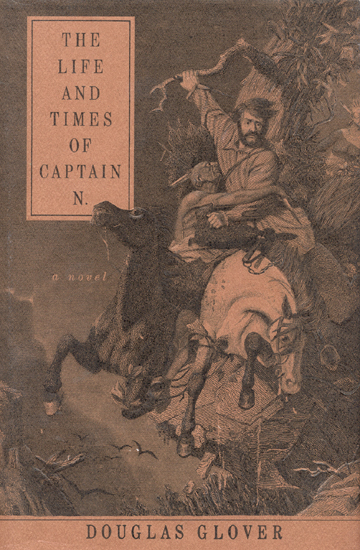
Original Alfred A. Knopf edition.

.

Becoming is an antimemory. Deleuze and Guattari, A Thousand Plateaus 294

I am against the future. Hendrick “Dutch Henry” Nellis, The Scourge of Schoharie, 1779[1]

.

How does one write a book about Indians?  This is one of Oskar Nellis’s dilemmas in The Life and Times of Captain N.  Douglas Glover’s dilemma: How does one write a book about history?  My dilemma: How does one write an academic essay about The Life and Times of Captain N. and A Thousand Plateaus, two texts that seek liberation from linear structures of thought?  And does the problem of writing about Indians and History become part of my dilemma also?

But when one writes, the only question is which other machine the literary machine can be plugged into, must be plugged into in order to work (Deleuze and Guattari 4).

And,

Literature is an assemblage (4).

Can I plug the Glover machine into the Deleuzo-Guattarian machine?  What kind of assemblage will this make?  Will it work?  (“Don’t ask questions you can’t answer”—My advice to undergraduates on writing research essays.  Here I am—breaking the rules.  Sometimes there are only questions . . . leading to more questions . . .)

Oskar thinks he could write a whole book, and there would be nothing in it but questions (Glover 24).

In many ways, A Thousand Plateaus seems antithetical to books about History and Indians.  “Becoming is an antimemory.”  Does this mean Deleuze and Guattari are against the past?  Hendrick Nellis, or Captain N., professes to be “against the future.”  Is this a contradiction, or are they both simply for the present?

“Unlike history,” say Deleuze and Guattari, “becoming cannot be conceptualized in terms of past and future.  Becoming-revolutionary remains indifferent to questions of a future and a past of the revolution” (292).

The present then.  But how shall I plug them all in together?  As Deleuze and Guattari advise,

Writing has nothing to do with signifying.  It has to do with surveying, mapping, even realms that are yet to come (4-5).

And,

[W]rite at n – 1 dimensions.  A system of this kind could be called a rhizome (6).

A rhizome ceaselessly establishes connections between semiotic chains, organizations of power, and circumstances relative to the arts, sciences, and social struggles (7).

There are no points or positions in a rhizome, such as those found in a structure, tree, or root.  There are only lines (8).[2]

Write rhizomatically.  But, I protest, there must be an argument!  There must be a thesis!

The majoritarian argument, then: According to Oskar Nellis, one of the storytellers and protagonists of Douglas Glover’s novel, The Life and Times of Captain N., “Everything is a sign of everything else.”  It is a state of being that causes him to feel “lost in a circular whirl of interchangeability based on masks” (52).  This state of being, or of interchangeability, might more aptly be called a Deleuzo-Guattarian “state of becoming.”  Like Deleuze and Guattari’s conceptualization of identity in terms of “becomings,” Glover’s historical novel articulates a notion of cultural and national identity that privileges indiscernibility, symbolized by the Iroquoian whirlwind masks that figure so prominently in the novel.  This has a direct bearing on the question of History and Indians, for it is by reading Oskar’s book about Indians within the text of The Life and Times of Captain N. that he and his readers become-Indians (which is a fine way of saying we become-everybody/everything).
The minoritarian argument . . . But wait, Deleuze and Guattari object . . . “Flat multiplicities of n dimensions are asignifying and asubjective.  They are designated by indefinite articles, or rather by partitives (some couchgrass, some of a rhizome . . .)” (9).

Fine then . . . some minoritarian arguments: Plug The Life and Times of Captain N. and A Thousand Plateaus into each other.  Make an assemblage.  “Collective assemblages of enunciation function directly within machinic assemblages” (7).  Make a machine, a BwO (a Body without Organs, a Book without Origins).  Create: Lines of Flight.  Planes of Consistency.  Connections:  “and . . . and . . . and ”(25).[3] “[A] line of becoming has neither beginning nor end, departure nor arrival, origin nor destination” (293).  A Becoming-Glover of Deleuze and Guattari and a Becoming-Deleuze-and-Guattari of Glover.  “Each of these becomings brings about the deterritorialization of one term and the reterritorialization of the other” (10).  Is it true?

As Brian Massumi states in his foreword to A Thousand Plateaus, “The question is not: is it true?  But: does it work?  What new thoughts does it make it possible to think?  What new emotions does it make it possible to feel?  What new sensations and perceptions does it open in the body?” (Massumi xv).  Will it work then?

I’m not sure, but the connections are there.  Like Deleuze and Guattari, Glover writes and theorizes the middle, the inbetween space elided by dualism machines.  Binary machines that separate being and nonbeing, self and other, “God and reason,” as well as America (“the rhizomatic West,” for Deleuze and Guattari, “with its Indians without ancestry, its ever-receding limit, its shifting and displaced frontiers” [19]) and “the old country” (Oskar “wondering which old country”—suggesting it doesn’t really matter [112]).  Many of the characters in The Life and Times of Captain N. feel they are, like Nellis himself, “between peoples” (19).  For Deleuze and Guattari, “the only way to get outside the dualisms is to be-between, to pass between, the intermezzo . . .” (277).

“Are you ready to write?” asks Oskar (32). .

.

Becomings.  Becoming-masks.

A becoming is always in the middle; one can only get it by the middle. A becoming is neither one nor two, nor the relation between the two; it is the in-between, the border or line of flight or descent running perpendicular to both. Deleuze and Guattari 293.

The Truth is a Mask & its Signe is Division. It is Nought but what lies between Things. It whirls. Yet I believe that to know It is a kind of Madness & a joyful Relief. Glover 99

.

In A Thousand Plateaus, the concept of becoming is described as “a zone of proximity and indiscernibility, a no-man’s-land” (293), as it were, that is itself the in-between of being and non-being.  When they speak of becoming-girl, becoming-woman, or becoming-animal, Deleuze and Guattari are not advocating an imitation or identification with the other.  Becoming is a notion that they are constantly reinventing, making it difficult to define.  However, several of the ways Deleuze and Guattari describe becoming are suited to a comparison with the articulation of identity in The Life and Times of Captain N.  Becoming is, as the epigraph to this section explains, an “in-between” zone, which is particularly resonant with Hendrick Nellis’ avowal in the novel that he is “between peoples” (Glover 19).  Deleuze and Guattari explain that becoming is to extract particles between which one establishes the relations of movement and rest, speed and slowness that are closest to what one is becoming, and through which one becomes.  This is the sense in which becoming is a process of desire.  (272)

Becoming is a “process of desire” through which one becomes-other, abandoning one’s major identity with “state[s] of domination” to be “deterritorialized,” to communicate with the other (291).  As Elizabeth Grosz explains, becomings “always involve a substantial remaking of the subject, a major risk to the subject’s integration and social functioning” (174).

In The Life and Times of Captain N., being “between peoples” means being a split subject, risking one’s subjective integrity, as well as one’s social, national, or cultural identity.  There are times when Hendrick Nellis’ philosophy reads like a section from A Thousand Plateaus.  When he reflects on the attitudes of those people who cross cultures with ease, Nellis echoes Deleuze and Guattari’s emphasis on becoming as a no-man’s-land, and as “a process of desire”:

In the no-man’s-land between peoples, languages, and customs, there is no custom, only naked desire and misunderstanding.  It is a childlike state, full of violent experiment—when I think of this I am reminded of the mask of the Whirlwind.  Once they have gone there, few ever return.  (80-81)

For the characters in The Life and Times of Captain N., Iroquoian masks are a sign of the often chaotic and confusing process of becoming-other.  It is, as Nellis observes, a violent state, potentially leading to “misunderstanding,” a risk to the stability of one’s identity.  Yet being-between is also the only state or process that allows one to enter into a relationship of mutuality with the other, to become-everybody/everything, to be redeemed.
By “becoming-masks” the characters of Life and Times lose all sense of stable national, cultural or gendered identities.  The Whirlwind mask, also called the mask of the Split-face god conveys this most effectively.  Ethnologist William N. Fenton translates the name of the mask as “He Whose Body is Riven in Twain.”  He explains that “his body is half human and half supernatural; hence his face is divided between deep red and pure black, symbolizing the east and the west, and he is free to wander at large even among the people” (Fenton 16).  As a being that is between life and death, the Split-face god is particularly suited to signifying becoming as a process of being-between.  (In photos he looks quite gleeful about this, as if he knows something we don’t).  In the zone of “in-betweenness,” the characters of the novel enter the whirlwind of indiscernibility where identity is turned upside down.

Many of the First Nations characters in the novel embody this state of being-between.  The “Black Minqua sorcerer,” Crow, paints his face like the Whirlwind; Hendrick Nellis takes the painting to mean, “he is half-spirit and half-human, half-dead and half-alive,” and hence “a medium for the magical forces of the forest, a messenger from the Land of the Dead” (43).  Oskar’s friend, Tom Wopat, who is “half-Savage” according to Oskar (14), is a maker of masks.[4] He is also a “down-fended Boy,” which Oskar tells us is “an ancient custom” of keeping a child thought to be “werrie powerful in Magic” (123).  It is a sign of his ability to live “between Worlds” (123).  Tom is also able to live in the space between dreams and the real.  As a “pawaganak” who appears in the dreams of Mary Hunsacker, Tom is “a manido or person who spoke to the Indians in their sleep” (90).  For Oskar, Tom is often the spokesperson for becoming-other as an experience that allows one to be renewed or redeemed.  Tom tells him that “we will be made new only when we learn to speak the language we cannot understand” (120).  This leads Oskar to wonder if this means “that difference itself is sacred?  That my savior is the other, whoever he is?”  (120).  As one of the characters who are “between peoples” (19), Tom understands that embracing difference enables one to gain new perspectives, to think new thoughts, feel new emotions, and open new sensations in the body.

Mary Hunsacker is one white character who learns to live “between peoples” after she is captured by the Mississauga Indians and adopted by them.  Mary’s process of becoming-Indian is inscribed with violence; when Scattering Light, one of the Mississauga, clubs her over the head with his death maul, Mary suffers a headache that is quite literally a splitting headache. She explains that the bruising that results from her injury turns her face into “a mask, which nevertheless seemed strangely familiar to me”(26).  Such physical pain is often a sign of the cultural in-betweenness that characters like Mary, Hendrick and Oskar experience.  Mary senses that her “mask of pain” hides a person she does not know inside (37), signifying the fluidity of her identity, as well as the potential for discomfort that this risk to one’s subjectivity involves.

As she becomes more comfortable with the Mississauga language and culture, Mary learns the skills of wabeno magic under the tutelage of Wabanooqua.  This occurs after a doctor for the King’s Regiment places a silver plate in her head, an operation that almost kills her and therefore increases her sense that she lives between the two worlds of life and death.  She describes her new subjectivity as a “strange state between being born and giving birth” (73).  Mary’s position enables her to be more accepting of ambivalence and in-betweenness.  As she explains,

You could never tell what a thing really was.  The world was full of shapeshifters and talking rocks and words that had souls.  I myself was both what I was and something more on account of that silver plate in my head, my dream, and my song.  (117)

Mary experiences her subjectivity as “something more” than her identity as a white woman colonist.[5]  As she later recalls, “The world had turned itself upside down for me.  I was an Indian, though pale, and a white woman, though I spoke and walked like an Indian” (125).  Mary feels that her ability to live between two worlds makes her “a machine for translation” (141).  As such, she functions as a “machine for becoming” for others.[6]  For Mary, becoming-Indian is a kind of becoming-minoritarian.  As Deleuze and Guattari explain, this is necessary since “only a minority is capable of serving as the active medium of becoming” (291).[7]
In many ways, Hendrick Nellis is the most outspoken advocate of becoming-Indian as a means of redemption.  He is also one of the most ambiguous characters in the novel.  As Glover remarks, “Nellis isn’t a liberal.  He’s no improver.  He has already rejected history and the future.  He’s a tragic hero, an Old Testament patriarch.  And his words are a kind of prophecy” (Yanofsky 14).  A self-appointed redeemer of whites captured by Indians, Nellis seems to be a paradoxical proponent of becoming-Indian.  He is a Tory and a loyalist, a captain in the King’s Regiment, yet it would seem he eventually comes to feel no real sense of allegiance to either side in the American Revolution.  For Nellis, war is a “species of conversation” more than a political conflict (17).  “The main effort for any man on the frontier” he suggests, “is the effort to understand the messages” (17).  Nellis interprets the messages as questions:  “Why am I here?  Who is the other?  What is he saying?”  (17).

According to Nellis, the American Revolution turns the world and people upside down: “I do not know if we are sane or insane, the world is so topsy-turvy.  The war is like a whirlwind, and the structures of our lives (army, Indian, colonist) have been upended” (79).[8]  Like Mary, Nellis suffers from headaches that cause him to feel “split in two,” and his physical symptoms are similar to the effect of the Whirlwind mask (81).  “The right side is on fire,” he explains, “and the left is in shadow” (81).  Like his face, Nellis’s subjectivity is split:  “What I believe is that I am split (we are all split) between what we dream (Indian) and what we fear is true (white)” (106).  In his “Address to Pilgrims,” Nellis preaches a doctrine that is founded on loving difference, and in which becoming-Indian is, like the Deleuzo-Guattarian notion of becoming, about entering into a relationship of proximity to the other:

Once I said that becoming an Indian was like unto entering a swarming madness, but it might redeem you.  I mean going out of yourself, abandoning the structure of mind which is peculiarly white, entering that area where, because it is neither one nor the other, you are nothing.  (173)

For Nellis, becoming-Indian is about relinquishing one’s identity with the majority and its domination over other minoritarian identities.  This is also important for Deleuze and Guattari: “Woman: we all have to become that, whether we are male or female.  Non-white: we all have to become that, whether we are white, yellow, or black” (470).  Moreover, it is not a question of identifying as either white or Indian, but of being comfortable with being somewhere in-between.  Nellis describes the process of becoming-other as one that ends with becoming-nothing.  His own madness and his belief that his brain enters a “process of disintegration” influence this idea when he settles in Canada (173).[9]  He is not fearful of this process; as he says, “I am against the future.  But I firmly believe that out of the collapse of everything something new arises” (182).

Similarly, for Deleuze and Guattari, the goal of all becomings is becoming-imperceptible.  “The imperceptible is the immanent end of becoming, its cosmic formula” (279).  Becomings move in “molecular segment[s]” that begin with becoming-woman and that are all “rushing toward” becoming-imperceptible (279).[10]  What becoming-imperceptible means is “to be like everybody else” (279), just as for Nellis it means, “entering that area where, because it is neither one nor the other, you are nothing” (173).  As Deleuze and Guattari explain:

Such is the link between imperceptibility, indiscernibility and impersonality—the three virtues.  To reduce oneself to an abstract line, a trait, in order to find one’s zone of indiscernibility with other traits, and in this way enter the haecceity and impersonality of the creator.  One is then like grass: one has made the world, everybody/everything, into a becoming, because one has made a necessarily communicating world, because one has suppressed in oneself everything that prevents us from slipping between things and growing in the midst of things.  (280)

There is, then, a redemptive quality in becoming-indiscernible.  While it does not necessarily erase difference, it does enable “a communicating world” open to slippages between different things, where, as Nellis suggests, we can attempt to understand the messages of the other.  As Oskar explains, Nellis regards becoming-Indian as redemption, as a process that opens one up to greater potentials for life and love of difference.  Nellis teaches his son that “for a White Man to become an Indian is like entering a swarming Madness.  Becoming an Indian is difficult as knowing the Truth or becoming a Child agin [sic].  But it might redeem you” (100).  Lunacy, Oskar explains, effects “a breach in . . . understanding which allows a new perspective” (180).  Neither this nor that, but in-between.

For Deleuze and Guattari, becomings are also redemptive, because they “rend” us from a “major identity” (291).  This is why the subject must always pass through becoming-woman first:

In this sense women, children, but also animals, plants, and molecules, are minoritarian.  It is perhaps the special situation of women in relation to the man-standard that accounts for the fact that becomings, being minoritarian, always pass through a becoming-woman. . . . In a way, the subject in a becoming is always “man,” but only when he enters a becoming-minoritarian that rends him from his major identity.  (291)

For Nellis’s son Oskar, the Iroquois are the other, the molecular minoritarian segment he must pass through in order to “rend” himself from “his major identity.”  In words that sound uncannily like Deleuze and Guattari’s, Oskar explains his relationship to the Iroquois:

Difference is their primary characteristic.  It envelops them in a luminous sheath.  They seem marvelous, more real than real.  They become everything that is not familiar, expected, and routine.  They become the mystic other, the female, the child, and the self, which I glimpse only fleetingly.  (66)

Yet Oskar’s attempts at becoming-Indian are often suspect.  When he shaves his head and wears a scalp lock or “practices walking like an Indian,” Oskar claims that “the world looks different” (101).  However, Nellis regards his son’s becoming-Indian as an imitation grounded on “naïveté and false bravado” (119).  Oskar seems incapable of distinguishing between becoming-Indian and “going-Indian” (a difference that is grounded in sincerity).  This may have something to do with Oskar’s attitude towards the Indian and the fact that he has not yet learned to embrace difference, to follow his father’s “11th Commandment,” which is “Love difference” (173).[11]  As he writes in one of his letters to General Washington: “This War has turned my Brain upside down.  That wch I loved I hate & that wch I oncet hated I love.  Such Inconstancy is a Sin” (137).  Mary, however, believes that

Under his clothes, Oskar was half-Indian.  Except when he was writing things down (he collected facts like butterflies, pinning them to the pages, dead) . . . He had an affinity for the edges of civilization—people at the edge are always closer to the other, more tolerant of difference; this tolerance brands them as sinful; it is a brand and a badge. (165-6)

Strangely, it is only after he has entered into the process of writing the book about Indians (and failed) that Oskar is able to relinquish the desire to master his subjects and truly come to “love difference.”  This is when he learns that becoming-other is not, as Deleuze and Guattari warn, about imitation and identification.  As Mary points out, he must recognize that he is “half-Indian” underneath his clothes, in his heart rather than by imitation.  He must not “go-Indian” but become-Indian, with sincerity and a desire to create a communicating world.  One must be aware, as Oskar says, “In Life, we should not pretend lest We lose ourselves & become that wch we pretend to be.  When you wear a Mask, you become the Mask” (185).  This does not mean one should not do it, however.  Oskar follows his warning with the admission that he is “haunted” by his father’s words: “But it might redeem you” (185).

“No longer white or Indian, what might we become?”  (Glover 180).  “Nomads” is one possibility that Glover, Deleuze and Guattari might all agree on because, as Deleuze and Guattari suggest, “The life of the nomad is the intermezzo” (380).  For Glover, being “a nomad, an expatriate, and a wandering Canadian” is part of his process of becoming-writer (Yanofsky 15).  Nomads are always becoming. .

.

The Book.  The Book About Indians..

[C]ontrary to a deeply rooted belief, the book is not an image of the world.  It forms a rhizome with the world, there is an aparallel evolution of the book and the world; the book assures the deterritorialization of the world, but the world effects a reterritorialization of the book, which in turn deterritorializes itself in the world (if it is capable, if it can). Deleuze and Guattari 11

. By recording facts, the book separates the world of facts from the flow of memory, from individual consciousness, from poetry.

This is Oskar’s dilemma throughout the novel.  He writes to knit up the tear in his life, but the thing keeps unravelling again behind him.  At the moment of writing, though, he feels better.  So the book remains a mystery, even to us.  It is an impossible object.  It both condemns and redeems us. Glover, Interview with Yanofsky 14

.

For Deleuze and Guattari, books are not reflections or representations that simply mirror life or the world.  By suggesting that the book “forms a rhizome with the world,” Deleuze and Guattari rescue it from arborescent structures that limit how we understand the relationship between the two.  The book engages with the world and the world engages with the book; this engagement has the potential to “deterritorialize” but also to “reterritorialize” each, meaning they can have a liberatory, but also a mutually confining, relationship.

Glover understands the book in a similar way.  For him, the book has a relationship to the world, the “world of facts,” that is similar to the Deleuzo-Guattarian idea of the book.  He explains the dilemma of Oskar, whose Book about Indians often frames or directs the other narratives of The Life and Times of Captain N., as one that is involved in negotiating this relationship between the world and the book.  Oskar’s writing is an attempt to “knit up the tear” between the two—to “deterritorialize” them—but his attempts are often thwarted by the tendency to “reterritorialize.”  As Glover puts it, “the thing keeps unravelling again behind him.”  Oskar’s desire to connect the world and the book may be impossible, but as Glover suggests, the attempt makes him “feel better.”  When he suggests that the book “both condemns and redeems us,” Glover seems to be embracing the ambivalence of its potential to deterritorialize and reterritorialize ad infinitum.

Oskar’s compulsion to write is often a response to the “call to battle” of his teacher, the humpbacked dwarf, Witcacy (31).  “Are you ready?  he shouts. Are you ready to write?  Are you ready to tell the truth?”  (32).  But as much as Oskar may seek to tell the truth, his Book about Indians is constantly unravelling and undoing itself.  As he later confesses, “the book about Indians is not (a) a book or (b) about Indians.  It is about Indians tangentially.  And it is incomplete and unorganized, sheaves of notes sewn with a thread, scattered about” (65).  As Oskar comes to recognize, the reason his book about Indians is not a book about Indians has to do with his understanding of history, which changes when he compares the history of literate cultures to the dreams, myths and legends of native oral cultures.  “Scholars of savage lore err in concluding that the native myths and legends are a primitive form of history” he observes.  “They are nothing like history, which is an hypothesis about past events, cast in terms of cause and effect, based on evidence and stretching further and further back in time” (82-3).  It is the very act of writing a book about Indians that destroys them because writing is antithetical to the oral nature of their culture.  As Oskar observes, “the savages are fading now because they are being written—by writing this book, I erase any number of those creatures which I hold most dear, my subjects.  The real challenge, the hardest thing of all, is to write a book about Indians” (83).

The difference, as Oskar comes to realize, has to do with the relationship the two cultures have to the present.  “Savages dream in order to remember; we write in order to forget” (83).  While the Western notion of history follows what Deleuze and Guattari would call a linear or “punctual system,” the function of dreams in an oral culture is closer to the Deleuzo-Guattarian notion of “becoming” in relation to time and the past.  Deleuze and Guattari state that “Creations are like mutant abstract lines that have detached themselves from the task of representing a world, precisely because they assemble a new type of reality that history can only recontain or relocate in punctual systems” (296).  As Oskar discovers, “By writing history down, we try to extend the explanation of the present deep into the past.  But the savage, in his dreams, seeks to extend the present laterally, as it were, across the axis of time” (Glover 83).  The dream has a more creative relationship to time; by “detaching itself from the task of representing a world,” the dream (and the Indian) can assemble “a new type of reality” in a manner history cannot.

As Oskar comes to have greater respect for the native oral culture, his book becomes “an antibook”:

The book about Indians can’t be a book at all.  (As a book, I agree, it’s a mess, no substitute for all the histories, geographies, anthropologies, and novels that will one day illuminate the subject of Indians.)  It is a song, a hymn, a keen, a cry of mourning and condolence.  It is a recitation of names, a string of masks, a prayer.  It is a break, a rupture in the whole cloth of normal discourse.  It is an antibook meant to destroy all books.  It is pure ritual, mumbo jumbo, words of power, a spell—not to be read as a book at all, but to be incanted over and over until it infects the soul, until the words pierce the skull and suck out the brain, until the brain is turned upside down.  (121)

Oskar’s book becomes an antibook once he ceases to understand history in the traditional sense of literate culture and embraces the native way of being in the present.[12] “Part of the difficulty of writing a book (first impossible project) about Indians (second impossible project) is that the Indians themselves do not recognize our distinction between knowing and being.  What they know or say or remember about themselves they are” (109).  As Oskar says, “The book about Indians is against the being of Indians” because “the Indians believe that by telling the stories they are.  They exist in the telling of stories, the singing of songs, the dancing of dances” (109).

Oskar’s book about Indians becomes an anti-book at the moment when he too ceases to distinguish between being and knowing, which becomes possible only when “the brain is turned upside down,” allowing for the potentialities of a new perspective.  His book becomes an act—“a song, a hymn, a keen, a cry of mourning and condolence”—when Oskar relinquishes his need to write a history and to control the subjects of that history.  Most importantly, as it becomes an anti-book, it becomes, like A Thousand Plateaus, a book that enacts a becoming.  “If you read the book the correct way,” Oskar advises, “you will become an Indian (that is what I intend; that is the purpose of all books that are not books)” (121).  As Deleuze and Guattari explain, creative pursuits such as “Singing or composing, painting, writing have no other aim:  [but] to unleash these becomings” (272). .

.

Some Conclusions: History and Nomadology.  War and Love..

What counts is that love itself is a war machine endowed with strange and somewhat terrifying powers. Deleuze and Guattari 278.

The War has taught me a Grammar of Love.  We—Rebels & Tories & Whites & Indians—are having a violent Debate whose Subject is the Human Heart, its constituent Elements & Humors, its hidden Paths.  This is a Mystery.  The Effect of the Argument, the Structure of its Thought, is a curious Splitting or Splintering. Glover 162

.

History and Nomadology, War and Love: such binaries seem out of place in an essay that wants to be undoing dualism machines.  However, as Deleuze and Guattari tell us, “We invoke one dualism only in order to challenge another.  We employ a dualism of models only in order to arrive at a process that challenges all models” (20).  It is when these dualisms collide that the whirlwind is created; the brain is turned upside down.

[O]nly nomads have absolute movement, in other words, speed; vortical or swirling movement is an essential feature of their war machine (Deleuze and Guattari 381).

Deleuze and Guattari themselves are guilty of opposing History to Nomadology when they write, “History is always written from the sedentary point of view and in the name of a unitary State apparatus, at least a possible one, even when the topic is nomads.  What is lacking is a Nomadology, the opposite of a history” (23).

I think what Glover attempts to do in The Life and Times of Captain N. is to write a novel that is between History and Nomadology, one for which he, as a half-Canadian, half-American “nomad” is particularly well-suited to write.  As he explains,

I’m a nomad, an expatriate, a wandering Canadian (which is worse than just being a Canadian, I am doubly displaced, a Canadian squared), and I can no longer tell whether that’s because I am a writer or why I am a writer.  Some mornings I wake up and it’s a problem.  Some mornings I wake up and it’s a dance. (Yanofsky 15)

Glover’s novel is in-between history and fiction;[13] he creates a space in which dualisms collide, creates a whirlwind, a rhizome that turns North America upside down.

Of course it [America] is not immune from domination by trees or the search for roots.  This is evident even in the literature, in the quest for a national identity and even for a European ancestry or genealogy (Deleuze and Guattari 19).

Glover thwarts this “domination by trees” by subverting the “quest for a national identity.”  Neither Rebel nor Tory, White nor Indian, American nor British, what might we become?  Canadian nomads?  I am aware that the idea of a “Canadian nomad” seems to contradict my argument about the subversion of national identities.  However, Glover suggests that Canada is a place that embodies in-betweenness very well.  “Canada is a cracked mirror, a splintered psyche,” he explains, “the idea of being against the future and, consequently, somehow outside history is a powerful theme in the discourse of Canadianism” (Yanofsky 15).

I chose the two quotes on love and war for my epigraphs to this section, in which I am attempting to draw some conclusions, because they each connect a “grammar of love” to the terrifying possibilities of a war machine.  “All’s fair in love and war?”  Not quite.  But the “terrifying powers” of war to effect a splitting, a splintering of identity seems to be a creed common to both The Life and Times of Captain N. and A Thousand Plateaus.  And somehow, this “violent debate” that is war becomes, in the whirlwind, in the becoming, a “Grammar of Love.”  Dualisms become each other.  Love itself is a war machine.  Perhaps this is because, as Hendrick tells Mary, “violence has its own strange and perverse beauty—at least it makes you pay attention.  You get to know a man when you’re a-killing him, or he’s a-killing you” (168).

Returning to one of Massumi’s earlier questions—“Does it work?”—I feel some of the anxiety Oskar expressed when he acknowledged the messy state of his book.  My attempt to write rhizomatically has not been entirely successful—this paper is somewhere between a rhizome and a tree.  But perhaps this is the best strategy—a happy accident—for a paper that seeks an in-between space connecting two texts, a paper that is not, in fact, about Indians or History, but about becomings, nomads, wandering expatriates, whirlwind masks, chaos and books that are not books at all.

—Cheryl Cowdy

Notes

1 Douglas Glover, The Life and Times of Captain N., Epigraph ([ix]). [[2]] Deleuze and Guattari oppose rhizomatic to arborescent systems.  While the tree is a linear model that is suggestive of genealogies and origins, rhizomes (such as bulbs and tubers) are founded on principles of multiplicity and alliance.  See the chapter “Introduction: Rhizome,” 3-25.[[2]] 

Works Cited

Deleuze, Gilles and Félix Guattari.  A Thousand Plateaus: Capitalism and Schizophrenia.  Translation and Foreword by Brian Massumi.  Minneapolis: U of Minnesota P, 1987. Fenton, W. N.  Masked Medicine Societies of the Iroquois.  Ohsweken, Ontario: Iroqfrafts Reprints, 1984. Glover, Douglas.  The Life and Times of Captain N.  Toronto: McClelland and Stewart, 1993. Grosz, Elizabeth.  Volatile Bodies: Toward a Corporeal Feminism.  Bloomington and Indianapolis: Indiana UP, 1994. Yanofsky, Joel.  “A Feeling for History.”  Interview with Douglas Glover.  Books In Canada 23:1 (February 1994): 13-15.

.
.

Footnotes    (↵ returns to text)

  1. Douglas Glover, The Life and Times of Captain N., Epigraph ([ix]).
  2. Deleuze and Guattari oppose rhizomatic to arborescent systems.  While the tree is a linear model that is suggestive of genealogies and origins, rhizomes (such as bulbs and tubers) are founded on principles of multiplicity and alliance.  See the chapter “Introduction: Rhizome,” 3-25.
  3. “Principles of connection and heterogeneity: any point of a rhizome can be connected to anything other, and must be.  This is very different from the tree or root, which plots a point, fixes an order” (Deleuze and Guattari 7).
  4. Oskar observes that one of Tom’s masks “looks suspiciously like a Continental soldier,” indicating that the masks themselves are capable of becoming-other, of being influenced by cultural exchanges (51).
  5. In his interview with Joel Yanofsky, Glover suggests that Mary demonstrates how “underclass whites and especially white women along the frontier in North America were close enough to their oral past that they often found the Native culture not so very alien.  This is borne out,” Glover adds, “in statistical studies of captivity and acculturation” (14).
  6. Deleuze and Guattari suggest that girls and children are particularly suited to becomings because they “draw their strength from the becoming-molecular they cause to pass between sexes and ages, the becoming-child of the adult as well as of the child, the becoming-woman of the man as well as of the woman” (277).  They seem to represent a more provisional status than other segments of becoming.
  7. Deleuze and Guattari explain that becomings “imply two simultaneous movements, one by which a term (the subject) is withdrawn from the majority, and another by which a term (the medium or agent) rises up from the minority” (291).  There is, therefore, no “becoming-man” because “all becoming is a becoming-minoritarian” (291).
  8. Deleuze and Guattari suggest that “Learning to undo things, and to undo oneself, is proper to the war machine: the ‘not doing’ of the warrior, the undoing of the subject” (400).
  9. Nellis’s disintegration as a subject is also conveyed by a dream he has of making love to the decomposing corpse of his former wife (61).  Canada seems to be a fitting place for Nellis’s process of disintegration to occur since he regards it as an “imitation country” (153), a place that is in-between the dichotomy of British colonialism and American republicanism created by the Revolution.
  10. Deleuze and Guattari identify “an apparent progression” of segments of becoming:  “becoming-woman, becoming-child; becoming-animal, -vegetable, or –mineral; becomings molecular of all kinds, becomings-particles”(272).  Yet they also say, “all becomings are already molecular” which means, “In a way, we must start at the end” (272).
  11. Glover refers to Nellis’s “Address to Pilgrims” and the injunction to “Love difference” as “the Law, the 11thCommandment” that Nellis is able to give because he inhabits a “rhetorical position of loss” (Yanofsky 15).
  12. Oskar demonstrates his rejection of Western philosophical traditions, as well as the emerging principles of the American revolution later, when he states, “I do not believe in God (old Europe, the King, loyalty, and authority) or reason (Locke’s blank slate, history, atoms, laws, freedom, and democracy)” (158).
  13. In his Author’s Note, Glover jokes that the “descendants and relatives on both sides of the border” of the people whose lives his novel is based on will “find much to complain of” ([xi]).
Nov 012011
 

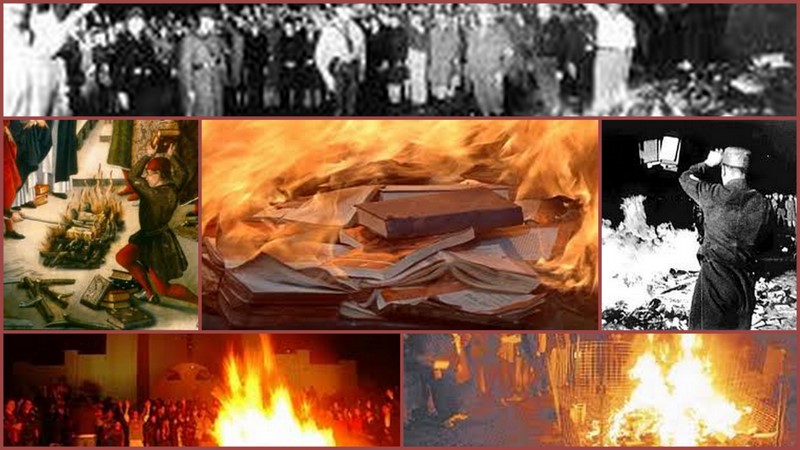
Herewith a brilliant, provocative, obstreperous essay outlining ten reasons why we should burn books. Yes, yes, this seems vaguely counter-intuitive, Numéro Cinq being a literary magazine and all. But two things need to be said at the outset. First, book burning and books, together, have always been the signal marks of an emerging modernity. They co-exist as sign and substance of the new. This is why, of course, there is a book burning in Don Quixote; Cervantes had his finger on the pulse. In my book The Enamoured Knight, I make a side argument that, in fact, book burning is one of a “basket” of themes that supply the discourse of the novel as a form. And, second, inversion is perhaps the most elegant of rhetorical devices; instead of arguing (tediously and correctly) for the right, you take the opposite view and find occasions for wit, comedy, and trenchant critical thought. In this case, our author, Noah Gataveckas, uses inversion, his own wide reading, and a radical logic born of Jacques Lacan and Slavoj Žižek to mine the contemporary chaos of our late literate age and say very smart and inflammatory things (which is the point, right?).

Noah was born in Oakville, Ontario, in 1985, and educated at Acadia University in Wolfville, Nova Scotia. After moving to Toronto to work as a DJ in the entertainment district, he rediscovered his love of reading and writing. He is the author of poetry (“Silence”, “The King of the River”), journalism (“Hijacked: The Posthumous Reinscription of a Socialist in Canadian Consciousness”, “Digital Theft in a Digital World”), polemic (“Why Occupy? An Approach to Finance Capital”), theatre (Five Star), and a book-in-progress entitled Symposium: A Philosophical Mash-up. He lives and works in Toronto.

dg


Why do we burn books? or,

The burning question of our movement

 By Noah R. Gataveckas


Prologue

 The “we” in question refers specifically to the Angry Young Readers Anonymous (AYRA) book club. You know who you are; you know what’s at stake. In order to commemorate our one-year anniversary of successful self-pedagogy, we have dared to consider the inconsiderate: a quaint little book burning, with drinks and snacks being served around 8. This has – understandably – unnerved some of us. After all, Hitler. Enough said. So, to help us understand why we are doing this, I have prepared a list of ten possible reasons why one might justifiably “commit it then to the flames”, as David Hume once put it.[1] Be aware that they are inconsistent: that is, at least one reason presumes some form of spirituality (3), while others are specifically atheistic (4 and 7), and so on. We don’t need to have the same reasons; de gustibus non est disputandum. This is just a compendium of some of the answers that have been given over the years to explain why some books got fired.

(1)   Kill what you love.

We bookclubers—we love books. Do we not? Why oh why are we setting (some of) them on fire when they’re what we’re about?

After all, we more than most people should see their value: think of the many excellent texts that we’ve had a chance to read and discuss this past year, and how these readings and conversations have enriched our lives. Starting with Findley’s The Wars, including Horkheimer and Adorno, Žižek, “Junkspace”, Reality Hunger, Chinua Achebe, To the Lighthouse, Baudrillard, Ondaatje, “The World as Phantom and as Matrix”, Serge Guilbaut, “Politics and the English Language”, The Wretched of the Earth, Melville, The Master and Margarita, Chekhov, Dylan Thomas, Octavio Paz, McLuhan, and so many other texts that I can’t even remember, we’ve learned a hell of a lot this year from books.

Furthermore, they have provided us with the grounds for having excellent conversations. We have applied Marxist, Freudian, Lacanian, Žižekian, etc., theories to them in our efforts to maximize our minds. Note that theories apply to their texts like bees to blossoms: once pollinated, they bloom with mucho meanings, full of information and insight. This literary entomophily has rewarded us, nudging us ever closer to Enlightenment.

So how can we turn our backs on them now? They’ve been so generous to us in the past. Why oh why burn books?

Continue reading »

Footnotes    (↵ returns to text)

  1. An Enquiry Concerning Human Understanding, ed. L. A. Selby-Bigge (Commons), ch. XII.
Oct 312011
 

Eric FoleyEric Foley

Here’s a lovely, sad Childhood essay by Eric Foley. It’s a meditation on presence and absence, the presence of his sister growing up in Toronto and her sudden death, at the age of 14. It’s a meditation on photography and the strange way photographs carry the mark of absence, of love and loss, even as they record (in snapshots, sometimes double-exposed or damaged) the apparent trivia of family life. What’s the difference between life and a photograph? And what is the meaning of those ghostly images of loved ones now gone? Eric Foley has been a finalist for the Random House Creative Writing Award, the Hart House Literary Contest, and winner of Geist Magazine and the White Wall Review’s postcard story contests. Eric currently attends Guelph University’s Creative Writing MFA program (last summer, he was a student of mine in Guelph’s mentorship program), where he is at work on his first novel, and a memoir about living in Morocco. His poetry and criticism can be found online at influencysalon.ca.

dg

Foley1

/

In photography, exhibition value begins to displace cult value all along the line. But cult value does not give way without resistance. It retires into an ultimate retrenchment: the human countenance. The cult of remembrance of loved ones, absent or dead, offers a last refuse for the cult value of the picture. For the last time the aura emanates from the early photographs in the fleeting expression of a human face. This is what constitutes their melancholy, incomparable beauty. But as man withdraws from the photographic image, the exhibition value for the first time shows its superiority to the ritual value. To have pinpointed this new stage constitutes the incomparable significance of [the photographer Eugène] Atget, who, around 1900, took photographs of deserted Paris streets. It has quite justly been said of him that he photographed them like scenes of crime. The scene of a crime, too, is deserted; it is photographed for the purpose of establishing evidence. With Atget, photographs become standard evidence for historical occurrences, and acquire a hidden political significance. They demand a specific kind of approach; free-floating contemplation is not appropriate to them. They stir the viewer; he feels challenged by them in a new way. At the same time picture magazines begin to put up signposts for him, right ones or wrong ones, no matter. For the first time, captions have become obligatory. —Walter Benjamin

The above quotation is from Walter Benjamin’s famous essay “The Work of Art in the Age of Mechanical Reproduction.” By cult value, Benjamin is referring to the private, ceremonial, spiritual status of the art object, where what matters most is the object’s existence, rather than it being constantly on view. The photograph in the family album or the musty cardboard box in the attic, rather than the framed print on the (facebook) wall. Writing in the 1930’s, Benjamin saw photography and film as “the most serviceable exemplifications” of a new function of art where “absolute emphasis” was placed on the exhibition value of the work. I’m interested in the tension that exists between cult value and exhibition value in relation to photographs taken prior to the existence of the digital realm for essentially private family albums. What happens to these images when they are scanned and disseminated online, for all to see? Who today would allow a picture of themselves to be taken (or to remain undeleted on a camera), without imagining its appearance on Facebook?

As I came to try and make a narrative out of a series of the most resonant photographs from my childhood, perhaps it is no surprise that I kept returning Benjamin, who, in the end, inspired me to use this narrative not only to narrate but also to essay, to attempt to think about the nature of photographs and their use within a family. Here then are a series of the pictures that still obsess me, an album of images for which I “have not yet found the law,” with obligatory captions (right ones or wrong ones, no matter).

.
November 16, 1979

An image is not a permanent referent for those complexities of life which are revealed through it; its purpose is not to make us perceive meaning, but to create a special perception of the object – it creates a vision of the object instead of serving as a means of knowing it. – Victor Shklovsky, “Art as Technique”

Foley2

By a chance double exposure, the first picture taken of me, less than one hour old in my mother’s arms, also contains the last picture taken of her before she became a mother. In the ghosted image snapped one day earlier, she sits with her hands on her lap, hands that push through time to rest on my newborn head. Of course, I’m also in her stomach in that fainter image, more than a week overdue.

.

.
Eleven Days Old

One of the—often unspoken—objections to photography: that it is impossible for the human countenance to be apprehended by a machine. This the sentiment of Delacroix in particular. – Benjamin, The Arcades Project

“Look at the camera!” my parents must have said, voices young, soft, and joyous. “Look at Daddy!” My mother’s robed arm propping me up. What am I looking at? It appears to be an otherworldly orb, a gaseous rupture in the surface of the image, but in fact, this rupture inserted itself along my line of vision several months after the shutter was clicked.

In the spring of 1980 my father went on a canoe trip in with his best friend Joe, bringing along his camera, which contained the undeveloped film from my first months of life. Stepping out of the canoe, my father dropped the bag with the camera into the lake. When the pictures were finally developed, they had this milky, bluish cast, as if light were peeling away the surface of the image. My mother was heartbroken.
.

‘.

Fall, 1980

Over the next several years, my mother would take thousands of pictures, like this one of my father and me in France:

.Or the one that begins this piece, of my brother Andrew and me, which perfectly captures our opposing dispositions. Andrew: carefree, happy-go-lucky, singing away in his own fine world. Me: well, me.

.

103 Glenrose

Hopkins describes these obsessive images of objects as things for which he has not “found the law.” They are unfulfilled in meaning, but take up a lot of room in the memory as if in compensation. They seem both gratuitous and inexplicably necessary. – Charles Baxter.

I grew up in Toronto, in a three-story brick house surrounded by oak trees and lilac bushes. A beer commercial had been shot on the property a month before my parents bought it, and for the first few years we lived there, we would gather around the TV excitedly whenever the ad came on to watch three sweaty, blue-jeaned men kick back on our porch with a couple of cold ones.

Jumping through that first-floor window and reversing the camera angle, we can travel ahead seven years in time, to where I sit poised at our newly acquired 1906 Steinway Grand, my father’s dream-come-true..
“Put your hands out like you’re about to play,” my mother instructed, “and look over at me.” So I did. To take this picture, my mother would have had to stand in the entranceway to our living room, which, if we the reverse the angle again, is approximately here:.

.That piñata was one tough mother. Forty minutes of heavy abuse, and it wasn’t even dented. My friends and I exhausted, their parents due to arrive any moment, my father pulled the piñata down and dumped the candy onto the hardwood floor for us to flail over.

.

Cottage

In making a portrait, it is not a question only…of reproducing, with a mathematical accuracy, the forms and proportions of the individual; it is necessary also, and above all, to grasp and represent, while justifying and embellishing,…the intentions of nature towards the individual. – Gisela Freund, “La Photographie au point de vue sociologique”

I had better luck with these two:


.
.
.

.

.

..

My mother snapped these from opposing angles in the living room of my grandparent’s cottage. The first was taken in the summer of 1987, at my sister Kristen’s third birthday party. The piñata hangs from a long wooden beam that at Christmastime held up to twenty-eight stockings at once. In the second image, you can see one of the stockings in my cousin John’s hands.

This picture was taken a few years earlier, from where the piñatas would later hang:

My parents had seen an ad in the paper for dwarf rabbits, and decided to get us one for Christmas. But by the time they went to pick one up, this monstrous creature was all that was left. It hopped around my grandmother’s carpet leaving a trail of brown pellets. Andrew crawled along behind picking up the pellets and putting them into his mouth, thinking they were chocolate-covered raisins. That spring, I forgot to close lid of the rabbit’s cage and the rabbit escaped. My Dad told us it probably got eaten by raccoons. The body was never found.

.

Speaking of Cages

Consideration of the image is still a sacred cause today only because the fate of thought and liberty are at stake in it. The visible world, the one that is given to us to see: is it liberty or enslavement? – Marie-Jose Mondzian, Image, Icon, Economy: The Byzantine Origins of the Contemporary Imaginary

Two photographs taken thirty years apart. The first is of my mother on vacation with her family in Florida, 1961. The second one shows my sister Kristen with our new dog Tessa.

We used to go on a canoe trip every summer to Algonquin Park, and I always wished Tessa could come, but she was too hyper, my Dad said. He worried that if she spotted a loon she would go crazy, tip the canoe. I was, however, allowed to bring Tessa along in the form of an image of the two of us together on a t-shirt:


.
Rusty

Communications technology reduces the informational merits of painting. At the same time, a new reality unfolds, in the face of which no one can take responsibility for personal decisions. One appeals to the lens. – Benjamin, The Arcades Project
.

My brother’s favorite pet was a hamster named Rusty. Like our rabbit, Rusty also escaped. One day after school Andrew and I were playing floor hockey in our unfinished basement, when Andrew slapped the ball past me into the furnace room. I went in behind the woodpile to retrieve the ball and there was Rusty: trembling, emaciated. He had been missing for five days. Andrew carried him upstairs and tried to feed him, but the animal was too weak to ingest anything. When my father got home he gave Rusty a series of sugar-water infusions, reviving him for three weeks, after which the hamster passed away. “The shock to Rusty’s system must have been too great,” my father explained.

The above photograph was taken for a series of watercolor portraits my mother commissioned her friend Maureen to do (mine of course featured Tessa and me). In the background of the photo below, taken during one of our theme dinners, Andrew and Rusty’s portrait hangs above the mantle between a framed photograph of Kristen and one of me as a toddler standing beside a baguette. Here is evidence that not all the pictures my mother took were intended solely for our family albums (lined up chronologically in the cupboard behind my father’s left shoulder).

If, when she clicked the shutter, my mother happened to capture an image that made her feel a particular warmth within (and she says she always knew it with that initial click, before the film was developed), something to do with natural lighting, composition, the expression on a face she loved, if all of these combined to preserve a moment she wished to keep on seeing, then the image would be enlarged and placed on more permanent display..


.
No House, Hardly a Room

There used to be no house, hardly a room, in which someone had not once died. – Benjamin, “The Storyteller”

Going over these photographs, I think of the spaces they were taken in. What, besides pets, died there? A look? An object? A gesture? An idea?

These pictures were taken to preserve moments now past, but in another way they also constitute my past. As I grew, so did the pile of images that related to me, and I regularly went to that cupboard where the albums were kept and pored over them, using them to build the narrative of who I was, where and what I had come from.

I could always count on my mother to fill the plastic pages of those gilded, leatherbound books thick with photos from each year, forming a canon of accepted family imagery, a pictorial narrative that each of us could access at will (and, for the most part, agree upon).

Let it rescue from oblivion those tumbling ruins, those books, prints and manuscripts which time is devouring, precious things whose form is dissolving and which demand a place in the archives of our memory—it will be thanked and applauded. – Baudelaire, on the proper use of photography

.

Kristen

It is no accident that the portrait was the focal point of early photography. The cult of remembrance of loved ones, absent or dead, offers a last refuge for the cult value of the picture. – Benjamin, The Arcades Project

These pictures of my sister Kristen almost didn’t make it into the canon. They were taken after she had gone into the bathroom, aged three, and given herself a haircut. For years, Andrew and I used these images to tease her. She hated them, wanted them destroyed, at one point even stole them from the family album. I’m surprised they still exist. I’m glad they still exist, because in 1999, at the age of fourteen, Kristen died of meningitis, and our family’s narrative was irrevocably changed. After such an event, every trace of the past gains in significance.


Following Kristen’s death the old canon of images splintered apart, reforming with her at its centre, as my mother disassembled the master albums to make copies of pictures, reassembling them into more than fifty individualized mini-albums for friends and family.

For the last time the aura emanates from the early photographs in the fleeting expression of a human face. This is what constitutes their melancholy, incomparable beauty. – Benjamin, The Arcades Project

There are photographs from that time, still not held in any album, that are crucial to me. One shows my father kneeling in front of Kristen’s open casket, my two-and-a-half-year-old sister Kathryn in his arms in a green dress, sucking on the nub of a glass bottle filled with apple cider. Another is of the cemetery: it has started to rain, and I’ve just opened a burgundy umbrella, which I’m holding high over my mother’s head. My father and I are looking up at that umbrella as it floats above the crowd of relatives and friends. As I look at the picture now, it occurs to me that it is the only image I have of any of these people looking so sad; an uncomfortable thing to behold, but all the more valuable for that. Also: no one is looking into the camera. Their attention is elsewhere.

.

Postscript: Summer, 2002

In the end, we managed to convince our father to let us take Tessa along on a camping trip. She was nearly twelve by this point, her hips going, unlikely to bolt up for a bird or anything else. For the last three days of the trip my father had to carry Tessa, the hair of her hindquarters stained with diarrhea, along the portages. She died not long afterwards, but at least she got to see the Barron Canyon from the belly of a canoe.

The work of art is valuable only in so far as it is vibrated by the reflexes of the future. – André Breton

What reflexes vibrate these photographs? Are they art, or the merely the passing memories of a single family? The above image was taken on the first day of our trip to the Barron Canyon. Andrew and I, now young men, sit behind the stump of the jack pine from Tom Thomson’s iconic painting of Round Lake. The tree has been cut down years before, but a sapling grows from its roots. This picture takes me back to the very first in this series, of my brother and me as children. Many things happened between that earlier photo and this one. Many things happened afterwards, and continue to happen to each of us, every day, and we are all filled with multiple exposures. The hands of time push through to rest upon our heads. A feeling kicks in our stomachs, waiting to be born. But “the true picture of the past flits by,” as Benjamin says, and, at least for now, the images of all those places, times, and events not shared between us will have to remain lost.

.

—Eric Foley

Oct 282011
 

At the Confluence

.

Hurricane Irene did surprising and catastrophic things to Vermont, surprising because, well, Vermont is inland, far from the storm-whipped coasts, far from, say, New Orleans. You don’t get a storm surge in Vermont. But when a storm like Irene hits, all the topographic beauties of the place turn to its detriment. The rain washes straight down the mountainsides into the narrow, deep valleys. Creeks and rivers that were nothing but shallow meanders through deep cobble beds, mostly dry at that time of year, fill up with alarming suddenness. The rivers rage down the valleys, demolishing roads, buildings, towns. Hilary Mullins is an old friend from her days as a student at Vermont College of Fine Arts when she used to hang out in Francois Camoin’s room on the third floor of Noble Hall just down the corridor from dg who also tended to hang out in Francois’ room a lot (it was a hospitable place, a cross between a Paris salon and a homeless shelter). Hilary lives in Bethel, Vermont, where she reads, writes, teaches, sermonizes and runs a window-cleaning business. She was, yes, at home when Hurricane Irene hit, and this is her story—a What It’s Like Living Here essay with a twist. (The photos are a group effort; credits to Janet Hayward Burnham, Dan Thorington, Bill Gibson.)

dg

.

Hurricane Irene—What It Was Like

From Hilary Mullins in Bethel, Vermont

.

Everyone in Bethel knew the hurricane was coming–we knew all about it. We knew the forecasters were saying it could be significant, and we knew why: August had been rainy, and we already had plenty of water in the ground. So we knew we didn’t need any more, particularly not in the quantity that a hurricane might bring. We also knew there was supposed to be high wind. So we stacked our yard chairs, tossed more rounds of wood on the tarps covering our woodpiles, and brought our animals in.

But at first when Irene arrived–not as a hurricane but as a tropical storm–she didn’t seem so significant after all. The rain started Saturday night, and yes, it came steady, but around here, we’ve all seen rain like that before. And we know rain. There’d be some wash-outs, we knew that: roads where the gravel would be eaten and maybe some pavement too. And maybe some people’s houses would be threatened. Because that does happen more often now: a thunder storm hits, leaving a flash flood in one area.

But even though we knew all this, even though we knew the land here is all ridges and river valley, brooks and streams pouring down from everywhere to merge, uniting in the White River that runs through our village, we didn’t know. We didn’t know the power of what was running at the level of our feet–or what could happen if all those little waters—not just some here or there–began to rise. Which on the 28th of August they did.
.

.

Continue reading »

Oct 272011
 

Mamá (2008 Spanish short film) from Pablo Sierra on Vimeo.

/

.In this Halloween edition of Numéro Cinq at the Movies, we have Andres Muschietti’s Mama (2008). Turn the lights out, turn the sound up, put some headsets on, and enjoy.

The plot is simple and yet leaves gobs of story unexplored, haunting the plot we do get: two children are tormented by a terrifying mother; we never find out the origins of this terror and we don’t find out what becomes of the children. This tip of the iceberg approach to storytelling gives the piece a depth that makes it even more terrifying for all the unimaginable horrors we are left to imagine.

What’s scary here is firstly archetypal and secondly uncanny. Mama is the archetypal bad mother that lurks behind the good mother archetype, waiting to consume, torment, and dismember instead of nurture. Like the one daughter, we are drawn to the figure of Mama, because she promises to fulfill the maternal role, but soon we understand their trepidation. This mother is not up for baking cookies.

She’s also uncanny here thanks to a couple of very successful horror techniques. Mama, though human in form and thus familiar, is unfamiliar because of her movements. The head tilted to the side, the contorting, jerking motions of her limbs and the speed of her movements are all unfamiliar. Similar effects were used in the horror film the The Ring when the monstrous young girl climbs out of the television. To achieve this effect they shot the actress in reverse with exaggerated movements so that when they played the footage forward her gestures seemed insect like and inhuman. This is Freud’s Uncanny: both familiar and unfamiliar and disturbing all around.

When this short film came out three years ago it created so much of a buzz that Mexican director Guillermo Del Toro – known for his popular Hellboy type fare and his more art house type horror films like Pan’s Labyrinth – decided to take Muschietti under his producing / mentoring wing and turn the film into a feature-length terror. Del Toro similarly mentored / produced the The Orphanage (2007).

Continue reading »

Oct 252011
 

Blanca Castellón’s poems are starkly honest. Her tenacious pursuit of the unknowable results in work that illuminates a resolute but permeable humanity. Through an intently economic use of language, her writing strikes chords by casting familiar images into new light. With vicious yet softly abstracted lines such as, “Nostalgia brings its thorns to the back of the eye until I am left blind,” I am reminded of the magnetic existentialism of René Char. These wonderful translations come to NC through the extensive work of the poet J.P. Dancing Bear.

Blanca Castellón is a Nicaraguan poet born in Managua. In 2000 she received the International Award from the Institute of Modernists. She is the Vice President of the International Poetry Festival of Granada and the Nicaraguan Writers Association. Her books include, Love of the Spirit (1995), Float (1998), Opposite Shore (2000), and Games of Elisa (2005).

J.P. Dancing Bear is author of nine collections of poetry, his most recent being, Inner Cities of Gulls (Salmon Poetry, 2010). He is the editor of the American Poetry Journal and Dream Horse Press. His next book of poems is Family of Marsupial Centaurs due out from Iris Press. He is the host of Out of Our Minds poetry show for public station KKUP and available through podcast or iTunes.

—Martin Balgach

.
I Walk Directionless and Groping

In this moment, imposed by distance, I remain silent today, looking back to contemplate the city in ruins.

Nostalgia brings its thorns to the back of the eye until I am left blind, groping for the secret seams of the universe where cracks continue to flourish and no one walks, where the missing populate the soft areas of the unconscious.

As if I flung on a dress of uncertainty, stopped in front of my house and recognized myself at once: I no longer watch, my feelings confirmed by the eternal verses:  I WALK DIRECTIONLESS AND  GROPING.

This is nothing but the enduring image that walks with me always and forever.

.

Genuflection

Couch sadness
with your red dress
Lay down in the center of the page
get the attention of seaweed
recognize your knees in the sand.

.

The Dead

The dead distill smoke
and pending matters.

They settle in a crown of arteries,
making home around the heart.

The dead are not
so noble in their rest.

They take advantage of free time
in order to interfere with the living.

Practice smiling
because you have life.

Soon they will turn a key
and release the water in your eyes

and make us all cry.

—Blanca Castellón.

.

.

Oct 242011


Rational thought. Calm, reasonable, gentle persuasion.  It was this quality of moderation in his writing that most impressed me, for my own inclinations tended toward the opposite, the impatient, the radical, the violent.

That’s how Edward Abbey described Joseph Wood Krutch in an essay that appeared initially in the journal Sage and then featured in Abbey’s 1988 collection One Life at a Time, Please. The piece, called simply “Mr. Krutch” (that’s “krootch” if you’re reading aloud), recounts Abbey’s 1967 interview of Krutch—the last formal interview the latter granted before his death in 1970. The circumstances and content of the interview say much about both men: it took place in the desert burg of Tucson, it resulted from Krutch’s acceptance of Abbey’s simple cold call (Abbey admits to having simply looked up the well-known Krutch in the phone book), and it features a palpable tension as then-debutant Abbey tries to direct the conversation but is instead led along by Krutch.  It’s an excellent read.

Abbey, of course (as described in an earlier installment of this series), is known for his passionate defense of and writing about the desert.  Krutch, perhaps exactly because of that more “reasonable” voice, is far less well known—he is probably the least recognized name among those profiled here—but he also comes to mind mostly because of his desert writings.  That late 60’s interview brought together two men with similar loves at the very moment the environmental movement was in the midst of legislatively changing the world. It is a pivot point on the environmental timeline.

Moving forward, Abbey would publish Desert Solitaire less than a year later in 1968. Within two years, Edward Hoagland and Wendell Berry would be on the scene, the Clean Air and Environmental Policy Acts would become law, the elder desert sage would publish his life compendium, The Best Nature Writing of Joseph Wood Krutch, and Krutch would die, just two months after the first Earth Day. Moving backward, Krutch published books contemporaneously with Loren Eiseley (whom Krutch admires specifically in the Abbey interview), Rachel Carson, and Peter Mathiessen. Krutch was born in 1893 (the only major mid-century writer to see the turn of the last century), and in fact his writing should have been contemporary to Aldo Leopold (born in 1887), except that Krutch came to nature writing quite late.

Krutch began his writing career as a theater critic and professor at Columbia University.  He wrote biographies of Edgar Allen Poe (1926), Samuel Johnson (1944), and–who else–Thoreau (1948), as well as a book-length thesis critical of science and technology (The Modern Temper, 1929).  The Thoreau book, initially just another biography project, made Krutch take a closer look at environmental topics.  This is from his 1962 autobiography More Lives Than One:

One winter night shortly after I had finished Thoreau I was reading a “nature essay” which pleased me greatly and it suddenly occurred to me for the first time to wonder if I could do something of the sort. I cast about for a subject and decided upon the most conventional of all, namely Spring.

That first essay, “The Day of the Peepers,” led quickly to Krutch’s first nature-focused book, The Twelve Seasons (1949). He was 56 (by contrast Abbey published Desert Solitaire at 41 and had by then already written three novels). Krutch’s most famed volume The Desert Year came out in 1951 (the same year as Rachel Carson’s best-seller The Sea Around Us). The Voice of the Desert expanded on the earlier book in 1954, and travelogues on the Grand Canyon and the Baja Peninsula followed in 1957 and 1961, respectively. Other books, more philosophical in nature, alternated with these environmental tomes, making this an extremely prolific time for Krutch: including the Thoreau biography and his autobiography, 11 books in 14 years.  It was almost as if he was making up for lost time.

Abbey describes Krutch’s style exactly right. The quote above from More Lives Than One is a perfect example of the lilting, matter-of-fact, discover-as-you-go tone of Krutch’s nature writing. (How ironic it is, by the way, that Krutch’s autobiography is called More Lives Than One and Abbey’s last essay collection is called One Life At a Time, Please.) Though I think Krutch’s language matures a bit through his career, that by-golly sense of wonder is always present—tempered, though, by hints of the intelligentsia of which Krutch can easily be considered a member.

Some examples: first from “Don’t Expect Too Much from a Frog” (1953):

The whole philosophy of frogs, all the wisdom they have accumulated in millions of years of experience, is expressed in that urrr-unk uttered with an air which seems to suggest that the speaker feels it to be completely adequate. The comment does not seem very passionate or very aspiring, but it is contented and not cynical. Frogs have considered life and found it, if not exactly ecstatic, at least quite pleasant and satisfactory.

“Urrr-unk” and “feels it to be completely adequate” are delightfully opposing semantic poles.

And from “Journey in Time,” part of the 1958 Grand Canyon book:

As soon as nature has made a mountain, she seems to regret it and she begins to tear it down.  Then, once she has torn it down, she makes another—perhaps, as here, precisely where the former mountain had once towered.  Speed the action up as in those movies of an opening flower, and the landscape of the earth would seem as insubstantial and as phantasmagorical as the cloudscape of a thundery afternoon.

The first sentence here is decidedly low-brow, but then comes “phantasmagorical” and “cloudscape.” Even Krutch’s essay and book chapter titles are a little aw-shucks. The first four chapters of The Desert Year are “Why I Came,” “What It Looks Like, “How to See It,” and “How Some Others Live Here.”

To use a thrice removed quote, Mark Tredinnick, in his unique exploration of writers’ home landscapes, The Land’s Wild Music (Trinity University Press, 2005), pulls this Krutch gem from Frank Stewart’s A Natural History of Nature Writing (Island, 1995): “[Nature writing is] experience with the natural world, as opposed, for example, to science writing, which is knowledge about the natural world.” Krutch happily admits to being a novice. In the essay called “On Being an Amateur Naturalist” he says, tongue-in-cheek, “I think I know more about plant life than any other drama critic, and more about the theater than any botanist.” That humility is a refreshing departure, and one that lets the reader feel ignorant without shame. A recurring story in The Desert Year sees Krutch trying to discover why bats always spiral a certain direction when exiting a cave. He writes to scientists and even imagines himself gaining some recognition in scientific circles for raising this apparently never-before-asked question. He wonders if they go the other way in Australia. He envisions some non-verbal compact among the bats, to eliminate traffic accidents.

For to Krutch, the bats are sentient and are possessed of personalities. So are the spiders and the birds and even the saguaro cactus. This belief sets Krutch apart from the other writers of his time, hearkening back to a more romantic notion of nature found often in the writings of John James Audubon and, at times, John Muir.  Tredinnick in The Land’s Wild Music goes so far as to put Krutch in a box with Leopold, Henry Beston, and Carson, while the opposite box has Abbey, Annie Dillard, Barry Lopez, and “all the other Thoreaus of the baby boom” (ugh! a group Thoreau reference–see my rant about Hoagland, here).  This belief also set him against the prevailing science of his day, which relied on dissection to study living things and considered all plants and animals mere machines governed by instinct and natural selection.  Krutch’s writing believes in the real lives being lived in the natural world: the joy, the sorrow, the patience, the humor.

For instance, in The Desert Year, he watches courting lizards:

When I first noticed this pair the male had just made a direct, crude approach toward the female and she, quite properly resenting this matter-of-factness, scurried away as from an enemy about to devour her. The male stopped disappointed; shrugged his lizard shoulders; started off in the opposite direction; and was then obviously surprised to discover he was being followed at a discreet distance….

Besides the advances and retreats which are the essential features of all courtships, this one consisted principally of poetical speeches or amorous arias, though I could not be sure which since the sounds were completely inaudible to me, at least through the window…. [The] lady would listen intently, move a little closer, and then edge away again when her suitor approached to ask what effect his eloquence had produced.

Ahh, the rigors of flirtation, and life, for all creatures, not just we humans.

The other day I hiked with my youngest son Mason for the first time in a state park. He is six months old and was strapped to my chest, contentedly looking up at the silver maples.  A small woodpecker exploring along the trunks caught my eye. Soon the bird flew to different branch where another woodpecker was already tapping. As the first bird arrived, the resident woodpecker pecked aggressively in his direction, spread his own wings wide, and called out a series of shrill staccato tones. The interloper followed suit and the two danced on the branch, arms outstretched, beaks threatening.

I imagined what they might be saying to each other—or, rather, what Joseph Wood Krutch might imagine them saying to each other. I am sure he would have exactly the right dialog.

Proceed to the next essay, on Wendell Berry; or return to the Table of Contents.

—Adam Regn Arvidson

Oct 212011
 

Consider the photo of the author skiing in Taos (where she works as a ski instructor when she’s not writing and teaching writing) and then consider the first lines of the first poem—

When we pause at the near edge
of memory or invention and elect
not to venture further, we fail…

—and keep these in mind as you read through this gorgeous selection of poems by an author/skier who, in her maturity, has allowed herself to go over some visionary edge and both lament and glorify the universal desire for being and presence (read “desire” as absence—oh, my goodness, that beautiful lost turquoise metaphor in the first poem and the image later on of the author looking in at the village windows). Leslie Ullman manages to make the cosmic intimate and personal and vice versa.  It’s breathtaking to see a poet writing at this level of daring, elegance, and mastery.

—dg

CONSIDER DESIRE   

When we pause at the near edge
of memory or invention and elect
not to venture further, we fail
to consider that invisible journeys, too,
leave dried mud and grass on our shoes;
that one can dream of waltzing with
a stranger, following every
subtle lead, and wake up happy

or be consoled by a fragrant loaf
mentioned briefly in a poem.
The vast bowl of the desert once held
an ocean we can borrow any time
we cup our minds around it like hands
around spinning clay. Once, I halted
on a winter street when I noticed the turquoise

stone had slipped from the center of my ring.
I reversed my steps and searched for hours,
peering downward for a  bit of sky,
seeing every crevice in the dark pavement
for the first time, every sodden leaf
and twig. I fingered the empty bezel, sky
filling my mind. Luminous. Parachute of blue.

 .
.

ALMOST LISTENING

Not revelation shot from the hip
by Fresh-schooled Mind  practicing its aim
on the future, or  fact Administrative
Mind wields like a mallet, never waiting
to see what wing-fragile contours
it might settle around, never accepting or
offering it like a handful of water that holds
its shape even as some leaks between the fingers

the truth, as incipience,
is rarely allowed to slip into the ear of

someone in the street talking rapidly into
an invisible phone as though talking to himself
or to settle beside him in the airport lounge
as he taps money and one-liners into
his keyboard; is rarely glimpsed sideways by
the young mother rushing in shoes that pinch,
after hours of setting plates before others, through a haze
of fumes towards the aluminum glare of the bus

she may miss; is rarely allowed presence
like a word thought before it is spoken

or a note that is less sound than an exhalation
riding the air from another latitude
long after it has signaled, from a burnished
gong, the end of a ritual meditation

or like the thick fur of an animal almost camouflaged
amid dark trees on a moonless night,
a large animal believed to be dangerous
when removed from his world, or when his world
is altered by our presence in it.
.

.

DON’T SLEEP YET

This is what you’ve longed for,
drops tapping the shingles
and the silent flowering of each word
printed on the page before you.
Water pours off the eaves and drips
on the dead leaves outside, and you
are held, held the way wood and glass
were meant to hold you. Keep
the rain. You need the privacy
tomorrow will shred to bits. Blue
rain. Streaked wind. The lamp
pulling the room around it. The book
pulling your life around it. The rain
is trying to tell you a story
of going outside and
coming back in.


THE STORY I NEED

—after a line by Ricardo Molinari

Ah, if only the village were so small
and I could look into others’ windows by
looking into my own cupped hands

to see what steams on their
plates, or read the spines of books
on their shelves, all those lives

to open one at a time, I might hold
the history of civilization a little closer
to my own small history—bread
passed down from the centuries, leather boots
on flagstone, couples’ first words

in the morning—not for the privacies
but as proof of the way buildings hold the countless
small movements of words and bodies
through space, and for the feeling

that I, too, am drying the cups and putting them away
or sitting at the tavern, a chessboard
open between me and the oldest inhabitant

or joining a family at their picnic on the green,
unable to distinguish myself from
the murmuring parents and noisy siblings
gathered around the cheese and pears
they have chosen, in a world

of possibilities, to set on the bright cloth.

.

—Leslie Ullman

——————————————

Photo Credit: Peter Lamont

Leslie Ullman is a prize-winning poet, friend, colleague (at Vermont College of Fine Arts) and ski instructor (in Taos). Also a graceful, intelligent presence whenever she is around. She is Professor Emerita at University Texas-El Paso, where she taught for 25 years and started the Bilingual MFA Program. She has published three poetry collections: Natural Histories, winner of the Yale Series of Younger Poets Award in 1979; Dreams by No One’s Daughter, University of Pittsburgh Press, 1987; and Slow Work Through Sand, co-winner of the Iowa Poetry Prize, University of Iowa Press, 1998. Individual poems have appeared in numerous magazine, including Poetry Magazine, The New Yorker, Arts & Letters, and Poet Lore. Her essays have been published in Poetry Magazine, Kenyon Review, Denver Quarterly, The AWP Writer’s Chronicle, and Numéro Cinq. (Author skiing photo by Peter Lamont.)

.

Oct 192011
 

Here is another dg epigram at the international affairs magazine Global Brief. Global Brief is an amazing and ambitious magazine, the inspiration of the editor Irvin Studin, who finds his writers all over the world (the online part of the magazine features blogs in several languages). The current issue features an interview with Steven Pinker, an essay on three tragedies of humanitarian intervention, a piece on international criminal justice and a prophetic text on the complex future of Israel—to name a few.

dg

Magnanimity heals the rift; ruthlessness seeks to erase the opponent. Both are tools of what we nowadays call conflict resolution. Yet history abounds with cautionary tales. In 1836, Santa Anna was ruthless at the Alamo and Goliad, raising the red flag signifying No Quarter, only to inspire the rag-tag Texians at San Jacinto. After the Second Punic War, Scipio Africanus was surprisingly magnanimous toward the defeated Carthaginians, which only led to the Third Punic War (after which the Romans ruthlessly sowed the ruins of Carthage with salt, and resolved that conflict for good).

Ruthlessness means without pity – without those second thoughts about the feelings of others that plague the well-brought-up human. Mexican drug lords popping victims into oil drums filled with acid are ruthless. Pol Pot was ruthless, as were Hitler and Vlad the Impaler. Andrew Jackson sending the Cherokees on the Trail of Tears was ruthless. Harry Truman bombing Hiroshima and Nagasaki was ruthless. But Gandhi was ruthless, too, in his own way, and maybe even Martin Luther King Jr. (a case could be made).

Read the rest at On Magnanimity and Ruthlessness : Global Brief.

Oct 192011
 

Donald Breckenridge has a story to tell you: He’s a failed-actor-turned-fiction-writer, playwright, literary activist/editor, and wine-seller who’s carving out a life for himself in New York City. Though I’ve never met Donald Breckenridge in the flesh, he’s the guy I’d like to meet for a beer. After reading his brand new novel, This Young Girl Passing (imminent from Autonomedia—see the Publishers Weekly review here; read an excerpt on NC here), it was clear to me that Breckenridge has a self-consciously intentional approach to crafting fiction, and this interview/conversation reiterates the thoughtfulness behind his work. If you haven’t met Donald Breckenridge already, it’s my pleasure to introduce you to him and his work in some small way.

Donald Breckenridge is the author of more than a dozen plays as well as the novella Rockaway Wherein (Red dust, 1998) and the novels 6/2/95 and You Are Here (Starcherone Books, 2009). In addition, he is the fiction editor of The Brooklyn Rail, co-editor of the InTranslation website and editor of the The Brooklyn Rail Fiction Anthology (Hanging Loose Press, 2006). He is working on his fourth novel.

Here is what NC Editor Douglas Glover wrote about This Young Girl Passing:

This Young Girl Passing is a deceptively short, dense, ferociously poignant novel of sexual betrayal and despair set in impoverished upstate New York, a Raymond Carver-ish milieu of never-weres and left-behinds. Breckenridge is a pointillist, constructing scene after scene with precise details of dialogue and gesture, each tiny in itself but accumulating astonishing power and bleak complexity. The novel’s triumph though is in its architecture, its skillfully fractured chronology and the deft back and forth between the two main plot lines, two desperate, sad affairs twenty years apart and the hollow echoes in the blast zone of life around them.

—Mary Stein

.

Our Endless Past: An Interview with Donald Breckenridge

By Mary Stein

.

.

MCS: Why don’t we start off with a little personal backstory: from thought to fruition, could you describe the gestation period of writing This Young Girl Passing? How did it compare with some of your other works?

DB: I discovered the article that this book is based on in March of ’00. It was a Saturday and I was waiting on the downtown platform at the 77st 6 train station. It was early afternoon and I was going home from my part-time wine shop job in Yorkville. I didn’t have a novel with me and there was a day-old copy of the Times on the bench. I was skimming through the NY section and I was taken immediately. The actual article is only four brief paragraphs but I knew right away that I wanted to write about it.

At the time I was writing my first novel, 6/2/95, which was a year away from being finished, so I cut out the article and put it in a drawer. I thought at the time I would turn it into a play but that didn’t happen for a host of reasons. After finishing, 6/2/95, I took a few months, March of ’01 till July of ’01, approximately, to work myself into an place that I thought would be a good beginning. I really wanted to write a book about child abuse that wasn’t autobiographical, so that’s where I began with Sarah, from her reaction to a shitty home life which is my how and why she became involved with Bill. I have never been even remotely interested in telling the real story of the actual participants in the article, that is absolutely none of my business, the truth really only belongs to the people involved. The article in the Times was simply a sketch and I let my imagination roll out from that point of departure. I began writing the first chapter that August, while my now wife, Johannah Rodgers, and I were staying in Door County, Wisconsin. We were there for 7 weeks and I’d wake up early every morning and work on this conversation that Sarah was having with Robert in the woods and in his father’s car.

All of my books begin in dialog, with a simple conversation between two people, and once that is recorded all the other information, vital or otherwise, is piled on top of that dialog. The novels all begin with dialog and all of them incorporate found news items. The gestation here was very deliberate, in that I wasn’t telling a story that was autobiographical, so I was separating myself from the story while at the same time grounding what was to become Sarah in this wounded and romantic landscape.

MCS: It doesn’t surprise me that you considered making the story into a play. In the novel, dialogue and physical descriptions (which read like stage directions at times) are braided together to create the sentence-level foundation of the novel’s structure. How do you feel your background as a playwright influenced this novel’s form? 

DB: I’m a failed actor, I came to NYC in ’89 to study acting and was thrown out of school after the first semester, however I did meet quite a few truly talented actors in school and a year or so later I founded a theater company with a handful of them, The Open Window Theater, and at first we worked out of a storefront Co-op art gallery, Brand Name Damages, in South Williamsburg where I wrote and mounted my first plays, later we moved to a converted paint factory beneath the Williamsburg Bridge where we continued putting on plays, hosting readings and bands, there was a gallery upstairs as well where local artists would show—Williamsburg was a very different place then. After doing that for a few years I left the company and slowly, really glacially, I began attempting to write fiction, because it became prohibitively expensive for me to mount my plays and I had lost my cast. My earliest attempts were published as the novella, Rockaway Wherein (Red Dust 98) but to answer your question, I’ve always tried to capture the immediacy of watching a performance on the page. That immediacy where the reader is in the moment with the present, as if the reader was watching the characters performing on stage. For an actor all his lines in a script contain cues—when A is to stand up while speaking and how A is to then cross the room with a sullen expression while proclaiming his love for B who is sitting in a chair by the window overlooking the crowded street and is secretly waiting for her lover to emerge from the subway entrance at the end of the block—the actors playing A and B need to internalize all of their objectives and to thoroughly understand what their character’s psychological motives are beneath the lines, what the real motivations are, what moves them across the room and has them proclaiming and or hiding their love. This is of course a very simple example of what Method Acting is, and by making the psychological motives visible in the dialog, and by laying out the surroundings in the dialog as well—which is obviously equally important—I think I’ve brought a heightened present, or at least more urgency, to the page..

MCS: You accomplish a lot with such economical prose. The point of view is prismatic in the sense that the reader is made to understand the motivations and desires of multiple characters—oftentimes simultaneously. It seems that most writers find it challenging enough to convey the motivations of even just one character without compromising the complexity of another. How did you manage this?  

DB: I try to be thorough and I’ve learned to be very careful, and although it has taken a long time, I’ve finally learned how to write slowly and for myself. That was my take-away from This Young Girl Passing; you have absolutely no reason to rush writing, ideally the work will last much longer than the time it took to create, so why rush? The hordes aren’t clamoring at my door. This book took forever and way too many drafts before it became an actual book, and although at times the wait and the rejections were incredibly frustrating—in the end I’m really grateful for the struggle, as clichéd as that sounds. I spend a long time on a single page, they often take weeks to write, and then I’ll go back a few dozen times and spend twice as much time as I really should compressing text and then reintroducing the lines. Also, I tend to get bored with all the tedium that is involved with writing everyday so I’ll introduce new narrative threads within the existing lines, this resuscitates the everyday exploration of what writing a novel should be and enables me to create that prismatic point of view that you mentioned. I’ll then build out of the gaps once I remove the obvious lines and attempt to formulate a stronger foundation for the characters in the scene once the redundant has been purged and purged again.

MCS: Your approach to time and historical context is met with a similar sense of refinement and narrative necessity. One of the defining characteristics of This Young Girl Passing is its back-and-forth movement between a post-Vietnam 1970’s and the late 90‘s (and your earlier novel, You Are Here, also moves through time within the 9/11 era). Yet it manages to avoid the entrapments of sensationalism that threaten to derail narrative. How did you inhabit both these eras in This Young Girl Passing?

DB: When writing out the dialog for chapters I always reach a point when I need to consult the newspaper and check the weather; so I get the light right, so the moon is full or gone on the right night, to make sure it actually snowed enough to be a nuisance, and knowing what the weather was like also helps me dress the characters. I’ll go to the library and check the weather for the day before the chapter, the day of the chapter and the day after, just to be sure. At times the headlines from those dates leak in as well and that helps inform the characters dialog—sometimes it’s necessary but I’m really careful with how I use it—and it also provides the reader with a skeletal time line. However, the people I write about aren’t on the cusp of breaking news, ever, with the exception of Stefanie in You Are Here, who is last seen entering the WTC on the morning of 9/11, my characters are all very marginal and quite content to be so, they might talk about current events but only in passing—like Bill and Sarah in the hotel room talking about Hale Bopp and Heaven’s Gate—headlines are always on the peripheral.

I’m very much into the music and culture of the 70’s, so for me, who was a teenager in the 80’s that decade represents an almost mythical time in America, and my father served in Vietnam so that war was and still is a very real part of my personal history.

MCS: I spied on your Goodreads account, and when it comes to reading, you certainly don’t mire yourself in one literary tradition. You’re the fiction editor of Brooklyn Rail and the co-editor of its InTranslation publication which gives exposure to English translations of new international voices that might otherwise go unrecognized. How does your involvement with Brooklyn Rail impact your writing? 

DB: I’ve always been a ferocious reader since I was very young, and one of the happiest times in my life was when I read a novel a day for a 9-month period of deliberate and blissful unemployment during my mid-twenties. That was just before I began my attempts at fiction. What I’ve found with writing novels is that I cannot read them as avidly as I once did. What the Rail has allowed me to do is to ingest lots of current writing and to support it in a very public way. The work I do on behalf of the Rail and InTranslation doesn’t pay but I see it as a form of literary activism, which is a very nice way to go about doing something that you love.  My work as an editor takes considerable time away from my own writing, obviously, which is at times problematic because I need to work harder at making money in order to survive in NYC, which also takes time away from my own writing, but my work as an editor has given me a greater perspective as to where my writing may or may not fit in this current publishing climate and it has enabled me work with some truly dynamic authors and publishers whom I might never have been in contact with if I’d simply stayed at my desk and toiled away in solitude.

.

Where Donald Breckenridge toils away in solitude

.

MCS: How do you manage to survive as a writer and literary activist in NYC? What does a “typical day” look like for you (if there is such a thing)? 

DB: No, no such thing as a typical day. If I can get 5 hours in a day on the novel, I know I’ll be able to face the rest of the day, and that no matter what happens it will be a good day. And if I can stay at home and write all day then it has been a fantastic day. I’ll wake up at 5 or 6 and write till 11 or noon and then get started on money work—I sell wine for a small yet prestigious wine importer. The reading and editing I do for the Rail and InTranslation takes place in the late afternoon and into the evening.

MCS: Going back to your voracious reading habits—which writer(s) do you feel have most impacted your craft and/or your approach to writing? Who are you reading now? 

DB: The two most important authors would be the French novelists Claude Simon and Emmanuel Bove. Simon for the multiple layers and textures he brings to the page that make reading his novels (Histoire, The Flanders Road, Conducting Bodies) a nearly visceral, always urgent and wonderfully lucid experience. And Bove (My Friends, A Winter’s Journal, A Man Who Knows) for his precision, emotional honesty and pristine imagery. Also the Japanese novelists Kawabata and Soseki. And the German author, Arno Schmidt who is a tremendous writer, everyone on the planet should read Schmidt! Dalkey Archive just released a really handsome four volume set of collected works that John E Woods has translated over the years, and if you are unfamiliar with Schmidt’s work, Nobodaddy’s Children, which collects three of his early novels is an ideal place to start. And also the Brooklyn-born, Gilbert Sorrentino who is by far my favorite American author. I recently read and really enjoyed Chris Turner’s translation of Pascal Quignard’s The Roving Shadows that is a truly outstanding book and out from Seagull this month. I am currently reading Hans Fallada’s Wolf Among Wolves that Melville House published last year, also, Ahmet Hamid Tanpinar’s A Mind at Peace, one of the most elegant books that I’ve read in years, Archipelago published that a few years ago and I’m eyeing Ursula Meany Scott’s translation of Wert and the Life Without End by Claude Ollier which was just published by Dalkey Archive.

MCS: Earlier you mentioned thwarting the tedium of writing everyday by introducing narrative threads. Friday, December 19, 1997, is a distinct passage because of its absence of dialogue. Each sentence swivels back and forth between POV to capture the (almost) simultaneous but separate experiences of Mary and Bill. Yet, the reader is rooted in the text largely due to the very idea of “pristine imagery” you just mentioned, and the movement between scenes sustains the momentum of dialogue. While crafting This Young Girl Passing, did you consciously engage with an aesthetic that would interrupt the everyday tedium of writing?

DB: The line by line shifts in that chapter, as it finally exists are so different from a few drafts ago. Initially they had been alternating 4 to 6 sentence long scene blocks containing dramatic dialog that I stripped down in a few drafts. It was this half-formed, cathartic nonsense that I somehow felt obligated to write into the book—it was really terrible, like I was trying to wreck the novel. It works for me now because I dumped all of the false notes, everything shrill and moralistic, and all of that sentimental shit. Creating collages out of my imagery (I hesitate to call it pristine, although I try—perhaps too hard at times) on the page keeps the momentum going and at times it can suspend or stall a reader’s sense of disbelief. I wrote this book to music from the era, watched most of the films advertised in the newspapers from the days the chapters were taken while writing those chapters, studied the history of the era, so not really, other than editing the fiction in the Rail on a monthly basis, putting together the fiction anthology that Hanging Loose published in ’06  and curating a monthly reading series at the Central Branch of the Brooklyn Public Library from ’02-’08, my head was always in this book. That is until I couldn’t find a home for it, almost lost my mind, and then wrote You Are Here . This Young Girl Passing didn’t have a publisher until July of 2007, I was shopping around You Are Here, having just finished that. Both books got picked up that summer, which was a huge relief, because I was really dreading having two unpublished novels.

MCS: People who saw me reading your book in public asked me about its title, and I would respond with an imprudent amount of speculative gibberish. I swore that I would never ask this question for an interview, but I’m compelled to ask for this novel in particular—how did you settle on the title This Young Girl Passing? Would you be willing to share any working titles you rejected? 

DB: The title is from the epigraph which is taken from Eugene Ionesco’s Present Past Past Present. Eugene Ionesco is one of my favorite authors. Each one of my novels and the novella, Rockaway Wherein, contains an epigraph from that book. What I tried to say with This Young Girl Passing, ultimately, is that the past we’ve accumulated, and cultivated is the same past we will into our present. We are predetermined to live in a present where the past resonates around us endlessly, and I learned that from reading Eugene Ionesco. The working title for the novel and the title that I shopped around for a few years when this book was a disaster was Arabesques for Sauquoit as I thought that spoke to the way it was written and the location, Sauquoit, where the novel takes place.

MCS: What’s next? 

DB: I’m currently working on my fourth novel. I started it in the winter of ’09 and I have about a 100 manuscript pages that might be ok. It’s been slow as You Are Here came out while I was writing it and that was very distracting. My father got really sick in the spring of ’10 and then he died that September which was really brutal as we were very close. Incidentally, he is buried near the farm where he was raised which is in the same county where This Young Girl Passing takes place. Getting this book ready for publication was also incredibly distracting, in a good way, and that kept me away from the new novel, but now, finally, I can begin again in earnest!

— by Mary Stein and Donald Breckenridge

Oct 142011
 

These are End Times—can there be any doubt?—and in this brilliant, dense essay Patrick J. Keane explains how and why Yeats’s prophetic/apocalyptic poem “The Second Coming” has become the byword (and epitaph?) for our world, the modern era, the contemporary predicament. Keane has already published three books on Yeats; he brings an easy erudition and scholarship to the table but also demonstrates a sharp eye for current discourse—wherever an echo of the poem appears, he’s sure to notice and mark it down. We have here also copies of Yeats’s manuscript revisions and Keane’s vivid recreation of the history, influences and states of mind that produced the poem. Yeats was thinking of the slaughter of the Russian Royal Family by the Bolsheviks, but his words reverberate like an ancient premonition.

Patrick J. Keane is Professor Emeritus of Le Moyne College. Though he has written on a wide range of topics, his areas of special interest have been 19th and 20th-century poetry in the Romantic tradition; Irish literature and history; the interactions of literature with philosophic, religious, and political thinking; the impact of Nietzsche on certain 20th century writers; and, most recently, Transatlantic studies, exploring the influence of German Idealist philosophy and British Romanticism on American writers. His books include William Butler Yeats: Contemporary Studies in Literature (1973), A Wild Civility: Interactions in the Poetry and Thought of Robert Graves (1980), Yeats’s Interactions with Tradition (1987), Terrible Beauty: Yeats, Joyce, Ireland and the Myth of the Devouring Female (1988), Coleridge’s Submerged Politics (1994), Emerson, Romanticism, and Intuitive Reason: The Transatlantic “Light of All Our Day” (2003), and Emily Dickinson’s Approving God: Divine Design and the Problem of Suffering (2007). He is currently trying to puzzle out the pervasive presence of Wordsworth in almost everything he writes, and recording personal and literary reminiscences, one part of which is “Convergences: Memories Related to The Waste Land Manuscript.”

dg

o

Eternal Recurrence: The Permanent Relevance

of William Butler Yeats’s “The Second Coming”

By Patrick J. Keane

o

Portrait of Yeats:  photo taken by Pirie MacDonald, New York City, 1932

o

The Second Coming

Turning and turning in the widening gyre
The falcon cannot hear the falconer;
Things fall apart; the centre cannot hold;
Mere anarchy is loosed upon the world,
The blood-dimmed tide is loosed, and everywhere
The ceremony of innocence is drowned;
The best lack all conviction, while the worst
Are full of passionate intensity.

Surely some revelation is at hand;
Surely the Second Coming is at hand.
The Second Coming! Hardly are those words out
When a vast image out of Spiritus Mundi
Troubles my sight: somewhere in sands of the desert
A shape with lion body and the head of a man,
A gaze blank and pitiless as the sun,
Is moving its slow thighs, while all about it
Reel shadows of the indignant desert birds.
The darkness drops again; but now I know
That twenty centuries of stony sleep
Were vexed to nightmare by a rocking cradle,
And what rough beast, its hour come round at last,
Slouches towards Bethlehem to be born?

.

1

On the eve of the tenth anniversary of 9/11, as I was completing the first draft of this attempt to account for the “permanent relevance” of “The Second Coming,” a friend brought to my attention that morning’s New York Times column by liberal economist Paul Krugman. Addressing what he saw as the failure of the Federal Reserve and of most politicians to grasp the “urgency” of the labor-market crisis, Krugman lamented, as “a tragedy and an outrage,” predictable Republican opposition to President Obama’s flawed but promising new jobs plan, or indeed to any plan likely to make a dent in unemployment. “These days,” charged Krugman, “the best—or at any rate the alleged wise men and women who are supposed to be looking after the nation’s welfare—lack all conviction, while the worst, as represented by much of the G.O.P., are filled with a passionate intensity. So the unemployed are being abandoned.” Would Yeats, a man of the Right, disown this liberal appropriation of his words? Perhaps not; in 1936, as we shall see, he, too, quoted from this passage to make a point liberals would applaud.

But Yeats’s lines, open to appropriation on a more bipartisan basis than anything going on in contemporary American politics, are also repaired to by those on the Right. Following the uninspiring September 23 Republican presidential debate, and registering both the on-stage meltdown of front-runner Rick Perry and the continued right-wing lack of enthusiasm for Mitt Romney, conservative commentator Bill Kristol was driven to fire off a Weekly Standard “special editorial,” titled simply “Yikes!” Kristol—who, along with many conservatives, wants New Jersey’s “tough-love” governor, Chris Christie, to get into the race—ends by quoting an e-mail from a fellow-Republican equally dismayed by the quality of the debate and the caliber of his party’s declared candidates. Concurring with the e-mailer’s allusion—“The best lack all conviction, while the worst/ Are full of passionate intensity”—Kristol couldn’t “help wondering if, in the same poem, Yeats didn’t suggest the remedy: ‘And what rough beast, its hour come round at last,/Slouches towards Bethlehem to be born?’ Sounds like Chris Christie.”

Something even larger than Governor Christie seemed headed our way to former Labor Secretary Robert Reich, who recently blogged that the U. S. economy was “Slouching toward a Double-Dip.” Even that is part of a wider concern, again reflected in the apparent need to quote “The Second Coming.” The whole of the poem’s opening movement was posted in August on the website Sapere Aude!, singled out as the best description we have, not of the U. S. economy or the lackluster field of Republican presidential hopefuls, but of “the dismal state the world is in right now.” There was also an illustration of “the widening gyre,” all supplied by one Ahmet C. Toker (whose suggestive surname reminded me that the irrepressible Kevin Smith, by his own admission fueled by cannabis, has been busy writing a 12-issue Batman comic-book series under the general rubric, The Widening Gyre). That Europe, and perhaps the U.S., may be slouching towards something more ominous than a double-dip recession—may, indeed, be spiraling out of control in a widening gyre—was made graphic in the banner headline and blood-red cover of the August 22 issue of Time, which projected nothing less than “THE DECLINE AND FALL OF EUROPE (AND MAYBE THE WEST).”


.

In addition to those already mentioned in the text, there are many titular allusions to “The Second Coming.” Canadian poet Linda Stitt considered calling her 2003 collection Lacking All Conviction, but chose instead another phrase for her title: Passionate Intensity, from the line of “The Second Coming” that immediately follows. Describing a very different kind of disintegration than that presented by Judge Bork in Slouching Toward Gomorrah, another law professor, Elyn R. Saks, called her 2007 account of a lifelong struggle with schizophrenia The Center Cannot Hold.

Detective novels, crime fiction, and pop culture in general have drawn liberally on the language of “The Second Coming.” The second of Ronnie Airth’s Inspector John Madden novels is The Blood-Dimmed Tide (2007). H. R. Knight has Harry Houdini and Arthur Conan Doyle tracking down a demonic monster in Victorian London in his 2005 horror novel, What Rough Beast. Robert B. Parker called the tenth volume in his popular Spenser series The Widening Gyre. I referred in the text to Kevin Smith’s Batman series appearing under that general title.

Continue reading »

Oct 132011
 

.

Warning: this video contains suggestive animations of fruit, human sacrifice, and some coarse language. “The Island” is a short film by Trevor Anderson, a filmmaker from Edmonton, Alberta, Canada. Anderson is a self-taught independent filmmaker who is currently in post-production on his tenth short film. His work has screened at countless film festivals around the world, including Sundance, Berlin and Toronto.

I saw “The Island” accidentally the first time, then realized I knew the filmmaker. Once upon a time, we both lived in the basements of lesbian professors in Edmonton. We were an exclusive subculture immortalized in a line from a non-fiction piece by Janice Williamson: “gay boys who live in the basements of dyke professors and wonder about the status quo.”

“The Island” for me is carnivalesque in that Rabelaisian sense of being both outrageous and intolerant of hypocrisy which means here being intolerant of intolerance. The film begins plainly enough in the hinterlands, one man walking against a blank canvas of snow, the starkness of the landscape emphasizing the stark hatred in the “fan mail” the narrator receives. What follows is simply beauty made from ugliness, a massive flight of fancy that describes a utopia of tolerance and celebration and freedom.

The last line troubles things with one of those perfect tugs on the tablecloth. Like Anderson believes too much in an interdependent and connected humanity, one that even includes the ignorant and intolerant, to move permanently to this Rabelaisian island.

At the Hot Docs International Documentary Festival, Anderson won the inaugural Lindalee Tracey Award, presented to “an emerging Canadian filmmaker working with passion, humour, a strong sense of social justice and a personal point of view.”

If you like Anderson’s style of autobiodoc filmmaking (a term I’m trying to put into common usage so please pass it on), then please check out the trailer for his last film, “The High Level Bridge” (and if you’re enticed pay the $1.99 to download the full film and support this indie filmmaker). “The High Level Bridge” is a short meditation on the untold history of suicides off of Edmonton’s High Level bridge and concludes with Anderson dropping his camera off the bridge into the icy water below.

Trailer:

Purchase the film at Trevor Anderson: Dirty City Films.

“The High Level Bridge” was  selected for the Sundance Institute’s Art House Project. From Anderson’s website: “In 2005, the Art House Project was created to celebrate the 25th Anniversary of Sundance Institute and pay tribute to art house theatres across the USA. Twelve art house theatres from around the country were designated and united as Sundance Institute Art House Project theatres. In 2006, a Sundance Institute 25th Anniversary retrospective series was made available for each of the theatres to show in their local communities. The Sundance Institute Art House Project has since grown to a total of 17 participating theatres nationwide and continues its commitment to expanding the reach of independent cinema across America.”

—RWGray

Oct 112011
 

The Perplexing Other

A Review of Dorianne Laux’s The Book of Men

by A. Anupama


The Book of Men
By Dorianne Laux
W. W. Norton
96 pages, $24.95
ISBN 978-0-393-07955-5

“It was the title. I admit, I thought that maybe Dorianne Laux was giving us the answer key right here in her new collection of poetry, The Book of Men. I ran to get a copy. Well, I didn’t actually. I downloaded mine on a reading tablet, I admit, which I don’t like to do with poetry books, but I was in a hurry to take a look. Luckily, Laux’s book isn’t the sort of visual poetry that loses some of its elegance in the tablet. Even so, I dislike the way mine breaks a poem on the screen or shifts to landscape when I shift the tablet to the side, as when I lie on the couch to read. It is different, something to get used to, and it reveals my own expectations of the experience of reading as I adjust settings so that it annoys me less, or contemplate upgrading to a newer model. It just added to my experience of Laux’s theme—the struggle to read our perplexing others, to reveal to ourselves our expectations of love and life.

I was pleasantly surprised to find that this wasn’t the “answers” book I had imagined, but rather a place for Laux’s questions to flourish, seeding our own questionings. Some of the poems are personal ones, about past lovers and friends. She also picks out a few of the “gods” of the Sixties, men whose art defined her generation: Bob Dylan, the Beatles, Mick Jagger. She takes her attention to them, with questions, requests, awe, and dismay. Her personal reactions and observations are rendered with humor and vulnerable honesty.

In the poem titled “Bob Dylan,” the epigraph is taken from his song “Father of Night,” which is a stark contrast to Laux’s poem. Dylan’s song lyrics are almost hymn-like in their tone of reverence to the Father. Laux’s poem’s Father is asleep on a bench somewhere; he is someone who has abandoned the speaker of the poem, a speaker who says things like “I knew there was no mercy but me.” The image of the ant in the middle of the poem is Laux’s portrait of Dylan:

one, without a leg, limped
in circles, sent two front legs out to stroke
a crooked antenna, a gesture
that looked to me like prayer. I knew
it wasn’t true.

Her doubt sends her “on with my empty plate, / like everyone else, calling, calling.” I considered too, that Laux might have meant the poem to be read as a persona poem, in which case, the ant would be one of the regular folks of Dylan’s songs, and the old man is the Father of that song, but changed into a vagrant “his sack of clothes beneath his matted head.” What a change from the Father in the Dylan song, who builds rainbows, teaches birds to fly. This one is “twitching in dream. One hand clutching / the bald earth, the other waving me down.” It is strange and ambiguous. I wondered when I read this–is this a good thing?  The birds in this poem are not flying. The ants are not praying. But the speaker has gotten down on knees and has noticed the dreaming old man’s waving, beckoning.

The question “is this a good thing?” came up again for me at the end of the poem “The Beatles.” Laux lambasts them with her sarcastic hypothesizing on why the band broke up. Was it love? Was it greed? Was it a damaged sense of reality? Laux’s last stanza suggests an answer:

Maybe they arrived
at a place where nothing seemed real. A field
bigger than love or greed or jealousy.
An open space
where nothing is enough.

If nothing itself could be enough, that’s the answer isn’t it? If nothing is enough, then desire itself is frustrated to the point of annihilating itself—isn’t that a good thing? Or, is desire the only eternal thing for our cultural gods who, by singing from the heart, have gorged themselves with wealth and fame by creating insatiable desire—Beatlemania and the reverence of fans even today? The multiplicity of meanings in Laux’s one-line punch is remarkable for the cascade of new questions it sets off. I found myself examining the post-Beatles activities of its members, mulling over the possibilities of what the answer could be. It brought me up short at the present, with McCartney writing a romantic opera for the New York City Ballet and Starr’s official website displaying a photo of him in a gesture of two fingers up for peace and love. I couldn’t really place a value on the merits or sincerity of these projects. And that seems to be Laux’s brilliant point. Her sarcastic tone evaporates into uncertainty, seeding questions.

The poem “Men” is a deliberately crafted statement, but a statement with subtle lies in it. So the questioning starts again. Laux begins with

It’s tough being a guy, having to be gruff
and buff, the strong silent type, having to laugh
it off—pain, loss, sorrow, betrayal—or leave in a huff

Every line of the poem ends in the “f” sound, except the penultimate line.

Son, brother, husband, lover, father, they are different
from us, except when they fall or stand alone on a wharf.

The word “different” frustrates the pattern of the poem, emphasizing its presence in a way that sets off questions again. There is this doubt. If one were to reverse all the adjectives and metaphors in this poem to make it “easy being a girl,” would the poem say the same thing? And what about the word “lover” in the middle of that same penultimate line? Every other word in the line can only be used to refer to men. The placement makes “they are different” seem ever so slightly like a lie. The final image stating that men and women only seem alike when in suffering or solitude seems ambiguous after that. The question again–is that a good thing?

Interestingly, in the second section of the book, Laux questions her mother, her mother’s friend, her niece, a pregnant mare, Cher, a female neighbor, a female friend, Emily Dickinson–a lot of people who are not men! And there’s a poem about a dog howling at the moon who “has one blind eye, the other one’s looking up.” A poem about gardening, “pulling stones like tumors up,” and another about gold, “Color of JCPenney’s jewelry, trinket / in a Cracker Jack box…” Laux’s collection makes a meandering progress from questioning the gods, to questioning her companions, to questioning the animals and the inanimate objects in our lives. She arrives at the last poem, which is a meditation on trees overlooking water, essentially a nature poem. Here she compacts the questions, so elegantly, in the stark comparison between the pine tree leaning from a cliff over the ocean and the “blossoming cherry growing up over / the shed’s flat roof,” dropping petals into a pond. In this poem, she embraces the passion and desire in human experience at the beginning, and at the end gives us a haunting image of our mortality:

and a few bright petals settle
onto the black pond. They float only a moment
before the moon-colored carp finds them
with his hairy ancient lips, and one by one
carries them down.

The Book of Men as a whole does this, and this final poem mirrors the brilliant movement of the collection from its beginning to end.

Charles Harper Webb’s article about Laux’s poetry in the most recent issue of The Writer’s Chronicle (October/November 2011) focuses of the power of her work. Webb offers some insight into technical elements in her poems, but he concludes that the success of her poetry comes from her willingness to allow her personality to blaze strongly in a way that is accessible to the typical reader. The result is that the enduring quality of human emotions illuminates her poetry. I agree, and I would add that she has let her wisdom blaze here in The Book of Men with her willingness to enter into her own questions unwaveringly.

—A. Anupama

Oct 102011
 

Ben_Woodard

Here’s a poignant, playful little piece, a variation, as it were, in the old sense of the word, a school exercise (think: Bach’s Goldberg Variations) that caught the wind under its wings and took off and now glows with wit, imagination, and feeling. The story is based on the writing exercise at the end of the essay “How to Write a Short Story: Notes on Structure and an Exercise” in my book Attack of the Copula Spiders. As such it is genetically related to the two stories by Casper Martin also published on Numéro Cinq. All three are based on the same algorithm (form), but all three develop along startlingly divergent lines. There is a lesson here about the zen of form; and my delight is both as a reader and as a teacher—it’s amazingly cheering to see a student suddenly achieve lift-off and create a self-sustaining world.

dg

.

Old boy, I’m certain that you know all, but I need to address you today because I believe I’ve finally gone on and lost the last of my marbles. Have you listened to my thoughts of late? Are you aware that I’ve contemplated murder?

May, May. It’s true.

Well murder may be too strong a word. Of course, I could never kill May. Not with my bare hands or with a weapon. And yet every time we’re parked up on a big hill and I’m helping her into her wheelchair, a piece of me wants to present her with a little push, to watch her roll away.

I know this is wrong, old boy, and I worry I’ll surely go to Hell for such feelings. The truth is, though, my existence crumbled the day May’s hips confined her to that chair. My devotion to her care has rendered me a servant, nothing more. She has grown cruel and demanding, a gray curmudgeon. And, yes, there was a time when I loved my May more than I’ve ever loved anyone else; and, yes, we once shared happiness. But those years have long passed. At eighty-four, old boy, I assure you Joe and May are mainly together out of habit. Two wrinkled roommates. Nothing else.

I think about pushing her, and I say to myself: How much time do I have left on this Earth, anyway?

She zips down that hill, and I think: Now I can live.

At an age when I should be forgetting, why do you, the Almighty, keep my mind nimble?

I’m so packed with misfortune. Joe, you can’t be thinking these things.

We stop for ice cream after her doctor’s appointment. As I taxi her toward a picnic table, I contemplate my sick vision. My grip on the back of the chair loosens. It feels nice to see May roll on her own, a cone in each hand, with no knowledge of her would-be doom.

“I just let you go,” I say, grabbing the handles.

May holds up the two cones. “Which one was yours, Joe?”

“Did you hear me?” I ask, parking her and taking the butterscotch. “I said I let go of your wheelchair, May. On a hill and everything.”

“You forgot napkins,” May says. “I’ll drip all over my new slacks. Go get us some napkins, will you?”

I hobble over to the window—Joe’s no spring chicken, old boy! It takes me time to move—and pull a handful of napkins from the dispenser. My twisted thoughts make me want to weep.

“What’s this about letting go of my chair?” May asks.

I say, “I’ve considered letting you roll down a hill. A big, tall hill.”

She takes a bite of ice cream and chews until it melts in her mouth. “If you did that,” she says, “everything we share would be gone with me.”

“That’s true, dear,” I say.

We eat our cones in silence after this, old boy. I watch the cars zoom down on the road and May admires the flowers sprouting along the edge of the parking lot.

No ice cream drips on May’s slacks.

As I help her into the passenger seat, May laughs. “I’m imagining myself rolling down a steep hill, Joe,” she says. “My hair in the wind, my saggy skin pulled back. Oh, what a sight that would be.”

“You’re right,” I reply.

May buckles her seatbelt. “Good thing you’re a moral Christian man, Joe,” she says.

Collapsing the wheelchair and wedging it into the trunk, my arms tremble. The effort leaves my heart thumping and my brow moist.

Joe, take a few deep breaths.

The next day, old boy, I help May out of bed in my usual way. I wake her, bathe her, feed her, dress her, and pull her pants up for her after she finishes on the toilet. At lunch, I fetch her a sandwich and a glass of milk. As you’re aware, we eat most of our meals in the television room, so we can watch our game shows and news programs.

“You haven’t thought about poisoning my food, too, have you, Joe?” May asks, peeling back the top slice of bread.

“Of course not,” I answer.

She takes a bite. “Of course not,” she repeats. “How silly of me. Then you’d have to do something with the body.”

I carry my sandwich plate from the kitchen and ease in next to May.

“It was a harebrained thought,” I say, “nothing more. A flight of fancy. I shouldn’t have mentioned it.”

May says, “It’s best to keep the victim in the dark so she doesn’t suspect anything.”

Remain calm, Joe.

“You’re acting cruel,” I say. “As if you never had a single off-putting thought in our marriage.”

May replies, “We all have fantasies. But fantasies don’t usually end with a corpse. I’m not the one thinking about murder, Joe. Boy, had I known you felt such passion for violence…”

“Passion for violence? Come now,” I sputter back.

“I’m surprised I’ve made it this long, to be perfectly honest,” she says.

Try to hold your tongue, Joe. Oh, old boy. Sometimes I can’t contain myself.

“Would you stop, please?” I shout back to May. “Would you please let it go?” My breath fires out in short bursts. I can feel the wetness forming in my eyes. “Don’t you see how my entire life has been dedicated to you? Don’t you see these things?”

“Oh, Joe,” May says. She drops one of her wrinkled paws onto my forearm. “Oh, my little Joe.”

I take refuge in the basement. Quiet here. May can’t reach me. She doesn’t like it when I leave her like this, but I need some time. Her badgering has worked me over.

I ask you, old boy, architect of Joe’s body and channel of his blood, why did you fill my head with such terrible thoughts? May is my wife! We have shared our lives for over sixty years! I cannot harm her, can I? Even if our love has faded, even if I welcome death as an alternative to being her nursemaid, even if I only have a few years left in the tank, I must remain faithful to my marriage vows, right?

And yet I meditate on that brief moment at the ice cream stand, of letting go, and a chill runs up my aching, bowed back. The air tasted sweet, old boy. It may have only lasted a second, but I remember the flavor of syrup caressing Joe’s dulled tongue as he inhaled. It sounds crazy, I know. Freedom rang over those two, maybe three steps across the pavement. And here I am, crouched in our dank basement, sitting on a folding chair. To my right lean a small lamp, my spy novels, my mysteries, my adventure stories, my magazines, my letters, and my empty flask. This nook is all I have left. In this great big world, the only place Joe can call his own, free from interference, is a musty, pathetic chair in the basement.

Death may point his cold, bony finger at me tomorrow. Then again, you may allow me to hold on another year or two. And I wonder if this is how I want to be found. A dead man already underground?

None of these things should be taking place, but they are.

May’s screaming. I can’t recall drifting off, and mounting the top step, I find her splayed on the kitchen floor. I notice that the sun has set. The entire house is dim. The edge of my existence is so very near.

“See what happens when you abandon me,” she yells.

I yank her chair over to her side. “I’m so sorry,” I say. “Are you hurt?”

“I believe I’ve torn my slacks, Joe,” she snaps. “If you were here, I wouldn’t have had to do this on my own.”

With my help, she crawls back into the wheelchair.

I say, “How did this happen?”

She waves me off. “How do you think this happened? My wheels went out from under me when I tried to get some crackers out of the cupboard. You may be able to get by on ice cream cones and sandwiches, but I need supper.”

“I was downstairs,” I say.

May shakes. “I need to eat to get my strength back. When you decide to roll me down that hill, I’d like to think I’d have enough muscle to stop you.”

I open the cupboard and hand May the box of Saltines. “It was a harebrained thought,” I answer.

“Harebrained or not, a stiff breeze would send me to my maker,” she nods. “I wouldn’t blame you for doing it, Joe. Not one bit. I see how tired you are. I know how long it’s been since you went out to play cards. Don’t think I don’t notice these things.”

“Oh, no, no, no, no,” I say, wheeling her to the kitchen table. Steady, Joe. “Please don’t talk that way, dear. I wouldn’t ever do such a thing.”

May shrugs. “I notice these things,” she says.

I microwave a frozen pizza. Vegetable. I keep my eyes on the glowing door. Maybe radiation will do us both in. The whir of the machine is loud enough that I don’t notice the change in May’s temperament until it clicks off.

She’s laughing.

“All my wrinkles, my saggy skin, pulled back by the wind,” she says.

I smile. “Your hair flopping about,” I add in.

“What a sight I’d be,” she says.

You send me a message in a dream, old boy.

It’s winter and I’m with May atop a mountain. We’re outfitted in skis and our regular clothes; only we’re not cold. May’s hips are better, too, because she stands without any help. Hooting and hollering, she kicks up powder. Joe loiters at the summit and watches her disappear into the white. She’s nothing more than a pinprick in the distance; then she’s not even that.

There’s something in me that won’t let my legs crest the slope. It surprises me to know that a part of me still fears death. No offense, old boy. Nobody lasts forever, but some of us try our best to think otherwise.

May reappears by my side, smiling. “It isn’t bad at all,” she says. “We could go together if you’re afraid.”

I wake from this dream and look over the nightstand at May in her bed. She wheezes in her sleep. Her hair catches the moonlight.

She might enjoy a push too much, I think. Then I consider sharing the chair with her. Perhaps, in this fog, I’m trying to justify my sinful thoughts.

Joe is so packed with misfortune.

You allot us a quiet morning, old boy. Gratefulness from both May and I.

We drive to the park to feed the ducks.

“I dreamed of mountains last night,” I say.

May wipes her nose with a tissue. A bag of bread heels crinkles on her lap. We circle the tennis courts and pass the gardens with their young flowers. Joe and May. They’ve seen so many flowers bloom.

I say, “I won’t roll you down a hill, May.”

“You’ve announced this so many times,” she replies, “you sound like you’re trying to convince yourself.”

I push her up the slope toward the duck pond. “I don’t want to give you the satisfaction.”

May nods, “You’re a moral Christian man.”

One of her wheels squeaks as we reach the ducks. The chair complains. It is ready to stop. May removes the bread heels with her shaky hands and begins to break them up on her lap.

She says, “I could roll myself if I wanted. Nobody says you need to push me.”

These words should not be said, but here they are. I lose my breath! This is something new. I’ve never thought that May could let herself go.

But why? Why would she want to leave Joe?

Sorrow fills my heart. I feel heavy, rooted.

The ducks swarm and bite at each other for dominance.

“But you’re a moral Christian woman, May,” I whisper.

“Moral or not, I can’t stop picturing myself lost in the wind,” May replies. Is that a whimsical tone I hear?

I latch onto the handles of her wheelchair. “But everything we share would be gone,” I add. “You’ve said so yourself.”

“Did I? My, Joe, that memory of yours is better than mine.” May laughs.

“I won’t let you do it,” I announce. All of a sudden, our wedding day floods my mind. Old boy, you make me remember the vacation to Niagara Falls. Decades roll by as I inhale and as I breathe out. My eyes fill.

May reaches up and pats my hand. She says, “Oh, my little Joe.”

We empty the bread onto the ground and I walk us back to the car. May slides into her seat and waits for me to stuff the wheelchair in the trunk.

I start the engine but do not drive.

May says, “You know, we could go together if you’re afraid.”

“You said the same thing in my dream,” I confess.

“Is that so?”

“You held my hand,” I add.

May nods. “We could find the biggest hill in town,” she suggests. “I could sit on your lap and we could feel the wind together.”

Old boy, I look up at the sky and see a pair of cardinals fly by. They mate for life, you know. Oh, of course you know. You made them, after all. Just like you made Joe and May.

“Which hill should we drive to?” I ask.

 —Benjamin Woodard

.
.

Oct 072011
 

McElroyJoseph McElroy (Photo by Peter Chin)

Stanley Elkin describes Joseph McElroy’s fiction as “the mazy coil of an educated, complex vision,”[1] and “The Man with the Bagful of Boomerangs in the Bois de Boulogne” (excerpted from his collection Night Soul and Other Stories) exemplifies what Elkin’s talking about.  At one level, this story is busy with phantom characters and the narrator’s cycling behavior and chaotic psychology.  And at another, it’s rich with allusions to literature and lore, taking on the slight flavor of a nineteenth century Gothic horror, which is not in McElroy’s other stories, but makes for an apt addition here because of the setting.  For me, the knot of confusion over invention at the heart of this story is as playful as it is unsettling—“I made him up out of what I knew, and I assumed he was too authentic to have time to make me up.”

—Jason DeYoung (who reviews McElroy new story collection here)

0
mcelroy-cover-rev
0

.

He was not to be confused with my new friends or my old. He was there before I found him and he did not care about being discovered. I knew him by a thing he did. He threw boomerangs in the Bois de Boulogne. If he heard any of my questions, he kept them to himself. Perhaps we were there to be alone, I in Paris, he in the Bois that sometimes excludes the Paris it is part of.

But what makes you think Paris will still be there when you arrive? inquires a timeless brass plate embedded in the lunch table and engraved with an accented French name. Well, I’m in Paris, after all; that was obvious even before I sat down with my friend who invited me to meet him here, though the immortal name I put my finger on, that frankly I don’t quite place, might have been instead that of the burly American who’s also, I’m told, here somewhere staring in brass off a table—far-flung American name once commonly coupled with Paris itself. So now, like a memorial bench in a park, a table bears his name, that fighter who once clued us all in that you make it up out of what you know, or words to that effect. His pen (or sharpened pencil) had more clout even than his knuckles.

What is the name of that famous burly writer who lunched at this consequently famous restaurant? Out there past the brass plaques and dark wood surfaces and the warm glass and the conversation, the city doesn’t happen to answer. Not a student descending from a bus; not a woman hurrying by with two shopping bags like buckets; not a man in the street I’ve seen in many quarters carrying under his arm a very long loaf of bread and once or twice wearing a motorbike helmet. He is probably not the man my French friends patiently hear me describe, who is my man in the Bois whose very face suggests the projectiles he carries in a bag, a cloth bag I didn’t have to make up, to contain those projectiles in the settled November light of late afternoon in the Bois when I begin my run.

Which man? The man with the bagful of boomerangs, wooden boomerangs one by one, old and nicked and scraped and shaped smooth to the uses of their flight, one or two taped like the business end of a hockey stick. When I arrived, coming down the dirt path toward a great open green, and broke into my jog, he was there. And he was there when I wound my way back three or four miles later, in later light, around me the old cognates of trees, of dusk, of leaves, crackling under foot. Yet, veering down hedged paths, past thickets where dogs appear, and piney spaces with signs that say WALK, to surprise a parked car where no car can drive, and across the large, turned-over earth of bridle paths, and around an unexpected chilly pond they call a sea, a lake, that has hidden away for this year its water lilies, I could sometimes lose myself with the deliberateness of the pilgrim runner whose destination is unknown and known precisely as his sanctuary is the act of running itself. So I find I am beside the children’s zoo, or so close to some mute lawn girdled by traffic thinking its way home that I can plot my peripheral position sensing I am near both the Russian Embassy and the Counterfeit Museum. Or I can’t see Eiffel’s highly original wind-stressed “tree” anywhere, whereas here’s a racecourse that I know, so now I must be running in the other direction toward Boulevard Anatole France and the soccer stadium. But I am still meditating the famed water jumps of the other racecourse, and turning back in search of the Porte d’Auteuil Metro, I breathe the smoke of small fires men and boys feed near the great beech trees.

But most often, I ended where the boomerang-thrower was working his way into the declining light. And passed him, because that was my way back to the Metro. He began low, he aimed each of those bonelike, L-shaped, end-over-end handles along some plane of air as if with his exacting eyes he must pass it under a very low bridge out there before it could swoop upward and slice around and back, a tilted loop whose moving point he kept before him pivoting his body with grim wonder and familiarity. As I came near, I would not stop running but I might turn my head, my shoulders, my torso, to try to follow the flight of the boomerang. More than once I felt it behind me, palely revolving, silent as a glider and beyond needing light to cross the private sky of the Bois, which for all its clarity of slope and logical forest is its own shadow and contagion within a metropolis of illuminations balconied, reflected, glimmering, windowed in the frames of casements. More than once I saw the boomerang land near its intent owner, wood against earth. Sometimes he seemed to be launching the whole bagful before proceeding to retrieve. What was his method? He would pick one boomerang up with another or with his foot. One afternoon I must have been early, I was leaving as he arrived; I wanted to know how he started doing this, because we had boomerangs in Brooklyn Heights before the War in a dead-end street looking out from a city cliff to the docks and New York Harbor and the Statue, and we hurled our pre-plastic boomerangs out over the street that ran below that cliff and thought of nothing, not people below, not the windows of apartment houses. I looked this foreign boomerang-thrower in the eye, his the angular face of a hunter looking out for danger, a blue knitted cap, old blue sweatshirt with the hood back like mine. What was he doing off work at four? The things in the bag were alive, their imaginary kite strings resilient.

I come from a city also great, also both beautiful and dark, its people also both abrupt and not distant; and I wanted to (as Baudelaire says) “accost” this boomerang man. However, I could not find the French for what I had to say, remembering that at least in my own language I would know better what I had to say when I began to say it. I had lost one of his boomerangs in the dusk once, but the man himself seemed not to have lost it, although I never saw it land and I heard a sound in the trees near my head.

The French for all I wanted to say, I found in a dream, and there, I think, it stayed. I lived, during those first weeks, alone, consciously located between the light and darkness of living with someone. This person, sometimes mythical, later materialized as if she had never gone away, perhaps because I was the one who had gone. But in those weeks before American Thanksgiving, reaching toward Frost’s “darkest evening of the year,” dreams found their way to my new door and, unlike the daytime clients of the rare stamp dealer (though his metal plate ENTREZ SANS FRAPPER was all I knew of them or him, apart from what I knew of the subject matter of his business, not to mention a slow leak from a water-pressure valve in my kitchen which I heard nothing from him about), my dreams were by contrast both inside my apartment before I knew it and outside knocking like an unknown neighbor in the middle of the night.

At least once during my first dreams, the man with the boomerangs threw them all so that they did not come back. Two French friends of mine said he sounded a little crazy (the way in the United States they say that some poor person is “harmless”). A private citizen was how I took him, a survivor-craftsman testing the air. The boomerangs I dreamt were not some American dream’s disposable weapons; my twilight companion’s resources proved renewable, his boomerangs reusably old and known; this wasn’t some Apache spilling the blood of vowels F. Scott Fitzgerald rendered out of Rimbaud, but a native true to the wood from which the aboriginal implements were cut. I made him up out of what I knew, and I assumed he was too authentic to have time to make me up.

The phone rang and I went out to meet a friend. I checked the Mont-St.-Michel tides and saw a French child on a train wearing a University of Michigan sweatshirt. I came out of the Chartres cathedral and went back inside. I returned to the Jeu de Paume to hear American spoken without hesitation or apology and, from within that temple of light and color, to view through my favorite window the gray spirit of the riverbank—its founded harmonies of palace and avenue, whose foreground proved to be where those water lilies hang, safe-locked in the sister temple of this tennis court, where my three-dimensional fellow wanderers, refusing to disappear into the “Moulin de la Galette” we’re all admiring, crowd about me as if I were my mind. Here, what went up must come down—downstairs, I mean. “What gains admission must find exit,” they say with justice.

But what goes out—does it come back? I cannot help the signs and symbols; they are as actual as the knocking on my Montmartre door at the moment of my dream when at last I completed the invention of the man with the bagful of boomerangs in the Bois de Boulogne. It was more urgent even than a phone ringing in the middle of the night, that knock at my front door—was it the concierge?—and I must wake from my dream just when I have at last found the French with which to accost the person I have made up. The stamp dealer went home eight hours ago. Who can it be at the door? Well, you can’t always choose your time to make the acquaintance of a neighbor. I’m out of bed, croaking, “J’arrive, j’arrive” (pleased to recall the more accurate English), walking half in my sleep through someone else’s curtain-insulated rooms to ask in French, “Who’s there? What is it?” only to realize I have heard no more knocks, and to suspect that they were not here upon this front door in the pitch-black hall but back in that bedroom where I left the dream. What a way to gain entrance to an apartment! Knock on the door at three in the morning until you rouse your prey, then express such concern over the nightmare yells and cries he did not even know were coming out of his sleep, that helplessly he opens the door to thank you.

But that was a New York dream. I found the light; I sat on my bed and remembered hearing the French I needed in order to address the boomerang-thrower, only in my dream fluency to pass to a stage in which he spoke to me. Till all the interference in my solitary situation left me in that empty apartment, and the sounds of knocking that had brought me stumbling through rooms I hardly knew faded from me with the French I had found but now lost, though not its sense. For the boomerang man from the Bois had told me what I could not have learned had I not already known it: that if it was worth telling, it was worth keeping secret, how he shied those pieces of himself down into the late autumn, his aim at some distance from him, his boomerangs quarrying not prey but chance which was to cast that old and various loop beyond routine success, dreaming the while of a point where at its outward limit the path’s momentum paused upon a crest of stillness and by the logic of our lunatic hope did not return. In this way, although he will not hear me, he is still there when I go, and here when I come back.

Yet if this is unbelievable, I tried something more down-to-earth. One cold afternoon I spoke; I approached the man and said in French that I had not seen a boomerang thrown “since” thirty years. He answered. He had been throwing them that long and longer, he said. I asked if he had hunted with them. He looked me up and down, his eyebrows raised, his forehead wrinkled. He had not, he said. And were these the same old boomerangs he had always used? Only this one, he said, raising the one in his hand. Speaking for all of us, I asked if his aim was accurate, though not having the French noun for “aim” (which proves to be but), I asked if, when he threw (lancé) he was toujours exact. In English, then, he said, “American?” We smiled briefly; we nodded. “You jog,” he said slowly, “I throw boomerangs.”

“I used to throw a boomerang as a child,” I said in French.

He was looking downrange, shaking the boomerang in his hand downward at arm’s length, first one big shake, then a series of diminishing shakes. “Moi aussi,” I heard him say.

Like a knife-thrower pointing at his target, he launched his toy. Like a passerby, I continued on my way.

—Joseph McElroy, from Night Soul and Other Stories, Dalkey Archive Press, 2011

.
.
.

Footnotes    (↵ returns to text)

  1. “Joe McElroy Introduction,” Stanley Elkin, The Review of Contemporary Fiction, Spring 1990, Vol. X, No. 1, page 7.
Oct 072011
 

0

Immersed in Mystery

Joseph McElroy’s Night Soul and Other Stories

Reviewed by Jason DeYoung

0

Night Soul and Other Stories
By Joseph McElroy
296 pages, Dalkey Archive Press, $14.95
ISBN-10 1564786021
ISBN-13 9781564786029

Night Soul and Other Stories  comprises twelve short stories, each dynamic, powerful, and original. But be forewarned, these stories are not coin-operated narratives that payoff with an oh-so-satisfying clear resolution. No, these stories are more like sophisticated, homemade devices, buzzing and wooly with wires, transmitting a multiplicity of signals—patterns of meaning that confuse as they compound.  Often harried by warped syntax, convoluted time, and the chaos of the narrator’s (or character’s) mind at work, they’re not typical well-made short stories. McElroy will not tolerate the prejudice that fiction needs to bow to Clarity. He is the type of writer who will ask, Why can’t a story be an expanding fractal-like mediation on the mysteries of a single event or question?  And then asks, why stop there?  In short, McElroy’s fiction is difficult.

Joseph McElroy is a long-standing member of the Society of Fat Books (a phrase used by William Vollman).  His masterpiece is Women and Men, a novel that clocks in at over a thousand pages, and he is often compared to William Gaddis, Thomas Pynchon, and, more recently, David Foster Wallace. Night Soul is McElroy’s first collection, and the stories date from early in his career up to the present, allowing a thirty-year perspective on his writing.  Though the chronology of when these stories were written isn’t made clear in Night Soul (aptly McElroy-ian), you can see how he has stayed focused and interested in certain concepts, or how he replays a technique to different effect. Throughout the collection there are stories that dovetail thematically and share variations on plot and image.

Most of the central characters are lonely men, at a point of transition.  Their lives are often times inverted from those around them, and this eccentricity informs (deforms?) their personalities—“[D]id it matter who he was, going to work when others are going home?” McElroy’s character asks in “Silk, or the Woman with the Bike.”  In the same story, the main character says, “I’m in materials,” which is another commonality these characters share—their deep interest in things. They obsess with wood, plastics, bicycles, canoes, and the everyday detritus of living.  A character in “Silk” maintains a list of things found on the floors of subway cars. These men, however, present tidily enough to the outside.  They enjoy working, which helps ground them in a world they find incomprehensible.

Over and over characters grasp for meaning, but invariably it slips away. In the story “Character,” for instance, the narrator retells a boyhood summer during which he holes up in a toolshed, where he carves a whaleboat. At the beginning, the narrator warns us that this “isn’t a story maybe” and “part of something else.”  And he’s right.  The real story is that his father, a famous anti-war activist, might have to serve jail time, and the boy’s mother is cheating on the father with one the family’s neighbors. Instead of following this action, we follow the boy’s frictional encounters—as they relate to his carving—with the reality outside the toolshed. When alone he is certain the carving is a whaleboat, over which he works and worries the wood, rhapsodizing descriptions of it.  When a dull-witted neighbor interrupts the boy’s whittling, it becomes a “hunk of wood…wasn’t a boat any more.”  When he talks to his father about it, the boy doesn’t know what the carving is or will be, but he recognizes its power: “In my palms I was making more than a boat. I think now, What could be more than a boat or more than me? I felt what I was making must be more than a boat. Or must turn into more. I was stuck, and responsible, and doomed, but excellent, no more than I deserved.” When the neighbor’s daughter visits, it transforms into a “pretty amazing little hull.”  Finally, when the mother’s lover looks at it, he say there is “hard and soft maple, both of them hardwood….[the model boat] was the soft variety.”  The boy’s meaning, or its potential meaning, is dispelled by the lover calling the boat what it is. And this outcome reminds me of a Gilbert Sorrentino story in which the narrator decries we’re surrounded by optical illusions (“Pastilles,” The Moon in Its Flight).

The characters’ search for meaning is generally sought in parallel to their desire for human connection.  And language, they believe, is the key to connection. We see this in the title story. A father begins to note of his infant’s babbling. Every eh, uh, gree, ih becomes important to him. He yearns to communicate with the child.  It becomes almost a duty.  McElroy writes: “He is going to know his son’s language.  It is a son’s language.  You can do that much.”  In another story, “The Man with the Bagful of Boomerangs in the Bois de Boulogne,” the narrator desires to communicate with a boomerang thrower in the famous Pairs garden.  He wants to ask the thrower how he got started, but he doesn’t “possess” the French to “accost” the thrower. Instead of learning French in any kind of reasonable way, he dreams (invents) a second thrower, one he can practice his French on. He invents a fiction to confront his reality—a kind of test-drive for how to handle real-life.  And in the dream, he finds the “French with which to accost the person” he’s made up just as someone knocks at his door and wakes him. The stilted conversation the narrator eventually has with the actual thrower is rather dull and inconclusive.

And “inconclusive” might be the most accurate words to describe these stories.  They are troubling and unsettling in their inconclusiveness, which is the overall take away from this book; if Night Soul is united by anything, it’s by its message that life is uncertainty. In an interview (available on YouTube) McElroy defines difficult as “corrugated and complex, perhaps a more adequate image of the life we’re living.”  Elsewhere he writes: “Writing isthinking. Getting somewhere. Even into ignorance.” (“Socrates on the Beach: Thought and Thing“—this is a must read for writers, by the way.)  And he portrays this particular vision throughout Night Soul. In “The Unknown Kid” a daughter asks her father repeatedly why he bothered to have her.  She receives only a mildly satisfying answer. The father, meanwhile, is puzzled by his daughter’s homework: “math where you didn’t really get right or wrong answers.”  In “No Man’s Land,” one of the more political stories in the collection, the puttering lead character constantly wonders, “what is my job.”  Uncertainty takes hold in the punctuation of “Mister X.”  Many sentences tie up with a baffling “(?).”—“Plavix against heart attack and stroke (?).”  And a few of these stories read like the monologue of a person in distress, re-explaining or over-explaining an event, but they can’t quite find the will to shut up about it, mainly because they keep discovering that the more they talk, the more words they use, the more their meaning doesn’t exist when it comes in contact with reality.  As one character says: “All this really happened, and I am trying to get it right.”

This is not to say that the book isn’t playful or darkly humorous. In “Mister X,” a punctured bike tire sends the main character to an acupuncturist.  “Annals of Plagiary” tells the transactional nature of language as a hydrologist’s (inaccurate) flourish of metaphor in a report written early in his career becomes the inspiration for a mixed media artist’s riverside “installation” of garbage.  And in “Particles of Difference,” McElory sets up a conflict between Vic and Flyet, who “buzzes” be let in Vic’s apartment, but he’s “not somebody you let inside your house.”  I don’t know if it’s a stretch to conjecture whether McElroy was inspired by the Victor flytraps but I love thinking that he was.

McElroy’s writing is big. The prose in Night Soul is stuffed to the point of exploding with insights and minutiae that showcase both a meticulous eye and an encyclopedic mind.  These stories contain multitudes.  Dipping into this collection is like putting one’s ear up to a radio that’s slipping its station.  You hear nitwit rock, nattering wonks, scratchy Mussorgsky and then something in between; you sense something odd and beguiling in the mix of static, words, and music. Of course, it’s gone before you can make heads-or-tails out of it. I know it sounds like I’m complaining, but I’m not.  I really enjoyed these stories for their challenge and for all their strangeness, which inspires. They have what Viktor Shklovsky says art should have—texts that makes the familiar strange, which allows the reader to experience the world afresh.  “The shock of the new.”  And though I often felt like Homer watching Twin Peaks while I reading Night Soul, I’m okay, happy even, to put my ear up to the radio speaker and immerse myself in the mystery of what I’m hearing.

———————————-

Jason DeYoung lives in Washington, DC.  His fiction has appeared or is forthcoming in The FiddlebackLos Angeles Review, New Orleans Review, Harpur Palate, and Numéro Cinq, among others.

James McElroy author photo by Peter Chin.

Oct 062011
 

.

At the core of Miranda July (writer) and Miguel Arteta’s (director) short film “Are You the Favorite Person of Anybody?” is the title question. It is repeatedly asked by a man standing on a street corner (John C. Reilly) to strangers who pass by, but we never find out why he’s asking the question or what he intends to do with the information he collects. All we know about him is that he has a burning question, three orange trees, and a wife trying to get rid of oranges. None of this matters. The question’s profundity disarms and obscures all else.

That burning question supersedes the simplicity of the film, supersedes the film itself in the way the it poses the question to the audience, too. The youtubification of this film led to a spate of vloggers asking themselves and others the same question in a sort of viral existential awakening, or, at times, mass despair. Certainly, though, the question hails us if we dare to let it. Are you the favorite person of anybody? It’s difficult not to get caught in the musical chairs of the query. And won’t most of us end up on the floor?

But to dwell on the question this way is perhaps to identify too strongly with Miranda July’s character. Mike White’s character doesn’t seem compelled or bothered. He has no delusions of grandeur, but does have a girlfriend and is bringing her an orange or two – he leaves almost elated.  So what of the oranges? On a certain level, the film seems too simple to contain metaphor. But then there are oranges. Are they consolation? Are they payment for pain inflicted, or are they the very point of existence? Much depends on a bag of oranges.

What intrigues me here more though is the intimate story around the story.  How Miranda July had just finished shooting Me and You and Everyone We Know and had nothing to do until the editor came back with a rough cut – a peculiar waiting. So she wrote these sketches. Showed them to Arteta who she was dating at the time. Arteta rushed them to shoot and cast July, Mike White (the writer of Chuck & Buck, which Arteta directed) and Chuy Chavez (July’s DP on Me and You and Everyone We Know).

Arteta, in an interview in Wholphin confesses what the script meant to him:  “When I read it, it hit me hard for the first time: I wasn’t going to be [July’s] favorite person for too much longer. I was having doubts about us and the script felt like a warning . . .  I said ‘Let’s shoot this, right away’ – knowing that working together was something I would always cherish”

In her Wholphin interview, July confesses she was excited to just act. It was something she committed herself to so strongly that when she walked away from John C. Reilly, exiting her scene with him, and no one called cut, she just kept on walking. “I walked practically to the next neighborhood before anyone noticed I was gone.”  These are the interstitial stories I believe imbue films.

After the death of French filmmaker Jacques Demy and the decaying of the prints of his early film Umbrellas of Cherbourg, his filmmaker wife Agnes Varda oversaw the re-colorization of the film. The result is lurid, gaudy, and gorgeous. Walls aren’t just walls, they leap out in shades of eggplant and lime. Varda was ostensibly realizing Demy’s original vision for the film’s color, but there’s something else that imbues the film. Call me overly romantic but I read each color, each frame, as part of a love letter to her deceased husband.

What imbues “Are You the Favorite Person of Anybody?” for me is the tension between July’s never ending take where she walks off the set and away. . . and Arteta’s manic intent to make the film and collaborate while they still had time. A letting go and a holding on. This bittersweetness stains the film for me.

Romanticism aside, this is simply a film I wish I’d made. With one location and only four actors this is one of the simplest short films I’ve seen. Made for  $150 (for apparently coffee, bagels, tape and a transfer to HD), the simple style and simple content let the film’s principle dramatic question do the work.

The film appears in Issue #1 of Wholphin, the McSweeney‘s DVD magazine, available here:

http://store.mcsweeneys.net/index.cfm/fuseaction/catalog.list/object_id/4F541504-D8B3-44BE-9DAC-32B0B4554215/Wholphin.cfm

In their own words:

“Wholphin is a quarterly DVD magazine featuring short films, documentaries, animation, and instructional videos that have not, for whatever reason, found wide release. Recent issues of Wholphin have included films by Spike Jonze, David O. Russell, Miranda July, Miguel Arteta, Errol Morris, and Steven Soderbergh, and performances from John C. Reilly, Selma Blair, Patton Oswalt, Andy Richter, a monkey-faced eel, and many others.”

—RWGray

Oct 052011
 

0

Mucking Up the Landscape: Poetic Tendencies in Prose

by Mary Stein

.

There’s a certain trend I’ve noticed among some essays and craft books on writing fiction: It hints at the idea of a beleaguered prose writer, imprisoned at her desk—a person who narrates rather than directly experiences life for the sake of fiction, a person held hostage by the endless pursuit of the right-hand margin. It’s an idea of the prose writer as sacrificial lamb for the god that is verisimilitude. Prose and its process can be intoned with a sense of drudgery—particularly in comparison to poetry. In “Rhyming Action,” Charles Baxter jokes, “Prose writers have to spend hours and hours in chairs, facing paper, adding one brick to another brick, piling on the great heap of endless observations, going through the addled inventory of all the items they’ve laboriously paid attention to, and it makes them surly—all this dawn-until-dusk sitting for the sake of substantial books that you could prop open a door with … Fiction writers get resentful, watching poets calling it quits at 9:30am.”

Now of course I don’t agree with the literal assessment of this statement—I know poets who work at least until 10:00, maybe 10:30 in the morning. (Poets must forgive me, I have to believe this farce exists, otherwise I’ll never have anything to aspire to.) But there’s something about the spirit behind the statement, the implicit (or, I suppose, explicit) idea of drudgery inherent to the prose-writing process leading to an implicit drudgery of prose itself—an idea that the reader is led through a corridor of scenes, narratives, backstory, interior and summary to get somewhere. In an interview with Lydia Davis, Sara Manguso asks, “How do you know a story’s a story?” Davis says, “I would say a story has to have a bit of narrative, if only ‘she says,’ and then enough of a creation of a different time and place to transport the reader. But, of course, it is not a narrative poem. It is flatter, rhythmically different from a poem, and less elliptical.” This is interesting coming from Lydia Davis considering her prose often slants toward all these poetic tendencies—elliptical movement, a poetic attention to rhythm, and a use of language that certainly doesn’t flatline by any means. In fact, many of Davis’s stories exemplify how poetic attention to syntax creates resonant effects in prose.

.

.

Eileen Myles is one example of a poet crossover. Her self proclaimed “poet’s novel,” Inferno, explores the confluence of poetry and prose. In her critical essay on novel writing, “Long and Social,” Myles says, “Poets should write novels en masse and reinvent the form and really muck up the landscape.” Although I don’t intend to discuss murky genre distinctions, if genres paralyze or constrict your writing process, I’d say forget about them or invent your own—at least while you’re writing.

I want to consider how these same poetic elements might help the reader engage with the text: regardless of genre, the manipulation of or play with syntax can demand a reader to become conscious of his or her interaction with the work. I want to examine how some fiction writers use syntax to amplify image patterns and create rhythm in order to motivate narrative movement—to muck up the landscape of prose.

Continue reading »

Oct 042011
 

rickmartin-current

Curious and maze-like story behind this delightful essay about an atypical Mennonite childhood in southern Ontario: Rick Martin lives in Kitchener, Ontario (it used to be Berlin, Ontario, but was renamed after a famous English general—Lord Kitchener—during the First World War). He lives next door to dg’s old friends Dwight and Kathy Storring. Long ago in the Triassic or, maybe, the Cretaceous, Kathy was a reporter at the Peterborough Examiner while Dwight took photos and dg was the sports editor (yes, yes, we all have a secret, sordid past). Kathy showed Numéro Cinq to Rick and Rick got inspired by the NC Childhood series to write his own story. Kathy showed Rick’s essay to dg, and here we are. (Accept this is a peek into the byzantine editorial apparatus behind NC—if you want to get published here, it helps to move next door to the Storrings.)

Rick Martin  is a technical documentation and training consultant. He has taught technical and business writing at the University of Waterloo and York University. He has had dozens of technical manuals published and has written numerous essays and poems for his own pleasure and the enjoyment of family and friends.

dg

/

rick_2yrs-260x300Two years old.

“What is a true story? Is there any such thing?”  Margaret Laurence, The Diviners

I was a shy child and bewildered by almost everything around me.

My mother and father were born into horse-and-buggy Mennonite families in Waterloo County, Ontario. My father’s family were regular Old Orders, who eventually moved to the more modern Conference (or “red-brick”) Mennonite church so that my grandfather could have a truck to haul his produce to the Kitchener market. My mother’s family belonged to the more extreme Dave Martin Mennonite sect (founded by her grandfather), and when my grandparents were born again and joined the small Plymouth Brethren congregation in Hawkesville, they were completely shunned by their family and friends.

My father was a long-distance truck driver, so he was often absent. My parents’ first child died in his crib when he was four months old, so there was always a ghost in our lives. When I was 18 months old, my little sister was born several months premature and lived in an incubator at the hospital in Kitchener for months. With no means of transportation to the city and no one else to look after my older brother and me, my mother was stuck at our rented farmhouse near St Clements, unable to care for her fragile new baby.

dad-1958Dad in 1958.

When I was still quite young, my mother, on the verge of mental collapse, had a spectacular conversion, in which Jesus appeared to her in a vision and assured her she was saved and going to heaven. This experience gave her strength to carry on through the adversities of near blindness from a childhood eye infection, too many kids (there were soon 5 of us), poverty, and a mostly absent husband who, she was convinced, was not saved: Dad drank and smoked and swore, had an explosive temper, and didn’t much like going to church.

When I was 5, my dad was transferred to Sault Ste Marie, 500 miles from family, friends, and any sense of security we had. We lived in a rented farmhouse about 5 miles west of the city for the first year, then bought an unfinished 3-bedroom house in a barely developed subdivision on the eastern fringes of town: gravel roads, no municipal water or sewers, roadside ditches, and no bus service for the first few years. Because my mother couldn’t see well enough to drive a car, we were stuck in the neighbourhood except on the weekends, when Dad was home.

rick-and-sibsRick and siblings.

With her fundamentalist mixture of Dave Martin Mennonite and Plymouth Brethren beliefs, fed by radio preachers like Theodore H. Epp, my mother thought that TV, movies, card-playing, and dancing were all worldly, if not sinful. We grew up believing that everyone around us was a heathen, headed for hell, intent on tempting us into lives of sin. We could play with neighbourhood kids, but we understood they were different than us, and we shouldn’t get too close to them (in the summer, my mother held Daily Vacation Bible Schools in our yard, in an effort to convert our friends).

I knew, from the time I was conscious, that I was a sinner, headed for hell unless I accepted Jesus as my saviour. And I knew—from my mother’s and grandparents’ experience—that such a conversion was dramatic, that when you were saved, you knew it. Jesus never appeared to me, despite my nightly pleading, and I was never able to find the assurance that he lived in my heart.

Dad, of course, was a worry. I was pretty sure he wasn’t saved, and I knew he was in constant danger: fellow drivers were periodically killed in spectacular crashes, skewered by steel against some rock-cut on the winding road to Toronto. We prayed on our knees for his safety and his salvation, among other things, every night before bed.

And we believed in the Rapture, that Christ could appear at any moment and sweep true believers up into heaven, leaving the unsaved to a horrible stint with the anti-Christ. This was a concept invented by the founder of the Brethren, John Darby.

rick_4yrs-206x300Four years old.

In many ways, the east end of Sault Ste Marie was a wonderful place to be a child. Just a block south of our house, on the other side of Chambers Avenue, there was bush all the way to the St Mary’s River, and on the other side of highway 17, a half mile north of us, it was bush pretty much all the way to James Bay.

The neighbourhood was all young families with lots of kids and not a lot of discipline. We ran wild, exploring and building tree-forts. We played baseball in empty lots and kick-the-can and hockey on the streets. At night, there were hide-and-seek games that ranged across the whole block of back yards.

We’d take day-long hikes back into the bush on the other side of the highway, cutting across the Indian Reserve and getting lost in the meanderings of the Root River. We built rafts in the drainage ditches and ponds down towards the river. We rode our bikes down to Belleview Park in the city and 7 miles out to Hiawatha Park to go swimming. In winter, we would hang onto the rear bumpers of cars and slide along behind them until they got going too fast and we rolled off into the snowbanks.

Mom often didn’t have a clue where we were or what we were doing; she just prayed constantly that we’d all get home safe and sound for supper.

going-to-churchGoing to church.

Every Sunday, there were three services at Bethel Bible Chapel on North Street: 9:30 Breaking of Bread, 11:00 Family Bible Hour with a sermon for the parents upstairs and Sunday School for the kids in the basement, and 7:00 Gospel Hour. We rarely went to the first service, but almost always to the other two. If Dad was too tired, Mom would arrange for someone else to take the rest of us.

It was at Sunday School, we understood, that we could make real friends: these were Christian people, unlike our neighbours in the east end. So Sundays were the high point of the week. Often I would be invited to a friend’s place for the afternoon, between services. I soon realized that not all Brethren families were like ours. Most of them had much nicer homes and furniture and toys than we did, some of them had TVs, and many of them had a happy, easy-going, fun-loving approach to life. A few of the kids, whose parents had invited me, were selfish and nasty and treated me like dogshit on their shoes.

We’d often have Sunday School friends come home with us, too. Dad was the cook on Sundays, and he usually made a big mid-day meal of roast beef or pork and mashed potatoes and gravy and tossed salad. After dinner, we’d often go for a drive and a hike at Gros Cap or somewhere along the Lake Superior shore. I was always sad when the Sunday evening service was over and we’d pile into the car for the drive home to another week of school and neighbourhood friends.

mom-readingReading as a group activity.

Mom read stories to us every night before we said our prayers, things like The Five Little Peppers. It seemed our house was full of reading material (especially compared to those of our neighbours): the Bible, of course, but also novels, magazines, and newspapers. Mom was always reading, with her book held close to her nose, and—when he was at home and awake and not fixing something—Dad was often in his easy chair reading the Family Herald or National Geographic or some trucking journal. I can remember starting to learn to read, identifying letters and words, sitting on Dad’s lap while he read the newspaper.

At first, most of our reading material other than newspapers was religious in nature. Every Sunday, we got little pamphlets from Sunday School, and every Christmas our Sunday School teachers gave us story books and, later, novels with blatantly evangelistic aims. But when we got access to school and city libraries, we read the Hardy Boys, Enid Blyton’s several series, the Swallows and Amazons books, and all sorts of stuff: pretty much anything we could get our hands on. Eventually, in high school, I graduated to Steinbeck, Hemingway, Kerouac, and Kesey.

christmasChristmas.

My older brother was always pursuing some hobby—stamp collecting, oil painting, magic, photography—with a passion that was infectious. I’d always end up doing what he did. I sent money off to some mail-order place in BC to get bags of stamps and bought an album to put them in. I got hold of an old Brownie somewhere. I helped my brother develop our film in the little dark room he carved out amongst the boxes in the tiny attic off our bedroom. But somehow, I could never generate the enthusiasm he had for these activities. It was always a borrowed interest, not strong enough to sustain me.

The one thing I did take up more or less on my own was a fascination with bicycles. I collected old frames and wheels in the annual spring clean-up, and from them I’d assemble strange bikes: I remember one that had a 28-inch front wheel and a 20-inch back wheel. About grade 8, I put together one of the first 10-speeds in town from parts I had lying around, parts I scrounged, and parts I bought at my friend George’s father’s hardware store. I would ride all over town, exploring every neighbourhood, and out into the countryside as far as Island Lake and St Joe’s Island.

I was also infatuated with cars and knew the year, make, and model of almost everything on the road by the time I was 5 or 6. Dad subscribed to Mechanics Illustrated, and I’d avidly read Tom McCahill’s car reviews every month. We would go to the annual Auto Show at the Memorial Gardens, and I’d drool over the new models. I remember the first Mustang I ever saw and the first MGB. I thought I’d gone to heaven when my dad’s friend took me for a ride in the ’66 Dodge Charger he bought with insurance money from the truck he’d crashed on highway 69.

bikeHome built bike.

Our family was always short of money, usually running up a bill at Jean’s Handy Store for bread and milk between pay-cheques. Among other methods of getting cash, we’d pick wild blueberries in the late summer and sell them door-to-door in the neighbourhood for 10 cents a quart.

When he was still pretty young, maybe 10 or 11, my older brother got a paper route, delivering the Toronto Telegram across the whole East Side, and I was conscripted as his helper. The first night was miserably cold and snowing, and we wandered about through the snow drifts looking for addresses on Boundary Road and Trunk Road, a mile or more from home. We split up to find the last few houses, he in one direction and me in the other, and I never did find the one I was looking for. I arrived home what seemed like hours later, freezing and wet and miserable, feeling a failure.

When I was 12 or so, I landed a Sault Star route, and my dad loaned me the $50 to buy a brand new Super Cycle 3-speed, electric blue, with chrome fenders. I had about 50 customers spread along a 3- or 4- mile route that wound through the neighbourhood and ended up at the Husky Truck Stop down the highway at the very edge of town. For awhile, I had several customers across the tracks on the Rankin Reserve. I cleared about 5 dollars per week.

In the summer, I’d strap the paper bag on the back of the bike and race through the route in just over an hour, but in the winter, it was a long, slow slog in the dark, with the bag biting into my skinny shoulder and my hands freezing. When I got home, everyone else would have already finished supper, and I’d eat alone while Mom washed the dishes and my younger sibs dried them and put them away.

One year—1966, I think—as a bonus for signing up new customers, I won a trip to Toronto with a bunch of other carriers and some crusty old newspaper types as chaperons: it was the first time I’d been away from home with strangers. We stayed at the King Edward Hotel. We saw the Toronto Maple Leafs play the Detroit Red Wings, the first time I’d seen a professional hockey game (no TV, remember). And we went to see the movie Fantastic Voyage. It was the first time I’d ever been in a movie theatre, and my lack of familiarity with the conventions of either film or science fiction rendered the narrative completely unintelligible. The whole weekend was equally surreal and disturbing.

siblings-1963Sunday Afternoon at Grandma’s in Waterloo, 1963.

Mom always put a very high value on education (she and Dad had only gone as far as grade 8), and I did well in school, usually at the top of my class. But there was really little competition, given the sub-working-class character of our neighbourhood, and there was only one other boy, Roger, who did anywhere near as well as I. The other boys were all rough and rowdy, bigger than me and barely literate.

I was lousy at sports and a wimp on the playground. I was always in the Crows in singing class. I had to stand out in the corridor with the Jehovah’s Witnesses when the class sang God Save the Queen and recited The Lord’s Prayer. I had to sit out while they learned to dance in Phys. Ed. and learned about sex in Health. I was entranced by the girls, but afraid to speak to—let alone play with—them. I hung around the edges of things, much like my ghostly eldest brother.

family-reunion-1966Family reunion, 1966.

We often went to my grandparents’ place in Waterloo for our vacations—Christmas, sometimes Easter, and usually a couple weeks in the summer. If my dad couldn’t get off work, Mom would somehow find a ride with somebody who was heading down that way: she and her 5 kids crammed into the back seat for the 10- or 12-hour journey “home.” Our times in Waterloo County were usually a whirlwind of visits with all the relatives. Unlike my siblings, I had no cousins my age, and I wasn’t really close to any of them, but I’d often end up spending a few days in the home of some aunt and uncle I barely knew, homesick and struggling to decipher the strange habits and rhythms of my cousins’ lives.

with-fishDad’s latest catch.

Every summer, Dad would take some time off to go camping. He loved the outdoors, and he loved fishing. We had a big orange canvas tent that we’d pitch at Echo Lake or Twin Lakes on St Joe’s Island. Dad would rent a boat, put his old 5-horse Johnson outboard on it, and go out fishing, taking any of us who were willing to go. My mom and the others would hang around the campsite, reading, paddling in the water, or playing on the beach.

ice-fishingIce fishing.

Dad was not a patient man, and I could never get the hang of casting. I never caught a fish and couldn’t see the point of just sitting in a small boat in the sun all day, bothered by mosquitoes, worried about storm clouds. But it was better than the ice fishing, when we’d be huddled out on Lake Superior in our thin ski jackets and rubber boots and home-knit mittens, freezing as the sun set in the late afternoon behind the rim of ice. In both cases, I endured the misery only for the opportunity to be doing something with Dad.

§

Perhaps it is because they are relatively rare that I remember my times with Dad so vividly. He gave me access to a different world than my mother’s. It was Dad who helped me realize I could fix things. I remember one evening helping him disassemble and repair the coaster brake from one of my bicycles on the back porch. He showed me how the parts went together and where to put the grease (probably Vaseline) and explained how the brake worked. Later, he showed me how to change spark plugs and set the points on his car.

I would sometimes hang around the garages where he worked on the trucks he drove: changing the oil, fixing the brakes, or overhauling an engine. Because he worked for fly-by-night operators during the 60s, most of the garages were awful places, old warehouses with dark puddles in the corners and rats scurrying around in the trash piles. He and the other drivers worked on the trucks under feeble lights, getting me to fetch tools or rags, swearing and laughing, and drinking beer when they took breaks. They were always friendly with me, giving me bottles of Coke and teasing me.

Once in awhile, I was allowed to go on a trip with Dad in his truck. It was wonderful, heading out into the night way up in the cab of that roaring machine, stopping in truck stops for hot hamburger sandwiches, going to places I’d never been before: Hamilton, Windsor, Muskegon, Grand Rapids. But it was also terrifying, being away from the familiar rituals of Mom and home, conscious of the 50 tons of steel or lumber on the trailer behind, worried that Dad would fall asleep or enter a curve too fast. And I always had to pee, but was afraid to tell Dad, to force him to pull over on the soft shoulder of the highway.

§

As it turned out, we got home safely every time. Both Dad and I survived my childhood, perhaps thanks to Mom’s prayerful intervention.

I somehow managed, out of all of this, to cobble together a persona: about grade 6, I adopted the role of class clown, with little respect for rules or authority and with what I thought was a clever and cynical wit. That carried me, not especially happily, through high school.

—Rick Martin

.

Oct 012011
 

Carrie Cogan

.

Set in New Orleans “The Filthiest of Shiny Things” is a gorgeous excerpt from a novel-in-progress by Carrie Cogan who lives on Salt Spring Island, off the coast of British Columbia, with her husband and two small sons. Carrie earlier contributed a “What It’s Like Living Here” essay to Numéro Cinq. The two photos of New Orleans architectural details were snapped by Sarah Gadola Campbell, her old friend and long ago co-worker at Aunt Sally’s Praline Shop in Jackson Square. Everything Carrie writes is a treat. “The Filthiest of Shiny Things” is also a bit of a tease, not only because of the amazing title, but also because after reading this bit, you’ll want to read the whole thing.

dg

.

AS ROSE GETS OLDER she gets more stunted. Shorter, and skittish. Her eyes dart around so much that by afternoon a blink will feel so good she’ll draw it out, stop short on a sidewalk or halfway across the kitchen floor with her lids down, settling into the dark. If pressed–and she moves around enough no one knows what she started as, to ask how she slipped–she’ll trace her deterioration to the years she spent living alone on dry, deserted land, in a shed just bigger than a closet. But she knows she probably wouldn’t have chosen to live there, if she wasn’t stunted already. In that parched isolation she followed lots of bugs, and unlearned some grammar.

Now she’s in a city–the one they call The Crescent City, The City that Never Sleeps–and she speaks properly. She hardly speaks. But when she watches people, she can tell the ones who are chasing or being chased from the ones who are just sitting peacefully inside themselves, settled to the ground like musk beetles to a leaf. Some people, they are flat on their backs flailing in panic, and she can spot this even as they glide along fine.

.
She tries tricks–the little ones she can manage–to give her appearance the illusion of moisture. Something called Face Dew, with a bright pink applicator brush. As she spreads the shiny, heavy blots of Face Dew into her cheeks, she envisions a snail inching forward and recoiling across her face. She buys hand cream made for horse hooves, and lip gloss infused with silver glitter.

Down at the Walgreen’s on Canal Street, Rose watches a young black girl reach for a hair gel on the shelves while a kinky strand of her hair, seemingly electric, crackles free from a barrette. Now Rose uses the same product–it is thick as shellac, and smells like a stick of clove doused in gasoline. When she works it through her hair the strands fall heavy and damp, like drenched wool socks dipping a clothesline. She has noticed more than once, upon walking into a store, the way people glance worriedly from her gelled hair to the windowpane, expecting splatters of raindrops on the glass.

All these efforts to look moist–in the city with the wettest air. But Rose still appears on the outside how she feels underneath. Something like rust on a corroded battery. She suspects the landscape where she’d isolated herself–cacti, bones, flint and rusty barbed-wire–was the one that marked her.

People always look surprised when she says her name is Rose.

.
Rose has washed dishes all over the country. It whets her appetite. The plates here get filthier than any she’s seen–tourists like their creme brulees creamy and their jambalayas thick. She doesn’t make friends with the cooks, because it feels like she’s changing their diapers. Rose once caught a waitress named Junie picking at a piece of cornbread on a plate waiting to be washed. She’ll say say Hi to Junie. Otherwise she keeps her eyes on the dishes, or–while in transit to the sink–on the water and bits of food speckling the rubber tips of her sneakers into an abstract painting.

A large man, so black he sometimes looks purple, shucks oysters on Sundays, and Rose will step away from the sink to watch that. It’s no safer than juggling swords. His hand never slips and he lays the shells apart as smooth and easy as stepping one leg away from another. Sometimes when she’s watching him she pictures him shucking oysters inside a giant oyster, the shells parted just a slit. In that dark only his eyes, teeth, and the diamond shooting off the knife blade show. He whistles through his teeth and the whistle ricochets off the walls of the shell, becoming in its pearly hollows a cold, spinning wind.

After work her old red motorcycle boots, scuffed grey in places, hit the pavement chuck chuck chuck. And as she tromps she schemes, arranging and re-arranging the delicate details of abduction. But it’s easy to be distracted. Whole blocks go by with her half-drugged on the sights and smells. The wavering flames of gas-lamps, snapping without sound. A carriage horse’s hoof thudding softly into the shit left by some other carriage horse. The beads and vomit decorating naked chests; the unreachable gardens and fountains, framed in wrought iron shadows.

Some people paint their bodies silver, even their eyelashes, and stand comatose on pedestals. For that stillness Rose gives up her coins. One girl is solid white with golden hair and wings, an angel. And when she breaks her perfect freeze to bow she manages to make the bow look stiller than her stillness. People set flowers and 20 dollar bills at her feet. Rose bets she’s an old lady under all that. Still, she drops what change she has. She doesn’t give to the stilted Uncle Sam, or to the escape artist with a megaphone, or to the man who walks barefoot across broken glass, hefting the biggest person from the crowd on his shoulders.

.
She wasn’t completely isolated back in the desert. And it wasn’t just the landscape that dried her up into nothing. She blames a boy. He wasn’t technically a boy but he had giant dark eyes that never seemed to blink and a fresh take on things, like he had just arrived in the world. He drove a truck with a bullet-hole in the hub-cap, and tore open her bra with his teeth. So, man. Boy, man. Ghost. When one day his truck wheels failed to crackle the gravel leading to her shed, when one day the silence hollered and kept on getting louder, Rose became one of those people haunted by a living ghost. She despises such people. Crying into their drinks, re-playing the same moldy scenes on an endless loop. Pitiful people, pinned by cobweb shackles. For fifteen years she’s been mute, rather than talk the lovesick crap screaming inside her.

Now her ghost resides seven miles south-west of her apartment, and the air is full of music. Some guy in a red lumber-jack coat sitting on the corner of Dauphine and Ursulines wails a blues song like he’s sliding a knife from his wool picket, setting a heart out on the curb, and stabbing it ruthlessly. He’s just singing. But Rose, she doesn’t collapse. She doesn’t think of the way that boy made perfect sprinkler sounds beside her ear, to cool her off. Or the bits of smashed orange bicycle reflector he stuffed into his pocket. Grubby treasure, he called it, and strung some of it into a mobile he tied above her bed. Rose doesn’t care. I’ve been places way over the sea, the musician cries. She doesn’t falter or flinch. That’s how I know you’ve done forgotten about me. If anything, Rose’s step quickens. The blues pulse her forward with the force of a battle hymn.

.
If not for the constant machine sounds and traffic barreling by, Rose might think–by the smell of her apartment–that she lives beside the ocean. She rents a second story in the Bywater, beside a fish factory. The toilet is broken, and that constant gushing inside the bowl could be shoreline. Also the floorboards are rotting, and they give under her feet like sand. One of the workers at the fish factory sings, but the machinery there is so loud it took Rose two weeks to figure out he was singing in French. When she walks out her door each morning, she stops short with her face tilted down, admiring how the pavement sparkles with scales and guts.

She has a time-tested theory about moving into an apartment: unless you drag in a good piece of furniture that first day, or have a good meal, good drug trip, or good fuck in it within that first twenty-four hours, it’s destined to be a miserable space. When she got the keys to this one, she shook all the clothes out of her pack, into the middle of the empty floor, and fell asleep on them. It was light when she went to sleep and light when she awoke, but a day had passed. So she knows there’s no hope for this place.

In the first weeks she draped some of the beads she’d found along the gutters–dice, camels and fleur-de-lis–around the nails in the walls. But they looked too pathetically hopeful–like lawn ornaments in dead grass. She is grateful to whoever left the nails behind, because depending on the light they flash or give a dot of tar black in the familiar places and her eyes automatically travel to them, as they would to paintings.

.
Inside the Quarter, behind a fence of wire diamonds, looms a large brick elementary school: Bishop Acadamy. If she’s in the area Rose consults her watch–an old Mickey Mouse one repaired, in the split leather strap, with silver duct tape. The children spill out into the schoolyard for recess at 12:20. If she arrives even a minute early, she gets to witness the transformation of the absolutely still asphalt bombarded by flailing limbs and screeches. The students remind Rose of ocean: they spill out the door fast and roaring, then seem to slow and murmur as they spread out to the far reaches of the yard. They sizzle quietly in the peripheries, like sea-foam. She lifts one hand above her eyes against the glare, scanning through the heads of hair, searching.

After passing so many half-naked people in the Quarter, the student uniform of plaid skirts or shorts, white shirts, and black neckties lend a surreal feel to the scene, like Rose has stumbled into an Opera.

One afternoon a short man with bleached hair and mirrored sunglasses sidles up to her. An undercover cop? A parent? Or a plotting child-snatcher, like her? He curls one hand around the fence, the other around a go-cup.

“Which one is yours?” she says curtly. When he turns to her she spots a shrunken image of herself in his lenses. Leering at him with her frazzled hair. A wolf.

“None,” he says. It takes just one word to reveal a southern drawl. His lips stretch out, impossibly slowly, into a smile. “I was just trying to remember what that was like.”

“Oh,” says Rose. “Recess, you mean?”

“Yes Ma’am,” he says. He takes a sip from his cup, which could be water but for the swizzle stick and lime wedge floating in it. “I figure it’s something you either like or don’t, and I was just trying to remember if I did.”

“My son doesn’t, usually,” Rose says. “Or he doesn’t like the idea of it. I think he actually has a good time during recess.”

The man takes his hand from the fence and pushes his sunglasses to the top of his head. Rose takes this to be a gallant and old-fashioned gesture, this show of eyes to prove that he’s listening. They gleam blue, a little wetter than they should, which makes Rose wonder if he’s lying and does remember his childhood after all. The possibility makes her like him ferociously.

“He’s kind of a loner, see, so he stresses over group games.” She gushes. “But on the other hand, once he’s out there’s much more space between him and other people.”

“Which one is he?”

Rose was hoping he would ask.

“Just there,” she says. He’s the whitest in the crowd–almost pale-blue. He’s over in the corner on one knee, sorting through gravel. They can’t see his freckles from here. His hair is sticking up where it shouldn’t, styled like only the wind would’ve done it. Alexander, he’s called. She’s pretty sure never Alex or Zander. If he got glasses, Rose thinks, by the next day the kids wouldn’t be able to remember him without glasses. He would be difficult to lure away. Harder than Ryder, the one Rose is going to take. Rose hasn’t seen Ryder in his schoolyard yet, but she assumes he talks to all sorts of people. Still, she suspects she’d have a better time with Alexander. She’d want to keep a tally of what he said.

“He looks like you.” The stranger, her new best friend, the confidant she’ll never see again, says.

“Really?” Rose is smiling, her lips up close to the fence.

“Yeah. You’ve both got that really smart look, like you just woke up.”

.
Rose remembers all kinds of crazy things from her childhood as she’s washing dishes. It’s not like tea leaf readings, not that the soap suds drift and bond into visible images. Maybe it’s the sloshing of her hands repeatedly into the warm water, dipping her right back into the womb, into baby baths. Or the flashes hypnotize her–the light bouncing off of soap suds, silverware, spanning bellies of plates in the drying rack. As a toddler she hoarded the filthiest of shiny things, mistaking them for treasure. She remembers her mother feeding this fervor, carefully twisting off the tabs from her beer cans or gingerly handing over the cellophane from inside her cigarette packs. You be very, very careful with this. On the other hand, her mother once handed Rose a thick envelope with a small sparkling seal embedded into it. The square flashed silver from a distance, but up close revealed a spectrum of colors, pale blue green yellow and pink–all those you’d see in a dragonfly wing. It’s a hollowgram, Rose murmured. Her mother laughed and said sweepstakes were for suckers.

.
A few times weekly Rose takes the streetcar uptown, and walks two blocks to her ghost’s house. A towering three-story white house beside a cemetery that would stand out as monstrous were it not sandwiched between similar houses. It has gables and wrought iron balconies–and from the faint, constant whirring she suspects it also has an elevator, or a pool.

The boy Rose loved lived in a trailer and tacked polaroid photographs to the walls with chewing gum. Now he’s married to a famous pop star: skinny, with long shiny yellow hair and a white smile. Rose isn’t sure the radio would play her if she were homely. She’s right in tune, but her songs repeat the chorus at least three more times than they should, and always end on it. Her lyrics sometimes allude to being haunted, but her voice stays smooth and so never seems to agree.

The lyrics in his wife’s songs are nothing like the perfect sentences the boy had scrawled in his letters. Now those were songs. Astounding details of the every day noted in a crazy mix of capital and little letters Most of the pages he sent were penciled faintly, so that even as she clutched them, freshly-salvaged from the tin jaws of the mailbox, Rose would sense her letters–they were hers! They had her name at the top of them!–disappearing. Reading those letters felt like looking into a mirror and seeing, beyond your face, a faraway bird dipping and soaring and somersaulting end over end through gaudy blue sky. There is so much beauty in the world, his letters said without saying. And you’re facing it. You’re it the most. Because you see it.

.
Rose perches in the cemetery, at the fence-line, where she can see his house from a part in the hedges. The hedges are otherwise packed tightly together; just this one break, where a child or a spirit or a mourner mad with grief broke through. No one ever sits on the front porch chairs, or on the ones on the higher balcony. They’re just there for parades, Rose supposes. All the empty porches and balconies in the neighborhood seem strange coming from the Bywater, where bodies lounges on every stoop, stair, or plot of sidewalk.

The house is so still. Rose has no way of knowing, by staring at the house, if anyone is inside. They might have been out of town for weeks. How boring is architecture? She thinks. So private and unmoving. So unlike the human face that has me standing here, staring at a house. Even the memory of a face is like dancing, dancing on fire, compared to this line of still white houses. Rose sighs, and turns around. The tombs too are massive, impenetrable. The head of a flower–pink, with crispy brown edges, as though it has been set in an oven and timed just so–lies quivering atop one, impossibly fragile.

.
Sundays, the restaurant spills outside to a patio with tower-high bloody marys and oysters on the half-shell. Rose is on her break, sipping the dregs of the kitchen coffee. Chewing on the grinds. And watching the oyster shells fly. She knows customers don’t like seeing the person who has to wash up after them–it’s like being told goodbye before they’ve even ordered. So she stays over to the side, in the shadows.

The oyster shucker pauses, raises a bottle of orange pop to his lips. The lump in his neck bounces five times on one sip. Crush, the bottle says. In big puffy letters, more inflated than crushed.

“Hey,” says a voice beside her, “You don’t have a light, do you?” Rose is dismayed she didn’t see Junie coming, in her bright green-and-white checkered waitress uniform with the starched white half apron in the middle. She shakes her head.

Junie sighs. “I guess it’d be bad policy to ask him,” she says, nodding towards the oyster shucker. “Seeing as his hands are busy.”

She slouches back against the wall and holds the cigarette up, squinting at the tip of it. Rose can’t tell if Junie’s honey-colored hair is dry or greasy because she always has it in braids. Today the braids are pinned up into curls on either side of her head, Princess Leia style. Her lips are pillows of bright red, the kind of brightest red that makes you think before she approached you were watching a black-and-white world without knowing it. She probably puts powder on her lips first, so the lipstick will stay. Rose read about that in a magazine.

“Those bloody marys have whole salad bars in them,” Junie says. “But I guess you know that.”

Rose shakes her head again. “Most of the bloody mary glasses come back empty.” They are slippery to wash: long diamonds with many sides and thin bases.

“Well, let’s see. They have olives, and celery, and artichoke hearts, and marinated mushrooms, and dilly beans, and those tiny corn-on the-cobs that don’t taste like corn.”

“All that?” Rose says.

Junie nods. “I have to constantly reassure people they’re not lacking vodka.”

Junie lifts the cigarette to her mouth, inhales as though it were lit. When she pulls it away the end blazes crimson. She is pretty, Rose realizes suddenly. If you look past the plaid uniform, past the clumsy and distracted way Junie moves. She remembers thinking once, as she saw Junie stepping across the restaurant with a tray of dishes, in that jerky and spacey way: She looks like someone who is bird-watching. Someone who might trip over her own feet and bust the binoculars around her neck. But now, up close, Junie looks regal, like someone who should glide. She has good cheekbones–twin diagonal pillows that add gleam and shadow and dale, a whole landscape, to her face. And perfect skin, like she drinks twelve cups of water every day. If this were the movies, Rose thinks. Junie would pull out a cigarette and five different men would appear out of nowhere to light it. Why are you working here, she wonders. But it’s not a question Rose would ask, since it’s a question she would hate to be asked.

“So ends my break,” Junie says. She reaches into a pocket beneath her apron and pulls out a cigarette box, carefully feeding in this one with the stained tip. “I’m trying to quit anyway.”

“Good luck there,” Rose says. She saw how delicately Junie treated that unlit cigarette.

“New Orleans is the shits for trying to quit things. Do you find that?”

Rose gulps, and looks down. Beside her shoe is a stray oyster, naked and leaking. So much of the litter on these streets looks like it’s alive, she thinks. Alive, or newly dissected out of someone.

“I do,” she manages.

.
Rose knows if she spends a couple hours with his son–the youngest one, who looked almost Three in the internet photo–she will get over her ghost. The boy has his father’s huge dark eyes and his mother’s silk-yellow hair. They will eat sundaes at the ice cream parlor she passes on her way to work, their long spoons clinking against the deep tear-drop dishes she sees dangling in a long line above the counter (sparkling, because all dishes look well-washed if you hang them high). Dada this, he will say, between mouthfuls of ice cream, Mama this. Dada Mama do this, Dada Mama say this. Brother Other Brother Sister Dada Mama Doggie together in House. Rose feels certain, hearing this toddler talk about his family, that she will get it then. She will suddenly and thoroughly understand, in a way she can’t seem to otherwise, that the boy from her past is gone from her. She can finally put the past in the past.

If only his family lived in the suburbs somewhere, in a simple house without a fence or alarms. Maybe she wouldn’t have to borrow the boy. She could peek into their yellow-lit windows one dinner hour, watching them all interact around a table, and have the same yearned-for epiphany. Your locks and alarms, your shutters and massive square footage, she whispers. They’ve made your house dangerous.

.
The daiquiri shops are a skewed sort of laundry-mat. Pitch dark laundry-mats, so you can never see if your clothes got clean. Laundry-mats with frozen drinks instead of clothes spinning in the line of silver dryers. And the background radio music suddenly shifts to loud metal in the later hours, to distract potential re-orderers within from the fact that they’re drunk.

Rose wouldn’t mind working in one. The new people, the tourists–some from places where you have to drive a long ways to get bottles of alcohol you can’t open in public–they can’t hide their glee. They think they’re dreaming. Here you go, she might shout, over the music, and wave her hand down the line of whirring colors. Dispensing the dream. Here is a 180 proof drink resembling the Icee of your childhood, as big around as a trash can, in so many more flavors than cherry and cola. Take it out into the heat with you. Walk with it. Meet the cop’s eyes as you take a long draw on the straw.

Initially Rose tried all the flavors, but she found the High-Octane made stuff that wasn’t moving dance real pretty, and froze all the pretty people she saw dancing to slow-mo. So she sticks with that. As a bonus it gives her lips a nice application of dark red.

Junie orders the Blue Hawaiian. She turns at the register and says something Rose can’t hear, smiles. She reminds Rose of Day of the Dead decor: big white skeletal teeth sandwiched between cheekbones, which are sandwiched between braids.

“You got the small,” Junie says, when they are back on the street.

Rose has to be careful. She wouldn’t want to moan heartbreak. Or boast revenge. She doesn’t want Junie to have a single glimpse into her. And yet, and yet. She wouldn’t mind a friend like Junie. Junie’s the kind of bug who could lug an entire dead rat away, millimeter by millimeter.

“I’ve broken my wrist a few times,” she lies. She nods at Junie’s cup. “That size could snap it.”

.
When Rose collapses down on her single mattress, in the triangle of floor cast white by street-light, she weakens. Her mother made her pray before she fell asleep, and Rose still hears her voice, prompting. What are you thankful for? What did you do that you’re sorry for? The mere memory of her mother’s voice dissolves her plotting warrior and she writhes, flopping, twisting the tail of her long white undershirt. It was her ghost’s shirt once, so it almost reaches her knees. The hole just beneath the left armpit has spread enough she sometimes wakes up with her elbow, caught inside it.

She worries into the dark that when she snatches his son after school, and takes him for ice cream, he’ll order pistachio. And just because his dad always did, as stupid as that–Rose will fall in love with him. She worries time will go all funny when they’re together, the way it had when she was with his dad, so that the minutes won’t slide into each other but stand apart in magical chunks, unrelated. She worries this boy will already have the same slanted take on things his dad did, which made everyone afterwards sound so sickeningly predictably. Then she’ll have to keep him. Just to stop his beautiful observations from that day repeating in She’ll have to keep him so her ghost can know what it is to be haunted.

And what if? Humans walk by her window all night, laughing and singing, cursing or vomiting, and Rose begs silently for their sounds to carry her firmly into the present, into this room in this city. She focuses sharply on the geometry of the window-frame, then of the perfect shadow it casts, but her worry seeps everything blurry and yanks her backwards through time into this one what if.

What if this boy is somehow the living re-incarnation of the child she aborted when they were together?

(The baby-that-never-was is sleeping deeply, drawing her down with it. She closes her eyes to better see it. Tiny, damp and stunned, snatching breaths so big they make its translucent red chest bubble out and in, out and in, like the throat of a frog.)

With her eyelids lowered Rose practices saying the name out-loud, so it will sound casual. It has to sound like she just now heard it. Ryder, she says. Hi Ryder, she says. I’m Rose.

—Carrie Cogan

Sep 302011
 

Wendy1Author Wendy Voorsanger performing literary art on the playa. Photo credit: C. Voorsanger.

Wendy2.

/

Burning Man is all about radical self-expression.  50,000 free-spirited “burners,” as they’re called, descend upon the Black Rock Desert in Nevada to create a city: an interaction, art, the performance and ultimately the whole Burning Man experience. Many burners labor all year creating stunning art installations and engineering marvels that sit surreally against the stark and eerie landscape of the playa.  Imagine Chitty Chitty Bang Bang inventions on steroids, combined with copious quantities of jet fuel.  See El Pulpo Mecanico. All commercialism is banned; creations are strangely random and come from a place deep within the mysterious subconscious. Check out this list of art on the playa.
.

img_07201Playa from a Plane. Photo Credit: C. Voorsanger

Surprisingly, there’s lack of literary presence on the playa.  Perhaps the community is too enthralled with the extraordinary visual peculiarities to meditate on the cerebral.  Perhaps the loud house music pumping from art cars and daytime raves might be incompatible for reading.  Every year a unique Burning Man theme guides camps toward a common launching point for communal offerings.  The 2011 theme “Rites of Passage” lent itself to some interesting variations on rites both familiar and fringe, such as beer pong, the Homecoming Dance, getting a tattoo.  The theme seemed a perfect platform to riff off literature in some way, “the first draft,” “first reading,” “first rejection,” “first publication,”—rites for all writers. I searched the playa but couldn’t find much in the way of literature, books, words.  I’d heard about a creative impromptu slam poetry happening in Buddha Camp at the Lotus Dome—Poetry Slam, a wee bit of poetry and spanking.  The description scared me off: This is not some ordinary poetry reading, nor is it your poetry contest with score paddles. But you will be paddled with poetry in this full contact open mic. Curious yet? So are we! Bring a poem, or be a spectator, but  stay away if you have a soft tush.

I did stumble upon a few open mic sessions in the Center Camp tent with poetry readings and spoken word performances.  One woman set up a 1950’s typewriter and composed poems on the spot with a one word prompts.  But really, words were missing from the playa.

.
img_07287Random Trojan Horse (Exploded and burned on Friday night.)

As an enthusiastic newbie burner, I wanted to embrace the Burning Man tenants, but lacked the engineering skills and pyrotechnics license.  So, I turned to my own art: literature.  I’d created my own radial self expression, writing a chapter of my first novel-in-progress Capturing the Eddy on a Japanese Zentai suit.  I’d chosen a Burning Man-appropriate chapter, entitled—A Coated Spirit.  The idea wasn’t to publicize my writing, (the novel is far from ready for prime time) but to get burners to pause and read. Meditate on the word.  Relish in a beautiful phrase.  Ponder the random sensation a sequence of sentences might stir.  I wanted to get burners to read a “novel-off-the-page,” if you will.  So the second night I pulled on my Zentai suit at sunset and walked out the playa in hopes of inspiring people to read me and enjoy a bit of literature as performance art..

img_07186Writing novel-in-progress on Zentai Suit

Turns out, I fit right in as a random object on  the playa.  I danced  and twirled wearing my  words, as the sun sank low and dust billowed  in the dusk.  When darkness oozed around, I  joined in a larger dance party and burners caught random words on my back while moving languidly to the thumping beat. “What  are you wearing?” one guy asked.  “My novel.  Wanna read me?” Responses were enthusiastic..

img_07713Wearing my words.  Photo credit: C. Voorsanger.

.img_07751Literature on the Playa.  Photo credit: C. Voorsanger.

.
Later, I caught a ride from an art car taxi through the playa and more people read random strings of words on my shoulders, ankles, and wrists.  I’d offered my creation to the Burning Man community and felt fully accepted and appreciated in my participation.
.

img_07263Pirate Art Car.

img_07493Dragon Art Car

The question I’m left with is why not more literature as performance art at Burning Man?  I ask my fellow writers: What ideas do you have for adding more a more literary influence to Black Rock City 2012? I’m thinking of something more worthwhile than a poetry slam with paddles.  What about a word labyrinth placed in the desert or signs in a selected solstice sequence that tell a story, or novel chapters embedded in the playa dust discovered randomly?  I’d love to hear ideas from you. What say you fellow writers?

.Wendy2
—Wendy Voorsanger

/
/
/

Sep 292011
 

.
http://www.youtube.com/watch?v=P8dF2fmb5rY
.

From last week’s collision in an intersection to this week’s collection of small caught moments in Jane Campion’s series of shorts, Passionless Moments (1983). The series is made up of ten short films co-written by Campion’s then boyfriend Gerard Lee and is narrated by a BBC-type narrator giving the films a scientific or sociological flair (further emphasizing in a perhaps misleading or ironic fashion the importance of these moments). There is, in these shorts, a fetishization of minutiae. Each is smaller and less dramatic than the collision in And the Red Man Went Green. And these are “real” people, flawed and vulnerable; they do not anticipate the camera’s gaze. We catch them at their most vulnerable and unawares.

Taken individually, I feel these are moments that read you back: what small details of our lives have escaped film’s classical three-act structure and drive for catharsis? As Geraldine Bloustien points out in her essay “Jane Campion:Memory, Motif, and Music,” “Classical Hollywood cinema concerns itself with the heightened moments of passion of individuals with whom we identify in some way because of their bravery, humour, innocence, heroic qualities and so on. In traditional feature films and documentaries we are usually introduced to the characters’ backgrounds, motives and problems. However, in Passionless Moments the characters serve only to illustrate some quirky aspect of human nature and relationships.”

These moments cumulatively tempt me to universalize: that it might be the minutiae and /or our “quirky” aspects that connect us to one another, a humanity found in the small, quiet, sometimes embarrassing moments. Though in the actions of Campion’s characters it is difficult not to see something vaguely heroic. I am embarrassed for the boy named Lyndsay Aldridge, his explosive string beans, and his manic running, but I admire his commitment too. I recognize myself in him and don’t want to at the same time. Campion’s oevre is made up of such characters, from her exploration of the author Janet Frame in An Angel at My Table, to the complicated relationship at the core of Holy Smoke.

I have to confess that the title of the series confuses me. Are these moments truly passionless? Or is the title ironic? Passionless as in lacking suffering? Or passionless as in suggesting disengagement? In a sense it reminds me of Roland Barthes’s A Lover’s Discourse, an at time dispassionate analysis of desire and passion. These films contain a similar tension / contradiction and perhaps the title participates in that. And I think there’s a similar undecidability to the shorts: what significance do they amount to? To whom do these moments matter?

I heard the writer filmmaker Miranda July introduce a screening of these shorts at the IFC in New York this summer. She said that when she first saw Campion’s shorts she saw a type of filmmaking she could do (my summary). I took this to mean that July felt the films provoked and read her back too. That to watch these “passionless” moments is an invitation to reflect on one’s own moments. I see further evidence in the several “Passionless Moments” shorts on youtube that pay homage. Explore at your own risk. And maybe dare to ponder your own.


http://www.youtube.com/watch?v=pXfQOZOk8dU

—RWGray

Sep 262011
 

I was almost finished reading Rachel Carson’s Silent Spring when I authorized the application of Garlon to 3300 square feet of vegetation surrounding a new commercial building. Garlon is an herbicide: a chemical officially called triclopyr—a cocktail of oxygen, nitrogen, hydrogen, and chlorine arranged in a particular structure that makes it fatal to broad-leaved plants.

I visited the application site after a few days and the plants had already started to wither. Garlon takes a little while to act, but over the course of a week or two, the lambs-quarters and creeping charlie browned and fell to the earth. The company I hired later arrived to mow the whole thing down.

Silent Spring spends an entire chapter (ominously called “Elixirs of Death”) on how exactly the various pesticides and herbicides work. Garlon is more recent, so it doesn’t appear, but it shares many of the chemical properties of the chlorinated hydrocarbons and organic phosphates Carson describes. “Elixirs of Death” occurs early in this seminal (some would say THE seminal) environmental work. Carson, an otherwise soft-spoken science writer, sets the book’s tone with the chapter’s title, and with stories like this:

On another occasion two small boys in Wisconsin, cousins, died on the same night. One had been playing in his yard when spray drifted in from an adjoining field where his father was spraying potatoes with parathion; the other had run playfully into the barn after his father and put his hand on the nozzle of the spray equipment.

Dwell on those words for a minute: “had run playfully into the barn after his father.”

Chemical diagram of triclopyr (Garlon)

I am a landscape architect, which means I typically come up with designs for parks, homes, and commercial properties, then leave the maintenance to others. At some level I suppose I understand that a broad array of synthetic fertilizers, pesticides, and herbicides are being sprayed on my idealistically created landscapes. But what they do is their business—out of sight, out of mind. On the particular commercial project I mention above, though, I was thrust into a management role due to some contract discrepancies. The responsibility of maintaining the native prairie grasses I had seeded along the building’s main walkway fell to me. I called a prairie expert who told me herbicide would be the best way to get the weeds under control and allow the little bluestem room to grow. I wavered. Then agreed.

Hanging up the phone I was wracked with guilt. Carson’s book has a way of making one feel that way, if one is in any way complicit in the use of pesticides or herbicides. Silent Spring is both fact-packed and heart-wrenching. It leaves a reader feeling emotionally spent, yet unable to find relief in the possibility that the stories are either exaggerated or untrue. And that, of course, was its intended effect.

It’s hard to know exactly where to start a new essay about Carson, since of all the environmental writers in American history, she has been more researched, praised, referenced, essayed, and reprinted than anyone but perhaps Thoreau and John Muir. Certainly of all the writers covered in this series, no one sold more books and no one had a more direct effect on legislation than she did—even though she only wrote four books and succumbed to cancer a mere 18 months after Silent Spring was published, at age 56. If you want biography, read Linda Lear’s excellent and honest Rachel Carson: Witness for Nature. If you want homage, go for Courage for the Earth, edited by the venerable Peter Matthiessen. You can find Rachel Carson children’s books and Rachel Carson school curricula. (I’m thinking of starting a line of “what would Rachel do?” bumper stickers and coffee mugs.)

It’s hard to know where to start with Carson because so much has been said already. What I will add is this: Silent Spring struck me in two ways. Foremost, I felt like a direct subject of criticism, because of the Garlon, and the book has made me rethink some of my professional practices, even though it is near 50 years old and wildly out of date factually. I also felt a deep admiration for Carson because she, I believe, deliberately altered her writing style in order to have the desired impact. Silent Spring, in tone, subject, and language choice, is markedly different from her earlier works about the ocean:  Under the Sea Wind (1941), The Sea Around Us (a 1951 bestseller), and The Edge of the Sea (1955). Though this earlier trilogy—completed a full seven years before Silent Spring—has notes of warning, it is above all a paean to the sea, in all its glory and poetry. I read The Sea Around Us immediately before delving into Silent Spring, and the contrast was stark.

Indulge me in a side-by-side comparison. To make it a little more apples-to-apples, I’ll look at the same subject: water. Here is Silent Spring:

Here and there we have dramatic evidence of the presence of these chemicals in our streams and even in public water supplies. For example, a sample of drinking water from an orchard area in Pennsylvania, when tested on fish in a laboratory, contained enough insecticide to kill all of the test fish in only four hours….

For the most part this pollution is unseen and invisible, making its presence known when hundreds of thousands of fish die, but more often never detected at all. The chemist who guards water purity has no routine tests for these organic pollutants and no way to remove them.

And The Sea Around Us:

Fish, amphibian, and reptile, warm-blooded bird and mammal—each of us carries in our veins a salty stream in which the elements sodium, potassium, and calcium are combined in almost the same proportions as in sea water. This is our inheritance from the day, untold millions of years ago, when a remote ancestor, having progressed from the one-celled to the many-celled stage, first developed a circulation system in which the fluid was merely the water of the sea.

You will of course have to give me the benefit of the doubt that I have selected representative samples. Yes, there are glimpses of the critical Carson in the sea trilogy and of the enraptured Carson in Silent Spring (“those woodland sprites the kinglets…the warblers, whose migrating hordes flow through the trees in spring in a multicolored tide of life”). But it’s not a stretch to say that the sea trilogy is poetic while Silent Spring is analytical.

I believe that difference is not just because of the passage of time between the works, nor is it because of the inherently negative subject matter of the later book. As Ann Zwinger writes in her introduction to the 2002 reprint of Silent Spring, after World War II “The public endowed chemists, at work in their starched white coats…with almost divine wisdom. The results of their labors were gilded with the presumption of beneficence. In postwar America, science was god, and science was male.”  Science also stood alone, in philosophical opposition to art and poetry. That dichotomy, which Loren Eiseley and others began to expose in the early 1960s, led to the intense social upheval that pitted “9-to-5-ers” and “hippies” against each other in the decades to come.

In order to have an affect on the science of the day, and on the general population, Carson needed to adopt an empirical rhetoric, mostly free of the soul-stirring prose that populates her earlier work but would be rapidly discredited in the context of her new subject. In fact, the chemical industry tried to do exactly that, launching a smear campaign that, among other things, labeled Carson a spinster and a madwoman—powerful and damning language in the late 50s. Carson buttoned Silent Spring up tight, leaving no space for the chemical establishment to set a hook and tear it apart.

However, if that had been Carson’s only trick, Silent Spring would stand as an excellent report to Congress, rather than as the “cornerstone of the new environmentalism,” as Peter Matthiessen calls it. Carson’s final book was embraced by an entire generation and many believe it led to not just the domestic ban on DDT application (for which it is best known), but also the Clean Air Act and the creation of the Environmental Protection Agency (EPA) in 1970 and the Clean Water Act in 1972—all of which directly address environmental pollutants like herbicides and pesticides.

The reason for Silent Spring’s longevity is that laced within the analysis are passages like this:

I know well a stretch of road where nature’s own landscaping has provided a border of alder, viburnum, sweet fern, and juniper with seasonally changing accents of bright flowers, or of fruits hanging in jeweled clusters in the fall…. But the sprayers took over and the miles along that road became something to be traversed quickly, a sight to be endured with one’s mind closed to thoughts of the sterile and hideous world we are letting our technicians make. But here and there authority had somehow faltered and…there were oases of beauty in the midst of austere and regimented control…. In such places my spirit lifted to the sight of the drifts of white clover or the clouds of purple vetch with here and there the flaming cup of a wood lily.

Or this, in reference to the “explosive power” of nature to reproduce and fill a void:

I think of shore rocks white with barnacles as far as the eye can see, or of the spectacle of passing through an immense school of jellyfish, mile after mile, with seemingly no end to the pulsing, ghostly forms scarcely more substantial than the water itself.

It has been more than a month now since I was complicit in the application of an herbicide. Today the site is a green swath of baby prairie grasses pushing their roots deep into the earth and covering the soil with their stems. Next spring there will be fewer broad-leaved plants and after another year this landscape will not need to be mowed, fertilized, watered, or treated with chemicals of any kind—ever.

My 3300 square feet is infinitesimal compared to the millions of square miles of neighborhoods, forests, and farms that used to be sprayed from airplanes with a mixture of DDT powder and fuel oil (can you imagine?!). And Carson’s last chapter gives me an out: perhaps surprisingly, she doesn’t call for outright bans, but rather a careful combination of biological control and chemical use applied where needed and for the right reasons.

She also calls for effective regulation and decision-making through sound science, and that sentiment became the foundation for the EPA and all the environmental legislation passed in the early 1970s.

So if you will indulge me in one more paragraph, I would be remiss in not mentioning current events.

I opened this series by referencing a January 25, 2012, speech by Newt Gingrich in which he proposed elimination of the EPA. He, the few remaining presidential hopefuls, and conservative members of the U.S. Congress have held that line for the past year. The standard phrase, crowed ad nauseum in debates and stump speeches, is that the EPA and the Clean Air and Water Acts are “job-killing” regulations. Gingrich and the other so-called advocates for business and jobs should take a moment to remember life before 1970: fuel oil dropped from airplanes on suburban neighborhoods, chemicals in general use so dangerous that children could die from touching a spray nozzle, Cleveland’s Cuyahoga River so polluted it actually caught fire (that was 1969), cities across the nation dumping untreated sewage into local waters (yes, the Clean Water Act regulates government in addition to private business). Conservatives are holding a ridiculous and untenable position that essentially suggests businesses would pay more taxes and hire more people–if only they could pollute.

Carson described the 1950s as “an era dominated by industry, in which the right to make a dollar at whatever cost is seldom challenged. When the public protests…it is fed little tranquilizing pills of half-truth.”

Silent Spring is 50 years old in 2012—election year. As I wrote in the introduction, it’s time for another reading.

Proceed to the next essay, on Joseph Wood Krutch; or return to the Table of Contents.

—Adam Regn Arvidson

Sep 242011
 

It probably doesn’t bear reminding, but I will remind you anyway. In the March/April issue of the AWP Writers’ Chronicle, Aleksander Hemon, in an interview with Jeanie Chung, contrasted fiction and memoir and found the latter wanting in some way, even cowardly. Sue William Silverman, my friend and colleague at Vermont College of Fine Arts and a famous practitioner of the art of memoir-writing, wrote a retort which appeared as a letter to the editor and was also reprinted under the title “In Defense of Memoir” on Dinty Moore’s Brevity. Suzanne Farrell Smith wrote a measured summary of the whole story (“Hemon, Silverman, and What Makes Good Writing“) on her blog and pointed out that just months after casting aspersions on the genre in the Chronicle, Hemon published a memoir of his daughter’s illness in The New Yorker. (In the nature of things, he probably did the interview long before he wrote the memoir, but the two came out in ironic proximity.)

Now Sue has contributed a call to the barricades, an inspirational rationale for memoir-writing which, yes, includes a small excursus into her own acts of memoir (and delightful photographs which are a memoir in themselves).

Sue William Silverman is the author of numerous books, essays, and works on craft, and she is a profound influence in the lives of her students (see the recent NC Childhood essay by Kim Aubrey as an example). Her memoir Love Sick: One Woman’s Journey through Sexual Addiction was made into Lifetime television movie. Her first memoir Because I Remember Terror, Father, I Remember You won the Association of Writers and Writing Programs award in creative nonfiction, while her craft book Fearless Confessions: A Writer’s Guide to Memoir was awarded Honorable Mention in ForeWord Review’s book-of-the-year award.

dg
.

The Courage to Write and Publish Your Story: Five Reasons Why it’s Important to Write Memoir

By Sue William Silverman

.


I’m frequently asked why I write memoir. Why reveal intimate details about my life to total strangers? Why put myself, or my family, through the pain—some would even say shame—of telling family secrets? Why not just be quiet, keep personal information to myself?

Here is how I answer:

Growing up, I lived a double life. On the face of it, my family seemed normal, happy. My father had an important career. We lived in nice houses and wore expensive clothes. But all this seeming perfection was a veneer, masking the reality that my father sexually molested me, a reality never spoken aloud.

Later, as an adult, I continued to live a double life—this time as a sex addict. Again, in public, I appeared normal, with a professional career and a seemingly good marriage. No one knew that the shiny façade hid dark secrets: I cheated on my husband; I was close to emotional and spiritual death.

Before I began to write, I didn’t fully understand the effects of the past on the present. For years, the past appeared in my mind’s eye like faded black-and-white photographs in which no one, especially me, seemed fully alive.

Then I started putting words on the page. Finally, I chose to examine my past. Through this exploration, it was as if I slowly began to awake after living in a state of emotional suspension. I wrote my way into the darkness—not to dwell there—but to shed light on it. My entire life changed, all for the better. I no longer lived a lie.

I encourage you to explore, through writing, your life, as well. Whether your childhood was traumatic or not, whether your current life is in disarray, chances are you have a story to tell. Whether, say, you’re figuring out a divorce, finally coming to terms, perhaps, with an alcoholic mother or an absent father, struggling to repair a relationship with an estranged sibling or battling a physical disease, we write memoir to better understand ourselves, as well as to bring a reader with us on our journeys.

Here are five reasons why your life will be enhanced by writing a memoir, by telling your own story.

Continue reading »

Sep 232011
 

.

Writing a War Story

by Richard Farrell

.

For the better part of two years, I wrote a war story that wouldn’t come together. No matter how hard I tried, the damned thing refused to work.  It’s not that I spent six-hundred days toiling away at the same pages like Jack Nicholson in The Shining, though at times it did feel that way. No, my devotion to this story meandered over those two years. I would chip away at it for a few weeks, abandon it for a while, and then come back to it. I deleted scenes and added new ones. I switched from a first-person narrator to cascading, multiple third-person points of view. I changed the title, the main characters, the setting, the tone. Every so often I sought help, from  my writing group, from workshops and from trusted grad school advisors. The consensus was always the same: the story floundered.

But I couldn’t let it go.

I was writing about the firebombing of Tokyo, a particularly horrific incendiary attack by U.S. bombers in March of 1945. The ensuing firestorm was more grisly, more deadly even, than the atomic bombs that were later dropped. It is estimated that over 100,000 people died in a single night. Shadows of the dead were burned into sidewalks. Downtown Tokyo was obliterated.  Many consider it to be the deadliest day in history. The target of the attack was not Japan’s munitions factories, electrical grids or coke ovens; it was not enemy harbors or troops or barracks; the target was the citizenry of Tokyo, non-combatants, women and children.

Mother and daughter after raid on Tokyo. (Note: This famous photo is often associated with atomic attacks. Either way, the impact is obvious.)

Almost as troubling as the stark reality of this raid is the fact that the firebombing of Tokyo rarely warrants more than a footnote in the history books. I was (and am) both fascinated and terrified by the casual way we forget these things.

Still, these were only facts, and none of them made for a good war story. I wanted to understand why.

 In Tim O’Brien’s How to Tell a True War Story,” he writes:

A war story is never moral. It does not instruct, nor encourage virtue, nor suggest models of proper human behavior, nor restrain men from doing the things they have always done. If a story seems moral, do not believe it. If at the end of the story you feel uplifted, or if you feel that some small bit of rectitude has been salvaged from the larger waste, then you have been made the victim of a very old and terrible lie. There is no rectitude whatsoever. There is no virtue. As a first rule of thumb, therefore, you can tell a true war story by its absolute and uncompromising allegiance to obscenity and evil.”

Continue reading »

Sep 222011
 

.

Ruth Meehan’s And the Red Man Went Green brings the chaos and potential of one day down to a single moment crossing a street. Though it’s not ostensibly about a kiss, the narrative has much in common with Chekhov’s short story “The Kiss,” in which a young soldier is accidentally kissed by a woman, sending a shudder of changes through his plain life.

The director Richard LaGravanese also found inspiration in Chekhov’s short story for the key moment when his protagonist in the film Living Out Loud (starring Holly Hunter–the movie was originally called The Kiss) is surprised out of the grief she is suffering at the loss of her twenty-year relationship.

Each of these stories touches on sudden moments when strangers are accidentally and sometimes unconsciously there for one another.

>Meehan is an Irish writer / director and she has shot several short films. And the Red Man . . . is her second short and it did well at festivals, winning the Special Jury prize a the Tehran film Festival and the Prix Canal+ at Brest.

If you enjoy Meehan’s very short film, you can see another by her (based on a true story about an adventurous cat) here:
.

—RWGray

.
.

Sep 192011
 

leslie-ullman_09Leslie Ullman. Photo by Jamie Clifford.

The beginning of craft is in reading. And herewith NC presents a gorgeous essay by Leslie Ullman on reading poetry, on poetic “centers” and “dark stars,” about the nature of lyric and the links between poetry and love. The heart of the essay is in Leslie’s deft and expansive analyses of poems by Adrienne Rich, James Tate, Mary Oliver, James Wright, and William Stafford, the whole vectoring toward a lovely line from a Rich poem: “a house lit by the friction of your mind” which is as good a summation of the contemporary lyric poem as any I have seen.

Leslie Ullman is a prize-winning poet, friend, colleague (at Vermont College of Fine Arts) and ski instructor (in Taos). Also a graceful, intelligent presence whenever she is around. She is Professor Emerita at University Texas-El Paso, where she taught for 25 years and started the Bilingual MFA Program. She has published three poetry collections: Natural Histories, winner of the Yale Series of Younger Poets Award in 1979; Dreams by No One’s Daughter, University of Pittsburgh Press, 1987; and Slow Work Through Sand, co-winner of the Iowa Poetry Prize, University of Iowa Press, 1998. Individual poems have appeared in numerous magazine, including Poetry Magazine, The New Yorker, Arts & Letters, and Poet Lore. Her essays have been published in Poetry Magazine, Kenyon Review, Denver Quarterly, and The AWP Writer’s Chronicle. In addition to working for Vermont College of the Fine Arts, Leslie is a certified ski instructor at Taos Ski Valley. The essay originally appeared in Southern Indiana Review, Spring, 2001.

dg

.

A “Dark Star” Passes Through It

By Leslie Ullman

.

An inspired, well-made poem is all muscle, all linked movement and harmonious gestures, efficient and lovely as a snake moving across rocks or blacktop or water before it disappears into tall grass. Break this good poem down, and one can see it as a construct of images, phrases, observations, maybe even statements—gestures which have practical uses and varying levels of energy when taken one at a time. Often these gestures are indeed taken one at a time, in workshops or in classrooms at any level, where “understanding” the poem is a more graspable and thus a more settled-for goal than feeling the poem. Start discussing feeling, and one is in that no-man’s land where the boundaries between one’s private experience of the poem and the intentions of the poem can blur. Language becomes untrustworthy. Perception becomes suspect. It is one thing to watch a snake move and imagine its slipperiness, and another to pick it up with an ungloved hand and then sustain and communicate to someone else the sensations of smooth muscle against the palm–at least in the arena of a workshop or literature class, where the task is to find usable terms and defend a point of view in the midst of peers and teachers. But in private, one might well pick up the snake, find one’s hand and arm moving in a dance with its body and feel the marvelous interlocking of its sinews and scales, the dry smoothness of it, not a slipperiness at all.

My first experience of the quietly electrifying  impact a poem can have occurred when I was sitting alone on a dock one summer before my junior year in college. Since then, I have sought ways to honor what can scarcely be described about a well-made and deeply inspired poem–the vatic sureness, the textured play of utterance and silence, the sense of inevitability or urgency from which a poem seems to arise, the resonance some images have, the way the last line reverberates in the reader’s mind and sends her back into the poem again and again only to find each reading richer than the last. In graduate school I was introduced to the work of Gaston Bachelard, the French phenomenologist and philosopher of science who understood reverberation as the operative word for describing the dynamics of literary expression, emphasizing the wealth of association and memory touched off in the reader, often a recognition of something deeply buried within herself, as part of a literary work’s own properties and realm of intentions. Bachelard helped me take seriously the sensations that arise from inspired reading, the literal twinges in the gut that tell me when I have encountered a particularly important image or passage even before my head tells me why it’s important. A few years later,  a conversation with my then-colleague James Ragan helped me begin to find a vocabulary for including and then using sensation as a starting point for grasping the whole of a poem, its deft and muscular movement, in a way that might appeal to readers at any level of experience.

Over the years I have played with the notion of a poem’s “center” in so many contexts as a teacher, and thus have made it so deeply my own, that I can no longer determine how much of what I have to say on this matter originates with me or with Jim. But I can say that the basic idea came from him, and that when he introduced it to me, a light went on in my head and has stayed on ever since. Jim said, if I remember correctly, that every poem has a “center,” a line or group of lines, which reveal the heart of the poem but should not be confused with theme or content. Rather, they are lines with a particular sort of energy, almost always a heightened energy, and one way to identify them is to imagine that when the writer drafted these particular lines, she could feel the force and trajectory of the finished poem even if many details still needed to be worked out—that the poem from that time forward held mystery and  potential completeness for the writer and would indeed be worth finishing. I loved this. To enter a poem in the skin of the writer, to feel the itch of important lines without quite yet knowing what they meant–this seemed an engaging and intuitively accurate way to be a reader.

I soon discovered that one cannot identify a poem’s center without dwelling within each of a poem’s gestures—each image, each transition, each close-up or wide-angle view—without, in other words, feeling the weave of the entire texture, its larger and smaller variations. This is not the work of intellect or analysis. Imagine being blindfolded, learning the layout of a room by groping your way along its walls and furnishings, letting your sense of touch replace your eyes and yield the landscape of the room in a visceral, intimate way. This is what happens when one reads a poem with the intent of identifying its center. The center derives its energy from how it works in its relation to other moments in the poem. To feel the center of a poem, one has to have felt the significance of all of the poem’s moments, moments of lesser as well as greater intensity that nevertheless are crucial to the poem’s structure and cumulative power. This is what picking up the snake—not the devious Edenic archetype, but the lovely work of nature—is all about.

Continue reading »