
Douglas Glover

Sep 082014
 

Desktop12

The Austrian novelist, Robert Musil (1880-1942), who was trained as a mathematician, physicist, and behavioral psychologist, spent most of his career working on his magnum opus, The Man without Qualities, which, despite the thousands of pages completed, remained unfinished at his death while in exile in Switzerland. But he also wrote many essays, a few plays, a good deal of criticism, many philosophical and sociological essays, and many shorter prose pieces, including a novella and a number of longer short stories, published during his lifetime in book form and in numerous journals and newspapers, not to mention endless unpublished drafts of his novel, and for other literary, essayistic, and theatrical projects. Musil’s short prose pieces, which are a mixture of different sorts of experimental stories, of period vignettes, feuilletonistic sketches, and glosses on social and cultural issues, situate Musil within the literary, social, and philosophical concerns of his times, and show him struggling with incomparable wit and insight with problems, such as the commodification of art and culture, the sloppiness of language, the tension between individualism and conformity, and the decline of critical thinking, still very much unsolved today. These two short glosses, from the mid-twenties, which were published in 1926 and 1927 in a number of journals and newspapers, address the question of modern art, commodification, and the imprecision of metaphoric language. They are part of a collection of translations of previously untranslated Musil stories, glosses, and literary fragments I will be publishing with Contra Mundum Press in 2015.

This excerpt has been published by permission of Contra Mundum Press. Robert Musil, Short Prose, tr. by Genese Grill (New York: Contra Mundum Press, 2015).

—Genese Grill

/

Speed Is Witchy!

It is always good to use words as one should, without thinking about it, that is. One can easily go on for ten sentences before a word pops up that needs to be thought about. This is doubtless a freewheeling kind of style that has about it an air of speeding traffic over long distances, and it seems that the intellectual tasks of the day can only be mastered with its assistance. But if one pays niggling attention to details, one will go flying into a hole in the language. Language no longer ambles along like it did in the days of our ancestors.

Consider for example the phrase, “head over heels”; what an important and much used phrase in a time which depends so much on tempo! How many people use this phrase in a rush without considering how many difficulties it creates for speed? For to fall head over heels toward somewhere would be to develop such a frantic acceleration that your body would seem to be wheeling over your feet, and your feet over your head; speed grabs you by the cuffs of your pants, the law of inertia shuts down in your head, and you are torn out of yourself like a rabbit out of his hide. But when was a person ever in such a mad rush? God yes, as a child, when one ran with unsteady legs. As a boy when one rode one’s bike down a steep hill. Maybe as a knight when one didn’t really know how the quest would end. At a paltry speed of ten to twenty miles per hour! If a car or a train wanted to drive head over heels they would have to creep!

Head over heels does not express a speediness then, but rather a relationship between the quickness and the danger of the conveyance or between the quickness and the excitement of extreme exertion. The streamers have to fly, the eyes have to lather, and the flanks must cramp. But then even a snail rushes along head over heels, in an utterly accelerated snail tempo, mad cap, in peril. Secondary observations are once again always the decisive ones. It is said that a small car speeds faster than a large wagon, and the more worn down the rails are, the faster a train speeds. Even romping is a matter of habituation. We have neighbors who think it means carefully gliding along through life as if on waxed floors.

One looks around in language for more solid expressions. How would it sound, for example, if one said: “He stuck the dagger in her heart head over heels?” Even the most daring novelist wouldn’t bring that over his quill. He doesn’t know why. But he makes the dagger thrust like lightning. Quick like a thought would not quite be the correct speed for it. But a lover is with his beloved as quick as a thought and never suddenly like lightning. These are mysteries.

A general always charges in forced marches. Someone who has finally been found falls into your arms, but runs to greet you. A general director storms around; his office employee, on the other hand, enters breathless; the speed of movement has, for each of them, the opposite effect on their breath. Perhaps it also should be mentioned that one always comes flying, but is gone in a flash.

One can see that these are difficult problems. But the worst of it is that modern life is filled with new speeds for which we have no expressions. Remarkably, speeds are described using the most conservative expressions that exist. Despite the train, the airplane, revolutions per minute, slow motion, the outermost limitation of speed expressions is the same today as it was in the Stone Age; nothing in language has gotten any faster than a thought or lightning or any slower than a snail. That is a devilish situation for a time period that has no time and that believes itself called to give the world a new speediness; the apples of quickness are dangling in front of us, but we cannot seem to open our mouths.

But maybe the future will be totally different. Classically experienced speeds still do exist today, but only in places where one would least expect them, like for farmers in the country. There lightning still flies through the air, the passing car blasts through the chickens, and there are paths where one can fall on one’s nose for rushing. In the city, the only speed one still senses is that of the connection that has to be made, the haste of disembarking and the uncertainty about getting somewhere at the right time. Without the blessing of neurasthenia we would have already lost this kind of speed too, since, in the worst case scenario, the person in a hurry, instead of wheezing and perspiring vapors, relinquishes a buck fifty for a car that will do this for him. And the higher one rises in the realms of power, the quieter it gets. A turbine factory with fifty thousand volts of horse power hums almost silently, and the most monstrous speeds of technology are still only a gentle rocking. Life becomes more prosaic and practical the larger it gets. A boxing match between two masters makes a lot less noise than a street fight between two laymen, and an explosion is not as dramatic as a knifing. The great new intensities have something that our feelings cannot grasp, like rays of light for which an eye does not yet exist. But it won’t be very long before we say relaxing-train instead of express and only use the phrase head over heels when we want to describe or depict something like the evening stillness, when far and wide nothing stirs, and the rare quiet rushes over us like an ocean.

(1927)

Intensivism

Don’t waste too much time on art! Find yourself without further ado on the pinnacle of expertise! All you need is two rules.

Always declare that a picture that does not please you or that you do not understand is old-fashioned. Don’t include anything that will let on whether you have taken it to be second or twentieth century, a watercolor or a woodcut. For one can argue about those things.

Secondly, maintain, if people ask you for the reasons for this judgment, that the painting style of the future is Intensivism. And if they ask you what this is, refuse to answer and say, that’s self-explanatory.

This is, after all, how it is always done. This is how Impressionism did it and Expressionism. I will not tell you, of course, what these two words mean; happily, that no longer concerns you. And if I tell you a bit more about Intensivism, it is not with the intention of giving you an idea of it—because, if the adherents of a movement had a clear conception of it that would paralyze their momentum —, but so that you can get a feeling about how this coming art will become the nerves, the will, and the vitality of painting; stick to this resolution, forget everything else.

In the old days people painted larger pictures than today. That was because the living areas were larger. You see how simple the rules of art are.

When we lived in castles, we covered whole walls with a single picture. Later, when we lived in a house, the pictures were 5 x 6 ½ feet at their largest. Today even massive people can only afford apartments with a few rooms, rooms only half as high as they were before, and the pictures correspondingly have a format of only 3 ¼ feet; and if, as is to be expected, the building activity in Europe stagnates for much longer, the pictures will get even smaller.

But they have not become correspondingly less expensive. From this follows that the ground and surface of the picture has gotten more expensive, the ground rent of the canvas per square inches has become larger and the same spiritual profit requires an intensivist economizing. That is the root of Intensivism.

Secondly, it demands psychic energy. Look at a landscape, and you will usually find a third, if not a half of the picture covered with air or water. Such pictures are more or less fallow land. It cannot be contested that a quarter inch of painted blue or an explanatory note are quite sufficient to let us know whether sky or water was meant; every person knows what they look like, there is nothing new about it to depict, it is just a matter of habitual waste of going through the motions. Naturally, you discover the same thing when you look at a portrait. The painter does not fill the whole picture with it, but spares himself with a background, which fills at least half of it.

I could, for example, paint you two times, or you and then after you your rival while you step on his neck, the great day when all paper securities skyrocketed, or the black day when everything collapsed. Don’t be afraid of such demands; all truly original epochs of art came about quite naturally. Consider that one can paint many pictures inside each other; but I won’t jump ahead, this art is already developing on its own. Just keep a firm hold on the wish that painting will soon turn to race horses, hunting scenes, automobiles, airplanes, and whatever you find truly beautiful, and tentatively demand that we put an end to all these underutilized spiritual surfaces.

Intensivistic life in the smallest portion of a picture, nervous surfaces, introduction of the victorious energy of modern life into the frame of the picture: that is Intensivismus! If you see something that already seems to tend toward it, then say nothing more than: but is that ever intense! If this is too hard for you, then bring your wife along, she will get it right.

(1926)

—Robert Musil, Translated by Genese Grill

These short essays have been published by permission of Contra Mundum Press. Robert Musil, Thought Flights, tr. by Genese Grill (New York: Contra Mundum Press, 2015).

All original texts taken from Die Klagenfurter Ausgabe (Klagenfurt Edition): Annotated Digital Edition of the Collected Works, Letters and Literary and Biographical Remains, with Transcriptions and Facsimiles of All Manuscripts. Ed. Walter Fanta, Klaus Amann, and Karl Corino. Robert Musil-Institut, Alpen-Adria Universität Klagenfurt, Austria, 2009.

Intensivism. “Intensismus”. Berliner Tageblatt (1926), Der Tag (1927). Posthumous printings: Frisé (1978), pp. 681-683, Klagenfurter Ausgabe: Lesetexte Kleine Prosa.

Speed is Witchy! “Geschwindigkeit ist eine Hexerei”. Vossische Zeitung (5.28.1927), Prager Presse (7.6.1927), Magdeburgische Zeitung (7.29.1927), Der Tag (9.20.1927), Vierzehn Federn (1927). Posthumous printings: Frisé (1957), pp. 542-544, Frisé (1978), pp. 683-685, Klagenfurter Ausgabe: Lesetexte: Kleine Prosa.

/

Genese Grill

Genese Grill is an artist, writer, German scholar, and translator living in Burlington, Vermont. Her first book, The World as Metaphor in Robert Musil’s ‘The Man without Qualities’: Possibility as Reality (Camden House, 2012), explores the aesthetic-ethical imperative of word and world-making in Musil’s metaphoric theory and practice and celebrates the extra-temporal moment of Musil’s “Other Condition” as a transformative aesthetic and mystical experience informing a utopian conduct of life.

Sep 072014
 

Michael OatmanMichael Oatman in London in March 2014 with Eduardo Paolozzi’s 1982 mural for the Tottenham Court Underground Station, completed the year he started college at RISD. Photo credit: Jen Kollar.

 /

Michael Oatman is brilliant. He calls his practice “the poetic interpretation of documents,” and much like a poet in love with the lyric moment, he captures hundreds of still-lifes, bits of magic, preserving the quality of the painterly images he works with by using them in his constructions, simultaneously reverent and irreverent. He works in collage and installation, making pieces that can be extremely large scale.

His work, studio, and intellect set up a seduction not unlike a labyrinth, and shortly after entering, you realize you’ve willingly let go the thread. Time no longer exists. You want to go down every rabbit hole. His downtown Troy studio is jam-packed, floor to ceiling. Yet it is also highly organized and makes your fingers itch with excitement and curiosity. There are books everywhere. Thousands. And objects, in stacked files and bins overflowing, whose stories and histories are locked away, subject to the imagination, some known only to their collector. Oatman unlocks or reinvents these images and objects for us as painstakingly as a surgeon.

Oatman’s influences, surprisingly (and not) include Cage, Duchamp, and Hitchcock. His installations are utterly immersive projects, and he’s constantly got things in the works. Many of you will have seen one of his recent pieces, a four-year collaborative effort, “All Utopias Fell,” installed at Mass MoCA. It includes jars of tomatoes his mother canned, a stationary exercise bike from the seventies, power tools, a record turntable and collection of vinyl records, and a fascination of knobs, gizmos & do-dads, which remake odd instrument panels. Of course there are books, among hundreds of other items, housed in a re-purposed Airstream trailer, whose outside is graffitied with phrases including “Ignore alien orders,” “One word changes everything,” and “Build your wings on the way down.” This trailer has become a spaceship, a satellite that has crash-landed, and the collection inside & out tells the story of a man.

We get the feeling that Oatman’s work is suffused with his biography. Because he is so deeply engaged in the world around him and in art as a means of communication, I was inspired to speak with him primarily about collaboration and connection.

  —Mary Kathryn Jablonski

 /

“The creative act is not performed by the artist alone; the spectator brings the work in contact with the external world by deciphering and interpreting its inner qualifications and thus adds his contribution to the creative act.”

—Marcel Duchamp

Mary Kathryn Jablonski (MKJ): Michael, I see here in your studio that you’re working on a new collage using images of cloaked body parts. They remind me of Nina Katchadourian’s “Lavatory Self-Portraits in the Flemish Style,” and make me want to ask you, what would you do if you were trapped on an airplane for twenty hours?

Michael Oatman (MO): I’ve had that happen before. 38 hours one time to go to Montana, and it only took me 27 hours to go to Easter Island, the most remote place in the world. I’ve been in that kind of situation. I’d probably get everyone on board to do something together to kill time, because everyone’s got a video camera on their phone. Also, what I used to do a lot of when I was waiting, when I didn’t have a car, when I was a student, I had my sketch book, and I’d just draw. Everybody. Bus stations, train stations, airports, waiting to get on the subway. And I find when I travel I sometimes go back to that a little bit. I like drawing people. For me, it’s not part of my work any more, but occasionally I’ll draw the figure. I taught it for 10 years, but the kind of drawings you get out in the world are really different from the kind of drawings you get of the body in the studio. Sometimes a body makes a scene seem more real somehow. I don’t live in a sketchbook quite as much as I used to, but I think Nina’s really figured out something hilarious.

MKJ: Yes, I especially love the clandestine “Bucklehead” photos of other passengers reflected in her seatbelt.

MO: Oh, that’s great. Yeah, I just saw the movie, Finding Vivian Maier. It’s about a woman who was a self-taught photographer who produced over 100,000 images in her lifetime. Quintessential street photographer, easily as good as Robert Frank. She was a nanny to make her money, but she also wanted a job that wouldn’t take up a ton of her time, that would get her out onto the streets all day, so she worked for seemingly dozens of families from something like the 1940’s until the 90’s, maybe longer. 50, 60 years as a nanny. Sometimes you can tell she had a Rolleiflex that you looked down through the top of. It was easy for her to take pictures with no one noticing her. But other times it’s clear that the subjects are looking right at her. She had the ability to get people to trust her enough to take that photo. It’s a wonderful movie.

But going back to the visual relationship to Nina’s things. What I obviously like about those photos where she mimics the Dutch Masters… These photos I’m currently working with are actual pieces of diseased skin that the doctors or authors of the book (titled “The Jacobi Dermachromes”) framed out with cloth to look a bit like relics. They’re kind of honoring the disease and the person by beatifying it, and that’s what I really like. I did some work many years ago with images from life saving manuals, and in all these scenes of mayhem with broken legs and bones sticking through arms and people unconscious and bleeding, everybody, including the victims, looked so calm. And that was something I drew on.

Similarly, what I like about these diseased skin images is the devotional quality, and that is actually how I think about the images I use in my collages. Generally speaking, the pictures that I’m using, nobody cares about anymore, because everything on the Internet is a photograph. Why have a painting of a sea urchin or a horseshoe crab when you can have a photo of it? The illustrators that I use whose work comes mostly from between the 1920s and 70s made everything by hand, by painting. I guess it’s a little nod to the fact that I used to be a painter, so I really like images that started as paintings and ended as reproductions in books. With this project, in breaking my own rule, I’m working with photographs, but I feel like they’re altered enough by the process of being framed out with the fabric around the figures, and the hand coloration, and the separations for printing, that they feel more like illustrations to me than straight photographs.

Collage parts in preparation as decals, studio view, 2014

Because there are often hundreds of illustrators in one image that I make, and it has to work somehow, I’m trying to maintain the “official quality” of these original picture sources, which were so authoritarian, and at the same time, confidence in the judgment of the selector.

MKJ: Your work seems at once nostalgic and futuristic. In that way it reminds me of some of Margaret Atwood’s novels, The Handmaids Tale, Oryx and Crake. And all of your work, whether the two-dimensional wall pieces or the three-dimensional installations, I see as collage.

MO: That’s interesting, kind of “fugistic.” It’s funny you say that you see all my work as collage, because I now call the collages “flat installations.”

And I have these new frames that my dad has been making, which nobody’s written about yet. It’s really interesting for me because I’ve always commissioned my folks to make work for my projects, so I’ll hire my mom to do sewing or my dad to do carving or knife making or frame making and I’ll ask for 10 frames, as I did recently for this piece called “The Branch,” which is 30 feet long, which Ian Berry commissioned for the Wellin Museum of Art at Hamilton College. My dad made these rectangular frames that I kind of assembled together on the wall in the form of a branch. But two Thanksgivings ago he called me excitedly to ask if I was coming home for the holiday, saying he had this idea he wanted to run by me, an art idea he didn’t think anyone had done before. So I went up to Vermont and he had this beautiful drawing on vellum, a drafting of a Native American thunderbird shape. And he said, “I’ll make these shapes and you fill them.” I’ve been waiting for this for 30 years, for him to propose a project. Because it’s always been, “Dad, I need this. It’s this dimension. Here’s how to make it.” Now he’s picking the shapes: fish, butterfly, bat, thunderbird, anvil. I guess I influenced him on the anvil [see bio: Falling Anvil Studios].

He just gets them done whenever he gets them done and delivers them, and he’s an amazing resource. But it’s a real challenge, because the way that I’ve been working with imagery is in the classical manner of the Renaissance model: single viewer, a scene that unfolds in the world. I generally don’t make pieces that are pure abstraction, although I’ve made a few. One was in a Tang show and called “Code of Arms,” which was a human DNA helix. It’s pretty abstract, but it was still made out of pictures of things. Or a piece I made titled “Germinal Velocity.” Having the shaped edge means that you’ve really got to work with it or ignore it in a fantastic way. It’s been an opportunity for me to think dynamically about what’s been going on. It’s also given me an opportunity to change scale.

3-Germinal Velocity “Germinal Velocity (by the time I get to Phoenix, she’ll be rising),” 2013, collage on paper with frame custom made by the artist’s father, Gordon Oatman.

Like in this new piece, it’s not a landscape in a traditional sense, the zoom-out of the surface of the earth, but when I began to move the butterfly frame around, I realized that Africa fit in the upper right hand corner and the rest of it was blank. It’s a piece kind of about the butterfly effect, you know, the butterfly flapping its wings in the Amazon, changing the weather, and this is more like a creature of human invention, the Pegasus, which is the Mobil Oil Corporation mascot. I’ve been collecting them. So they’re kind of the storm spiraling out. The working title for this piece is, “Convenience Storm,” a play on convenience store, which is a place where you get things like gasoline, cigarettes, condoms, beer. This piece is a bit about convenience store culture, a weird “Ode to Stewarts,” our regional shop, and I’m sure I’d be shocked if I learned how much I spent at Stewarts over the years. This piece is still very much in progress, and I’m not sure where it’s headed. I think things started to snap when I got the red working with the rest of the colors in the map. This is going to be one of the pieces in my upcoming show in October at the Arts Center in Troy with Colin Boyd called “Abecedarius,” which, as you know, follows a kind of A, B, C format. We’re each taking 13 letters of the alphabet and making a work, and we’re going to do one ampersand work that we make together.

4-Convenience Storm in process“Convenience Storm,” 2014, collage on map with frame custom made by the artist’s father, Gordon Oatman. Process, studio view.

5-Convenience Storm - process detailDetail view of “Convenience Storm,” 2014, in process.

MKJ: Has it ever felt forced to you to have your father make the frames first and you having the task of filling them? Have you ever dreaded the challenge or has it thrilled you instead?

MO: Totally thrilling. And what’s really thrilling is his process. He finds a shape online, so my non-computer-expert Dad has been surfing Google looking for animals. He’s thrown a lot of things out there that we’ve decided weren’t so great. We thought a manta ray was good, but he couldn’t really find a geometry that he liked. He thought a shark might be interesting, but it was a little too goofy. And then he found this bat, and it got stylized, not quite like the Batman logo, but it’s very baroque. I asked him years ago to find a way not to cast a shadow as much with the frames, and he came up with this bevel on the surface, which tapers down to about a quarter of an inch. Previously it was a three quarter inch edge. I asked him to start making frames like this when I came back from the Rijksmuseum in Amsterdam and saw these really plain frames around Dutch paintings. I’d been teaching that semester in Rome and took a trip to Amsterdam to meet my then wife. In Rome the frames were like somebody threw up on them and then gold-leafed it, but in Northern climes they wanted this severe Calvinistic frame. So that’s what my father and I started doing, and we just painted them black instead of the Jacobean brown, which he was using earlier.

His process includes finding an image and printing it out at home. He goes to an old fashioned Xerox place, blows it up, then uses his 30-60-90 triangles, protractors, and other tools, as he averages the geometry. I think you have to admit that it’s a very good configuration of that shape, and I hope to actually show these drawings that he made someday, because I love them: the graininess of the Xerox and the calculations of the angles written at each point. I think this frame has 32 compound angles. Not only is he beveling the surface, he’s mitering each angle, you know, it’s 25 degrees, 60, 15, 45, 30, 60. It’s a lot of work to make these frames! So I really appreciate it, and I’m glad we’re finally getting to do something that’s a real 50-50 team effort. I’d long hoped to do a project with my whole family, my brother included. He’s in finance, but he was great at sewing when he was younger. I want to do an “Oatman Family Robinson” type show, where they would make everything. We would make everything together. That may happen someday.

MKJ: I made the assumption that when you work in the studio on your 2-D collage works it is a very solitary, meditative practice, based on the exacting quality of your cutwork. In the project “Beautiful Moths,” even the book you cut is intact! At Mass MoCA, however, the wall label for “All Utopias Fell”  reveals an amazing collaboration of over 20 names. I recall thinking that the canned tomatoes in that installation must have been your mother’s. I was going to ask you to speak about the differences between the (seeming) privacy of your studio practice and the social, collaborative aspects of your installation works, yet you’ve just been describing the blurred lines between the two, haven’t you?

6-Beautiful Moths“Beautiful Moths,” book.

MO: There were way more than 20 involved in the Mass MoCA piece; like maybe 60. And, yup, Dad grew the tomatoes; Mom canned them! Well, if my dad continues to make these shaped frames for me I’d be happy to work in nothing but the shapes, although I do have a lot of projects that are earmarked already for rectangular frames. It’s a really good question. I used to do the installations completely by myself and then my ambitions got bigger and museums wanted bigger pieces, and I had longer time frames within which to work. Now, I’d probably say that I wouldn’t do installations without working with a lot of people because I like it. I get to be like a director on a film. When you work with a lot of people you have to have a certain control over the overall project, and I think you also let go of a lot. And that’s much more surprising for me. There’s much more of a chance element if you say to a student, “All right, if you want to make a video for this piece, make a proposal and we’ll include it in the reel.” If I’m asking a helper use beer labels to make them into a kind of wallpaper in the ship, and they get to determine what the layout is, then I get to be surprised by that. My longtime editor that I worked with for many years is a former student. He’s now editing out in Hollywood. He began to know what I was interested in after awhile, so he could do a lot of work on his own that would be in the vein of how we’d work together. I miss that relationship greatly, and I’m looking to rekindle or replace that, working with a new editor. But I think collaboration is interesting not just because of the high, but also because of the surprise. That’s why I do it now.

I’m currently working on a big project for Toronto with my friend Brian Kane, an artist from Cambridge, Massachusetts, curated by Denise Markonish from Mass MoCA, titled “Nuit Blanche.” It has changed, because of venue changes and budget changes, literally a dozen times. It’s been super-interesting, and I think we’re going to have a great project in the end. We’re also collaborating with Paul De Jong, the cellist and former member of the now disbanded group The Books. He’s an amazing composer, studio craftsman, and performer. This sort of “secret” project is being deployed at Union Station for 12 hours only, at a sunset to sunrise art festival, on October 4th. It’s deeply collaborative, curatorially, and even in terms of working with the city managers. It has had its challenges and its delights, and I think that’s the nature of collaboration. I don’t know of any collaborations that were completely smooth. I think they’d probably not be so interesting.

MKJ: I want to know if you conceal yourself in your works, particularly your collaborations, or if you reveal yourself. Of course, most viewers who walk into the Airstream at Mass MoCA must ask if Michael Oatman is the hermit.

MO: When I was an undergraduate student I was churning out a lot of stuff. After I was a freshman and chose my major, which was painting, I was making a lot of collages, and I think it was my friend Todd Bartel who pointed out to me one day that every single image that I’d been making had a hand in it somewhere. Sort of, the Hand of God, or maybe the Hand of the Maker. It was a symbol that had crept in, and hands were in sculptures and pointing down from the sky and jutting into frames. Ninety-five percent of what I made that year in prints and collages and paintings had no full bodies, not even heads or faces, but hands coming into the frame. And once I saw it, I began to do it in earnest to try to figure it out. I guess I began to see it as a reluctant portrait in a way, but also mentors, parents, and partners, an absent body. Later, when I was making paintings in graduate school that were all about bodies, they were very distanced. Even later still, I used imagery of objects used by the body, the tools of a surgeon or artist. If there was a body in the picture, it was often an unconscious body or disembodied body.

Lately I’ve been thinking about the great tiny piece by Rauschenberg called “Portrait of Iris Clert.” I think the story is that he was supposed to be in a portraiture show featuring this woman in particular, and he telegrams the gallery, addressing Iris Clert and saying basically, “This is a portrait of Iris Clert if I say so / Robert Rauschenberg.” Her name was in it. His name was in it. Her picture was nowhere to be found, and it was just this completely conceptual move. Remembering that piece has been useful in answering this question. I do get asked a lot where I am in “All Utopias Fell.” I think that the short answer is that my biography drives a lot of the material and image choices. Not any readily available facts about me, not my own image, obviously. It’s really how sensations, stories, memories from my own life help me make choices for what’s going to go into a piece, and that’s beautifully indirect. That piece at Mass MoCA on some level is about a romantic relationship that ended, on some level it’s about historical figures that have influenced me. In the stained glass there are references to Tom Phillips, author of The Humument, my girlfriend in college, and my mentor, Alfred DeCredico, both of whom are now gone. There’s also reference to Chinua Achebe, author of When Things Fall Apart, who was alive when I made the window, but recently died. His book is also in the installation. You know, it’s riddled, riddled, with personal information that is not easily obtainable by the viewer, because I don’t think it needs to be, but it needs to be there for me to make a choice about something. For me it isn’t every work that’s deeply autobiographical, but the large ones tend to be. I’ve made something like 24 installations in my lifetime now, some big, some small.

MKJ: “All Utopias Fell” is actually a project in three interrelated parts: “The Shining,” “The Library of the Sun,” and “Codex Solis.” Let’s talk about the solar panels/coded text aspect, titled “Codex Solis.” I recently attended a wonderful panel talk at the Arts Center in Troy on The Creative Process, and among other things the discussion touched upon topics including success & failure, submission & rejection of works, and intrinsic value of the work as well as public recognition. So often you speak about art as a form of communication; would this piece be a “failure” in your mind if it were never deciphered? Or, if it is deciphered and publicized, does that devalue the piece in your mind? Or, is its value intrinsic, making these issues irrelevant? How do you process this piece?

MO: If it’s solved is it a success? If it’s not solved is it a failure? Or if it’s solved is it a failure? If it’s not solved is it a success? Actually, one person has solved it. The analogy for “Codex Solis” for me is a Duchamp piece called “With Hidden Noise,” which I think is one of his greatest contributions to the idea of art. It is two plates of metal with a ball of twine in between, and there’s some French and English words on the top and bottom of it, and right before he closes up the two metal plates with four bolts, he gives it to his friend and patron Walter Arensberg, and tells him, “Put something inside and don’t tell me what it is.” That’s what Arensberg does, and supposedly nobody’s ever opened it. It’s highly unlikely in the world of curious people and conservators that nobody’s X-rayed the thing. People have speculated that, well, Arensberg wasn’t a particularly risky guy intellectually, and probably knowing Duchamp’s interest in chance, there’s a die or coin or something related to chance hidden in there. They’re good guesses. They may be totally off base. Hopefully we’ll never know. In my mind, that’s the perfect artwork: where the artist makes something extremely deliberate, and there’s a great deal about it that he doesn’t know. That’s what I want to do.

In “Codex Solis” I still know what the message is. I had to look for it in a very unorthodox way. It had to be a certain number of characters. I could have as many mirrors and blank spaces as I wanted, but I had to have a certain number of solar panels. It took me six months to find something that would meet the electrical load of the piece, which is a weird requirement, kind of Duchampian. And I needed something that would relate content-wise to my overall project. It’s not something that I wrote. It’s something that I transplanted into the piece. Now, would it have been a better piece if someone else chose the text? Probably, on some level, because then I wouldn’t know what it is, sort of invisibly beaming into the heavens every day.

I think that the person who solved it generously decided to keep it to himself, because to answer your question, something will change when it is revealed. I think it will be interesting for people, some more than others, to know what it says.

MKJ: Yes, yes. Toshiko Takeazu also made closed ceramic vessels, inscribing the inner walls with hidden messages before she sealed and fired them. One final question, Michael. Does your artwork ever teach you things about yourself?

7-Who Me- Pornithology series“Who, Me?” (from the ongoing series “Pornithology”), 2014, collage on paper, 10″ x 13″.

MO: All these books to look through… It can be wildly inefficient, because I stop to read. I cut things out and leave them in a pile and forget about them and come back to them, and don’t quite remember what they were for specifically, but they take on a new meaning, and that’s a sort of gift of working with physical material. There are a few in this folder titled “Pornithology,” birds and guns and things I think of as a perversion of the birds through human weapons. But I also make deliberate notes and sketches. Almost every collage or installation has anywhere from a few to hundreds of drawings. Then there’s like a rule that comes along. Like the Moth Book Rule of removing only shaped things. For instance I wouldn’t bother to remove rectangles from the dictionary, but if it’s a book of birds and they’re in that shape, then that’s a much more interesting book to cut out. Otherwise, I would never tear a book apart, but I’m choosing books that are beautifully laid out, and there’s an acknowledgement that the designer, the illustrator were masterful.

I think that the studio is a place of great discovery. I don’t even know if I’d call it learning as much as I’d call it discovery. It’s not knowledge in the way that I’m consuming it. It’s trivia. I would say that there’s loads of interesting trivial information, lots of experience that happens in the studio. I don’t think I’d do it if there weren’t some sort of payoff of consciousness or realization or growth. Certainly the studio has been a very sustaining part of my life. The first thing that saved me was probably reading. The second thing that saved me was an outlet for ideas. But the studio is always like an old friend.

There’s second hand smoke knowledge in the studio all the time. But I learn a lot more in the collaborative works, from other people, students, teachers, friends, audience members, people who start out as audience members and become collaborators. They’ve seen something and they get in touch with me and want to become involved. I try to think, if there’s a place for them that would be great. It’s an easy decision to make, because help is help and it’s going to change the piece. It’s going to change the way I think about it.

— Michael Oatman and Mary Kathryn Jablonski


Michael Oatman was born in Burlington Vermont in 1964. He received his BFA in painting from RISD in 1986. His installations integrate thousands of found, modified and handmade components, including artifacts of material culture, painting, drawing, video, sound, food – and objects at the scale of architecture. These ‘unvironments’ have been installed at museums, public spaces and private homes.

His collages, also realized on a large-scale, typically contain vast numbers of hand-cut images culled from discarded and unloved books – children’s encyclopedias, scientific texts, product and armament catalogs. His father, a carpenter, makes the frames. His rigorously researched subjects include genetics and eugenics, capital punishment and prisons, the history of knowledge and the exploration of space. Often using large amounts of material from archives, libraries, flea markets, garage sales, abandoned stores and the collections of private individuals, he refers to his practice as ‘the poetic interpretation of documents.’ He has also written about art and has curated several important exhibitions, most notably Factory Direct, a new version of which was mounted by the Andy Warhol Museum in 2012.

Similar to the Situationists’ notion of the dérive, his works often begin with an aimless foray into psychogeographic terrains, on foot, in a car, or occasionally by dreaming. In order to perform his research he has posed as a salesman, pollster and journalist; sometimes this playacting gives way to legitimately operating as a private detective, technician or personal assistant.

In addition to his studio and post-studio practices, Oatman teaches first-year and thesis in the School of Architecture at Renssealer, in Troy, NY. His Extreme Drawing course – as well as seminars on Duchamp and Hitchcock – are popular, even with students from non-art disciplines. He has also taught at Harvard, The University of Vermont, SUNY Albany, St. Michael’s College and Vermont College. He has been a visiting critic at RISD since 1986.

Oatman’s installations are ‘context-specific,’ and demand from him a total immersion into physical location, sonic/haptic realms, local history and the personal stories of those he encounters in the process of making a work. He is prone to collaboration, and, since 2004 has worked with gifted students under the name of Falling Anvil Studios. Privileged to study with Kate Ericson and Mel Ziegler, the most significant conceptualists/social activists of the 1980s/90s, he has also studied with Ana Mendieta, Guillermo Gómez-Peña, Edward Mayer, Jim Dine, and his RISD mentor, Alfred DeCredico.

Oatman has shown his work extensively in the U.S. and abroad. Recent projects include All Utopias Fell, a permanent commission for MASS MoCA, which opened in October 2010; a large-scale commissioned collage for the newly opened Wellin Museum at Hamilton College; a recent book for graphic design firm id 29, and a long-term outdoor video environment. He is represented by Miller/Yezerski in Boston, MA; Lenore Grey in Providence, RI; Stremmel Gallery, in Reno NV; and Mayson Gallery in New York, NY.

Mary Kathryn Jablonski

Mary Kathryn Jablonski is a gallerist in Saratoga Springs, a visual artist and a poet, author of the chapbook To the Husband I Have Not Yet Met (APD Press, 2008). Her poems have appeared in numerous literary journals includingSalmagundi, Slipstream, Beloit Poetry Journal, and Blueline. Her artwork has been widely exhibited throughout the Northeast and is held in private and public collections.


Sep 062014
 

Desktop2


It was through Phyllis Springer and Goksin Sipahioglu, the owners of the celebrated photo agency SIPA press in Paris, that I met Mavis Gallant.  This was in the 1980s.

Mavis lived in the apartment next to Phyllis and Goksin on the left bank near Boulevard Montparnasse, not far from 27 rue de Fleurus.  In that same apartment building in those days lived the Czech novelist Milan Kundera, with whom I had no encounter.

I had been staying in Paris above a couscous restaurant on rue Xavier Privas that I shared with fullback-sized cockroaches.  In those days I drove a yellow deux chevaux I named Colette.  I would park her where I could, changing places in a failed attempt to avoid parking tickets, but at least not being towed.

Some days I’d buy a lunch from un marchand de rue and, with a bottle of vin de pays, take my meal on Square du Vert Galant, a point on l’Ile de la Cité where I’d watch the bateaux mouches on the Seine.  One such lunch I saw a barge going up the river packed with cars; Colette was among them—-in fact, on the bow, like a figurehead.

It took three days of my poor French and 300 francs to free her from the Fourrière, a kind of dog pound for cars. Later, just before I left Paris, I put an AV sign in the windshield and sold her to a sous chef of Café de Palais on Place Dauphine. Adieu: Colette.

Sometimes Phyllis and Goksin would invite me to join them for dinner at a restaurant where they were habitués. It was at one of those meals that I met Mavis: La Marlotte? Brasserie Lipp? Closerie des Lilas? Probably La Marlotte, as that was not far from where they all lived.

It was at that meal that Christiane Amanpour stopped to say hello to Goksin and Phyllis; she had worked for them at SIPA before she turned to television reporting.

—He is a great photographer, she said to me, putting her hand on Goksin’s shoulder. Do you know that? I said I did. And Mavis is a great writer, she continued.  I said I knew that as well.

I had, like almost any American author who writes short fiction, read Mavis’s stories in the New Yorker. Along with Salinger and John Cheever in those days, you could earn multiple graduate degrees in creative writing by reading these authors. At one point I typed (on a manual typewriter, it was that long ago) parts of stories from all three to see what they had accomplished, and how they did it.  I learned, among other things, what a fine sense of local detail these writers had:  Salinger for the parks and subways of New York City; Cheever for the upstate suburbs with roaming lovers and Labrador Retrievers; Mavis Gallant for the rues of Paris; her stories were their own Plan de Paris.

Also at that first dinner, Phyllis asked Mavis if she had walked that day. Paris has many rainy days, and that had been one of them.

—I walk every day in Paris, Mavis said. It is how I fetch my stories. Not to do so would be impossible.

Years later, when she was crippled by arthritis and diabetes, Mavis’s agent made her a Christmas gift: a year’s worth of taxi rides so she could continue fetching her stories.

I imagine her with the notebook of her writer’s mind open through her eyes as she has the driver take her toward Place de l’Odéon, and then down where the students rioted in 1968. The next day the taxi is driving her across the Seine toward the Hotel de Ville in the 4th, past the apartment buildings and cafes and art galleries of her characters, and beyond: to Pere Lachaise in the 20th–all the time Mavis not looking where she had been in her previous work, but where in her mind’s eye she would be setting new stories once she got back to her writing.

In the years that followed our first dinner, Mavis and I would eat entre nous at restaurants that her characters and mine frequented; she would order from my fictional menu, and I would order from hers–both being true to our characters. Because of the writer she was, and because of the writer I was, her characters were much better fed than mine.  Tant pis. At least I ate well, and in her company had bright and witty talk.

At one such lunch (at Le Cherche Midi I think because it was open on Sunday), she lectured me that I was not a writer because I did not make my living as one; beyond that, I taught creative writing, which is not how writers learn. I said I knew the latter from reading her stories.  She smiled.

As if to compensate for her rather pointed points, she ordered a split of Chateau D’ay (the appellation delighted her given the company), and toasted the quality of my fiction: très amusant, which was high praise, as she thought herself a comic writer. Très belle: To Mavis Gallant, after all these years I toast both the woman and her fiction, as if the two can be separated which, had you watched her walking through Paris in the rain (as I did one day on my way to join her for lunch, her head turned here and there to see what would become the facts of her fiction) you know is, thankfully, impossible.

 —Robert Day

Bob DayRobert Day in Paris

Robert Day’s new novel Let Us Imagine Lost Love premiered here on Numéro Cinq in its entirety as a serial novel and will be published in fall 2014 by Mammoth Publications. Prior to that, his most recent book was Where I Am Now, a collection of short fiction published by the University of Missouri-Kansas City BookMark Press. Booklist wrote: “Day’s smart and lovely writing effortlessly animates his characters, hinting at their secrets and coyly dangling a glimpse of rich and story-filled lives in front of his readers.” And Publisher’s Weekly observed: “Day’s prose feels fresh and compelling making for warmly appealing stories.”


Sep 062014
 

Capture

Reading Peter Kolchin’s American Slavery 1619-1877 led me to this.

CaptureSlave Auction, United States. Henry Bibb, Narrative of the life and adventures of Henry Bibb, an American slave, written by himself (New York, 1849).

And this. Call-and-response.

dg

Sep 052014
 

Desktop2

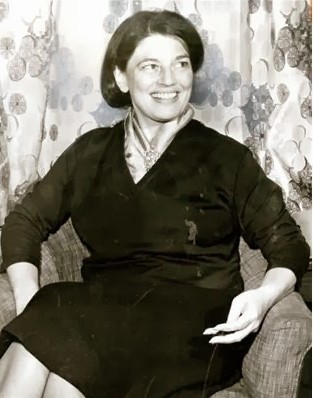
Gallant and MulhallenMavis Gallant & Karen Mulhallen

/

Three months after my conversation with Richard Landon, Director of the Thomas Fisher Rare Book Library at the University of Toronto, Mavis Gallant and I were able to meet at the radio station to discuss her work in anticipation of my broadcasts on her writing. We spent an entire day in the recording studio and saw one another two more times that week, off record so to speak. I found her both candid and open.

And our subsequent talks, after the tape machine was turned off and we had changed context, bore out my sense of her deep intelligence and her compassion. In rereading her stories to prepare these pages for Numéro Cinq, I found another quality, which perhaps I had been too young, or too anxious to take in — her comic, even madcap, sense of human folly.

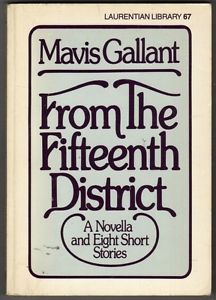
In “The Four Seasons,” the first story in From the Fifteenth District, there is a six-page scene where a substitute priest in the British colony in the south of France is being lessoned in manners and morals, and the classics and the Bible, and of course, really, on their expectations, by his new parishioners. They have informed him there is no need to change the signage which advertises “Evensong Every Day at Noon.” They warn him about his sermons: “I hope you are not a scholar, Padre. Your predecessor was, and his sermons were a great bore.” And finally, on telling him it is time for him to leave, his host says, “Well, I’ll expect you’ll not forget your first visit.”  “I am not likely to,” says the young man.

Mavis Gallant and I began to talk in the CJRT art deco studio on Victoria Street in Toronto in the morning of Wednesday, October 11, 1989. It was just past Canadian Thanksgiving, a festival which carries very specific culinary rituals, as will become later important in my brief epilogue to this narrative. The small art deco building on Victoria Street was one of a group of exquisite art deco structures in downtown Toronto, which have since been torn down. The signature building, which still stands, is just up the street at the corner of College and Yonge, the former Eaton’s College Street. Another exquisite building is at the south west corner of Gerard and Yonge, formerly a bank, now a pub. It’s impossible to think about Gallant without thinking about cityscapes, since she is so much the writer of urban life, and she chose to live the greater part of her life in a city, Paris, which has not pulled down its signature architectural structures willy-nilly.

— Karen Mulhallen
 

$(KGrHqZ,!qwF!-Frz!GDBQdEV8STnw~~48_35

As it had been with with Richard Landon, the focus of our conversation was initially her collection From The Fifteenth District (1979), nine tales set in Europe after the Second World War. We began with” The Moslem Wife,” and Gallant read part of the story, explaining its context as she read:

Mavis Gallant (MG): The story is set in the south of France before the war and this couple, Netta and Jack Asher, owns a hotel. Just as the war breaks out Jack gets to America, but Netta is left behind, and she tries to look after the hotel, and she also has his mother to look after, and a lot of different things. She starts to write him a letter, which she never sends, but she keeps trying over and over, because what she has experienced is so remote from anything he’s been living. So she starts to write — the letter she’s been writing in her head for many years. She is in her father’s business room, wearing a shawl because there is no way of heating any part of the hotel now, and she tries to get on with the letter she’d been writing in her head on and off for many years:

“In June 1940 we were evacuated” she started for the tenth or eleventh time, “I was back by October. Italians had taken over the hotel.”

MG interjects: You must understand, that the Italian army had occupied that part of the South of France, then in 1943 the Germans occupied it.

“Italians had taken over the hotel… When the Italians were here we had rice and oil. Your mother, who was crazy, used to put out grains to feed the mice. When the Germans came, we had to live under Vichy law, which meant each region lived on what it could produce, as ours produces nothing we got quite thin…. This true story sounded so implausible that she decided never to send it. She wrote a sensible letter asking for sugar and rice and for new books; nothing must be older than 1940.”

MG: That’s all true you know, that’s all based on truth, the Red Cross people who took a German skull away as a souvenir and the Italians who were there when the Germans took over because the Italians had suddenly switched sides in 1943 and then they were put in the hotel and just left there. And the local people took them water, something to drink, because they hadn’t been all that bad, they hadn’t been anything as bad as the Germans who came in.

Karen Mulhallen (KM): Netta feels the same way, doesn’t she?

MG: The hostages who were taken for shooting at the Germans as they were retreating were all young boys and they were all taken and shot along the wall of a café and left there.  There were all these true stories.

KM: Where did you get them?

MG: Well, I lived there on the border.

KM: When it was happening?

MG: Well, no, not when it was happening, but shortly after, and I knew lots of people and they told me all sorts of stories.
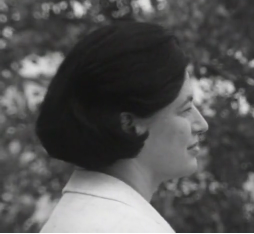
ghallant younger

KM: Do you keep notebooks of people’s stories and go back to them?

MG: No, I keep a journal and anything you write down you’re apt to remember, and anything you’re told more than once you remember. One time you might forget, but when people tell you the same things over and over, they stick.

KM: Were you in Europe when all these things were happening and were still vivid for people?

MG: No, I was in the post-war period, but the whole coast was still bombed and the Germans were in the hills behind and they were shooting at each other, and the town was pretty well shot up. They didn’t begin to build again until late fifties.

I went to Europe in 1950, five years after the end of the war, so it was still the post-war period.

KM: Is that the time in which you first began to write full time, in which you decided that would be your career?

MG: No, I decided that before I left Canada, and so I went away in order to do it.

KM; So there was a kind of coalescence of history and your own decision. Do you think that might be one of the reasons why history is so essential to your stories, not just the fifties?

MG: I can’t judge whether it is or not; the reader has to judge. Certainly a book like From The Fifteenth District is entirely European history, but I wasn’t conscious that I was doing it until I started to put the book together. Then I was able to put in chronological order stories, or a story that begins with the war.

An incident in the stories that was true takes place in “The Four Seasons.” It is the story of a little Italian girl named Carmela who works for a British family. They run away because they have to go home and they say to her we’ll pay you when we come back, after the war. My story doesn’t go on from then, but after the war they paid her in devalued money. It was disgraceful. I used to look at them in the market and I used to think you’re not going to get away with that. I’m going to write about you.

KM: Did you use their names?

MG: Oh, no, there’s never anything recognizable.

KM: So it’s the bare bones of the story?

MG: It’s not exactly as it is in the story — she was a bit older than my character, and the geography isn’t exact. That’s one of the rare stories though that is lifted from an instant, where somebody said this and I thought I’m going to write about this. That’s rare.  Most of the time it’s imaginary.

KM: And was that in a way to avenge her?

MG: Well, I remember when she pointed them out to me in the market — she said those are the people — I thought they shouldn’t get away with this.

KM: How did you know her; was she still living in the town?

MG: She was working for me, for everyone.

KM: In the story she goes back to her mother, doesn’t she? and is afraid she will be beaten.

MG: Well, her mother did beat her, because she came back with no money, and her mother didn’t believe the story. That part’s true.

KM: What about the ice cream? She eats ice cream and eats her way into heaven?

MG: I guess that part is invented.

KM: It made me want to go out and immediately eat ice cream.

MG: She was someone who was a good gardener. She did all sorts of things like that and worked by the hour for people. She died there. That was her life.

Mavis Gallant

KM: When you organized From the Fifteenth District, there were stories that you had written over a long period, six or eight years?

MG; Yes, they were stories from the seventies.

KM:  Did you decide on the order of the book, since the stories wouldn’t have been written with an eye to the collection?

MG: Yes, I put them in that order. Where the book was best received was in Germany. I’d like to know why. You would think with all the German parts they would be very touchy, but they were enthusiastic. So that was very interesting and now they are going to translate The Peignitz Junction.

KM: They want to examine their own history?

MG: Yes, but from a Canadian?  That’s what is so interesting.

KM: There has already been a wave of young German filmmakers scrutinizing their history, and it hasn’t stopped, has it?

MG: No, it hasn’t stopped. I don’t mean reviews but translations. Germany figures in all my war stories, for example “The Latehomecomer,” and they have been enthusiastic about my view of Germany, and have said it should have been published in German. I am barely German-speaking, I speak like a child of five or six, but it has been astonishing for me. If this sounds like boasting, don’t use it, because I don’t mean it that way. But they said, at last a European writer, and that was astonishing.

KM: I’m trying to think of the German name for latehomecomer — Spätheimkommer? So you have given the feeling of German with the name of the story.

MG: I just translated the word into English, but what it means now mostly is people who are disappeared into Russia. Originally my book was called The Latehomecomer,  but I couldn’t use that because readers would think  it was about a German who disappeared into Siberia or something. From the Fifteenth District is a title that doesn’t translate into German, so it was what was chosen.

KM: But by choosing that title, changing the title, they’ve also given the book a different emphasis, haven’t they?

MG: Well, in France it was called The Four Seasons. You can’t translate From The Fifteenth District, just doesn’t make any sense.

KM: Where is the fifteenth district? I thought I should try and find it on a map of Paris.

MG: It’s imaginary, but there are small things that are not, yet it is completely imaginary. At one time I thought I would like to write some stories set in the fifteenth arrondisement. It’s the largest, in a sense the newest in Paris. It’s so new that it has no cemetery. It’s where people go to live when they can’t find a flat, so it’s the most mixed area, it has no class, it’s neither upper nor lower nor middle. So everybody who can’t find a flat will find one there. It has no character. Somebody told me it had no cemetery and that gave me the idea of the living haunting the dead.

It’s something completely new with no settled character. I was really thinking of it as a metaphor for Europe, for Modern Europe. I also got the idea of the living haunting the dead from the wife of a poet. I don’t know why widows of poets always say, he couldn’t write a word without me, you know, or he couldn’t paint unless I was in the room, or he couldn’t…whatever. I thought, I wonder what they feel like in heaven, these poets and writers and so forth. Can they hear this? And there’s not a word of truth in it: he couldn’t paint, I had to be there to look at everything he was doing otherwise he was miserable. I thought what if they go and complain, the dead, and say look at you. Shut these people up, there’s not a word of truth in it. That’s what it grew out of.
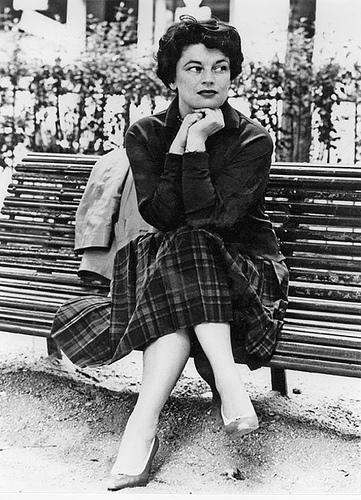
gallantMavis Gallant. Photograph: Jane Brown, The Guardian

KM: And Irina, in the last story “ Irina,” is she such a widow?

MG: Well, no. She doesn’t say he couldn’t write without me, on the contrary.

KM: But she does say she couldn’t leave him, when Mr Aiken wants to know why she didn’t?

MG: Well, it’s probably true, and she had five children. It’s not all that simple.

KM: And there’s the scene where her husband cried because she doesn’t butter his toast properly. And of course her lover cried because she doesn’t leave her husband. There are a lot of men crying over her.

 Let’s talk about Irina. It’s the last story in the collection. She seems to me to be an immensely sympathetic character. One feels a great love for her. Her appearance in the doorway with her blue eyes and her short white hair, holding her dressing gown gripped at the collar. The way she looks at her young grandson at the end and she seems to understand young people, how they feel.

MG: Yes, people who understand young people usually are not sentimental about them at all. I’ve noticed that people who are sentimental about children don’t understand them, they’re trying to make the children enter into a fantasy life  of their own. She is a woman who is not sentimental.

KM: Is she based on anyone at all or a mixture? She gives that remarkable speech about women of her generation, how they’re really packages. It’s an amazing set of observations about women being packages and owning nothing.

MG: She is a mixture of characteristics. Those observations are mine. Those are things I’ve noticed. I remember asking someone in France “Why didn’t you leave?” and she said “Well, I’ve no money.” And I said, “You had a dowry,” and she said, “Well, he has it now.” So these women were often stuck because they couldn’t earn their living.

KM: So as you said a moment ago, it’s not that simple.

MG: But there are European women who have gone out and taken any job, the way a Canadian woman would. A Canadian woman might say I’d rather scrub floors than that, and she meant it. But it’s inconceivable even now in Europe.

KM: Is it just a different sense of who you are?

MG: It’s inconceivable. I gave an introduction to some friends to a Canadian architect. They came back and were very shocked because his son had a paper route.

They couldn’t understand how the son of an architect in Montreal had a paper route. I explained, well he wants a boat and his father says he’ll have to pay for most of it himself. That seemed to be very ordinary. And then they said, but you said he is an architect and his son sells papers on the street, like a common…You know it was inconceivable to them.

KM: Mavis, that allows me to ask you my next question, which is about the very real differences among the different nationalities in your stories. With “The Latehomecomer” you have a sense of a working class German family.

MG:  When I began to be interested in writing fiction out of Germany, I was only interested in the working class and lower middle class. Intellectuals cannot tell you anything at all in my view in any country. I’m not being anti-intellectual and stupid, but they don’t know anything. I’d rather anytime have lunch with a working journalist to find out things, but even there there’s a limitation, they’re busy, and they see a bit too much.

I didn’t think the working class was a victim of what happened in Germany, they were a part of it, of the movement, not out  of evil-mindedness, but out of a deep depression. I don’t mean that the industrialists didn’t put money into the Hitlerian movement, but I don’t think that having lunch with an industrialist would have got me anywhere, whereas meeting these people on a friendly basis, I did find things out. The only thing that interested me was finding out from them, because a victim can only tell you what happened to him.

You know you have to know what was going on in the mind of a man in the firing squad. I don’t pretend I ever did find out, but I got enough to satisfy my interest a bit.

KM: I think what you are saying is that the different classes have a completely different value system?

MG: They do anywhere.

KM:  In North America the architect’s son can sell papers on the street?

MG: But that doesn’t mean that he is going to marry a working class girl. Necessarily a different thing. Unless she’s been to the same university as he has, or something like that. It’s more fluid in North America but it’s pretty snobby too.

KM: Yes, the class system is still here; do you think it is easier to see it in Europe?

MG: It exists everywhere, probably in societies I know nothing about. When I first went to Europe in 1950, the class structure was distinct. I couldn’t stand England for that reason. In fact I loathed it. I couldn’t bear to stay there because it was so contrary to everything I admired or believed.

gallant mah

KM: In your stories, characters who are expatriates are in a sense out of class, aren’t they?

MG: Except among other expatriates.

KM: So then the class system kind of kicks in again.

MG: There was a British colony in the south of France, and it was like ancient Egypt, you know, with a pharaoh, and there was always something very amusing about it.

KM: What about Eric Wilkinson in “The Remission?” He’s able to adapt to different accents.

MG: He floats up and down and we don’t really know very much about him except that he can act a bit.  The view of the others in the British colony pretty well fluctuates with his fortunes.

KM: And the kind of curry he can cook for dinner! They pay him five pounds, don’t they? They offer him a fiver.

MG: It’s been a long time you know…

KM: Now Gabrielle Baum is also an actor.

MG: That’s my favourite story in the collection: “Baum, Gabrielle, 1935—(  ).”

KM: It’s a lovely story.

MG: It’s really about Montparnasse more than anything else and the changes and it’s through the sixties.

KM: Yes, I was going to ask you if it wasn’t about the whole feeling of the changing district. La Méduse — is that the name of the bar, and the old car seats, and so on?

MG: In the sixties and the seventies all those English style pubs came in and orange lights. There were scenes for recruiting for the Resistance TV and film productions. A series of five episodes or so. I actually used to go to one or two cafes there and someone did come in and say in a very practical way, “I want 12 Polish Jews for deportation.” And everybody was saying me. Me, me, me. I couldn’t do that. And then somebody would say: “Don’t take him. He doesn’t look Jewish.” They usually picked Yugoslavs for nearly everything, but I’ve forgotten why. They were great drifters. There were actors who did these bit roles and they would try and get a speaking part because they’d get more money. And that was why there were so many of these long deep silences in French films. They just didn’t have to pay them much if they didn’t say anything!

KM: Now that story ends with something about age. Gabrielle says his father lived to ninety. How does he feel about that?

MG: I think he thinks he has lots of time. He’s an actor and he works all the time. He’s not a drifter. He always lives in the same place, he won first prize at the Conservatory and so forth. But you know there are an awful lot of actors who are unemployed. There is 90% unemployment. And he does have that mystery in his life, of what became of his parents. They just disappeared, probably picked up by the police. I don’t say I know because I am seeing from his point of view, so I can’t pretend to know more than he does. But I think anyone reading it would guess that his parents have probably been picked up in the street one day.

KM: They were in the south of France weren’t they?

MG: There was a point where it was a free zone, and then the Germans occupied the whole thing, I think that was in 1942, so everyone was at risk. People were picked up in the street.

KM: And then some people had left early enough to get to South America. Is that what happened with the uncle, that he had gotten out earlier? And he seems to despise Gabriel’s parents for not having gotten out earlier.

MG: Yes, he seems to have gotten out before the war and feels they dithered.

KM: Why is that your favourite story?

MG: Because of Montparnasse and the kind of people in it. When it was translated I reread everything and I recognized the Montparnasse of the sixties and the seventies. I think I had it right.

KM: Have you noticed Paris changing in the years you have lived there and how do you feel about any changes?

MG: Oh yes, it has changed and I regret the decline of Montparnasse. But those things have to happen. There are still cafes.

KM: That’s one of the things Gabriel talks to Dieter about, isn’t it, the changes?

MG: It’s nothing to the changes now in the architecture. When it comes to hideous architecture, the French are the champions.

KM: Some people, for example Prince Charles, would say the English are the champions.

MG: Paris has not been destroyed anything like London. Prince Charles has superimposed a painting of London as it was, I think it was a 17th century painting, over the skyline today, but you could put an old painting of Paris over today’s Paris and still find a lot of it. And there are some new buildings which are beautiful, like the Arab Institute. And the Pyramid in the Louvre. They’re beautiful.

mavis-gallant by Jane Brown the GuardianMavis Gallant

KM: Let’s go back to “The Latehomecomer,” which is written in the first person. I think that’s a surprise to have the narration in the first person after reading several stories in the third person. Generally in the stories there is the feeling of knowing everything the narrator seems to know. That’s an exhilarating thing about your writing.

MG: Well, I just wanted to tell it that way, more intimately, from his point of view throughout. But his mother is from her point of view. In the letter she says, “I was your mother.” That’s much stronger in English than in French. In French it doesn’t mean anything.

KM: In English, it’s like a sudden bolt.

MG: And I’m not a writer in the French language and I don’t do my own translations. If I wrote first in French I might know a way of doing it, but I don’t. The humour doesn’t come through in translation either, at least not much.

KM: When you write a story, do you work from the characters? How do the stories come to you?

MG: As images of the people. “The Remission” was the first of them. I remember this because I kept my notes, which usually I tear up. I saw the family getting down from the train, there’s nothing like that in the story, but that was the first image. I saw them getting down from a train arriving in the south of France with three children, the mother and the father and the 1950s clothes and suitcases. I had a sort of image and I built from that.

KM: And then did you begin to imagine what their lives were?

MG: You don’t imagine anything; it just comes to you. For a few days after that things come out of the air, you write them down, and then it stops, that onrush of several days, and then you have to work from there.

KM: Is there any time in which you know a story will be with you, a specific period in which you work, a special time of the day?

MG: In general, I work everyday. If I have an idea for something new, you don’t control the time, it just rushes in. On the whole, I get up and I work, that’s what I do, I write and even if it’s going badly I just sit there. I usually eat lunch around 2 p.m.

When it’s going well, it’s perfect, and when it’s not, it’s an awfully long time.

KM: Do you stay with a story until you feel it’s done, or do you write several at once?

MG: I work on several things and come back and then when it’s done, it’s done. When I am getting to the end of a story, I don’t do anything else at all.

KM: You’re immensely prolific; I ‘m sure other people have said this to you. There are hundreds of stories.

MG: Isn’t it funny, I think I’m not prolific. There are over a hundred stories, but not hundreds.

KM: In 1978, there were a hundred, and there are so many uncollected. You have twelve books.

MG:  There are still some which are uncollected, from 1985 on. But I want to publish a novel before I publish another collection, and I’m working on one now.
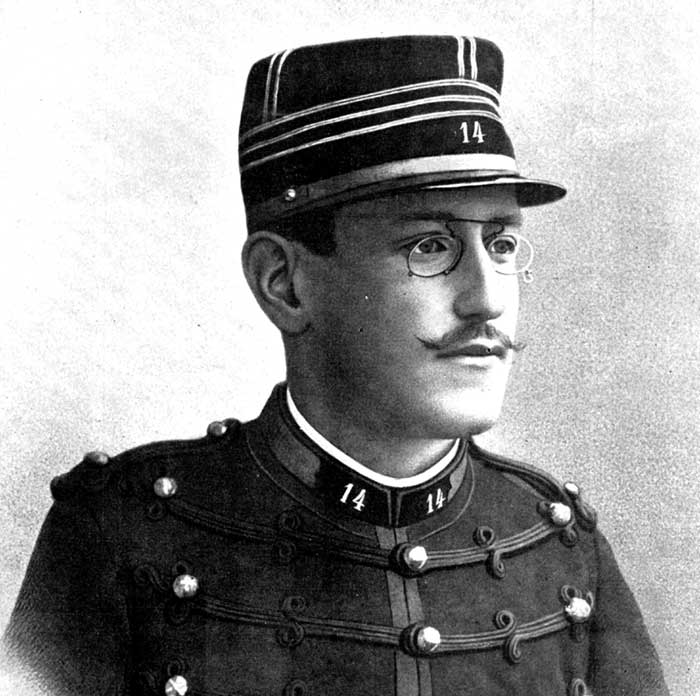
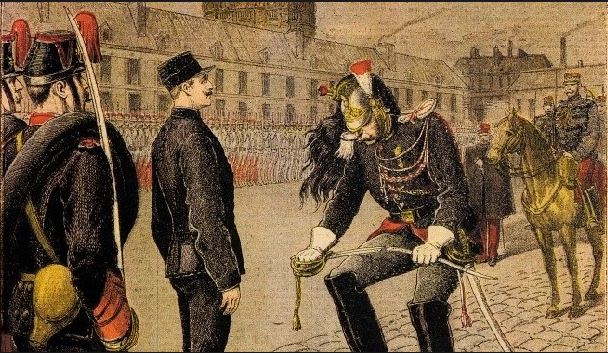
a-dreyfusAlfred Dreyfus

KM: Tell me about your Dreyfus book?

MG: How much do you want to know? First, it wasn’t my idea, but it was the American publisher, Random House, who asked me if I wanted to write about the Dreyfus case.  I accepted without realizing. I’m not an historian, it’s not my training, my training is journalism. I was a journalist all through my twenties, and that’s how I look at the world a bit. I accepted because I thought, well, probably no woman has ever done anything like this. Although I knew about the case, I didn’t know what I know now. I knew Alfred Dreyfus had been unjustly convicted of treason and I knew he’d been sent to Devil’s Island. I didn’t know for how long. I knew that the French writer Émile Zola had written passionately about this in a newspaper article which had the famous heading “J’accuse,” I accuse. I knew he had had a famous lawyer named Fernand Labori. I knew that he’d come back and more or less disappeared. But it ended there. I knew nothing more about him.

I looked it up in a French encyclopaedia to get a beginning, and I saw it was a huge fresco of French society. I became wildly enthusiastic about it and I said I could do it I thought in two and a half years. Famous last words. Two and a half years later I was still looking, looking things up, meeting people and carrying on

It was an extraordinary experience for me to do the research, which is done. In fact if someone came along with some startling thing, I don’t even want to hear it. I’ve done my research, its miles and miles of notes and stories and interviews. I got in at the right time, because Dreyfus’s daughter was still alive. I couldn’t work from documents, because I didn’t want to write the books I was reading. They told me about the case, but they didn’t interest me. I wanted to know about the people.

I used journalistic techniques. I took my telephone and my notebook and I called every single person I knew in France who was French. Everyone. I mean people I had not talked to for years. I asked do you have anyone in your family who had a connection to the Dreyfus case? And then I began to be more general, have you any Jews in your ancestors and don’t say no right away but ask your grandmother. I got people who had been Jews at that time. People who had descendants whom I knew and who often didn’t know their own life history. Do you have anyone in your family who were officers at that time? Don’t say no, ask your grandfather.
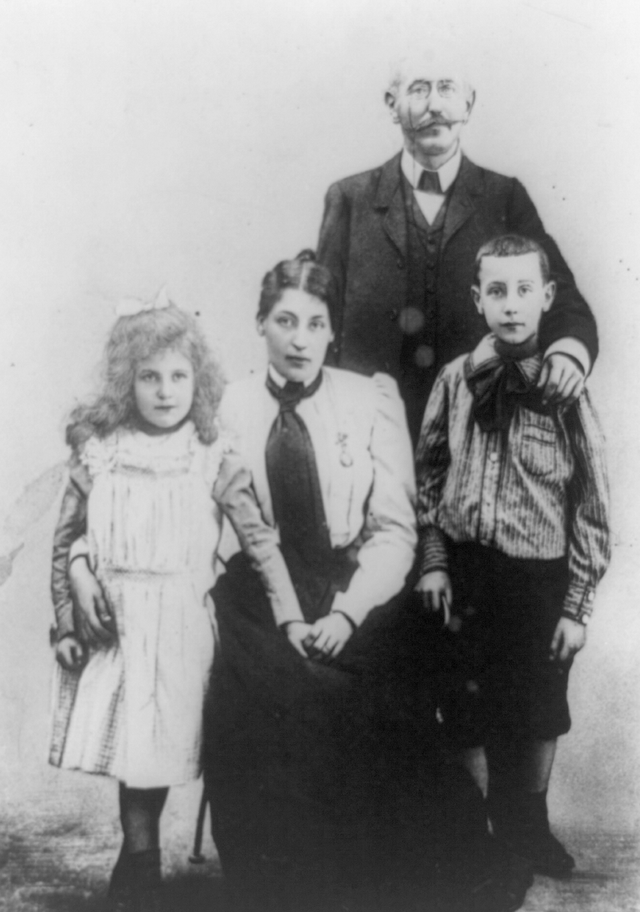
640px-AlfredDreyfusDreyfus with his family, 1905. via Wikipedia

In about three weeks, I had Dreyfus’s daughter, and I knew all about Esterhazy’s daughters — he’s the villain of the piece; he’s the one who was the German informer, not poor Alfred Dreyfus. I had the daughter of the man who’d been chief-of-staff in the army and who worked against Dreyfus. I had that generation of elderly people, all defending their fathers, whichever side their fathers were on. Those loyal daughters, and believe me this is something — no matter what side their father was on, he was right.

The great help to me was Dreyfus’s daughter Madame Jeanne Levi. I didn’t get to her right away. I’d asked a book seller I knew whether anyone among her customers or clients might be connected  to the case. She called me and said I have a customer who is a great niece or something by marriage. I only met two people who knew my work or anything about me, so I went in as a complete stranger. She read English and read The New Yorker, so she knew a bit about me. That was a great help. The others didn’t know any English, and so I just came on as a foreigner really. This woman was the first. She looked me over. Then she invited me to lunch to look me over. Then she invited two of Dreyfus’s grandsons, who were both doctors, and their wives to dinner, to look me over. Then one of the grandsons, one of the doctors turned to his cousin, it was rather dramatic, and he said, “You may make an appointment with my mother to meet Madame Gallant.”  This man’s wife took me aside and said you are not going to get anything out of that family— they have a policy of total silence. I said, well then, I will have to work without them, but if I can talk to them, that would be even better.

So then I was taken to tea with Dreyfus’s daughter, who was a stunning elderly woman. She was in her seventies, with white hair and she looked like an English woman to me. I can’t explain why I would have taken her for an Englishwoman of a certain class. She had blue eyes, lovely white hair and she was very, very straight and rather solid and very careful. She didn’t know much about me and we talked about general things. She showed me a few innocuous souvenirs and at the end of the tea she said, “Je suis à votre disposition.”  I am at your disposal. Wow. So I waited more than two months, as I didn’t wish to push her and then I called.

I came and I brought her a box of chocolates. It was Monday and the florists were closed, or maybe there was some other reason why I didn’t bring flowers. I said to myself elderly people like sweets. She was delighted and said that her mother never let them have candy because they were afraid it would be poisoned. Anti-Dreyfus. People sent boxes of chocolates for the children, but she always threw them out. So they were brought up very, very strictly, and in her old age chocolates were a treat.  She could have gone out and bought herself chocolates, but they were brought up in such a way that they wouldn’t, would ever self-indulge. It was quite an experience for me, and here I am old self -indulgence herself in contact with this rather rigid view. In the end, I had her going to restaurants with me, and eating desserts and carrying on. I loved her dearly. She died ( 1893-1981). She helped me a lot, a lot!
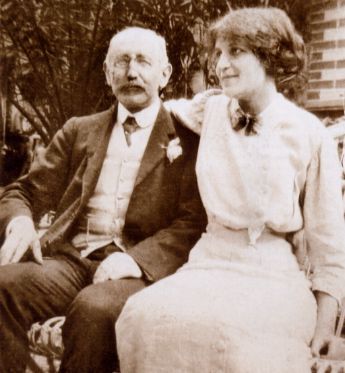
57990974Dreyfus and his daughter Jeanne, 1910. via Clioweb

KM: When will the book be done?

MG: A fortune -teller in Bangkok told me it was the last thing I’d ever do. That doesn’t encourage me much. I can’t tell you when. I think that would be tempting fate. It’ll be done certainly. I’m not going to spend half my life on something I’m not going to finish, didn’t finish.

KM: How long have you been working on it?

MG: Many years.

KM: I won’t ask you anymore!

MG: But I have learned a lot and I haven’t any startling conclusions. I do have things that I think are interesting about what people were like who populated the story. Dreyfus is an enigma because everyone is so contradictory about him. But I think I’ve a clue as to what he was like. It’s a clue: he’s a man who’s very nervous. Tension. He always speaks of “my damned nerves” in his letters. “If only I could control my damned nerves.” But he’s all of a piece, he doesn’t flounder all over the place. He was a pathetic figure in a way, yet it was the last thing he wanted to be.

KM: But you must be very interested in this story even if it is a book you were asked to write?

MG: I could have wound it up a long time ago, but it would have been the book I did not wish to write. I am not going to turn in a book that I do not wish to read. It’s a very difficult thing I have done. The first third is an essay setting the case in its time, and explaining. Alfred Dreyfus was an Alsatian Jew and he was also an officer. What is an Alsatian Jew; what is a Jew in France; what is an officer? I begin with the officer, because— you won’t believe me— it was the most important. Nobody can understand the Dreyfus case who doesn’t know what it meant to be an officer in the French Army at the end of the nineteenth century. It explains his behavior, it explains  the way in which he almost went along  with the thing out of loyalty to the army. Things that are inconceivable to us today. As for the religious side of his life, I can only trace it through letters, his letters. There’s a point where he says at the beginning: “I trust in God. God will get me out of this; it’s the God of mercy and so forth.” And then one day he writes, “God has abandoned me.” Whew. Finished. There’s no more mention at all. Someone who is all of one piece lost his faith, it’s obvious. That’s interesting to me, but it’s not interesting to anybody else. I mentioned it to people, and they say well who cares? Well I do, because you can’t judge a man, or a woman. But we’re talking now about a man: every attitude has to come into it. The attitude to religion, the attitude to money, the attitude to his wife, the attitude to women, to his country, to history. I’ve read books that said he was a snobbish officer. He wasn’t snobbish at all. He was an officer. He had it in the blood. Some men are like that. I’m not like that; I’m a pacifist. So it was even more interesting for this pacifist to encounter a military man. That was fascinating to me. And people’s memories of him varied. His daughter adored him; he was so kind to her. Other people found him stiff, cold, sometimes inexplicably cold. But it was a horror of sentimentality, and a horror of people gushing, and a horror of people crying all over him— he would just freeze.

I interviewed two women, witnesses, one was a hundred years old, the other was 99. The one who was a hundred remembered being at one of the first gatherings — we would call it a party — when he came back from Devil’s Island. Everyone applauded when he came in, which embarrassed him, and then a woman rushed up to him and flung herself into his arms, well not his arms because he kept them at his sides, and said: “Oh Captain Dreyfus, the dream of my life has been to meet you. Now I am meeting you, you’re my hero, and you’re my this and that.” And he didn’t answer. And she became hysterical because she thought he had turned to stone or he was dead, or something had happened. And she went on and on and he didn’t answer.

And she had to be led away in hysterics. He just stood there; he was incapable of saying that’s enough, or calm down or anything like that. He was all of a piece. He just didn’t answer. People remember him and his family with his watch in his hand.

Dinner was at 7:30 p.m. and not a minute before and not a minute after.

He was a military man, and a loving father, and a loving husband. I think all these things have to be put together.

mavis-gallantMavis Gallant in The New Yorker

KM: Mavis, are there writers who have been important to you?

MG: The writers that are important are those you begin to read as a child. I’m convinced of that, quite serious about it.  The wealth of books in the English language for children was extraordinary, well-written, with style. Like Lewis Carroll. I regret that children read less and that they are not read to and that they are taught to read so late and so badly I think the Swiss psychologist Piaget is going to have to answer for a lot in heaven. There must be a wicket they go through in heaven for what they had to do with a child’s education. And they are going to say: “Are you the man who started them reading at seven? Purgatory for you!”

KM: Piaget and B.F. Skinner together? I wanted to ask you about Tolstoy?

MG: Oh that goes on and on, but the basic English style comes from the first books you read. Then you begin to read more and more widely. I read the Garnett translations of Russian writers rather young, but I don’t mean at twelve, but older. I read an awful lot of that, and Chekhov was probably very important, although at the time you don’t know that. You just read them.

KM:  Because you have been talking about the war, and about a man, his society, his religion, his profession, I was thinking this is the way — I am sure people have said this to you before — this is the way Chekhov thinks, this is the way Tolstoy thinks. You do see a human being in a total social, political religious context. Not all writers do.

MG: If I started to think that I was anywhere close to these people I would think I was paranoid, and I would go instantly to a psychiatrist and ask him to bring me down to earth. So, no, I have always thought it is my journalist’s training.

KM: To see the total context?

MG: Yes.

KM: The reason I’d asked you earlier about how you write is because it seemed to me that when I pick up a story by you and I look at a single sentence, the sentence seems to include the world, there is a total context all the time.

MG: I don’t like reading things that aren’t set somewhere. I don’t like never never land.

KM: Do you travel to all the places you describe, for instance Berlin, Budapest? Are these places you have visited?

MG: You are living in Western Europe, and so earlier yes. In the last few years I‘ve been coming more to Canada and to North America.

KM: You’ve written many stories set in Canada.

MG: If I stay here a while, I go back and I just bubble up. I lived here in ’81, ‘83, ’84. I had a very good time. Do you think the city has changed since then?

KM: Yes it has.

MG : In what way?

KM: There’s tremendous destruction of the city itself and there are many more homeless people. And the class distinctions are much sharper.

MG: I haven’t been where the homeless are, because I’ve been around the university.

KM: You’re in the ‘shopping danger zone’.

MG: And I go wherever I’m going in a taxi.

KM: Your Paris Notebooks were recently published and in them you discuss 1968.  Could you say a little about that moment in French history, which you experienced directly and which speaks so tellingly to your intense scrutiny of French society?

MG: There’s a passage in the book which comes directly from my journal. On the twentieth of May, 1968, I saw people hoarding. The reaction of the people of Paris went straight back to the war. Whenever there is a crisis in France, you can tell it’s a real crisis because sugar disappears from the supermarkets. It’s striking. You go to the supermarkets, and all you get are the grains of sugar on the floor. People were frightened that if there was a civil war, food would be missing. I’d never seen that kind of public reaction.

Later in the diary I mention a shop owner who, when the wind turns, puts  up only right wing magazines. And I remind him of what he’d been thinking about two weeks before and he said, “I don’t know what you’re talking about.”

gallant again

KM: Mavis, you live in Paris, and you write in English in a French environment. How do you keep your English intact?

MG: Well, it was never a problem until a year or two ago. I don’t speak enough English. Most of my friends are French-speaking. If they are foreigners, we speak French together, because it’s what we have in common. Of the Canadians whom I see and talk to, there’s Joe Plaskett, a Vancouver painter. But there aren’t many Canadians because they don’t form colonies, they’re all very independent, each going off by himself and so forth. But I never had trouble maintaining English until my work was translated into French, about two years ago. Last year the first books were published, and the year before I was reading the proofs of my own work in another language, helping with the translation, my own ideas expressed not as I expressed them. Then I had a lot of trouble with English, I began to think in French syntax. I wasn’t thinking in French, I was thinking in English with French syntax, which is completely different. I had to take strong measures, and I mean strong, otherwise I would have had to leave the country altogether.

KM: What did you do?

MG: Well, these might sound odd, but I don’t read or speak any French at all until I’ve finished working for the day. I read only an English newspaper, I listen to the BBC news. At 7:45 every morning CBS American News with Dan Rather. It’s with French subtitles but it’s in English. I watch a bit of it, not the whole thing. It’s also the only place where I can get any Canadian news. I read only in English. I have to get on the English track in the morning, listening, reading. I’m probably alright now, but I’ve gotten into this habit of a year and a half. I don’t answer the phone in the morning. From lunch on, it doesn’t matter.

KM: Do you dream in English?

MG: Both, but I had to do that. I thought it was the most drastic thing to do, but it helped.

KM: Created a kind of barricade?

MG: It’s like two tracks. I had never before confused them. I had never used an Anglicism in French, put English words into French, used English syntax in French. If I do that in English, it’s a bit of a joke. Sometimes you are joking and you use some French words in English. You know we say hors d’oeuvres or détente, and it’s not really thought of as French. It was a question of the syntax, which is completely different. I don’t think it would have lasted, and I do think it just came from reading those proofs. I read French all the time and it has never impinged. But my own work in French had a devastating affect on me.

With the third book, I didn’t help nearly so much. I read it quickly to see if there were any real semantic mistakes, but I don’t read it for mood, tone, tense, etcetera. I thought even if it’s wrong. even if it’s a betrayal, it’s dangerous, too dangerous for me.

KM: Do you have a translator that you trust in France?

MG: I did, but when I was in Vancouver a short time ago, I met a woman at the University who is writing her MA thesis on the betrayal of my work in French. She calls it betrayal. It is a question of mood, of tense, of using verbs in a different way, and so forth. And I said to her, well, you are probably right, but I can’t do anything about it. I will correct actual mistakes, where I’ve said geranium and they think it’s nasturtium, but the rest I simply can’t cope with. I thought that would interest you?

KM: It does, and in French Canada today this is a constant question, isn’t it, about the relationship between the French language in Quebec and English.

MG: Well, I maintained mine for nearly forty years with no problem. So it certainly can be done. I never never had any problems at all.

KM: It’s also interesting that it just came at this particular phase…

MG: It’s seeing the images. When you read someone’s work, you see images. The author cannot provide what’s in his head. You provide the images. When I read my own work, I see my original images. But seeing my original images in another language was as if two railway tracks went together.

KM: Thank you very much, Mavis, for your generosity.

/

Epilogue

I saw Mavis Gallant three more times after this long day of interviewing and taping.

We went for lunch at a French bistro, then located on Queen Street West in Toronto. At that time, Le Select had bread baskets strung over each table with clothes line tackle. Luckily the main dining room was full and the waitress decided to squeeze us into a small front window area. We sat near the entrance to the alcove and settled in to talk about Toronto and her time here and Janice Keefer’s recent book on her work, when the waitress asked me to pull in my chair so some other clients could get by. After she left, Mavis commented that it was interesting that the waitress did not ask the table next to us to pull in, which would have been equally effective in freeing up passage. The next table was occupied by two men in red ties and grey business suits.

We talked as well about aging, what it means for a woman, and about Gallant’s own intention to stay full-bodied to preserve her skin, and about her love of pumpkin pie. It was a few days only after Canadian Thanksgiving and Mavis was staying in The Windsor Arms Hotel, then and now a chic hostelry in the most expensive shopping district in the city. On Saturday, I made my way to the St Lawrence Farmers’ Market and then drove up to The Windsor Arms with a fresh baked pumpkin pie for Mavis. She was delighted, of course, because there was no pumpkin pie on the menu at The Windsor Arms Hotel.

Years later, I ran into Mavis at the Writers’ Suite in the Harbour Castle Hotel during the International Authors’ Festival. I was with my friend Nancy Huston, each of them had flown in from Paris to read that week, and the suite was crowded with writers from all over the globe. Mavis was sitting on a sofa, surrounded by admirers, but she seemed delighted to see one, or perhaps two familiar faces. We began to chat, but then a well-known Canadian poet began to drunkenly declaim and to threaten to punch out another poet, so the three of us, rather wistfully I thought, said good night. I never saw her again, and the notes from her unpublished Dreyfus book, I understand, were still stuffed into a closet on her death this past February, as fiery battles shattered the Ukraine. She was a writer who belonged both to Canada and to the world. We will not see her like again.

gallant photo by Nott & Merrill

—Mavis Gallant & Karen Mulhallen

/

Karen Mulhallen has published 16 books (and numerous articles), including anthologies, a travel-fiction memoir, poetry and criticism. She has edited more than 100 issues of Descant magazine. She is a Blake scholar, a Professor Emeritus of English at Ryerson University, and adjunct Professor at the University of  Toronto.


Sep 042014
 

Desktop2

rlandonRichard Landon—Photo: Rick/Simon

/

In late 1988 I was hired to develop a series of year-long programs on current Canadian fiction for the Toronto radio station CJRT, now exclusively a Jazz FM station. The station had had an earlier program on Canadian fiction, but it was felt it was time to update as a new crop of writers had emerged, as indeed they had.

I drew up a list, I underwent a series of interviews and trial tapes, and I took a year off from my main gig, which was as a professor of English at a Toronto university. It was an intense year, 1988-89, both for professional and personal reasons, but my focus was the studio and an accompanying workbook for students who might want to enroll in a credit course connected to my programs, and we were off to the races.

Mavis Gallant was one of a distinguished company of writers and critics and visual artists whom I invited in to the studio to be interviewed.  Of course I wanted the writers to speak for themselves, but I also wanted to have others speak to them, and about them. I spent two days with Mavis Gallant in the fall of 1989, both in studio and in the city proper, but in the summer before I met her I interviewed Richard Landon (1942-2011), then Director of the Thomas Fisher Rare Book Library, University of Toronto, where Gallant’s papers are held.

I felt a conversation with someone who knew her work and also knew her would help me in my planned interview. Over many years of my reading Gallant, I had found her both intriguing and enigmatic. I hoped for some guidance and for some basis for comparison. I wanted to know about the contents of her “living” archives, that crucial period where an artist gets to make a choice about what is to be saved by deposit and thereby directs future commentary and research. And some of the questions which arose in this interview with Richard Landon would surface later in the fall when I spoke directly to Gallant herself.

Although most of her writing life had been spent in Europe, Gallant had been frequently in Canada. Richard Landon knew her well, and was also intimate with her work and of course her papers. He seemed ideal, both as a reader and a scholar, for an introduction to Gallant’s extraordinary talent and her working methods.

— Karen Mulhallen


July 27, 1989

Karen Mulhallen (KM): Richard, I’m looking at a xerox copy of a very brief note from Mavis Gallant. I don’t know when this note was written, it’s not dated, but it is something to do with From the Fifteenth District, Mavis Gallant’s collection of nine stories published in 1979. Toronto. What are these two xerox sheets I have in front of me?

Richard Landon (RL): This is a note Mavis wrote when she sent a batch of her papers to the Fisher Library. Her papers come in little batches and sometimes she puts in notes that are either explanatory or give critical comments from her on the material. Sometimes they are about who edited her work for The New Yorker, normally William Maxwell. This note is amusing, because one of the characters in the title story in From  the Fifteenth District is a social worker named  Alicia Fohrenbach who turned out to have a real life counterpart in the United States.

KM: What does she say in this note? Can you decipher it for me?

RL:From the Fifteenth District was written and published in 1978 and in it the name Alicia Fohrenbach was invented. I received several letters from a Doctor Alicia Fohrenbach in the U.S., a psychologist. These coincidences often arise and are tricky to handle. Luckily Dr. Fohrenbach was willing to believe that I had never heard  of her. However, as she had graduated from some institution called Regius, the coincidence was more than close. This is one of my favourite stories, but my readers were baffled and irritated by it. MG” The reference is to the hospital from which Mrs. Ibrahim is being discharged, which is called Regius  Hospital.

gallant

KM: Yes, I see the passage, a little past page 165 at the centre of the collection, probably in all editions? It is curious, more than an odd coincidence. Writers are, I think, prescient. Do you think Gallant is sensitive to the possibilities of intuiting things. After all, one of the stories is about ghosts.

RL: I think she is. I don’t know that she would claim to be prescient in that way at all, but part of her technique is the accumulation of detail, which is one of the most impressive things about her writing, its precision. There is an easy recognition on the part of the reader of things you don’t normally think about. She describes people’s fingernails, small incidents, very precise details of a scene — I suppose the accumulation does somehow give a notion of prescience.

KM: In rereading the stories in From The Fifteenth District, I noticed sentences that didn’t seem to belong to paragraphs. And it’s just what you’ve said, all that detail by the end of a story is in many ways overwhelming. She does this too with metaphors.

I was looking at the opening story, “ The Four Seasons,” just at the end of the fourth section, page 28: “ ‘That’s not our property’ Mrs Unwin cried. The man said ‘You hired me and I am here,’ and kept on sawing.”

This is a scene where the Marchesa’s date tree has grown up again, and Mrs. Unwin is  feeling the perfume fumes from the tree are noxious and she has a successful court order against the Marchesa and her tree. The Marchesa has long ago left her garden and so in comes this local to cut down the tree, and he decides he will not just cut down the overhanging branches but will cut down the whole tree and he breaks through the fence. That’s why Mrs. Unwin says, “ That’s not our property.” Meanwhile in the scene we’re reminded of the chauffeur of the Marchesa. The Marchesa has fled before the coming Allied forces. Mussolini’s war activities are failing, so people are leaving the country as Hitler is failing. The Marchesa has fled because, despite her Italian title, she is an English woman. Her chauffeur hangs around the garden like an abandoned domestic animal.

The chauffeur had walked the Marchesa’s dogs, and on the road there is a convoy of army lorries moving like crabs on the floor of the ocean. You think my goodness what are these army lorries doing? And we haven’t seen him before. And why are the lorries described like crabs in the ocean. Then you realize that the whole story is shot through with these images of the sea, and the maid Carmela looks out to the sea and is afraid, and then she’s underwater. It’s such an accumulation of detail — the sea, the army, the Marchesa’s dogs, her chauffeur, all together. And yet that’s got nothing to do with the cutting down of the tree at the beginning of the whole movement.

$(KGrHqZ,!qwF!-Frz!GDBQdEV8STnw~~48_35

RL:  But it is not the sea as most people notice the sea; it’s quite threatening and boring, and is often described as a line on the horizon and as unattainable. There is always a road or a railway between them and the sea. It is this sense of alienation which they have by some kind of accident in a particular situation. They’re stuck. The Marchesa might get away, but no one else does.

KM: You know she got away because the story begins with her eating ice cream and anybody who eats ice cream in this story is going to get out some way!

RL: But the principle characters never get out. There’s a kind of universal rootlessness about many of the stories. The one that most affected me on rereading is called “Potter.” It’s quite long, one of the longer ones, about the Polish poet and lecturer in Paris and his American lover, Laurie Bennett, and his reaction to her going off with someone else.

It’s a more complete story in some ways because it has a movement of plot. Laurie goes off to Venice, he’s devastated, and a good deal of it is describing his reaction to her leaving. He then has his visa revoked — he’s lecturing in Paris — and at the same time she sends him a postcard telling him she is coming back. The end of the story is about him going back to Poland, from which he might never again emerge, whereas she thinks she’s resumed the relationship. It sounds a bit banal, but it’s the way it’s expressed that is extremely impressive. It’s quite haunting.

KM: What do you find impressive?

RL: Her observations about how people react to each other and to external forces, and even to the city of Paris, to the weather. It all has a real accuracy and is recognizable. You think that’s right, I would never have expressed that, but in fact, that’s how I might feel.

KM: And Mavis has the girl misspelling the word ‘separate,’ which really impressed me. This is the kind of girl who can’t spell in her love letters: “We’re seperating forever,” she says. And in another she described him as a “really sensative person.”

RL: Yes,  it’s those details..

KM …which are her talent?

RL: Yes, in a real way.

KM: Do you find alterations, revisions in the manuscript?

RL: I have here the first three pages of typescript of a story in From the Fifteenth District.  It’s pretty clean.

KM: Does she write long hand, does she type, does she word process?

RL: She mainly types and then corrects in holograph, that is by hand. She might write drafts, but what we get at the Fisher Library is essentially what is sent to The New Yorker magazine. It’s edited there and then sent back to her. So you get two kinds of marks, her corrections and the odd suggestion by an editor with the technical notes about how to set it for printing.

gallant

KM: How did Fisher acquire these papers, which are an ongoing collection, aren’t they?

RL: Yes. It began when the University of Toronto invited Mavis Gallant to be Writer-in-Residence, in 1980, I believe. She wasn’t able to take it up then, but she did come in ’83-’84 as Writer-in Residence, living at Massey College. Shortly after she was invited she wrote to ask whether we would be interested in having her papers, which she wished to give to us, saying in one of the letters she strongly disapproved of writers selling their papers.

KM; That’s interesting, so she just gives them to you. That’s unusual.

RL: And, of course, there is no tax advantage for her either because she  lives in France.

KM: Do you have other writers who have simply given their papers?

RL: Josef Skvorecky, David Solway, Margaret Atwood, Dennis Lee.

KM: In all those cases, there are also tax advantages.

RL: Yes, they do get evaluated.

But obviously, for Gallant, this is a conscious decision. There is no particular association with Toronto, except that she remembered it from the 1950s. Not everyone’s fondest memory…! One would have imagined because she grew up in Montreal, went to school there, worked there briefly, before going to Paris, which was about 1950, that her Canadian association would be directly Montreal. She did explain that she objected to the Quebec language law and that sort of thing. I think she came to Toronto, was impressed by the city, because it had changed. It would be hard not to be impressed by the difference between 1950 and 1980.

KM: There were no park benches in 1950.

RL:  Right, and so she started sending, every once in a while, a little batch of papers. Mainly corrected typescripts, galleys, some correspondence, which relates directly to her work. Eventually I hope we will get her journals. She adapted her journals for articles on the 1968 disturbances in Paris, and I do hope to see more of them.

KM: So there are no letters, no personal papers, mementos?

RL: My impression is that whatever she decides to give us of that kind of material will be very consciously chosen. She’s not just going to scoop everything into boxes and send it. She will direct, in a way, future critical or biographical work on her.

KM: So an archive can be quite diverse. If you have six archives from six writers they could be quite different in composition. What is your impression of Gallant as a personality. She’s directed, careful, controlled, not only in her prose, brilliantly so, but as a personality.  Is she uniform, enigmatic?

RL: I found her fascinating. First of all, physically she’s quite beautiful and obviously was stunning when she was younger. She’s very direct and a bit quirky. She likes to ask questions that catch you slightly off guard.

KM: You’d like that!

RL: Yes, she asked me to lunch one time. Out of nowhere, in general conversation, she asked me, “What had the men of Canada done to women?”

KM: What did you say?

RL:  I said I didn’t feel I could take responsibility for every man in the country.

KM: What did she mean?

RL: She was asking what was wrong with the women. She’d been traveling around on a promotion for one of her books. Macmillan had sent her across the country on planes, trains, and so on, and she’d fallen into conversation with women. She asked them questions about what they did, how they were feeling, and she found most of them terribly depressed. and the cause seemed to be their relationships with men. So she developed this little theory that the men of Canada were oppressing women, in a kind of spiritual way. This was a new concept to me, and certainly the women I know don’t seem very oppressed. I think she was exploring something in her own mind. That’s another impression I have of her, that she was always exploring, thinking about things, and that someday parts of it would emerge, not this conversation particularly, but some aspect of it might very well come out in a short story. That was one of her methods of working; she talked to people; she listened to what they said, but she asked questions that elicited responses she thought would be interesting.

KM: So she’s one of those people who don’t shut the world out, who keep on processing?

RL: That was my impression. She could be great fun, funny, quite witty, very sharp-tongued. I went to a reading with her one time, she was terribly nervous before, although once she started the reading she was fine, and afterward we sat around and drank wine for hours, and she chatted with people, told stories; it was very amusing.  She got to interview [Maurice] Duplessis because she was so gorgeous. No other reporters could get in to a private interview with him. He obviously fancied her. Funny stories, like that.

She was very engaged with the students, with the junior fellows, when she was at Massey College. They were obviously very fond of her, and people talked to her a lot. She lived in college, and people would drop in and see her. I think she was somewhat less impressed with some of the other people she met around the university.

However, she also said she didn’t get any writing done, although when she’d come to be Writer-in-Residence, part of her plan was to finish her Dreyfus book which she’d been working on for years. She found she couldn’t do it, because her time was taken up or broken up. When people sent her things she read them seriously and commented. She took the job of Writer-in-Residence seriously, I think.

KM: Yes, I think she did. One of the writers I’m interested in and whom I’ve interviewed for these programs is Rohinton Mistry.  In fact he got his start the year she was Writer-in-Residence and sent her a story, one of his first, and she sent it to Leon Rooke who then published it in a New Press Anthology. That was perhaps Rohinton Mistry’s first publication, and after that he just took off. Within a few years he had a Penquin collection of stories, and so that was Mavis.

She’s one of the few writers I’ve heard of who has taken the Writer-in-Residence job with great seriousness. People are in and out of that job everywhere. I know Elizabeth Smart had a position out west and I think enjoyed it, but was not engaged in the way Mavis was. I know Graeme Gibson had a Writer-in–Residence position at the University of Waterloo and I understand he wasn’t very much on campus. It’s the kind of job where the writer decides how to do it.

RL: That was the first time Gallant had lived in Canada for any extended period. She is a Canadian citizen and comes back a lot and is very conscious of being Canadian. More of her books are appearing here and she comes for promotional tours as well. But she has chosen to travel.

At the University of Toronto she was here the whole year, so living on campus, was more engaged than someone coming onto a campus once or twice a week.

KM: Have you been to her home in Paris?

RL: I have never visited her, although I would like to. I am going there next month, but it being August I assume, like the rest of the French, she will likely have left town.

KM: I have been to the house of a friend of hers on the edge of the Marais, Joe Plaskett, who is a painter from Vancouver. There was a group of people who emigrated at the same time and Mavis is close to Joe. He lives near the Place des Vosges in a medieval house which is actually two yoked together. I think she lives not far from Joe. For these programs, I have also talked to Virgil Burnett, who’s part of that group of people. People came and went, but Joe and Mavis were two Canadians who stayed and gathered other people around them over the years. Why do you think she stayed in Paris?

RL: I don’t really know except that it suits her. She has, I think, a fairly highly developed sense of the advantages of a certain kind of isolation. If you live somewhere where you are comfortable, and she obviously is in Paris, but it’s not what you grew up with, it’s easier to investigate in a fictional way; it gives a kind of perspective. Most of her stories are set in Europe, often in Italy or France or sometimes Germany. She did publish that volume called Home Truths ( 1981), which was about Canada, but it still had that sense of distance. I think she finds it useful.

I read an article she wrote for a magazine, a description of Paris. It was in a series by various writers describing places they lived. Hers was very evocative, but it was mainly about Paris in the winter. It rains all the time, it’s dark. It’s only light from 9-10 a.m. Then it’s dark from 10-3 p.m. or grey, and then it’s really dark. The impression was of rain dripping on stone, greyness and the river. There are photographs too. There’s something that speaks to her from the city itself. Although I am sure she has been asked why she stays, I have never read or heard the real answer.

mavis gallant 866

KM: Did she not talk about being in exile when you spent all that time with her?

RL: I think she doesn’t consider herself in exile in the normal sense. She just considers herself someone who lives somewhere else, who did it deliberately when she made her career as a writer. She has been publishing primarily in The New Yorker, so her audience has been in the States and in Britain. From the Fifteenth District was reviewed as her emergence in Canada, but her books were not before then published here. The dust jacket quotes all of these Canadian writers saying how wonderful she is, so they all knew about her — George Woodcock, Mordecai Richler, Morley Callaghan, Alice Munro and so on, but nobody else did.

But, of course, that ignores the audience of The New Yorker. She published her first story there, in 1951, I think, and virtually everything she’s written has appeared there since. The audience of The New Yorker is about half a million readers, and it’s international, not just Americans, and a good many Canadians. So in a sense she was recognized in Canada and  it is slightly surprising  that a publisher didn’t pick up her stories and collect them and publish them earlier.

The New Yorker connection is interesting. I have been mulling this over: Are you born a New Yorker writer, or do you develop yourself  in such a way that you’re a natural for The New Yorker. The manuscripts which I have looked at don’t have any evidence of The New Yorker imposing its famous style.

KM: Not from the sheets we have in front of us anyway.

RL: What is the influence of someone like William Maxwell or the other editors at The New Yorker, not just on Gallant but on a whole series of writers?

KM: Alice Munro? Woody Allen?

RL:  That’s right. Every time you read something by them you recognize that it reads like a New Yorker piece.

KM: It’s an important question. Writers perhaps unconsciously adjust for their market. I heard of Mavis Gallant  in ‘63 or ’64. She was introduced to me by Miriam Waddington who was from Montreal and knew Mavis. So I started reading her then, and, of course, I thought of her as a New Yorker writer. I was just a student, and just beginning to read those sorts of magazines. Do you think there is a New Yorker style, which Mavis fits into, or perhaps she has helped to create it, too?

RL: I think both those things are true.  When she sent in her first couple of stories, someone there recognized that here’s someone who writes  the kind of fiction that we’re identified with, that our readers want, and we should seize that, and they did. It is true that there are several writers who are so closely identified with The New Yorker that you don’t see them as publishing anywhere else.

KM: And Alice Munro as well. Is it the condition of alienation, when we think about these stories?

RL: Partly that, alienation often in terms of the stories themselves, in terms of the style. Part of The New Yorker style, to me, is that nothing ends, it’s soft.

KM: I was going to say that they wander off.

RL: That’s right, they sort of stop…

KM: Never mind Aristotle, down with Aristotle…

RL: Certainly Gallant has that, always enigmas at the end, so that it could could either way, and it’s strongly suggested that the way it is going to go is not the nice way.

KM: Something we were talking about earlier is detail. When you think about a New Yorker essay, whether it’s on Jeffrey Moussaieff Masson,  or tomatoes, or the rebuilding of Avery Fisher Hall, any New Yorker essay has more detail than any human being could possibly process. That seems to be to be a keynote of that magazine’s writing. And that also seems to me to be American. Like the social science novel. An American popular genre is so detailed so that people feel they get something for their money. In The New Yorker they get something for the time invested reading. They learn that tomatoes are gas-fired in upper Florida and so on. I think in most New Yorker fiction, including Mavis’s, the detail really serves the end of the story, but it is a feature of that kind of writing.

RL: Yes, sure.

KM: Do you think it is fair to say that’s an American contribution to 20th century writing — detail?

RL: I don’t know.

KM: You don’t have to go on record. You can back out…

RL: I don’t know about that, but the difference between non-fiction and fiction in The New Yorker is not that great. It’s recognizable as New Yorker stuff and her style suits that.

KM: Let’s talk about the two writers, Alice Munro and Mavis Gallant, who are very different writers, I think. Munro has a tremendous identification with and compassion for her characters. With Gallant there is a distance, she has them on a pin, or is looking through a glass.

RL: I think that’s probably true. With Munro you do feel her engagement with one character or another. With Gallant the relationships are unconsummated, people are observed  but what they are doing with each other often isn’t working either. Yet the descriptions are impressive.

1329152

KM: Is there a moment in From the Fifteenth District where characters seem to connect with each other, or with the reader?

RL: In “Potter” they do. The Poles in Paris, like Potter, or Piotr and his cousin, Marek. The relationship is close but they don’t fully connect in the sense that everyone is coming or going. And the people who are really there are always described in terms of hanging around the cafes.

KM: …or the train station…

RL: Being there physically and being somewhere else mentally and spiritually is an aspect of her characters. What’s really going on has only a token amount to do with the physical circumstances. It doesn’t have to be Paris, except that obviously she can describe Paris better because she lives there. But she will describe in great detail small places in Italy, for instance, where presumably she has spent some time as well.

KM: The Italian Riviera, or the point where Italy and France come together, figures in her stories, doesn’t it?

RL: Yes, in fact that’s one of the points that’s made. How can you tell what is Italy and what is France? They speak French, but the signs are in Italian. Right now it’s part of Italy, but about 75 years ago it was part of France, and who knows what it might be in the future. This is part, I suppose, of European alienation. There is a whole series of countries which haven’t always been there in that form. It would be interesting to ask Mavis what she thinks of 1992 and the grand new Europe. I dare say she has some opinions about it.

KM: I’m sure she has opinions. I wonder what she thinks of Mrs. Thatcher!

RL: She does have very strong views about French politics, and I did talk to her a couple times about that, but always her view is a real Canadian connection, which is curious and amusing. She invented a persona for herself, the name I can’t remember, but when she hears something on the radio that involves Canada, or sees something on television, she phones the stations and asks to talk to the producers, and even politicians and sets them straight, as in that’s not what it’s like in Canada, that’s a wrong interpretation, you really should get this right. So, in a way, she’s a kind of unofficial Canadian conscience.

KM: A gazetteer?

RL: Yes. I think she enjoys that a lot and realizes probably that the French don’t listen very carefully. I don’t know that she’s had any real political effect, but it amuses her to correct them about what is really going on. During the 14th  of July parade she was on television with Peter Mansbridge describing it. A friend told me that a float went by that was meant to represent the French colonial period, and Canada had a small part of it, and she said, “That’s not right, it’s the wrong period.” Of course, Canada wasn’t a colony of France at all, and then CBC cut her off. I wish I had heard that comment. I wouldn’t think of Mavis Gallant as someone to describe a parade to you, but it was an inspired choice. I’m sure that what she said, or at least what they let air, was very interesting and pertinent. She observes the French in that way as well. She wrote quite a lot about the school teacher who had an affair with one of her students — was her name Gabrielle Russier, is that right?— she’s also been very much involved in researching a book on Dreyfus.

KM: That Dreyfus project has gone on for more than a decade, hasn’t it?

RL: A long time. It’s been imminent for several years.

CaptureDégradation d’Alfred Dreyfus” from Le Petit Journal, Supplement Illustré no. 217, 1895 via Forward

KM: She’s working on archives, and letters and journals, isn’t she?

RL: And she met the daughter, who might not be alive now, knew her quite well.

KM: Let’s quickly review what happened in the Dreyfus case and try and put it in context. It’s in the 1890s in France and he was drummed out of the army as a Jew and imprisoned.

RL: And Émile Zola took up his case and wrote “J’accuse” and then Dreyfus was brought to trial and was released and then put back in prison.

KM: It was an enormous trial wasn’t it, with many transcripts?

i-accuse

RL: It’s one of those grey scandals which the French cling to forever. A hundred years later, it’s still fresh. It’s been written about many times and there are at least half a dozen books in print.

KM: There’s a long essay by Sartre, and all kinds of people who try to come to terms with this event.

RL: I think to be a respectable intellectual in France, you must. Mavis has new evidence, has seen some new material, which suggests a new interpretation.

KM: Obviously, it’s an ongoing project for her and a sign of her membership  in an international intellectual community, which is also how I see other people’s engagement with the case. Do you think that is her motivation, or could there be more personal reasons for her being involved, interested?

RL: Well, at some basic level, she is doing historical journalism, and she was a journalist.

KM: So she’s not Jewish; she went to a convent school?

RL: In fact, those potted little biographies for her books always start by saying she went to 17 schools. The first one when she was four was a convent, and there were altogether 17 in Montreal and the eastern United States.

KM: Was she kicked out of them?

RL: Next time I see her I’ll ask her, why 17? There must be some story there. Her father moved around? She was a quarrelsome student? She must have approved the figure 17,  because it appears on everything.

KM: There are so many enigmas for me about Mavis Gallant:  the 17 schools, the rootlessness, which is paradoxical as she is very rooted in one city, which didn’t begin as her own, and her seeing herself as a Canadian. Her characters move around, and then there is the very specificity of her details, which contrast with the rootlessness of the feeling in the stories. And that’s true all through the collection From The Fifteenth District. And it is set in a very specific district, the 15th arrondissement. But the stories themselves are set all over Western Europe, and yet that title story is a ghost story, for heaven’s sake, characters don’t even live there. They live in “other space.” So there are all these paradoxes at work.

Obviously, she’s kept on writing and I think she’ll continue to surprise us. If she is engaged with the Dreyfus book and it gets finished, she is not only doing historical journalism but making her mark on intellectual history, which is what the Dreyfus case is really about, isn’t it?

RL: I think that’s probably true. How consciously she approaches that I’m not sure.

KM: I think that’s one thing you feel with Gallant’s work, her tremendous intelligence. You don’t necessarily move toward her, she’s hard on her characters, there’s not immediately a great sympathy, although there is ultimately compassion, and you feel her intelligence, and it’s admirable.

RL:  She makes many people nervous, I think, because she’s very sharp and bright, so people feel a little hesitant about meeting her, about what she’s going to say to them and will they feel they have something silly or stupid. She wouldn’t do that but people think she might. It’s that general feeling that she doesn’t suffer fools gladly, that you ought to kind of watch it. When she’s talking to you, she listens carefully, and you need be conscious about what you say. Not because she’s going to write it into a story, but because she’s listening carefully, and she’s critical.

KM: Someone said something similar about Virginia Woolf, whom I’ve always assumed wasn’t critical, but listened very carefully. In Woolf’s time, they would say she was a person who could elicit your darkest secrets, and she would use them. Not against you, but they would be used. In that way she was dangerous, and I would think the same about Gallant. Writers are observers; there’s no doubt about that anyway. But certain writers could elicit your secrets and your wariness could make you blurt out things. And perhaps those things might in the end be used against you.

RL: I’ll always be careful what I say to writers.

KM: I’m delighted to hear that!

The papers Gallant is placing at the Fisher Library are not full of personal details, but you would think so much of the information in her stories comes about through her keeping notebooks about people, and then using these notes later. It’s exciting to think that her work comes out of a kind of memory repository, rather than something else.

RL: Well, she doesn’t keep things for the sake of having 97 boxes. When she gets a letter, I am sure she doesn’t keep it unless it matters.

KM: So the Fisher collection is small but important?

RL: Yes and it has been used and is likely to be used more. There is a book on her.

KM: Janice Kulyk Keefer, Reading Mavis Gallant? I haven’t read it.

RL: Neither have I but we keep track of the people who use the collections and there’s already a whole file folder of people who have looked at her papers for one reason or another.

KM:  So a critic or a student will come and look at the papers, and then they’ll be able to deduce her working method among other things?

RL:  Yes, they might. I think anyone doing anything serious on her would have to be in touch with her, as you wouldn’t find enough in the papers, although it depends on what you are looking for. It’s a conscious archive, which I rather like, because it means a writer has taken some real responsibility rather than leaving it up to a curator or an archivist to decide at some point in the future what is to be saved and so on.

KM: You actually get rid of materials that people give you?

RL: No, no we don’t, but someday someone’s going to have to. The mountain of paper will become overwhelming to the point where someone will have to make real decisions and that probably won’t be me. Every writer varies so much, but it’s interesting, that someone so consciously forms her archive. So her archive is a little bit like her stories.

KM: I was going to say it sounds as if she is all of a piece. She’s a highly conscious and a highly responsible person. That certainly sheds a very important light on her, because I don’t think you know her as conscious or responsible from her stories, so some of these other things are very very important.  Thank you, Richard. I am very much looking forward to talking to Mavis Gallant next.

—Richard Landon & Karen Mulhallen

Richard Landon (1942-2011) was the Director of the Thomas Fisher Rare Book Library and Professor of English. He taught courses on aspects of the history of the book and bibliography for many years in the University of Toronto’s Graduate Department of English and the Faculty of Information. Among his publications are Bibliophilia Scholastica Floreat (2005), Ars Medica (2006), “Two Collectors: Thomas Grenville and Lord Amherst of Hackney” in Commonwealth of Books (2007), “The Elixir of Life: Richard Garnett, the British Museum Library, and Literary London” in Literary Cultures and the Material Book (2007), and articles in the History of the Book In Canada (2004-2007).

Karen Mulhallen

Karen Mulhallen has published 16 books (and numerous articles), including anthologies, a travel-fiction memoir, poetry and criticism. She has edited more than 100 issues of Descant magazine. She is a Blake scholar, a Professor Emeritus of English at Ryerson University and adjunct Professor at the University of Toronto. Douglas Glover edited and wrote an introduction for her book of selected poems Acquainted With Absence and several of her poems have appeared on the pages of Numéro Cinq.


Sep 032014
 

Bydlowska What Women WantPhoto Credit: Jowita Bydlowska

/

I get up to close the curtains. Lit-up against this darkness we must look like a dinner-party diorama.

“I was cutting the umbilical cord and I just thought to myself, that’s it buddy, it’s all over now.” Rick laughs so hard the table shakes.

“What’s over?” Helen, his wife, says. She doesn’t look at Rick.

“Oh, you know. Life as you know it,” says my husband. “I’m kidding, Babe.” He smiles at me.

“Although there are many good things about it. Milk breasts,” says Rick.

Helen gets up and goes into the kitchen where she stands by the stove. I follow her.

“Do you have any cigarettes?” she says when I come in.

“I quit.”

I open small drawers punched into the kitchen furniture. Candles, string, tape, sunglasses, a Valentine’s Day card. You are my love and my life.

“The one fucking night we get to spend time with each other,” Helen says and shakes her head.

“There are old Marlboros in a drawer somewhere,” I say and find them. “He’s just drunk. They’re both drunk.”

“We should get drunk,” she says.

“Look what I found.” I show her the Valentine’s Day card. “He thought I was joking.”

“Were you?”

“I don’t know. Yes.”

She lights her Marlboro.

I turn on the kitchen fan.

“My grandmother told me every woman wants her husband dead eventually,” Helen says.

“The black fantasy.”

“What?”

“The white is when you dream of your wedding.”

“That’s right.”

“’You’re supposed to just wait it out. It’ll turn. Secret to marriage.’ My mother.” I say the first part in my mother’s voice.

“Amazing.”

We don’t say anything for a while. We can hear Rick and my husband laugh in the other room. They are probably still talking about breasts. Milk breast. Breastfeeding breasts. Leaking breasts. Breasts.

“Are you trying to be writers again?” Helen says.

“He’s reluctant. He thinks it’s a waste of time now.”

“Oh. What an idiot.”

“I don’t know. He says, either you really do it or you’re just dabbling. Anyway, we plan to try again this summer. But it’s hard with Emily,” I say and think how there still isn’t anything I’d like to write about anyway. Maybe a children’s book, something about penguins.

Helen looks away, her face distracted. “I can’t do this anymore,” she says.

She turns on the tap and holds the cigarette underneath it.

“What?”

“This,” she points with her chin towards the dining room.

I put my arm around her shoulders and she leans her head against me. She smells of Marlboro. “Christ,” she sighs.

We go back to the dining room.

Back in the dining room, Rick says, “Genes. Helen’s second cousin gave birth to a retard. They call a child like that something else now, but let’s be honest, that’s what we all think when we look at a child like that. What?”

Helen’s eyes are closed.

I watch the candle wax slug slowly toward the tablecloth. I stick my finger underneath it like a child. The burn is pleasant, quick then it’s gone.

My husband shows his bottom teeth in a yikes-smile, “Bro.”

I’ve never heard him say that, bro.

“No, but really, bro. The wife’s brother, right? And the husband’s aunt? And yet, they still chose to go natural. What a legacy. All I’m saying is that genes are not always the best thing to preserve. There was an unusual aggregation of you know in their family.”

Rick sits back and stares at Helen.

I try to imagine him on top of me. I used to be able to but now I no longer can.

“Nina says you might try to write this year again,” Helen says. “What about the book that you were working on?”

“I’m looking at some cottages,” my husband says. “I’ve lost that manuscript.”

“No, you haven’t,” I say, unsure if he has.

“I have.”

“Well, write something new then. You should write about us,” says Helen.

“Write what?” I say.

“About him,” Helen says.

Rick says, “I don’t want to be written about.”

“You know how the saying goes, ‘If you don’t want to be written about, don’t have a dinner with a writer?’” Helen laughs.

“Not true. We would never write about our friends,” says my husband. “Anyway. Nobody’s writing anything. Maybe Nina is.” He tops our glasses.

Helen takes a big sip of her wine. “I would,” she says and stares at Rick. “I would write about my friends saying shitty things.”

“I wouldn’t,” I say.

I would.

“Why do you want to be written about anyway?” my husband says.

“I don’t really. I’m just saying we should be careful. Everyone should be careful around writers,” Helen says and laughs again.

“In that case, you have nothing to worry about,” says my husband.

“Good,” says Rick. “We’re so boring and predictable anyway.”

“You are,” Helen says.

/

Later that evening, my husband has sex with me.

I worry about our daughter coming into our bedroom, seeing us.

I wait for the break in thrusts, when he rests his body on top of mine, and I ask him to close the door.

He gets up and closes the door.

I turn off the light.

He lies back down beside me and runs his hand from my collarbone down to my thighs.

“Let’s just go to sleep,” I say.

“Sure. Whatever you like.” He kisses my neck. He pushes against me.

“I’m sleeping,” I say and help to put his penis back inside me.

He thrusts.

I fantasize about repainting our bedroom, the whole house. When he’s gone.

“Nina,” he whispers into my neck.

His body feels like heavy rubber on top of me. A rubber man. It’s not anything he’s doing or not doing.

He stops. “What is it?”

“I’m not feeling it.”

“Oh, baby,” he says as if I needed consoling.

“Sorry,” I say.

He kisses me on the lips; his tongue is aggressive. He grabs the back of my head in the way I used to like and he pushes himself further inside me staring hard into my eyes.

“How does this feel?”

I smile.

Lately, there have been a lot of articles about my husband raping me. Not about my husband specifically but about husbands who rape. The grey area of consent, the drunkenness, the middle-of-the-night inserting, this – what is happening right now.

I don’t feel raped. Many women are speaking up about it. The articles are asking women to speak up. But there’s nothing to talk about. It’s only biology. Traditional marriage: women belonging to men. We sleep next to men with our vaginas right there. What do you expect?

I’ve never stopped him before and I never would. I am not traumatized. I don’t interpret the sex in a negative way because magazines suggest I should. The articles are horseshit.

He is done now.

He wipes his cum off of my thighs, lovingly.

It is moments like this, of tenderness, that are important. I collect moments like this now because every little bit counts, every good thing between us is precious because there are so few of them.

*

Before I had my daughter, I went to Mexico with my father for an All-inclusive vacation.

It was there that my father told me about his father who moved his mistress into the house while the rest of the family was on vacation. Because of that my father as a young boy was homeless for two months and lived in a motel.

That’s why, he said, as if his past was enough of an excuse to explain what he had done to my mother, why he’d left. But it was okay; I didn’t care. We were all grownups now. I had my own life to fuck up.

On our vacation, we swam and sun-tanned on the beach during the day.

In the evenings at the resort, I watched my father take photographs of the local girls dancing in sequined costumes on the stage.

You could see their nipples through the cheap fabric. The girls were beautiful – young and with black hair, dark skin.

There were free drinks everywhere. Everything smelled and tasted of coconut.

On Christmas Eve, a band entertained the tourists in the cafeteria. Jingle Bells and Holy Night.

A young woman dressed as the Virgin Mary sat on a roll of hay and held the beach ball under her robe beatifically.

There were live chickens and rabbits and a donkey. At one point, one of the chickens escaped the enclosure and ran around the cafeteria.

My father got up and chased the chicken with the other tourist men.

A young guy from the band caught the chicken.

It’s Pedro he always does this. He laughed.

The guy’s English was perfect, I thought, just a little bit of an accent.

The reason why I was on an All-inclusive vacation with my father was because I needed to decide if I was going to leave my husband.

I decided yes.

/

He was picking us up at the airport and when I saw him, I felt nothing. He was just a guy picking us up at the airport.

He drove my father to the train station. My father was going back to Montreal where he said he lived with a woman, not anybody I would know.

My father told the story about the chicken, how he caught the chicken.

Before he got on the train he hugged me and whispered in my ear, I never stopped loving your mother.

It sounded like a bad line from a movie. It upset me but I said nothing, just hugged him back.

On the way to our house, my husband talked about how much he missed me and how a houseplant died and how he replaced it so I wouldn’t be able to tell the difference but he had felt guilty about it, which is why he was telling me.

I thought about how I didn’t want him to talk. Or how we shouldn’t talk about houseplants because we needed to be in a serious mood. How the shyness of seeing each other at the airport was a good prelude to seriousness and how he was ruining it now with his chatter.

But I said nothing.

After the plant story, he talked about something else, some product launch he attended or a gallery opening. Jokes, who he saw, who got drunk and sloppy.

At home, I unpacked all the sand from my suitcase, and he came up behind me and put his hands around me.

I moved his hands and wrapped them around my neck.

I pressed my back against him.

He said, Whoa.

Whoa, I said.

He said, You smell of coconut.

Tighter, I said.

He did it tighter.

Tighter.

I wanted to feel actual pain, bring myself back to him. But he would never squeeze as tight as to hurt me.

I wanted him to. I wanted him to be someone else – a guy who could hurt me.

—Jowita Bydlowska

/

AuthorJowita2014

Jowita Bydlowska is a writer living in Toronto, Canada. Her first book, Drunk Mom, was a national bestseller. Her novel, Guy, is coming out in 2016.

/
/

Sep 022014
 

sarah micSarah Clancy

/

When asked to contribute poetry to Uimhir a Cúig I was enthusiastic, but on reading the second part of the request, namely that I might also provide a few thoughts on slam or performance poetry in Ireland I grew a little more hesitant. With thoughts of writing this commentary and of my own reluctance to be categorised I conducted a brief and very unscientific survey on my Twitter and Facebook accounts to ask various writers and performers what they thought performance poetry actually is in an Irish context. The overwhelming trend in response was a rejection of the definition of ourselves as purely performance poets or ‘slam’ poets. Many of my fellow writers indicated that the difference between page and ‘performance’ poetry was whether or not our work was memorised and performed to an audience, and for me that is nearly as narrow as classification of performance poetry in Ireland can go.  I don’t particularly want to get into the much-flogged-hackney debate about which form of poetry is more poetic, nor do I want to go over the much-mentioned or mis-mentioned role of spoken poetry in Ireland and literature’s history. Instead I’d like to tease out (with the help of all the people who gave me their opinions) what performing poetry is like here and some of what (other than the obvious) divides and unites the page and stage methods of delivery.

It is irrefutable that a writer personally delivering their work in public has a whole range of what I’ll call emotional manipulation ‘tricks’ at their disposal if they chose or learn to use them:  they have their physical presence, they have their tone of voice, eye contact or lack of it, they can dictate the pace of the poem, insert poignant pauses and depending on how their appearance or manner engages the audience they can add layer after layer of meaning, wit or irony to words that are absent if, as with traditional printed poetry, a quiet reader sitting alone has to interpret a piece unaided. Conversely though, as someone who was dragged around to literary events from a young age I heard many readers, poets in particular who were terrible, terrible readers of their own work and whilst I forgive some of them – (the ones who were nervous or who really wished not to be in the public eye) there was frequently a type of soul destroying reading where the hefty profound pauses between words and thick silences supposedly laden with meaning at the end of each utterance presented poetry as some type of Latin mass to which some people had access and the rest of us never would.

These type of readings now seem to be an endangered species however (thankfully), and I put this down to the good influence of a whole gang of poets who are interested in both the written and performance aspects, particularly the ones who encourage other writers (people such as Kevin Higgins, John Walsh and Lisa Frank of Doire Press, Stephen Murray, Dave Lordan, Colm Keegan and Stephen James Smith) These ‘crossover’ poets (and writers) are threateningly at-large on the small literary circuit here at the moment. For any writer going off to do a public reading there’s a great risk now that you might be faced with being billed with Kevin Barry hamming  his way through a variety of his character’s voices, or with the fury and passion of Dave Lordan unleashing his vernacular poetry or ‘frags’ upon you, or with Elaine Feeney’s warm demeanour tricking you into thinking you are in safe hands before she launches into the creative and fearless deconstruction of everything middle Ireland holds dear from the GAA to the catholic church, you might find yourself lulled by Billy Ramsell’s Cork accent and mesmeric voice as with limitless ambition for what language can be made to achieve, he tries to describe music more musically in words than the music can describe itself in notes. If like me you are totally prudish about hearing sexual exploits described in public, you might find yourself squirming beside our adopted Canadian Dimitra Xidous as she takes a totally un-Irish relish in describing her own and others genitalia and how they might combine in a range of inventive ways mostly related to food. There are many other poets just as impressive and engaging that I could and should include here for mention but those will be enough to indicate that in Ireland, the notion of performing your poetry or writing is by now firmly ensconced within the literary scene rather than an outside element. Perhaps it was always like this and I just went to stuffy readings? Several of  the writers mentioned above are award-winning ‘page’ poets who have published collections of their poetry as well as being performers (except for Kevin Barry who is an award winning short story writer and novelist and Dave Lordan who is a playwright and prose writer as well as being a poet).

Whilst there are exceptions to every bold statement I might make about performance poets in Ireland, you will see from the above that it is safe to say that a lot of the poets here who regularly or irregularly perform their poetry are, at the very least as concerned with their written, published work as with their performances. I am even going to hazard a foolhardy statement and say that for the most part even in ‘competitive’ performance poetry in Ireland as represented by long-running annual events such as the Cuirt International Festival of Literature Grand Slam Championships, the North Beach Nights Series and the All Ireland Grand Slam Championships (which feeds qualifying candidates through from events held in each province of Ireland) the successful poets[1] seem to owe more to traditional lyric or narrative poetry than they do to rap or hip hop or the influence of the Beat poets, as seems to be the case in other perhaps more culturally and ethnically diverse countries.  We seem here too, to have less of the ‘confessional element’ that I have seen and heard in popular spoken word from North America. Yes we have lots of people with poems about gender and sexuality and politics and bullying etc. but generally here to be successful in competitive events or well received at the others, people’s personal experiences need to be put through a spin-cycle of imagination and deflective imagery that I haven’t seen evident in competitive performance poetry from the US or Canada. This is also the case in many social settings in Ireland though; we are not generally straight or forthright talkers about emotional issues.

For context, a word or two about my own stance on things; I am often described as a performance poet and I vary between being amazed that anyone would call me a poet at all and between being unhappy with the restriction implied by the label. I started to pay proper attention to my own desire to write creatively in around about 2009, and now five or six years later, a relatively short time in the life of a ‘poet’, I have had two full length collections of poetry published and have another one The Truth and Other Stories due out this month. I am not making any claims for the merits or standard of my various emissions – that’s something any interested others can assess as and when they want – what I am saying is that for someone who gets variously described as a slam poet, a spoken word poet or a performance poet (even by my own publisher) I have actually published more written or page poetry than many people who are described as poets without any of the various prefixes attached, and sometimes if I am in that kind of humour, I wonder why should be the case.

In my own writing, I don’t consider the page and performance poetry as separate things and I don’t generally consider which arena or form I am writing for at all when I sit at my computer or scribble in a notebook. I write very instinctively and sometimes when I am finished I find that I have captured something in a way that I like, and sometimes I haven’t.  In the latter case I usually delete it. The ‘finished’ poem then, if it survives my delete button, will sometimes be a piece that lends itself particularly well to the immediacy of performance in public, but in fact if I have written a poem that to my own standards is one to keep then even if it’s not a performance ‘hit’ it should almost without exception, be able to be read or performed aloud in a way that maintains its rhythm and meaning. This does not mean that I’ll necessarily perform the poem in public; what it means is that if it sounds wrong, awkward or uncomfortable when I read it aloud to myself then I haven’t finished it, and I need to adjust or rewrite or rethink whatever lines jar either on my tongue or in my ear.

Speaking personally again, for me if a poem is to be effective in a noisy bar or other public space filled with the circulating thoughts and movements and concerns of others it needs, in some way to be able to claim and own that space. It’s a mistake though to think that performance poems need to be strident or obvious or raucously funny. Often a quiet, eerie poem can silence an audience much better than a more in your face piece.  In a lot of cases with poetry-performed-out-loud-in -public when the performer is doing a whole set rather than just one piece they can usually establish a connection with the audience by presenting some familiar or accessible work and in doing that they can in a way ‘earn’ the right to have more complex or less immediate pieces heard, and in this way anything, even the most obscure or un-crowd pleasing poems, can be aired without losing the engagement and energy that comes from connecting with an audience.  This all sounds weird perhaps, but if compared to a singer songwriter or a band it’s very familiar to us: they play a few old favourite or hit songs or even a cover version (the crowd pleasers) then they play their new material to introduce it to their fans, they let it sit and then they’ll play a few more hits to send everyone off satisfied. This works in performance poetry too. If you’ve gained an audience’s trust and attention they’ll come with you to places they wouldn’t necessarily chose to go by themselves.  I have no proof of this, but I suspect that sometimes when a performance goes well you can get an audience to engage with a poem they may have skimmed over or not bothered to read in your book.

William Wall a novelist, poet and friend who responded to my Facebook question pointed out that for him the flip side of the range of ways a performance-poet has of communicating through poetry is a slight over-determination. In some cases the reader or the audience is told what to feel about the poem, often in no uncertain terms and so the ambiguity or the space for a reader to interpret or respond to a poem themselves, (which is perhaps one of the chief defining criteria of a piece of art) can sometimes be lost or diminished. In terms of detailing differences between the page and stage forms, I think this is a valid point; that page poetry may well retain a capacity within its ambiguity to access the sublime in a way that is very rare in ‘performance’ poetry.

The first two poets I ever saw give what I would call a ‘performance’ of their work in public were Rita Ann Higgins and Maighread Medbh. Both of these poets and those first performances I heard are useful to put the theory of performance poetry as overly-deterministic to the test.  That both are woman is not a coincidence; some of what struck me about both events (which took place some years ago) is how unusual it was or unfortunately still is, to have woman claiming and occupying stage space for their own work on their own terms.  I am not sure how Medbh would self identify if we asked her to classify herself poetically, but I do know that Rita Ann Higgins does not claim membership of any ‘performance poetry’ sub or supra strata in Irish poetry.

Despite the fact that I mostly agree with Wall’s point regarding the narrowing of creative ambiguity when poetry is performed, I’d have to make an honourable exception for Maighread’s work, which certainly keeps one luminous eye on the  sublime. I first saw her perform in the quiet reserved venue of Galway City Library during one of the Over the Edge Series of readings run by Kevin Higgins and Susan Millar Du Mars and she took the space at the front of the room and through presence, energy and movement as well as through the intensity of her poetry created a charge and a level of discomfort amongst the audience that fascinated me- this was not consoling poetry.  I didn’t and still don’t find her poetry immediately accessible. On the page or computer screen I find her work resonant and deeply unsettling but each time I have watched her in the flesh performing I have been moved and impressed by her bravery. Hers was a performance of poetry that blew space open rather than summarised or encapsulated any particular event or experience.

Staying with that point about the possible loss of ambiguity in performances or readings it is worth looking at some of the ways a totally deterministic performance of a poem is in itself (or can be) an act of imaginative creativity. For me a fine clear example of this was that reading by Rita Ann Higgins some years back (I think it took place at the Cuirt International Festival of Literature).

In a crowded room filled with the type of people who attend literary festivals (myself included) she read her poem ‘Some People’. She left no wriggle room for anyone listening, it was her poem, her hook and us her audience were on it.  The poem begins:

Some people know what it is like
to be called a cunt in front of their children

It then continues to describe a litany of demeaning, horrible and sometimes absurd things that some people and their children know before finishing in magnificent understatement:

and other people don’t.

The closing lines and in fact the silence that lingered after them perfectly captured the unbridgeable gap between the majority of her audience and the people who the poem speaks about. As a member of that audience I had no doubt at all that I was one of the ‘other people’.  In this case the poem in question also works brilliantly on the page but it works there in a way that is different from hearing it read aloud in public:

In public it is a direct, confrontational and political act, an intervention in polite discourse.  For a woman to stand on stage at a civilised poetry reading and say the word ‘cunt’ in the way it is used in this poem; as an insult hurled at a woman in front of her children is not business as usual. Right from the off we were far, far out of our comfort zone. The impact of the physical presence of a woman writer standing there and using either her own personal experiences or witness, and her willingness to be personally publicly identified with the demeaning experiences she describes is immeasurably greater than the effect of the words on the page alone.

On the page parts of the poem are amusing, striking and inventive, but performed, in person they are devastating.

The reason I highlight this particular poem is to point out what I see as something vital in poetry that is performed and that is that it necessitates a willingness on the part of the poet to be personally identified with what they have written.   In my experience in effective or good performance poetry there is no dispassionate distance available to the poet because it is that distance (which IS available as an often effective device within page based poetry) that will diminish a performer’s chances of connecting emotionally with an audience.  Even if performance poems are not autobiographical in any strict sense, when they are performed by their writers themselves the creative aspect of the writer’s personality is being demonstrated in a physical public space and that in itself is an intimacy that the remoteness of the covers of a book can help to shield us from.

To a large extent (and possibly a matter for me to take up with my psychologist rather than here) most of my own public interactions in any sphere are performative but what causes me stage fright and nervousness quite often is that in performance poetry even if I am not the ‘speaker’ in any particular piece and even if, as is usually the case my poems are not a verifiably true reportage of anything that has actually happened, every time I stand there and perform one of my own poems, I am exposing my own vulnerable creativity and allowing it to be linked back to my own physical presence, my actual body and voice and demeanour while I stand there on the spot.  For me that is the best thing about performing my own poetry and for me that is the horror of performing my own poetry.  Whilst having a book or a poem published is hugely thrilling to me it is something that happens at a distance, whereas performing is hyper-personal.  In one final point it is worth mentioning that like most writers I know, the making public of my writing either in performance or in a publication (or on Facebook which is my bad habit) is actually a side effect. What I am actually addicted to (other than reading which is my first love) is the act of writing, the excitement of inspiration and moments of realising that inspiration into something that didn’t exist before I wrote it and hopefully each time into something that doesn’t mimic what I have written before. Yehaw, that’s what that feels like.

—Sarah Clancy

download 

.

For Lazarus, whose alarm clock is ringing
For Elaine

In the terminal’s time warp the sun-on-glass glare
and the lack of appropriate places to sleep
have me left bug eyed and pacing static-filled corridors
that send sparks through my fingers and hair
when I touch things (or if I touched things) and I’m thinking
of how we came to be each others others and
how it is that people like us come to mean things to each other.
Without knowing it does so, the heat from the sun’s kiss on
the plate glass windows licks at my neck and like it, you and me are helpless
our warmth spreads without any permission, we’ve no borders,
no boundaries and we’ve been friends since we met
so I can say; Lazarus get up out of that because I want to talk to you about how
I’d resolved to be only one person all of the time but then
a woman came in to my ninth floor hotel room and stood
at the window looking down at some city or other beneath her,
I (or the me I was using) stayed at a distance with my back
to the wall and across those great acres of room space and bed space
and sheet span I watched the light burnish her edges;
her ribcage, her jaw and the fine hairs on her arm
and as the evening grew gentler I watched the rise and fall
of her breath while the day itself melted and Lazarus
I wanted to go to her but this me that I’ve chosen to be
all of the time now didn’t know how or where to begin,
I didn’t believe that my static filled fingers could touch her
and that she might welcome it and I wanted to tell you
that I mightn’t be able to stay being me in situations like this
where I have all the ingredients gathered and measured
and then I forget how to cook them (if that was in fact,
me there in the bedroom and not one of my minions)
and I’m saying this because I’ve learned that staying one person
isn’t straightforward and sometimes being truthful is less accurate
than having the courage to act the part beautifully,
and Lazarus I want to tell you whenever you get up
that I might not be able and I know you’ll know what I mean
because we are each others others and we know things
Lazarus, it’s high time you were up.

.

It’s the Dark
A poem for my selves

On this day of halogen and helium
we are dodging shadows
our eyes squinting against late afternoon sun
but it’s with us, despite the whiteness;
it’s a hand not held
in a dark bedroom, of a dark house, on a dark street
where no one ever thought to leave a light on for us
it’s every unblown birthday candle
a school of sorts, an education,
it’s a taunting lane with pine trees and a wind channelled down it,
it’s the terror that made our fat legs pedal faster,
made us flee it,
as if in the bright lights of the kitchen hours later
we still wouldn’t feel it
it’s that car journey we didn’t want to go on
those other headlights sweeping past in freedom
and our relentless windscreen wipers beating rhythm
to the place we swore we’d never get to
on a morning night wouldn’t relinquish,
it’s a bridge in an inferno crumbling
and I can tell you there’s no crossing back over
it’s the confessional where we don’t know what to say
or even who to answer
it’s a hundred pagan folk memories;
nameless because they never tried to conquer it
it’s the dark
it’s the dark
it’s the dark
and it’s best to leave it be.

.

Sad Bear’s Dance

In the middle of a critique of post-feminist lit the academico asked for examples
she cased the joint for samples. ‘You there in the corner’ she pointed ‘how do you
……….identify?’
and like I do when put on a spot I back-answered, retorted; ‘as chat ups go,
……….sweetheart
that one’s a keeper, and I’m really liking the cut of your jib’. She insisted excitedly
that I was manifesting a notably insidious strain of patriarchy and said; ‘Sisters
and the few selected males amongst us, can you see how our specimen is acting
unwittingly contrary to feminist interests… Seems she’s internalised, oh yes she’s
……….aping it.
Picking fleas from my fur I said well in the interests of political correctness, are we
……….talking
here gender or sex? And she; ‘Whichever, I’m asking are you an X or a Y and if
……….you’re happy
with that designation or do you feel you’ve been put in a box?’ Never till now, I
……….was thinking
but yer wan just wouldn’t be stopped; ‘I’m asking did you learn it or just be it,
……….chromosomally
speaking, science we’re talking, not myth?’ And I said ‘Oh science is it? Why didn’t
……….you say?
Well you’ll be happy to know I’m empirical, a walking experiment and I propose
……….that there are
waaaaay more letters than that. I’m a boy if you want, a man for all seasons and
……….when
the moon calls I’m her bitch, I’m a wave that never comes far enough in, an eight
……….year old child
in a dress, in my father’s high heels call me princess — and sure while we’re at it get
……….down
on your knees for your king, and if we’re talking here subject and object then I’m
……….the rent boy
you’ve always wanted to bugger, I ‘m a work in progress – might never be
……….finished,
a construction fallen foul of the bust, so come on in with your cork board and
……….microscope,
sure I’ll prostrate myself for your pin- why wouldn’t I when I’m my own favourite
blank canvas, an artwork unfinished and I’m thoroughly glad of your interest –
……….here listen,
yea I know — Eureka! We could begin our own travelling freak show and go out
on the road if you want, we’ll meander through small towns and hamlets and
……….nothing
and when the crowds surge I’ll get my kit off oh yes I’ll perform to entice them
while you pocket our ill gotten loot, then later when it’s quiet and they’re gone,
I’ll slow dance on your chain like the saddest of bears until someday, when
I’ll about face and savage you, in that way no one ever predicts, however often
this rictus of captive and victims’ enacted, and I’ll be happy at it let me tell you,
happy as a striped jacketed monkey transplanted to the coldest of streets, ‘cos
I’m a one trick pony reading up on peripheral vision, realising she has it and
asserting that I can grind any organ I wish, and I trust that answers it?’

/

Gorse

Your tight lips and stubborn back
and the sound of our dinner dishes
being none too gently stacked
have sent me outside
to sneak a cigarette
in the closest thing a summer night has
to darkness.

My match strike flares
and blinds me for an instant
as I guiltily inhale.
Down on the bog-land
below our house
there are car lights moving slowly,
then going out.
A door thuds shut
and no other sound comes up.

Close-by my ear I hear
your barefeet lubdubing like my heartbeat
across the wooden kitchen floor.
My nicotine plumes fray
then disappear,
and on the uplift of the breeze
an acrid petrol smell
mingles with the gorse, wildflower
and wet earth fumes.

In the morning all there is
is wood smoke and a few blackened patches,
otherwise the gorse bushes
stand out flag-yellow
and unmolested.
Bogland doesn’t always burn
that easily, even after
a surprise late night baptism with petrol
up here, where we are,
a sly sea mist can sneak
in to douse it
so it’s left to smoulder
neither burning nor put out
like we are
like we are.


 —Sarah Clancy

/

feathers
Sarah Clancy is a page and performance poet from Galway City. Her first themed collection of poetry, Stacey and the Mechanical Bull, was published by Lapwing Press Belfast in December 2010 and further selections of her work were published in 2011 & 2012 by Doire Press Galway. Her first full length collection of poetry Thanks for Nothing, Hippies was published by Salmon Poetry in April 2012 and was launched at the Cuirt International Festival of literature that year. It has since become a poetry bestseller. Cinderella Backwards a CD of poetry by Sarah and her fellow Galway poet Elaine Feeney was released in December 2012.  Her forthcoming collection The Truth and Other Stories is due out from Salmon Poetry in September 2014.

She has had success in slam or performance poetry circles winning the 2011 Cuirt International Grand Slam Championship, twice coming in as runner up in the North Beach Nights Grand Slam Series (2011& 2012) and in 2013 she was runner up in the All-Ireland Grand Slam Championship.  She has also been placed or shortlisted in many page-poetry prizes including the Listowel Collection of Poetry Competition, the Patrick Kavanagh Award, the WOW awards and the Over the Edge Poetry Competition. In 2012 she received second prize for her poem ‘I Crept Out’ in the Ballymaloe International Poetry Competition judged by Matthew Sweeney.

/
/

Sep 012014
 

LMMLucy M. May

One morning I stood on a big round rock and put a heavy rock on my head. I was willing to be still, balanced on the rock and balancing the other rock on my head, but in order to keep it together I had to keep a very slight movement, a tiny dance, going on between the two rocks. That went on for many minutes. No one else was awake. —Simone Forti

/

Lucy collageHuddle, Loeb Student Center, New York University (1969)[1]

In the landscapes surrounding the hippy commune near Woodstock, New York where she briefly lived, Simone Forti spent a year of her twenties balancing on stone walls and observing the movements of the world. This is how she began becoming a legendary dance improviser, musician, creator of “Huddle”… In her 1974 classic Handbook in Motion (Contact Editions, 1998), Forti recounts:

One morning I stood on a big round rock and put a heavy rock on my head. I was willing to be still, balanced on the rock and balancing the other rock on my head, but in order to keep it together I had to keep a very slight movement, a tiny dance, going on between the two rocks. That went on for many minutes. No one else was awake.

By paying attention to minutia, Forti’s explorations tie up the essence of what a ‘big’ dance might also achieve, in a single, simple act. Something succinct enough to fit in a drawing, a photo frame./

thisisadanceThis is a Dance: For Simone Forti
Dance by Lucy M. May. Photo by Patrick Conan (2013)

Forti was my muse when I stopped in a national park in Croatia last year and asked my boyfriend to take a picture. I lay face down into the trunk of a tree that had grown out the side of a hill horizontally. Patrick tipped the camera to set me upright. “This is a dance,” I said to myself, as he clicked me into place.

§

In his book of essays on experimental choreography, Exhausting Dance: Performance and the Politics of Movement (Routledge, 2006), André Lepecki discusses a trend in dance criticism that laments any “down time” interrupting the constant flow of gestures in a dance. He cites New York Times Senior Dance Editor Anna Kisselgoff, who seems to feel that any stilling of motion threatens the very nature of dancing.

As a dancer, I embrace subtlety and especially stillness as integral to my work. Being still is not a “betrayal” of movement, as Lepecki theorizes. And a choreography that takes the form of a photograph therefore is not an oxymoron.

In Larry Lavender’s handout from the 2013 American College Dance Festival Association Conference, the admired scholar and professor defines the contemporary practice of choreography as “possibilizing the presence of people in places.” This necessarily vast definition suits the diversity of what is being made today in avant-garde dance, which includes as much idea as action, as much inactivity as activity, as much challenge and discomfort as pleasure and satisfaction for the viewer, as much happening off stage as upon it…

Lavender goes on to say that “Dance [capital D] is one of the approaches to choreography, and “a dance” is one of its possible outcomes.” So long as people’s bodies are inhabiting a space in time, a dance might be happening.

GertrudeLeistikowGertrud Leistikow performing in a meadow near Ascona, 1914. [2]

In Germany, both slightly before and after the First World War, dances were made for still photographs: figures caught in a landscape or an interior. The photographs circulated as part of an international culture of the body and movement. During that time, author Karl Eric Toepfer writes in Empire of Ecstasy : Nudity and Movement in German Body Culture, 1910-1935 (U. of California Press, 1997), that “dance was a cosmic force that was only partially visible in dance performances as such.” Toepfer cites dances imagined by writers Ernst Blass and Paul Van Ostaijen as well as approaches to dance that were about cosmic bodies and forces of nature in the multifaceted movement work of Rudolf Laban. “[W]hen dance assumes this sort of metaphorical identity,” he continues, “its meaning, its power to liberate, derives as much from its image and from ideas about it as from witnessing dance performances themselves.” Performers collaborated with photographers to hold the entirety of their dance inside a single cell of film back then.

§

While I was studying at The Rotterdam Dance Academy in Holland in 2006, dance artist and pedagogue Gabrielle Staiger taught me ways of using physical constraint to create meaning and emotion; following techniques developed by English choreographer Lloyd Newson and his DV8 Physical Theatre company. Just as Christian Bök limited himself to only one vowel for each chapter of his experimental poem Eunoia (Canongate, 2008), we spent afternoons dancing in pairs while limited to only one physical point of contact—back to back, hand-to-throat. We set out to discover what distillation of meanings might emerge from the physical relationships we restricted ourselves to. The results were often stunningly efficient and potent. Creation can be a game of closing oneself into a space in order to find surprising ways out, by driving the imagination to seek new possibilities.

Yvonne Rainer’s silent six-minute “Hand Movie” is a fine, danced example. From within the boundaries of a rectangle of celluloid, the renowned choreographer and film-maker (who emerged alongside Forti and the New York City cohort of the sixties and seventies) made her iconic film while confined to a hospital room. Her palm and fingers behave as surrogates for the body she could not use to dance.

§

The series of danced photographs included below is the product of a challenge I posed to choreographers from several places and time zones. I asked them all to create a dance, following Simone Forti’s inspiration, within the confines of a single photo frame.

Today’s dance makers ask us to pay attention to detail, to open our vision wider than the proscenium, to take in everything that is going on both outside and within our own bodies as spectators. If a dancer’s constant motion is stilled, if her movements are restrained or contained, something is not necessarily out of order—complexity can be uncovered in the simplest proposal if we look closely.

\

An Underground Dance by Dana Michel (Montreal).

DanaMichelPhoto of Dana Michel, taken by Mathieu Léger (2014)

The edges of the photo are littered with evidence of family: birthday card envelopes and balloons, the feet of an office chair and sofa, a baby blanket. At its centre, Michel is radial in a baby’s starfish posture.

Infants first learn to roll over by following others with their eyes. Michel gazes up towards her witness, pre-expressive, lips slightly parted—a sign of release. The comfort and familiarity of Michel’s outfit flow all the way to her curled fingers. She doesn’t reach for the edges of the space, but is only passively oriented in relationship to them. Her limbs kick out towards the skirting objects blindly, which gravitate like moons around her belly. All elements lay on the floor, ceding energy into the ground on a snowfield of spotless wall-to-wall carpeting.

Underground is a place of endings, stillness, recharging… As the winter solstice marks the pause between finality and new gestation, Michel’s dance in her parents’ basement could be one of winter energies, marking the drawn-out conclusion to her own childhood and her son’s infancy.

Michel writes:

photography jokes can fuel us for years. it’s a very lucrative energy source.

i wear all my old shit that i don’t care about when i’m at my parents’ place.  it feels nice to be an asshole sometimes. my favourite thing in the world sometimes is to layer on asshole amounts of layers of clothing when i’m cold. i have bad circulation. and it’s cold as fuck in that basement.

the balloons in the background were leftover from my son’s first birthday party. balloons depress me post-celebration. they just won’t go away.

/

A Shape-Shifting Dance by Jacinte Armstrong (Halifax)

JacinteArmstrongPhoto and dance by Jacinte Armstrong (2014).

From her vantage point above the late spring earth, Armstrong’s movement plays out on an invisible Z axis. The spectator is invited into a game of peek-a-boo across the open space between her body and the ground. We step into Armstrong’s sandals, adopting her skin. Our shared shadow is a wraith interacting soundlessly, weightlessly with the landscape. It embraces a cluster of onion flowers that leap out of an armpit.

Armstrong’s dance is driven by the senses. Smell, taste and light sensitivity guide her towards the plant and into a sunlit tango with her double.

The onions are briefly entangled in a ring-around-the-rosie as they sense the light and shade pass over them. They might be adjusting their length and reach too, however slightly.

Armstrong writes:

The score was to feel the sensory/body experience of communing with the plants and wind, while asking the question “is this a dance?” with my eyes. Then the sun came out and revealed the outline of my body with the Alliums resting on and decorating my shoulder. It went away shortly after. Ephemeral. Then I ate one of the Alliums with a Daylily chaser.

/

A Dance of Entirety and Infinity by M. Eugenia Demeglio (Cornwall, United Kingdom)

Dance by M. Eugenia Demeglio.[3]

Demeglio stands like a patient lightening rod in the centre of a sunny field. She is central, distinct, immovable yet human-sized: we relate to her.

Demeglio acts as an extra-sensory dowsing rod, connected to the sky, the earth and to herself in between. She seems to sense an inner mantra that streams through her body, into the earth below her bare feet and up into the cloudless blue sky above her pointed index. But she also seems to be listening for other human voices.

“Every movement,” Demeglio writes, “is the language through which new meanings can be collaboratively generated with those who witness. The process is transparent. Everything is inherently contextual.”

Demeglio is in a timeless state of consciousness although the sun circles temporally around her, using her body as a sun-dial. It must be late afternoon, but the dance has no beginning or end. I am reminded of performance artist superstar Marina Abramović’s idea behind her four-month-long sitting performance “The Artist is Present”: Abramović saw herself as a mountain to which people would come. She would not move. Demeglio has chosen to be a vector through which our language might pass forever, in the permanency of the photo.

/

An Everyday Dance by Justine Chambers (Vancouver)

JustineChambers Dance by Justine Chambers, Photo by Katie Ward (2014).

Chambers’s dishwashing dance is caught in mid-stride. Her action is, of course, very familiar, but the frame of the photo catches attentiveness in the pinpoints of her black irises. She sees where she is going but is also anchored to where she has come from with strong shoulders and an open chest. The apex of the gesture is paused; the sweeping blur of her arm shows a honed pathway, made precise over time by repetition.

The softness of the camera focus, the primary colors of the scene—red, yellow, blue—bring an artlessness to the piece that invites a close-reading of details and a mindful contemplation of the moment.

Several performers and choreographers of 20th century New York post-modernism (Trisha Brown, Bruce Nauman, Lucinda Childs, Yvonne Rainer) focused on the meticulous repetition and accumulation of mundane actions to structure their work, alongside Philip Glass’s minimalist compositions and John Cage’s Zen Buddhist contributions to music. Their  methodologies, motives, practices and modes of presentation have changed shape over time, but an ongoing interest in the beauty of dailyness and unspectacular events has held sway through several generations of dance-makers.

Chambers’s Family Dinner collaboration with the Task Force collectiveis “an immersive dining performance” for an equal number of performers and audience. It literally brings the practice of art-making around a dinner table, where the temporary “family” unpacks the choreography of actions surrounding the collective making and consuming of a meal.[4]


/

A Circulatory Dance by Diego Agulló (Berlin)

DiegoAgulloA Circulatory Dance by Diego Agulló (Berlin). Flow Chart by Diego Agulló (2013). Click on the image to view a larger version.

Agulló’s dance of concepts cycles clockwise. Branches snap off into corners. Its movement is directed by arrows that guide the eye and the mind around thickets of symbolic words. Agulló seems impelled by an inner restlessness to say what he knows. He engages us in a charged exchange of symbols across our synapses.

There is an effort to control the relative position of each element in the map. Words cling tightly to the sweep of the designed trajectories. Agulló sifts logic out of chaos but the position he holds balances precariously. The weight of the corpus of words seems to tremble against its structure, and the upheld posture might collapse if the movement stops—as Forti discovered in her rock-balancing micro-dance.

Conversion and translation are Agulló’s blood flow, necessary to the life of his dance. Its movement is propelled by a basic systole/diastole: the back-and-forth insistence of movement felt by all living things, in the human need for dialogue. It is endangered by the stasis of a short circuit.

Agulló writes:

Movement is a guarantee of preventing ossification. Ossification is the process of hardening that leads a system into stagnation and potentially into a dead end. […] translation is also a process of giving an intelligible form to what has no name. This can be considered the mission of art and philosophy.

How to learn to control the oscillatory movement? Perhaps the question should rather be: how to dance the oscillation? How to become the choreographer of your own life trajectory?

/

A Seeking Dance by Katie Ward (Montreal)

KatieWardDance by Katie Ward, Photo by Justine A. Chambers (2014)

Ward’s face is turned away. Her whole spine bends towards the curve of the tree’s trunk. She and the tree share their ‘natural inclinations’ and arch in unison towards one another. We are granted privileged spectatorship of this intimate dance.

A tiny interstice remains between Ward’s left fingertips and the bark of the tree. In that inch, there seems to be a subtle exchange in progress. A garland of the chestnut’s leaves cascades down, contributing to the conversation. Her fingers are antennae that sense and impress upon the matter at hand.

“In my current work, via sophisticated and naïve surveying techniques,” Ward writes, “I explore properties of REALITY: matter, interconnection and imagination. I am inspired by my own intuitive leaps and imaginative versions of scientific explanations… I embark on explorative adventures, where the outcomes are unknown…”

Meanwhile, the man-made architecture of Ward’s sandals and the fence hidden in the greenery are left behind. In the moment of Ward’s intention towards her tall dance partner, straight lines and pre-fabricated structures are of little importance. All of Ward’s physical attention is thrust towards those few interceding millimetres between her body and that of the other. She trusts that something is there to be discovered.

—Lucy M. May

Choreographer Biographies

Spanish artist and self-described dilettante Diego Agulló lives in Berlin, researching the intersection between pedagogy and art. He creates contexts for learning and practicing theory across art and philosophy. He understands choreography as a practice of infiltration, which he applies through interdisciplinary work. His essay The Mischievous Mission intends to problematize the notion of professionalism in the arts.

Jacinte Armstrong is based in Halifax, NS and is newly the Artistic Director of Kinetic Studio, a Halifax-based organization that provides support to Nova Scotian dance artists, and presents a series of showings featuring artists from across the country. She is currently a co-founder and member of SiNS (Sometimes in Nova Scotia) dance collective, a dancer with Mocean Dance, as well as being her own man.

Justine A. Chambers is currently making and playing out of the Ten Fifteen Maple field house in Vancouver, a space she shares with four other artists situated in Hadden Park. She is a choreographer, dancer, teacher, facilitator and maker of things. Recently she has collaborated on the creation of works with Marilou Lemmens & Richard Ibghy, Brendan Fernandes, Jen Weih, battery opera, and Rebecca Bayer. She is one of four facilitator/mentors for the Vancouver Contemporary Art Gallery Youth Mentorship Program and was invited this spring to be a guest lecturer at Emily Carr University for Art and Design for the course The Act of Emotion.

M. Eugenia Demeglio is currently living and working in Cornwall, UK, where her practice includes movement and improvisation performances, installations, participatory events, videos, community projects and (body) sculptures. She is an Associate Lecturer in Dance Training at Falmouth University and also enjoys delivering improvisation workshops for non-dancers. “I like to think of myself as a strategist, creating frameworks for individuals to feel free within them.”

Dana Michel is a choreographer and performer based in Montreal, Canada. Her practice is rooted in exploring the disorderly multiplicity of identity using intuitive improvisation and image creation. She has been making and internationally touring work for the past nine years and her newest solo, Yellow Towel, premiered at the 2013 Festival TransAmériques in Montreal to critical acclaim.  It was singled out as a remarkable production at American Realness Festival in 2014 by the New York Times.

Katie Ward is an independent choreographer dancer and most recently a teacher at Concordia University’s Dance department, who lives and works in Montreal. In 2008, along with Thea Patterson, Peter Trosztmer, and Audrée Juteau, Katie founded an artists group The Choreographers, who co-created and presented Man and Mouse and Oh! Canada. Her piece Rock Steady was presented in Lennoxville (QC), Créteil (FR), Maubeuge (FR), and Nottingham (UK) between 2010 and 2012. She presented her new solo The How and Why Machine in October 2013. A new group work, Infinity Doughnut, has creation residencies at Dance4 in Nottingham (UK) and in Créteil (FR), and is slated for performance in the fall of 2014.

Lucy M. May is a New Brunswick-born contemporary dancer based in Montreal. Her work—including choreography and performances in films and multimedia installations, site-specific creations, work alongside musicians, DJs, VJs, visual artists and archivists, and a dance with a horse—has been presented in Canada, Holland and Sweden. May has performed further abroad as a member of Compagnie Marie Chouinard since 2009. Her persistent desire to contribute to her communities has her presently experimenting with new movement training forms and writing frequently for the Canadian publication The Dance Current. She teaches as often as she can.


Footnotes    (↵ returns to text)

  1. Photograph by Peter Moore, Score by Simone Forti (from Handbook in Motion, p.58-59)
  2. Dance by Gertrud Leistikow (from Hans Brandenburg, Der moderne Tanz, 1921, reproduced in Empire of Ecstasy).
  3. Digital photograph by K. Scott taken in a meadow near Helford Passage (2014).
  4. http://tenfifteenmaple.org
Sep 012014
 

Rheims Cathedral on fire.

The novel is called The Martial Artist, and it’s based on the life of Gabriele D’Annunzio, the poet, playboy, war hero, proto-fascist statesman and sometime prince of pirates on the Dalmatian coast. This story is being narrated by D’ Annunzio himself in 1923 to his ex-lover, Eleonora Duse, once the most famous actress in the world, who has come to visit him at Il Vittoriale, the museum-palace on Lake Garda where Mussolini keeps him a virtual prisoner—and figurehead of fascism. In this reminiscence he is telling Eleonora about his first visit to the Western Front in 1914. D’Annunzio was instrumental as a propagandist in bringing Italy, which was supposed to be neutral, into the war on the Allied side, and later fought with great distinction in all three services (he became the most decorated Italian of the war, although he enlisted at the age of 52.)

—Garry Craig Powell

/

First Battle of the Marne, September 1914

The Peugeot waiting at the kerb outside my hotel in the Marais is as shiny and black as the carapace of a beetle. It coughs politely as Bertillon, the owner, cranks the starting handle with his gauntleted hand. Rocco, my valet, loads the trunk with leather suitcases and lays hampers on the back seat. I have had him pack petit-fours, tongue, caviar, paté de foie gras, fruit in abundance, as well as baguettes, pain au chocolat, eau minerale, and a bottle of burgundy for Ugo Ojetti. The engine growls, but before Bertillon can reach the driver’s seat he finds that I have beaten him to it. What is more, Ojetti, in a plain grey suit and trilby, is already in the passenger’s seat beside me. With his upturned moustaches and malevolent monocle, he winks at me.

—Mais monsieur, —Bertillon begins. —I understood when your friend engaged to hire the car that I would be driving.

I fix him with a lordly look. My eyes pierce the Frenchman’s with the certainty that I will be obeyed. I am wearing English riding breeches with puttees, a russet overcoat trimmed with yellow fox fur that curls like a collar of gold around my neck and ears, and a tweed motoring cap.

—I always drive myself, —I say. —You need not fear. I am a superb driver.

Although Bertillon declares he has never before entrusted his machine to anyone, he relinquishes control as if he has no will of his own. He is a plump little creature, as white and doughy as a bread. He climbs in the back, and the bête noir is soon lumbering along the lanes of Picardie. The roads curve like banderols, those ribbon-like pennants one sees in paintings of medieval saints. Pigeons burst from the hedges as though the wing of an angel has suddenly opened, and fall around us in grey squalls.

With my high celluloid collar—oh, so uncomfortable!—I sit erect at the wheel, my shoulders squared like a horseman with a handsome seat. We drive through villages of smashed shops and houses. In one of them we stop and stretch our legs. It is a ruin, deserted: it would touch some archaeologist of the future. On a stucco house-front, blue shutters flap in the wind, banging lazily against the wall. In another dwelling, roofless but intact on one side, a pile of rubble on the other, there is a toothless cottage piano, a vase of artificial flowers such as the gypsies make from pipe-cleaners and silk, and grimy dolls lying on a dusty carpet like the victims of a massacre. Back in the car, leaning forward nervously, M. Bertillon talks incessantly about the brutality of the Germans. I am not listening. I look at the farmhouses, the still-smoking stubble and black sheaves of wheat, the skinny Frisian cows with swollen udders. We see a couple of human corpses, a fat old woman reclining on the grass verge as if taking a nap, and a bony old man on his knees beside her, his face in the grass as if he were grazing, his arms at impossible angles. Then a boy, face down on the road, legs flung out, stiff as a cardboard puppet. Ojetti sighs, moans, perhaps weeps. Bertillon keeps saying Mon dieu, mon dieu, les sauvages. I feel nothing. Too many live, as Nietzsche says. We need this blood-letting to purge us. My heart thumps, excited at the car’s power and speed, or because I will soon be at the Front where I will finally see Death and discover my mettle. Or is it because I am still remembering yesterday afternoon with Mme. Fournier-Kasinsky? It was a routine seduction, nothing out of the ordinary, except that for a bourgeoise she was quick to take to the pleasures of oral love, and surprised me by flinging open the drapes on the windows, although she was naked, apart from her black silk stockings, which were embroidered with cherries.

—You don’t mind the neighbours seeing us? I said. ˗˗˗The lights are on.

Tant mieux, —she said, pouting her lips like a spoilt schoolgirl. —I want them to see us. J’en trouve très passionant. Et vous?

I felt as if I were onstage in a cabaret in the Pigalle. But yes, it was exciting. The smell and taste of her sweaty armpits, the stretch-marks on her breasts and belly—for some reason I cannot get them out of my mind. She raised her upper lip in a sneer as I fucked her, repeating mon Dieu, mon Dieu, as if she were unable to believe what was happening, yet never once looking me in the eyes, which I found disconcerting. So what? Could it be that as Death draws near, the urge to procreate becomes imperative? I must find a prostitute in Soissons or Rheims, I decide as I drive. No, the primitive urge is not merely more imperative, but more significant, more numinous. As the car clatters along the narrow lanes of Picardie between the high hedges, a procession of women flee past, most of them nameless, even faceless, though I recognize many: Splendore, Giselda, the two Marias, wife and Gravina, Olga Ossani, Barbara, you, naturally, Alessandra, Giuseppina, Nathalie, Isadora Duncan, Ida Rubinstein, Romaine Brooks, Luisa Casati… Perhaps it is the faces of these women, it occurs to me, that I shall see on my deathbed, and not the spines of my books. Maybe my loves have invested my life with meaning.

But the rumblings and detonations that I assumed was distant thunder are growing louder, and judging by the Frenchman’s agitation—the man yaps like a lapdog—I have been mistaken. A bombardment is underway. We pass muddy army trucks, marching infantry, pack-horses, and tents in the fields, including one with a red cross. The landscape becomes lunar, drained of colour, blighted. Blasted trees stand like scribble against a grey sky. Craters pock the desert surface. Dead horses and mules lie on their backs like beetles, their bellies inflated, their legs in the air.

—So now we are at the Front, Monsieur, we have seen everything and we can turn around, —Bertillon says in a high, strained voice. —N’ est-ce pas?

I speak to Ojetti in the middle of the Frenchman’s utterance, pretending not to have heard him. Ugo keeps up a gay and lyrical banter as we reach the outskirts of Soissons, driving along roads lined with rows of little brick workers’ houses, and factories and warehouses, and elm-trees, dogs running in a frenzy, and a line of blind soldiers, each touching the shoulder of the man in front of him. We pass a parabola of big black nests: in each slumbers a plane. At a barrier a corporal halts us and inspects my pass from General Galieni.

˗˗˗The Germans are shelling the town, ˗˗˗he says. ˗˗˗Do you not hear?

˗˗˗Are you saying we cannot continue?˗˗˗Ojetti asks.

˗˗˗You may proceed, ˗˗˗the soldier says, ˗˗˗although you will probably be killed.

I thank him and put the car in gear, ignoring Bertillon’s womanish wailing. We climb a low hill, winding past carts filled with the wounded, and from its crest gaze upon the city: the twin spires of the cathedral reaching for the grey sky like imploring hands, and between them, it seems to me, an angel balancing on the roof. Without pausing, I take my hands off the wheel and stretch them towards it. All is beautiful. Suddenly there is a flash, like sheet lightning, and the air breaks, buffets us. One of the spires has gone. Now only one arm is raised to heaven, one arm and a mutilated stump. I cry out to the wounded in the carts, who, it seems to me, are bleeding on behalf of that bloodless stone.

Presently we are in the main square. A pond of blood pools in the middle of it: a scarlet man and a scarlet horse lie glistening in it. I halt the car. Beside the red lake is a smashed mess of broken wood, wheels, leather harness, bones and hunks and strips of meat, the remains of a team of horses. Bertillon begs me to turn around and leave at once. One of the towers of the cathedral has been neatly sliced off at the level of the roof of the building; the other still points to the sky like the arm of a prophet. Out of one of the houses a French officer comes running. Even with his crested helmet on, he looks like a teacher or a professor, with his horn-rimmed glasses, but he shouts furiously as he reaches the car:

—Who the hell do you think you are? What the hell are you doing?

—We are here to watch the bombardment, —I tell the lieutenant with a slow smile. —We have a safe-conduct pass from General Galieni.

From the pocket of my coat I extract the pass and wave it at the officer. He snatches it.

Frowning, the Frenchman reads. His eyebrows rise and he shoots a look at me, at last taking in the pointed beard, the waxed upturned points of his moustache, the penetrating eyes.

—You are M. Gabriele D’Annunzio, the writer?

—At your service.

—Monsieur, allow me to express my surprise. I am the greatest of your admirers. I have read all your novels, seen all your plays; it is only your poetry that I don’t know well, because little of it has been translated into French. But what am I saying? I am desolated by my rudeness. Please forgive me.

—Of course.

—I only wish I had a volume of yours here, so that I could beg you to sign it.

Le Triomphe de la Mort would be appropriate, no? Can you tell us where the battle is?

The lieutenant’s eyes widen. —But this is the battle, M. D’Annunzio. You are in the middle of it. The Germans are less than a hundred metres away, over there.

—Excellent. Might I be permitted to give some cigarettes to the men?

—Naturally, monsieur. You may do anything you wish, though I must warn you that it is very dangerous to remain here.

Bertillon chimes in: —You hear, monsieur? It would be prudent to leave at once. It is very dangerous!

—Don’t tell me you are afraid, Bertillon, ˗˗˗says Ojetti.

Bertillon clutches the secretary’s shoulder with a hand like a talon. —I am mortally afraid, monsieur. Are you not?

Ojetti smiles, impervious to fear, casting an ironic glance at me. I climb out of the car, pocketing the keys in case Bertillon decides to leave without us, and take a big blue box of Gauloises I have brought with me from the back seat. The lieutenant points to the house he has come from, and trots in that direction. Bertillon scampers after him, his arms flailing as if he were falling off a cliff. Ojetti and I follow like men out for a Sunday stroll. When a shell whizzes past or bursts in the air, we gaze around with dreamy expressions. On reaching the shelter of the house, we find two platoons of poilus, who eye us with amazement and disdain, then with amusement and camaraderie, when they discover that I am the playboy they have read about in Le Petit Parisien, Le Matin, and other illustrated papers. As I open the box and throw cartons of cigarettes at the men, they cheer and shout ribald remarks:

—So what’s La Duse like in bed, eh? Big tits? (That is exactly what they said.)

—How does it feel to have Rubinstein’s legs wrapped round your neck, I want to know!

Il est tant petit, ce gentilhomme.

Il doit être grand là bas, où la taille a plus d’ importance. Tu sais ce qu’ on dit des italiens.

He’s got balls, I’ll give him that.

—How about changing places with me, Italian? I want to ride Isadora Duncan. Just once!

—You lucky little bastard!

—And this is how he does it: by writing fucking poetry. Right? You talk about tenderness, and sighing, and the deep pools of their eyes, when all you’re after is getting inside their knickers. Have I got it right?

I grin. —You have discovered my secret.

—But what the fuck are you doing here? a poilu asks. —Are Italians all mad?

—We are mad with love for our Latin brothers and sisters, —I say, with a manly nod at Ojetti, who nods back, —and mad with hatred of the barbarians from the north. I have come here because I want to see the war for myself. And this is my pledge to you: I will not rest until Italy is fighting beside you. I will use my voice to convince my countrymen that they must do so. And if I succeed, I swear I will fight alongside you myself.

While I am speaking, the men grow quiet and stare at me with an intensity I know: at my first speech in Venice—remember?—I learned I had the power to move people deeply with my oratory. When I am finished, there is a moment’s stunned silence. Then the lieutenant cheers, everyone joins in, and soon everyone is crowding around me and Ojetti, slapping our backs and shaking our hands. These are the first steps to the alliance.

 /

That night, while I visit a backstreet brothel—I have a ferocious Fleming, a tall redhead with a heavy chin who allows me to tie her to the bed but has the temerity to bite me back when I sink my incisors into the freckled white flesh of her shoulder—that very same night, Rheims Cathedral fulfils itself in flames. I am a celebrant at that great, sacred rite.

No, not the night before, my love, but that same one. You are obstinate! And your memory has never been accurate. Yes, I am sure.

And what’s more, strange to recount, I am there too. You can read the accounts in the newspapers. “Monsieur D’Annunzio sat calmly taking notes in his automobile while the conflagration lit up the night sky.” I read it myself in Le Matin or Le Petit Parisien, or perhaps Le Journal: so it must be true, eh? Surely you are not accusing me of making this up?

I remember the dizzying, dazzling flash, but no crash—only an eerie, preternatural silence, an eager, expectant silence, as when the mob gathers in the square beneath the guillotine with bated breath to hear the head of the innocent roll into the basket. Finally there is a crash so loud that I feel it more than hear it, like a box on the ears, a blow from a heavyweight. The earth shakes; the air ripples. From the roof of the cathedral an aurora borealis of flame pours and waves, a cauldron of colour, crimson, orange, butter and black. Sparks fly among the stars.

Someone, Bertillon or Ojetti, tries to stop me, but I cannot help myself. Like a man mesmerized I stumble towards the conflagration at a stately pace. Bertillon is screaming, Quel désastre, quel désastre, quelle tragédie! He squeals at me to stop, but I reply, or perhaps only think, Can you not see how beautiful, how perfect, this is? I hear Ugo guffawing. Perhaps I sleepwalk? As I step into the church, the great rose window, lit by the fire outside, starts to rotate, and the colours of the stained glass—the richest reds and blues, the deepest purples, yellows and greens—are liquescent, sublime. Some madman is still inside, playing a Bach cantata on the pipe organ while the window slowly spins like a kaleidoscope and the fire crackles and spits. Beside myself with ecstasy, I pick up a shard of stained glass, a stone flower, and a strip of twisted lead. I stuff the last two in my pockets but hold on to the thick gold glass as if it were a talisman, choking and spluttering as the smoke billows around me. Rafters rain from the ceiling, forcing me to retire from the glorious spectacle, but not before seeing that a miracle has occurred: the building is freed by the fire from the burden of its weight, and the entire edifice, this vast stone ship, is sailing unmoored into the oceanic sky. Church and firmament are one.

Outside once more, as the fire consumes the roof and I hear the groans and bellows of crashing timbers and masonry, Ojetti appears, Disque Bleu Caporal alight in his lips, to drag me away, shaking his head. I tell him my rapture is not merely aesthetic, for this holocaust is a rebirth, a resurrection, the soul of France is undergoing a Messianic awakening. I have never needed a God to prop me up or comfort me, but there is a spiritual exaltation in all this. It reminds me of the night I hired the organist in St. Stephen’s cathedral at Mulhouse in Alsace, where I had gone at night with Tom Antongini and two bovine Alsatian girls, and sat in the chilly dark for hours listening to Buxtehude and Bach, never once thinking of fucking—or very well, rarely thinking of fucking. Later, when I found myself in a half-timbered inn room with that blonde dairymaid, practical and matter of fact as she was as she took off her clothes, she turned into an ethereal creature, a fleshy seraph like one of Raphael’s, a nebula of stars spinning from her grey eyes like the silken threads of a spider’s web, and I found that I was floating on a vast, sunlit cloud, beyond Time, rippling aloft with that cool-fleshed creature, far above the world, impossibly slowly, impossibly gently; I knew sex as sacrament, just as the fire was a sacrament.

What really happened the night Rheims Cathedral burned? Did I hallucinate my recollection of being there? I would consume cocaine when I became a fighter pilot, to stay awake, but that was later. Could I have been in two places at once? The artist can; the super-man can. I only know what burns on the altar of my memory. No man knows more.

 /

Certo, Eleonora, they accuse me of lying, of making things up, as if that were a crime. The literalist swine say that the next day I did not see with my own eyes the dead poilus bound upright, to stakes, in bands of ten, in mud and blood-spattered uniforms, their puttees lacerated by barbed wire, their boots broken, cheeks sprouting stubble, open eyes staring like those of soulless madmen. I did not smell the stench of soiled drawers, of stale sweat; nor did I hear the buzzing of the flies around the open wounds. When I said that this sight reminded me the fasci, the rods bundled around an axe on ancient Roman coins, they did not believe me. I only pretended to see and think these things, the pettifoggers insisted. I invented this image of the fascio because it was such a potent symbol, the axe the bringer of life and death, the soldiers standing together like staves around it, strong and stiff even in rigor mortis. This is what they do not understand: that an act of imagination can transform reality. I dream, therefore I am.

—Garry Craig Powell

/

Garry Craig Powell

Garry Craig Powell was born and educated in England, but now teaches creative writing at the University of Central Arkansas. His linked collection of stories, Stoning the Devil (Skylight Press, 2012), which is set in the contemporary Persian Gulf, was longlisted for the Frank O’ Connor Short Story Award and the Edge Hill Short Story Prize. He is completing the novel The Martial Artist, whose protagonist, Gabriele D’ Annunzio, was in real life the most famous writer and playboy in Italy, as well as the most decorated war hero, a pirate leader, the founder of a short-lived utopian state on the Dalmatian coast, a proto-fascist statesman, and eventually a prince.

/
/
/

Aug 292014
 

effortsattruth

Here’s a review I wrote nearly 20 years ago, published in the Chicago Tribune at the time. Efforts at Truth deserves to be remembered and reread, as does its author. God loves the outliers and eccentrics, his hopeful monsters, too.

dg

/
Efforts at Truth: an autobiography
By Nicholas Mosley
Dalkey Archive Press 1995

Nicholas Mosley is a rare beast — a reactionary revolutionist, what they call in Canada a Red Tory. He is an English lord, son of an infamous fascist anti-semite, a one-time Church of England apologist, and a writer for decades of highly regarded experimental novels in which he explores the ideas of consciousness and responsibility as a way of critiquing what he sees as the victim ethic of liberal modernity.

At first glance, he looks post-modern or avant garde, but he is not. He is just the opposite — pre-modern, if you will, the voice of an older tradition. Mosley is the champion of an heroic Christianity which reflates the Kierkegaardian ideas of paradox and the romance of risk. Not for him the Christian Coalition brand of weak religiosity with its emphasis on being saved — God’s version of Social Security.

Mosley places humans in the center of a mystery, with a duty to spend their lives paying attention, learning, experimenting — their reward being not safety but the chance of discerning a pattern. “To discover what is hidden,” he writes, “you have to go on a journey; what uproar, indeed, before you arrive at what is there!”

The author of thirteen novels and numerous works of non-fiction, family memoirs and screenplays, Mosley is best known in this country for his novel HOPEFUL MONSTERS which won the 1990 Whitbread Award in Britain and capped a brilliant sequence of books collectively called CATASTROPHE PRACTICE begun in the 1970s.

In CATASTROPHE PRACTICE, the same six characters weave through a series of stories dealing with contemporary issues of love, marriage and the upheavals of history. The books are difficult and unfashionably didactic — demonstrations of the paradoxical questing Mosley posits at the center of existence. But they are also immensely interesting, dense with a sardonic self-honesty, humane and accepting.

Now Mosley has written EFFORTS AT TRUTH, a magnificently idiosyncratic autobiography, in which, with characteristic tenacity, intelligence and decency, he tries to picture the patterns that have informed his own life and work.

Sir Oswald Mosley, the author’s father, was the dashing, charismatic, philandering leader of the Black Shirts, British Fascist sympathizers during World War II. Faced with the paradox of loving his father and hating his ideas, Mosley quickly learned to walk a tightrope between admiration and criticism. While his father languished in a British prison, Nicholas Mosley was in the army fighting Hitler. And amidst the fighting, he found time to exchange loving, deeply intelligent letters with his father.

This ability to hold contradictions suspended in thought, to walk psychic tightropes (Keat’s called it Negative Capability), with minefields on either side, is one-half of the Nicholas Mosley equation.

The other half has to do with the Bible, the Church of England and old-fashioned goodness. Mosley’s dissatisfaction with the traditional novel form stems from a commitment to a literal Christianity, the kind that explores earnestly what is meant by goodness, God and grace in worldly and up-to-date terms. Mosley is no born-again tub-thumper — he is the sort of Christian writer who can write, in his inimitably droll fashion, “For the experience of making patterns the word ‘God’ is useful, but not imperative.”

According to Mosley, modern novels portray characters as victims, with no room for assigning or accepting responsibility for actions. “The literary world seemed to have been taken over by a vast army of contemporary fashion in which freedom was denied and ideas of dignity and redemption mocked.” He set out to write books which, in his words, related the inner (thought) to the outer (actions).

This was no easy task. A new form had to be invented. Mosley’s prose style has a functional awkwardness built in (Mosley himself has always stuttered — he speculates upon the relationship between trying to see the world clearly and his inability to speak). He mixes together letters from lovers, wives and friends, excerpts from his essays and biographies, and passages that are formal pastiches from his novels.

One of Mosley’s favorite devices is the rhetorical question, which gives the narrative a questing quality, an open-endedness. Frequently, his syntax stretches for a kind hypothetical uncertainty — “And at the center of the paradox, should it not indeed be something about sponteneity that is learned?” Sentences like this read strangely at first, till the reader begins to see them as tied perfectly to the author’s project: the careful dissection of thought and action in an effort to reveal some central pattern whose nature may be inexpressible in ordinary expository terms.

Mosley’s rhetoric, like that of Jacques Derrida or Ludwig Wittgenstein, has the quality of seeming to teeter at the very edge of language. Those questions, the sudden twists of self-doubt, the leaps of understanding, the conditional hypotheses — have the effect of drawing the reader’s attention to something that is not quite being said or understood.

EFFORTS AT TRUTH weaves back and forth between Mosley’s life and the life of his books, showing how the one influenced the other. The discovery that, in his earlier books, he has repeated the self-sacrificial hero motif, leads him to shake off a post-combat depression and locate an unexamined yen for the Church of England. (What, after all, is Jesus but a self-sacrificial hero?)

He befriends a monk, suspends his novel-writing and takes over an Anglican magazine called PRISM from which pulpit he blasts the church for moral complacency. This wild turn into Anglicanism happens just as the Angry Young Men, writers like John Osbourne and Kingsly Amis, are storming the bastions of English letters and is an example of Mosley’s sturdy inability to stay with the crowd. Modishness is a vice to which he seems singularly, and sometimes comically, immune.

Meanwhile, Mosley has married, had children, and become willful philandering skunk like his father. At one point, father and son meet accidentally while chasing women in the same London dive. But Mosley’s monk-friend takes him aside and gently suggests there is something wrong in his family dynamic, especially in regard to children.

Till then Mosely has taken forgranted the upper class English notion that children should be raised by someone else. Author and wife energetically fire their nanny and begin to teach themselves how to take care of children, how to love them. Later on, he even figures out about the philandering mess — but not before his willfulness has ruined his first marriage.

Mosley has a fling with screen-writing when two of his novels sell to the movies. He suffers a terrible car accident from which it takes him a year to recover. He goes into analysis and marries a fellow analysand, both of them embarking on this venture in the charmingly naive belief that they have achieved wisdom enough to assure a problem-free marriage. “Here were Verity and I intending to be model spouses and parents in some psychoanalytically re-cycled Garden of Eden. Oh dear!”

Mosley is unsparing of himself, exploring his own smokescreens and cruelties, detailing the awful consequences of his infidelities. One woman has a nervous breakdown, another an abortion. In a letter, his first wife writes: “We are beastly when we are together, but I like you when you’re away very much.” One gets the impression of a creative volcano, an immensely intelligent and self-willed personality, guaranteed to give a rough ride to whoever comes within reach.

EFFORTS AT TRUTH does not set out to be a popular autobiography. There is no name-dropping, little inter-twining of current events (surprising for an author who, in HOPEFUL LOSERS, wrote a masterful historical novel). Mosley sticks with his work and his family, knowing that within this narrow ambit most of the great mysteries of life are played out.

All this is told with infectious brio. Despite the in-built difficulty of the argument, EFFORTS AT TRUTH radiates a cheerfulness, a curiosity about life that is fundamentally healthy and humane. Mosely marks his sins but does not compound them by wallowing in guilt; he does not present himself as a victim of his own faults.

EFFORTS AT TRUTH is an antidote for those who feel the current debates between the right and the left, the Moral Majority and the advocates of a social safety net, have bogged down in stale rhetoric and endlessly circling arguments. It is a brilliant work of literary artistry and an act of faith — a message of mysterious complexity that goes straight to the heart of existence.

—Douglas Glover

/
/
/

Aug 152014
 

/

In David Cho’s “Where We Are,” the film’s assertive title is betrayed by a montage of images under the dialogue of two lovers who wonder where they might be now, both geographically and emotionally. The title might suggest a destination, a place where we and they will find one another, but the tension between what the characters say and what we see in the film instead reveals that either one or both of the characters would rather not arrive, would rather carry on desiring across the distance between them.

where_are_we_01

The film’s dialogue is composed of what might be an intimate phone call, non-diegetic sound for an otherwise silent film, separate from the pictures we see. In an interview over at directorsnotes.com, Cho indicates that he saw these voiceless and soundless images to be flashbacks. He connects these to his “themes of separation, distance, and memory” and adds that he’s interested in “blending what characters see in their minds’ eye with reality and the present. It’s something that our minds do so seamlessly and we can fall into daydream without even realizing it.”

Film language, in its most realist forms, cannot show or represent the reality of this stream of consciousness and memory which is so indelible human, so it falls to more formalist, styled film choices to show us what that visually might look like.

where_are_we_02

The peculiar thing about “Where We Are” is that Cho chooses to shoot the visuals in a more realist, hand held, improvised fashion. On the one hand this captures the randomness of moments in desire, but because these moments are small here and not momentous or overwrought in terms of symbolism or narrative significance, they do not necessarily read like memory.

The visuals have the kind of Terrence Malick style that Nick Schager laments in his Vulture article, and, indeed, the content is visually pleasing but the content is not necessarily distinct, unique, or revealing of character or plot. Yet that is probably the point. These are small happy moments, the kind most easily lost to memory.

Traditional film syntax would Vaseline or blur the lens, but Cho resists this for the most part; the images are warm and sometimes there’s soft focus, but nothing overt. The absence of diegetic sound (relating directly to the action) does to some extent dislocate the images, contain them in a way which makes them more memory like, but there is something insistently present tense about the visuals.

Schermata-2014-04-18-alle-11.46.29-1024x640

“Do you wonder where I am?” “Do you miss me?” The woman on the call persists with her questions. When the man suggests the woman should come to him, however, she replies, “I’m happy here.” On the most overt level, this is the woman defining her contradictory desires, where she seeks the answer to “Do you miss me?” before she will assert “I am happy here.” Come here / go away. This is Anne Carson’s “sweetbitter,” cultivated by the woman who wants longing more than having. On another level, the dislocated dialogue appears over these memories and the “here” where she is happy could be memory, specifically these memories.

1_Where

When the man replies with his checkmate question, “Are you? Are you happy with him?” he unfolds a second possible reading of the film, one where he is not the man in the footage. Supporting this, there is no diegetic sound moment where we hear the voice of the man on the call connected to the body of the man in the film. Granted, I am a little oversensitive to these dislocations since I just shot a film on super 8 film that has no sound and then after the fact had to find some way to identify voice overs with bodies in some symbolic fashion. I found, as I find here, that voices divorced from bodies can sometimes be symbolically useful. Here, it adds an indeterminacy: we cannot know if the man who speaks is the man in the film and we cannot know if what we see is the love he once had with her or the love she left him for. The more realist, improvised footage also more readily supports this later interpretation, looking less like memory and more like caught moments.

Where-We-Are

If it is not memory, then whose perspective? Is it the man’s fearful imagining of how happy she is now with this other man, or is it real, present footage of her current happiness with the man she has chosen over him?

If it’s her perspective, what we see and hear is a woman happy with one man while she longs for another. She lures a declaration of longing from the man in the dialogue while we see her being happy with another man, one who is perhaps oblivious to her duplicitous heart. Then, her last line — when the man asks if she is happy with the man she’s chosen instead of him, when she replies “I love this place” –reads even more like betrayal. She has chosen “this place” over the one who longs for her, and chosen the man she’s with for his place.

Or maybe these are just memories, the title playing off the more Hollywood narrative The Way We Were. Regardless, “Where We Are” ultimately won’t let us know where we are, just leaves us in a space of indeterminacy. All of these interpretations are possible and true. All of these desires, these words, these images, lovely memories or not, suitably point to just how impossible and contradictory desire can be.

— R W Gray

/
/

Aug 142014
 

GrisGris SlateGris-gris is a powerful charm.

Jody headshotJody Gladding

Sound and sight, on the page and off—croaking ravens, scraping stones, melting ice, dying stars, unfathomable mysteries all. Gladding doesn’t just write poems about this unsettled world, a difficult-enough task. She turns the world into poetry, then lets it go. —Darren Higgins

MW-Gladding-cover

/

In “Lawn Chairs,” the last poem in her new book, Translations from Bark Beetle, Jody Gladding writes about “stars / so far away / they’ve long stopped burning.” “Unfathomable Mystery!” she goes on to exclaim, without a hint of pity or mourning, which, if we’ve been paying attention, should come as no surprise. Bark Beetle presents one unfathomable mystery after the next—stars burnt out, relationships damaged, butterflies blasted by traffic—but in this magical collection, that’s no reason for despair. As Ovid, another poet concerned with metamorphoses, has written, while everything changes, nothing is lost.

“Process and decay are implicit,” says the environmental artist Andy Goldsworthy. “Transience in my work reflects what I find in nature.” Gladding has come to celebrate, or at least embrace, such impermanence. Yes, she is the kind of poet who will incise a poem (“Habitat”) on an icicle:

why
I
am
like
this
place
is
beautiful
and
cold
.

The icicle, of course, is long gone, yet the words, and the act of their creation, persist. I imagine that final period falling away in a drop of water, followed, in the rising light of the winter sun, by everything else. With its specimen-box cover design, Bark Beetle serves as reservoir or record of numerous such disintegrations. Indeed, there is a photograph of the melted icicle in the back of book, along with images of other “object poems” that served as incubators for and partners to the poems on the page.

I should rephrase that: the object poems are poems in their own right. Over the course of her career, Gladding has come to see poems, whether on the page or off, as physical things built to interact with the world. She writes on paper, of course, but also on feathers, tongue depressors, milkweed pods, X-rays, split logs, eggshells, and change-of-address forms. Bark Beetle, by juxtaposing textual poetry with full-color images of these object poems, gives readers and viewers an unprecedented glimpse of the remarkable range of her poetic art and artistic ambition.

Tongue Depressorsswallow

LikeLichencrossroad

Gladding’s interest in objects, nature, and the changeable language and life within landscapes is not new. “Midwifery,” the first poem in her first book, Stone Crop (winner of the 1992 Yale Series of Young Poets Award), begins:

These stones
I unearth
squatting
in my garden
working them
into the light

Taking us from “pregnant” garden stones through to the birth of her daughter, the tactile, sensory poems in her debut collection are grounded in seasonal shifts, in soil and snow, death and life, cycles unending. In Bark Beetle, she again unearths stones, but there is a difference: here she has made them poetry (see “Seal Rock” or “Gris-gris is a powerful charm”).

Seal RockSeal Rock

Other recent projects also spring from a sense of such poetic transformation—wrapping a quarry in blood-red bolts of cloth, making a series of site-specific nests with grasses, sticks, and strips of text, and weaving yarn and wool around the interior of an ancient stone shelter in France. Spaces, openings, margins, sanctuaries.

In “Triphammer Bridge,” A.R. Ammons writes,

sanctuary, sanctuary, I say it over and over and the
word’s sound is the one place to dwell: that’s it, just
the sound, and the imagination of the sound—a place.

Gladding knows the sound of such places. She is a great listener, a great believer in listening. In this increasingly amped-up, on-demand-everything world, she makes us stop and listen too. Take “Sonogram of Raven Calls,” from Bark Beetle:

rapp
……………………………..krapp
…………kra
……………………………………………..pruk
……………………………………………………………..quork
………………..gro
……………………………………………………………………………………kaah

While the lines in her early work tend to arrange themselves obediently on the left, Gladding’s words in recent years have begun scuttling across the page like beetles on a log. And so “Sonogram” continues, corner to corner, placing us in a forest of song rising up from the white. You can hear the music here (“the imagination of the sound”), but you can also see it. You are in it.

Sound and sight, on the page and off—croaking ravens, scraping stones, melting ice, dying stars, unfathomable mysteries all. Gladding doesn’t just write poems about this unsettled world, a difficult-enough task. She turns the world into poetry, then lets it go.

—Darren Higgins

/

I first met Jody Gladding twenty years ago at Cornell University, where she was kind enough to say that the tortured poems I kept submitting for her writing seminar showed promise. Recently, over a series of weeks, her kindness undimmed, she took the time to speak to me—in person, over e-mail, and on the phone—about her poetry and art, her new book, and how she approaches her work.

Steep3MinutesAfter the Vote to Mass Discontinue Unmapped Invisible Town Roads

DARREN HIGGINS: How long had you been making the pieces that are found in Translations from Bark Beetle? Did you see them from the outset as constituting a greater whole, or did that sense of unity or cohesion only come into focus over time?

JODY GLADDING: The oldest piece in the book, “Gris-gris is a powerful charm,” goes back a decade to the 2004 elections. After Bush stole the presidency in 2000, after his warmongering response to 9/11, after all the eloquent, articulate arguments against him, how could he have won? Maybe it had something to do with what those arguments were written on. Which led me to try writing on/in stone.

As my work over this time drifted further and further from the page, it seemed less and less likely that a book could come of it. So, no, I had no sense of a greater whole, only a growing excitement about the possibilities that were opening up to me. Then, a couple years ago, I looked at what I’d been making and tried to see what might be lured back into a printed format—which became the manuscript for Bark Beetle.

Mobile Since Mars won’t be this close to Earth again

DH: I love the handcrafted feel of the book itself—part field guide/notebook, part artist book. How did the publication come together, and how involved were you able to be in the layout, image selection/placement, and so on?

JG: Milkweed Editions was absolutely wonderful about collaborating on the production of the book. What I submitted to them as “manuscript” included poems, rubbings, photos, and notes. I knew the poems required landscape orientation and the bark beetle specimen box should serve as the cover. Milkweed’s Jeenee Lee came up with the design itself, plus the typewriter font, which makes the whole thing feel provisional, like field notes. I love the sense that you’re opening a specimen box as you turn the first pages.

Milweed#23 Sent to Susan Walp on 9/9

DH: Could you discuss how some of these pieces were created? Do you collect objects that fascinate or engage you, only to figure out what can be done with them later? Or do you head out into the world with a poem in your head, seeking its perfect medium or vessel?

JG: It’s different for each piece. I had the tongue depressor before the poem with “swallow,” but “roc” was on paper long before it found its way onto a feather. With “Nesting Ravens,” from the beginning it needed an egg. But would the egg be whole or broken? In a nest? It wasn’t always a broken egg. Before it broke, I could actually read from it at readings—slow going, because the print is small and the egg has to keep turning. Once at an area high school, a student came up afterward and said it was like the words were coming out of the egg as I read them. Ideally, that would be true for all these object poems.

Featherroc

DH: I had the pleasure of seeing “The Object Poems: Translations from Bark Beetle,” an exhibition of your artwork, photographs, and poetry at the Vermont College of Fine Arts gallery. You wrote something in your artist’s statement that I keep coming back to: “I consider the objects themselves to be the poems. I’m interested in how poetry operates in physical acts, in three-dimensional space, in the world at large.” At what point, then, did you begin to think that the writing could live apart from the art (or vice versa, as the case may be)? Were there pieces for which this kind of vivisection was not possible? More broadly, does the success of the art depend at all on the separate or distinct success of the text? That is, would you consider the art incomplete if the text could not find a home on the page?

JG: All good questions. The word “success” makes me nervous, but yes, in compiling the manuscript there were poems I rejected because, separate from their objects or sites, they seemed insufficient. I’m coming at this process, this way of making art, as a poet, so the text itself must feel as viable to me as any poem I write—that is, what it’s on or what larger project it’s part of can’t act as an excuse for it. On the other hand, I don’t think of the page as the poem’s final home. Some of the poems that are in the show didn’t make it into the book, not because they were any less “successful,” but because the book just couldn’t accommodate them.

EggShellNesting Ravens

DH: In the gallery show and in the book, translations abound: Your printed poems as a kind of translation of the object poems. The objects as translations of landscapes or specific sites. The photographs as translations of the objects. In addition to being a poet and an artist, you are a translator of French. What is it that excites you about translation? And can you talk about the differences between, say, translating from bark beetle and translating from French?

JG: I think translating makes you aware of the spaces between languages, and I think that’s where poetry springs from. I translate French to earn my keep, so my excitement about it ebbs and flows depending on the project. Translating French generally pays—that’s one difference. Translation lets us rethink our own linguistic frameworks, lets us transit across, beyond or through them. That was certainly at the heart of my attempts to translate bark beetle.

DH: You have spoken elsewhere about your embrace of the ephemeral. Many of your recent art projects have channeled transience, living purposefully fugitive lives. Many of the object poems in Bark Beetle are fragile and clearly not meant to last. Have you always been this comfortable with disintegration? If not, how has it come about? And does your attitude extend to your writing?

Hard WoodHardwood

JG: I’d like to say I’ve always been comfortable with transience, but the fact is that when I put together my first collection of poems, in about fifth grade, I imagined archeologists excavating it from ruins eons hence, and I wrote “by Jody Gladding (a girl)” on the cover, so they wouldn’t be misled by my gender-neutral name. I can’t say when not lasting, limited shelf life, became more appealing. It just makes sense. I’ve always been saddened by library discards, stacked remainder tables at bookstores. Better a beautiful demise. The ephemeral works of Andy Goldsworthy or Cecilia Vicuña, are profoundly moving to me. A.R. Ammons, who we both knew at Cornell, has this little poem:

Providence
To stay
bright as
if just
thought of
earth requires
only that
nothing stay

Scan11 Sentences

DH: It seems to me that your pages have themselves turned into landscapes, and that your words—as printed, typographical objects—have, for a while now, been inclined to wander somewhat restlessly across them. Do you ever feel constrained by the page?

JG: It goes back to that notion that poems operate as physical acts, in physical space, in the world at large. Visual artists or installation artists, especially those with poetic sensibilities—I’m thinking of Ann Hamilton, for instance, or Roni Horn—have long worked from that premise, they just didn’t begin on the page. I’m coming to a similar place but from another direction.

Vellum book stitch

DH: After reading Bark Beetle, I was left imagining an inscribed world, a familiar place utterly transformed. Your work, both on and off the page, has long been associated with place. Do you feel that the landscape itself has something to say? In other words, are your works an interpretation or translation of that natural “language,” or do you feel that you in some way impose a language on the land? Can language be trusted in this context? Merwin writes, “our ears / are formed of the sea as we listen.” I suppose I’m really asking how you feel about failure.

JG: I do feel that the landscape has something to say, not to say to us, in some romantic or mystical way, but that the landscape is speaking all the time and we can only benefit by listening, which means expanding the boundaries of what we allow to be language. Recent studies on loons reveal that the particular call that echoes from a particular lake belongs to the lake itself and not the loon. That is, when a new loon takes up residence at a lake, it adopts its predecessor’s call, even if they’ve never met. And a loon moving from one lake to another will change its call to match its new home. If I entertain the notion that language resides in and issues from landscape, the realm of “linguistic beings” increases exponentially. The poems that then emerge? Closer, I hope, to translation than to imposition, to play than to betrayal, but there’s always the danger of making things up.

Failure? My language may fail (and I like what Andy Goldsworthy writes, that “each failure has taught me a little more about the stone”), human language may fail, but language? As a natural phenomenon? Failure is out of the question.

—Darren Higgins & Jody Gladding

/

Jody Gladding’s newest poetry collection is Translations from Bark Beetle (Milkweed Editions, 2014). Recent poems have appeared in ecopoetics, Orion, Terrain.org, and other journals. She lives in East Calais, Vermont, teaches at the Vermont College of Fine Arts, and translates French. Her work includes site-specific installations that explore the interface of language and landscape. 

Darren Higgins

Darren Higgins is a writer, editor, and artist living in Waterbury Center, Vermont, with his wife, two sons, and a cat who never comes when she’s called. A graduate of the Vermont College of Fine Arts, he has written poems and stories for a variety of publications, essays for a couple of local newspapers, and commentaries for Vermont Public Radio.  

/
/

Aug 142014
 

Biss

In my recent interview with the brilliant essayist Eula Biss, we spoke at length about one of the major themes in her new book: the continuity between human beings and the environment we inhabit, as well the continuity between all human bodies and human minds. I find this to be an evolution of a major theme in Biss’s last book, the remarkable 2009 essay collection Notes from No Man’s Land. This book, which established Biss as one of the great nonfiction writers at work today, is predicated on the continuity of past and present. There can be no separating ourselves from history. In Notes, Biss invokes of the great crimes of early America and confronts the myriad ways we encounter their echoes—in our schools, in our neighborhoods, in our fractured families and complicated identities. Best of all, Biss immerses herself in each essay, examining the place she occupies—as a researcher, a writer, a neighbor, a daughter—in the various attitudes, narratives, and institutions the book seeks to expose and challenge.

This lens, at once highly confessional and fiercely critical, is put to use once again in On Immunity: An Inoculation. Biss and I spoke about her desire for the book to highlight “the intellectual work of mothering.” Indeed, On Immunity might easily be read as a personal struggle with information; an intellectual odyssey. But the added drama here is that the life of one’s child depends on that struggle.

In the following excerpt, Biss confronts the common model of the human immune system as a defensive military force eternally on high alert. Our metaphors have consequences. Late in On Immunity, Eula Biss quotes George Orwell from his famous 1946 essay “Politics and the English Language”: “If thought corrupts language, language can also corrupt thought.” I find that one of the driving forces behind On Immunity is a hopeful reworking of this idea: if thought enriches language, language can also enrich thought. On Immunity is a challenging book, often as sharply critical as its predecessor. But it is also, as Biss noted in our interview, about moving forward. It is an incitement to “live one’s life reparatively.”

— Adam Segal

Excerpt from On Immunity: An Inoculation. Copyright © 2014 by Eula Biss. Used by permission of Graywolf Press. All rights reserved. www.graywolfpress.org


Three immunologists on a road trip in 1984 became excited about the possibility that the cells of our bodies might, like the humans they compose, use a system of signs and symbols—a kind of language—in their communication with each other. After traveling for seventeen hours in a VW bus with a ripe wheel of Taleggio cheese and an Italian edition of Umberto Eco’s A Theory of Semiotics, they determined, through some rough translations performed by the Italian among them, that a better understanding of semiotics, the study of how signs and symbols are used and interpreted, might enhance their work in immunology.

When I learned of the resulting conference on “immuno-semiotics,” I was excited by the possibility that it was devoted to the discussion of metaphor, a semiotic device. I thought I had found a group of immunologists interested in dissecting their own metaphors. To my disappointment, the conference papers revealed that they were much more concerned with the question of how our bodies, not our minds, interpret symbols. But as the immunologist Franco Celada proposed in a paper titled “Does the Human Mind Use a Logic of Signs Developed by Lymphocytes 108 Years Ago?” our minds may have learned the ability to interpret from our bodies.

“Immunologists are forced to use unusual expressions in order to describe their observations,” the semiotician Thure von Uexküll observed at the conference. “Expressions like ‘memory,’ ‘recognition,’ ‘interpretation,’ ‘individuality,’ ‘reading,’ ‘inner picture,’ ‘self,’ ‘nonself,’” he maintained, were unknown in physics or chemistry. “Atoms and molecules have no self, memory, individuality, or inner pictures,” he said. “They are not able to read, to recognise or to interpret anything and cannot be killed either.” Some of the other semioticians at that conference, most notably Umberto Eco, would question whether the cells of the body were literally engaged in acts of interpretation, but the immunologists seemed less skeptical.

When the anthropologist Emily Martin asked an array of scientists to discuss descriptions of the immune system that depended on the metaphor of a body at war, some of them rejected the idea that this was a metaphor. It was, they insisted, “how it is.” One scientist disliked the war metaphor, but only because he objected to the way war was being waged at that moment. In her study of how we think about immunity, which was conducted during the first Iraq war, Martin found that metaphors of military defense permeate our imagination of the immune system.

“Popular publications,” Martin observes, “depict the body as the scene of total war between ruthless invaders and determined defenders.” Our understanding of disease as something that we “fight” invites an array of military metaphors for the immune system. In illustrated books and magazine articles, the body employs some cells as “infantry” and others as the “armored unit,” and these troops deploy “mines” to explode bacteria, while the immune response itself “detonates like a bomb.”

But this war imagery does not reflect the full diversity of thinking Martin discovered in her interviews. Alternative medicine practitioners, as a group, consistently refused to use war metaphors in their descriptions of the immune system. Most other people, scientists and nonscientists alike, tended to gravitate toward militaristic terms, but many were able to suggest different metaphors and some explicitly resisted military metaphors. “My visualization would be much more like a piece of almost tides or something . . . the forces, you know, the ebbs and flows,” a lawyer remarked, clarifying that by forces she meant “imbalance and balance.” A number of other people, including scientists, echoed this idea of a body striving for balance and harmony, rather than engaging in armed conflict. The inventive metaphors with which they imagined the immune system ranged from a symphony to the solar system to a perpetual motion machine to the vigilance of a mother.

The term immune system was used for the first time in 1967 by Niels Jerne, an immunologist who was trying to reconcile two factions of immunology—those who believed that immunity depended largely on antibodies and those who believed it depended more on specialized cells. Jerne used the word system to unite all the cells and antibodies and organs involved in immunity into one comprehensive whole. This idea that immunity is the product of a complex system of interdependent parts acting in concert is relatively new to science.

Even so, what we know of this system is staggering. It begins at the skin, a barrier capable of synthesizing biochemicals that inhibit the growth of certain bacteria and containing, in its deeper layers, cells that can induce inflammation and ingest pathogens. Then there are the membranes of the digestive, respiratory, and urogenital systems with their pathogen-ensnaring mucous and their pathogen-expelling cilia and their high con- centration of cells equipped to produce the antibodies responsible for lasting immunity. Beyond those barriers, the circulatory system transports pathogens in the blood to the spleen, where the blood is filtered and antibodies are generated, and the lymphatic system flushes pathogens from body tissues to the lymph nodes, where the same process ensues—pathogens are surrounded by an assortment of cells that ingest them, eliminate them, and remember them for a more efficient response in the future.

Deep in the body, the bone marrow and the thymus generate a dizzying array of cells specialized for immunity. These include cells that can destroy infected cells, cells that swallow pathogens and then display pieces of them for other cells to see, cells that monitor other cells for signs of cancer or infection, cells that make antibodies, and cells that carry antibodies. All of these cells, falling into an intricate arrangement of types and subtypes, interact in a series of baroque dances, their communication depending in part on the action of free-floating molecules. Chemical signals travel through the blood from sites of injury or infection, activated cells release substances to trigger inflammation, and helpful molecules poke holes in the membranes of microbes to deflate them.

Infants have all the components of this system at birth. There are certain things the infant immune system does not do well—it has trouble penetrating the sticky coating of the Hib bacteria, for example. But the immune system of a full-term infant is not incomplete or undeveloped. It is what immunologists call “naive.” It has not yet had the opportunity to produce antibodies in response to infection. Infants are born with some antibodies from their mothers already circulating in their systems, and breast milk supplies them with more antibodies, but this “passive immunity” fades as an infant grows, no matter how long it is breast-fed. A vaccine tutors the infant immune system, making it capable of remembering pathogens it has not yet seen. With or without vaccination, the first years of a child’s life are a time of rapid education on immunity—all the runny noses and fevers of those years are the symptoms of a system learning the microbial lexicon.

When I asked for help understanding the basic mechanics of immunity, a professor of immunology gave me a two-hour explanation of the immune system in a coffee shop. He never once, in those two hours, used a military metaphor to describe the workings of the body. His metaphors tended to be gastronomic or educational—cells “ate” or “digested” pathogens and “instructed” other cells. When he spoke of something being killed or destroyed, he was referring to literal death or destruction. The scientific term for a type of white blood cell capable of destroying other cells, he told me, is natural killer.

Later, I attended a series of lectures by the same professor. While I was learning the distinction between innate immunity and adaptive immunity and trying desperately to keep track of a proliferation of acronyms—NLRs and PAMPs and APCs—I would note that the cells of the immune system lead lives in which they kiss, are naive, eat, purge, express, get turned on, are instructed, make presentations, mature, and have memories. “They sound like my students,” a friend of mine, a poetry professor, would observe.

If a narrative of any kind emerged from those lectures, it was the drama of the interaction between our immune system and the pathogens with which it coevolved. This drama was sometimes characterized as an ongoing battle, but not the kind that involves Apache helicopters and unmanned drones— this was clearly a battle of the wits. “And then the viruses got even smarter,” my professor would say, “and did something ingenious—they used our own strategies against us.” In his telling, our bodies and the viruses were two competing intelligences locked in a mortal game of chess.

— Eula Biss

Excerpt from On Immunity: An Inoculation. Copyright © 2014 by Eula Biss. Used by permission of Graywolf Press. All rights reserved. www.graywolfpress.org


Eula Biss  is the author of three books: On Immunity: An Inoculation, Notes from No Man’s Land: American Essays, andThe Balloonists. Her work has been supported by a Guggenheim Fellowship, a Howard Foundation Fellowship, an NEA Literature Fellowship, and a Jaffe Writers’ Award. She holds a B.A. in nonfiction writing from Hampshire College and a M.F.A. in nonfiction writing from the University of Iowa. Her essays have recently appeared in The Best American Nonrequired Reading and the Touchstone Anthology of Contemporary Nonfiction as well as in The BelieverGulf CoastDenver QuarterlyThird Coast, and Harper’s. Eula Biss and John Bresland are the Chicago-based band STET Everything.

/
/

Aug 122014
 

Eula Biss Eula Biss photograph by Akasha Rabut

 And yes, becoming a mother has changed my understanding of impossible apologies. — Eula Biss

Capture

On Immunity: An Inoculation
Graywolf Press, September 30 2014
216 Pages; $24


I would often wonder, during my time in that town,” writes Eula Biss at the outset of “Is This Kansas,” published in her 2009 collection Notes from No Man’s Land, “why, of all the subcultures in the United States that are feared and hated, of all the subcultures that are singled out as morally reprehensible or un-American or criminal, student culture is so pardoned.” This is the theme of an essay that critiques the white-washing of Midwestern collegiate debauchery by setting it against the narratives we cling to regarding the urban poor, particularly poor black Americans. That town, incidentally, is Iowa City, Iowa.

Eula speaks of Iowa Avenue as an epicenter of overindulgent partying life, while Lucas Street, “with all the hooting from dim porches and the boys smashing beer cans, [was] significantly scarier than anywhere I had ever lived in New York.” Some years after she left, I once happened to live, during my sophomore year at the University of Iowa, in an old white house on the intersection of those two streets.  So the honor I was recently granted of interviewing Biss was tinged with a soft, highly personal strain of shame. I believe there is much for which to apologize.

“Is This Kansas” stands out to me for its personal immediacy. But it also exemplifies Biss’s style as an essayist: her frustration with conventional narratives about race and privilege, her desire to expose the coded language we use to cover up our uglier thoughts, and her desire to visualize the derelict buildings, the dried-up or overflowing rivers, and the unfulfilled promises that make up the ruinous legacy of American injustices.

This September, Graywolf Press is publishing Eula Biss’s new book, On Immunity: An Inoculation. Inspired by Biss’s experiences as a new mother, On Immunity is a manifesto on the intersection of public and personal health, as played out in our own bodies and the bodies of our children. Central to the narrative—for there is a narrative here—is the contemporary controversy over vaccination. I’ll allay quickly-aroused fears presently and say that Biss is not against vaccination. But neither is this book a single-minded crusade in the name of vaccination. There are, I’m sure, hundreds of printed and digital articles one could read to that effect.

Biss uses this book to explore the complicated history of immunization. She examines the metaphorical language we use to describe immunity, and relates the often maddening work of a parent to navigate the endless streams of conflicting information in order to answer the primary question: how do I care for my child, and how do I care for the children of others? And is there a way to do both? That we still inhabit the imperfect world of Notes from No Man’s Land is made explicit in On Immunity. Here we must come to terms with all that humanity has wrought upon this Earth—the injustice, the pollution, the chemicals in our food and in our bodies—and accept that it is now a part of us. This time, Eula doesn’t leave us in ruins. She leaves us with something perhaps more useful: a vision of humanity enduring, proceeding, together.

Recently I corresponded with Eula Biss by way of email. We spoke about the place for personal narrative in nonfiction, the power of a carefully chosen metaphor, the illusion of bodily and mental independence, and the debts we owe to our parents and our children.

—Adam Segal

/

Adam Segal (AS): Your new book is heavily influenced by Susan Sontag’s 1977 Illness as Metaphor as well as its 1988 follow-up, AIDS and its Metaphors. Both books work to disentangle disease—particularly cancer and AIDS—from the associated narratives and metaphors Sontag saw as harmful to literal patients of those very real diseases. Our metaphors, she argues, obscure and distract from the reality of suffering, and often increase suffering by instilling shame in patients and preventing people from seeking effective treatment. In Illness as Metaphor it is never mentioned that Sontag herself was diagnosed with cancer, a decision she explains in AIDS and its Metaphors in the following way:

“I didn’t think it would be useful – and I wanted to be useful – to tell yet one more story in the first person of how someone learned that she or he had cancer, wept, struggled, was comforted, suffered, took courage… though mine was also that story. A narrative, it seemed to me, would be less useful than an idea.”

You note in On Immunity that Rachel Carson wrote Silent Spring with similar feelings. “She did not want her work to appear to be driven by anything other than scientific evidence. And so her personal struggle with cancer was told only through dwindling numbers of bald eagles, through eggs that did not hatch, and through the robins that lay dead on the lawns of suburbia.” On Immunity, in contrast, presents your own story prominently. That you present yourself as mother in addition to being a writer and researcher is perhaps what makes your new book so relatable. We all fear for our families, we all want to care for our children, whether real or potential. But was there was a time in the writing process that you considered following the example of Sontag and Carson in keeping your personal narrative out of the finished work? And if there was, what finally made you choose to write On Immunity as you did?

Eula Biss (EB): I suspect that there was a lot more than a desire to be useful behind Sontag’s decision not to write a personal narrative about her struggle with cancer. Her aesthetics as an essayist, for one, don’t seem to favor such a work. And—this is purely speculative, as I am an admirer of Sontag but no scholar of her—perhaps the pressures of being a female intellectual in her time also played some part in that decision. Rachel Carson, who studied biology when that field was almost entirely dominated by men, likely faced similar pressures.

I know about those pressures, but I don’t really feel them when I am writing. My work as an essayist is heavily influenced by poetry, and I was lucky to be reading Adrienne Rich and Sylvia Plath as I was finding my way as a young writer. I count that as one of the reasons why I tend to think of personal narrative—particularly when it concerns the body or domesticity—as a perfectly viable space for intellectual exploration. Both of my previous books use personal narrative to explore ideas and problems. But when I first began writing On Immunity, I found myself gravitating toward information and abstract ideas more than narrative. Sontag was a valuable guide to me because she is so very comfortable in the meditative mode, and so adept in her handling of ideas. Part of what I felt driven to do, in the early drafts of On Immunity, was to address the intellectual work of mothering. There is some acknowledgment in our culture that mothering is physically demanding and emotionally demanding, but I think there is less acknowledgment of the fact that it is intellectually demanding. So the ideas came first.

I was nursing a child and changing diapers—very viscerally engaged—but I was most captivated by disembodied ideas. As I worked, some personal narrative emerged, in part because it was, in places, the best way to address the ideas that interested and vexed me. I struggled, for instance, to write about the complexity of paternalism in medicine until I used my son’s surgery as a window into some of the contradictions of paternalism. I was very reluctant to write about that experience—in part because thinking about it was still painful, but also because I wanted to offer my son some privacy. (With two parents who write personal essay, he is at risk for quite a bit of exposure!) The narrative of his surgery was ultimately much more effective at communicating my thinking than my initial draft, which was not narrative at all—I have Maggie Nelson to thank for that, as she encouraged me toward personal narrative in that case.

AS: You’ve certainly succeeded in addressing the intellectual work of mothering. One of the more compelling aspects of On Immunity is that the story of your search for (and struggle with) information—as a mother and as a writer—is as important to the personal narrative as your stories of motherhood.

Sontag writes in AIDS and Its Metaphors that her two books on illness are an exercise in being “against interpretation.” So in her books on illness, she asks that we speak of illness without reaching for further meaning. “Of course,” she admits, “one cannot think without metaphors. But that does not mean there aren’t some metaphors we might well abstain from or try to retire.” But where Sontag’s books are purely dedicated to stripping illnesses of excess metaphorical weight, you have a different tactic entirely. Often in On Immunity, you seek to replace an arguably harmful or archaic metaphor with one that is more fitting or more positive. For example, in assessing negative associations with paternalism in medicine, you write, “If fathering still reminds us of oppressive control, mothering might help us imagine relationships based not just on power, but also care.”

You once wrote, in an essay pitting the myths of New York City against an individual’s actual lived experience of that city, “I know now that it is very difficult to dismantle one story without replacing it with another.” Is this why you’re so interested in choosing new metaphors, rather than just dismantling them as Sontag does? And do you suppose it’s really possible to, with active surveillance of the language we employ, find metaphors that don’t harm or distort?

EB: I think it is entirely possible to employ metaphors that do more good than harm. They just need to be apt metaphors. As Sontag notes, we can’t think without metaphor. Nor can we speak or write without metaphor—our language is dense with metaphor, much of which we no longer recognize as metaphor. My project in On Immunity was never to strip immunity of its metaphors—not much would be left in that case, as even the technical language of immunology is built on metaphor—but to make the metaphors we employ around immunity visible enough for us to think about them, rather than simply through them.

Early in my research I read a book called Bodily Matters, which is a history of the anti-vaccine movement in England from 1853 to 1907. The book is full of surprises, but I was most surprised to discover that some of the metaphors I was hearing in contemporary usage around vaccines were already in use over 150 years ago. The metaphor of pollution, for instance, is an old one. Victorians were very concerned about bodily pollution and the threat of a foreign substance polluting the blood set off some of their anxieties around purity, anxieties closely tied to class and race politics. We still have those anxieties, but the metaphor of bodily pollution has gained even more power for us from its association with environmental pollution. This is a loose association, and environmental pollution is not a good metaphor for much of anything that goes on in vaccination, but our anxieties around everything we associate with pollution tend to be intense.

While I was reading Bodily Matters, I reflected on the source of my own fears about vaccination. Many of those fears were tied, I realized, to metaphors of pollution. The idea that vaccines contained “toxins,” for instance, invited all my concerns over the ambient toxicity of our environment and the destruction of our environment to bleed into my thinking about vaccination.

But when I thought more deeply into both vaccination and environmental pollution, I began to feel that the metaphor of a vaccine as a pollutant that enters the environment of our body and degrades it was a highly inaccurate metaphor that obscured what was really happening. And yes, I did ultimately feel moved not just to critique that metaphor, but to replace it with a new metaphor or metaphors related to environmental preservation. It seemed to me that the metaphor we were using was so wrong that it was actually suggesting the opposite of what was true, so I tried turning the metaphor around. There are a handful of metaphors that I turned in this manner: I replaced metaphors of pollution with metaphors of habitat preservation, I replaced metaphors of fiscal corruption with metaphors of fiscal responsibility—banking is a persistent refrain throughout the book—and I replaced the metaphor of the vaccinator as a vampire preying on babies with the metaphor of the unvaccinated person as a vampire preying on the social body.

AS: Another of your projects within On Immunity is to engage with and revise the language we use to position ourselves as somehow Separate. Separate, for example, from an idealized “nature.” Separate from the viruses and bacteria that thrive in us, have evolved with us, and have become a part of us. And separate from the pollution we’ve collectively brought upon the natural world. One of my favorite passages from your book makes it perfectly clear that such a separation is impossible:

“If we do not yet know exactly what the presence of a vase range of chemicals in umbilical cord blood and breast milk might mean for the future of our children’s health, we do at least know that we are no cleaner, even at birth, than our environment at large. We are all already polluted. We have more microorganisms in our guts than we have cells in our bodies – we are crawling with bacteria and we are full of chemicals. We are, in other words, continuous with everything here on earth. Including, and especially, each other.”

It is in this last point that I am most interested. Much of the book’s later portion is dedicated to examining the extent to which humans are continuous and codependent. You quote your sister, a professor and Kant scholar, as saying “you don’t own your body – that’s not what we are, our bodies aren’t independent. The health of our bodies always depends on choices other people are making… The point is there’s an illusion of independence.” On Immunity makes a compelling case for the idea that our bodies are not the self-contained systems we imagine them to be, that the skin around our flesh is not an impermeable boundary between Us and Them. “From birth onward,” you write, “our bodies are a shared space.”

But I sense that the most basic way we feel separate from others isn’t in the perception that we have separate bodies, it’s in the acknowledgement that we have (or seem to have) our own inner lives, our own consciousness. Whether one sees the mind, soul-like, as independent of and higher than the body, or whether one sees mind and body as utterly inseparable, a model of humanity in which all human bodies are continuous with one another complicates the idea of an independent consciousness. Suppose the model of a broader human body you present were to take hold, how would it affect the way we understood the conscious mind? This illusion of independence, does it extend to the inner self?

EB: I’m of two minds about this. On the one hand I want to believe that, yes, my consciousness is mine alone. I remember a moment from a Faulkner course I took with Marilynne Robinson when she answered a student’s question about the difficulty of The Sound and the Fury by talking about the inherent difficulty of entering the consciousness of, for instance, Benjy, a mentally disabled adult. Literature is, she suggested, the closest we were ever going to get to inhabiting another consciousness. I think of that often when I am writing—literature can bring a consciousness to the page to be shared.

But part of why I was surprised when I read Bodily Matters is because I recognized, in reading that book, that my fears around vaccination weren’t original to me. They weren’t, in fact, even original to my time. They were historically sourced, bred by shared social anxieties, and fed by collectively embraced metaphors. Our minds and our emotional lives aren’t self-contained—they are constantly informed by the people around us. The results of a well-publicized study recently suggested that one can “catch” happiness from one’s friends—emotional states are, to some extent, contagious. As is obesity, for many of the same reasons. The health of our minds, like the health of our bodies, depends on the people around us. Our minds don’t exist in isolation and isolation isn’t good for our minds. Solitary confinement, for instance, can be psychologically harmful. The mind doesn’t thrive when it is cut off from other minds.

But yes, in a culture that is as thoroughly steeped in Enlightenment values of individuality as ours is, it can be even more difficult and threatening to think of our minds as connected than it is to think of our bodies as connected. I’m reminded of the Borg on Star Trek, the alien race that is made up of many species that have all been “assimilated” into a collective that is made up of somewhat autonomous bodies that share a “hive mind.” The Borg is a persistent threat in various episodes of Star Trek and it remains sinister in part because it offers us an opportunity to explore our fear of the collective, especially collective thought. The idea of a shared mind terrifies us. But it’s not science fiction. One of the things my research for On Immunity taught me is how much of our knowledge, as well as our information, is a product of a hive mind. Our most pressing scientific inquiries are performed collectively. Insights are arrived at through the collaboration of many minds. We do not know alone.

AS: The moment that I found most affecting in Notes from No Man’s Land wasn’t within any of the essays, it was actually the endnote to the final essay “All Apologies.” In that note, you compare our relationship with the past and present injustices of our nation to the relationship you have with your parents:

“If America was a young country during slavery, then she is now an adult who must reckon with her childhood. The guilt I have lived with longest and felt most deeply is my guilt over all the debts I will never be able to return to my parents, and over all the impossible apologies I owe them. In this case, I can only hope that my life, which is my crime, might also serve as my apology.”

After a book of essays chronicling the legacies of American injustices, this final passage offers a suggestion on how to move forward: To recognize (but not necessarily to dwell upon) all that has been done and cannot be undone, and to live one’s life as an apology for that wrongdoing.

But in On Immunity you no longer play the role of child. Here you are very clearly a mother. Do you feel that this new book is a continuation of that lived apology? Has becoming a mother perhaps changed your understanding of these impossible apologies you owe?  (Does the debt now belong to your son?)

EB: When I began working on On Immunity, I didn’t really think the book had much relationship to Notes from No Man’s Land. The subject matter felt like a departure, and it was stylistically different. But as I worked, I did begin to think of it as a kind of continuation of Notes. The idea of living one’s life reparatively, rather than destructively, emerged in Notes, but even after the book was published I was not certain that I really knew what that looked like in a practical sense. And then I found myself confronted, through my research for On Immunity, with all the ways that refusing vaccination resembled other manifestations of privilege. I understood that if I really believed in living reparatively, I was going to have to act out that belief through my son’s body. And yes, it caused me some anguish to hold down his arms and legs while he screamed and struggled against vaccination. I told him some version of “this is for your own good” at the time, but the truth was more complicated—this was for his good and the good of everyone around him.

When he was first born, I thought a lot about what it meant to live a “good” life. My parents raised me with a moral vision that was mostly communicated not by what they said, but by what they did and how they lived. One of the many debts I owe them is that vision, and as a mother I can see that I may not be able to pay that debt back, but I can pay it forward by casting their moral vision into the future through my son. I want him to grow up knowing that the wellbeing of the people around him is important.

And yes, becoming a mother has changed my understanding of impossible apologies. I have taught my son to apologize, but I want no apology from him. Nor, I am now certain, do my parents want one from me. We do what we do as parents out of love. When my son was quite small, around three, one of his good friends lost her father. So we had a lot of conversations about death. He asked me questions like, “Can you still see after you’re dead? And can you still hear?” And then he asked me, “Can you still remember your life after you’re dead.” I told him that nobody knows, and then I asked him what he would like to remember from his life. He said, “loving you.” I still haven’t recovered from hearing that. I told my husband recently that I hope to have earned that sentiment by the time my son is grown.

—Eula Biss & Adam  Segal


Adame Segal

Adam Segal is a writer and culinary professional in Portland, Oregon. He graduated from the University of Iowa some time ago, and has since interned for Graywolf Press and contributed extensively to Whole Beast Rag magazine, among myriad other adventures.


Aug 112014
 

author pic Shane JonesShane Jones

The world of Crystal Eaters, from its myths to its inhabitants’ futile struggles (to be remembered, to avoid death), mirrors so closely our plain old world, and all the more in its dissimilarities, the bits that simply seem out of place, because what it exposes is the movement of our beliefs, no matter what we believe in, as a movement beyond ourselves—and perhaps towards nothing. —Sebastian Ennis

Crystal Eaters cover

Crystal Eaters
Shane Jones
Two Dollar Radio (June, 2014)
Paperback; 183 Pages; $16.00

/
Shane Jones’ Crystal Eaters crossed my email with no more description than “tight prose, reckless imagination.” Basically: take note. This is the real thing. His debut novel, Light Boxes, was about a town that wages war against February. Jones followed that with The Six Failure, a “sick little fairy tale” set in a town where speech filters through a dream-machine of recycled bureaucracy and shuffles through stacks of papers so tall they touch the sky. That one’s about a group of messengers tasked with telling the life story of an amnesiac. It’s a novella of rhythmic variations and the unbecoming of memory. Then came Daniel Fights a Hurricane, which Jones described as “a novel of hallucinations.” This one popped up on our radar at Numéro Cinq. “[Daniel Fights a Hurricane] is a novel reminiscent of Don Quixote, some stories in the Christian Bible, and accounts of other eccentrics,” writes Jason DeYoung:

but it’s remarkable on its own merits for breaking with narrative orthodoxies while uncovering what is soulful and heartbreaking about its characters. And, yes, it has that hallucinogenic combo of being fucked-up and beautiful.

DeYoung, plenty risqué on his own to be sure, was actually quoting Jones there, from an interview with BOMB Magazine:

Beauty in novels is important to me. I really don’t care for novels that have an agenda, a political statement, a sassy take on contemporary society. Give me something fucked-up and beautiful.

(I’ll come back to this.)

And now there’s Crystal Eaters, published by Two Dollar Radio, a family-run outfit you should keep an eye on. It’s about a village where people believe they’re born with 100 crystals inside their bodies (probably in their stomachs), and as they age, as they get hurt, their count goes down. It’s also a family saga and a coming of age story; it touches on modern life, rituals, myths, and bygone days; it’s hallucinatory, dreamlike, lapsing into memory, collapsing landscapes and dreamscapes and mental states in drug-induced sensory overloads; it’s about a city that grows on its own like a fungus in the night spreading a quarter-inch further across the horizon each day; it’s about a mother dying; it’s about the sun colliding with the Earth; it’s one of those stories that seems familiar yet not, sci-fi but not really, poetic but only just, even _________ (but I can’t write “Kafkaesque” here; however apt, it’s a dull and overused adjective).

Here’s the thing about Jones and Kafka though: they both know how to do “fucked-up and beautiful.” Not only that, but their writing does something to us; it suspends fear and beauty in a complex and inescapable space of mundane human struggle, and by no more than presenting it thus, without overnaming the anxiety we feel when we realize the paradox of our situation, it creates a terrible effect (terrible because it’s impossible to place, impossible to trace back to an origin; it shouldn’t be and yet it is everywhere). Ben Marcus’ recent article on Kafka’s “A Message from the Emperor” pinpoints these feelings and their transformative effect:

The kind of feeling that Kafka traffics in I find especially appealing because of its contradictions and conflicts, and because of the mixture of fear and beauty, the seemingly incompatible sensations are suspended and held aloft and presented to us . . . An individual sentence can be penetrating, almost like a drug when it gets into me. I read, and as I read I find myself rearranged and transported and moved, as if I’ve swallowed a little pill. I love sentences that instantly hit my bloodstream and derange me.

The pills might look different, but the effect that Jones and Kafka produce when they’re at their best is the same: it’s what Marcus calls “defamiliarization”—it’s the sort of word that crawls out of your mouth one leg at a time, like some nasty academic thing. Describing the effect of Kafka’s intimate prose, the way it drags you in deep and shakes you off in a familiar place before spitting you out the other side of elsewhere, Marcus writes:

This is a stunning feat of defamiliarization—we’re not in the real world, and yet the world is entirely familiar to us—from stories, from myths, from legends. It’s dreamlike. It’s not invented to the degree where you have to suspend disbelief—there’s a feeling of plain normalcy, this banal particularity that is our world, at the same time it’s otherworldly.

Marcus doesn’t mention “the uncanny” here, which, given its proximity to what he’s describing, seems odd. Maybe because “uncanny” is as hard to define as “Kafkaesque”; as Freud put it, the word “uncanny” is not always used in a clearly definable way, but we expect that it implies some intrinsic quality which justifies the use of a special name. Of course, then Freud went and famously defined the uncanny as: “that class of the terrifying which leads back to something long known to us, once very familiar.” Something uncanny seems unfamiliar at first and then all too familiar; it syncopates between the two. So the uncanny produces an effect that can also be called “defamiliarization.” And yet, while the uncanny uncovers a banal strangeness we’re used to, it goes about it in a different way than what’s going on in Kafka and Jones, who aren’t particularly terrifying. Instead, they use the fucked-up, the odd, the out of place in a way that’s just familiar enough to affect not a gestalt shift but the feeling of a putting in question, digging at our beliefs from the edge of a precipice.

The world of Crystal Eaters, from its myths to its inhabitants’ futile struggles (to be remembered, to avoid death), mirrors so closely our plain old world, and all the more in its dissimilarities, the bits that simply seem out of place, because what it exposes is the movement of our beliefs, no matter what we believe in, as a movement beyond ourselves—and perhaps towards nothing. In a recent interview with The Paris Review, when asked about the layers of mythology in Crystal Eaters, Jones said: “The idea of choosing something—a value system—and believing in it is very beautiful, even if it’s absurd in the face of death.” Belief moves the soul outside itself, and it’s going on all around us—this form of transcendence—in a very mundane sort of way that might not mean anything. For Jones, the absurd beauty of belief isn’t reserved for the dirt dwellers, who, here, believe they have a number of crystals inside them; but a myth like this shows us something of our own beautiful distractions, our everyday beliefs and all we take for granted that’s odd and out of place in our lives while seeming unremarkable. Of course, it’s all absurd in the face of death and maybe it’s a bit fucked-up, but, hell, if it isn’t beautiful all the same.

— Sebastian Ennis

.

Sebastian Ennis

Sebastian Ennis is a future law student living in Vancouver. He is a graduate of the University of King’s College in Halifax with a background in Classics and contemporary French and German philosophy.


Aug 102014
 

Harvey imageMatthea Harvey

If the Tabloids Are True What Are You? Matthea Harvey packs the scissors and mercury thermometer in your suitcase and imagines the security x-rays in full color. This hybrid poetry and visual art collection encompasses prose poems with intriguing and crystalline photographs for titles, embroidered models of imagined inventions,  and mermaid silhouettes with tools for tails, including a Swiss Army knife and a hole-punch. —A. Anupama

If the Tabloids Are True What Are You?
Matthea Harvey
Graywolf Press
160 pages, $25.00
ISBN: 978-1-55597-684-2

/

In If the Tabloids Are True What Are You? Matthea Harvey packs the scissors and mercury thermometer in your suitcase and imagines the security x-rays in full color. This hybrid poetry and visual art collection encompasses prose poems with intriguing and crystalline photographs for titles, embroidered models of imagined inventions, and mermaid silhouettes with tools for tails, including a Swiss Army knife and a hole-punch. And if that’s not enough, the list of collaborations and co-inspired projects at the end of the book adds audio, film, and even more poetry and visual art to the experience.

Matthea Harvey is the author of four collections of poetry and two children’s books. Born in Germany in 1973, she lived in Marnhull, England, until age eight, when she moved with her family to Milwaukee. She earned a BA in literature from Harvard, then an MFA at Iowa Writers Workshop. She currently lives in Brooklyn and teaches at Sarah Lawrence College. Her third poetry collection, Modern Life (Graywolf Press, 2007), won the Kingsley Tufts Poetry Award, was a finalist for the National Book Critics Circle Award, and was also a New York Times Notable Book.

A silhouette of a mermaid with a hand-saw for a tail greets us on the first page of this new collection. And the mermaids tie back to that earlier collection. In an interview about Modern Life, Harvey said, “My interest in hybrids may go back to the centaurs in Greek mythology and, in The Chronicles of Narnia, the mermaids. I can’t remember a time when I wasn’t interested in hybrids. I recently found some mind-boggling photo-hybrids online by Khoa Tran—a cat-penguin, a horse-duck, and a dog-gull, among others. And I’ve just remembered how enchanted I was by Charles Kingsley’s The Water-Babies.” The strikingly beautiful sequence of mermaid poems that opens her new book could have leaped right out of “You Know This Too” in Modern Life:

…through the restaurant window he sees flashes of silver and pink in the river. It’s so clogged with mermaids and mermen, there’s no room for fish. And under the bridge, a group of extremist griffins, intent on their graffiti—Long Live the Berlin…. The spray paint runs out and while they’re shaking the next can in their clenched claws, the centaur spells out Wall on his napkin, and sketches next to it a girl in sequins getting sawed in half.

As Harvey scissors back into the subject, various types of mermaids sing their grievances in brief prose poems. “The Backyard Mermaid” suffers namelessness as well as persecution by the neighborhood cat, and “The Straightforward Mermaid” has learned through experience to avoid hooks and sailors. The lament of “The Objectified Mermaid” reveals that:

The photographer has been treating her like a spork all morning. ‘Wistful mouth, excited tail! Work it, work it!’ He has no idea that even fake smiling spreads to her eyes and her tail and there’s nothing she can do about it short of severing her spine. Without asking, the assistant resprays her with glycerine…. After an hour under the studio spotlights, she’s starting to smell pretty fishy. Can’t blame it (as she has before) on her standard seaweed bra because this fool of a photographer has her holding two clear fishbowls in front of her breasts so it looks like goldfish are swimming past her nipples. She’s supposed to pretend it tickles. She wants to ask if he’s heard the phrase ‘gilding the lily’ which she recently learned at Land Berlitz. When asked if she’s tired, she lies. A downward spiral means the opposite up here.

Objectified Mermaid

In another brilliant sequence, this one titled “Inside the Glass Factory,” Harvey pretends to invent a new type of mythic creature: girl factory workers who live entirely within glass walls and glass ceiling.

Since they’re not allowed outside—
never have been, never will be—
they used to watch rainstorms
like television, cross-legged, wiping
the glass if their breath fogged
the view. They used to exclaim
over drops of dew. They used to
run their fingers along the walls,
searching for a way out, but that only
smeared the sky. At break they lie
on their stomachs in the sunroom,
where they’ve stacked a wall of cracked
glass hands. Looking through it is the closest
they come to touching the things they see—
the horizon a lifeline across one palm,
the pine trees in the distance like
bonsai in tiny finger terrariums.
Moving things—foxes and half-moons—
slink in and out of adjacent wrists,
slide under successive glass fingernails.
Once a stag walked past and scraped
its antlers along the glass wall.
They all gasped. It was the closest
they had ever come to another body.

When they make a girl out of glass, the creative process anneals to reveal that their kiln-born invention is an accomplice in escape:

The thermometer hits one thousand
degrees and suddenly she’s standing there—
hot, glowing, almost still liquid. Like them,
but unlike too. They don’t question that
she is alive, walking, gesturing. But no one
imagined that she, with her new glass eyes
would be able to see the glass lock
and the glass key. In an instant, she opens
the door and they stream outside into
the solid world. This isn’t at all what
they imagined. The sky is like lead
about their heads. The once-silent birds
flood their ears with clashing arias.

Rhyme slides like reflections across glass throughout this sequence and the collection as a whole. Harvey creates special effects with slant rhymes, like “cross-legged” and “fogged,” or various styles of non-end-line rhymes, like “she,” “see,” and “key” in the middles of lines 6, 7, and 8 in this poem. Often Harvey uses one end word and one internal word as a rhymed pair, as with “lead” and “heads,” or she flattens the poetic line with placement of one word in the middle and the other at the end, as in “smeared the sky. At break they lie….” In the three lines beginning with “Once a stag,” Harvey’s combination of slant rhyme (scraped / gasped), end word with internal word rhyme (wall / all), and assonance with alliteration (glass / gasped) and consonance (stag / past / gasped) reveals the dimensions of kaleidoscopic reality. At the end of the sequence, Harvey remarkably renovates one of the most clichéd rhymes in English poetry: trees / breeze.

Another holds a thermometer
horizontally, and uses its markings to measure
the height of trees. The mercury inside
shivers in the newly imagined breeze.

Harvey - glass factory image

The titles of the poems in this sequence are photographs of glass bottles, which distill space, color, and light in a dazzling movement. The images and texts scissor past each other, raising the highest temperatures of sensory attention. My review copy offered only black-and-white reproductions, completely unlike the full-color experience, which I was happy to find available online at the American Public Media website along with an interview and audio performance. This set of poems and their photograph titles were commissioned by the Poetry Radio Project, a collaboration between the Poetry Foundation, American Public Media’s Performance Today, and the White Pine Festival, as a multidisciplinary performance of Philip Glass’s “String Quartet No. 5” with the Miro Quartet.

Before I snip loose threads and sew up this review with glories from the substantial final sequence, let me add a few poems from the middle of the collection that reveal some of Harvey’s poetic tone. “When the Water Is at Our Ankles” devastates with its calm, dark voice cutting through to reality in the form of global warming.

Unwedge the ruler you use to prop up your
window and meet me in the street. I’ll bring
the measuring tape curled in the desk drawer
like a sullen snail, and hand in hand, we’ll watch
as the water creeps up an inch, then two…

“Last Stop Dreamland” prefaces a string of post-apocalyptic poems, most of which are titled by photographs and which I marked as little marvels, beautifully imagined and individually distinct. In this particular poem, the robot–beverage cart on a train “is careful about feet / so careful about feet. Once someone slapped / it, and the cart thought, ‘this will serve me a lesson / to look where I step’….” Later in the poem, Harvey observes this—

…Through the window,
a flash of horse nodding in the field (nose to
the hay, nose to the sky) and the chorus
of sugar maples above singing almost there, nary
a care, as the passengers gather their reflections
from the windows and slap them back onto
their faces and chests, flex their feet, and
arch their backs to erase the shape of their sitting.
The ice cubes are all melted, the books are
stowed away, and as the people exit the train,
they look dazed, hazier, as if their bits aren’t
quite put back together. The Treatzcart hums
along happily—soon it will start over, chugging
down the aisles offering bagels, coffee, juice.
It loves to watch the faces waver as they choose.

The passengers’ staring into glass for a semblance of themselves echoes the action in the sequence “Inside the Glass Factory.” Harvey manages this evolving repetition masterfully throughout this collection. Another example: the ice cubes melting in this poem echo an earlier sequence of photographs of objects embedded in effervescent ice.

The last sequence, “Telettrofono,” echoes the mermaids in the form of Esterre Meucci, wife of the inventor Antonio Meucci, who is credited by some with creating the first telephone. The dramatic scene-by-scene text reads like an instruction manual or patent application, with scientific figures illustrated in embroidery. The first of these figures is a cross-section of Meucci’s telettrofono, featuring a double-helix in periwinkle thread next to a microphone stitched in chartreuse. The first instruction reads: “Hello? Please turn off all twenty-first-century gadgets, as they will interfere with the delicate instrument you are holding in your hand.”

The delicate instrument could be the long poetic sequence itself, measuring the precise length of a love of sound:

Esterre wants her ears closer to the clouds,
wants them to stretch over the water
so she can hear the opposite shore.
You give her one thing, she wants more.
I bring her a hare after a long day of hunting
and she cries and strokes its long ears.

and the density of a love affair:

…She gave me scraps
of white cotton and muslin for my snow cradle—
we suspended the bag above the stage and a man
in each wing shook the strings gently, gently
so the snow-cloth sifted through the holes
in the bag and drifted down onto the singers.
That snow scene was the only silent thing that
ever made her smile.

Some of the segments of text are framed as stage directions for an opera, dramatic monologues, math problems, or fairy tale. The sequence takes up the last quarter of the collection—a significant portion of the work. Harvey created the sequence as a soundwalk with sound artist Justin Bennett, and the hour-long audio is available on the Poetry Foundation’s Soundcloud [https://soundcloud.com/poetryfoundation/telettrofono-by-matthea-harvey]. The full text and images are also on the Poetry Foundation’s website. If I could snip a couple of favorite images from this sequence, they would be the bone xylophone and the marine telephone—beautifully close to seeing Harvey’s poetic language and imagining the sound she had in mind.

harvey_bone xylophone

If the Tabloids Are True What Are You? contains worlds and collections, which spill intimately, like your suitcase probably would upon security inspection, and pronounces what you already know: you’ll never get that thermometer back.

 —A. Anupama

/
A. Anupama

A. Anupama is a U.S.-born, Indian-American poet and translator whose work has appeared in several literary publications, including The Bitter Oleander, Monkeybicycle, Fourteen Hills, and decomP magazinE. She received her MFA in writing from Vermont College of Fine Arts in 2012. She currently lives and writes in the Hudson River valley of New York, where she blogs about poetic inspiration at seranam.com.

/
/

Aug 092014
 

Lee Thompson


George and Chiara spotted the sea monster not far from where they had set down their picnic blanket and basket.  It was George who had recommended this spit of rocky tongue that overlooked the sea, but not because he thought a monster might be floundering a stone’s throw from Chiara’s smooth, tanned knee, but because he wanted to be alone with her, away from the hotel, and on Chiara’s map she had written ‘hidden lover cove’.  But it was while gazing at her knee – which had small, pale scars – and while letting his gaze slip higher that something beyond her hip caught his eye.  That hip now, the hip he had held and pulled to him last summer, that hid beneath a thin summer dress, there was no reason for his eye to leave that hip, especially as his cock began to stir against his thigh.  It is not so easy this time, Chiara had said as they set the blanket down.  There are… complications.

It is hungry, was what Chiara said, after they had wandered to the shore.

It was green-black, serpentine, had a dog’s head and fur here and there where its stubby limbs joined the body. The fur was more a bronze colour, and thick.  It didn’t look real.  It had nostrils that flared and closed, like a seal, and Chiara said it is just a weird sea lion, George, and George remembered her way of saying weird, and other strange inflections.  Its mouth, when it opened its mouth, was wide, sucker-like.  OK, it is not one of those, said Chiara.

I do not like it.

But we should feed it.

.           

If there was divine form in the universe, it was that sweep of hip, that fall and cradle for a cheek or a palm. In bed last summer, in Chiara’s childhood bedroom, her mother having stepped out to get a few things at the market, George had thought this and tried to tell Chiara.  You think too much, George, she said.  Once, I thought too much.  But no more.  Do you understand?  And she had moved over him so slowly, like a curse, and took him in her mouth.  She did not stop when her mother returned, calling out from down the stairs, nothing George understood for he was distracted and not good at Italian.

How did he feel when she went below and then kissed her mother on the forehead?

And how did he feel when her mother kissed her, on the lips, and then met George half way up the stairs and kissed him, too?  I love… this man, she said, proud of her daughter’s choice, and her own passable English.  Keep him.  And they ate.

.

Why does it not like fish, George?  It is a thing of the sea, it has the smell of the sea, but look, you throw it fish, dead fish, alive fish, and it is like you give it shit.

George told her not to stand so close.

Why, it won’t eat me!  Chiara stuck her foot toward the monster, told it to take a bite, and before George could move – for they were on slick rock – the thing had lunged and perhaps only her falling back had saved her, that and her swearing.  She had bloodied her elbows but was never one to feel pain, unless it was the pain of the past.

It needs a pig, she said.

So they left it in its shallow pool on the edge of the spit and gathered their picnic blanket and basket and hopped in her old French car and drove inland, to the mountains, where she said they would catch a pig, a wild boar, with their hands, no, but with the blanket and put it in the basket, yes, that was a better idea.  George recalled last summer when she would not make love in the forest for fear of boars, and now she wanted to scoop one into a basket?  She laughed.  Just a baby one, but you will have to keep the mama away.

They did not catch a wild boar.

But she told him about the complications.

.

There once was a man and a woman, George.  And the man and the woman lived very far from each other.  They lived so far from each other that there was water between them.  So much water.  And the water was full of salt, like tears, like crying tears, not tears like rips.  Am I saying it right?  Tears. Teers.  Stupid language.  Why is your language like this?  Why do you not fix it?  How do you English talk to each other without every body saying what, eh, huh, excuse me?  Squid!  Stop the car, turn around, George!

It’s context.

What? Turn around.

At the roadside market she bought too much squid, but she liked it, too.  And squid was also a weird word, she said.  She squeezed her hands together, delighted.  Squid squid squid, she said, pretending to squirt something then looking him in the eye and saying oh Georgie, I want to squid you.  I am very serious. So they drove back to the serpent while the sun sank through the sea and set the blanket down once more and made love.  The serpent thrashed in its shallow pool.  Its odour, and the odour of the squid in the bag, and the scent of Chiara’s hair and the musk of her body lotion and the breeze from the shore had George drunk and not worrying about anything beyond Chiara’s movements.  Her mouth covered his and she held him between her thighs, would not let him pull out.

I am pregnant, she said afterwards.  So do not worry.

Naked, they threw squid into the tidal pool.

But it did not eat.

.

It wasn’t his, and that was the complication.  She would not say whose it was, saying only there is so much water, George. He had his hand on her brown belly, his pinky finger in her pubic hair and his thumb over her navel.  A baby?  She shrugged.  Are you sure?  She nodded.  I stopped bleeding, did the stupid test, now it grows in me.

Could he make love again?

She took hold, tried to tease it back to life.

Why won’t you eat, she said to it, then laughed.  She spread her thighs.

They left the motel and stopped the car alongside the highway, for there was a stench.  A bag of hot squid in the trunk.  George said it was a waste but Chiara said the sea birds and homeless cats would not let it go to waste.  But yes, it is sad to throw it out.

The tide had ebbed, flowed, left behind wrack and dreck, had easily washed over the sea monster’s pool, but had left the creature behind.  It is dead, said Chiara.  And I am hungry.  Throw a stone at it.  George lobbed a stone underhand and the sea monster sloshed its tail.  Chiara swore, said she would not spend her vacation doing this, said let’s grab it and George said we should just tell someone.  Who?  Isn’t there a marine centre, or?  They have seals and dolphins, George, not these.  She took off her sandals and before George could stop her – he had returned to the car for his camera – she  entered the pool.  Are you fucking crazy, George shouted. Chiara, turning, made a small sound deep in her throat and collapsed.

.

He would rescue his beloved with her car.  He would put it in neutral and push it over the edge where it would tumble down the rocks and land atop the beast. He stood at the edge of the pool and saw the car topple, pin the sea monster. Just kill it, kill it.  But how do you put a standard transmission in neutral?  Where are the keys? Hit it with a rock!  Who had she fucked?  Why did she do that?  There was a metre of water between them.  If he leaped in?  Distracted it? Call, call for help.  If it ate her it would also eat her baby.  He couldn’t watch it eat her.  He was doing nothing.  How could she just stroll in like that?  Really, how messed up is that?  It’s like you’re that kid who strolls into the tiger exhibit holding out his sandwich.  But that’s it, isn’t it?  That explains why she had fucked around.  And come on, there was Paul, remember?  George, Paul will not be happy with me, I should not see you.  What about Ringo?  She paused, then laughed, was sputtering, was crawling for the edge of the pool reaching for George, who pulled her out.

If anything, the sea monster had moved farther from her.

It won’t even eat me now, George.

It was electric, she said, lying in his arms.  Zap.  Zap zap.

____

Days later, when Chiara could walk again, for she had indeed taken quite a shock, they returned to the tidal pool. It was dusk and high thin clouds swirled.  On the salmon-hued horizon a sailboat’s mast swayed and they could hear the sea crashing.  This is the Ostro, Chiara said, or the unhappy wind, so we mustn’t stay long.

He told her he wished she wouldn’t.

My hair?  It is mine to do with.

But I love your hair.

You are leaving, George, what do you care?

On the drive along the rocky spit she had said she could feel it in her hair, the creature, that it had discharged in the pool, peed or squirted something, but you wouldn’t understand.  This is because no one understands.  She placed her hands on her stomach.

She hadn’t lost the baby.

At the hospital George changed the story Chiara had burbled while under pain killers.  Not a monster, he said, non e monstro, non e animale, era… uh, lightning… rumble sounds and sky gestures.  The doctor’s brow furrowed, una tempesta? ieri sera?  Si, George said, ieri sera, tempesta, ma… piccola tempesta.

You should not even try, Chiara had said.

Little storms pop up all the time, George had said.

You are foolish, Chiara had said.

And the mood was no better an hour later.  Why should he be bothered if she wanted to cut her hair?  It was long and black and cutting it would make her much less attractive and, but what did that matter, too?  She was expecting another man’s child.  How did that happen?  With him she was always  insistent on condoms, saying a baby would be a disaster, there would be rumours in her hometown, her father would know she’s not a virgin (she laughed), she’d have to quit her job teaching kids to dance, which would leave those kids with nothing to do all summer and maybe they’d start smoking, drinking, get pregnant…

The sea monster was still there.

.

We will get gasoline and set the pool on fire.  But we should do this at night, when no one will see the smoke.  I know what you are thinking, but smoke will hide the flames.  No, I do not have experience with this, George. But it is common sense.  This is cruel, though, so we won’t do this.  We should get a shark and put it in there.  Well, a small shark, please George I am not stupid.  But we have to do  it. It is our responsibility.  What if children come here to play?  It will kill them all.  We will be guilty.  Maybe you can throw a stone at its head?  You throw stones well.  But that could take a long time.  A gun?  No that is crazy, you cannot get a gun on the island.  Why are you looking like that?  You don’t think we should kill it?  It tried to eat me, George.  Let’s wear boots and drain the pool, OK?  Yes, this is the best way – it will leave the pool when there is no water, or it will die.  Both of these things are the best things.  So we need the little buckets and rubber boots.  But you cannot buy rubber boots here, we must steal them from fishermen, who buy them off the island.  They only sell sandals here, and flip flops.  No, no we don’t need to stand in the water, we’ll just scoop the water out.  We will do this tonight.  I will make us sandwiches. 

.

To Chiara, a sandwich was a brick of dry bread with a chunk of brie stuck in the middle and George wondered what kind of wife she would be.  She had a fear of corners, and she talked about this as if it were a common thing.  My fear of corners is worse than most.  She didn’t allow him to touch her clitoris directly, but would tear the hair from her loins with a brutal, buzzing device.  He watched her while she did this, one leg set on the bathtub ledge.  You like to watch me torture myself, George?  But everything was a kind of torture. 

In bed she was erotic, but a prude.

She often called him a sorcerer.

You have a big belly (he didn’t!), so how do you do this to me?

They lay in bed, the sheets soiled from two weeks of heat and secretions, his cock aching and his underarms rank.  She was two months along, she’d said.  She liked not having her period, not bloating like a seal.  It hadn’t set in, really, that she’d be a mother.  She asked if he was angry?  She said no you are not, you do not anger, and George shrugged.  Or is it only fucking, George?  He said it wasn’t, but it was, though it wasn’t, so he didn’t say anything for he saw her as volatile, not dangerous, not a storm, just…  Well, admittedly, if he’d arrived and she’d said I’m pregnant and we cannot have sex, it would have been different.  He’d be unhappy, yes.  She started to stroke him, no longer surprised that he was hard again.  She wondered if it, the monster, had a cock.  Maybe he only wants a girlfriend?  Maybe he is the last of his kind.  Poor guy.  She stroked him slowly.

.

As midnight approached and the rising moon slipped in and out of mackerel clouds, the creature began to keen.  Above the falling surf it keened, a sound that was not like a baby’s mewling, though that’s what George thought of.  It keened as they scooped seawater from the dark pool and Chiara said it knows what we are doing, George, but George said perhaps it keens every night.  Chiara started to cry.  George held Chiara.

They were racing against the tide.

There is too much water, said Chiara through her tears.

.

They slept in the car, the back seats set back and Chiara sprawled over George, who woke to the sound of rain.  The remnants of a dream slid across the rear windshield and the car shook.  His heart raced.  It had been in here, or it had tried.  Through the rust it had moved, the vents.  The car shook and it was the wind, he knew, lashing from the sea. The Ostro whistled through the rocks below and he moved out from under Chiara, an arm numb, moved out and slipped into the front seat, started the car and turned on the headlights, saw sheets of rain and white crests of waves, tried to put it into gear, stalled, remembered that she had parked too close to the edge, the drop was there, the passenger side.  He turned the headlights off, then the car, slept in the front seat until the sun woke him.

When it did, his lover was not there. The car’s rear hatch was open.

And he did not find her down at the shore, sitting at the edge of the tidal pool, watching over the  serpent, which was gone.  He walked, then ran along shore, stumbling over rock, seaweed, stung by plump purple jellyfish when taking to the water, thought he saw her offshore, on a jagged excuse of an island the locals called Scoglietta, the Little Stone, so he stripped nude and swam part way, but nothing was there and the current took him far from the spit.  He drifted, tread water, trusted the tide would return him to shore.  After an hour he stopped calling her name.  After two a local on a surfboard helped him to a beach, which was filling with sunbathers.  His nudity did not shock them, but the violet blisters from the stings did.

____

George, wake George.  Wake up please.  Why can’t you wake up, George?   We don’t have all day.  Can I slap him?  Why did he swim?  What kind of fool swims with jellyfish before breakfast?

George.

He felt a soft touch on his face, then his cheek being pinched.

Were you looking for me, George?  You were?  Yes?  No?  He heard her ask if people swim in their sleep, heard a grunt in reply, heard her say he talks in his sleep all the time, talks nonsense.  He could see her gestures, but the rest was a blur.

You are a mess, George. You are like… bubble wrap.

Crap, he said.

I don’t think we can have much fun on your last week.

Damn, he said.

She whispered, Well maybe you can watch.

She said that, he knew, to wake him, rouse him under the sheet.  Was there stirring?  He was very tired, he said, but tried to smile.  You swim for, like, ever, George.  They found you in the lido next over!  I drove to the hotel for my phone, and then there are sirens so I thought yes, those are for George….

You know me well, he said.

And then I thought no it’s just a crazy man showing his penis to every body.

Oh…

She sat on the bed next to him.  But I kind of recognized…

.

Chiara drove George back toward the hotel the following morning, happy that he’d only truly been suffering from dehydration and exhaustion.  The stings would heal, but leave purple scars.  She liked scars, she said, scars told the truth.  Her mother, she told him, was arriving later that evening, so they had to meet her at the port.

My mother likes you, George.

The sea monster, she said, laughing, it was some kind of plant.  Like a vine.  She’d gone down to the pool while he’d slept snoring like a toad, and everything was a mess, seaweed and sand and garbage and there it was, George. I gasped. It was trying to get out. It was crawling toward the car and I had no time to wake you so I grabbed a piece of drifting wood and I thought it’s going to eat me and my baby but I smashed it.  I am a tiny woman, you know, but when I get angry, bam bam bam.  She laughed, then shuddered.

It had strings in it, and green blood!

Strings?

You know, like rope, like… sedano.

Fibres?

It was a stupid stupid plant. That is all.

Well, but… no, Chiara, that’s not

Yes, and it lives in the ground, George.  I bashed it and it started to move, just a little bit.  And I said George, George come and see and then like, like a noodle it was sucked back in.  Into the hole, George!  And then all the water, too.  I must be hallucinating, I must be dreaming this.  And then I go back to the car and you are gone, so I run down the road looking for you.

Crazy, crazy morning.

.

Chiara did not stop at the hotel, but drove on through the royal palms and roadside agave saying she hated the hotel and wasn’t it too much like a hospital room?  You smell like a hospital, my lover.  On the west side of the island there will be no one, she chirped, the beaches are too rocky, but the wind is happier.  It is the Mistral. We will lay you out on the shore, George, take off your bandages, cover you with a soothing balm and we will kiss you where you have not been stung.  Will you show us where you have not been stung?

George’s cock stirred against his thigh.

And then we will go get mother.

—Lee D. Thompson


Lee D. Thompson was born and raised in Moncton, New Brunswick. His fiction has been published in four anthologies, including Random House’s Victory Meat, New Fiction from Atlantic Canada and Vagrant Press’s The Vagrant Revue of New Fiction, and in more than a dozen literary journals across Canada and the US. Lee’s first novel, S. a novel in [xxx] dreams, was published in 2008 by Broken Jaw Press. An e-book, Diary of a Fluky Kid, appeared with Fierce Ink Press in February 2014. In addition to writing fiction, Lee is a guitarist and songwriter who records under the name Pipher.


Aug 092014
 

baudelaire2

Extraordinary Carlos Schwabe illustrations for Charles Baudelaire’s “Les Fleurs du Mal.” See many more images posted at the sepia path. Read the poems in French and English translations here.

dg

J’aime le souvenir de ces époques nues

J’aime le souvenir de ces époques nues,
Dont Phoebus se plaisait à dorer les statues.
Alors l’homme et la femme en leur agilité
Jouissaient sans mensonge et sans anxiété,
Et, le ciel amoureux leur caressant l’échine,
Exerçaient la santé de leur noble machine.
Cybèle alors, fertile en produits généreux,
Ne trouvait point ses fils un poids trop onéreux,
Mais, louve au coeur gonflé de tendresses communes
Abreuvait l’univers à ses tétines brunes.
L’homme, élégant, robuste et fort, avait le droit
D’être fier des beautés qui le nommaient leur roi;
Fruits purs de tout outrage et vierges de gerçures,
Dont la chair lisse et ferme appelait les morsures!

Le Poète aujourd’hui, quand il veut concevoir
Ces natives grandeurs, aux lieux où se font voir
La nudité de l’homme et celle de la femme,
Sent un froid ténébreux envelopper son âme
Devant ce noir tableau plein d’épouvantement.
Ô monstruosités pleurant leur vêtement!
Ô ridicules troncs! torses dignes des masques!
Ô pauvres corps tordus, maigres, ventrus ou flasques,
Que le dieu de l’Utile, implacable et serein,
Enfants, emmaillota dans ses langes d’airain!
Et vous, femmes, hélas! pâles comme des cierges,
Que ronge et que nourrit la débauche, et vous, vierges,
Du vice maternel traînant l’hérédité
Et toutes les hideurs de la fécondité!

Nous avons, il est vrai, nations corrompues,
Aux peuples anciens des beautés inconnues:
Des visages rongés par les chancres du coeur,
Et comme qui dirait des beautés de langueur;
Mais ces inventions de nos muses tardives
N’empêcheront jamais les races maladives
De rendre à la jeunesse un hommage profond,
— À la sainte jeunesse, à l’air simple, au doux front,
À l’oeil limpide et clair ainsi qu’une eau courante,
Et qui va répandant sur tout, insouciante
Comme l’azur du ciel, les oiseaux et les fleurs,
Ses parfums, ses chansons et ses douces chaleurs!

Charles Baudelaire


baudelaire

baudelaire3

Aug 082014
 

Paul PinesPaul Pines

yggdrasil gamle naboerYggdrasil


Probative Values

The future of High Culture in today’s world is a daunting question, assuming there is a definition that we can agree upon. One might well ask if High Culture even exists. And if it exists, where do we find it? Perhaps in the historical consensus of universally valued products like Phidias’ 5th Century BCE statue of Athena Parthenos, the poetry of Li Po who died in 762 supposedly trying to embrace the moon in the Yellow River, Vermeer’s “Girl with a Pearl Earring,” painted in 1665, or Mozart’s “Requiem Mass in D minor,” in 1795. There are the obvious venues of High Culture such as the Metropolitan Opera at Lincoln Center offering “La Boehme,” or The Getty Museum in Brentwood displaying a restored Jackson Pollock, “Mural,” commissioned by Peggy Guggenheim in 1943. Then there is the anti-elitist vision expressed by Matthew Arnold in his 1875 essay, “Culture and Anarchy,” as that which makes “the best that has been thought and known in the world current everywhere.” All of it buckles under the weight of changes in the last century that make it unclear what High Culture looks like, or how it functions. We may, like young Parsifal in the spectral castle known as Mount Sauvage, ask the wounded Fisher King: Who does the Grail serve?

Wolfram von Eschenbach’s Parsifal searches for the grail in a Waste Land devastated by war. Nathanael West’s novel, Miss Lonelyhearts, written in 1933, describes just such a landscape stripped bare of traditions, symbols and long held beliefs that once provided comfort and civility. Standing in the Waste Land of a Civil War field hospital, Walt Whitman wondered what had become of the grail he’d called “democracy”, and soon after wrote that we might be growing “an expanding material body with no soul.” For Whitman, as for West’s wounded Miss. L., soul loss is an abiding wound that can only be healed by the poetic imagination.

Whitman declared the poet as shaman, able to call forth the vision to unite a culturally diverse nation. Only the poetic imagination could forge this connection, give birth to a High Culture that would water the flowering tree at the center of our garden. There is evidence that the symbols of this idea have been buried in the relativist trope of Post Modernism and the expanding web of electronic media. Ominous clues suggest that poetic imagination has been reduced to a retail commodity in the global economy. High Culture, subject to a rate of change equivalent to that of the G-force that pulls space craft loose from gravity, may be unrecognizable.

gimbutas-Spirals-60ANeolithic Spirals — Maria Gimbutas, Language of the Goddess

.

Starting at the Centre

…he drew a circle on the face of the deep…Proverbs 8:27

In considering the plight of High Culture in our time, it may be helpful to examine its roots. Around 8,000 BCE patterns appear on Paleolithic vessels from the Great Mother Culture representing forms of energies,  i.e. the chevron (bird), waves (water/frequency), swastika (wheel of life in motion), and the most basic orienting symbol of all—the circle  traversed by four lines converging at its center: the circle-squared. Visible in this structure is the paradox of stillness (center) and motion (periphery) and basic orienting division into four starting with the four directions, four seasons, and four phases of life. The center still point, axis mundi, is often depicted as a tree with roots below and branches above. Energies flow from upper and lower worlds through the nexus where time meets eternity to animate the material world.

This paradigm can be found in Plato, the Egyptian Night Sea journey of Osiris, Sioux Medicine Wheel teaching and indigenous Central American cultures. Most often the center is anchored by a tree, the Mayan Tree of Life, the Kabbalist’s Yesod and the Norse Yiggdrasil. In these systems the dark world at the root works in tandem with branches flowering in the light. Where the center holds, masculine and feminine, the whole congress of opposites work to form the unus mundus, one world composed of many parts.

In Vedic discipline the world-tree is the spinal column rooted in the pelvic chackras rising through the heart chakra to an opening between the eyes through which the soul-bird is released at death. The snake and the bird inhabited the Tree at the center of Inanna’s Sumerian garden as early as 4,000 BCE. Quetzalcoatl, the snake-bird, was equally at home in the roots and branches of the Aztec/Mayan World Tree in 1511 AD when the Spanish first cruised past the gleaming towers of Tulum. It is interesting to note that the soul’s double-nature carries the morphic resonance of the biological link between snake and bird.

The most complex form of the circle-squared is the mandala common to Navajo, Ancient Egyptian, Cretan, Jewish, Druidic, Roman, Christian, Indian, Aboriginal and Tibetan cultures. A Chinese alchemical text, The Secret of the Golden Flower, translated by Richard Wilhelm, speaks of a Golden Flower (lotus), four petals rising from the center. Psychologist Carl Jung recognized in it his own mandalic structure, the flowering of the individuated Self/Soul. Nomadic groups in Paleolithic Europe or the buffalo rich Native American Plains left little physical evidence of advanced civilization, but poetic imagination abounds in the symbols on Venus figures and exploits of Coyote of oral tradition: the metaphysical system of the circle squared may well be an Ur-product of High Culture.

cross-circle-horned-serpent-3Aztec Serpent Wheel

.

The Original Vision

And I say the sacred hoop of my people was one of the many hoops
that made 
one circle, wide as daylight and as starlight,
and in the center grew one mighty 
flowering tree to
shelter all the children of one mother and one father.

Black Elk Speaks, J.G. Neihardt.

Oglala Sioux shaman Black Elk, cousin of Crazy Horse, had a Great Vision as an eleven year old while deep in an illness those around him thought he wouldn’t survive.  During this time he was taken to the center of the world he saw “with the sacred eye” his nation as one of many sacred hoops. The year was 1874. Wasichu were passing through Sioux land on their way to the gold fields. He was given power-gifts to save the flowering tree at the center of his nation. Fifty-one years after the battle of Wounded Knee, that sounded the death knell of his people, Black Elk agreed to share his Great Vision with ethnologist J.G. Neihardt, who found the old man at the rear of a squalid reservation. He had lived the last two-thirds of his life there lamenting his failure. In spite of his efforts, the tree had died. But as the end approached, he thought his Great Vision might instruct others, its truth find a way back into the world.

After all, his hoop was one of many. He saw that when the tree dies, the center is lost. When a center is lost, it is buried and must be renewed. Black Elk’s cry to the Grandfathers at the end of his life echoes those other visionaries for the loss of their cultures: the buried Merlin’s grief for Camelot echoes through the wood, Ezekiel weeps for Jerusalem, Aztec poet Netzahualcoyotl

(Hungry Coyote) who appears on the Mexican 100 peso note, divines as the bearer of High Culture: The smoking stars gather against it; the one who cares for flowers is about to be destroyed.

Pauli_s_World_ClocknewThe World Clock: Wolfgang Pauli, the Nobel laureate physicist saw in a dream this image that came to be known as Pauli’s world clock. It is a multi-tiered mandala similar to the circle squared where a vertical and a horizontal circle share a common centre. Pauli and C.G. Jung suggested the image supported their intuition of a unified psychophysical reality that interfaced with individual consciousness.

T

Ralph Loves Walt

Thirty years before Black Elk received his Great Vision, Ralph Waldo Emerson wrote his essay, “The Poet”, calling for “one with tyrannous eye” to unite “Our logrolling, our stumps and their politics, our fisheries, our Negroes, and Indians, our boasts, and our repudiations, the wrath of rogues, and the pusillanimity of honest men, the northern trade, the southern planting, the western clearing, Oregon, and Texas…” He promised that poet, “Thou shalt have the whole land for thy park and manor…”

Implied in his call was the fear that without poetic imagination the culture would fall apart. Ten years later Walt Whitman sent Emerson the first edition of Leaves of Grass. In the introduction he stated: “The soul of the largest and wealthiest and proudest nation may well go half-way to meet that of its poets.” Whitman articulated a version of democracy in which our very atoms resonate, but enjoined us also to prize individuality—a High Culture built on poetic imagination, its ability to integrate as well as renew experience.

Later this vision, like Black Elk’s, dimmed.

The nation divided by Civil War left its youth for dead in heaps, and shuffled others into make-shift tents. Whitman threaded his way through the fetid field hospitals of D.C. nursing the boys he loved, navigating their corpses, lost limbs, buckets of blood swinging from broom handles; his optimism darkened. It may have been with a touch of PTSD that he wrote in his late essay, “Democratic Vistas,” dated 1871, of the failure of poetic imagination to take hold, and the withering flower at the center of his hoop:  “…with unprecedented material advancement–Society in these States is canker’d, crude, surreptitious, superstitious and rotten…I say we best look our times and land searchingly in the face, like a physician diagnosing some deep disease…It is as if we were being endowed with a vast and more thoroughly appointed body, then left with little or no soul…

meta_navajo_sandNavajo Sand Painting

.

The Centre Cannot Hold

Black Elk lived from 1863 to 1949, from the buffalo-rich open prairie to the post Holocaust reality in the wake of WWII. Even so, he held on to the core of his Great Vision. Prior to the 20th Century, the circle-squared archetype of wholeness passed easily from one civilization to the next until it hit a hard edge mid-way through Modernism, and broke. Cracks had appeared at the dawn of the 19th Century, but went largely unobserved.

In 1807, Georg Wilhelm Friedrich Hegel published his theory of Geist in his Phenomenology of Spirit. His idea of Geist, translated as “spirit” or “mind,” is essentially an examination of consciousness. The consciousness in question is a collective one realizing itself over time through the philosophical work of individuals starting with Heraclitus and culminating in Hegel, who posited that the history of philosophical enquiry ended with him; from that point forward consciousness didn’t so much unfold as contained absolute knowledge. This was cause for celebration in the Hegel household. He had secured the Paleolithic/Platonic ontological center of the circle squared. That’s when cracks appeared in the saucer of Hegel’s teacup. Something dark began to shimmer in the wings of the departing century: the swan-song of the Victorian age. Nietzsche, Freud and Marx danced onto center stage in bow ties and patent leather shoes. Billed on the marquee as The Hermeneutics of Suspicion, they declared that nothing is what it appears to be; all received wisdom and articles of faith must be regarded with suspicion.

By mid-century, philosophy no longer addressed general questions about the human condition, but cracks into numerous specialties each in search of a foundation. The dervishes of Post Modernism, chief among them two Jacques, Lacan and Derrida summed it up. Lacan called The Real “the impossible.”  Derrida thought any inquiry outside the limitations of language unthinkable, and everything inside of it only spin.

..

The Crack Up

The Great Depression confirmed for many that there was nothing of substance at the center. A few grieved the demise of High Culture. F. Scott Fitzgerald and Nathaniel West wailed in the 1930s Waste Land. West wrote Miss Lonelyhearts as a night clerk at the Hotel Albert in Greenwich Village, and then at the Hotel Kenmore on 23rd Street. From his desk at the latter, looking out on a second floor terrace, he watched bankrupt millionaires fall from the top floor, “lovers leap.”  He observed that in the absence of a center, pain can’t be addressed. The result was a culture of cruelty and disconnection. His novel follows a sports journalist reassigned by a sadistic editor to the Advice Desk where he answered letters from the heartbroken as “Miss. L”. His attempt to take on the burden of the suffering humanity fails. Miss L. experienced a psychotic breakdown rather than what at an earlier time might’ve been mystical union or a redemptive renewal of faith.

West never made a penny on his novels. He moved to Hollywood in 1935. He met F. Scott Fitzgerald on the lot of Republic Pictures, aka Repulsive Pictures, where the major stars were singing cowboys. Fitzgerald’s royalties plummeted to $50 in 1933 from an earlier high of $29,757.85. The author who once defined The Jazz Age, now analogized himself and the world in which he found himself to a cracked plate. It might be glued and used, but would always be a cracked plate, not suitable for company. In essays for Esquire published posthumously as the Crack Up in 1940 by Edmund Wilson, Fitzgerald wrote about the death of High Culture. The novel, which he’d thought “the most powerful medium of conveying thought and feeling from one human being to another,” had become “subordinate to a mechanical and communal art…capable of only the tritest thought, the most obvious emotion.” Poetic imagination had given way to Hollywood, a collaborative medium which fed on the obvious.

In West’s Hollywood novel, The Day of the Locust, the “dream machine” fabricated and recycled virtual realities for financial gain. Its illusions were paper thin, but addictive. The novel ends with an apocalyptic riot; a panicked crowd covers the land like locusts driven by a viral hunger to consume their own medium. Fitzgerald and West became fast friends. One day after news of Fitzgerald’s death reaches him, West collided with another car. He and his wife, Eileen, returning from a hunting trip in Mexico, were killed. West is thirty-seven.

-axis-mundi ldsanarchyAxis Mundi — LDS anarchy website

.

Chinatown Chicken

As a young man in search of a center, I engaged in numerous addictions, but none so telling as one in Chinatown. The object of my hunger for The Real, which Lacan labeled “the impossible”, was a chicken. Not the edible kind, baked in clay or shredded with almonds and bean sprouts, but a live fowl, occupant of a glass case mounted on a platform in an arcade south of Canal Street.

The challenge overhead read: BEAT THE BIRD.

No one ever beat the chicken at its own game: tic-tac-toe.

A quarter in the slot, and the game was on. A board at the base marked each move with an illuminated X or O. The chicken didn’t have to see it. His attention was on the pellet that dropped into one of several dishes to prompt his next move. The whole affair was run by wires and electrical connections to which the player became attached as an input in an otherwise selforganizing system. It didn’t really matter who performed that function.

It was not simply passive pleasure that held me, but the hunger that drove West’s substance starved movie audience to swarm like locusts. I became infected by the inevitability of defeat, but couldn’t stop hitting keys, a glimpse of the addiction that would later wire me to Facebook. Years later teaching an essay, “The Moral Equivalent of War,” I asked my American Literature class at a small college in the Adirondacks if they agreed with William James that “the pleasure culture” posed a greater danger to us than the “warrior” culture. Facing the fear of death-in-battle deepened those who survived it. Entertainment and entitlement in pursuit of pleasure offered only endless adolescence. James suggested that we find moral equivalents for those rites which made men of boys, but without the violence of warfare.

Was my attachment to the tic-tac-toe chicken an early immersion in pleasure culture, or a moral equivalent worthy of a warrior?

There was no contest; the chicken always won!

But I succumbed to the addictive thrill of punching the buttons to watch the chicken dance in front of the feeding tray. Who does the Grail serve?

What would William James say? I see him as a young man who feels like a failure and suffers a nervous breakdown. No warrior, he pays for another man to face the rebel yells in his stead, and most likely die. Older, at his desk, scruffy beard starting to grey, he sniffs ammonium nitrate from a beaker, giggling as he makes notes for an article, “Consciousness Under Nitrous Oxide,” in the Psychological Review (1898). High Culture gives way to getting high, William James, in pursuit of altered consciousness, uses an anesthetic gas. Foldedin the chemical hilarity, James writes:

Good and evil reconciled in a laugh!
It escapes, it escapes!
But–
What escapes, WHAT escapes?

Integra Natura—The Whole of Nature (1671) – Robert Fludd physician, alchemist, philosopher and artist depicts in this engraving the correspondence between realms linked in the Great Chain of Being by the World Soul, Anima Mundi. From his two volume masterwork Ultriusque Cosmi.

.

Numbness and the Mediated World

Here is a conversation recently overheard between two girls at Starbucks in NYC.

GIRL 1: I mean…it’s like he doesn’t even care.
GIRL 2: Why do you think that?
GIRL 1: I posted something super nice about him on Facebook and he never liked it!
GIRL 2: When did you post it?
GIRL 1: Like…an hour ago.
GIRL 2: Oh, that’s serious!!

Thomas de Zengotita’s “Numbing of the American Mind, Culture as Anesthetic,” (Harper’s, 4/02) captures the ironic relationship of stimulation to numbness. It opens with a quote by Nietzsche: …the massive influx of impressions is so great; surprising, barbaric, and violent things press so overpoweringly–balled up into hideous clumps–in the youthful soul; that it can save itself only by taking recourse in premeditated stupidity. The philosopher isn’t referring to I.Q., but to being anesthetized. “Ever notice how, when your hand is numb, everything feels thin?” asks Zengotita. “Even a solid block of wood lacks depth and texture. You can’t feel the wood; your limb just encounters the interrupting surface. Well, numb is to the soul as thin is to a mediated world.”

His point is hiding in plain sight: the effect of constant stimulation is numbness. The absence of sensation is not linked to sense-deprivation, but to excessive input of shifting images and messages claiming our attention. The excitation is numbing.  When the surface becomes all there is to life, stress is “how reality feels.”

Post Modernists assert we live in closed, self-referential systems such as language, culture, identity, politics—constructions of the moment. We can’t claim to live in reality, only our representation of it. Derrida insists that there is nothing outside the text, but more text, which we create to describe the purport of our text.

What happens when the soul turns numb and poetic imagination goes underground? What difference does it make if our children are fed packaged imagery designed to sell product but leave their inner worlds atrophied? Why should we care if there is no perceived difference between news and entertainment, advertising and information, Vivaldi and Kenny G.

Nezahuacoyotl Peso

.

The Submerged Centre

There rises an unspeakable desire
After the knowledge of our buried life;
A thirst to spend our fire and restless force
In tracking out our true, original course…

—Matthew Arnold, “The Buried Life”

It may be impossible to endure the crushing G-Force, that propulsive rate of change, without a degree of protective numbness. At the same time, the structure of the psyche remains the same since it gave birth to Paleolithic images on cave walls.  Symbols rising spontaneously from its depth inform and guide us.  Polymath anthropologist George Gregory Bateson tells us that the ordering process of self-organizing systems is not imposed by the environment but established within the system itself. Two dynamic principles are at work here: self-renewal and selftranscendence–the ability to reach beyond physical and mental boundaries in the process of learning, development and evolution. A system that becomes stressed—read here “numb” or “stupid”—will become rigid and unable to adapt, connect to its own symbols, and hear its inner voice.

Socrates called his inner voice the daemon. Romans, the genius.  Native Americans, the Spirit Guide. Mayans know it as the Nahual. In analytical psychology it is the Self or Objective Psyche. In a study of destiny, The Soul’s Code, James Hillman refers to Plato’s myth of Er, in The Republic. Er returns from a near death experience to describe the protocol of returning souls. Before crossing to the re-birth destination, each soul witnesses the Fates spin, weave and cut the cloth of its destiny. The soul knows the unique pattern before it drinks from Lethe. Some drink more deeply than others. Those who hears the spirit guide whisper in its ear, are said to be touched by Genius, the submerged center.

This is another way to describe poetic imagination and its ability to give birth to works that constitute High Culture. Poetic imagination rises from the same intelligence that conveys information about the destiny of individuals and civilizations. Even unheard, at times when the center collapses, the Genius speaks, seeks a way to break the surface of numbness and denial. William James curiosity about altered consciousness, including his love affair with Nitrous Oxide, can be viewed as a search for the pharmakon, that remedy mentioned by Plato which is both cure and disease. It can be argued that those most in touch with poetic imagination in the last century were scientists, not poets.

Sacred Script: Catalog of signs collected by Marija Gimbutas, showing core signs at left and derivatives at right formed by additional dots, lines, curves or alternate orientations; from her ground breaking work, "The Civilization of the Goddess."Sacred Script: Catalog of signs collected by Marija Gimbutas, showing core signs at left and derivatives at right formed by additional dots, lines, curves or alternate orientations; from her ground breaking work, The Civilization of the Goddess.

.

Albert Einstein’s imaginative “thought experiment” in 1905, working in the Swiss Patent Office, led to his theory of special relativity. Using poetic imagination, Einstein was able to formulate the behavior of movement at the speed of light when time falls away. Later, he would write in his essay, On Science: “Imagination is more important than knowledge.”

Depth psychologist Carl Jung asserted that imagination and its products must be understood as facts. Jung worked with quantum visionary Wolfgang Pauli to explore the phenomena of meaningful coincidence, which Jung called synchronicity, and Pauli non-local causality. They published a paper together in 1952, “The Interpretation of Nature and the Psyche,” concluded that “the observed patterns of matter are reflections of patterns of mind.”

But the question remains, how can we discern the voice of poetic imagination, rooted in the archetype of wholeness, through the numbness of surface stimulation?

350px-Mandala_of_VajradhatuMandala Of Vajrahdatu

.

The Face of the Deep

“My core fear,” writes Sven Birkerts in The Guttenberg Elegies, “is that we are as a culture, as a species, becoming shallower; that we have turned from depth…and are adapting ourselves to the ersatz security of a vast lateral connectedness. That we are giving up on wisdom, the struggle for which has for millennia been central to the very idea of culture…” Birkets views the changes to our world, (and our psyches), as a Faustian trade-off.

Cyber-technology promises mastery of time and space, the ability to make love to a virtual Helen or Hercules, circumnavigate the globe in a heartbeat, and access financial markets at a key stroke. The reality is that we are trapped in an “electric tribalism” where individual development is not a goal but an impediment. Instead are offered superhuman avatars, but exist as insects stuck in a web, or as Birkerts would have it, bees glued to a hive. He may have reason to fear the hive mentality and it consequences for depth of any kind. For example, the most frequent and celebrated activity on Facebook is the ritual changing of the Profile Picture. Two recent examples of this drifted through my timeline this morning.

Which 80s Superstar are you?
Which mystical creature are you?

Two “friends” linked to me by the wireless network for no apparent reason but that we share the technology, responded to these challenging questions with answers applauded by each of their networks first separately and then on a “share”, together:

Madonna (w/photo), responded one.
A Fairy (Tinkerbelle), declared another.

My “profile picture” of choice belongs to Sri Ramana Maharshi  on the cover of his collected works published in the early 60s. When I first opened the book years ago I was stunned by its simplicity the teaching. The man in a loincloth with a trimmed grey beard lean body curved slightly like a question mark broached this call and response.

Maharshi posed what philosophers today would call a foundational question: Who am I? He then instructs the student to answer: “Who is asking the question?” This may fairly characterize the sum total of the teaching.

Who is asking? He persists.

I repeat this over and over to myself, going deeper with each repetition. Eventually one understands:  Who am I? is not a question.

Who breaks the surface by asking Who.

Who delivers the intelligence that draws on personal and collective fields.

Who messages in dreams, epiphany, and the shaman’s visionary consciousness.

Who pre-exists language and can’t be deconstructed, embedded in the structure of the psyche.

Who rises from the submerged center.

Who hosts the poetic imagination, and interfaces with the informational field that holds all forms in potential?

Who in the psyche that knows the knower.

Who looks back at me through my eyes but remains unseen.

Tree_of_Life_geometry2Tree of Life geometry

.

The Problems of High Culture

There are many ways to understand the term High Culture. On the most obvious level it is a privileged procession of products agreed upon by consensus, i.e. Michelangelo’s paintings on the roof of the Sistine Chapel, which he did under protest; on another level, self-selecting groups of esthetes may admire carved duck decoys or Faberge Eggs. Those whose products are deemed worthy of High Culture might often be more at home in the Cedar Bar than on Park Avenue, while the reverse may be true of those who consume those products to verify their status. Then there is the culture of improvisation that takes place in smoke filled rooms, street theater, subway mimes. For example, French composer Darius Milhaud, foremost among the Les Six, disembarked in New York and went directly to Harlem instead of Carnegie Hall, to hear authentic jazz, arguably the only high art form created on this continent. We are familiar with High Culture Enshrined, but what about the numinous moments that pass and are gone, High Culture In Time? About which Thelonious Monk said: “If you’re not there, you miss it all.”  Perhaps there is a working definition that connects them.

High Culture: that which connects us to the submerged center, conduit for poetic imagination, moves people beyond numbness, dumbness, violence and blind belief, absorbs pain that is otherwise not addressable—and suggests something permanent in the midst of impermanence.

Does such a thing exist?

And what becomes of a Rothko painting once it appears as a postage stamp?

High Culture may slumber like Schrodinger’s cat closed in a box that regarded from the superposition suggested by complementarity is both alive and dead.

As we move forward, it is important to understand the proof that haunts our dreams, the archetypes of totality, refrain of oracles and sages, often using the same words.

Empedocles: “The nature of God is a circle of which the center is everywhere and the circumference nowhere.”

Timaeus of Locris (via Plato): “A circle whose center is everywhere and circumference nowhere.”The Timaeus

Hermes Trismegistus: “God is an infinite sphere, the center of which is everywhere, the circumference nowhere.” Book of the 24 Philosophers.

Alain of Lille: “God is an intelligible sphere whose center is everywhere and whose circumference is nowhere.”

Nicola of Cusa: “Your eye is a circle—or better, an infinite sphere—sees—all things at once.” De Visioni Dei

Hildegard of Bingen: “In its workings the Godhead is like a wheel, a whole.”

Voltaire: “God is a circle whose center is everywhere and circumference nowhere.” The Philosophical Dictionary

Blaise Pascal: Nature is an infinite sphere whose center is everywhere and circumference nowhere” (Pensees #199 in Penguin tr.)

It’s as if we all woke up from the same dream!

Or were enfolded in it.

We thirst for that long draught of what Mircea Eliade calls a thirst for the experience of being, the ontological soul-bath. If in this metaphor God/Self/Genius is understood as the center of consciousness, that circle of wholeness in the depths of our psychic field, is everywhere, then it can be accessed wherever we find ourselves. The voice from the submerged center calls to us,

“Drop your bucket anywhere and pull up sweet water. Break the surface and be healed.”

Buddhist Wheel of LifeBuddhist Wheel of Life

.

Damage Report

In The Guttenberg Elegies, Sven Birkerts opines that electronic media destabilizes “our entire collective subjective history;” reduces our capacity for “inwardness,” and repeats William James’ warning. The “pleasure culture” has given birth to the “hive mentality,” a form of mindless collectivity. Absent a concrete center, Birkerts sees every dissolving digital byte as a “metaphor for chaos.”  The energies of eternity flowing into time have gone underground, along with historical memory.

Until recently, the cultivation of memory has been central to education. Simonides handed down his memory system in the 5th Century BCE after the roof caved on friends at dinner while he was standing outside. The bodies couldn’t be recovered but he found a way to recall who was there by remembering where each friend was sitting. Cicero’s memory system linking things to remember with rooms in his villa was used by Renaissance luminaries like Ficino, Picus, Campenella, and Giordano Bruno. In the 16th Century Guilio Camillo built his Theater of Memory to contain the entire history of man.

One might observe without hyperbole that memory is the guardian of meaning. There is no High Culture without it. Unfortunately, memory has been a prime casualty of the pleasure culture and hive mentality. We can access endless information at a keystroke, but ignore the scaffolds for memory to support a coherent vision of events and ideas.  Abjured in the schools, memory has become a fatality of impact and speed.  We entered the 20th Century on horseback and exited with the first man on the moon. At that speed, a collision of Historical Memory with the Virtual Present is both inevitable and catastrophic.

No doubt the accident took place on a difficult merge. According to the report, Virtual Present did not give way. Historical Memory was forced to pull into oncoming traffic. Witnesses fled the scene. Most severely injured, High Culture was rushed to the ER, admitted after a long wait, and then placed in ICU.

There are no clear directives, no Proxy Power of Attorney, DNR or Organ Donor plans. The court may have to appoint a Medical Guardian. Fortunately, the vitals have stabilized and High Culture, uncovered by private insurance, was moved into a public ward. It is however resting comfortably, hooked up to IVs and monitors charting oxygen levels, heart rate and BP.

There’s been discussion of rehab, but it’s premature.

The speculation is that High Culture may continue to exist, but more as an idea within the  virtual body of ideas, rather than as a direct experience

Maya worldtreeMaya World Tree

.

Summing Up: The Pharmakon

Plato talks about the pharmakon as both a remedy and a poison. It is the cure in the disease and the disease in the cure. That medicine had a double nature was well known to Galen and Asclepius as well as Paracelsus and Derrida. The pharmakon may be the Objective Psyche or the submerged center. By the same token Post Modernism, with its claim of absolute relativism married to Faustian promise of technology and instant information may be the poison in which the panacea is secreted. Caught between the dreams of virtuality and globalization, a wounded poetic imagination bombarded by packaged images for consumption, symbols replaced by brands, we must not retreat in grief and anger, or to easy answers. In her exploration of centrality, Dreams of Totality, Sherry Salman warns us that where the old symbols no longer hold and new ones have yet to emerge, we must be wary of “the pull toward passive or righteous identification with either utopian faith or dystopian demise.”  If we hold the questions in our consciousness, the submerged center, Genius, Objective Psyche will in its own time yield answers, give birth to new symbols. Beyond that, the sense of helplessness and fragmentation is inevitable.

“We know that in order for new dreams of totality to emerge,” Salman continues, “the old ones have to be broken, and that this happens at the point of weak links, where disenfranchised elements create the tension. Stay near this edge between order and disorder. Have empathy for what’s dying and being born.”

What is the future of High Culture in the world as we now know it? Where is a credible center, or conduit for poetic imagination? We may well ask again, like Parsifal, “Whom does the Grail serve?”

What lies ahead may be taking shape in us even as we question its existence.

The Genius whispers, “This way.”

— Paul Pines

 .

Bibliography

ACZEL, D. Amir, Entanglement, The Greatest Mystery in Physics, New York: Four Walls Eight Windows, 2001

BATESON, G. (1979). Mind and Nature: A Necessary Unity (Advances in Systems Theory, Complexity, and the Human Sciences). Hampton Press.

BIRKERTS, Sven, The Guttenberg Elegies, The Fate of Reading in an Electronic Age, NEW YORK: Fawcett

Columbine, 1994

BOHM, David, Wholeness and the Implicate Order, London: Routledge and Keagan Paul, 1987

DANIELSON, Dennis Richard ed., the book of the  cosmos, Imagining the Universe from Heraclitus to Hawking, NEW YORK: Perseus Publishing, 2000

DERRIDA, Jacques, Disseminations, tr. Babara Johnson, Chicago, Universit of Chicago Press, 1083 EINSTEIN, Albert, Cosmic Religion: With Other Opinions and Aphorisms, New York, Covini-Freide, 1931

EMERSON, Ralph Waldo, The Complete Works of Ralph Waldo Emerson, New York, Houghton Mifflin, 2004.

EDINGER, Edward, Ego and Archetype, New York: Putnam, 1972

GELL-MAN, Murray, The Quark and the Jaguar, Adventures in the Simple and Complex, San Francisco,

W.H.Freeman, 1994

HILLMAN, James, Re-Visioning Psychology, New York, Harper Paperbacks, 1977

———————, The Soul’s Code, In Search of Character and Calling, New York, Grand Central Publishing, 1997

HEGEL, G.W.F., Hegel’s Preface to the Phenomenology of Spirit, translated with introduction, running commentary and notes by Yirmiyahu Yovel (Princeton: Princeton University Press, 2004)

HOLLIS, James, 2004, Mythologems, Incarnations of the Invisible World, Toronto, Inner City Books.

JAMES, William, The Principles of Psychology, vol 1, New York, Cosimo Classics, 2007

JUNG, C.G. The Collected Works, (Bollingen Series XX) 20 vol. Trans. R.C.F. Hull. Ed. H. Read, Princeton University Press, 1953-79

————————–, Man and his Symbols, New York Doubleday and Co;, 1964

————————-, Memories, Dreams, Reflection, Ed. Aniela Jaffe, New York, Pantheon Books, 1961

—————————,”Commentrary of ‘The Secret of the Golden Flower’”, 1957. In Alchemical Studies, vol.   13, The Collected Works of C.G.Jung. Princeton, NJ: Princeton University Press, 1967.

————————-The Red Book; Liber Novus, Edited and introduced by Sonu Shamandasani. New York,  W.W.

Norton, 2009

JUNG, C.G., and Wolfgang PAULI, Atom and Archetype: The Pauli-Jung Letters 1932-1958, Edited by C.A.

Meier, Princetone NJ; Princeton University Press, 2001

MCQUADE, Donald, et.al., The Harper American Literature, vol 2., New York: Harper Collins, 1993

NIETZSCHE Friedrich, The Portable Nietzsche, Ed. Wlter Kaufman, New York, Viking, 1972

PEAT, F. David. Synchronicity: The Bridge Between Matter and Mind, New York: Bantam, 1987

——————–Infinite Potential, The Life and Times of David Bohm, MASS., Addison-Wesley, 1997

RUDOLF, Anthony, 2013, London, silent conversations, Seagull Books

REGIER, Willis G., Masterpieces of American Indian Literature, New York: MJF Books, 1993

SALMAN, Sherry, Dreams of Totality, Spring Journal Books, New Orleans Louisiana, 2013

SHELDRAKE, Ruppert, The Presence of the Past: morphic resonance and the habits of nature, New York, NY:

Times Books, 1988

TALBOT, Michael, Mysticism and the New Physics, Toronto, Penguin Arkana, 1993

TODD, Peter B., The Individuation of God, Integrating Science and Religion, Ill, Chiron Publications, 2012

Von ESCHENBACK, Parzival, New York, Vintage Books, 1961

Von FRANZ, Marie-Louise, Alchemical Active Imagination, Shambhala, Boston, 1997

WHITMONT, C. Edward, The Alchemy of Healing, Psyche and Soma, CA, North Atlantic Books, 1993

YATES, Frances, The Art of Memory, Chicago: University of Chicago Press, 1966


PAUL PINES grew up in Brooklyn around the corner from Ebbet’s Field and passed the early 60s on the Lower East Side of New York. He shipped out as a Merchant Seaman, spending August 65 to February 66 in Vietnam, after which he drove a cab until opening his Bowery jazz club, which became the setting for his novel, The Tin Angel (Morrow, 1983). Redemption (Editions du Rocher, 1997), a second novel, is set against the genocide of Guatemalan Mayans. His memoir, My Brother’s Madness, (Curbstone Press, 2007) explores the unfolding of intertwined lives and the nature of delusion. Pines has published ten books of poetry: Onion, Hotel Madden Poems, Pines Songs, Breath, Adrift on Blinding Light, Taxidancing, Last Call at the Tin Palace, Reflections in a Smoking Mirror, Divine Madness and New Orleans Variations & Paris Ouroboros. The last collection recently won the Adirondack Center for Writing Award as the best book of poetry in 2013. His eleventh collection, Fishing On The Pole Star, will soon be out from Dos Madres. Poems set by composer Daniel Asia appear on the Summit label. He is the editor of the Juan Gelman’s selected poems translated by Hardie St. Martin, Dark Times/ Filled with Light (Open Letters Press, 2012). Pines lives with his wife, Carol, in Glens Falls, NY, where he practices as a psychotherapist and hosts the Lake George Jazz Weekend.


Aug 082014
 

Capture

Not to be too confusing, but this is a review of Butterfly Stories, written eons ago in the time before time (1993 to be precise) for Boston Globe Books. It came up in conversation just now, and I looked to see if I still had a copy. It was on a disc of old files in my safety deposit box. Go figure. I liked what I wrote. So here you go.

dg

Butterfly Stories
A Novel
By William T. Vollmann
Grove/Atlantic Press
200 pp.; $22

/

William T. Vollmann is a certified literary phenomenon. In his early thirties, he already has seven books to his credit, including two installments of a multi-volume fictional history of the North American continent. His journalism appears in high profile glossies like Esquire magazine. The Review of Contemporary Fiction recently hailed him as a writer destined to “eventually achieve historical importance.” He even runs his own publishing house, specializing in limited art editions of his work selling for thousands of dollars.

Vollmann’s latest novel Butterfly Stories — not part of the projected continental magnum opus — harks back to the author’s earlier and continuing obsession with prostitution. In The Rainbow Stories (1989), for example, Vollmann wrote about hookers and hangers-on in San Francisco’s slums. The Review of Contemporary Fiction spread features photographs of the author with assorted prostitutes — in one the author has his hand up the skirt of a black prostitute identified as an AIDS victim. His self-published The Convict Bird sports a bookmark made with a lock of a prostitute’s hair.

This time Vollmann, or Vollmann’s fictional alter-ego — identified as “the journalist” — ranges through Thailand and Cambodia with a photographer accomplice, flitting like a butterfly from one prostitute to another, tubes of K-Y jelly in one hand and packages of (mostly unused) condoms in the other.

The journalist catches an amazing array of sexually transmitted diseases. He worries about Pol Pot and the terrible things some of his whore-lovers and their families have suffered. He falls in love with a Cambodian hooker named Vanna who vanishes. Then he returns to the United States so haunted by Vanna’s disappearance that he divorces his wife and devotes himself to tracking down the missing prostitute. He also discovers that he has won the STD lottery and is carrying the HIV virus.

Butterfly Stories is a startling amalgam of self-destructive behavior, seedy detail (so much as to raise the issue of puerility, though perhaps this is a reaction the author intends), arcane philosophizing, and over-ripe prose that works by virtue of its very strangeness. Butterfly Stories reads like a cross between Henry Miller, Hunter Thompson, William Burroughs and something written by a kid with a green mohawk, EAT MOMMY tattoos, and nails in his ears. Or it reads like one of those postmodern art installations — chaotic, temporary, challenging in its bad taste, and riddled with scattershot culture-bashing.

“The journalist never tried the photographer’s condoms,” writes Vollmann, “because he didn’t even use his own as much as (to be honest) he should have; but the photographer, who tried both, decided that the journalist had really made the right decision from a standpoint of friction and hence sensation; so that is the real moral of this story, and those who don’t want anything but morals need read no further.” [p.26]

This is interesting, this is new, this is weird. No doubt about it. This is the death of modernity with a vengeance. And what we are left with, Vollmann seems to say, is not Nietszche’s Superman or existentialism’s romantic loner but a kind of Judeo-Christian moral sludge. This moral sludge, with its self-absorbed pop spirituality, neo-racism, platitudinous liberalism, and open acceptance of violence as a form of human interaction, is the dominant philosophical system in America today.

The argument of Butterfly Stories is rigorously logical. Pol Pot persecutes prostitutes (Vanna wears the scars of her persecution on her back). America persecutes prostitutes. Therefore, America and Pol Pot are identically tyrannical, fascist, and genocidal. This simple syllogism turns all our cultural assumptions upside-down, and wanting to catch AIDS from a Thai prostitute named Oy or Toy becomes an acceptable ethical choice. The homely little HIV virus becomes the Holy Grail of an inverted universe of values. (It is important to note that these prostitutes are not real characters. Nor is this book titillating or even informative about prostitution. Prostitutes are simply Vollmann’s shorthand metaphor for the mudsill, bottom-level victims of society.)

In this new universe, words like “love” begin a strange migration. Thai chambermaids say, “I wuff you.” Having sex with a sick partner without a condom is love. A prostitute allowing a john to kiss her on the mouth is love. Trying to get an erection, despite debilitating illness and lack of interest, so you won’t hurt a prostitute’s feelings is love. Buying a prostitute drink after drink so you won’t have to sleep with her and be unfaithful to another is love. And, conversely (since, in the world of moral sludge, consistency is a fascist value), being unfaithful, sleeping with another prostitute, though regretting it, is love.

Butterfly Stories ends up being a parody of the traditional romance novel in which the knight errant-journalist falls chastely in love (love is just wanting to hold a prostitute without having sex) with an unreachable, ideal woman who becomes the goal of his adventures. Vanna disappears only to become Western man’s traditional absent love object (the fantasy wife as opposed to the real wife at home doing the laundry). The fact that she may just be hiding out from a tiresome john is heavily ironic, even comic.

The joke, finally, is on the journalist-hero who wanders through Butterfly Stories sick and sick at heart, toiling in the coils of romantic calf-love, and spreading disease in the name of sexual adventure. He doesn’t even have a name. He is Graham Greene’s ugly American and he is Everyman. He is the new hero, the epitome of moral sludge, a walking, talking, self-incriminating critique of the Western world.

Vollmann goes farther than any American writer in expressing his national self-disgust. He consigns his readers to a region of despair where even the hope of hope is lost, where even the consolation of some fragmentary beauty is denied. Butterfly Stories is one long, intricate and disturbing epitaph on a dying civilization.

—Douglas Glover

/
/
/

Aug 082014
 

dancersDancers, Photograph by John Oughton

/
Dawning

“To many, the language of birds is therefore nothing more or less than a series of secret codes and phrases, which pass by in daily conversation, except for those with ears that ‘hear’.” —Philip Coppens[1]

Before the human eye can catch the light
birds call up the sun,
each giving a separate secret name
understood only by them and the awakening star.
One robin calls: warmer-of-lost-eggs
and a cardinal: bleeds-the-eastern-sky
a jay announces: shards-you-can’t-look-at
and whipporwill: courser-of-clouds

when all these qualities are uttered
the new-known sun arises
and birds fall silent,
drained of aspects to declare.

/
Force Field

A field, a dance floor,
The poem can be.
A tennis game (with Rhymes)
But what if it’s a vacuum, abhorred,
massive black hole around which
one galaxy turns?

Everything sucks into its event
horizon. Nothing achieves escape
velocity. So, circulating in this hive
of form: the hardest scream
life can draw from your throat,
Lost loves, the scent of flowers
your face was pressed into, unwilling,
The moments you thought death
came next, all the lines you never wrote down.

And this: last night’s dream,
growing anxiety as you couldn’t
find the black car you’d parked to
get an aged aunt home, the midway ride
twirling in air around the belfry
pealing clangour,
an endless paean to midnight.
Your shame, your surprise,
Your last word.
In this poem.

/
Arise

Waking, I trail a skin of dreams
like a caul, contrail
I am the sniper – crosshairs aligned
on the joy of a clean kill

rainbow-scaled, I fight my way up the ladder
flying is only walking with more will
I am the wise child, lost man
with breasts, knee-length beard, new needs
dogged, fur pelts forth
I lie cat-kin along possibility’s wall

From this surfeit of symbol
I rise slowly, half thought, half felt
become small waves in a cup of coffee.

—Poems & Photographs by John Oughton

birdbath Birdbath by John Oughton

.

Oughton

John Oughton has published five books of poetry (most recently Time Slip, new and collected poems from Guernica Editions). He has also produced several chapbooks, over 400 articles, reviews, blogs and interviews, and a suspense novel which will be published by Neopoeisis Press. He is a member of the Long Dash writing group. As a photographer, he has had three solo exhibitions, and his images have appeared on book covers, in journals and e-zines. John works as Professor of Learning and Teaching at Centennial College and is completing a doctorate in Education at York University in Toronto.

/
/

Footnotes    (↵ returns to text)

  1. From “Tweet tweet: the language of birds” http://www.philipcoppens.com/birdlanguage.html
Aug 072014
 

leslie-ullman_09

100_0892_0024


The sky is all taunt and taskmaster, even though I’m closer to it than I’ve ever been. Or maybe because I’m closer to it than I’ve ever been. The air is thrilling, illusive, a blade that sings without a sound. I and my sister trekkers gulp it down as we climb well before dawn—4 a.m., to be exact—to reach the highest point of our eight-day trek and be rewarded, hopefully, by the most spectacular in a week of spectacular views before the day’s usual clouds set in.

We camped last night at over 14,000 feet, after five days of almost steady climbing, although we took one day off to rest and acclimate when we reached 12,500 feet. We made our way through dense vegetation at first, tall trees lining our paths and the rivers we crossed. Then rhododendrons, a whole day of them, their leaves deep red in the early October sun. Plant life thinned as we climbed, trees turning to bush which then turned to scrub. The tree line is very high in this part of the world, Sikkim, a little sleeve of India, once a separate country tucked between Bhutan and Nepal.

When the sun peeks through the almost constant cloud cover, especially in early mornings, we are surrounded by white peaks, whole walls of white  that make me feel I’m at a remote northern reach, even though Sikkim lies at a latitude similar to that of central Florida, closer to the equator than most of the United States. Now, as we trek through the dark in our good hiking boots and headlamps, there is scant vegetation to interfere with our climbing. But the step-like rocks give us enough to work with, as does the air itself, an odd mixture of presence and absence that keeps me focused on my breathing the way I’ve never managed to do in a yoga class.

100_0889_0027

I have skied and hiked in high places, but this is the first time I’ve experienced the altitude as a personality, as something to negotiate. I’m not uncomfortable, exactly; rather in something of an altered state, aware of what every muscle is doing, and focusing on one rock at a time. I place my each foot just so, not wanting to waste any energy regaining my balance. And then there’s the fatigue, a feeling of being packed in cotton, all excess tamped down. For once, none of us have social energy to spare, even though we are eight women from Moab, Salt Lake City, and Taos, middle-aged athletes and power-shoppers who normally have plenty to say.

We climb silently through darkness that begins to lift now, only to reveal thick mist and cloud cover. Not a good sign. Normally dawn is clear in this part of the Himalayas, and already we have gotten a few early-morning glimpses of Mt.Pandim, the third highest peak in the world, a mass of blinding white that is sacred to the Buddhists of Sikkim and said to be unclimbable. Our goal today, and perhaps the goal of our entire eight-day trek, is to get an unprecedented view of this mountain whose presence all week has beckoned and then disappeared into mid-morning clouds.

100_0874_0042

The dawn grows brighter, but not bright enough. We have arrived at our lookout point at 16,500 feet, the light grey around us and rain beginning to sprinkle, then fall with conviction. Our guide Namgayl pulls on a bright blue poncho, and our Sherpa helpers don their own red, yellow, grey, and blue rainwear before handing around mugs of tea, hardboiled eggs, apples, and brown breadlike slabs of something thick, sweet, unrecognizable and sustaining, which they baked the night before. Never has an egg tasted so good. And the tea, lemony and sweet. As for the apple—by now I trust that it has been washed in thoroughly boiled water, and I take a huge, thirsty bites, feeling none of my earlier fears of contracting something ugly.

We are all bent over our breakfasts like this, chattering again, energized and even happy while the rain pelts down, when one of the women suddenly gives a cry and points behind us. The clouds have broken just over Mt.Pandim, and now it hovers larger than I could have imagined, so close it seems to be breathing over us. We feel held in something like a kind hand made of air and sky, a hand that has parted those clouds just for us, just for these moments, as we stand in the rain three miles above the earth’s floor. The mountain seems to bless us, dwarfing us and then offering all of its calm self, its whiteness, its unconquerable splendor. We offer back our silence. And our tears.

100_0877_0039

—Leslie Ullman


Leslie Ullman is the author of four poetry collections, most recently Progress on the Subject of Immensity published by University of New Mexico Press in 2013. Her awards include the Yale Series of Younger Poets Award, the Iowa Poetry Prize, and two NEA Fellowships. Now professor Emerita at University of Texas El Paso, where she taught for 27 years, she continues to teach in the low-residency MFA Program at Vermont College of the Fine Arts. For the past eight winters she also worked as a full-time ski instructor at Taos Ski Valley in northern New Mexico.


Aug 062014
 

imageDavid Hayden

In his novel À la Recherche du Temps Perdu, Proust famously introduced the concept of involuntary memory where the taste of a madeline dipped in tea brought back to his narrator, Marcel, a memory of the past, the memory being triggered unconsciously, effortlessly, by a sensory experience. Memory researcher and cognitive psychologist, Marigold Linton, rather poetically, described these involuntary memories as “precious fragments,” and I was reminded of these precious fragments when first reading David Hayden’s story Memory House.

Generally by placing events in sequential order and suggesting a connection between them, the writer gives meaning to plot, the narrative allowing causality to be inferred, but here the construct of the narrative replicates the fragmented process. If we accept that selfhood exists in the continuity of memory, then the narrator’s search for identity lies in the retrieval of encoded past experiences. In this regard, Hayden’s vivid language is rich with the sensory detail necessary to provide the triggers. Ultimately, however, we learn of the narrator’s personal history not through the memories themselves (which are not described) but through their metaphorical impact.

Metaphor, as we know, is not simply a figure of speech but a form of thought, and the associative nature of Hayden’s writing coupled with the sheer power of his imagistic words reveal marvellously the internal unseen world.

—Gerard Beirne

/

Memory House

/

The memory house is in my mind; today and everyday. Each thing is itself and is a way out to another object or to a time that happened or almost happened or didn’t happen.

I am the broken plate lying on the kitchen floor. Eight main pieces are grouped together on the yellowed linoleum that is cool beneath my bare feet. Scores of fragments are scattered in the greasy shadows, or wedged under the heels of the table.

The warped, lemon-shaded light is my mother’s eye. It gives off a gentle heat and can see nothing. Each chair is a misplaced friend. If I sit down I will remember who, and why they became lost and, perhaps, where they are today.

The table is a stony beach on a Cretan shore. Facing north, a salt-thickened breeze pushes back my hair. There are lights out to sea but none behind me. My baby boy rests warmly on my hip, his eyes narrowing as he looks out into the future.

From upstairs I hear the blunt crack of steps on a broken board. I should be alone here. I’ve always been alone here. But lately I’ve found evidence of a visitor. In the bathroom I found a damp, half-smoked cigarette in the sink. The sink is my broken tooth with taps for tears; hot and cold. I didn’t see the assailant’s face and I still wonder if he cut his hand.

The air is coloured with the smell of bay rum and sandalwood. I look into the empty bath. It is the smile of a girl I liked at school forty years ago. I open the window and the staleness is sucked out into the dark leaving the room cold and alert.

I’m on the stairs sounding like a horse and then comes the kitchen.

From the shadowed pantry three white eyes stare out. They are flour, rice and sugar. Clouds of flour become thoughts cased in bone, grains of rice pulse out from my wooden heart through cracked ceramic veins, sugar crystals swell in my bladder.

I must go.

Down two steps, across the rushing carpet its pattern forming, distending and breaking; the floor underneath could be one great muscle. I am at the bottom of the stairs and at the top of the stairs with no motion in between. I follow the urinous smell to a battered door.

I pull the pure cord in the dark and something white and sticky pours from the ceiling; it is light. The cord is clean from the fat circular fitting at the top but halfway down turns brown as a stick, ending in a grey, plastic bell fragment.

I relax my muscles and micturate a stream of sugar into the bowl which piles up on the slope before slumping into the water. I shake and grains patter on the floor.

The hair moves on the back of my neck, tall, dry grass, my head a rounded dune travelling slowly to the shore, a mud-choked littoral, the smell of ozone, sewage and tobacco smoke. I turn around to see a fat, white cigarette left on the top stair post, it is burning rapidly and by the time I am within reach it is all ash.

There is a clatter in the kitchen but from where I am I cannot move. Someone shouts and the sound billows out behind me then funnels away before sweeping back over my head and down the stairs. I follow, passing the mirror at the bend in the staircase. I look into the glass and a seagull gazes back, stone blue pupils, yolk yellow iris, beak wide open dripping black tar. I hiss back.

Downstairs the sea crashes against the windows, a pane shatters, the grey water plunges in then the wave rescinds taking the glass with it.

All stills.

In the kitchen a broken umbrella and belted raincoat lie on the table. I don’t recognise them and return to the living room where I squat in front of the fireplace placing coal in the grate a piece at a time from a galvanised bucket using a pair of brass tongs. The matches are damp but one flares and I start the kindling. Moonish smoke rises from the pyre and begins to fold on top of itself, layer after layer. I lie on the mossy sofa, a spring pressing into my back. The fire begins to roar orange and my fingers unclench in the easy warmth.

Rolling forwards, one hand forks over my face and I sneeze, a green smile twitches on the floor like a tapeworm. The smile ripples towards, then over, the tiled surround, puckers slightly then kisses the hot coals. I hiss again, bitumen breath and a white gas cloud the size of a sugar cube puffs from my mouth. I put my hand behind my back, dig under a cushion, pull out a bag of broken biscuits and begin nipping off the hard pastel frosting. I throw the biscuit discs towards the fire but I miss each time.

The radio comes on loud in the yellow bedroom. I feel like my teeth are going to fall out. I get up and the sofa’s skin stretches and snaps back to itself. I stumble for the stairs. Light is washing and blinking around the trembling frame of the bedroom door. The handle rattles. I know I will be shocked if I touch it. There’s a rushing sound behind me and I run into the bathroom waving steam away. The shower is on, yellow, green, red, sprays from the head into the tub and onto the floor. I close my eyes and grab the tap turning and turning, and when the flow stops I stand up and hear silence where the radio’s clamour was. I undress and get into the bath which frees me of the need to sleep that I have had for as long as I can remember.

The dark, unfilled rags that are my empty clothes wrap around each other on the floor. I step back into them and walk into the yellow bedroom. A young, well-fleshed dog fox is sitting on a stool in front of the dressing table its brush trailing on the floor. In the mirror I see the fox’s jaw exposed, fizzing with yellow maggots, its eyes staring steadily, wisely into themselves. On the bedside table there is a glass full of water in which is a pair of dentures made with far more teeth than can be contained in a human mouth. A small metal box, a radio, shines next to the glass. I switch it on and there is a loud belch followed by a round of applause. I switch the radio off.

On the stool in front of the dressing table is a coat. From behind me there is a gagging then a throaty gurgle, a wet, chunky evacuation, perhaps through the nose as well as the mouth. On the bathroom floor in front of the toilet bowl lie strands of tomato and lumps of shrimp. I clean the floor and open the window, which slams shut immediately that I release it as if the outside air were resisting the gastric stench within. On the third attempt I manage to wedge the window open with a toothbrush.

I look up through the glass into the massing sky, bruised silver-grey and violet, and raise my arms, my hands, thinking through the sudden pain in my head, and see a frozen lark fall at great speed before exploding on the concrete path, scattering its music all around the garden in numberless, glittering fragments.

I open the back door and for the first time walk outside and when I look back I see nothing but trees. I sit on a rock and watch the nearest one to me. Silver bark crumbles from the trunk and snows onto the ground. The tree trembles.

I stand up in brilliant sunshine and turn to look over a rotten stile at a meadow that slopes away; long grass, scrubby, clumping weeds with tight pink buds, yellow butterflies twitch in the air, white mushrooms nose up through the damp soil, swallows dip and roll. In place of the sun a giant, golden, severed hand radiates in the sky. The hand closes into a fist making the world dark. Turning around, I run for the trees, eyes twitching up to the trunks and boughs that are scarred with hoops that glow orange ember. I trip over the step and fall into the kitchen smoke rising from my jacket.

The smell, like toasted marshmallows, makes me feel sick and hungry at the same time. I roll to my feet and approach the bread bin, carefully lifting the lid and, as I put my hand in the loaf scuttles into the corner pressing up against the side, palpitating under the bag tie.

This is my hunger.

I put the hand under the tap and watch it turn red.

Walking quickly from the sink I step out of my shoes, they float away and I feel lighter and truer. There is a breakage far in the distance but still inside. The stranger is coughing and laughing in the parlor.

I reach the door which gasps softly as I push against it and sighs as I pull it back. I refuse to do this again.

I step onto an irregular orange rug, the burning sand cradles my feet, one move, two moves and I am struck by a jag of glass that pierces my foot to the pith and I stand bleeding freely. The desert turns red and I become blue while my foot pulses. I move off into a corner and reach for the floor which spins around to meet me. Within reach there is a narrow bed and, propped next to it on its side, an empty television. I can’t remember all the programs I must have watched there when it had a screen but I know the time must have passed because here I am inside, looking at myself, watching nothing. I cough and, for a moment, I think I must be the stranger – I am a man after all – but I hear laughter outside the window, and then I think that he must be a piece of me that has broken off and is living a happier life than the one that I lead but, somehow, still cannot completely escape the original self who now lies maimed on the parlor floor.

But then I remember.

I don’t smoke.

I can’t be the stranger.

The pillow ascends and approaches as if interested in my breath. It becomes as big as the moon; or maybe it is merely close and white and glowing cold like a pillow does before one falls into its plump, lightly wrinkled face with one’s own red, heavily wrinkled, bewhiskered one. The moon or the pillow is behind me and my face is in front of me and the lack of a breath is not troubling me and I grow calmer and darker, waiting for the world to fall away not knowing whether it will fall up or down. I land heavily on my knees. (There will be a bruise.) The room shakes awake and I long for a blanket. I hear a long crisping sound, a suck and a pout, nearly silent, and a louder, but still quiet, exhalation, sour smoke drifts over my head and I struggle to stand, to turn, to see the secret smoker, to seize him – because it must be a him – to push him over, to crush his pack and kick away the yellow lighter, with its grind wheel and shimmering liquid gas, into the shadows of the shadows under my bed where I will reach for it in the morning – should the morning come.

I scramble sideways, pull myself up and balance on toe-tips, fingertips, before shuffling forward and rising in one long stretch. On the stairs I hear the rolling grind and fat thump and thump of a heavy ball descending.

I press my fingers into the palm of my left hand to dig out a chemical itch. I hold the sparkling hook in the air above my head before dropping it into my mouth and swallowing. There’s a fishy wiggle and a tickle and then it’s gone into the acid darkness.

There is a tapping under my feet, not on the plaster ceiling some distance below, but a hard, sore-knuckled rapping on the boards directly beneath the coarse leather of my shoes. There is a muffled shout from the same place; it must be hard to breathe there. I stamp my foot twice, three times and the sound stops. I fold over and put my ear to the warm wood.

The dark is hovering in the dark and behind these are the walls.

“Are you there?” I say but when I realise that I’m talking to myself I stand up.

Vines twist around the iron loops and knots of the bed head. There is a force of sweetness passing through these living cables, swelling the grapes that group together and nod towards the pillow. Dragonflies rise and fall in the turbid air, rapid wings making a deep hum and I imagine that this is what makes my glasses tremble and slip down my nose. I go to lie down and I’m relieved to be that little distance further from the earth, pleased to be upheld, and I recognize the vastness of the effort required to keep flesh, bones, skin, frothing blood and the soft, thinking matter of the brain from parting, each from the other, and sliding into the soil.

I sense the possibility of no more happening.

There is a sudden fall, a cough, of soot in the chimney and a small cloud passes over the tiles and settles on the carpet.

The stranger’s sounds make sense for the first time.

He is saying: “Get out of my house.”

I turn around and a man is standing close to me swelling large on the in breath, shrinking and warping on the out breath.

I talk and my words run backwards but I pull the sounds in and blow them out in the right direction.

“This is my home… my house. I have the deeds in my pocket. I always carry the deeds.”

I hand them over for his inspection.

“You see,” he says, waving the papers in the air. “I have the deeds. This is my house.”

“But all of this is mine. It’s what I’ve lived. Look – look… The rug there – it’s the skin I tore from my back when I fell off my boy’s scooter after steeping down a gravel path in the park.”

“Everyone has skin.”

“My books. All my books. I’ve read them.”

“No one has the words. The mind is on a slope and the words pour off like water and who knows where they go?”

“Not the words. The books. They’re mine… Downstairs… in the drawer. The knives. They cut my food.”

He has folded his arms and begun a slow, wet smile that I fear may never end.

“There’s no food in this house.”

I point upwards to the ceiling, his gaze follows and he cries out at the rough, fibrous shag of an over roasted slice of beef; wet strings of fat hang down, bloody drops pendulate, hesitating to fall.

The stranger reaches over and returns the deeds.

“It’s your house. It is.”

He stands wavering; thinning out.

“What am I doing here?”

“You’ve been scaring me.”

“I was happy scaring you. I never thought that it was my house. I was lying.”

“I know.”

“I couldn’t live in a house like this.”

“Neither do I.”

The stranger looks down at his shoes and so do I. They are just shoes.

“The truth is… I can’t remember anything.”

—David Hayden

/

/

/

An Apple in the Library

/

The librarian sits at her desk; unblinking, because unable to blink, unmoving, because unable to move. Air rushes between the stacks making a hoarse throat-music. The lamps are on and the ceiling is covered in scars.

The books know but are still.

The reader pushes at the door, considers his choices when it resists him, then pulls on the door, which opens. There is no knowing what the librarian is thinking. It is possible to know what the librarian is thinking.

The reader approaches her.

“Do you have an apple?”

If it were possible she would be nodding, not talking, nodding; indicating the shelf behind the reader where the apple is. He turns around and turns back.

“I’m sorry. I need the apple. And you can’t help me?”

The librarian stares at the reader. She knows that she cannot help. He smiles, considering his own simple appetence, it is a lovely thing, perhaps better than the apple sought; but still he must have the apple.

“Who brings you here? Are my questions cruel? I don’t feel cruel although I know what it is. I can look at you and in seeing you not see you, only a dark part of myself which I do not recognise as myself but as you; the surface of you, made a thing; a thing I see and want, or don’t want, to look at, to act on.”

Every day. Every single day,” thinks the librarian.

This is a loud thought but the reader can not hear it. She thinks it again.

Every single day.”

“I’m sure the apple is near,” says the reader.

“I have the idea of it in my hand. I possess the weight of the idea; not much, it is sufficient and, while lighter than many ideas, it is, at the moment, larger and more present than all those other thoughts.”

You are loud, unsheathed and boring, but you have a good smell; cleanliness with a superadded element, a bright unguent applied on the face with the fingers of each hand in a soft, swirling motion that awakes the skin, makes it live and feel like my skin, my flesh, once felt; a good smell; the odour of self-love, of care, of caring to be seen, of inhabiting one’s aliveness and feeling it both never ending and short-lived.”

The lights blink off and the library stages a presentiment of endless darkness. The reader can smell the apple now; it is behind him or, perhaps, over his head, floating. He reaches up into the dark pursuing his sense and the lights blink on and he is staring at his hand reaching out to nothing.

The librarian has a thought but it is not in words. The reader wants to be guided to the apple by words, by the alphabet even, but the fruit is before, or outside of all that; it is possible that the apple leads to the words but not the other way round.

“I will look at the books. It’s all right that I look at the books?”

The reader looks again into the librarian’s face.

“Everything I need to know today is in there. What do you do with it all, I wonder?”

Love. It’s enough.

“The apple is near and you are here and if I take the trouble to search I will find it.”

You are so vehement. It’s right behind you; you might not find it; perhaps you will.

“I like being here with you; so little moving.”

Your lips are moving.

“Everything that I need here and unable to leave.”

Nobody talks like you; it’s not credible; it’s not a good thing.

“There’s no resurrection except in small moments.”

The reader turns and finds the apple; the apple finds his hand. The apple is more than one simple green, perfectly imperfect as a minor sphere with spongy facets that can take the light and appear white in patches, but never completely. Wood, a stalk, and a tiny, heart-shaped, serrated leaf which, when lightly tugged, pulls back, belonging to the apple. He pushes the fruit into his mouth; his tongue’s memory of other apples creates an unthought motion to test, to paint the smooth, cool surface. Between the head and the hand: the apple; and out of the head, the mouth, the teeth. The reader is biting and chewing and it’s all happening very quickly.

The librarian thinks:

Is he eating the apple? Is the apple eating him?

The apple is finished.

The reader stands with one arm and hand free, the other bent slightly at the elbow; the core pinched lightly between his thumb and fore and index fingers.

“What I have had must come back to me; a thing, an event; done to, done by, me or who or her or him. The core turns brown, my fingers wet and sticky and fragrant.”

My eyes pour out meanings, longings – not him – meanings that stop at my eyes, which are dry; terribly dry.

The reader raises the core to his mouth and his tongue works, the teeth click and snap, and white flesh pulses out and around the fibrous, seedy pith and the apple grows fuller and more itself, and a waxy, green ribbon peels out from the reader’s mouth and spins around the fruit until it is complete.

The reader places the apple back on the shelf.

“Thank you.”

The librarian blinks.

The reader leaves.

—David Hayden


David Hayden’s short stories have appeared in The Yellow Nib, The Moth, The Stinging Fly, Spolia and The Warwick Review, and poetry in PN Review. He was shortlisted for the 25th RTÉ Francis MacManus Short Story prize. Memory House is from his unpublished collection of short stories titled It’s Darker With the Lights On.

Aug 042014
 

saer2

La Grande was Juan José Saer’s final novel, published not long after the Argentinian author’s death in 2005.  Recently translated by Steve Dolph and published by Open Letter Books, La Grande follows Nula Anoch, Willi Gutiérrez and a host of other characters over the course of a single week. Set against the backdrop of Argentina’s long and tortured history, the characters contend with memory, loss, love, betrayal and hope in the days leading up to a party at the Gutiérrez compound. Part mystery, part  philosophy, part answer to the question, What is the novel? Saer’s masterwork is a wonderful example of why the novel remains relevant and very much alive. Saer reminds you of John Fowles, Virginia Woolf and William Faulkner, all rolled together into a South American exile with a Paris address.

In this excerpt. Nula (five years before the major events of the novel) has been swept up in a strange, sordid relationship with a married couple, Lucía and Riera. For months, LucÍa fondles Nula on the couch with her husband’s permission, but she refuses to bring him to orgasm or have intercourse with him. Still, Nula is mesmerized, and progressively becomes a puppet to this couple, until, in a heart-cringing scene, Lucía and Riera have sex on the bed while Nula watches television on the floor.

Saer’s ability to precisely render a scene, coupled with his unflinching gaze into the heart of human desire, offers a tense, gripping and unforgettable view into the mystery of existence.  We may not understand it all, but we will never forget it.

—Richard Farrell

lagrande

/

After that October night, for several months, until the following fall, they were almost always together. Lucía didn’t work, which meant she had lots of free time, but Riera went to the office early, and later, during his lunch hour, and in the evenings, he made house calls; Nula worked at the law school kiosk several times a week, and when he stayed home he pretended to prepare for his philosophy exams in November and December, but the thought of returning to Rosario, of leaving the city and Lucía, and Riera too, even for a single day, seemed intolerable: it would have been like stepping out of a magical world, a novel and seductive place, not exempt from sordidness and cruelty, to return to the uncertain, grayish days, with their perpetual seesaw between doubt and serenity, where he’d been treading water, resigned, since his childhood. He wanted to be Lucía’s lover, but he was barely her friend, her confidant, and sometimes he even reached the status of lap dog. Even though it would’ve been enough for him to know her, to sit calmly and silently at her side, she allowed him certain gratifications: every so often she let him touch her, kiss her, put his hand down her brassiere, and even suck on her breasts, and two or three times she’d accepted, submissively, when he guided her hand to his open fly, squeezing his penis in that strange way, squeezing and releasing, but once when he’d put his own hand over hers, forcing her to rub until he finished, she’d jumped up, rearranging her clothes, indignant and flustered, protesting, Oh no, not that, definitely not that! And she’d practically run to the bathroom and the bedroom to clean up and change. But despite that, when she returned she seemed content, with an abstracted, placid smile. After being with them a few times, Nula realized that Lucía and Riera were joined by a feeling, or whatever it was, that wasn’t exactly love, in the altruistic sense of the word at least, but actually something more turbulent that combined with a sort of voluptuous interdependence in which their differences generated a sarcasm more mocking than violent and their affinities a blind, impulsive, almost animal fusion. It was strange to see how the most insulting nonsense from one, verbal or otherwise, first produced indignation and then complicit laughter in the other. Nula felt momentarily excluded in those situations, but they, together or alone, always rushed to recover him. There was always the perpetual enigma: were they manipulating him, were they laughing at him, were they using him for some incomprehensible ends? Or did they really appreciate him and acted like that with everyone? Even now, lying face down on the mat, his chin resting on the back of his superimposed hands, feeling the sweat run down his face and back, even at this very moment, when they’ve reappeared, unexpectedly, into his life, he still doesn’t know. The fact that he’d been with Lucía two days before, finally possessing what five years before he’d sought in vain, and then the coincidence that Riera had called to announce his arrival from Bahía Blanca, restarts the mechanism of the past, and though he knows that he’ll never be trapped by them again, a distant, even vaguely ironic curiosity suggests that he should be alert in the days ahead. With his eyes closed, his face sweaty, pressed against the back of his hand, Nula laughs, shivering expectantly, and he realizes that his affection for them persists, but that its charge has been reversed, that it doesn’t have the same painful dependency of the first period, which had lasted a while after he voluntarily decided to stop seeing them, and has now taken on a paternalistic forbearance, a sympathy without a trace of possessiveness, governed by a completely atheoretical and in fact sporting inclination, to anticipate their curious reactions, for pure entertainment, without inverting any sentiment in the issue. This attitude provokes in him an excessive impatience to see them again.

Lucía was rich, but Riera, on the other hand, had come from a family of petty merchants in Bahía Blanca, and he always said that because petty merchants and the rich had more or less the same things weighing on their conscience, that it was only a difference of proportion, he and Lucía had been made for each other from the start. Lucía always complained that, because she was expected to marry rich, she hadn’t been allowed to pursue secondary studies. She’d had a rancher boyfriend, but she’d left him for Riera. Her mother disapproved of the relationship (Lucía’s father had died long before), but her own sentimental complications didn’t allow her the occasion to worry about Lucía’s future; Leonor, for her part, had been born rich, and because she’d married a rich man from whom she’d inherited a second fortune, she knew instinctively, and from personal experience, that money made intelligence superfluous. But Lucía’s ignorance tormented her: when Nula and Riera discussed science and philosophy (each loathed the other’s specialty), Lucía’s mood would sour, and Riera, mercifully, would change the subject. The sexual disarray of Riera’s life contrasted with his professional diligence. When he finished at the office he went on house calls, and he also worked with a group of doctors who treated people from the shantytowns and the countryside free of charge; they distributed medicine, and, in the worse cases, sent them to the hospital. He also saw the novitiates of a semi-clandestine brothel and though the owner paid him he gave the girls condoms and free samples that pharmaceutical salesmen had left with him. One Saturday afternoon, Nula was in Riera’s car with him when suddenly he stopped, opened the door, and ran out onto the sidewalk, leaving the car running; they were downtown, and because it was Saturday, it was crowded on the street. The row of cars and buses behind Riera started to honk, but Riera didn’t seem to hear a thing. Nula got out and saw that a boy who was about ten, a shoe shine who always worked on that corner, was lying on the ground, convulsing and drooling. Riera bent over him, and with two or three quick operations, did something to his jaw and laid him on his side, trying to contain his seizures. It was an epileptic fit. The boy calmed down gradually—the scene lasted two or three minutes—and Riera told Nula to open the rear door of the car and then to pick up the shine box, while he himself picked up the boy, laid him down on his side on the back seat, set the shine box on the floor of the car, closed the door, and sat down behind the steering wheel. He told Nula to kneel on the front seat and watch the boy in case the seizures started again. The boy was pale but calm, and seemed lost and drowsy. Riera took him to the hospital, to the neurological office, and didn’t move until he was sure he had a bed and a specialist to examine him. Nula had gone to his office to meet him for an afternoon swim at the beach in Rincón (Lucía had gone to Paraná to see her mother), but at two thirty they were still at the hospital, so when they left, shortly after three, they ate a slice of pizza standing up at a pizzeria across from the hospital, and Riera, although he didn’t usually work on Saturday, decided not to go to the beach after all, and leaving him at the entrance to La India’s, went back home.

In late November, Nula had a fight with La India because he’d decided not to take his philosophy exams in December and push them back to March, under the pretext that he still wasn’t prepared. You’re one of those people who thinks that the mayonnaise gets made whether you beat the eggs or not! La India had exploded; she’d noticed that something strange had been going on with him since September, though she didn’t mind that he was staying in the city, working at the kiosk and living at home. Ever since their father had left, and especially after he was killed, her sons’ emotional life worried her, and she preferred to always have them on hand, but it was difficult (with Chade, who was more reserved, almost impossible) to talk about things in a clear and direct way. The offhand and somewhat aggressive talks she had with Nula contributed more to hiding the real problems than to revealing them clearly. Nula listened with a serious expression to La India’s remonstrations, but every free moment he had he spent with his new friends. Sometimes he was alone with Lucía at their house, or they went out walking, and other times he met up with Riera for a beer and they’d talk a while, but what he preferred was for the three of them to be together, because he got the feeling that Lucía and Riera really appreciated him and did everything they could to make him feel welcome. But with them there was always something false that came through despite the fact that everything they did seemed so natural, so much so that Nula ended up thinking that they must have been unaware of it. Riera would sometimes take him to Cristina’s—he remembers a week in December when her son was in Córdoba, at his grandparents’ house—and the thing that seemed unconscious with Lucía became obvious, even brutal, when they were with her. Riera’s political theories were as expedient as they come: the problem with society wasn’t the poor but rather the rich families that controlled the banks, the military, the seats of political power, the media, the factories, the press, and so on. Because they were very few, the simplest solution was to kill them all, but because this was impossible, they had to start by corrupting their women, and he’d taken on the task of corrupting the wives of the bourgeoisie in order to precipitate social change. And he always followed that brief discourse with that terse, somewhat degenerate laugh that no one, male or female—and he knew it—was capable of resisting. Cristina wasn’t particularly rich: if her family did have money, it was certainly less than Calcagno’s fortune, of which Riera never touched a dime, referring to it often with contempt and even disgust. Riera subjugated her, and she, Cristina, accepted everything he gave her. Sometimes, in Nula’s presence, he even ordered her around, and one night even suggested she should sleep with him, something she accepted immediately, but Nula, although he was very excited, didn’t dare do it and went home. He heard them laughing as he went out to the street, and then, after taking a few steps along the sidewalk, he stopped and stood for a couple of minutes, thinking about going back, but he changed his mind and went home, past Lucía’s house, which was dark and silent, and since it was almost midnight he didn’t want to ring the bell, so he just went to sleep.

The summer passed in this way; March, and the exams, were approaching. Nula studied, and because the law school shut down from early December to early March, the kiosk closed too. The bookstore, meanwhile, closed in January, for the judicial holiday, and reopened in February, half days only. Nula worked there twice a week, Thursdays and Fridays, which allowed La India to spend long weekends in the country or at the shore. Riera and Lucía didn’t leave the city all summer, and all that time Nula was trapped in the aura that they secreted, trying to prove to himself that he was capable of controlling his desire, his suffering, and even his lust. Their company became a kind of addiction: wherever they were was the center of the world, solid and brilliant; everything else was soft, shapeless, and gray. He knew he wasn’t getting any farther with Lucía, but while they continued to make him feel like he existed as something other than the theater of their wretched war—a feeling he often had—he’d be able to tolerate their machinations. One night in early March, having already decided to go to Rosario for his exams, he decided never to see them again. The heat was dreadful, so they ate in the courtyard, but suddenly, in the middle of their conversation, a storm drove them inside. After the lightning and thunder of a dense and turbulent storm had passed, a rain settled in that would surely last till the morning. Lucía proposed that they watch a movie she’d rented, a detective story that had made a big splash the previous winter, but which she hadn’t been able to see in the theater. They moved to the bedroom, with fruit and cold water, and sat down together at the foot of the bed to watch the movie. After a while, Lucía said she preferred to lie in bed to be more comfortable, and five minutes later, without saying a word, Riera followed her. Nula felt his heart beating harder and harder in his chest. His throat dried, and he opened his mouth to breathe, trying to be silent, because it felt like he was drowning. At first he thought these were the symptoms of desire, but immediately he realized they were of pain, and that, in fact, he wouldn’t have been able to tell them apart. The unnamable, the inconceivable, was happening. Because they’d turned on a bedside lamp so as to not watch the movie in the dark, the room had a warm glow, which from time to time brightened even more when the film passed from a dark image to a clear one, and which meant that everything happening was perfectly visible. But Nula didn’t want to turn around. Suddenly he heard Lucía’s voice behind him saying, Poor thing, we left him alone, and then, directly to him, Are you alright there, on the floor? with a distant, absent voice, as if she were falling asleep. But Nula was sure that she wasn’t falling asleep—just the opposite; their barely audible voices, their movements, their sounds, signaled not only that they weren’t sleeping, but that in fact they were wide awake, though in a somewhat different state of consciousness, which may have even pushed them radically farther from consciousness than a dream, believing they liberated in a whirlwind of sensation that defined them most intimately, when in fact they had been possessed and were now controlled by what was most external to them. Up till that moment, Nula had thought that the strange laughter that connected them precluded intercourse, that they left that extenuating labor for others—an illusion that, later, when he thought it over, seemed at once hilarious and pathetic. For several minutes, he was frozen, rigid, leaning against the edge of the bed, trying to ignore their whispers, their laughter, their moaning, the squeaking and creaking of the bed, the rustle of the sheets, but when Lucía finally started to emit a guttural noise, increasing in intensity, he crawled out on all fours, like a cat, trying not to make a sound, all the way to the hallway, where he stood up and walked out, practically running, through the darkened house that, over the last few months, he’d come to know by heart. Except for the morning when he’d seen them from a taxi, in Rosario, he never saw either of them again, until about a month back, in March, five years after that night, when he saw Lucía come out of the swimming pool in a green swimsuit, and when Gutiérrez, looking at him, had said, It’s not what you think. She’s my daughter. After the March exams, Nula stayed in Rosario under the pretext that classes were starting soon and he didn’t want to get behind that year, and when he came to visit La India on the weekends he almost never left the apartment, and if he did he never took the walk around the block; he always walked straight to the city center. Later, from Cristina, who he bumped into that winter, with her husband, he learned that Lucía and Riera had moved to Bahía Blanca. That October he met Diana, and he forgot about them completely; with Diana everything seemed easy and transparent, which was why, when she got pregnant and she told him she was willing to get an abortion he responded that it would be better if they got married. With his Greek philosophy professor he’d studied Problem XXX.1, attributed to Aristotle, or to Theophrastus, where the affinity between wine, sex, poetry, and philosophy—common ground of the melancholics—was discussed, and because he had to find work and just then an introductory seminar in enology was being offered at the Hotel Iguazú, and which created the possibility of finding a job if he did well, he enrolled with a loan from La India, and, soon after, with another brief course in Mendoza, he was offered a job with Amigos del Vino, which meant that the next year, when Yussef was born, he had enough to provide for him, and by the time Inés was born he was already one of the top salesmen for Amigos del Vino, at least the only one who Américo allowed to bend the rules. And now he’s lying on the mat, face down, tanning in the sun, feeling the sweat drip down the corners of his face pressed against the back of his hands superimposed on the edge of the mat.

 —Juan José Saer, translated by Steve Dolph

/
Juan José Saer (1937–2005), born in Santa Fé, Argentina, was the leading Argentinian writer of the post-Borges generation. In 1968, he moved to Paris and taught literature at the University of Rennes. The author of numerous novels and short-story collections (including The Sixty-Five Years of Washington, Scars, The One Before, and The Clouds, all published by or forthcoming from Open Letter Books), Saer was awarded Spain’s prestigious Nadal Prize in 1987 for The Event.

/
/

Aug 042014
 

Saer

 This mystery is one of ontology, of the deep, mystical, convoluted experience that is life, with all its secrets, its intrigue, its tragedies and its triumphs. At the very bottom, on the murky river floor where memory resides, where so much has been lost to time—betrayals, desires, the forgotten war, love, passions—here we find the source material for Juan José Saer’s La Grande. Saer reassembles the fragments. He reconstructs experience through memory, where nothing is ever quite what it appears, and yet where everything that appears is luminescent, like gold flakes panned from the silt, polished, crafted and forged into a ring. —Richard Farrell

lagrande

La Grande
Juan José Saer
Translated by Steve Dolph
Open Letter Books
497 Pages, $16.95

/

Consider hospitality. Imagine, say, a cookout, on a Sunday afternoon, with old friends gathered around a pool deck. Meat sizzles on the grill. It is autumn, but a last gasp of summer heats the day and warms the water. The party’s host, Willi Gutiérrez—a screenwriter, a sophisticated man of letters—has been living abroad in Europe for the last thirty years and has recently returned to his native Argentina. Decades have passed since many of the guests assembled here have broken bread together. The convivial atmosphere of the party crackles with laughter, with clanging wine glasses, and with stories. But just beneath that welcoming surface hides a mystery, swirling down like a river, faster and deeper as the party courses above. This mystery is one of ontology, of the deep, mystical, convoluted experience that is life, with all its secrets, its intrigue, its tragedies and its triumphs. At the very bottom, on the murky river floor where memory resides, where so much has been lost to time—betrayals, desires, the forgotten war, love, passions—here we find the source material for Juan José Saer’s La Grande. Saer reassembles the fragments. He reconstructs experience through memory, where nothing is ever quite what it appears, and yet where everything that appears is luminescent, like gold flakes panned from the silt, polished, crafted and forged into a ring.

In La Grande, Saer masterfully creates a fictional world at once brimming with life, detail, and imagery. Recursive themes appear, connect, and eventually assemble into a story. For nearly 500 pages, La Grande patterns many different but deeply connected narratives across those thirty years, two continents and dozens of characters. The novel opens as Gutierréz leads Nula on a walk along the Paraná River, toward a café in the countryside. Saer always evokes place through movement and memory, and as they walk, the young wine merchant becomes mesmerized by his older friend, who has reentered this world—abandoned for thirty years—as if no time has passed at all. Nula wants to understand Gutiérrez. Who is he? Why did he leave? Why has he returned? Saer may not directly answer these questions, but they constitute the main impulse of the novel.

An important subplot follows, involving two characters, Soldi and Gabriella. They are writing a literary history of “precisionism,” a suspicious, possibly fascist-friendly art movement founded by Mario Brando in the 1960’s. Brando is long dead, but Saer always entangles, so that the Brando story parallels but contrasts with many aspects of Gutiérrez’s story. Then there is Nula himself, whose friendships and vibrant sex life constitute the connective tissue of the novel. Nula moves through the seven days of novel-time, bedding women, selling wine, jotting notes down on philosophy. There are also many subplots, twists, anecdotes and memories, so that when these various characters gather at Gutierrez’s house in the final chapter, we know them intimately, like old friends.

La Grande is Saer’s final novel. An afterword from the book’s translator Steve Dolph tells us that Saer was still working on the novel when he died in 2005. Though nothing about La Grande feels unfinished, and the familiar subjects of Saer’s earlier novels—time, movement, philosophical speculation mixed with pragmatism and politics—return in full force here.

Argentina’s turbid political history in the aftermath of World War II is the backdrop for the narrative action of La Grande. Because the nation remained neutral during both world wars, Argentina’s economy, culture, and literacy rates positioned it to be a world power. But Argentina was slow to industrialize. Much of its labor economy faltered as post-war rebuilding set a new pace for world markets. When Juan Perón became president in 1946, he rode to power as a populist leader, touting a labor-friendly brand of ‘right-wing socialism’. In time, however, his over-reaching social agenda began to bankrupt the economy. Perón also drew the suspicions of many powerful anti-communist nations, including the U.S. and Great Britain.

Perón’s ouster by coup in 1955 ushered in a new wave of instability and violence. What followed were two decades of reactionary bloodshed and political upheaval, as Argentina worked out its schizophrenic feelings toward Perón. When he died in 1974 (after again serving as President), Argentina descended into its most violent period, the now infamous “Dirty War.” Military dictators clashed with leftist guerillas. Up to thirty-thousand citizens were either killed or became desaparecidos, the disappeared, men and women snatched off Argentina’s streets never to be seen again. It was during this violent era when Gutiérrez flew to his European exile (like Saer himself) and when Nula’s father was murdered outside the pizza restaurant. The repressive military governments met their demise in 1983, after the British military retook the Falkland Islands and a more moderate government replaced the dictatorship.

Against this backdrop we descend, to the Santa Fe region of Argentina, Saer’s favorite choice for his novel settings. Gutiérrez, the exile-come-home, survivor, enigma, left Argentina as a young man “in search of three chimeras: worldwide revolution, sexual liberation and auteur cinema.” Of course the reader knows that Gutiérrez also fled Argentina’s political turmoil. Gutiérrez rants about the way European commercial interests are misguided. “He refers to the rich as the fifth column and the foreign party, and the rest, the masses, he argues, would be willing to trade their twelve-year-old daughter to a Turkish brothel for a new car.” At first blush, it might be easy to dismiss this character as a type, the craggy grouch railing against the system, but Saer rarely paints with simple brush strokes. A paragraph later, he broadens out the description:

The vitriol in the sentiment contrasts with the composure of his face each time he looks over his left shoulder, with the calm vigor of his movements, and with the monotone neutrality of a voice that seems to be reciting, not a violent diatribe, but rather, in a friendly, paternal way, a set of practical recommendation for a traveler preparing to confront an unfamiliar continent.

Many aspects of this character description equally mirror the experience of reading the novel. There is a distinct neutrality to the way events unfold. A paternal coolness—friendly but formal, polite and pragmatic—directs the action. The further we read, the more prepared we are to confront the unfamiliar continent. Saer leaves little to chance, so that even a simple character description can recapitulate and reflect on the larger themes of the novel itself. This marks the high mastery of a brilliant writer.

Though in one sense Gutiérrez functions as the novel’s hub, he actually doesn’t do much. He throws the party, and the others come. And though most of the novel’s momentum surges toward this party (which occurs in-scene in the final chapter) we never really grasp who Gutiérrez is. He remains, purposefully, enigmatic. Too much time has passed since he left his homeland. The real story grows in the countryside, its history and the people who endured the misery of Argentina’s tumultuous wars, coups, and dictatorships. The novel’s other characters seem drawn to Gutiérrez out of curiosity. Who is this man? What might they have become had they too left? What destinies did they abandon or inherit? Gutiérrez embodies aborted memories, memories that never grew, never played out. And because his participation in most of the actual events was lacking, Gutiérrez is oddly detached from what for the others are familiar experiences, shared so intimately.

In a gorgeously dense passage, Gutiérrez gazes at the Paraná River and meditates:

Gutiérrez’s senses perceive the rain across the deserted expanse that surrounds them, while his imagination projects it over the contiguous and distant spaces they have crossed and that, despite their imaginary provenance, are complemented by and confused with the empirical plane that surrounds them. What he perceives from the point in the verdant space where they find themselves, his imagination likewise assigns to the entire region, where, for the past year or so, after more than thirty years away, he has been living. And he thinks he can see, in the leaves that shudder silently as the drops fall, in their impacts with the yellow earth, and, especially, in the agitation that the drops cause as they cover the rippled surface of the river over an infinite number of simultaneous points, the intimate cipher of the empirical world, each fragment, as distant and distinct from the present as it might seem—the most distant star, for example—having the exact value as this, the one he occupies, and that if he could disentangle himself from the grasp of this apparently insignificant present, the rest of the universe—time, space, inert or living matter—would reveal all its secrets.

The “intimate cipher of the empirical world” will forever elude Gutiérrez. The novel attempts to reveal life’s secrets, unlocking meaning and rendering their beauty, but not for him. Gutiérrez walks through the world as a time traveler, who has passed through three decades unscathed. His memories are detached, cut-off from the land, less intimate, perhaps more innocent, because history, age, the passage of seasons, have exacted no toll. In many ways, Gutiérrez remains a ghost, the intimate cipher, encrypted by absence, forever a stranger in a familiar land.

For Nula Anoch—raconteur, wine salesman, part-time philosopher, full-time philanderer—memory comes at a great cost. If Gutiérrez is the still center of La Grande, Nula is the story’s bent rim, frenetic, wobbly, navigating the world with a notebook in his pocket for jotting down philosophical points that strike him (as they often do). Nula rarely rests. Imbued with an intellectual spark mixed with a salesman’s charisma, he is the primary point-of-view character (though Saer is never above dropping into omniscient narration). Despite a penchant for seducing women, Nula wonderfully remains in love with his wife, the beautiful but disfigured Diana. “Nula cheated on her often, telling himself each time that he really loved her but was incapable of establishing a direct correlation between love and fidelity.” Rarely are Saer’s characters one dimensional.

Two primary events have shaped Nula’s life: the first was the murder of his father years earlier in the political firestorms that ravaged Argentina. Nula’s journey might well be seen as a quest for lost paternity. The other event, and the one that occupies a good deal of the second half of La Grande, is an affair that took place five years before the party with an exotic couple, Lucía and Riera. This libidinous husband and wife seduced Nula into a strange love triangle (one that never achieved sexual fruition). When Nula encounters Lucía again, at Gutiérrez’s house (in the pool, in fact), the themes of betrayal, mistaken identity, paternity, grief, and recovery all come together.

In many ways, Nula’s role in the novel is a simple one. Nula delivers the wine. He acts impulsively, without restraint. But he also forges the connections between the various characters, which will allow their significant histories to be told. If this works as the dramatic device, so be it, because a traditional plot is something Saer eschews. Instead, we get movement. Characters are always moving, across the littoral region of Argentina, through city streets, across rivers, across time, across space. This churning creates the story. Through choppy cadences, false starts, and carefully timed pauses, Saer creates narrative and meaning.

In a pivotal scene, Gabriella and Soldi, two of the peripheral point of view characters who appear in an important subplot representing the history of Argentina’s literary avant garde, are crossing a bridge over the Paraná River (note the motif of movement again). They pause and simultaneously observe two boys also standing on the bridge:

Suddenly the tallest one, the one who’s most calm and most patient, without warning but nevertheless gently, asks, What is the novel? And the other one, who’s slightly younger, without even looking up from the whirlpool, says, The decomposition of continuous movement.

Movement is essential to understanding Saer. Like an orchestral piece of music, each instrument plays a part. Various sounds form, often in a disharmonic state, until each note begins to register, until a melody emerges. The sophistication of voice, the ease with which Saer switches point of view, time, even story lines, points not to erratic or jumbled narrative, not to jazz, but to a deeply sophisticated harmony, something that forces us to pay attention, to admire, and, eventually, to understand.

Flannery O’Connor once remarked that a good story resists paraphrase. La Grande isn’t about parties, wine sales, sex or even ultimately about Argentine history. And yet it contains all of these and so much more. The experience, the joy, of reading this book comes from an appreciation of Saer’s ability to keep these various pieces in motion. Saer-as-maestro teases apart story lines, only to carefully reconnect them hundreds of pages later, so that, by novel’s end, when the various actors have gathered at the party in Gutiérrez’s home, “even the things that are familiar to us are unfamiliar, if only because we’ve allowed ourselves to forget the mysterious things about them.” The mundane becomes strange, significant, filled with meaning, so that each story, each character, each plot step even, appears consequential. Nothing is ever wasted.

Suddenly, in a spark of clairvoyance, he realizes why they are together, gathered around the table, relaxed and happy, because, he thinks, no one among them believes that the world belongs to them. They all know that they are apart from the human swarm deluded into thinking that it knows where it’s going, and that separation does not paralyze them, just the opposite, it actually seems to satisfy them. Every one of them, not to mention the owner of the house, who guards an impenetrable mystery behind his forehead, insists on being something other than what’s expected of them.

—Richard Farrell

/

Rich Gun-001

Richard Farrell is the Creative Non-Fiction Editor at upstreet and a Senior Editor at Numéro Cinq (in fact, he is one of the original group of students who helped found the site). A graduate of the U.S. Naval Academy, he has worked as a high school teacher, a defense contractor, and as a Navy pilot. He is a graduate from the MFA in Writing Program at Vermont College of Fine Arts. His work, including fiction, memoir, essays, interviews and book reviews, has appeared in Hunger Mountain, New Plains Review, upstreet, Descant, and Numéro Cinq. He teaches at Words Alive and the River Pretty Writers Retreat in the Ozarks. He lives in San Diego.

/
/

Aug 032014
 

Debbie1

The purpose of travel must be to abandon expectations.
—Deborah Willis

Volcan Santiguito croppedVolcan Santiguito


Chichi fire

Ash

The roads are grey; the buildings are grey; the pigeons that congregate in the central square are grey. This city is surrounded by volcanoes, including the still-active Santiguito, and I imagine that the people of Quetzaltenango once swept up volcanic ash and used it to construct their city.

Of course, that’s not true. What’s true is that most houses and buildings were built of concrete blocks—more accurately, rebuilt with concrete blocks after a 1902 earthquake and the volcanic eruption of Santa María. This city seems meant to be solid, not beautiful.

Each evening, after studying Spanish in a café, I walk home with my friend Mary along Calle 5A, where there is a McDonald’s, a gas station, and tiendas that sell chips and corn nuts and tamarind liquor that swirls in the bottle like clouds of diesel from the cars.

“Watch out,” says Mary as we stroll along the sidewalk. “There’s always vomit or poop on this street.”

Xela street sceneXela Street Scene

.

Flesh

The high elevation means cold, dry air and no beaches—this is not the Central America of my imagination.

I might as well have stayed in Calgary, I think petulantly as I unpack. I’ve brought skirts and t-shirts, so the first place I go is an outlet store called MegaPaca. It too reminds me of growing up in Calgary, when my friends and I took the C-Train to Value Village and bought plaid pants and cardigans and old costume jewelry. At the door to MegaPaca, a security guard with a rifle checks my purse, then I look through racks and racks of used clothing as Christmas carols play over the sound system. To the tune of “Jingle Bell Rock,” I hear:

won’t you please touch my
won’t you please lick my
won’t you please suck my cock

I must be the only English speaker in the store; everyone else continues to shop, oblivious to the lyrics.

I buy two sweaters, one grey and one black, and they set me back the equivalent of two Canadian dollars. I wear them, one on top of the other, every single day.

Xela marketXela market

.

Water

According to legend, Guatamala’s second-biggest city got its name when the K’iche prince, Tecún Uman, was killed by conquistador Pedro de Alvarado. The battle turned the nearby river red, and when it was over, the Quetzal—a small, red-breasted bird—flew out of the prince’s bloodied chest.

Now, four hundred years after the Quetzal rose like a phoenix from ash, four hundred years after the city was brought under Spanish rule, everyone still refers to the city as Xela, the shortened version of its pre-conquest Mayan name, Xelajú.

I’m here to study Spanish, and for five hours a day, five days a week, I sit with my teacher, Aracely. She is five years younger than me and five months pregnant, with a pleasant double chin and a slash of blue eyeliner over each lid. She is a feminist; she is stylish; she has been working since she was ten years old. She carries Kleenex tucked into her sleeves because the cold morning air makes her nose run. “Mi nariz,” she says, shaking her head. “Oh, mi nariz.”

I love her the way I loved Madame Potvin in grade two, when our class had a ginea-pig and I got to keep him at the end of the year. Aracely writes grammatical notes for me on thin sheets of grey paper. We sit at a wooden table, on hard wooden chairs, next to a row of old desktop computers. We tell ourselves that the computers humming beside us are generating heat, even though that’s not really true. What’s true is that as Aracely quizzes me on verbs, we can see our own breath.

Making tortillasMaking tortillas

Home isn’t any warmer. I’m living in a homestay with Doña Maria Teresa, a woman who moves heavily through the house, sings to herself, talks to her dog, and makes the best food I’ll taste in Guatemala. Lime and tomato soup, whole-grain pancakes, fruit salads of papaya and pineapple. Maria Teresa’s long black hair is veined with ash-coloured streaks, but her face doesn’t seem old so much as soft and malleable like the dough used to make tortillas. She wears the traditional traje of indigenous women in Guatemala: yards of cotton wrapped around her waist and a blouse hand-embroidered with bright flowers.

She runs a store that sells mostly liquor to men who stop by at lunch or on their way home from work. The store is attached to her house, but Maria Teresa keeps herself separated from the men by a metal grill, passing them bottles or bowls of soup through the bars. She keeps track of her expenses and sales in a small notebook, and washes dishes and clothes by hand in a pila—a cement sink with a built-in washboard.

.

Exhaust

One weekend, to escape the diesel-fumes of Xela, my friends and I decide get out of town. We travel on a “chicken bus,” Guatemala’s cheapest form of transportation, a former school bus familiar to me from my childhood in Calgary. I sat at the front with Leanne Snowden, and the grade sixers at the back threw staples and dirt and bits of chalk at our heads. I don’t have to worry about bullies now, but my guidebook advises me to be careful of theft—lock the zippers of your bag, keep nothing in your pockets.

Chicken busChicken bus

Mostly I’m distracted and thrilled by the pimped-out glory of the chicken bus. Instead of the typical mustard-yellow exterior, the bus has been painted glittery blue and green and gold. Prayers are stenciled on the inside and outside: Jesu Cristo vive. Que dios nos acomparnos.

Passengers crowd three-to-a-seat or stand in the aisles, tilting into each other as the bus takes the turns too fast. There are women with babies tied to their backs, children with blackened teeth, men playing games on their cellphones, tourists who are exhilarated and exhausted. We are a moving congregation, addressed by traveling salesmen instead of a preacher. “Are you tired?” asks one of these men. “Is your energy low?”

The sermons sell us vitamins, small packets of shampoo, creams to cure rashes and acne and dry skin.

.

Smoke

We arrive in Chichicastenango—or Chichi, as it’s known—the site of one of the biggest markets in Central America. Everything is here: blankets, sandals, fruit, vegetables, notebooks, chickens, tortillas. I buy a shoulder bag, a drum for my nephew, earrings, and—for an almost unimaginably kind man who lives in Calgary—a piece of cloth embroidered with the image of that rare bird, the Quetzal.

Chichi street sceneChichi street scene

After the market we visit the cathedral, a white building that houses many gods. A woman named Tomasa offers to give us a tour. When she smiles, which is often, she shows a beautiful plate of false teeth: there’s a gold, five-pointed star at the centre of each tooth. She tells us that Jesus is worshiped at the front of the cathedral, and at the back there are twelve Mayan altars. Here candles are burned—white for prosperity, pink for love, yellow to bless the dead—and they make a soft crackling sound.

Mayan priest -001Mayan priest

Outside, on the church steps, Mayan shamans burn pine resin or swing metal cans that release white, aromatic smoke. In jeans and sneakers, they are nothing like the shamans of my imagination. Tomasa says they are hired by families to pray for luck, or happy marriages, or better job opportunities. Across town there is a smaller, darker church that represents death, says Tomasa, but this one is used to celebrate life.

Chichi church stepsChichi church steps

.

Fire

Back in Xela, to celebrate life, we drink overly sweet mojitos then decide to go dancing. We head to a place called Pool and Beer, which provides exactly what the name advertises, then to another place that must have a name but I can’t remember it.

People are smoking and it reminds me of when you could still smoke in bars in Canada, when I was eighteen and went to Cowboys and drank 25-cent draft. Except now, instead of two-stepping with men who are too old for me, I salsa dance with a Guatemalan who is too young for me. He looks like a Latino Justin Bieber: slim, with a popped collar and a tongue-piercing that glows in the dark. It flashes like an ignited flame every time he smiles.

Xela eveningXela, evening

The next evening is one of my last in Xela, and I walk through the streets wistfully wishing I could stay. This city consistently failed to live up to my romantic imaginings, and yet, during my days here, I have felt calm and engaged in my life. The purpose of travel must be to abandon expectations. I lived here like a child. Made new friends, relied upon Maria Teresa’s kindness as though she were a mother, found my way around without GPS, learned the language one word at a time.

I find myself in the central square during the procession of Guadalupe. A plastic, lace-draped, neon-lit effigy of the saint is carried through the streets. After she passes, strips of firecrackers are set off. I’ve read that during Guatemala’s civil war, rebels sometimes set off firecrackers to mask the sound of their gunfire. I’m sure that I could stay in Guatemala for years and never get used to the sound. I cover my ears as a string of firecrackers explodes. When it’s over, the casings smolder and it looks like the street itself is burning, or like the pavement is volcanic.

Mayan candlesMayan candles

—Deborah Willis

Deborah Willis was raised in Calgary, where she currently makes her home. Her first book, Vanishing and Other Stories, was named one of the Globe and Mail’s best books of the year and was nominated for the Governor General’s Award for fiction. She has been the writer-in-residence at the Joy Kogawa House in Vancouver and at the University of Calgary. Her fiction has appeared in PRISM InternationalGrainThe Walrus, and Zoetrope.


Aug 022014
 

CaptureAn elf

People living in glass houses shouldn’t throw stones. And if you’re in Iceland, even displacing a stone could be sacrilegious. That’s because there could be elves under there.

Warped rock in the continental rift between the North American and Eurasian plates. There may be elves hidden in there.

Don’t ask why, but I”m on the loose in this lusciously green country of volcanos, glaciers, geysers, and $30 fish-and-chips. (Don’t even get me started on the price of beer.) I’ve found this country of 325,000 people to be an exotic, friendly (tourist-trappy, even) haven for lovers of isolation, the outdoors, and folklore.

As the ridiculously cool Settlement Exhibition explains, scientists are still uncertain when the island was first discovered, ever since a recent unearthing of pre-Viking ruins debunked the conventional story that Ingólfur Arnarson was the original settler, in 874.

Capture

And as detailed here last year, another ongoing mystery is the existence of “hidden people,” or elves. They live among the rocks in the lava fields that cover substantial parts of the island. Now, many Icelanders kind of mock this traditional superstition, but few have gone so far as to say they are certain elves don’t exist. On one tour I joined, the guide spoke of elves without a trace of irony. On the other hand, ethologist Árni Björnsson suggests only 10% of Icelanders actually believe in the little guys.

Many are agnostic on the issue. That’s partly why activists have successfully protested even large-scale construction projects in the name of the Huldufólk.

CaptureFemale elf near tree hideout. I myself did not see this.

Whether elves themselves exist or not, there’s something uncanny and lovely about the idea of a “hidden” entity contributing to the mystique and beauty of this rather unique country. At the time of this writing, no elves were immediately available for comment. But that doesn’t mean they don’t exist.

A geyser with water reaching 80-100 degrees Celsius. Probably no elves in there, but the steam felt quite lovely.

The heath and lake in the continental rift.

The gorgeous Gullfoss (gold fall), so powerful it sprayed much water up onto its visitors.

The gorgeous Gullfoss (gold fall), so powerful it sprayed much water up onto its visitors.

No elves out here in the ocean, where I caught a majestic rainbow rising above the mainland. I was riding to the Westman Islands, where a 1963 volcano birthed one of the world's youngest islands, Surtsey.

No elves out here in the ocean, where I caught a majestic rainbow rising above the mainland. I was riding to the Westman Islands, where I observed colonies of the beautiful puffin and where a 1963 volcano birthed one of the world’s youngest islands, Surtsey.

—Tom Faure (on Elf Assignment for NC)


Aug 012014
 

BattleofIssus333BC-mosaic-detail1Detail of the Alexander Mosaic, representing Alexander the Great on his horse Bucephalus, during the battle of Issus. via Ancient History Encyclopedia

.

 History repeats itself, first as tragedy, then as farce.
—Karl Marx

…Out of the murderous innocence of the sea.
—W. B. Yeats

Anderson, slender and bespectacled, and Haggerty, who retained the musculature of the high-school wrestler he once was, had been roommates in graduate school. They had been rivals then and ever since. Before they knew one another, each had decided to major in Classics, and they had both applied to the same top-tier graduate programs in that field: Princeton, Brown, Berkeley, Chicago, Michigan, Stanford, Penn, UNC-Chapel Hill, Yale, Columbia, and Harvard. Both had been brilliant undergraduate students, excelling particularly in history and languages, including, of course, Greek and Latin. Since they had also been fulsomely recommended by their dazzled college professors, it was no surprise that, even in the fiercely competitive struggle to gain admission to these formidable programs, both had been accepted by all the universities to which they had applied. As Fate, and the rankings, would have it, both chose Princeton.

Fate once again took a hand in throwing them together as roommates, and, for whatever reason, both found themselves, after the first year, gravitating toward the study of Greece in the fourth century BCE, focusing particularly on matters Alexandrine. Here their paths diverged, and sharply, for they quickly and adamantly adopted antithetical positions regarding the Great one.

Following, with some sophisticated nuances of course, in the line of the venerable W. W. Tarn, Anderson, in a beautifully-written article in the Classical Quarterly and a well-received contribution to A Companion to the Hellenistic World, honed the image of Alexander as not only a forger of Greek-Persian-Oriental unity, but an idealistic believer in the ultimate unity of all man-(and woman-) kind. Though he was deeply troubled by his hero’s brutality in suppressing the early rebellion at Thebes, Anderson adhered in general to the line of thought so movingly laid out by Tarn back in the 1930s and recapitulated and amplified after World War II in his celebrated two-volume Alexander the Great (1948). The result was Anderson’s own magisterial and eloquent Alexander the Far-Seer (Harvard UP, 1995), in which he directly engaged the problematic “situation” at Thebes, gingerly depicting that slaughter of men and enslavement of women and children as ultimately humane: Alexander’s admittedly severe but effective way to punish betrayal and to preempt subsequent mutinies among the other Greek city-states.

Tarn’s image of Alexander, as embellished by Anderson, was that of a chivalrous (Exhibit 1: his exquisitely courteous treatment of the captured mother, wife, and daughters of the defeated Persian king, Darius) and visionary conqueror, a man more than two millennia ahead of his time. The appeal of this Alexander no doubt explained why, once he had become a professor himself, at Columbia, Anderson had been sought out by both Martin Scorsese and then by Oliver Stone in connection with Alexander film projects. Anderson, who had been remunerated handsomely as a consultant in both cases (enabling him to purchase and furnish a spacious apartment on Riverside Drive), regretted that Stone’s film had actually been made, starring an unfortunately blonde-wigged Colin Farrell, while Scorsese’s, which was to star Leonardo DiCaprio, had fallen by the wayside.

As for Haggerty’s Alexander: that was an altogether different kettle of fish. Haggerty had been powerfully and permanently influenced by the scholarship of the formidable Ernst Badian, who had been kind enough, even in retirement, to read and comment on a paper Haggerty had sent him unsolicited. For Badian, Tarn’s image of Alexander was a starry-eyed idealization created by a brilliant but UN-influenced scholar who had imposed his own well-intentioned but dreamy twentieth-century global utopianism on an ancient blood-letter, a brutal conqueror whose legacy, far from any unified world, was a Hellenistic and post-Hellenistic morass of division, endless war, and misery. Haggerty’s long-gestating major study, Alexander: The Myth vs. the Man, published by Peter Lang in the very month (May, 2011) Ernst Badian had died, exhibited, despite its relentless thesis, some modicum of scholarly balance. But it was too little, too late. More than occasionally, prior to that belated publication, Haggerty, fatally injuring in the process his status in the scholarly community, had succumbed to sensationalism, most notoriously in his scathing review of the second edition of his former roommate’s Alexander the Far-Seer.

In this jealousy-fueled assault on Anderson’s magnum opus, the legitimate son of Philip was summarily dismissed as a “murderous bastard and drunken thug,” not to mention being “homoerotic and undersexed.” Haggerty’s most vitriolic scorn was poured on Anderson’s “mendacity” and “patent hypocrisy” in rationalizing the “bloodbath at Thebes.” In Haggerty’s telling of the tale of Alexander, only Bucephalus—chosen, but not himself at liberty to choose his master—fared well. In fact, in his concluding sentence, Haggerty tossed a single contemptuous sop to his rival by unqualifiedly praising Anderson’s “justified admiration of the psychotic’s innocent warhorse,” a “four-legged hero who had played no part whatever in the bestial and bloody atrocities inflicted by his master on the unfortunate citizens of Thebes.”

§

Before the rivalry between Haggerty and Anderson had intensified and then petered out into a typical academic power-struggle evoking the spectacle of two impotent serpents hissing at each other, they had interacted, in their Princeton days, in a civilized and gradually friendly manner. Just as Fate had made them Classicists, sent them to Princeton, made them roommates, and drew them to the study of Alexander, so that uncanny and intertwining Power arranged for them to date, interchangeably, two very different women, having only beauty in common. At first, Diana had been with Haggerty, Alicia with Anderson. But at some point (the quartet could never pinpoint the precise moment of transposal), there had been a sudden switch. However incongruously, sensuous, pouty-lipped and opulently breasted Diana ended up with the delicate, even slightly effeminate Anderson; delicate, slim-hipped, ash-blonde Alicia with burly Haggerty.

Separately but simultaneously, the couples married the year after the men graduated from Princeton. As ambitious as her husband, Diana was not in the least reticent when it came to charming whoever might be in a position to advance her husband’s career. And that career did advance, rapidly, thanks to the combination of a burgeoning list of publications, entrée to the New York Review of Books, very occasional but still first–name relationships with “Marty” and “Oliver,” and that ample and strategically-located Riverside Drive apartment—all voluptuously enhanced by the social and related skills of a stunningly attractive hostess-wife.

Though it took well over a decade, it seemed, at least to an envious and increasingly embittered Haggerty, no time at all before his old roommate was a chaired professor in the Classics Department at Columbia, his considerable salary buttressed by an inherited but shrewdly augmented stock-portfolio. Meanwhile, Haggerty, professionally scarred by the “intemperance” of his savaging of Anderson’s much-applauded Alexander the Far-Seer, labored in the obscure vineyard of a second- tier small liberal arts college in upstate New York. On occasion, Haggerty would come down to New York City to work for the day in one or another of the libraries; then scurry back to the sticks on Amtrak. However, on their brief biannual visits to Manhattan to take in a show, he and Alicia were, at least at first, invariably invited to stay with the Andersons, who “wouldn’t hear” of their friends  “putting up at an expensive hotel.” The other unheard-of matter, ever-present but never addressed during these visits, was the attack on Anderson’s book: what even Alicia, the most candid of the four, simply accepted as the Great Taboo.

gemitoAlexander the Great mounting his horse Boukephalon. Vincenzo Gemito (1852-1929) via Wiki Media Commons.

As the years went on, these visits always seemed to coincide with parties, during which Alicia, though still attractive, was inevitably outshone by Diana, who had become ever more glamorous, a Bergdorf blonde whose champagne, salon-tended coiffure made Alicia’s unpretentiously-styled, naturally ash-blonde hair seem dishwater-dull. For his part, Haggerty, though he stood over six feet and had retained more than the remnants of an athletic physique, almost literally felt the testosterone drain from him during these affairs. He would drink too much, and still find himself self-conscious and cringing, surrounded by Manhattan theater people, and, even worse, by higher-paid and better-known academics. When the subject as to where he “taught” came up (as it always did), the cosmopolitan professors would predictably and condescendingly observe that they had heard “good things” about his little college “up there.” Eventually, both he and Alicia wearied of these petty humiliations, and either skipped coming down to the city at all, or slipped furtively in and out of town without informing the Andersons.

§

Then came the fateful autumn day. Haggerty, in Manhattan to do research in the Berg Collection of the 42nd Street Library, stopped at the Wine Bar in Bryant Park before heading to Penn Station. Suddenly feeling as leaden as the sinking light of dusk settling over the park, he realized, with a shock of recognition, that his current project, whatever its initial excitement, had palled. Even if he supported with solid evidence the point, or quibble, that had been preoccupying him for several months—so what? He needed at least one drink, maybe more, before setting out on the long, dark trip back along the Hudson and Mohawk. And there, a sudden burst of light in the darkness, was Diana! She had just tucked her cell phone in her bag, and was sipping a white wine. She glanced up, saw him, and smiled, then smiled again, this time differently. She was never more radiantly gorgeous, and Haggerty hadn’t seen that particular smile since their nights together back in Princeton. After three or four drinks, Diana pressed her warm lips to his ear and whispered, “I think it’s time we moved this act to a more intimate setting.”

Haggerty concurred, wondering only briefly if he could get away with using his Amtrak ticket a day late; tonight, at Diana’s insistence, they would be “putting up at an expensive hotel.” She called and made a reservation at the nearby Grand Hyatt. After they’d each discreetly attended to their other necessary phone calls (two, he noticed in Diana’s case), they headed out at full tilt to the hotel. Stopped by a red light at 42nd and Madison, Haggerty, unable to wait, pulled her to him and kissed her with a passion fired by genuine lust and a fury of jealousy and anger that had been simmering for years.

At the desk, he had to hold his briefcase in front of him to conceal his erection, and when they finally got into the room, he once again couldn’t wait. As it happened, neither could she. Their first fuck, up against the wall and half-clothed, was violent, almost savage. It was fantastic while it lasted, but he was too hot to control himself for long. He came earlier than he intended, and explosively. She groaned, but was far from finished. They stripped, had a drink from the mini-bar while he recovered, and then hit the bed. He went at her breasts like a starving baby, and then he was deep inside her. She felt familiar and yet different, better and certainly blonder. It was during their third encore that she murmured, “You’re making me crazy,” and she meant it.

§

That autumn, winter, and spring, Haggerty found it imperative that he work in the Berg Collection at least twice a month. Simultaneously, Diana discovered that her own delicate psyche demanded “quiet time,” when she needed to be “by herself” for a day or two. This need for contemplative solitude arose twice monthly, coinciding with her bi-monthly hair treatments and re-colorings at Bergdorf Goodman’s. As fate would have it, these restorative hiatuses also coincided precisely with Haggerty’s research expeditions to the city, during which he never had occasion to renew his “Special Visitors” card, the catalogued riches of the Berg Collection going unexplored while Haggerty devoted his energies to exploring the more palpable riches of the opulent Diana.

Anderson was not unaware of his wife’s flexible interpretation of their marriage bond. Aware as well that her exuberant sex drive dwarfed his own, he tended to be tolerant. But these twice-monthly absences eventually proved too much even for him. Suffering from unaccustomed jealousy and a festering sense of betrayal, he found himself becoming distracted from his current research—on Callisthenes, nephew to Aristotle and official historian on Alexander’s expedition into Persia. His research into Callisthenes’ possible (probable?) involvement in the Royal Pages’ conspiracy to murder their warrior-king fueled Anderson’s growing sense that he too was the victim of a conspiracy.

Awaking from a troubled dream one night, his scholarship and his likely cuckolding suddenly converged in a single name: “Haggerty!” A week later, on a bright Tuesday morning when Diana had set off for her regular bi-monthly salon visit to Bergdorf’s followed by her bi-monthly “rest,” Anderson phoned the hinterlands. Alicia answered. When, after the routine pleasantries, Anderson asked to speak to his old pal, she informed him that Haggerty was, “in fact, in Manhattan, doing some research, though he would be back Wednesday night.”

“Really,” said Anderson, concealing his emotion. “He should have arranged to stay with us.” The pretense of civility, hypocritically maintained over years now, had never ceased to amaze Alicia. Though Haggerty’s ferocious attack on Anderson’s book had in fact shattered their friendship, the offending review was never spoken of, or even alluded to, by either man. Always there, but never mentioned, it had long been the perennial elephant, or the warhorse, in the room.

“Well, there have been several trips of late, and he didn’t want to bother you and Diana.”

“Hmmm,” said Anderson. “Just what is it he’s working on?”

Alicia chuckled, but it was mirthless; her awareness of the men’s professional rivalry, like her husband’s suspiciously frequent trips to the city to do “research,” was far more a source of pain than of amusement. “I wouldn’t be at liberty to tell you if I knew. But, to be honest, I don’t. It must be going well, though; he always seems to come back…rejuvenated.”

“I just bet he does,” said Anderson, in a tone Alicia found more than usually difficult to decipher. Her own resigned tone touched Anderson, who found himself wondering, as he often had over the years, how it was that, betraying his heart and even against his will, he had turned from Alicia to Diana. Not that the turn was ever quite complete. Anderson had flirted with Alicia on a few occasions; and there was that night a few years back when, having had one scotch too many, he had kissed her when they were alone for a moment in the Andersons’ dining room. His attempt at seduction, if that’s what it was, ended before it began, with Alicia unresponsive and murmuring something about her “husband,” a loyalty that embarrassed and, even more, angered Anderson. But so be it: for better, for worse, for richer, for poorer, it would be Anderson and Diana, Alicia and Haggerty. Perhaps old Pindar had it right: “that which is fated cannot be fled.”

Anderson let it all marinate. The longer it did, the more furious he became. Diana’s sensuality, at an earlier stage an ancillary means to career-advancement, had begun to degenerate into potentially embarrassing sexual indiscretions. But this treachery—with Haggerty of all people!—went beyond the endurable. Conscious of the melodramatic touch, he nevertheless vowed vengeance on both miscreants. Perhaps, afterward, he and Alicia, no longer bound by loyalty….

2801624-bucephalusAlexander Taming Bucephalus” by Francois Schommer, German, late 19th century. Via Wiki Media Commons.

As for Haggerty, Anderson’s resentment now soured into much more than professional hatred, though his emotions also leached into his scholarship. In a New Republic piece, he introduced a detectable caveat to his central Alexandrine thesis: the conqueror’s ultimate vision of universal unity and concord as the end to which all the bloodshed was merely a tactical means. “The end of art is peace,” said the late, great Irish poet, Seamus Heaney, in accepting his Nobel Prize. He acknowledged borrowing the phrase from his predecessor, the late, great Irish Nobel laureate, W. B. Yeats; who’d borrowed it from the not so-great, non-prize-winning, non-Irish 19th-century poet, Coventry Patmore; who doubtless lifted it himself. Anderson couldn’t speak for “art,” but he had long been sure that the end, as well as the beginning, of academic scholarship was not peace but war. Now he was beginning to wonder if the end—the purpose—of war was, not peace, but just…more war. He would soon, at his publisher’s request, be undertaking a 4th edition of Alexander the Far-Seer. Anderson decided to defer further historical speculation to that new—and very possibly substantially revised—edition of his masterwork.

§

In the meantime, he prepared to bait a trap. His plans were delayed when he wrenched his knee while jogging in Riverside Park, missing his step because of his preoccupation with his stratagem. But with some rehab, and a brace and cane, he experienced only minor pain, and productively utilized his un-Diana-like “rest period” by polishing the details of his version of Hamlet’s mouse-trap.

One particularly fine spring morning, when birds were singing and whatnot, he informed Diana over breakfast, just before she headed out for her bi-monthly highlighting and hiatus, that he had come to a decision regarding his estrangement from Haggerty. He had, he said, long since forgiven his erstwhile and underpaid friend for his intemperate review of Alexander the Far-Seer; indeed, to be candid, he had been “slightly” rethinking his own thesis. He even had enough equanimity to chuckle at Haggerty’s having limited his agreement with the book to the sentence in which Anderson had praised the brave and blameless Bucephalus, who, along with performing magnificently in battle, “had played no part whatever in the anomalous episode at Thebes.”

In any case, it was “high time” to “let bygones be bygones,” to “bury the hatchet, as it were.” What—he wanted to know—did she “think about a get-together? Perhaps dinner next week in Manhattan with the four of us, my treat, including their trip down from upstate.”

Though caught off guard, Diana, her feet as quicksilver as Mercury’s, instantly adjusted, responding that she thought the idea “fine,” even “delightful,” though she wondered if it might not be too much too soon on his knee.

“Not in the slightest. Wednesday, then, this week or next. I understand from Alicia that he’s been doing some mid-week research at the Berg twice a month.”

Diana was lighting a cigarette when he came out with that, but only the eye of a detective (or Anderson’s) would have caught the slight trembling of her hand as she flicked the lighter. What occasion had he to be speaking to Alicia? Was it just to do with his sudden idea for the men to make up over dinner, reuniting the two jolly couples of Princeton days? And what exactly had Alicia said, other than to blurt out the news about Haggerty’s “research” trips to the city? Best, Diana thought, to pass over all that terra incognita, and focus on the dinner plan.

“Wonderful. Where?” she asked, dilating her pupils to what she calibrated was the appropriate degree to convey surprised delight.

“Smith & Wolensky, I think. Not far from the library, and Haggerty loves a good steak.”

“Great. But I must dash.” Forgetting that she had just lit it, Diana stubbed out her cigarette, pecked him on the cheek leaving a faint imprint of lipstick, and was gone.

§

When, following their afternoon coupling and some rather more amorous imprintings of her lipstick, Diana informed her lover of this peace offering, Haggerty was instantly suspicious.

“Do you think the devious little prick knows about us?”

She thought not, and mentioned the unmentionable: Anderson’s specific reference to Haggerty’s review of Alexander the Far-Seer. He had even laughed, she reported, at what Haggerty had singled out as their one point of agreement: the praise of splendid Bucephalus.

“For whatever reason, he’s forgiven you. He recently injured his knee. Maybe he’s mellowing with age. In any case, his new attitude seems to be ‘live and let live’.”

“Arrogant son of a bitch; he doesn’t leave us much choice, does he?”

When Anderson phoned the following evening and extended his invitation, Haggerty, armed by Diana’s advance warning, worked up as much feigned surprise and enthusiasm as he could manage without puking. Actually, he was now looking forward to the meeting. He had decided to show up with his own peace-offering, a “Greek gift.” Triggered by Diana’s reference to Anderson’s injured knee, the idea had solidified into a specific shape. He had some shopping to do.

§

The following week the four met as arranged. After the somewhat strained handshakes and obligatory kisses, Haggerty checked a long package in the cloakroom adjoining the entrance. “A gift,” he winked at Anderson. The two couples had several drinks at the always inviting copper bar, and then adjourned to their reserved table. The evening, lubricated by several bottles of a fine red, was unexpectedly convivial. Warmed by the wine, and experiencing a vestige of the old friendship, Anderson began to waver. At one point he came close to jettisoning his plan to expose the clandestine lovers. But as fate would have it, that was the very instant that Haggerty and Diana exchanged furtive glances, fleeting and yet so unmistakably intimate that it re-fueled Anderson’s rage. Only the most Herculean effort at self-restraint enabled him to maintain his false veneer of bonhomie.

Though controlled, his hostility, squirming beneath the lacquered surface, took the form of several supposedly innocent questions intended to goad his rival: queries as to how Haggerty’s research in the Berg Collection was going? Whether he had received any grants and/or secured a publisher—other than “Peter Lange”—for his current and “long-gestating” book? What the “cost” was these days for a round-trip Amtrak ticket to the city? He even expressed a sincere wish that Haggerty hadn’t “spent too much” on the “gift” he’d checked in the cloakroom.  Diana grew a bit suspicious and restive, but, to Anderson’s annoyance, Haggerty refused to join in the petty professional game-playing by rising to the bait. Whether he was oblivious to Anderson’s barely camouflaged taunts, or simply basking in the confidence that comes from secretly fucking the wife of one’s interlocutor, host and rival, Haggerty remained maddeningly complacent and convivial.

Just as they were finishing their steaks, and Anderson was ordering yet another bottle of Pibarnon, Haggerty, who had been so animated and voluble during dinner that Alicia had suggested at one point that he try being “still” for at least a moment, excused himself. He returned with his package, presenting it to Anderson with a jovial yet enigmatic grin. Once unwrapped, it proved to be an exceptionally handsome mahogany cane, its oversized knob adorned with a silver horse’s head inscribed… BUCEPHALUS.

photo_verybig_129490Warrior (possibly Alexander) on a Horse, Macedonia, 2011. Photo by EPA/BGNES.

Only Alicia seemed puzzled, until Haggerty re-explained the inside joke. Diana, who required no explanation, wondered where it was all headed. Nervous, but anxious to alleviate the palpable tension at the table, Diana laughed. In fact, they all laughed—with the notable exception of Anderson, whose face reddened with repressed fury. He understood the joke beneath the joke. Haggerty was still rubbing it in, repeating, with that silver Bucephalus-head, his original assault on Anderson’s magnum opus. Anderson had brought them here, at considerable expense, to expose the sordid liaison between Haggerty and Diana. Softened by the wine, the fine meal, and the dinner conversation, he had considered abandoning his plan; and now, Haggerty, turning the tables, was not only cuckolding him, but making him the butt, rubbing salt in the old wound by bringing up that goddamned review. True, in the end, the attack had backfired, damaging Haggerty’s reputation far more than his own. But that sarcasm and ridicule still smarted, indeed stung even more, because, in his heart of hearts, Anderson had slowly come to realize that Haggerty’s critique, however snide and hyperbolic, was largely accurate.

He also realized (though no one at the table noticed at first) that his body was shaking.  Suddenly, in a spasm of uncontrollable rage, Anderson took up his steak knife, and—unaware of making any conscious decision, apparently guided by the inexorable Fate that had bound them together in so many other ways—leaned across the table and plunged it into Haggerty’s chest.

As the women screamed, the surprised stabbee clutched, as well he might, in the general vicinity of his heart. But the old wrestler in him rallied and he staggered to his feet, knocking his chair backward, grunting in pain and rage, and stretching out his trembling but still powerful hands toward his assailant. Shrinking back at first, but then rising to the occasion, Anderson hefted the heavy, Bucephalus-headed cane, and brought it down, battering his rival’s skull repeatedly, until Haggerty, strong as he was, finally collapsed on the table, the blood spurting from his chest and head-wounds forming two stains—distinct, then unified, then again separating—which, between them, soaked most if not all of the fine S&W linen table-cloth, turning the white one red.

Continuing to shriek, Diana and Alicia looked on, open-mouthed but catatonic. The stunned patrons round about them, having finally snapped out of their momentary paralysis, rushed belatedly to disarm the caner and assist the victim. The bludgeoned Haggerty twitched twice, then lay, finally, and in both senses of the word, still—in accord, ironically enough, with Alicia’s earlier suggestion. Struck dumb herself, Alicia gazed at her husband’s body, then at Anderson—who turned to Diana, then to Haggerty, then back again. The gesture implied causality: a causality into which Alicia—who now joined Anderson in staring at a for-once unnerved Diana—had a sudden, all-illuminating insight.

In the moment before he succumbed, providing he retained some minimal ability to appreciate irony, Haggerty may also have experienced a graphic insight:  in his case, into the all-too-human and universal nature of the wine-dark, mysterious impulses driving the bloody violence he had always dwelt on, perhaps to a fault and certainly glibly, in writing about Alexander. And, had he been able to articulate the thought, he might conceivably have expressed regret regarding his ill-chosen (or fated) gift of that formidable, Bucephalus-headed walking stick.

For his own part, Anderson experienced, albeit more consciously than his rival, a similar double-illumination. He felt that now, at last, he fully appreciated the sterling virtues of Bucephalus, and further, that, for perhaps the first time in his career as an Alexander scholar, he had grasped the immediate point and lasting impact of his hero’s Theban policy.

—Patrick J. Keane 

,

Patrick J Keane smaller

Patrick J. Keane is Professor Emeritus of Le Moyne College and a Contributing Editor at Numéro Cinq. Though he has written on a wide range of topics, his areas of special interest have been 19th and 20th-century poetry in the Romantic tradition; Irish literature and history; the interactions of literature with philosophic, religious, and political thinking; the impact of Nietzsche on certain 20th century writers; and, most recently, Transatlantic studies, exploring the influence of German Idealist philosophy and British Romanticism on American writers. His books include William Butler Yeats: Contemporary Studies in Literature (1973), A Wild Civility: Interactions in the Poetry and Thought of Robert Graves (1980), Yeats’s Interactions with Tradition (1987), Terrible Beauty: Yeats, Joyce, Ireland and the Myth of the Devouring Female (1988), Coleridge’s Submerged Politics (1994), Emerson, Romanticism, and Intuitive Reason: The Transatlantic “Light of All Our Day” (2003), and Emily Dickinson’s Approving God: Divine Design and the Problem of Suffering (2007).

.
.


Aug 012014
 

Here are a few paragraphs from the opening of my essay on Witold Gombrowicz’s novel Cosmos. The essay was just published this morning at 3:AM Magazine.  A great magazine, a pleasure to appear there.

Note my amazing coinage “onanomaniacal.”  I was asked to explain what the word meant. I wrote:

Onanomaniacal is my coinage. It combines Onan (Genesis, Chapter 38) and “maniacal”. God smites Onan for “spilling his seed” on the ground. This is most often construed as masturbation (although some biblical critics are more precise and suggest it might just be coitus interruptus). In any case, Onan is the great masturbator of the Bible and hence Onanomaniacal means something like the adjective form of frenzied masturbator. So it’s a joke, of sorts. And there is quite a lot of talk of masturbation in Cosmos.

I used to drive by a warehouse in Guelph, Ontario, which bore the sign “Onan Generators” — this always seemed hilarious to me.

dg

Capture

In Cosmos — the title makes it obvious — Gombrowicz is satirizing the phenomenology of world creation, the mental process by which we construct a frame of meaning for ourselves. Not the world (whatever that is), my world. Both inside and outside the novel (that is, in so-called real life), the modus operandi of consciousness is comically super-rational and simultaneously self-defeating (Husserl demonstrated that reason was never going to get where it said it was going). You (a subject, a consciousness) begin to notice hints of repetition and pattern; you look for other instances of the pattern in the chaotic flux of sensation; and eventually you decide the pattern is real. This is the procedure of reason and science. But, of course, in Cosmos what seems real to the narrator is in fact utterly contingent and often ridiculous or even murderous.

Form cannot enclose reality, but form always threatens to become reality. That is the antinomy of the novel: you can’t fit the world into a book, and yet form (read: custom, tradition, ideology, inter-personal expectation, etc.) is always threatening to derail the life of the individual, that is, there is always someone or some thing trying to fit you into his book. Cosmos is, in part, a horror story in which the monstrous evil is a form (in this case, a literary device) that haunts the narrator and eventually takes over his life. Instead of Godzilla or the mad slasher moving ineluctably toward its victim, the villain of Cosmos is an image pattern.

There are two other forces working on the human mind besides reason. One is the dark and unknowable current of desire; the narrator, whose name is Witold, can’t sleep with the girl he’s attracted to so he suddenly and incomprehensibly kills her cat (it’s a sick joke, right? He orgasmically strangles her pussy). The other force is the desire or gaze of the other. As soon as you enter a relationship (however trivial), you begin to bend yourself to fulfill, oppose or circumvent the desire (expectation, form) of the other. Even if you resist, the purity of selfhood has been corrupted. So you construct another self in secret, the masturbatory self, the self who doesn’t have to relate or unmask himself before the eyes of the other (but who is corrupt, seedy, infantile, trivial and evasive in any case).

Out of this triangle of forces, Gombrowicz creates a truly awe-ful, hilarious novel. The narrator discovers patterns and deduces meaning; his own sexual violence betrays reason; he discovers that the secret life of the adult male patriarch is one of chronic secret masturbation (the creation of private, obsessive cosmos).

Read the rest at Consciousness & Masturbation: A Note on Witold Gombrowicz’s Onanomaniacal Novel Cosmos » 3:AM Magazine.

Capture2dg