Mar 162013
 

China Marks & H L Hix

When the artist China Marks, who specializes in amazing drawings she does with a sewing machine, offered to interview the poet H. L. Hix for Numéro Cinq, I had no idea the interview would turn into a conversation, a mutual interview, and that the conversation would metamorphose into this wonderfully intelligent, cross-genre meditation on the foundations and process of art whatever form the art takes. Not only that but the conversation takes as its starting point an essay by the poet Julie Larios published on these pages, so that NC is part of the conversation, that is, as a catalyst and locus where artists and idea come together (across continents, across disciplines, you can hear the cultural tectonic plates colliding in the background). If we were on the Left Bank, NC would be a cafe and China Marks and H. L. Hix would be leaning across a marble-topped  table sipping absinthe and talking intensely (and you would be listening, you, dear NC reader, at the next table). This conversation is packed with quotation, quotable lines, self-reflection — but China and Harvey are old friends, too, and that comes through, intense, intelligent conversation between friends. They take, as their starting point, a phrase from Richard Wilbur — confounders of category — which they both read in Julie Larios’s essay on riddles; and this conversation is all about confounding categories, crossing boundaries, connecting things that are not connected except in the minds of the artists, about play and the dramatic tensions inherent in confounded categories. A delight in every exchange — though my favourite is the bit about versos, the backs of works of art, especially the backs of China Marks’s sewn drawings.

dg

China Marks: Numéro Cinq recently published an essay by Julie Larios on the riddle.[1]  It was full of things that made me think of my own work and to a certain extent yours as well; for instance, “to describe something by describing something else.” And “you turn the reader’s gaze to something clear, physical and believable in order to understand something deep, emotional, and invisible.” She quoted Richard Wilbur as calling riddles “the confounders of category.”

I think that we are both confounders of categories.

H. L. Hix: I too enjoyed the Larios essay, especially her way of seeing riddles as “mak[ing] us rethink our assumptions.”  I certainly want to be — I try to be — a confounder of categories.  Wilbur’s term makes me think of Gilbert Ryle’s philosophical term “category mistake,” which consists in treating something from one category as if it belonged to another category, the way we do when we speak of ideas as things.  Ryle uses the concept of a category mistake to identify as one purpose for philosophy “the replacement of category-habits by category-disciplines.”  I appreciate Ryle’s aim there, but it seems naïve, in that it takes for granted the neutrality of categories, as if they were things in the world rather than human constructions.  (In other words, it seems to me to make a category mistake!)

That’s why I want to be a confounder of categories: because I take it that many category-habits are received, or (to put it less mildly) imposed on us.  For instance, the pervasive description of persons as consumers is a category mistake, but it doesn’t happen accidentally because of an indifferent category habit: it’s one that Walmart wants us to make, pressures us to make, and benefits from our making.  It leads to such individual stupidities as thinking that my purchasing something will increase my worth as a person, and to such collective stupidities as the belief that growth is the highest economic aim.  So I don’t just want to discipline categories, I want to confound them.  I want to be engaged — in my art, and in other aspects of my life — in an active, ongoing process of resisting received or imposed categories, and creating new ones.

CM:  I don’t think you have to try to confound categories, you do it naturally, the way you range over a vast array of subject matter and verse forms, wear so many hats, hang out with visual artists, remain open to possibilities of all kinds.  For myself, I can’t remember a time when one thing didn’t connect willy-nilly with something else entirely different and then branch off in several directions.  As no one else seemed to notice, I never said anything about what I saw/sensed. By now I am used to it, no, more than that; I understand that categorizations are constructs and if not perceived as such, are impediments to speculative play.

HH: Many people regard play of any sort as a form of irresponsibility: children are permitted to play, the view goes, but adults should not be.  But what you’ve just said points up the flaw (or one of the flaws!) in that conception.  Thinking of play as irresponsible neglects the fact that coherence depends on association.  If I can’t connect one thing with another — and that includes connecting apparently dissimilar things with one another — then I can’t test my view in one area against my view in another.  I can’t preclude self-contradiction.  In other words, if I don’t get to play, to speculate, then I can’t be responsible.  To me, that is one of the ways in which poetry and visual art have both private and civic value: they facilitate the associations that enhance coherence and diminish self-contradiction.  They are forms of imaginative caprice that constrain logical and empirical caprice.

But “playful” isn’t the only term I would use to describe your work; I would describe it also as “dramatic,” meaning that it seems to me to depict situations of tension and conflict, just as a stage play or film or novel would.  Is there a connection between the importance you place on process in making your work, and the centrality of drama in the work that results?

CM: I do think that what I make is inherently dramatic.  I’ve even called my drawings “little dramas.”  I consider my role as an artist that of an entertainer.  I want my drawings to compel and amuse, to make eyes widen and jaws drop. During the process of making a drawing, I am in the audience as well as on stage, often surprised, sometimes thrilled at what I see, or so bored and restless or unhappy that I make drastic changes, until my own jaw drops….

HH: We started by noting similarities in our work, but maybe this is one difference.  I’m inclined to think of my work in contrast to entertainment, after the manner of George Oppen’s journal note that “entertainment ameliorates human life; art means to make human life possible.”

CM: Definitions of art and its functions are just definitions. People will always write about art and decide what it really is or should be.  In the meantime, I make art that among other things, entertains.  So what?

HH: Point taken.  It’s true that defining art is not your project, or mine, nor was it Oppen’s.  But I doubt that either of us makes our art without some working conception of art, even if our practice tests or resists that conception as much as it enacts it.  We’re not defining words right now, but we couldn’t be using them without an operative conception of their meanings.  I think we’re agreed that definition is a distraction, though, in this context, one that leads away from, rather than into, the shared intensity — the confounding of categories — that motivates this conversation.  So let me try to reframe things in a way that I think does look toward, rather than away from, that shared intensity.

I’ve known you for give or take fifteen years now, long enough to have seen transitions from sculpture to painting and from paintings to sewn drawings; and long enough to have seen your sewn drawings expand to include books.  I’m reminded of Louise Glück’s assertion that “An aspect of relentless intelligence is that it finds no resting place.”  How does it happen, or why is it important to you, that your work finds no resting place?  What makes your intelligence so relentless?

CM: My art has changed even more in the forty years or so since I graduated from art school.  I don’t feel responsible for the changes.  I just showed up in my studio every day possible and worked as hard as I could.  Did my art morph and change because I had a relentless intellect?  I think that I simply gave myself over to process very early in my life as an artist and went where it took me.  Process is more than making a single sculpture or drawing. The process of becoming an artist takes most of a lifetime and has affected not just my studio practices but also where I live, what I eat and how I exercise, what I read, who my friends are, the music I listen to, my marital status, even the way I look.

I started out as a sculptor, but always drew for its own sake as well.  A series of works on paper begun in 1992 took on a life of its own and since then, except for two installations in the 90’s, the last to describe a world parallel to our own, accessible only through my art, I have mostly drawn; except of course in the mid-90’s, when my drawings grew so big that I moved onto canvas for two years, which led to my being hired to teach painting at the Kansas City Art Institute, where I met you…

On Dec. 6, 2000, my drawings told me that they had to be sewn, and not by hand: I would have to buy a sewing machine and learn to generate and control a sewn line.  It might as well have been the voice of God.  I did as I was told, and it turned out to be the most demanding and compelling thing that I have ever done. I knew that I would be making sewn drawings for the rest of my life, and because their potential was infinite, however much time I had, it wouldn’t be enough.

In 2007, Esther Smith, a book artist who loved my sewn drawings, persuaded me to make a little sewn book, which was such a revelation that I resolved to make at least one book a year for the rest of my life. In the spring of 2009, walking my dog after a rainstorm, I found a big black broken umbrella printed with words, and without having any idea of what I would do with it, carried it home. This somehow led to my making my first two text-based books later in the year.  I am still making books, but since the fall of 2010, my drawings have also been full of words, and that has changed everything.

People who’ve known my work over many years say that it all looks like my art; the hybrid forms, the seductive line, the visual wit, my interest in patterns, my appropriation of found objects and images, the narrative drive, the idiosyncracy and flamboyance.  But that isn’t anything I have to try to do, that’s just what I’m like.

HH: Your remarks that “I just showed up in my studio every day possible and worked as hard as I could” and “that’s just what I’m like” remind me of an answer Rauschenberg once gave in an interview, when he was asked whether he planned his pieces.  He said, “No, I have discipline.  I work every day and I never know what I’m doing….”  The end of his answer was like the end of yours: “you’re just doing something.  You’re doing what no one can stop you from doing.”

When I look at any of your pieces — I have “Lovely, Dark, and Deep” called up on my computer screen right now — I get the feeling (and would get this feeling even if I weren’t in the middle of conversing with you like this) that you are doing what no one can stop you from doing, or, in the words you just used a moment ago, that your drawings told you what to do, and you did as you were told.
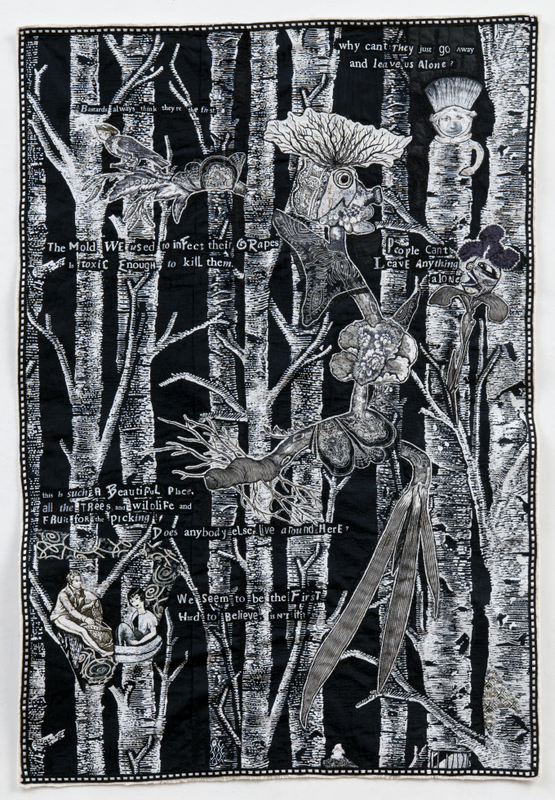
Lovely Dark and Deep by China MarksLovely, Dark, and Deep, 2011

CM: All I ever know is what to do next, even if I have to un-do it the next day or a month later.  But I have to do it.

HH: That sense of necessity in the process — just doing what you have to do — raises for me a question about necessity in the result.  I have seen the backs of some of your sewn drawings.  Each verso has its own integrity and beauty, a complement to that of the recto.  Which makes me think of the pedimental sculptures from the Parthenon, painstakingly finished on the back, even though they were made to be positioned in such a way that the back would never be visible.  Accident?  Design?  Is this result (the beauty of your versos) a necessity?

CM: The difference between my versos and the parts of ancient sculptures that were finished even though those parts would never be seen, is that my versos thrive in the dark, neglected and unheeded until they’re photographed at the end. I don’t make them. They happen because sewing machines stitch on the back as well as the front. They are entirely uncalculated, all their power and coherence transmitted from what is occuring on the other side. Mirror-image twins.

HH: You speak of your work with a kind of animism that out of context I might regard skeptically, but that in regard to art I am inclined to embrace, namely that those versos “thrive,” that they are able to “transmit” their power and coherence without being seen.  But what I am most fascinated by in your response is the observation that the versos are “entirely uncalculated,” rather than your making them happen.  Their power and coherence result directly from your process, but either indirectly or not at all from your intention.

CM: Yes, the power and coherence of my versos result directly from my process, which contains the time it takes to make a particular drawing, my intentions, the workings of my sewing machines, my threads and fabrics, my tools, artifical and natural light, my doing and undoing stitches, the weather, the music I listen to, whether I swam in the morning, what I ate and read that day and the last, etc. etc. The process is much wiser and goofier than I am. By the time I finish a drawing, it is breathing on its own and full of all kinds of things I could never have imagined, including its verso.  I make my drawings and books in order to see them.  I couldn’t possibly think them up.
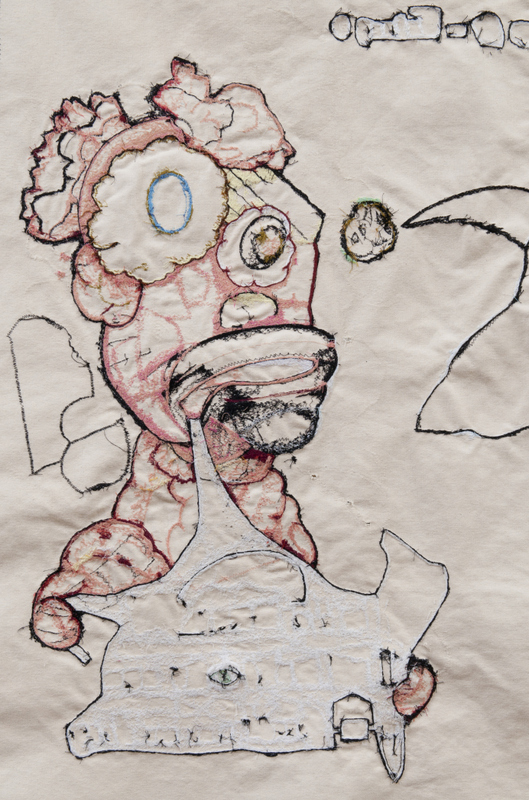
verso Bear's Dream by China MarksDetail, verso, Bear’s Dream, 2011

HH: I wish we were geographically close enough that I could have you in every semester to speak with my writing students.  What you’ve just said in relation to your visual art studio practice applies also to a writing practice.  But it seems to be, for many people, a very difficult step to take.  I mean your conceiving, and maintaining in your creative process, a distinction between making and intention.  I find that many aspiring poets believe that making must fulfill an intention that is already complete prior to its enactment, but that assumes that one is oneself the locus of wisdom, and the source of wisdom, in the enterprise.

To think up something first, and then employ the medium as a means to make the already-thought-up thing could make sense only if the smarts are in the person rather than in the medium.  But I hear you observing something with which I concur: more wisdom is to be found in one’s medium and in one’s process than in oneself.  That shift is radical, and, I believe, all-too-rarely made: from thinking that through one’s art or writing one shows the world to others, to thinking that one’s art or writing might show the world to oneself.  When we talk about the importance of process, I take that as at least one thing we mean.

CM: One thought casting back to the beginning of our conversation and a question for you, but they’re related, so I’ll start with the thought. You’ve said that you don’t believe in inspiration. I didn’t look this up, but doesn’t that come from Inspiritus, being possessed of the gods in the form of a divine wind or breath?  If we become instruments of our process, about which so much remains stubbornly ineffable, is that much different? There were various ritual practices to summon the gods, standing inside a circle drawn in the dirt at the new moon, bathing and putting on new clothing, fasting, and so forth. Most visual artists and writers need particular conditions in order to work.  Only in daylight, only at night, five no. 2 pencils sharpened to a point, a particular word processing program, coffee or scotch, after a run, with a favored brush, whatever it takes to make us ready to give ourselves over to the process.

I think that I have it easier than you, because I start by selecting a hundred or more scraps of patterned fabric, backed with fusible adhesive, from thousands so prepared, and go from there.  But how do you start?  With an idea or a phrase?  Do you write in your head for a while before you let yourself write it down? Is it always the same way?  That’s my question.  Where do your poems come from?  And how?

HH: It may be that some of the affinity I perceive between your drawings and my poems derives from affinity between your process and mine.  I do have rituals — I write early in the morning, I wear as a talisman a ring given me by the poet William Meredith, I write with an elegant fountain pen Kate gave me — but the content of the rituals is (as your comment suggests) not as important as the fact of the rituals.  I don’t think one need believe in the real existence of something invoked (such as gods or divine winds), to find efficacy in the act of invoking.  In fact it may be better if one does not so believe, as Simone Weil implies when she calls it “a method of purification” to pray, “not only in secret as far as men are concerned, but with the thought that God does not exist.”

But it’s the collecting I’m focused on here as an element of process we share.  You say you start with scraps of patterned fabric you’ve prepared.  I start with scraps, too, only in my case it’s scraps of language.  For me, the writing of a poem is not an act of self-expression but an act of listening.  A poem, for me, is not the externalizing of an idea or feeling that was inside me prior to the poem, but the derivation of a linguistic construct implicit in a fragment of language, as one derives a theorem from premises in mathematics.  It’s not that I show others in my poems what I happen to feel or think, but that my poems show me what I ought to feel or think.  As with a mathematical theorem, it is their necessity, not their accidental connection to me, that matters.

CM: Could you talk a little about how that necessity operates in your poem “What Creature In What Darkness”?

What Creature In What Darkness

So accustomed to light have we grown (evolved, really,
it’s not you and me only, not decision exactly)
that we forget the lives, species, entire biotas
underground, in caves or tunnels no light tastes, ever.
Which doesn’t mean they don’t inhabit us, or that we
share with them no (actual, not merely potential) traits.
In water the whale, in air the hummingbird:
to these totems I arch elements of identity.
Underground, who knows what sister life-form waits.
I have my library of unconscious states

that I claim awareness of, and accept,
though clearly that’s contradiction and self-deception.
What creature inhabiting what damp darkness
will show me what I might morph into, might have been
all this time?  Does it glow?  What best describes its limbs?
What sounds in what notation by what lurching has it scrawled?
Does it have limbs?  Does it crawl?  Or is it sessile,
gasping then lisping what vagrant spores and molds it may?
Or just patient, able to trace but waiting instead, curled?
This is my preferred world, the shadow world

that does not — need not — speak, will not be spoken to.
All this flailing at communication — I’m flailing now
just shows I haven’t learned, may never learn, to abide.
Who realizes the desperate still wants the needful.
Wait, the subterranean advises.  Wait, wait.
Because only by waiting may one hear the gritty
shifting of Patience itself.  Even that’s misleading, though:
the one who waits despises Because.
When she who is here with me is here with me, with me
beneath this city there is another city,

ruins not restored, not even preserved, but hosting
a less demonstrative but equally insistent
other estimation.  When she is here with me,
she is the other city, host to (or sum of)
secret othernesses and nethernesses.
We need not think of lives as woven by a loom
to think of them as interwoven, and need not pretend
they watch us, or care, to make of them second chances,
alternatives, opportunities to assume
other orientations to the textured vacuum.

HH: In an important sense, you are the source of this poem.  Maybe you’ll remember a studio visit Kate and I made a couple of years ago to see what you were working on.  During that visit you gave me an exhibition catalog of work by a painter friend of yours, Thomas Lyon Mills.  His work stayed in my head, so when I began the “Show and Tell” project on my blog — the project in which poets respond to images by artists, and in which your own work appears — I looked him up and asked him to participate.  This poem derives from his participation.

“What Creature In What Darkness” is one of a sequence of poems, all of which come from that “Show and Tell” project.  Each poem in the sequence takes the form of a “glosa,” so in fulfillment of that received form the last line of each stanza is quoted: the last lines of the first two stanzas come from the artist statement of the particular artist in question, and the last lines of the last two stanzas come from the poem the poet made in response to the artist’s work.

“What Creature In What Darkness” derives from the pairing of the artist Thomas Lyon Mills with the poet Evie Shockley.  So the lines “I have my library of unconscious states” and “This is my preferred world, the shadow world” both are quoted directly from Mills’s artist statement, in which he describes his (amazing) process, which centers on research in underground catacombs in Rome.  The lines “beneath this city there is another city” and “other orientations to the textured vacuum” come from the poem Shockley wrote in response to Mills’s work.  “What Creature In What Darkness” tries then to listen to what words and images follow inevitably from their words and images.

To put this another way, those lines borrowed from Thomas Lyon Mills and Evie Shockley perform the role your selected scraps of patterned fabric play.

CM: Haven’t you sometimes also used borrowed language more directly as found objects, as in Chromatic, where you appropriated early 20th century vernacular speech to great effect?

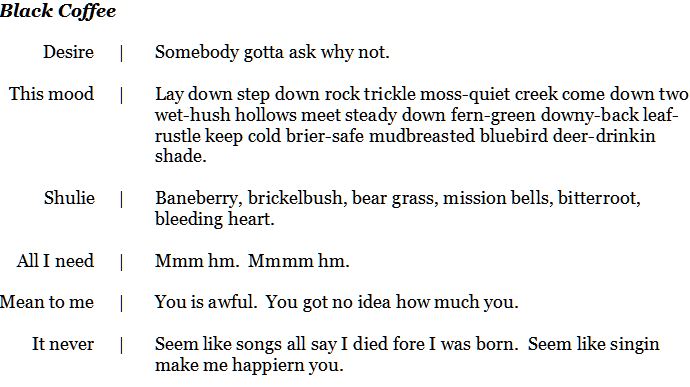
HH: Appropriated language definitely is important in Chromatic.  Almost all my poetry starts with found language.  Introspection and perceptual observation follow, but the found language almost invariably offers the starting point.  That found language might be “intellectual,” derived from things I read: that happens, for instance, in the first sequence in Chromatic, “Remarks on Color,” which draws on two sources, Wittgenstein’s Remarks on Colour and Mondrian’s Natural Reality and Abstract Reality.  But the found language might also come from other sources, and you’re right about my interest in vernacular speech.  I assume you’re referring to “Eighteen Maniacs,” the second sequence in Chromatic.  Here’s one of the shorter of those poems.
hix poem2

One reviewer mistakenly identified these poems as operating in “blackface,” trying to mimic African-American dialect.  But I’m after a much broader attention to dialect and vernacular.  So the sequence does include usages drawn from (or based on) African-American vernaculars, especially the rich language that grew up around jazz.  (The sequence itself is a kind of abbreviated history of jazz, as signalled by the title: “eighteen maniacs” was one way Duke Ellington referred to his band.  Each piece in the sequence revolves around one jazz musician.  In “Black Coffee,” all the words in the left-hand column come from Sarah Vaughan: titles of her songs, etc.)  But “Eighteen Maniacs” includes other vernaculars as well, such as the regional dialects I heard growing up in small towns in the South.  The “seem like” in the last sentences here is not peculiar to African-American vernacular, but shows up in many regional and ethnic dialects, often enough that in linguistics it has a name, “sibilant deletion.”

CM: Was it always words for you, even as a boy?  I ask because I remember a crucial time in my own life, when I was about 19, when I gave up on words and embraced image-making.

HH: Even though I was a late-comer to poetry per se, and even though I wouldn’t have known it at the time, it was always words for me.  I drew a lot as a boy, birds in grade school when I was obsessed with birds, cars in high school when I was obsessed with cars.  But even though I grew up in a household (and in school districts) that didn’t introduce me to poetry, I can see in looking back how the household’s preoccupation with language nurtured my own.  My father, a journalist, made his living with words; there was always popular music playing, so the lyrics of songs performed by Johnny Cash (my Father’s favorite) and Andy Williams (my Mother’s) and the Carpenters (my older sister’s) and Olivia Newton-John (my younger sister’s) were in my head; it was a religious household, so I listened to a thousand alliterative Baptist sermons and memorized a boatload of Bible verses in Sunday School; and so on.

Consequently, when at last I was exposed to poetry, as a college undergraduate, I was “primed” for it by all that intense attention to other language uses.  I’d been socialized, without being aware of it in these terms, into the sense that language mattered, indeed (this especially from the religious context, in which language, in the form of prayer, is the vehicle through which one speaks to God, and also, in the form of scripture, the vehicle through which God speaks) that language is a matter of life and death.

It’s interesting to me, in the context of this question, though, that words have become quite active and prominent in your recent drawings.  Which in one way may not be so surprising: I would want to modify the self-description you give in asking this question. Yes, you gave up on words in the sense that you went for a long time not producing words as part of your work, but it seems to me that — at least for as long as I have known you — you have been very actively receiving words as one aspect of the preparation for your work.  Your omnivorous (and category-confounding) attention, your relentless intelligence, includes intense attention to words.

CM: I was a great, omnivorous reader as a child and adolescent, and I’ve written all my life, long letters back in the days when people wrote letters, accounts of dreams, descriptions of acute psychological states, journals, richly detailed assessments of arts-in-the-schools for my job at the NYC Board of Education, stories and poems, especially when I was in love. I also talked a blue streak. My late friend Stanley Landsman once predicted that if after we died, all the words we’d spoken were heaped in a pile in front of us, my pile would be twice as big anybody else’s.

But my facility with words is what made me distrust them. They could mean almost anything, while during my adolescence and early adulthood, most of what mattered was worldess and sensory, sexual, instinctive, uncanny.  In those days, I used words to “pass” as not-crazy, till I couldn’t any more.

But when I started making text-based books in 2009 after a chance encounter with a dead umbrella printed with words, it was just part of my process.  And it turned out that I had a lot to say, more than I can fit in my drawings.  So I’ve begun to collaborate with letterpress printers. The first project, a little poem of mine, four verses with six lines in each, printed as a pamplet, is already in the works. A broadside comes next, and I already have the text for it.

HH: It seems like we’re making a connection here between process and paying attention.  We’ve talked about the importance process has for us, about its centrality to our practice, but how does that play out in a particular work, such as “The Language of Flowers”?  How does process amount to paying attention?
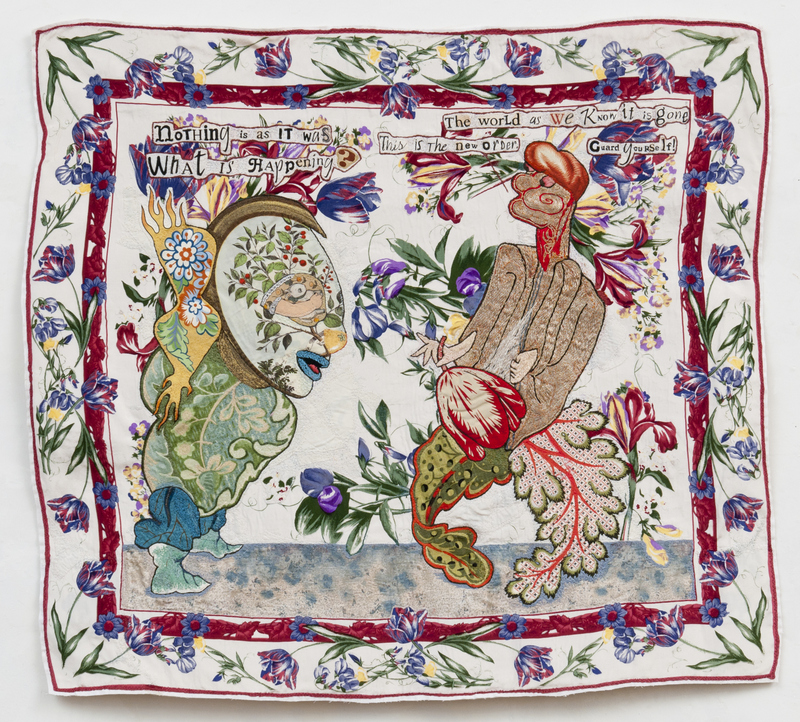
 

The Language of Flowers by China MarksThe Language of Flowers, 2012


CM: One must be fully present to make process-directed work, expanding one’s attention to take in the work at hand, but also to a lot of other things that might be relevant to the process…

When I visited Gerry Trilling in Kansas City in 2010, I bought two vintage scarves at an “antiques” mart in the river bottoms.  I really wanted them and I could afford to buy them, but I had no idea of what to do with them. I rarely do.  Almost two years had passed before it occurred to me to try to create a space inside the borders of the Liz Claiborne scarf and then to construct two eccentric, flamboyant figures to occupy that space.  I don’t remember deciding that one figure should be static and the other dynamic.  I concentrated on keeping as much of the original print as possible and altering as little as possible what I imported. As these fellows came to life, it occurred to me that it must be so strange for them: they’d changed from scraps of printed fabrics to beings — nothing was as it was!  Which is how the text began.

But as I refined the drawing, they seemed more and more like Renaissance courtiers in a walled garden, which is how the text ended. It’s probably just as applicable to our time. It’s pleasant enough, but the world as we know it is gone. Guard yourself.

HH: That’s it, though.  This image has in spades one of the forms of dramatic tension I experience — see and feel — in all your work.  One the one hand, it emphasizes features that make it entertaining: a bright palette, playful figuration, dynamic composition, a “busy” surface, and so on.  But on the other hand, this entertaining, even delightful, image is terrifying.  This drawing, like your other drawings, is the world: I as a viewer recognize the figures as figures, etc.  But it’s not the world given to us by Hollywood romantic comedies or tv sitcoms.  The world as we know it is gone, replaced by the world of the drawing.

CM: I don’t think that anything I make really stands outside our world, or rather, the various overlapping and interpenetrating worlds that comprise out present reality.  Things out there, murders, starvation, genocide, the coarsening and brutalization of whole populations, natural disasters and extinctions, are terrifying, not The Language of Flowers.

HH: And yet you spoke earlier of a world parallel to our own, accessible only through your work.  That seems an important complement to what we’re discussing here.  That tension/paradox is one way I would try to speak of the importance your work has for me.  I contend that one can’t know this world by knowing only this world.  (The facts, in other words, are not enough.)  To take the most obvious kind of example, our capacity for ethical judgments depends on our imagining other worlds.  To say that women and members of ethnic minorities ought to have the same rights as males of the privileged ethnic group is to imagine a world parallel to our own, and the “ought to” imputes to the imagined parallel world a “reality,” a force, greater than that of the “real world,” the world as we know it.

So I’d repeat your words, “The world as we know it is gone. Guard yourself.”  And add: gird yourself.

CM: And yet somehow, every glance into the abyss sends us back to our work with fresh vigor, I to my drawings, you to your poems.  Don’t you have a poem or part of a poem about that?  It would make a nice end to this.

HH: Maybe they’re all about that, but here’s one I’ll re-title for this context.

Another Glance Into the Abyss

But that my having fallen came first,
I had not known to call falling

this feeling of following grainy shades
into gray, waving for want of wings,

or fog this silent summoning,
a city sunk whole under a sea.

Who would watch waves must lean into wind.
They wind up lean who long want rain.

If not for waiting, why have we mouths?
If not for failing to fly, why fingers?

— China Marks & H. L. Hix

————————

H. L. Hix lives in the mountain west, where he marvels at how late in the summer it is before hummingbirds arrive at 7,200 feet, at how hardy pocket gophers are, and at the fact that he can survive at an altitude at which cockroaches cannot.  He and his partner, the poet Kate Northrop, live in an 1880s railroad house, and their studio space is converted from what was once a barn.  His recent books include a “selected poems,” First Fire, Then Birds: Obsessionals 1985-2010 (Etruscan Press, 2010); a translation, made with the author, of Eugenijus Ališanka’s from unwritten histories (Host Publications, 2011); an essay collection, Lines of Inquiry (Etruscan Press, 2011); and an anthology, Made Priceless (Serving House Books, 2012).  His website is www.hlhix.com.

China Marks was born and educated in Kansas City, MO, earning a BFA in Sculpture from the Kansas City Art Institute. A Fulbright-Hayes fellowship took her Katmandu, Nepal, where she spent sixteen months constructing a major installation out of local materials. On her return to the United States, she was awarded a graduate fellowship by the Danforth Foundation. In 1976, having received an MFA in Sculpture from Washington University in St. Louis, China moved east to make art. She has received numerous grants and awards, including three fellowships from the New Jersey State Council on the Arts, a Mid-Atlantic Arts fellowship, two George Sugarman Foundation grants, and two New York Foundation for the Arts fellowships, most recently in 2011, when she was also named a Gregory Millard Fellow. Since 1999 China Marks has lived and worked in Long Island City, a block and a half from the East River. Her work is shown in galleries and museums in the United States and Europe. She is represented by the J. Cacciola Gallery in New York. Her drawings will be shown there in May as part of a group show.

—————


Footnotes    (↵ returns to text)

  1. Who Am I? What the Lowly Riddle Reveals,” November, 2012
Nov 112012
 

The riddle is an ancient and persistent literary form. In Bowstring: On the Dissimilarity of the Similar Viktor Shklovksy writes about riddles:

Hegel wrote in his Lectures on Fine Art that “the riddle belongs to conscious symbolism.” What is the riddle’s answer? It is derivation of meaning. According to Hegel, the riddle consists of “individual traits of character and properties drawn from the otherwise known external world and, as in nature and in externality generally, lying there scattered outside one another, they are associated together in a disparate and therefore striking way. As a result they lack a subject embracing them together [as predicates] into a unity . . .” This disparity of signs hinders the immediate solution as to which whole they all belong to.
 In veiling the whole, the riddle forces us to rearrange the signs of a given object, thus showing the possibility of diversity, the possibility to combine the previously irreconcilable in new semantic arrangements.

Herewith we have a shrewd, clever, witty and expansive essay on the riddles and riddle poems in (mostly) Western literature from The Book of Exeter to Harry Potter and J. R. R. Tolkien and Emily Dickinson. It’s partly a highly suggestive craft essay and partly an informal history of ideas, also a refreshing sort of literary criticism, the kind that takes a long and inquisitive look at the words on the page.

Julie Larios is a friend, an esteemed colleague in the Vermont College of Fine Arts MFA in Writing for Children and Young Adults Program and a gifted poet whose work has already graced these pages more than once (here and here). It is always a huge pleasure to have her back.

dg

—–

I’m not much of a “main highway” kind of person when it comes to thinking about the craft of writing.  I go down lots of sides streets, I let my mind wander. Sometimes even a side street feels too wide. And I’ve been thinking lately about a small alley named “Riddles,” a deceptive short cut (sometimes filled with broken bottles and garbage cans) between one street and the next. I have the feeling deception is important. “Most felicitous sayings rely…on a capacity to deceive beforehand…” said Aristotle. “We have even more obviously learned something,” he said, “ if things are the opposite of what we thought they were, and the mind seems to say to itself, ‘How true. I was mistaken.’”

Riddles are all about questioning our own grasp of the world by questioning the nature of things, casting a new light – thereby casting new shadows –  and I believe that thinking in riddle-mode can help us be better writers. After all, don’t riddles follow the pattern of all great works of literature by asking large questions of us like “Who am I?” and “Are things what they appear to be?” and – perhaps the most important question of all – “When is a door not a door?”  Ah, yes, one of the great questions of Western literature.  It has survived the test of time, as has its existential answer – “When it’s ajar.”

I remember the first time I heard this riddle, I was in Mrs. Frizzy’s second-grade class at Booksin Elementary, standing outside the cafeteria in the lunch line.  A boy named Dickie, who was in line in front of me, turned and asked, “When is a door not a door?”

I repeated the riddle out loud. “When is a door not a door?”

Dickie waited as I turned the riddle over and over in my head. Well, I thought, maybe it’s not a door if it’s like a –what do you call it? – one of those swinging things you see in the movies; cowboys push through them when they walk into an old-time saloon, like Gary Cooper did in High Noon, or maybe John Wayne in something?You know, not a door but like shutters on hinges.  I didn’t say that, because it didn’t seem to me like Dickie was waiting for that particular answer.  So I repeated the riddle with more emphasis.

When is a door not a door?”

Dickie looked annoyed, so I gave him what he was waiting for: “I don’t know.”

“When it’s ajar,” Dickie said.

What?” I asked, which is actually a good question the first time you hear a riddle like that.

“When it’s ajar,” Dickie said.

A jar?” I asked.

“Yeah,” said Dickie, snickering.

“I don’t get it,” I said.

“When it’s ajar,” Dickie repeated.

“What do you mean, when it’s a jar?” I asked.

“Ajar,” Dickie said.

I said nothing.

“Ajar,” Dickie said again.

“Oh,” I said, as if I understood. And that was that.

I think it was my father who explained the answer to me. I bet my mother groaned, but my father probably thought it was funny, and I was left at 7 ½ years of age wondering about the world of discomfort and flat-out deception that the English language might inflict on me for years to come.

And that was my introduction to riddles. I didn’t like them. They weren’t funny. They made me feel stupid. I don’t remember ever telling them to my friends. I don’t think I ever checked a riddle book out of the library. Some people groan when they hear punning riddles, other people laugh. For a long time, I didn’t laugh, I groaned.  Now, if I’ve never heard the riddle before, I usually laugh and groan.

“What’s black and white and “red” all over?” Answer, of course, a newspaper – black and white and “read”– r-e-a-d-  all over.  

This category of riddle is also called “Shrewd Questions.” The riddle of the Sphinx is a shrewd question in an answer-this-or-you-die way. Basic shrewd questions and punning riddles are the riddle forms most children are exposed to, and I think it’s fair to say some of these shrewd questions are shrewder than others.

What did one wall say to the other wall? (Meet you in the corner.)

What birds are always unhappy? (Bluebirds.)

How do you make a lemon drop? (Hold a lemon up and let it go.)

If there were no food left in the city, what would you eat? (A traffic jam.)

I particularly like that last one.  It turns the word “jam” so steeply and suddenly on its head that the reader thinks immediately, “Traffic jam – what a strange phrase.” Anything that slows us down and makes us hear language in a fresh way is alright by me, though I didn’t believe that when I was seven.

I do remember liking the following shrewd-question” riddle, even when I was young: What flies but has no wings?  The answer –most of us know this – is Time. That riddle is elegant – it moves away from goofy wordplay and into the territory of poetry. Emily Dickinson, whose poems were sometimes riddles and sometimes what appear to be their opposites – definitions –  knew this when she said, “Hope is the thing with feathers that perches in the soul.” To turn that definition into a riddle, all you do is reverse it – “What has feathers and perches in the soul?” One answer could be Hope. That’s the kind of riddle I’m interested in.

Listen to the lovely beginning of this “riddle” by Ms. Dickinson:

She sweeps with many-colored Brooms—
And leaves the Shreds behind –
Oh, Housewife// in the Evening West –
Come back, and dust the Pond.

Who is the Housewife in the Evening West with her many colored Brooms? She’s the sunset. Dickinson’s poetry is full of definitions and riddles. What house has no door? “Doom,” Dickinson answers.

At the very least, riddles help us understand that definitions are elastic, as is identity itself, and language is delicious and strange, not to be taken for granted. As a creative writing teacher, I like encouraging fiction writers to taste them – words – once in awhile. Like blueberries, they are good for you, full of antioxidants.  It’s a fine approach, slowing down and thinking about word sounds, word choices, and how language either flows or gets tangled into traffic “jams,” or – and this is a shame – how it loses its luster and becomes dull, rusted out by cliches.   I believe we write better fiction when we balance forward motion (plot) with attention to language.  And I could justify studying riddles that way, hoping they would be seen as evidence of the nutritional value of wordplay.  Acquire a taste for wordplay and see where it takes your prose. If it takes you too far, step back – no need to go overboard, and certainly no need to go beyond wordplay and overwrite the thing, no reason for your language to get fancier than the story requires it to be.

But I‘m actually more interested in how our minds use language as a way to organize the world – that is, the way the mind searches for stability by creating categories and classifications, and the way it makes meaning. I’m quite serious in saying that the study of riddles – their long history, their presence in nearly every culture of the world in every age, their subversive nature – affects our mode of thinking. Riddles interrupt our human inclination to stash things in well-defined cubby holes, to insist upon order and to find “solutions” to things that puzzle us. Riddles ask us sometimes to live comfortably without firm solutions. At their best they can teach us to think metaphorically, to find fresh ways to say things, to think about indirection as a writing strategy, to build a tolerance for alternative meanings and contradictory truths, to turn away from infallibility and learn to live with our own stupidities, and to question assumptions – something every writer, not to mention every good citizen in a participatory democracy, should know how to do. For example, here’s a riddle which is not poetry but which I do like:

A bus driver was heading down a street in Colorado. He went right past a stop sign without stopping, he turned left where there was a “No Left Turn” sign and he went the wrong way on a one-way street past a cop car. Still – he didn’t break any traffic laws and didn’t get a ticket. Why not?

(Because he was walking.)

Our assumptions are wrong from the beginning, and the person who framed this riddle understood how to manipulate the reader into believing one thing (a bus driver only drives) while many alternative things about a bus driver are true – for example, a bus driver can walk. Riddles obstruct our desire to pigeon-hole people, objects and events, and to keep things neatly organized in categories. They make us rethink our assumptions.

I’m interested in that. I’m interested in the interruption of assumptions as a technique of fiction. We lead people to believe something, based on the preconceptions they come into the story with. Then we turn those preconceptions on their head, and we take our readers someplace unexpected. Neither our characters nor our readers have to go where stereotypes, clichés and assumptions push them – they don’t have to file things into orderly little categories like “bus driver” or “walker” or – more irritatingly – “bad guy” or “good guy.” Characters can be more complicated, readers can be asked to leave their assumptions behind. And as both readers and writers, we can say, as Aristotle wants us to say when we learn something new about the way the world works, “How true. I was mistaken.”

Sure, there’s a level of discomfort associated with admitting we are fallible. But being convinced of our infallibility will ultimately make us miserable (along with our readers, our spouses or partners, and our children) due to a little thing called hubris. Believing as an author that you have a lesson to teach, that you know the truth, that you are infallible, can be lethal to your storytelling.  For starters, it usually produces boring stories.  It also assumes your readers are children in need of guidance – not bad if they are children (after all, five-years-olds are probably not quite ready to be knocked senseless by the blurred line between good and evil) but not great if they’re young adults and fully-grown adults.

One solution to being boring and pedantic is getting into a riddling frame of mind – admitting that answers are hard, that tricks are played, that situations and people are not always what they appear to be, that the “right” answer sometimes proves to be wrong, that we’re not the only ones who head one way and then have to circle back or start over in order to understand.

I grew up thinking riddles were only puns and plays on words. I moved from the typical groan to a kind of bemused admiration for the best punning riddles, and lately I’ve felt true affection even for the worst ones. Especially for the worst ones, actually. But punning riddles and “shrewd questions” are only a small part of the whole idea of riddles.

I took several classes at the University of Washington with the poet Richard Kenney, whose delight in word play, proverbs, charms, curses and blessings was infectious. He mentioned in passing one day that his favorite riddle was a medieval one, traced back to the 1300’s: Round the house and round the house, and a white glove at the window.

I’d never heard a riddle like that, and it stopped me in my tracks. It was a riddle, yes, but it was also mystery and a story, and it was also poetry. Who or what was going around the house? Why more than once? Who did that white glove belong to, why was it at the window, what was happening? Could I conjure up a narrative to stand alongside this riddle? A girl who is pushed…is it sorrow that spins her round and round, is there something of herself she leaves behind? Something that says, “I was here”? Or something that asks “I was here, but who was I?”

Professor Kenney told us one answer to that riddle, of course. What was swirling around the house was snow, and it left a white glove – a small drift – at the window.  But he wasn’t as interested in answers as he was in questions.  He believed, as Samuel Coleridge did, that “In a complex enigma, the greatest ingenuity is not always shown by [the person] who first gives the complete solution.”

I thought about that riddle – Round the house and round the house, and a white glove at the window – as I went to sleep that night. Along with all the other questions I had, I began to think about another person – the one inside the house, looking out.  What is that person doing or what is happening to that person? I loved how far I could take this riddle, loved feeling haunted by it, loved trying to make sense of it and loved its changing perspective.  Good poetry makes you do that, makes you wonder. Wondering was what I enjoyed, not the “solution.” And the riddle didn’t say, “Snow is like someone going around and around the house and leaving an accumulation at the window frame that is similar to a white glove.” And it didn’t say “Snow IS a white glove at the window frame.” Those imply a more direct approach to metaphor and simile. I’m interested in the leap – the method to the madness– and in what we don’t see.

The snow riddle’s method is indirection – another term for “sleight of hand” – the trick of magicians and con men who convince their audiences to pay attention to one hand while the other hand is hiding the card up the sleeve.  Indirection is what Archibald MacLeish was talking about in his poem “Ars Poetica” when he said that for “all the history of grief” you could substitute “an empty doorway and a maple leaf.”  This ability to direct attention somewhere else – to describe something by describing something else – is the key component of poetry. Taken larger, and sustained a bit longer, it becomes T.S. Eliot’s objective correlative. Basically, it boils down to this: You turn the reader’s gaze to something clear, physical and observable, in order to understand something deep, emotional and invisible. Grief exists, yes, but it’s an emotion, an abstraction, while an empty doorway is touchable and real – much more powerful for a writer to use, because it gives us an image rather than something ephemeral or intellectual.  What we encourage our readers to do, when we use this strategy, is to think about convergences: “How and where does this touchable object intersect with that emotion or idea?” But we don’t ask the question directly. We simply turn to the physical world and evoke it. We let readers understand, either immediately or later, on closer reading, that we directed their attention to this other thing for a reason. This is the point at which the writer makes a leap of trust –we trust our readers to notice and to make meaning.

One reason we use indirection is because it’s more subtle. No one wants, hopefully, to hit a reader over the head with a 2×4 to get a message across. We don’t say, “Hey, that maple leaf, it’s grief, get it?” Instead we want the reader to intuit that when a character turns to look at something – let’s say it’s a bird flying – the bird stands in physically for an invisible desire. Perhaps the character wants “to fly,” to break out of his or her oppressive world.  The repeated trope of the flying bird becomes an objective correlative, triggering this convergence automatically. Granted, a bird standing in for freedom is a cliché; writers should be able to come up with something fresher than that.  But cultivating a riddling frame of mind helps us turn from blatant telling to subtle showing, via correlatives – things that correlate –  and that’s an important tool for our writing toolbox.

At the heart of riddle-making are the concepts of correlation and equivalency. A equals B. That sounds more like basic math than story, doesn’t it? But math is not the opposite of story, because math, like much of human behavior, is about patterns. Metaphorical-thinking is also a matter of patterns and convergences – A and B overlap and intersect like harmonies in music.  Or, in chemistry, A and B exhibit the same properties when reacting to C.  Or maybe it’s alchemy – base metal (the story’s bones) turn into gold (the story’s beauty.) By thinking of a story that way, I can create a riddle:

Bones in my body, that’s how I stand.
Beauty as I move, my sleight of hand.  
Who am I?

Does my riddle-poem have an answer? Well, one answer could be “a good story.”  Her bones and her body are structure and plot – without them, she can’t stand.  The beauty and sleight of hand are language and metaphor – without them, there’s no magic, no elegance, no “liquefaction of her clothes” to borrow a phrase from the poet Robert Herrick.

You can notice freshness of thought in something as simple as a Mother Goose rhyme describing a candle: Little Nanny Etticote in a white petticoat and a red nose. The longer she stands, the shorter she grows. In this ditty is the most basic of all lessons about writing: “Say it new.”

After taking Rick Kenney’s class, I started collecting “Who Am I?” riddles. I love the idea of identity being hidden behind the mask of metaphor.  It’s a little exciting, a little creepy, a little Carnivalesque. Reality with some slippage into the dream-world, that’s what the language of many riddles is like. Here for example:

Always old, sometimes new, never sad, sometimes blue. Never empty, sometimes full,
never pushes, always pulls. Who am I?

One answer is “the moon,” which is old, yes, but sometimes we see a “new” moon, we see a blue/sad moon though never a blue/blue one.  How lovely, in this case, to find identity in contradiction. Not a bad thing for people to think about, that contradictory things can both be true.  There’s the moon, a large stone in the sky, supposedly dead and cold.  And yet, it glows, it pulls.  That feels like something to put into a story, a very human story, something that turns to the sun and says, “Did you do that?”

In my hunt for “Who Am I?” riddles, I found a huge encyclopedia of Indian Literature offering up these three Punjabi riddles:

I’m the son who can climb to the roof before his mother is born. (Smoke)  

See her coming, see her going, thinner than water, sweeter than sugar. (Sleep) 

Tied in a blue cloth, a handful of rice –  lost in the daylight, found at night. (Stars in the night sky.)  

Compare that last riddle to one from the Aztec culture in Mexico, transcribed by early Spanish explorers – same answer, but it goes like this: A blue calabash sprinkled with toasted kernels of corn.

Here is a lovely riddle from the Congo: Who am I that when I fall, I make no noise?   (Night.) To me, that feels like the beginning of a story. It encompasses the Zen idea of satori which, by means of a koan – a kind of riddle –  produces first, hesitation, then, self-revelation.

It’s curious how the Western mind puts objects and people into well-defined hierarchies of classification,  just as pre-determined as those used in museums of natural history. The famous cognitive scientist Stephen Pinker calls categories “fuzzy similarity clusters” and the key there might be the word “fuzzy.” The edges are not always as well defined as we want them to be. When is a door not a door? If we think too rigidly, in “unfuzzy” similarity clusters (in this case doors) we can’t come up with solutions. The more determined we are to sort things according to the closed cluster we assume they are in, the more we fail.  If something is a door, it can’t NOT be a door, right? If something is a son, it can’t be smoke, can it?  Well, what if we learn to think of fire as a mother? Is smoke her son? We’re re-clustering when we try to understand the relationship of fire and smoke to mothers and sons. George Lakoff, who knows a thing or two about metaphor, says that putting things in categories is a “bad habit” left over from the days of Aristotle. Lakoff says “pristine categories are a fiction.” So if we want to move over from Aristotelian territory into a landscape where categories are fuzzy, maybe we need to change the way we think and the way we use language. As the wonderful poet Richard Wilbur said, riddles are the “confounders of categories.” Deception is not only the riddle’s method but the riddle’s glory.

The language of literary riddles can cross over into a dream-world in the same way charms, incantations, curses and blessings do, as opposed to punning riddles where much of what confuses us and makes us hesitate is a trick. Many of the great writers of fantasy, interested in the dream-world, have been interested in riddles. That’s because one essential question of fairy tales, legendary quests or shape-shifting is “Who am I?” Looking at the Harry Potter series, an extended journey where Harry moves from innocence to self-knowledge, we see a world filled with riddles, including at the most unsubtle level, Lord Voldemart’s original name, Tom Riddle. Likewise J.R.R. Tolkien, whose characters Bilbo Baggins and Gollum in The Hobbit engage in a riddle duel, using along with traditional folk riddles some examples written by Tolkein, like the following about the wind: Voiceless it cries,/  Wingless flutters, / Toothless bites, / Mouthless mutters. And this, whose solution is Time: This thing all things devours: / Birds, beasts, trees, flowers; / Gnaws iron, bites steel; / Grinds hard stones to meal;/ Slays king, ruins town, / And beats high mountains down.

Imagine yourself as a twelve-year old again, reading The Hobbit for the first time, trying to figure out the answers to those riddles.  The more committed you are to finding a single solution, the more you must learn how to de-code, looking for words that block you and send your thinking into the orderly, tidy world of classifications and categories, rather than into the messier poetic world of overlapping meanings and metaphors.

De-coding is a valuable thing – nothing wrong with looking for the trick that’s being played on you. But it’s a familiar undertaking, and it treats storytelling as if it were a standardized test.  Find the right answer, fill in the bubble. The thinker who stands outside the box and see alternatives that are equally interesting or plausible traditionally does the worst on that kind of test.  Do we want always to encourage the decoding approach? Stories are not information, there are not right answers. A story haunts us not because it can be decoded but because it can’t. Not quite, anyway.

This is another thing the lowly riddle reminds us of: Good readers – and the good editors and good critics who judge them – don’t always want the most easily de-coded narrative. They often want something innovative. They don’t always want to know exactly how the story is built and where the story is going; they want surprise, whether in structure, language or plot.   As Emily Dickinson said: The Riddle we can guess / We speedily despise —/ Not anything is stale so long / As Yesterday’s surprise —

Some riddles, like some very good stories I know, are not meant to offer solutions; they’re only shaped to make us wonder.   Part of the pleasure derived from them is in the hesitation they produce – that “satori” I mentioned. Hesitation, failure of the author to spell it all out, drives readers who want easy answers crazy. What on earth are those bears about in Margo Lanagan’s Tender Morsels?? Lanagan wants us to hesitate – she expects us to make a guess, she wants us to make our own meaning from her story. Some riddlers and storytellers take such a lot of pleasure in the hesitation that they offer no answers at all. “How is a raven like a writing desk?” is one of the riddles Lewis Carroll posed in Alice in Wonderland, and it’s never actually been “solved.” Carroll did come up with an answer, but it was after the fact; he never intended the riddle to have an answer, and the one he made up later is pure nonsense. Northrop Frye, in his essay Charms and Riddles, says that Carroll’s riddle tactic was often to overwhelm sense with sound. I think that’s true, and not all of us want to overwhelm sense with sound, at least not all the time, though you’ve got to admit “Jabberwocky” is a lot of fun.

If we look up the word “riddle” in the Oxford English Dictionary, we can trace it back to the Old English root “rede” – meaning counsel, opinion, or conjecture. We come back again to the idea of interpretation. If riddles with no firm answers, and fiction open to interpretation and conjecture, can move us toward actively making meaning, that’s got to be a good thing, right? Most of us would be proud to help our readers do that. One of my students recently shared a quotation with me by the Austrian satirist Karl Kraus: “Writers are people who can make riddles out of answers.” If that idea appeals to you, you are in a riddling frame of mind.

And what if the answers to the riddles are lost? For over a thousand years, people have been offering up solutions (the answers have disappeared) to riddles in The Exeter Book, written between 960 and 990 A.D. by Benedictine monks. Some answers seem guessable: A wonder on the wave / water became bone. Could it be ice on a lake? Possibly. Some are more difficult:

I was locked in a narrow nest,  / My beak bound below the water
In a dark dive; the sea surged / Where my wings work – my body quickened
From the clutch of wave and wandering wood. / Born black, streaked white, I rise
from the womb of waves on the wind’s back,  / Sailing over seals’ bath. Who am I?

Bright people, many of them doctoral candidates working hard, have guessed at the solution over the centuries: Maybe it’s an anchor, a bubble, a barnacle goose, a water-lily, a baptism…? We just don’t know. Besides, dissertations notwithstanding, aren’t we better off swimming in that lovely poem and not knowing the answer?

With literary riddles, we sometimes learn to let go and say, “There might not be an answer I understand,” or “There might be more than one answer.” If you can be comfortable with that, then you’ve learned a very large and important lesson for writers, which John Keats described as “negative capability” – the ability to reside within “uncertainties, mysteries, doubts, without any irritable reaching after fact and reason.” That’s another lesson riddles can teach us – to live in uncertainty, to shrug and say, “I’m not sure I can come up with anything more than my own answer.” What we give our readers is not a possible answer, and not even a partial answer, but wonder.

Overwhelmingly, English teachers unfamiliar with poetry present it to their students as a process of decoding and finding an answer. “Here’s a poem; let’s decode it, let’s figure out the solution to the riddle.” That’s not bad exercise, actually – certain muscles build up. But one problem about this approach is that readers want the solutions to come fast. It’s a fast world, there should be fast answers. That’s a problem, because the best riddles (the best stories) don’t have easy answers – the reader works to make meaning.  The biggest problem is when a teacher says, “There’s only one right answer to this riddle – one proper interpretation of its meaning.” Admitting to alternative interpretations, admitting there might be NO answer, understanding that the joy is in the wondering, is essential in the classroom.  And it’s just as essential when it comes to the fiction we write.

It’s especially important to get into a riddling frame of mind for writers who are vulnerable to the super-virus called didacticism. If you have learned to live with uncertainty (that is, no single answer to the Big Riddles) it is very, very hard to be pedantic. We may offer up a scenario or a guess, but remaining open-minded is vital to being a good writer. There are so many ways people deal with adversity and try to live meaningful lives and make good choices in this world. Writers tell stories about the choices people make, and the changes those choices provoke, and the end-product is empathy. We don’t want to be “right,” necessarily – I don’t like to think of myself as a judge, coming down with the gavel and startling everyone in the courtroom. The economist Daniel Kahneman theorizes that people have two different systems for processing input – System 1 is the knee-jerk brain, the one that makes fast and easy choices based on biases and assumptions. System 2 is thoughtful and open to new perspectives and new information. I want to write a good poem or tell a good story that is filtered in by System 2.

After all, the effort to make meaning is often more valuable to us than what particular meaning we make. As writers, we present people with the stories that will help them pick up cues, think about behavior, think about complications, assumptions, categories and – bottom line – will encourage them to take all that System-2 thinking and make meaning with it. We give readers compelling situations and complicated characters. We give them a well-shaped story arc. We do it, hopefully, with some attention to well-crafted prose. That’s our part of the job. Then we let go. Our readers make meaning. And good for them for doing it.  A little work, a little lost sleep as they try to puzzle out their particular perspective on a story – isn’t that a good thing? It’s just as valuable as saying, “I’ve written a book that will tell you the answer about the right way to live in the world. I know who the bad guys are. I know who the good guys are, I know the solution to the riddle.” If you find yourself in that frame of mind as you write, feeling wise, feeling certain, feeling smug, get up from your desk and take a walk. Relax, come back later, when you remember that you don’t really know much.

So, I’ve been thinking about thinking. As I said, I go down not just side streets but narrow alleys when it comes to wondering how fiction and poetry work. For a moment, let’s allow  the vista open up on Heraclitus, the 5th-century B. C. Greek writer known as “the father of the riddle.” He came up with the idea of “logos,” which has at its core the idea of flux. In flux, the nature of things is not fixed and everything is in process. Heraclitus famously suggested that you can’t step into the same river twice, because the river is constantly moving and changing.  He also suggested that despite attempts to understand our world, “Things keep their secrets.” I like that idea. I find that satisfying because it humbles me. It encourages me to write poems, not teach people lessons. It allows me – and my readers – to guess. As Northrop Frye once said, “Guessing is an integral part of the poetic experience.”  And as Emily Dickinson once wrote to her sister-in-law, “’In a life that stopped guessing, you and I should not feel at home.”

So, here we are, embracing the common riddle. Riddles are common to all language groups, all cultures, all parts of the world from all periods of time. How is that possible? Why do riddles in cultures with no contact share motifs and have, more often than coincidence can explain, near-identical phrasing and similar patterns of musicality?

Well, it has something to do with the nature of a world in flux and the phenomena of synchronicity. The riddle scholar Craig Williamson says, “All things shift in the body of nature and the mind of man. But the flow, the form and movement, remains. As the mind shifts, it shapes meaning. When is an iceberg a witch-warrior? When it curses and slaughters ships.”

This synchronic system – of patterns, events and objects that mirror each other and that are grouped not by cause and effect, but by similarity of meaning – sits on the opposite end of the seesaw from Causality – Cause and effect – the stuff we are told drives plot. Now we’ve entered the world of Carl Jung and Sir James Frazer and Joseph Campbell. The books they’ve written belong on our shelves as much as any traditional how-to books about fiction, because they offer writers examples of a different way to organize the world – possibly more ancient, more a part of the dream-world, shared by other cultures. How exciting a tool is that in our writing? Jung believed that synchronicity shared something with the idea of the “intervention of grace,” a kind of spiritual awakening, and you can’t get much bigger than that.

Maybe the vista has gotten a bit too Big and Grand now. I’ve arrived at the doorstep of what I sometimes point out to my students as a BPM, a Big Poetry Moment. At those dangerous and inflated moments, when spiritual awakening is accompanied by the call of trumpets, crashing waves, fluttering flags, sunsets, rainbows and a grandmother’s tears,  I usually ask students to step away from the vehicle, put down their weapons and take a deep breath. Instead of talking anymore about these large ideas, I want to leave you with two riddles  –  the first from The Real Mother Goose:

In marble walls as white as milk,
Lined with a skin as soft as silk,
Within a fountain crystal clear,
A golden apple doth appear.
No doors there are to this stronghold,
Yet thieves break in and steal the gold.

The second is by children’s author Rebecca Kai Dotlich

Sliver of moon / slice of a star. / Rhinestone in / a jelly jar.

If we can learn to think that a firefly is a rhinestone in a jelly jar, learn to think of the golden apple of an egg yolk and the marble walls of an eggshell, our stories will be richer and deeper.  Next time you put your head on your pillow, listen – can you hear night falling? Can you imagine a girl who, like the night, makes no noise as she stumbles in her life from daylight into darkness? A girl who asks, like the best riddles, “Who am I?” I think you can. After all, you’re a story-teller.  Train yourself to listen carefully, see if you hear the wind muttering without a mouth. When you can hear it, that’s when you sit down to write.

—Julie Larios

——————————————–

Julie Larios has had poems appear in The Atlantic, Ploughshares, The Threepenny Review, the Georgia Review, Field, and Margie, among others. Her libretto for a penny opera titled All Three Acts of a Sad Play Performed Entirely in Bed was recently performed as part of the VOX series by the New York City Opera. She has published four poetry picture books for children, and she teaches at the Vermont  College of Fine Arts in the Writing for Children and Young Adults program.