Jun 182012


I was a substitute teacher for two years. If that wasn’t enough of a reason for me to be treated for serial masochism, consider this: I was a substitute teacher at three schools, and two of them were the elementary school and the high school that I attended as a student. The third, situated in a slightly better-off nook of the rural fringe (at least until Hurricane Irene) where I live in upstate New York, had been my high school’s perennial rival. My old school district still employed teachers with whom I’d taken classes as a child; now we were colleagues. Nobody at the Other School cared for me much.

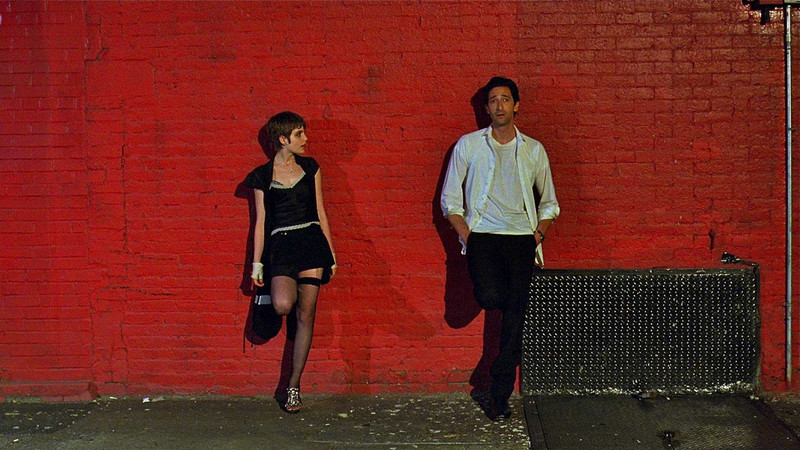
Henry Barthes, played by Adrien Brody in Tony Kaye’s Detachment, reflects the characteristics I tried to embody during my stint as a sub — namely, a genuine empathy for students and a desire to put time and care into teaching them something that would stick. Barthes, despite working a job in which everything is temporary — school, class, relationships with coworkers, bonds with students — takes his duties seriously and delivers lessons (which seem to be completely of his own invention, not from any curriculum I might recognize) with vigor. When Ms. Madison (Christina Hendricks), a fellow teacher, asks why he doesn’t become a real teacher, Barthes responds, “I teach every day. What do you mean?”

Detachment is an engrossing, occasionally heavy-handed (mainly when it slaps us with quotes from Albert Camus and Edgar Allen Poe), character-driven story that follows Barthes through three weeks of personal and professional trials. He has begun subbing at an urban school with a decaying administration, exhausted teachers, and students who threaten him within five minutes of his first class. He frequently visits his grandfather (Louis Zorich), who lives in a care facility, his memory and life-force slowly fading. He also meets Erica (Sami Gayle), a sixteen-year-old prostitute who roams the bus route near Barthes’ small apartment. After witnessing her physical abuse at the hands of a repulsive customer, Barthes decides to let her stay with him for a while. The ephemeral nature of everything in Barthes’ life is immediately evident: these are all temporary situations. Eventually, he will have to move on to a new school. His grandfather will die. Erica will have to move out. His reasons for embracing this lack of commitment, whether consciously or unconsciously, are explored through intermittent flashbacks, which slowly unravel the fact that Barthes’ mother killed herself when he was young, and he never knew his father.

What initially enthralled me about this film is that it takes an old trope — the Man With No Name — and applies it to two characters, then forces them to spend time together. Barthes is stoic and ashen for nearly the entire film, maintaining “I have no feelings you can hurt” and that “I’m a non-person. You can see me, but I’m hollow.” Erica comes out of nowhere, materializing on the bus as Barthes cries in his seat. According to the formula, familiar to us from the old Westerns like Shane, the Man (or Woman) With No Name appears abruptly “just passing through;” (s)he gets involved in other people’s business, solves a core problem or provides the necessary tools with which to solve it, then disappears, never to be seen again. This is the myth Barthes wants to claim for himself. He says he has no feelings yet he’s vulnerable, prone to quick anger and deep sadness at matters over which he has no control. His job allows him to show up, have an impact, then vanish. Just as he begins displaying emotion, Erica appears. Erica becomes the catalyst for Barthes’ change; they form a classic Travis-Iris Alliance and the better sides of both begin to shine through the grime of the workday.

The film features an ensemble which includes Christina Hendricks (sadly underused), James Caan, Lucy Liu, Marcia Gay Harden, Bryan Cranston, Blythe Danner, and Tim Blake Nelson. The teachers often appear in group scenes in which they get to kvetch about the school; these scenes, along with Barthes’ disconnected testimonials, out the film’s agenda in regard to the education system in America (and screenwriter Carl Lund’s feelings are, to say the least, not optimistic). Memorable exchanges include a harrowing scene in which Liu’s character, the school guidance counselor, finally snaps into a histrionic (yet genuine) polemic concerning the hopelessness of the students at her school — this is directed at a student, who begins to absorb the lesson, but then responds with “Fuck you” and walks out. Caan’s character, a substitute for the former dean (another temporary situation) shows students pictures of gonorrhea-infected genitals. Nelson’s character, yet another unhappy teacher, spends his breaks standing on the school’s playing field, staring at the sky. Barthes finally notices.

Barthes: You alright?

Mr Wiatt: What, you see me? You see me standing here?

Barthes: Yeah, I see you.

Mr Wiatt: Oh god. So relentless. Thank you. Thank you!

Unfortunately, we see most of these supporting characters only fleetingly with Barthes. The most developed relationship is a hackneyed attempt at romance between Barthes and Ms. Madison.

In spite of his apparent apathy, Barthes puts care into his lessons when he could just be a glorified babysitter, and we can see in his face that he wants to leave these students with something. Consider this speech from his first week teaching the new students.

“How are you to imagine anything if the images are always provided for you?” He goes on to explain doublethink: “Deliberately believing lies while knowing they are false. Examples of this in everyday life: I need to be pretty to be happy. I need surgery to be pretty. I need to be thin, famous, fashionable. Our young men today are being told that women are whores, bitches, things to be screwed, beaten, shit on, shamed. This is a marketing holocaust! Twenty-four hours a day, for the rest of our lives, the powers that be are hard at work, dumbing us to death. So to defend ourselves and fight against assimilating this dullness into our thought processes, we must learn to read, to stimulate our own imaginations, to cultivate our own consciousness, our own belief systems. We all need these skills to defend, to preserve, our own minds.”

How many of these students will learn to read, to cultivate their minds, to think independently? In this situation the moviegoer is just another temporary visitor witnessing a story that is clearly the middle of a story. If evolution begets resolution, then the end is well on its way, because there is a good amount of evolution on the part of Barthes once things begin to change (he confronts his feelings about his mother, finishes his three weeks at the new school, and makes two very substantial decisions about Erica).

In the final shots, Barthes reads aloud the opening of “The Fall of the House of Usher” as the school empties around him (nailing the parallel between the Usher house and family and the school). Has he let go? Will he become a real teacher? Explore a new career altogether? Has he left his fixation on the transient behind him after his experiences over the last three weeks? What’s the next step with Erica (there’s a conclusion to this story in the film, but even so there must be another step at which we can only guess)? I like that Detachment seeks to tell a human story (and tackle large social issues), dropping questions in the audience’s lap without making pretentious and unavailing stabs at final answers.

Detachment (2012); written by Carl Lund; directed by Tony Kaye; starring Adrien Brody, Sami Gayle, Christina Hendricks, and James Caan.

—Richard Hartshorn

————————-

Richard HartshornRichard Hartshorn is a writer of contemporary literary fiction and the recipient of the 2011 Richard Bausch Short Story Prize.  His work has appeared in several publications including Our Stories, The Dirty Napkin, and Hawaii Women’s Journal.  He lives in New York State. He is one of the original NC contributors — see his online “diary” of the making of Wings Over Arda, a feature-length movie production of a text by J. R. R. Tolkien.

Apr 092011
 

Play video & music while reading the winning entries. Not suitable for readers under the age of 42.

Numéro Cinq is a refuge for anarchists, outsiders, rebels, misfits, petty criminals and layabouts (something like the infamous Hole-in-the-Wall hideout), and getting them to vote properly has been one of the most difficult of dg’s tasks (has he mentioned recently how he loves you all, in spite of your myriad faults?). The People have spoken and the message is as clear as this week’s vote for the State Supreme Court judge in Wisconsin. We have already had one objection to the official vote count. Surely there will be more. This is not dg’s fault. Some of you voted on the wrong post; some voted for two or more different aphorisms; some, instead of writing out the whole aphorism (thus making it easy to count), simply wrote down ONE WORD from the aphorism! As a group, you are the walking definition of the word “obstreperous.” As near as dg can figure, this year’s vote came down to a tie. You can see the votes and count them yourselves here. The official entry list is here. Even if you find voting discrepancies, dg will not change the results. Always look on the bright side…

And the winners are!

Continue reading »

Mar 032011
 

Poster by Ginger Anne London

On Thursday evening, my brother and I sat in the clammy bedroom of his Latham, NY apartment and mulled over the final edits of Wings Over Arda: The First Age, which had in the last six months undergone an assiduous metamorphosis from a disconnected reel of raw footage to a coherent, colorful, mellifluous chunk of mostly-edited data.  The sound effects had all been dropped in, the music had been finalized (as of the previous night), and the color grading had been completed after hours of sedentary work.  The film was to have a private premiere (with invited guests, friends and family of the cast) in two days.  Travel plans had been made by cast members and family in Manhattan, Boston and Rochester.  36 gigabytes worth of special effects, which would need compression to 1.5 or so, had yet to be delivered to us.  Philip sat on the phone with Jack, our special effects expert and camera operator, uttering intermittent “Oh”s and “yeah”s as my chest did cartwheels.  “There’s no way I’m rescheduling the premiere again,” I thought.  It turned out Jack’s computer had taken longer than expected to export the effects.  He came through, like I knew he would, but by the time the effects were done and the film exported in its entirety, we had about twelve hours to figure out how we were going to show it.  The DVD-making process, for whatever reason, failed.

While getting dinner with cast members/musicians, less than two hours before the film was to premiere, I received a call from my brother, and there came the first time I’ve ever answered my cell phone in a restaurant.  It was just like I’d imagined: the dismayed stares from the wait staff, the attempts of my companions to shield their faces, all of it.  The call itself lasted roughly nine seconds.  My brother had only one sentence for me, a sentence which came out as a single word: “GotthemovieworkingbutSeedwon’tworkgottafigureitoutseeya.”  Seed is my brother’s short film, which was set to screen before Wings.

I arrived at the Key Auditorium with friends at my heels and half the cast already present.  The congratulations began and I made sure my handshakes and hugs were firm, despite not knowing whether our planned double-feature would even be happening.  When I finally entered the theatre, a still frame from Seed‘s Gung-Fu action finale was spread across the screen, and my brother worked away on his Mac computer, which he’d MacGuyver’d to the theatre’s projector system.  Deep breaths were taken by all.  Anna and Laura, who had come with me to dinner, took turns laying hands on my shoulders and insisting that I’d been worrying about nothing.  The cartwheels inside wouldn’t stop, however, until the end credits rolled.

The initial response to the premiere-version of the film was what I’d hoped for.  Nearly the entire cast was able to attend.  Audience members who knew the source material expressed support of my adaptation, and those who had never even heard of it claimed they were able to follow the story with no trouble.  My father even breached his usual 9PM bedtime to attend.

It wasn’t until midway through the laughter-coated cast party, during which we watched the behind-the-scenes featurettes I edited together, that I realized what this project really was.  Amid my sadness about such a fun, thought-consuming project reaching its inevitable end, I forgot to look around the room.  Once I did, I realized that more than half of the attendees, now some of my closest friends, had been strangers to me a year earlier.  Working on this film did more for me (and hopefully others) than I ever anticipated.  As I move into the DVD-burning process and flirt with the idea of film festivals, I can only hope the adventure will continue.

Thanks to DG for letting me host the film diary here.

Click here to see Tolkien Gateway’s article on the film

Facebook fan page

Return to the table of contents

Feb 132011
 

After some grueling work, the film finally has a release date.  There will be a premiere event at Siena College on February 26th, 2011, at 7PM.  Screened before the film will be a short movie by my brother.

Without further ado, here’s the new, longer trailer, which includes some story bits.  Don’t mind the parts that look a tad garbled; it’s what happens when you try to smush a widescreen HD film into the tiny Youtube box.  Enjoy.

All music is original:

“Alamenë” – Jennifer Wicks

“Riverflow” – Dizzi Dulcimer

“Battle for the Silmaril” – Philip Hartshorn

Return to the table of contents

Jan 172011
 

The First Annual Numéro Cinq Erasure Contest

Here’s a mini-contest. Not so hard, not as daunting as writing a rondeau or translating from the Dutch without a dictionary. The words have all been written for you. You just have to find the story. This should be a dream for those of us who are imaginatively challenged. The text below is from Monsieur L’Abbat’s Fencing, or, the Use of the Small Sword published in Dublin in 1734 (text and illustrations from Project Gutenberg). Dg is not sure what makes a good erasure text, so this is somewhat experimental. Someone suggested using a passage from the Bible, but that seemed vaguely blasphemous. A sword-fighting instruction book has the advantage of a certain drama in the choice of diction. Conflict is of the essence.

Rules: There are always rules. An erasure is a text created by taking words out of an existing text. In the best of all possible worlds, you’d have been able to submit the original text with words blotted out—this would make for a certain drama of presentation. And dg supposes it would be possible for you to convert the text into a jpeg and then use a photo processing program to effect the erasures and then submit the final jpeg. But somehow the mechanics of this seem anti-inspirational. For the purposes of this contest, you just need to take out the words you don’t want and submit the remaining text. You can’t change the order of the words and you can’t change the capitalization. The words in your new text have to be exactly the same and in the same order as they were in the original. You can insert your own punctuation. Try to make it something sensible–a love story, perhaps. But it doesn’t necessarily have to be a story. It could be a poem or a scene. Let the words take you where they listeth.

Remember: at NC we value wit and arrogance as the paramount literary values.

The contest is open to absolutely anyone. Newcomers and people who cannot speak English are especially welcome. (People with memory loss issues would seem especially adapted to this contest.) Just sign in on the comment box and erase away.

Entries, as usual in these contests, must be submitted in the comment box at the bottom of this post (yes, yes, in the past, some NC members have been deeply confused on this point and entered under completely unrelated posts). Multiple entries are perfectly acceptable.

Entries must be submitted between midnight January 15 and midnight January 31.

There are no other rules except, of course, Gary Garvin will notice a loophole and dg will retroactively have to rewrite the rules. If anything is unclear, please mention it in the comment box.

Munificent prizes will be awarded (come to think of it, we forgot to award prizes at the NC party in Montpelier) as usual. A list of actual prizes will be provided upon request (send your requests to the chair of the Official Judges Panel).

dg

Here is the official contest UR-text

It begins here. When you have for some time used yourself to push and parry at the Wall, according to the Rules that I have laid down, you must, (tho’ ’tis not the Rule of Schools, especially when you push with Strangers,) you must I say, when you push with a Scholar of your own Master, push and parry a Thrust alternately, disengaging, and then do the same Feinting, and sometime after you shou’d make the other Thrusts, telling one another your design, which makes you execute and parry them by Rule, especially if you reflect on the Motions and Postures of the Lunges and Parades. Being a little formed to this method, you may, being warned of the Thrust, parry it, telling the Adversary where you intend your Riposte, which puts him in a condition to avoid it, and gives him room to redouble after his Parade, either strait or by a Feint, at which you are not surprised, expecting by being forewarned the Thrust he is to make, which puts you easily on your Defence and Offence: by this manner of Exercise, you may not only improve faster, but with more art, the Eye and Parts being insensibly disposed to follow the Rule, whereas without this Method, the difference that there is between a lesson of assaulting a Man who forewarns you, helps you, and lets you hit him, and another who endeavours to defend himself and hit you, is, that except the Practice of Lessons be very well taught by long exercise, you fall into a Disorder which is often owing to the want of Art more than to any Defect in Nature. The taking a Lesson well, and the Manner of Pushing and Parrying which I have just described, may be attained to by Practice only, but some other things are necessary to make an Assault well; for besides the Turn of the Body, the Lightness, Suppleness and Vigour which compose the exteriour Part, you must be stout and prudent, qualities so essential, that without them you cannot act with a good Grace, nor to the purpose. If you are apprehensive, besides, that you don’t push home, or justly, fear making you keep back your Thrust, or follow the Blade, the least Motion of the Enemy disorders you, and puts you out of a Condition to hit him, and to avoid his Thrusts. Without Prudence, you cannot take the advantage of the situation, motions designs of the enemy, which changing very often, according to his Capacity and to the Measure, demonstrates that an ill concerted Enterprise exposes more to Danger than it procures Advantage: in order to turn this Quality to an advantage, you are to observe the Enemy’s fort and feeble, whether he attack or defend; if he attack it will be either by plain Thrusts strait, or disengaged, or by Feints or Engagements, which may be opposed by Time, or Ripostes: if he keeps on his Defence, it is either to take the Time or to Riposte. In case of the first; you shou’d, by half Thrusts, oblige him to push in order to take a Counter to his Time, and if he sticks to his Parade you must serve in what Manner, in order to disorder him by Feints, and push where he gives Light. And ends here.

Jan 122011
 

Stephanie Tribu-Cromme as Idril.

Today, we had our first “guinea pig” viewing of the film.  Since my brother and I have been cooped up in the basement – er, editing studio – working on the film, we’ve begun to lose all sense of objectivity.  A mutual friend not versed in the works of Tolkien nor the specifics of our film project took a look at the mostly-edited second cut of the film, which contains no music, and which still needs audio work, special effects and minor cutting.

Since the last entry, we’ve been gathering the final pieces of the puzzle and editing our second cut, which far surpasses the first in terms of coherence, sound and pacing.  Our biggest struggles now involve audio, as most of the film was shot outdoors (wind! waterfalls!  kids shouting!) and some of the already-difficult dialogue is hard to hear.  In addition to editing, we’ve been working on the main musical themes of the film, and we’ve ordered the DVD packaging and sleeves.  I also edited together a gag reel and a second behind-the-scenes featurette.

The DVD sleeve.

In writing the film, I made an early decision not to dumb down the dialogue.  The characters speak as they would in their world.  The details of the conflict and the goals of each character, however, are explicitly defined at the outset of the story and kept on top of the film’s list of priorities.  Going into today’s viewing, I wanted to make sure the level of audience confusion was at a bare minimum, though part of the idea is that you’re thrown into the midst of a conflict.  We start out playing catch-up with the characters, and an inherent sense of urgency remains throughout.  Even when the characters attempt to slow down, the story does not allow them to.

The viewing was, I think, a success.  Our subject enjoyed the film and was not confused about the conflict.  “The locations were phenomenal,” he said upon my asking his favorite part of the film as a whole, “The costumes were amazing, and it was obvious a lot of time was put into everything.  It didn’t look like something you just whipped up.  It looked like a professional film.”  He told me he had a hard time keeping up with character names, but if that was his biggest complaint, I’m happy.  My brother mentioned not remembering anyone’s name the first time he saw The Lord of the Rings (having not read the books previously).  Tolkien’s properly-named people and locations lend themselves more to text, but as long as you remember who they are in the story, we’ve succeeded.

—Richard Hartshorn

“Wings Over Arda” Facebook fan page

Tolkien Gateway article

Return to the table of contents


Dec 152010
 

The travels of Tuor and Voronwë will soon be accompanied by appropriate music

Things have quieted down in the production process, but only in the figurative sense.  Our main focus right now is the film’s score, which is being worked on by many talented folks.  Oh, and I’m working on it, too.

The film includes many scenes of conversation, some poetics, and long crawls of travelogue, all of which flow together into (hopefully) a sort of symphony of visuals where you never see the same set twice.  My brother and I came up with a goal on the audio side of this cinematic multiverse: about 90% of the movie’s soundtrack should sound like one varying piece of music.  Anna Pauline Kenzie, our resident opera singer who also acts in the film, came up with an excellent song she’s been recording over the course of a month (despite completely losing her voice for the better part of two weeks), and our costume expert, Jen Wicks, wrote a song in Quenya (a form of High Elvish created by Tolkien) and recorded a few demos with her own equipment.  As of now, these two pieces act as our leitmotifs for the film’s score.

Listen to Jen’s song, “Alamenë,” below.

Alamenë

Andrew, Kate Chappell and myself in August 2010

My cousin, Andrew Busone, a multi-talented musician best known for playing in New York City punk band Tied For Last, is also skilled on the keyboard, and will be putting together a few tracks for the film’s non-vocal score.  Laura McCoy, a fellow VCFA graduate, will be providing the flute tracks.  Vermont’s own Red Heart the Ticker also agreed to contribute a nice ambient traveling song.

While editing the rough cut, Philip would sometimes put on music from other artists to help us get a feel for what sort of sound we wanted in the background of a certain scene.  Quite often, I’d say, “Just turn off the music; you can’t hear the dialogue,” but many times we struck gold with this technique.  A certain scene involves a duo of travelers making their way across a narrow bridge that spans a swamp, with an unknown figure awaiting them on the other side.  We need apprehension, suspense, and music you’d imagine playing if a swamp had its own soundtrack.

The challenge of creating the film’s tunes is a journey which parallels, in some ways, the journey of creating the film itself.  It doesn’t involve as much standing out in the cold, driving fifty miles or sustaining open wounds, but sometimes I wonder how close we’ll come.

Return to the table of contents


Dec 012010
 

A trial poster by Ginger Anne London, featuring the WOA logo by Philip Hartshorn

Sometimes you see a big-budget Hollywood film and you notice something in the background that shouldn’t be there, or someone’s hand is in a different spot after a lightning-fast cut, or all of a sudden Steven Baldwin is wearing a different shirt. Y’know, the gargantuan flubs that don’t take anything away from the story but become brief distractions.  I’m proud to say that after several eight, ten and thirteen-hour days of nearly nonstop editing, Wings Over Arda: The First Age does not have… many of those.

The rough cut of the film is finished.  Clocking in at 63 minutes (not counting the closing credits), it’s a massive file which will be exported in HD (1080 P) for Blu-Ray discs, as well as standard definition for DVDs.  Basement-bound for a week, my brother and I sifted through the various hours of footage, culling the most powerful takes from the ocean of decent, mediocre, and just plain bad.  I applied my final script revision during the last two hours of edits, and we had to employ some serious editing magic to get certain scenes to look the way we desired.  I ended up cutting one full scene I didn’t need, but other than that, every bit of work we put into the shooting period shows up in some way, shape or form in the film.  Next, the film will go into fine-tuned edits, further audio work, and special effects, while others compose/prepare/donate the musical score.

Here’s a little taste of what other members of the cast and crew were up to, besides waiting patiently, whilst Philip and I sat in the basement with our muscles atrophying.

Ginger Anne London, who plays Glorfindel in the film, is proficient in Graphic Design and put together the little gem seen above, featuring the characters of Dior (Philip Hartshorn), Caranthir (Samuel Aguirre) and Voronwë (Jennifer Wicks).  I like to call it “People With Hoods.”

Jen with the “Arda Buddies.”

Jen, our costume expert and one of the film’s leads, used the remainder of our costume materials to create the “Arda Buddies” (or “Arda Pals,” I’m not sure which I like better), plush dolls modeled after Jen and myself.  Yes, there is a plush doll of me, and Wings Over Arda officially has, to use the parlance of our times, “swag.”  I was rather surprised to wake up and see the below photo after naively thinking Jen was joking about making these.

Anna Pauline Kenzie

Music is being done by several talented folks.  We’ve received musical contributions from the likes of Andrew Busone (my cousin, guitarist/singer/pianist/drummer extraordinaire); VCFA’s own Red Heart the Ticker; and even a few from musicians who saw our project’s fan page and expressed interest.  The main theme/leitmotif of the film is currently being composed by the amazing Anna Pauline Kenzie, an operatic singer and stage actress who also appears in the film as Elwing.  Additional tunes are being put together by my brother Philip, who plays the piano and excels at the Finale music program.

Everyone has been pretty well occupied over the past week, and in the spirit of the time of year, given a certain writer/director plenty to be thankful for.

Return to the table of contents