Mar 202014


Patrice Leconte’s La fille sur le pont  (Girl on a Bridge) tells the story of Gabor (Daniel Auteuil), a knife thrower, who returns to a certain bridge in Paris looking for suicidal women to be his assistants, for they, usefully, have nothing left to lose. When he meets Adele (Vanessa Paradis), he finds more than an assistant, he finds a woman who might as well be throwing the knives back.

la_fille_sur_le_pont_reference

Though I encourage you to see the whole film, there is one three-minute scene that stands on its own as a well-wrought short film. In this scene, Gabor throws knives at (or, more accurately, near) Adele. The scene derives its power primarily from the intense anxiousness of Gabor and the ecstasy of Adele.

We begin in the audience and then we pinball between the knife thrower, the target, and the faces of those who watch enraptured, fearful, and envious. Much of the pleasure in this scene is derived from the expressions of others in a way similar to  Woodkid’s “I Love You.” The chorus of faces in this film that layer and shape how the story is told: the face of a woman in the audience as she leans to see better and, backstage, the various circus performers, the small woman with the massive floral headdress and the stricken clown with the oblivious dog. The circus performers, more than the others, instruct us to be fearful, because they do this for a living every day but they seem worried.

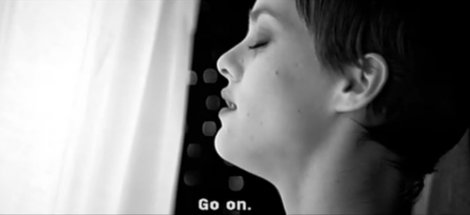
We are all of them and yet we are not simply them. The camera lets us behind the sheet and in a medium shot we get to see what Gabor cannot: Adele’s ecstatic experience. We also see what Adele cannot, in close-up: Gabor’s concern, his worry, his focus. Later in the film, Adele and Gabor are able to communicate with one another over great distances, letter writing to one another without the writing, and this seems possible because of their intense connection. This moment reads us back to the theatre and the knife throwing where we, the audience, were caught between them and the sheet lightening connection to the enraptured onlookers. We see we inhabit the air between them all and were, perhaps, amorousness itself.
go_on-470x215

Of all the spectators in the montage, it is particularly Irene, the woman backstage dressed somewhat like a showgirl, who stands in counterpoint. Irene gives us every indication that she is vicariously deriving a great deal of pleasure from the spectacle. She is identifying with Adele. Does this envy encourage us to also identify with Adele’s pleasure or does it just make Adele’s pleasure more real? Regardless, what plays across her face is a pleasure both envious and nostalgic, as though she too once knew a pleasure like this.

The worried faces, we find out at the end of the scene, were right to worry: one of the knives has nicked Adele and drawn blood. It is for Gabor an admission that he can’t see the way he used to. It also foreshadows that he cannot see Adele clearly enough and this might not bode well for them.

For Adele, the cut is more complicated. What would be different if every knife had lodged perfectly around her and there had been no cut? This is in some ways the knife thrower’s version of Michael Ondaatje’s “The Cinnamon Peeler.”

what good is it
to be the lime burner’s daughter
left with no trace
as if not spoken to in the act of love
as if wounded without the pleasure of a scar

The ecstatic joy on Adele’s face seems connected to this, wounded, the experience now written on her body. Indeed, if all the love songs tell the truth, then the amorous experience threatens the lover the way the knives do here. There is always the threat of loss of the self but the pleasure of being made specific.
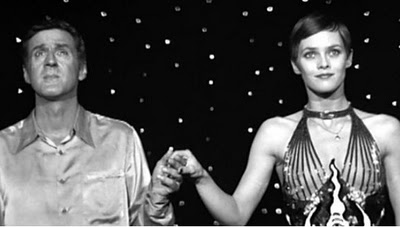
12 The Girl on the Bridge(La fille sur le pont) 1999 Vanessa Paradis, Daniel Auteuil

That the film is presented in black and white makes this a nostalgic cinema with a hankering for the way romances used to appear on the silver screen. This coupled with Marianne Faithful’s broken glass and whisky vibrato creates a peculiar tension between the nostalgic and the primal. As Roger Ebert notes in his review of the film, its take on romance stands in resistance to the current take Hollywood has on the genre:

Occupations like knife-throwing were not uncommon in silent comedy, but modern movies have become depressingly mired in ordinary lifestyles. In many new romantic comedies, the occupations of the characters don’t even matter, because they are only labels; there’s a setup scene in an office, and everything else is after hours. Here, knife-throwing explains not only the man’s desperation to meet the woman, but also the kind of woman he meets, and the way they eventually feel about each other.

What Ebert is essentially saying is that Leconte here presents a romance that is specific. This is echoed in Gabor’s act of knife throwing. He cannot throw the knives the same way twice. We see him study the contours and outlines of Adele’s body before he pulls the white sheet over her to begin. She has become specific. Even the gesture of pressing his index finger to her forehead pins her in that specificity.  Amorous discourse is this battle between the specific and the generic. When “I love you” is the most cliché thing one can say, the rest must conspire to free the sublime experience from the generic.

— R W Gray
 

Oct 132013
 

Relaunching the NC at the Movies page, which, yes, has been needing a bit of a facelift for a while. Holiday weekend, nothing to do but —

dg

Numéro Cinq’s unique and unparalleled collection of short films and commentary edited and (mostly) written by R. W. Gray. Other contributions from Jon Dewar, Sophie Lavoie, Philip Marchand, Megan MacKay, Jared Carney, Erin Morton and Taryn Sirove.

via Numéro Cinq at the Movies | Edited by R. W. Gray » Numéro Cinq.

Aug 192013
 

This month we have a new NC at the Movies contribution from Vancouver (Canada) horror and comedy filmmaker Nicholas Humphries. You might recognize his name from two previous posts on his films “The One That Got Away” and “Little Mermaid.” He’s prolific and is drawn to wild, exciting worlds, as you can see by checking out his demo reel. While in Vancouver last month I was interviewing him for a documentary short I am working on when he demanded I stay after and watch this great short film / music video, Dash Shaw’s “Seraph.” It was obvious he was the person who should write about this on Numéro Cinq.

–RWG

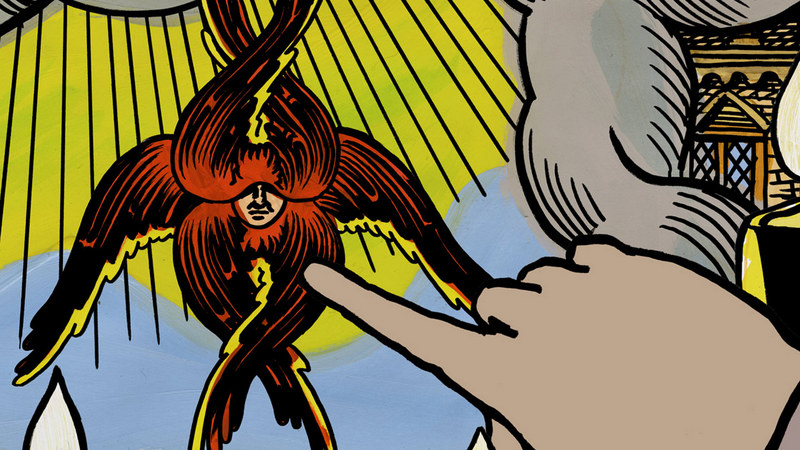
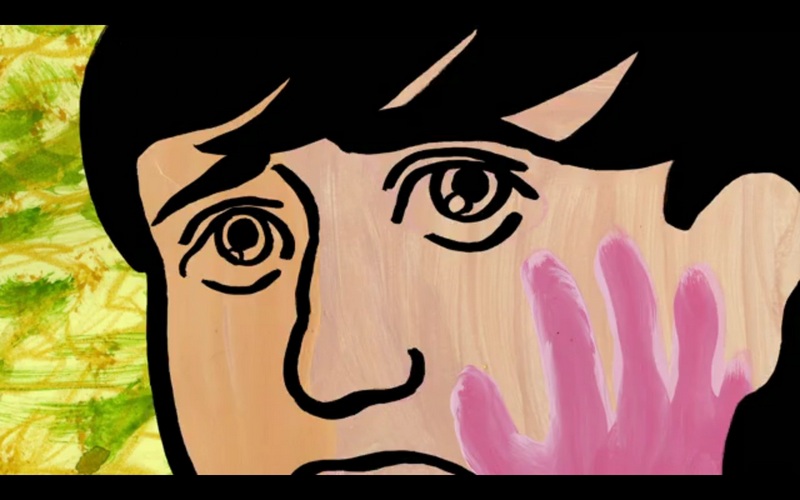
Dash Shaw’s “Seraph” follows a young man through his brief, tragic existence as he struggles to understand his identity and feelings.  The young protagonist is repressed by his father and religion and is taught to feel ashamed of his body and desires. He ultimately grows up unable to accept himself and believes that the greatest sin he could ever commit would be to acknowledge love from the objects of his desire and metaphorically “look at God.”

Seraph 5

Through two haunting pieces from the Sigur Ros Voltari album (“Rembihnútur” and “Ekki Múkk”), this nearly wordless short exposes the damage misguided biblical rhetoric can do during our maturation via a condensed journey we take with the protagonist from adolescence to death.

The film is an installment of the Sigur Ros Valteri Mystery Film Experiment. The films were selected from 800 submissions internationally. Sigur Ros funded a handful of the films and “Seraph” is one of the results. Say Sigur Ros about the project, “We never meant our music to come with a pre-programmed emotional response. We don’t want to tell anyone how to feel and what to take from it.”

Seraph 7

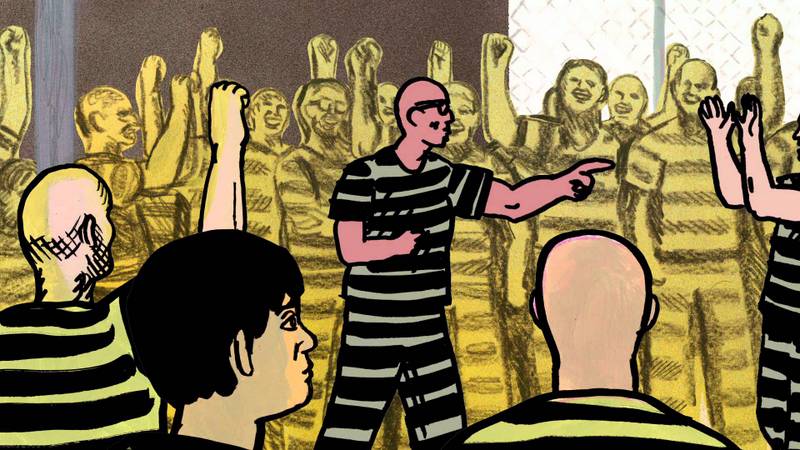
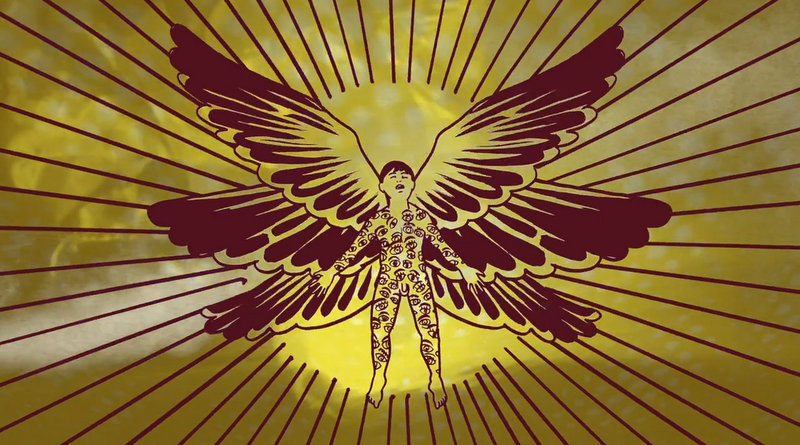
The title of Shaw’s contribution to the project,  “Seraph,” is a reference to a type of celestial or heavenly being in the Abrahamic religions. Rather than tackle the customary queer struggles with homophobia and disease, Shaw, along with long time collaborator John Cameron Mitchell (Rabbit Hole, Shortbus, Hedwig and the Angry Inch), chose to focus on a more emotional, internal aspect of the gay experience. Shaw illustrates the pain of the boy’s self-hatred through his compulsive self-mutilation. The eyes that the boy crudely carves into his own flesh allow him to channel the pain of not being able to see love, both from others and for himself. He grows into a man with a violent disposition, compensating for his homosexual feelings by resorting to acts of physical hostility against those that look too deep. The pain caused by the eyes he carves in his flesh also serves as a base attempt to touch the divine and look at God.

Seraph 3

As the director of a number of short films, I often struggle with the size of story to tackle using the format. If the story is too simple than what’s the point if nothing happens? If it’s too big, you run the risk of weaving an overly ambitious yarn about characters the audience doesn’t care about. What resonated for me with “Seraph” was the way Shaw used music and animation to create a dreamlike state where multiple images from a lifetime were used to illicit a central feeling of loneliness: a big story, simply told. Few feature films manage to conjure up the level of intensity that this animated short manages to execute in its seven minutes.

Imagery plays a large part in how the story plays out, both through the moments Shaw selects from the boy’s life but also through the symbolism of the eye. Historically, charms and decorations featuring varying eye symbols have been used to protect against The Evil Eye, a look that is believed by many cultures to cause injury for the person at whom it is directed.  The use of eye symbols for protection is most common in the Middle East and dates back to the Old Testament.

Seraph 2

So in some sense the symbol of the eye could be a way the boy in “Seraph” protects himself, but ultimately the symbolism is ambiguous. In the only scene with dialogue, the boy’s father explains to him that angels can never look at God because it is impossible to look at a love you can never understand.  In the final scene, the boy is covered from head to toe in eye carvings and is finally able to see God. The eyes then, seem to allow him to see what God loves which (we hope) will allow him to finally love himself. This is tragic since the boy is only able to cope and find this love through self-mutilation.

Seraph 1

Self-inflicted punishment is not uncommon in queer texts. In Jean Genet’s Querelle de Brest, the titular character allows himself to be sexually penetrated by the owner of a brothel as a way of punishing himself for the murder of one of his comrades. While Shaw’s character is punishing himself for his sexual feelings and Genet’s character is using sex to punish himself for his immoral actions, they both reflect the ways repression misdirects that which we wish to keep hidden.  Both texts deal with themes of sadomasochism, or the giving and/or receiving of sexual pleasure through acts involving the infliction of pain or humiliation. In the queer cannon, overly repressed characters often express their desires through sadomasochistic scenes or fantasies (T .E. Lawrence’s The Mint, Timothy Findley’s The Wars, the works of Dennis Cooper, etc). “Seraph” does not posit sadomasochism as a solution so much as use this self harm as a testament and condemnation of the repressive social and cultural forces that seek to diminish each person’s access to the divine.

“Seraph” was screened and nominated for the Short Film Grand Jury Prize at the prestigious Sundance Film Festival this year.

–Nicholas Humphries


Nicholas Humphries HeadshotNicholas Humphries is an award-winning director from Vancouver, Canada. His accolades include Best Short at the Screamfest Horror Film Festival, Audience Choice at the NSI Film Exchange, a Tabloid Witch, an Aloha Accolade and a Golden Sheaf. His films have been nominated for multiple Leo Awards, have screened at Grauman’s Chinese and Egyptian Theatres, on CBC, Fearnet, SPACE Channel and in festivals around the world. Additionally, Nicholas has directed for Written by a Kid on the hit premium YouTube Channel Geek & Sundry. He is also a director on the acclaimed Syfy digital series, Riese: Kingdom Falling, which was nominated for four Streamy Awards, three IAWTV Awards and a Leo Award. Riese was also an Official Honoree at the 2011 Webby Awards. His feature film, Death Do Us Part, is scheduled for release in 2013. Nicholas teaches film at both Vancouver Film School and the University of British Columbia. He has a BA in Film Studies and an MFA in Film Production.

Sep 232012
 

It’s been a year since Rob Gray joined the crew at Numéro Cinq and took over the nascent NC at the Movies series. Only a year, but he has made himself a mainstay of the community. I originally set him up as a kind of duke or baron in my Internet kingdom. I said he could do what he wanted within his fiefdom. And he has made that slot unique, bizarre, macabre, exciting, erotic, stylish and always surprising and delightful. He has contributed dozens of short movies and movie commentaries. I don’t know of another publication with a feature remotely like this. It’s gone well beyond any editorial fantasy I might have had at the beginning.

Not only that, but as an editor with his own domain, Rob has brought in other exceptional movie commentators — Jon Dewar, Sophie M. Lavoie, and Megan MacKay. He has also contributed poetry, fiction and a complete screenplay to the magazine. And just last issue he started a new hybrid series of publications, coupling  poets with critics in a single hybrid piece — see “Stray Dog Poetics” with poet Shane Rhodes and critic Rob Ross.

To acknowledge Rob’s profound (and, yes, often exuberantly eccentric) contributions to NC, I’ve devoted 10 slots on the slider at the top of the page to some of my favourite pieces, including, yes, the ever popular Treevenge by Jason Eisener (the Christmas movie that proved to me the truly depraved nature of Rob Gray’s mind) and Pedro Pires’s Danse Macabre (which I adore — go figure).

I look at the list of movies and, momentarily, I bask in the glow of accomplishment — we really have created something unique and beautiful at NC.

dg

Feb 072012
 

Nights caught in small cold moments of crystallized fire. Winters here about temporary shelter, the unmittened hands of friends, and accidental warm bodies. Strung lights across the darkness. This is how we find our way.

He and I walk in the dark woods. We call out and point at the constellations. We each know only four. A short game. But it makes sense of the darkness, our breaths rising, converging, in the air above us, our gloved hands pointing, reaching, like children too small to grab the lowest branch. Round the corner, dip in the tree line, sudden fire of the moon rising, hanging burnt orange.

He tells me how his mother brought oranges home box by box from the grocery store, each orange in its small green paper nest. Satsuma, Clementine, Tangerine, Owari, Tangor.  Each sounding like a country he might someday visit. Early morning, his mother at the kitchen counter peeling his father’s oranges for his lunch, so he could eat them later without the citric acid from the peels stripping the machine grease from his hands. How she saved him from black oranges. Love in the small lunch-box gestures.

I tell him how in my town I knew a boy who worked at the grocery store who had been bitten by a tarantula that had been accidentally packed or stowed away in a case of bananas. I still think about that tarantula so far from the warm, so far from home. Did he get to see snow? After that, I opened each box of oranges my mother brought home carefully, wondering what exotic things might come along with them. What stows away, escapes, what bites you and your greedy hands.

I tell him, too, of that Christmas when my mother told my brother and I how the oranges had vitamin C, which would make us grow up big and strong. How when she was out shoveling snow off the steps, we took turns eating an orange and then lifting the end of the couch. She was right, we decided with each lift. Soon we would lift the trailer. Soon we would tear it from its blocks and roll it to another town, one with more oranges. And we would be gods. Orange gods. But how instead we spent the next day fighting for the toilet.

A conversation beneath this conversation glowers between us. The erratic space between our hands as we walk. How, later, on the wide bare bed, he will explain that an orange is a question of distance: from tree to hand that picks it, from hand to box, from box to home, to hand, to mouth, to tongue. Says we are all reaching for the branch. Even oranges.

I explain how oranges, mandarins, offer themselves up, shuck peels, let segments fall away from one another, like a too eager lover naked at the foot of a bed waiting. They are always waiting.

And other aches of time. Time between each segment placed on a tongue. Span of time before bodies can no longer keep one another warm so the duvet has to be retrieved from the hardwood floor.

For now, though, we walk deeper into the woods, the soldier, bare trees reaching for the stars. But once you’ve seen an orange, you can’t help but see oranges everywhere. In the darkness, each star caught in the wide blackness might be an orange gloaming there instead of a planet. Celestial bodies, the hurtling rotations and orbits of great oranges, galaxies just spilled boxes out of reach.

I want to quote Neruda. Something about his lover’s “orange laughter.” But I can’t remember how it goes. So we walk on, a waltz of bumping shoulders, the quiet hum of the star flung, mandarin sky.

— R. W. Gray


R. W. Gray is a writer with commitment issues when it comes to form. He has published his poetry and prose in numerous journals and in the anthologies Seminal, And Baby Makes More, Queering the Way, and Quickies 1 and 2.  His first collection of short stories, Crisp, was published by NeWest Press (2010). Ten of his short scripts have been produced and the most recent, “alice & huck,” won awards at festivals in New Orleans, Beverley Hills, and Honolulu. He currently is a professor of film and screenwriting at University of New Brunswick. He is also senior editor at the helm of Numero Cinq’s NC at the Movies.


Dec 022011
 

DG’s dog Lucy, aka the NC Blue Dog


DG will read his new story “Snow Days” on The Sunday Edition, CBC Radio One, this Sunday (December 4). That’s a three-hour morning show; the story airs in the third hour (dg thinks). It’s also broadcast on Sirius–check the CBC website for details on that.

This story was commissioned by CBC producer Sarah Gilbert for a series called Winter Tales (um, winter had to be mentioned), all the stories written by former winners of the Governor-General’s Award for Fiction.

After the broadcast, the text of the story and a podcast will be up on the CBC Canada Writes Winter Tales website.

The idea also was to pair each GG winner with an up-and-coming writer of his or her choice—dg picked NC Contributing Editor R. W. Gray as a Writer to Watch. So please read his contribution, too, when you go to the site.

dg

Oct 272011
 

Mamá (2008 Spanish short film) from Pablo Sierra on Vimeo.

/

.In this Halloween edition of Numéro Cinq at the Movies, we have Andres Muschietti’s Mama (2008). Turn the lights out, turn the sound up, put some headsets on, and enjoy.

The plot is simple and yet leaves gobs of story unexplored, haunting the plot we do get: two children are tormented by a terrifying mother; we never find out the origins of this terror and we don’t find out what becomes of the children. This tip of the iceberg approach to storytelling gives the piece a depth that makes it even more terrifying for all the unimaginable horrors we are left to imagine.

What’s scary here is firstly archetypal and secondly uncanny. Mama is the archetypal bad mother that lurks behind the good mother archetype, waiting to consume, torment, and dismember instead of nurture. Like the one daughter, we are drawn to the figure of Mama, because she promises to fulfill the maternal role, but soon we understand their trepidation. This mother is not up for baking cookies.

She’s also uncanny here thanks to a couple of very successful horror techniques. Mama, though human in form and thus familiar, is unfamiliar because of her movements. The head tilted to the side, the contorting, jerking motions of her limbs and the speed of her movements are all unfamiliar. Similar effects were used in the horror film the The Ring when the monstrous young girl climbs out of the television. To achieve this effect they shot the actress in reverse with exaggerated movements so that when they played the footage forward her gestures seemed insect like and inhuman. This is Freud’s Uncanny: both familiar and unfamiliar and disturbing all around.

When this short film came out three years ago it created so much of a buzz that Mexican director Guillermo Del Toro – known for his popular Hellboy type fare and his more art house type horror films like Pan’s Labyrinth – decided to take Muschietti under his producing / mentoring wing and turn the film into a feature-length terror. Del Toro similarly mentored / produced the The Orphanage (2007).

Continue reading »

Oct 132011
 

.

Warning: this video contains suggestive animations of fruit, human sacrifice, and some coarse language. “The Island” is a short film by Trevor Anderson, a filmmaker from Edmonton, Alberta, Canada. Anderson is a self-taught independent filmmaker who is currently in post-production on his tenth short film. His work has screened at countless film festivals around the world, including Sundance, Berlin and Toronto.

I saw “The Island” accidentally the first time, then realized I knew the filmmaker. Once upon a time, we both lived in the basements of lesbian professors in Edmonton. We were an exclusive subculture immortalized in a line from a non-fiction piece by Janice Williamson: “gay boys who live in the basements of dyke professors and wonder about the status quo.”

“The Island” for me is carnivalesque in that Rabelaisian sense of being both outrageous and intolerant of hypocrisy which means here being intolerant of intolerance. The film begins plainly enough in the hinterlands, one man walking against a blank canvas of snow, the starkness of the landscape emphasizing the stark hatred in the “fan mail” the narrator receives. What follows is simply beauty made from ugliness, a massive flight of fancy that describes a utopia of tolerance and celebration and freedom.

The last line troubles things with one of those perfect tugs on the tablecloth. Like Anderson believes too much in an interdependent and connected humanity, one that even includes the ignorant and intolerant, to move permanently to this Rabelaisian island.

At the Hot Docs International Documentary Festival, Anderson won the inaugural Lindalee Tracey Award, presented to “an emerging Canadian filmmaker working with passion, humour, a strong sense of social justice and a personal point of view.”

If you like Anderson’s style of autobiodoc filmmaking (a term I’m trying to put into common usage so please pass it on), then please check out the trailer for his last film, “The High Level Bridge” (and if you’re enticed pay the $1.99 to download the full film and support this indie filmmaker). “The High Level Bridge” is a short meditation on the untold history of suicides off of Edmonton’s High Level bridge and concludes with Anderson dropping his camera off the bridge into the icy water below.

Trailer:

Purchase the film at Trevor Anderson: Dirty City Films.

“The High Level Bridge” was  selected for the Sundance Institute’s Art House Project. From Anderson’s website: “In 2005, the Art House Project was created to celebrate the 25th Anniversary of Sundance Institute and pay tribute to art house theatres across the USA. Twelve art house theatres from around the country were designated and united as Sundance Institute Art House Project theatres. In 2006, a Sundance Institute 25th Anniversary retrospective series was made available for each of the theatres to show in their local communities. The Sundance Institute Art House Project has since grown to a total of 17 participating theatres nationwide and continues its commitment to expanding the reach of independent cinema across America.”

—RWGray

Oct 062011
 

.

At the core of Miranda July (writer) and Miguel Arteta’s (director) short film “Are You the Favorite Person of Anybody?” is the title question. It is repeatedly asked by a man standing on a street corner (John C. Reilly) to strangers who pass by, but we never find out why he’s asking the question or what he intends to do with the information he collects. All we know about him is that he has a burning question, three orange trees, and a wife trying to get rid of oranges. None of this matters. The question’s profundity disarms and obscures all else.

That burning question supersedes the simplicity of the film, supersedes the film itself in the way the it poses the question to the audience, too. The youtubification of this film led to a spate of vloggers asking themselves and others the same question in a sort of viral existential awakening, or, at times, mass despair. Certainly, though, the question hails us if we dare to let it. Are you the favorite person of anybody? It’s difficult not to get caught in the musical chairs of the query. And won’t most of us end up on the floor?

But to dwell on the question this way is perhaps to identify too strongly with Miranda July’s character. Mike White’s character doesn’t seem compelled or bothered. He has no delusions of grandeur, but does have a girlfriend and is bringing her an orange or two – he leaves almost elated.  So what of the oranges? On a certain level, the film seems too simple to contain metaphor. But then there are oranges. Are they consolation? Are they payment for pain inflicted, or are they the very point of existence? Much depends on a bag of oranges.

What intrigues me here more though is the intimate story around the story.  How Miranda July had just finished shooting Me and You and Everyone We Know and had nothing to do until the editor came back with a rough cut – a peculiar waiting. So she wrote these sketches. Showed them to Arteta who she was dating at the time. Arteta rushed them to shoot and cast July, Mike White (the writer of Chuck & Buck, which Arteta directed) and Chuy Chavez (July’s DP on Me and You and Everyone We Know).

Arteta, in an interview in Wholphin confesses what the script meant to him:  “When I read it, it hit me hard for the first time: I wasn’t going to be [July’s] favorite person for too much longer. I was having doubts about us and the script felt like a warning . . .  I said ‘Let’s shoot this, right away’ – knowing that working together was something I would always cherish”

In her Wholphin interview, July confesses she was excited to just act. It was something she committed herself to so strongly that when she walked away from John C. Reilly, exiting her scene with him, and no one called cut, she just kept on walking. “I walked practically to the next neighborhood before anyone noticed I was gone.”  These are the interstitial stories I believe imbue films.

After the death of French filmmaker Jacques Demy and the decaying of the prints of his early film Umbrellas of Cherbourg, his filmmaker wife Agnes Varda oversaw the re-colorization of the film. The result is lurid, gaudy, and gorgeous. Walls aren’t just walls, they leap out in shades of eggplant and lime. Varda was ostensibly realizing Demy’s original vision for the film’s color, but there’s something else that imbues the film. Call me overly romantic but I read each color, each frame, as part of a love letter to her deceased husband.

What imbues “Are You the Favorite Person of Anybody?” for me is the tension between July’s never ending take where she walks off the set and away. . . and Arteta’s manic intent to make the film and collaborate while they still had time. A letting go and a holding on. This bittersweetness stains the film for me.

Romanticism aside, this is simply a film I wish I’d made. With one location and only four actors this is one of the simplest short films I’ve seen. Made for  $150 (for apparently coffee, bagels, tape and a transfer to HD), the simple style and simple content let the film’s principle dramatic question do the work.

The film appears in Issue #1 of Wholphin, the McSweeney‘s DVD magazine, available here:

http://store.mcsweeneys.net/index.cfm/fuseaction/catalog.list/object_id/4F541504-D8B3-44BE-9DAC-32B0B4554215/Wholphin.cfm

In their own words:

“Wholphin is a quarterly DVD magazine featuring short films, documentaries, animation, and instructional videos that have not, for whatever reason, found wide release. Recent issues of Wholphin have included films by Spike Jonze, David O. Russell, Miranda July, Miguel Arteta, Errol Morris, and Steven Soderbergh, and performances from John C. Reilly, Selma Blair, Patton Oswalt, Andy Richter, a monkey-faced eel, and many others.”

—RWGray

Sep 222011
 

.

Ruth Meehan’s And the Red Man Went Green brings the chaos and potential of one day down to a single moment crossing a street. Though it’s not ostensibly about a kiss, the narrative has much in common with Chekhov’s short story “The Kiss,” in which a young soldier is accidentally kissed by a woman, sending a shudder of changes through his plain life.

The director Richard LaGravanese also found inspiration in Chekhov’s short story for the key moment when his protagonist in the film Living Out Loud (starring Holly Hunter–the movie was originally called The Kiss) is surprised out of the grief she is suffering at the loss of her twenty-year relationship.

Each of these stories touches on sudden moments when strangers are accidentally and sometimes unconsciously there for one another.

>Meehan is an Irish writer / director and she has shot several short films. And the Red Man . . . is her second short and it did well at festivals, winning the Special Jury prize a the Tehran film Festival and the Prix Canal+ at Brest.

If you enjoy Meehan’s very short film, you can see another by her (based on a true story about an adventurous cat) here:
.

—RWGray

.
.

Jul 012011
 

.

Here is another first for Numéro Cinq: A full length film script from R. W. Gray (who earlier appeared on these pages as the author of the stunning short story “Crisp”). Not only do we have the original film script for Alice & Huck (who else publishes movie scripts these days?) but we also have an excerpt from the movie, teaser and fan videos. This is a wonderful chance for readers to compare script and the made movie (you can get the complete DVD here; the IMDB movie page is here), a chance to see words embodied in the actors’ gestures and words (a transformation of text to stage that is always a mystery to me). Alice and Huck is a delightful, whimsically romantic love story of close encounters, near misses and second chances.

Robert Gray was born and raised on the northwest coast of BC, and received a PhD in Poetry and Psychoanalysis from the University of Alberta in 2003. He is the author of two serialized novels in Xtra West magazine and has published poetry in various journals and anthologies, including Arc, Grain, Event, and dANDelion. He also has had ten short screenplays produced, including Alice & Huck and Blink. He currently teaches Film at the University of New Brunswick in Frederiction.

dg

.

What is Alice & Huck about?

.

Alice & Huck Fan Video

Continue reading »

Jun 012011
 

rwgray-victoria.

Lightning, God, rocks, an eternally smouldering corpse, and a giant mother are the furniture of this spectacularly macabre and hilarious short story from R. W. Gray’s first collection Crisp, which I discovered just a couple of months ago while reading books for the Danuta Gleed Literary Award (Crisp was a finalist). First, the coincidence: I actually met Rob Gray two years ago in Mark Jarman’s house in Fredericton, New Brunswick, but it did not register with me at the time that he was a writer of such gifts and charm. (Goes to show, I guess, but what?) Second, the literary refs: I love the giant woman, the smouldering car. Obviously, we are not in the world of the real, possibly the world of the Real (in the Lacanian sense). The giant mother is, of course, a descendant of Rabelais’ giants, also a relative of the mysteriously enlarging giantess in Robert Coover’s novel John’s Wife (gorgeous novel: the giant woman saves the sheriff from a forest fire by peeing on him) and even the giant pig that takes over the house in Flann O’Brien’s amazing little book The Poor Mouth. This story has, as Mark Jarman writes, “verve and swing.”  It’s a pleasure to present it on Numéro Cinq. (And you can buy the book here.)

dg

R. W. Gray was born and raised on the northwest coast of British Columbia, and received a PhD in Poetry and Psychoanalysis from the University of Alberta in 2003. He is the author of two serialized novels in Xtra West magazine and has published poetry in various journals and anthologies, including Arc, Grain, Event, and dANDelion. He also has had ten short screenplays produced, including Alice & Huck and Blink. He currently teaches Film at the University of New Brunswick in Frederiction. Crisp is his first book.

.

Crisp

By R. W. Gray

.

It’s Tuesday and our father has packed the trunk of his rusty blue car. I am seven, my brother Randy is five, and we’re both standing on the porch and what neither of us says out loud is that we’re relieved. We watch him load the last of his stuff in the car. The lamp with the tassels from the living room, and his dining room chair, the one with the arms. Now there will be only three chairs left. I think to myself that the lamp and chair are signs he isn’t coming back. He’s taking everything he could need. Then I see a storm in the South bunching up where the highway and the horizon meet and I worry this is a sign he’s going to stay. I tetherball back and forth this way.

Randy stands and stares. He grips a rock in his right hand and I wonder if he’s going to throw it. I say nothing to him. I’m not a very good older brother. Mom pushes the screen door open and stands between us. Her left hand is over her mouth, her right hand props her elbow to keep her mouth in place. I can hear the thunder now. I want to call to Father as he opens the door, say maybe he should wait out the storm. But he nods before I can and gets in. The car shudders, a plume of blue smoke erupting towards us on the steps. He doesn’t wait for it to warm up, just backs up then the car moves forward and away. His left arm reaches out the window and waves a slow wave. Thunder again, and I look up to the rain suddenly falling on my bare face, the storm here already, like it just remembered it should rain and is making up for lost time. She starts to cry then, our mom. Maybe she thinks the rain will hide her tears, the telltale red of her run-ragged eyes. Or maybe she doesn’t care.

We watch him drive the half-mile down to the end of the driveway, driving into the storm, the clouds mud grey and the lightning cracking in the big sky. His car stops at the highway. He doesn’t signal. The car idles, long enough for me to think maybe he’ll turn around and come back. Maybe he’s thinking about Randy and me. How we need a father. One one thousand. Two one thousand. What’s he waiting for?

A bolt of lightning rips through the air above the highway, smites Father’s rust-pocked blue car and it explodes as the gas tank turns electric. Mother’s hand flies off her mouth and she lets out a strange animal shriek; she starts to laugh, everything tumbling out of her mouth at once. She had been nagging him for weeks to get the gas tank fixed. It was leaking gas everywhere. The back seats, the carpet, were wet with it. So it could have been the car cigarette lighter that pops clear of the dash when ember hot. But I prefer to think it was the lightning, that God has something to do with it. Because only God can smite things.

Mom’s face clinches red and raw in the rain, the laughter spilling out of her a little angry then a little sad then a little angry, and on and on. I see Randy look down. Yellow liquid running down her legs from her short denim shorts. She’s peeing herself, a yellow puddle forming around her bare feet on the deck. The rain’s falling harder now, splashing the urine. Randy looks like he’s going to say something but I give him a full force look. I give him the look that he and I both understand means just look at the horizon, look at the smoldering metal of our father. We are rocks, Randy, just look at the horizon.

What if he’s still alive? I take a step forward, a lurch.

Continue reading »

May 032011
 

DG is one of the judges (along with Claire Rothman and J. Jill Robinson) for the $10,000 Danuta Gleed Literary Award. He read dozens of story collections over the last few months (fresh crates of books seemed to arrive every week). He mulled them over and conducted lengthy negotiations with his co-judges (gracious and intelligent writers, both of them). Then he managed to keep his mouth shut about the shortlist until its official announcement today. The winner will be trumpeted abroad May 28.

The shortlist is:

  • Darcie Friesen Hossack, Mennonites Don`t Dance (Thistledown Press)
  • R.W. Gray, Crisp (NeWest Press)
  • Billie Livingston, Greedy Little Eyes (Vintage Canada)
  • Alexander MacLeod, Light Lifting (Biblioasis)
  • Teri Vlassopoulos, Bats or Swallows (Invisible Publishing)

Here is a lovely CBC photo display with the judges’ comments on each author.

dg