N5
1. THE FIRST TO RISE
I
miss my friend Robin. Robin Kilson. She was a black panther who was raped by the Black Panthers. And I met her when I was fairly young and she taught me a lot about betrayal, and betweenness, and belonging. And she died ten years ago and they say not to look into the face of what is sacred and to close your eyes or to avert your eyes or maybe just cover your eyes because then your eyes are still open and what you’re seeing is something beyond sight.
I think Robin talked so much about deprivation of belonging, and all of the places that she fought to belong in and arrived at only to realize she didn’t belong and she didn’t want to belong and I wonder if she feels that way now that she’s dead.
Does she feel a sense of belonging with the dead?
She’s not my relative. There’s no blood between us but she has felt like an ancestor ever since she passed away. More of an ancestor than my own ancestors, and there’s no reason for me to belong to her but I feel that I belong to her. And somewhere there’s a long thread that hasn’t been broken between the two of us.
Most of what we talked about were broken threads. Most of the time we spent together was holding threads to see if they would reach. She was a sixty year old quadriplegic African American Black Panther and I was a 19 year old lost child in the west and we would take these strings and somehow they tied together and the knots still hold but I know for her there were strings she tried to tie to people she thought were like her, other black panthers, other women, other afro-caribbeans, other people from Boston, other professors, other people in wheelchairs, other people with shaved heads.
I don’t think the strings that we always expect to connect are the ones that hold.
But the one that we tied, has held.

2. THE SECOND TO RISE
I must have been around nine probably when my blood grandmother said she had a very exciting day planned. And we packed a picnic together.
There were crickets in the summer. It was absurdly green in the South in June with noises of bugs and leaves and flowers bursting out and we were making fried chicken and ham sandwiches and Dr Pepper bottles and I knew we were going for a picnic that’s all I knew that we were going for a picnic and we got in her car and we drove and we got out and it was a beautiful place but it was a cemetery and a graveyard and I asked her why we were there and she seemed so happy. And so full of joy about the surprise that was awaiting me. And this adventure that we were on. And she said I can’t tell you, I can’t tell you, and we ran through the graves in her housedress and me in my brother’s clothes like a little boy and we reached a tulip poplar tree full of huge pink flowers falling all around and she pointed glowing at the ground and she pointed and pointed and pointed and she said, look look look, here’s your grave.
And I realized somewhere that day that she had bought my funeral plot. She had gone to the cemetery and bought me my grave. And that she hadn’t done this for anyone else. It was just for her and my grandfather. And she said, So that you’ll always be here. You’ll always have a place to belong.
And we ate our fried chicken and our Dr Pepper and its bottles on this beautiful green sloping blossom-filled path, where I had been given a place to decompose.
And I realized that was not where I belonged.
I think she wanted me to lay with my ancestors but the ancestors that I had were not her.
The thread that I tried to tie to her was not a thread that tied and held.
3. THE THIRD TO RISE
We have pipelines threading underground. The Black Snake pipeline. The Dakota Access Pipeline, the black snake of prophecy that is connecting the north to the south of this continent and is burrowing through the sacred and its eyes are open but it’s not seeing. The people who are destroying the earth and tunneling through the graves of the ancestors are not seeing. Their eyes are open and they are not seeing and I want to say, go to your grave, and lie there, and open your eyes in the darkness. Who will reach out to you? When you descend that far, whose string will follow you down?
There’s a sense that the pipeline doesn’t belong. It doesn’t belong in sacred space. It doesn’t belong. Oil doesn’t mix with water. Oil doesn’t belong in our water. Gas doesn’t belong in our water. It has its own grave. Which perhaps are dinosaurs. Perhaps bringing the fossil fuels from the earth is the most ancient grave robbery we’ve ever known.
All I know is that at night when it’s dark and my eyes are open I want to reach down farther than a drill, farther than any equipment could go, to the birthplaces and death places and sacred places that are under what we take for granted.
I was raised not believing in dinosaurs. My mother said that dinosaur bones were placed in the earth by god during the seven days of creation so that when they were found in the 19th century, in the 20th century, in the 21st century, they would test the faith of the nonbelievers. And it wasn’t until I was 20 that I learned that dinosaurs were real. The black snake of oil, of gas, of fossil fuel. A fossil is a body. Is a dead body of something that was once living. That people have chosen to exploit. My grandmother decided where I would be buried while I was still alive—even at nine that felt like a form of exploitation.
How—how do we see the dead?

4. THE FOURTH TO RISE
I was in Vienna working on a project that involved the archives of the anthropology department at the museum and there was a young anthropologist who had found some disturbing files. She was a woman, and the department was male dominated and they didn’t like her around. Interrupted their reality, I suppose. And they put her down in the vaults, which are underneath all of the beautiful Hapsburg plazas of Vienna. And she said, I’m afraid what I found is going to get me fired. And I’m afraid my supervisor will destroy them. And they have to be seen by someone who can see them. And I didn’t know what these were. She told me to bring my camera and told me I needed to see.
And I saw hair and fingernails and she explained they were from Jews collected for anthropological purposes a few days before they were murdered in the gas chambers. And each of the envelopes had a number. And each of the numbers corresponded to a name. And each of the hairs were different. Some were light, some were dark, some were straight, some were curly—there were fingernails of infants, there were fingernails of old men, everything numbered and I thought this is what I’m here to see, the remains of the dead something sacred, and she said, no there’s more. We must have to go down deeper. So we took the elevator and we went down for a long time. It was the longest elevator ride I’ve ever taken. And at the end of it were tunnels and more tunnels and at the sides of the tunnels were climate controlled—almost prison cells—but they called them archives and she opened the door with a key and there were banana boxes everywhere. As far as you could see down the metal industrial shelving cold—so cold—so far underground—banana boxes. Banana boxes from the 1930s, the 1920s, the 1950s, and then older boxes that were also fruit boxes that said—in languages from all over the world—bananas, oranges, and she looked at me and I knew I was supposed to see, I was seeing boxes of fruit but maybe if I closed my eyes I would see what she wanted me to and I did and it felt terrible down there. It felt terrible down there.
And she led me over to a box, and it was full of carefully marked femurs. And she said, this was a tribe in Niger. And we walked a little ways further and there was another row of shelves and there were orange boxes and there were newspapers and she just said, we’ll just unwrap the first newspaper. And there were finger bones and wrist bones—an assortment of tiny fragments and she said this was an aboriginal tribe in Australia and this, this continued through every continent. Another collection of fruit boxes filled with such strange fruit, and I asked her as I tried to breathe why the fruit boxes and she looked and me and she said, they so closely correspond to the size of human bones.
And I realized the orange is the hand. The fist. The black fist of Australia. Is the size of an orange on a ship brought back to a museum in Austria. And a banana is the length of the femur of a pygmy tribe in Africa, brought back by camel, by train, carried down stairs after stairs after stairs down into a cold basement in Vienna where they were fossils. And they were fossil fuels. They were fuel for hatred. They were a fuel for power. They were a fuel for control. A fuel for sadism over other people.
We don’t get to choose very often where the fossils of us remain. I don’t know how I feel about an afterlife. If Robin… The Robin I remember from the Black Panther photographs. The Robin I remember as she lay in bed dying still loudmouthed, still brave, still damaged, still full of threads.
Is she an ancestor fossil? I draw strength from her but I don’t desecrate, and I want the oil workers and the gas workers and the everyday people with their pipeline and their black snake to go down deeper. They don’t respect the fossils.
How far down do they need to go to learn respect?
And will it take their lives, as well as ours?
5. THE FIFTH TO RISE
In the middle of the United States there’s a town called Saint Louis. There’s the Saint Louis Arch, which would go by the name of a landmark. A landmark. A mark on the land that we all can agree upon perhaps when it’s erected, when it’s an arch that’s erected in a town like Saint Louis with the Mississippi River running below this arch that connects nothing with nothing to nothing. White is not connected to black. The segregation of Saint Louis is not affected by this landmark, arch, bridge from nowhere to nowhere.
It was 1992, I feel like it was before we recognized bombs as something that could land on us, here, there were stink bombs and smoke bombs for Fourth of July. Winter. New Years Eve. A holiday where a smoke bomb could be lit off against a white bank of snow or a dusky twilight early in the evening for children to be out. A flash of magenta or a flash of turquoise the gorgeous colors of smoke bombs from roadside fireworks stands. But in 1992, I only knew magenta and turquoise and saffron and cyan as the vivid colors coming from bombs that did not explode but only smoldered.
And so I was in Saint Louis with a young man my age who was very angry. And he was not interested in smoke but he was interested in bombs. And this young man had gotten me into his car and we had driven and driven and driven—I had no idea where he was taking me and then in front of us is this archway. And an archway is a gateway is a point in a journey where you’re crossing a threshold. But the threshold was so unclear. It didn’t cross the Mississippi, it didn’t cross, nothing was connecting, it wasn’t a bridge it didn’t make sense, and then we were in the elevator. The elevator at the Saint Louis Arch is a box that ascends a staircase it rocks the shape of the architecture the bend of the steel. The chamber is so small—it’s crypt-like—your knees are touching knees and you’re rocking as the car, a cube, is making a journey up an angle that is circular and there’s the roundness that doesn’t fit with the squareness and yet by god you’re going to the top.
By god, I went to the top. And this is where the bombs were not going to be smoke bombs but incendiary bombs, explosive bombs, bombs that would bring the arch down. The arch from nowhere to nowhere would explode in the name of this boy’s anger.
At the top of the arch it’s surprisingly narrow and you lie on your stomach at a strange angle that’s not standing up or not lying down, it’s suspended but you’re supported, it’s the angle of flight but gravity is still pushing you down onto this carpeted surface and there are windows and you look out on black Saint Louis and white Saint Louis and the Mississippi River and he says to me I’m going to blow it all up. And in that moment in that position in the arch from nowhere to nowhere, the gateway was the belief that I and everyone around me was going to die. It’s not a question. Might we die. Could we die. We’re in the process of dying. It’s—we are about to die. And since that threshold, that was crossed with no visible explosion, I have never since been human again. Not in a sense of being mortal and not in a sense of being immortal, but at that angle, suspended, between lying down and standing up, lying down and standing up. Lying down and standing up. In the space in between the two where you’re at an angle, traveling towards a destination that is no longer human.

6. THE SIXTH TO RISE
To escape this man, I got a bus going anywhere. I was in Nambé Pueblo, I was in Española, I was at a Greyhound station, it was blindingly bright and it was as far as my money would take me. Somebody—I don’t remember who—a woman, came up to me and she said you look like you need help. I’m not sure she used the word help. Then her husband was standing beside her. And I remember nothing about the word help. I just knew that I was to go with them. And when I arrived in their adobe there were ravens on the windows, one by one, each window I would look at and they, they said again this thing to me that was not help, it was not, you need our help, it was a word that I cannot remember. And they kept saying, you need, you need, and I was not lying down, I was not standing up. I was not human, I was not alive, I was not dead I was not mortal, I was not immortal, and they gave me peyote and I became a scorpion.
For five days I was a scorpion. I was not a scorpion but I was a scorpion. I was not a human who thought she was a scorpion. I was not a scorpion who thought she was a human. I was neither a scorpion nor a human. I was a human and I was a scorpion.
They told me my tail had the capacity to kill. I had never thought of myself as having the capacity to kill. I looked at myself and I was black and shiny and deadly. I had never been deadly before. For five days I was deadly. I walked. I walked outside. I walked the pueblo. I was not dead. I was not alive.
I was not human, I was not scorpion—I was deadly.
I asked them what I was supposed to do with this capacity to kill. What was I supposed to do with this capacity to cause pain? Was it justified as self-defense? Could I light this bomb of poison in the name of something like justice? Like revenge? Could it be a firework display of power to say, I can choose to make the living dead.
For five days I walked. I didn’t kill anyone.

7. THE SEVENTH TO RISE
Years later, I was working in northern Mexico, on the Tohono O’Odham. We were finding parts of women. They hardly seemed dead. They would have a leg with a shoe, and I would expect it to walk. The desert was full of bodies of women who were fossil fuels but they were desiccated and buried after they were exploited. There was no river of their blood coursing through a land of genocide, it was drying in their veins under the soil—sometimes I knew their names and sometimes… Sometimes there was no name.
I was walking in a forest in northern Europe, and there was a pile of ashes as high as I am tall. As wide as I am long. Grey. A kind of grey the sky will never turn. The kind of grey a rock will never be. Only a human incinerated will turn that color grey. It’s not forgettable.
How much have we forgotten in our landmarks? How many of us know the land on which we walk? The black snake pipeline. What does it really travel through?
Interstate 10. What does it truly travel past?
The Autobahn. Over whose ashes is it built?
8. THE EIGHTH TO RISE
I sleep at night but it’s not sleep, it’s something else. It’s not a human sleep because I don’t wake from it. All I know is there’s darkness, and I know I’m dead, and I’m lying down, I’m aware, I’m lying down and there’s darkness, and I’m dead and this lasts and it lasts and it lasts until the shapes of my room come back—the squares the circles, the angles, I sit up, I stand up, I’m upright. Upright is alive. I go outside into the desert so that I can feel the land and I feel like stomping. I feel like pounding. I feel like I should be on all appendages—scorpion legs. Human legs. Arms. Everything pounding, to let out what’s in the earth
Those who are sleeping are not quiet. Our ancestors who sleep—are they dead?
My grandfather sleeps in a green Naugahyde chair after dinner and we’re happy that he’s peaceful, we’re happy that he’s not angry, we’re happy that he’s fallen asleep after an insubstantial meal, and we go about our evening so delighted that he’s resting until we realize his chest isn’t moving, there’s nothing rising and falling, there’s no up, there’s no down—there’s just him at this angle, at this slanted angle suspended in a green Naugahyde easy chair and his heart has stopped and he’s here, but he’s not here.
9. THE NINTH TO RISE
For animals when they are fearing death, they have three choices. They can fight, they can take flight, or they can freeze. Those are the only three options. Those are the only three options for survival. Fight or flight or flee. And we who are not human who have not earned the title of human, those of us who are dead or have become something else—we have these choices, fight flight freeze, fight fight fight flight freeze, up down over, standing, lying, leaning.
And in the morning when the sun has come up, and I think it might be possible that I’m alive, and I stomp my feet on the desert floor—I want them to rise. I want all of them to rise. I want the trafficked women to rise. I want the genocided tribes to rise. I want the lynched to rise. I want the incinerated to rise.
Do I want them to fight? Do I want us to fight?
And I’m a scorpion again and I know I’m dead and I’m deadly and they’re dead and they’re deadly. And the living are dead and the dead are living and we’re in pain.
And I think, can this tail be used for justice? Is it possible? Can we protect and not protest? Can we have our tail and not be forced to use it? And some mornings as it turns to autumn and the fog rises from the Bosque and for a minute I think, yes, we’re rising—I can’t tell who fought back and who did not. Who froze and who fled. Who fought and who fled. Who fled then fought then froze. Who froze then fled then fought. There’s too many. There are too many. They go on. And on. And the deeper the soil and the deeper the rock the deeper they’ve climbed out and we stand and we look at each other and we say, we want justice, what do we do now?

—Quintan Ana Wikswo
N5
Quintan Ana Wikswo is the author of The Hope Of Floating Has Carried Us This Far (Coffee House Press), a collection of photographs and stories, and a forthcoming novel with photographs, A Long Curving Scar Where The Heart Should Be (Stalking Horse Press, 2017). Other work appears in magazines such as Tin House, Guernica, Conjunctions, the Kenyon Review, and Gulf Coast, and in anthologies, artist books, and exhibition catalogues. Her projects have received multiple solo museum shows in New York City and Germany, including the Berlin Jewish Museum, F.A.C.T. (UK) and are presented in galleries such as Ronald Feldman Gallery (NYC) as well as in museum and public collections throughout the United States and Europe including the Brooklyn Museum, the Jewish Museum Munich, and People for the American Way.
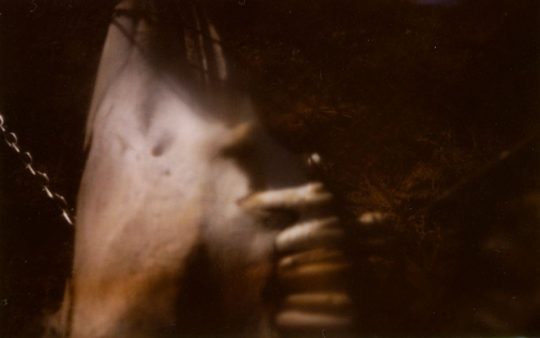
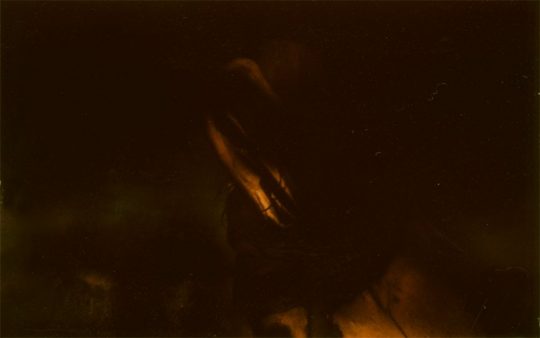
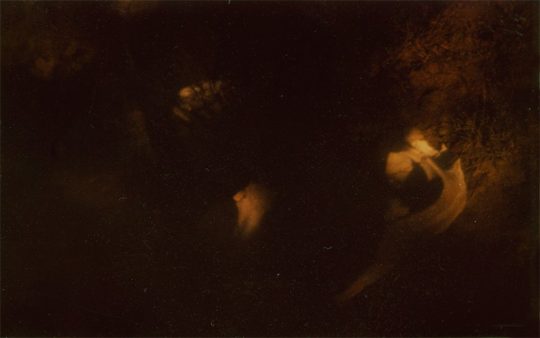
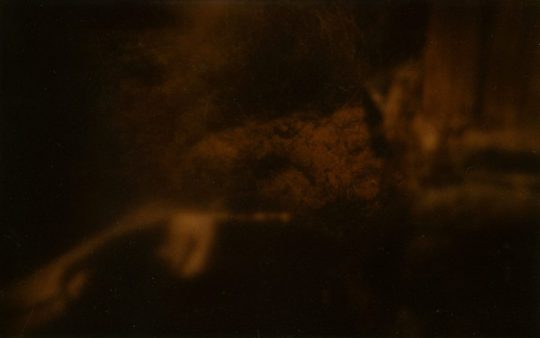
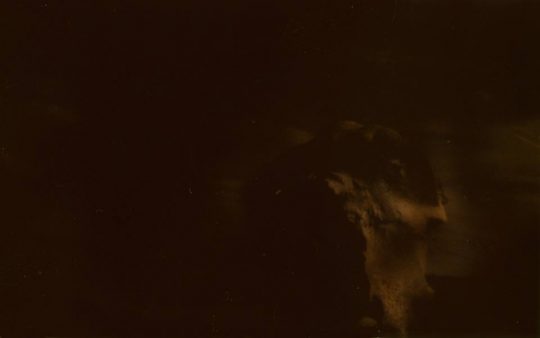
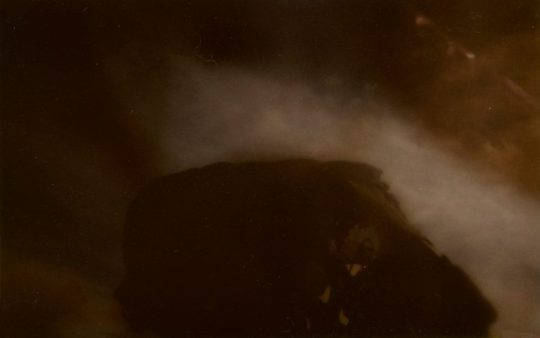
This Polaroid series created during a ritual walk for Thanksgiving Day, along the Jornado del Muerto (Journey of the Dead Man) desert of El Camino Real de Tierra Adentro: the genocidal road of the Spanish conquistadors, the site of the explosion of Trinity (the plutonium infusion fission nuclear bomb), and the American Indian Wars against the Apache and other Native Nations. The bones depicted in these photographs are of the skulls of cows left chained to fence posts. Thanks to the Creative Capital fellowship and the Theo Westenberger Estate. These images are part of a multidisciplinary collaboration in progress with Matt Contos and Andrea Clearfield.
N5