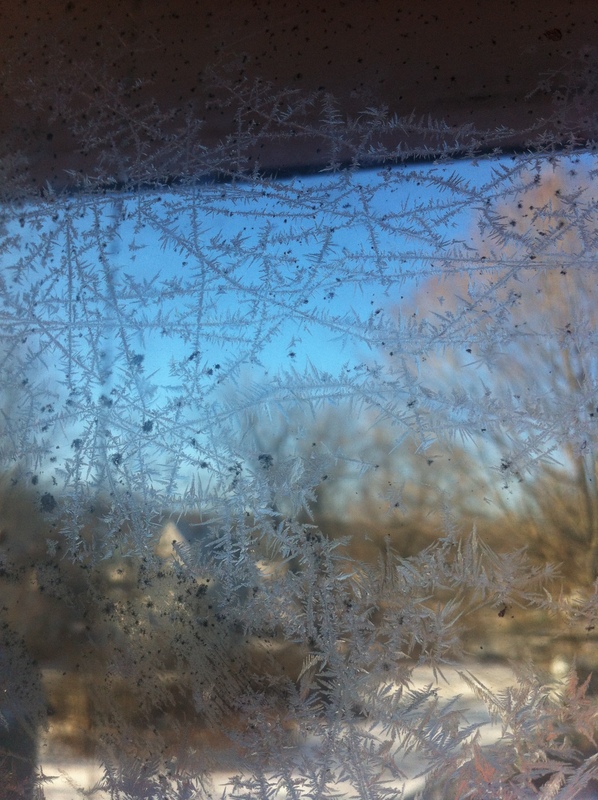
Nights caught in small cold moments of crystallized fire. Winters here about temporary shelter, the unmittened hands of friends, and accidental warm bodies. Strung lights across the darkness. This is how we find our way.
He and I walk in the dark woods. We call out and point at the constellations. We each know only four. A short game. But it makes sense of the darkness, our breaths rising, converging, in the air above us, our gloved hands pointing, reaching, like children too small to grab the lowest branch. Round the corner, dip in the tree line, sudden fire of the moon rising, hanging burnt orange.
He tells me how his mother brought oranges home box by box from the grocery store, each orange in its small green paper nest. Satsuma, Clementine, Tangerine, Owari, Tangor. Each sounding like a country he might someday visit. Early morning, his mother at the kitchen counter peeling his father’s oranges for his lunch, so he could eat them later without the citric acid from the peels stripping the machine grease from his hands. How she saved him from black oranges. Love in the small lunch-box gestures.
I tell him how in my town I knew a boy who worked at the grocery store who had been bitten by a tarantula that had been accidentally packed or stowed away in a case of bananas. I still think about that tarantula so far from the warm, so far from home. Did he get to see snow? After that, I opened each box of oranges my mother brought home carefully, wondering what exotic things might come along with them. What stows away, escapes, what bites you and your greedy hands.
I tell him, too, of that Christmas when my mother told my brother and I how the oranges had vitamin C, which would make us grow up big and strong. How when she was out shoveling snow off the steps, we took turns eating an orange and then lifting the end of the couch. She was right, we decided with each lift. Soon we would lift the trailer. Soon we would tear it from its blocks and roll it to another town, one with more oranges. And we would be gods. Orange gods. But how instead we spent the next day fighting for the toilet.
A conversation beneath this conversation glowers between us. The erratic space between our hands as we walk. How, later, on the wide bare bed, he will explain that an orange is a question of distance: from tree to hand that picks it, from hand to box, from box to home, to hand, to mouth, to tongue. Says we are all reaching for the branch. Even oranges.
I explain how oranges, mandarins, offer themselves up, shuck peels, let segments fall away from one another, like a too eager lover naked at the foot of a bed waiting. They are always waiting.
And other aches of time. Time between each segment placed on a tongue. Span of time before bodies can no longer keep one another warm so the duvet has to be retrieved from the hardwood floor.
For now, though, we walk deeper into the woods, the soldier, bare trees reaching for the stars. But once you’ve seen an orange, you can’t help but see oranges everywhere. In the darkness, each star caught in the wide blackness might be an orange gloaming there instead of a planet. Celestial bodies, the hurtling rotations and orbits of great oranges, galaxies just spilled boxes out of reach.
I want to quote Neruda. Something about his lover’s “orange laughter.” But I can’t remember how it goes. So we walk on, a waltz of bumping shoulders, the quiet hum of the star flung, mandarin sky.
— R. W. Gray
 R. W. Gray is a writer with commitment issues when it comes to form. He has published his poetry and prose in numerous journals and in the anthologies Seminal, And Baby Makes More, Queering the Way, and Quickies 1 and 2. His first collection of short stories, Crisp, was published by NeWest Press (2010). Ten of his short scripts have been produced and the most recent, “alice & huck,” won awards at festivals in New Orleans, Beverley Hills, and Honolulu. He currently is a professor of film and screenwriting at University of New Brunswick. He is also senior editor at the helm of Numero Cinq’s NC at the Movies.