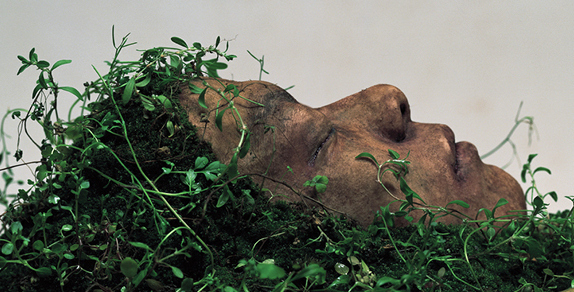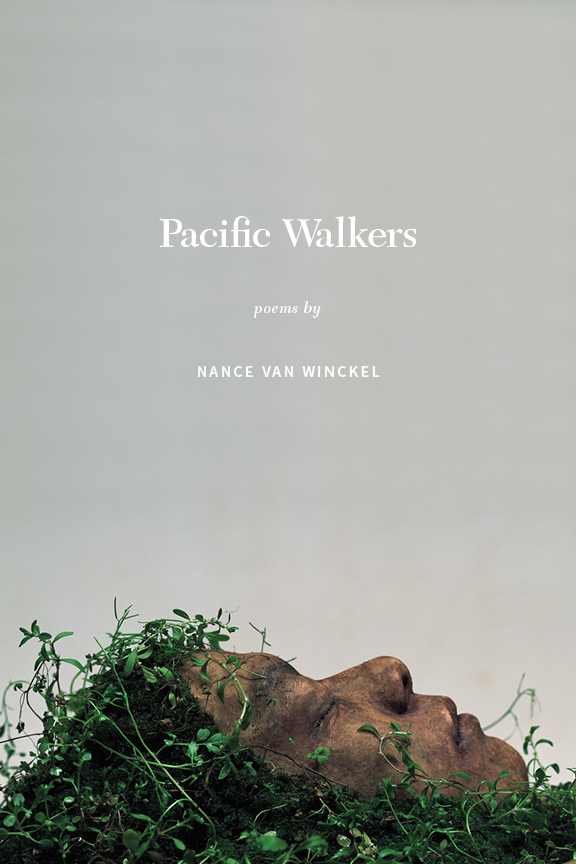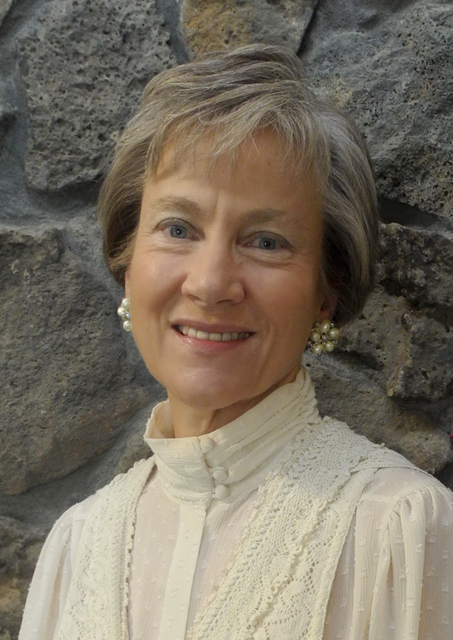
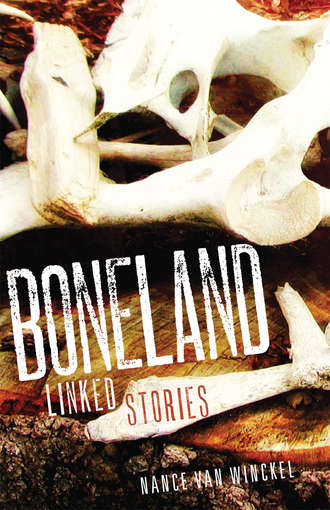
NC Contributing Editor Nance Van Winckel has popped out two, yes, two! books simultaneously this year; Pacific Walkers, a collection of poems, and this one, Boneland, a collection of linked short stories. As we all know, one book is amazing enough; two books, in different disciplines, is tantamount to having the literary equivalent of Multiple Personality Disorder. Only this is a disorder we all wish we could catch. I have taught with Nance for years at Vermont College of Fine Arts. She never ceases to surprise me with her unconventional wisdom, her oblique and revelatory take on art, and her questing spirit. We have here for your delectation a lively and intelligent interview with Nance by the inimitable Ross McMeekin.
dg
Ross McMeekin: Tell us about the Spokane area literary scene; there are so many great writers who call it home.
Nance Van Winckel: Yes, Spokane has some wonderful writers and I feel lucky to call many of them friends: Sam Ligon, Jess Walter, Laurie Lamon, Christopher Howell, Greg Spatz, Tod Marshall. There’s a very active spoken word poetry scene here too and many younger poets—with loads of great energy—involved with that. We have a literary festival, Get Lit, every spring that brings many writers of national prominence to town. And of course we have three outstanding universities in town, and all of those have good writers on staff and bring IN good writers. I’m still very connected to my former colleagues at E. Wash. U, and the MFA Program there where I taught for 15 years. I’m teaching a one-day workshop for them in November. And we have a great independent bookstore, Auntie’s, that has fabulous readings every week.
RM: Do you have some recommendations for books or literary journals that have impressed you recently?
NVW: With some of my Vermont College students I’m currently reading a very compelling book of stories: Guide to Being Born by Ramona Ausabel. I also just read a superb second book of poems by a former student of mine: Jennifer Boyden’s The Declarable Future. I’m also reading Proust for the first time. I’m half way through the six volumes and loving this work, savoring it. Wish I could read it in French. I talked with a French Canadian flight attendant who said he had read it all by reading one page aloud every day for several years. He had also loved it. Gorgeous prose. Luminous. Strange. Imagistically sparkling. And full of a sad interiority, a soul I find myself missing when I’m away from it for a few days.
As for literary journals, I’m trying these days to get to know more of the online journals and formulate a sense of what may be the BEST of those. Since I’m working now on combining text and photography (digital photo-collage), those journals—rather than print journals—seem to be better possibilities for me in terms of “publishing” these full-color hybrid art pieces. Of these journals I especially like ILK, EM, Cascadia Review, Diode, Sleeping Fish, and Drunken Boat. I’m also amazed at how many bad ones there are out there: badly edited with grammar troubles and/or typos everywhere, or badly managed. I had one journal (Glassworks) accept three pieces, and then email later that they’d changed their minds and weren’t going to use the work after all. What?! I wish there’d be more REVIEWS of online journals, or of ALL journals really. But clearly it’s also part of a writer’s job to do this sort of legwork and scope out the best homes for her work.
RM: The characters in your new collection, Boneland, are excavating everything from memories to ancient dinosaur bones in order to understand the past. This desire to piece together what’s happened seems to me an innate and universal human drive, even for those of us who choose to ignore it. But there’s a certain strangeness and sadness to this drive, as well, that I think the collection exposes. I wonder if you’d speak a bit to our drive to dig up the past.
NVW: Yes, very well put, Ross! Excavation is a big part of Boneland. So is reconstruction. As we see with the do-it-yourself dinosaur fossil reconstruction going on in the old dairy barn, and probably a few mastodon bones getting glued into the dinosaur, what was the ACTUAL past, the reality of the past, later becomes a mish-mash. A collage. Made up of facts and guesses. History may never be completely accurate since memory itself isn’t. But you’re right—we try anyway. As we mature, as these characters do, we try to understand better what haunts us, what lingers in unsettled ways, from our earlier lives. And we never can put together a full and perfect rendering of the BEFORE. There’re always going to be gaps and holes, things we can’t know, things that will continue, maybe forever, to remain hidden. But what remains hidden may give the resurrection an air of sadness and/or strangeness, as you say, but I hope it may also suffuse it with something beautifully human or humane—this living with uncertainties, accepting these, and going on from there.
RM: There’s a lovely passage in which your protagonist, Lynette, is piecing together the development of her relationship with another character that I think speaks to the nature of how imagination and memory and the physical bleed into one another.
“These last few mornings, I’d awaked imagining conversations that Steve and I might have. I varied the lines. There was, each day, a little more sexual innuendo in the exchanges I invented between us. I could almost feel on the inside of my left thigh the place I’d imagined his hand last night and this morning his mouth.”
I’d love to hear your thoughts on the nature of memory, and also how imagination and memory interact.
NVW: What I think about with this passage is how a friendship or a romance may often begin IN the imagination. One first has to SEE in the mind’s eye what a connection with another person might look like, might BE like—emotionally and physically. This facilitates—doesn’t it?—the making of the bond. So, really, I guess I’m talking about how the construction of the future itself is similar to the construction of the past in that one first has to “glimpse” the possibility. Then begins the building.
RM: I was fortunate to have the opportunity at a conference to hear you read a section from one of the stories in the collection, “A Kingdom Comes.” The piece involves a family’s discovery that their son is uniquely gifted in mathematics, and perhaps on the spectrum for Asperger’s Syndrome. What inspired the story?
NVW: Yes, I do think of Buster as having Asperger’s. I have two good friends who have autistic sons. One son is quite gifted, though. As a visual artist. As a writer I’m intrigued by sometimes seemingly contradictory elements that make up a personality. Though this particular character has trouble connecting with other humans in some ways, I found myself moved by how he tries to. This was an act of pure imagination, of course. I love that he finds a way to be a husband and father. I am not sure if this will be true for either of my friends’ sons. But in writing the story, I constructed a kind of future that I hoped for them.
RM: There’s some beautiful image patterning in the book, specifically the attention given to eyes and eyesight, both metaphorically and physically. How did it first emerge, and at what point did you recognize the pattern?
NVW: The “re-seeing” was something I recognized was going on in “The Funeral of the Virgin,” an early story in the book. A woman with some greater temporal distance on her husband’s death begins to wonder if the death might have been a suicide. The implication is that she may not have been able to contemplate such a version of events at the actual time of his death. Keeping that narrator, I subjected her in a series of small short-shorts to LASIK surgery. Those were interesting pieces to write in that I had the actual physical messed-up eyesight to work with. I could give a physical body to something that had seemed more cerebral or theoretical in other stories, that “re-seeing” of the past. And of course the surgery itself had to get a little bollixed up for this to work. I liked too the narrator having this “down-time” from ongoing dramatic events to ruminate. It seemed to me I could let the language get perhaps a bit more lyrical in these sections since they were small and interrupted the ongoing dramas in the longer stories. I liked coming back to her lying there, holed-up in a foreign country, blindly feeling around, sorting through what had been. This may have been partly inspired by the fact that back in the mid-1990’s a lot of people I knew were driving up to Canada to get this surgery done because it was, for some reason, hundreds of dollars cheaper there! There were ads in the paper for it every week.
RM: I also wondered at what point during the composition of Boneland you realized the interconnectedness of the stories. Did you intend it from the beginning? Was the process similar to your previous linked story collections?
NVW: Every book of my stories (and they’re ALL linked) has been linked in a different manner. This linking is, for me, something I just thoroughly enjoy experimenting with. The number of ways one might link stories seems infinite to me! I love series too. My last three books of poems I consider poem “series” as well. The stories in Boneland started to “form” their linkage in a way I hadn’t expected or intended. When I realized these characters were all cousins, that they hailed from three brothers, three sons who’d grown up on the Montana ranch together and worked themselves on the dinosaur fossil reconstruction—when I realized this particular commonality, the linkage began to come into focus. I have liked the family saga sort of novel sometimes, the large arc of time and history that can be covered, and so for me, the challenge and the experiment were to see if I could do something remotely like that with a group of stories. I’m not sure I finally did match the breadth and sweep of some of those novels, but I did enjoy being alive in a history that felt very very large and went WAY back. Way back.
RM: You’ve had both poetry (Pacific Walkers) and story collections come out in the last year. What’s next?
NVW: I have a new book of prose poems in progress. I’m tinkering with its shape right now, moving parts around, and still writing a few new prose poems that may yet be included.
I’m also working, as I mentioned, on these hybrid text-based photo-collage pieces right now. There are three distinct book projects, each of which I see as a possible ebook. (I suspect they’d be too pricey an undertaking for print publication. But maybe. Maybe black and white versions?) One is a novella in the form of a photo album/scrapbook/flash-fiction memoir. Another is a book of poems that consists of altered pages from the Official Guide to the 1964 New York World’s Fair. This is not erasure art, but rather text I have changed and integrated into text that was already there, and I usually add other graphic material as well. This World’s Fair was something I went to as a girl with my family and it was the first time I recall having my wee little mind blown. Blown by the huge wild international world and THE FUTURE suddenly all around me. In my project I talk back, some fifty years later, to these versions of the future I was given. And the third project is also an alteration project; it’s tentatively called THE BOOK OF NO LEDGE. Altered pages of an old encyclopedia. I’ve been sassing back, as my mother would say, to the All-knowing Voice of Certainty of this encyclopedia. Since there’re about nine volumes, all purchased for five bucks last year at a yard sale, I think this project may well last me the rest of my days. And to tell you the truth, if I die altering THE BOOK OF NO LEDGE, I think I’ll die happy.
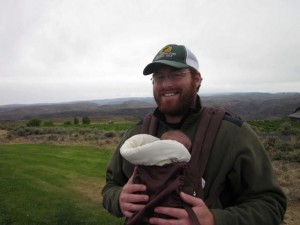 Ross McMeekin’s fiction appears or is forthcoming in publications such asShenandoah, Passages North, Doctor T.J. Eckleburg Review, Green Mountains Review, and Tin House (blog). He received a MFA from Vermont College of Fine Arts, edits the literary journal Spartan, and blogs at rossmcmeekin.com. He lives in Seattle with his wife and daughter.
Contact: nancevanwinckel@old.numerocinqmagazine.com