May 022015
 

karl ove
The fraught interplay between the teenage Karl Ove and his father, who is now divorced and living a different life with Unni, his girlfriend, is caught in this extract. One of the first changes the sixteen-year-old notices is the informal way of dress for a formerly carefully put-together man; the second is the steady drinking; the third is that infractions he commits that would have been punished before, such as spilling a drink, smoking, or having another glass of wine, pass by unremarked. The narrator’s disorientation is clear; this is not the father he once knew. However, everything can change back quickly, and the alcohol-induced state of cheerfulness on the part of both adults descends into anger once Karl Ove’s mother is brought up too many times for Unni’s comfort. Abruptly dismissed from their home, Karl Ove boards a bus. He doesn’t dwell on the mood shift any more than we consciously think of the air we breath. The narrative jumps forward a quarter century to when he has possession of his dead father’s notebooks that indicate Karl Ove’s visits, along with other matters.

—Jeff Bursey


.

From My Struggle: Book Four
Karl Ove Knausgaard; Translated by Donald Bartlett
Archipelago Books

The following afternoon I went to Dad’s. I had put on a white shirt, black cotton trousers, and white basketball shoes. In order not to feel so utterly naked, as I did when I wore only a shirt, I took a jacket with me, slung it over my shoulder and held it by the hook since it was too hot outside to wear it.

I jumped off the bus after Lundsbroa Bridge and ambled along the drowsy, deserted summer street to the house he was renting, where I had stayed that winter.

He was in the back garden pouring lighter fluid over the charcoal in the grill when I arrived. Bare chest, blue swimming shorts, feet thrust into a pair of sloppy sneakers without laces. Again this getup was unlike him.

“Hi,” he said. “Hi,” I said. “Have a seat.”

He nodded to the bench by the wall.

The kitchen window was open, from inside came the clattering of glasses and crockery.

“Unni’s busy inside,” he said. “She’ll be here soon.” His eyes were glassy.

He stepped toward me, grabbed the lighter from the table, and lit the charcoal. A low almost transparent flame, blue at the bottom, rose in the grill. It didn’t appear to have any contact with the charcoal at all, it seemed to be floating above it.

“Heard anything from Yngve?”

“Yes,” I said. “He dropped by briefly before leaving for Bergen.” “He didn’t come by,” Dad said.

“He said he was going to, see how you were doing, but he didn’t have time.”

Dad stared into the flames, which were lower already. Turned and came toward me, sat down on a camping chair. Produced a glass and bottle of red wine from nowhere. They must have been on the ground beside him.

“I’ve been relaxing with a drop of wine today,” he said. “It’s summer after all, you know.”

“Yes,” I said.

“Your mother didn’t like that,” he said. “Oh?” I said.

“No, no, no,” he said. “That wasn’t good.” “No,” I said.

“Yeah,” he said, emptying the glass in one swig.

“Gunnar’s been round, snooping,” he said. “Afterward he goes straight to Grandma and Grandad and tells them what he’s seen.”

“I’m sure he just came to visit you,” I said. Dad didn’t answer. He refilled his glass.

“Are you coming, Unni?” he shouted. “We’ve got my son here!” “OK, coming,” we heard from inside.

“No, he was snooping,” he repeated. “Then he ingratiates himself with your grandparents.”

He stared into the middle distance with the glass resting in his hand. Turned his head to me.

“Would you like something to drink? A Coke? I think we’ve got some in the fridge. Go and ask Unni.”

I stood up, glad to get away.

Gunnar was a sensible, fair man, decent and proper in all ways, he always had been, of that there was no doubt. So where had Dad’s sudden backbiting come from?

After all the light in the garden, at first I couldn’t see my hand in front of my face in the kitchen. Unni put down the scrub brush when I went in, came over and gave me a hug.

“Good to see you, Karl Ove.” She smiled.

I smiled back. She was a warm person. The times I had met her she had been happy, almost flushed with happiness. And she had treated me like an adult. She seemed to want to be close to me. Which I both liked and disliked.

“Same here,” I said. “Dad said there was some Coke in the fridge.”

I opened the fridge door and took out a bottle. Unni wiped a glass dry and passed it to me.

“Your father’s a fine man,” she said. “But you know that, don’t you?”

I didn’t answer, just smiled, and when I was sure that my silence hadn’t been perceived as a denial, I went back out.

Dad was still sitting there.

“What did Mom say?” he asked into the middle distance once again. “About what?” I said, sat down, unscrewed the top, and filled the glass so full that I had to hold it away from my body and let it froth over the flag- stones.

He didn’t even notice!

“Well, about the divorce,” he said. “Nothing in particular,” I said.

“I suppose I’m the monster,” he said. “Do you sit around talking about it?” “No, not at all. Cross my heart.”

There was a silence.

Over the white timber fence you could see sections of the river, greenish in the bright sunlight, and the roofs of the houses on the other side. There were trees everywhere, these beautiful green creations that you never really paid much attention to, just walked past; you registered them but they made no great impression on you in the way that dogs or cats did, but they were actually, if you lent the matter some thought, present in a far more breath- taking and sweeping way.

The flames in the grill had disappeared entirely. Some of the charcoal briquettes glowed orange, some had been transformed into grayish-white puffballs, some were as black as before. I wondered if I could light up. I had a packet of cigarettes inside my jacket. It had been all right at their party. But that was not the same as it being permitted now.

Dad drank. Patted the thick hair at the side of his head. Poured wine into his glass, not enough to fill it, the bottle was empty. He held it in the air and studied the label. Then he stood up and went indoors.

I would be as good to him as I could possibly be, I decided. Regardless of what he did, I would be a good son.

This decision came at the same time as a gust of wind blew in from the sea, and in some strange way the two phenomena became connected inside me, there was something fresh about it, a relief after a long day of passivity.

He returned, knocked back the dregs in his glass and recharged it.

“I’m doing fine now, Karl Ove,” he said as he sat down. “We’re having such a good time together.”

“I can see you are,” I said. “Yes,” he said, oblivious to me.

***

Dad grilled some steaks, which he carried into the living room, where Unni had set the table: a white cloth, shiny new plates and glasses. Why we didn’t sit outside I didn’t know, but I assumed it was something to do with the neighbors. Dad had never liked being seen and definitely not in such an intimate situation as eating was for him.

He absented himself for a few minutes and returned wearing the white shirt with frills he had worn at their party, with black trousers.

While we had been sitting outside Unni had boiled some broccoli and baked some potatoes in the oven. Dad poured red wine into my glass, I could have one with the meal, he said, but no more than that.

I praised the food. The barbecue flavor was particularly good when you had meat as good as this.

Skål,” Dad said. “Skål to Unni!”

We held up our glasses and looked at each other. “And to Karl Ove,” she said.

“We may as well toast me too then.” Dad laughed.

This was the first relaxed moment, and a warmth spread through me. There was a sudden glint in Dad’s eye and I ate faster out of sheer elation.

“We have such a cozy time, the two of us do,” Dad said, placing a hand on Unni’s shoulder. She laughed.

Before he would never have used an expression such as cozy.

I studied my glass, it was empty. I hesitated, caught myself hesitating, put the little spoon into a potato to hide my nerves and then stretched casually across the table for the bottle.

Dad didn’t notice, I finished the glass quickly and poured myself another. He rolled a cigarette, and Unni rolled a cigarette. They sat back in their chairs. “We need another bottle,” he said, and went into the kitchen. When he returned he put his arm around her.

I fetched the cigarettes from my jacket, sat down and lit up. Dad didn’t notice that either.

He got up again and went to the bathroom. His gait was unsteady. Unni smiled at me.

“I teach my first course at gymnas in Norwegian this autumn,” she said. “Perhaps you can give me a few tips? It’s my first time.”

“Yes, of course.”

She smiled and looked me in the eye. I lowered my gaze and took another swig of the wine.

“Because you’re interested in literature, aren’t you?” she continued. “Sort of,” I said. “Among other things.”

“I am too,” she said. “And I’ve never read as much as when I was your age.” “Mm.”

“I plowed through everything in sight. It was a kind of existential search, I think. Which was at its most intense then.”

“Mm.”

“You’ve found each other, I can see,” Dad said behind me. “That’s good. You have to get to know Unni, Karl Ove. She’s such a wonderful person. She laughs all the time. Don’t you, Unni?”

“Not all the time.” She laughed.

Dad sat down, sipped from his glass and as he did so his eyes were as vacant as an animal’s.

He leaned forward.

“I haven’t always been a good father to you, Karl Ove. I know that’s what you think.”

“No, I don’t.”

“Now, now, no stupidities. We don’t need to pretend any longer. You think I haven’t always been a good father. And you’re right. I’ve done a lot of things wrong. But you should know that I’ve always done the very best I could. I have!”

I looked down. This last he said with an imploring tone to his voice. “When you were born, Karl Ove, there was a problem with one of your legs. Did you know that?” “Vaguely,” I said.

“I ran up to the hospital that day. And then I saw it. One leg was crooked! So it was put in plaster, you know. You lay there, so small, with plaster all the way up your leg. And when it was removed I massaged you. Many times every day for several months. We had to so that you would be able to walk. I massaged your leg, Karl Ove. We lived in Oslo then, you know.”

Tears coursed down his cheeks. I glanced quickly at Unni, she watched him and squeezed his hand.

“We had no money either,” he said. “We had to go out and pick berries, and I had to go fishing to make ends meet. Can you remember that? You think about that when you think about how we were. I did my best, you mustn’t believe anything else.”

“I don’t,” I said. “A lot happened, but it doesn’t matter anymore.” His head shot up.

“YES, IT DOES!” he said. “Don’t say that!”

Then he noticed the cigarette between his fingers. Took the lighter from the table, lit it, and sat back.

“But now we’re having a cozy time anyway,” he said. “Yes,” I said. “It was a wonderful meal.”

“Unni’s got a son as well, you know,” Dad said. “He’s almost as old as you.” “Let’s not talk about him now,” Unni said. “We’ve got Karl Ove here.” “But I’m sure Karl Ove would like to hear,” Dad said. “They’ll be like brothers. Won’t they. Don’t you agree, Karl Ove?” I nodded.

“He’s a fine young man. I met him here a week ago,” he said. I filled my glass as inconspicuously as I could.

The telephone in the living room rang. Dad got up to answer it. “Whoops!” he said, almost losing his balance, and then to the phone, “Yes, yes, I’m coming.” He lifted the receiver. “Hi, Arne!” he said.

He spoke loudly, I could have listened to every word if I’d wanted to. “He’s been under enormous strain recently,” Unni whispered. “He needs to let off some steam.” “I see,” I said.

“It’s a shame Yngve couldn’t come,” she said. Yngve?

“He had to go back to Bergen,” I said.

“Yes, my dear friend, I’m sure you understand!” Dad said. “Who’s Arne?” I said.

“A relative of mine,” she said. “We met them in the summer. They’re so nice. You’re bound to meet them.”

“OK,” I said.

Dad came back in and saw the bottle was nearly empty. “Let’s have a little brandy, shall we?” he said. “A digestif?” “You don’t drink brandy, do you?” Unni asked, looking at me. “No, the boy can’t have spirits,” Dad said.

“I’ve had brandy before,” I said. “In the summer. At soccer training camp.” Dad eyed me. “Does Mom know?” he said.

“Mom?” Unni said.

“You can have one glass, but no more,” Dad said, staring straight at Unni. “Is that all right?”

“Yes, it is,” she said.

He fetched the brandy and a glass, poured, and leaned back into the deep white sofa under the windows facing the road, where the dusk now hung like a veil over the white walls of the houses opposite.

Unni put her arm around him and one hand on his chest. Dad smiled. “See how lucky I am, Karl Ove,” he said.

“Yes,” I said, and shuddered as the brandy met my tongue. My shoulders trembled.

“But she has a temper too, you know,” he said. “Isn’t that true?” “Certainly is,” she said with a smile.

“Once she threw the alarm clock against this wall,” he said. “I like to get things off my chest right away,” Unni said. “Not like your mother,” he said.

“Do you have to talk about her the whole time?” Unni said.

“No, no, no, not at all,” Dad said. “Don’t be so touchy. After all, I had him with her,” he said, nodding toward me. “This is my son. We have to be able to talk as well.”

“OK,” Unni said. “You just talk. I’m going to bed.” She got up. “But Unni . . .” Dad said.

She went into the next room. He stood up and slowly followed her with- out a further look.

I heard their voices, muted and angry. Finished the brandy, refilled my glass, and carefully put the bottle back in exactly the same place.

Oh dear. He yelled.

Immediately afterward he returned.

“When does the last bus go, did you say?” he said. “Ten past eleven,” I said.

“It’s almost that now,” he said. “Perhaps it’s best if you go now. You don’t want to miss it.”

“OK,” I said, and got up. Had to place one foot well apart from the other so as not to sway. I smiled. “Thanks for everything.”

“Let’s keep in touch,” he said. “Even though we don’t live together any- more nothing must change between us. That’s important.”

“Yes,” I said.

“Do you understand?”

“Yes. It’s important we keep in touch,” I said.

“You’re not being flippant with me, are you?” he said.

“No, no, of course not,” I said. “It’s important now that you’re divorced.” “Yes,” he said. “I’ll ring. Just drop by when you’re in town. All right?” “Yes,” I said.

While putting on my shoes I almost toppled over and had to hold on to the wall. Dad sat on the sofa drinking and noticed nothing.

“Bye!” I shouted as I opened the door.

“Bye, Karl Ove,” Dad called from inside, and then I went out into the darkness and headed for the bus stop.

***

I waited for about a quarter of an hour until the bus arrived, sitting on a step smoking and watching the stars, thinking about Hanne.

I could see her face in front of me.

She was laughing; her eyes were gleaming. I could hear her laughter.

She was almost always laughing. And when she wasn’t, laughter bubbled in her voice.

Brilliant! she would say when something was absurd or comical.

I thought about what she was like when she turned serious. Then it was as if she was on my home ground, and I felt I was an enormous black cloud wrapped around her, always greater than her. But only when she was serious, not otherwise.

When I was with Hanne I laughed almost all the time. Her little nose!

She was more girl than woman in the same way that I was more boy than man. I used to say she was like a cat. And it was true there was something feline about her, in her movements, but also a kind of softness that wanted to be close to you.

I could hear her laughter, and I smoked and peered up at the stars. Then I heard the deep growl of the bus approaching between the houses, flicked the cigarette into the road, stood up, counted the coins in my pocket, and handed them to the driver when I stepped on board.

Oh, the muted lights in buses at night and the muted sounds. The few passengers, all in their own worlds. The countryside gliding past in the dark- ness. The drone of the engine. Sitting there and thinking about the best that you know, that which is dearest to your heart, wanting only to be there, out of this world, in transit from one place to another, isn’t it only then you are really present in this world? Isn’t it only then you really experience the world?

Oh, this is the song about the young man who loves a young woman. Has he the right to use such a word as “love”? He knows nothing about life, he knows nothing about her, he knows nothing about himself. All he knows is that he has never felt anything with such force and clarity before. Everything hurts, but nothing is as good. Oh, this is the song about being sixteen years old and sitting on a bus and thinking about her, the one, not knowing that feelings will slowly, slowly, weaken and fade, that life, that which is now so vast and so all-embracing, will inexorably dwindle and shrink until it is a manageable entity that doesn’t hurt so much, but nor is it as good.

***

Only a forty-year-old man could have written that. I am forty now, as old as my father was then, I’m sitting in our flat in Malmö, my family is asleep in the rooms around me. Linda and Vanja in our bedroom, Heidi and John in the children’s room, Ingrid, the children’s grandmother, on a bed in the liv- ing room. It is November 25, 2009. The mid-’80s are as far away as the ’50s were then. But most of the people in this story are still out there. Hanne is out there, Jan Vidar is out there, Jøgge is out there. My mother and my brother, Yngve – he spoke to me on the phone two hours ago, about a trip we are planning to Corsica in the summer, he with his children, Linda and I with ours – they are out there. But Dad is dead, his parents are dead.

Among the items Dad left behind were three notebooks and one diary. For three years he wrote down the names of everyone he met during the day, everyone he phoned, all the times he slept with Unni, and how much he drank. Now and then there was a brief report, mostly there wasn’t.

“K.O. visited” appeared often. That was me.

Sometimes it said “K.O. cheerful” after I had been there. Sometimes “good conversation.”

Sometimes “decent atmosphere.” Sometimes nothing.

I understand why he noted down the names of everyone he met and spoke to in the course of a day, why he registered all the quarrels and all the reconciliations, but I don’t understand why he documented how much he drank. It is as if he was logging his own demise.

—Karl Ove Knausgaard

.
.
May 092014
 

AskildsenPhoto

 Where would I have gone? one character asks. Is this question meant to illustrate his entrapment? Where would I have gone: there’s nowhere else I can go. Or is it an expression of preference? We walk a line, always, between obligation and isolation. Can you make peace with what you owe to your partner? What do you mean when you tell her, where else would I have gone? — Adam Segal

Selected Stories Cover

Selected Stories
Kjell Askildsen
Translated by Seán Kinsella
Dalkey Archive Press, May 2014
Paperback, 100 Pages, $11.95.


When Ameir discovered that I was a nonbeliever, he was incensed. We worked in a kitchen in downtown Iowa City; it was mid July and sweat was plentiful. What began as a jocular conversation about the benefits of certain religious dietary rules had become an expression of more radical thought: the most just society, argued Ameir, would be a total theocracy populated only by faithful adherents. He was a master provocateur, somehow believing this sincerely while simultaneously saying it simply to goad me. What about atheists, I said. They don’t belong in any society, he said. So I began to make my case.

The ensuing debate was lengthy and passionate but likely unremarkable, having been played out by young students for centuries. But one of Ameir’s more compelling barbs connected, and has stayed with me for years. If you’re so certain there’s no God to judge you, he says, and no afterlife to reward or punish you for your deeds, then why are you still here? Here, in Iowa City, in the July heat, in a restaurant kitchen. The mundane Here and not the seductive Elsewhere. His challenge presupposed questionably that the forces holding me in this Midwestern college town (close friends, need for financial stability, general contentment, crippling postgraduate uncertainty, etc.) were moral obligations as opposed to practical ones. But the challenge stung, and the challenge lingered, because in truth I’d been contemplating escape. In truth I’d been wondering just what ties were holding me in place.

This May, Dalkey Archive Press is publishing a taut little collection of fictions by the Norwegian author Kjell Askildsen.  Askildsen has been writing consistently since the 1950s, though these Selected Stories have been gathered from four collections published in the ‘80s and ‘90s. Askildsen is currently in his eighties. His writing has not yet been widely translated into English.

I think of this encounter with Ameir when I think of Askildsen. Selected Stories is a meditation on individual freedom, a book fraught with the day-to-day pressures of human life.

The nine brief stories collected within can all be described in terms of absences. The absence, for example, of experimental or ornate, “flowery,” prose. The absence of unnecessary characters. The absence of exotic or alien locales, or of complicated plot arcs. The emotional landscape is barren, bleak. The stories, on first glance, exhibit such stark similarity that it’s almost alarming. The first four take place prominently in suburban gardens and on the overlooking verandas. Very few of the protagonists mention work, none of them are seen working, and only one, in the three-page “The Nail in the Cherry Tree,” has a named profession. He is a poet. Only in the opening story, “Martin Hansen’s Outing,” is a young child involved or even mentioned. Parents are aging, ailing, or freshly dead. One senses that Askildsen is delicately, deliberately seeking answers to a particular set of nagging questions, and is never quite satisfied with what he uncovers.

Askildsen’s stories are thus constrained, quiet, and at times they even feel polite. But they are not simple.

It does at first seem odd, the overwhelming lack of employment. Where, after all, is this idle world in which one’s primary concerns consist of caring for guests and tending to the vegetable patch, a world in which several stories can begin with some variation of, “We drank morning coffee in the garden”? But it is precisely in this idleness that Askildsen is able to pursue his obsessions. He is fascinated by human pettiness. His characters lie in hundreds of small ways, grow unfairly annoyed with one another, expect much and offer little. They refuse to forgive, and never apologize.

“Martin Hansen’s Outing” sees the titular protagonist lie to his wife about having to meet his brother, just so he will be able to spend his evening drinking alone on the town. Elsewhere characters pretend not to hear their wives, berate grieving relatives for not having enough ashtrays, empty bottles of wine down the drain to create the illusion they got drunker than they did, and stand around in the middle of an upstairs room, simply to “let time pass.”

These antics are variously sad, cruel, and uncomfortably relatable. But Selected Stories is not just a comedy of minor indiscretions. Martin Hansen’s lie about his brother, for example, hints at further lies, and deeper infidelity. Martin comes clean and is asked by his wife “what’s the point of all this sudden honesty?” a question that keeps him up all night, wondering, “what does she know about me that I don’t know that she knows?” Askildsen convincingly plays out the multifaceted tensions and aggressions that arise between siblings and lovers alike. These stories, with very few words, evoke whole years or even decades of family history.

The peaceful, almost pastoral setting in which these stories take place does very little to abate the characters’ strife. Askildsen avoids lingering in his descriptions of nature. In “The Dogs of Thessaloniki,” the protagonist casually takes stock of what is perhaps the collection’s most vivid depiction of Norway’s natural splendor: “I had the fjord and the distant, wooded hillsides in front of me. The murmur of hushed conversation and the gentle gurgle of the water by the shore put me in a drowsy, absentminded state.” Otherwise one gardens in order to ignore one’s family, walks in the woods as a means of hiding from one’s spouse, discusses the weather to cover up all the things one ought to say but refuses to, or can’t. “A Lovely Spot,” a story about a married couple visiting the family summer home, repeatedly employs the title phrase as a sickening joke to illustrate just how incapable the couple is of genuine communication.

—Isn’t this a lovely spot, she said.

—Certainly is, he said.

One of Askildsen’s more acute concerns in these stories is the nature of adult male sexuality, which to him contains subtle underlying elements of violence, rapaciousness, and exploitation. Martin Hansen stares out the window at his daughter’s 15-year-old friend and finds that “it wasn’t difficult” to close his eyes and picture himself “taking her.” Another character reads a “rape-like scene” in a novel, and “felt [himself] aroused.” He develops an intense sexual interest in his new sister-in-law, commenting several times on “how easy it would be to lift her up.” None of the male characters act on these darker urges. But the urges are there, contributing to the sense that the thoughts and actions bubbling up to the surface in Askildsen’s stories–the lies, evasions, and little betrayals–are just superficial manifestations of the forces really at play.

In fact the depictions of male desire reminded me often of the work of J.M. Coetzee, whose aging, overeducated protagonists are often disgusted by and at odds with the power their lust still holds over them. But where Coetzee’s protagonist philosophizes and self-interrogates, reining in the influence of his phallus as if it were an excitable beast on a chain, Martin Hansen and his compatriots are much less interested in self-study. There is very little guilt or shame to be found within these pages. Defending his curious, evasive behavior while home for his father’s funeral, Bernhard, the protagonist of “The Unseen” declares, “I can’t help the way that I am. If I were to kill a person, for instance, I couldn’t help it, but I’m not about to kill anyone, that’s not how I am. Everything that I do, I do because that’s how I am, and it’s not my fault that I’m the way that I am.” Only in “The Unseen” is this idea so explicit, but a soft fatalism envelops every one of Askildsen’s stories.

I have, on several occasions, attempted to comfort myself and close friends in the wake of a breakup with the observation that, individual human desires being as they are so fleeting and disparate, it’s really something of a miracle that any romantic relationship manages to last at all. I acknowledge that the verity of this observation, as well as its usefulness as a soothing agent, are open to debate. But it strikes me now that if youthful romance is “miraculous,” then a lifelong committed marriage must be an exercise in impossibility. Two unlike and unlikely lives, welded together by tradition, eros, child-rearing, desire for fiscal responsibility.

At very least, this might be the thought of many of Askildsen’s characters, who view marriage as a form of oppression in direct opposition to their freedom. Martin Hansen (who, it seems, makes for the perfect prototypical Askilsenian protagonist) wonders for some time just why it is he lies to his wife, and eventually lights upon the realization that “my non-disclosure and falsehoods were prerequisites for my freedom.” Another character lies about visiting his sick father in order to get away from his wife for a few hours. He, too, is attempting to reassert control over his life: “Later on, as he was driving out of town in the direction of R, he felt almost cocky, and he thought: I do as I please.”

“Do you remember the dogs of Thessaloniki,” asks the protagonist’s wife Beate in the story of the same name, “that got stuck together after they mated… All the old men outside the café shouting and screaming… and the dogs howling and struggling to get free from one another.” This unsubtle little allegory makes it clear that all parties feel equally choked by the marital bond, and also brilliantly depicts the overwhelming agitation – the howling and the struggling – hiding beneath all this small talk over coffee in the garden. But how to break free? Beate’s husband, out for a walk earlier in the story, confides: “I noticed I was reluctant to go home, and suddenly I thought, and it was a distinct thought: if only she were dead.”

What, exactly, is this sort of freedom that manifests itself in such childish, petty ways? Why is it so important to establish one’s autonomy through minor deceptions, just so that one can go smoke cigarettes down by the fjord? It turns out that marriage isn’t the real culprit. What these characters want, more than anything, is to be free of all obligations, to be owed nothing and owe nothing in return.

It’s no coincidence that friendship is almost completely missing from these stories. The closest thing any protagonist has to a friend is described as “a man my own age who lives in the area, with whom I have a somewhat forced relationship, because he once saved my life.” This same character explains to his sister that he has no girlfriend because “I prefer women who don’t make any demands of me, but who give, take, and go.” In “The Unseen,” Bernhard is shown contentedly allowing his sister and her fiancé to carry on a conversation without him: “It had grown darker, their faces weren’t completely distinct, he felt almost unseen. Almost free.”

So it’s appropriate that so many of these stories are about family visits and homecomings: the homecoming is the time when one’s current self is weighed against old expectations and aspirations, when weddings and funerals shake up or reify the accepted family dynamics. Longtime conflicts, neglected or forgotten, seethe and push against expectations of civility. In an environment of increased pressure, it’s hard not to dream of escape.

But Askildsen’s stories don’t ever build to a level of tragic, operatic family collapse. The conclusions are anticlimactic, the conflict is rarely resolved. There is generally a return, or a resignation. There is an uneasy acceptance of the fact that one is trapped in the same situation as before. “The Grasshopper,” a story of admirable subtlety and palpable sadness, ends with the husband finding his wife–with whom he has of course had some quarrel–alone and afraid in their bedroom. “I thought you had gone, she said. Where would I have gone, he said.”

Where would I have gone?

Is this question meant to illustrate his entrapment? Where would I have gone: there’s nowhere else I can go. Or is it an expression of preference?

Askildsen’s Selected Stories present a world in which one can never truly escape from one’s obligations. There is one character who gets close. His wife is dead and he is ambivalent; he speaks with her father and feels “something approaching satisfaction thinking about how, now that Helen was dead, he was no longer my father-in-law, and Helen’s sisters were no longer my in-laws either.” In all this loss of ties he seems to lose his humanity as well. Contemplating life alone on a large, empty estate, he closes his eyes and sees “that great deserted landscape, that’s painful to see, it’s far too big, and far too desolate, and in a way it’s both within me and around me.” There’s only one place we’re certain to be freed from our debt: the grave.

We walk a line, always, between obligation and isolation. Can you make peace with what you owe to your partner? What do you mean when you tell her, where else would I have gone?

— Adam Segal

.

Adam Segal

Adam Segal is a writer and culinary professional in Portland, Oregon. He graduated from the University of Iowa some time ago, and has since interned for Graywolf Press and contributed extensively to Whole Beast Rag magazine, among myriad other adventures.


Read “A Great Deserted Landscape” on Electric Literature

Aug 152013
 

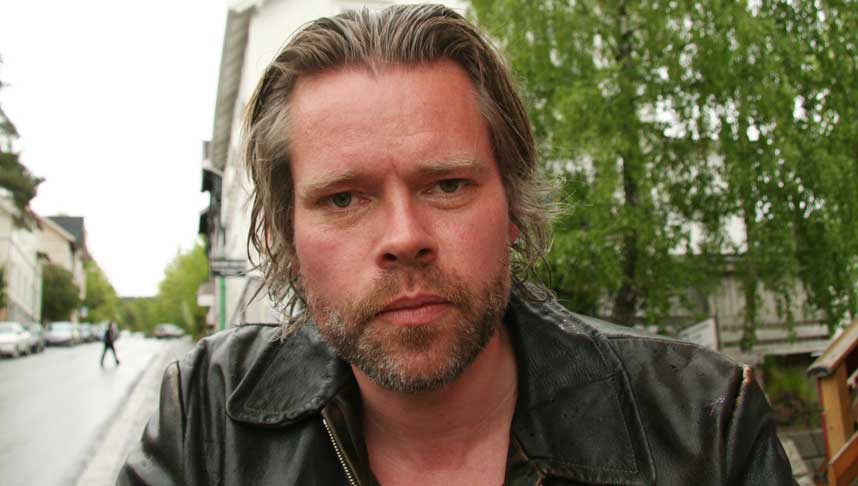
stig

Herewith is “Us.” I’ve chosen this excerpt of Through the Night (Dalkey Archive Press), translated by Seán Kinsella, to illustrate the power of Sæterbakken’s prose, particularly his narrative voice and control of the moment. “Us” comes early in the novel, and is perhaps the origins of Karl and Eva’s eventual separation. But as this section makes clear, Karl poses many existential questions on love and fidelity, which are paralyzing, and for him unanswerable. This rather prismatic questioning of life is repeated throughout the novel, adding to the novel’s overall tension and psychological terror.

Jason DeYoung

cover

Us

“Do you think the two of us will always be together?”

We’d eaten a late dinner, and I was pouring Eva some wine from a newly opened bottle, after she had, surprisingly enough, asked me to check and see if we had one. I felt a smile cross my face as I stood in the closet with the bottle in my hands, Eva had that carefree air about her, the one she usually had, in fact, when circumstances suited her, and as I stood in the kitchen cutting off the bottle’s seal with the tip of the corkscrew, I couldn’t help but smile again, as if it were our very first night together.

“Do you think the two of us will always be together?”

The question gave me a start and I tightened my grip on the bottle, anxious about where she wanted to go with this. Why did she ask? Because she figured, no matter which way she looked at it, that the answer had to be yes? Or because she figured, no matter which way you looked at it, that the answer had to be no? And I thought about how often the questions we asked each other were in reality the questions we wanted to be asked ourselves.

“Do you think the two of us will always be together?”

I looked at her. Her neck, her shoulders. So beautiful, everything! Sometimes in the evenings I massaged her while she watched TV. I felt like a sculptor when I did it. This was what a sculptor must have felt, I imagined, when he had finally gotten a piece just as he wanted it, standing there running his hands over his finished work. And, in fact, she now placed her hand on her own shoulder, there at the table, and began to rub at it, without being aware she was doing so, which was usually an expression of exhaustion, self-pity, of wan despair, but which now seemed more like a self-caress.

“Do you think the two of us will always be together?”

In order to avoid answering, I raised my glass and clinked it against hers, and asked for her own opinion on the matter. The subject could hardly be coming up out of the blue, it occurred to me, when I actually thought about it: it was only a few days since one of Eva’s old friends, whom she hadn’t heard from for years, had called her up and described in detail—they’d been on the phone for almost three hours—the last few years of her marriage, a marriage that had lasted since the days she and Eva had been at school together, but was now over, as it had turned out that her husband, who had been her childhood sweetheart, was jumping into bed with practically every woman who had come his way, most recently with his sister-in-law, something that of course had come out, by and by, and had in turn triggered an absolute avalanche of confessions. This friend told Eva that she felt that her entire life had been ruined. All those years she’d regarded him as her one and only, believing him to be regarding herself as his . . . She’d said she would have felt better if she’d been the one who had done it, if she’d been the one who had lied and cheated, the one who now had to put up with the accusations, the one racked with shame and regret. She’d embarked on a few reckless escapades after she’d found out, she confided to Eva, as a revenge of sorts. But it was too late. There was nothing to be gained from it, neither for her nor for him. Nothing for her to win, nothing for him to lose. Everything was ruined. And she had never even had any fun of her own!

“Do you think the two of us will always be together?”

I looked at Eva. I remembered when I had gone back to her place for the first time, how amazed I’d been at how neat and tidy it was. It was like a household already, just as though the apartment was furnished for the life she wanted but had yet to acquire. It was a home, just standing there waiting for its family to arrive. And I remember thinking with horror about my own one-bedroom apartment, which she still hadn’t been to, how hopelessly juvenile and unfinished it would appear to her compared to all the things she kept around her. The chairs she had were comfortable to sit in, in the kitchen she had good quality knives on a magnetic strip above the range. She wasn’t a student! She was a complete person! There was something extremely appealing about it. I’d been filled with admiration as I looked at her standing there with a bottle of wine in each hand, asking me which I’d prefer; I wanted to move in with her right away, abandon everything I had, take nothing along, just advance to the start, her start, and begin there, over again.

So what did I think? Did the fact that I hesitated, that I didn’t have a ready-made answer, mean that the answer was no? Or was it just that I hadn’t formed any particular opinion yet? In which case it must mean that one outcome was just as likely as the other? Why hadn’t I thought it through properly? Was it because I was so certain that nothing would ever happen that could threaten us, our relationship, the vows we’d made?

I looked at her, the lovely renewed Eva. The just right level of tipsy Eva. The slightly nonchalant, amenable Eva. Whenever I dreamed of her, she was wearing the red dress she’d had on the first time we went out, to that Chinese restaurant. Yes, I think the two of us will always be together, I thought. What else could we possibly want? Her hair, which had grown and was long, fell across her face every time she turned her head, but it was as though she wanted this to happen, since she liked to rake her hand through it, gather it, pull it back behind her ear in a fresh futile attempt to fix it in place, the most beautiful of power struggles.

I looked at her and thought: Now it’s turned into the kind of night where anything can happen. Now we can say anything, anything that comes to mind, without either of us being hurt. At this moment we can take anything. And I remembered a film I’d seen, where you could enter another dimension through a hole in the atmosphere that was only open at certain times, and even then only to those who knew the secret formula. It was there now, the wormhole. It was right in front of us, the possibility to say anything we wanted, exactly what we had on our minds, without the need to take anything else into consideration. At this moment we ourselves didn’t need to be taken into consideration, neither of us. Right now we were the opposite of jealous. At this moment we were equally strong and could tolerate everything.

There and then I felt the need to do it, reveal something, confess something, anything at all, in order to affirm the new intimacy that had arisen (and that would soon vanish again), the candor that now existed between us (and that I knew would soon close again, like a flower that only blooms at night, which folds together as soon as the first rays of the sun fall on it). I despaired. Did I really have nothing to say? No, it seemed that I didn’t. No confessions. No admissions. Nothing to answer for. My conscience was clear. I felt ashamed at the thought. Because it was true, there really was nothing. Nothing other than some altogether insignificant episodes, some embraces that perhaps lingered beyond the merely amicable, some too-close dances, some fleeting touches, one or two kisses that were so innocent that I’d only make a fool of myself if I told Eva about them.

I thought: What in the world have I actually gotten up to in all these years?

A thousand thoughts, a thousand possibilities tumbled around in my head—I had to act quickly, our night was in danger, it could collapse at any moment, and if it did, then nothing could save it from the wan abyss, from the greedy maw of everyday life—but none distressing enough to take advantage of this opportunity, this potential for a new sort of relationship between us. No, to my horror, I had to face the fact that I had nothing to say. My God, if only I’d deceived her one single time! And I cursed myself, my honesty, my excessive caution. My sole sin: omission. Time was up, but there was nothing. She was ready, and I had nothing to offer her.

And a new anxiety pierced through me. What if she now came out with something? What if she now felt the same as I did, that the time had come to admit things, and that she, in contrast to me, actually had something on her conscience, something she now wanted to take the opportunity to unburden herself of? How then would I deal with that? I didn’t have anything to offer her in return, nothing of my own to balance the books with. And for a moment I felt helpless, terrified of what I might hear. I looked at her, waited for her mouth to open, for her to say the words, in an oddly toned voice, which would constitute the introduction, accompanied by a somewhat fearful glance, uncertain of exactly how open she could be.

“Why did you fall in love with me?” she asked before I could think of anything to say, and what I initially took as being a tender thought, a romantic invitation, was in reality, I realized, as I was about to answer, a challenge, a provocation, there had been something aggressive about the way she’d posed the question that only sank in afterward, like a delayed sting. And before I had time to answer, she continued, “Why us exactly? Why didn’t we both end up with other people? Why is it the two of us, in particular, sitting here?” And then she made a gesture with her hand: surrounded by all this. “Why you and me exactly? Why did you decide that I was the one? What was it that made you take that decision?” I searched for something to say, something to stay her with. Because I could see where this was going. But I couldn’t think of anything. And why should I? She wasn’t looking for answers anyway. Her eyes had that slightly glassy look about them, as if they weren’t being used to see anymore.

“Why?” she asked again, pausing before she continued, “Why did you marry me? Why didn’t you wait until you met somebody else? What was it that was so special about me? Was it really impossible for it to have been, just as easily, someone else? Did it only just happen to work out that way, that it was me? Was it just that I was at hand, that I was around when you thought the time was right?”

I said her name, but she didn’t hear me. She was far away. How am I going to get her back? I wondered. If I can’t get her back now, the evening will be lost. Then it was as though she came to life, her cheeks were crimson and a flame danced all the way up along her neck, it looked like her collarbone was on fire, the way her skin flushed and tightened over her throbbing veins.

“Am I the love of your life, Karl? The love that only comes along once in a lifetime? Am I?

“And does it only come along once in a lifetime? What do you think? Maybe it comes along a few times? Or is it something you can use up? What do you think?

“What about you, Karl? Could you love more than once? Is there anything left in you? Or have I taken it all?”

I should have stopped her, defended myself. But the way she’d worked herself up, I knew the only way to get her to stop would be to let her exhaust herself. She was like a riverbed in a spring flood. Any obstacles in her path would only increase the pressure.

“Why don’t you answer me? I’m only asking a few simple questions. What else can I do but ask when you don’t give me anything to work with? You never answer! What is it you don’t want to say? Are you hiding something? Are you hiding something from me, Karl? Are you keeping secrets from me? You don’t have any secrets you’re keeping from me, do you, Karl?”

She looked out of her mind, with her flaming red neck and the purple blotches all around her eyes and cheeks.

Then her head tipped forward, her face hidden by her hair. I didn’t know what to do, only that I’d be wise to wait a little longer before doing it. It looked like she was asleep, but I knew that her eyes were open, that she was sitting there struggling to collect her thoughts. Yes, best to wait, I thought. I took her hand, it was freezing. I warmed it up in my own, and after a while I felt it twitch a little. And then, at long last, she lifted her head and looked at me, fixed her eyes on mine, tried to lift herself up using only our eye contact as a prop. And now the glassy look had vanished, now her eyes sparkled, the light deepening, her look of despair finding expression, her lips regaining their color, the person in her returning, all her wrinkles and lines slipping back into place.

I stood up, still holding her hand, got down on my knees in front of her, and stroked her hair. She sat there for a long time just looking at me, smiling, rather contritely, it seemed. Then she grabbed me by the arm and stared into my eyes with an almost parodic over-seriousness: “Whatever you do, Karl,” she whispered, “whatever you do, don’t lie to me! Do you hear me? I think I’d be able to forgive you almost anything. No matter how idiotic. But not if you lied to me. Not if it turns out that you’d lied to me. Will you promise me? Promise me that you’ll never, ever lie to me?”

I promised, swore a solemn oath. Unconditionally, right there and then, I promised. I felt a pang of conscience as I said it. But then it vanished. Does it matter what you say, what you promise? I remembered how scared I used to be, at the time we were first getting to know each other, of her demands. It was as though she wanted us to live in a way the era in which we lived simply wouldn’t allow us. It was as though marriage was one of the antiques she’d collected, one she felt a particular attachment to. We had friends who’d already divorced and remarried, it was like a perpetual round dance, fueled by the same desires and the same disappointments at every point in the circle. They sought out marriage in order to realize their dreams, and they broke out of marriage in order to realize their dreams—which is to say, they married and divorced for the same reason. All the same, it didn’t occur to me to protest against the old-fashioned boundaries Eva set. Maybe she was right? Maybe it needed to be that strict if it was to mean anything at all? What would be left of fidelity once it was broken? All or nothing, wasn’t that how it had to be? If it happened once, what was to prevent it happening again? Was breaking your marriage vows five times any worse than breaking them twice? Is it better or worse to go to bed with ten different people or to do it ten times with the same person? Is the sin made greater when it’s repeated? Does fidelity even have any meaning in cases where it’s not absolute? And what value does it have if it’s going to be violated someday anyway? The smallest crimes are the largest. By perpetrating them you demonstrate that you are capable of anything.

What had bothered Eva’s friend wasn’t that her husband was unfaithful, but that she herself hadn’t been. Since she herself had refrained, when he did not, all of her years of fidelity became an object of shame. Her entire attitude, her devotion, her marital investment were all taken from her in one fell swoop. Her life-choice became a mockery, retroactively. Her outlook held up to ridicule. Her commitment a waste of time, when all was said and done.

Eva sat staring at me, with a look of either joy or despair, it was hard to say which. Then she tossed her head, sighed heavily, and shook off whatever it was that either delighted or distressed her. All at once she seemed completely sober. The transformation was almost uncanny, as if she’d only been pretending to be drunk.

“Does it make any difference,” she asked, watching me from inside that part of her brain she’d managed to keep on dry ground, away from the alcohol that had been flowing through her, “whether you do it or not, if you really want to do it?”

I asked her what she meant.

“If you meet someone you find attractive, someone you’d like to go to bed with, someone you know you could go to bed with, if you wanted, and then you don’t, out of consideration for me, have you been unfaithful to me anyway? What difference does it make, if it leaves you thinking about how nice it would’ve been to do it? Is there any difference? Does it affect our relationship any less, if you don’t go through with it? Is there less damage being done to our marriage if we do it in our heads and not in reality?”

For the umpteenth time that night I was again at a loss for words. All the same, I was aware that I was enjoyed talking to her about this. I liked the danger of it, the delicacy of it, liked the fact she was on a roll, that she was challenging me, I liked the way it all gushed out of her, how months of constantly recycled thoughts were suddenly being given vent, how everything that was usually concealed was now frolicking so openly between us. Oh, darling, why don’t we do this every night? Why don’t we sit like this, night after night, filling the cup till it overflows, talking about ourselves and our relationship, repeat things we’ve said a hundred times before, tell each other stories we both know by heart, let the familiar mill grind down the corn of our solidarity? Why does such a long time have to pass between each time we do it? Why does such a long time have to pass between each time we find our way to one another like this? What’s the point in everything we do if it doesn’t lead us here, the only place worth being? This is what we live for! This is the purpose of everything we do! The nights that make our days pale by comparison, which bathe our intimacy in a glow, the nights when it’s obvious and evident we can sit across from one another and tell each other everything. Why don’t we do this all the time? Why isn’t every night like this? If there’s a price, then let’s pay it: forty days of silence for one voluble night! As though it all runs by clockwork, gears turning us so slowly, impelling us, cogs that have to make a full revolution before their teeth again connect, slip into one another in precisely the right way, falling into the position needed to set the clock striking. And then come the beautiful, delicate sounds. And everything becomes melodious and obvious. Before the cogs move on, beginning the next long, slow revolution.

“Eva?”

“Yes?”

“I love you.”

—Stig Sæterbakken, Translated by Seán Kinsella

Aug 142013
 

stig858


Equal parts fantasy, horror, and domestic drama, Through the Night is a confident and spacious novel, touching on familiar themes in Stig Sæterbakken’s work—grief, loss, isolation. It tells the story of one man puzzling out his incessant and insidious sorrow over his son’s death against a surreal backdrop of terror. It is a novel with a stirring combo of artistic ambition and moral ambiguity, steeped in the spirit of Céline, Beckett, and Kafka. —Jason DeYoung


cover


Through the Night
Stig Sæterbakken
Translated by Seán Kinsella
Dalkey Archive Press, 2013
259 pages, $15.00

GOD PLEASE FUCK MY MIND FOR GOOD snarls the disquieting music in the rather sinister nightclub Neusohl near the end of Through the Night. EVERYTHING’S BACKWARD! EVERYTHING’S BACKSWARD! the song urges. Our narrator, Karl Christian Andreas Meyer, a fractured, grief-pierced family man, is here to get the key to the house where “hope turns to dust.” In reversal of the typical quest story, Karl is questing for pain, a long-desired punishment for his familial betrayals which he believes led to his son’s suicide. This house is where you’ll be confronted with your greatest fears, where cocky, self-assured men are carried out, turned into babbling ruins and devastated by what they’ve seen. Karl hopes to see his son once again. As we’re told, punishment is a sort of medicine.

Equal parts fantasy, horror, and domestic drama, Through the Night is Stig Sæterbakken’s final novel. Compared to the other two translations of his work Dalkey Archive Press has published, Through the Night is downright baggy narratively and straightforward. The other two, Siamese and Self-Control, are taught, claustrophobic novels, pushing against the smallness of the lives of their characters, with very little in the way of backstory. In fact, Self-Control reveals so little of its protagonist’s history that when it does in its final sentence readers are confronted with near-total reassessment of whose story they have been following. Although Through the Night touches on familiar themes in Sæterbakken’s work—grief, loss, isolation—it spreads out. It’s a confident and spacious novel, with a narrator seeking a kind of genealogy of guilt while limning his own stratums grief.

Before he took his own life in 2012, Stig Sæterbakken was renown as one of Norway’s best living novelists—as well as one of its most infamous.  As a writer, Sæterbakken insisted “that literature [be] a free zone, a place where prevailing social morals should not apply…[that] literature exists in a space beyond good and evil where the farthest boundaries of human experience can be explored.” His novels investigate much of what is unflattering about human behavior. In Through the Night there is no filter on the narrator’s thoughts, and because of this the novel is unyieldingly intense and heartbreaking—we see how startlingly pathetic, confused and human Karl is.  It is a novel with a stirring combo of artistic ambition and moral ambiguity, steeped in the spirit of Céline, Beckett, and Kafka.

Through the Night opens after the suicide of the narrator’s son, Ole-Jakob. Karl’s betrayal is hinted at but not revealed in these opening few pages, instead we are lulled by Karl’s narrative voice, thoughts on sorrow and escape, and we witness how distraught his family has become after Ole-Jakob’s death. Eva, Karl’s wife, cleaves the family’s television set with an axe in response to Karl’s binge viewing. Stine, his daughter, goes mute after the funeral until finally she breaks her silence with GOD DAMNED FUCKING SHIT and a stream of more complex profanities. “I felt a pang of happiness,” Karl says, “the first sign of life from someone we’d thought was lost to us.” This first section also sets up the lore of the mysterious house. Karl’s friend Boris[*] Snopko, a sort of failed novelist, tells the story:

Boris told me about the mysterious house, someplace in Slovkia, he didn’t know excacly, where if you contacted the right person and paid a sufficient amount of money, a staggering sum apparently, you were given a key and a scrap of paper with an address on it, where you, if you were to let yourself into the house at exactly that time, would be confronted with your greatest fears….where hope turns to dust.

The first section concludes with the retelling of Prince Unknowing, a fairy tale Karl told Ole-Jakob as a bedtime story. Although Karl’s profession is dentistry, he published Prince Unknowing, a story about a young man who is unaware of his royal heritage. The title of the novel comes from Karl’s tale. When the prince is reunited with his father, he asks “Will you look after me, no matter what happens?”  His father, the king, replies: “You have nothing to fear, may son….No matter what happens, I will be there to look after you. No matter where the road my take you, I will be by your side to protect you. Through the night and into the day.”

Alas, Karl is no fatherly king. But the retelling of Prince Unknowing sets up a motif in the novel.  Secondary stories abound in Through the Night.  Plots of films are retold, Karl attends a showing of The Ape Planet, a kind of art student attempt at avant-garde theatre, and there are two novelists—Boris and Karl’s sister—whose novels are recounted. As Karl says early in the novel about his television viewing: “I’d become part of that second reality, where pain doesn’t exist.” The stories are a form of escapism, but strangely enough they also add a sense of mimesis to Through the Night, acknowledging that Sæterbakken’s characters  live in a world where they too tell stories to one another to explain their lives.

The second section of the novel takes up the history of Karl and Eva’s marriage, the birth of their children, and the eventual extramarital affair Karl has. Because of the novel’s first person point of view, culpability for the collapse of Karl and Eva’s marriage is put into question. Yes, Karl has an affair, but Eva initially questions their marriage and fidelity. Either way, after Karl’s return from his “fairy tale affair,” as Eva calls it, disharmony reigns in the Meyer house, and Eva, Stine and Ole-Jakob are emotionally wounded and distrustful of Karl. In an act of inexplicable and extreme teenage defiance Ole-Jakob steals his parent’s liquor and then their car and drives it head on into a tractor-trailer. After Ole-Jakob’s death, Karl thinks:

I had gone from knowing everything to knowing nothing. I hadn’t seen that my boy was in danger. Whatever was needed in order to keep things going had deserted him. He’d gotten to the end, and I wasn’t there to hold him back. Was that why he did it? Because I didn’t have any idea? Because I didn’t have a clue about what was going on? Was that his way of saying it, of drawing the attention of the whole world to it, that I hadn’t understood goddmaned fucking shit? Was it was his final protest against the unsuspecting bastard of a father he’d been saddled with?…And I though of the beautiful girl who had been on her way to meet him an who would have kissed him and said that she loved him and made it impossible for him to wish for his own death.

After the funeral, Karl leaves his family again, this time traveling to Redenburg, Germany, which he calls Christmastown—“as I couldn’t help but call that place, overwhelmed by all the details, all the finesse, that served to reinforce the idyllic impression of a closed world free of anxiety and suspicion.”  In Redenburg he meets Caroline, whom at first he thinks is trying to kill herself by jumping off a bridge (in fact Karl sees potential tragedy everywhere he looks).  She is a photographer, working on an exhibition of photographs paring images of water with facial wrinkles. Caroline is also the name of one of characters in Prince Unknowing and Redenburg shares numerous similarities to the illustrations in the published manuscript, all of which lead Karl to feel an affinity for the small town, and it releases him somewhat from his guilt. He listens to a harpist in the town square, and realizes it’s the “first piece of music…[he’d] been able to perceive as beautiful” since his son’s death. He agrees to Caroline’s request to take his picture and sees her on multiple occasions, as she becomes an emblem of survival for Karl after she recounts her brother’s suicide. These opening few chapters of part three are off-plot but reveal the state of Karl’s soul, so to speak. Enticing as it is, however, Karl cannot stay in Redenburg: “it all seemed hopeless from beginning to end, everything I’d gotten myself into, in the enchanted hope of finding another life, another place, in believing in a fresh start, in believing in anything at all….Dear Ole-Jakob, can you forgive me?”

With the idyllic Redenburg behind him, he starts his quest for the house. He travels to Slovkia, finds the nightclub Neusohl and its owner Zagreb, who has the key to the house at Skubínska Cesta 64. Neusohl is a shit-smelling club and Zagreb turns out to impossible to read. Is he evil or good? By this point it doesn’t matter really, as Zagreb’s little speech on ‘reality’ reveals:

God may be a bastard. But someone is watching over us, I don’t think anyone can be in any doubt about that. The Black Death. The Holocaust. AIDS. Hurricanes and typhoons. People have turned religious over far less. Auschwitz and Hiroshima and the Gulag, they’re God’s winepresses! He uses them to crush us and squeeze out the juice needed to survive, Imean for the ones who’re left!…If you look at it like that, the house is no more mysterious than what’s going on around us all the time, it’s just that the house is on a smaller scale, actually.  It can’t compete with the world, after all…Look at whatever’s waiting for you there, whatever it might be, as your own private miniature Holocoust!

Sæterbakken’s descriptions of the interior of the house are exquisite; if it were a film, it would be a long-take, five minutes or more of silence, image after image of a home devoid of life. He takes us through each of the rooms and the attic. We see how common, drab, almost dull this house of horrors is. Atmospherically, however, it’s stunning with the plumbing emitting a “plaintive howl” and “the light from the lamp in the staircase growing dimmer.” At first Karl finds nothing in the house and assumes “the only thing [the others had] found, and which made them lose their minds, the ones who’d been in the house before me, was themselves, their own spooky emptiness, I thought, overwhelmed, suddenly, by a despair so intense that I couldn’t manage to restrain a scream, drawn-out and as unfamiliar to me as a the voice of another man.”  Against the advice of everyone he has spoken to about the house, Karl falls asleep, and it is upon waking that his true horror is revealed to him.

Bleak, complex, and precise, Through the Night is a masterful novel of ones man puzzling out his incessant and insidious sorrow.  The surreal textures of the novel provide a backdrop of terror for Karl’s existential questioning: how much is he to be blamed for the end of his marriage, how much is he to blamed for Old-Jakob’s death, how does one heal after the death of a child. Mid-way in the novel, the narrator thinks: “It was over. Yet it continued.” What this “it” is isn’t clear. His marriage, his sorrow, his existence? A fate worse than death is life seems to be the conclusion. In the end Karl’s all-consuming guilt takes him. The novel’s last pages speak ambiguously about a fire that Karl swears he did not set. But there is no clear fire in the novel only a neglected frayed cable in his son’s room, but there is longing for obliteration; Karl frequently wishes that his home would burn down, he desires to drown, he wishes to “arrive without a trace.”  Obliteration, as he sees it, is the only escape from his labyrinth of moral shame.

—Jason DeYoung

——————————————-

Jason DeYoung lives in Atlanta, Georgia.  His fiction has appeared or forthcoming in REAL: Regarding Art and Letters, New Orleans Review, The Los Angeles ReviewNuméro Cinq, and The Best American Mystery Stories 2012

Jason DeYoung


Footnotes    (↵ returns to text)

  1. There seems to be a definite nod to Andrei Tarkovsky in Through the Night.  Boris is one of the names of the Strugatsky brothers who wrote the novel Andrei Tarkovsky’s Stalker was based upon. The movie tells the story of three men traveling to another mysterious room, this time in a place called the Zone, where their greatest desire would be granted. Other similarities with Tarkovsky—notably all the fire and water imagery in Through the Night—make enticing fodder for consideration.
May 072013
 

author top

What ultimately matters is the magnitude of Knausgaard’s investment in his project, the sense that here is a man writing to save himself, writing to survive, writing because these things mean so much to him. Somehow, he is able to make them mean almost as much to us. Like all great art, whatever the genre, one leaves these books with a renewed feeling for what life and art can be.
—Eric Foley

bookcover


My Struggle: Book Two
A Man in Love
Karl Ove Knausgaard
Translated from the Norwegian by Don Bartlett
Archipelago Books, trade cloth
576 pages, $26.00

A Story of the Struggle to Tell a Story

“Meaning requires content, content requires time, time requires resistance.”
—Karl Ove Knausgaard

The year is 2007. For the past four years, Karl Ove Knausgaard has been trying to write about his troubled relationship with his deceased father. Though the 38-year-old author has two previously acclaimed novels under his belt (Out of the World, 1998, and 2004’s A Time For Everything), this time around the attempt to cast his material into fiction isn’t working:

Wherever you turned you saw fiction. All these millions of paperbacks, hardbacks, DVDs and TV series, they were all about made-up people in a made-up, though realistic, world. And news in the press, TV news and radio news had exactly the same format, documentaries had the same format, they were also stories, and it made no difference whether what they told had actually happened or not. It was a crisis, I felt it in every fiber of my body, something saturating was spreading through my consciousness like lard, not the least because the nucleus of all this fiction, whether true or not, was verisimilitude and the distance it held to reality was constant. In other words, it saw the same. This sameness, which was our world, was being mass-produced . . . I couldn’t write like this, it wouldn’t work, every sentence was met with the thought: but you’re just making this up. It has no value.

Finally, after returning home from a visit to the region of southern Norway where he grew up, Knausgaard stumbles upon a new strategy: to alter the distance between the work and the world by getting “as close as possible to my life.” That evening, after his family has gone to bed, he sits down at his desk and describes what he sees in front of him:

In the window before me I can vaguely see the image of my face. Apart from the eyes, which are shining, and the part directly beneath, which dimly reflects light, the whole of the left side lies in shade. Two deep furrows run down the forehead, one deep furrow runs down each cheek, all filled as it were with darkness, and when the eyes are staring and serious, and the mouth turned down at the corners it is impossible not to think of this face as somber.

What is it that has etched itself into you?

This mini-scene repeats itself in My Struggle. Its first appearance is on page 28 of Book One. There, we read it as a description of the book’s brooding central character, an isolated, conflicted man. In Then, Again: The Art of Time in Memoir, Sven Birkerts writes that the genre “begins not with event but with the intuition of meaning—with the mysterious fact that life can sometimes step free from the chaos of contingency and become story.” 962 pages later, near the end of Book Two, Knausgaard’s mini-scene reappears verbatim. Only at this point do we learn the scene’s greater significance: that it is the turning point in Knausgaard’s attempt to write about his father’s impact on his life, the kernel that contains the six volume autobiographical saga to come.

While the above passage is a good example of how Knausgaard employs repetition across time to build meaning in his work, it also neatly enacts, in miniature, another type of movement the author utilizes in the My Struggle books to powerful effect: a quietly intense attendance to visual phenomenon, always linked to the act of perception/self-perception, with a particular emphasis on the perceiving apparatus (the eyes), will suddenly be followed by a shift to a larger, abstract question. (Indeed, Knausgaard’s epic, relentless attempt to answer the question that ends the passage – “What is it that has etched itself into you? – could rightfully be said to form the true subject of these remarkable books.)

But let’s go back to February, 2007: Knausgaard has just begun his new method. He seeks to “dramatize the inner self” by uncovering his past: first five pages a day, then ten, and near the end as many as twenty pages; he writes as quickly as possible in an attempt to escape his conscious notions of what the form should be, trying to move beyond the desire (amply exhibited in his previous novels) to produce aesthetically beautiful prose. By 2009,  Knausgaard has accumulated 3600 pages. That same year, the first part of his novelistic “autobiography,” entitled Min Kamp (“My Struggle”), appears in Norway to equal amounts of praise and controversy. The controversy is not so much over the title, with its echoes of Hitler’s memoir (Mein Kampf in German, Min Kamp in Norwegian), but has rather to do with the people the author has “exposed.” In a northern European nation that prefers to keep family trauma private, Knausgaard has written directly about the most personal aspects of his family experiences without any attempt to disguise or change the names of his ex-wife, his father, his grandmother, and other friends and family. When the second volume of My Struggle appears, Knausgaard’s mother calls him and begs him to stop. An uncle threatens to sue. Ultimately, author and publisher agree to change a few of the names in subsequent editions, but the media storm grows, first spreading through Scandinavia, and then across Europe. Most agree about the power of the work, but at what cost has it been achieved? The books become a national obsession, selling 450,000 copies in a country of less than five million people. Norway’s culture minister declares the work the “the greatest account of our generation.” On a national radio program, Knausgaard will go on to say that he feels he has made a “pact with the devil.”

Last August, a few weeks before Archipelago Press released Don Bartlett’s excellent translation of My Struggle: Book One in North America, the book received the “James Wood treatment.” Writing in The New Yorker, Wood praised the work as “intense and vital,” stating that it contained “what Walter Benjamin called ‘the epic side of truth, wisdom.” The first volume of My Struggle is indeed a rarity in contemporary literature; part memoir, part unhinged bildungsroman, it ploughs through and ultimately transcends both genres with a driving seriousness of intent, delving more deeply into the human experience than anything I’ve read in a long time. Fixated on the shadow Knausgaard’s father cast over his childhood and teenage years, and ending with the thirty year-old Karl Ove confronting the horrible death of that father from alcoholism, the 430 page book alternates between extended, minutely detailed descriptive passages and essayistic meditations on death. The result is a kind of crackling slow-burn, a fearless examination of, as Carlos Fuentes once said of Frida Kahlo: “internal darkness under midday lights.”

This month, My Struggle: Book Two makes its North American debut. If Book One centered on death (in order to downplay potential controversy over Knausgaard’s Hitlerian title, the work was published as To Die in Germany and A Death in the Family in the U.K.) then Book Two is loosely organized around the concept of love (and has already been published across the pond under its subtitle A Man in Love). While it is possible to read Book Two on its own and still get something out of it, to do so would be like opening up Remembrance of Things Past for the first time at Within a Budding Grove. Much of the power of Proust and Knausgaard’s projects comes from their length and breadth, which allows for a gradual accumulation of patterned detail, as specific themes and moments repeat themselves in subtle and not-so-subtle variations. In both works, repetition is key.

My Struggle: Book Two primarily covers 2003-2008, years when Knausgaard left behind his old life and partner in Norway and moved to Stockholm. For readers of Book One, Knausgaard’s escape to Sweden possesses added significance: it was after Karl Ove’s own father moved away from his family that he began the drinking and isolation that fourteen years later would leave him dead. Knausgaard does plenty of drinking in Stockholm, but rather than fall apart, he falls in love – with the poet Linda Bostrom.


bostromLinda Bostrom

Knausgaard imbues these scenes with the nostalgic power of true love glimpsed in retrospect. He vividly captures the feel of early love, the uncertainty and vulnerability at the beginning, when things could still go either way, as well as the ecstatic heights:

The town sparkled around us as we walked home, Linda in the white jacket I had given her as a present that morning, and walking there, hand in hand with her, in the midst of this beautiful and, for me, still foreign town, sent wave after wave of pleasure through me. We were still full of ardor and desire, for our lives had turned, not just on the breath of a passing wind, but fundamentally. We planned to have children. We had no sense of anything awaiting us except happiness.

Over the course of My Struggle: Book Two, Karl Ove and Linda become parents to three children. One of the pleasures of the work is the associative, non-chronological way Knausgaard unfolds his story, shifting in and out of different periods according to the movement of thought and memory. Because of this, Book Two begins with all three children already born and the early stages of infatuation between Karl Ove and Linda a relic of the distant past.

The first thing one notices about My Struggle: Book Two (other than the fact that it is a hefty 146 pages longer than its predecessor) is a decrease in the level of intensity that filled Book One. With the father figure dead and buried, the sense of dread behind each sentence is palpably lessened. E.M. Forster once remarked that “mystery creates a pocket in time.” Book One utilizes the mystery of Knausgaard’s father (why is he such a cruel, tortured man? How exactly will he meet his end?) to mesmerizing effect. Throughout that first volume, wherever young Karl Ove goes, the father’s shadow follows; there is always the sense of movement towards further revelation. Many of the scenes in Book One possess an aura of somnambulant terror, as if anything could occur at any moment, which provides a momentum that propels the reader through some of the lengthier descriptive passages. A roughly 60-page description of young Karl Ove trying to secure alcohol for New Year’s Eve, for example, unfolds in painfully slow fashion beneath the constant apprehension over whether the father will find out what the son is up to. The tension builds until, at the end of Book One, Karl Ove pays a second visit to his father’s corpse (again, repetition). Here, something opens up in him, and he begins to see the intertwining elements of death, life, and time in a different way:

 . . . there was no longer any difference between what once had been my father and the table he was lying on, or the floor on which the table stood, or the wall socket beneath the window, or the cable running to the lamp beside him. For humans are merely one form among many, which the world produces over and over again, not only in everything that lives but also in everything that does not live, drawn in sand, stone and water. And death, which I have always regarded as the greatest dimension of life, dark, compelling, was no more than a pipe that springs a leak, a branch that cracks in the wind, a jacket that slips off a clothes hanger and falls to the floor.

With this conclusion to My Struggle: Book One, the last two sentences of which rhythmically and thematically echo the final sentences of the first volume of Remembrance of Things Past,[*] the great tension is released. A new point of realization has been reached.

Initially then, Book Two lacks both the momentum and the mystery of Book One. Certainly love can be a mystery, but at the outset of Book Two it seems more like a daily slog, as we are confronted with scenes of Knausgaard’s new family life. Only in the light of what has come before do these scenes gradually accrue a resonant force. The still fearful, still internally isolated Underground Man persona that Knausgaard continues to develop here—picture a 21st century Raskolnikov schlepping a stroller, a diaper bag, and two toddlers up a hill while his wife stands at the top in a foul mood, a third wailing infant in her arms—is understandable precisely because we know what he has come out of. Although the hated father is dead and Karl Ove has escaped to a new country, Knausgaard still struggles to relate his internal and external worlds, and to be around others. Most moving, in these early scenes, is Knausgaard’s depiction of his own quest to be a decent father, as he attempts to raise his young children without duplicating the paternal coldness, cruelty and occasional rage he was treated to during his own upbringing. We come to see that for the adult Karl Ove Knausgaard, love means following through on one’s commitments, regardless of how fucked up one feels inside.

So it goes for 67 pages, with little of what contemporary publishing would call “narrative tension” or “drive.” As with certain sections of Book One, we begin to suspect that the day-in-day-out nature of these scenes, the very mundaneness of their details, is the point; these scenes need to be long for the same reason that the infamous sermon on hell in the third chapter of A Portrait of the Artist as a Young Man needs to be long: to enact, rather than simply describe the interminable, real-time duration of certain life moments. And yet, after a while, we begin to wonder if this is all Book Two has to offer.

Then, on page 68, Knausgaard returns home from the birthday party of one of his young daughter’s friends. He steps out alone onto the balcony, has a smoke, drinks some stale diet coke:

I returned the glass to the table and stubbed out my cigarette. There was nothing left of my feelings for those I had just spent several hours with. The whole crowd of them could have burned in hell for all I cared. This was a rule in my life. When I was with other people I was bound to them, the nearness I felt was immense, the empathy great. Indeed, so great that their well-being was always more important than my own. I subordinated myself, almost to the verge of self-effacement; some uncontrollable internal mechanism caused me to put their thoughts and opinions before mine. But the moment I was alone others meant nothing to me . . . Between these two perspectives there was no halfway point. There was just the small, self-effacing one and the large, distance-creating one. And in between them was where my daily life lay. Perhaps that was why I had such a hard time living it. Everyday life, with its duties and routines, was something I endured, not a thing I enjoyed, nor something that was meaningful or that made me happy. This had nothing to do with a lack of desire to wash floors or change diapers but rather with something more fundamental: the life around me was not meaningful. I always longed to be away from it. So the life I led was not my own. I tried to make it mine, this was my struggle, because of course I wanted it, but I failed, the longing for something else undermined all my efforts.

It is difficult to convey the full force of this passage without also including what preceded it: a forty-plus page description of a middle-class Swedish child’s birthday party, where a Norwegian father remains intensely within himself, unable to connect with the others, even those he likes. This struggle is made more poignant by the fact that we see how Knausgaard’s three-year old daughter Vanya already exhibits these same social tendencies, this same furious need to be accepted by others, coupled with the inability, on a bodily level, to figure out how to join in the other children at play. For Knausgaard and his daughter, a routine social occasion is a source of fear, shame, and longing.

A Few Words About Titles

Given that Hitler’s memoir is often published in North America, even in translation, under its original German title, for some the English “My Struggle” will not have the same resonance it does in Norwegian. The above passage from page 68 of Book Two is the first time we get a direct reference to, and partial explication of, the work’s title. Here, the emphasis is on the struggle to balance being in the world for others versus being in the world for oneself—the struggle to exist, on a moment-to-moment basis. In a recent interview, Knausgaard said that he chose the title Min Kamp on something of a lark. He liked the friction it carried between the daily, personal struggles of the individual and the larger structures of ideology and politics that function in opposition to private life. My Struggle: Book Six reportedly contains an essay that delves further into this issue, focusing on a comparison between Knausgaard and Hitler’s books, but English readers will have to wait a few more years for this.

lyktestolper:Layout 1

If nothing else, Knausgaard’s series does foreground, in immense detail, the struggles of everyday life. By placing this struggle in the background, as the UK version does on its cover, the emphasis becomes reversed. Whether this retitling was done in order to avoid controversy or to more easily market the volume-by-volume content of Knausgaard’s work makes little difference; it interposes a too-large distinction between each book in the sextet, as if there were no significant overlap. The throughline of struggle is downplayed, the totality of the whole sacrificed for an emphasis on each volume as an individual marketable product.

For make no mistake, struggle, in conception and reality, runs through everything Karl Ove does, everything he thinks. Happy or sad, in joy or despair, he suffers apart from the rest, alone. In this, he is a true Underground Man.

Notes From Underground

dosFyodor Dostoyevsky

“All the same, if we take into consideration the conditions that have shaped our society, people like the writer not only may, but must, exist inthat society.”
—Fyodor Dostoyevsky

The above words (or rather, their Russian equivalent) were written in 1864 as a description the original Underground Man. Dostoevsky’s name appears 16 times in My Struggle: Book Two. Like Karl Ove in My Struggle, that main character of Notes From Underground is also a writer composing a sort of memoir: “I, however, am writing for myself alone, and let me declare once and for all that if I write as if I were addressing an audience, it is only for show and because it makes it easier for me to write. It is a form, nothing else; I shall never have any readers. I have already made that clear . . .” Interestingly, Knausgaard has said in interviews that he too “didn’t believe that anyone would be interested in this writing, because it’s so personal, so private.” This thought set him free at his desk, to write “for myself, by myself.”

As Dostoyevsky writes in a passage that applies equally to My Struggle’s central character, the Underground Man’s dilemma, “lies in his consciousness of his own deformity . . . the tragedy of the underground [is] made up of suffering, self-torture, the consciousness of what is best and the impossibility of attaining it, and above all else the firm belief of these unhappy creatures that everybody else is the same and that consequently it is not worth while trying to reform.”

While the Underground Man feels isolated from the rest of society, he is also a product of it, and perhaps, in the end, not quite so hideously unique as he imagines. Knausgaard realizes that his is as much a problem of perception as anything else, but does not know how to change:

Oh, fuck. Oh, fuck, fuck, fuck, how stupid I was. I couldn’t find any peace in a café; within a second I had taken in everyone there, and I continued to do so, and every glance that came my way penetrated into my innermost self, jangled about inside me, and every movement I made, even if only flicking through a book, was likewise transmitted outwards to them, as a sign of my stupidity, every movement I made said: “This is an idiot sitting here.” So it was better to walk, for then the looks disappeared one by one, admittedly they were replaced by others, but they never had time to establish themselves, they just glided past, there goes an idiot, there goes an idiot, there goes an idiot.

This paradox of the Underground Man, painfully separate from society, while at the same time yoked to and created by it, is presumably what allows Karl Ove to see himself as outside, different from the rest, and still write “the definitive portrait” of his generation, a work that has resonated so deeply for so many others.

The other reference point for the Underground Man, particularly from a Norwegian perspective, is Knut Hamson’s Hunger. In the course of My Struggle: Book Two, Hamsun’s name is mentioned 11 times. In one scene, a Swedish filmmaker begins jokingly calling Knausgaard “Hamsun,” for his reactionary Norwegian views.

knut-hamsunKnut Hamson

In Hunger, we are again presented with a writer struggling to maintain his dignity in an urban setting. Hamsun’s Underground Man is defined by his extreme refusal to partake in the pleasures of everyday life, to join the crowd by accepting help in the form of food or money. Knausgaard too is interested in refusal. Late in Book Two, Knausgaard’s friend Geir Gullickson informs him that: “Not to strive for a happy life is the provocative thing you can do.” A page or so later, Knausgaard responds: “All I know is that success is not to be trusted. I notice that I get angry just talking about it.”

Style

The prose of Book Two is similar to Book One: the long sentences and paragraphs do not induce anxiety in the way that Thomas Bernhard or László Krasznahorkai’s writing can, but rather project a certain detached calm. A typical Knausgaardian sentence piles independent clause upon independent clause, linking these with comma splices where grammatical convention would seem to call for a period, semicolon or coordinating conjunction. 800 pages into the My Struggle saga, these splices were still tripping me up. I began to wonder if it was a function of the translation; perhaps Norwegian possessed different conventions with regards to sentence structure?

A perusal of Knausgaard’s previous novel, “A Time for Everything,” revealed that the author does indeed know how to “properly” punctuate. A typical passage from that work reads: “Cain felt the gaze of the crowd at his back, but he didn’t turn; in a strange way their exit felt like a victory: it was just the two of them. In a few minutes the festivities would continue, and the wonder would dissipate itself in them.”

47 words in total. The varied punctuation helps to regulate the flow of the two sentences. We stop at the periods. And pause at the semi-colon and colon. Each of the two commas is followed by a coordinating conjunction (but, and). Now, compare this to the writing in My Struggle:

Later that autumn the temperature plummeted, all the water and the canals in Stockholm froze, we walked on the ice from Soder to Stockholm’s Old Town, I hobbled along like the hunchback of Notre Dame, she laughed and took photos of me, I took photos of her, everything was sharp and clear, including my feelings for her.”

One sentence, 57 words: one period, seven commas. My guess is that the run-ons in My Struggle are the result of Knausgaard’s compositional method, and that he decided to leave many of them untouched as a statement about the formal constraints of his project. As he recently told Eleanor Wachtel, length and speed were crucial: “It had to be long, and I had to write very quickly, so I could be ahead of my thoughts all the time.” By consistently eschewing the aesthetics of a properly punctuated sentence, Knausgaard allows data and detail to pile up without the emphasis that more varied punctuation would provide. At one level, the My Struggle books seem to be about getting as much of the world’s content as possible onto the page, rather than arranging this content for artful effect. Knausgaard will sometimes leave a sentence deliberately clunky to enhance this impression. Listen to the repetition of the word “mind” in the final clause here: “The boxer incident, when I hadn’t dared kick in the door, and the boat incident, when I hadn’t dared to ask Arvid to slow down, as well as Linda’s concern about my failure to act, had played on my mind so much that now there was no doubt in my mind.”

Eyes Within a Face

“What is a work of art if not the gaze of another person?”
—Karl Ove Knausgaard, My Struggle: Book Two

Which is not to say that there aren’t still beautiful passages and artful effects, but rather that these are not the point of the work. In particular, Knausgaard has a knack for describing eyes, getting at the essential individuality and emotion they convey. Knausgaard is obsessed, in a conflicting way, with how he sees the world and how others see him. It is little wonder, then, that painting is his favourite art (Book One contains a beautiful passage describing the eyes in a late Rembrandt self-portrait), or that the most frightening creature he can imagine, from a childhood dream, is a lizard-like figure without any eyes.

How Knausgaard perceives his own eyes often provides a clue to his relationship with the world. When he first arrives in Stockholm:

I studied myself in the mirror for a few seconds. My face was pale and slightly bloated, hair unkempt and eye . . . yes, my eyes . . . Staring but not in an active, outward-facing fashion, as though they were looking for something, more as if what they saw was drawn into them, as if they sucked everything in.

Since when had I had such eyes?

There is only one scene in Book Two where Knausgaard’s mother is remotely critical of him: after he moves to Stockholm, she lashes out at how he left his wife and then fell in love again so quickly: “I couldn’t see other people,” Knausgaard summarizes, “I was completely blind. I saw only myself everywhere. Your father, she said, he looked straight into people. He saw immediately who they were. You’ve never done that. No, I said. Maybe I haven’t.”

Later, his love for Linda changes the way he sees by bringing him into closer proximity to reality: “Before, I had always been deep inside myself, observing people from there, like from the back of a garden. Linda brought me out, right to the edge of myself, where everything was near and everything seemed stronger.”

Struggle with Form/Struggle as Form

“ . . . I could counter that Dante, for example, had written just fiction, that Cervantes had written just fiction, and that Melville had written just fiction. It was irrefutable that being human would not be the same if these three works had not existed, So why not just write fiction? . . . Good arguments, but that didn’t help, just the thought of fiction, just the thought of a fabricated character in a fabricated plot made me nauseous, I reacted in a physical way.”
—Karl Ove Knausgaard, My Struggle, Book Two

In Reality Hunger: A Manifesto, David Shields describes being overtaken by a similar feeling: “Every artistic movement from the beginning of time is an attempt to figure out a way to smuggle more of what the artist thinks is reality into the work of art.” It is worth noting that very few of the writers of recent works of reality-based fiction are as wholeheartedly against the traditional novel in the way that Shields can sometimes appear to be (e.g. Sheila Heti’s How Should a Person Be?, Francisco Goldman’s Say Her Name, Ben Lerner’s Leaving the Atocha Station). It is tempting to add My Struggle to the list of contemporary fiction/nonfiction hybrids, the most epic version yet of the novel-from-life.

But somehow Knausgaard’s work displays a less playful attitude towards the division between fiction and reality, as if he is off working in his own mad dimension that paradoxically feels closer to the real. Though Knausgaard’s series was originally published in Norway and other European countries with the word roman on the cover, in Britain and North America it is more often referred to as an epic memoir. In many ways, My Struggle perfectly enact Birkerts’ definition of the genre. While “this really happened is the baseline contention of the memoir,” Birkerts writes, the true “fascination of the work . . . is in tracking the artistic transformation of the actual via the alchemy of psychological insight, pattern recognition, and lyrical evocation in a contained saga.”

Archipelago has wisely decided to publish My Struggle without a genre label. What ultimately matters is the magnitude of Knausgaard’s investment in his project, the sense that here is a man writing to save himself, writing to survive, writing because these things mean so much to him. Somehow, he is able to make them mean almost as much to us. Like all great art, whatever the genre, one leaves these books with a renewed feeling for what life and art can be.

Birkerts also stresses that it is the juxtaposition of multiple timelines, “the now and the then (the many thens) . . . that creates the quasi-spatial illusion most approximating the sensations of lived experience, of recollection merging into the ongoing business of living.” Knausgaard has taken this technique to new heights, returning again and again to his themes, with new insight:

Throughout our childhood and teenage years, we strive to attain the correct distance to objects and phenomena. We read, we learn, we experience, we make adjustments. Then one day we reach the point where all the necessary distances have been set, all the necessary systems have been put in place. That is when time begins to pick up speed. It no longer meets any obstacles, everything is set, time races through our lives, the days pass by in a flash and before we know what is happening we are forty, fifty, sixty . . . Meaning requires content, content requires time, time requires resistance. Knowledge is distance, knowledge is stasis and the enemy of meaning. My picture of my father on that evening in 1976 is, in other words, twofold: on the one hand I see him as I saw him at that time; on the other hand, I see him as a peer through whose life time is blowing and unremittingly sweeping large chunks of meaning along with it.

The overall effect of the first two My Struggle books, despite the seriousness of the subject matter, is both liberating and exhilarating. In any one book, so much has, of necessity, to be pared away. The magnitude of Knausgaard’s project allows him to shine a light on hitherto unknown aspects of being, indulging in immense, 234 page-long digressions into the past. But when we return to the present, it is with a renewed knowledge and understanding of the characters and their situations.

And yet, despite its allegiance to reality, Knausgaard’s art is still an art: it still employs form and illusion. For all its breadth, the writing still only seems to include everything. In reality, it casts its net only over what has come through the author’s mind in the process of writing. Gradually, as Book Two progresses, we move back round to the subjects and questions of Book One: alcoholism, death, paternity. We come to see that death and love are bound up together in myriad ways. But perhaps, with his particular brand of intuitive energy, Knausgaard was setting us up for this all along, right from the very first sentence of Book One:

“For the heart, life is simple: it beats for as long as it can.”

—Eric Foley

——————————————-

ef

Eric Foley holds an Honours BA in English and Literary Studies from the University of Toronto and an MFA from Guelph University. He has been a finalist for the Random House Creative Writing Award, the Hart House Literary Contest, and the winner of Geist Magazine and the White Wall Review’s postcard story contests. His writing can be found online at Numéro Cinq and Influencysalon.ca. He lives in Toronto and divides his time between his writing and teaching at Humber College.


Footnotes    (↵ returns to text)

  1. In the Moncrieff/Kilmartin translation: “The places we have known do not belong only to the world of space on which we map them for our own convenience. None of them was ever more than a thin slice, held between the contiguous impressions that composed our life at that time; the memory of a particular image is but regret for a particular moment; and houses, roads, avenues are as fugitive, alas, as the years.”
Feb 052013
 

800px-Forfatter_Stig_Sæterbakken

Self-Control is a disquieting novel of Beckettian stasis that simmers in that prolonged “state of emergency that answers to the name of Humankind.”  Its narrator, inexplicably possessed by sadistic thoughts, off-putting desires, and weaknesses, lives in a constant state of dissatisfaction in a world that seems to take little notice of him. He is man intoxicated by his own pain, an agony that has dulled him to the point of despair, and throughout the novel we witness his (initial?) efforts to confront his reality only to have them thwarted either by those closest to him or by his own self-control.   —Jason DeYoung

1642

Self-Control
Stig Sæterbakken
Translated by Seán Kinsella
Dalkey Archive Press, 2012
$13.50
154 pages

In response to the question how can we enjoy something sad, Stig Sæterbakken writes in a short essay titled “Why I Always Listen to Such Sad Music”:

I believe disharmony and asymmetry correspond to a disharmony and an asymmetry within us, because we ourselves are not whole, or complete. Because we are never fully and completely ourselves. Because our lacks, our weaknesses, and our fears make up an essential dimension within us. Because our wounds are meant not only for healing, but also the opposite, to be kept open, as part of our receptivity to that which is around us and within us. And because there is also relief in this, not to be healed, not to be cured, melancholia satisfies us by preventing us from reaching satisfaction, it clams us by keeping our anxiety alive, it gives us peace by prolonging the state of emergency, the state of emergency that answers to the name of Humankind.[1]

Self-Control is a disquieting novel of Beckettian stasis that simmers in that prolonged “state of emergency that answers to the name of Humankind.”  Its narrator, inexplicably possessed by sadistic thoughts, off-putting desires, and weaknesses, lives in a constant state of dissatisfaction in a world that seems to take little notice of him. He is man intoxicated by his own pain, an agony that has dulled him to the point of despair, and throughout the novel we witness his (initial?) efforts to confront his reality only to have them thwarted either by those closest to him or by his own self-control.

Influenced by writers such as Poe, Celine, and Georges Bataille, Stig Sæterbakken doesn’t write pretty books nor does he write novels that close with an upstroke of sweetness.  Instead, his novels remind us that there are fates worst than death, namely life—long, horrifically normal life, in which people do not know you and you do not know yourself.  Life in which we cannot find congruence with one another, even though that is what we yearn for the most.

Before he took his own life in 2012, Stig Sæterbakken was renown as one of Norway’s best living novelists—as well as one of its most infamous.  As a writer, Sæterbakken insisted “that literature [be] a free zone, a place where prevailing social morals should not apply…[that] literature exists in a space beyond good and evil where the farthest boundaries of human experience can be explored.” His novels investigate much of what is unflattering about human behavior—evil, which he called “the most human condition of all.” [2]

This exploration of evil bled over into his professional life as the Content Director of the Norwegian Festival of Literature in 2008, when he invited the controversial author and Holocaust denier David Irving to be the keynote speaker for the 2009 festival. The Norwegian press demanded Sæterbakken disinvite Irving and even Norway’s free speech organization Fritt Ord asked that their logo be removed from all of the festival’s publicity. Sæterbakken refused.  He called his colleagues “damned cowards.”  Although reviled by some as a stunt, the David Irving invitation has been seen by others as within keeping with Sæterbakken’s examination of evil.[3]

For all this talk of evil, however, Self-Control is not an evil novel—or I do not perceive it to be—but it does delve into unattractive human behavior, specifically our indifference to the pain of others.  Self-Control is the second novel in Sæterbakken’s S-trilogy, so called because the title of each book starts with an “S”.  The trilogy starts with Siamese, which Dalkey Archive Press published the first English translation of in 2010, and concludes with Sauermugg (not yet available in English). The S-trilogy novels are linked by their exploration of male identity problems, and a “disgusting descent into the hell of human flesh”[4]

Outraged by the complete indifference and self-centered behavior of the people around him, Andreas Felt, the narrator of Self-Control, begins a series of deliberate actions to defy the social norms he sees as the barriers between us. His rampage (of sorts) starts with a lie he tells his daughter that he and her mother are divorcing, a lie that is spontaneous, meant to puncture the “cool…arrogant attitude” his daughter has adopted. Only briefly does his daughter seem touched by this news.

During the second scene of the book, Andreas carries his rampage into his boss’s office.  His boss is a man “five to ten years” his junior, and Andreas thinks to himself that their whole relationship is built upon formalities: “we only need to leave the premises and go to another place…in order to see how ludicrous…how implausible” it all is.  He walks into the office and without provocation calls the man a “little shit” and a “miserable bastard.” He tells him that he is “one of the worst imaginable types of creeps that crawls on the surface of the earth,” reminds him that he got his job through fraud, and that he “probably couldn’t put two words together if someone came up and asked what it is we actually do here.”

Andreas expects dismissal or some sort of reproach.  Instead his boss says simply: “My wife is very ill.”  His boss wants to discuss his wife’s illness, not Andreas’s tantrum.  As with his daughter, Andreas’s expectations are rebuffed, this time by an exchanged of one outpouring of pain for another.  A quick search through this slim novel (154 pages) reveals that the word “expect” shows up fourteen times, and its close cousins “usual” and “usually” appear fourteen times and sixteen times respectively. Self-Control is a novel that shows how our lives are ruled by the “familiar” (a word that appears eleven times), by “habit” (a word that appears eight times), by route and routine (a variation that appears six times).  Granted it is a translated text—but this is a novel of spurned expectations.

What Andreas wants is for our usual, familiar, habitual behavior to go away—a full extirpation of all our hideous decorum. Of a houseguest, Andreas says: “His discretion has always irritated me.”  He imagines leaping upon this man and biting his nose; this thought he says, “cheered me up.” As Georges Bataille writes: “Society is governed by its will to survive…and based on the calculations of interest… it requires [savages] to comply with…reasonable adult conventions which are advantageous to the community.” [5] In Self-Control, characters are govern by social norms, and will not tolerate Andreas.  Where he breaks with custom, others rebuke with conventionality.

Reappearing like a compass heading throughout the novel is the disappearance of a sixteen year-old girl.  The girl goes missing on the same day as the novel begins and lends a sense of imminent tragedy to the narrative.  But the presiding sense of doom in the novel also manifests in Andreas’s almost worshipful attitude toward disaster and catastrophe. When observing his colleague Jens-Olav, who has lost his wife and house and most of his possessions in a recent fire, Andreas thinks: “I didn’t know if it was compassion or envy I felt most. Grief like that…I couldn’t imagine to think of it as anything other than liberation, liberations from all the trivial things that otherwise have such power over you.”  At other times, he lies in bed fantasizing about living through war.  He also desires misfortune on others: “I thought that if I could only mange to find out who [carved an obscene word into the lavatory wall at work] then that person would undergo a transformation, right before my eyes, and it would be a lasting change.”  But his obsession with tragedy is part and parcel with his desire for change. Late in the novel while watching a movie in a theatre for the first time in years, he thinks:

I didn’t want it to end. I wanted a new beginning. Everything over again…fresh and unfamiliar…without any clues as to how it was going to go…what was going to happen…no end. Only beginnings. One after the other. That was the way I wanted it. To know that everything was in front of me. That nothing was decided.

Andreas covets his own sovereignty, but he is fearful of taking real action toward obtaining it. Instead he longingly looks upon tragedy as a source of freedom—“It was as though I was close to exploding with joy over something that in reality was dreadfully sad.”   This promise of tragedy invades his decision making as he put faith into chance occurrences: “if [the traffic light] changes to green while I can still see it then a disaster is going to take place” (page 12); “if a taxi drives by the department store next…then I’ll call [home]” (page 86); “if the next person who goes by the window has a hat on I’ll make the call” (page 90); “if a female newsreader comes on the radio at the top of hour I’ll leave [my wife]” (page 153). When he finally sees someone who has what he wants it is a bum seated a few table over from him, farting:

[T]he power in the eyes of a man who has given up on everything…at least that was what I thought I’d seen in them…one who has nothing left to lose…who has no interest in the workings of the world…and so take people for what they are, not for what he wants them to be… a look so pure and hard and clear that I felt it in the pit of my stomach. Inferior, I felt completely inferior… I felt like a fool, like someone whose development has been at a standstill since his youth and has never been corrected, who’s never been made aware of the grotesque disparity between reality and his perception of reality.

For all his desire to “freshen” life, to be “transformed,” to change the “usual” course of things, Andreas is a man boxed in by self-control, too.  If the reader stops listening to Andreas’s flat, rather monotone torrent of thought for a moment, and thinks about his actions, what we discover is that he is really very similar to those around him.  After he rants to his boss, his boss confesses that his wife is ill.  Andreas can’t show any compassion toward the man, who so clearly desires it, but he does asks “politely” what’s wrong with her, and many of the other “usual” questions one perfunctorily asks when told such news.  During a diner party, Andreas’s guest so plainly wants to enliven the mood. Andreas refuses to play along.  After a meal in a restaurant, where Andreas over tips the waitress, the waitress begins to go on and on about how hard her work is, and she wants to show Andreas the kitchen, which is a terribly confined space, where a sick person, wrapped up like a larva, lingers in a corner.  Again, the social norms are tested—what he seems to want—but our flummoxed narrator retreats.

I’m resisting the urge to spoil Self-Control, because there is a profound silence in it—an important character who doesn’t speak. What I will say is that the final sentence of this novel reveals that one of the worst tragedies that can befall a person has already happened to Andreas, and the end of Self-Control blossoms with complexity only suggested on the previous pages. It is a line that attacks and shakes you from compliancy in Andreas’s nightmare. It is testament of Sæterbakken’s great skill as a writer, too, that he manages to withhold its information for so long and uses it to obliterate our perception of his narrator, to show how insidious Andreas’s stasis is and perhaps how impossible to overcome.

                                                            —Jason DeYoung

——————————————-

Jason DeYoung lives in Atlanta, Georgia.  His fiction has appeared most recently in Corium, The Los Angeles ReviewNuméro Cinq, and The Best American Mystery Stories 2012

Jason


Footnotes    (↵ returns to text)

  1. “Why I Always Listen to Such Sad Music” by Stig Sæterbakken. Literature & Music. Vol. 1, Fall 2012.
  2. “Stig Sæterbakken—Between Good and Evil” by Gabriella Håkansson, Transcript.
  3. I am not trying to defend Sæterbakken’s decision or ethics here, but to give a sense of his character. He does seem to be a person who lived by a code near to Terence’s “I am a human and consider nothing human alien to me.”
  4. “Stig Sæterbakken—Between Good and Evil” by Gabriella Håkansson, Transcript.
  5. Literature and Evil, Georges Bataille. Trans by Alastair Hamilton. Marion Boyars, 1988.
Mar 092012
 

When I was a child, I always dreamed of being taken away by an ambulance, and when there was one nearby, I’d cross my fingers and whisper: “Let it be me, let it be me,” but it never was me, the ambulances were always moving away from me, I could tell by the sirens. Now I hear ambulance sirens in the distance again, they should be coming to get me because I’m wearing clean underwear and will be dying soon. But no, there’s someone else in the ambulance instead, someone who is no longer responsible for their destiny. — The Faster I Walk, The Smaller I Am, Kjersti Skomsvold

The Faster I Walk, The Smaller I Am
Kjersti Skomsvold
Translated by Kerri A. Pierce
Dalkey Archive Press
$17.95

And maybe all we want in life is a sorrow so big that it forces us to become ourselves before we die.

                                                                        –– Kjersti A. Skomsvold

Norwegian writer, Kjersti Skomsvold, is no stranger to solitude. Skomsvold sequestered herself in her parents’ basement, recovering from an illness that removed her from the comforts of the daily routine of university life, abandoning her plans to become a computer engineer. During her two-year stint of solitude, Skomsvold endeavored to write fiction for the first time, crafting what became the complex and refined interior landscape of her aging protagonist and quiet heroine, Mathea Martinsen. Mathea’s first person account of her own journey through solitude became Skomsvold’s debut novel, The Faster I Walk, The Smaller I Am.

Frankly, the success of Kjersti Skomsvold’s debut novel gives any writer who has ever toiled away at fiction another reason to cry in her beer: The Faster I Walk was not only Skomsvold’s first attempt at fiction (let alone a novel), but also received Norway’s Tarjei Vesaas First Book Prize. The novel was originally published in Norwegian in 2009; Dalkey Archive Press released Kerri Pierce’s English translation in the fall of 2011.

The novel introduces its reader to Mathea floundering in the aftermath of the death of her husband, Epsilon (a nickname used more often than his given name, Niels). Epsilon was the only person who seemed to know Mathea existed; to the rest of the world, she is all but invisible. “[Epsilon] must’ve been born with some superhuman power that made it possible to notice me. The fact that we ended up together is thanks to him rather than me.” To say Mathea leads a quiet existence is an epic understatement––-she has spent almost her entire life waiting for Epsilon to retire. “When Epsilon was at work and I was alone in the house, I didn’t do much of anything … now that I think about it, I didn’t do nearly enough, and nothing mattered anyway.”

But the quiet exterior life is deceptive. Mathea’s voice is nothing short of a combustion engine. Each of Skomsvold’s sentences is electric, rejecting the role of a mind at peace in solitude. The humor and vitality of Mathea’s voice propels the narrative, repelling any automatic sympathies. Mathea is intelligent, death-obsessed, and neurotic and her voice reflects as much.

I remember reading somewhere that the total number of people alive on earth today is greater than the total number of people who have died throughout all time, and I wonder when the opposite will be true, when there will be more dead people than living, because if that were the case, then at least I could be helping to tip the scale in favor of the dead. It would be nice to make a difference.

Mathea’s solitude is rooted in social anxiety and agoraphobia. Confined in her apartment and within her own thoughts, Mathea spends the majority of her time knitting ear warmers, baking meringues or buns and obsessing over social interactions. Now, without Epsilon’s attention, Mathea’s solitude becomes even more oppressive, and she decides to wrench herself away from the self-imposed hermitage of solitude in attempt to leave her mark in the world, hoping somehow to reconcile herself with her own invisibility before she dies. “I’m wishing I could save what little I have left of my life until I know exactly what to do with it.”

A rash of inept and slyly comic social failures ensues. She buries a time capsule at night so no one will see her, but it’s unearthed in order to plant a flag for her housing co-op; she braces herself against going to the store to buy jam, but the clerk doesn’t notice her anyway; she plans to attend a cleaning party with her co-op but loses the courage; she attends a gathering at a senior social center but remains unseen as the hostess accidentally raffles off Mathea’s coat.

But the heart of the story exists within memory where Mathea’s storytelling cracks open to reveal themes of death, pain and obsession. As Mathea rifles through an inventory of memories of her life with Epsilon, she reveals a quiet–-–almost evasive–-–tension between the two of them. Their early affection slowly unravels in part due to their shared sorrow over their inability to have a child, a situation exacerbated when a couple with a baby moves next door. And there are hints that Mathea’s reclusiveness had infected Epsilon, inciting his own despondency. “One day, Epsilon didn’t come home after work. From the kitchen window I’d seen him enter the building, and I’d counted the number of steps he had to take to get to the fourth floor. Finally, I went to the peephole. He was standing right between our door and June’s mother’s, just staring at the stairs.” Skomsvold employs great narrative restraint, artfully revealing the immensity of Mathea’s sorrow without Mathea ever directly acknowledging it herself.

The energy of Skomsvold’s prose compensates for the deceptive languor of Mathea’s remarkably unremarkable life. While she continues to fail at making any impact on her exterior environment, her thoughts, at times erratic, at times endearing, are always probing, intelligent and searching. Skomsvold laces Mathea’s narration with epigrams and self-conscious rhymes—as though the narrator is trying to keep herself entertained. “Every joyful hour in life is paid for with strife. Despite its depressing sentiment, at least this one rhymes” or “I don’t know any better, I’m almost a hundred, just a stone’s throw away, but acting like I was born yesterday. That sort of rhymes.”

Skomsvold uses Mathea’s macabre anticipation of her own death to motivate and intensify her use of this device, especially in the embedded drafts of Mathea’s comic self-obituary (she is writing this through the novel). “‘MATHEA MARTINESEN -–– deeply loved, dearly missed’ I write at the top of a page and underline it. ‘You were always loving, gentle, and kind, you departed this work before your time, with future achievements waiting in line.’”

The simplicity of Skomsvold’s prose veneers Mathea’s stratified consciousness. Apparently minor details are always resurfacing as signs and metaphors of the inner ferment. In one scene, Mathea’s neighbor comes over unannounced and spackles mysterious fork holes in a wall. The fork holes are perplexing. Only later does Mathea reveal their significance, as evidence of an old argument with Epsilon. “Then I walked up to him, grabbed the fork out of his hands, and threw it as hard as I could against the wall. I just couldn’t throw it hard enough.”

In another passage, Mathea is mysteriously drawn to a stranger randomly holding a banana. “… I’m afraid anything I say will ruin the moment. I whistle a bit and try to ignore the banana he’s holding in one hand.” Later, the banana burgeons hilariously into a psycho-spiritual symbol:

It says that even though the banana plant looks like a tree, it’s really just a big plant that has flowers without sex organs and fruit without seeds. Therefore, the banana doesn’t undergo fertilization and plays no role in the plants formation, and when the banana plant has lot its fruit, it dies. It was the meaninglessness of this cycle that made Buddha love the banana plant, which he believed symbolized the hopelessness of all earthly endeavors. … and wasn’t it the Buddha who also said that everything is suffering, and I think that if I’d been religious, I would’ve been a Buddhist, and if I’d been a fruit, I would’ve been a banana.

In yet another passage, Mathea references the tongue as a symbol of attachment. “… I always kiss kiss with [my tongue] because then I know it’s there, the only muscle in the body that’s just attached at one end, a fact I don’t like to think about. It reminds me of everything I’ve lost.” It doesn’t end there -–– throughout Mathea’s narration the existential underpinnings of her solitude begin resurface again and again as she attempts to make meaning of her life.

Mathea’s laconic voice is laced with absurdity and humor, buoying the ironic gravitas of her existential ruminations. The tonal dissonance is the pillar of the novel’s complexity. Skomsvold threads Mathea’s narrative with spiritual, philosophical and mathematical concepts of major thinkers from Schopenhauer, Descartes, HC Andersen, and the Buddha to the Norwegian novelist (one of Skomsvold’s literary forerunners) Knut Hamsun. The title itself is a reference to Einstein’s theory of relativity. But despite the litany of reference, The Faster I Walk self-presents with disarming humility and wry deprecation. As Mathea says, “But sometimes you have to give meaning to meaningless things. That’s usually how it is.”

Eventually Mathea reconciles herself to her solitude without fanfare, but her presence is incandescent. She remains invisible in Skomsvold’s fictional universe––but in no way does Mathea remain invisible in the minds of her readers. Long after the story ends the language continues to coalesce the voice of solitude.

—Mary Stein

——————————————

Minnesota native, Mary Stein, currently lives and writes in Minneapolis. She’s a contributor to Numéro Cinq and her fiction has appeared in Caketrain.