Oct 312014
 

Richard Farrell

.

There was no indication that day would be the one, no sign that I was ready, no ceremony or ritual to mark the passage, no warning, no karmic winds blowing, nothing to differentiate the routine of that particular flying lesson from any other. We were forty-five minutes into the hour-long flight, shooting touch-and-goes into a small airfield, when Mark—my taciturn three-pack-a-day instructor pilot, who heretofore had betrayed no confidence in my ability to handle an airplane alone—ordered our next landing to be a full-stop. Under Mark’s watchful eye, I lowered flaps, flared the nose, and squeaked the tires more or less on centerline. We taxied off the runway and onto a parking apron. Mark opened his door and a rush of cool air filled the cockpit. He grinned, slid from his seat, and with one foot on the wing strut, leaned his head back inside and asked if I was ready to try one on my own.

I thought he was joking. I’m quite sure I didn’t answer. I worried that I’d misheard his question. But I must have nodded, or blinked my assent, because a heartbeat later, Mark had closed his rickety door, stepped from the wing’s shadow, and walked away. And for the very first time in my life, I was utterly alone inside an operational airplane, sputtering at the end of a taxiway in Marlboro, Massachusetts. It was 1986 and I was a sixteen year-old boy who did not yet drive a car. I was still a virgin, and would soon likely die as one. I had not, in fact, even kissed a girl yet, but I’d just been handed the controls of a sixteen-hundred pound Cessna, and told to take ‘er up. I’d been put in charge of its ailerons, engine valves and avionics. I’d been given permission to haul it aloft and bring it back to the ground, with the tacit understanding that I wouldn’t kill myself or anyone else along the way.

The Cessna-150 cockpit was thirty-five inches wide and less than five feet front to back. Crammed into a space smaller than an average dining-room table were two sets of flight controls, engine throttle, fuel mixture valve, and an array of instruments, fuses, navigation equipment, radios, lights and compasses. Not an inch of space was wasted. Only moments earlier, I’d sat knee to knee with my flight instructor, whose nicotine and stale-coffee breath provided a comforting if somewhat nauseating reminder that I had competent company. With the sudden absence of a man whose thousands of flying hours were meant to counteract my insipid twenty, that cramped space felt downright lonely.

The cockpit air smelled of low-lead gasoline and panic. I held the plane’s brake pedals with rigid feet. My biggest fear was that the plane would careen off into frost-browned fescue grass that bordered the taxiways. Dotting the surrounding hillsides, sugar maples and Dutch elms had already dropped their leaves and stood bare and gray against the late autumn sky. I pressed harder against the brakes.

~

Earth-bound for some fifty-thousand years, modern man is a recent habitué of the skies. The rapid advancement of flight, from Kitty Hawk to Cape Canaveral, occurred in a flash, though perhaps the real curiosity hides behind how quickly we adapt to such miracles. Hardly anyone notices airplanes zooming overhead, whereas a hundred years ago, such sights would have been a dazzling spectacle. To me, it was still a spectacle. I was a gazer. Countless hours of my youth were spent staring at vapor contrails scratching the sky, or identifying airplane silhouettes, or listening to the bassy whir of a turboprop descending into Logan Airport on a winter’s night. With a lover’s desire, I had dreamed of that moment when I would join the marvelous procession of machines and pilots.

The physics of flight is relatively simple: as an airplane gains speed, pulled or pushed along by an engine, a decrease of pressure builds along the upper surface of curved wings, the famous Bernoulli’s Principle. In a sense, flight is achieved by suction, by a force of low pressure over the wings siphoning the airframe aloft. Given enough wing-surface area and enough speed, a football stadium could fly. The pilot’s job, simplified to its barest bones, is to maintain the right mix of airspeed and attitude. Transitions are the most critical: earth to sky, sky to earth. The greatest danger in flight occurs closest to the ground, during takeoffs and landings.

It is hardly surprising that aviation invented a mythology that evolved alongside its technology. Even the earliest depictions of aviators showed swashbuckling men with scarves, leather jackets and adoring females draped on their shoulders. I admired these mythical heroes growing up, and internalized depictions of pilots in a profound albeit overly romantic way.

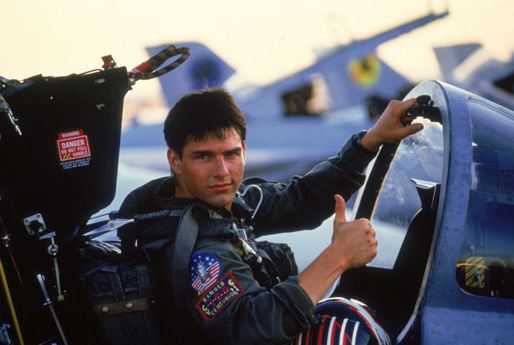
In the summer of 1986, when my flying education began in earnest, Top Gun shattered box office records across America. But Tom Cruise’s portrayal of the man I dreamed I might one day become was far from confirmatory. Rather than inspiring me, the movie violated the sanctity of my most private dreams. Flying for me was soul-work. I had wholesale invested my identity and my future in the notion of pilot-hood. Then, overnight, pop culture co-opted my deeply revered ambitions. Thanks to Tom Cruise, everyone wanted to be a pilot, and I felt violated.
Capture

I didn’t realize at the time why I resented that movie so much. But looking back, I see that the movie commercialized and distorted many of the spiritual aspects of my dream. Top Gun also amplified the pilot stereotype. Flying looked glamorous, easy. Jets zoomed against brilliant blue skies without effort or strain. While Maverick and Ice Man dueled across silver screens in their sleek F-14 Tomcats, I spent the summer of ‘86 coming face to face with my own ineptitude as a pilot-in-training.

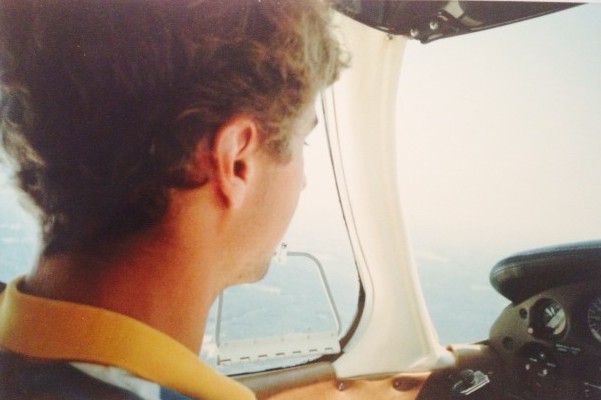
Though I’d been a diligent student, no amount of book learning could make up for what, in aviation lore, is called a seat-of-the-pants feel for the sky. When I started taking flying lessons, I had imagined I’d be a natural from the get go, a student so adept at the skill of flying that I would zoom through the curriculum and immediately be recognized as the heir apparent to Lindbergh, Yeager and Armstrong. Instead, I struggled with even the most rudimentary of skills. I couldn’t keep the plane straight-and-level. My airspeed control was for shit. I landed long, struggled when pulling the plane out of a stall. My steep turns were never steep enough and my lazy-8’s resembled an asymmetrical snowman in the sky. The only thing I felt in the seat of my pants was clenched terror.

My original goal, to solo on my 16th birthday, the earliest legal age, had come and gone six months before. While teenage boys donned flight jackets and Ray Bans and serenaded teenage girls with “You Lost that Lovin’ Feelin,’” and while Tom Cruise buzzed the tower fifty feet off the deck, I came to the clear understanding that I wasn’t much of a pilot.

A previous flight instructor, a grumpy aviator with a fu-manchu mustache, once told my mother that I flew like a doctor. The only thing I gleaned from this strange violation of teacher-student trust was a veiled reference to sloppy handwriting.
Rich Pilot1

Of course I wasn’t supposed to be a good pilot with fewer than twenty hours of flight time. The stumbles, setbacks and mistakes were supposed to teach me. But in the pilot myth, as well as in the movie, difficulties were glossed over. The legend left no room for failure, no room for growth or learning or progress. So every miscue, every clumsy maneuver and failure felt keenly personal. Surely the great pilots didn’t start this way, I told myself, not realizing that they most likely had.

Mark stood on a nearby grassy hillock, smacking a package of Marlboros against his wrist. I waited. I prayed. Climb back into this Cessna and tell me it’s all a big joke. Ha ha, kid, I’ve got the controls. Go back to algebra class. But he didn’t move. In fact, Mark lit up a cigarette, his sandy hair flapping a bit in the breeze. A breeze? Where did a breeze come from? I checked the windsock again, which stretched out into the shape of a Day-Glo ice cream cone, indicating the wind had increased and swung around a bit from the southwest, adding a complicated crosswind to my still-not-so-imminent takeoff. Any attempt to leave the earth just became that much more difficult.

I tried to wrap my head around what was happening while searching for the before takeoff checklist. I pulled the laminated sheets from a door pocket, only to fumble the checklist between the seat cushions. My hands were shaking.

“Jesus,” I said out loud, more curse than prayer. How long had I been sitting there? I needed to act, to do something. The longer I waited, the worse my fear became.

As I fished the checklist from a between the seats, a thought slammed through my brain: I’m going to die. The only question was how, not when. From incompetence? From shame? From failure? With every second passing, the certainty of my untimely end came nearer. I worried I might drop from sheer terror right there, idling on the taxiway. The other possibility seemed to involve a blazing ball of fire at the runway’s end.

Needing to resuscitate my brain, I tried to recall the plane’s takeoff procedures. The checklist was useless now since on top of everything else I’d lost the ability to read. It appeared to tell me that I needed to adjust the trim, set the fuel mixture, and somehow force my hands to push the throttle forward, dumping 80-octane fuel into the plane’s normally-aspirated, direct-drive, air-cooled, horizontally-opposed, four-cylinder engine, thereby accelerating the McCauley fixed-pitch propeller to 2,500 RPMs. If I could manage to free my hands to perform these tasks, if I could follow all the steps, in more or less the correct sequence, and release the breaks and speed down the runway without veering off into the grass, if I could summon the strength from my flaccid arms to pull back on the control column, all while tapping rudders to keep the plane coordinated, and if I could remember to check the airspeed, the wind and the engine oil pressure, then, in theory, the plane would fly. I would fly. I would solo.

The first solo is a consecrated ritual—a baptism and wedding rolled into ten minutes of sheer terror a thousand feet over an airfield. Some thirty years have passed and I still remember the disintegrating sensation somewhere southwest of my heart. The fear hollowed me out, an erasure that scoured the insides of my body, leaving only a shell. My skin became acutely sensitive. My mouth went chalk dry.

I remember the way light fell on indifferent hillsides. I remember spinning propeller blades, whirring gyros, a tremble in the wings, perhaps caused by my shaking hands reverberating back through the flight controls. Face to face with reality, the magnitude of fear surprised me. The heroic architecture, so long associated in my mind with brave pilots laughing at danger, came crumbling around me.

A gray cloud deck scattered above the airfield. The runway, scuffed with rubber skid-marks and brake dust, tumbled off into the somber horizon. Behind the controls of that Cessna, alone and uncertain, I searched desperately for a way out.

Once more, I glanced at Mark, hoping for a reprieve. He took a long drag on his cigarette.

I hated him. I hated his parents for bringing him into this world and hated mine for doing the same. I hated Isaac Newton and Daniel Bernoulli and the Wright brothers and Clyde-fucking-Cessna too. The universe had ripped open a hole into eternal darkness, manifest in an empty seat where my instructor belonged. Like in a falling nightmare, the emptiness of that seat, the haunted, horse-without-a-rider sense of a pilot-less plane—unoccupied rudders, uncontrolled control column, unlatched seat belt—these things most surely represented my imminent demise. Except that airplane had dual controls, and my feet rested on the rudders, and my sweaty hands clutched the control column. I was the one strapped into that saddle, a bucking bronco of wires and avionics assembled in Wichita, Kansas, waiting for me to spur it into the air.

The runway was clear, almost mocking me with its emptiness. Fly or don’t fly, the asphalt seemed to say. Live or die. It makes no difference.

For a moment, I thought I might throw up, not an uncharacteristic response from my body when faced with stressful situations (like asking a girl out for a date). The propeller twirled and the fuselage rattled. Only two choices remained: grow a pair and get going or pull the parking brake, open the door and run screaming for the woods. Gasping for breath at the end of the runway, this couldn’t have been how Yeager got started.

Where once strength and bravery seemed embodied in the very word, pilot, the word and the act suddenly lacked meaning, because I could not remember how to do the very thing the word implied, which was to fly the airplane.

Time elongated. Each propeller revolution re-radiated doubt and fear. It felt like an hour passed while I decided. But Mark’s cigarette had barely burned down. I reflected on the absurdity of the scene, my instructor pilot watching me do nothing, the engine whining, position lights blinking, the whole airport on hold, waiting for me. At the same time, there came an awareness that I was not cut out for this sort of thing. Better to survive a coward than die a fool. But what choice did I really have? The way out certainly was no less complicated than the way through.

The metamorphosis that was about to occur was entirely lost on my teenage brain. I didn’t realize what a privilege I was being granted. On that November day, there was no way to foresee the future, or to comprehend how life decouples, like ill-fated box cars, throwing certainty and meaning off a track that then seemed iron-clad. I had no way of knowing that seven years later, my wings would be clipped for good, and that I’d be diagnosed with epilepsy and told I could never pilot an airplane again. I didn’t realize that deep fear often accompanies life’s most extraordinary moments. I had no way to realize that the minutes that terrify and most rattle us are the ones that will stand out. Like a bas-relief of memory, those moments become enshrined by their height and importance: the first girl I would eventually kiss, the first time I would fall in love, the birth of my children, and the so-many unimaginable losses and joys that would mark the path. How could I have even glimpsed a hint of that on the tarmac?

Finally, something inside flickered. The hollow sensation of fear gave way. My body and brain stirred back to life. Was that sensation what bullfighters call the moment of truth? If so, the feeling was not a triumphal one, more like resignation combined with a pinch of anger. Fear yielded to reluctance which surrendered to inevitability. Hardly a heroic procession.

I lowered a notch of flaps and picked up the mike. I called out the plane’s tail number and announced an intention to fly.

“Marlboro traffic, November-seven-one-four, Charlie Pop, ready for departure.”

The intent was for my voice to sound defiant and serious, but the words came out as a barely-whispered squeak, a child’s final desperate plea for help. Then, after a glance heavenward, and one last check of the wind, I advanced the throttle and released the brakes. The engine whirred louder. With a press of right rudder, the plane twirled around and lined up with the runway centerline. My breathing evened out. On the windscreen, the compass lagged before it confirmed my heading. This next part may not have happened, but my memory registers a shaft of sunlight piecing through cloudy autumn skies.

I pushed the throttle to the firewall and the engine revved. Torque drove the nose wheel into the ground and the plane lurched forward. The nose yawed left, which I counteracted with more rudder as the semi-monocoque fuselage reverberated atop rough asphalt with echoes and thumps.

The plane accelerated and the abyss receded. Where did the fear go? What replaced it? I don’t understand how I climbed inside the moment. I don’t quite comprehend how a timid, frightened teenager managed to fly.

I pulled back on the wheel and the wings began to generate lift. The plane entered its transition to flight, where gravity succumbs, a transition not only of the physical machine but also of the body. I may have even felt that sensation in the seat of my pants.

After that, I continued to climb out, the needle steady at 70 knots. My gut wobbled as I pushed the nose over and gained speed, a thousand feet of altitude, the propeller high against the gray horizon, trees and hills falling away. The world shrank. The runway appeared small and distant, the clouds large and close. The temperature cooled. Downwind, I aligned the port wingtip perfectly with the runway margins, and I recognized calmly, in an almost holy way, with a certainty and confidence that was entirely new, that I was actually flying, alone, no longer terrified, ass-unclenched, hands dry and not choking the wheel, and how in those few minutes of flight, all the fear and confusion receded into the background, and all that remained was flight, the pure dream man had yearned to achieve for millennia.

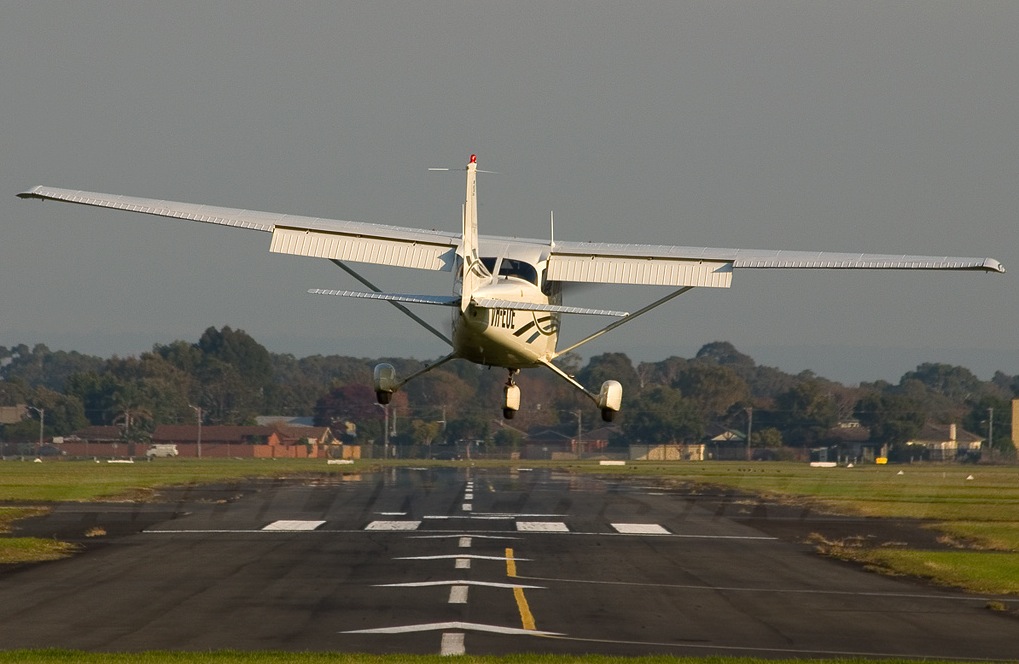
The transcendental feelings ended quickly. There was work to be done. A moment later, abeam the numbers, I lowered the flaps like a real pilot, and throttled back, slowing, descending. I checked the windsock and announced my intentions again—this time with a voice a sixteen year-old boy borrowed from the gods—that I was coming in to land. l turned to base and then to final, scanning airspeed and altitude, nudging the plane’s nose to line up with dashed white stripes painted down the runway, anticipating wind vectors, adjusting for turbulence, steadying the wings. Just over the numbers, I pulled back gently on the controls and cut the throttle. The nose lifted. The plane floated a second or two, caught in the magical buoyancy of ground-effect, that final transition, just before the main landing gear returned to earth, two shudders beneath me, two chirps of rubber kissing earth. Then I caught the plane’s yaw, holding the nose straight and true, and in that final moment, before the nose wheel touched down, in that final instant when the transition from air to ground remained ever so slightly in jeopardy, I realized that I’d done it, that I’ve soloed, and that nothing would ever be the same again.
172-landing

—Richard Farrell

.
Rich Gun-001

 Richard Farrell is the Creative Nonfiction Editor at upstreet and a Senior Editor at Numéro Cinq (in fact, he is one of the original group of students who helped found the site). A graduate of the U.S. Naval Academy, he has worked as a high school teacher, a defense contractor, and as a Navy pilot. He is a graduate from the MFA in Writing Program at Vermont College of Fine Arts. His work, including fiction, memoir, essays, interviews and book reviews, has appeared in Hunger Mountain, New Plains Review, upstreet, Descant, and Numéro Cinq. He teaches at Words Alive and the River Pretty Writers Retreat in the Ozarks. He lives in San Diego.

.
.

Jun 012014
 
raymond_2

Photograph – Veronica Carroll

Raymond Deane was born on Achill Island in county Mayo, the largest island off the squally West Coast of Ireland.  The artist Paul Henry lived and worked there from 1910 to 1919 and his paintings of Achill, such as his depiction of the pirate queen Granuaile’s castle, entitled The Tower, capture the unique meshing of light, sea and landscape. Raymond’s compositional oeuvre including works such as Seachanges (with Danse Macabre) for ensemble, Ripieno for Orchestra, and the electro-acoustic Passage Work also seem to inhabit this dramatic Atlantean lit world. An inheritance, surely, of his boyhood in Achill. Embers for string quartet with its stark and ethereal beauty was composed when Deane was only 20. This remains the composer’s personal favourite and perhaps the most widely performed of all his works.

His work is finely crafted and exquisitely textured. Black humour pervades as in the subject matter of his latest opera (libretto by Gavin Kostik), The Alma Fetish, based on the true story of the love affair between artist Oskar Kokoschka and Alma Mahler and the “anatomically correct” doll that a distraught Kokoschka had made in Alma’s likeness when the affair ended. Doll and artist lived together until ultimately Kokoschka had her publicly “executed”.

Raymond is also known for his writing. The gothic novel Death of a Medium (Published by Odell & Adair, UK, 1991) describes the quest of a failed composer in 19th century Dublin to find his father who himself is embroiled in a quest of his own to find the libertine Duc D’Urval with a phantasmagoric dénouement in guillotine-ridden Paris. The novel currently has the interest of a film production company.

— Siobhan Cleary


noctuary

Minerva Owl from Raymond Deane’s new Noctuary album (Resonus Classics), played by Hugh Tinney – release date June 2014

.

If way to the better there be, it exacts a full look at the worst. – Thomas Hardy

A substantial body of work exists comprising of the memoirs and autobiographies of composers. The most eulogised of these is Hector Berlioz’s moires, published posthumously a year after his death in 1870. This is a rollicking, colourful testament of Berlioz’s life equally intimate and tender, particularly when writing of his heartbreak, sense of failure and loneliness even after becoming a celebrated composer.  More recently John Adam’s Hallelujah Junction: Composing an American Life  released in 2008 is a wry but informative look back at Adam’s life combining childhood memories, cultural history and music criticism.

In My Own Light released this May is a welcome addition to this repertoire. Bob Quinn, the Irish filmmaker, writer and photographer describes it as “a superb and shocking memoir. Elegant prose first lulls us into complacency with a rich, obsessively detailed, account of an Irish childhood. Cleverly, inexorably and despite a warning prologue, we are drawn into a subsequent nightmare recalled dispassionately. The absence of self-pity heightens the horror of a life almost destroyed. Only a very talented artist could have survived the self-inflicted travails described and at the same time become one of Ireland’s finest composers. The book leaves one with a feeling of relief, even joy.”

The memoirs were written in an attempt to re-examine his past, and in particular, his descent into near fatal alcoholism. No misery memoir this, however, as Deane’s honesty, wit and humour allow a lightness on even the darkest subject matter. He was determined not to romanticise his relationship with drink which he describes as “shabby, squalid and sordid.”

The memoir is in three parts corresponding perhaps to the three movements of a symphony, each with its own tempo and style. The first accounts for his first 10 years as a boy in Achill. Contrary to the narrative of memory he previously held of an adverse childhood, he found writing this part of the memoir that his childhood was perhaps not the source of his alcoholism. Instead he describes a comfortable, middle-class background with everything provided for in an idyllic setting. Probed, he admits to have been an anxious child and was bullied by his less well-off peers, but not as badly as he had previously conjured up in his mind. His father is described as a “very nice man” who had his own battles with alcoholism. This was carefully hidden from Raymond (a drunken gait was described as the effects of prescribed medication for example) until one of his siblings spilled the beans when he was 14.  One wonders how this secrecy contributed to a young boy’s anxiety, and indeed a mere three years later, at the age of 17, Raymond had embarked on his own drink-ridden path of self-destruction.

The second part of his memoir picks up when the Deanes moved to Dublin in 1963. Raymond was thrilled at the move and didn’t miss his rural idyll. Dublin provided more stimulation by way of libraries, museums, concerts, and Raymond began to compose there at the age of ten, deciding at that tender age that a composer is what he would be.  He left school at the age of 14 wanting to concentrate on music and writing and embarked on a self-designed course of study, “reading everything that was worth reading”  including Kafka, Woolf and Faulkner (not regularly prescribed reading on any school syllabus at the time).  He matriculated into university where he studied music at UCD.  The isolation of his previous years study had its consequences and Raymond found it difficult to socialise with his colleagues. Drink became the answer to this solution bringing with it its own set of problems from which he was unable to escape for the next 18 years.

The terseness of the language of the third part underlines the torment of these years when Deane reaches hellish depths mired in the grasp of severe alcoholism. Brief sojourns as a pupil of Stockhausen in Cologne and Iseung Yun in Berlin were cut short as Raymond tried to balance his heavy drinking with the demands of rigorous 20th century compositional technique.  A further decline on his return to Dublin left him on life’s edge. He chose to admit himself to St Pat’s Hopsital and began his road to recovery.

The next part of the story is unwritten but thankfully less troubled.  Raymond successfully remained off alcohol becoming a prolific, flourishing and esteemed composer, writer and activist (he is a founding member of the Ireland–Palestine Solidarity Campaign (IPSC). He describes himself as “happy” and fulfilled, and although he abstains from alcohol, as a “hedonist enjoying life’s pleasures”. He divides his time between Dublin, France and Germany.  He feels very lucky that he escaped the alcoholic lifestyle, no doubt mindful of countless of his contemporaries that were less fortunate. He remains optimistic about his future with his opera “The Alma Fetish “ due for a full production by the Dublin company “Wide Open Opera”,  a commission by the exciting new ensemble “The Robinson Panoramic Quartet” and he is in talks about a movie based on his Death of a Medium. He is toying with a follow up to the memoir, this time more “hallucinatory” in style. At age 61, it is clear Deane has faced and conquered whatever demons he had and is grateful for the second chance that life handed to him. In spite of terrible odds he has come through due to his own determination and resourcefulness. An inspiration indeed for those who may find themselves in similar desperate circumstances.

SC: What prompted you to write a memoir and why does it end when it does, at the relatively young age of 35?

RD: That is when I stopped drinking. The memoir was an attempt to explore the reasons why I drank so destructively and what, if any, were the childhood roots of this.

SC: Did you find a reason?

RD: No… Maybe there is no reason. Perhaps it is genetic… I was an anxious child who was terrified of growing up. I saw my father, having responsibilities, paying bills etc. and I didn’t want to be an adult. But I discovered through the writing of the memoir, that my childhood wasn’t nearly as bad as the one I had dreamt up in my imagination. I was bullied at school because I was different. I lived in a big, comfortable house and came from a more middle class background than my peers but on the other hand, I lived in an idyllic setting for a kid. I had plenty of freedom, and I was given every opportunity I could wish for, music lessons for example. But I ended up squandering all of this.

SC: Growing up in Ireland in the 1950’s by current account, seemed to bring its own set of troubles, in particular the oppressiveness of the Catholic Church. Do you think this had anything to do with the stresses that may have propelled you into alcoholismalong with many of your contemporaries?

RD: No. I don’t think so. I think it was just part of who I was.

SC: The second part of the memoir begins when you move to Dublin at the age of ten.  This seems to be a significant turning point for you.  Why did your family move? And did you miss the rural island setting of Achill?

RD:  We moved to Dublin in 1963 because my two brothers had left home and my sister was a boarder in Loreto, Stephen’s Green. I was thrilled and I didn’t miss Achill at all. I missed my piano which was still in Achill, and while waiting for it to be transported, I visited the Dublin public libraries and studied all the available piano scores. It was then at the age of ten, I decided I would be a composer. I hid this from everyone though because I was afraid of being called a sissy!

SC: By whom; Siblings? Friends? Parents?

RD: I grew up in a time and place where gender roles were very rigidly assigned. A little boy was expected to be a little man. Any perceived deviation from this – such as an interest in the arts rather than in sports – was subject to explicit mockery from peers (the word “friends” would have been too strong in my case). However, I may have been over-sensitive to this possibility. I used to hide my manuscripts behind the radiators which would cause a smell whenever the central heating was turned on in the winter!

SC: Was there a particular composer or piece of music that influenced your decision to become a composer?

RD:The “most influential piece I heard as a child” (as described in my memoir, in fact) was probably Nicolai Gedda singing the Flower Song from Carmen.

SC: Did you do any writing at that time? Short stories? Essays?

RD: Yes. Prose mainly.

SC: Do you find a difference or a similarity in composing to writing?

RD: Composing is more abstract, but I find that in either, I enter a world inhabited by characters. So if I am walking down the street, these personalities, themes, images are in my head while the real world passes by.

SC: You left school at the age of 14.  An unusual decision for a boy of your background and academic potential. Why was this?

RD: I left school because I wanted to concentrate on music and writing, and because I was fed up of mathematics, history, geography, Greek, and the likes…I felt completely relieved and not particularly anxious – I was confident of getting in to university because I could concentrate on studying English, French, Irish, Latin, and music (it was possible to do only those in the Matriculation) and I knew I was reasonably competent at all those subjects. I started reading a lot and by the time I was 23, I had read everything that even now I feel was worth reading. I practised piano, wrote and composed. I also walked the dog a lot!

SC: You studied music at UCD.  Did you enjoy this? Looking back, do you find it was particularly helpful for a subsequent career in composition?

RD:I didn’t particularly “enjoy” studying music in UCD, because I hardly did any study – I “knew it all already”. I found some of Seoirse Bodley’s lectures on modern music helpful. In 1974 when I graduated, I went to study in Switzerland, in Basel, with Gerald Bennett who was, himself, a pupil of Pierre Boulez. I studied then with Stockhausen in Cologne and with Isang Yun in Berlin.

SC: You were drinking quite heavily at this time.

RD: Yes.

SC: What were the circumstances of you giving up drink?

RD: People don’t give up drink because x, y, or z – they give up because they’ll die otherwise, or because they just age out of it, or whatever. I had reached “rock bottom,” on the verge of death, having to make a choice between life and death and choosing life… But in fact no choice being involved – given a firm push by the good people in St Pat’s.

SC: You have been sober now for nearly three decades. How easy or difficult was it to make this resolve and does it remain a temptation?

RD: In 26 years I’ve never had the slightest twinge of temptation to go back on the hooch. It’s not a question of resolve – just of the absence of temptation.

SC You later spent some time in Paris. How did this come about?

RD My sister worked for 12 years at UNESCO in Paris. She bought a small studio apartment in the 17th arrondissement (she lived in the 15th) as an investment, and put it at my disposal. I spent a few months of the year there between 1990 and1994. I came to love the place, and I still do.

SC You still spend lot of time there and in Fürth (Northern Bavaria). Do find this time away from Ireland beneficial?

RD:I need to be “away from home” for appreciable periods, be it in Germany or France, because I thrive creatively on a certain feeling of alienation from my surroundings. I don’t mean the kind of alienation I feel in Ireland – despite its cultural and political conservatism, which are repellent to me, I still feel “at home” here, a kind of insider – but the sense of being an outsider, being surrounded by people speaking a different language (which, fortunately, I also speak and understand) and having different customs. In such an atmosphere I feel freed up to work without interruption, and with a clearer perspective on what I’m doing, and also to pursue my culture vulture instincts…

SC: How did you become a political activist?

RD:I was involved in a detached kind of way in the East Timor-Ireland Solidarity Campaign, which evolved into the Ireland-Palestine SC in 2001. Its first chair was Tom Hyland, who was head of ETISC since its foundation but who soon found that he didn’t really want to continue heading the Palestine group and resigned. I was elected chair in absentia, so I was more or less thrust into intensive activism.

SC: Would you describe yourself as a reluctant activist?

RD: Yes.

SC: You’ve had some very nasty (and untrue) comments written about you in the press as a result of your activism.  Does this get to you?

RD: Press defamation DOES get to me, at least for a while. Actually, the old AA slogan helps: “This too shall pass.”

— Raymond Deane & Siobhán Cleary

cover image by Jerry Cassidy

cover image by Jerry Cassidy

 Extract from the last chapter of In My Own Light


That April I moved into a first-floor bedsit overlooking Upper Leeson Street.Increasingly I concentrated my drinking on Grogans, a famously bohemian public house presided over by the legendary Paddy O’Brien, a man who had served and refused service to Patrick Kavanagh, and who was benignly disposed towards me. Here I fell among thieves, and not just in the figurative sense. Among the hardened drinkers who became my regular cronies was Danny, a dapper rogue with an enviable way with women and an unenviable prison record. Danny rapidly ascertained that I possessed a cheque book, and seemed convinced that it was intended primarily for his benefit. He would play chess with me on my tiny portable set and would cheat shamelessly and without subtlety, taking back moves and moving pieces around when my back was turned. Eventually, when I tired of this and told him I would play no more, he simply appropriated the set and found other victims.

A more congenial companion was my old friend John Jordan. Nowadays, frustratingly, he lapsed into a comatose state after one or two drinks. John had a fine mind, had known everyone worth knowing, and could, when he wished, converse with an eloquence that contrasted blatantly with the drivel spouted by most of my associates. He was a generous man who, when compos mentis, would always stand me a pint or a short. On seeing me he would invariably exclaim “Ravel! Ma mere l’oye!” and reminisce fondly about Annaghmakerrig.

No matter how shaky I felt, I was never too self-conscious to sidle into Grogans and sit in a dark corner with a pint of water until such time as a willing victim entered the premises and either plied me with drink or “lent” me money (or both). Sometimes Paddy O’Brien or Tommy Smith, one of the pub’s co-proprietors, would let me have a few drinks on the house. When my cheques bounced they did not make too much of an issue of it, although they kept a tab of what I owed them.

Of course I had a major orchestral work to write, and this necessitated periodic trips to Bunclody. Whether I arrived drunk, hungover or semi-sober, my father always met me at the bus-stop and was always welcoming and non-judgmental. He would “feed me up” and slip me a few pounds when I left.

That summer my drinking, already excessive, took a turn for the worse. It required increasing quantities of alcohol to relieve the horror of my hangovers, yet my capacity for the stuff was diminishing drastically. This meant that by the time I had begun to feel semi-human, usually in the early afternoon, I was ready to stagger home and collapse into a short-lived and unrefreshing stupor. At seven or eight p.m. I would emerge from this with a fully reconstituted hangover, and start the whole awful process again.

This harrowing schedule often entailed waking during “the hour of the wolf”, at three or four a.m. Unable to get back to sleep I would lie there until morning, racked with anxiety, soaked in perspiration, trembling, nauseated, and dreading the delirium tremens that somehow remained at bay. I ate little, although sometimes Danny dragged me into a restaurant during the “holy hour” when he would eat with a healthy appetite while I picked at a snack and concentrated my attention on the wine. I would pay for this with a cheque, whether or not I had the funds to cover it.

On 8th July as I lurched homewards I collapsed somewhere on Leeson Street. I awoke to find myself in bed in an unknown environment. Someone had apparently taken the unacceptable liberty of inserting a wire into my penis. When I sought to remove it, my hand was clasped by an attractive young woman in a white uniform, whose firm but gentle words were: “Don’t – it’ll be very sore.” I drifted back into pleasing unconsciousness. When I came to, I was in a different bed, surrounded by curtains. My body was free of intrusive appendages. I felt drained but peaceful, and sought in vain to remember how I had arrived wherever I was.

The curtains were drawn aside and a doctor materialised. He told me I was in Saint Vincent’s Hospital, an ambulance having picked me off the street three days earlier. I had suffered an epileptic fit, and been “transferred to Casualty comatose, feverish, with abnormally low blood pressure and a severe metabolic acidosis”, to quote the medical records that I accessed a quarter century later (metabolic acidosis is an excess of acid in the body fluids). I was also suffering from dangerously rapid heart rhythm. On resuscitation I had been able to inform them that I had been drinking an average of ten pints of beer daily prior to my collapse (a figure plucked out of the air, and omitting any reference to wine, vodka and whiskey).Growing increasingly agitated over the following days I had been heavily sedated and indeed “became unrousable due to excess sedation”, which necessitated my transfer to intensive care.The words that most horrified me were “epileptic fit”. The doctor reassured me that I was not an epileptic, and the fit I had suffered was probably due to withdrawal from alcohol; such fits need not recur were I to avoid getting into such a state again.

Later that day my father visited me, bringing me a copy of Thomas Flanagan’s novel The Year of the French, which turned out to be an excellent piece of hospital reading. He had been summoned by the hospital when it seemed that my life was in danger (interestingly, this is not mentioned in the medical records). Of course he had been terribly worried but, he gently concluded, I was better now, and perhaps this was the shock that would lead to my changing my life… Yes, I responded fervently, definitely! I had learned my lesson, and everything would be different from now on.

I was taken for an endoscopy. Liquid Valium was injected into my arm to sedate me while a tube was inserted down my throat to ascertain the condition of my gastro-intestinal tract. I coughed and retched and sweated and sobbed. The doctor, disconcerted, ordered more Valium, to no avail; I went on retching and weeping until the procedure was finished. An hour later the doctor visited me, expecting to find me in a state of unconsciousness. Instead, I was sitting up in bed reading The Year of the French. He appeared baffled, and almost disapproving. The medical records mention Valium, but not my failure to respond to it. My stomach was fine, and a biopsy revealed that my liver was “as well as could be expected”, and would undoubtedly recover fully “if I gave it a chance.” Had this latest and most spectacular collapse not occurred on the street but while I was at home, nobody would have known about it and I would certainly have died.

Of course I emerged from hospital a new man. I had seen the error of my ways and henceforth would shun the embrace of Dame Ethyl. I had no fewer than three lucrative commissions waiting for me and I completed them, working mainly in Bunclody, in an unprecedented spate of concentrated work. These, like Écarts, were avant-garde pieces, quite remote in style from my earlier (and later) works, but effective for all that.

I was busy, healthy, sober, and making money. Each evening I went on a pub-crawl, drinking litres of non-alcoholic beer just to prove that I could resist temptation. Once more I anticipated amorous adventures and was undaunted when they failed to materialise – after all, it was just a matter of time until Anette and I were reunited.

We agreed to spend a week together in the Canary Islands that autumn. On 4th November I flew to Gran Canaria, where she had booked us into a German holiday resort (where the restaurants advertised Kaffee wie zu Hause! – “coffee just like at home!”). We were reasonably at ease with one another, although I felt from the start that she was insufficiently appreciative of my self-reforming zeal. I half hoped that she might confine her drinking to mineral water in solidarity with my virtuous abstemiousness. I resented the pleasure she clearly derived from a glass of wine with her meals, and envied her ability to slake her thirst in this warm climate with glasses of cool, refreshing, tempting beer.

We visited the Playa del Inglés and sneered at the crass loutishness of the Brits. We swam twice a day. We hired a car one rainy day and drove into the mountains, terrified by the absence of barriers on the abyss side of the wet winding road (lucky Anette could calm herself afterwards with a cool, refreshing, tempting beer). We took a boat trip to Tenerife, where I admired the snow-capped volcano and fantasised that it was the Popocatepetl of Under the Volcano.

As the holiday wound to a close, it became clear that it would not give renewed impetus to our relationship. I believed that I had proved my readiness to change my life in the interests of such a renewal, but that she was unwilling to meet me half way. I felt cheated, and bitterly resentful. We were leaving on successive days, so I saw her off at the airport, continued by bus to Palma, and booked into a hotel. Soon I was sitting at a terrace overlooking the sea, a large, cool, refreshing beer in front of me.

Four months without alcohol had toughened my system, so that it took a while for me to disintegrate again. After Gran Canaria I practically severed contact with the rest of my family. I learned that my father was spending Christmas in Dublin with John and his new wife Ursula, but there was no question of my inviting myself around. Instead, I accepted an invitation from the poet Michael Hartnett to partake of Christmas dinner in his house, which was a few doors away from my Leeson Street bedsit. When I arrived, Michael nervously ushered me into his sitting-room, where the table was laid for one. He himself was on the dry and his wife, fearing contagion, had ordained that I should eat alone, be given one single glass of whiskey, and sent on my way. The impulse to walk out in a dignified huff seized me momentarily, but I had little dignity left, was hungry, and “had a mind for a dhrop”.

A week later my Dublin Millennium piece, Thresholds, was performed at the NCH, conducted by Proinnsías Ó Duinn. I had attended no rehearsals. I sat in the reserved seats with a retinue of Groganites, as the habitués of that drinking establishment are known. After the concert I refused to see in the New Year with any of the musicians or even to congratulate Prionnsías on his exertions.

The year began in a blur and degenerated steadily. I stopped shaving, and took to sleeping fully clothed on the couches or floors of various cronies’ flats, which were mostly dirty and often malodorous. I began to smoke heavily and soon had acquired my first and last nicotine stains.

On my birthday, 27th January, I trundled homewards before the holy hour and decided to have a quick drink in O’Dwyer’s at Leeson Street Bridge.

“A pint of Smithwicks, please.”

“I’m sorry, we’re all out of Smithwicks.”

“Oh? A pint of Harp then.”

“Sorry, there’s not a drop left.”

“Guinness?”

“All gone.”

I gazed at the flippant young man, and noticed my image in the mirror behind him.

“Look, I know I look a bit ratty because I haven’t shaved in a while, but today’s my birthday…”

“Happy birthday, then. Maybe you’d be better off going home for a nap.”

I went around the corner into the neighbouring pub, O’Brien’s.

“A pint of Smithwicks, please.”

“I’m afraid we’re all out of it, sir.”

I bought a half bottle of vodka in the nearest off-licence and went home. I had broken my last remaining glass, so I mixed the vodka with water and sipped it gloomily out of a cup. If desperation mixed with desolation has a taste, then this was it.

—Raymond Deane

siobhan

Siobhán Cleary  was born in Dublin.  She studied music at the NUI, Maynooth, the Queen’s University, Belfast and Trinity College, Dublin where she completed a Masters in Music and Media Technology. She has composed in all the major genres, producing in addition to orchestral, chamber and vocal works, a number of works for electronic media and film scores. Her pieces have been performed and broadcast widely in Europe, USA, Canada, South America and Australia.  Her orchestral work ‘Threads’ was selected by Vienna Modern Masters for performance at the Second International Festival of New Music for Orchestra in Olomouc in the Czech Republic and later released on CD. In 1996 as a Pépinières European Young artist Laureate, she was composer in residence in Bologna with the Argo Ensemble. In January 1998 a concert devoted to her music was given at Cité International des Arts in Paris, She has been commissioned by The National Symphony Orchestra The Irish Chamber Orchestra, The National Chamber Choir, the Arts Councils of both England and Ireland, Cité International des Arts in Paris as well as many individuals soloists and ensembles. She is the founder of Ireland Promoting New Music which promotes the performance of contemporary music through its series New Sound Worlds. She was elected to Aosdána, Ireland’s state-sponsored academy of creative artists in 2008.

raymond_1

Raymond Deane was born in Co Galway, on the west coast of Ireland, on 27 January 1953. He was brought up on Achill Island, Co Mayo. From 1963 he lived in Dublin, where he studied at University College Dublin, graduating in 1974. He was a founding member of the Association of Young Irish Composers, and won numerous awards as a pianist. He subsequently studied in Basle with Gerald Bennett, in Cologne with Karlheinz Stockhausen (although he doesn’t consider himself “a Stockhausen pupil”), and in Berlin with Isang Yun. He was featured composer in the 1991 Accents Festival (with Kurtag) and the 1999 Sligo New Music Festival (with Roger Doyle). He has featured in several ISCM festivals (Mexico City, Manchester, Hong Kong), in the festivals l’Imaginaire irlandais (Paris 1996), Voyages (Montreal 2002), Warsaw Autumn (2004), and regularly in the UNESCO International Rostrum of Composers (his Ripieno for orchestra winning a special prize in 2000).

He was artistic director of the first two RTÉ Living Music Festivals (Dublin 2002/2004),  showcasing the music of Luciano Berio and contemporary French music respectively. In 1992 he published Death of a Medium, a novel (Odell & Adair), and he continues to publish essays and articles on culture and politics. He was awarded a Doctorate in Composition by the National University of Ireland (Maynooth) in 2005. He has been a member of Aosdána, the government-sponsored academy of artists, since 1986. He is now based in Dublin, Paris, and Fürth (Bavaria).