
 Richard Landon—Photo: Rick/Simon
/
In late 1988 I was hired to develop a series of year-long programs on current Canadian fiction for the Toronto radio station CJRT, now exclusively a Jazz FM station. The station had had an earlier program on Canadian fiction, but it was felt it was time to update as a new crop of writers had emerged, as indeed they had.
I drew up a list, I underwent a series of interviews and trial tapes, and I took a year off from my main gig, which was as a professor of English at a Toronto university. It was an intense year, 1988-89, both for professional and personal reasons, but my focus was the studio and an accompanying workbook for students who might want to enroll in a credit course connected to my programs, and we were off to the races.
Mavis Gallant was one of a distinguished company of writers and critics and visual artists whom I invited in to the studio to be interviewed. Of course I wanted the writers to speak for themselves, but I also wanted to have others speak to them, and about them. I spent two days with Mavis Gallant in the fall of 1989, both in studio and in the city proper, but in the summer before I met her I interviewed Richard Landon (1942-2011), then Director of the Thomas Fisher Rare Book Library, University of Toronto, where Gallant’s papers are held.
I felt a conversation with someone who knew her work and also knew her would help me in my planned interview. Over many years of my reading Gallant, I had found her both intriguing and enigmatic. I hoped for some guidance and for some basis for comparison. I wanted to know about the contents of her “living” archives, that crucial period where an artist gets to make a choice about what is to be saved by deposit and thereby directs future commentary and research. And some of the questions which arose in this interview with Richard Landon would surface later in the fall when I spoke directly to Gallant herself.
Although most of her writing life had been spent in Europe, Gallant had been frequently in Canada. Richard Landon knew her well, and was also intimate with her work and of course her papers. He seemed ideal, both as a reader and a scholar, for an introduction to Gallant’s extraordinary talent and her working methods.
— Karen Mulhallen
July 27, 1989
Karen Mulhallen (KM): Richard, I’m looking at a xerox copy of a very brief note from Mavis Gallant. I don’t know when this note was written, it’s not dated, but it is something to do with From the Fifteenth District, Mavis Gallant’s collection of nine stories published in 1979. Toronto. What are these two xerox sheets I have in front of me?
Richard Landon (RL): This is a note Mavis wrote when she sent a batch of her papers to the Fisher Library. Her papers come in little batches and sometimes she puts in notes that are either explanatory or give critical comments from her on the material. Sometimes they are about who edited her work for The New Yorker, normally William Maxwell. This note is amusing, because one of the characters in the title story in From the Fifteenth District is a social worker named Alicia Fohrenbach who turned out to have a real life counterpart in the United States.
KM: What does she say in this note? Can you decipher it for me?
RL: “From the Fifteenth District was written and published in 1978 and in it the name Alicia Fohrenbach was invented. I received several letters from a Doctor Alicia Fohrenbach in the U.S., a psychologist. These coincidences often arise and are tricky to handle. Luckily Dr. Fohrenbach was willing to believe that I had never heard of her. However, as she had graduated from some institution called Regius, the coincidence was more than close. This is one of my favourite stories, but my readers were baffled and irritated by it. MG” The reference is to the hospital from which Mrs. Ibrahim is being discharged, which is called Regius Hospital.

KM: Yes, I see the passage, a little past page 165 at the centre of the collection, probably in all editions? It is curious, more than an odd coincidence. Writers are, I think, prescient. Do you think Gallant is sensitive to the possibilities of intuiting things. After all, one of the stories is about ghosts.
RL: I think she is. I don’t know that she would claim to be prescient in that way at all, but part of her technique is the accumulation of detail, which is one of the most impressive things about her writing, its precision. There is an easy recognition on the part of the reader of things you don’t normally think about. She describes people’s fingernails, small incidents, very precise details of a scene — I suppose the accumulation does somehow give a notion of prescience.
KM: In rereading the stories in From The Fifteenth District, I noticed sentences that didn’t seem to belong to paragraphs. And it’s just what you’ve said, all that detail by the end of a story is in many ways overwhelming. She does this too with metaphors.
I was looking at the opening story, “ The Four Seasons,” just at the end of the fourth section, page 28: “ ‘That’s not our property’ Mrs Unwin cried. The man said ‘You hired me and I am here,’ and kept on sawing.”
This is a scene where the Marchesa’s date tree has grown up again, and Mrs. Unwin is feeling the perfume fumes from the tree are noxious and she has a successful court order against the Marchesa and her tree. The Marchesa has long ago left her garden and so in comes this local to cut down the tree, and he decides he will not just cut down the overhanging branches but will cut down the whole tree and he breaks through the fence. That’s why Mrs. Unwin says, “ That’s not our property.” Meanwhile in the scene we’re reminded of the chauffeur of the Marchesa. The Marchesa has fled before the coming Allied forces. Mussolini’s war activities are failing, so people are leaving the country as Hitler is failing. The Marchesa has fled because, despite her Italian title, she is an English woman. Her chauffeur hangs around the garden like an abandoned domestic animal.
The chauffeur had walked the Marchesa’s dogs, and on the road there is a convoy of army lorries moving like crabs on the floor of the ocean. You think my goodness what are these army lorries doing? And we haven’t seen him before. And why are the lorries described like crabs in the ocean. Then you realize that the whole story is shot through with these images of the sea, and the maid Carmela looks out to the sea and is afraid, and then she’s underwater. It’s such an accumulation of detail — the sea, the army, the Marchesa’s dogs, her chauffeur, all together. And yet that’s got nothing to do with the cutting down of the tree at the beginning of the whole movement.

RL: But it is not the sea as most people notice the sea; it’s quite threatening and boring, and is often described as a line on the horizon and as unattainable. There is always a road or a railway between them and the sea. It is this sense of alienation which they have by some kind of accident in a particular situation. They’re stuck. The Marchesa might get away, but no one else does.
KM: You know she got away because the story begins with her eating ice cream and anybody who eats ice cream in this story is going to get out some way!
RL: But the principle characters never get out. There’s a kind of universal rootlessness about many of the stories. The one that most affected me on rereading is called “Potter.” It’s quite long, one of the longer ones, about the Polish poet and lecturer in Paris and his American lover, Laurie Bennett, and his reaction to her going off with someone else.
It’s a more complete story in some ways because it has a movement of plot. Laurie goes off to Venice, he’s devastated, and a good deal of it is describing his reaction to her leaving. He then has his visa revoked — he’s lecturing in Paris — and at the same time she sends him a postcard telling him she is coming back. The end of the story is about him going back to Poland, from which he might never again emerge, whereas she thinks she’s resumed the relationship. It sounds a bit banal, but it’s the way it’s expressed that is extremely impressive. It’s quite haunting.
KM: What do you find impressive?
RL: Her observations about how people react to each other and to external forces, and even to the city of Paris, to the weather. It all has a real accuracy and is recognizable. You think that’s right, I would never have expressed that, but in fact, that’s how I might feel.
KM: And Mavis has the girl misspelling the word ‘separate,’ which really impressed me. This is the kind of girl who can’t spell in her love letters: “We’re seperating forever,” she says. And in another she described him as a “really sensative person.”
RL: Yes, it’s those details..
KM …which are her talent?
RL: Yes, in a real way.
KM: Do you find alterations, revisions in the manuscript?
RL: I have here the first three pages of typescript of a story in From the Fifteenth District. It’s pretty clean.
KM: Does she write long hand, does she type, does she word process?
RL: She mainly types and then corrects in holograph, that is by hand. She might write drafts, but what we get at the Fisher Library is essentially what is sent to The New Yorker magazine. It’s edited there and then sent back to her. So you get two kinds of marks, her corrections and the odd suggestion by an editor with the technical notes about how to set it for printing.

KM: How did Fisher acquire these papers, which are an ongoing collection, aren’t they?
RL: Yes. It began when the University of Toronto invited Mavis Gallant to be Writer-in-Residence, in 1980, I believe. She wasn’t able to take it up then, but she did come in ’83-’84 as Writer-in Residence, living at Massey College. Shortly after she was invited she wrote to ask whether we would be interested in having her papers, which she wished to give to us, saying in one of the letters she strongly disapproved of writers selling their papers.
KM; That’s interesting, so she just gives them to you. That’s unusual.
RL: And, of course, there is no tax advantage for her either because she lives in France.
KM: Do you have other writers who have simply given their papers?
RL: Josef Skvorecky, David Solway, Margaret Atwood, Dennis Lee.
KM: In all those cases, there are also tax advantages.
RL: Yes, they do get evaluated.
But obviously, for Gallant, this is a conscious decision. There is no particular association with Toronto, except that she remembered it from the 1950s. Not everyone’s fondest memory…! One would have imagined because she grew up in Montreal, went to school there, worked there briefly, before going to Paris, which was about 1950, that her Canadian association would be directly Montreal. She did explain that she objected to the Quebec language law and that sort of thing. I think she came to Toronto, was impressed by the city, because it had changed. It would be hard not to be impressed by the difference between 1950 and 1980.
KM: There were no park benches in 1950.
RL: Right, and so she started sending, every once in a while, a little batch of papers. Mainly corrected typescripts, galleys, some correspondence, which relates directly to her work. Eventually I hope we will get her journals. She adapted her journals for articles on the 1968 disturbances in Paris, and I do hope to see more of them.
KM: So there are no letters, no personal papers, mementos?
RL: My impression is that whatever she decides to give us of that kind of material will be very consciously chosen. She’s not just going to scoop everything into boxes and send it. She will direct, in a way, future critical or biographical work on her.
KM: So an archive can be quite diverse. If you have six archives from six writers they could be quite different in composition. What is your impression of Gallant as a personality. She’s directed, careful, controlled, not only in her prose, brilliantly so, but as a personality. Is she uniform, enigmatic?
RL: I found her fascinating. First of all, physically she’s quite beautiful and obviously was stunning when she was younger. She’s very direct and a bit quirky. She likes to ask questions that catch you slightly off guard.

KM: You’d like that!
RL: Yes, she asked me to lunch one time. Out of nowhere, in general conversation, she asked me, “What had the men of Canada done to women?”
KM: What did you say?
RL: I said I didn’t feel I could take responsibility for every man in the country.
KM: What did she mean?
RL: She was asking what was wrong with the women. She’d been traveling around on a promotion for one of her books. Macmillan had sent her across the country on planes, trains, and so on, and she’d fallen into conversation with women. She asked them questions about what they did, how they were feeling, and she found most of them terribly depressed. and the cause seemed to be their relationships with men. So she developed this little theory that the men of Canada were oppressing women, in a kind of spiritual way. This was a new concept to me, and certainly the women I know don’t seem very oppressed. I think she was exploring something in her own mind. That’s another impression I have of her, that she was always exploring, thinking about things, and that someday parts of it would emerge, not this conversation particularly, but some aspect of it might very well come out in a short story. That was one of her methods of working; she talked to people; she listened to what they said, but she asked questions that elicited responses she thought would be interesting.
KM: So she’s one of those people who don’t shut the world out, who keep on processing?
RL: That was my impression. She could be great fun, funny, quite witty, very sharp-tongued. I went to a reading with her one time, she was terribly nervous before, although once she started the reading she was fine, and afterward we sat around and drank wine for hours, and she chatted with people, told stories; it was very amusing. She got to interview [Maurice] Duplessis because she was so gorgeous. No other reporters could get in to a private interview with him. He obviously fancied her. Funny stories, like that.
She was very engaged with the students, with the junior fellows, when she was at Massey College. They were obviously very fond of her, and people talked to her a lot. She lived in college, and people would drop in and see her. I think she was somewhat less impressed with some of the other people she met around the university.
However, she also said she didn’t get any writing done, although when she’d come to be Writer-in-Residence, part of her plan was to finish her Dreyfus book which she’d been working on for years. She found she couldn’t do it, because her time was taken up or broken up. When people sent her things she read them seriously and commented. She took the job of Writer-in-Residence seriously, I think.
KM: Yes, I think she did. One of the writers I’m interested in and whom I’ve interviewed for these programs is Rohinton Mistry. In fact he got his start the year she was Writer-in-Residence and sent her a story, one of his first, and she sent it to Leon Rooke who then published it in a New Press Anthology. That was perhaps Rohinton Mistry’s first publication, and after that he just took off. Within a few years he had a Penquin collection of stories, and so that was Mavis.
She’s one of the few writers I’ve heard of who has taken the Writer-in-Residence job with great seriousness. People are in and out of that job everywhere. I know Elizabeth Smart had a position out west and I think enjoyed it, but was not engaged in the way Mavis was. I know Graeme Gibson had a Writer-in–Residence position at the University of Waterloo and I understand he wasn’t very much on campus. It’s the kind of job where the writer decides how to do it.
RL: That was the first time Gallant had lived in Canada for any extended period. She is a Canadian citizen and comes back a lot and is very conscious of being Canadian. More of her books are appearing here and she comes for promotional tours as well. But she has chosen to travel.
At the University of Toronto she was here the whole year, so living on campus, was more engaged than someone coming onto a campus once or twice a week.
KM: Have you been to her home in Paris?
RL: I have never visited her, although I would like to. I am going there next month, but it being August I assume, like the rest of the French, she will likely have left town.
KM: I have been to the house of a friend of hers on the edge of the Marais, Joe Plaskett, who is a painter from Vancouver. There was a group of people who emigrated at the same time and Mavis is close to Joe. He lives near the Place des Vosges in a medieval house which is actually two yoked together. I think she lives not far from Joe. For these programs, I have also talked to Virgil Burnett, who’s part of that group of people. People came and went, but Joe and Mavis were two Canadians who stayed and gathered other people around them over the years. Why do you think she stayed in Paris?
RL: I don’t really know except that it suits her. She has, I think, a fairly highly developed sense of the advantages of a certain kind of isolation. If you live somewhere where you are comfortable, and she obviously is in Paris, but it’s not what you grew up with, it’s easier to investigate in a fictional way; it gives a kind of perspective. Most of her stories are set in Europe, often in Italy or France or sometimes Germany. She did publish that volume called Home Truths ( 1981), which was about Canada, but it still had that sense of distance. I think she finds it useful.
I read an article she wrote for a magazine, a description of Paris. It was in a series by various writers describing places they lived. Hers was very evocative, but it was mainly about Paris in the winter. It rains all the time, it’s dark. It’s only light from 9-10 a.m. Then it’s dark from 10-3 p.m. or grey, and then it’s really dark. The impression was of rain dripping on stone, greyness and the river. There are photographs too. There’s something that speaks to her from the city itself. Although I am sure she has been asked why she stays, I have never read or heard the real answer.
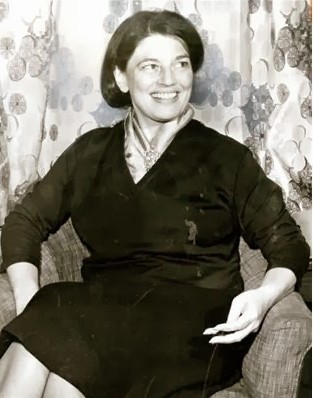
KM: Did she not talk about being in exile when you spent all that time with her?
RL: I think she doesn’t consider herself in exile in the normal sense. She just considers herself someone who lives somewhere else, who did it deliberately when she made her career as a writer. She has been publishing primarily in The New Yorker, so her audience has been in the States and in Britain. From the Fifteenth District was reviewed as her emergence in Canada, but her books were not before then published here. The dust jacket quotes all of these Canadian writers saying how wonderful she is, so they all knew about her — George Woodcock, Mordecai Richler, Morley Callaghan, Alice Munro and so on, but nobody else did.
But, of course, that ignores the audience of The New Yorker. She published her first story there, in 1951, I think, and virtually everything she’s written has appeared there since. The audience of The New Yorker is about half a million readers, and it’s international, not just Americans, and a good many Canadians. So in a sense she was recognized in Canada and it is slightly surprising that a publisher didn’t pick up her stories and collect them and publish them earlier.
The New Yorker connection is interesting. I have been mulling this over: Are you born a New Yorker writer, or do you develop yourself in such a way that you’re a natural for The New Yorker. The manuscripts which I have looked at don’t have any evidence of The New Yorker imposing its famous style.
KM: Not from the sheets we have in front of us anyway.
RL: What is the influence of someone like William Maxwell or the other editors at The New Yorker, not just on Gallant but on a whole series of writers?
KM: Alice Munro? Woody Allen?
RL: That’s right. Every time you read something by them you recognize that it reads like a New Yorker piece.
KM: It’s an important question. Writers perhaps unconsciously adjust for their market. I heard of Mavis Gallant in ‘63 or ’64. She was introduced to me by Miriam Waddington who was from Montreal and knew Mavis. So I started reading her then, and, of course, I thought of her as a New Yorker writer. I was just a student, and just beginning to read those sorts of magazines. Do you think there is a New Yorker style, which Mavis fits into, or perhaps she has helped to create it, too?
RL: I think both those things are true. When she sent in her first couple of stories, someone there recognized that here’s someone who writes the kind of fiction that we’re identified with, that our readers want, and we should seize that, and they did. It is true that there are several writers who are so closely identified with The New Yorker that you don’t see them as publishing anywhere else.
KM: And Alice Munro as well. Is it the condition of alienation, when we think about these stories?
RL: Partly that, alienation often in terms of the stories themselves, in terms of the style. Part of The New Yorker style, to me, is that nothing ends, it’s soft.
KM: I was going to say that they wander off.
RL: That’s right, they sort of stop…
KM: Never mind Aristotle, down with Aristotle…
RL: Certainly Gallant has that, always enigmas at the end, so that it could could either way, and it’s strongly suggested that the way it is going to go is not the nice way.
KM: Something we were talking about earlier is detail. When you think about a New Yorker essay, whether it’s on Jeffrey Moussaieff Masson, or tomatoes, or the rebuilding of Avery Fisher Hall, any New Yorker essay has more detail than any human being could possibly process. That seems to be to be a keynote of that magazine’s writing. And that also seems to me to be American. Like the social science novel. An American popular genre is so detailed so that people feel they get something for their money. In The New Yorker they get something for the time invested reading. They learn that tomatoes are gas-fired in upper Florida and so on. I think in most New Yorker fiction, including Mavis’s, the detail really serves the end of the story, but it is a feature of that kind of writing.
RL: Yes, sure.
KM: Do you think it is fair to say that’s an American contribution to 20th century writing — detail?
RL: I don’t know.
KM: You don’t have to go on record. You can back out…
RL: I don’t know about that, but the difference between non-fiction and fiction in The New Yorker is not that great. It’s recognizable as New Yorker stuff and her style suits that.
KM: Let’s talk about the two writers, Alice Munro and Mavis Gallant, who are very different writers, I think. Munro has a tremendous identification with and compassion for her characters. With Gallant there is a distance, she has them on a pin, or is looking through a glass.
RL: I think that’s probably true. With Munro you do feel her engagement with one character or another. With Gallant the relationships are unconsummated, people are observed but what they are doing with each other often isn’t working either. Yet the descriptions are impressive.

KM: Is there a moment in From the Fifteenth District where characters seem to connect with each other, or with the reader?
RL: In “Potter” they do. The Poles in Paris, like Potter, or Piotr and his cousin, Marek. The relationship is close but they don’t fully connect in the sense that everyone is coming or going. And the people who are really there are always described in terms of hanging around the cafes.
KM: …or the train station…
RL: Being there physically and being somewhere else mentally and spiritually is an aspect of her characters. What’s really going on has only a token amount to do with the physical circumstances. It doesn’t have to be Paris, except that obviously she can describe Paris better because she lives there. But she will describe in great detail small places in Italy, for instance, where presumably she has spent some time as well.
KM: The Italian Riviera, or the point where Italy and France come together, figures in her stories, doesn’t it?
RL: Yes, in fact that’s one of the points that’s made. How can you tell what is Italy and what is France? They speak French, but the signs are in Italian. Right now it’s part of Italy, but about 75 years ago it was part of France, and who knows what it might be in the future. This is part, I suppose, of European alienation. There is a whole series of countries which haven’t always been there in that form. It would be interesting to ask Mavis what she thinks of 1992 and the grand new Europe. I dare say she has some opinions about it.
KM: I’m sure she has opinions. I wonder what she thinks of Mrs. Thatcher!
RL: She does have very strong views about French politics, and I did talk to her a couple times about that, but always her view is a real Canadian connection, which is curious and amusing. She invented a persona for herself, the name I can’t remember, but when she hears something on the radio that involves Canada, or sees something on television, she phones the stations and asks to talk to the producers, and even politicians and sets them straight, as in that’s not what it’s like in Canada, that’s a wrong interpretation, you really should get this right. So, in a way, she’s a kind of unofficial Canadian conscience.
KM: A gazetteer?
RL: Yes. I think she enjoys that a lot and realizes probably that the French don’t listen very carefully. I don’t know that she’s had any real political effect, but it amuses her to correct them about what is really going on. During the 14th of July parade she was on television with Peter Mansbridge describing it. A friend told me that a float went by that was meant to represent the French colonial period, and Canada had a small part of it, and she said, “That’s not right, it’s the wrong period.” Of course, Canada wasn’t a colony of France at all, and then CBC cut her off. I wish I had heard that comment. I wouldn’t think of Mavis Gallant as someone to describe a parade to you, but it was an inspired choice. I’m sure that what she said, or at least what they let air, was very interesting and pertinent. She observes the French in that way as well. She wrote quite a lot about the school teacher who had an affair with one of her students — was her name Gabrielle Russier, is that right?— she’s also been very much involved in researching a book on Dreyfus.
KM: That Dreyfus project has gone on for more than a decade, hasn’t it?
RL: A long time. It’s been imminent for several years.
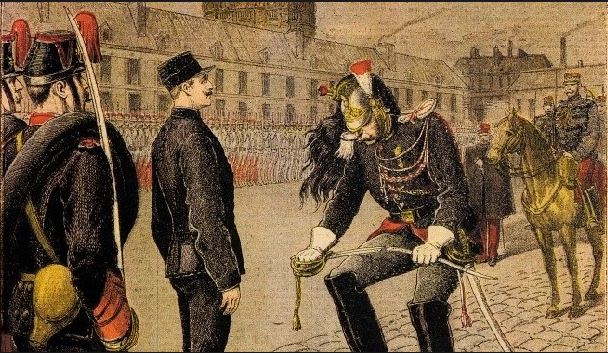 Dégradation d’Alfred Dreyfus” from Le Petit Journal, Supplement Illustré no. 217, 1895 via Forward
KM: She’s working on archives, and letters and journals, isn’t she?
RL: And she met the daughter, who might not be alive now, knew her quite well.
KM: Let’s quickly review what happened in the Dreyfus case and try and put it in context. It’s in the 1890s in France and he was drummed out of the army as a Jew and imprisoned.
RL: And Émile Zola took up his case and wrote “J’accuse” and then Dreyfus was brought to trial and was released and then put back in prison.
KM: It was an enormous trial wasn’t it, with many transcripts?

RL: It’s one of those grey scandals which the French cling to forever. A hundred years later, it’s still fresh. It’s been written about many times and there are at least half a dozen books in print.
KM: There’s a long essay by Sartre, and all kinds of people who try to come to terms with this event.
RL: I think to be a respectable intellectual in France, you must. Mavis has new evidence, has seen some new material, which suggests a new interpretation.
KM: Obviously, it’s an ongoing project for her and a sign of her membership in an international intellectual community, which is also how I see other people’s engagement with the case. Do you think that is her motivation, or could there be more personal reasons for her being involved, interested?
RL: Well, at some basic level, she is doing historical journalism, and she was a journalist.
KM: So she’s not Jewish; she went to a convent school?
RL: In fact, those potted little biographies for her books always start by saying she went to 17 schools. The first one when she was four was a convent, and there were altogether 17 in Montreal and the eastern United States.
KM: Was she kicked out of them?
RL: Next time I see her I’ll ask her, why 17? There must be some story there. Her father moved around? She was a quarrelsome student? She must have approved the figure 17, because it appears on everything.
KM: There are so many enigmas for me about Mavis Gallant: the 17 schools, the rootlessness, which is paradoxical as she is very rooted in one city, which didn’t begin as her own, and her seeing herself as a Canadian. Her characters move around, and then there is the very specificity of her details, which contrast with the rootlessness of the feeling in the stories. And that’s true all through the collection From The Fifteenth District. And it is set in a very specific district, the 15th arrondissement. But the stories themselves are set all over Western Europe, and yet that title story is a ghost story, for heaven’s sake, characters don’t even live there. They live in “other space.” So there are all these paradoxes at work.
Obviously, she’s kept on writing and I think she’ll continue to surprise us. If she is engaged with the Dreyfus book and it gets finished, she is not only doing historical journalism but making her mark on intellectual history, which is what the Dreyfus case is really about, isn’t it?
RL: I think that’s probably true. How consciously she approaches that I’m not sure.
KM: I think that’s one thing you feel with Gallant’s work, her tremendous intelligence. You don’t necessarily move toward her, she’s hard on her characters, there’s not immediately a great sympathy, although there is ultimately compassion, and you feel her intelligence, and it’s admirable.
RL: She makes many people nervous, I think, because she’s very sharp and bright, so people feel a little hesitant about meeting her, about what she’s going to say to them and will they feel they have something silly or stupid. She wouldn’t do that but people think she might. It’s that general feeling that she doesn’t suffer fools gladly, that you ought to kind of watch it. When she’s talking to you, she listens carefully, and you need be conscious about what you say. Not because she’s going to write it into a story, but because she’s listening carefully, and she’s critical.
KM: Someone said something similar about Virginia Woolf, whom I’ve always assumed wasn’t critical, but listened very carefully. In Woolf’s time, they would say she was a person who could elicit your darkest secrets, and she would use them. Not against you, but they would be used. In that way she was dangerous, and I would think the same about Gallant. Writers are observers; there’s no doubt about that anyway. But certain writers could elicit your secrets and your wariness could make you blurt out things. And perhaps those things might in the end be used against you.
RL: I’ll always be careful what I say to writers.
KM: I’m delighted to hear that!
The papers Gallant is placing at the Fisher Library are not full of personal details, but you would think so much of the information in her stories comes about through her keeping notebooks about people, and then using these notes later. It’s exciting to think that her work comes out of a kind of memory repository, rather than something else.
RL: Well, she doesn’t keep things for the sake of having 97 boxes. When she gets a letter, I am sure she doesn’t keep it unless it matters.
KM: So the Fisher collection is small but important?
RL: Yes and it has been used and is likely to be used more. There is a book on her.
KM: Janice Kulyk Keefer, Reading Mavis Gallant? I haven’t read it.
RL: Neither have I but we keep track of the people who use the collections and there’s already a whole file folder of people who have looked at her papers for one reason or another.
KM: So a critic or a student will come and look at the papers, and then they’ll be able to deduce her working method among other things?
RL: Yes, they might. I think anyone doing anything serious on her would have to be in touch with her, as you wouldn’t find enough in the papers, although it depends on what you are looking for. It’s a conscious archive, which I rather like, because it means a writer has taken some real responsibility rather than leaving it up to a curator or an archivist to decide at some point in the future what is to be saved and so on.
KM: You actually get rid of materials that people give you?
RL: No, no we don’t, but someday someone’s going to have to. The mountain of paper will become overwhelming to the point where someone will have to make real decisions and that probably won’t be me. Every writer varies so much, but it’s interesting, that someone so consciously forms her archive. So her archive is a little bit like her stories.
KM: I was going to say it sounds as if she is all of a piece. She’s a highly conscious and a highly responsible person. That certainly sheds a very important light on her, because I don’t think you know her as conscious or responsible from her stories, so some of these other things are very very important. Thank you, Richard. I am very much looking forward to talking to Mavis Gallant next.
—Richard Landon & Karen Mulhallen
Richard Landon (1942-2011) was the Director of the Thomas Fisher Rare Book Library and Professor of English. He taught courses on aspects of the history of the book and bibliography for many years in the University of Toronto’s Graduate Department of English and the Faculty of Information. Among his publications are Bibliophilia Scholastica Floreat (2005), Ars Medica (2006), “Two Collectors: Thomas Grenville and Lord Amherst of Hackney” in Commonwealth of Books (2007), “The Elixir of Life: Richard Garnett, the British Museum Library, and Literary London” in Literary Cultures and the Material Book (2007), and articles in the History of the Book In Canada (2004-2007).
—

Karen Mulhallen has published 16 books (and numerous articles), including anthologies, a travel-fiction memoir, poetry and criticism. She has edited more than 100 issues of Descant magazine. She is a Blake scholar, a Professor Emeritus of English at Ryerson University and adjunct Professor at the University of Toronto. Douglas Glover edited and wrote an introduction for her book of selected poems Acquainted With Absence and several of her poems have appeared on the pages of Numéro Cinq.