Oct 072011
 

0

Immersed in Mystery

Joseph McElroy’s Night Soul and Other Stories

Reviewed by Jason DeYoung

0

Night Soul and Other Stories
By Joseph McElroy
296 pages, Dalkey Archive Press, $14.95
ISBN-10 1564786021
ISBN-13 9781564786029

Night Soul and Other Stories  comprises twelve short stories, each dynamic, powerful, and original. But be forewarned, these stories are not coin-operated narratives that payoff with an oh-so-satisfying clear resolution. No, these stories are more like sophisticated, homemade devices, buzzing and wooly with wires, transmitting a multiplicity of signals—patterns of meaning that confuse as they compound.  Often harried by warped syntax, convoluted time, and the chaos of the narrator’s (or character’s) mind at work, they’re not typical well-made short stories. McElroy will not tolerate the prejudice that fiction needs to bow to Clarity. He is the type of writer who will ask, Why can’t a story be an expanding fractal-like mediation on the mysteries of a single event or question?  And then asks, why stop there?  In short, McElroy’s fiction is difficult.

Joseph McElroy is a long-standing member of the Society of Fat Books (a phrase used by William Vollman).  His masterpiece is Women and Men, a novel that clocks in at over a thousand pages, and he is often compared to William Gaddis, Thomas Pynchon, and, more recently, David Foster Wallace. Night Soul is McElroy’s first collection, and the stories date from early in his career up to the present, allowing a thirty-year perspective on his writing.  Though the chronology of when these stories were written isn’t made clear in Night Soul (aptly McElroy-ian), you can see how he has stayed focused and interested in certain concepts, or how he replays a technique to different effect. Throughout the collection there are stories that dovetail thematically and share variations on plot and image.

Most of the central characters are lonely men, at a point of transition.  Their lives are often times inverted from those around them, and this eccentricity informs (deforms?) their personalities—“[D]id it matter who he was, going to work when others are going home?” McElroy’s character asks in “Silk, or the Woman with the Bike.”  In the same story, the main character says, “I’m in materials,” which is another commonality these characters share—their deep interest in things. They obsess with wood, plastics, bicycles, canoes, and the everyday detritus of living.  A character in “Silk” maintains a list of things found on the floors of subway cars. These men, however, present tidily enough to the outside.  They enjoy working, which helps ground them in a world they find incomprehensible.

Over and over characters grasp for meaning, but invariably it slips away. In the story “Character,” for instance, the narrator retells a boyhood summer during which he holes up in a toolshed, where he carves a whaleboat. At the beginning, the narrator warns us that this “isn’t a story maybe” and “part of something else.”  And he’s right.  The real story is that his father, a famous anti-war activist, might have to serve jail time, and the boy’s mother is cheating on the father with one the family’s neighbors. Instead of following this action, we follow the boy’s frictional encounters—as they relate to his carving—with the reality outside the toolshed. When alone he is certain the carving is a whaleboat, over which he works and worries the wood, rhapsodizing descriptions of it.  When a dull-witted neighbor interrupts the boy’s whittling, it becomes a “hunk of wood…wasn’t a boat any more.”  When he talks to his father about it, the boy doesn’t know what the carving is or will be, but he recognizes its power: “In my palms I was making more than a boat. I think now, What could be more than a boat or more than me? I felt what I was making must be more than a boat. Or must turn into more. I was stuck, and responsible, and doomed, but excellent, no more than I deserved.” When the neighbor’s daughter visits, it transforms into a “pretty amazing little hull.”  Finally, when the mother’s lover looks at it, he say there is “hard and soft maple, both of them hardwood….[the model boat] was the soft variety.”  The boy’s meaning, or its potential meaning, is dispelled by the lover calling the boat what it is. And this outcome reminds me of a Gilbert Sorrentino story in which the narrator decries we’re surrounded by optical illusions (“Pastilles,” The Moon in Its Flight).

The characters’ search for meaning is generally sought in parallel to their desire for human connection.  And language, they believe, is the key to connection. We see this in the title story. A father begins to note of his infant’s babbling. Every eh, uh, gree, ih becomes important to him. He yearns to communicate with the child.  It becomes almost a duty.  McElroy writes: “He is going to know his son’s language.  It is a son’s language.  You can do that much.”  In another story, “The Man with the Bagful of Boomerangs in the Bois de Boulogne,” the narrator desires to communicate with a boomerang thrower in the famous Pairs garden.  He wants to ask the thrower how he got started, but he doesn’t “possess” the French to “accost” the thrower. Instead of learning French in any kind of reasonable way, he dreams (invents) a second thrower, one he can practice his French on. He invents a fiction to confront his reality—a kind of test-drive for how to handle real-life.  And in the dream, he finds the “French with which to accost the person” he’s made up just as someone knocks at his door and wakes him. The stilted conversation the narrator eventually has with the actual thrower is rather dull and inconclusive.

And “inconclusive” might be the most accurate words to describe these stories.  They are troubling and unsettling in their inconclusiveness, which is the overall take away from this book; if Night Soul is united by anything, it’s by its message that life is uncertainty. In an interview (available on YouTube) McElroy defines difficult as “corrugated and complex, perhaps a more adequate image of the life we’re living.”  Elsewhere he writes: “Writing isthinking. Getting somewhere. Even into ignorance.” (“Socrates on the Beach: Thought and Thing“—this is a must read for writers, by the way.)  And he portrays this particular vision throughout Night Soul. In “The Unknown Kid” a daughter asks her father repeatedly why he bothered to have her.  She receives only a mildly satisfying answer. The father, meanwhile, is puzzled by his daughter’s homework: “math where you didn’t really get right or wrong answers.”  In “No Man’s Land,” one of the more political stories in the collection, the puttering lead character constantly wonders, “what is my job.”  Uncertainty takes hold in the punctuation of “Mister X.”  Many sentences tie up with a baffling “(?).”—“Plavix against heart attack and stroke (?).”  And a few of these stories read like the monologue of a person in distress, re-explaining or over-explaining an event, but they can’t quite find the will to shut up about it, mainly because they keep discovering that the more they talk, the more words they use, the more their meaning doesn’t exist when it comes in contact with reality.  As one character says: “All this really happened, and I am trying to get it right.”

This is not to say that the book isn’t playful or darkly humorous. In “Mister X,” a punctured bike tire sends the main character to an acupuncturist.  “Annals of Plagiary” tells the transactional nature of language as a hydrologist’s (inaccurate) flourish of metaphor in a report written early in his career becomes the inspiration for a mixed media artist’s riverside “installation” of garbage.  And in “Particles of Difference,” McElory sets up a conflict between Vic and Flyet, who “buzzes” be let in Vic’s apartment, but he’s “not somebody you let inside your house.”  I don’t know if it’s a stretch to conjecture whether McElroy was inspired by the Victor flytraps but I love thinking that he was.

McElroy’s writing is big. The prose in Night Soul is stuffed to the point of exploding with insights and minutiae that showcase both a meticulous eye and an encyclopedic mind.  These stories contain multitudes.  Dipping into this collection is like putting one’s ear up to a radio that’s slipping its station.  You hear nitwit rock, nattering wonks, scratchy Mussorgsky and then something in between; you sense something odd and beguiling in the mix of static, words, and music. Of course, it’s gone before you can make heads-or-tails out of it. I know it sounds like I’m complaining, but I’m not.  I really enjoyed these stories for their challenge and for all their strangeness, which inspires. They have what Viktor Shklovsky says art should have—texts that makes the familiar strange, which allows the reader to experience the world afresh.  “The shock of the new.”  And though I often felt like Homer watching Twin Peaks while I reading Night Soul, I’m okay, happy even, to put my ear up to the radio speaker and immerse myself in the mystery of what I’m hearing.

———————————-

Jason DeYoung lives in Washington, DC.  His fiction has appeared or is forthcoming in The FiddlebackLos Angeles Review, New Orleans Review, Harpur Palate, and Numéro Cinq, among others.

James McElroy author photo by Peter Chin.

Jul 082011
 

But we should remember that Shklovsky attributed a deeply humane and benevolent purpose to the virtuosic machinery of literature: he argued that, by unhinging our habits of cognition, literature refreshes human perception, revitalizes the experience of being alive. —Bruce Stone

.

Bowstring: On the Dissimiliarity of the Similar
By Viktor Shklovsky, Translated by Shushan Avagyan
468 pages, Dalkey Archive Press, $16.95
978-1-56478-425-4

.

Viktor Shklovsky’s name has become synonymous with the Russian Formalist movement that he helped to found in the early decades of the 20th century. With a series of landmark papers, he taught generations of readers that, in the art of literature, content simply doesn’t matter. Form, rather, is where it’s at—the defining feature of the literary work and the singular determinant of its status AS art. He showed us that Lawrence Sterne’s Tristram Shandy, for example, is structured as a series of elaborate digressions, which sabotage the narrative momentum—a principle he called retardation. He analyzed Cervantes’ Don Quixote, not to expose its roots in 17th century Spain, but to uncover its concatenating plot, with each of the Don’s new adventures linked tenuously to the preceding, something like a chain of cut-out-paper figures holding hands. He revealed the manner in which Tolstoy rendered familiar concepts, like property ownership, unfamiliar by narrating events from the vantage point of a horse: this technique he dubbed estrangement. For Shklovsky, literary works were not documents of social history or human psychology; they were neither comedies nor tragedies. Instead, they were best understood as language experiments devised to tactically derange our notions of life and of literature. To everyone except writers of fiction and poetry, this position sounds distressingly inhuman, painfully mechanical, regrettably ahistorical, perhaps even philosophically bogus. And indeed, these are some of the very charges that have been leveled against Formalist poetics from the start. But we should remember that Shklovsky attributed a deeply humane and benevolent purpose to the virtuosic machinery of literature: he argued that, by unhinging our habits of cognition, literature refreshes human perception, revitalizes the experience of being alive.

For many North American readers, this is the Shklovsky we know, a Shklovsky we remember, a literary insurrectionist who resides, under lock and key, in a narrow chamber of the past. As it happens, history has contributed to Shklovsky’s temporal incarceration. Born in 1893, Shklovsky’s intellectual coming of age coincided with the sparking of the Soviet revolution, and the Party politics of the era proved hostile to the subversive, cheerfully antisocial poetics of the Formalists. Although Shklovsky lived through both World Wars, endured two periods of punitive exile, and survived into his nineties—working steadily all the while—he essentially disappeared from view. Much of his work sat relatively idle for years, awaiting publication outside the Soviet Union. For all intents and purposes, Shklovsky has remained under intellectual quarantine, marooned on an island gulag, a casualty of Cold-War power politics that essentially retarded the course of his career and limited his role on the world stage of literary criticism and theory.

No longer.

Dalkey Archive Press has undertaken the project of publishing, for the first time in English, much of the maturing Shklovsky’s output: Knight’s Move (2005), Energy of Delusion (2007), Literature and Cinematography (2009), and now Bowstring: On the Dissimilarity of the Similar (2011) have all been published in the last decade. And we greet the arrival of these works with joy, gratitude and some trepidation, as if we were welcoming home a family member long absent due to calamity, presumed dead: an Odysseus, an Elle, a Crusoe.

Bowstring was first published in 1970, and the Shklovsky writing this work bears a passing resemblance to the one we remember. But deep changes have been wrought in the man, and the book reads as a revision, inclining to a recantation, of several of his most influential ideas.  The text is strange: encyclopedic in scope, promiscuous in genre, willfully disjunctive and aphoristic in style, often frustrating and intermittently scintillating. Reading Bowstring isn’t always a thrill ride. However, for anyone interested in the legacy of Formalism—which includes everything that we conceive of as craft instruction in creative writing—the publication of this book is profoundly consequential. It shows us the evolution of Shklovsky’s thought, a momentous instance of theoretical rapprochement, reconciling the Formalist vision with the views of skeptics. Further, in aggregate, the work is a manifesto of sorts—a little wistful, a bit opaque—about the purpose and processes of literature. This alone suggests that readers of every stripe should consult Bowstring. The book allows us to take the measure of latter-day Formalism, and, like all great books, it takes the measure of us.

.

LITERARY SOLITAIRE

Shklovsky tells us directly what he’s up to in Bowstring, but he does so haphazardly, often ambushing readers with summations of purpose. In the course of a chapter titled “The Unity of Structures,” he remarks, “I am writing this book to refute the very convincing and ingeniously articulated idea of art censorship carried out by Tolstoy, and to refute his relationship and methods of crossing things out.” Never mind, for the moment, the problem of unpacking the sense of the last clause (his relationship?). Shklovsky doesn’t tell us that he is referring here, presumably, to Tolstoy’s own manifesto, “What is Art?” (1897), in which the writer cites the capacity for emotional communion as the defining feature of literature. Perhaps Shklovsky feels that clarification is unnecessary, but he also chooses not to prosecute this disagreement in a linear and explicit fashion. Rather, Shklovsky counters Tolstoy (whom he reveres, naturally, as an artist and countryman) by indirection; he mounts a cumulative assault that emerges as he careers idiosyncratically through the annals of world literature. In fact, the entire first half of the book feels evasive—it’s hard to follow the thread, despite these nudges from the author. But in the second half of the book, the fireworks start to fly, the cannons boom, and we better understand the rhyme and reason of Bowstring. Very near the end, Shklovsky writes, acknowledging the text’s chaotic nature, “I am trying to remain within the limits of a single work, but the purpose of my book is an attempt to grasp the mobility of the literary work and the multiplicity of its meanings.” We come to see that this is exactly what Shklovsky has wrought.

To capture the “mobility of the literary work,” Shklovsky casts a wide net, touching—at times glancingly—on everything from the epic of Gilgamesh to John Updike’s The Centaur, from Rabelais and Cervantes to Dostoevsky and Thomas Mann. He discusses fairy tales and parables, Shakespeare and Pushkin, ancient Hindu sacred narratives, and he also comments on techniques in painting and cinema. On occasion, we’re privy to the jotted marginalia of V.I. Lenin, reading Hegel, and of Tolstoy, on Shakespeare. It’s a dazzling array of material, all of which is relevant to his task, certainly. Yet the sheer variety and abundance of Shklovsky’s interests gives you a taste of the scattershot method of the book. The course of a page might span centuries and continents, and thus, the writer often articulates his conclusions arcanely, and not always convincingly. In Bowstring, you will encounter more one-sentence paragraphs than perhaps in any other work of literary theory since Friedrich Schlegel’s Fragments, and such paragraphs, as a rule, cohere only loosely and implicitly. For example, in a chapter on Shakespeare, one of the book’s weaker moments, Shklovsky says this about Othello:

The astonishing thing for Shakespeare is not that Desdemona fell in love with he Moor, but why the Moor didn’t trust her love. Why did he believe in Iago’s words, blindly accepting the petty rumor and its intended malevolence, yet didn’t believe in simple love?

This new meaning of inequality is Shakespeare’s own discovery.

Shylock is a villain to Shakespeare.

In this run of paragraphs, Shklovsky skips from Othello to The Merchant of Venice to, eventually, Romeo and Juliet, only grazing the evidence that shores up his assessment. To be fair, the surrounding pages help to flesh in some of the support for Shklovky’s conclusions; however, Shklovsky does very little of this explanatory work for the reader. His compositional method is one of willful juxtaposition, strategically withholding the connective tissue that binds the observations together in the manner of a conventional argument.

Astute readers will notice already that the humanistic tenor of Shklovsky’s analysis bears little resemblance to the mechanistic cerebrations of hard-core Formalism (simple love?!). For now, suffice it to say that, with regard to the book’s argumentative armature, Shklovsky knows exactly what he’s doing; he takes the trouble to “lay bare” his chosen device (a phrase Shklovsky coined) as he discusses the technique of cinematic montage, drawing on the work of Sergei Eisenstein. The montage, with its atemporal juxtapositions and its implicit logic, is exactly the figure for Shklovsky’s method in this book. He stacks his observations side by side, rapidly shifting the focus, often requiring readers to infer the connections—rather like a man laying out cards in a game of Solitaire. Conveniently and quite brilliantly, this method reflects the writer’s newfound vision of literature. For example, Shklovsky finds the technique of “vertical montage” at work in Crime and Punishment (he sketches a list of competing thematic conflicts), and he also arrives at the conclusion that what is true of the internal components of a single work is also true of the body of world literature. Near the end of Bowstring, he summarizes his position plainly: “I think that every work of art, as a link in a self-abnegating process, is juxtaposed against other works of art.”

This stylistic agenda yields a work that is disjunctive, sharply contrapuntal, even giddily discontinuous. However, readers are richly compensated for their pains as virtually every page of Bowstring contains a radiant apothegm, a one-sentence koan of arresting power. Of the fairy tale, he writes, for example, “The heroes of folklore are strewn with ashes of sorrow, they are sprinkled with the salt of difficult paths—journeys in the sea.” These accesses of poetry are also evident in the book’s Prologue and Epilogue, passages of terse, descriptive lyricism that disclose, in microcosm, something of the writer’s grand vision:

Nightingales sang below my window, or maybe they weren’t nightingales at all.

They don’t care that they have been exhausted in poetry; they don’t know that they’ve been refuted.

Then spring comes. Trees bloom one after the other, nightingales sing and crows caw.

Someone even heard the blackbirds. They imitate other birds.

The nightingales are still on their way.

.

THE FORMALIST REFORMED

Shklovsky’s sympathy for those outmoded nightingales reveals a deep vein in Bowstring, its concern with the persistence of the past. But Shklovsky himself acknowledges that this is hardly new, and in fact, Bowstring ultimately proffers conclusions that seem eerily familiar. For example, Shklovsky cites Heraclitus, offering a glimpse of his position regarding the interpretation of individual works: Many readers “do not understand how that which differs from itself is in agreement: harmony consists of opposing tension, like that of the bow and the lyre.” Here, we feel the resonance of Bowstring’s title: the power, the beauty, the functionality and the very existence of literary works depend upon conflict and contradiction, a tension between opposing elements. And later, Shklovsky writes, “Let me remind you of this book’s subject: it is trying to prove that at the basis of every artistic work, every stage in artistic construction, lie similar principles of revealing the contradictions, that the artistic processes of various epochs and nations are universal in this phenomenon and hence comprehensible to us.” This premise sounds a lot like party-line New Criticism, the British and American critical movement most closely linked to Formalism both historically and ideologically. In “The Language of Paradox,” Cleanth Brooks outlines a virtually identical set of conclusions about literary structures and their universality; he argues that irreducible contradiction (or paradox) is the structural principle that organizes all great works of art. Shklovsky and Brooks are unlikely bedfellows, even now, and Shklovsky does add some new wrinkles to this theoretical position. But since Shklovsky never cites Brooks, or references New Critics, it remains possible that he’s simply unaware of the proximity of their vantage points.

What’s new in Shklovsky stems from the remnants of his rehabilitated Formalism and his emphasis on genre conventions. Shklovsky argues, albeit obliquely, that art evolves through a process of generic mutation: genre conventions eventually grow stale, and new writers explode those conventions through a process of comparative juxtaposition. And this is the upshot of Bowstring’s subtitle, On the Dissimilarity of the Similar: new works of art preserve the outmoded genre conventions, even as they subvert them—“The similar turns out to be dissimilar.” Perhaps the clearest snapshot of Shklovsky’s revised interpretive method arrives in his analysis of Alexander Pushkin’s short poem “I Loved You Once.” Shklovsky offers a long quotation from Roman Jakobson’s Formalist reading of the poem, a paragraph dense with linguistic jargon that says virtually nothing about the poem’s ostensible content. To this interpretation Shklovsky remarks, “It seems that this analysis didn’t bring the poem any closer to the reader.” And Shklovsky goes on to show how the poetic “content” inevitably bleeds into Jakobson’s analysis, ultimately leading Shklovsky to deal more fully with the poem’s theme, its content, and its relation to matters of form and technique. He notes the way the love poem draws on the conventions of classical rhetoric to find its form, producing an unusual combination, a linguistic fusion of the public and the private, the impersonal and the personal, the high and the low, the old and the new. Shklovsky summarizes his assessment: “The poet’s forceful, imageless and as if unfinished address to the woman is an example of a unique negative form, which in this instance becomes especially powerful.”

In Bowstring, Shklovsky seriously modifies, and in some cases disavows, many of the core principles that constitute Formalist theory. Of the one-time divorcing of form and content, Shklovsky now writes, “We mustn’t separate the plot-evental structure of the work from its verbal structure. They don’t coincide but they are correlated.” Elsewhere, he puts the matter more bluntly: “A long time ago I declared something rashly. I said that a work of art is the ‘sum total of its devices.’ I said it so long ago that I can only remember the refutation.” What is this if not a direct recantation of the traditional Formalist distinction between fabula (plot-evental structure, or content) and suzhet (verbal structure, or form)? It’s a little like Prometheus renouncing the gift of fire.

Similarly, Shklovsky speaks of “the notion of estrangement,” a central tenet of Formalist theory, as if it belonged to another time: “There used to be an old term—ostranenie or estrangement.” Granted, he doesn’t turn fully or consistently apostate on this or other points. For example, he still considers the literary character—and the writer him or herself—as a “person out of place,” a person with a strained perception of the world, alienated from the ordinary, essentially estranged. And old-school Formalism still informs his analyses; at one point, he describes the plot structures of “realist” narratives as approximating a “dashed line”—that is, containing gaps in the chronology to omit irrelevant intervals (very few narratives are strictly continuous). And he sounds very much like his old self, paraphrasing his insights in “The Resurrection of the Word” (1914), when he remarks on the artistic project of poets like Pushkin, “It’s true, they use only words, but those are extraordinary words that are felt through the mouth, that renew thought and disrupt the sclerosis of concepts.” The similar and the dissimilar coexist here, too.

However, Shklovsky discusses very candidly the faulty premises on which he had founded his interpretive house. On the matter of defamiliarization, or estrangement, which he had said restores the sensation of life, he writes, “I should have asked myself: what exactly are you going to estrange if art doesn’t express the conditions of reality? Sterne, Tolstoy were trying to return the sensation of what?” In this regard, Bowstring is truly jaw-dropping. Shklovsky reflects on his early work and renders an unequivocal verdict: first-wave Formalism was terminally, almost comically, flawed.

.

CONTENT AND CONTEXT

In large part, the recuperation of fabula and the modification of estrangement require Shklovsky to account for the historicity of literary texts, their relations to their immediate historical contexts. And this he does. He discusses Don Quixote, in part, as a period piece: “the difference between the actions of Don Quixote and Sancho Panza is social.” Elsewhere, he invokes (repeatedly) a quote from Albert Einstein that asserts the primacy of experience over language, as if we can know the world and its phenomena firsthand, unmediated by words and forms. These are huge, perhaps heretical, concessions from a card-carrying Formalist, and though Shklovsky consistently writes, in this fashion, with hat in hand, his heart sometimes appears to be elsewhere, not engaged in the work. He often deals with history in the most cursory and brittle fashion, offering sweeping generalizations about places and eras. Even so, it seems that, in the English-speaking world, Formalism can never really be the same in the wake of Bowstring’s publication.

The tendency to historicize and contextualize is evident not just in Shklovsky’s textual analysis; it’s also woven more thoroughly into the fabric of Bowstring. Among the layers of Shklovsky’s textual montage, he veers twice into biography, narrating the lives and deaths of two colleagues: Boris Eichenbaum, who wrote a famous paper “How Gogol’s Overcoat Is Made,” and Yuri Tynjanov, who wrote the less-well-known Archaists and Innovators. Eichenbaum, we learn, died under absurd circumstances, immediately following the delivery of a lecture that flopped (he expires in his chair in the audience). Tynjanov died progressively of multiple sclerosis, an eerie revelation if we recall Shklovsky’s pronouncements on poetry.

In both cases, the biographies include descriptions of the Petersburg environs, of landscapes and architecture, of the exigencies of politics and war (the Decembrist uprising, the siege of Leningrad), of the city’s evolution over time. And one gets the sense that Shklovsky is here explicitly linking his theory of literature to the convulsions of history: the two domains behave analogously. Of both the literary work and the city of Petersburg, he writes that it is composed of “systems of systems.” And he might be referring both to texts and to people when he writes, “We live simultaneously in multiple temporal realms.” In the same historicizing spirit, Shklovsky frequently slides into autobiography and sketches something of the root causes that led to his revision of Formalist theory: his own experiences as a writer of fiction and memoir seem to have contributed to his change of heart. He confesses, “Back then I used to say that art had no content, that it was devoid of emotion, while at the same time I wrote books that bled, like A Sentimental Journey and ZOO.”

And it is the merging of life and art, history and textuality, that results in one of Bowstring’s most powerful and beautiful passages. Shklovsky begins the chapter “The Road into the Future and the Past (An Unfinished Story)” by summarizing a manuscript that Tolstoy had abandoned. It’s the story of a military man, a major Verein, riding toward his post on a rainy night, his overcoat “reeking of soap from wetness.” Verein envisions his ideal future, a place with “a wife in a white bonnet, children playing in front of the balcony and picking flowers for papa.” At length, Verein nods off and awakes to find himself residing in the future he had imagined. He enters his house where his wife, out of temper, insists on nursing their two-year-old child (who is too old for such nursing). Then, in a startling turn, without segue or comment, Shklovsky leaps from the story to autobiography, writing,

I have lived a long life, I have seen crowds, been on many roads, and I know what a  wet overcoat smells like.

I live simultaneously in the old world and the new.

I have been reading books by Structuralists with interest, difficulty and benefit. I am getting acquainted.

I’m not surprised to appear in the middle of a conversation. Everything is interesting, but forgive the man who has long been absent from theory.

In an instant, we recognize that Tolstoy’s story is an analogue of and proxy for Shklovsky’s own experience. And Shklovsky presses this relation farther; he writes,

Here, as before—forty years later—they are still primarily analyzing the poem; of course now they have applied mathematics to it, as it was expected a long time ago.

They still haven’t weaned the child from the breast and she’s already grown! The weather is pleasant, but everyone is walking dressed up in academic clothes.

The characters and conflicts of Tolstoy’s story supply Shklovsky with a poignant metaphorical vocabulary for describing his own plight as a theorist. The method, here, is less rigidly juxtapositional than searingly prismatic; instead of side-by-side comparison, shimmering palimpsest. And though this chapter concludes, typically, with another rapid and seemingly incongruous turn—as Shklovsky summarizes another tale, this one by Jules Verne—the strategy retains its power. The Verne story illustrates the point that human beings, including literary theorists, are bound to discover that “ideas repeat”; on voyages of discovery, without immediately recognizing the fact, we find ourselves retracing our own footsteps. The past and the present, like texts and contexts, are densely interwoven, impossible to disentangle.

.

NET GAME

Shklovsky’s ambivalent relationship to time helps to explain a comical turn in Bowstring. In a run of short chapters, he prosecutes, almost fifty years too late, a disagreement with Vladimir Propp on the structures of folkloric narratives. Even so, this impulse to grind old axes leads to perhaps the best sustained analyses in the book, as Shklovsky spars impressively with Mikhail Bakhtin and his Problems of Dostoevsky’s Poetics and Rabelais and His World. Ironically, the same charge that Shklovsky levels against Bakhtin’s work might well be leveled at Bowstring: “Bakhtin possesses the attributes of a discoverer and an inventor, but the scope of his generalizations sometimes turns into a sea, engulfing the already-found specificities.”

In the long view, Bowstring delivers joy and pain in nearly equal measure. Among its many beauties, this book shows us something of Shklovsky’s humanity, a kind of avuncular self-consciousness, given to lapses into faux-naif autocommentary: of one of the book’s long block quotations, Shklovsky observes, “I decided to end the quote at the ellipsis—it’s too long, anyway.” But finally, he arrives at conclusions that, while more sound, seem less riveting than those flawed propositions of his radical youth. (Sometimes being right is simply the less interesting alternative.) It might have been enough for him to conclude, as Tzvetan Todorov does when defending Structuralist poetics against the (posthumous) ire of Henry James, that the distinction between form and content, suzhet and fabula, can be a useful fallacy. It allows us to concentrate our attentions in new ways on literary works, to see new facets of their construction, and perhaps this remains the necessary first step before we can synthesize the two poles once more.

Further, in a long chapter on the failings of Thomas Mann’s monolithic Joseph and His Brothers, Shklovsky seems to break character, disappointing our expectations, as he formulates his criticisms in flimsy terms: he says of one episode that it “is treated rather conventionally. It’s inaccurate. It has been needlessly prolonged and it lacks in emotion.” More broadly, he quibbles, “the descriptions in Mann’s novel are too wordy and the characters are too eloquent”—a statement that he follows, bafflingly, with the assertion “Every epoch has its conventions of representation that must be followed.” This sentence, in isolation, is difficult to reconcile with his argument that those conventions are refreshed through subversion and violation.

Perhaps most distressingly, in the book’s penultimate chapter, titled “Return the Ball into the Game,” Shklovsky stakes out a position that is all too familiar to any fiction writer. He bemoans novelists who would write about novel-writing, poets who would write about composing poems—that is, those who make fabula of suzhet, content of form. Shklovsky compares such writers to the characters in Antonioni’s Blow-Up who play tennis without a ball. These writers, the conventional wisdom goes, sap the life from art. There is wisdom in this injunction, naturally, but coming from Shklovsky, it feels like a confession elicited under bare-bulb duress, a defeatist compromise struck between his revolutionary ideas and the precepts of Socialist art.

In the end, the publication of Bowstring is a major literary event. This book radically alters the legacy of Russian Formalism and contains abundant rewards for anyone with a vested interest in the art of literature. And it’s a testament to Shklovsky’s achievement that his own words, on Mann and his multi-volume boondoggle, best summarize the experience of reading Bowstring: “Sometimes [the book] succeeds, other times it fails. Occasionally it is hard to turn the pages. But the path that Mann chose is the path of a person who carries with him not objects but ideas, who does not want to lose the magnitude of the past.”

—Bruce Stone

.

Bruce Stone

Bruce Stone is a Wisconsin native and graduate of Vermont College (MFA, 2002). In 2004, he served as the contributing editor for a good book on Douglas Glover’s fiction, The Art of Desire (Oberon Press). His essays have appeared in Miranda, Nabokov Studies, Review of Contemporary Fiction and Salon.  His fiction has appeared most recently in Straylight and Numéro Cinq. You can hear him talk about fiction writing here. He teaches writing and literature at the University of Wisconsin-Parkside.

Jun 172011
 

WinterbachAuthor Photo by Val Adamson

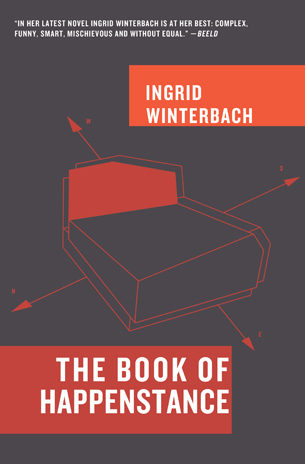
book_happenstance_large

The Book of Happenstance
Ingrid Winterbach
Open Letter Books
Paperback, 254 pages, $11.95
978-1-934824-33-7

.

Though Ingrid Winterbach sets her novel, The Book of Happenstance, in contemporary South Africa, a country dominated by a history of racial oppression, the book is not about race or the inheritance of Apartheid. The Book of Happenstance is about memory and death, yet paradoxically so, for the novel is ebulliently alive, ironic and smart. The characters seem hyper-linked to Google and Wikipedia; the book is full of spontaneous eruptions of intelligence, and that is fun to read.

Winterbach (who wrote earlier works under the pseudonym Lettie Viljoen) lives in South Africa with her husband and two daughters. She has a degree in Afrikaans—one of the main characters of the novel is an expert in Afrikaans. She is also a visual artist and has won all kinds of awards for her work in her native land including the W. A. Hofmeyr Prize, the M-Net Book Prize (for the book in hand), the University of Johannesburg Award, and the Hertzog Prize. The new English version of The Book of Happenstance, just out with Open Letter Books, was co-translated by Winterbach herself and Dirk Winterbach (I checked but was unable to pin down the relationship).

The novel is about a middle-aged woman, Helena Verbloem, hired on a research grant to help compile a dictionary with the scholar Theo Verwey. One night thieves break into Helena’s house, steal her sentimentally priceless sea shell collection, and shit on the floor. When the police appear uninterested in helping her recover the shells, Helena starts investigating the robbery herself. Some of the missing shells have turned up at the feet of a recent suicide, a man who killed himself by hanging.

The shell investigation trajectory involves two visits to a town a day’s drive away where the suicide (and his family) lived. Helen and her girlfriend Sof meet the locals in bars, disguise themselves as members of a Bible group delivering pamphlets, take pictures of the suicide house, question family and friends and come up with precisely nothing. In fact, what they learn is that the shells are gone, who knows where, and that her house had been broken into by accident by men looking for drugs. At one point Sof quotes the opening lines of Kafka’s The Castle: K has just arrived, the Castle is hidden in mist and fog, the village shrouded in snow, gazes up into “seeming emptiness.” Of course, the passage is even more enigmatic because it’s quoted in Afrikaans.

The shell plot is comic and Kafkaesque and ends in apparent inconsequence. The novel’s parallel plot belongs to Theo and Helena in the museum—less action than the quasi-investigation plot but many delightful scenes. The work scenes go like this: Theo and Helena sit in an office organizing words into alphabetical order, Helena fantasizes, talks about books, sometimes she asks Theo about a word and he—a human dictionary—answers with comic completeness in little essays like entries in an etymological database. Helena is obviously attracted to Theo, but the attraction is an intellectual crush not so much a romantic longing and certainly not lust.

Slotted between the interwoven main plots are a series of recurring but unplotted scenes in a tea room, more often than not Helen and another museum friend drinking, yes, tea and discussing the origin of life and evolution. These scenes are comic, exasperating—Helena’s naïve and ingenuous questions prompting lengthy, erudite answers which she seems to ignore half the time (inserting lengthy parenthetical scene commentary in the middle of the explanations). Helena’s interest in life no doubt evolves out of the context of death that surrounds her. Already, as novel begins, Helena’s parents and sister are dead, her brother estranged, she herself is divorced, her daughter is out of touch.

The novel is written in the first-person present tense. The present tense conveys immediacy and a kind of spontaneous propulsion that more conventional past tense Freitag-ular narratives don’t. In other words, Winterbach’s novel didn’t happen it keeps happening, throwing itself forward with a kind of whimsical blind hopefulness, a summoning of eternity.

In the first two sentences Winterbach announces the time frame of the novel: March to October—in March Helena starts working on the Afrikans dictionary with Theo Verwey, and by October Theo is dead. At the outset, we know the parameters, we know the course of the novel; Winterbach seems to splice the story out of the larger reel of time and in the same act warrant its significance, as Walter Benjamin suggests in his essay “The Storyteller.” “Death is the sanction of everything that the storyteller can tell. He has borrowed his authority from death.”

Much of the novel consists of memories and reflections. When writing the memories Winterbach steps in and makes a stylistic choice. She writes a number of the memories in the past tense and some in the present and, a few times, seems to mix the two. The weaving of tenses together seems to add to the eternal bracket around the novel. Winterbach wants Happenstance to break out of linear time and rest securely in the present. Therefore, even the memories, past events, occasionally happen in the present. There is, I think, an ironized search for the eternal in the novel. The shells in their way seems to represent something beyond time to Helena, considering “their beauty restored [her] trust in all of creation” (59). At one point Helena’s friend Sof  says, “I’ve just read and interesting article… All writers are actually pursuing a single ideal, namely the universal.” To which Helena replies dryly, “I’ve always thought the universal to be suspect.” (130). But her denial rings with irony.

Happenstance is a terrific read. It is consciously intellectual without being pretentious or didactic. It is smart and knows it but the irony runs deep. Against the etymology, we have Helena obsessing over the shit on her carpet; she associates the lingering smell of aftershave in her apartment with crime, so that she qualifies every clean-shaven man with the thought: Could he have shat on my rug and stolen my shells? And then there is the whole Sof/husband subplot: Sof’s hatred for her husband and her desire to have an affair with a crippled pediatrician. Even Theo’s funeral has a comic aspect: a member of the museum staff, nicknamed Sailor, shows up drunk, wearing a natty white suit, and tries to jump into the grave with the coffin.

Finally: Why happenstance? The title of the English translation seems to refer the coincidental nature of the crime, the shell-robbery, perhaps the Kafkaesque and coincidental nature of all life. The novel forces the death of Theo Verwey and the loss of Helena’s shells together, but their juncture is conditional, fleeting and evanescent, means almost nothing except in the pleasurable connection of words, obsession, human affection, and our ultimate end (itself likely to be comic). It is all happenstance.

(Read an excerpt from the novel here.)

—Jacob Glover

.

Jacob Glover1

Jacob Glover is studying Classics & Philosophy at the University of King’s College in Halifax, Nova Scotia. His work has been published previously on Numéro Cinq: essays (on Kierkegard, Montaigne, and Spinoza), translations, and poems.

.
.
.

May 302011
 

Sam Lipsyte, © Robert Reynolds

The Ask
Sam Lipsyte
296 pp.
$25
ISBN  978-0-374-29891-3 

As a Canadian, I’m ashamed that American fiction, which is largely underwritten by a market, has a keener social eye than Canadian fiction, which is underwritten significantly by state-funded, supposedly arms-length grants. Contemporary American novels from maturing writers like Jonathan Franzen, Jennifer Egan, Michael Cunningham and Sam Lipsyte (author of this superb novel The Ask) as well as emerging novelists Joshua Ferris and Jonathan Dee examine, castigate and celebrate today, while my fellow Canadian writers remain obsessed with yester-year. Egan’s recent A Visit from the Goon Squad mocks celebrity culture and trophy marriages. Dee’s The Privileges boldly reasserts that novels about money are not the exclusive domain of the Victorian novel. Ferris’s chilling The Unnamed and Cunningham’s By Nightfall fearlessly plumb the life-time relationship. Here in Canada we get muskeg tales of outport woe (see February by Lisa Moore and/or Annabel by Kathleen Winter). With The Book of Negroes, a mega bestseller in Canada, Lawrence Hill digs deep to conclude that slavery was bad. Canadian writing grants that should make our fiction brave and bold too often leave it feeling like it was written (reluctantly) by a harried committee at a government ministry.

Sam Lipsyte’s searing, hilarious and moving new novel The Ask is able to judge the society it records without sounding as sanctimonious as a government recycling campaign. Most fiction writers at some point feel the pull of Chekhov’s claim (or Thornton Wilder’s paraphrase) that literature is not bound to answer questions but rather to pose them fairly. However, Chekhov’s advice can create a crippling rudderlessness that leaves superficial fiction misidrected and unengaged. Egan’s A Visit from the Goon Squad has an utterly condemning scene with a self-inflicted scar. Franzen’s The Corrections has that minor but unforgettable couple who lost their adult daughter to murder. The father responds by eventually deciding to never speak of the matter again. The mother draws the killer’s gun every day then rips up her (near perfect) drawing. Social portraiture is alive and well in American fiction. In The Ask, the multi-talented Sam Lipsyte laughs and cries along with the characters he condemns and condones.

Continue reading »

May 082011
 

This Ancient World
A Review of Mathias Énard’s Zone
by Mary Stein

Zone
By Mathias Énard
Translated by Charlotte Mandell
Open Letter Books
ISBN-13: 978-1-934824-9

I am lucky enough to have experienced the horrors of war only indirectly in the form of newspaper articles and television newscasts. I remember small blue-on-black explosions of sparkling shards arching through Iraq’s sky, ticker tape reeling across the bottom of the screen attempting to quantify casualties like stock market quotes. But in 1991 during the First Gulf War, a series of wars began tearing Yugoslavia apart—a nation splitting at cultural and political seams—and in Serbia, Croatia, Bosnia and Montenegro, people were faced with an entirely different wartime experience: Instead of watching dim explosions on the television, they found war erupting in their cities, backyards, homes and bodies.

Translator, Charlotte Mandell

Zone, Mathias Énard’s fourth novel (of five), his first novel translated into English is an attempt to articulate the experience of the Balkan wars from the inside. Charlotte Mandell’s deft translation from French highlights Zone’s lyric quality, conveying the retroactive point of view of a narrator who condenses the personal and cultural impact of the Yugoslav wars along with historical war crimes, genocides and ethnic cleansings dating back to Troy.

Zone’s narrator, Francis Servain Mirkovic, is a French-born Croat, a former soldier who fought “…for a free and independent Croatia, a free and independent Herzegovina and finally for a free and independent Croatian Bosnia…,” thus, in his own mind, straddling the boundary between victim and perpetrator. In the present story of the novel, Mirkovic is a spy for French intelligence collecting stories of war crimes “…like someone who becomes a referee having been a boxer and himself no longer touches the faces that explode beneath fists, he counts the blows…”

Under the influence of alcohol and amphetamines, Mirkovic has just boarded a train from Milan to Rome intending to sell the Vatican another “sad piece of the past in an entirely ordinary plastic suitcase wherein is written the fate of hundreds of men who are dead or on the point of disappearing…” Using the identity of a childhood friend, Yvan Deroy, as a cover, Mirkovic finds himself “lost now with an assumed name between Milan and Rome, in the company of living ghosts.” A bizarre interaction with a stranger further unhinges Mirkovic, inciting a state of post-traumatic stress. As Mirkovic’s train crosses city boundaries, his erratic mind wanders, and he finds himself unable to separate his own trauma-tainted memories from the stories and names of the dead that fill his suitcase.

Continue reading »

May 042011
 

Foran’s Version

A Review of Mordecai: The Life and Times by Charles Foran

By Darryl Whetter


Mordecai: The Life and Times
Charles Foran
738 pp.
Knopf Canada
$39.95 hardcover


Author Charles ForanUntil Charles Foran’s recent Mordecai: The Life and Times, the various biographies of Mordecai Richler suggest that an interesting subject for biography does not necessarily an interesting biography make. Great lives don’t always inspire great books. In the decade since Richler’s death in 2001, four books entered a biography’s race between early market share, thoroughness and accuracy.  Globe and Mail journalist Michael Posner pre-excused the scattershot tone of his 2004 The Last Honest Man by subtitling it An Oral Biography. Posner splices together 150 interviews to raise questions (How much did he drink? Why the rift with his brother? Did he really seduce his high-school English teacher?) but refuses to affix any answers. The fatuousness Richler often mocked in the CanLit establishment didn’t leave him completely ignored by the Canadian academy. Reinhold Kramer’s Mordecai Richler: Leaving St Urbain (2008) examines many of the same formative experiences as Foran’s (the fall from Jewish orthodoxy, his parents’ loveless marriage and rare divorce) but also suffers the congenital blind spot of interpretation and begins to read a creative life of decades through a few childhood events. Like Foran, M.G. Vassanji is first and foremost a novelist. Vassanji’s peripatetic life within diasporic and intellectual communities could have made his 2009 Extraordinary Canadians: Mordecai Richler the most attentive to Richler’s dual citizenships as Canadian and a member of the Jewish diaspora, as Canadian novelist and cosmopolitan writer. However, Penguin’s insistence on a short biography denied Vassanji the archival time of the Kramer or the Foran and doesn’t find it as emboldened by extensive quotations from letters and manuscripts.

Continue reading »

Apr 152011
 

Elegant Uncertainty

A review of Juan Jose Saer’s The Sixty-Five Years of Washington

By Richard Farrell


The Sixty-Five Years of Washington
By Juan José Saer
Translated by Steve Dolph
Open Letter Books
ISBN-13:978-1-934824-20-7

To be clear: the soul, as they call it, is not translucent, it seems, but murky.
—Juan José Saer

WHEN IS THE LAST TIME you went on a good walk with a friend? Cell phones off, eyes fixed on the path in front, minds alert and the conversation buzzing?  A good walk opens the ears and the heart to storytelling, creating a sacred space in between two individuals as they make their way.  Juan José Saer invites us on such a walk in The Sixty-Five Years of Washington.  But, reader be warned: this is no ordinary stroll and this is no ordinary novel.

The Sixty-Five Years of Washington follows Angel Leto and “the Mathematician” as they walk through the city center of Santa Fe, Argentina. “Suppose it’s October,” the narrator begins, “October or November, let’s say, in 1960 or 1961, October, maybe the fourteenth or sixteenth, or the twenty-second or twenty-third—the twenty-third of October in 1961 let’s say—what’s the difference.”  This uncertain narrator interrupts frequently and becomes a third protagonist in the novel as he narrates the journey, conversation and thoughts of the characters and supplies ongoing, humorous commentary.  The conversation quickly turns to the sixty-fifth birthday party for Jorge Washington Noriega, a party which neither man attended.  Washington is an elusive character; we don’t know much about him.  He writes lectures on the Colastine Indians (“Location, Lineage, Langauge & Logic”); he was arrested once, and avoided prison by going to a mental hospital; he throws wild birthday parties for his younger friends. The Mathematician heard his version of the party a week earlier from one of the attendees, Botón, as the two men rode a ferry.  Leto hears his version from the Mathematician.  The reader, of course, hears all of these accounts from the narrator. The party attracted les enfants terribles of Argentina, young artists, poets and political activists ready to disrobe, fight and snort coke into the wee hours of the morning. You want to be at this party, but, like Leto and the Mathematician, you can’t attend, so you must be willing to accept a re-telling (hyphenated emphasis intended throughout) of the event as the men stroll through the city.

This device of re-telling is crucial. By not going directly at the events the way a traditional narrative might, Saer creates distance between the characters in the novel and the dramatic action.  This recursive structure forces us to question the very idea of what happened at this party, and, on a deeper level, what is happening in the novel. Saer challenges the notions of verisimilitude and truth.  And with this technique, the re-telling of the events at the party mimics our reading of the novel itself (of any novel, really), by recreating a version of reality through the description of events not directly experienced by the characters or the reader.  Saer seems to be jack-hammering at the foundations of storytelling.

Continue reading »

Apr 032011
 

Christopher Ryan, Ph.D. & Cacilda Jethá, M.D.

/
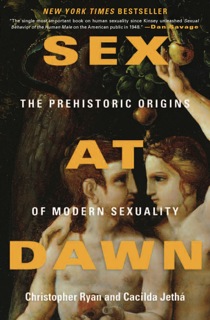
Sex at Dawn: the Prehistoric Origins of Modern Sexuality
Christopher Ryan and Cacilda Jethá
Harper, 416 pp., $25.99
ISBN 9780061707803

John Gardner’s lovely On Becoming a Novelist claims that readers have two big incentives to get through long blocks of prose: story and/or argument. In Sex at Dawn: the Prehistoric Origins of Modern Sexuality, Christopher Ryan (PhD) and Cacilda Jethá (MD) offer a little of the former and plenty of the latter. With kilos of scientific homework, not home-wrecking confessions, they tell the polyamorous story of human evolution as an argument for contemporary tolerance for open relationships and other strategies for more sexual-social-spiritual contentment and less work for divorce lawyers.

Those of us who teach know that few lessons are as powerful as Thomas Kuhn’s revelatory paradigm shift. Ryan and Jethá start their polyamorous argument in a double bind: Western culture has been so thoroughly and punitively mired in the monogamy paradigm that even the scientists (from Darwin to Stephen Jay Gould) who should be helping create an accurate reflection of open human sexuality often misinterpret, misrepresent or misguide us with physiological and historical evidence that should be a clear argument for some divisions of sex, love and family. To their credit, Ryan and Jethá (a couple) turn this challenge into a key opportunity for this measured, informed account of human sexual mutability. This wake of human intellectual development and the social management of knowledge (plus 65 pages of notes and references) make Sex at Dawn much more than a martini-soaked argument for a key party.

Taccola’s Piston, 15th century

The antagonists of the Sex at Dawn story are (recent, proprietary) monogamy, close-mindedness and unwise policy. Its various protagonists are human and (other) primate anatomy, evolutionary survival, wide-eyed history, and brave honesty. In emphasizing that humans, our closest primate relatives, and proto-humans are physiologically hard-wired for polyamory, Ryan and Jethá make a historical and biological argument, not a revolutionary one. With fact after fact they demonstrate that we almost always have been polyamorous and are physically if not evolutionarily equipped to be so. Citing past precedent and current failure, their argument is much more palpable and significant than any proselytizing campaign. Sex at Dawn doesn’t argue that we should convert to polyamory; it argues that we almost always have been polyamorous and should be again given our current failure at monogamy. Their citation of Schopenhauer’s 1851 essay “On Women” gains additional relevance as we consider contemporary divorce rates, what American literature profs Carmine Sarracino and Kevin M. Scott call The Porning of America, and the global sex trade: “In London alone there are 80000 prostitutes [in 1851!]. Then what are these women who have come too quickly to this most terrible end but human sacrifices on the altar of monogamy?”

Ryan and Jethá’s attention to human sexual anatomy is crucial to their argument that if we want healthier bodies, relationships, and societies we should revert to polyamory. Their comparisons to other primate genitalia and sexual behaviour foreground that theirs is an argument from science, nothing faddish like ‘alternative lifestyles.’ A handy diagram summarizes their repeat and varied attention to the large penis and testicle size of polyamorous humans, bonobos, and chimps (where males aren’t too much bigger than females) compared to polygynous gorillas, where males tower over females to fight off other males then impregnate multiple females with their (relatively) miniscule penis and testicles [truck size joke anyone?]. Gibbons are monogamous and equally sized between the sexes, but they also don’t shag very often and don’t, unlike randy humans and bonobos, ever copulate facing each other. The testicle size issue is illuminating. Male gorillas fight to be the one inseminator of multiple females, so they have put their evolutionary work into arm and chest strength and have “kidney-bean sized” testicles buried up in their bodies. The primate playahs (humans, chimps and bonobos) have evolved sizeable testicles to frequently produce large volumes of ejaculate so their sperm, not their arms, compete within females who have multiple partners.

Vanessa Woods’s public image of the high-empathy bonobo.

Ryan and Jethá’s attention to male and female anatomy is illuminating [oh the back-pumping male penis; oh the attacking acids in the first spurt of male ejaculate], and they augment it with genuine curiosity and intellectual history. In a truly remarkable connection they observe the intellectual taint of biases and reception chronology shared between our current (misinformed) monogamy paradigm and the massive research preference for chimps over bonobos. Genetically, humans are equally similar to combative (and horny) chimps and cooperative (and really horny) bonobos. However, chimps were discovered and brought into comparative research earlier, and various lasting comparisons were cast. Their quotation of Frans de Waal’s Our Inner Ape is a cri de coeur for the social improvement, not just sexual adaptation, Ryan and Jethá advocate:

I sometimes try to imagine what would have happened if we’d known the bonobo first and chimpanzee only later or not at all. The discussion about human evolution might not revolve as much around violence, warfare, and male dominance, but rather around sexuality, empathy, caring, and cooperation. What a different intellectual landscape we would occupy!

As a (rational and compassionate) argument, Sex at Dawn draws as much evidence from history and anthropology as it does from anatomy. In a forthcoming book of poems about evolution, I use a corporeal dramatization of planetary evolution to illustrate the same evolutionary timeline so central to the Sex at Dawn argument. Stretch your arms wide and imagine the creation of Earth at your right fingertips. For the vast majority of planetary history, past your left shoulder, only bacteria existed. Sex didn’t evolve until past your left elbow, as complex plants began to reproduce sexually. Dinosaurs roamed around in the palm of your hand and humans arrived in just the end of your fingernail. Ryan and Jethá treat that fingernail paring forensically and anthropologically, stressing that the vast majority of proto-human and human evolution was spent pre-agriculturally in hunter-gatherer tribes. Nomads who needed to band together to survive were evolutionarily rewarded for cooperation and sharing. The vast majority of human history was spent sharing food, genes and child-rearing. Ryan and Jethá compare early humans and twentieth-century hunter-gatherer tribes in which rotating sexual partners meant any man could be the father of various children and therefore all men provided for all children. Later they contrast that cooperative child rearing with the high divorce rates and the very large fraction of single-parent families in contemporary America, citing studies which show that single-parent children under-perform on “every single significant outcome related to short-term well-being and long-term success.” As Ryan points out in one of his two stimulating appearances on Dan Savage’s sex-advice podcast, only with the very recent human switch to agriculture did humans shun cooperative, communal ownership (and polyamory) for private ownership of land, seeds and their heirs (through monogamous marriage).

How Reymont and Melusina were betrothed / And by the bishop were blessed in their bed on their wedlock. From the Melusine, 15th century.

While the thoroughness, variety and balance of Ryan and Jethá’s case are crucial to demonstrating what to many will still be a radical thesis, the abundance of evidence actually becomes a rhetorical challenge. Admittedly, logic and organizational ease do favour a loosely chronological development from proto-humans to (racier) later chapters on the West’s policing of the female orgasm. In general, the first half is more anthropological and the second, much more gripping half, is anatomical. Readers interested in—forgive me—hard persuasion may appreciate anthropological example after example, but there’s a risk of losing sight of the argumentative forest for its evidentiary trees. References to South American tribes, remote Chinese communities and enlightened Indian provinces are important reminders that divisions between sex and love are healthy and that human behaviour, not just anatomy and bonobos, favour multiple sexual partners. Nonetheless, chapter after chapter of anthropology may prevent readers from getting to the later, better chapters. Without Sex at Dawn, who would know that “By 1917, there were more vibrators than toasters in American homes”? The argumentative foreplay is great. For a while.

—Darryl Whetter

/

Photo: Nicole Dixon

Darryl Whetter’s latest book is The Push & the Pull, a novel of bicycling and bisexuality. In April 2012, he will release a debut book of poems about evolution (including the evolution of sex). He’s also at work on a novel about polyamory.

/

Mar 252011
 

Anonymous folk engraving of merpeople.

Speculating on Divinity Genes

A Review of Matthew J. Trafford’s The Divinity Gene

By Peter Chiykowski

The Divinity Gene
Matthew J. Trafford
Douglas & McIntyre
ISBN 9781553656036

In his debut collection of short stories, The Divinity Gene, Matthew J. Trafford pulls off a generic balancing act, suspending his swaying narrative tightrope between the often opposed platforms of “genre” and “literary” fiction. His performance is certainly captivating. Walking the line with him are rogue angels, dissected mermaids, messianic clones, Faustian e-demons, and homophobic undead (the term “zombie” is considered demeaning to still-sentient beings who have yet to gain the vote). These creatures swing the stories between scenes that are sometimes fantastically unfamiliar, sometimes unflinchingly intimate, often both.

“Thoracic Exam,” the opening act of the ten-story collection, is a good indicator of the volume’s strengths and weakness. An unnamed female narrator-nurse examines the recent widow of an old love interest. The routine check-up turns into an opportunity for the romantically unsatisfied stethoscope-wielder to investigate the body and the life she never chose. The story showcases Trafford’s writing chops (“I must eavesdrop inside of her”), but also his off-putting love of jargon (“Her lacrimal ducts are now secreting full tears”).

Public Domain Image from Wikimedia Commons. Artist unknown.

His tendency toward clinical and obscure terms, one that recurs frequently, culminates in a prepubescent narrator from a fishing village describing a cut-up mermaid using words like “striated,” “lepidopterist,” and “filigreed.” The narrator’s vocabulary asks for more suspended disbelief than the mythical sea creature around which the story revolves.

Trafford skilfully deploys the speculative elements of his fiction. Never does he let fantasy outweigh the emotional core of his plots, and crucially, he never lets the magic or technology interfere with the complex networks of desire that motivate his characters. Rather, the “genre” elements of his stories work to distil the conflicts and intensify the choices the characters have to make. In “iFaust,” a widowed grandfather wrestles with the decision to trade his well-aged soul to the devil in exchange for that of his ungrateful grandson who made a literal Faustian bargain for success as a rock musician. The conflict – the grandson’s sullen plea and the grandfather’s vacillating refusal – is served well by the supernaturally high stakes. Unfortunately, the tension is later spoiled by a last-minute decision from a secondary character who consequently trivializes the grandfather’s role in the story.

This is not to say that Trafford relies on speculation and magic to distract from narrative shortcomings. One of the collection’s most powerful pieces, “Past Perfect,” is a slice-of-life story that follows the experiences of a young man losing his older husband to aphasia. It is one of the book’s many grief narratives, arguably the most powerful. While in “The Renegade Angels of Parkdale,” the gay male narrator of a similar age is made passive by the loss of his partner, relying on friends and fallen angels to initiate the story’s significant scenes, the narrator of “Past Perfect” is admirably active in dealing with and dramatizing the gradual and thoroughly disenchanting processes of grief. The loss of partners and family members is a recurrent focus of the work, as is the nature of homosexual and homosocial relationships.

In addition to being fascinated by the classic themes of death and love, Trafford is also interested in formal experimentation. “Renegade Angels” features some two-column simultaneous narration. The gambit is a little distracting, a visual reminder that the reader is involved in the physical task of reading a page and not the cognitive task of a reading a story. The footnotes of “The Grimpils” feel less like aids for differentiating protagonists and more like excuses for the author to trot out his technique. The centre-stage action of the characters coping with the disappearance of their friends and lovers is vastly more interesting than Nick’s aromatic analysis of Ceylon tea. The opening section of the title story, “The Divinity Gene,” engages in a much more rewarding bit of play. It is formatted like a wiki entry, complete with links and section headings to explain technological advances that lead to the genetic cloning of Jesus in 2006.

Ultimately, The Divinity Gene indulges in a level of showmanship that is unnecessary, but not unappreciated. The volume is best taken in multiple sittings. The young introspective gay narrators dealing with isolation and/or grief can become a bit monotonous, even when separated by the various other protagonists (including a widowed grandfather, a thirteen year-old boy, and a bitter middle-aged nurses). Whatever their limitations, though, his stories all come from a uniquely powerful breed of conflict, one playfully mutted up with formal and fantastical experiments that continue to yap and growl in the memory after the book is closed.

Peter Chiykowski

www.rockpapercynic.com

Mar 012011
 

David Levithan’s Argot of Arousal,

A review by Darryl Whetter


The Lover’s Dictionary
David Levithan
Farrar, Straus and Giroux
ISBN 9780374193683

Frontispiece, Frankenstein by Mary Shelley, Colburn and Bentley, London 1831

Mary Shelley and her progeny know that novels need more than just bone, muscle and skin; they also require that elusive spark of life. David Levithan’s interesting but patchy novel The Lover’s Dictionary definitely isn’t another atrophied non-story du jour. In places, the skin of prose also glows with ruddy life. Its familiar but relevant romantic trajectory gives it a strong, able skeleton with cheekbones of infatuation, flirting hands and a breadth of shoulder willing to take the weight of romantic cohabitation. Despite these strengths, however, the novel’s dictionary structure leaves the body of this story unfinished, as if constructed during fitful labour shortages. Between the islands of gleaming flesh, too much glaring white bone is left exposed to the air.

Continue reading »