Apr 182015
 

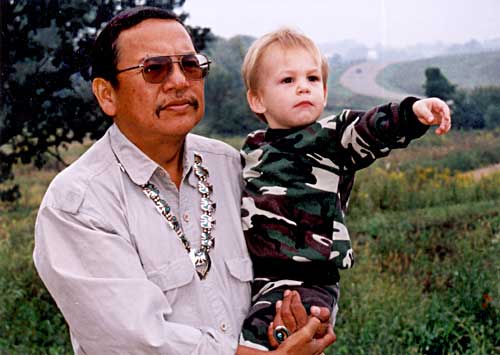
Ray A Youngbear and son

Taiaiake Alfred just wrote to say he’d discovered by chance that I had written a review of one of his favourite novels, Black Eagle Child by Ray A. Youngbear. Taiaiake sent me the link, which I had lost track of, which gave me a chance to waste half-an-hour adding the review to NC. This review is important in my own development as a writer. It appeared in April 1992 in the Los Angeles Times. I was working out the aesthetic and form for my novel The Life and Times of Captain N. So there was a crucial influence, a cross-pollination. Black Eagle Child itself was absolutely fascinating and mysterious.

dg
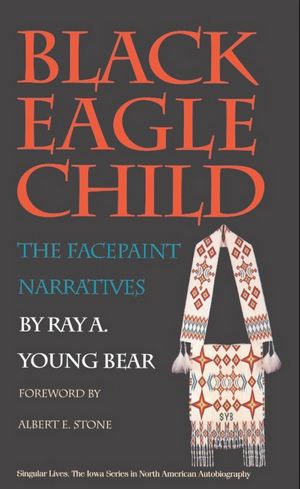
Cover

BLACK EAGLE CHILD: The Facepaint Narratives
Ray A. Young Bear
First published by University of Iowa Press

.

Albert E. Stone, in his foreword to “Black Eagle Child,” calls this book an experimental autobiography. But the reader quickly discovers two things: This tale is not factual–it is full of composite characters and fictionalized events–and it is only tangentially about its author, the Mesquakie Indian poet Ray A. Young Bear, who eventually disappears behind a series of changed names, false leads, alter egos, digressions, epi-stories and myths.

Young Bear is a poet who makes his aesthetic home between two worlds, the native and the non-native. He is a dancer at the world’s rim–a fan dancer, for he conceals as much as he reveals of himself and his people. Concealment is a key aesthetic principle, for as Young Bear constantly reiterates, there is a price to be paid for telling tribal secrets to outsiders. In his afterword to “Black Eagle Child,” he recollects how his grandmother taught him that “there were things I could not write about.”

As an Indian who sets himself up as an author in the white sense, Young Bear is freighted with a terrible dual responsibility: to satisfy his readers that he is being truthful and informative, and to satisfy his personal and tribal need for secrecy. He must invent a new form, the nature of which is duality, a form that is never straightforward, yet full of implication. It will be poetic, but it will not fulfill every demand of traditional poetic genre. It will always be surprising; it may not end. A code, in other words, that only the right people can break.

In his first book of poems, “Winter of the Salamander” (1980), a much younger Ray Young Bear gave a hint of forms to come:

What do you do when
there is a man
who represents your dreams
who goes talking and appraising
his deeds
and for no reason he stops
and says something new
there is a chance
for those who want to learn
but not for those who feel it
hard and difficult

For “those who want to learn,” “Black Eagle Child” is a kind of non-autobiographical Zen treasure trove of non-information about Mesquakie Indians and Young Bear. It is ostensibly a poetic Bildungsroman centered around Edgar Bearchild, a Mesquakie boy from the Black Eagle Child Settlement in central Iowa (Young Bear is from the Mesquakie settlement near Tama, Iowa). It begins with Edgar in grade eight in 1965 and follows him through his career as the community’s youngest treatable alcoholic. There’s a brief stint at a prestigious liberal-arts college in California, then back to Iowa, where he becomes a successful poet haunted by UFOs. He lives off grants from the fictional Maecenas Foundation (Young Bear received grants from the National Endowment for the Arts in the 1970s).

This process of becoming a writer fascinates Edgar, who sees himself wrapped in a paper cocoon, changing, altering, saving himself from the usual fates of a reservation Indian. Learning to translate between worlds redeems him, though with redemption comes alienation and survivor’s guilt, since he must separate himself from the normal communal life of his people.

Twinned with Edgar (like the twin boys of Indian legend) is the more adventurous and traditional Ted Facepaint, who follows the tenets of the Well-Off Man Church, a fictional Mesquakie affiliate of the mushroom-eating, pan-Indian Native American Church. (This, by the way, is Young Bear being highly elusive. Rather than reveal traditional Mesquakie rites and legends, he describes a modern cultural intrusion in which he has no stake. Here he seems to reveal without revealing anything.)

Like Edgar, Facepaint also heads west to college. He drops out and hitchhikes across America, trying to reach some romanticized accommodation with this alien white country, only to be beaten and robbed along the way. Back in Iowa, he continues his frenetic drinking and eventually dies—metaphorically, at least—stabbed repeatedly with a screwdriver by rogue Mesquakies nicknamed the Hyenas. He is then mystically transported to Orion, the sacred constellation of the Well-Off Man Church. “Black Eagle Child” closes, however, with Facepaint’s resurrection at the hands of Rosie Grassleggings, an immensely obese native healer.

Young Bear knits together these two narrative lines with a complex pattern of imagery. Red-haired and red-hatted people relate to the red-capped hallucinogenic mushrooms, and also to the red-haired man of some native legends. White rabbits recall the Great Hare, Nanebojo, an Algonquin culture hero, who is often paired with Jesus Christ in modern native myth.

This is the bare skeleton of Young Bear’s code, the vastly complex and engaging system the reader has to learn to read. Only superficially chaotic, his narrative bears all the indications of a sophisticated and cunning literary intelligence. Young Bear has a novelist’s eye for precise social and atmospheric detail.

In his afterword, the author himself calls his book a collage, but whatever you call it, “Black Eagle Child” is an example of the new blood flowing back into the hardened arteries of Anglo-American literature from the margins–from the formerly colonized, enslaved and defeated peoples who must, inevitably, change us as we have changed them.

April 12, 1992|Douglas Glover | Glover’s most recent book, “A Guide to Animal Behavior,” was nominated for the 1991 Governor-General’s Award for Fiction, Canada’s highest literary prize.

.
.
.
.

Jun 092014
 

4pinkMtns.Weso12WebPink Mountains by Thomas Pecore Weso (acrylic, 3’x4′)

Denise Low thinks big, as her first poem suggests. She wants a new Good Book, a rewritten Bible for a new country that grew up before it had any sense of itself. She juxtaposes the slow rhythms of geology with the quicker beat of history and both with the jittery rhythms of contemporary poetry. She places the Bible next to Native American lore and that lore infiltrates the history of pioneer settlement jostling against New Age neo-mythology of UFOs, “Atlantis aliens” and Sasquatch. Pioneers burn their furniture to bear out the Kansas winter, but the poem is haunted by the native version of the weather.

Another year trees explode.
Crows fall from trees.
Lakota winter counts show a black-ink crow.
Ben Kindle writes, “K’agi’ o’ta c’uwi’tat’api.”
Crows, they freeze to death.

Denise Low is a prolific poet and prose writer (twenty-five books, not to mention an active blog), a protean editor and administrator, a perceptive critic, a Kansas Poet Laureate, a past-president of the Associated Writing Programs, and a Native American conscious of all the heritages that run through her. In February, she contributed an essay to these pages, “Optical Structures in The Shrubberies: Ronald Johnson’s Cascades.” But that was just a warm-up. Now we have poems. Four of them — “Shooting Stars Wolf,” “Sedimentation,” “Cold” and “West of Hays City” — will be published in her new collection, Melange Block (Red Mountain Press, Santa Fe), about to be launched on Saturday in Albuquerque (see her web page for details). The fifth — “Imperfect Refraction” — will be in a book of prose and poetry Jackalope Walks Into an Indian  Bar (Mouthfeel Press, 2015).

To accompany the poems we have images by Thomas Pecore Weso, Denise Low’s husband, paintings and drawings that pick up the juxtaposition of mythic landscape and native myth. (I once drove through Kansas from southwest to northeast, and there was nothing higher than an anthill as far as I remember till I hit the Flint Hills, which have always loomed high in my imagination.) The two together, poems and paintings, are a spectacular image in themselves, beautiful and mysterious.

dg


West of Hays City

The challenge is to rewrite the Bible, think big
fill these unrelenting  spaces with murals.
Swathes of sun-yellow stubble glow intensely,
the pale hue illuminated improbably into brilliance.

I grew up in this gessoed landscape without edges or peaks,
people lost in swells of dried seas and granaries,
wandering my own stories of seven-year droughts,
dust devils, narrow escape, baptism by prairie fires.

Patches of ponderosa pine windbreaks slide into gullies.
White frame houses huddle  hidden in windbreaks.
Bright corn circles drain Ice Age ground water.
Weathered outbuildings shelter crazy prophets.
Wending bluestem and datura outlast this summer.
One drought and buffalo grass fills in the blanks.
All else turns to trail ruts and shibboleths
Quartelejo Pueblo, Fort Zarah, Fort Wallace.

YelloKoKoCardImageYellow Kokopelli (acrylic, 2’x3′)

#

Cold

A family burns chairs, clothes, and axes
but nothing stops the silent killer.
Neighbors find them frozen in bed.

Another year trees explode.
Crows fall from trees.
Lakota winter counts show a black-ink crow.
Ben Kindle writes, “K’agi’ o’ta c’uwi’tat’api.”
Crows, they freeze to death.

This enemy seeps through sills and door jambs.
Chimney flues fill with its wrath.

North is its direction.
Nothing stops it from reaching
through flesh to the center of bone.

WinterShamanHiRezWinter Shaman (acrylic, 2’x 4′)

#

Shooting Stars Wolf

River Leonid Showers overhill
UFOs flash Feather Lane
tribal cop’s SUV is
on it.

Quartz-crystal sprinkle
dark pines hover glitter
woodland county lit-
up orb.

Phone camera off missed
Sasquatch on cable TV
his treetop moans
what next.

Riverview Circle dogs yowl
Saint Anthony burials
Little People trick nuns
Sun/Moon one.

Snake effigy mound upstream
here the clans Eagle Sturgeon
Crane Beaver Moose
Wolf Bear.

Tumbling Atlantis aliens
magnetize pyramids
stoned freaks stars
land here.

Cher.bear.blueCherokee Bear (colored pencil, 12″x18″)

#

Sedimentation: Alligator Junipers

tree-skin sediments
oblong scales tiered
centuries old living shale

spiral rows mortared
circling pith of sap
guarding scant water

agate-ring years
seared drought forged
creased wrinkled torsos

FlintHillsFlint Hills (acrylic, 2’x3′)

#

Imperfect Refraction
……………for Roger Holden

Lens convex image pop
this is your peyote brain
hologram alive one sliver
image falls forward—boom—

reconstituted flash-dried
memories this is what
it’s like going on in years
Artoo Detoo burbles back

pulse quickens reruns
Bre’r Rabbit Tsi-s’tu
Wau-pus picture rolls on
no mirror background

Roger Rabbit projects out
particles assemble for Skype
beam you back beam aboard
this Love Boat Osiris cruise


#—Poems by Denise Low with paintings by Thomas Pecore Weso


Denise.12.insight.blackdirect

Denise Low, 2nd Kansas Poet Laureate, has published 25 books, including Ghost Stories (The Circle -Best Native Am. Books of 2010Ks. Notable Book). Heath Fisher writes: “Filled with vivid imagery of the land and the culture, and both verse and prose, Ghost Stories is an enchanting tribute to the plains and the history (Rain Taxi). Low’s Natural Theologies: Essays (The Backwaters Press, 2012) is the first critical review of mid-plains literature. Mary Harwell Sayler writes: “The literature of the ‘New Middle West’ seems to adapt, innovate, and follow Low’s insightful view” (Rattle). Low is a former board member and past president of AWP. She writes articles, blogs, and reviews and also publishes a small press, Mammoth. A critical article on the poetics of Kenneth Irby is forthcoming from Jacket 2. Her heritages include British Isles, Delaware, and German. Recent writings appear in American Life in Poetry, Yellow Medicine Rev., Virginia Q. Rev. New Letters, Yukhika-latuhse, Unraveling the Spreading Cloth of Time(rENEGADE pLANET), I Was Indian (Foot Hills), I-70. You can find Denise Low on the web at http://deniselow.blogspot.com and  www.deniselow.com.

Tom.09 (2)

Thomas Pecore Weso, enrolled Menominee Indian from Wisconsin, has paintings in private collections throughout the country. He has had one-man shows at Hutchinson Center for the Arts, Haskell Indian Nations University, Percolator Gallery, and others. He has an MA in Global Indigenous Studies from the University of Kansas. www.tomweso.com