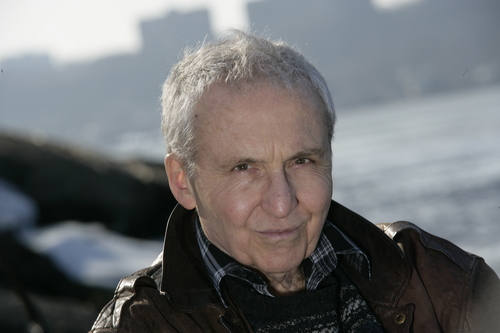
The first book I reviewed for Numéro Cinq was Joseph McElroy’s Night Soul & Other Stories. It was a book that shook me like few other have. Its sentences were often long, articulated in a style that was erudite and meticulous. But length and erudition wasn’t all, these sentences frequently seemed to syntactically dislocate, or bloom formally and then mutate colloquially, or grow fractal-like with a multitude of subordinate structures resisting simplicity to achieve a kind of nonhierarchical fiction.
The complexity and range of these stories were beguiling, like a new experience, displacing what I thought fiction could do. At the time I knew very little about Joseph McElroy’s fiction, and in my naiveté I compared the stories in Night Soul to wooly, homemade machines; I compared them to a radio slipping between stations. But here’s how novelist Kathryn Kramer says it: “[A]s you wend your way through some of McElroy’s sentences, you find, not so much yourself, as yourself in the process—yourself not lost through diffusion but enlarged through connections.”[1]
While reading for that review I stumbled upon this from Joseph McElroy in which he writes: “What can happen? my stories ask, as I ask of my life and yours. Not only what did happen.” This in many ways helped me to read and appreciate McElroy’s fiction more, understanding that his imagination didn’t stop at the aesthetical, but pushed beyond. “The Man with the Bagful of Boomerangs in the Bois de Boulogne,” a story from Night Soul & Other Stories, is available on Numéro Cinq to get a little of the flavor of what I’m talking about.
Joseph McElroy is the author of nine published novels, including Cannonball (2013), Actress in the House (2003), Letter Left to Me (1988) Lookout Cartridge (1974), and the twentieth-century classic, Women & Men (1987). He has also written a book of essays and three plays. Dzanc Books will be reissuing several of McElroy’s books in the coming year, including the aforementioned collection of essays, Exponential, in e-book form, and his second novel, Ancient History: A Paraphase, in paperback. He is the recipient of the Award in Literature from American Academy of Arts and Letters and a fellowship from the Guggenheim, Rockefeller, and D. H. Lawrence Foundation and twice from the National Endowment for the Arts. Now in his early 80s, he doesn’t seem to have lost any steam for writing remarkable prose. Cannonball, his most recent novel, has the robustness in style and execution that characterizes his work without a hint of looking back, but with an enthusiastic pressing forward.
Over the last few weeks, Joseph McElroy was gracious enough to take some questions. We talked on three topics: his unique writing style, Cannonball, and his upcoming books. As you’ll discover, Cannonball is about many things: conspiracies, competitive diving, bogus religious texts, the United States’ most recent war in Iraq, and more. So, in the way of offering some guidance through the interview, I’ll just mention a few facts. Zach is the novel’s narrator. At the beginning, Zach is a teenager, and he befriends Umo, a 300-plus pound (possibly illegal) immigrant after seeing Umo dive so elegantly at a community pool. Zach’s father is the coach of a local swimming club and he has ambitions of coaching a swimmer to the Olympics. Zach brings Umo to see his father, thinking that Umo is the one who’ll help his father. The Chaplin who is mentioned below becomes important mid-way through the novel after Zach has enlisted in the army, receiving a somewhat mysterious offer to be a photography specialist despite his lack of talent as a photographer. Zach meets the Chaplain twice: once during training and a second time after an explosion at a palace in Iraq. Zach discovers the wounded Chaplain holding what appears to be ancient Scrolls “purporting to be a first-hand first-century live interview with a Jesus” in a water system running underneath the palace. Zach takes from the Chaplain a scrap of the Scrolls, which is later used to prove their inauthenticity.
I’ll leave it that and let Cannonball’s author speak.
—Jason DeYoung
Jason DeYoung (JD): Your style of writing has often been described as difficult, challenging, demanding. Your sentences are often mysterious, long, and multifaceted; they are often wonderfully exuberant with words, too. You seem to be interested in pushing the English language to “do more.”
Joseph McElroy (JM): I’m only using it for myself, to get at whatever it is I think I’ve found or I’m up to. It’s a great language, the Germanic and the Latinate and Shakespeare’s new words and Anthony Burgess in A Clockwork Orange—the novel and its glossary. American English, too, no matter what people say, the variety of vocabularies overlapping and migrating like people who happen to come to you at a big moment or even who deny you something. When I was teaching at Hopkins in 1975 I wrote down a bunch of short statements about the sentence and said them aloud in class, however gnomic they might have sounded, and felt badly afterward but was told that what I said was OK. I have added to that list, maybe there are forty of those statements. Maybe I’ll publish it and be paid for it someday.
I think about the sentence as drawn between a need to get somewhere and end and then not to end if it can find its continuing shape in what comes next. Thurber on Henry James wanting to say everything at once. Proust both thinking summarily of a whole narrative of things all in one sentence with particulars and wonderful generalized coups of insights, the last sentence of “Swann in Love” where he concludes with a longing, almost corny, but shattering climax, that Odette wasn’t even his type—his genre (in the French); James Joyce a great composer of syntactical fragments and of long sentences—in Ulysses xvii, especially on water, where the seriousness, the comprehensive well-informedness implied humorously and lovingly by Joyce in Leopold’s science and municipal technology become also the ongoingness of the sentences, the “prose” as well as Leopold’s happiness to be giving this young guy Stephen some hospitality in the middle of the night boiling water for tea. Sentences are like home for me, even a wilderness, yes, to seek what I have perhaps found. Eudora Welty, Donne (his sentences in the poems), poor Cheever recalling DeQuincey in Bullet Park, Jane Austen (the mind of all those fine ironies all at once in her sentences), Nabokov in Pale Fire (even granting a truth in Nadezhda Mandelstam’s charge that the expatriate never achieved maturity), Henry Adams in The Education, the nursing mother whales we look down and see suspended in the watery vault “eyeing us” in Melville’s close to miraculous Grand Armada chapter—sentences so many of our younger memoirists running off at the mouth would do well to have heard and given some thought to— Intricate the passage and the sentence are my unit, pretty much, and can be sometimes several thoughts enfolding one another, passing through one another like neutrons or my reciprocal fortunate memories—and is Melville not a thinker?
JD: But how do you see your style? Do you see it as those things, as I mentioned?
JM: A rhythm of amazement and precision, risk maybe sometimes like Faulkner’s in Absalom or As I Lay Dying, his best—blunt elusiveness like Beckett’s? Beckett maybe in The Letter Left to Me.
JD: Could you talk a little about the evolution of your style, how you developed it, influences, philosophy?
JM: Philosophy? Read it all, Barthelme advised. Haphazard. Dos Passos and the collage of informational forms in the USA trilogy made a huge impression. Japanese legends of warriors, black armor. Great Expectations, the great sources in a kid’s helpless snobberies, the first novel I ever took apart and analyzed, I mean a teacher in second year high school told me to—I mean I saw that this story was a thing made and could be studied as to how it worked. Technique, structure. I can’t think where my style came from at the moment. Science reading. The fear of not gathering what I wanted into a sentence. Don’t trust the writer answering this personal question. Sentences, though.
JD: Well, how do you think about sentences? How do you know when they’re done and what are you looking for?
JM: I thought I had to curb my syntaxes when I was ten or eleven years old and writing stories. It wasn’t till I was in college that it occurred to me that the structures of my sentences might be truer than… —I wonder if the highly inflected Latin I had four years of in school in an amiable way suggested to me that I might find truthful structures in English while positioning parts of a sentence as if I were working with declensions, dative, ablative, accusative, a nominative toward the end, say, of the sentence. I have only a little graduate school German, whatever I kid myself I get in facing-text renderings of Rilke—so I never thought about holding the verb off till the end.
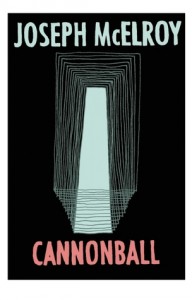
JD: Cannonball is your ninth published novel. What are some of the discoveries you made while writing (these could be technical or emotional or something else) or what surprised you the most about writing Cannonball? This question is inspired by those wonderful three sentences in your essay “Socrates on the Beach”: “Writing is thinking. Getting somewhere. Even into ignorance.”
JM: Sounds like you want to take readers away from the book itself, but no, not you, Jason. “Ignorance” I mean here is an achievement, right? Limits crashed into for now, a dark space you fall into. But limits which if you live in them are like the next question, which is even, Why the need of questioning?
Cannonball takes the mess afflicting its characters to a new stage and is clear about it. Some of it is learning how things began. Why the huge, in fact corpulent Asian probably “illegal” teenager who can dive so astonishingly well came into Zach’s life to begin with. It’s all there. How things happen. Something’s at stake for the reader. This is my most uneasy-feeling or darkest book. More than Lookout Cartridge. My only really dark book, upshot after upshot, though with a young voice that itself isn’t dark.
Stanley Elkin, in the days of carbon paper—was it that early?—said somewhere more or less that your American novelist makes his POV hero six or seven years younger than himself; this is what is known as Carbon 14 dating, Stanley explains. My hero, and at the end of it all he is something of a hero, is six decades younger than I and I’ve been happy to hear from some young readers (they’re all younger now) that Zach is convincing. He’s a remarkable witness, for all he doesn’t quite know. You have to look at what happens. People sometimes they come to you at the right time asking you for what is needed. What does William James say about this in the Varieties of Religious Experience: What actually happens. It’s right there. What do we learn from the Chaplain? What are we to make of it? And what of him is saved by Zach—one of the best surprises in the story. Somewhere between Catch 22 and The Red Badge of Courage, I’ve heard said of Cannonball. That doesn’t come too close. Closer to Crane if I have to compare. But Crane? Hemingway admired The Red Badge—who said: You make it up out of what you know—though he didn’t know much about women and men together.
“Surprised,” you said? I was surprised how the closeness between brother and sister developed. What it has to do with the war and diving. I let the characters be. That means make the scenes speak. Brother and sister in the car toward the end, things changing between them slightly – one of the best things I have done. Each new book asks the reader to read what it says. Many readers would rather talk about something else. The father is seen by one reviewer as an absence. But we know a lot about him. Maybe for some readers each scene the father’s in might seem to leave out some dumb confessional explanation by him of himself some reader thinks is needed. It’s not. The son Zach doesn’t know him too well, perhaps. Zach tells what he knows. The father seems to find fault with the son. But not only. What the main character Zach sees gives us even richly these extraordinary limitations of the father character. He recedes but not into indefiniteness. Proust would have given us a wonderful analysis of the man. I might have in another novel. Proust the greatest novelist of the twentieth century, so much closer to me than these other names I hear myself placed with and am so unlike. Doesn’t mean I write like him. In this novel, did father sacrifice son to get what he wanted? The father probably doesn’t see it that way. Attentive reader grasps the question. By the time of his enlistment Zach makes his own choice. But he’s invited to enlist, remember, and if you read, you can find how he came to be invited. The reader might try accepting the characters as given. All the information’s provided—a lot, and often I would say American information. The chaplain, what happens to him and before he recedes, all that he leaves us with. Lazarus. Zach’s half-unknowing influence on events. Government thinks one character is alive but isn’t, another dead but isn’t.
JD: I’m interested in the idea that you wrote Cannonball out of your “anger about the Iraq war,” as you mentioned in another interview. Were your emotions purged or lessened by writing the novel? Or is the point of writing with these strong emotions meant to be a transference of sorts of your emotions onto the reader? And if that’s so, do you agree that writing is a “hostile act,” as Joan Didion called it so many years ago?
JM: Transferred into the story, I would say. Story stands between the reader and the writer: there it is, for the reader to take or leave, and not for the writer to explain, much less explain where it came from. Writer probably does not entirely know. I say the Scrolls, one source. An American curse, mouthing some Christianity lipservice to justify any damn thing we do as a nation. So from archaeology and weapons of mass destruction and confirming all our self-promotions comes an ancient transcript torn and fragile and part-lost derived from what we know and what we do purporting to be a first-hand first-century live interview with a Jesus not at odds with American success myths. Lawrence meant something else when he said “The essential American soul is hard, isolate, stoic, and a killer.” But the cruelty in a whole segment of our politics (right wing? the word “wing” is misleading) is hard to believe. [2]
I guess the Scrolls are near the source of Cannonball. But springboard diving another point of departure definitely. Perhaps never quite been done like this before in a novel. Even the calculus of it at the very end connects it to the war and the brother and sister and the Hearings about Competition.
For me there are no individual beginnings for a novel—several points of departure, impulses, subjects scattered out there, that I let myself be at sea with or in orbit around or they in orbit half out of reach around me and gradually the subjects gather their relations. The diving accident, as the reader will understand, draws so many of the book’s elements together; but so does the brother-sister relation; and friendship; and the Scrolls, and so on.
JD: What about “hostile act”?
JM: What exactly, and who, am I, as you put it, agreeing with? Anger could be out of control. Anger could be a clarifying force. Writing is fighting, I think Nietzsche said. Only as it’s trying to think something through. It’s meditation, too. I have it both ways. There are the sentences and there are the people.
JD: One of the more interesting facets of your style is the confluence of simultaneous events for instance early in Cannonball, Zach, the narrator, is shooting onto film one of Umo’s dives, while at the same time Zach is being told about a question Corona’s wife has asked E, Zach’s sister; but also there is a “breaker fluke,” and the power flashes, and on to that an “old woman” “materialize[s]” to speak. This is all captured in an 18-line sentence.
JM: (An 18-word sentence would have been better.) It’s an embrace a love a prayer but to whom(?), so many parts of one in-motion act—vision like a dive you might want to see all the parts of but at the same time as William James in that late book refutes Zeno’s infinitely dividing up the space traversed so supposedly you never get there?
Everything at once may make hash of causality. It’s also the way we can feel—not overwhelmed so much as in touch with a lot suddenly, our decision-making all but dissolved or some aesthetic thrill at the changing core of things if there is one. A reader might note that a character close to Zach is interested in what happens right before an event; another what comes right after. A nose for how things happened. Something to do with photography, too—what seems to take Zach to the War, Army’s employing him for that. Reader might follow why. Zach’s not a pro. Really not much of a photographer. Though maybe that makes the photography more interesting. It’s not photography that takes him back to the War the second time.
JD: In a lot of Cannonball, sports and war and religion are all mixed up, and it is in many ways a political novel. Do you believe that sports are (or can be) a replacement or placeholder for war?
JM: Sure. Who doesn’t? Conflict coming at you unavoidable—doesn’t mean that knife-fighting is the ultimate moral test as Cormac McCarthy, a great landscape writer, would have us believe, who dismisses Henry James. You have to decide how far the always interesting pressures of a competitive sport can take you. Character-building as coach says, whose own character may have been stunted by it; it lives in fantasy—but imagination, finding new combinations and possibilities is our social and ethical genius if we would seek it in ourselves. Diving, soccer, karate—art? Maybe, or some texture or task like how to live. Football takes brains, all those playbooks, but the allegiances and simple-mindedness and insane fandom, God. Preoccupation with sports makes us trivial but it’s dramatic, too. Degrees of difficulty in competitive diving measure beauty too. Never apart from the behavior of the water. Yeats, the “fascination of what’s difficult” —Orwell, the overcoming of something difficult in writing, hence a density. Someone says “difficult” —of art—but “difficult” is never spelled out, it’s conveniently left indefinite, it’s never voiced as a word that refers to a clear idea or standard, though it pretends to in readers’ mouths. What are we willing to look for in other people? Intricacies of courage.
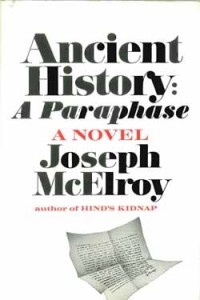
JD: Ancient History being re-released just a few months after your most recent novel, why Ancient History: A Paraphase and not, say, Hind’s Kidnap? Or is the latter forthcoming?
JM: Partly an accident of publishing; Hind’s Kidnap is coming out as an e-book, and I hope for a print reprint. A young writer friend of mine thinks Ancient History (1971) has a lot to say to young people now, so we pushed for a print reprint. Jonathan Lethem wrote an intro. What publishers choose to bring back, it’s all something of a lottery.
JD: I’ve read that your next project is a nonfiction book on water.
JM: It’s been in progress nine years. Almost done. I don’t think there’s anything like it. One small side of it visible in an essay that appeared recently in New England Review, “Wetland Reflections,” about a made wetland in lower Bronx River. I’m interested in what water is to us.
JD: Any other new work?
JM: Sceenplay. Children’s book. Libretto. A novel called Voir Dire begun in 1991. 600-some pages so far. An excerpt published a few years ago. And another novel at last getting finished was the first effort I ever made to understand what I was doing—being made to move by outside forces yet somehow within their restrictions making my world move—sorry about that word “world” —and what awaited (though not necessarily me). You sign up for what you think the job is and it turns out to be something entirely different. More to it, you know, than that. It gives me the chills how that novel is still clear in my mind. I started it around 1948, do you believe me? Been sort of writing it since I was 18. It’s getting done by Spring.
—Joseph McElroy and Jason DeYoung
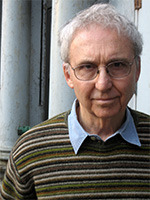
Joseph McElroy is the author of nine novels including A Smuggler’s Bible, Lookout Cartridge, Actress in the House, and Women & Men. He has also published a book of short stories—Night Soul & Other Stories—and a collection of essays—Exponential. He received the Award in Literature from the American Academy of Arts and Letters and fellowships from the Guggenheim, Rockefeller, and D. H. Lawrence Foundations, twice from Ingram Merrill and twice from the National Endowment for the Arts. He was born in Brooklyn, New York in 1930.
 Jason DeYoung lives in Atlanta, Georgia. His fiction has appeared or forthcoming in REAL: Regarding Art and Letters, New Orleans Review, The Los Angeles Review, Numéro Cinq, and The Best American Mystery Stories 2012
- Kramer, Kathryn, “Dr. McElroy, Homeopath: What One Goes to Him For,” The Review of Contemporary Fiction. Spring 1990. Vol. X, No. 1. Page 80↵
- The full D. H. Lawrence quotation from Studies in Classic American Literature: “The essential American soul is hard, isolate, stoic, and a killer. It has never yet melted.”↵