Jun 222012
 

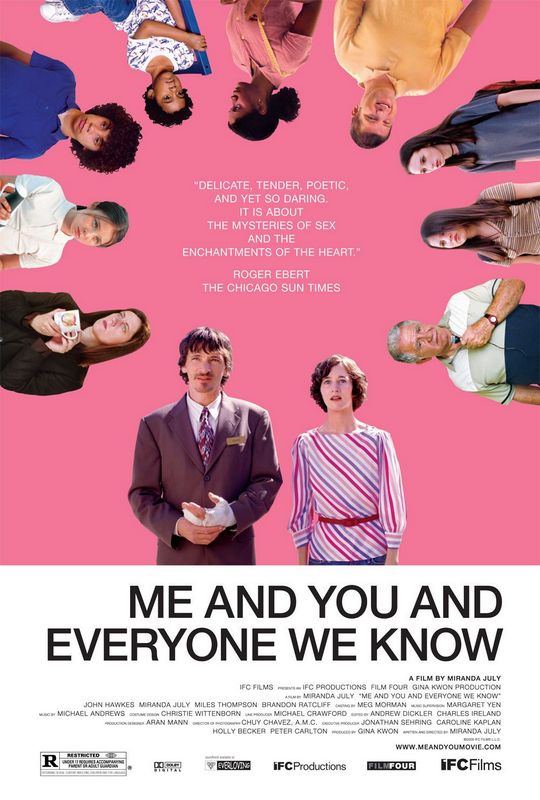
Occasionally, in the structure of a larger film there will appear a scene or sequence that can stand on its own, discretely, as its own short film. Here I would include the opening scene to Neil LaBute’s Your Friends & Neighbors, the seduction / meeting scene in Julio Medem’s Sex and Lucia, the “Hotel Chevalier” short shot alongside Wes Anderson’s The Darjeeling Limited (a separate film but theatres often screened it with the feature and it contains events referred to throughout the film), and this short set of scenes spanning the story of a goldfish on a freeway in the middle of Miranda July’s first feature film Me and You and Everyone We Know.
Structurally each of these shorts can be viewed discretely from their feature films and some, as in the case of July’s goldfish story, may even seem like an aside, though I think it still adds something tangentially to the larger film it belongs in. Some like “Hotel Chevalier” are subplots. Others like the opening to Your Friends & Neighbors and Medem’s seduction scene are building blocks of the main plot but could still exist as separate entities. Despite these differences, what they do have in common is that they provide enough narrative cohesion and catharsis to exist on their own if they had to. Or if you wanted to see them that way.

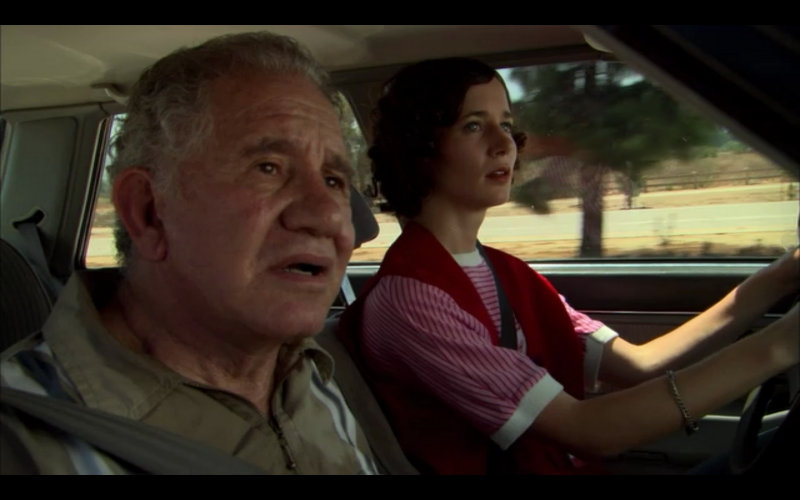
The goldfish sequence is tonally and stylistically similar to the rest of the film it appears in but is also similar to “Are You the Favourite Person of Anybody?” which was previously featured in Numero Cinq at the Movies. In July’s worlds we find absurdist realities where what happens is probable, realistic, but told in an overdrawn way, here particularly evident in the dialogue between Christine (Miranda July) and Michael (Hector Elias).
There are also strong similarities between this oversaturated reality and the style of Jane Campion’s short films (which were also featured in Numero Cinq at the Movies) which is no surprise as July commonly cites Campion as one of her inspirations and influences.

Though the goldfish short fits within the feature it is a part of, viewed on its own it offers a different experience. It is then a short film about loss, about condensed meaningful moments, and connection between strangers witnessing those moments. This isn’t at odds with the feature film it belongs to, but is in hues and tenor more melancholy than the rest of the film.

There are two things which tonally shift this shared sad experience, though, and keep it from plummeting into melodrama: 1) the couple in the vehicle that is the goldfish’s penultimate landing place are oblivious to the goldfish’s last moments, even though, as Michael notes, “at least we are all together in this.”
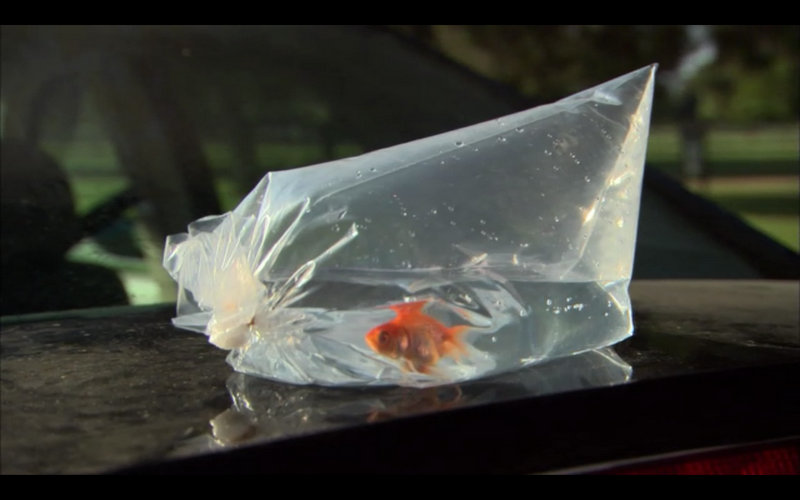
2) It’s about the death of a goldfish, possible the world’s most disposable pet. Truly, for the goldfish, these last moments hurtling down the freeway in his little bag of water might be a much more euphoric way to die than the neglect and probable toilet bowl funeral ending that would have awaited him at the little girl’s home. Regardless, the accidental death that connects these strangers is light on tragedy as a result.

All told this mixes into something sublime: a little accident, a little collision between strangers, a little loss, all finding something meaningful and significant that is more than a little beyond words.

None of this is intended to disparage the larger work, July’s absurd and lovely first feature Me and You and Everyone We Know. It’s just there’s a pleasure within the pleasure. And this might be worth tasting on its own.

–R. W. Gray

Oct 062011
 

.

At the core of Miranda July (writer) and Miguel Arteta’s (director) short film “Are You the Favorite Person of Anybody?” is the title question. It is repeatedly asked by a man standing on a street corner (John C. Reilly) to strangers who pass by, but we never find out why he’s asking the question or what he intends to do with the information he collects. All we know about him is that he has a burning question, three orange trees, and a wife trying to get rid of oranges. None of this matters. The question’s profundity disarms and obscures all else.

That burning question supersedes the simplicity of the film, supersedes the film itself in the way the it poses the question to the audience, too. The youtubification of this film led to a spate of vloggers asking themselves and others the same question in a sort of viral existential awakening, or, at times, mass despair. Certainly, though, the question hails us if we dare to let it. Are you the favorite person of anybody? It’s difficult not to get caught in the musical chairs of the query. And won’t most of us end up on the floor?

But to dwell on the question this way is perhaps to identify too strongly with Miranda July’s character. Mike White’s character doesn’t seem compelled or bothered. He has no delusions of grandeur, but does have a girlfriend and is bringing her an orange or two – he leaves almost elated.  So what of the oranges? On a certain level, the film seems too simple to contain metaphor. But then there are oranges. Are they consolation? Are they payment for pain inflicted, or are they the very point of existence? Much depends on a bag of oranges.

What intrigues me here more though is the intimate story around the story.  How Miranda July had just finished shooting Me and You and Everyone We Know and had nothing to do until the editor came back with a rough cut – a peculiar waiting. So she wrote these sketches. Showed them to Arteta who she was dating at the time. Arteta rushed them to shoot and cast July, Mike White (the writer of Chuck & Buck, which Arteta directed) and Chuy Chavez (July’s DP on Me and You and Everyone We Know).

Arteta, in an interview in Wholphin confesses what the script meant to him:  “When I read it, it hit me hard for the first time: I wasn’t going to be [July’s] favorite person for too much longer. I was having doubts about us and the script felt like a warning . . .  I said ‘Let’s shoot this, right away’ – knowing that working together was something I would always cherish”

In her Wholphin interview, July confesses she was excited to just act. It was something she committed herself to so strongly that when she walked away from John C. Reilly, exiting her scene with him, and no one called cut, she just kept on walking. “I walked practically to the next neighborhood before anyone noticed I was gone.”  These are the interstitial stories I believe imbue films.

After the death of French filmmaker Jacques Demy and the decaying of the prints of his early film Umbrellas of Cherbourg, his filmmaker wife Agnes Varda oversaw the re-colorization of the film. The result is lurid, gaudy, and gorgeous. Walls aren’t just walls, they leap out in shades of eggplant and lime. Varda was ostensibly realizing Demy’s original vision for the film’s color, but there’s something else that imbues the film. Call me overly romantic but I read each color, each frame, as part of a love letter to her deceased husband.

What imbues “Are You the Favorite Person of Anybody?” for me is the tension between July’s never ending take where she walks off the set and away. . . and Arteta’s manic intent to make the film and collaborate while they still had time. A letting go and a holding on. This bittersweetness stains the film for me.

Romanticism aside, this is simply a film I wish I’d made. With one location and only four actors this is one of the simplest short films I’ve seen. Made for  $150 (for apparently coffee, bagels, tape and a transfer to HD), the simple style and simple content let the film’s principle dramatic question do the work.

The film appears in Issue #1 of Wholphin, the McSweeney‘s DVD magazine, available here:

http://store.mcsweeneys.net/index.cfm/fuseaction/catalog.list/object_id/4F541504-D8B3-44BE-9DAC-32B0B4554215/Wholphin.cfm

In their own words:

“Wholphin is a quarterly DVD magazine featuring short films, documentaries, animation, and instructional videos that have not, for whatever reason, found wide release. Recent issues of Wholphin have included films by Spike Jonze, David O. Russell, Miranda July, Miguel Arteta, Errol Morris, and Steven Soderbergh, and performances from John C. Reilly, Selma Blair, Patton Oswalt, Andy Richter, a monkey-faced eel, and many others.”

—RWGray

Sep 292011
 

.
http://www.youtube.com/watch?v=P8dF2fmb5rY
.

From last week’s collision in an intersection to this week’s collection of small caught moments in Jane Campion’s series of shorts, Passionless Moments (1983). The series is made up of ten short films co-written by Campion’s then boyfriend Gerard Lee and is narrated by a BBC-type narrator giving the films a scientific or sociological flair (further emphasizing in a perhaps misleading or ironic fashion the importance of these moments). There is, in these shorts, a fetishization of minutiae. Each is smaller and less dramatic than the collision in And the Red Man Went Green. And these are “real” people, flawed and vulnerable; they do not anticipate the camera’s gaze. We catch them at their most vulnerable and unawares.

Taken individually, I feel these are moments that read you back: what small details of our lives have escaped film’s classical three-act structure and drive for catharsis? As Geraldine Bloustien points out in her essay “Jane Campion:Memory, Motif, and Music,” “Classical Hollywood cinema concerns itself with the heightened moments of passion of individuals with whom we identify in some way because of their bravery, humour, innocence, heroic qualities and so on. In traditional feature films and documentaries we are usually introduced to the characters’ backgrounds, motives and problems. However, in Passionless Moments the characters serve only to illustrate some quirky aspect of human nature and relationships.”

These moments cumulatively tempt me to universalize: that it might be the minutiae and /or our “quirky” aspects that connect us to one another, a humanity found in the small, quiet, sometimes embarrassing moments. Though in the actions of Campion’s characters it is difficult not to see something vaguely heroic. I am embarrassed for the boy named Lyndsay Aldridge, his explosive string beans, and his manic running, but I admire his commitment too. I recognize myself in him and don’t want to at the same time. Campion’s oevre is made up of such characters, from her exploration of the author Janet Frame in An Angel at My Table, to the complicated relationship at the core of Holy Smoke.

I have to confess that the title of the series confuses me. Are these moments truly passionless? Or is the title ironic? Passionless as in lacking suffering? Or passionless as in suggesting disengagement? In a sense it reminds me of Roland Barthes’s A Lover’s Discourse, an at time dispassionate analysis of desire and passion. These films contain a similar tension / contradiction and perhaps the title participates in that. And I think there’s a similar undecidability to the shorts: what significance do they amount to? To whom do these moments matter?

I heard the writer filmmaker Miranda July introduce a screening of these shorts at the IFC in New York this summer. She said that when she first saw Campion’s shorts she saw a type of filmmaking she could do (my summary). I took this to mean that July felt the films provoked and read her back too. That to watch these “passionless” moments is an invitation to reflect on one’s own moments. I see further evidence in the several “Passionless Moments” shorts on youtube that pay homage. Explore at your own risk. And maybe dare to ponder your own.


http://www.youtube.com/watch?v=pXfQOZOk8dU

—RWGray