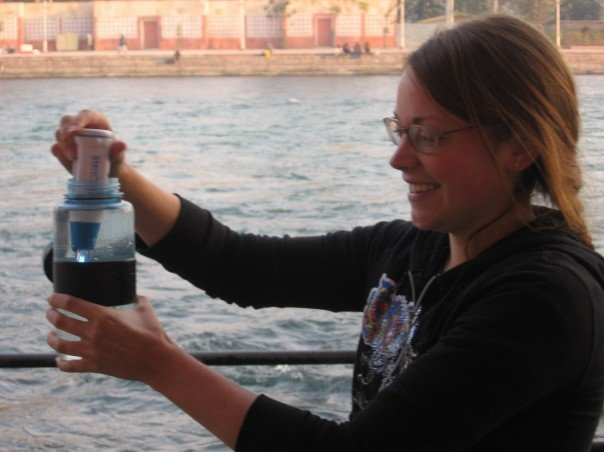
 Kate McCahill on the Ganges
It’s a huge pleasure to introduce Kate McCahill who is a former student of mine at Vermont College of Fine Arts (she hasn’t graduated yet). Before coming to VCFA, Kate traveled in India, and when she came to work with me, she was writing a series of essays about that experience (with a book hovering in the near distance). These essays were remarkable for their structure and verve, their plots and their attention to character and detail. This is one of my favourites.
The big news for Kate, though, is that she’s just been awarded the Mary Elvira Stevens Traveling Fellowship, funded by Wellesley College (Kate’s undergrad school). Kate expects to get about $15,000 to finance a writing trip from Guatemala to Patagonia.
dg
/
The day I met Teddy, the heat and the grimy streets of Pune had mixed a muggy haze outside, which leached its way into the bookstore, slicking our foreheads and necks. As I examined the travel section, the bell above the door clanged and Teddy came in, stood for a moment in the doorway, backlit by the sun, and then walked over, close to where I stood, so close I could hear him breathing. I watched from the corner of my eye as he scanned the horror novels and selected an old hardcover. I caught a glimpse of the curling binding: Carrie, by Stephen King. The bell above the bookstore door clanged again; hot wind blew in.
Teddy was a tall black man with close, tight curls and white teeth save for a brown one towards the molars, which he’d learned to hide by keeping the left side of his mouth closed. Because of this, he talked with only half his mouth, and that, combined with the rotting tooth behind full lips, gave him a sly, crafty look. We were four hours northeast of Mumbai, in a city known mostly for an ashram, built by the guru Osho.
Teddy’s eyes sidled to mine as we browsed, but I looked away. Aman had warned me of certain people on my first night in Pune. There were those who came to Pune for the money there could be made selling drugs to hippies at the ashram, or slipped pills into their coffees at the German bakery, or took them away by motorbike into the night. Aman was a friend of a friend, a second cousin of a farmer I’d met while still in Dehra Dun, and I figured he was exaggerating a little, trying to scare me into being extra-careful. But I took the horror novel in Teddy’s hands as a sign nevertheless. The books on the shelf before me bore beaten bindings and dated titles, and I set my attention on those. The USSR Today, one stated gloomily. Myanmar: Temples of Splendor, read the cracked yellow spine of another. When I tugged it down, opening the long cover that drew stickily back, a flattened moth broke off and spiraled to the floor. The pages showed Technicolor tourists admiring a crumbling, sunlit temple.
Those books were like the maze-like, rutted streets outside, the old men on rickety gray bicycles, even the street-children, their cries at once pitiful and joyful, and the beggars with their practiced wheedling. I would remember each one as an enduring, Indian staple: worn by time, accustomed to crowds, doggedly resilient. Teddy, on the other hand, was fresh, with pearl buttons on his Western shirt and pointy shoes on his feet. “Have you read this?” I heard him ask. I looked up; he waved Carrie. I couldn’t help it: I smiled, shook my head, and pretended to look grim. He wasn’t like the enduring things of India, standing so tall in the bookshop, and speaking English, too.
“What’s wrong?” Teddy asked, seeing the look on my face. “What’s it about?” His question was mockingly innocent. Even if you knew nothing about Carrie, the cover, with her body stained red, told you everything. “Just joking,” he said at my raised eyebrows, and flipped fast through the pages like he was just seeing how long it was, how closely set the type.
“So, you can’t stand the gore?” he asked after another moment. When I looked at him, he winked. Be careful, Kate, a little voice said. But Teddy continued talking, and I kept listening. “That Stephen King—he’s something else,” he remarked, lowering his voice a little as an elderly Indian couple brushed past us. “He’s American, like you?”
I could tell by the way he said it that he knew the answer, but I nodded anyway. His own accent sounded imprecise—a little off-kilter, rolling and round. He was from South Africa, if I had had to guess.
He looked at me like he was waiting to hear me ask where hewas from, but I remembered Aman’s warning and said nothing. When I looked up from the Myanmar book again, he’d bent to examine the rest of the Stephen King section. I slid my book back beside the others on the shelf, and as I walked towards the door to leave I ran my fingertips along the soft spines once more. Just before I reached the end of the stack, the pad of my first finger caught on the broken coil of a spiral-bound book, and I drew my hand back. I thought I felt a tiny spark as my fingers left the book. I stopped, peered at it, then eased it out from between the other books. It was a loose-leafed notebook, the kind you buy in American drugstores. I felt Teddy glance over, but in that moment, nothing could keep me from lifting the cover and looking inside. There was something funny about that notebook, I just knew.
Handwriting choked the inside cover and the very first page: all Sanskrit and all in pencil, delicate marks made by a trembling hand. The words spilled onto the next page, and then the next and the next. In places, the writing ran over itself, and as I turned the pages the characters grew smaller and began to march up and down the margins and snake between each coil of the binding. It was as if the writer had had the book as his only source of paper for a very long time.
“Someone’s journal,” I heard Teddy whisper beside me.
“Maybe,” I said. Put it back, the little voice said, and leave Teddy. That’s what Aman would want you to do. But I just couldn’t take my eyes from those pages. The notebook felt both heavy and flimsy, like the words were weighing the cheap paper down. Teddy didn’t try to take the book, didn’t say anything else, and together we looked at the pages the way little kids look at picture books without reading the words. The tightness of those words; their growing frenzy.
Towards the very end of the notebook, we came across a nearly clean page, startling and white like a flat, smooth stone in grass. The lines resembled the veins on a wrist, and the only other thing there was a signature at the lower right. The signature was both scratchy and looping, if that can describe it: hard at its points, but soft in its curves. How had it happened, this page? I heard Teddy’s breath quicken a fragment. Had the writer waited as he filled up every other page for the person who would sign their name on the only blank one? I imagined a prisoner, or someone exiled. Someone banished. Was it a hastily scribbled prayer?
Teddy brushed the signature delicately with one calloused thumb. I reached out myself and felt the way the writing cut into the page. It was impossible to tell whether the signature was a man’s or a woman’s, in the way it both rolled and cut into the page. I glanced at Teddy; he shrugged. When I looked down again I felt a little chill, even in the hot store: looking at that page was like seeing a secret.
I felt guiltier and guiltier as I held the book in my hands. What was it doing on these shelves, anyway? I glanced towards the counter at the young shopkeeper, who was typing into her cell phone intently, perched on a stool with her legs crossed. I closed the book, knelt down, and slid it onto the lowest shelf, taking care to tuck it in so that it wasn’t easily visible to a browser. Teddy didn’t protest. It didn’t occur to me to even ask whether the book was for sale: I simply assumed it was not. For one selfish second I imagined waiting for Teddy to leave, and then slipping the book into my purse, hurrying back to Aman’s and holding it open again, this time alone.
We stood there for a while, looking at the place where I’d slid the book back. Teddy finally broke the spell. “Want to grab a chai?” he asked, and I felt relieved that he’d broken the strange book’s spell. What could be said, after all, except that those pages had held a mystery? All of a sudden I was aware again of the shouts of chai-wallas outside and the shotgun explosions of motorbike engines in the street. No, I didn’t have time to drink chai, meditations started in an hour and I still had to meet Aman beforehand. I shook my head.
“Can I at least get your name?” Teddy asked, and I gave it to him. What the hell; we’d already shared one secret. “I’m Teddy,” he replied, and plucked Carrie back up off the shelf. “I’m taking this one,” he added, grinning.
“Good luck with that,” I said, and without looking again for the spiral-bound book on the shelf, I left the store and went back out into the sunshine.
The ashram wasn’t like the rest of Pune, which was built, as far as I could tell, around the wide, trash-littered, dried-up river that divided the city. Aman lived on the northern side, opposite the ashram, up a little street lined with apartment buildings built in the seventies. Most of Pune’s streets were unpaved—except for the wide avenues that circled the city center—and were crowded with vegetable stands and bidi shops, vegetable-wallas and munching cows. If you walked from Aman’s flat away from the river and up the hill a ways, it was like stepping back in time: no cars, just cows and bike rickshaws and a crumbling red temple, centuries old. Strings of marigolds for sale. But the ashram was always gleaming, always manicured, perpetually gated to keep in the scented flowers, the shining floors, and the servants in their clean white linens.
Beggars gathered at the ashram gates, but of course they could never go in; two guards planted there day and night made sure of that. You could feel the shift as soon as you entered; gone were the noisy cars, the shouting hawkers, the trash on the ground. Fake waterfalls obliterated all unpleasant noise. Neatly shaven grass; tall, carefully-planned stands of trees.
I was late to meet Aman after the bookstore, even though I’d been rushing. It always took longer than I thought it would to race back to the flat and change into my red robe. Everyone at the ashram had to wear the red robe, even the guards and front-desk agents. The robe was to keep us all looking the same, all equals I suppose, but when you walked around the city you sure could tell who was part of the ashram and who wasn’t. The most devout in the ashram wore their red robes everywhere. Personally, I hated my robe, which chafed against my skin and made me sweat profusely, but when I didn’t wear it to the ashram Aman took offense. He’d given it to me as a gift, and wore his each day, washing it carefully in the evenings and putting it out on the little balcony to dry in the night.
I didn’t tell Aman about Teddy as we sat sipping our tea before meditation. I didn’t mention the notebook either. I wanted to keep it a secret, preserve the mystery. I held it in my mind like a precious stone, something to be guarded and saved. Instead, Aman and I just drank our tea and talked about our schedule: noon meditation, another at two, and then the White Robe ceremony in the evening.
Aman had taken great pains to ensure that I attended at least one White Robe ceremony. In the first few days I’d arrived, we’d both been too exhausted; meditation at five AM followed by afternoons of touring Pune tired us both out. But today, Aman was determined. The morning before, he’d sent me across the street to his neighbor’s, a woman who lived with her teenaged daughter. They lent me a white robe stamped with cream-colored flowers. Aman laundered it again for me after I brought it home – just in case, he’d said. In case of what? I wanted to ask, but bit my tongue. Deep down I knew why. While Aman’s apartment was clean right down to the shoes lined up by the door, the neighbor’s house was really a two-room flat, smaller than Aman’s and stinking of cigarettes, the windows shut tight to preserve the air conditioning. I didn’t mind the smell, just the close, freezing air. The television blared.
Aman drank down the last of his tea now and we made our way to the meditation room. It was just as the website pictured: the whole room sparkled with mosaics made of mirrors. Aman and I showed our ID cards at the door, removed our shoes, and went in; thirty people or so already sat cross-legged on the low, wide steps that rose toward the back of the room, their eyes closed. Silently, Aman and I joined them, and he settled into a cross-legged position. His breathing soon deepened and slowed. I closed my own eyes.
I tried to let me thoughts slip from me, but my legs fell asleep right away, still unused to the position. I cracked my eyelids open: everyone around me kept their backs straight and their hands folded. Someone dimmed the lights and a gray-haired woman wearing lots of turquoise jewelry lit a candle up front, clicked two little chimes together, and the room fell into an even deeper quiet, steady breath the only sound.
But I couldn’t keep my mind still. This wasn’t like the yoga I’d practiced up in Rishikesh, in an old man’s living room that became a studio every afternoon. In this glittering space, thoughts crowded in on me and raced around. Little twinges in my muscles and on my skin grew into itches, cramps, and I wanted to stretch so badly but knew that if I did, I would bump the people around me, break them from their trances. The candle smelled sickly sweet, and the room grew very warm with all of the bodies. Notice your breath, I reminded myself, but my thoughts just shot away from me again like little film reels. I was hungry. What were my parents doing, right now? And where was that scarf I bought in Thailand? I hadn’t seen it lately. My mind circled over itself, and then I remembered the journal. I thought of the words that filled the pages, and then startling empty one. I settled on the thought of slowly turning the notebook’s pages. I imagined touching the penciled words. Teddy’s breath on my neck. When the gray-haired, turquoise clad woman touched the chimes together again, I blinked in the light with everyone else, like waking up from a dream. I hadn’t emptied my mind, but I’d come close, had thought only of that creamy blank page for the final long minutes of the session.
Aman never spoke about his actual meditation. When I tried to ask him, on our second day together, what he tried to think of when he meditated, where he tried to send his mine, explaining that I was struggling with the concept, he’d shrugged. “We each find our way,” he’d said, and though he was never short of words anywhere else, we both avoided further discussion of the hours we spent in inward silence. After this meditation, we talked of yoga later on, of his adopted son who was planning a visit later in the week, and of where we’d take our lunch. We ambled to the German bakery, still in our robes, and ate soup together at a long table where other soul searchers, also in their robes, talked and ate too. Outside the German bakery, vendors displayed long racks of red and white robes for sale. I tried not to meet their eyes on the way out.
Aman liked to wash before the White Robe ceremony, so after we’d attended the second meditation and eaten dinner, which Aman purchased in tins from the same neighbor who’d lent me the robe, he went into the bathroom. I could hear the water running as I took off my red robe and slid on the white one. At least it was cooler, sewn of thin cotton instead of the red robe’s scratchy polyester. Aman emerged from the bathroom eventually, his hair slicked back with water, his white robe cloaked over him. He’d ironed the robe that morning; I told him it looked nice. He told me mine did too. Then we walked back across the river to the ashram, where a hundred other people in white robes waited outside of the big auditorium, its silhouette reflected in the meditation pool that lay before it.
You weren’t allowed into the auditorium until right before the White Robe ceremony, so while Aman chatted with old friends who’d donned the white robe for years, I recognized an Israeli girl, Eti, that I’d met in a yoga class the day before. She, too, was looking around, standing a little apart from everyone, so I went over to say hello. She always toted a huge backpack, and it was no wonder, with the number of robes we needed here. She smiled when she saw me coming over, and we talked about the mall, where she’d been that morning. “I just could not get up for this morning meditation, you know?” she said. “Maybe tomorrow!” And then the doors were opening and people began flowing in along both sides of the meditation pool.
It took quite a while to get to the door, because everyone needed to remove their shoes and place them in cubbies, then grab a handful of tissues for when the breathing meditation got started. People murmured and mumbled in line, but no one spoke too loud or laughed, unwilling perhaps to break the stillness of our reflections in the meditation pond. Slowly we made our way up the stairs and into the cavernous auditorium lobby. I unlaced my sneakers and tugged them off, tucking my socks inside, and stuffed them beside Eti’s in an available cubby. We started to follow the other white-robers inside.
“Miss,” I heard a woman call from behind me. Eti and I turned; the woman was talking to me. “Miss,” she said again, and beckoned with her hand for me to come back. Eti and I looked at each other; I shrugged, and she found a place on the floor.
“I’m sorry, miss,” the woman was saying, as I pushed back through the doorway, against the flow of the white robes. “You can’t attend the ceremony today.” She glanced at my robe. “It’s the flowers, these little flowers here. The robe needs to be totally white, just plain.” She shrugged her shoulders and legitimately tried to look sympathetic. Sorry, they’re the rules, her look said.
“Are you serious?” I asked her, and a few heads turned. I was making a commotion, but I just could not believe it. After Aman washed the robe? After the neighbor lent it to me? The woman nodded. “Sorry,” she said, out loud this time, and then coolly moved her gaze from my face to monitor the others who still trickled in. I glanced through the doorway; Eti had craned her neck from where she sat and was watching me, confused. I didn’t see Aman anywhere. I held up my hands at Eti, the universal gesture for who knows? Eti waved, smiled a little smile that genuinely seemed sorry, and I was at least grateful for that as I laced my shoes back up and left, taking the stairs two at a time, my face aflame.
Mostly, I was annoyed—after the initial shock of being banished wore off—that I didn’t have a change of clothes. I figured, as I tried to steady my breath and slow my beating heart, that I had two choices. I could go home, or I could wait for the White Robe ceremony to end so I could still walk back with Aman. After pondering the walk home alone, across the bridge beneath the dimming sky, I chose to wait, and so I walked out the ashram gates, white robe and all, and down to the German Bakery, where I thought I’d get a coffee and try to find a magazine, or a person to talk to, that would take my mind away from this mess.
Stupid white robes, I muttered as I walked past the beggars, who must have sensed my frustration because they didn’t even bother to approach me. Or maybe they just figured I was stingy. Or, maybe even beggars hold off when someone’s having a conversation with herself. Damn freaking flowers, I mumbled as I entered the German Bakery, and what finally stopped my cursing was the sight of Teddy, standing there at the counter plain as day and talking with the girl serving coffee.
He turned and grinned, recognized me immediately, then took a moment to look at my white flowered robe. He studied my face. “Everything okay?” he asked carefully. I must have still been red in the face.
“I’m okay,” I said, then blurted it out. “I got turned away from the White Robe ceremony just now.” He grimaced.
“Was it the flowers?” I nodded. “How’d you guess?” I asked, half sarcastic.
“I’ve been to a few of those White Robe’s in my time,” Teddy said. He put on a grim doctor’s face: “I’ve seen this a few times before.” I laughed at his tone, which compared the ceremony to a serious condition that lacked a cure.
“It’s silly,” I admitted, “but I was so embarrassed! It really sucked, you know?”
“Let’s have a coffee and make fun of the ashram,” Teddy said. I couldn’t help but laugh, and nodded yes. A coffee was what I needed, all right. For those moments I forgot all about the empty page in the journal and the little voice that warned me about Teddy, and instead just felt happy that Teddy was there, for sly as his half-smile was, he was being kind. He bought two coffees, and we looked around for somewhere to sit. All the chairs were full, tables littered with dirty cups and newspapers.
“Let’s go outside,” Teddy suggested, so I followed him out the door and we sat down on the sidewalk outside of the coffee shop, lowering ourselves carefully so as not to spill the steaming contents of our mugs.
“So what do you do here, Teddy?” I asked him as we sipped. I could smell chocolate emanating from the bakery.
“I’m a PhD student,” he answered. I was surprised, but then I knew nothing about him. “Anthropology,” he added, anticipating my next question. “I’m especially interested,” he paused, put down his books, stretched his hands out before him, “in the palms.”
“You read palms?” I asked, before I even realized the words were out of my mouth. Sure enough, he looked offended.
“I don’t just read palms,” he insisted, like he’d dodged the question all his life. “I read them in the traditional, voo-dooey way, yes,”—he wiggled his fingers in the air to emphasize voo-doo—“but my degree has many levels. Astrology, physiology, human biology, psychology…” the list petered out. He set his coffee down beside him and leaned back on the heels of his hands. “It’s a complicated degree,” he finished, and drew a pack of cigarettes from his pocket.
I watched him strike a match and light a cigarette. As an afterthought, he offered the pack to me. I shook my head. “So, what can you see in the palms?” I asked him. I looked at my own; they were sweaty, for one thing, with a few scooping lines.
“Oh, you can read many things,” he finally said vaguely, maybe still miffed at me. He drew on his cigarette and blew the smoke out into the street. He took another drag, exhaled. “Many things,” he said again, this time as if to himself, drawing the words out like swoops of honey pulled from the jar. I guessed he’d decided to make me beg. He turned and looked at me for a long moment, his gaze uncomfortably piercing. I looked away.
“You don’t have to tell me,” I said. I reached for his pack of cigarettes and took one out. He struck the match.
“It’s not that I don’t want to tell you,” he finally said. “It’s that…” he paused, dragged. “I’m afraid to tell you what the palmist sees.” I waited for him to explain. The cigarette tasted smooth and had a thick gold filter.
“Everyone wants their palm read,” Teddy said, “but when they hear what the lines mean, they often see them as…” he waved his hands, looking for the right word. “As ugly,” he finished. “People are afraid of the truth in the lines.” He looked over, down at my hands. I was touching the lines of my left hand with my right fingers. When I noticed the movement, I lifted my cigarette to my lips.
He grinned at that. “Do you really want me to read it?” he asked.
“Yes,” I said, and then I realized that I meant it. I guessed I wanted to hear what was so bad, the way we’re compelled to stare at car accidents we pass on the freeway.
“You sure?” he asked. “Because I will. I’ll tell you what it says.” His voice was still lighthearted, and I nodded.
“Okay then, hand it over. Ha, get it? Hand it?” He snickered. I fake-laughed. “I get it,” I told him, and stuck my left palm out.
He flicked his cigarette into the gutter. “Get rid of yours, too,” he said. “I need to see both.” I obeyed, tossing the golden butt in behind his. He rubbed my outstretched palms with his thumb, as if to draw out the lines. For a very long time he stared at them, looking back and forth between my two hands.
“It’s a very interesting hand,” he muttered finally. “A very, very interesting hand.” Again he went quiet, pressing my palms again with his thumbs. Then he let both hands fall.
“You will have an ordinary life,” he said with a shrug. He wouldn’t meet my eyes.
“That’s it?” I checked my palms again myself; what was so wrong with them? “Tell me, Teddy,” I urged. “I won’t be hurt.” Even then I think I knew that was a lie.
“Yes, you will,” he affirmed, and inhaled deeply, let the breath out slowly. “This is why I never read the palm of a friend,” he said, and went for his cigarettes again. “They never leave me alone, after that.”
But I wanted to know! I had to know. “Please tell me,” I said, and now I really was begging. What could be so terrifying in the lines?
“Okay,” he finally said, after a few long drags on his new cigarette. “Okay. I can tell you about here, because the hand is always changing to show the present. Here,” he reached for my right palm and poked a finger into the longest line, “in India, you are afraid. You are suspicious. And, you are often alone?” he looked at me. I nodded. “But, you feel as though you are searching for something here?” he continued. “And,” he added, “you worry you’ll go home without it.” Again he looked at me, confirming. I nodded yes. “You’re expecting something. Not expecting,” he laughed, “as you Americans say, but expectant. You’re waiting for something.”
“That doesn’t sound so horrible,” I said. It was all I could think to reply. Only later would what he’d said would really sink in; all throughout India, I felt challenged by the constant eyes upon me, the crush of people always.
“There’s something else,” he told me. “Something happened, before you were born.” He let the words sink in for a moment, then continued. “Maybe something happened with your parents, or in your family, or something. I think,” and he paused, took a drag, let the cigarette fall. “I think it was something bad.”
Ever since that moment, I’ve wondered what he meant when he said that. My parents lost a child before me; is that what so darkened my palm? But Teddy was standing now, his coffee cup empty. He stretched his arms high and glanced down at me. I must have looked bewildered, because he said, as if to comfort me, “Don’t worry, Kate. Luck will be on your side.” He mumbled something about how he had to meet his friend inside. “You okay?” he asked. I nodded. “See you, Teddy,” I called softly as he walked away, but I can’t be sure whether he heard.
Instead of returning to the ashram, I walked towards the city center, letting my mind wander into everything I passed. I just couldn’t think too much of what Teddy had said, I just couldn’t. Yet his words were like the empty page of the journal we’d found together: meaningless without context, yet important too, somehow. The most frightening thing was his hesitation, and what he withheld. I thought of the meditating rooms, and tried to send my mind to the quiet tranquility they claimed to hold. I took in the world around me, and walked for miles.
The walk to the city center was always rich for the senses. Food-sellers tended stands from dawn until dusk and the cigarette and sweet shops stayed open through the night. Boats on the river pulled up to the banks, and bums and sadhus slept on the shores, shaded by day and protected from the wind by night with trees and boulders. Taxis pulled up from the train station; buses came through from Bombay and sometimes from as far away as New Delhi. The wealthier, more modern side of Pune came next, with paved roads and expensive restaurants, a shopping mall and a university. Aman’s side of the river had bumpy, narrow streets, the buildings alongside crumbling from a dozen layers of paint. I thought that old paint made walls more beautiful, because you could see every color of paint ever used on the place—cream was popular, and yellow and blue. The paint told a history of the building it clung to, and judging by the number of layers around here, that history was usually long. Thin old men pedaled bike rickshaws as I approached the city-center, their sandals flapping on their feet.
The center, when I reached it, pulsed with people bicycles, a score of buses, cars that slunk through the crowds. The visitors ambling around the mall were dressed in Western clothes; almost everyone wore sunglasses, their skin tanned. I forgot about my white robe and let myself observe: the women walking here could have stepped onto Fifth Avenue and would have been admired for their beauty, their cutting-edge style. I hadn’t seen Louis Vuitton since Hong Kong, and suddenly I was surrounded. There was Jimmy Choo and Vera Wang, draped over the wrists and arms and heads of the women who glanced at me, taking in, I guess, the silly robe and the sweat at my hairline. Clearly what they thought of me was not much; they didn’t interrupt the flow of chatter into their cell phones, just raised curved eyebrows or half-smiled to themselves and turned their eyes down, amused. Still, I liked the walk, a striking contrast to the crowd Aman’s street. The woman here picked their way along in stilettos, the men in polished loafers. I imagined them pausing for a bag of mangoes or a pack of American cigarettes before hurrying on down towards the bridge to catch a rickshaw that would rush them back to the city center’s magnetic glitter.
I remembered the wealth I’d encountered in America: a few friends with houses like mansions, a ride in a limousine, dinner at an elegant restaurant with my parents, one night in a four-star, silk-sheeted hotel with my boyfriend. Here in Pune, amidst all this downtown glamour, I felt a pang at the disconnect. How strange it seemed to have known such comfort, in a place where such a level was now inaccessible to me. I had little money, and my pack at Aman’s contained everything I’d needed, this whole time I’d been traveling. It struck me that everything I had could fit in one bag and meant nothing.
I got lost in the winding streets of Pune, and it was dark before I took a rickshaw back to Aman’s flat across the river. He’d been worried sick about me, it was clear; when I knocked on his door, he opened it immediately, relief in his eyes. His hair was greasy, like he’d run his hands through it over and over. He’d changed out of his white robe, but still had his black sneakers on.
“Oh, Katie,” he gushed, before I was even inside. “I heard about the robe.” He looked me over. “I guess I should have known. They’re very strict about the white robe.” He went to the stove to start tea. “Oh, Katie,” he went on as he filled the kettle, “Where were you? Oh, I’m so sorry. I apologize. What a long night you must have had.” He turned to look at me, to check whether indeed I’d had a long night, and perhaps to hear where, exactly, I’d been. But I couldn’t think of an excuse. How could I tell Aman that a palmist had seen something bad in my hand, and I’d wandered the city as a way to escape? I apologized, explained that I’d gone to the library and lost track of time. As we sipped our tea, I thought of being banished from the White Robe ceremony, but spared Aman the details.
Aman and I resumed our routine. For three more days we rose in the morning, walked across the river to morning meditation, then sipped tea at the ashram. I walked around the city again, this time with Eti, and together we strolled through the mall. Malls are universal things, I realized in Pune. The shops are just an excuse to gossip, to waste time, to escape from whatever burdens your home life brings to you. Each shop window was painstakingly decorated, the costumed models thin and exuberant. Aman and I did not attempt the White Robe ceremony again; we didn’t ever again speak of the night I’d been turned away.
But the ashram wore on me. Beyond the issue of the flowers on my robe, there were the fees, and the guards at the door, and the aging hippies who floated around, seeking nirvana. There was the overpriced tea, the glittering meditation room, the pristine, manicured lawns. This was not what I’d come to India to find; the closest thing to peace I’d encountered so far was the illicit blank page in the journal, the one I could settle my mind upon. After my seventh day in Pune, I told Aman I’d be leaving. I told him while we both stood in the kitchen that night, preparing tea. He was sorry, wishing I would stay so as to more fully experience the ashram, but in the end he relented, helping me to book a train ticket online to Goa, where I planned to meet a friend.
That night, Aman and I went out to dinner, I guess to commemorate my final night in his city. Aman selected a touristy place in the city center, where he was practically the only Indian man ordering dinner, but we had a fine time in any case. We both grew jolly with Kingfisher beer, and I paid the tab in order to thank Aman once more for his hospitality. We took a rickshaw back home, and then Aman lay down in his hammock and I shut out the lights. I packed the rest of my things; my train left at five the next morning. I wished, right before sleep came, to see Teddy again, of all things, and then my alarm was going off, and it was time to wake up and get going.
Aman still slept as I crept out the door. I scribbled a note on the pad beside the phone: Aman: thanks for everything. Will call when I get to Goa. Then I let myself out, closing the door quietly behind me, and then I saw the envelope on the ground.
Whoever had left it had tucked it halfway under the door. I thought it was an electricity notice, or some apartment document, but when I picked it up and lifted the open lip, I saw that it wasn’t anything Aman was meant to see. I drew the page that was inside from the envelope, knowing what it was and at the same time hoping it was anything but.
It was the empty page, with the signature in the lower right corner.
The edge of the paper was ruffled from where it had been torn from the notebook. Now ripped from its context, it had clearly been folded and smudged. It resembled trash. I held the envelope and the piece of paper with trembling hands. I remembered my train. With the papers still clutched in my hands, I ran down the stairs, through the gate, and out into the main road, where I caught a rickshaw that would take me to the station.
I don’t have the empty page anymore. When I got to Goa, I looked up the address of the bookstore and mailed it back. I don’t know why Teddy tore the page from the book, or how he knew where to leave it. But the story has stuck with me, even as my time in the ashram has fallen away. That ashram was a place where I failed, spiritually and logistically, but Teddy and the empty page remain unanswered questions in my mind. Maybe, holding that book in my hands, with Teddy looking over my shoulder, I did find what I was seeking in India. No, the memory of that moment has never left me. I think of Teddy now, his sly half-smile, and realize that perhaps its purpose was both sad and true: the gesture’s most basic intent was to hide something ugly from the world. And I can only hope that whoever wrote that journal will someday come to claim it again. I’ve prayed that they will open the cardboard cover, checking for the scrawled name, and find that page just where they left it, torn from the spiral rings but still intact, blessed in its comparative bareness.
—Kate McCahill
/
/
/