May 032014
 

Capturevia www.paolomerenda.it

Beyond the raw emotion and deft psychology contained in these stories, each of Mozzi’s parables drifts into the tall grass of that other garden—the garden of creation, of story-telling, of finding the right word. —Tom Faure
Capture

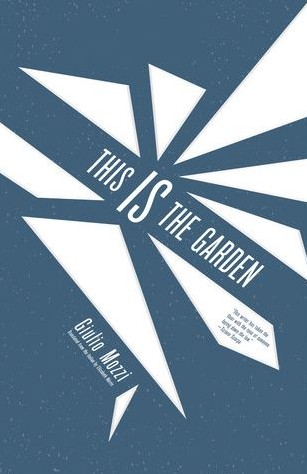
This Is the Garden
Giulio Mozzi
Translated from the Italian by Elizabeth Harris
Open Letter Books
Paperback, 121 pages, $13.95
978-1-934824-75-7

.

What is a garden? For Adam and Eve, it is the warm kingdom of innocence from which they have fallen. For Candide, it is the final plot he must dedicate his life to cultivating. For Giulio Mozzi, the garden resembles a Borgesian labyrinth—a mysterious, perplexing place in which people constantly write, read, and rewrite the ever-shifting planes of some elusive salvation. Mozzi’s garden is both the sandbox of the imagination and also an idyll his sad, thoughtful characters can never seem to achieve.

Mozzi’s This Is the Garden is easily the most rewarding book I’ve read this year. First published in 1993 (and winner of the Premio Mondello) and translated this year by Elizabeth Harris for Open Letter Books, these short stories each explore a combination of metaphors that plague and sanctify the human experience: the word, the letter, the sheltering garden, and the postlapsarian dream of succor.

The first piece in this brief, eight-story collection gives us a petty thief writing to his most recent victim. He is returning two letters he found in the purse he snatched. While detailing the thought process of a criminal observing potential victims, he digresses into disclosures such as that letter-writing seems more honest than the ephemeral, blunt honesty of direct conversation: “I don’t want you to get the wrong idea about me, and perhaps that’s making me too verbose; my apologies.” Such an existentially conscious and narcissistic character offers his victim enough gems about the letters that perhaps she’ll even forget her material suffering:

“Anyway, since your friend’s descriptions were completely unreal, I took to them at once. Children view reality this way, too, and I’m not sure if it’s instinct or habit that makes adults tell fairytales and stories to reinforce this idea of the world as somehow magical, or if adults are too lazy to explain the way things really work.”

A perfect opening to a story collection, “Cover Letter” tells us what to expect: very fine sentences, outcast characters, tacit ruminations on everything from first impressions to deontology and consequentialism, all held in check by a steady hand. Control is the order of the day and it is mesmerizing to see how much Mozzi packs into just under 120 pages.

His Kafkaesque characters—old, young, male, female, adroit, spacey—do not know what plagues them, necessarily. The second story, “The Apprentice,” tells of a young man who wishes to be more than just a delivery boy, but rather a true apprentice who might grow in time into “a man, a worker.” He experiences the joys and pitfalls of laboring for an uninterested boss who might hold, not only the keys, but the existential manual, to his future. He suffers the futility and anomie of his work, furiously certain that “he’s certainly much more than nothing, even if he doesn’t know what.” The boy haplessly considers the merits of punishment as biblical path to salvation, recalling the garden in which men first foolishly attempted to be like gods.

Each of these stories does indeed evoke or otherwise explicitly depict a garden, but the collection is not purely religious in nature. It’s thoroughly human, it’s Kafka, it’s experience of love and the puzzles of human connection and communication.

“To Mario, the dreams you can’t remember are the most important kind—they protect your vital secrets.” Mario is whiling the time on a five-hour train ride that reminded me in its style of Venedikt Erofeev’s masterful fugue Moscow to the End of the Line.  “Today, Mario is headed to Rome where, perhaps, a woman is waiting for him. A few days ago, he got a letter from her saying: ‘I miss you’ and ‘I wish you were here.’ But the letter didn’t say: ‘Please come.’”

“What he thought were her dreams turned out to be his instead.” What a line—and Mozzi offers many like this. “Trains” is my favorite for its relentless burrowing—again, a Kafka reference of Mozzi’s—into the seismic trepidations of the romantic experience.

Beyond the raw emotion and deft psychology contained in these stories, each of Mozzi’s parables drifts into the tall grass of that other garden—the garden of creation, of story-telling, of finding the right word.

“You might say that in some letters, maybe all letters, the important thing is only said after the final sentence, in the silence that follows.”

Or: “I ask myself what compels all this to hurl itself headlong into something so precise and defined as a story that has a beginning and an end. I think there must be some kind of grudge against reality in all this.”

But fear not—Mozzi does not stake his claim to meta-narrative navel-gazing. The experience that fascinates him most seems to be more primal, more guttural: a person’s simple search for how to speak to another, for how to begin, for how to end: “There’s something I keep trying to say, that grammar won’t permit, won’t allow.”

“I’ll never forget this pain. I beg you, all of you here, and I think I’ve finally managed to say what I had to, after all this hemming and hawing that was more from fear than anything else, because just bringing up certain things is scary, I beg you, please, try and understand my pain even a little, or at least try to accept it as something that could happen and could be true. The books I’ve read have taught me many things, but above all, they’ve taught me to preserve my life and to tuck my voice away inside my life and keep it safe—my voice, unique and private: my unique treasure and my health. I love you all.”

This is not easily digestible and forgotten. Mozzi’s is a European sentence—meandering, introspective, borderline Proustian at times. It is a sentence that demands its place on the page, that, without meaning to, reminds us of how many sentences don’t merit the space we give them. His words breathe in the vastness of their own possibilities, do not want to waste their breath.

“There have been many times, during intense conversations full of affection and emotion, with people I loved very much or at least wanted to love very much, that my words slowly disappeared, until all I had left in my head was one tiny phrase, or a few phrases, incongruous, but full of meaning, mysterious phrases, impossible to say. And in those moments, you can almost hear your brain creaking, straining to raise too great a weight. To say these words, to transform their mystery into a simple sequence, compressions and decompressions of air, to hear them disperse, scattered, useless, this would have been too much. As I stop writing this letter, I apologize to you that I can’t even sign it. Good luck.”

But to rave about the maestro’s sentences is insufficient—what of plot, drama, explosions? There is plenty of that here, in Mozzi’s dream garden. The conflict is buried deep in and burrows deep into the psyche of these perturbingly mundane characters. Mozzi’s little gem is not called This is the Garden, but rather This Is the Garden. The first thought upon finishing the last story of the collection is: ah, yes—there—I must return.

—Tom Faure

 

Tom Take 4

Tom Faure is an MFA in Fiction student at Vermont College of Fine Arts. His work has appeared in Zocalo Public Square, Splash of Red, Chattanooga Times Free Press, The Journal News, and undergraduate magazines at Columbia University. He lives in New York, teaching English and Philosophy at the French-American School of New York.

Contact: tomfaure@old.numerocinqmagazine.com


Oct 132013
 

Must read. Not only because it’s about Kafka, but also because it is by John Banville. See my Banville reviews and interview here.
dg

What are we to make of Kafka? Not, surely, what he made of himself, or at least what he would have us believe he made of himself. In a letter to his long-suffering fiancée Felice Bauer he declared: “I am made of literature; I am nothing else and cannot be anything else.” This was a constant theme of his mature years, and one that he expanded on in a highly significant diary entry from August 1916: “My penchant for portraying my dreamlike inner life has rendered everything else inconsequential; my life has atrophied terribly, and does not stop atrophying.”

Of course, Kafka is not the first writer, nor will he be the last, to figure himself as a martyr to his art—think of Flaubert, think of Joyce—but he is remarkable for the single-mindedness with which he conceived of his role. Who else could have invented the torture machine at the center of his frightful story “In the Penal Colony,” which executes miscreants by graving their sentence—le mot juste!—with a metal stylus into their very flesh?

Read the whole essay at A Different Kafka by John Banville | The New York Review of Books.

Jun 072013
 

Full-cover-art Artist Mystic

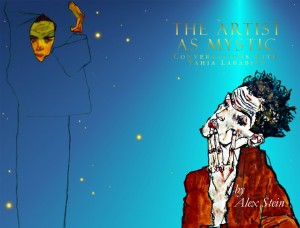
The Artist as Mystic: Conversations with Yahia Lababidi
Alex Stein & Yahia Lababidi
Onesuch Press
86 Pages, $9.98
ISBN 978-0987276049

In Alex Stein’s book, The Artist as Mystic: Conversations with Yahia Lababidi, there are two central topics—conversation and the artist-mystic. Conversation and its relation to artistic-mysticism manifests in the magical coming-together of an artist and his inspiration; Stein and Lababidi describe this inspiration as conversation or a commune. Artistic-mysticism denotes firstly a form of self-induced suffering and sequestration and, secondly, a notion of attention. Stein writes: “I kept trying to clarify to myself this idea of the artist as mystic, the artist and the mystic and their disparate ways of summoning the spirit, and I kept coming back to the idea of attention. Attention is the artist’s mode of prayer.” This is the most beautiful moment in the book. Here, we have a true convergence of the artist and the mystic in this notion of attention.  What follows is an investigation into the different mystic ways and words of several authors who have inspired or intrigued both Lababidi and Stein.

This book becomes, in effect, a homage to these masters. Stein remembers that while writing the book he could hear Lababidi’s voice telling him to: “Make of your art an offering to those spirits (“literary masters” as Yahia calls them) with whom you would commune.” Stein weaves conversations between himself and Lababidi about Nietzsche, Kafka, Bataille, Kierkegaard, and Rilke, among others into a compiling of thoughtful reflections on what it means to do art and to be an artist, or more specifically, an artist-mystic.

For Stein and Lababidi conversation is much more spiritual than a Socratic dialog or the Hegelian dialectic. The spirituality or mysticism inherent to conversation in Stein’s book is the way in which conversation is inspiring. Conversation is a moment of commune in which an exchange of spirit happens, and the duality of dialog renders down to a monad of thought. In many ways, though they are the titular aspect of the book, the conversations between Stein and Lababidi are not the focus. Rather, the implicit conversations with those dead authors for whom the book is an offering are the focus. For Stein and Lababidi these references in conversation to these late thinkers and artists is akin to a conjuring, bringing with it a revelatory or mystical magic which compels those conversing toward art.

Being an artist-mystic, like those late “literary masters,” is a specific way of life typified by self-denial and suffering. This way of living, according to Stein, “cannot be a voluntary thing”; it is duty which neglects and ignores personal happiness in service to art. To Stein, “the life of the artist may not be apparently monastic, or holy, but there is the same sense of sacrifice, of vocation, of having been entrusted with something greater and dearer than one’s own happiness.” This sentiment follows Lababidi who says that the artist is “called to service” and “exalted.” There is a great deal of play between Christian religiosity and a kind of eastern self-denial throughout this book, however I don’t think it would be right to characterize Stein’s mystic as a version of the Christian monk. Rather this artist is someone inspired and willing to suffer to create art. This investigation into personal suffering and anguish is particularly interesting in relation to the importance which both authors put on conversation and “communal destiny.” Suffering for the sake of art or in the service of art sequesters the artist from the rest of society as a sufferer, while the idea of mysticism and communing with dead “literary masters” introduces these hyper-individuals to one another. There is an implicit play, then, on the idea of the conversation between a group of people who see themselves as rejected in some sense or, at least, have removed themselves, from society and thus are not predisposed to conversation.

The thinkers and authors Stein and Lababidi mention become case studies for their overarching thesis about artist-mystics. For example, they see in the philosophy of Kierkegaard and Nietzsche the same anguish in the face of self-induced suffering for the sake of art that appears in the literary work of Baudelaire and Rilke among others. Lababidi talks about watching Bataille in an interview: “But there he was, this shifty, shifting creature who looked as though he could be anything from a pedophile to mass murderer.” Lababidi’s characterization clearly puts Bataille outside of the norm of society, an outlier of law (murderer) and of socially acceptable practices (pedophile). Thus, for Lababidi, Bataille is an artist who refuses to acquiesce to social institutions. This construction is only confirmed or at least enhanced by Bataille’s own writing which focuses on death and necrophilia among other things. Lababidi and Stein see this peculiarity as a demonstration of Bataille’s mysticism. As Lababidi says, Bataille himself refers to writing as “dabbling in the black-arts.”

Stein and Lababidi are looking for a mystic quality that manifests in the writing of the author but also comes across in his actions and biography. Stein says that “it is this detachment, in its variety of permutations, that I admired in the lives of the artists whom I would eventually take for my models.” “[Kierkegaard, for example] determines to himself that he is ill-suited for marriage. He no longer believes it would be ethical to drag another person into the inward life to which he believes he has been called.” He breaks off his engagement with the woman who will turn out to be the love of his life and retreats into a mystical inwardness necessary for him to produce thoughtful and revelatory work. Of course, there is no way of knowing if Kierkegaard’s diagnosis of love-as-distraction was correct; but the question of how much writing he would have produced had her married will forever linger. As Lababidi puts it: “Maybe [Kierkegaard] thought that because he made the sacrifice, she would be returned to him the way faithful Abraham’s son Isaac is spared and returned to Abraham.”

This conception of mysticism and self-denial returns during the discussion of Kafka. Stein includes the following aphorism by Kafka:

“There is no need for you to leave the house. Stay at your table and listen. Don’t even listen, just wait. Don’t even wait, be completely quiet and alone. The world will offer itself to you to be unmasked; it can’t do otherwise; in raptures it will writhe before you” (Kafka’s Aphorism 109).

According to Lababidi, the world Kafka refers to in this specific aphorism “is the ‘there-world’ into which he enters to write, as the yogis enter theirs to breathe.” Lababidi’s comparison between Kafka and yogis suggests that Kafka’s mysticism takes the form of a trance or meditative state, that the ‘there-world’ is an achievable form of awareness or attention. In Lababidi’s words, the ‘there-world’ is “a paradox, like the snake that swallows its own tail until it has swallowed itself entirely. A double joint in time, or a space that is only a bit of fabric that gives, and one can just slip on through it.” Thus the ‘there-world’ is an escape of sorts—a break from reality.

There are nonetheless similarities between Kierkegaard’s choice not to marry, Kafka’s world, and Bataille’s unsettling topics. These all represent modes of escape. But it is crucial that these not be seen as ways of escaping from torment or suffering. Rather they are ways of escaping from a fixedness. In these moments of escape, “inspiration is able to move with more agility and vision to engage with more dexterity.” This is not a physical escape from X to Y, but a transformation of attention; rather than travel to a new place, we are looking at the world differently.

Stein rightly notices that art is a manifestation of what the artist is paying attention to, and correspondingly the mystical moment for yogis and for Kafka, as it were, is a certain way of directing attention toward something. The artist-mystic never goes to the there-world, for we are always already inside it yet un-attuned to it. Stein and Lababidi’s book investigates the way the artist, be he a phenomenologist or a poet, “prays” to that which is already before us in a more attuned and spiritual way.

 —Jacob  Glover

————

Jacob Glover

Jacob Glover is a pursuing an MA in Classics at Dalhousie University in Halifax, Nova Scotia.

Feb 012010
 

Over the weekend I read Michael Slater’s tiny 104-page biography of Charles Dickens. In the same mail delivery, I received Peter Ackroyd’s 1144-page biography of Dickens. I spent a lot of time just looking at the two books side-by-side on my bed (where I read) wondering about the disparity between the two. I haven’t finished the Ackroyd book yet (check out his novel Chatterton). I also read Theodor Adorno’s essay (in his books of essays called Prisms) on Kafka which was brilliant as usual and made strange sense out of Kafka’s desire to have his papers burned and to remain obscure. And then I read a dreamy, odd, surprising William Faulkner story “Red Leaves” about Indians (probably Chickasaws), slaves and human sacrifice. (For an interesting thematic variation, see D. H. Lawrence’s human sacrifice story “The Woman Who Road Away.”) I had earlier read something about this: the Chickasaws were one of the Five Civilized Tribes forced to move to Oklahoma by Andrew Jackson in the Trail of Tears episode (as in how America invented Ethnic Cleansing). The Chickasaw had African slaves which they took to Oklahoma with them. After the Civil War and Emancipation, the Chickasaw refused to give up their slaves since they believed they weren’t governed by American legislation. If I remember correctly, the actor Don Cheadle had an ancestor who was a Chickasaw slave. This is mentioned in Henry Louis Gates’s book In Search of our Roots.

dg