Jul 142013
 

DW-Ark_Codex

I’m happy to report in on a recent joyous dance of my reader-self and viewer-self as I turned the pages of ARK CODEX, a thoroughly engaging visual/verbal collage “novel.” My curiosity about this authorless book led me to question its shepherd, the one who goaded this “mutated goat” of a book into being. Says Derek White, “Each word is a collage in itself . . . .” Yes! And the correspondences between the bits of text and gorgeous etchings bring an unusual intrigue to the pages and to the journey of this odd ark/book.

Derek White lives in New York City where he publishes Calamari Books and Sleepingfish Magazine. Do explore more of his work via the web links. You won’t be sorry!

— Nance Van Winckel

—–.
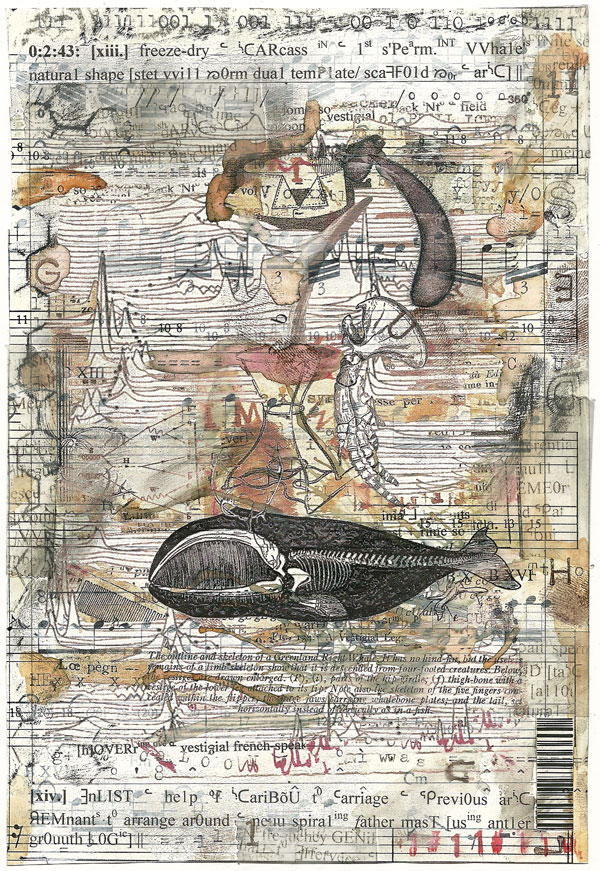
Ark Codex 0:2:43 13x19 cm, multimedia (collage/frottage) Derek White

Ark Codex 0:2:43 13×19 cm, multimedia (collage/frottage)

.

Nance Van Winckel: I know you’re interested in Derrida and his ideas that words refer primarily to other words, rather than to things and ideas, and also his view of texts as residing finally beyond authors, of literary works as collective enterprises generated by a concert of forces: reader, writer, cultural echoes surrounding them, etymologies, etc. I like how Ark Codex ±0 clearly allows the whole of itself to be “created” by those forces, and I appreciate how much I have to “bring” to the book myself. My own imagination and intellect are truly involved in furthering the book’s narrative momentum and visual journey. Could you talk a little about your own sense of authorlessness and the “concert of forces” that make the Ark Codex.

.
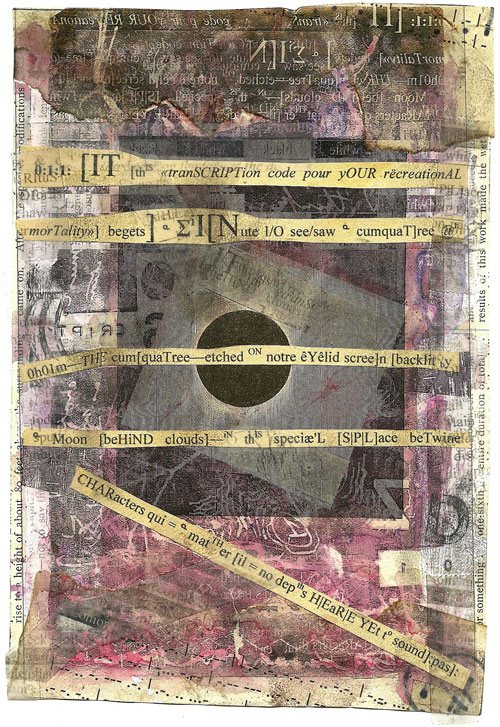
Ark Codex 0:1:1 13x19 cm, multimedia (collage/frottage) Derek White

Ark Codex 0:1:1 13×19 cm, multimedia (collage/frottage)

.

Derek White: Thank you, you are reading Ark Codex as i hoped it would be read. At the end of the day Ark Codex, any book, is a bound stack of paper on a shelf . . . until a reader comes along. Readers are the true “authors”—the ones who give meaning to a book. And your reading of it is just as valid and important as any other, including mine. Sure, my role is unique in that i experienced Ark Codex as it was coming together, but i think of my role more as a shepherd. Or, okay, maybe a breeder. And i personally prefer to think of goats rather than sheep, wherein the goats are other books and ideas . . . yes Derrida’s books being some of those goats. But Derrida is not one of those goats—I’ve never met Derrida. Sadly, he is dead. But his books aren’t (and in this sense, neither is he). Ark Codex is some sort of mutated goat that came about by such selective breeding. But again, don’t let me be the one to tell you what Ark Codex is or isn’t; you might have a completely different beast in mind when your eyes scan over this particular confluence of text & images, based on your own prior collective associations with certain words, phrases, images, etc.

.
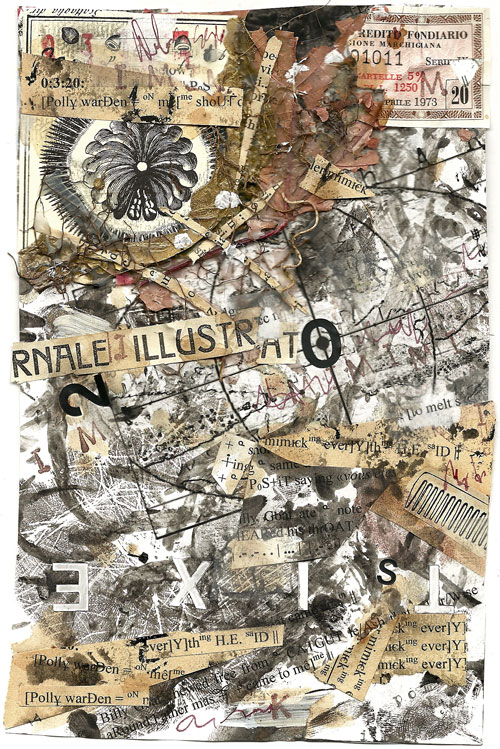
ARK_CODEX_0-3-20

Ark Codex 0:3:30 13×19 cm, multimedia (collage/frottage)

..

NVW: Collage seems both a method of creation AND a method of participation in this book. As a reader/viewer, I was fascinated by how my reader-self and my viewer-self danced about on the pages. I loved this back-and-forth interplay and how when I’d read the small passage of text at the bottom of a page, what I’d just visualized in the imagery and graphics hooked in, “enlarged,” or somehow “played with” the linguistic elements. I think the text and the visual elements achieve an amazing symbiosis or amalgamation here, and I wonder if you could comment on that interactivity of visual and verbal elements.

.
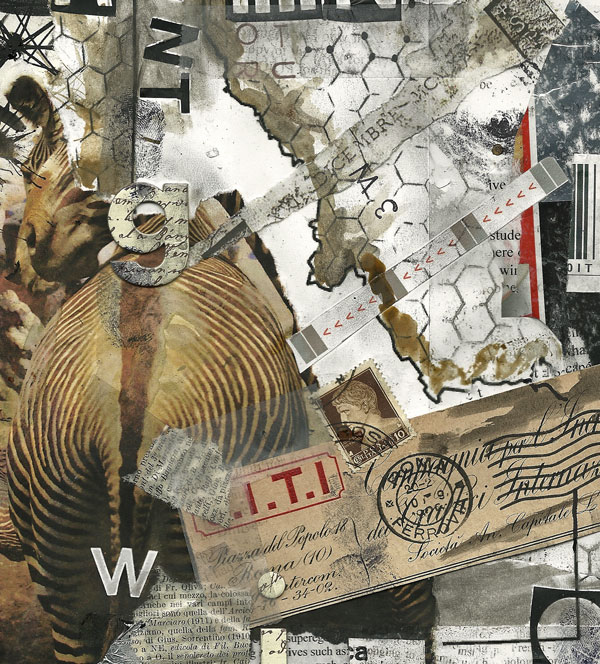
H0MEovoID_8_private_gravesite_600

h0ME(o\v/o)ID 8: GRAVE[e|it]Y helps deSign find its private tombstone ID[enTITy]

.

DW: Ark Codex actually started as a text, a somewhat linear narrative. If you look carefully in the pages you might find traces of it, but most of its original form is probably lost, embedded into the page, bleeding into the collage of image and other underlying or superimposed text. The footnoted text came as an afterthought—a sort of associative narrative that came about by re-processing the images. I think of them as abstracts, in a scientific sense. Collaging feels more like how at least my brain thinks. Language in its pure form is a beautiful thing, but it can also be debilitating in that we risk detachment, severance even. Someone like Peter Markus (a true guru of pure language) is so enamored by language that when he hears a word, like “river,” the first thing he thinks of is how the word looks on the page. While i also share this reverence of, especially written, language, in all its type-faced forms, i don’t want to lose sight of the actual river. But even staring at a river (which is what i look at when I’m not looking at my computer) we can still forget, or take for granted, what the river means, or has meant to us. I’m not so interested in photography or still lifes—capturing images, reducing them to their iconic forms. Collage allows us to breed new images, new ideas. And yes, when i say collage i don’t mean just images from magazines cut and pasted together. Even if I’m writing something purely textual, i think of it as collage—the way combinations of words interact and morph, glued together by syntax and grammar. And each word is a collage in itself, a vessel that contains an accumulative amalgamation of every instance and use before us.

.
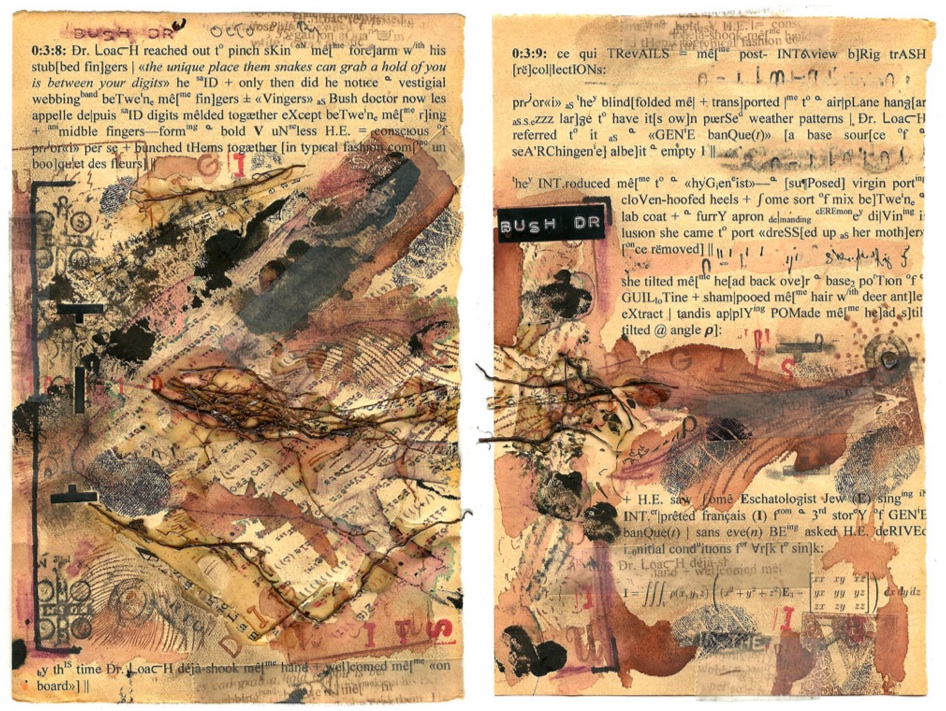
NVWimage1

Left to right: Ark Codex 0:3:8, 13×19 cm, multimedia (collage/frottage), and Ark Codex 0:3:9, 13×19 cm, multimedia (collage/frottage)

.

NVW: For me, Ark Codex ±0 has many qualities of a novel. I’m thinking about the journey undertaken on this strange ark, an ongoing narrative that’s a kind of quirky Noah story set in realms that are by turns ancient or futuristic, metafictional or metaphysical, scientifically “steeped” or mythically enriched. I could go on and on with my list. But let’s look, for instance, at a couple of my favorite pages, these two from the third section where “we” seem to have made landfall (or are within our museum diorama) and encounter the figure of the “bush doctor.” Here’s the text which reads a bit like a ship’s log:

0:3:8: Under such sea-snaking circumstances, the bush doctor warns us to not splay our fingers. He is not counting on the fact that our <>are webbed. Before we snap out of it, he blindfolds us for continuity. We can see all the way to the end of our own nerves from within our cloth cul-de-sac. Clogged fibers branch back into the roots of palms. At this point a puncture is made to drain any misleading perceptions. Even judgment of unreliability is deemed unreliable, so we are back to square 1 with each articulation.

And from the facing page:

0:3:9: At his juncture, the kernel become clearer. A system is in place to separate trash from recyclables—organic & non-organic (& sub-divided even further). We are in a hangar now (or a diorama of 1, still in the natural history museum)—an ark house so large that isolated weather patterns form from within. It is still below freezing on this page, but the rate of the rate of change is what matters. To determine our current coordinates (& capacity for change) we integrate this rate of the rate of change in each cardinal direction.

Wow! The brevity of each of these snippets makes me feel I’m getting just a small part of a huge—HUGE!—story. Plus each piece of information makes the ark tremble. Unexpectedness in each new sentence. Where will the ark go next; what fauna and flora will we encounter; what will happen to our own physical selves? For me, it’s an adventure story in the widest possible sense of that word. If not as author or even as “authority,” but rather might you comment on the book’s behalf about its proclivities toward story in general or the novel in particular?

.
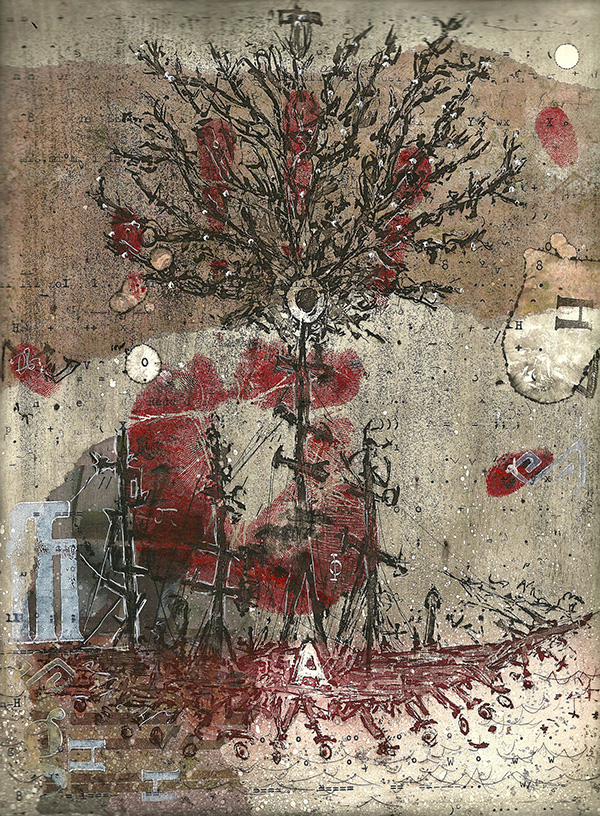
Arc-incisione_H

Incisione H from Ark Codex (incised print)

.

DW: Ha, you made landfall! That’s further than i got—in my mind, the narrator is constrained to the North Pole, waiting for the ice to melt, for the flood. So in this sense, nothing happens. But in such a landscape, cabin fever sets in, the imagination runs wild. I’m not very good at making things up. And i am far from a reliable source as to what is happening. If there is any semblance of story, it likely rose out of a dream. And dreams came from a warped union of personal experience (the hangar—Hangar One in Moffet Field, CA—i actually delivered a pizza to!) and the tapping of our collective unconscious. As Joseph Campbell and others have showed us, we are telling the same story over and over—this four-pronged cycle or journey. Noah’s story is just one variation on the theme, that particularly appeals to me because it is about more than just the human condition, but is inclusive of all animals, and the inherent drive in us to preserve and propagate our underlying code. Which is to me what writing and publishing is all about. Story to me is just a framing device, a vessel for language, a boat that gets you down (or up) the river. Ark Codex is a fleeting condensation of collective unconscious that materializes to stain the page, then dissolves when read, into liquid—rain that falls on the landscape, flows into the river, back to the sea … to do it all over again. The ‘story’ comes in the reader reading it. They become the ark, the historical act.
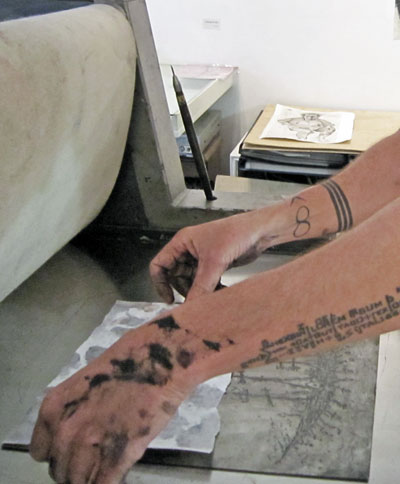
05-under_pressure

Under Pressure

—Derek White & Nance Van Winckel

—————————————–

Derek White lives in NYC where he publishes Calamari Press & Sleepingfish magazine and blogs at 5cense.com. More about Ark Codex may viewed here: http://calamaripress.com/ark_codex.htm. Much more of his “bookish art” may be viewed here: http://www.5cense.com/art.htm.

Nance Van Winckel

Nance Van Winckel is the author of six collections of poems, including After A Spell, winner of the 1999 Washington State Governor’s Award for Poetry, and the recently released Pacific Walkers (U. of Washington Press, 2013). She is the recipient of two NEA Poetry Fellowships and awards from the Poetry Society of America, Poetry, and Prairie Schooner. Recent poems appear in The Pushcart Prize Anthology, The Southern Review, Poetry Northwest, Crazyhorse, Field, and Gettysburg Review. She is also the author of three collections of short fiction and a recent recipient of a Christopher Isherwood Fiction Fellowship. Her stories have been published in AGNI, The Massachusetts Review, The Sun, and Kenyon Review. Boneland, her fourth collection of fiction, is forthcoming in October from U. of Oklahoma Press. Nance’s photo-collage work has appeared in Handsome Journal, The Cincinnati Review, Em, Dark Sky, Diode, Ilk, and Western Humanities Review. New visual work and an essay on poetry and photography are forthcoming in Poetry Northwest and excerpts from a collage novel are forthcoming in The Kenyon Review Online. Click this link to see a collection of Nance Van Winckel’s mash-ups of poetry and photography, which she calls photoems. She is Professor Emerita in Eastern Washington University’s graduate creative writing program, as well as a faculty member of Vermont College of Fine Arts low-residency MFA program. She lives near Spokane, Washington with her husband, the artist Rik Nelson. Her personal web page is here.

Feb 202013
 

I found this fascinating video via David Winters who saw it on the European Graduate School site: Derrida, and life inside the machine of, well, life. We seem to be on a Derrida theme lately. This fits with Jacob Glover’s essay on Derrida “What If God is One of Us?” in the current issue of NC, an essay based on Derrida The Gift of Death. See also Wes Cecil’s lecture on the NC Blog “On Derrida: Deconstruction (among other things) Explained, Jacques the Tormentor”. Catherine Malabou herself is a fascinating person, a rare woman in the male dominated club of Continental philosophy.

dg


Feb 072013
 

Jacob Glover

.

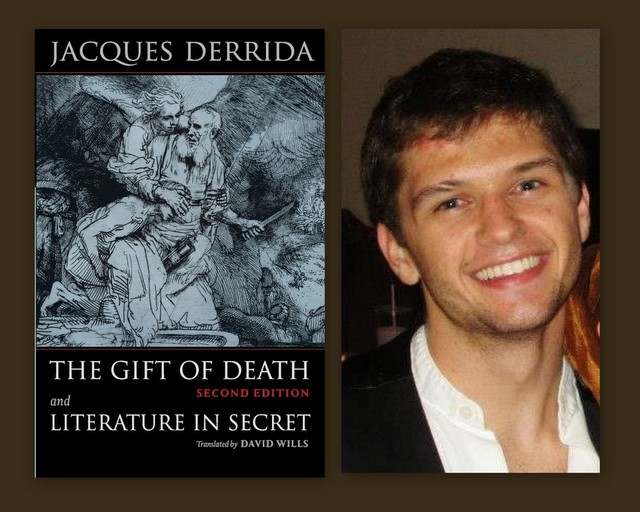
Jacques Derrida’s book The Gift of Death contains a particularly playful and complex chapter entitled “Tout autre est tout autre” or “Every Other is Entirely Other.” The underlying theme of the chapter is the relationship between humans and other humans (what I will call ethical) and humans and God (what I will call religious). Derrida uses the phrase tout autre est tout autre to deconstruct the relationship humans have with God according to the Bible (specifically in the Gospel of Matthew). He demonstrates that the phrase “tout autre est tout autre,” which is foundational to ethics, also undercuts and obscures the biblical characterization of the relationship between God and humans. What Derrida is doing in this argument is showing the incommensurability of Christian doctrine with a more contemporary articulation of ethical theory.

To begin with we need to address the dual meaning of the phrase tout autre est tout autre. Derrida frequently says that this phrase trembles. It cannot be said to mean one thing or another but must mean two things simultaneously. Derrida says that we can understand it either tautologically or heterologically which means that either this phrase is just saying that every other is every other, or it is saying that every other is all, completely, or entirely other (different).[1] The translator David Willis construes the phrase as: “Every other (one) is every (bit) other”.[2] Willis is trying to allow for the double meaning while maintaining a sensible translation. He includes the words “one” and “bit” in parentheses to suggest that they need not be read as an explicit part of the sentence. In this way Willis preserves the tautology of the phrase: every other is every other, but he also includes the secondary meaning: every other one is every bit other. The only problem with this translation is that it seems to prioritize the tautological reading over the heterological. This is, of course, the way the phrase appears at first glance, but we need to be careful not to say that one version is more true than the other.

The double-meaning of this phrase is not the problem for Derrida. The problem arises out of the implications of one of the possible versions. Derrida says: “One of the [versions] keeps in reserve the possibility of reserving the quality of the wholly other, in other words the infinitely other, for God alone, or in any case for the single other. The other attributes this infinite alterity of the wholly other to every other, in other words, recognizes it in each, each one, for example each man and woman, indeed each living thing, human or not.”[3] So, on the one hand, the phrase suggests the distance between humans and God; God is wholly other and a singular other. This version is in line with the biblical characterization of God. While, on the other hand, this phrase seems to imply that anything which is other to me is wholly other, therefore, nothing is more other than anything else. The phrase implies that the alterity of God is indistinguishable from the alterity between one human and another. Furthermore, as Derrida says, “if every human is wholly other, if everyone else, or every other one, is every bit other, then one can no longer distinguish between a claimed generality of ethics that would need to be sacrificed in sacrifice, and the faith that turns toward God alone, as wholly other, turning away from human duties.”[4] Derrida is saying that if God is just as other as every other other, then there is no way to distinguish between religion and ethics.

Now it might be too strong to say that Derrida has a problem with this conflation of the ethical and religious spheres, but, religiously speaking, it is problematic to posit that God and humans have a relationship that is indistinguishable from the relationships humans have with one another. God is no longer God (i.e. as he is characterized in the Bible) if He could also, just as easily, be a human. In a sense “tout autre  est tout autre equivocates between humans and God.

Derrida brilliantly continues his deconstruction of God-man and man-man relations with a discussion of the Gospel of Mathew. Mathew contains two famous stories which deal in the relationships between humans and God and humans and other humans, namely, the Sermon on the Mount and Jesus’s temptation in the desert. Taken together, these two stories separate the inherited nature of ethical rules from the textually authoritative imperatives of religion. But Derrida doesn’t focus on these stories as a whole; his discussion concentrates on one specific line from the end of the Sermon on the Mount, “The Father who sees in secret.”

In the Sermon on the Mount Jesus teaches his disciples proper relations between humans, relations that will ensure a ticket to heaven, e.g. “Blessed are those who are persecuted for righteousness’ sake, for theirs is the kingdom of heaven.”[5] But he is quick to add: “Think not that I have come to abolish the law and the prophets; I have come not to abolish them but to fulfill them.”[6] The word for law in this quotation is νόμον which may also be translated as traditional custom or inherited habit. Jesus is referring to ethical life among humans here and not religious law. In part, the ethical life of a person dictates admission to heaven, but this is separate and distinct from the religious life described in the Temptation of Jesus.

In the story of the temptation, God leads Jesus into the desert “to be tempted by the devil.”[7] The devil asks Jesus to turn stones into bread, jump from the top of a temple, and offers him the chance to rule over the entire world.[8] Jesus answers each of these temptations with a rule of action for how humans are to relate to God, beginning each rule with the prefix: “It is written.” There are three such rules: “Man shall not live by bread alone, but by every word that proceeds from the mouth of God,” “You shall not tempt the Lord your God,” and “You shall worship the Lord your God, and him only shall you serve.”[9] According to Jesus and his undisclosed written source, God’s words are as necessary as physical sustenance. Moreover, God’s authority is beyond dispute. And, finally, God is the only divinity humans will serve or worship. Essentially, Matthew here articulates the radical power and authority God has over humans which does not come from an inherited tradition but from a mysterious source.

As I said, Derrida’s discussion of the Gospel of Matthew focuses mostly on the line, “The Father who sees in secret,” which Kierkegaard quotes in Fear and Trembling. And I think it is important to note that the line “the Father who sees in secret,” when taken in context, contains a synthetic quality; the meaning of this line coagulates the ethics of the Sermon on the Mount and the religion of the Temptation of Jesus. Derrida says of Kierkegaard’s allusion that “[it] describes a relation to the wholly other, hence an absolute dissymmetry.”[10] This line parallels the version of tout autre est tout autre which reserves absolute alterity for God, i.e. God is wholly other and radically different from humanity. What we should remember is that for Derrida the titular phrase for chapter four, i.e. tout autre est tout autre, seriously problematizes the ethics that this scriptural quotation sets up.

The first time Jesus says “The father who sees in secret” he is telling his disciples not to display their piety or alms-giving publicly. He says: “Beware of practicing your piety before men in order to be seen by them…But when you give alms do not let your left hand know what your right hand is doing, so that your alms may be in secret; and your Father who sees in secret will reward you.[11] In this moment Jesus concatenates ethics and religion. He sets the boundaries of what is to be within the realm of person-to-person and what is in the realm of human-to-God, but these two spheres, however bounded from one another, share the unseen gaze of God. All this is to show that, in the Bible, the relationship of humans to other humans is divided from and radically different from the relationship humans have with God. And contrary to Derrida’s formulation tout autre est tout autre religion is not soluble in ethics.

It should now be clear that, as I said above, that the characterization of God and His relationship to humans in the Gospel of Matthew is not in line with the phrase: toute autre est tout autre. God, in the Bible, remains wholly outside yet “conditions” human interaction and existence. But tout autre est tout autre implies that the ethical and the religious are indistinguishable spheres or relationships. This indistinguishability, according to Derrida, should render us at some level “paralyzed by what can be called an aporia or an antinomy”.[12] But in fact society “operates so much better to the extent that it serves to obscure the abyss or fill in its absence of foundation, stabilizing a chaotic becoming in what are called conventions”.[13] For Derrida, this indistinguishability is a hole in the logic of society; ethical interaction should not be possible because it lacks a clear articulation. Nevertheless, due to “a lexicon concerning responsibility that can be said to hover vaguely about a concept that is nowhere to be found,” we beat on.  Society, it seems, manages to obfuscate the lack of foundation with those very νόμοι, which Jesus claims he is not here to abolish. The customs and conventions of society conceal the fact that the reason for ethical interaction, whether it be for one another or for God, is unclear, yet out of habit and tradition we remain blindly ethical and secretly religious.

—Jacob Glover

Bibliography

  • The Bible, Revised Standard Edition. Meridian Books, New York: 1974.
  • Derrida, Jacques. The Gift of Death. Trans. David Willis. The University of Chicago Press, Chicago: 2008.

.

Jacob Glover is in his senior year in the Contemporary Studies Programme at the University of King’s College in Halifax, Nova Scotia. He is a frequent contributor of book reviews and essays.

.
.
.

Footnotes    (↵ returns to text)

  1. The Gift of Death, 83
  2. Ibid., 82
  3. Ibid., 83
  4. Gift, 84
  5. Matthew 5:10
  6. Matthew 5:17
  7. Matthew 4:1
  8. Matthew 4:1-10
  9. Mathew 4:4, 7, 10
  10. Gift, 91
  11. Matthew 6:1
  12. Gift, 84
  13. Gift, 84
Dec 222012
 

Jacob pointed me to this very entertaining lecture, part of a series, by Wes Cecil who teaches at Peninsula College on the Olympic Peninsula in Washington. I listen to this and recall how much I loved the Paralogisms of Pure Reason[1] section in Kant’s Critique of Pure Reason wherein Kant demonstrated the paradoxical nature of reason (language) which can both prove and disprove the same proposition thus reducing any claim to Correct Thinking or Truth to ashes. This lecture is often very funny while not being entirely sympathetic to its subject. Also a window on American cultural history, history of ideas, Derrida’s reception, etc.

dg

.

Footnotes    (↵ returns to text)

  1. See “Mappa Mundi: The Structure of Western Thought
Sep 092011
 

Here’s an essay on hauntology (word derived from one of Jacques Derrida’s puns). I place it here as a addendum to my essay on the history of philosophy just published. Haunting, hauntology, the ghostly feeling of immateriality–new metaphors for the way we feel today, what is also called nostalgia, or nostalgia for being. Philosophers are really poets of Being. They are always thinking up new metaphors for the relationship between Self and Other. Today it is haunting. We are haunted by Being. In this case, the idea is not so new, as the author points out.  This essay is by Andrew Gallix and it first appeared in the UK Guardian.

dg

Today, hauntology inspires many fields of investigation, from the visual arts to philosophy through electronic music, politics, fiction and literary criticism. At its most basic level, it ties in with the popularity of faux-vintage photography, abandoned spaces and TV series like Life on Mars. Mark Fisher — whose forthcoming Ghosts of My Life (Zer0 Books) focuses primarily on hauntology as the manifestation of a specific “cultural moment” — acknowledges that “There’s a hauntological dimension to many different aspects of culture; in fact, in Moses and Monotheism, Freud practically argues that society as such is founded on a hauntological basis: the voice of the dead father”. When you come to think of it, all forms of representation are ghostly. Works of art are haunted, not only by the ideal forms of which they are imperfect instantiations, but also by what escapes representation. See, for instance, Borges‘s longing to capture in verse the “other tiger, that which is not in verse”.

via ANDREW GALLIX.

Mar 242011
 

Here’s a fascinating biographical interview with critic J. Hillis Miller that spans decades of the development of literary criticism in the U. S. Lovely to watch his exposure to new ideas, his growth as a thinker and reader. Especially interesting is the influence of Kenneth Burke, an American critic not often talked about these days, followed by Miller’s exposure to Derrida and the French.  Also not the now laughable academic career-making activity called “indexing.”

dg

Miller: I learned a lot from myth criticism, especially the way little details in a Shakespeare play can link up to indicate an “underthought” of reference to some myth or other. It was something I had learned in a different way from Burke. Burke came to Harvard when I was a graduate student and gave a lecture about indexing. What he was talking about was how you read. I had never heard anybody talk about this. He said what you do is notice things that recur in the text, though perhaps in some unostentatious way. If something appears four or five times in the same text, you think it’s probably important. That leads you on a kind of hermeneutical circle: you ask questions, you come back to the text and get some answers, and you go around, and pretty soon you may have a reading.

An example of that would be the color red in Tess of the d’Urbervilles. You say, “There sure are a lot of red things in the novel.” You see the red inside Tess’s mouth at some point, and the red sign that she sees painted on a barn. It says, “Thou shalt not commit [adultery],” as she has done, or, strictly speaking, fornication. Then you say, “Hmm, what do you do with all these red things?” That leads you back to the text.

via ns 71-72 (Winter/Spring 2009) // the minnesota review.

Nov 132010
 

Lively review of a new biography of Claude Lévi-Strauss, but this quote was the most interesting bit because it lines up with some of the ideas I tried to get across in Elle and The Life and Times of Captain N. The new technology of writing destroys oral cultures and we somehow feel nostalgic for those lost ways of being, but to think that any one culture is essentially less alienating than another is a sentimental mistake.

dg

Derrida showed that Lévi-Strauss’s position, far from breaking with a Eurocentric model, reproduced it. He demonstrated how the notion that the Nambikwara inhabited a different and better world, one before writing, reflected a long-held western prejudice that ignored the way in which any system of language had all the features of a writing system that Lévi-Strauss considered distinctively modern. The Amazonian enjoyed no more direct and unmediated a relationship with his surroundings than the western anthropologist…

via New Statesman – Claude Lévi-Strauss: the Poet in the Laboratory.

Feb 012010
 

We advisees have grown very quiet on this page of late.  I’m in the midst of some final editing right now (well, I’ve walked away from it for a moment) and thought I’d add my comments from the weekend.  Spent large chunks of time Saturday and Sunday at the University of San Diego Law Library.  I tried their undergraduate library too, but it was louder than hell.  I was surprised by how many people were on their phones or just engaged in loud conversations.  Maybe I’m just getting old.  The law library was much more quiet.  They post signs forbidding phone use and talking but permit food and drinks, so it’s beocme the new go-to.  I get very little done in my house.  Too many distractions.

I’ve been reading Francine Prose’s book, Reading Like a Writer.   I find it a bit tedious at times, but she has some great things to say about reading.  I also picked up the Best American Poetry anthology and I’m looking forward to reading some of that once the packet is in the mail.  With Doug’s postings on Lish and Shklovsky, I’m tempted to try to read Francois Cusset’s French Theory, a book I purchased last year and which has been gathering dust ever since.  (My daughter and I are flying to Amstredam next week for her swim meet…I’ll have a lot of time to read.)  I should get back to my editing and printing.   Hope to be more active on this sight in a day or two.

—Richard Farrell