Dec 152013
 

via Wikipedia

Since the beginning NC as made it a habit, now and then, to publish a sermon. It’s an old form, not much thought of in literary terms these days — you don’t see many college courses on sermons. But it’s a form that was once immensely popular; books of sermons were published regularly and became bestsellers. I have friends whose fathers were ministers and I’ve loved listening to their memories of the weekly composition process — think of it, an ESSAY a week, 52 weeks a year! Kind of like a blog but with God as one of your readers.

Hilary Mullins lives in Vermont, runs a window-cleaning business, and gives sermons — in a sense, she has given her life over to helping people see better. This is her Christmas sermon delivered earlier this month to the UU Fellowship in  Stowe. The subject is close to my heart because when I was six I played Tiny Tim in the school Christmas play. Picture this: rural, one-room, stone schoolhouse with a raised dais along the front for the teacher’s desk, Union Jack and the Queen’s portrait prominently displayed, and me with my theatrical leg-brace made (by my father) of soup tins and cut-down harness straps. Hilary quite rightly focuses on Scrooge, who is the reclaimed character, but still I love the line I got to say (raising my wine glass filled with apple juice), “God bless us, every one.”

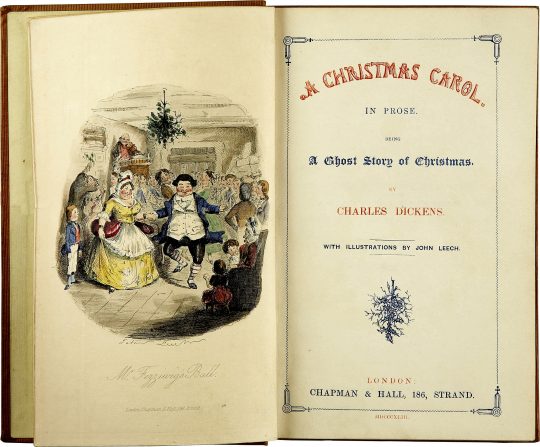
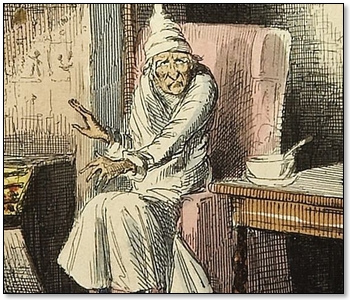
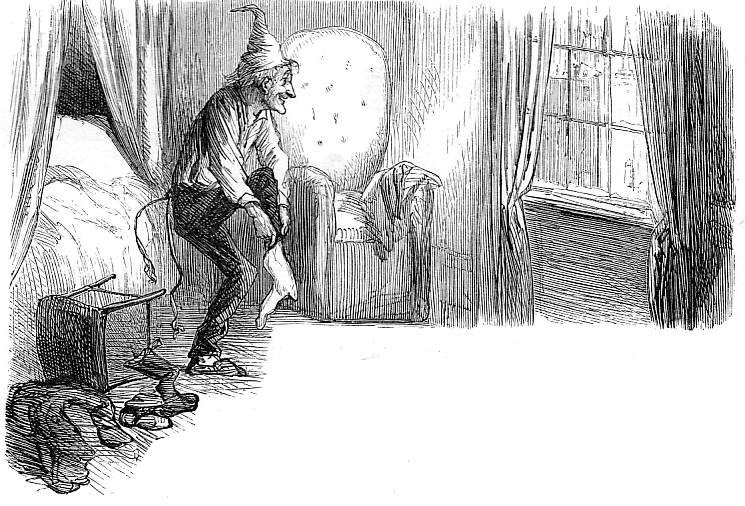
The images are John Leech’s original illustrations for A Christmas Carol, via the wonderful Victorian Web.

dg

.

Oh! But he was a tight-fisted hand at the grindstone, Scrooge! a squeezing, wrenching, grasping, scraping, clutching, covetous old sinner! Hard and sharp as flint, from which no steel had ever struck out generous fire; secret, and self-contained, and solitary as an oyster….

Nobody ever stopped him on the street to say, with gladsome looks, “My dear Scrooge, how are you? when will you come to see me?” No beggars implored him to bestow a trifle, no children asked him what it was o’clock, no man or woman ever once in all his life inquired the way to such and such a place, of Scrooge. Even the blind men’s dogs appeared to know him, and when they saw him coming on, would tug their owners into doorways and up courts; and then would wag their tails as though they said, “no eye at all is better than an evil eye, dark master!”

But what did Scrooge care! It was the very thing he liked. To edge his way along the crowded paths of life, warning all human sympathy to keep its distance….
Ebenezer-Scrooge

Charles Dickens wrote his famous Christmas Carol in 1843, and from the very first, it sparked changes in the people who read it, momentous and generous changes. Robert Louis Stevenson for instance, wrote a friend this: “I want to go out and comfort someone; I shall never listen to the nonsense they tell one about not giving money—I shall give money; not that I haven’t done so always, but I shall do it with a high hand now.”

The historian and philosopher Thomas Carlyle was seized with his own verifiable fit of generosity. We don’t have an account of it in his own words, but his wife wrote her cousin, referring to her husband by his last name and saying this: “A huge boxful of dead animals from the Welshman arriving late on Saturday night together with the visions of Scrooge—has so worked on Carlyle’s nervous organization that he has been seized with a perfect convulsion of hospitality, and has actually insisted on improvising two dinner parties with only a day between.”

And yet another conetmporary, William Makepeace Thackeray, pronounced the book, “a national benefit and to every man or woman who reads it, a personal kindness.”

But it wasn’t just other writers who were affected. Some years later, after the queen of Norway read A Christmas Carol, she sent gifts to disabled children in London, signed “With Tiny Tim’s love.” And an American industrialist, a certain Mr. Fairbanks of Massachusetts, having heard Dickens’ own reading of the book one Christmas Eve, was so inspired he closed his factory the very next day for Christmas, somehow managing to get a turkey to every worker he had.
Used with permission from http://www.victorianweb.org/art/illustration/eytinge/49.html.

Plain folks too, numberless people whose names and stories we’ll never know, were affected as well. For instance, in the spring after A Christmas Carol was published, one English magazine noted that charitable giving was up across the whole country, evidently a result of this one little book. People were moved! And moved to action.

Even Dickens himself was deeply moved by the act of writing A Christmas Carol, pushing through it in the midst of other projects in a remarkably short six weeks, crying and laughing as he wrote, taking long walks through London—and I mean long walks—supposedly fifteen or twenty-mile walks!—at a time of night when, as he put it, “all sober folks had gone to bed.” And when he reached the ecstatic, joyful end of the book, and finished it, he said he “broke out…like a madman.”

But of course acting like a madman is just how Scrooge behaves too in the joyful conclusion of A Christmas Carol:

“I don’t know what to do!” cried Scrooge, laughing and crying in the same breath; and making a perfect Laocoon of himself with his stockings. “I am as light as a feather, I am as happy as an angel. I am as merry as a school-boy. I am as giddy as drunken man. A merry Christmas to everybody! A happy New Year to all the world. Hallo here! Whoop! Hallo!”

He had frisked into the sitting-room, and was now standing there: perfectly winded….

“I don’t know what day of the month it is!” said Scrooge, “I don’t know how long I’ve been among the Spirits. I don’t know anything. I’m quite a baby. Never mind. I don’t care. I’d rather be a baby. Hallo! Whoop! Hallo here!”

I don’t know about you, but whenever I get to this short section at the very end of the book, I always feel a little mad with joy myself, almost embarrassed by the sheer exuberance welling up in me too. And why is that? What is the power of Dickens’ little fable? Why has it touched and changed so many people?

One reason surely is simply because it’s a remarkably well-written book. If all you’ve done for years now is watch the various movie versions, I suggest this Christmas season, you go back to the book itself. It’s sheer pleasure. But there’s more to its effectiveness than its high level of craft. There are, after all, lots of well-written books. But very few of them have worked the kind of change in people that A Christmas Carol has.

So walking a little deeper into the story itself, let us next consider the book’s most obvious lesson, a lesson that can’t be repeated too often, and that Dickens himself thought of as the “Carol Philosophy,” which is simply to give, and to give in particular to those who don’t have the money or resources you do. But though this is, as I say, the obvious lesson of the book, and giving is itself a profound practice that has its own momentum in people’s lives, taken alone, it still can’t account for the singular transformational power this book has.

That power, I think, lies deeper in the story itself and is related to its more fundamental teaching—which is to open our hearts, or as E. M. Forster put it: “Only Connect!”

This approach to life of course, the way of connection, is entirely the opposite of how Scrooge conducts himself at the opening of the book: Dickens makes that abundantly clear in the description I quote earlier of Scrooge as a man who is “secret, and self-contained, and solitary as an oyster,” edging “his way along the crowded paths of life, warning all human sympathy to keep its distance.”

That is to say, Scrooge is a man who has disconnected himself as much as is humanly possible. He may have a business and a good reputation as a businessman, but in the beginning of the book, he has no authentic intercourse with anyone, spurning even the one surviving relative he has, his nephew Fred–and on Christmas Eve no less.
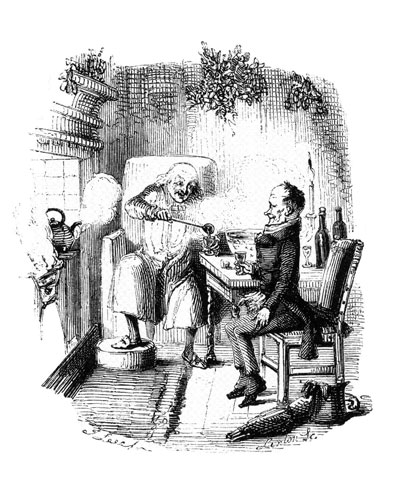
photo 3

Fred however, a plucky chap, never loses his good humor in this early scene, giving his uncle a fine little speech about the particular value of Christmas, calling it

a good time: a kind, forgiving, charitable, pleasant time: the only time I know of, in the long calendar of the year, when men and women seem by one consent to open their shut-up hearts freely, and to think of people below them as if they really were fellow-passengers to the grave, and not another race of creatures bound on other journeys.

Scrooge’s response is to belittle his nephew. Then, after Fred, still persisting, invites him to dinner the next day for Christmas, Scrooge turns even uglier, vowing to see him in hell before ever he comes for Christmas dinner.

So then, think about it. How does this work really? How does Ebenezer Scrooge shift from a miserable, money-making oyster, poking his head out of his shell only to insult people, to a man who frisks about his rooms and heads right out the door, engaging right and left in handsome acts of generosity? What can actually account for his new, miraculous and permanent habit of connecting whole-heartedly with people everywhere he goes?

Another place to look for the answer I suppose lies with the power of the spirits who visit Scrooge. A Christmas Carol is a ghost story after all, and who wouldn’t change their tune faced with these visitations? Scrooge, you could say, is scared straight.

But now I’m really setting up straw ghosts here, because clearly,  this is not the whole answer either: Scrooge is plenty afraid at various points along his journey, but it’s not fear that is the most potent catalyst for his change. It couldn’t be. For though fear may change us, its primary effect is not to open our hearts, but to close them.

I think the key to Scrooge’s transformation lies in something else.

So let us start with him after Marley has gone, at the beginning of his journey with the three spirits. As you recall, Scrooge’s first companion amongst these spirits is The Ghost of Christmas Past, who confirms, as Marley foretold, that he has indeed come for Scrooge’s reclamation.

What you might not recall however is that just before they fly from Scrooge’s dismal rooms, the spirit, having compassion for the fear Scrooge is feeling, places his hand on the man’s heart. And his hand is still there when they make their first stop, a “gentle touch,” Dickens writes, that though “light and instantaneous,” is “still present to the old man’s sense of feeling.”

Where they are now when first they alight, is on an open country road, in a place that catapults Scrooge into a wholly different frame of mind as he recognizes countryside from his boyhood, happily recollecting and relishing the old familiar sights as they walk along. But soon they are not alone: the road is filled with boys Scrooge also remembers, boys who are traveling home for Christmas on horseback, on gigs, and on carts. “All these boys,” Dickens writes, “were in great spirits, and shouted to each other, until the broad fields were so full of merry music, that the crisp air laughed to hear it.”

In the midst of all this, we see a side of Scrooge we haven’t seen before, a side that no one has seen, evidently, for years: “Why was he rejoiced beyond all bounds…why did his cold eye glisten, and his heart leap up as they went past!”

But this opening jaunt, pleasant as it is, is just an ice-breaker, a little warm-up before the next step in Scrooge’s reclamation. Because a whole nightful of recreated happiness would not have the power to thaw the deep freeze Scrooge has packed around his heart. Not permanently anyway. That will take something else.

And that something else comes soon enough, the Ghost of Christmas Past going on with Scrooge to the school building the boys have just left, a mansion of “broken fortunes”: desolate, shabby, damp, and cold: “There was an earthy savour in the air, a chilly bareness in the place, which associated itself somehow with too much getting up by candle-light, and not too much to eat.”

Surprisingly, as moving as this scene is, Dickens, in the theatrical readings he used to give in later years of A Christmas Carol, dropped it. No doubt he had good reasons—the whole book, for one thing, couldn’t be read in one sitting, and it is also said that Dickens’ contemporary audiences favored Tiny Tim and the merrier feast scenes in the story too.

But I wonder if perhaps another reason Dickens declined to share this passage with an audience live was because it touched too painfully on a similar kind of desolation he himself had experienced as a boy during a period of acute family crisis.
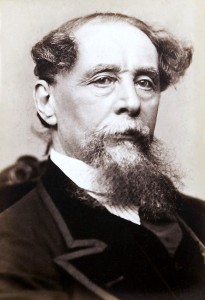
Charles DickensDickens

Dickens’ father went into a financial freefall that ultimately landed him in debtors’ prison. This resulted in two things: while most of the family actually stayed in the prison along with the father, the young Charles Dickens, who considered himself a gentleman in the making and who had been going to school, instead now found himself at the age of twelve living alone in rented rooms and working, trapped, ten hours a day, six days a week, in a broken-down factory pasting labels on pots of shoe blacking.

And this went on for months, an experience so traumatizing for the boy that years later, as a grown man, he could not walk past the place where the factory had once been, without crying.

Strikingly Scrooge has the same reaction when he is confronted with the sight of his younger school-boy self: “They went, the Ghost and Scrooge, across the hall, to a door at the back of the house. It opened before them, and disclosed a long, bare, melancholy room, made barer still by lines of plain deal forms and desks. At one of these a lonely boy was reading near a feeble fire; and Scrooge sat down upon a form, and wept to see his poor forgotten self as he had used to be.”

It’s a painful moment, but a momentous one, because it’s the point where Scrooge’s transformation truly begins. For it’s not only the house that’s broken–it is the boy himself who is broken too, the boy whose heart Scrooge still bears within, that same heart the Spirit has laid his careful and abiding hand upon.

Understated as the scene is, compared to, say the later scenes with Tiny Tim, this moment conveys a kind of human miracle. Though utterly sunk in his old, overwhelming desolation, Scrooge now has a companion, a calm and deeply accepting witness to his anguish.
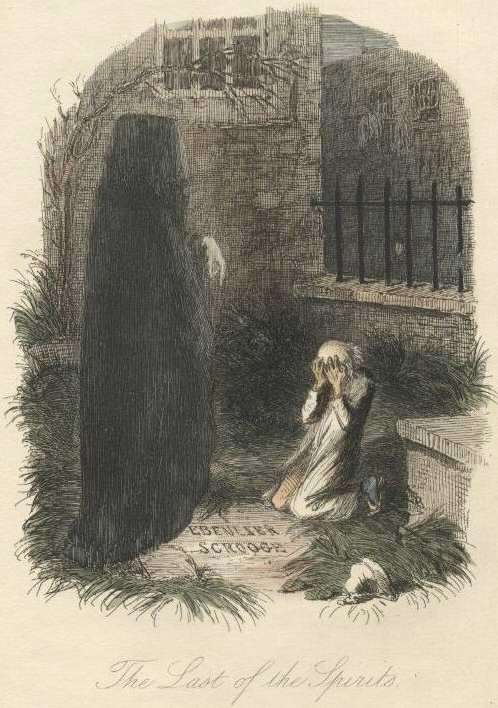
photo 2

So now it’s no longer a question of how long Scrooge will take to thaw: his melting is instantaneous. And why? Because of the power this kind of witnessing has, the ghost’s compassionate spirit bringing clear-eyed acceptance, allowing Scrooge the boy and Scrooge the man to reconnect with the whole truth of himself.

And this, I’d say too, is the underlying dynamic in the transforming power of the book itself. One word for it of course is connection. But more specifically, the process that Dickens is enacting on the page for us is the process of vulnerability. Because it’s not just that the spirit connects with Scrooge—there’s more going on, an ultimately mysterious, paradoxical process, one I think that quietly runs beneath all the rest of the story, through all of Scrooges’ journey through the Past, the Present, and the Future, through all the wrenching scenes and the boisterous ones too.

But wait, just what do I mean by vulnerability?

Well, as I was saying before, the fundamental truth of being human is that we need to be connected—like it or not, we come wired for it. Without connection, we’re stifled; with it, we thrive. But in order to be connected, we have to let others see the things in us that make us feel like we’re maybe not good enough for anyone to connect with. It’s like Brene Brown, the researcher whose TED talk on vulnerability went viral, says: “Vulnerability is the core of shame and fear and our struggle for worthiness, but it appears that it’s also the birthplace of joy, of creativity, of belonging, of love.”

What Scrooge discovers when he revisits his abandoned younger self in the company of the spirit, is that he must embrace his vulnerability in order to live again. Not only that, he must have the courage to do it with others. But courage, as Brene Brown reminds us, is not to be confused with bravery. If you look at the original root sense of the word, courage means having the heart to tell your whole story.

This of course, at the beginning of the Christmas Carol, is exactly what Scrooge doesn’t have. All he has is money, lots of it. But ironically, given the ways he has compensated for his extreme lack of connection with others, it turns out he is no better off than he was as a boy. He has in fact, recreated the hateful circumstances of his younger years with an unwitting fidelity. Whereas the young Ebenezer was left alone on Christmas day huddled by a small fire in a large, dilapidated, poorly lit and cold building–Scrooge, on Christmas eve, rich as he is, takes himself home to a large, dilapidated, poorly lit and cold building. His fire too, is the same fire, a dispiriting thing, a “very low fire indeed; nothing on such a bitter night.”

But as ironic as the situation is, it’s natural too—in fact it’s exactly the kind of thing lots of us do, recreating the old wounding dynamics of our childhoods and imprisoning ourselves in the process.

For Scrooge himself is certainly in a prison, as the spirit of his former partner Marley recognizes. He sees that Scrooge needs drastic spiritual reclamation, a kind of crash course in vulnerability, and that of course is what Scrooge gets, the ghosts with their spirit of compassion handling him not with kid gloves, but compelling him simply to see things as they are. And that’s what does the trick: the spirits usher our man Scrooge into a fuller vision of himself, one that makes the prison of his own construction finally visible to him. Once he has seen that, the process of reclamation really takes hold in him, and he makes reconnection his own habit, his own philosophy, his religion really. For Ebenezer Scrooge is a man joyfully resurrected.

No wonder then, he goes frisking about his rooms! It’s not just because he finds he’s still alive, but because he finds at last he truly is alive. And what else to do then but make his reunion with mankind manifest, not only through giving spontaneously and generously, but by going forth to join the world on the streets of London? And here is how Dickens, who was himself his whole life a great walker of the streets of London, describes Scrooge’s jaunt that Christmas morning:

“He went to church, and walked about the streets, and watched the people hurrying to and fro, and patted children on the head, and questioned beggars, and looked down into the kitchens of houses, and up to the windows; and found that everything could yield him pleasure. He had never dreamed that any walk—that anything—could give him so much happiness.”

Yes, it has taken a long night of work, but here at last, rejuvenated on Christmas Day, Scrooge has found out the wisdom of his nephew Fred’s words the day before—that is, for all that we continually fail to see it, other people really are our fellow-passengers to the grave: they are the only companions we have.

Scrooge1

Now I know Christmas certainly is not always the festive occasion Dickens painted. It truly is not. And it can be a time of particular and pointed anguish. But at the same time, it is also a time of year when, again, as Fred claims, “men and women seem by one consent to open their shut-up hearts freely.” In that way, Christmas offers precious opportunity, a chance for us to disregard what pains us most about the holiday and do instead what we’re here to do: connect.

So may the spirit of the past, the present, and the future be with you this Christmas season. May you have the courage to reconnect yourself with others and to find yourself whole. And may it bring us all joy.

Amen and blessed be.

 —Hilary Mullins

.

Hillary Mullins

Hilary Mullins lives in Vermont. She supports her writing habit by teaching college and cleaning windows and has been writing sermons for area churches since 2000. Besides her sermons and essays in NC and Vermont’s Seven Days, she has published a YA novel called The Cat Came Back.

.

.
Aug 062013
 
Sheehan1

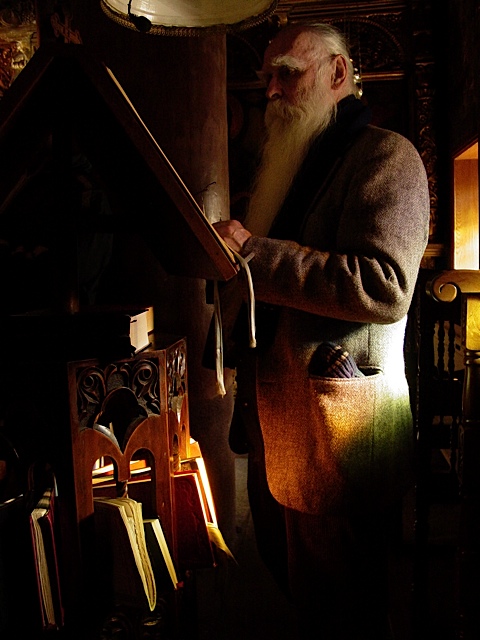
Photo credit: Mark Montague

Today is the Russian Orthodox Feast of Transfiguration, also Hiroshima Day, a day of near absolute contradiction. Hilary Mullins takes the opportunity to explore the person and teaching practice of the late Don Sheehan, whose spirituality (Russian Orthodox) and spirit made him perhaps one of the most remarkable writing teachers ever. Part portrait of the man, almost a hagiography (an ancient genre, not to be dismissed), part exploration of what a writing workshop might be if suffused with spirit, part exploration of technique (chiasmus, a little form, strewn through the Bible), part homage, part homily, Hilary’s essay crosses genres and practice in a remarkable and loving way.

dg

Nine a.m. August 6th 2004, and at The Frost Place in Franconia, New Hampshire, we are assembled in Robert Frost’s old barn. It’s the second-to-last day of the annual week-long poetry conference, and though lots of us are tired at this point, there’s still a quietly-bright buzz in the air: every day here brings good things. But before the morning’s lecture gets underway, Don Sheehan, founding director of The Frost Place, rises and walks to the lectern, clearing his throat to make his customary morning remarks.

At this point, Don, with the quiet assistance of his wife Carol, has been running The Frost Place for almost thirty years, handling the multitude of various tasks involved. But I know very little about all that: the thing I have been learning about Don Sheehan is how, through all his teaching, he helps people bring forth their best and deepest selves and change their lives.

This morning he begins by noting the date: August 6th, going on to explain how it is one of the high holy days in the Russian Orthodox calendar, the feast of Transfiguration. This of course is not a common topic at most writing workshops, but his Russian Orthodox faith is a common topic for Don, and he begins to elaborate on the biblical story, describing how Jesus, taking three of his disciples, climbs a high mountain where suddenly he is transfigured by light, his face shining like the sun, his clothes dazzling white. The wonderful thing about this, Don stresses, is that this moment of Jesus’ transfiguration is also a transfiguration of the world: the holy is here. Not somewhere else, but here, now.

Sheehan2

Photo credit: Maria Sheehan

Nine years it’s been since Don spoke those words and he himself now is no longer here.

And yet, I think of him almost every day. And looking back, part of what strikes me is how truly unusual he was, not only in the largely secular world of writing workshops but probably in most places he went. At the most obvious level, the reason for this was his devout Russian Orthodox practice. But it went far deeper than that, as did his gifts to those of us who knew him.

Though I am a Unitarian Universalist myself, I had the great fortune to know him first in his own context, tagging along with a friend one evening to what I thought was a Bible study class for members of St. Jacob’s, a small Russian Orthodox congregation in Northfield, Vermont. What I was expecting was a small circle, primarily women, gathered around the priest in chairs, nibbling cookies perhaps, leafing through Bibles balanced on their knees, commenting perceptively but mildly on lectionary passages.

What I got was something altogether different. For one thing, the people who came to the class that evening, men and women both around the table, were serious in a way I was not used to. That was partly a function I’d guess of the devotional character of Russian Orthodoxy, with its calendar structuring life around faith. But it was also Don himself. A scholar with a poet’s heart dedicating the bulk of his energies to the Russian Orthodox tradition, he taught by spreading out the fruits of his scholarship and inviting us to take and eat. My own beliefs, theologically speaking, run along more liberal lines than his did, but I knew right away on that first night in his class, he was the religious teacher I’d prayed to find. So I kept attending and sometimes too visited him and Carol in Sharon at their home, sharing meals, spending time in the garden and, wonderful pleasure, spending time also with the rest of their family.

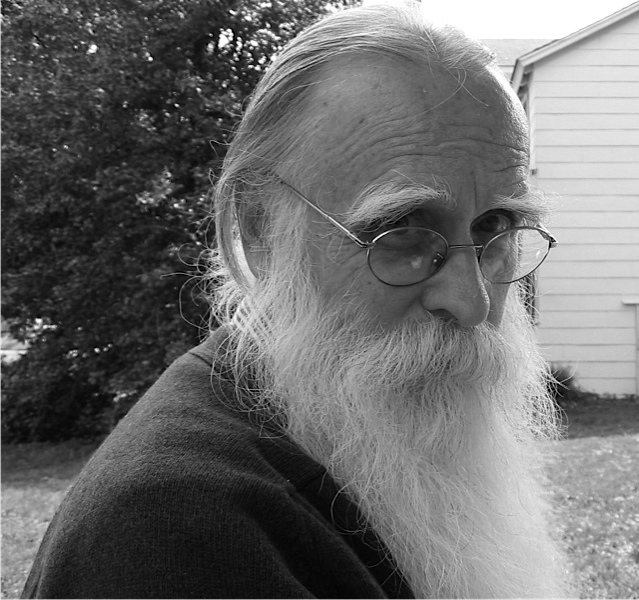
Even then, Don was already ill, suffering with the beginning symptoms of the condition that three years ago ended his life, probably an undiagnosed case of Lyme Disease. And yet though I remember him being bone-tired, he never lost his gentleness or his characteristic bright clarity. He was in his mid-sixties then, with fly-away eyebrows and look-clear-at-you blue eyes–a shy, soft-spoken man, reflexively self-effacing, who appeared like the scholar he was in his well-used, rumpled khakis and button-up shirts–except that because he and Carol were off the grid on their somewhat remote hillside in the woods, he also wore things like serious boots in the winter and a faded blue hand-knit hat to keep away the cold.

And that is another key thing to understand about Don: money and position were never his goals. This is clear for instance, in the decision he’d made much earlier in his life, before his conversion, to give up a tenure track job at the University of Chicago. In fact, even though he was at Dartmouth, Don Sheehan was an adjunct professor—a low-rung position on the academic ladder. But I doubt he regretted his choices–not because he lacked ambition, but because his ambition aimed for what he thought were worthier things. And this dedication of his to higher callings had a tendency to rub off on others. For Don Sheehan had a way. He was never one to call attention to himself, but in a room full of people, he was still someone you’d notice, not least of all because of his unusually long beard, the kind older Russian Orthodox men seem to cultivate. It draped down over his chest, a fluffy white wing attached to his chin.

I don’t mean to claim by this Don was angelic exactly, but the truth is, the man was so immersed in soul-work, he threw off a little light. And he was always casting that light toward you. That was one of the remarkable things about him: given his teaching at the church, and at Dartmouth, and particularly as director of The Frost Place, he was continually in situations perfectly rigged with opportunities for misusing his power and padding his ego. But he passed all that by, leading in the humblest way I’ve ever seen. And I don’t think this was because he failed to understand power: I think it was because as a man and as a Christian, he understood the best thing to do with power is give it away. Not to dissipate it, as if it were a dangerous electrical charge, but to transform it into love, keeping the circles of its impact ever rippling out into the world at large.

Another element fundamental to this practice of self-extending was the way Don did not strike. Having survived a childhood that was at times shattered by brutal violence, he understood the multitude of diverse, often subtle blows we deal one another. And he made a practice of not passing them on. So, in class at St. Jacob’s for instance, he never engaged in the far-too-common disheartening practice of chopping up or dismissing our responses. There were even times when I wished he would—a little anyway—be a tad more corrective perhaps—for instance, when it seemed another student’s reading of a passage was clearly off the mark. But it was Don’s habit instead to say yes and keep us walking with him, all the while modeling the way through his own fine work–essays and lectures that were deep and wide and reflective, pathways into marvelous complexities.

This approach of his he made explicit in The Frost Place workshops, starting off the week each year with these words:

“If you must make a flash choice between sympathy and intelligence, choose sympathy. Usually these fall apart—sympathy becoming a mindless ‘being nice’ to everyone, while intelligence becomes an exercise in contempt. But here’s the great fact of this Festival: as you come to care about another person’s art (and not your own), then your own art becomes mysteriously better.”

And it was true. We were all always becoming mysteriously better under Don’s tutelage. And happily, he had a way of making the work itself deeply satisfying, approaching writing not only as a believer but a lover too. In our classes at church for example, passages from the monastic Saint Isaac of Syria or the chapters in 1st and 2nd Samuel were not abstract ‘texts’ to be deconstructed: Don was no vivisectionist. Instead, he turned all the powers of his scholarship towards bringing out a passage’s depth, approaching each one as real, as a lovely, created thing, like a chapel or a shaded pool, a place to be entered with reverence and wonder and pleasure.

Likewise, it seems to me that what Don did at The Frost Place was very similar, renewing poetry for others because he believed it too was real. And this is not just a pretty way of speaking. Where our secular culture denudes the sacred properties of poetry, of all art in fact, Don was deeply grounded in a tradition that has never lost its sense of the holy in art. As I understand it for instance, a Russian Orthodox icon, properly prepared and painted, is not just a painting: it is a portal for the holy, an actual opening through which God moves toward us and through which we can move toward God, where indeed we are invited to do so.

Isaac_the_Syrian

The same goes for the written word: just as St. Isaac of Syria had explained in the 7th century, holy books in Russian Orthodoxy are understood to be places where the light of God shines through: “Those who in their way of life are led by divine grace to be enlightened are always aware of something like a noetic ray running between the written lines which enables the mind to distinguish words spoken simply from those spoken with great meaning for the soul’s enlightenment.”

The first time I read those words off a Xeroxed sheet in Don’s classroom, they made the lights come on in me, as if a Christmas tree in a darkened room had just been plugged in, glowing suddenly with the light I’d always known was there in things I read and loved, bits of bright color weaving in and out of the branches, deep glimmerings from within all the recesses.

The psalms too, were places Don brought us into the same way, teaching us the ancient chiastic pattern they’re written in. That is to say, psalms move not only from start to finish in the linear way we’re used to, they also move in a call and response fashion across the whole of the psalm, back and forth across the center, calling us, as we read, to pay attention to how the first and last verses are related, along with how the second and second-to-last are connected too, and all the others in just the same way, until we reach mid-point, which is the place where, one way or another, God appears, turning the poem in some way. But of course for Don whose religious practice for years had included praying the psalms every day, this appearance of God wasn’t simply a reference that functioned in the narrative logic of the poem: it was, just as in icons, the place where  touching and being touched by God was actually possible.

To us this chiastic doubling-back-and-forth pattern across the center is so counter-intuitive, it can take some getting used to, but one inexact analogy is this: think of yourself again as a child, hopping along a slate sidewalk, coming down from every hop with one foot on each of two paired slabs—hop, hop, hop–until then you come to the center, the deepest point of the journey, where the presence of God wells up like a sweet water spring in a hollow. Then imagine laying down, here, now, in this marvelously still, green-grass place.

Sheehansketch

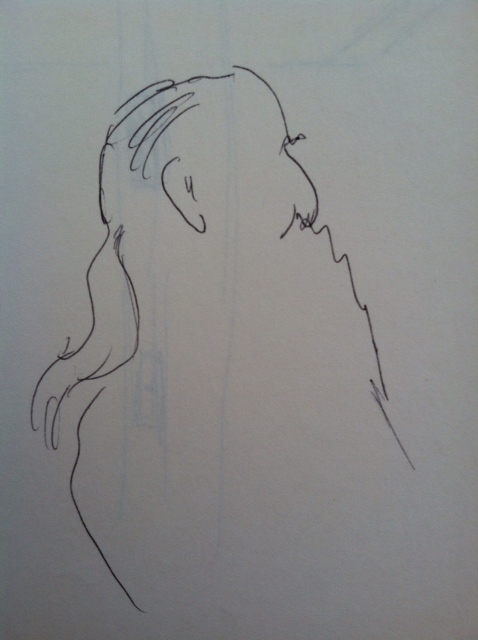
A sketch of Don Sheehan by Hilary Mullins

Now you might think from these kinds of descriptions that what I’m going to relate next is the story of my own conversion. But that is not what happened: I was certainly changed by Don’s teaching, and I loved the way his tradition approached things that usually are understood as merely metaphorical, rendering them instead as vibrantly and powerfully real. But still, I have never shared his—or anyone else’s–certainty about the workings of the divine. And Don knew this. Yet, in spite of that deep commitment to his own faith, he never cajoled conversion or conversely set me outside the walls in any way: these too were the sorts of corrections he did not engage in. Even while we were studying Isaac’s lovely passage about the noetic ray glimmering in amongst the written word, and I said I’d experienced the same thing in, say, a poem by Frost, Don did not close the door. “Orthodoxy points to where the truth is,” he said. “It doesn’t say where the truth is not.”

It was this sort of catholic approach that meant poets even more secular than I could benefit from Don’s sense of the holy in poetry. We never talked about this explicitly, but my guess is that his daily contemplative reading of the psalms did lead him to find many contemporary poems to be empty, echoing forth a hollow space where he was accustomed to sensing God. And yet it seems he did sometimes see more in them too. For instance, once, on the wooded hill beside his house, I asked him, theologically speaking, for his definition of grace. He smiled in his unassuming way and told me he thought it was like the passage in Frost’s poem The Death of the Hired Hand, where the farmer and his wife, in the course of deciding whether or not to take in their occasional (and historically unreliable) hired man, are talking about the definition of home:

“Warren,” she said, “he has come home to die:
You needn’t be afraid he’ll leave you this time.”

“Home,” he mocked gently.

“Yes, what else but home?
It all depends on what you mean by home.
Of course he’s nothing to us, any more
Than was the hound that came a stranger to us
Out of the woods, worn out on the trail.”

“Home is the place where, when you have to go there,
They have to take you in.”

“I should have called it
Something you somehow haven’t to deserve.”

The last lines of course embody the generosity of Don Sheehan himself, a generosity he shared through all his teaching, be his subject a homily of St. Isaac’s, a poem of Robert Frost’s, or a theological concept he thought could bring something deeply good to our lives too. But he was remarkably kind in smaller, everyday acts as well, even in the very way he gave you all his attention in a conversation. And the sum total of all this of course is that this ongoing generosity of his quietly but powerfully influenced many, many people.

And because he knew the healing power this practice had for him as well, the mysterious way it had of making him better, he was always enjoining us to do the same: “Your work at this conference,” he would say at The Frost Place, “is to make the art of at least one other person better and stronger by giving—in love—all your art to them.”

Sheehan3

In the end I think he stressed love so much because he knew and understood its opposite so well. He and I never discussed what went on in his home when he was a boy, but in an essay on the Orthodox concepts in The Brothers Karamazov (still easily found online), he referred to that history to make a point, writing,  “I was raised in a violent home where, until I was nine years old, my father’s alcohol addiction fueled his open or just barely contained violence, a home where my mother was beaten over and over (I remember her face covered with blood).”

Nine years ago, on August 6th, 2004, when Don Sheehan got up before the morning’s craft lecture and spoke, of all things, the Transfiguration, of the miracle of the holy transfiguring the world, he turned next to its opposite, bringing our attention in his measured way to another event marked by August 6th: the bombing of Hiroshima: “This,” he said, “we can refer to as a disfiguration of the world.” Knowing disfiguration as he’d had in his own life, his phrasing was deliberate as quietly he urged us to choose transfiguration in our own lives, yielding not to the innumerable temptations to slight or demean others but instead to make the kinds of gestures that embody the practice of love.

This of course was how Don Sheehan himself transfigured the world as he traveled through it, bringing light wherever he went. And it was what he was pointing to again and again in everything he taught, just as he did each year at the beginning of The Frost Place Festival: “The key that unlocks all truth,” he said, is “taking very great and very deliberate care with each other.” This infinitely exacting, transforming task was his greatest lesson, the one that is up to us all to carry on.

— Hilary Mullins

Editor’s Note: Don Sheehan did finish his translation of the Psalms and the book will be published shortly by Wipf and Stock.

—————————

HMullins

Photo credit: Phil Crossman

Hilary Mullins lives in Bethel, Vermont, teaching public speaking for Vermont Technical College and cleaning windows in the warmer months. She also does occasional preaching for local churches. Along with an MFA from Vermont College, her education includes classes at the UU’s Starr King School for the Ministry, as well as completion of a three-year study program run by the Vermont UCC.

.

.

.

.

.

May 142013
 

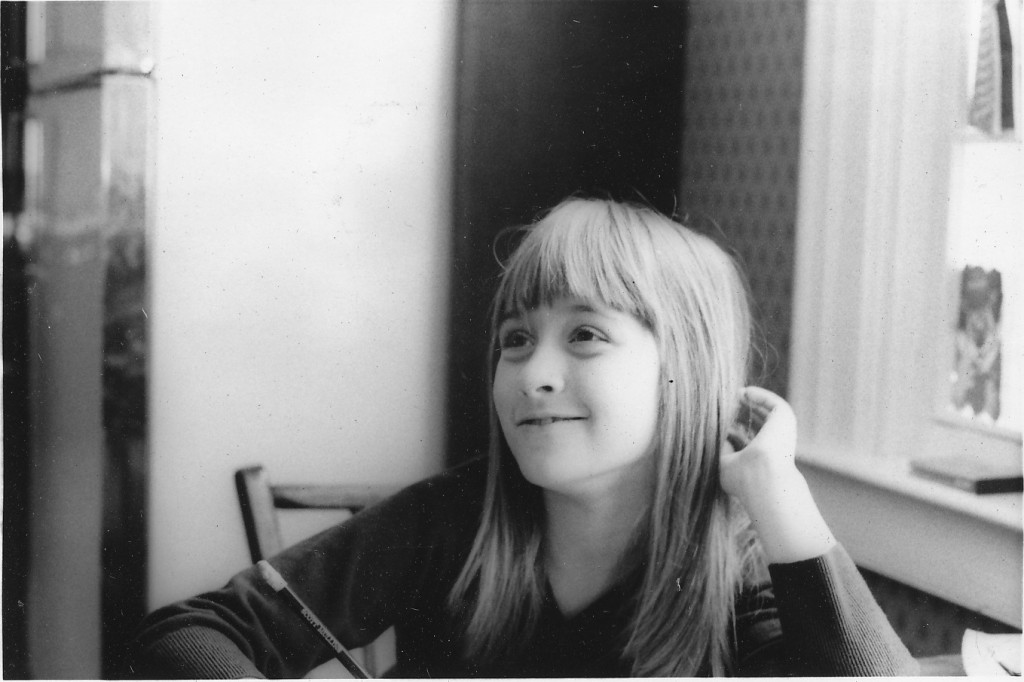
Hilary, girl writer. Photo credit: Bill Hayward.Hilary Mullins, girl writer. Photo credit: bill hayward.

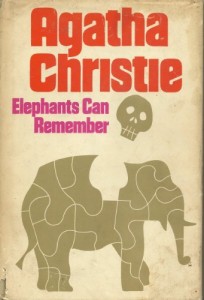
“Elephants Can Remember” is a sweet, all too brief memoir of a grandmother and a childhood from Hilary Mullins, a Vermont writer I have known since she was a student at Vermont College of Fine Arts, yea, these many years ago. Hilary was never my student but she has the gift of making friends, and she used to hang out in Francois Camoin’s room across from me in Noble Hall where a group of us would be drinking wine and talking late into the night. In this essay, Hilary writes about her beloved grandmother, nicknamed Germ, who was a force of nature, a tank, as one of her children called her, and a puzzle. One of the puzzles is how much she loved puzzles and mystery novels, especially the novels of Agatha Christie. This is Hilary’s fourth contribution to NC; she has previously published two sermons and a piece on Hurricane Irene in Bethel, VT. And it’s a gorgeous addition to our growing list of Childhood essays.

As an added perk we also have photographs of the girl writer by the renowned New York photographer bill hayward who happens to be Hilary’s uncle and who took the epic Gordon Lish photos we published a couple of issues ago. In an email, Hilary wrote: “For the record, the black and whites from my childhood were taken by Bill–check out that cowboy hat, eh? He gave it to me for my 5th birthday as I recall, and oh what a big deal it was. When I was 10 and he lived in Vermont too, I really couldn’t think of anything to do that was more exciting than going to visit my uncle Bill.”

dg

—-

One late summer day this year, I went up to the attic of the old house where I grew up, climbing the steep and narrow stairs to the open, slanted space, a familiar musty smell of aged wood and bat dung thick in my nose. Turning right, I walked along the top of the west ell of the house, threading between two long, chest-high mounds made by the sheets my father draped over shelves and boxes long ago to protect them from bat droppings. Though the bats are all but gone now—those little mummies wrapped in wrinkled sackcloth hanging upside down in clusters along the joists like dark seed pods everywhere–the sheets are still here, a sign of hope for their resurrection left so long I’ve forgotten what lies buried below.

But I’ve not forgotten what’s down to the right of the small, spidery window at the end of the ell: my grandmother’s things, boxes of pots and pans and chotzkes. Germie’s corner is how I think of that spot, and my guess is all of us in the family think of it that way: her stuff has been here twenty-five years, since she died one night in January  of ‘87, when I was just twenty-five myself.

Of course not everything my grandmother, whose name was Ethel, had is still here: five years ago, for instance, around the time of the anniversary of her passing, my dad and stepmother brought out a couple boxes of her jewelry, each of us at the dinner table choosing a few things, laughing as we picked through the baubles, fingering clip-on earrings, shaking our heads as we remembered the woman one of her sons, now gone himself, used to refer to as “my mother the Russian tank.”

elephants

So I knew the jewelry was gone. But that wasn’t what I was after: it never was. I was coming at last for the books. I had decided to write a mystery. Never mind I’ve never been a mystery reader myself: my grandmother was, most emphatically, and I thought I might take a clue from her. So pulling away the thin and dusty sheets, ashy attic grime smearing onto my fingers, I began to dig through the boxes until I found what I’d come for:  a book by Agatha Christie, the one writer I could remember for sure my grandmother had loved. And this particular book, called Elephants Can Remember, I even vaguely recognized, a hardcover book clad in an off-white cover, an outline image on the front of an elephant made up of puzzle pieces with one missing, a skull-shaped hole gaping just below his neck, the skull itself floating eerily just above, a bit of levitated, mock ghastliness I dimly remembered, the elephant and the skull and the book itself sitting on the shelf in her place, the top of which I could catch a glimpse of even now through the window in the attic, my grandmother’s two little kitchen windows below.

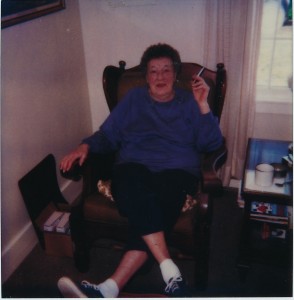
There in the little apartment fashioned out of the first floor of what once was a barn-slash-woodshed, a place we called, after her own joking suggestion, Ethel’s Luncheonette, she had read this book and done her crossword puzzles, my grandmother the Russian tank, a first-generation German born just after the turn of the last century, a stout woman with big feet and hands and a tissue stuck under the strap of her bra, a working class woman who liked her fancy clothes when occasion called for it, but usually wore colorful sweatshirts and polyester pants. Which, in my mind’s eye, she’s wearing still, enthroned in her large, wood-framed easy chair, sneakers propped on an overstuffed orange plastic hassock before her, cigarette adding its idle punctuation to her nonstop talk, that perennial bit of smoke drifting up from her fingers.

Germ in 1986, shortly before she died in this chair. Photo credit: Janet Hayward Burnham & Bill Hayward

Germ in 1986, shortly before she died in this chair. Photo credit: Janet Hayward Burnham & bill hayward

So, too, at night when Johnny Carson was over and we’d all gone to bed, she was in that chair, sipping her rum and Cokes, smoking her Pall Malls, drifting with her puzzles and er books long and late into the night, immersed in the word.

I, too, already, was immersed in the word back then, was famous—or infamous depending I suppose—for churning out book reports as steadily as our hot-air popper spewed out popcorn, reading books in bed, in trees, in class behind my Junior High English text book. And I was writing. Badly, childishly, but still. Writing. And as I got older and went away to boarding school, my stuff got darker.

My grandmother did not approve. “Why do you always have to write about sad things?” she’d chide me. “Write about something happy. People don’t want to read sad stories.” What did I say to her? I don’t know. All I remember is a little smoke between the ears, that particular keen-edged resentment young people can feel towards their all-knowing elders when they haven’t yet figured out how to articulate their own dissenting sense of a thing. Now, all these years later, it occurs to me we perhaps were after all, the same but different, going to books for analogous causes but in search of different balms. I wanted to find some expression, however transmuted, of the quiet disasters I was enduring. But my grandmother, I’d guess, went in order to think of different things altogether. And for that I cannot blame her.

Ethel Weippert Mullins had grown up poor in a large immigrant family, the oldest daughter of a violent German father who, I’ve been given the impression, would knock you across the room soon as talk to you, a policeman so infamously brutal that African Americans in Newark would cross the street rather than walk in front of his house. Though in the end my grandmother herself was a proud survivor, far as I can make out, life in her family was a series of catastrophes, her brothers drowning themselves in their bottles, one of her sisters becoming a drug addict, later murdered in the bathtub by her husband.

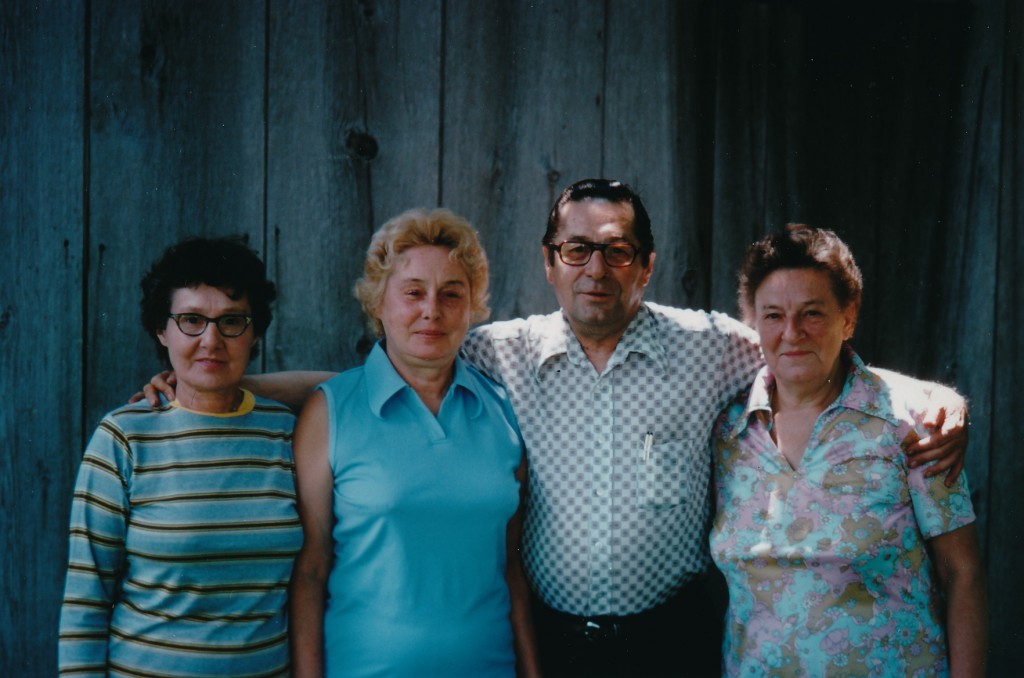
1975 Germ with her remaining siblings. Two--a brother and a sister--have already died (sister's murder is mentioned in essay).

1975 Germ with her remaining siblings. Two–a brother and a sister–have already died (one of her sisters was murdered). Photo credit: Janet Hayward Burnham & bill hayward

No wonder then my grandmother ran off just as soon as she could, fleeing with a handsome Canadian Irish man named Bernard who did not drink but gambled with the same reckless abandon her brothers had all taken to booze. For a while she lived with him in Montreal, doubtless hoping for a new and better life, but three little boys later, in the midst of the Depression, when that better life was not coming to pass, she left him, still so very young herself, and fled again back to the States to live with her mother in Connecticut, raising her sons on the rough side of Danbury and never marrying again.

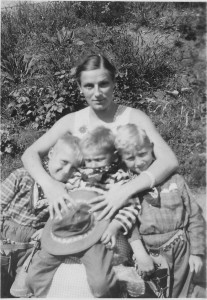
Germ and her three boys in October of 1934. My father is on the left.

Germ and her three boys in October of 1934. My father is on the left.

So my grandmother, who’d had her fill of sad, quite understandably had no wish to go to books for more. Instead, I imagine her during those long nights alone, savoring her books and crossword puzzles like sweets, using their plots and grids to chart her way across the vast hours of darkness.

Because my grandmother stayed up so late, she also slept in, sometimes till as late as eleven, snoring so loudly that in the summer when we were little, we could hear her through the open window and catch scandalized glimpses of a high lump under the covers where we knew she was sleeping with no clothes on. But she was not to be wakened, a boundary she always reinforced by last thing at night locking her door, a Dutch-style door with an upper and lower half. Many a morning I gave that door a careful, quiet tug to see if it was still latched from the inside, but many a morning, it would not budge. Finally a half hour later, maybe a whole hour, you would hear it, the characteristic iron-striking-iron sound that door made when she popped the deadbolt open and threw back the cast iron swivel-arm that held the two halves together.

Then you were glad: the door was open and you went romping in, hoping for the spaghetti she would fry up with peppers and onions and eggs, hoping for her chipped beef, hoping for a hundred things. Because my grandmother gave continually, putting before us not just breakfast but dinner too some nights, and in between, brownies and chocolate puddings and games of cards, clearing her table to spread out another hand of Go Fish or Kings in the Corner. Summers she took us swimming, stowing a cooler in the trunk of her old Rambler which skittered up and down the dirt roads like an oversized Pepsi can. Then, at the lake, at a place where you could park all day for $3, we kids immersed ourselves like pollywogs in the miraculously clean water while she presided from the little beach in her lawn chair, the kind with aluminum pole legs and colorful plastic webbing, one leg crossed over the other, her big red painted toenails prominent even from out in the water. Finally, at some point she would always heft herself up and come in too, wading her bulk in, letting my little sister and me shimmy underwater through her legs a few times before she headed out for her own swim, using a stroke I still like to use myself from time to time, a combination of side and breast stroke, a strolling way through the water. Or she would roll over and rest there on the surface like a pontoon, placid and still. Her ability to do this mystified me. When I tried, I sank like a little barrel filled with sand. But she floated without even effort, imperturbable, content with her portion of water and sky.

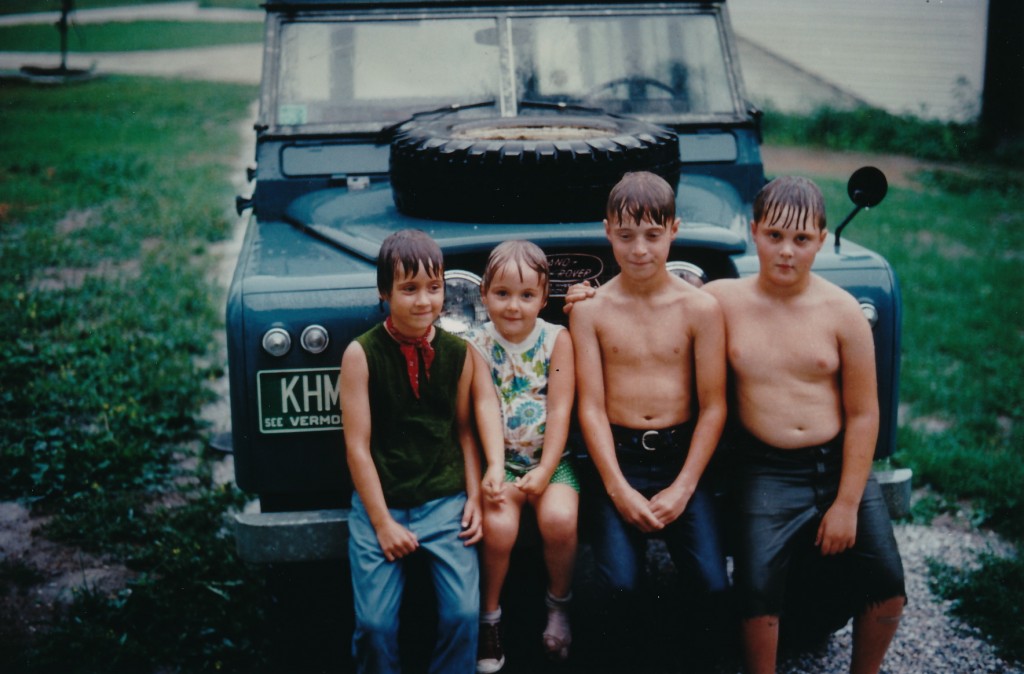
1969, My brothers, sister and me

1969. My brothers, sister and me. Photo credit: Janet Hayward Burnham & bill hayward

Given all this, it was only natural we were keen in the mornings for our grandmother to wake. True, like any Russian tank, she might run us over from time to time—but never with malice, for though she was, to put it bluntly, bossy, she was not unkind. The only way any of us I think ever felt truly flattened by her was through her talk, which at times had a kind of stunning endlessness to it, a tendency which became more pronounced as she got older, the way she would neglect to finish the end of one sentence before taking off on another, fumbling for that tissue under her bra strap to wipe the sides of her mouth and yet still scarcely pausing, her words endlessly surging at you, as if you were trapped beneath a falls, the water coming constantly, bombarding you senseless.

Looking back, it seems to me some of this barrage must have found its springs in her loneliness—to come with us in the late sixties to rural Vermont, with its farmers and fields, our grandmother had left behind the rest of her family and friends back in Danbury, a move that had worked well when we were little, but to a large extent left her stranded as we got older and began to scatter and my parents’ marriage broke up too, leaving her alone for days on end three miles out from town on a back road, a situation that understandably made her not only angry but overly chatty.

Be that as it may however, much of my grandmother’s talk was more than chatter in overdrive: it was conversation, for she was a woman who had things she wanted you to know. And yet, for all her intense need to convey this or that or the next hundred things, there was also a way I began to understand she was not exactly communicating, at least not in the hopeful sense of the word. For that was the other thing: when it came to my grandmother and her talk, I often had this sense of her standing back behind the flood of words as if behind a tree at a river, calculating what she intended, peering out from her shelter to gauge your response. She had a way of leaving a key piece out, of hinting around it to see what you might know or think yourself, as if trying to flush you out first, rather than hazarding a clear statement of her own to begin with. She was always holding something back.

Of course I know now this is, more or less, the way the whole world talks. Always we too are leaving a key thing out, too afraid, too defended, or just too insensible, mis-trained as it were, to clearly say what we see and feel and think. I do it myself. And yet my grandmother did it more, feinting and dodging, retreating behind her words, where, in spite of all she said, she would not declare herself.  And that made her, as my sister-in-law commented recently, “hard to understand, that’s for sure.”

But let me be fair.  There were things plenty easy to understand about her, even when I was little. If I close my eyes for instance, I can still feel her hug, the way she would draw me close in, smushing me right up into her big mamma bear body, her large arms wrapping warmth around me. Truth is to be loved by my grandmother was to have a place in the world and be anchored there.

And so she held us, and so the years went on. And so too, even as we grew older, we still tugged at that door in the morning, and we waited, and we tried again.  And we also saw she was getting older herself, a fact which began to give her locked door another significance: I doubt I was the only one who began to regard it with some misgiving, dreading the morning that door would not open.

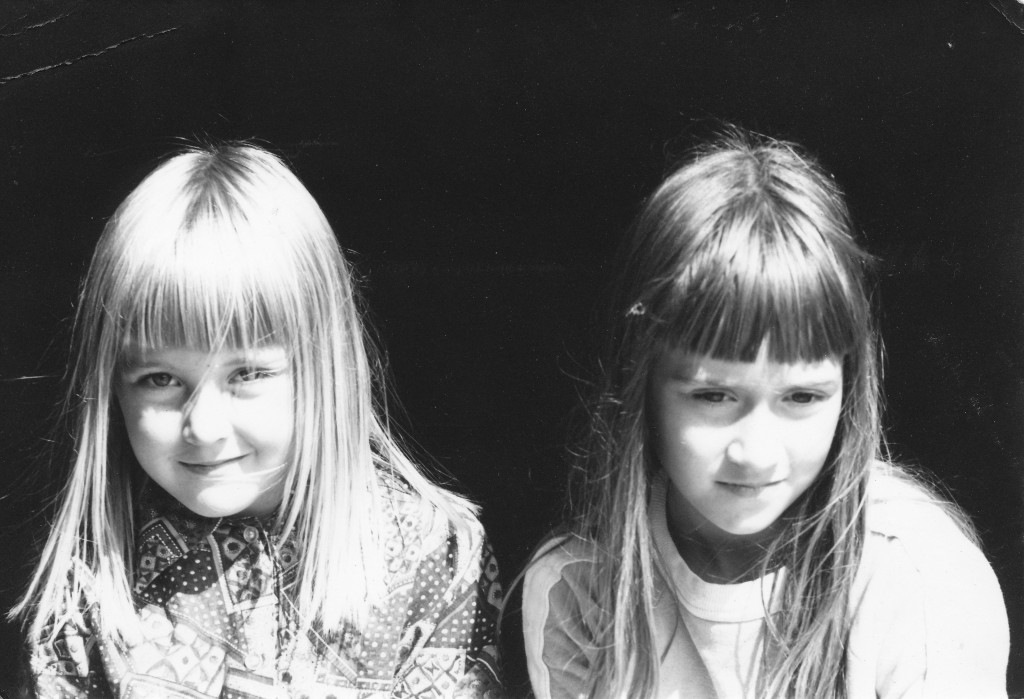
Don't know date--my sister and I

My sister and me. Photo credit: bill hayward

As it turned out, when that morning came, I was not there. My sister was though, home from college, with one of my brothers, the two of them finally resorting in the early afternoon to pushing open one of the small windows over Germie’s sink from the outside, my brother boosting my sister up so she could clamber in, crawl across the sink, and lower herself carefully down.  And when she came around the corner to the little sitting room, she found our grandmother still in her chair, crossword puzzle in her lap, already gone.

No more puzzles then, no more books either for our grandmother, just a poem I read at her funeral a few days later, a poem about a child and her kite, a poem that closed with the kite doing what it wants most, what the soul perhaps wants most of all in the end, to burst past night and rise through haze/ of radiance to a sky beyond these skies/where brighter beings float free of earth’s ties.

Was that really what we all believed? I don’t know: everyone has their own ideas about these things. In the end, the only thing we knew for sure was like the kite, she was gone: all we had left was a canister of ashes kept in the cupboard by the fireplace. But we knew they were not ours to keep either. Finally, two and a half years later, on a late summer morning, we took a row boat out into the lake she’d taken us to so many times  and sowed her ashes to the waters, watching the strange trails those powdery shards made across the surface, windings garnished with the wild flowers my sister had cut that morning from a field, a bright yellow profusion strewed out behind us.

1971

1971 Photo Credit: bill hayward

Twenty-five years now it’s been, and I miss her still, not with that stunning acuteness of first loss, but with a kind of keen wistfulness. Because of course I want her back. More than anything that was what brought me up to the attic to find her old Agatha Christie books. Fifty now, gaining on the age my grandmother was when I first knew her, I thought I might get a better sense of her through her treasures, even if those treasures seemed to me a little gaudy, a little cheap, the literary equivalent of her old costume jewelry. But that was ok: I was ready to be wrong about that. I wanted to like Christie. I was looking forward to digging into her pages, to casting around in her passages for some echo of my grandmother, of how she thought about things. Really, to be frank, I would say I was looking for a little philosophy, a little love.

But half a dozen Christie books later, all I can really say I’ve found are puzzles. True, they are most often well-wrought puzzles, wrapped in a requisite amount of deft characterization and dialogue, but it’s a comic world my grandmother’s favorite writer conjures up, not a place of depth. Where I look for meaning, Agatha Christie is producing clues. And yet that must be the key, I figure, when it comes to my grandmother. She loved her crosswords just as much as she loved Christie, probably because both are built on clues, and because the pleasure involved, I suppose, is what you construct in your mind with those clues as you read–along with the completed perfection of the thing at the end when Bingo! all the pieces connect.

Still, for someone with a poetic, even scholarly bent, this is not much to show for my efforts. So what if I’ve discovered my grandmother enjoyed putting clues together? And so the world is round, they say, and goes about the sun. And tomorrow is another day.

But let me temper myself. My disappointment is making me sell them both short. Christie may have thought of herself, for instance, as merely clever, but at her best, she does have a kind of mad genius for these puzzles of hers, especially in her inexhaustible churning out of those clues. For as limited as the settings in her books tend to be—a little clutch of characters in a teacup—Christie’s clues come in stupefying superabundance, the tart Miss Marple or the smug M. Poirot amassing bewildering thickets of them. In Elephants Can Remember, the book for instance, I found in my grandmother’s things, the murder is a dated one, but the same pattern holds, Poirot and his confidante, Mrs. Ariadne Oliver, a mystery writer of all things, flushing out aging clues from aging characters, many of whom make cameo appearances just long enough to contribute their little clue.

And yet even with this potentially slow-as-syrup scenario, Christie keeps the clues coming like a pitching machine gone haywire. And these clues have energy: they direct your attention. One tugs your nose one way, the next yanks you in another, and meanwhile, ten more are coming straight on at you, a blur in succession, a blizzard in your headlights.

Did my grandmother hang on through all this? I wish I could joke with her about it because I certainly didn’t. I just got buried, barely hanging on as chapter by chapter M. Poirot or Miss Marple navigated the way with lanterns, lead explorers in a cave at last clicking on the light, banishing darkness at book’s end to reveal a marvelously intricate design on the walls.

So yes, I can see the pleasure in all this. And yet my grandmother was right when she did not try to share her books with me, the way she did with my mother and sister-in-law, eagerly passing her favorites on. I think even if she did not approve of my tastes—and I’m afraid she didn’t, thinking of me as arrogant–she understood I did not go to books for Bingo, that I was not interested in that delicious moment when the chips all line up–a fact time has not changed. For we are different readers still, my grandmother and me. The only puzzles I really care about are the ones we cannot solve. And she was one of them.

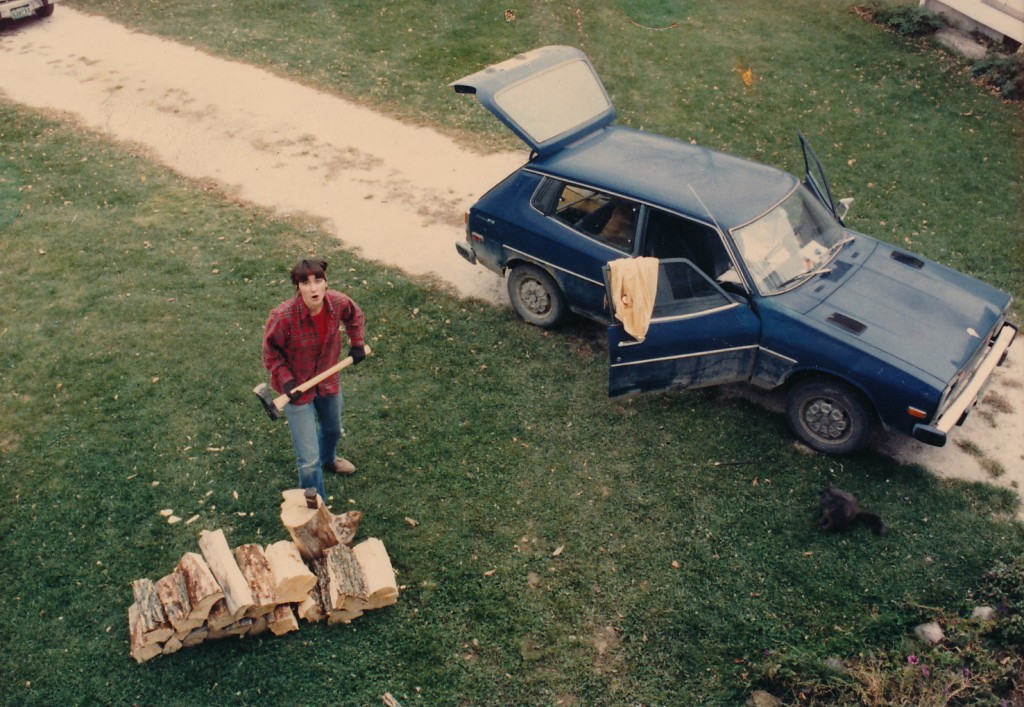
Me the next fall, age 25, after she died in '87. This photo I just had scanned not cause I think it should really go in but because I like it. But it is about the age I was in the scene I describe at the end of the essay.

Me, age 25, the fall after Germ died in ’87. Photo credit: Kristen Mullins

A couple of years after I graduated from college, my grandmother asked me to drive her up to visit her sister-in-law Bernice in Toronto. I remember specially the drive north, the particular pleasure she took in that autumn day, a day that in my recollection is filled with an abundance of light, light on the glittering waters around the Champlain Islands, on the glowing swaths of the still green fields, light suffused in the richly brilliant reds and yellows of the maples.

Then we arrived at Bernice’s. Though she’d left Bernice’s brother so many years before, having nothing to do with him afterwards, I knew my grandmother had always stayed close with Bernice herself. I also knew she had once been a great beauty, but it was hard to discern even faded glory in this nice but shrunken old woman who hosted us, this continual smoker who seemed not so much caved in but hollowed out, as if the gods had sucked at her bones like straws, leaving her skin dry as old paper. She seemed to blink often and never once went out the whole time we were there, never once changed out of her bathrobe, slowly making her way around that small, smoky, always darkened apartment, a cave I was glad to escape from once or twice a day for the long weekend we were there, walking up to the wide open grounds of a local school to breathe and feel my legs again.

Meanwhile, back in the den as it were, my grandmother and Bernice were having their great visit, their last one in fact, something they both must have known was likely. One night they got into their cups and, stationed at one end of Bernice’s bed, which took up nearly the whole of the room, commenced to spin out some story, the two of them made merry and wise by drink, each adding bits to their patchwork of recollection, chuckling and chucking their chins, as people who have known each other for years will do, nodding sadly in one spot, smirking in another.

Because there was nowhere else to go in that stuffy, tiny place, I was in the room too, reading at the other end of the bed but made privy to their talk, the realization gradually dawning on me as their words filled my ears that for the first time, I was seeing someone who wasn’t just my grandmother, but a woman in her own right, a woman like me with an entire life teeming full of friends and work, heart-felt things, dramas, things I was suddenly keen to know about.

So as they sat there, mildly tittering over another thing somebody once had done, I asked a question about it, aware I might be trespassing, but feeling somehow that my motivation was good. Unfortunately my execution probably wasn’t. I think I went about it stumbling, the way a child does on skates the first time, awkwardly stiff, lofting my words self-consciously—or at least that’s how it feels in my guilty recall.

Because no grace came of it. Instead my grandmother turned on me as she never had before, rearing back with a snarl. “You might want to know, but you never will—you will never know the truth about my life!”

Think of a bear that smacks its young with claws out. Without moving from where she was the other side of the room, she landed a direct blow, one that even seemed sharpened with the pleasure she took in her ability to withhold herself from me, some spite in it surging across the years now as clearly as it did then, dazing me even yet because I still don’t understand it, why she reacted that way. And standing alongside her, Bernice in her bathrobe seemed to be wondering at it too, blinking, shifting her weight to another foot, looking away. I retreated.

The next morning I was back outside, walking the windy grounds behind the school up the block. Overhead, the dark sky was thickly blanketed in gray, a color that seemed to be overtaking everything–the field I was walking in and the trees that bordered it, their branches stripped, thrashing in the gusts that now and again tore across the exposed landscape. It was a Saturday or a Sunday, no children in sight, and I had no particular endpoint in mind either. I was just walking, chin tucked into my jacket as I crossed the gradual slope.

Then I saw it, though at first I did not understand what it was, some strange flurry of white in motion that only gradually came into focus: an old dictionary, sprawled on the ground in pieces, as if some defiant student had just ripped through it, shredding out the innards and heaving the covers aside. But rather than being destroyed, the words now were liberated, the pages everywhere, each one intensely peopled with words, and now in the wind they were scattering across the hillside like big bright leaves, they were swirling like a thrumming, eager flock, a gust lifting them at last in an eruption of wings, my baffled heart lifting with them.

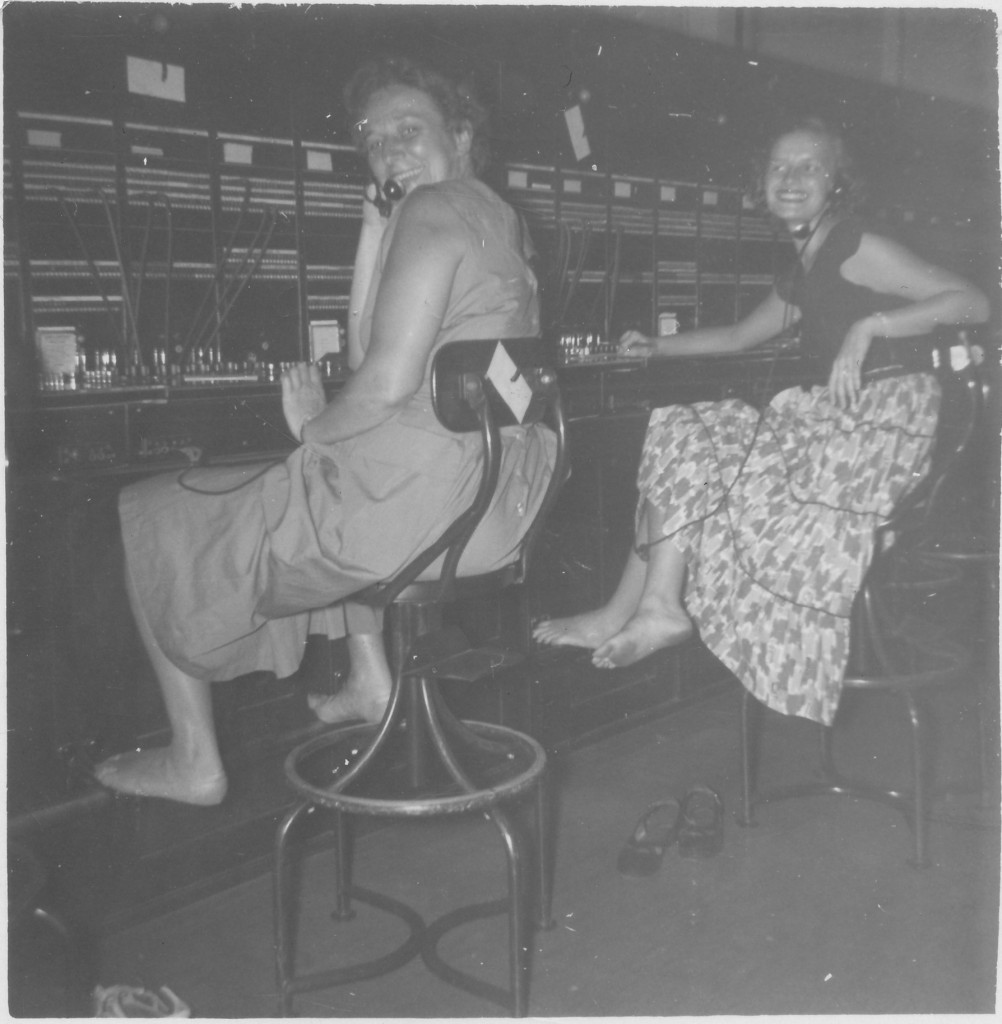
August 1950, Germ working as an operator for Southern Bell. Note the bare feet!

August 1950, Germ working as an operator for Southern Bell. Note the bare feet!

The morning our grandmother’s door did not open came a few months after this, on the coldest night of that next winter, my sister finding her in her big wooden chair, the pen she’d been writing with still in her fingers but her spirit flown, her big friendly body uninhabited, an empty place all of us came home to circle around and grieve. And yet, now, even after all these years, we find it’s us she inhabits, secured behind a lock she will not throw back, but dwelling all the same deep within the marrow of our bones and brains, floating in us word on word, our grandmother, exquisitely puzzling, like the line of flowers and ashes she left behind, a bright and silent trail I am following still.

–Hilary Mullins

————————

Hilary Mullins lives in Vermont. She supports her writing habit by teaching college and cleaning windows and has been writing sermons for area churches since 2000. Besides her sermons and essays in NC and Vermont’s Seven Days, she has published a YA novel called The Cat Came Back.

Nov 032012


Photo by Kevin Cosgrove.

NC has a special place in its heart (okay, really, the magazine doesn’t have a heart perhaps, but in the editor’s heart) for mixed forms, hybrid forms and old forms gone out of fashion. They don’t teach sermon-writing in the college workshops, but the sermon is a great and ancient nonfiction form (books of sermons used to be bestsellers), and we have published several on this site. This is the first sermon Hilary Mullins ever gave and dates back to 2000 when she lived in Oakland, CA. She now lives in Bethel, VT, and is a graduate of the Vermont College of Fine Arts MFA in Writing Program and writes and teaches and washes windows in the summer. Her most recent contribution to NC was an essay on her experiences during Hurricane Irene. This her second sermon on NC. See the first here.

dg

—–

One dervish to another, What was your vision of God’s presence?  — Rumi

I’m no dervish, no Sufi mystic. I’m just a writer. And though like Rumi, I too sometimes conceive of God as a baptism of fire, I find that when I sit down to write, water is the vision that keeps returning to me. I’ve been writing about water my whole life. It’s not my only metaphor, but it may be my most frequent. I’ve written poems about rivers and brooks, about lakes and skating on lakes. I’m not sure, but I think it has something to do with the lake back in Vermont I grew up swimming in, the hours and endless hours I spent in that water.

Especially I remember swimming underwater: nosing around submerged parts of trees for the sudden sparkle of a fishing lure, or better yet, pulling myself with wide arm-strokes down the mysterious, green-dark slope where the real depths began.

Experiences like this get under our skin, making a metaphorical sense that sticks with us, informing our lives. Though as a writer, I’m probably more aware than most of the metaphors I use, I think everybody uses them.

And I’m certainly not the only one who thinks this. University of California linguistics professor George Lakoff thinks so too. Lakoff has been championing the importance of metaphor for quite some time now. In a recent book with the delicious title, Philosophy in the Flesh, Lakoff and Eugene philosopher Mark Johnson argue that metaphors are not a mere matter of the words we use. In fact, they claim that metaphors structure the ways we conceptualize our most fundamental experiences.

And furthermore, they say, reeling in abundant evidence from the cognitive sciences, this metaphorical structuring of meaning is largely unconscious and inescapable, the result of our embodied existence.

Let me give you an example. When we are babies, picked up and held, we learn to associate affection with the actual warmth of embrace. And ever after—so the argument goes—those two things become associated in our minds: we think of affection itself as warm, though literally of course it is not.

This linkage, which occurs in the brain, this conceptualization of affection as warmth, Lakoff and Johnson call a primary metaphor. And we have many, many of these metaphors. Think about it: we talk of happiness in terms of being up, we think of intimacy in terms of closeness, of knowing as seeing, of understanding as grasping.

None of this is literal. For instance, happiness, as an emotion we feel in our body is not actually up or down; it has no location in space that way at all. And yet this is how we think of it and therefore how we experience it: happiness, for us, is up.

One of the implications of metaphor theory—if you find it convincing and I certainly do—is that we are not the transcendent rational creatures we have taken ourselves to be for a very long time. To the contrary, Lakoff and Johnson argue that reason is not a transcendent entity somewhere “out there” like some supernatural deity we can commune with through our rational faculty. They claim instead that what we think of as “reason” is actually  a product of our bodies and the ways that we, these bodies, interact with the world. As a result, our reason is largely metaphorical and imaginative.

As someone well-acquainted with the power of metaphor in my own work, I take this to be good news. For I have long noticed that the introduction of a good metaphor can transform a piece of stagnant writing into something else all together, into something with a pulse, something with movement, direction.

For example: Let’s say I tell you about a period of major transition in my life. Let’s say I list the feelings I had during that time, that I describe to you my resulting indecision and hesitation. There’s nothing wrong with such a retelling of course. I could convey something important this way.

But, let’s say I use an image instead, an image about riding a train. Let’s say that I’m standing in an open doorway on that train, straddling a gap between cars, that I’m gazing down the rattling, serpentine-length of that train, all its doors open, the swaying of its motion along the tracks rocking me gently towards my next destination. Yes, let’s say, held in the belly of that train, I am rocked and carried along.

Something in us perks up when we speak of our experiences this way, something vital in us begins breathing, resonating. This is no small thing, for I believe it brings us closer to where we live, which is another way to talk about the search for meaning in our lives, or if you will, the search for God.

But there’s more that I think metaphor can do. I think it can transform us as well.

Let’s think about the train some more. The fact is though my description of riding that train may be imaginative, my actual choice of the train as a metaphor is not. It’s not that I’m criticizing my originality. No. What I want to point out is that trains, planes, and automobiles are metaphors people frequently reach for when they are speaking of their lives.

I remember when I used to work at a teen center, we often played a board game called Life. On the board, point by point, along a curving, broad path were laid out all the conventional mileage markers of  a life: birth, school, first job, marriage, house, children. And each contestant piloted her or himself along this yellow brick road of expectation in a tiny, plastic car.

Of course, it seemed silly, putzing in plastic through a life like that, but the fact is that that board game was a good mock-up of our culture’s concept of life: which is to say we hold life to be a journey, one complete with itinerary, destinations, and  obstacles to those destinations. This can be a useful way to think of life.

And yet it has its obvious drawbacks as well. For conceiving of our lives this way leads us to make judgments about whether we have at any given point in time made it to the “mileage markers” we or others think are appropriate to that period in our lives. People who are obviously successful when they are young, look good according to this reasoning, while some of us late-bloomers can look pretty lackadaisical.

But this is just one way of looking at things. In other countries, people don’t think this way at all. In other countries, there is no journey—there’s just you, living your life.

Lately, with seven years and counting between my first and still unfinished second novel, some of these other countries are beginning to look pretty appealing.

But maybe I won’t have to move. Maybe I can start with countering the concept here, now, in myself. I think to some extent this is possible. We may not have much choice, ultimately, about whether we experience happy as up or affection as warmth (Lakoff and Johnson contend that we do not), but it is possible, I think, to grapple with some of our culture’s more complex metaphors if we find that, rather than bringing us along in some way, they are holding us back.

Think about the ways we talk about our relationships. Again journey metaphors abound. That is, we tend to think of love as a journey, of lovers as travelers with common destinations or paths. Fact is the little plastic car on the Life game board says it pretty well: we think of our relationships as vehicles on this common journey we undertake together. Sometimes our relationships “spin their wheels”, sometimes they “run out of gas”. Or sometimes they hit a “dead end.”

Haven’t you ever hit a dead end in a relationship? A lot of us have. That is, we’ve thought about it just that way. And so, then, did we decide that the whole thing had been a waste of time? A useless trip? The love-is-a-journey metaphor itself could very well lead us to that conclusion.

But what if we conceived of relationships in a different way? What if, as Lakoff and Johnson have suggested, we think of love as a collaborative work of art? Imagine that. Then ask yourself this: is art ever a waste of time?

And yet though I especially like the notion of collaboration that this metaphor offers, I find myself still wanting to salvage the journey metaphor. I like the motion in this image, the sense of distance traveled. Lately though, my own mileage markers don’t have much to do with the conventional signposts on the Life game board. Instead I find myself marking the miles with lessons learned. Sometimes it’s not even a matter of miles so much as it is the depth I’ve managed to get to, whether by myself or in the company of another. Being in relationship with another person for me is sometimes like going for a swim, an underwater dive.  I want to see how deep we can go. And swimming for me is never a waste of time!

This is why I believe the metaphors we use really do matter. Though it may be true that most of them are engrained and automatic, I still think that if you start nosing around in the ones you use, you can sometimes open up a little light in what might be a pretty dark corner. Or you can just as well notice one that’s always been a taproot for you and make more of it.

Some of you may remember a sermon Rob Hardies gave a few months ago where he argued that for religious liberals, thinking about God metaphorically is the way to go. Well, I for one have started to think of God as a writer.

Now thinking about God as a writer is not necessarily helpful to me on a night when I’m feeling lonely, or on a morning when I have something to do that makes my spirits sink. Lately when I’m feeling that way, I imagine God as a massive live-oak tree, someone I can climb into, a place I can rest.

But when I’m in motion, and wondering what to do next in my life, I like thinking of God as a writer. For as a writer myself, I know how important it is to get in tune with the story I’m writing.

This is not a matter of knowing where the story is going, how it will end, or all of what will occur along the way. Indeed, I find that when I try to force the outcome, the whole thing breaks down, that me and my story get flat-out stuck, going nowhere fast.  I find instead that to do well when I’m writing, a certain sort of surrender is required, a trust that the unfolding story itself will take me where it needs to go. I have to strike a balance, as if I were on a bike. Sometimes it even feels like I’m riding with no hands.

So I like to think of God that way, like me, but at the same time not like me at all. I like to think of God as an author writing the world. And in that writing, he’s present but divinely absent-minded too, somehow manifest but not at all embodied.

God the writer. He writes a world with all us characters in it. All of us. It’s not that he winds this story-world up and lets it go, as if it were a Newtonian script. No, writers have to keep writing to keep their stories going. But as any writer will tell you, those stories have a life of their own, a kind of creative free-will. And I have found recently that things go better with me when I pray to find some way to get in tune with the unfolding story—with my own and with the larger one, the multitudinous one I am just another piece of.

This is no guarantee, of course, that things won’t go wrong, that even terrible things won’t happen to me at some point when I’m living from this point of view. The way I look at it, all the characters in this story—God’s story—have free will. Speaking to this very same point, the writer Virginia Woolf once commented that nothing can be done about a drunk with a bat. Me, I’m not as fatalistic as all that—perhaps because I haven’t  live through WWI and II in England, as Woolf did.

Nonetheless the drunks with bats are still out there, and the fact is that we often fail, for one reason or another to stop them. In the face of such possibilities, we might do well then to pray we’ll be able to duck in time.

But if it just so happens that we are not able to get out of harm’s way, then perhaps that will be the day we call on God the shepherd, God the healer. For I think that when God appears, she comes to us in the form we most need at that time.

Let me give you one more example. I once wrote a story about a bear who appeared to me at nightfall, silently challenging me to follow her up a mountainside. In the story—after some hesitation—I met her challenge and tore up the mountain, trying to catch up to her.

Now imaging God as manifested in this great mother bear had wonderful poetic implications for me. For this goddess could take me into her den, surrounding me there with the embracing warmth of her massive body. She could lick me down like the needy cub I was, she could send me off in the morning, reborn, my old skin shed.

Of course it was just a story. But it was more than that too. For though I never literally saw that bear, she was nonetheless a vision. And though I can’t tell you if that bear was a spirit guide, or a gift from what the Jungian psychologists call the collective unconscious or even just the result of hundreds of thousands of nerve cells firing in my brain, I can tell you that this divinely imaginary bear helped me change my life at a time when I badly needed to begin anew.

One dervish to another, What was your vision of God’s presence?

You may not be a dervish either—I bet you aren’t—and yet I am suggesting this morning that you let yourself become more aware of the ways God comes to you. Pay attention! Let your own visions, your own metaphors bubble up.  Live with them. Notice how they live in you. Notice how they move.

For metaphors aren’t stagnant; they evolve. And it is through this transformative power that they transform us. So if God is your shepherd, leading you beside still waters, take a few minutes to enter that scene. Smell the water, feel the good ground under your feet, and let yourself be led.

Let yourself be led.

We can none of us know where our stories are going. But we can try to live in them more deeply. So if God is fire, throw yourself in a while. Burn a little. But if God is water, take a swim. Dive in, let your head break the surface. Pull yourself down as far as you can go, keeping your eyes open for sudden sparkles in the submerged trees. Let yourself slide down that mysterious green-dark slope. And trust that even in those times when you feel you are drowning, God—the source of your inspiration—will show you how to breathe.

Amen and blessed be.

 — Hilary Mullins

—————————————–

Hilary Mullins lives in Vermont. She supports her writing habit by teaching college and cleaning windows and has been writing sermons for area churches since 2000. Besides her sermons and essays in NC and Vermont’s Seven Days, she has published a YA novel called The Cat Came Back.

Oct 282011
 

At the Confluence

.

Hurricane Irene did surprising and catastrophic things to Vermont, surprising because, well, Vermont is inland, far from the storm-whipped coasts, far from, say, New Orleans. You don’t get a storm surge in Vermont. But when a storm like Irene hits, all the topographic beauties of the place turn to its detriment. The rain washes straight down the mountainsides into the narrow, deep valleys. Creeks and rivers that were nothing but shallow meanders through deep cobble beds, mostly dry at that time of year, fill up with alarming suddenness. The rivers rage down the valleys, demolishing roads, buildings, towns. Hilary Mullins is an old friend from her days as a student at Vermont College of Fine Arts when she used to hang out in Francois Camoin’s room on the third floor of Noble Hall just down the corridor from dg who also tended to hang out in Francois’ room a lot (it was a hospitable place, a cross between a Paris salon and a homeless shelter). Hilary lives in Bethel, Vermont, where she reads, writes, teaches, sermonizes and runs a window-cleaning business. She was, yes, at home when Hurricane Irene hit, and this is her story—a What It’s Like Living Here essay with a twist. (The photos are a group effort; credits to Janet Hayward Burnham, Dan Thorington, Bill Gibson.)

dg

.

Hurricane Irene—What It Was Like

From Hilary Mullins in Bethel, Vermont

.

Everyone in Bethel knew the hurricane was coming–we knew all about it. We knew the forecasters were saying it could be significant, and we knew why: August had been rainy, and we already had plenty of water in the ground. So we knew we didn’t need any more, particularly not in the quantity that a hurricane might bring. We also knew there was supposed to be high wind. So we stacked our yard chairs, tossed more rounds of wood on the tarps covering our woodpiles, and brought our animals in.

But at first when Irene arrived–not as a hurricane but as a tropical storm–she didn’t seem so significant after all. The rain started Saturday night, and yes, it came steady, but around here, we’ve all seen rain like that before. And we know rain. There’d be some wash-outs, we knew that: roads where the gravel would be eaten and maybe some pavement too. And maybe some people’s houses would be threatened. Because that does happen more often now: a thunder storm hits, leaving a flash flood in one area.

But even though we knew all this, even though we knew the land here is all ridges and river valley, brooks and streams pouring down from everywhere to merge, uniting in the White River that runs through our village, we didn’t know. We didn’t know the power of what was running at the level of our feet–or what could happen if all those little waters—not just some here or there–began to rise. Which on the 28th of August they did.
.

.

Continue reading »

Jul 012010
 

Up!
Herewith a sermon by VCFA graduate Hilary Mullins, not a former student of mine, though she was in a novel workshop with me once, just a friend, but an old and good friend who comes up to the campus every residency to visit and sits in for a lecture or two or a reading. I has fond memories of long evenings spent in Francois Camoins’ room in Noble with Hilary and Ralph Angel and any number of students and faculty rotating in and out. Good friends, good conversation.

I offer this sermon in the Numéro Cinq spirit of subversiveness and outlawry. Once upon a time, the sermon was a hot nonfiction form. Books of sermons were routinely published and became best sellers. Nowadays, creative nonfiction is pretty narrowly defined and almost all literary prose has turned secular. I offer this sermon to remind you of a form, now too often ignored, a vibrant form that by definition looks to the deepest places of the human heart. Also to remind you to look to the side, to avoid defining yourselves, your reading and your writing too narrowly.

dg


Hilary Mullins, Author’s Note:

Sermons are a great form, and–as a writer addressing other writers–I am here to tell you it’s a form you do not have to be ordained to practice. You should be informed  of course, but that is not the same as being ordained. In my case, I’ve taken a couple of seminary classes plus a three-year lay training program in Vermont where I live. I have also studied a fair amount on my own. But that is all. And yet it’s enough.

Naturally, since I also run the services I preach at, my sense of the sermon’s  potential exceeds the parameters of theHilary Mullins-background changed sermon itself. For me the form is the whole service: from the prelude and call of worship, to the first hymn and prayer, to the sustained silence that comes next, and on and on, each element flowing along in the larger structure of the liturgy, creating an ongoing rhythm that, if you do it right, wakes people up—to themselves, to each other, to the deeper  river running through all things.

But as for the sermon itself, it has its own dynamics as well. Even more obviously than a short story or an essay, the sermon is a wonderfully flexible form that you can shape shift in just about any direction that will serve, mixing facts and figures with quotations or poetry, alternating straight-up exegesis with story. And in the liberal denominations I work in, which are Unitarian Universalist and Congregationalist, I have the freedom to work with texts beyond the Bible. For instance, when it comes to picking scripture for a Sunday, I have often paired a Biblical passage with a poem, using works by Rumi, Mary Oliver, Sharon Olds, and Gerard Manley Hopkins. Some denominations won’t allow this, it’s true. But the limitations are not in the form itself.

Then there are effects that, though they don’t play in a reprinted sermon, work well in person with a congregation before you. Smile when you stand up, and they’ll smile back. Then as you get going, talk quiet or talk loud, slow up, slow down, use your body. Speak as if you were a channel for something good and something good can happen. And maybe best of all, the thing that other writers so rarely get to do: look in their eyes. Worlds are there. And they will come forth as they look back at you.

Continue reading »