Dec 142013
 

Genni in Myanmar

Myanmar, formerly Burma, has a reputation for being a closed kingdom, a place where military repression is the norm, unfriendly to strangers and outside influences. In 2006, my Italian-Canadian-singer-composer-writer friend Genni Gunn, rather intrepidly, went there anyway, with her husband Frank, her sister Ileana and Ileana’s husband Peter. “The Wild Dogs of Bagan” speaks of a down-at-heel country, the constant military presence (a soldier with binoculars watches a birdwatcher with binoculars), the poverty and the sense of menace (not just the cobras). It’s an essay excerpted from Genni’s brand new book of travel and memoir pieces entitled Tracks: Journeys in Time and Place. We published an earlier excerpt, an essay about her ancestral village in southern Italy called “Tracks: An Italian Memoir” last year and before that an excerpt from her novel Solitaria which was long-listed for the prestigious Giller Prize. Genni lives in Vancouver so we hardly ever get to see one another, although a side benefit of all my travel for Savage Love this fall was the chance to spend an afternoon in a Granville Island eatery catching up with her. Lovely memory.

dg

Bagan BuddhaBagan Buddha

Old Pagan 2006

8:00 a.m. I step out of the hotel bungalow to fenced, groomed, lush gardens, beyond which a yellow desert extends to the edge of the mighty Ayeyarwady River. A chain of blue hills shimmers in the morning sun. Three banyan trees provide all the shade for the restaurant, roots spread, branches clawing the sky. Squirrels run up and down their trunks. Crows shriek, flying back and forth, a murder of crows, whooshing their wings. Whoosh whoosh — the sound of lassos through the air. White-throated babblers hop into potted plants. Frangipani, skeletal grey limbs with single white flowers at the tip of branches. My brother-in-law Peter has his binoculars out, and his pencil and bird list: Vinous-breasted starlings, White-throated kingfishers, Great egrets, Ruddy Shelducks, White Wagtails, Grey herons.

At breakfast, served outdoors on the large patio, where all meals are served, on tables covered in white tablecloths, we hear that General Than Shwe — Myanmar’s iron-fisted military dictator — is in Bagan, as he often is, to visit the temples and gild the stupas and Buddhas, in a superstitious effort to fortify his power and gain the people’s confidence. “When he comes to visit a school,” a young man told us the other night, “they have to take the little money for education, and decorate one classroom, so that the General can see it. He spends two minutes there and leaves. Meantime, the towns and villages are suffering for this.”

“You won’t believe what happened to Peter,” my sister Ileana says, nudging him.

Peter, rolls his eyes at us, but is a good sport, so he tells us that he was up around 6:00 a.m., wandering about, bird-watching with his binoculars, when in his sights, he was startled by an armed guard staring at him through binoculars.
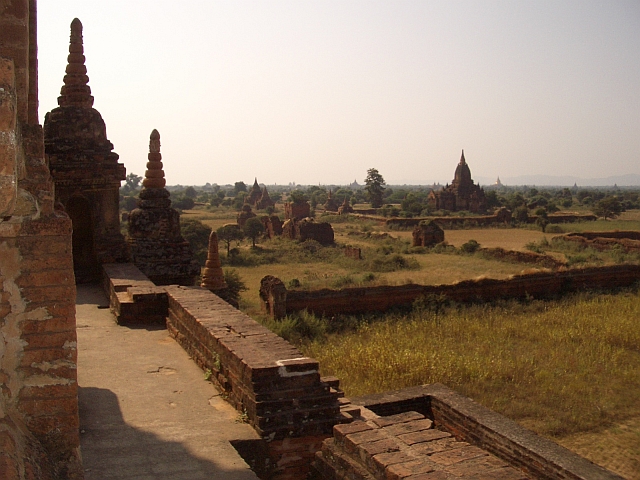
4 Bagan

We all laugh, imagining this unlikely scene, like a slapstick comedy on TV.

“Should teach you to stay in bed until a reasonable hour,” I say.

“It was not funny,” Peter says, and tells us he quickly lowered his binoculars, and casually walked away.

“Apparently,” Ileana says, “the generals are staying at the property next to the hotel.”

“You better be careful,” I say, smiling.

“They might come and take you away,” Ileana says, teasing him, because instead of joining us today, Peter is off on his own birding expedition.

After breakfast, we head out on foot to look at temples all around us, though we could rent a horse-drawn cart or a bicycle. Bagan, formerly Pagan, is an ancient city, the capital of the Kingdom of Pagan between the eleventh and thirteenth centuries, ruled by King Anawrahta. Situated in the dry zone and sheltered from the rain by the Rakhine Yoma mountain range in the west, it spreads for forty-two square kilometres along the east bank of the Ayeyarwaddy. At one time, the plain was dotted with over 10,000 Buddhist temples, pagodas and monasteries. Today, only the ruins of about 2,200 remain, rising above and among the desert vegetation. Of these, the gold and white ones are still in use, while the red brick ones aren’t.
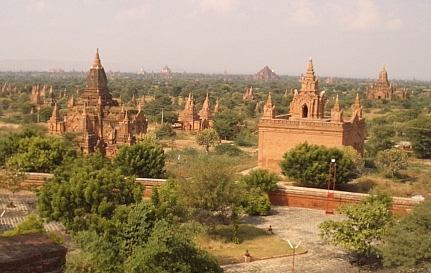
2 Bagan

3 Bagan

It feels as if we are the only people in this vast landscape of red earth, stippled with ancient spires, pagodas, temples. Desert brush and vegetation abound, dirt paths snake from one monument to the other, haphazard and circuitous. Quickly, however, two young boys attach themselves to us — Soe Myint wears a white dusty T-shirt and longyi, and Zaw Win an ochre T and jeans rolled up to mid-calf. Both their cheeks are white with thanakha and on their feet, flip-flops. In the woven bags around their bodies, the children stash accordions of postcards they sell for 1000 kyat.

“We are guide,” Zaw Win says. “We show you.”

We follow the children, who explain the history of the ruins, their voices rising and falling, their fingers pointing out this temple or that pagoda. Much of what we learn from the local people and the guides is oral tradition, difficult to substantiate through books or websites (as I later discover), but far more interesting. There has been no free press here for decades. The Internet is monitored and blocked. Ileana and Peter get their news every ten weeks in Bangkok, where they go to renew their visas.

“Do you go to school?” Frank asks.

“No,” Soe Myint says, “no money for school.”

I think about our spoiled children at home, our lax education system, the students’ sense of entitlement to good grades, the many functionally illiterate high-school graduates we see year after year. I understand why Ileana enjoys teaching overseas, in countries where education is valued, where students are eager to learn.

A military truck approaches in a cloud of red dust, its open bed filled with heavily armed soldiers, who roam, feral and unchecked, through the countryside, barking orders. We yield to the passing truck. I assume the soldiers are headed for Sinmayarshin Temple, whose golden stupa was regilded in 1997 by Than Shwe, on the advice of his soothsayer; Than Shwe, whose beliefs fuse Buddhism, Nat worship, astrology, and Yadaya magic rituals — an excellent witches’ brew for politics.

As we walk along, a venomous snake crosses the road, a slithering metaphor. We stare at the imprint it leaves in the earth. In this Garden of Eden live thirty-nine deadly snake species, many of which thrive in the abandoned temples of Bagan. Burma has the highest death rate from snakebites in the world — about 1,000 people a year just from Russell’s Vipers. Like everyone here, we walk barefoot along dark passages.

“King Cobra,” Soe Myint says, keeping a safe distance as the snake slinks away. “See it is thinner in one part and thicker where the head is.”

I try to stare at the ground from then on, but not for long, distracted by the splendour of the ruins, the brilliant skeletal frangipani along the road, and then, up ahead, a red carpet stretched to the stairs of a temple, the path bordered by red bougainvillea, and lined with soldiers who stand silent and forbidding in the sun. The children suddenly disappear.

Today was to be the start of the Popa Nat Festival, a festival that goes on for six days, beginning on the first day of full moon in Nadaw, which corresponds to our December. “Nadaw” in Myanmar characters transliterates as “Nat Taw,” meaning “Spirit Respect,” the veneration of Deities. However, because General Than Shwe is in town, the festival is not allowed.

Wherever he goes, a small army precedes him, clearing the area, setting down red carpets for him to walk on, lining these carpets with soldiers, like wild dogs keeping everyone frightened. He is enemy number one of the people, no matter how much he travels around, pretending to spread goodwill. It is obscene to see the money spent on pomp for this regime, for the new capital Naypyidaw, for the red carpets and lavish houses for the generals, whose disregard and disdain for their own people is staggering.
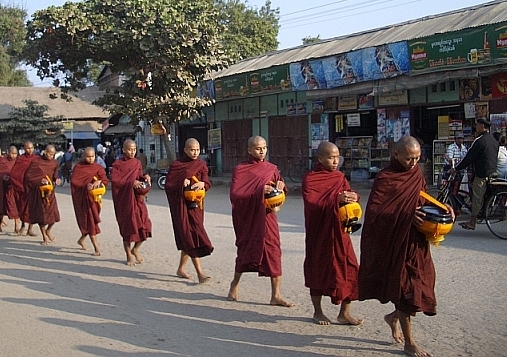
Bagan monks

We walk past the guards and climb the steps. This temple has padlocked iron gates at every entrance except for one — a security measure for the general, though we have seen no one all day. We remove our shoes, step on the red carpet and tiptoe inside, walking anti-clockwise through the long dark passages, admiring the Buddhas, stucco carvings, frescos. As we come to each opening, we find a padlocked gate, and soon we feel as if we’re in a maze and have lost all track of where we entered. A motorcycle revs outside, a warning surely. Then a wild dog barks, a man shouts, the motorcycle revs, other wild dogs join in, growing in magnitude until the air reverberates with deep sonorous woofs, yappy small-dog yaps, snarly Rottweiler growls, howls like wolves. A cacophonous canine symphony, an ominous soundtrack. It’s easy to imagine we’re locked inside. It’s easy to imagine a King Cobra slithering toward us. My heart beats faster, recalling the pack of soldiers, the ruthlessness they’re known for. My feet speed along the red carpet, and finally, there, the open gate.

We rush out, relieved, and avoiding the red carpet, scramble away from the temple. The soldiers watch us go, their faces impassive.

The two boys now reappear from behind a bush, eager to resume their guiding duties. We turn a corner and find a soldier facing us. Startled, we nod and walk on. At the end of another path, the soldier. The children are wary, furtive. They duck behind bushes. For the rest of the afternoon, no matter where we go, the soldier follows, sometimes surprising us at the top of a temple, his proximity threatening, like the wild dogs circling below. The children disappear whenever he’s visible, as if tuned into a collective memory.

“This is biggest temple,” Zaw Win says, pointing to Dhammayangyi Temple, a step-pyramid made of identical bricks without mortar.

“Look at the bricks,” Ileana says. “They are so precise. According to legend, while this temple was being built, King Narathu would execute masons if he could stick a pin between the bricks. Can you imagine? It was never completed.”

“No wonder,” I say. “He must have killed all the masons.”
temple

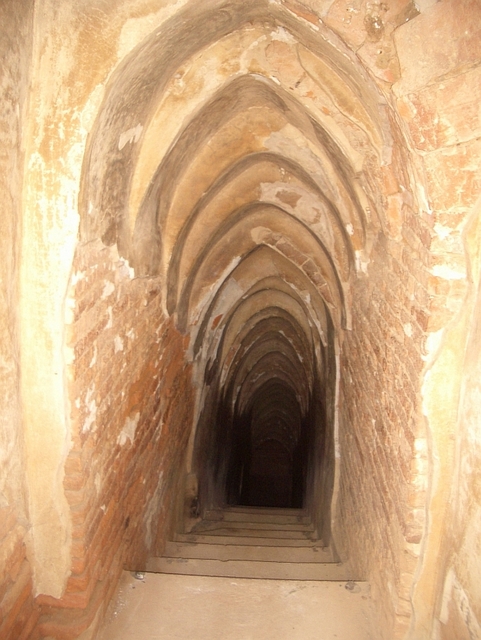
This temple has dark long corridors — approximately twenty-five metres per side — surrounding an enormous central core completely filled with rubble. No one knows why, or whether this core is simply a buttress to support the massive building.

We follow the passageways around, tall narrow walls pressing in, and when we get to one end, where small, perforated stone windows let in light, Ileana stops. “You know what this reminds me of?” she says. “Pozzecco.”

I stop too, and think about that. Pozzecco is a small village in the north of Italy, where my father’s aunts lived and farmed various fields. Ileana and I visited in summers, lay on top of hay wagons, watching the thin dusty road winding among green fields. “You’re right,” I say. “The paths, the colour of the earth, the feel of this is like Pozzecco.” And I recall the magic and superstitions of those happy days, when we slept in the stone mansion, which our great-aunts had convinced us was haunted. “And the ghosts, remember?” I say to Ileana. “Scrabbling in the ceiling, over our bedroom.” I look up, where high in the darkness hang hundreds of bats.

“They had silkworms up there,” Ileana says. “You didn’t really believe the ghost stories, did you?”

“We both did,” I insisted, and recalled a memory within a memory — a visit I made to Udine in 1982, to my father’s ancestral home where his sister lived, and how, on hearing I was going to visit the great-aunts, she had dissuaded me from staying overnight, citing malevolent ghosts. It grieves me to think how heartless I must have appeared, returning after so long to visit the last two octogenarian great-aunts, with whom my childhood summers are entwined, and not even spending a night with them in that mansion, with its long dark stone corridors, like the ones here in Myanmar, decades later.

“Actually,” Ileana says, “I wasn’t thinking about that at all. What I was recalling were the times — maybe you weren’t there — when I went to Pozzecco with the boy cousins, who would dare me to do crazy things in order to let me play with them.

“One day, I was wandering through the fields with our cousins, and we found an underground passage, a fallout shelter — I think that’s what it was, or maybe it was a bunker for soldiers during WWII. It was a cave, really, with a very small opening. Of course, the cousins dared me to go inside.” She pauses. “We had been warned about poisonous snakes that lived in crevices in the earth, so naturally, I was afraid. However, I wasn’t going to let the boys get the best of me. I was such a tomboy!”

In the winters, when Ileana came to visit me in Rutigliano, she was considered too loud, too rambunctious, an unbroken pony who galloped through the house, broken objects and scoldings trailing behind her.

“And did you?” I ask, though I have no doubt.

“Of course. I was petrified, but I crawled in and it was dark and dank, just like in here, only the walls were closer. I thought a snake would bite me. Oh, they were so impressed with me after that.”

“I was definitely not there,” I say.

“One of the boy cousins was Australian,” Ileana says. “Tulio, I think his name was, and what I remember is his mother, who was everything I wanted in a mother. She took the time to sit with me, to teach me to embroider, and do all the things that little girls did back then. I wanted her for my mother.”

I think about the childhood longing for this perfect mother in those years when there was none. Yet we’ve become who we are because of our pasts. Would we be here, now, in this remote location? Would we have travelled as we have — I for years a vagabond musician on the road — my sister endlessly displaced, returning every year to an altered home? The two of us, rediscovering each other in a foreign land?

Early Morning Ayeyarwady River

 §

At breakfast, in the morning, we continue to tease Peter about the binocular incident with the soldier, and blame him for our being followed the previous day.

“Careful when you’re in the pool,” Ileana says.

“Watch out for the King Cobra,” Frank says.

“Don’t go walking on any red carpets,” I say.

And suddenly, in the midst of our hilarity, arrives a pack of soldiers flanking a general, who strides directly to our table, as if he’s heard everything we’ve said.

“I am General Soe Naing, Minister of Hotels and Tourism,” he announces. He has a large white star on his uniform. “How long are you staying?” he asks, which feels like a trick question.

Our laughter wanes. Our earlier defiance dissipates as the twelve armed soldiers surround our table. Beside me, Frank’s face is set. I wonder what consequences there will be if he speaks up. The general looks carefully at each of our faces, but returns to Frank’s repeatedly. What could they do to us? I recall the statements we had to sign in order to secure visas, statements that say if we speak against the government, we can be imprisoned. Oppose those relying on external elements, holding negative views.

I listen to the murmur of our innocuous responses, to the wind through the banyan tree, the clatter of coffee cups against plates, the chatter of White-throated babblers, the soldiers’ boots on stone, the echo of growls, the barks of wild dogs around us, and when the general leans forward, his face in a tight smile, and holds out his hand to each of us, I watch myself from a distance, as if my arm does not belong to me, as it moves up to shake his hand. And the dogs howl.

—Genni Gunn

————————–

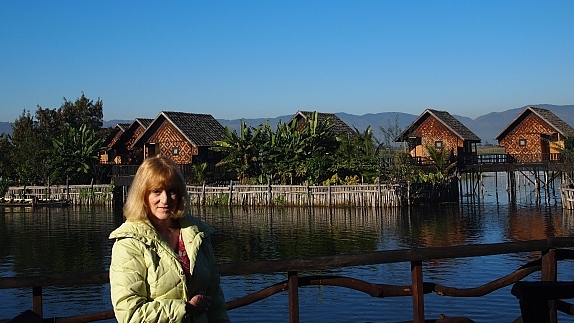
Genni Gunn in Myanmar

Ileana, Peter, Genni & Frank

Genni Gunn is a writer, musician and translator. She has published three novels: Solitaria (Signature Editions), nominated for the Giller Prize 2011; Tracing Iris, made into a film titled The Riverbank; and Thrice Upon a Time; two story collections,  two poetry collections, and two translations of poetry collections by Dacia Maraini. Her books have been finalists for the Commonwealth Prize, the Gerald Lampert Poetry Award, the John Glassco Prize and the Premio Internazionale Diego Valeri. She has written the libretto for the opera Alternate Visions, produced in Montreal in 2007, and showcased at the Opera America Conference in Vancouver, May 2013. She is an avid traveler, and her experiences are reflected in her most recent book, Tracks: Journeys in Time and Place (Signature Editions, 2013).

Mar 072012
 

Genni Sittway3

Here is a brief, sweet, melancholy memoir of Italy by my Italian-Canadian-singer-composer-writer friend Genni Gunn who lives in Vancouver but has a foot, a hand, a heart, still in southern Italy. She last appeared on these pages with an excerpt from her novel Solitaria which was long-listed for the prestigious Giller Prize.

dg

§

I’m in a rented car, at a railway crossing on the outskirts of Rutigliano, in southern Italy, when the train passes and the squeal of its wheels on metal transports me to a time before my birth, to a 1940 night sky in Locorotondo, where from her room my aunt Ida watched trains emerge and disappear into the railroad cutting in front of my grandparents’ house.

It’s May 2007, and I’ve spent the last month at the bedside of this aunt who, over the past five years, has told me her life story so often, I have begun to appropriate it, weeping and laughing in all the right places, mouthing the words right along with her. Ida is the guardian of our family stories, our oral historian. She claims absolute knowledge of everyone – despite my mother’s objections – and will recite particulars from all our lives, in dramatic arcs, complete with dialogue – mythologies which are difficult to prove or disprove.

I have been taking daily drives into the countryside to escape the weight of her past which, for the most part, Ida recounts in tragic, melodramatic tones, ending in maudlin, self-pitying sentences such as, “Oh how I’ve suffered!” and “I have worn out my threshold of pain.” During these afternoon drives, I can breathe deeply, unencumbered by her reproach which feels directed at me, even though her stories occurred decades before my birth.

Locorotondo from casello

I cross the tracks, and continue along the highway. At either side, rows upon rows of vines spread their arms beneath the mammoth nets that protect the grapes from hail, like prisoners praying for rescue, their legs tied, their heads back, faces to the merciless sun. As I drive on, the sky darkens with thunderclouds, and a surge of excitement – a memory – presses against my temples. I follow it to Locorotondo, tracing the map in my aunt’s head, the map of a young girl walking to school in the morning snow, flanked by her two brothers, Pippi and Alberto, all of them in paper-thin shoes and rough hand-knitted sweaters, all of them happy, carefree, Ida tells me, in a way she’s never felt since.

I approach the town from the north, drive up into it, up up past the school where Ida spent that year teaching small children, past the overlook at the park where old men on benches stare at the sprawling valley below.

My grandparents moved here in July of 1940, a month after Mussolini declared war on the Allied Forces. As a trackman, and also because of his difficult nature, Nonno had been relocated so often, his seven children – of whom Ida was the eldest – were dizzy with disruptions, unable to make friends, and weary of strangers, who constituted everyone outside the family. It explains, perhaps, Ida’s melancholy, her persistent memory, although she attributes it to Fridays – the day of her birth – which she tells me is unlucky, because it’s the day Christ died. A day of superstitions, she says, a small ironic smile curling her lips. Back then, people did not shop on Fridays or begin new projects or sign contracts or plan feasts. On Fridays, she tells me, people did not marry, nor did they baptize their children. If a man shaved on a Friday, he would be betrayed by his wife, or he would become widowed at an early age, and he who cut his nails on this day, would have to gather them on Judgement Day. One did not go visiting, send gifts, nor buy clothes, and if the first day of the year was a Friday, there would be wars, tempests and a thousand other natural disasters. Furthermore, she tells me triumphantly, children born on Fridays can expect to cry often during their lives – and this Ida has proven to be true.

Locorotondo Casello 72

My grandparents’ Casello Ferrovia #72 – the trackman’s hut – is situated next to a railway crossing, the tracks of which wind below the hill, two kilometres from Locorotondo, in the Valle d’Itria, a karstic depression, not actually a valley, but a firmament of green hills and vales studded with over 20,000 trulli – the white conical ancient dwellings – and with limestone farmhouses. Locorotondo – round place, as the name suggests – is one of numerous marvellous towns found throughout southern Italy, built on hilltops, and fortified by immense walls and towers. Inside are medieval cities, all wonderfully preserved. From the highways at night, these towns look magical, lit up and round like multiple nativity scenes. In the daytime, Locorotondo rises four hundred metres above sea level, one of three natural balconies that surround the valley, and from which one can admire the Mediterranean brush, an indigenous vegetation that includes groves of Macedonian, bay and holm oak, laurel, myrtle, hawthorn, lentisk, wild olives and black orchids. Nowadays, this valley is a patchwork of stone stitching an infinite number of handkerchiefs of red earth, dominated by vineyards and country estates. When my grandparents lived there all those years ago, however, they knew nothing of castles or monuments, didn’t realize those oaks were 800 years old. All they saw was a pervading green, stone walls built without mortar, fields of red poppies and yellow daisies. And at night, outside their window, the town appeared suspended in darkness.

It takes several tries before I can decipher how to reach the casello. I have to return to the lookout, to fix my memory – my aunt’s memory – on the green on green, forget the new developments, the villas, and the asphalt roads which slice through the valley, and concentrate on the wild brush, the faint chugging of a steam engine in my head. Finally, I spy a dirt trail that circles to the right, and following it, soon find myself in Ida’s youth, surrounded by small limestone walls covered in lichen, fields of forage swaying, and bunches of red poppies growing amongst the rock. I follow the railway tracks directly to their casello which stands exactly as it did when she was young – red, its number plainly visible. I park the car and walk on the two-foot path beside the tracks, around the circular waist-high wall to the front. On these paths, Nonno rode his bicycle to work, and each morning, the children walked to the station more than a kilometre away, to catch the train for school. On this path, in the cutting which rises high above my head, my aunt learned about the earth, about rocks, stratification, about fossils visible in the limestone. They seemed wider back then, she tells me later, welcoming, these paths which led them into the world outside the family, paths which in memory have expanded both in size and significance.

The casello itself is changed and yet the same. One of the windows has been bricked in, and against the wooden door is a padlocked steel grate. At the back, the oven gapes like a yawn in the afternoon sun. I lean my head in and close my eyes, imagining the children’s mouths watering, breathing in the distant scent of Nonna’s bread on Mondays. They were allowed only one slice a day, “until the war ends,” Nonno said, and the children dreamt of loaves of bread. They had so little, even their dreams were small. It seemed a marvellous childhood, Ida tells me, we were dying of hunger, we had fleas so large we had to smash them with hammers, we had mosquitoes that ate us raw, and yet everything felt normal at the time. We had bread, and a house to live in, and we were very fortunate. As well, because we didn’t know anyone who was wealthy, we had no comparisons to make. Not like now, with TV, where everyone knows how the wealthy of the world live.

I walk around the small circular yard surrounded by stone where for one summer, Nonno grew tomatoes, zucchini, eggplant, potatoes and onions, where Ida planted geraniums between the rocks. None of this is evident now, the earth reclaimed by nature’s wild grasses and flowers. Everything dwarfed by age, but I have only to close my eyes, and the casello is vivid with their nine lives, with their perfect happiness constructed inside my head.

Across the tracks from the casello, a small road leads up and over a rise. I follow it, past the abandoned trulli where decades ago lived a young woman who grew red roses – flowers my aunt had never seen before – past a carrozzeria – a fairly recent car graveyard surrounded by a chain link fence, past wild trees of cherry, almond, fig and hazelnut, past the sprawling sculptures of flowering cactuses, imagining the taste of fichi d’India – prickly pears – of my own youth, past swishing biada and gold lichen on the white white walls, heading for the end of the road, toward a story my aunt has told and retold so often that I feel as if I, too, am part of that November evening in 1940, after supper, when Nonno and Nonna heard the sound of thunder in the distance. Nonna crossed herself and cast a worried look toward the smallest child, Alberto, who sat at the table drawing. He had been born during a thunderstorm, and she believed that babies born during a thunderstorm have a lifelong tendency to tremble, that they fear things will collapse on them, that their sparkling eyes cannot hold another’s gaze, that they have brilliant ideas and thoughts but cannot articulate them because they will always be thinking about thunder and the possibility of the earth breaking open and swallowing them whole.

The thunder continued, but sounded strange – at times like a punctuation, other times drawn out. “It’s a bombing,” Nonno said suddenly. “Get the boys up.”

Nonna and Ida quickly awakened all the children and together they ran up the hill to the top from which they could see the lights of the port of Taranto on the Adriatic coast, with its arsenal and shipyards, chemical works, iron and steel foundries and food‑processing factories. In the darkness, the thirty kilometres of verdant fields in front of them disappeared. Mario who read newspapers every day, told them that the entire Italian fleet was harboured there, and that Taranto was impenetrable, with its shoreline cannons and its metal nets under water, so that even submarines could not reach the ships.

But even as he said this, aeroplanes swirled in the sky like a flock of pelicans over a school of fish, and dropped hundreds of torpedoes and flares into the harbour. The Italian cannons fired back non-stop. Projectiles flew hundreds of metres into the air. The sky was ablaze, the air thick with thunderclaps. Every now and then, a deafening blast echoed underfoot, the sky brightened into an artificial dawn and they knew a ship had exploded. In that 1940 darkness, those spectacular, recurring bombings seemed like fireworks. The boys stared with shiny, bright eyes; they were childish enough to be fascinated by the idea of war, and fortunately too young to join. They hollered and sprang in the air, feverish with excitement, arms out, fists punching the sky. This, despite the fact that since the war had begun, Nonno had been listing the horrors, using his and his brothers’ experiences in WW I as examples – a completely unsuccessful tactic, given that unperturbed, the boys continued to construct guns and canons from which they launched pieces of wood and pine cones against imaginary foes which often included their siblings.

In the following day’s newspaper, they read, “Last night, a large number of British enemy torpedoes attacked the port of Taranto, extensively damaging numerous ships of our military fleet.” They were stunned. Hadn’t they been told Taranto was impenetrable? Wasn’t Italy going to become a superpower? Of course, they didn’t realize what the state-controlled papers did not say: that all the ships had been sunk.

My aunt went outside and crossed the tracks to the little country chapel across from the casello, opened the gate and knelt in front of the Madonna and Child frescoed onto the back wall. She understood nothing of politics – it seems impossible now to think that while atrocities proliferated around them, the family existed in a pocket of staggering ignorance. Ida says they were so poor and so hungry, for them the war was a phenomenon occurring in a distant parallel universe that had nothing to do with their inside world of babies and children, where the dangers far outweighed any external imminent one – Pippi could step on a rusty nail; Alberto could drink stagnant water and contract typhoid; Bruno could succumb to pneumonia; Bianca could slide under the rails of a train. They were constantly vigil. Living, itself, was a danger.

Outdoor chapel Locorotondo

In that little chapel, my aunt prayed for everyone: for all the sailors who surely had been killed, for all their wives and children, for the British soldiers who had dropped the bombs, for their wives and children who would have to live with the knowledge of these deaths, for her siblings who seemed unbearably vulnerable, and for her mother and father who, she suddenly understood, couldn’t protect them from unspeakable evil.

I leave the hilltop, and walk back to the casello, past the country chapel that, with the exception of a locked iron gate, has remained exactly as my aunt described it, back to my air-conditioned car, imagining the sound of thunder, thinking how fortunate we are to never have witnessed war in our comfortable houses in Canada, to never have had to cower in our beds, expecting the sound of sirens.

I hear a train and quickly move off the tracks, experiencing a small moment of fear, like Ida must have – worried about the children, overly sensitive, overly morbid, always searching for the dark side of things.

The train is a pathetic old thing, four wagons only, all dirty and graffitied. I watch it turn the bend in the cutting, thinking how unlike what my aunt remembers, this decrepit train hobbling along, anachronistic in the wealthy landscape, the villas and superhighways nearby. I think how sad Nonno would have felt to see it, for surely it would have diminished him to witness its uselessness. And I think of my aunt, and for a moment, I feel the depth of her sorrow, her premonition that everything is gone, and that her awareness sprung of that night in 1940 was merely the beginning of a long line of disillusionments that would populate the rest of her life.

—Genni Gunn

—————————————————————

GENNI GUNN’s nine books include three novels – Solitaria (long-listed for the Giller Prize), Tracing Iris and Thrice Upon a Time; two story collections – Hungers and On the Road; two poetry collections – Faceless and Mating in Captivity; and two poetry collections by Dacia Maraini in translation Devour Me Too, and Travelling in the Gait of a Fox. Her opera Alternate Visions (music by John Oliver) was produced in Montreal in 2007. Her works have been translated into several languages, and have been finalists for the Commonwealth Prize, the Gerald Lampert Poetry Award, the John Glassco Translation award, and the Premio Internationale Diego Valeri for Translation. She lives in Vancouver. This memoir, without the lovely photos, was published by Wolsak and Wynn in Slice me some truth: An anthology of Canadian Creative Nonfiction, September, 2011.

Genni Ngapali beach2

Oct 272010


ENTRIES ARE OFFICIALLY CLOSED

Entries close midnight Sunday, November 21.


The First Annual Numéro Cinq Rondeau Writing Contest opens for entries November 1 (midnight tonight as of this writing). The rondeau is a slightly intricate little form (see preamble and definitions below). You should not attempt to write one under the influence of intoxicants or while using a cell phone (unless you are writing it on your cell phone). Also do not attempt to operate heavy machinery while composing your rondeau. Don’t shy away from trying a rondeau just because you consider yourself a rhyme & rhythm-challenged prose-writer. Fiction and nonfiction writers always need a dash of form in their lives, something to make them sit up straight (or just to jar the gears loose). As with all the NC contests, there is a method behind the madness. Beyond the discipline of form, we discover the freedom of aesthetic space. Every contest is a teaching moment, a formal lesson, and a moment of unleashing (paradoxical as that seems). Also, if you look at our previous contests, you will see that they are fun. Submit entries by typing them into the comment box beneath this post.

Continue reading »

Sep 122010
 

Genni venice

Here are the opening pages of Genni Gunn‘s new novel Solitaria. Genni is an old friend of DG, dating back to the time before he had children and used to fly across the country to this or that summer workshop (the summer he met Genni, he did three in a row in New Brunswick, Ontario and Saskatchewan). Once upon a time, Genni used to tour with bands in western Canada, which always struck DG as exciting and romantic (given his own sheltered upbringing). Now she writes novels, stories, and poems and the occasional opera. She is Italian by heritage. The photo above was taken in Venice and seems to DG to be iconic–Genni in the mysterious aquatic city, only half-western, caught in the embrace of the golden and opulent east.

By way of a further introduction, here is the novel trailer.

http://www.youtube.com/watch?v=oaXiH_NSRqE

dg

From Solitaria

By Genni Gunn

Facilis descensus Averni:
noctes atque dies patet atri ianua Ditis;
sed revocare gradium superasque evadere ad auras,
hoc opus, hic labor est.

It is easy to go down into Hell:
night and day, the gates of dark Death stand wide;
but to climb back again, to retrace one’s steps to the upper air,
there’s the rub, the task.

— Virgil

Prologue
Fregene, Italy, July 15, 2002

They navigate through thick traffic, from Rome, for an hour and a half, in stifling heat, among stalled cars and angry drivers. Finally, the Fregene exit leads them off the freeway, and onto Viale di Pineta through the ancient pinery, down to Lungomare di Levante, where they turn left at the seashore, and continue until they stop in front of iron gates, chained and padlocked. Visible through the bars, a dilapidated villa rises among pines and wild hibiscus whose magenta petals shimmer in the July heat. Yellow police tape girdles the entire area.

Once, this villa was the pride of its owners, nestled in a sprawling lot facing the Tyrrhenian Sea, surrounded by palms and oleanders on manicured lawns where children played and cats sunned themselves. Over time, the children grew and moved to the cities. When the owners died, the villa was sold to foreigners who came only in summer. In the winter months, small boys climbed over the fence and played in the tall grass no one tended. Sometimes, they built fires on the beach, and tried to pry open the green shutters. The villa was sold and resold, neglected and abandoned by owner after owner, none of whom lived there.

“This must be it,” the cameraman says, pointing to the number on a pillar whose plaster has broken away in chunks to reveal old bricks and mortar. He turns down the air conditioner.

The show’s anchorwoman sits beside him, fanning herself with a small spiral notebook. On the side of the van, the familiar logo — a large c ending in a question mark, inside which are the words: Chi L’Ha Visto? Who Has Seen Him?

A policeman unlocks the gate, checks their ids, and lets them in. While the crew unloads the van, the anchorwoman walks around, surveying the area for appropriate footage.

The villa looms over her, casting a dark shadow to the east, eclipsing the tent erected over the excavation site — a makeshift lab where forensic specialists gather specimens. She shivers under the unrelenting sun, then searches for the demolition foreman, interviews him, and jots his answers in the notebook.

The new owners want to tear it down and build something new.

We were going to take out the trees first, and that’s when we found him.

Continue reading »