Sep 052013
 

Krasznahorkai_Laszlo600_300_338

“This is my recommendation: we must live more attentively.”

 – László Krasznahorkai

Seiobo_300_450

Seiobo There Below
László Krasznahorkai
Translated from the Hungarian by Ottilie Muzlet
New Directions
448 Pages, Paperback, $16.95

There was a time when, as a Romanian poet once put it, every rotten tree trunk held a god. In Seiobo There Below (Seiobo járt odalent, 2008), László Krasznahorkai reminds us repeatedly that this time is long past. Not only is the sacred in retreat from the world, but we have forgotten how to perceive it (two sides of the same coin, some might say)[1]. And yet the fifty-nine-year-old Hungarian author persists in speaking of transcendence. For Krasznahorkai, the spirits that once conveyed mystery and authority have not completely withdrawn; traces of the divine may still be discerned in the making and receiving of tradition-bound forms of art. Seiobo There Below represents seventeen remarkably diverse and ambitious forays into aesthetic grace.

Seiobo is the fifth of Krasznahorkai’s sixteen books to appear in English. The fact that his other major novels in English translation – The Melancholy of Resistance, War and War, and Satantango – have primarily been set in Eastern Europe makes this latest effort seem like more of a departure than it actually is. A large part of the North American perception of Krasznahorkhai as “the contemporary Hungarian master of the apocalypse” (as Susan Sontag famously labeled him), has to do with the epic film adaptations of Krasznahorkai’s work that he and his friend director Béla Tarr have collaborated on (Damnation, Sátántangó, Werckmeister Harmonies), as well as the order in which the author’s books have appeared on these shores (his first novel, Satantango took 27 years to make it into English). As Seiobo’s translator Ottilie Muzlet has pointed out, Krasznahorkai’s Hungarian readership would be aware of the fact that the years 1999-2008 marked a transitional period in his work, which saw him turning increasingly to the Far East for inspiration.[2]

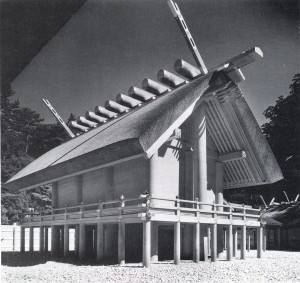
Fittingly then, the original Seiobo is a work of fifteenth century Japanese Noh theatre, in which the titular goddess comes down from heaven to the earth below, bearing immortality. While the character Seiobo appears in one chapter of Krasznahorkai’s latest work, and Noh theatre pops up in a handful of others, the title Seiobo There Below describes more generally an arc that recurs in a variety of locations and tonal registers throughout the book’s seventeen sections. Each chapter presents an intersection (or failed intersection) between the sacred and the human, the immortal and the perishable, via aesthetic production and/or reception. Krasznahorkai alternates between Europe and Asia, ranging across 3000 years of cultural history, featuring familiar works such as the Alhambra, the Acropolis, and the Venus de Milo, but also a 500 year-old copy of Andrei Rublev’s Trinity Icon, the restoration of a Buddha sculpture, and the rebuilding of Japan’s Ise shrine.

1929933703_8c6cc973cc  a041-honden-(main-hall)--ise-mie-pref

In the book’s first section, entitled “Kamo-Hunter,” the object of aesthetic contemplation is a white bird standing in the middle of Kyoto’s Kamogawa river:

A bird fishing in the water: to an indifferent bystander, if he were to notice, perhaps that is all he would see—he would, however, not just have to notice but would have to know in the widening comprehension of the first glance, at least to know and to see just how much this motionless bird, fishing there in between the grassy islets of the shallow water, how much this bird was accursedly superfluous; indeed he would have to be conscious, immediately conscious, of how much this enormous snow-white dignified creature is defenseless—because it was superfluous and defenseless, yes, and as so often, the one satisfactorily accounted for the other, namely, its superfluity made it defenseless and its defenselessness made it superfluous: a defenseless and superfluous sublimity; this, then, is the Ooshirosagi in the shallow waters of the Kamogawa, but of course the indifferent bystander never turns up; over there on the embankment people are walking, bicycles are rolling by, buses are running, but the Ooshirosagi just stands there imperturbably, its gaze cast beneath the surface of the foaming water, and the enduring value of its own incessant observation never changes, as the act of observation of this defenseless and superfluous artist leaves no doubt that its observation is truly unceasing…

Vision is crucial in Krasznahorkai’s work. Even in the sad and hilarious thirteenth section, the sole chapter of Seiobo There Below to focus on sound, the visual trumps the aural when a failed architect delivers a hysterical lecture on Baroque music to a group of elderly villagers who cannot take in the man’s words, because “it was really his gut that captured the attention of the locals, because this gut with its three colossal folds unequivocally sent a message to everyone that this was a person with many problems….” In the Kamo-Hunter chapter, however, the white bird serves a dual function. If it were enough just to see this bird in the river, then the initial clause, “A bird fishing in the water,” would suffice. The bird is a living work of art, but Krasznahorkai also grants the creature “the artist’s powers of observation,” so that it possesses the very powers of aesthetic perception that the prose displays. From the outset, Krasznahorkai suggests that perceiving the sublime is going to take more than simply looking as we are accustomed to doing (though the indifferent bystander is incapable even of this).

In The Senses of Modernism, Sara Danius reminds us that, “The etymological meaning of ‘aesthetics’ springs out of a cluster of Greek words which designate activities of sensory perception in both a strictly physiological sense, as in ‘sensation,’ and a mental sense, as in ‘apprehension.’” The indifferent bystander never turns up, but there is at least one person who perceives the Kamo-Hunter with an etymologically faithful aestheticism bordering on obsession: our narrator. In this opening chapter, Krasznahorkai caresses his white bird in mesmerizing, exhaustive prose, returning to it again and again as he weaves his way through modern day Kyoto, the “City of Infinite Demeanor.” The above sentence continues for another half-page and is by no means one of the lengthier ones in the book (in defense Krasznahorkai’s long sentences, the man knows how to wield a semicolon). It is as if the author is attempting a feat of linguistic perception to rival the bird’s “truly unceasing” gaze of “enduring value.” This heroic effort ensures that, in a delicious paradox, even those chapters that present failed intersections between the sublime and the human enact a level of writerly attentiveness that approaches transcendence.

Let us note one further thing about this opening chapter: an adjective attached to the word beauty. “The bird is granted the artist’s powers of observation,” we are told, so that it may represent “unbearable beauty.” For Krasznahorkai, immanence is a terrifying proposition. Few of the encounters with the aesthetic sublime in this book lead to healing, redemption, or acceptance. In a later chapter, a migrant Hungarian labourer’s unintentional encounter with a Russian icon painting leads him to purchase a large, sharp knife. Given the volatile power of art, why would anyone desire to commune with it as intensely as Krasznahorkai and some of his characters do?

Desire itself is commonly held to be the engine of the novel. It is important to remember that Seiobo is a novel, albeit one that at first glance appears to unfurl beneath an entirely different logic. For starters, the chapters are structured according to the famous Fibonacci sequence, and vary in length from eight to forty-eight pages. In the absence of a single main character, one way to connect Seiobo’s episodes to a central longing is to consider what Krazsnahorkai has said previously about his writing, that the sentences “are really not mine but are uttered by those in whom some wild desire is working.” In this sense, the most obvious desire at work would be the Bernhardian compulsion to continue speaking, narrating breathlessly before that final end stop, death, is imposed.

Yet there is another, more commanding form of desire in Seiobo There Below. In a recent essay, Scott Esposito identifies in Krasznahorkai’s writing the aspiration to an “authority beyond the physical confines of our universe as we know it.” Is there another living novelist of whom this could be as convincingly said? Krasznahorkai’s search for this level of authority allies him with the high modernism of Joyce and Rilke (think Stephen Dedalus’s artist-God merging with the terrible angels of the Duino Elegies), and it may also be the driving force behind his search for transcendence in the process of making and receiving of art. There is a fine line between wanting to know God and wanting to be God, a fact which Krasznahorkai is well aware of, and exploits to his advantage. Esposito: “Modernism attempts to conflate the aesthetic with the religious.” Indeed.

The modernists’ desire for mastery has often been linked to the waning of traditional sacred structures in the West. In Seiobo, the European forms have long since been displaced, and it is only in Asia that we find contemporary cultures still connected to living traditions. Fredric Jameson has written that “Modern art drew its power and possibilities from being a backwater and an archaic holdover within a modernizing economy: it glorified, celebrated, and dramatized older forms of individual production which the new mode of production was elsewhere on the point of displacing and blotting out.” Certainly, on one level, this is precisely what Krasznahorkai is engaged in. But notice Jameson’s tense: Modern art drew. This quotation comes from Jameson’s Postmodernism: The Cultural Logic of Late Capitalism, published in book form in 1991, when Modernism and its concerns were considered passé. What then is Krasznahorkai up to? Is he merely inhabiting an unproductive nostalgia for the past? Why can’t we shake our desire for wholeness? Perhaps, as Gabriel Josipovici has argued persuasively, Modernism’s concerns need to be understood not as belonging only to a particular era, but “as the coming into awareness by art of its precarious status and responsibilities, and therefore as something that will, from now on, always be with us.”

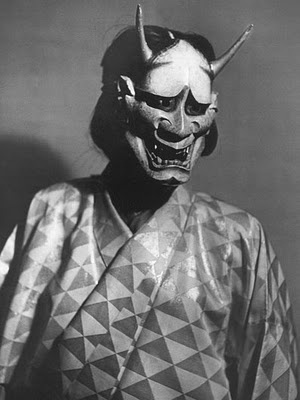
This is ultimately the reason why a book that examines the notion that the divine inhabits certain aesthetic objects can feel both epically, off-the-radar strange, and at the same time perfectly relevant. That Krasznahorkai successfully traces this inexplicable presence through a sixty-four clue Italian language crossword puzzle, the making of a Noh mask, and across a twenty-three page single sentence essay on the mysteries of the Alhambra is evidence of an astounding ambition and mastery. Here we are solidly in the realm of what Steven Moore would call “the novel as a kind of delivery system for aesthetic bliss.”[3]

But Krasznahorkai doesn’t just dazzle, he terrifies. By the final chapter, Seiobo There Below has accumulated a horrifically beautiful, almost unbearable force.
tumblr_mkpm05LofK1r076xro1_400

Writing about William Golding’s Pincher Martin, Josipovici notes that the traditional purpose of fiction is to protect us from the reality of our deaths. Krasznahorkai strips this protection away. The reality of death is often close at hand in Seiobo; many of the encounters with art bring a sharp awareness of mortality. For Krasznahorkai, the mystery of art is the closest thing to truth that we can glimpse, aside from death. (Perhaps it is no coincidence that these days we have less and less attention to give to either). At the end of the Kamo-Hunter chapter, our narrator advises his bird on the wisest course of action:

It would be better for you to turn around and go into the thick grasses, there where one of those strange grassy islets in the riverbed will completely cover you, it would be better if you do this for once and for all, because if you come back tomorrow, or after tomorrow, there will be no one at all to understand, no one to look, not even a single one among all your natural enemies that will be able to see who you really are; it would be better for you to go away this very evening when twilight begins to fall, it would be better for you to retreat with the others, if night begins to descend, and you should not come back if tomorrow or after tomorrow, dawn breaks, because for you it will be much better for there to be no tomorrow and no day after tomorrow; so hide away now in the grass, sink down, fall onto your side, let your eyes slowly close, and die, for there is no point in the sublimity that you bear, die at midnight in the grass, sink down and fall, and let it be like that—breathe your last.

It is possible, of course, that art will one day no longer be with us, but it is more probable that we will no longer be with art. When there is no one left who knows how to perceive a work, then it may well as crawl off and die, like the white bird that opens Krasznahorkai’s book. But we have not reached this point yet. Against the odds, making and perceiving continue.

Eric Foley

———————

Eric Foley

Eric Foley holds an Honours BA in English and Literary Studies from the University of Toronto and an MFA from Guelph University. He has been a finalist for the Random House Creative Writing Award, the Hart House Literary Contest, and the winner of Geist Magazine and the White Wall Review’s postcard story contests. His writing can be found online at Numéro Cinq and Influencysalon.ca. He lives in Toronto and divides his time between his writing and teaching at Humber College.

Footnotes    (↵ returns to text)

  1. For a brief account of modernity and the loss of immanence, see Douglas Glover’s essay “Mappa Mundi, The Structure of Western Thought.
  2. For more on Krasznahorkai see the excellent Spring 2013 issue of Music and Literature, to which this review is greatly indebted.
  3. “Literature is a rhetorical performance, a show put on by someone who possesses greater abilities with language than most people. This is reading for the same reason we might go to the opera or the ballet: to be dazzled by a performance.” – Steve Moore, The Novel: An Alternative History, Beginnings to 1600
Aug 132013
 

andrewgallix

We live in a culture at war with itself, and I don’t mean the War on Drugs. I mean the thousand-year war between the rhetoricians and the dialecticians (as McLuhan had it), between the Ciceronian, elaborated style and the plain style of Peter Ramus, between writers who believe in the aesthetic joy of linguistic play over those who think words are just for communication (how dull and, well, Soviet that word can sound). Andrew Gallix offers here a dazzling and provocative note, a report from the front, on literary Modernism and Paul Valéry’s famous sentence “The marquise went out at five” conceived as a critique of the traditional, conventional, realistic, well-made (pick your own epithet) novel, or, really, anything that smacks of the prosiness of prose, of mere communication. Valéry’s line cleaved to the centre of the debate: Would you write a novel or a story or an essay containing a sentence as mundane as “The marquise went out at five”or not? As Gallix points out, the marquise has become a shibboleth in France for a certain kind of traditional (dull) writing. Not so much over here where prose dominates the market place. Something to think about. Andrew Gallix is the brilliant founder of 3:AM Magazine, he teaches at the Sorbonne, he writes for the UK Guardian. It’s a great pleasure to present his work here.

dg

.

How is the marchioness? Still playing Alice in Rubberland?
– Adam and the Ants, “Rubber People”

Surprising as it may seem, “The marquise went out at five” ranks among the most famous quotes in modern French literature. It could have been tossed off by some Gallic Bulwer-Lytton type, and in a manner it was, albeit a fictitious one. These hapless words were first recorded in the 1924 Surrealist Manifesto, midway through a rant against what Barthes would dub the “reality effect“. André Breton recalls the time when Paul Valéry assured him he would never write a novel, adducing his aversion to opening sentences à la “marquise”. Referenced by numerous authors, from André Gide to Nathalie Sarraute through Francis Ponge, the marchioness and her teatime peregrinations, came to embody everything that was wrong with a certain brand of conventional fiction.

It was not just the insipid incipits of well-made novels that Valéry objected to. He believed that writing always betrayed the complexity of human thought. “The more one writes,” he wrote, “the less one thinks.” Valéry’s Monsieur Teste — a close cousin of Melville’s Bartleby and Musil’s Ulrich — is particularly scornful of novels and plays, in which “being is simplified even to stupidity”. Like his character, the reluctant author felt that prose was essentially prosaic — a communication tool as pedestrian as a peripatetic marquise in a potboiler. Poetry, on the other hand, was conversant with the ineffable, and could therefore be regarded as a true art form. The fact that some of the greatest novels of the last century merged prose with poetry, and that some of the greatest poets of our time (Gary Lutz) are fiction writers, seems to invalidate this dubious theory. Nonetheless, Valéry’s quip tapped into a growing sense of disillusionment with the novel, which, despite some very notable exceptions, already seemed to have ossified in its Victorian incarnation. Compared with the avant-garde movements’ attempts to bridge the gap between art and life — chief among them, Breton’s Surrealism — the novel’s “puny exploits” (Beckett) seemed risible.

Above all, Valéry objected to the arbitrary nature of such perfunctory preambles, anticipating Knausgaard‘s recent crisis of faith: “Just the thought of fiction, just the thought of a fabricated character in a fabricated plot made me feel nauseous”. Here, the reader’s willing suspension of disbelief is tested to breaking point by the nagging feeling that the marchioness could just as well have been a duchess on a different timetable, or an alien on another planet. What is lacking, to quote Dylan Nice, is the sense of “a text beyond the writer to which the writer submits”.

The refusal to submit to external constraints was key to the emergence of the novel. Gabriel Josipovici analyses this trend in What Ever Happened to Modernism?: “Genres were the sign of submission to authority and tradition, but the novel, a narrative in prose, was the new form in which the individual could express himself precisely by throwing off the shackles that bound him to his fathers and to tradition”. The flipside of this emancipation of the writer (or privatisation of writing) was, as Walter Benjamin pointed out, isolation. No longer the mouthpiece of the Muses or society, novelists could only derive legitimacy from themselves. It is this crisis of authorial authority that Valéry’s marquise throws into relief.

In Reading WritingJulien Gracq took Valéry to task over the alleged randomness of his imaginary opening sentence. “Everything counts in a novel, just as in a poem,” he argues; it just takes longer for patterns to emerge. Quite. Even at a micro-level, any minor amendment can trigger a butterfly effect. Should the marchioness morph into a princess, for instance, we might suddenly find ourselves slap bang in fairy-tale territory. Should she pop out, say, instead of simply going out, the register, and perhaps even the meaning, would be altered, and so forth. The point, however, is not whether everything counts in a novel, but whether a novel of this kind counts at all.

“The marquise went out at five” parodies all those narratives that aim for verisimilitude whilst inadvertently advertising their fictive status. In so doing, the sentence conjures up a quantum multiverse of alternatives. It haunts itself, begging to be rewritten over and over again, until all possibilities have been exhausted, and it can finally be laid to rest. The most recent example of this repetition compulsion is Jean Charlent’s Variations Valéry (2011) — a series of pastiches of 75 different authors, riffing off the famous phrase (which Claude Mauriac had cheekily used as the title of an early novel). Significantly, the marchioness made an appearance in One Hundred Thousand Billion PoemsRaymond Queneau‘s famous collection of ten sonnets (1961). Composed as an antidote to a bout of writer’s block, it comes in the singular — but fittingly ludic — shape of a flipbook. The fourteen lines on each page are printed on individual strips, so that every line can be replaced by the corresponding line in any of the other poems. By the author’s reckoning, it would take someone 190,258,751 years to go through all possible combinations. Queneau thus succeeded in producing a work that was at once complete, always in the process of becoming (with a little help from the reader) and necessary (on its own combinatorial terms). It was also the founding text of the OuLiPo — Ouvroir de Littérature Potentielle, or Potential Literature Workshop — which Queneau launched with François Le Lionnais, in 1960.

Queneau parted company with the Surrealists over aesthetic, as well as political, differences. He increasingly objected to their experiments in automatic writing, premised on the idea that freedom was “the absence of all control exercised by reason” (Breton). “Inspiration which consists in blind obedience to every impulse is in reality a sort of slavery,” countered Queneau, “The classical playwright who writes his tragedy observing a certain number of familiar rules is freer than the poet who writes that which comes into his head and who is the slave of other rules of which he is ignorant.” Italo Calvino concurred: “What Romantic terminology called genius or talent or inspiration or intuition is nothing other than finding the right road empirically”. It is, paradoxically, through the observance of rules that emancipation takes place. “I set myself rules in order to be totally free,” as Perec put it, echoing Queneau’s earlier definition of Oulipians as “rats who build the labyrinth from which they plan to escape”.

Historically, the importance of the Oulipo is to have provided an escape from the Romantic cul-de-sac of unfettered imagination (or its Surrealist avatar, chance) through the reintroduction of external constraints.

—Andrew Gallix

.

Andrew Gallix teaches at the Sorbonne in Paris, and edits 3:AM Magazine. His work has appeared in publications ranging from The Guardian and Times Literary Supplement to Dazed & Confused. He divides his time between Scylla and Charybdis.

.
.

Aug 122013
 

Jason Lucarelli

Jason Lucarelli follows his brilliant essay on Gordon Lish, composition and consecution (published on NC in February) with an equally brilliant and challenging piece on Stein, Walser and Lipsyte and the use of repetition in constructing narrative prose. In many ways this is an extension of his earlier essay since it seems obvious that Gordon Lish and Gertrude Stein emerge from the same stream of American Modernism and play somewhat similar roles as inspirational figures in their different generations. Lish’s influence on Sam Lipsyte goes without saying. And Walser is a European avatar of that same tradition. Jason’s essay, based on a lecture he gave at Vermont College of Fine Arts in July, is cogent, erudite, intuitive and compulsively readable. He teaches you how to read.

dg


“The whole idea is that there is the pattern.”

– Diane Williams, “D. Beech and J. Beech”


Lately I have been thinking a lot about repetition.

More specifically, I have been thinking about patterns of repetition and compression and ways to compose a narrative so that certain words and phrases carry the burden of motion or narrative momentum.

This all started after I read Roland Barthes, a French literary theorist who published a book in 1953 called Writing Degree Zero. In an essay titled “Is There Any Poetic Writing?” Barthes says that written language has a “relational nature” and that “words are abstracted as much as possible in the interest of relationships” (44). Barthes continues, saying, “no word has a density by itself, it is hardly the sign of a thing, but rather the means of conveying a connection.” According to Barthes, words extend toward other words, forming, what he calls, “a superficial chain of intentions.” As a word stands for itself, it also points to other words in a “relational network” that drives narrative intention and momentum. Barthes suggests that a reading of these relations might function similarly to a mathematical language expressing either “operative equality” or “difference.”

barthes2

As I thought about patterns of repetition, specifically word patterns, this seemed very interesting to me. I started thinking about the inter-textual connections in narrative form and the need for readers to be able to derive meaning from those relationships since it is always necessary to understand where we are going, why we are going there, and what the relational elements of a narrative mean within the context of the work as a whole (47).

Barthes says that our function as writers is “not to find new words, with more body or brilliance, but to follow an order of an ancient ritual, to perfect the symmetry or conciseness of a relation,” and because I was thinking about word patterns, I took Barthes quite literally (45). I thought, what could be more concise or symmetrical than a relational network of the same words and phrases repeating throughout a narrative?

So my journey into the world of word patterns began, and I will attempt to construct that same tour for you by examining word patterns from three stories: Gertrude Stein’s “Melanctha,” Robert Walser’s “Nothing At All,” and Sam Lipsyte’s “The Wrong Arm.”

First, I would like to introduce a working definition of word patterns from the mouth of Douglas Glover. In his essay “The Mind of Alice Munro” from his book Attack of the Copula Spiders, he says, word patterns “begin with mere repetition and accumulate meaning by association and juxtaposition, splinter or ramify, sending out subsidiary branch patterns, and…discover occasions for recombination or intersection of the various branches…in tie-in lines” (95). As portions of a pattern repeat, each repetition conveys its relationship or connection to the pattern. Glover separates word patterns into categories of root pattern (identified as such by its connection to a story’s protagonist) and split-off patterns.

In an echo of the Barthes passage mentioned earlier (“no word has a density by itself…”), Glover says, “No word sits by itself; instead, each word vibrates in a dozen relationships with other words, repeating, competing, dominating, wrenching, transforming, shading, and subverting” (98). Similar to Barthes, Glover emphasizes the relationships between words and the nature of those relationships. In this way, repeating word patterns are charged with a variety of structural and thematic functions. Word patterns, for example, can initiate motive and intention, develop conflict and characterization, convey desire and resistance, action and counteraction.

Glover’s words are a contemporary explanation of word patterns, so before examining a portion of one of the many patterns in Gertrude Stein’s “Melanctha,” let’s take a step back and see what Stein herself has to say about her process since she wrote and lectured on it so extensively. In her lecture “Portraits and Repetition,” published in 1935—eighteen years before Barthes, sixty-eight years before Glover—she says “…if you like repetition, that is if you like the repeating that is the same thing, but once started expressing this thing, expressing any thing there can be no repetition because the essence is insistence, and if you insist you must each time use emphasis and if you use emphasis it is not possible while anybody is alive that they should use exactly the same emphasis” (167). In her own way, Stein is saying that repetition alone is not enough, for how can one say anything by merely repeating oneself? Rather, Stein stresses the importance of how that repetition is positioned in relation to its prior utterance. Stein unpacks this idea later in her lecture when she says, “the repetition consists in knowing that that one is a kind of one” and “each sentence is just the difference in emphasis” (198). Each repetition with variation carries its own emphasis, its own context, and as a “kind of one,” points back to the whole of where it came. As a rule, each sameness should carry its own difference.

In an examination of the work and life of Gertrude Stein, scholar and literary critic Fredrick J. Hoffman writes, “Repetition is an essential strategy in composition; it guarantees similarity and forces the consciousness upon the nature of the thing seen while at the same time it provides the avenue along which movement and change may occur” (Stein, 20). The momentum of Stein’s stories—published in the early 1900’s until the time of her death in 1946—do not rely on discernable plotlines, but rather, as Hoffman says, “subtle gradations of change” and “slow accretions of variant meaning” achieved through a careful balance of repetition with variation (21).

gertrudestein

In “Melanctha,” published in 1909, Stein builds a relational network of patterns that, as Douglas Glover might say, “controls development and meaning within the text” (96). Stein repeats a variety of words with varying emphasis as a way of progressing the emotional battle experienced by Melanctha throughout the story. The patterns in “Melanctha” are too numerous to name now in every instance, but some of the repeating words and phrases can be easily integrated into the following summary: Melanctha is a girl of mixed race who often feels “blue,” loves “too hard,” “too fast,” and can only find “new ways to be in trouble.” She “wanders,” and in her “wandering,” searches for “wisdom” and “understanding.” But poor Melanctha is “full of the excitement of many men,” and can “always only find new ways to get excited.” When her mother becomes ill, Melanctha meets Dr. Campbell. Melanctha and the doctor begin a relationship of “talking” and “listening,” and Melanctha pushes Dr. Campbell to do less “thinking” and more “feeling,” but Dr. Campbell believes Melanctha’s way of “feeling” is much too “hard” and “too fast.” Eventually Dr. Campbell comes to a new “understanding” and a new “feeling” about Melanctha, even though Dr. Campbell believes he is moving “fast” and ahead of his own “feeling.” Yet Melanctha only “suffers” and remains unsatisfied because Dr. Campbell still seems so “slow” in his “feeling.” This struggle of conflicting emotions continues between them, their “minds” and “hearts” never agreeing, until they finally end their relationship.

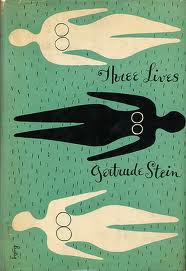
threelives“Melanctha” is told in the third person by an omniscient narrator who narrates closely beside Melanctha and other characters in the story, like Rose Johnson, Melanctha’s best friend, and Dr. Jeff Campbell, Melanctha’s love interest for most of the narrative. Much of the tension in “Melanctha” develops from and is controlled by word patterns, and I would like to look at a few patterns, a few examples, slivers really. The word patterns of “trouble,” “excited,” and “courage” are all connected to Melanctha’s character development, though these same word patterns also control aspects of the conflict between Melanctha and Dr. Campbell. The first instance of “trouble” is tied to Melanctha: “Melanctha Herbert was always seeking rest and quiet, and always she could only find new ways to be in trouble” (3). To give you a sense of its frequency, the word pattern “trouble” occurs 97 times throughout the story. The function of the pattern here is to reveal one of Melanctha’s flaws. The pattern continues on in other instances, though, most importantly, it appears in the sentence introducing Dr. Jeff Campbell: “Jeff Campbell had never yet in his life had real trouble” (14). Already, it’s easy to see the difference, the conflict, between the two characters: Melanctha is always in “trouble” and Jeff Campbell has never known “real trouble.”

Let’s look at a few instances of the intersecting patterns of “excited” and “trouble”: “Melanctha Herbert was always seeking peace and quiet, and she could always only find new ways to get excited” (3). For Melanctha, getting into “trouble” and getting “excited” are connected. One leads to the other, and Stein conveys this relationship in a sentence whose structure is parallel to that of the one with “trouble”: “Melanctha Herbert was always seeking rest and quiet, and always she could only find new ways to be in trouble”. Again, to give you a sense of its frequency, the pattern of “excited” along with its split-off pattern of “excitements” is repeated 27 times throughout the text.

During a conversation between Melanctha and Dr. Campbell early in their courtship, Melanctha suggests that Dr. Campbell do less “thinking” and more “feeling.” Dr. Campbell replies, “…I really certainly don’t ever like to get excited, and that kind of loving hard does seem always to mean just getting all the time excited. No Miss Melanctha I certainly never have mixed myself up in that kind of trouble” (18). Here, the patterns of “excited” and “trouble” intersect to reveal complication and growing tension in the relationship between Dr. Campbell and Melanctha. In this example, the patterns of “trouble” and “excited” indicate opposing viewpoints, alternate lifestyles.

 What makes Melanctha so prone to finding “new ways to be in trouble” is revealed in the following sentence: “Melanctha had always had a break neck courage…” (4) The relationship between “break neck courage” and “trouble” is defined in a later conversation between Dr. Campbell and Melanctha when she says: “…I mean real courage, to run around and not care nothing about what happens, and always be game in any kind of trouble” (37). Dr. Campbell replies, “…its all right being brave every day, just living regular and not having new ways all the time just to get excitements…I ain’t ashamed ever to say I ain’t got no longing to be brave, just to go around and look for trouble…” and, he continues, “that kind of courage makes all kind of trouble…” (38) Dr. Campbell’s idea of “brave” reflects “wisdom” that knows to keep away from certain “excitements” and “trouble.” Alternately, Melanctha’s idea of “courage” is one that leads to new “excitements” and “trouble” of all kinds. This succession of contexts forms a battle of opposites and, as Douglas Glover might say, “the competing points of view strive for interpretive primacy” (97). In other words, whose conception of love will supplant the other: Melanctha’s or Dr. Campbell’s?

Stein constructs the avenue for this struggle along threads of repetition and variation, sameness and difference, through the use of precise, complex word patterns. On “Melanctha,” Frederick J. Hoffman says, “Each of the significant phrases is repeated, again and again, in slightly new contexts, until one is aware of change within a central pattern of conscious experience” (30). Ultimately, the desired effect of Stein’s patterns, of all word patterns, is to produce some sort of change, or, in some instances, an awareness of staying the same.

robert_walser_01

In Robert Walser’s “Nothing at All,” published in 1917, the pattern making is even more transparent. Walser was a German-speaking Swiss writer who published short pieces of prose, novels, plays, and essays throughout 1901 to 1953 during the height of the Modernist period. “Nothing at All” (700 words) is much shorter than “Melanctha” (50,000 words), and while Walser’s patterning and use of repetition is equally interwoven, the compression of his narrative has much to do the transparency of his patterns.

“Nothing at All” is told by a first person narrator who narrates the story of a woman, a little “flighty” and a little “absentminded,” who goes shopping for something “good” for her and her husband to eat for supper that night. In town, the woman cannot keep her “mind on the matter,” a result of her “absentminded”-ness.  Between her inability to keep “her mind on the matter” and being a little “flighty,” the woman comes to “no decision” and goes home with “nothing at all.” At home, she explains to her husband how the “choice was too difficult,” and because her “mind wasn’t on the matter,” she bought “nothing at all.” The “good” husband accepts his wife’s explanation and that night they have “nothing at all,” which, ironically, tastes “exceptionally good to them.”

walserbook1The transparency of Walser’s patterning lends itself more easily to categories of root pattern and split-off patterns. Walser even tips off readers to the main pattern of “nothing at all” by initiating the pattern in the title of the story. Instead of tracing each pattern separately, I will trace the root pattern of “nothing at all” and its connection to the split-off patterns of “good” and variations of the phrase “mind on the matter.” As in Stein’s “Melanctha,” “Nothing at All” contains other patterns that carry all other prior utterances to the pattern they came from while relating to other patterns at work throughout the narrative.

The intersection or tie-in of all three patterns (“nothing at all,” “good,” and “mind on the matter”) occurs at the juncture, or climax, of the wife’s decision-making: “It isn’t good when minds aren’t on the matter, and, in a word, the woman finally got disgusted, and she went home with nothing at all” (110). When the woman gets home, her husband asks what “delicious and good” food she bought for supper, to which the wife responds: “nothing at all.” The woman explains: “‘I went to town and I wanted to buy something truly delicious and good for me and you, I wasn’t lacking in good will, over and over I considered, but the choice was too difficult and my mind wasn’t on the matter, and therefore I didn’t succeed, and therefore I bought nothing at all.’” Walser constructs this sentence using the ancient repetitive structures of polysyndeton and asyndeton. Asyndeton is the omission of conjunctions between phrases in favor of rhythm and speed, as in the first half of the sentence: “‘I went to town and I wanted to buy something truly delicious and good for me and you, I wasn’t lacking in good will, over and over I considered…” The final half of the sentence uses polysyndeton, a repetitive structure relying on excessive conjunctions also in the favor of rhythm: “‘…but the choice was too difficult and my mind wasn’t on the matter, and therefore I didn’t succeed, and therefore I bought nothing at all.’” In both cases, asyndeton and polysyndeton focus on the way clauses (or words and phrases) are linked. In other words, Walser uses these repetitive techniques to establish concise connections between three separate patterns: “good” and its split-off pattern “good will,” “mind on the matter,” and the root pattern of “nothing at all.”

Throughout the story, “good” is used in relation to the “something good” the wife wants to buy for supper. “Good,” in this case, represents intention or character desire. In other instances, “good” had the effect of characterization, like in connection with the “good intentions” or “good will” of the woman during her supper-search, and in the use of “good upright husband.” The woman’s motivation carried by the line, “A woman…went to town to buy something good for supper for herself and her husband,” receives its fulfillment in a tie-in line between “good” and “nothing at all” toward the end of the story: “And so they ate nothing at all and were both satisfied, for it tasted exceptionally good to them” (110). The husband is “in no way angry,” and this irony seems to suggest a resolution, because, in a way, the wife succeeds, at least until the final line of the story, which contains the final instance of the root pattern “nothing at all”: “Many other things would probably have tasted better to him than nothing at all” (111). This line reveals the only instance of judgment from the perspective of the “good” husband in the story, and extends the root pattern of “nothing at all” by complicating the narrative. This final instance also completes the circular momentum of the pattern—and the movement of the piece as a whole—as “nothing at all” moves from its connection of “good” into an implied connotation of “not good.” While “good” is a split-off pattern, it occurs more than any other pattern in the text, 17 times in all, 7 more times than the root pattern “nothing at all.” Here, the root pattern drives the avenue of progression, while the enriched pattern of “good” and all its variant meanings helps to elicit deeper meaning from the root pattern and the narrative overall.

lipsyte

The same kind of transparent pattern making is evident in Sam Lipsyte’s “The Wrong Arm,” a contemporary short story from Lipsyte’s collection Venus Drive, published in 2000.  Lipsyte’s root pattern of “the wrong arm,” initiated in the title of the story, controls the development of the narrative while the split-off patterns and repetitive phrases in the narrative initiate change.

lipsyte_venus_drive“The Wrong Arm” is told in the past tense from the first person point of view of an adolescent genderless narrator, who, for the sake of simplifying pronoun use, I will refer to as “he.” A family—consisting of a father, a mother, and three children—sets out on a road trip to see “the boats of the world” sailing up a river somewhere, but during the course of the trip, the narrator overhears his father and mother talking, and the narrator realizes there’s more to the trip than seeing “the boats.” The father says the boats are one thing and that there is another thing that they all need to talk about once they reach “the boats.” The narrator believes that what his father and mother have to tell the children has something to do with the “wrongness” in his mother, who has an arm with a visual history of “all the scars from all the times something tried to kill her in that arm.” Through the years, the mother’s arm has come to be known as the “the wrong arm.” There are strict rules against touching “the wrong arm”, or leading the mother anywhere by “the wrong arm.” Once the family arrives at the river to see “the boats,” in an effort to prove that “the wrong arm” is just like “anybody’s arm,” that they are “making it wrong by saying it was wrong,” the narrator suggests they “go closer” to the boats, and then he does “the wrong thing.”

As with Walser’s “Nothing At All,” “The Wrong Arm” contains a root pattern that centralizes the progression of the story by creating conflict, increasing narrative tension, and tying into the desires of multiple characters in various ways. The root pattern has branching associations of split-off patterns that, in one way or another, relate back to the root pattern. In Gertrude Stein’s words, each repetitive phrase, in connection to the root pattern of the story, helps to provide new insistence, new emphasis to the pattern. Lipsyte uses patternmaking as a way to compress the history of “wrongness” done to the mother’s “wrong arm” while also progressing the pattern in the present moment of the narrative.

Let’s look at an example that outlines the boundaries of the relationship between “the wrong arm” and the other family members: “All we knew about the wrong arm was that it was wrong to touch it, to pinch it, to rub it…The wrong arm was not for us to take her by and lead her. The wrong arm was not for us to tap it for her to turn” (117). This portion of the root pattern containing its split-off pattern of “wrong” wrenches with tension, and provides a source of conflict in the story. The fact that “the wrong arm” should never be touched acts as an obstacle for the narrator in his quest to discover the truth behind his mother’s mental and physical state. The root pattern of “the wrong arm” and all of its split-off patterns of “wrong,” “wronger,” and “wrongness” repeat 27 times throughout the text.

Lipsyte slowly unravels the history of hurt behind “the wrong arm” and its history of hurt through split-off patterns like “bees,” “bad nails in the porch door,” “porch-door nails,” and “scars.” Split-off patterns relate back to the root pattern in other ways, like the way “the boats” functions as the motive for the scene and the way “waste a wish” functions in the narrator’s evolving line of desire. Of course, there’s not enough time to look at examples of these patterns in any real detail, so instead, let’s look at possibly the most important connection to be drawn from the history of “the wrong arm” as seen in this example of the root pattern: “The wrong arm would never heal right.” Not only is it “wrong” to touch “the arm,” but the narrator also understands that “the wrong arm” would never heal “right.” This portion of the pattern is constructed on sameness and difference, or, as opposites, like in the instance of “good” and the implied “not good” in Walser’s story.

The next example of the split-off pattern “wrong” reveals a change in the narrator’s line of desire when the narrator says, “We were making it wrong by saying it was wrong. We should be holding it and rubbing it and taking her by it to lead her somewhere. To lead her by it to the boats” (121). This is the climax of the story, a turning point in the narrator’s understanding of his mother’s arm as he begins to form a new association in his mind. At the same time, this example recalls an earlier utterance of “the wrong arm” root pattern: “All we knew about the wrong arm was that it was wrong to touch it, to pinch it, to rub it…The wrong arm was not for us to take her by and lead her.” The change in the narrator results from his desire to deny the entire history of “the wrong arm,” to move beyond the prior association that touching “the wrong arm” is “wrong,” and so the story ends on the action of his following through: “And then I did the wrong thing.” All at once, the narrator’s actions extend the split-off pattern of “wrong,” complicate story action, and complete the circular momentum of the plot.

josipovici bookThroughout this essay I have looked at small examples of word patterns for the ways they function in narrative through a relational network of connections. On the relational nature of written language, Barthes says, “connections lead the word on, and at once carry it towards a meaning which is an ever-deferred project” (47). In these stories by Stein, Walser, and Lipsyte, the connections between words do not point immediately to one meaning, but rather, defer meaning through the act of repetition. This effect is something that contemporary British literary theorist Gabriel Josipovici, in his book Whatever Happened to Modernism?, calls the “playing off” of “forward movement against stillness and repetition,” an effect that has long been prevalent in poetry (Modernism, 87).

On the making of Three Lives, the book in which “Melanctha” was first published, Stein says, “In the first book there was a groping for a continuous present and for using everything by beginning again and again” (3). Stein’s “using everything,” her reliance on repetitions, and the varying of those repetitions allowed her to construct Melanctha out of a succession of contexts instead of a scene-by-scene based pattern of conflict. The resulting narrative seems temporally odd with a constantly churning, elliptical momentum. As readers, we move through the narrative without seeming to move at all.

In Walser’s “Nothing at All,” a story of only 700 words, 331 words span the arc of the woman’s journey into town for something good to eat, while 182 subsequent words amount to her re-telling of that journey to her husband after she returns home, a movement that is, essentially, a repeating of, or, using Stein’s words, a “beginning again.” Walser dilates the situation and achieves a complete deceleration of forward movement, or, as Josipovici might say, the staving off of forward movement in favor of “stillness” and “repetition.”

Roland Barthes says that narrative “is an act which necessarily implies a duration,” and by “duration” he means an “oriented and meaningful time” (38). In an essay by Ben Marcus in the June 2003 edition of The Believer, Marcus says, “One basic meaning of narrative [is] to create time where there was none” (2). He also says, “Fiction is the production of false time for readers to experience. Most fiction seeks to become time.” The stories by Stein, Walser, and Lipsyte are all concerned with influencing the way readers experience narrative time through using repetition and word patterning as orienting devices to compress time (in the way Lipsyte compresses a history of hurt into “the wrong arm”), or to subvert our narrative-based notion of passing time (in the way Stein carries out her concept of a “continuous present,” or in the way Walser decelerates the forward momentum of his narrative).

As writers, there’s no way to escape time, but there are alternative ways for building narratives outside of using an events-with-consequences based pattern of conflict. In word-pattern based stories, the duration of the narrative persists as long as the dominating or root pattern remains open, and in this relational temporality, the tension between a set of words behaves similarly to the way consequences separate events. Causality and consequence will always be concerns for fiction writers, but the contingencies that result from the textual connections between repeating words and phrases can also provide narrative movement or momentum, and new opportunities for finding ways in, around, and out of story.

—Jason Lucarelli

——————-

Works Cited

Barthes, Roland. Writing Degree Zero. New York: Hill and Wang. 1968.

Glover, Douglas. Attack of the Copula Spiders. Biblioasis. 2012.

Josipovici, Gabriel. Whatever Happened to Modernism?. New Haven and London: Yale University Press. 2011.

Lipsyte, Sam. “The Wrong Arm.” Venus Drive. New York: Farrar, Straus, and Giroux. 2000.

Marcus, Ben. “On the Lyric Essay.” The Believer. July 2003.

Stein, Gertrude. “Portraits and Repetition,” Lectures in America. New York: Random House. 1935. “Melanctha.” Three Lives. 1909.

Walser, Robert. “Nothing at All.” Selected Stories. New York: Farrar, Straus and Giroux. 2012.


Jason Lucarelli lives in Scranton, PA. He is a recent graduate of the MFA in Writing Program at Vermont College of Fine Arts. This is his second appearance on the pages of Numéro Cinq.


Jul 132013
 

Raymond Queneau

Oulipians are into literary bondage. Their fetish is predicated on the notion that writing is always constrained by something, be it simply time or language itself. The solution, in their view, is not to try, quixotically, to abolish constraints, but to acknowledge their presence, and embrace them proactively. For Queneau, “Inspiration which consists in blind obedience to every impulse is in reality a sort of slavery”. Italo Calvino (who was co-opted in 1973) concurred: “What Romantic terminology called genius or talent or inspiration or intuition is nothing other than finding the right road empirically”. Choosing the “right road” from the outset, instead of stumbling upon it haphazardly, is the Oulipian way: once the Apollonian structure has been circumscribed, Dionysus can work his magic. “I set myself rules in order to be totally free,” as Perec put it, echoing Queneau’s earlier definition of Oulipians as “rats who build the labyrinth from which they plan to escape”.

As Gabriel Josipovici argues in What Ever Happened to Modernism?, modern literature was forged out of a refusal to submit to external constraints, with the novel a “new form in which the individual could express himself precisely by throwing off the shackles that bound him to his fathers and to tradition”. The flipside of this emancipation of the writer (or privatisation of writing) was, as Walter Benjamin pointed out, isolation. No longer the mouthpiece of the Muses or society, novelists could only derive legitimacy from themselves. “Going back to the world of genres is not an option, any more than is a return to the world of the ancien régime,” writes Josipovici. The Oulipo escapes the Romantic cul-de-sac of unfettered imagination (or its Surrealist avatar, chance) by reintroducing external constraints, which are self-imposed.

via Oulipo: freeing literature by tightening its rules | Books | guardian.co.uk.

Apr 242013
 

I’ve been writing books for decades, teaching writing on and off for less than 20 years. Teaching makes up much less of who I am or how I present myself to myself than writing, being a father, etc. But it does provide me with a measuring stick (what are people thinking and reading these days?) and an occasional locus for thought (how does one explain how a work of literature is built?). One of the things I’ve noticed in my years of teaching is how few people come to the craft with much understanding of the context, the cultural backdrop, the history of ideas that informs works of art now. This is kind of like driving a car while wearing a blindfold. There is a huge difference between writing a sketch of a story or a bit of memoir and creating a work of art out of that sketch, between just getting down the bare facts and writing something beautiful, between anecdote and a short story, novel, essay, memoir. Modernism, as Gabriel Josipovici talks about it in his book What Ever Happened to Modernism? arises out of this distinction, the distinction between bare communication and art, between the naive use of language and the use of language that is aware of its own contradictions, glories and insufficiencies. I have a page on NC, the Necessary Books page, which lists some of the books I have found helpful in informing my own sense of context. And recently I’ve been telling students and the poor, long-suffering writers on the NC masthead, to read Josipovici’s book. No book tells the whole story, spells out the answers; we all have to assemble our own sense of tradition. But the ideal is always to be moving toward a larger and larger awareness of the intellectual furniture of the world. I append here three reviews of Josipovici’s book to whet your appetite. And then, to complicate matters, because matters should always be made more complicated, I add a link to David Winters’s review of Shane Weller’s Modernism and Nihilism.

dg

A long time ago Philip Roth said that there are around 60,000 serious readers in the United States. That is 60,000 who would buy a Philip Roth book, maybe, but realistically there are much fewer serious readers. The kind of readers who sit up late with Ulysses, or who consider Kierkegaard’s Either/Or to be beach reading. What’s more, of these readers I would guess that a significant percentage of them have a go at writing fiction or poetry. Even if they were all lucky enough to be published, a single popular novel would be enough to sap all the media attention away from them (even in the age of the internet, which, by the way, is conspicuously absent as a force in this book. I’m not complaining; it was actually a serene delight to read a new non-fiction book that did not pour on the dreaded “e” prefix remorselessly.) The fault is not with the authors, as such, but with the culture and the criticism surrounding them. It is this that Josipovici wants to change.

And it is a gargantuan task. If contemporary culture has taught us anything it’s that a worldwide web, a few dragging steps towards equality, and a more inclusive attitude in general have almost no impact on public taste. Most people just don’t care enough about the arts to do anything other than lie supine and wait to be entertained, and one wonders if this book can have any traction in a culture that resists elitism so stubbornly. And yet I can’t help but feel that this book is so alive because the world is turned the other way. Even with insurmountable resistance, What Ever Happened to Modernism? is an inspiring, sometimes electrifying, call to arms; a serious book for serious readers.

via The Millions : Getting Serious: Gabriel Josipovici’s What Ever Happened to Modernism?

§

For Josipovici modernism is a response in art (all art, music and painting too for example, not just literature) to the “disenchantment of the world”. That disenchantment is the loss of the Medieval sense of the numinous as being part of everyday life. In short, the Medieval vision of a world filled with purpose and divine meaning gave way to what would ultimately become the Enlightenment with its vision of a secular world governed by reason and natural laws (yes, I did just gloss over about 400 years there).

This is absolutely critical to everything that follows. The death of enchantment does not mean that people were happy in the middle ages but disillusioned thereafter. It is not a personal loss of enchantment. The point is that the European concept of the world changed from it being a place in which the natural and supernatural were different facets of the same reality to a world in which the natural and the supernatural were firmly separated (and in which the supernatural could therefore potentially be discarded entirely).

With the death of enchantment comes the death of meaning. Before the disenchantment of the world it is possible to speak with authority, because the world has meaning from which authority can be derived. After that disenchantment there is no longer such an authority. The only authority that exists is that which we assert.

via The death of enchantment | Pechorin’s Journal.

§

The Modernist project has been around for far longer than you might think: from Euripides, looked at one way; or from Rabelais, looked at another; certainly since Cervantes. “Somewhere in La Mancha, in a place whose name I do not care to remember …” is how Don Quixote begins, and it is as if the rest of the book is itself a huge piss-take of the very idea of narrative, a healthy scorn for plodding literalism. When Duchamp – he of the urinal in the art gallery – was asked in 1922 for his views on photography, he replied thus: “Dear Stieglitz, Even a few words I don’t feel like writing. You know exactly how I feel about photography. I would like to see it make people despise painting until something else will make photography unbearable. There we are.” Josipovici notes the “very Beckettian style” of this (pre-Beckett though it may be); and it reminds us that the Modernist avant garde is by no means without a sense of humour.

via What Ever Happened to Modernism? by Gabriel Josipovici – review | Books | The Guardian.

§

To consider the concept of nihilism, Simon Critchley once remarked 1, is to take up the trail of ‘Ariadne’s thread’, a theoretical route through the labyrinth of history. For Critchley, the story of nihilism is the story of what it means to be modern, and to read the philology of nihilism, of the nihil, is to look through a lens at modernity’s underside. Shane Weller’s survey of the web of relations between Modernism and Nihilism proceeds from the same supposition. His book unpicks the thread where it’s at its most knotted, in the high modernist literatures of the early twentieth century. For Weller, what’s at work in the works of the modernists – from Tzara to Kafka to Cioran – is a discursive puzzle for which ‘nihilism’ would seem to be the key, the master term that could unlock and make sense of the modern. Yet the thrust of his thesis is the fact that it fails to do so; the way that whatever it touches is rendered resistant to interpretation. So, on the one hand, thought and talk about ‘nihilism’ is ubiquitous across modern culture: wherever the modernist moment is, nihilism sits alongside (or inside) it. On the other, modernism proves unable to reduce nihilism to its propaedeutic, its explanatory toolkit. Rather, nihilism is what haunts modernism, as its ghost or double, a tense co-presence forever unsettling its meanings.

via Modernism and Nihilism by Shane Weller « Book Review « ReadySteadyBook – for literature….