
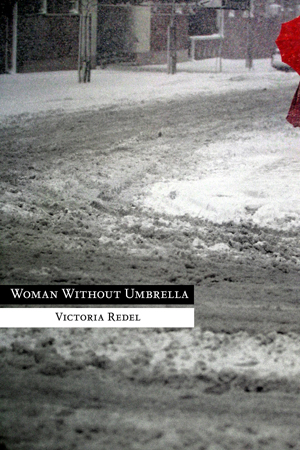
Woman Without Umbrella
Victoria Redel
Four Way Books
88 pages, $15.95
ISBN-13: 978-1-935536-24-6
Woman Without Umbrella slips out the door barefoot in spite of flash flood warnings. Without interruption is my recommendation when reading this, Victoria Redel’s third collection of poetry.
Redel is also the author of four books of fiction, most recently a collection of stories, Make Me Do Things, from Four Way Books. Her award-winning novel, Loverboy, was adapted to film in 2004. A native New Yorker, Redel earned her MFA at Columbia University and was a student of Gordon Lish: as an editor at Alfred A. Knopf, Lish published her first book. In an interview with Leah Umansky, Redel reflects “I’m a poet more driven by the sentence than by the line, and I’m a fiction writer driven more by language than plot.”
The first poem in this collection is titled “The Way It Began,” and the second one is “The End.” These two poems are separated by two blank pages and a page with an ampersand, an indication of Redel’s skill in measuring and compressing time and space in the length of the collection, in the space and interaction between poems, and within single stanzas.
From this energetic opening, the collection would seem to explode outward, way beyond structures. In fact, the next poem begins with “The roof collapses.” David Orr, in his most recent article “On Poetry” in the NYTimes Book Review, concludes “poetry, unlike churches and fortresses, has never loved a wall.” Here, poetry loves a wall but for different reasons entirely, as Redel shows in “Woman Without Umbrella, Unseasonable.”
All month her city sweats and sticks,
women and men stripped down to a snarl, it’s too fucking hot.
These are steamy low-key days, south of the border,
hot-to-the-touch afternoons,
burning cement walls built for pressing him up against.
The poem next is “Suddenly,” which begins “A month after turning forty-five, every last egg in her body / is a Rockette doing the can-can. Use me use me use me, they cry.” And it goes on, describing the woman at the crosswalk, warning off any nearby men. The next poem, “Woman Without Umbrella,” begins with “Thus she waited at the corner / for the light to change.” The manipulation of time between month and month is exhilarating, as is the way Redel focuses the space, from the wide-angle view of the city to the particular woman standing on a corner.
The poems “Upgrade” and “Bottom Line,” which are a little before the halfway point in the collection, is a glorious reflection on the nature of the heart and our relationship to it, which seems sometimes strange to say, as though we could remove ourselves from it enough to say “to it.” But in Redel’s hands, this manipulation of the view through time and space is masterful. In “Upgrade,” Redel shows us the “I want,” incessantly asking, clawing-for-something heart, the font of all desire. Apart from the heart, in the wonderment of considering it—
I don’t want a refund to say it didn’t fit, never worked, or worked at first,
then in fits and starts, the switches useless, gears stripped. No, I don’t want
Customer Service, a Claims Department, complaint letters, an exchange
or credit toward the latest model, an upgrade or Lifetime Parts Replacement.
Even now, broken, chipped, in pieces, pieces lost, worn out, the original
gone—there are times, still, it comes back to me whole and I am amazed
by what is beyond fragile, by how elaborately and generously, wrecked
and beyond repair, we made use of our hearts all those years. And then.
The way her lists topple into other lists here is the glory of it. The first stanza’s list repeats the words “fit” and “worked,” and uses the assonance of the short i sound for intense energy from the start. And we don’t know what she’s talking about yet, as the second stanza takes us into Customer Service for this broken or defective thing. Third stanza, and this list parallels the first with the short-i sound in “chipped” and the repetition of “pieces.” Then in the beginning of the third stanza, “even now” starts to shift the poem away from its initial “I don’t want” and into the amazement of “and then.”
“And then” is a force in this collection. I found myself following it, catching it hiding here and there, and finding its inverse flying around in certain dark corners. For example, we move from “And then” at the end of the poem “Upgrade,” to the beginning of “Bottom Line”: “As when my father goes back under / and the doctor comes out to tell us he’s put a window in my father’s heart.” Perhaps this is the most extreme example of the way “and then” propels the reader through this collection. Or maybe it’s in the poem “Later Still, Then,” where Redel begins, “What if I told the husband everything. / How I leaned against a shoulder on the raft. Later, still. Or years earlier. And then.” In the poem on the facing page, two of the lines begin with “then.” The poem titled “And Then” precedes a page with an ampersand, which precedes the three-and-a-half-page “Kissing.” That is followed by another page with an ampersand, followed by “Holy” which begins “Then I went to a party and danced like no tomorrow.” And next comes “And, Finally,” and then “Gorgeous Present.” And this is still nowhere near the end of the book.
So, back to “Kissing.” The poem begins with a potent first line, “The first surprise of your mouth on mine.” Then it steams up quickly with a glorious list of the places where:
On streets, on staircases, in bathrooms, in the backs of cabs, in a field, against that wall and that wall and that wall, down on the floor, my hair caught in it, in hotel beds, in a borrowed bed, and in the same bed night after night after year after night, through an open window, under pines, under water, on a raft, in rain, salty with ocean, a peck at the door, a have a good day.
Our mouths, prepositional.
From this point, the poem delves beautifully into every aspect of that description, “prepositional.” Mouths act as prepositions indicating another place, “like there is another room inside and then another room inside.” Alternatively, kissing mouths are prepositional to each other, introducing the irresistible action of offering and taking: “suddenly you are turning me saying, / ‘Give me your mouth,’ and I am giving you my mouth.” The poem takes the grammar reference further with these lines: “A fluency, accented, each vowel and consonant exactly formed. / Sudden native speakers.” Later in the poem, we consider “A private syntax. / Pun and slang, slip of tongue, intentional.” The reader wonders whether kissing is a metaphor for language or if it’s the other way around.
Redel’s list of mostly prepositional phrases uses alliteration and assonance in tight sequence at the beginning of the run, and then repetition of “wall,” “bed,” “night,” “under,” “on,” and especially “in.” There’s that wall again. And that raft. Within single lines of the poem, the repetition of a word strikes the right notes of sound and insistence. In “Kissing,” this doubling of words within the line occurs with “eyes,” “mouth,” “room,” “taste,” and “drifting,” which is in itself an enticing list.
Paired with this virtuosity of metaphor and pattern is Redel’s exquisite attention to imagery and sensory detail.
Like something windy, like good weather. In winter, our mouths the
warmest place in the city.
Kissing like nobody’s business.
A lower lip flicked by teeth, pulling back just a little to breathe
together.
And, then, all twitch and pull and ache.
If this were a review of a novel, I’d have to stop here to avoid spoilers. In her interview with Leah Umansky, Redel said “I see Woman Without Umbrella as having a kind of narrative arc and so the thread of poems using the same titles is a consideration of time. And though “Woman” in the title is singular I think of this as a book inhabited by many women both contemporary and historical.” A couple of stanzas toward the end of the collection stand out as fine examples of Redel’s repetitions and resulting conversion of these materials into something sublime. In “Smoking Cigarettes with Brodsky,” the last stanza evokes “and then” with the surprise of “and yet.”
I’m just learning desire makes us sometimes lovely,
always idiotes. And yet. And yet. And yet
Joseph smokes another cigarette.
The first half of “Monet’s Umbrella” gives it away, too.
I didn’t have to kneel down by the roadside lilacs
and I didn’t have to go walking this dawn in Riverside
with the dog sniffing wet dirt and the red tail hawks
nesting over the Westside highway on-ramp
to know that without even trying Sweetness returns
without a Monet umbrella or a proper scarf around its neck
and that when I rush to bring Possibility indoors for a hot tea
it gathers me in for a dirty-minded kiss.
Redel’s “and then” has become “and that when” here. And there’s that kiss again, suggesting with its capitalized “Possibility” an Emily Dickinson poem, which begins “I dwell in Possibility — / A fairer house than Prose –”.
Redel leaves us in a cozier place at the end of the collection—in a theater after the show, considering the “riveting” special effects, as you might after reading this book without intermission. The deluge of brilliance in this collection could turn manhole covers into geyser spouts, recycling bins into white-water rafts, and then—who needs an umbrella?
—A. Anupama
———————————–
 A. Anupama is a U.S.-born, Indian-American poet and translator whose work has appeared in several literary publications, including The Bitter Oleander, Monkeybicycle, The Alembic, Numéro Cinq and decomP magazinE. She received her MFA in writing from Vermont College of Fine Arts in 2012. She currently lives and writes in the Hudson River valley of New York, where she blogs about poetic inspiration at seranam.com.


