Aug 142017
 

  Walter Benjamin

.
My Red Heaven is collage in form. This piece centers on Walter Benjamin, and moves back and forth in time as he sits on a bench on Unter den Linden, beginning what will become The Arcades Project.


1.The only way of knowing a person is to love him or her without hope, Walter Benjamin pencils in his notebook, hunched on a dark green bench in the dark green shade of a linden.

A bear occurs, a man playing a flute followed by twenty beautiful children.

.

  1. Walter crosses out the sentence. He has spent his entire day here, the last three, in this park running up the center of Unter den Linden, in combat with a three-page essay about Parisian arcades for the Frankfurter Zeitung. The essay refuses to stay in its skin. It keeps wanting to unfurl into something larger, messier, less itself.

    .

  2. Suppose I were to begin by recounting, he pencils in his notebook, how many cities have revealed themselves to me in my expeditions through them in pursuit of books. Suppose I were to speak of a time, ours, when even the best readers have become frightened of imperfect, torrential monographs — ones that fan out into a maze of dangerous branchings.

    Suppose I were to bring up how easy a certain kind of completeness is.

    .

  3. He crosses out that paragraph, writes in a choked scribble I am falling in love with lostness, then the brakes, a woman’s shriek.

    .

  4. When he raises his head everything already exists in another tense.

    .

  5. An old truck, advertisement for a brewery across its side, run up onto the curb in front of the Adlon Hotel. Several empty barrels burst on the sidewalk. A smartly dressed man splayed in the street, pedestrians vectoring in.

    .

  6. (When a world war breaks out, all you can do sometimes is begin to translate the works of Baudelaire as faithfully as possible.)

    .

  7. The bear man stops. His triad of notes. The twenty beautiful children stop, at first confused about where to look.

    One points, a perfect girl, mouth opening, nickel-blue eyes wide with the world.

    .

  8. Walter squints through his chunky spectacles to determine if the man is alive or the other thing.

    .

  9. Suppose, he considers, his weak heart twinging, I am falling in love with disjunction. Medieval alleys full of flowers. Suppose I am falling in love with learning to interrupt my —

    .

  10. Three years ago. Island of Capri. Ernst Bloch crumpled down the newspaper he had been reading and glared at Walter over the dried-seagull remains. The pair reclined in chaise lounges on their pension’s balcony amid a tumble of shiny white houses overlooking the Bay of Naples.

    How just so fucking absurd it must seem, Bloch proclaimed, for an immortal soul destined for heaven or hell to find itself sitting in the kitchen in the form of a maid.

    .

  11. The bear waiting for orders.

    .

  12. The children.

    .

  13. We may call these images wish images; in them the collective seeks

    .

  14. But most of all the tiny squares. Medieval alleys full of bougainvillea clinging to stone walls. Plumbago. Yellow, red, powder blue rowboats pulled up on the Marina Grande’s pebbly beach. And Bloch saying: The most tragic form of loss isn’t the loss of security. It is the loss of the capacity to imagine things other than they are.

    .

  15. For you were born under the sign of Saturn, planet of detours and delays, blunders and stubbornness; of those who see themselves as books, thinking as a method of gathering, organizing, yet always knowing when to stray, wander off.

    .

  16. For to lose your way in a city or a person requires a great amount of willpower.

    .

  17. It is Bloch proclaiming from his chaise lounge, newspaper seagull crumpled in his lap, and emaciated Rilke all those years after that first meeting at the University of Munich, praising in a letter to Walter from somewhere among the Swiss Alps Mussolini’s New Year’s Eve speech.

    What soaring language! What beautiful discourse! Fascism, our great healing agent!

    .

  18. The hotel doormen holding onto the driver of the truck until the police show up, and the belief Jewishness means a promise to further European culture, each epoch dreaming the one to follow.

    .

  19. Inaccurately.

    .

  20. These moments, those hours, the other days: Had Walter really accomplished anything at all?

    Wonders Walter.

    .

  21. It is Baudelaire scribbling on a scrap of paper Sois toujours poète, même en prose — Always be a poet, even in prose — and the ambulance disturbance rising on the far side of the heavy, coal-smoked Brandenburg Gate, and the found object, the readymade, the already extant message, the chance encounter, the transitory, the fugitive, the contingent, that half of art of which the other half is eternal and immutable.

    .

  22. There was the juncture at which he understood he was not to become an academic instructor.

    There was that injury.

    .

  23. Wine. Bread. Thickly sliced salami.

    .

  24. The lizard with azure scales panting rapidly on a fence rail.

    .

  25. The sun, a glossy orange in the sunset sky: Capri.

    .

  26. There was that juncture, and there will be the one in which he can no longer remember what he wants as he reaches languidly for the bottle of tablets on his hotel nightstand in room number three.

    .

  27. Yet now it is those days with Bloch on that balcony, the nights with Asja Lācis in her bed, long umber hair tousled.

    Naked.

    Yawning.

    Her unselfconscious stretching, her body Y-ing on the mattress.

    Walter was completely open about the Latvian Bolshevik theater director when his wife, Dora, asked in her letters.

    But only when she asked.

    (She asked only once.)

    .

  28. Writing about a given place at a given time puts its existence between quotation marks, plucks it from its native context by engendering unanticipated new ones.

    This is collage’s capacity, through cutting up and cutting off, to open up and ou

    .

  29. We won’t be getting married, mana saulīte. I find divorce too hard on the nerves.

    Asja footnoting in mid-stretch.

    .

  30. Dora remaining behind in Berlin with their nine-year-old son, moody anxious Stefan, and Asja introducing Walter over dinner to Marxism as historical mutiny and late night Prosecco to sex as whirlwind.

    .

  31. Writing that looks like writing, however, thinking that looks like thinking, has come to feel to Walter progressively flat, faded, fated.

    Suppose, he pencils in his notebook, I were to rethink everything.

    Suppose I were to start all over again.

    .

  32. And thirteen years later, twenty-some-odd changes of address, standing outside the Bibliothèque Nationale on a thick spring day, twenty-four hours before the Germans howl into Paris with orders to arrest that Jew intellectual at his flat, Walter hands over his color-coded notes — green language, yellow, red; diagrams; copies of images that have collared his curiosity — to his grouper-mouthed librarian friend Georges Bataille.

    Over Georges’ shoulder, Walter’s last glimpse of the filthy Seine glistering.

    .

  33. Asja’s double enlivening: the erotic and the political slurred into a single unfathomableness.

    .

  34. Or this man, weak heart, weakening lungs, a mobile intelligence unit moving through the metropolitan streets, he likes to think of himself as, likes to believe he believes, maybe others, too, although what would happen if you began to imagine the essay you are composing, not as a —

    .

  35. After this shitty war, Georges telling Walter outside the library on that balmy pre-invasion day, Europe will resemble a de Sade novel. Watch out for Duc de Blangis. He will be everywhere.

    Georges not grinning then, but rather turning away, repairing to work.

    Walter watching his friend’s lightly pigeon-toed gait decrease in size down the sidewalk.

    .

  36. Suppose you began to imagine the essay you are writing, not as a piece of music that must move from first note to last, but rather as a building you could approach from various sides, navigate along various paths, one in which perspective continually changes?

    This building, we might submit, would constitute a literary architectonics that pits itself against narrative’s seemingly inflexible arc from birth to the other thing.

    .

  37. These lines written by the man who earned his Ph.D. cum laude eight years ago with a dissertation on art criticism amid German Romanticism, yet who has been assiduously unable to find academic employment ever since.

    That injury, too.

    .

  38. (Among others.)

    .

  39. There is that brief deliberation over emigrating from Germany to Palestine and how the bottle of morphine tablets catches the caramel sun in his tiny room at the Hotel de Francia on the Catalonian coast one autumn afternoon in 1940, police guard posted outside Walter’s door demurely clearing his throat every now and then.

    .

  40. Written by the thirty-four-year-old journalist unable to support himself, let alone his family, through his own labor, and so forced for a time to ask his wife to stop loving him so he could return to Berlin to reside with his parents.

    .

  41. To reside with his

    .

  42. Ne cherchez plus mon coeur; les bêtes l’ont mange.

    Baudelaire scribbling on a scrap.

    .

  43. There is that slightly less brief deliberation over emigrating to the United States through neutral Portugal as the Germans howled closer, and how Max Horkheimer negotiates a travel visa for Walter, who will only be able to flee as far as Spain over the Pyrenees before the Franco regime cancels all transit permits and orders the authorities to return those carrying them to France.

    .

  44. And on 25 September, 1940, there is that Spanish official with the pinched lips telling the group of Jewish refugees Walter has joined to prepare for deportation the following morning, and the emptiness on Hannah Arendt’s face taking in this information, on her husband the poet and philosopher Heinrich Blücher’s, on their friend the Hungarian novelist Arthur Koestler’s, on the German photographer Henny Gurland’s, her son Joseph’s.

    .

  45. Yet, despite the future, the bear man steps into motion again, melody picking up.

    .

  46. One by one, the beautiful children.

    .

  47. Do not look for my heart anymore; the beasts have eaten it, scribbling the poet who spent his last two years between Brussels and Paris, semi-paralyzed and unable to speak after the massive stroke.

    .

  48. The emptiness on the ambulance driver’s face as he employs a plain white sheet to cover the bodily fluids held in by tender skin.

    .

  49. Or the emptiness on the doctor’s face during each of his four visits to tiny room number three through that late September afternoon and evening, administering injections and blood letting as if these things might in the end somehow alter the configuration of that space.

    .

  50. It is the ambulance driver’s face, even at this distance, and Asja’s body in her bed, sheetless in silvery sun, along with the belief writing as collage draws attention to the sensuality of the page even as it strips itself of the tedious, tendentious pretense of originality.

    Suppose, therefore, it could be argued

    .

  51. Suppose we were to call it a meditative practice that allows one to be surprised by what one says next.

    A practice, we could even submit, of reading.

    .

  52. Or the other manuscript, completed, which Walter will carry in his suitcase from Paris to Portbou, which will disappear forever.

    That manuscript, too.

    .

  53. Suppose, therefore, it could be argued that we are all collage artists, pencils Walter, then crosses out the sentence, for there will be that juncture in two years at which Dora and he will have become separated, then divorced, the juncture in thirteen at which the other Jews in his party of refugees for no discernible reason will be allowed sudden passage through Spain into Portugal.

    .

  54. Four days later all will safely reach Lisbon.

    Minus one.

    .

  55. It is the ambulance driver’s face, even at this distance, and Hannah Arendt admiring the terracotta rooftops, the pale yellow dwellings, bunching down the steep Lisbon hillsides into bluegreen seasprawl.

    .

  56. The Spanish police will refer to the deceased forty-eight-year-old in their correspondence with Max Horkheimer, who will query about the details of his friend’s passing, as that German gentleman.

    .

  57. That German gentleman about whom you inquire, the Spanish police writing, died of heart failure.

    .

  58. Cerebral hemorrhage, the medical certificate will state.

    .

  59. The town judge listing Walter’s possessions at the time of death thus: suitcase leather, gold watch, pipe, passport issued in Marseilles by the American Foreign Service, six passport photos, an X-ray, one pair of spectacles, various magazines, a number of letters, a few papers, contents unknown, and some money.

    .

  60. A few papers, contents un

    .

  61. How, because of confusion surrounding his identity, Walter will be buried in leased-niche number 563 in the Catholic section of the Portbou cemetery. When no one remembers to keep up the payments, Walter’s remains will be quietly exhumed and moved in the summer of 1945 to the town’s common burial ground, where their exact location will over time become unremembered.

    .

  62. Four days after Walter reaches for the bottle of morphine tablets he brought with him from Marseilles, just in case, Hannah Arendt will lean out the window of her hotel room in Lisbon, relishing the act of breathing, just that, while admiring the terracotta rooftops and pale yellow dwellings bunching down the steep hillsides into the bluegreen seasprawl.

    .

  63. Below, the streetcars clanking by.

    .

  64. Mosquitoey scooters revving.

    .

  65. That greasy scent of reprieve billowing up around her a flash before she steps back into life.

—Lance Olsen

x
Lance Olsen
Lance Olsen is author of more than 20 books of and about innovative writing. His latest is the novel Dreamlives of Debris (Dzanc, 2017). A Guggenheim, Berlin Prize, D.A.A.D. Artist-in-Berlin Residency, N.E.A. Fellowship, and Pushcart Prize recipient, as well as a Fulbright Scholar, he teaches experimental narrative theory and practice at the University of Utah.

x
x

Mar 022017
 

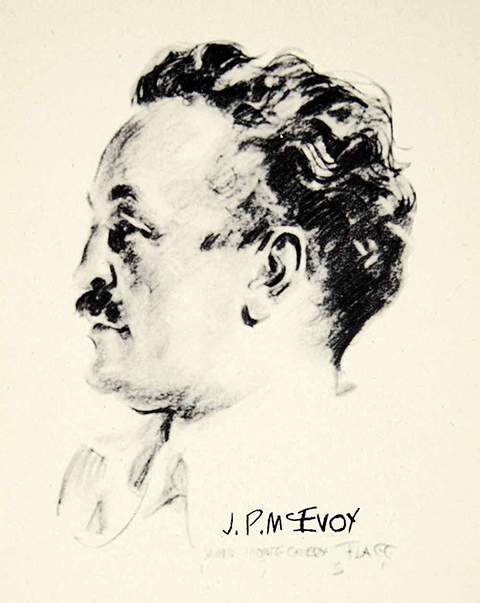
J P McEvoy image 37 J.P. McEvoy portrait by James Montgomery Flagg, from a 1951 print

x

The 1920s saw a surge in experimentation with the form of the novel. In Ulysses (1922), James Joyce used a different style for each chapter, including the play format for the notorious Nighttown episode. Jean Toomer’s “composite novel” Cane (1923) consists of numerous vignettes alternating between prose, poetry, and drama. John Dos Passos in Manhattan Transfer (1925) abandoned traditional narrative for a collage of individual stories, newspaper clippings, song lyrics, and prose poems. Taking his cue from European Surrealists, Robert M. Coates likewise deployed newspaper clippings, along with footnotes, diagrams, and unusual typography, in The Eater of Darkness (1926). Djuna Barnes’s novel Ryder (1929) includes a variety of genres—poems, plays, parables—and is written in a pastiche of antique prose styles. William Faulkner scrambled chronology and used four distinct narrative voices in The Sound and the Fury (1929), and later even added a narrative appendix. These were all serious novelists who disrupted nineteenth-century narrative form to reflect the discontinuities, upheavals, and fragmentation of the early twentieth century, a time when many new media emerged that would rival and in some quarters supplant the novel in cultural importance and popularity.

But literary historians have overlooked a novelist from the same decade who deployed these same formal innovations largely for comic rather than serious effect, adapting avant-garde techniques for mainstream readers instead of the literati. Between 1928 and 1932, J. P. McEvoy published six ingenious novels that unfold solely by way of letters, telegrams, newspaper articles, ads, telephone transcriptions, scripts, playbills, greeting card verses, interoffice memos, legal documents, monologues, song lyrics, and radio broadcasts. Ted Gioia described Manhattan Transfer as a scrapbook, which could describe McEvoy’s novels as well, and in fact a reviewer of his first novel used that very term.[1] Given their concern with a variety of media (vaudeville, musicals, movies, newspapers, greeting cards, comic strips, radio) and their replication of the print forms of those media, they might better be described as multimedia novels. But perhaps the best, if anachronistic, category for McEvoy’s novels is avant-pop,  that postmodern movement of the late 1980s/early 1990s which (per Brian McHale, quoting Larry McCaffery) “appropriates, recycles and repurposes the materials of popular mass-media culture, ‘combin[ing] Pop Art’s focus on consumer goods and mass media with the avant-garde’s spirit of subversion and emphasis on radical formal innovation.’”[2]

Since McEvoy is all but unknown, a brief biographical sketch follows.

An orphan, Joseph Patrick McEvoy told the Rockford Morning Star later in life that he didn’t “remember where he was born—but he has been told that it was New York City and that the year was 1894.” Newspaper comic historian Alex Jay, who records that remark in a well-researched profile,[3] gives a number of possible birthdates ranging from 1894 to 1897; the consensus today is 1895. Possibly born Joseph Hilliek or Hillick, the boy was adopted by Patrick and Mary Anne McEvoy of New Burnside, Illinois. The same Rockford Morning Star piece reports him as saying “he didn’t go to school—he was dragged. This went on for a number of years, during which time McEvoy grew stronger and stronger—until finally he couldn’t be dragged any more. This was officially called the end of his education.” In the contributors’ notes to a 1937 periodical, he wrote (in third person): “While he was still a guest in his mother’s house, J. P. McEvoy started his writing career at the age of fifteen as Sporting editor of the South Bend Sporting-Times.”[4] He later admitted (in first person), “I remember my first assignment as sports editor for the News-Times [sic] was to cover a baseball game. I was a descriptive writer. I became so interested in what was going on that I omitted the detail of scoring the game. I had to call The Tribune (a rival newspaper) to get the score.”[5] In 1910 he enrolled at the University of Notre Dame, which he attended until 1912.

In 1920, a stationery industry journal called Geyer’s Stationer gave this account of his early career (again from Jay):

It is interesting to take a peep into Mr. McEvoy’s past. He early acquired the art of hustling—perhaps that is why he is able now to do the work of two or three men. At Christian Brothers’ College in St. Louis he was the star bed maker. One hundred and fifty a day was his regular chore. Later, at Notre Dame University, he was a “waiter” at meal times and a newspaper man in the evenings. He worked on the South Bend News from six in the evening until two in the morning. When pay day came he required no guard to protect him—$4.00 constituted his salary!

When he came to Chicago, after graduating, he obtained a position as cub reporter in the sporting department of the old Record-Herald.

McEvoy in the 1920sMcEvoy in 1920 (l.) and 1922 (r.)

He created several comic strips there beginning in 1914, and moved on to the Chicago Tribune in 1916 for further strips before joining the P. F. Volland Company, which published books, postcards, and greeting cards. McEvoy published two illustrated books of sarcastic verse with Volland, both in 1919: Slams of Life: With Malice for All, and Charity Toward None, Assembled in Rhyme—with a postmodernish introduction in which McEvoy refers to himself in the third person as “his favorite author”—and The Sweet Dry and Dry; or, See America Thirst!, a mélange of poems and strips protesting the passing of the Eighteenth Amendment prohibiting the sale of alcohol. Slams of Life in particular trumpets the linguistic ingenuity that enlivens his later writings. The mostly comic poems are bursting with wordplay, slang, raffish rhymes, typographical tricks, and flamboyant diction: the first sesquipedalian word in one poem is “Absquatulating,” and the opening stanza of “The Song of the Movie Vamp” reads:

I am the Moving Picture Vamp, insidious and tropical,
The Lorelei of celluloid, the lure kaleidoscopical,
Calorific and sinuous, voluptuous and canicular,
And when it comes to picking pals, I ain’t a bit particular.

Many are quite literate, even erudite: “That’s a Gift” namedrops the historians Taine, Gibbon, and Grote, while another ranges from “the Ghibelline and Guelp” to “Eddie Poe.” The latter’s “The Raven” is parodied in “A Chicago Night’s Entertainment,” and “Lines to a Cafeteria or Glom-Shop” is a takeoff on a canto from “Kid” Byron’s Don Juan.[6] A poem with the baby-talk title “Bawp-Bawp-Bawp-Bawp-Pa!” acknowledges the ancient Greek orators “Who slung a mean syllable over the floor / Isaeus, Aeschines, Demosthenes, too,” and McEvoy seems to have been au courant with the latest poetry and art as well, for another one is entitled “An Imagist Would Call This ‘Pale Purple Question Descending a Staircase.’” He introduced Sinclair Lewis at a talk before the Booksellers’ League in Chicago in 1921; reporting the event, Publishers Weekly identified McElroy as the author of Psalms of Life, a sanctification of his Slams that probably amused him.[7]

McEvoy wasn’t happy at Volland, despite his lavish salary ($10,000 a year, equivalent to around $130K today) and the prestige of being “the first writer of greeting-card sentiments to be admitted to the Author’s League.”[8] In the author’s note at the end of his Denny and the Dumb Cluck—a 1930 novel satirizing the greeting-card business—he writes:

For many years I was editor and poet laureate of P. F. Volland and Co. and the Buzza Co., leaders in the manufacture and distribution of greeting cards, and among other minor atrocities I have compiled 47,888 variations of Merry Christmas. Also I have sat in on art conferences without number, where we met such important crises as “Shall we face the three camels east, or would it be better to put one of those Elizabethan singers out on the doorstep, holding a roll of wall paper?”

Until he resigned from Volland in 1922, McEvoy continued to write for the Chicago Tribune. It ran a serial called The Potters in 1921, illustrated by a friend he had made at Notre Dame named John H. Striebel (1891–1962), with whom he would later collaborate. The Potters was described as “a new weekly humorous satire in verse on married life in a big city” and was later turned into a successful play and published in book form  in 1924.

By then McEvoy had left Chicago and was living in New York City, leaving behind both greeting cards and comic strips to write for the stage. First he wrote a revue called The Comic Supplement (1924), which was produced by Florenz Ziegfeld and starred W. C. Fields.[9] McEvoy wrote the original “Drug Store” sketch, one of Field’s favorites and reprised in some of his later films. Ziegfeld forced unwanted changes on McEvoy’s script, but later repented and invited him to begin writing for the Ziegfeld Follies. McEvoy cowrote the 1925 production (with Fields, Will Rogers, Gus Weinberg, and Gene Buck), and continued to contribute skits and songs until 1926.

In 1926 he wrote a two-act revue entitled Americana,[10] a smart but zany show that Gershwin biographer Howard Pollack describes in terms that anticipate McEvoy’s novels: “Americana . . . satirized American life, including an after-dinner speech at a Rotary Club and an awkward attempt by a father to talk to his son about sex; it also took aim at opera (‘Cavalier Americana’) as well as Shakespeare by way of [composer Sigmund] Romberg (‘The Student Prince of Denmark’). Critics welcomed the show as refreshingly clever—a ‘revue of ideas,’ as the Times headline stated. . . .”[11] His other revues—No Foolin’ (1926), Allez Oop (1927), and New Americana (1932)—were less successful but provided plenty of backstage material for his novels.

It was at the Ziegfeld Follies that McEvoy met the inspiration for his first novel. Louise Brooks (1906–1985) was a featured dancer in the 1925 edition, and caught the eye of Paramount Pictures producer Walter Wanger, who signed her to a five-year contract later that year. McEvoy thought the wild-living Brooks would make an attractive heroine for a comic novel, and after naming her “Dixie Dugan” began writing a fictional account of her madcap adventures in show biz. Show Girl—made up of letters, telegrams, newspaper clippings, and so forth—was serialized in Liberty Magazine from 14 January to 14 July 1928, illustrated by his Notre Dame classmate John Striebel, who modeled Dixie on Brooks.
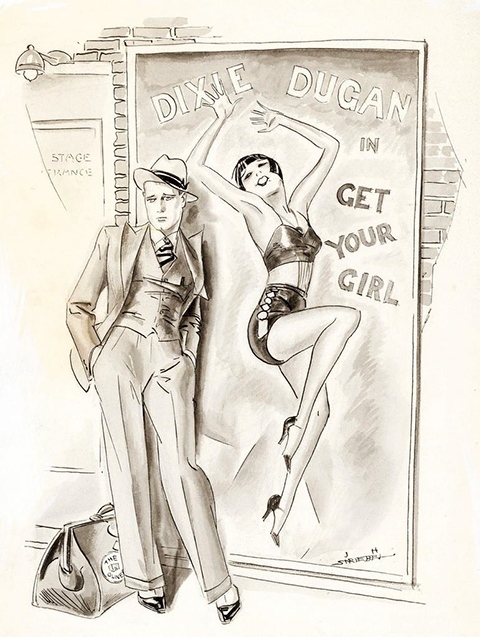
J P McEvoy Showgirl illus by John H StriebelJohn Striebel illustration, Liberty serialization of Show Girl

It was published in book form by Simon & Schuster in July of the same year, and was an immediate success, going through five printings in two months for a total of 31,000 copies in print—not to mention reprints by two other publishers, two British editions, and a German translation (Revue-Girl, adapted by Arthur Rundt). Show Girl deals with Dixie’s zigzagging path to success on Broadway; in its sequel, Hollywood Girl, Dixie (like Louise Brooks) travels out to Hollywood for further risqué adventures. Like its predecessor, Hollywood Girl was first serialized in Liberty (22 June–28 September 1929), then published by Simon & Schuster in book form later in 1929. Both were quickly made into movies, Show Girl (1928) and Show Girl in Hollywood (1930); it was initially reported that Brooks would play Dixie, but she didn’t get the part, possibly because she was under contract to another studio (though she had been loaned out before). Both films starred Alice White instead, who resembled It girl Clara Bow rather than the vampy Brooks. Stills from the films were tipped into later printings of both novels, an early example of media synergy.

In 1929, McEvoy’s former employer Florenz Ziegfeld, who appears as a character in Show Girl, produced a musical entitled Glorifying the American Girl with a script cowritten by McEvoy, and then staged a musical version of the novel, on which Gershwin again collaborated.[12] The lamest but longest-lasting spin-off of Show Girl is the comic strip Dixie Dugan, which McEvoy and Striebel began in October 1929 and which ran until October 1966, long after both had died.[13] The show-biz premise was soon dropped for a series of light romantic adventures, and today the strip is held in low esteem by most comic book historians. As Jay notes, McEvoy appeared in the 17 October 1939 edition of the strip, metafictionally depicted arguing with Dixie over money made from the franchise. A forgotten movie version, also called Dixie Dugan and starring Lois Andrews, was released in 1943.

J P McEvoy in Dixie Dugan comic stripMcEvoy in Dixie Dugan comic strip

Dixie Dugan comic stripLater Dixie Dugan strip

McEvoy followed Hollywood Girl with four more novels in the same multimedia format. Denny and the Dumb Cluck (Simon & Schuster, 1930), is about a greeting-card salesman named Denny Kerrigan, who was first introduced in Show Girl as a long-distance love interest of Dixie’s. (The “dumb cluck” of the title is Denny’s new girlfriend, Doris Miller.) In the same author’s note quoted earlier, McEvoy admits

The truth is Denny and The Dumb Cluck is a grudge book. It was I who originated the most famous Christmas Greeting of all—Wishing you and yours a Merry Christmas and a Happy New Year. You have probably used it yourself, not knowing—nor caring, which is worse—that it was stolen from me, that I have not received one cent of royalties for it.

I was robbed of that beautiful sediment [sic: a pun often used in his novels] and I swore that I would bide my time and some day I would get even. Denny and The Dumb Cluck is my answer.

McEvoy’s fourth novel, a satire of the comic-strip business entitled Mr. Noodle: An Extravaganza, was serialized in the Saturday Evening Post from 15 November to 20 December 1930 (a little too elegantly illustrated by Arthur William Brown) and published in book form by Simon & Schuster in April 1931. In the fall of that year they also published Society—serialized as Show Girl in Society in Liberty between 30 May and 8 August, again illustrated by Striebel—which picks up the Dixie Dugan story where it left off at the end of Hollywood Girl and, after a satiric view of high society in both Europe and the U.S., brings her zany story to an end.

Striebel illustration from Show Girl in SocietyJohn Striebel illustration, Liberty serialization “Show Girl in Society”

McEvoy’s final novel, Are You Listening?, was serialized in Collier’s Weekly between 17 October and 12 December 1931 (illustrated by Harry L. Timmins) and quickly made into a movie with the same title before it was published in book form by Houghton Mifflin in August of 1932. McEvoy’s last two novels apparently didn’t sell well, for they are nearly impossible to find today.

In 1930, at the height of McEvoy’s success, Broadway columnist Sidney Skolsky ticked off some amusing if questionable trivia about him:

His first piece of writing appeared in the South Bend News. He inserted a job-wanted advertisement.

For some unknown reason he is afraid to enter a laundry.[14]

Lives at Woodstock, N. Y. Is the proud possessor of two blessed events and a St. Bernard dog. The two children are now attending school in California. The dog, dying of loneliness, is to be shipped there next week.

The only jewelry he wears is a black opal ring. Wears this because everyone says it is unlucky.

Is very fond of people who resemble him.

He saves unused return postal cards.

Never actually writes a play or story. He dictates everything. Always has two secretaries working. Never revises any of his manuscripts. Show Girl has fourteen chapters. It was dictated at fourteen settings.

He is unable to part his hair.

Believes there should be a law against bed makers who never tuck in the sheets at the foot of the bed.

As far as comedians go he starts laughing if he’s in the same city as Jimmy Durante.

Always buys two copies of a book. One to read and one to lend.

His full name is Joseph Patrick McEvoy. His mother named him Joseph. His father named him Patrick. Not caring for either, he became J. P. McEvoy.

He has a picture of his wife in every room.

Still receives royalties on some of the greeting cards he wrote. His favorite is the following:

Eve had no Xmas
Neither did Adam.
Never had socks,
Nobody had ’em.
Never got cards,
Nobody did.
Take this and have it
On Adam, old kid.

He was once an amateur wrestler. Gave it up because he didn’t like being on the floor.

He hates to see people in wet bathing suits.

His first book to be published was a volume of poetry titled Slams of Life. He has the names of those who bought it. Two more sales and he could have formed a club.

Smokes a cigar from the moment he turns off the shower in the morning until he puts on his pajamas at night.

His pet aversions are women’s elbows, chocolate candy all melted together, fishing stories, fishermen, fish, Laugh, Clown, Laugh; radio talks on how to make hens lay, buying new shoes, mixed quartets, Laugh, Clown, Laugh; runs in silk stockings, three-piece orchestras, waiters who breathe down his neck and Laugh, Clown, Laugh.

When in New York he puts up at the Algonquin. If working on a story or play he and his wife occupy separate rooms.

His first writing for the stage was a vaudeville sketch. Out of the Dark, written with John V. A. Weaver. It played only two performances in a four-a-day vaudeville house.

His favorite composers are Tchaikovsky, and George Gershwin. His favorite conductors are Toscanini and Frank Kennedy of the Fifth Avenue bus line.

Has two mottoes. One for the home and one for the office. The motto hanging in his house is: “Let No Guilty Dollar Escape.” The motto hanging in his office is: “Watch Your Hat and Coat.”

Dislikes all the Hungarian Rhapsodies from number one to twelve.

His idea of a grand time is hearing Paul Robeson sing anything, going to Havana, being petted by any brunette not over five feet five, depositing royalty checks from Simon & Schuster, throwing pebbles into a lake, reading anything by James Stephens, eating kalteraufschnitt mit kartoffelsalat and attending a Chinese theater with a Chinaman.

He once got sick eating a sandwich that was named after him.

After he quit running a column in the Chicago Tribune the circulation of the Tribune dropped from forty thousand to a million.[15]

McEvoy continued to work in movies and publishing throughout the 1930s and 1940s. He appears in the opening credits of the 1933 film The Woman Accused as one of the ten authors who wrote a chapter each of the serialized novella (in Liberty) from which the screenplay was adapted; he collaborated again with W. C. Fields on the latter’s 1934 films You’re Telling Me! and It’s a Gift; wrote nonfiction accounts of his life in upper New York State; published a children’s book called The Bam Bam Clock (Algonquin Publishing Co., illustrated by Johnny Gruelle); and he wrote a humorous advice column called “Father Meets Son” for the Saturday Evening Post (published in book form by Lippincott in 1937).

J P McEvoy with W C Fields 1934McEvoy with W.C. Fields at a Paramount banquet, 1934

He coauthored the screenplay for Shirley Temple’s musical Just around the Corner (1938), along with an article on her (“Little Miss Miracle”) in the 9 July 1938 issue of the Saturday Evening Post, which reproduces a photograph of the author sitting next to the ten-year-old actress. He wrote the book for Stars in Your Eyes, a 1939 Broadway revue starring Ethel Merman and Jimmy Durante (the latter had a cameo in McEvoy’s first novel). Other notable magazine contributions include an interview with Clark Gable about Gone with the Wind in the 4 May 1940 issue of the Saturday Evening Post (there’s a photo available of a tuxedoed McEvoy dancing with Gable’s co-star Vivien Leigh), and a profile of Walter Howey, editor of William Randolph Hearst’s Boston American, in the June 1948 issue of Cosmopolitan. He was famous enough to be featured in magazine ads for White Owl cigars, “just off the plane from Havana” (reproduced by Jay).

J P McEvoy with Shirley TempleMcEvoy with Shirley Temple, 1938

J P McEvoy dancing with Vivien LeighMcEvoy dancing with Vivien Leigh, 1939

J P McEvoy White Owls Havana cigar adMcEvoy in White Owl  cigar ad, 1940

McEvoy spent the rest of his life contributing to Reader’s Digest as a roving editor, travelling with his third wife, and entertaining a veritable who’s who in America. Visitors to his large estate near Woodstock included members of the Algonquin Round Table, Frank Lloyd Wright, Clarence Darrow, Rube Goldberg, and avant-garde composer George Antheil. “One hectic weekend,” a local newspaper reported (per Jay), “almost the entire membership of the American Society of Artists and Illustrators attended a fabulous weekend party.” In 1956, McEvoy published his last book, Charlie Would Have Loved This (Duell, Sloan and Pearce), a collection of humorous articles. He died on 8 August 1958.

x

“Get hot!”: The Dixie Dugan Trilogy

Show Girl cover image

For most readers in 1928, Show Girl looked utterly unlike any novel they had ever seen. Preceding the title page is a teaser with some hype from the publisher’s Inner Sanctum imprint,[16] and the title page itself is an elaborate cast list “In the order of their appearance,” as in a theater program or the opening credits of a silent film. Each “performer” is followed by a saucy descriptive line, beginning with “Dixie Dugan: The hottest little wench that ever shook a scanty at a tired businessman.” The novel proper begins with a dozen pages of letters—familiar enough from epistolary fiction—which are quickly followed by a cavalcade of telegrams, Western Union cablegrams, newspaper articles (in two columns and a different font) and letters to the editor, playlets in script form, police reports (IN SMALL CAPS), poems and greeting card verses, a detective agency log, various  theater materials (ads, reviews, notices, house receipts), one-sided telephone conversations, a dramatization of a business convention, radiograms, even a House of Representatives session reprinted from the Congressional Record.

Show Girl title pageTitle page for Show Girl

All of this narrative razzmatazz supports a screwball-comic Broadway success story that occurs over a six-month period in 1927. (Nearly every document is dated, from May 1st to October 22nd.) The first half of the novel tracks Dixie’s hectic rise to notoriety. As this 18-year-old Brooklynite explains in a letter to her long-distance boyfriend Denny Kerrigan, she’s hell-bent on joining the chorus line of the Ziegfeld Follies.[17] He, on the other hand, writes that he wants to “get married and get a little apartment in Chicago, and I’ll come home to you every Saturday night after my week on the road selling mottoes and greeting cards in Indiana” (98).[18] Failing her Ziegfeld audition, Dixie instead becomes a specialty dancer at the Jollity Night Club, where she attracts the smoldering glances of “a tall, dark-haired, black-eyed tango dancer” named Alvarez Romano, who turns out to be the son of a South American president. (She enjoys making out with him: “And when he kisses—well the kid goes sorta faint and dreamy and don’t care-ish and can barely get through the front door and slam it shut” [19].) She also attracts the attention of a 45-year-old Wall Street broker named Jack Milton,[19] who one night after the show invites Dixie and other dancers to a party with his Wall Street buddies. He gropes and mauls her, only to be interrupted by Romano, who stabs him.

The New York Evening Tab turns it into a salacious scandal, and as a result Dixie is deluged with job offers, endorsement deals, and marriage proposals. The Evening Tab begins running Dixie’s first-person life story, ghostwritten and completely fabricated by reporter Jimmy Doyle, whom Dixie describes as “cute as a little red wagon and writes beautiful and I think he’s hot dog” (98). Fairly literate (though he confuses Swinburne with Browning), he describes his “bogus autobiography” to a Hollywood friend as follows, in a representative example of McEvoy’s jazzy style and his contempt for tabloid readers:

Well, I’m still Dixie Dugan and my contribution to the Fine Arts is monastically entitled “Ten Thousand Sweet Legs.” Boy, it’s hot. With one hand I offer them sex and with the other I rap them smartly over the knuckles with a brass ruler and say “Mustn’t touch. Burn-y, burn-y.” Then I sling them a paragraph of old time religion and single standard and what will become of this young generation. (I hope nothing ever becomes of it. I like it just the way it is.) And then another paragraph like the proverbial flannel undershirt that is supposed to make you hot and drive you crazy, and presto! the uplifted forefinger, “But this is not what you should be interested in, children.” And then a little Weltschmerz and then the old Sturm und Drang—a Sturm to the nose followed up with a Drang to the chin—the old one-two. So, as you may gather, this opus is the kind of love child that might result from an Atlantic City week-end party with the American Mercury and True Stories[20] occupying adjoining rooms. So much for literature! (77–78)

Spying on Dixie one night outside the theatre of her new show, Jimmy sees Romano abduct Dixie (to take her back to “Costaragua” to marry her), abducts Dixie himself when their limousine crashes, and then convinces her to lay low while his newspaper milks her disappearance for weeks. The recovering Jack Milton hires detectives to find her, offers to underwrite a musical for Dixie, and enlists Jack to write the book and lyrics for it.

Show Girl sample pages 1Pages from Show Girl

The second half of the novel documents the progress of the musical from its contentious beginning—Milton hires show-biz producers who rewrite Jack’s script and bring in outside contributors[21]—to its disastrous out-of-town opening, to its eventual success after Jack takes charge and restores his original conception. Retitled Get Your Girl, the musical makes Dixie a star, and Jimmy realizes he loves Dixie as much as she does him: “Besides being cute and all that she’s got a quick mind, a keen sense of humor and says just what she thinks,” he writes to his Hollywood friend. “And she really thinks” (195). Meanwhile, Dixie’s three suitors come to different ends: she rejects the marriage proposal of her sugar daddy, Jack Milton. Denny Kerrigan, still pining for Dixie, makes a big splash at a greeting-card convention in Atlantic City (where he catches Dixie’s show), and heads home with a promotion if not with the girl. On a darker note, Alvarez Romano returns to Costaragua to help his father lead a counter-revolution, is captured, and  sentenced to death. He escapes, but all his fellow prisoners are slaughtered, as a two-page article from the Evening Tab reports in gruesome detail. McEvoy places that tragedy near but not at the conclusion of the novel in order not to spoil the happy ending: Dixie finds success and love, conveyed by some clever parodies of notable theater critics of the day (Percy Hammond, Alexander Woollcott, Alan Dale, Walter Winchell) and a flurry of giddy radiograms.

Aside from the novelty of its format, the most appealing aspect of Show Girl is its language. Often sounding like a risqué and snarky P. G. Wodehouse, McEvoy offers a fruity cocktail of slang and flapperspeak, most of it from Dixie herself. She slings words and phrases such as “into the merry-merry” (show biz), “a good skate” vs. “a wet smack” (a fun vs. dull person), “gazelles” and “gorillas” (young women and nightclub predators), “butter and eggers” (theater audiences), “ginny” (tipsy), “static” (unwanted advice), “goopher dust” (a legal loophole), “blue baby” (a dud play), “clucks” (dumb people), “crazy as a brass drummer,” and exclamations like “Tie that one,” “skillabootch,” and “Get hot!” (encouragement shouted at a good dancer). Glib Jimmy Doyle has already been quoted, and throughout McEvoy inserts some clever song lyrics, parodies, and greeting-card verse; he even has Denny quote and praise a song from his own musical Allez Oop. There are times when the insider theater lingo becomes hermetic (“the old comedy mule stunt . . . an easy hit in the deuce spot . . . an unsubtle comedy team in ‘one’ with Yid humor and soprano straight . . . novelty perch turn in four . . . the choice groove next to shut” [52]), but all the slang and shoptalk is a constant delight. One reviewer said “Five years from now Show Girl and Hollywood Girl will need a glossary.”[22] Dixie agrees: she starts a diary in the latter for the benefit of her future biographers:

I can refer them to you Diary and they can see for themselves I’m not handing them a lot of horsefeathers. I suppose too Diary we should keep posterity in mind because when they came across a word like horsefeathers and didn’t know what it meant we should have it defined somewhere, so for the sake of posterity horsefeathers means a lot of cha-cha and cha-cha means what diaries are usually full of. (Hollywood Girl 35)

Dixie is the first of many independent, untraditional young women in McEvoy’s novels. She is a self-proclaimed representative of “flaming youth” (a 1923 novel and silent movie), and at times sounds surprisingly 21st-century: “The real ambition of our young generation . . . is to be cool but look hot” (7). At a time when most young woman wanted to get married as soon as possible, Dixie tells Denny, “I don’t want to marry you or anybody else. . . . I’m young and full of the devil and want to stay that way for a while” (94)—a sentiment that will be voiced by many of McEvoy’s young heroines.

Show Girl sample pages 2Pages from Show Girl

In Show Girl McEvoy introduces other themes that will run through all of his novels, dark undercurrents beneath their playful surfaces. His contempt for the general public has already been noted in Jimmy’s condescending remarks on his newspaper readers, an attitude that McEvoy will later extend to theater audiences, greeting-card customers, comic-strip fans, and radio listeners. When Jimmy meets with the Broadway producers who want to dumb down his play, we get this exchange:

DOYLE (bitterly): I suppose if you got “Romeo and Juliet” you wouldn’t produce it unless you could buy a balcony cheap.

EPPUS: “Romeo and Juliet”? Pfui! I seen that once. There wasn’t a hundred dollars in the house.

KIBBITZER: That kind of play don’t make money. You got to stick to things people understand. (112–13)

Kibbitzer later makes a pass at Dixie, and sexual predation in show business is another recurring theme. Dixie breezily dismisses that incident—“Well, that’s what a female gets for having Deese, Dem and Doze” (118)—but along with her earlier sexual assault at Jack Milton’s party and the lascivious advances of club “gorillas,” McEvoy dramatizes how dangerous show biz is for “gazelles” like her.

The mendacity of the media is mostly played for laughs here, with the joke on the dumb clucks who take celebrity gossip as gospel and actually believe the “sediments” expressed in greeting cards, but corruption is handled more seriously. When the police arrive at Milton’s wild party and arrest Alvarez, Dixie notes that one of the guests, “Wilkins his name was, a big politician I found out later—got the cops off to one corner and gave them some sort of song and dance” that keeps their names out of the papers the next day (30, 32). Near the end, Alvarez’s father travels to New York and promises Milton the oil concession in Costaragua in exchange for financing his revolt; Milton gets a few of his Wall Street pals together and decide “that would be the patriotic thing American thing to do. Our country may she always be right,” Dixie remembers him saying, “but right or wrong we’ve got to have oil.” Milton enlists an Alabama congressman named Fibbledibber to convince his fellow representatives via patriotic rhetoric that America’s honor depends upon &c &c &c, and sure enough Congress authorizes the Marines to intervene in the South American country. These darker elements add depths to what would otherwise be a light entertainment—depths that were drained by the producers of the 1928 movie version (no doubt of the same mindset as Kibbitzer & Eppus), according to those who have seen it. The novel is dark and daring, like Louise Brooks; the movie is blonde and harmless, like Alice White.

Scene from movie Show Girl starring Alice White 1

Scene from movie Show Girl starring Alice White 2Alice White in 1928 movie version of Show Girl

Show Girl’s reviews were as boffo as those for Dixie’s performance in Get Your Girl. Marian Storm quite rightly praised it as “a show-case of language. Whirling, whizzing, dizzying—a bombardment upon eye and ear of monotonous, accurate, faithful ugliness, of snappy similes.” Proposing a new criteria for literature, the Springfield Republican said, “If making ‘whoopee’ is one of the aims of literary art, Mr. McEvoy has scored a literary success.” Ziegfeld himself reviewed it for the Saturday Review of Literature—despite appearing in Show Girl as a character!—and described it as “show business ‘hoked up’ to the saturation point. . . . The action races by and every typographical ingenuity is used to emphasize and amplify the ‘punch stuff’”—slinging slang as deftly as Dixie, but perhaps not entirely comfortable with seeing his profession mocked.[23]

***

Hollywood Girl cover image

Published a little over a year later, Hollywood Girl is one of the first and still best satires of Hollywood—a clichéd subject today but a novelty in 1929, when the industry was still young and making the transition from silent films to talkies. It begins seven months after the conclusion of Show Girl, and ends a year later (i.e., May 1928–April 1929), and features a similar story arc. Get Your Girl having run its course, Dixie is back in Brooklyn looking for work while Jimmy tries to write a new star vehicle for her, vowing to marry Dixie as soon as it is staged. When Dixie learns that flamboyant movie director Fritz Buelow[24] is in New York casting his next epic—Sinning Lovers, based on “The Charge of the Light Brigade”[25]—and is “hot for a jazz-mad baby that could make yip yip and faw down in a new squeakie,” as Dixie puts it (14), she finagles an interview and passes a screen test, on the basis of which she’s given a tentative contract and sent to Hollywood. She gets only bit parts at first, and then none at all, and learns the studio will not be renewing her contract.

At this low point, nearly halfway through the novel, Dixie delivers an emotional, 18-page interior monologue modeled on Molly Bloom’s at the end of Ulysses, at the end of which Jimmy calls her and vows to help. (He too is now in Hollywood as a screenwriter.) He feels a publicity party is what she needs to attract work, which results in a remarkable chapter entitled “Hollywood Party: A Talking, Singing, Dancing Picture with Sound Effects,” another 18-page tour de force that ends with the suicide of an “aging” actress. (“I’m thirty two,” she tells Dixie, “and in this business if you’re [a woman] over thirty you’re older than God” [124].) While the party rages, Dixie goes off with Buelow to another party and is nearly raped. All this Sturm und Drang is heightened by troubling rumors that a Wall Street syndicate of bankers, including Dixie’s old admirer Jack Milton, will be merging the major studios, eliminating jobs, and moving the whole business back east.

Hollywood Girl sample pagesPages from Hollywood Girl

At about the same structural point in Show Girl where Jack regains control of his musical, Dixie learns she has been given the lead in Sinning Lovers, once again thanks to Jack Milton. (Ironically, the studio had decided to give the role to the aging actress the same night she committed suicide.) Dixie is tempted to accept Milton’s marriage proposal after she and Jimmy have the last in a series of fights, but after the preview version of the movie flops, she drops him because he wants to give up on the film (and on her career). She is shocked at his philistine views: “Jack says so far as the bankers are concerned if it doesn’t make money it’s not a good picture and I says what about Caligari[26] and he says I never saw it and from all I’ve heard of it I never want to see it . . .” (205). Fortunately, another producer and director step in, save the film (retitled Loving Sinners under pressure from the censorious Hays office), and the movie makes Dixie a star, as attested by another raft of rave notices (more real-life reviewers, this time representing Los Angeles).

But this is where the novel takes a surprising turn. Unexpectedly, Jimmy Doyle is not called in to save the screenplay, make up with Dixie, and marry her at the end. Instead McEvoy lets fame and riches go to her head: Dixie starts hanging out with silly rich people, indulges in trivial pursuits, and only two weeks after meeting Teddy Page, a “New York millionaire sportsman and young society aviation enthusiast” (227), she elopes with him in Las Vegas. She’s aware he’s a binge-drinking, hell-raising skirt-chaser, but she’s convinced she can change him. “It’s only because he hasn’t met the right kind of girl” (235). (Cue reader’s rolling eyes.) The penultimate page of the novel features a tipped-in wedding photo of the couple (with a dead ringer for Louise Brooks as Dixie), followed by an announcement in the New York Times that Page’s wealthy family has cut ties with him.[27] This unexpected ending is a daring subversion of the wedding bells convention typical of most romantic books and movies, but Hollywood Girl is not a typical novel.

Final pages of Hollywood Girl (book)Final pages of Hollywood Girl

Final pages of Hollywood Girl (serialization)Final pages of Hollywood Girl, Liberty serialization 

In addition to all the narrative bells and whistles of Show Girl, the sequel sports a publicity release, cast lists and shooting schedules, the morality clause from an actor’s contract, interoffice memos, six drafts of the opening sentences of a letter, screenplays (complete with camera directions), a full-page ad in Variety, and some unpunctuated, modernist-looking dialogue. Plus there’s a parody of Edgar Guest (reminiscent of the poems in The Sweet Dry and Dry) and that Joycean monologue. Dixie starts and abandons a diary, which feels like a narrative crutch on McEvoy’s part, but Dixie is so entertaining that it would be churlish to complain. There’s another slew of slang: “maddizell,” “laying down a few flat arches” (dancing), “belchers” (talking pictures), “dog house” (a bass violin), “sitzplatz” (sitting place=ass), and “Hot cat!” (expressing excitement). Jimmy is as glib as ever, as when he is asked by a reporter for his first impression of Hollywood: “Offhand, it looks a little bit like Keokuk [in Iowa] on a Sunday afternoon, except that the houses and vegetation seem to have been retouched by one of those disappointed virgins who go in for painting china” (67). But he can’t top Dixie on the difference between the Big Apple and the Windy City: “New York is a jazz-band playing diga-diga-doo but Chicago is just a big megaphone with an overgrown boy hollering through it: Look at me, ain’t I big for my age” (40).

Like the first novel, there are a few celebrity cameos, including Dixie’s counterparts Louise Brooks and Alice White, aptly enough, and Aimee Semple McPherson via the radio airwaves. Von Stroheim is seen working with Gloria Swanson on Queen Kelly, a production as costly and strife-ridden as Sinning Lovers, and fans of old Hollywood will revel in all the namedropping, tech talk (UFA angles, lap dissolves), and insider dope.

Sexual predation is even more prominent here than in McEvoy’s first novel, and creepier: Show Girl is PG-13, Hollywood Girl R-rated. Director Buelow is a letch who indulges in Trump/Bush “locker room banter” and seduces the Evening Tab reporter who interviews him near the beginning of the novel (and who begins dating Jimmy at the end, when he returns to his job there), and plans to do the same with Dixie. (First, she has to fend off his manager with a joke about pedophilia.) Warned by Jimmy that Buelow “was on the make for me,” Dixie tells her diary “of course he’s on the make and what of it, all men are, only some are sneaky and don’t admit it . . .” (42). Jimmy tells her she will have to put out to be put in Buelow’s movie, which causes their first spat, but Dixie sees plenty of that after she’s been in Hollywood a few months. She keeps saying no to all the men who hit on her, including Jimmy’s Hollywood correspondent, unlike those who say yes: “that’s how you get along say yes talk about yes-men you never hear of the yes-girls but they’re the ones with the Minerva cars and three kinds of fur coats I guess I could get there too if I said yes . . .” (81).[28] The novel is frank about the sex appeal of movies. The aging star says of the latest starlets,

they’ve got one thing I haven’t got—youth. They’ve got young necks and young legs and young eyes. And nice slim, soft young bodies. And you can’t fool the camera when it comes to those things. And that’s what they want out here in this business. Youth. Young flesh. And they feed it into the machine and out comes thousands of feet of young eyes and young legs and young bodies. Reels and reels of it. And that’s what people want to see. Men go there and watch them hungrily all evening and then go home and close their eyes when they kiss their wives. (124)

McEvoy would have used a different verb if he thought he could get away with it. A month later Dixie is almost raped by Buelow, and after her success she speaks of budding actresses in terms of prostitution:

Hardfaced mothers from all over the country dragging their little girls around to studios ready to sell them out to anyone from an assistant director to a property man just to make a little money off them. Agents with young girls tied up under long term contracts at a hundred a week leasing them to studios for ten times that and pocketing the difference. Hundreds of pretty kids from small towns, nice family girls, church girls, even society pets going broke and desperate, waiting tables, selling notions, peddling box lunches on the street corners—I could tell you stories that would curl your hair. (223–24)

Passages like this are what make Hollywood Girl closer in tone and intent to Caligari than Singin’ in the Rain.

These intimations on immorality in show biz perhaps account for the curious number of biblical allusions in the novel, beginning on the first page, when Dixie blithely answers an imaginary interlocutor: “Where’ve you been? On Broadway, sez I. Where on Broadway, sez you. Up and down, sez I—up and down, between Forty-eighth and Forty-second, looking for a job”—the final word punning on the source of Dixie’s diction, Job 1:7: “And the Lord said unto Satan, Whence comest thou? Then Satan answered the Lord, and said, From going to and fro in the earth, and from walking up and down in it.” Over the next few pages there are allusions to the twelve apostles, Jonah and the whale, the book of Genesis, Noah’s ark, and the Four Horseman of the Apocalypse. Though based on Tennyson’s poem, Sinning Lovers inexplicably begins with the Garden of Eden (with Dixie in Eve’s role), and when Dixie resignedly decides to marry Milton, she says, “sometimes I feel like that bimbo in the Bible who sold out for a mess of pottage” (cf. Gen. 25:29–34; “bimbo” is used of men and women in the novel).
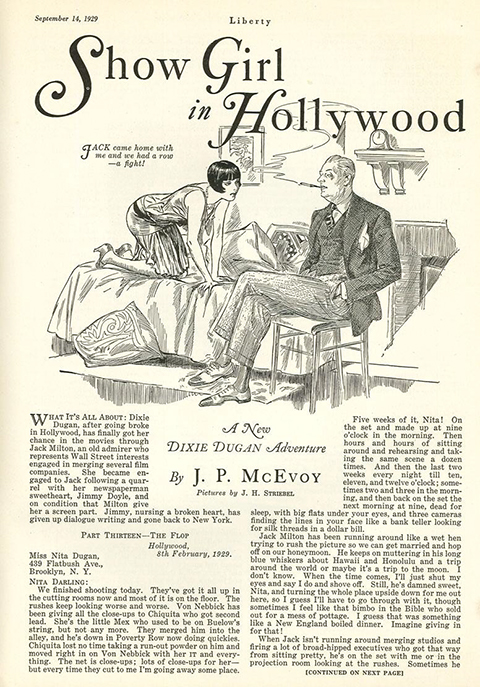
Show Girl in Hollywood pagePage from Hollywood Girl, Liberty serialization

The most sustained biblical allusion is the radio broadcast Dixie and Jimmy endure while in a restaurant: from L.A.’s Angelus Temple Aimee Semple McPherson delivers a hokey sermon on Daniel in the lion’s den, spread over four pages in small caps (174–77), exhorting her listeners to tune out “all the jazz bands and the frivolous things of this world” and to sing along with her (to the tune of “Yes Sir, She’s My Baby”):

Yes sir here’s salvation
No sir don’t mean maybe
Yes sir here’s salvation now
Goodbye sin and sorrow
Welcome bright tomorrow
For we’ve got salvation now (177)

This is too ludicrous to take seriously, and though Dixie occasionally refers to herself in terms such as “a devil on wheels” (231), she is hardly Satan, much less Eve, Esau, or Daniel, and her thoughtless elopement at the end makes a mockery of finding salvation. Nor is McEvoy calling for readers to renounce “the frivolous things of this world” like Broadway musicals and Hollywood epics; for his purposes, the Bible is no longer a moral guidebook but a source of wisecracks, but the recurring biblical references add one more unexpected level to the novel.

As with Show Girl, the reviewers ignored the dark depths and stayed at the bright surface of the novel, which they found a little dimmer than its predecessor. “The book is amusing, filled with Hollywood madness and Hollywood slang,” said the New York Times, “but it lacks the easy, hilarious fun of ‘Show Girl,’”[29] not considering the possibility that McEvoy was aiming at something more than “easy, hilarious fun.”

***

Society cover image

Two years later, McEvoy concluded Dixie’s sassy saga with Society, which picks up the same day Hollywood Girl left off.[30] The first half of the novel documents the first few months of Dixie and Teddy’s impulsive marriage: honeymooning down in Mexico and then up in Monterey, Teddy continues drinking and chasing after women, which soon drives Dixie to Hollywood to resume her career. But they make up, and Dixie begins learning more of Teddy’s rich family: his 18-year-old sister Serena, whom he calls “a wet smack and dumb as a duck” (6), who is preparing to make her debutante debut that fall; his 16-year-old sister Patricia, a hellion already wearing heels who has seen Dixie’s film and runs away from private school to pursue a similar career in Hollywood; and Teddy’s predictably stuffy mother and father; in order to trace his daughter, the latter hires the same Open Eye Detective Agency that searched for Dixie in Show Girl. Mr. and Mrs. Teddy Page, as they are called—Dixie loses much of her independent identity after she marries: “Teddy is my career now” (42)—then  sail to France to continue their honeymoon, but during the crossing Teddy lusts after an Apache dancer called Le Megot—“cigarette butt or a snipe,” as Dixie translates, and described as “one of the sexiest little devils I ever saw with a wild shock of hair, a slim lazy body, big black eyes and a red mouth that must drive men crazy” (70). Upon arrival in France, Dixie sends a telegram wittily announcing “LAFAYETTE I AM HERE” (74), but no sooner is the honeymooning couple settled in Paris than Teddy sneaks off to London “on business” to catch Le Megot’s act at the Kit Kat Club. Meanwhile, Dixie is escorted around Paris by an Italian gigolo who had tried to seduce her during the ocean crossing. After another big fight—Dixie throws “a complete set of Victor Hugo at [Teddy], all of which he managed to dodge with the exception of Volume II of ‘Les Miserables’” (109)—they make up and head down to the Riviera.

At that point, halfway through novel, the plot takes a metafictional turn: we learn that Jimmy Doyle is in Paris, working for Colossal Pictures again and “gathering material for a high society movie” (105–6). Excited to learn that Dixie is also in France, he telegraphs his producer with a revised idea: “COULD COMBINE EUROPEAN ANGLE SOCIETY AND DIXIES POPULARITY” (108, sic)—which sounds like a note McEvoy made to himself after finishing Hollywood Girl. Dixie continues to party with the idle rich and tells Jimmy she’s having fun, or “fun in a way. But it’s no pleasure—if you know what I mean. We’re all so bored—Teddy’s friends and their friends—and they work so hard to be amused—and nothing really makes ’em really laugh—only when they’re full of champagne and are their real selves but don’t know it” (123). Dixie is excited to learn she’s pregnant, but just then Teddy gets involved in a sex scandal and both have to sneak back to New York. As the Page family prepares for Serena’s obscenely expensive coming out ball at the Ritz-Carleton on Thanksgiving Eve ($50K, around $750K today), Patricia reconnects with the young communist radical she had met while en route to Hollywood, and attends a rally in Bryant Park at which he speaks the night of Serena’s ball. Learning the cost of the ball, her Red beloved leads a protest march to the Ritz, which is broken up by the police—or as the headline in the communist Daily Worker puts it (177):

TAMMANY COSSACKS DEFEND SACRED RITZ
FROM CONTAMINATION BY STARVING WORKERS
THOUSANDS OF DOLLARS FOR ORCHIDS
WHILE MILLIONS CRY FOR BREAD.

Early the next year, Jimmy returns from France, manuscript completed, and tracks Dixie down in Palm Beach, where she is drinking to excess, experiencing cramps, and having doubts about becoming a mother: “I’m so tired of this silly empty life and realize the baby is going to tie me down tighter than ever” (188). On the next page we read a news account of an explosion on a yacht, in which Dixie was seriously injured. When she learns she has lost the fetus, she declares herself through with it all. Her decent father-in-law arranges a quickie Mexican divorce (and a generous stipend for life), and Dixie agrees to star in Jimmy’s movie Society Girl, “A Sensational Expose of the Haut Monde At Play” as a full-page ad on the penultimate page describes it. The movie is a “smashing hit” (with more fake quotes from real reviewers of the time), and Dixie and Jimmy decide to rest by sailing together for France. Meanwhile, Teddy is already on to his next showgirl, who Walter Winchell informs us (in a tidbit from his column) is “the third gel from the left in Earl Carroll’s Fannyties” (205).[31]

Though Society lacks the hellzapoppin’ energy and jazzy lingo of its predecessors—which in fact would be inappropriate for the leisurely pursuits of the rich and fatuous—the novel is more ingenious than the average satire of high society due, once again, to the novelty of its materials. The title page resembles a formal invitation, set in a copperplate font and even blind-stamped.

Title page of SocietyTitle page from Society

In addition to the usual letters, telegrams, playlets, and news clippings, we’re treated to Dixie’s ocean crossing diary, shipboard schedules and announcements, formal invitations and cards of introduction, menus, invoices, legal documents, a Junior League report by Serena on “A Trip through a Biscuit Factory,” and best of all, several chapters from The Memoirs of Patricia Page (To Be Opened Fifty Years After Her Decease),” an amusingly self-dramatizing, misspelt account of the 16-year-old’s runaway adventure. There are self-conscious narrative winks from McEvoy, as when the stage direction in one playlet describes the head of the Open Eye Detective Agency as “one of those fiction detectives who can only be found in real life” (33), and when Jimmy remarks on the coincidence of booking a hotel room next to Dixie’s: “If a fellow wrote that in a book they’d say he certainly had to reach for that one” (118). As Jimmy adapts his film plans to fit Dixie’s life, and even asks her to supply background material on debutantes (which she does in snarky fashion), it becomes obvious that his Society Girl is a metafictional mirror image of McEvoy’s Society, a film of the novel/novel of the film.

Pages from Society

Pages from Society 2Pages from Society

The darker themes in the first two novels are lighter here: sexual predation takes the forms of handsy gigolos and rampant adultery. As early as page 3 Dixie reports that one of Teddy’s rich friends “went right on the make for me—didn’t seem to mind I was on my honeymoon. Teddy didn’t either. Seemed flattered if anything.” A dozen pages later he shacks up with his ex-fiancée, and his tomcatting ways result in the suicide of one betrayed husband. Prostitution imagery is used for both debutantes—their coming out balls are sales displays for the marriage market—and for “society girls who are poor as church mice and yet have to keep up a swank front and be seen everywhere in the swellest clothes and what they won’t do to get by would put a Follies girl’s gold digging into the ‘come into the drug store with me while I get some powder’ class” (18). Patricia’s communist friend reprises Alvarez Romano’s role in Show Girl to introduce political elements in the novel, railing against the decadence of capitalist society in America and aristocratic privilege abroad, which McEvoy records in garish detail.

He also slips homosexuality into the novel. In a brilliantly rendered playlet set in a Paris nightclub called Le Fétiche, two Harvard boys “doing post-graduate field work in abnormal psychology” marvel at the lesbians. “A rosy-cheeked, bright-eyed contralto in tweeds” sings three new stanzas of Cole Porter’s “Let’s Do It, Let’s Fall in Love” (1928), another opportunity for McEvoy to show off his gift for parody:

Bugs do it—
Slugs do it—
Evil-looking thugs in jugs do it—
Let’s do it—
Let’s fall in love.
In holes the nice little mice do it—
Tho they are pariahs—lice do it—
Let’s do it—
Let’s fall in love.
. . . . . . . . . . . . . . . . .
The Infusoria in Peoria do it—
And the better classes in Emporia do it—
Let’s do it—
Let’s fall in love. (93, 98)

This scene is followed by a letter from a Variety reporter describing the sights to be seen on the way south to the Riviera, including “a little hideaway tucked between [San Rafael and Toulon], entirely populated by the most delightful pixies, male and female, but you’ll never find it unless you meet one of three people, names enclosed here in sealed envelope. They’ll take you there if they like you” (103). In a trilogy about show business, it’s about time McEvoy mentioned the gay element, though it was a daring move for a commercial novelist in 1931.

Though Dixie takes up with high society, she’s never taken in by it. She mocks as she learns “society patter” and affected enunciation, yet can still deliver snappy similes such as “he closed up like Trenton on a Sunday night” (89; i.e., stopped talking). As she occasionally reminds people, she’s still just an Irish “punk” from Brooklyn, and despite a number of poor choices throughout the novel, she retains her best qualities. Teddy’s father praises her “spirit and independence in refusing alimony or settlement” (202), and the news item that concludes the novel indicates she’s single: she has reunited with the love of her life from Show Girl, but she hasn’t married him. Perhaps McEvoy merely wanted to leave the door open for another sequel, but it’s more likely that he intended Dixie to follow in the dance steps of his original model, Louise Brooks, who except for two very brief marriages spent most of her life single. (We can only hope that Dixie doesn’t wind up like our Miss Brooks did.)

Society is blander than its predecessors, but together the Dixie Dugan trilogy is an endlessly inventive portrayal of female independence as well as a damning indictment of show business, politics, sexual attitudes, and society at large. “To those who have followed him since ‘Show Girl,’ Mr. McEvoy has always meant humor and bite,” wrote the Saturday Review of Literature of Society. “The ridiculous and the sharply ironical were always blended,” and though the reviewer felt “the irony has wilted and the humor become worn” in the third novel, it’s that blend of humor and bite, of ridicule and irony—shaken and stirred with linguistic and formal ingenuity—that makes the trilogy as a whole a mordant, madcap masterpiece.

x

Fade to Black: The Final Novels

McEvoy’s 1930 novel Denny and the Dumb Cluck is a spin-off from Show Girl, which documented the failure of greeting-card salesman Denny Kerrigan to convince Dixie to abandon show biz and move to Chicago to marry him. Denny gets top billing in this novel, which begins two years later with a letter dated 11 May 1929 and ends about a year later, and which marks McEvoy’s turn toward darker, more bitter satires of American culture.[32] The novel is festooned with greeting-card verse, whose saccharine sentiments are undercut throughout by the vulgar businessmen who peddle the stuff and the “dumb clucks” who fall for it. Although marketed as a humorous novel,[33] the novel contains attempted suicides, mental breakdowns, divorce proceedings, Chicago mob slayings, and concludes with the murder of the president of Denny’s card company. Even the Hollywood happy ending, in which Denny regales his bride (the “dumb cluck” of the title) with the story of that murder during their honeymoon near Niagara Falls, is undercut by signs of what a terrible husband he will be. The novel is dedicated to Santa Claus.

Denny and the Dumb Cluck cover image

Like McEvoy’s earlier novels, Denny is an assemblage: letters, press bulletins and newspaper clippings, company memos (some shouting in ALL CAPS), telegrams, divorce papers and trial transcriptions, a hotel bill, two lengthy monologues, and selections from a lonely hearts newspaper column penned by “Carolyn Comfort”—actually a “white-haired [male] tobacco-chewing reprobate” (148).[34] It differs from his earlier novels in its structure: they proceeded chronologically, with their multiple story-lines interlaced, but Denny is divided into eight semi-independent sections that focus on specific story arcs. Part 1, dated from 11 May to 12 June 1929 concerns Denny’s modus operandi to selling the Gleason Greeting Card Company’s wares to the female owners of card shops (all with twee names like “Ye Arte Moderne Snuggery”); as he writes to his supervisor Al Evans, this entails “taking out the lady buyers and getting them all warm and confused so they’ll overstock themselves and have to work like hell making profits for you and me eh Al?” (22).[35]

Pages from Denny and the Dumb CluckPages from Denny and the Dumb Cluck

At loose ends one Sunday in Chicago, he meets “the dumb cluck”: a young woman named Doris Miller, estranged from her rich family in Indiana because she moved to Chicago “to make her own way” as a singer—another of McEvoy’s admirably independent young women. But when Denny recites one of his company’s lovey-dovey greeting cards and passes it off as his own spontaneous creation, Doris falls for him. “Poetry always gets dames,” he smirks to Al (15). But after she spots the poem in a greeting-card shop window, she attempts to drown herself. She is rescued, then explains her reason for the attempted suicide to a reporter who gussies it up for a human interest story for the Chicago Herald Examiner (reproduced on pp. 23–25), which leads to a spike in sales for the “Heart Throb” card Denny quoted. Denny hears about the sales but is unaware of his role in the spike.

The next section, however, begins with a letter by Al dated more than two months earlier (3 March) instructing his salesmen to make a big push for the new idea of a Father’s Day card, and concludes with a newspaper report dated 17 June 1929 noting Al’s admittance to a sanatorium for a nervous breakdown, the result of his stress-inducing sales efforts.  This section features heart-rending letters from his wife to her mother on the disastrous effects of his work on their marriage, and also introduces the Gleason Company’s “staff Poet Laureate” (3), Terence McNamara, a hard-drinking party animal (obviously a stand-in for McEvoy himself) whose marriage is likewise troubled. Section three is undated but apparently takes place in April, for it deals with sales plans for Mother’s Day cards. Denny gets nowhere with the proprietor of Ye What Ho Gifte Shoppe, “One of those long legged short-haired Greenwich village gals that wear batik bloomers and talk about their complexes” (60). She has eyes only for a milquetoast customer who shops frequently for cards to send home to mother. (In an ironic twist typical of McEvoy’s novels, he turns out to be a hired assassin.) Denny reports to Al about a crime wave in Chicago, and passes along his (and apparently his creator’s) doubts about his profession and his country: “Boy, you and I picked a piker’s game when we decided to spread cheer throughout the land. It’s nothing to cheer about if you ask me” (69).

Section four documents McNamara’s divorce proceedings, dated between 14 September and 5 October 1929.[36] His wife testifies to his numerous drinking binges on greeting-card related holidays and irresponsible behavior, including the time when McNamara flipped out when his kids recited a Valentine’s Day greeting-card poem to him. But when the poet takes the stand, he wins over judge and jury by answering entirely in greeting-card “sediments” (as it is often spelled in this and other McEvoy novels).
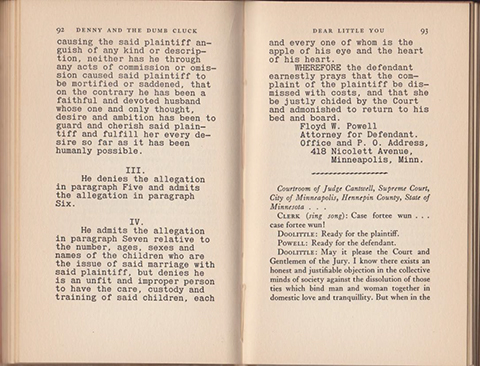
Pages from Denny and the Dumb Cluck 2Pages from Denny and the Dumb Cluck

The final four sections are undated. Section five apparently takes place later in October 1929, for greeting-card president George Gleason is in New York City looking for a replacement poet after firing McNamara for bad publicity. This startling section is a 23-page monologue delivered by Gleason to a Ziegfeld showgirl in his hotel room—she is currently dancing in Whoopee!, which closed 23 November 1929—whom he plies with liquor and tries to seduce until she panics and attempts to jump out the window. In section six, which seems to take place in late October or early November (though there’s no mention of the Wall Street crash during the last week of October), Denny searches for Doris, while the dumb cluck pours her heart out to Carolyn Comfort’s lonely heart column. Section seven must be set in late January of 1930, for football season has just ended and Denny is peddling Valentine Day cards. He’s having a difficult time making a sale to the owner of Ye Merrie Lyttle Nooke in South Bend, Indiana, “a little pug-nosed Mick” who is distracted by unrequited love for a theology student at Notre Dame, and is secretly contemptuous of her wares: “There is a card lying here on the table before me as I write, a sample Valentine given me by that fool salesman, Denny Kerrigan, who sells the Gleason line. It says ‘Love is bright as sunshine, love is sweet as dew’ and a lot more. But it isn’t anything like that at all, darling. Love is bitter and dark and cruel beyond all the cruel dark and bitter things of this world” (177). Her heartbroken letters to the student express true emotions in stark contrast to the false ones offered on greeting cards. After reading a newspaper announcement of her beloved’s ordination into the priesthood, clueless Denny writes to the woman about his new idea for a line of cards: “CONGRATULATIONS ON YOUR ORDINATION.”

The final section jumps ahead a few months to Denny and Doris’s honeymoon, and is mostly taken up by Denny’s account of George Gleason’s murder the previous February by a disgruntled customer. There’s no explanation for how Denny found and made up with Doris, for since Denny is talking to her (another one-sided monologue to a silent woman), there wouldn’t need to be. Doris obviously knows how it happened, but the reader doesn’t, who might be excused for thinking McEvoy grew impatient and didn’t want to write a penultimate section on their reunion and courtship. Denny had suffered some sort of accident in section six that entailed a hospital stay with his face in bandages, and unbeknownst to him Doris nursed him and took dictation for his letters to Al about his search for “that dumb cluck” (156). They obviously reconnected, so McEvoy apparently felt he could cut to the honeymoon and wrap it up.

Despite the ostensibly happy ending, this is a harsh novel, which is to be expected from an author who set out to write a “grudge book” to “get even” with the greeting-card industry, as he admits in the author’s note at the end. It was too harsh for some reviewers: “The book is American in the same way that chewing gun, comic supplements and loud speakers are American,” complained Edwin Seaver in the New York Evening Post. “It is a violent, noisy book.” Contemptuous of the publisher’s attempt to market the novel as light humor, V. P. Ross wrote, “It is too ugly to be delectable, too grotesque to be tragic, and too longwinded to deserve the laurels of humor.”[37] But it is precisely those qualities that give Denny and the Dumb Cluck its edge, its Voltairic clash between ideals and reality, its anticipation of the irony-clad black humor of 1960s novels. A standard boy meets-loses-marries girl novel taking jabs at greeting cards would be too simple. McElroy used that sideline to stand for American business practices in general, many aimed at persuading “dumb clucks” to purchase their goods and services. He even hints that the New Testament’s promises of immortality are as false and hollow as greeting cards when Denny flips through a Gideon’s Bible in a hotel room.

The language isn’t as slangy as that in the Dixie Dugan novels, though there are some amusing euphemisms (“you illegitimate sons of Rin-tin-tin’s mother”) and synonyms for drinking binges (“out on a bat”). There is also what appears to be McEvoy’s self-conscious defense of his “humorous” approach to writing versus that of “serious” writers, many of whom flocked to Paris in the 1920s. Denny writes to Al about the old drunk who writes the lonely hearts column:

For years he has done everything in the newspaper racket and found that nobody cared, so now he runs the Lonely Hearts Corner and hopes to save enough money to retire and go to Paris to write a novel. He says he needs a couple of years off from the job so he can gather material. I says, what about all these letters you get from the Lonely Hearts? I should think that would be swell stuff for a writer. A lot of hooey! says he. Now, take that story you were telling me about that girl you tried to find—you know, the one you picked up in a restaurant and took for a lake ride. She jumps off a boat because she thinks you wrote those bum sediments you’re always quoting! Well, I don’t blame her. I’d jump off myself to escape you. Now, I suppose you think there’s a story in that? Sure, says I. Crazy, says he. That just proves you’d better stick to peddling cheer. You’d starve to death if you tried to write. Now me, for instance, I know how, but I’ve nothing to write about and I can never save up enough to get ahead and settle down for a couple of years to do serious work. You know my dream, says he. I want to get a little studio in Paris near Montparnasse, and just sip wine, nibble cheese, and observe life and write about it. (150–51)

You can imagine what that novel would be like, if the old sot ever got around to writing it. But McEvoy did find “a story in that” attempted suicide, a polyvalent one that expands to indict all of American society at the bitter end of the Roaring Twenties when it all came crashing down, and didn’t need to take a few years off in Paris to write it.

***

Having settled his score with the greeting-card business, McElroy turned next to the comic-strip industry. The first half of Mister Noodle takes place in Chicago, where McEvoy got his start in strips, and I can’t improve on the plot summary provided by James A. Kazer in The Chicago of Fiction:

The story of Charlie “Chic” Kiley from Gum Springs, Illinois, is told through letters to his mother, news clippings, telegrams, and transcripts of conversations. Kiley takes drawing classes at the Art Institute and works in the art department of the Chicago Star. Overnight he becomes a nationally known comic strip artist when he introduces Mister Noodle, a strip composed only of profiles (since that is all Kiley can draw). He also effortlessly achieves social status, receiving memberships in the Chicago Athletic, Forty, and Midday Lunch clubs. With his newfound security he is able to marry his girlfriend and he soon has a one hundred thousand dollar per year contract for his syndicated strip. However, when he relocates to the syndicate’s offices in New York City he succumbs to the temptations of beautiful women, nightclub entertainments, and drink. When an actress falls from the balcony of his penthouse the scandal fills the Midwest with moral indignation and his comic book gets cancelled. Only when he returns to Chicago and reconnects with his small town does he get the inspiration for a new comic strip and rediscover success. This satire of the syndicated comic book industry makes pointed comparisons between Chicago and New York to the detriment of the latter.[38]

Illustration of Mr. Noodle from Saturday Evening Post 1Arthur William Brown illustration, Saturday Evening Post serialization of Mr. Noodle

It’s important to note that the novel satirizes only certain aspects of the comic industry, specifically the undeserved success of certain hacks and low-brow taste of many readers. The first time Kiley submits his poorly drawn strips to the editor of the Chicago Star, his boss tells him, “This paper has printed hundreds of questionnaires and prize contests for the correct answers on the simplest subjects, and we have found by experience that the average person knows only three things. . . . He knows his name; he knows his parents; and he knows where he lives. And that’s all he does know. Remember that if you’re going to be a comic-strip artist. . . . Always tell ’em something they already know. The better they know it the better they like it” (41). Talentless hacks pandering to the lowest common denominator is what irked McEvoy, not the genre itself; later in the novel, when a Russian director named Ivan Stalinsky sails to America to make a movie of Kiley’s strip,[39] the director expresses what might be McEvoy’s own views during a gangplank interview with the New York Evening Tab (the same rag that figures so prominently in Show Girl):

“The comic artist is the real modern artist. Comic artists were the first expressionists, and the colored supplements in your Sunday papers, with their vivid reds and greens and blues, are brutal and frank as the life they underscore, and it is only because I have always made pictures with real people rather than actors that I welcome this opportunity to come to your America and make a new comédie humaine, using the real Noodles of American life to reënact and interpret the salty humors of everyday existence. . . . You can say for me,” he added, “that the Supreme Author is a Humorist, and Life is a mad comic supplement He created to amuse the angels.” (125)

McEvoy placed the final sentence upfront as the epigraph to the novel, but then again, the entire statement may only be a swipe at the lofty claims sometimes made for the genre. The author definitely has his tongue in cheek when Kiley’s editor tells him, “Don’t forget the last frontier of old-fashioned virtue is the comic strip” (47).

Unlike the previous novels, the documents that make up Mister Noodle are not dated, except for a clip from Vanity Fair on the last page dated 1932, a year after the novel was published. Apparently the events occur between 1929 and 1930—a character on page 71 recites lyrics from “Just You, Just me,” a hit song introduced in the 1929 musical Marianne, though again there’s no mention of the Crash of ’29—and everything happens at a more rapid pace than in the previous novels, effectively conveying the “overnight-success” aspect of Kiley’s career. This is a deliberately unfunny novel about the funny papers, featuring one of McEvoy’s most despicable protagonists. Not only is he talentless, but he owes his success to others: his girlfriend Dorothy—whom he meets at the Art Institute and later elopes with—gave him the idea for the strip in the first place, which Kiley then adjusts to his boss’s low view of comics (which Kiley later parrots as his own). After he becomes successful, he has a team produce the strip for him while he gallivants around New York City, and even when he returns to Illinois in disgrace at the end, he has learned nothing. Kazer’s description of the conclusion is misleading: Kiley returns to Gum Springs to recuperate, but is subjected to a brilliantly rendered monologue by his ignorant Irish Catholic mother about murders, mayhem, and madness out in the sticks: hardly the stuff of inspiration. When Kiley then meets with his former Chicago Star editor and claims he has ideas for a new strip, he junks them as soon as his boss feeds him an idea for a new strip called Mister Whoosis, which Kiley claims for his own creation when he boasts to his New York syndicate boss of his imminent return to the big leagues. The novel ends with another hick comic artist arriving in the New York and getting carried away at the idea of living the high life, obviously on course to repeat Kiley’s fall. Or not: the last page of the novel reproduces a clip from a future issue of Vanity Fair stating, “We nominate for the Hall of Fame, Willie Timmerman, because—“ (186).

Illustration for Mr. Noodle from Saturday Evening Post 2Arthur William Brown illustration, Saturday Evening Post serialization of Mr. Noodle

The Chicago Star editor’s final lecture to Kiley is a cynical but informed overview of the comic-strip business, especially its lack of originality, and undoubtedly represents McEvoy’s conclusions after fifteen years in the business. When Kiley tells him that he has an idea for a strip that has never been done before, the editor (named James P. Mason) cuts him off:

Worse. Doomed to failure. The most successful strips running today were always successful, long before they were strips. Mutt and Jeff was a big hit when it was called Weber and Fields, and it’s a bigger hit now when it’s called Amos ’n’ Andy. Same idea. Big dumb guy picking on a little smart guy. German dialect, colored dialect, Brooklyn dialect—same thing. Little Orphan Annie is Cinderella. Bringing Up Father—Abe Kabibble—every burlesque show for the last fifty years has had a Jiggs and an Abe. The Gumps? Mr. and Mrs.? Any family comic? Has anything ever happened in any of ’em that hasn’t happened a million times in a million homes?

CHIC: I know, but they aren’t funny.

MASON: They don’t have to be funny. Did you ever watch anyone read a comic page? Did you ever see him laugh? Was there ever a laugh in Little Orphan Annie? One of the most successful comic strips running. People don’t want to laugh so much as they want to feel superior to somebody else. (179–80)

There are discussions like this throughout, with references to many strips and comic artists, which should make Mister Noodle valuable for comic historians, written by someone who was there at the beginning. For literary historians, Mister Noodle is valuable as a demonstration of how to take an unoriginal story-line (rube seduced by the big city) and make it new by way of formal and linguistic innovations. In addition to McEvoy’s usual documents, which as always provide a you-are-there immediacy to the proceedings, there are some amusing parodies of the gossip columnists of the time. Kiley’s arrival in New York is announced by a word-drunk columnist reaching for the literary stars:

AVE! MISTER NOODLE!
An Inquiry into the Irrefragable Tenuities
(From the Editorial Page of the New York World)

Swims into our ken a new planet—the algebraic mystification of orbital aberrations, the torturing ellipse of tortured ellipses, the Theseus before the throne of the Minotaur, half bull, half man, quaint Cretan symbol of American ideology—Mister Noodle—planet X—crying in the wilderness, eating the wild locusts of ephemeral fame, preparing the way for a greater-than-he, forsooth, or peradventure, if you will quibble—but I shout “Gold! Gold!” as did wild-eyed Sutter long ago—and mayhap I will grant you, a Fool’s Gold, but your Au may be my FeS₂, and who will bid me nay, for fool’s gold is the guerdon of fools—always the king on the throne has paid the fool on the stool stones for bread, darkness for light, the louring brow for the laughing lip—and so, in like manner—Measure for Measure, said the Mortal Poacher with immortal finality, or vice versa—we too long and too smugly, I fear, have been paying Mister Noodle of the earth earthy—Punchinello Redivivus!—with Jovian frowns from our high, crystal parapets, remembering not that Jove walked with the sons of men by day and talked with the daughters of men by night—Danaë? Shower of gold? FeS₂? Why not?—and from the little despairs of men, brewed by an alchemy lost to us the great courage of the gods against the cosmic crepuscle of the Götterdämmerung. (Ya sagers, all, shouting in the terrible twilight that finally swallowed warm, shining Olympus and cold, dread Erebus alike.) Vale, Great God Pan! Ave, Mister Noodle! (97–98)[40]

Columnist Walter Winchell is parodied twice, once upon Kiley’s arrival and once after his disgrace: “A certain cocky alien from Chicago, who was King Fish in the ookie-ookie racket a few months ago, and then faw down on his you-know-what with a big phfft is out of the camphor again and trying to merge a meal ticket on a local rag . . . no soap” (163). On the train from Illinois to New York, Kiley makes the acquaintance of “The Boop-a-Doop Sisters,” two nightclub chippies who provide an sassy stream of slang throughout the rest of the novel, even some pig Latin.

As in his previous novels, McEvoy takes the faults of a minor—some in the 1920s would have said trivial, even disreputable—medium of pop culture as a metonym for the faults of America at large. He presumably wrote Mister Noodle in the gloomy months following the Wall Street crash, which perhaps justifies the New York World columnist’s despairing evocation of Wagner’s Twilight of the Gods. Reviewers used to the fizzy fun of the Dixie Dugan novels were shocked at the novel: one complained “Its humor is cruel,” another that “There is a great deal that is coarse and unnecessarily realistic,” and a third that it “is hard, brittle, cruel almost to literary sadism”[41]—which sound like the reviews Faulkner’s Sanctuary received the same year. Neither Mister Noodle nor Society (also published in 1931) sold well, and perhaps for that reason McEvoy changed publishers for his final novel.

***

In contrast, reviewers were very impressed by Are You Listening?, and quite rightly so. It is his most compelling performance, his most technically ingenious “stunt” (as one reviewer called it), his grittiest and most realistic novel, and his most powerful dramatization of the impact of new media on the public. The media in question is commercial radio: only a decade old by 1932, “The invasion by this sort of blah is now history,” one of the novel reviewers lamented (William Rose Benét, he who labeled it a stunt):

One hears it not only in every apartment but on every street corner. It has turned any imaginative life that exists for the man in the street into a mixture of ballyhoo slogans, thickly syrupy sentiment—usually about all the wrong things—and sensational thought images. . . . [T]he industry in its infancy has so far managed to spread more blatant vulgarity on the air than one would even have suspected. This is probably what a democracy loves. It is certainly what it continues to listen to without noticeable protest.[42]

McEvoy’s “noticeable protest” puts it even more dramatically: a broadcaster describes radio as going “into every home, every factory, every story, every place where men and women meet to eat, sleep, drink, work or play; this tremendous voice from which there is no escape; this modern jungle drum beating from coast to coast . . .” (236). For some lonely souls in the novel radio provides companionship—“Turn it on in the morning and let it run. Keeps them company” (143)—but one character who can’t escape it lambastes radio for “babbling all day like a half-witted relative” (129).[43]

Are You Listening ColliersAre you Listening?, Collier’s serialization, illus. by Henry L. Timmins

The main story-line concerns the three O’Neal sisters, who have left Middletown, Connecticut, to try to make it in New York City. The eldest, Laura, went there to become a concert singer, but now performs for Radio WBLA (pronounced blah, as Benét notes). She shares an apartment with her younger sister Sally, who works as a receptionist at WBLA all day and parties all night. Their airhead kid sister Honey, nearly 18 when she moves in a little later, is “trying to crash Broadway” (40) but has to settle for bit parts on the radio, and eventually for a gig as a celebrity gossip reporter for the New York Morning Tab. All three have trouble with men, none more so than Laura, who is romantically involved with Bill Grimes, a continuity writer for WBLA. He’s stuck in a hellish marriage with a shrew who won’t grant him a divorce until he can afford to pay a huge alimony; near the end, he accidentally strangles her to death, then flees with Laura as WBLA, in cahoots with the police department and the Morning Tab, livecasts the manhunt for them. Because of the radio reports’ reach, the couple is ID’d and arrested in Florida, Bill is convicted of manslaughter, and is sent to Sing Sing (which was recently wired for radio). The novel ends with all three sisters listening, from different locations in different moods, to a live radio broadcast of Cab Calloway and his Joy Boys singing “Life Is Just a Bowl of Cherries” from the Cotton Club.[44]

The novel elapses over about a year’s time—undated, but apparently from May 1931 to spring 1932—and and is partly conveyed by way of radio broadcasts, set in boldface italics: announcer palaver, jingles, speeches (including one from the Vatican by the pope), skits plugging ludicrous products, musical interludes, and live shows from various locations, including the notorious Nut Club in Greenwich Village. (There are also some short-wave police bulletins near the end.) The broadcasts alternate with the main mode of the novel: unpunctuated dialogue, one-sided telephone calls (with unspaced Célinesque ellipses …), monologues, and italicized shouting in a larger point size. The earthy dialogues are often interrupted and undercut by the airy nonsense of the broadcasts, usually for darkly ironic purposes. (Saccharine love songs provide musical background for spats between couples; a noted judge delivers a speech praising Prohibition hours after his all-night, booze-filled yacht party; peaceful Christmas hymns are interrupted by the barked police reports on the manhunt.) And as in all of McEvoy’s novels, there is extensive behind-the-scenes dramatizations of putting a show together, especially the frustrating attempts of creative people to meet the needs of their commercial sponsors. WBLA’s producer regards radio as “a theater of the air. The advertising is incidental, but so far as the public is concerned, a necessary evil” (90). The sponsors, of course, feel precisely the opposite: one client, after hearing a Shakespearean skit created for the Eureka Exterminator Quarter Hour, wonders “if some of it won’t be hard to understand. Of course I understand it, but then you know how the average person is—especially when it comes to words like—like—like well, some of those words the girl used. . . . Seems we use a lot of time on the air without saying something about our product. Couldn’t we mention that it comes both in liquid and powder form, or something like that?” (184). The frequent time-of-day announcements are called M-O-R-I-S-O-N WATCH TIME after its sponsor, which anticipates the subsidized years in David Foster Wallace’s Infinite Jest.

McEvoy’s reliance on dialogue to carry the narrative is reminiscent of other novelists of the time such as Ronald Firbank, Ivy Compton-Burnett, Evelyn Waugh (Vile Bodies), and Virginia Woolf (The Waves). In the radio bits, he demonstrates his gift for satire and pastiche, but the dialogue is impressive for its unvarnished realism from a wide variety of characters, from radio personnel and sponsors to Wall Street investors to speakeasy owners and gangsters. (Just before he strangles his wife, Grimes tells her that her psychologist “just wanted to lay you” [219], perhaps the first appearance in fiction of the vulgar verb.[45]) By way of dialogue McEvoy ingeniously conveys everything that a third-person narrator in a conventional novel would—appearances, actions, settings—putting the reader in the same position as a radio listener creating visual images from dramatized scripts.

Pages from Are You Listening 1

Pages from Are You Listening 2Pages from Are You Listening?

The best lines are delivered by McEvoy’s female characters, most of whom reveal how difficult it is to be a woman, especially in what Sally O’Neal calls “this man’s town” of New York. When station announcer Buddy Law tells her he can’t see how girls stand it, she answers, “Buddy, when you’re a girl you learn to stand almost everything. That’s what being a girl means” (15). Both Sally and Honey party hearty in defiance of their conventional, religious mother, who visits and lectures them on a woman’s place in the world (safely married at home in an apron), while older sister Laura is so exasperated by her failed career and troubled relationship with Grimes that she attempts suicide. She complains of her neighbor Mrs. Peters, who turns on her radio “in the morning and never lets up until two o’clock the next morning,” but her mother tells her she does so because “She’s lonesome and sad. How would you feel if you used to be a famous actress, and now because you’re not young any more you can’t get a job and have to sit home and listen to the radio.” Laura replies, “Well, that’s just tough if she grows old and gets out of step. Who can help that?” (129). Later, Mrs. Peters offers some sound advice to Honey, who can’t decide whether to accept a rich man’s invitation to attend a football game in Chicago: “Remember, it’s always the woman who holds the key to any situation like this. It can be any kind of situation she chooses, and the man must abide by her decision. If I haven’t learned anything else in my fifty years, I’ve learned that men accept a girl on her own valuation of herself. If she wants respect for herself, she must have it for herself first” (167). As in his other novels, McEvoy portrays independent women in a positive light, but in Are You Listening? he poignantly captures the despair of women trapped in hopeless situations. The psychologist who treats, “lays,” and then abandons 50-year-old Mrs. Grimes doubts his smart secretary’s diagnosis that she’s dangerous: “Why? Just because she’s emotionally starved, repressed, and somewhat inclined to hysteria? What of it? Most married women of that age are.” “True,” his secretary responds, “but she’s a potential manic-depressive, starved, thwarted, on the edge of her menopause and fixed on you. You know that’s a bad spot” (195; like “lay,” this may be one of the earliest appearances of the word “menopause” in fiction). Both Laura and Alice Grimes suffer psychotic meltdowns, Sally and Honey fend off near-rapes, and in another scene a gangster Sally is dating knocks a woman unconscious. The plight of women alternates with the ubiquity of radio both formally and thematically in this gender-sensitive novel.

Despite its grim theme, there are some amusing bits. Answering the phone while the station’s broadcast blares overhead, Sally wisecracks, “If there’s anything that’s good for a hangover, it’s German on a loudspeaker” (45). There are clever Gilbert and Sullivan parodies that recall the McEvoy of Slams of Life, and the listening audience is treated to musical performances by such groups as the New Art Plumbing Symphony Orchestra (under the direction of Arturo Garfinkel) and the Beau Brummell Dandruff Dandies’ Jews’ Harp Trio playing the overture to Wagner’s Tannhäuser. (His Tristan and Isolde is incorporated into an ad for bathroom fixtures.) But as in McEvoy other late novels, the humor is black.

Even though the aforementioned William Rose Benét called Are You Listening? a “‘stunt’ novel” and stated “There is nothing a bit ‘literary’ about the book,” he praised it to the skies, pompously concluding his review: “Mr. McEvoy has been ere this a champion of the comic spirit. He has also, however, seen the cruel significance behind all the moronic chatter now burdening the ether, and has praiseworthily evoked it in this novel for us to see. Underneath all the japery, it mutters in our ears like the ghost of Hamlet’s father!” Hollister Noble, in a rave review for the New York Times Book Review, praised the “consistent balance between the serious delineation of character and the mocking irony of [the radio station] environment,” and complimented McEvoy

for two distinct achievements. He has re-created with amazing fidelity, through the rapid-fire conversation of his characters, the very breath and life of the studio. And at the same time he has skillfully handled a great variety of characters, each of them early delineated and definitely individual. All of them have the full flavor of reality, and Mr. McEvoy is most adept in depicting their collisions with the fantastic complexities and whirling enigmas surrounding them.[46] Perhaps heeding the show-biz advice of always leaving them wanting more, McEvoy ended his performance as a novelist on that high note.

***

The final line of McEvoy’s final novel is “Are you listening?,” which would be echoed 43 years later in the final line of William Gaddis’s multimedia novel J R, spoken into a telephone: “Hey? You listening . . . ?”[47] McEvoy resembles Gaddis in many ways: both have a caustic sense of humor and dim view of America; a high fidelity ear for dialogue and the vernacular; and a penchant for the comic-ironic juxtaposition of public statements vs. private sentiments, high art vs. low entertainment (in J R Gaddis uses Wagner much the same way McEvoy does). Both use documents in fiction—J R has several, and his novel A Frolic of His Own is filled with legal documents, a play script, letters, newspaper clippings, brochures, even recipes—and both satirize the frivolous uses of technology in the arts: like the Russian director in Mister Noodle, Gaddis in his final, posthumous novel Agapē Agape stares agape at “the lavish opulence of American technical resources and at the same time secretly frighten[ed] and depress[ed by] the remorseless rhythm of this great machine, spawning and spewing in callous complacence an endless flood of elegant marshmallows” (Noodle 136–37). Three other innovative fictions of the 1970s that come to mind are the vaudevillian skits, speeches, and news reports that make up Philip Roth’s Our Gang (1971), Jerome Charyn’s novel in the form of a literary quarterly, The Tar Baby (1973), and Robert Coover’s use of show-biz tropes to indict American culture in The Public Burning (1977), another novel comprised of documents, monologues, poems, and parodies. Whether regarded as a covert avant-gardist of the 1920s, as a harbinger of the Black Humor of the 1960s and certain multimedia novels of the 1970s, or as an avant-popster avant la lettre, J. P. McEvoy deserves to be rediscovered and reprinted.

J P McEvoy still from Woman Accused 1933Still from Woman Accused, 1933

—Steven Moore

.

STeven Moore

Steven Moore is the author of the two-volume study The Novel: An Alternative History (2010, 2013), as well as several books on William Gaddis. His new book, My Back Pages: Reviews and Essays, is forthcoming from Zerogram Press.


Footnotes    (↵ returns to text)

  1. Manhattan Transfer: The American Novel as Scrapbook,” http://www.fractiousfiction.com/manhattan_transfer.html. T. S. Matthews, New Republic, 25 July 1928, 259. The most famous predecessor for the “scrapbook” novel is Bram Stoker’s Dracula (1897); for a literal example, see The Scrapbook of Frankie Pratt by Caroline Preston (2011).
  2. The Cambridge Introduction to Postmodernism (New York: Cambridge University Press, 2015), 83.
  3. “Ink-Slinger Profiles: J. P. McEvoy,”<http://strippersguide.blogspot.de/2015/06/ink-slinger-profiles-by-alex-jay-jp.html>, posted 8 June 2015. This treasure trove of research is the source for many of the biographical details that follow.
  4. North American Review 244.1 (Autumn 1937): 206.
  5. Quoted in Ray Banta, Indiana’s Laughmakers: The Story of over 400 Hoosiers (Indianapolis: PennUltimate Press, 1990), 115.
  6. The Sweet Dry and Dry includes a parody entitled “The Boobyiat of O Howdri Iam.”
  7. “Lewis Talks to Chicago League,” Publishers Weekly, 19 March 1921, 914.
  8. James Curtis, W. C. Fields: A Biography (New York: Knopf, 2003), 157.
  9. For details, see Curtis (157–64) and especially chapter 23 of Simon Louvish’s Man on the Flying Trapeze: The Life and Times of W. C. Fields (London: Faber and Faber, 1997). Louvish says they had a lot in common, physically and temperamentally, and concludes, “McEvoy’s influence on Bill Fields was profound and long-lasting” (254). They appear together in a photograph on p. 255.
  10. It was registered with the Library of Congress as Americana: A Novel Revue—an inadvertent (or not) pun setting the stage for the revue-like novels McEvoy would soon write.
  11. George Gershwin: His Life and Work (Berkeley: University of California Press, 2006), 377. Gershwin wrote a song for the show (“That Lost Barber Shop Chord”). McEvoy was assisted by Morrie Ryskind and Phil Charig, and worked with composers Con Conrad and Henry Souvaine on the score. Conrad (1891–1938) writes the music for the musical in McEvoy’s first novel, Show Girl.
  12. See Pollack 451–61 for a detail account of the musical, who notes that the script “lost much of the charm of the original novel” (453). Ethan Mordden agrees: “Very little of McEvoy’s satirical view of how scandal and crime sell fame came through” (Ziegfeld: The Man Who Invented Show Business [New York: St. Martin’s Press, 2008], 268).
  13. Jay records McEvoy’s remark that he stopped writing the strip around 1936 and turned it over to his son Denny and Striebel. See the feature story on the origins of the strip in Modern Mechanix, April 1934, 57, 143–44 <http://blog.modernmechanix.com/dixie-dugans-fathers/#mmGal>.
  14. For the reason, see McEvoy’s “A Jeremiad on Laundries” in Slams of Life (58–59).
  15. Times Square Tintypes (New York: Ives Washburn, 1930), 245–48.
  16. Show Girl was what The Inner Sanctum calls a Life Saver. Part of it showed up on a gray afternoon and promptly ran away with the working day of our staff. It was read and accepted in twenty-four hours. Laughter is an irresistible salesman. A number of other customers fell in line. Liberty laughed and bought Show Girl for serial publication. First National is filming it and a musical comedy is in the offing.”
  17. Her age is not given in the novel, but in the sequel set a year later, Dixie writes: “As for me I am nineteen years old and what is technically known as a virgin although I have been most thoroughly and thrillingly mauled on many occasions . . .” (Hollywood Girl 37). She also states “I am now five feet two inches tall and weigh 110 pounds” (36)—Louise Brooks’s stats.
  18. Barry Shank offers some informed observations on Denny and his profession in A Token of My Affections: Greeting Cards and American Business Culture (New York: Columbia University Press, 2004), 148–51, one of the only treatments of McEvoy in recent criticism (though he gets some plot details wrong). Of McEvoy’s Slams of Life, Shank writes, “As an attempt at satire, the book fails to sustain a critical viewpoint. But it functions quite well as a document of the cheap cynicism that seemed to haunt those who produced culture on demand for commercial purposes in the first half of the twentieth century” (147).
  19. His formal name John Milton is given a few times; apparently McEvoy liked the idea of naming a horny Wall Street broker after the Puritan poet.
  20. American Mercury was the leading literary journal in the 1920s; True Story [sic] featured sleazy “sin-suffer-repent” confessions by women (often male ghostwriters).
  21. Real-life Broadway veterans Con Conrad (music), Sammy Lee (choreography), Herman Rosse (scenic design), and Walter Donaldson and Gus Kahn (additional songs). Several celebrities make cameos in the novel, including Florenz Ziegfeld, Jimmy Durante, and evangelist Aimee Semple McPherson, and many others are namedropped.
  22. Saturday Review of Literature, 30 November 1929, 491.
  23. All quoted from the 1928 edition of Book Review Digest.
  24. He is called Fritz von Buelow only on the cast list in the front of the book, and is apparently based on McEvoy’s friend Erich Von Stroheim, who also makes a few cameos in his novel under his real name.
  25. In 1929, the idea of making a romantic movie out of Tennyson’s 55-line poem was absurd, but in 1936 there appeared The Charge of the Light Brigade, starring Errol Flynn and Olivia de Havilland.
  26. The Cabinet of Dr. Caligari, the 1919 German Expressionist masterpiece.
  27. The final page of the Liberty serialization (28 September 1929, 73) is much more elaborate: the Times announcement mimics the paper’s actual display and text fonts, and the extended photo includes several wedding guests and a caption, not just the wedded couple as in the published book.
  28. This is occurs in Dixie’s monologue, echoing the closing line of Molly Bloom’s monologue in Ulysses: “. . . and yes I said yes I will Yes.” Like alcohol, Ulysses was prohibited in America at this time, but McEvoy managed to obtain both.
  29. Quoted in Book Review Digest for 1929.
  30. However, there is an inexplicable dating discrepancy: Hollywood Girl ends in April 1929, but Society begins in April 1930. A few references in the past tense to the Crash of ’29 indicate the novel is indeed set in 1930, the bulk of it from April to December, and concluding around the time of the book’s publication in the fall of 1931. Cf. note 33 below.
  31. A pun on Carroll’s stage revue Vanities. “Known as ‘the troubadour of the nude,’ Carroll was famous for his productions featuring the most lightly clad showgirls on Broadway” (Wikipedia).
  32. Thus the novel occurs during the inexplicable 1929–1930 gap between Hollywood Girl and Society, which is perhaps what McEvoy intended by re-dating the latter, hoping nobody would notice.
  33. The novel was published by Simon & Schuster’s Inner Sanctum line, an experiment at pricing new novels at $1.00 (instead of the usual $2.00) and using stiff paper rather than cloth covers. They were color-coded: blue for “books in a more or less serious vein,” green for detective and mystery novels, and red for “books of a lighter nature” (ii). Denny was classified as red.
  34. Nathanael West’s Miss Lonelyhearts was published three years later in 1933.
  35. Al and a few other characters from the greeting-card subplot in Show Girl reappear here.
  36. McEvoy drew upon his own 1922 divorce trial for this section. Jay quotes from a news story in the Portland Oregonian (27 August 1922), in which McEvoy accused his estranged wife of failing to take proper care of their children despite a generous alimony and “of gay ‘carryings on’ in her home at late hours after the children had been put to bed.” She countercharged “that McEvoy was too friendly with other women.”
  37. Outlook 155 (27 August 1930): 667. Seaver’s review appeared in the 9 August issue of the Evening Post, p. 5
  38. The Chicago of Fiction: A Resource Guide (Lanham, MD: Scarecrow Press, 2011), 236–37.
  39. When Stalinsky finally visits a Hollywood movie lot, a scene rendered in play form, the stage directions state he is shown around by a studio exec “overawing him with the lavish opulence of American technical resources and at the same time secretly frightening and depressing him with the remorseless rhythm of this great machine, spawning and spewing in callous complacence an endless flood of elegant marshmallows” (136–37), which can be read as McEvoy’s final verdict on the movie industry.
  40. This sounds like Percy Hamilton, who is parodied near the end of Show Girl (212).
  41. All quoted from the 1931 edition of Book Review Digest.
  42. “The Ghost in the Radio,” Saturday Review of Literature, 20 August 1932, 52.
  43. This recycles a stage direction in a restaurant scene in Hollywood Girl: “Above the clatter of dishes and the bumble bumble of voices a radio loud-speaker, pleasantly ignored, drools and cackles with the idiotic insistence of a half-witted relative at a family dinner” (168).
  44. There are footnoted permission acknowledgments for this and some other songs quoted in the book. McEvoy hadn’t done so in previous novels and may have run into legal problems.
  45. The earliest example recorded by the OED is John O’Hara Appointment in Samarra (1934).
  46. “Tuning for the Moonstruck Static of Radio land,” New York Times Book Review, 28 August 1932, 4.
  47. J R (New York: Knopf, 1975), 726. There’s no evidence Gaddis knew McEvoy’s work.
Mar 022015
 

Tom McCarthy
By allowing us to extend our perception to multiple images simultaneously, the image pattern creates a sense of multiplicity, a feeling of participation in a larger, more complex process than our experience in the present allows. That is one of the great rewards of reading, and when a story is crafted with the care and attention to detail like Satin Island, then sometimes, for brief moments, we might recognize something familiar, yet beyond; something we know is true, yet are unable to express. —Frank Richardson

satin-island-cover

Satin Island
Tom McCarthy
Alfred A. Knopf
Hardcover, $24.00, 192 pages
ISBN: 978-0307593955

.

S

ATIN ISLAND BEGINS, appropriately, with an epigraph from Stéphane Mallarmé’s “Limited Action.” Beyond anticipating themes and motifs, this epigraph is felicitous for two reasons: first, Mallarme’s symbolist poetry prefigures Tom McCarthy’s multilayered, intricately patterned novels, and second, like the French poet, McCarthy is hailed as his generation’s avant-garde. Now in his mid-forties and living in London, Tom McCarthy has been described as inheriting the literary mantle of unconventional authors such as Alain Robbe-Grillet, Maurice Blanchot, and J. G. Ballard.

Author of the acclaimed novels Men in Space, Remainder (winner of the 2007 Believer Book Award), and C (shortlisted for the 2010 Man Booker Prize and Walter Scott Prize), McCarthy has also published a book of literary criticism (Tintin and the Secret of Literature) and numerous essays. In 2001 McCarthy, with friend Simon Critchley founded the International Necronautical Society, a “semi-fictitious” organization of artists, writers, and philosophers that promotes a diverse range of art projects. McCarthy calls the INS “a literary project . . . played out through the art world.” McCarthy’s newest novel, Satin Island, a palimpsest of meditations on life in the twenty-first century, is as ambitious as it is rewarding.

.

The Construct

For now, let’s call the book a novel, the only subtitle not crossed out on the cover of the US edition. Some of the nixed ones? Confession. Treatise. Report. Confession comes closest, for that is the tone that the first-person narrator, known only as U., adopts. U., a 40-something man living in London in contemporary time, an anthropologist by training, works as a corporate ethnographer for “the Company” – the type of business whose least sinister operation might be the personalized pop up ads on your web browser. Consider how U. describes the Company’s Koob-Sassen Project:

It will have had direct effects on you; in fact, there’s probably not a single area of your daily life that it hasn’t, in some way or other, touched on, penetrated, changed; although you probably don’t know this. Not that it was secret. Things like that don’t need to be. They creep under the radar by being boring. (12)

Between U.’s single-initial name and organizations like the Company, the influence of Kafka’s legacy is clear.

Apart from his daily work for the Company, U. has been charged with creating a “Great Report,” a document that will be, in the words of U.’s boss Peyman, “The First and Last Word on our age,” a summary vision of the world, a “brand-new navigation manual.” Flummoxed by his exuberant boss’s request, U. spends most of his time compiling vast dossiers on subjects as diverse as oil spills, parachuting accidents, and the rituals of native Pacific Islanders. Eventually, his research begins to merge with the assignment, and he becomes lost in a quest of anthropological hermeneutics:

What fluid, morphing hybrid could I come up with to be equal to that task? What medium, or media, would it inhabit? Would it tell a story? If so, how, and about what, or whom? If not, how would it all congeal, around what cohere? (71)

U.’s attempt to complete Peyman’s mandate is the nominal plot of the novel. The chronology moves toward a notional present from a moment a few years in the past when U. was stranded in the Turin airport. Except for a few dips into the past, the narrative time is linear. The novel’s form, although of the memoir type, feels scientific, like entries in a lab notebook: fourteen numbered chapters are subdivided into numbered paragraphs designated by decimals (e.g. 1.1, 1.2). There are no other section breaks. The only dialogue is summarized by U. or reported within his paragraphs without quotation marks. As arid as this may seem, it is this very style that McCarthy mines for this novel’s greatest rewards. Like a Chuck Close portrait composed of a thousand painted squares, McCarthy’s mosaic of paragraphs has a gestalt quality – the whole is greater than the sum of its parts.

Chuck Close, Self Portrait, 1997Chuck Close, Self Portrait, 1997

 .

Call me U.

McCarthy said in a 2011 interview (The White Review) that his character Serge in C, like Leopold Bloom in Ulysses or Slothrop in Gravity’s Rainbow, is “a kind of prism.” The same could be said of U. – he filters information. When he introduces himself, McCarthy’s protagonist borrows the form of another famous eyewitness with the sentence “Call me U.” But U.’s occupation forces him beyond mere observation of the world; Peyman expects him to synthesize a meaningful interpretation of it. Inevitably, U. fails at his Great Report, for what could U. achieve that would satisfy Peyman’s requirements? Uncertain how to proceed, U. moves from day to day through a haze of depression and mounting obsessions (a signature characteristic for McCarthy’s protagonists). Besides his boss, U.’s only interactions are with his colleague Daniel, his friend Petr, and his girlfriend Madison. U.’s tone can be terse, clinical, the tone of a scientist. For example, when Peyman texts him the news the Company won the lucrative Koob-Sassen Project, U. replies:

Good, I texted. The answer came more quickly this time: Good? That’s it? I deliberated for a few seconds, then sent back a new message: Very good. (7)

But this isn’t U.’s sole voice, and while he may be a scientist by training, his musings are by turn philosophical:

People need foundation myths, some imprint of year zero, a bolt that secures the scaffolding that in turn holds fast the entire architecture of reality . . . (3)

poetic:

as I slipped into a flecked and grainy sleep, oil seemed to lie around the very cloud-patches the wing-lights were illuminating: to lurk within and boost their volume, as though absorbed by them, and to seep out from them as well, in blobs and globules that hovered on their ledges, sat about their folds and crevasses, like so many blackened cherubs. (11)

and mystical:

That final spur, the one that carried skydivers across the threshold, out into the abyss, was faith: faith that it all—the system, in its boundless and unquantifiable entirety—worked, that they’d be gathered up and saved.[1] (78)

Although haunted by the ghost of Camus’s Meursault, especially in his apathetic interpersonal relationships, U.’s character is buoyed up by sentiments such as these and his genuine desire to find meaning.

.

A Choir of Images

Several of U.’s favorite subjects are present in the quotes above. The subjects and words McCarthy chose are not accidental. Regarding Ulysses, McCarthy said:

Everything becomes this huge network in which any division between outer space and inner space collapses. There’s a total consistency and continuity. And I love that – it’s what life is actually like. It’s what literature should try and somehow produce. (The White Review)

In Satin Island, McCarthy delineates his own network. U. is obsessed with buffer zones and with domains both outer and inner: a parachutist falls from the sky, oil bubbles up from below, and both meet in the present. Between the poles of outer and inner extremes, U. searches for connections, for the networks that link them together. He compiles dossiers and connects literal strings between images pinned to his walls. The question is, will some “this is it” coalesce? This is what Peyman wants for the Great Report. He wants U. to “name what’s taking place right now” (57).

McCarthy is a master weaver of recurring images, and he does so to great effect in Remainder and C. Repetition of words and ideas in a novel creates patterns of images that lend structural coherence to the story and suffuse it with a poetic quality. Satin Island is a tour de force of interwoven image patterns. The central image pattern is of something lying beneath, some mystery that might be revealed. On the first page, U. is shown thinking about the shroud of Turin, and how the image of Christ (or so it was supposed at the time) emerged after people examined photographic negatives. U. tells us that “We see things shroudedly, as through a veil, an over-pixellated screen” – a metaphor that recurs at the end, framing the novel. If the allusion to Corinthians is extended, then U. might hope, despite seeing the world through a glass darkly, to someday see clearly. Indeed, this is his primary conflict: how to make sense of the world, to see it clearly, to reveal the underlying, secret substrata of existence. While working in his basement office U. hears noises through the ventilation, finds patterns in them, and indulges his imagination:

Sometimes these patterns took on visual forms, like those that so enchanted eighteenth-century scientists when they scattered salt on Chladni plates and, exposing these to various acoustic stimuli, observed the intricate designs that ensued – geometric and symmetrical and so generally perfect that they seemed to betray a universal structure lurking beneath nature’s surface . . . (15) [my emphasis]

Stephen Morris, Square Chladni plateStephen Morris, Square Chladni plate

Such musings on underlying structures, on something hidden beneath a surface occur repeatedly throughout the novel. For example, U.’s job is to “lay bare some kind of inner logic” (21); regarding his hero, the anthropologist Claude Lévi-Strauss, U. writes:

Describing sunsets, he saw spun webs of lit-up vapour [sic], a whole architecture of reflective strands that both revealed and hid the source that lay behind them; even landscape seemed to him to withhold, in its layers and strata, some kind of infrastructural master-meaning of which any one layer was a partial, distorted transposition. (28)

Revealed patterns, buried layers, structures hidden beneath – this is the language of McCarthy’s central image pattern. U. imagines giving a presentation on oil spills, claiming “Beneath all these dramas . . . there lies a source code” (103). The oil image repeats often; here in context with Petr’s cancer:

the dark lumps were still pushing up from under the skin’s surface, clouding it . . . . If Petr’s flesh was turning black it was because he’d let the world get right inside him, let it saturate him, until he was so full of it that it was bursting out again . . . (133-134)

All the Company’s actions “creep under the radar,” beneath the perception of the people it affects. Even in rare descriptions of physical movement, McCarthy capitalizes on the pattern: “We pulled into a docking bay beneath this building, parked beneath huge arches and got out” (93). Intersecting with this backbone, this infrastructure, are the recurring images of a different type of mystery, the mystery of faith: parachutists and Vanuatans taking literal leaps of faith; the shroud of Turin; Muslim pilgrims performing the Hajj.

.

Mysteries

From U.’s obsessions McCarthy composes a mosaic of images that forms the backbone of the novel. This harmony of images, more than a conventional plot, gives Satin Island its coherence and its poetry. Direct assaults on the mysterious, the ineffable, rarely yield anything but sentimentality. The image patterns that McCarthy creates are a method of approaching the mysteries of the human condition – what U. tries and fails to tap – indirectly.

By allowing us to extend our perception to multiple images simultaneously, the image pattern creates a sense of multiplicity, a feeling of participation in a larger, more complex process than our experience in the present allows. That is one of the great rewards of reading, and when a story is crafted with the care and attention to detail like Satin Island, then sometimes, for brief moments, we might recognize something familiar, yet beyond; something we know is true, yet are unable to express.

McCarthy has spoken of Remainder, C, and Men in Space in terms of the protagonists’ failed transcendence (Interview Magazine). And so it goes for U. But his loss is our gain, for in the wake of his failure to write the Great Report, comes “this not-Report you’re reading now, this offslew of the real, unwritten manuscript” (114). Where U. fails, McCarthy succeeds in letting image patterns work their peculiar magic. Here we can stretch our sensory perception from oil oozing from a cracked pipeline to the cancerous tissue bubbling up under Petr’s skin; here we can imagine a parachutist plummeting to his death at the same time a Vanuatan plunges off a tower in a jungle clearing; here we begin with the image of Christ emerging from the shroud of Turin and end with the image of a ferryboat crossing the river Styx. Here we might make a connection with the mysterious, with some meaning lying beneath the surface of our lives. McCarthy leaves us, not with a confession, manifesto, treatise, or essay, but “a novel.” He might equally have borrowed another line from Mallarmé’s poem and called this peek behind the curtain “a choir of pages.”

—Frank Richardson


Frank Richardson bio pict 2

Frank Richardson lives in Houston and is pursuing his MFA in Fiction at Vermont College of Fine Arts. His poetry has appeared in Black Heart Magazine, The Montucky Review, and Do Not Look At The Sun.

.
.

Footnotes    (↵ returns to text)

  1. Hear McCarthy reading this excerpt in a clip from a promotional film made by the author in collaboration with Johan Grimonprez.
Oct 012013
 
Photograph: Christopher Pillitz/Getty Images

Photograph: Christopher Pillitz/Getty Images

borges3

Borges at 80: Conversations
Edited by Willis Barnstone
New Directions, 192 pages, $18.95

Professor Borges
Edited by Martín Arias and Martín Hadis
New Directions, 288 pages, $26.50

Jorge Luis Borges: The Last Interview
Translated by Kit Maude
Melville House, 176 pages, $15.95

Jorge Luis Borges is a dead, white male. But he isn’t European. So he lacks imperialist cred and isn’t taught among the typical classics. As editor and translator James E. Irby remarks in the 1961 New Directions edition of Labyrinths, “Not being French has undoubtedly also relegated Borges to comparative obscurity in the English-speaking countries, where it is rare that a Hispanic writer is ever accorded any major importance at all.”

A lover of contradictions, he would appreciate the paradox of his current position: he is sometimes overlooked, often mislabeled. Some lazily lump him in with Marquez, with magical realism. Others tie him to dadaism, surrealism, modernism, post-modernism. Borges was a dreamer who described himself as constantly puzzled, stuck in a labyrinth, so perhaps he won’t mind being labelled so haphazardly. Probably aware of the futility of the exercise, David Foster Wallace attempted to classify him more accurately, calling him the “great bridge between modernism and post-modernism.”

He was barely even a writer—more a librarian, a professor of literature and philosophy who just happened to translate and write free verse poetry and brilliant experimental stories. His prose is usually short—compact yet expansive, deeply-rooted in a mixture of traditions yet simple in its fascination with time and eternity. A symbolist, Borges thought in metaphor from the beginning, but turned deeper into his imagination when he began losing his eyesight in his fifties. What results are his story-puzzles of infinite regression and infinite possibility.

New Directions was the first to bring Borges to an English-speaking audience when they published Labyrinths in 1961. That same year he and Samuel Beckett shared the Prix International, awarded by the Formentor Group (created by Carlos Barral). This brought more attention to his work. That collection of stories and short essays remains the essential primer to Borges. Now New Directions has released in short succession Borges at Eighty: Conversations and Professor Borges: A Course on English Literature. The former presents the interviews he gave to Willis Barnstone, Dick Cavett, Alastair Reid, and others during a visit to the U.S. in 1980. The latter is a transcription of twenty-five classes Borges gave in 1966 at the University of Buenos Aires. This spate of new material was just barely preceded by Melville House’s Jorge Luis Borges: The Last Interview, which came out in June, and contains a 1968 dialogue with Richard Burgin, a fantastic discussion with the editors of Artful Dodge, and of course the last interview Borges gave before his death.

In a short meditation written at Borges’ death in 1986, Sven Birkerts called him “the Euclid of the secret orders of time.” Birkerts, writing in the Boston Phoenix, captured the Argentine’s writing in as close to a nutshell as one can: “These are not stories at all. These fanciful narratives are the author’s way of telling us his truth; they are whimsical-looking ciphers in a most serious code.”

Nothing in Borges is superfluous or forgettable. But he was not much interested in character. Borges obliquely addressed this in The Last Interview. Burgin asks about writers like F. Scott Fitzgerald who have (Burgin’s words) “no metaphysical feeling.” Borges says, “They take the universe for granted […] They don’t think it’s strange that they should be living.” His stakes were metaphysical and only somewhat existential. One of his most memorable characters, Pierre Menard, decides to rewrite Don Quixote. To do this he seeks to immerse himself in old Spanish, recover his Catholic faith, and fight some Turks so as to become Cervantes. Menard’s work would be more formidable than the original, because Cervantes had the benefit of living in the sixteenth century. Cervantes had the benefit of being Cervantes. And the story is about identity and authority instead of personality.

In one article-cum-story, Borges invents a world where the spoken language contains no nouns (among other deformities). In the logic of Wittgenstein, the language dominates the world. On Tlön:

…they do not conceive that the spatial persists in time. The perception of a cloud of smoke on the horizon and then of the burning field and then of the half-extinguished cigarette that produced the blaze is considered an example of association of ideas.

Borges was a poet steeped in Leibniz and Spinoza, with a preference above all for Schopenhauer. He loved Whitman and Stevenson. He admired but also criticized Kafka and was fascinated by Zeno’s paradox of Achilles and the tortoise. He described himself not as an author but rather as an interpreter through which writers of the past were filtered. He found a fascination in mirrors and labyrinths, in the distortions not only of the senses but of the mind. Everywhere he saw tradition, variation, and the fictional hrönir.

Centuries and centuries of idealism have not failed to influence reality. In the most ancient regions of Tlön, the duplication of lost objects is not infrequent. Two persons look for a pencil; the first finds it and says nothing; the second finds a second pencil, no less real, but closer to his expectations. These secondary objects are called hrönir and are, though awkward in form, somewhat longer. […] Curiously, the hrönir of second and third degree […] exaggerated the aberrations of the initial one; those of fifth degree are almost uniform; those of ninth degree become confused with those of the second; in those of the eleventh there is a purity of line not found in the original. The process is cyclical. (Labyrinths)

borges4

Born in Buenos Aires in 1899 to a bookish father and a mother whose forefathers were criollo soldiers, Borges was outspoken against Argentina’s support for Mussolini. Early in his life he took firm liberal stances—especially against the ruling Perón family. He became disenchanted by his home country, or at least he became more careful in public proclamations, which lack nuance. He also became less productive in general when he began to lose his sight. As with Milton, blindness did not end Borges’ writing career. But it slowed him down and hampered his reading of contemporaries, which might have contributed to the complaints that he ignored his country, its literature, and its politics.

Meanwhile he was too shy (and, perhaps, too clever) to fully embody a public persona, presenting himself as humble and apologetic for all the fuss made over his work. In his short essay “Borges and I,” he plays with the duality of his life as both a public figure and a quiet, sociable person. Just read this and shudder:

I like hourglasses, maps, eighteenth-century typography, the taste of coffee and the prose of Stevenson; he shares these preferences, but in a vain way that turns them into attributes of an actor. It would be an exaggeration to say that ours is a hostile relationship; I live, let myself go on living, so that Borges may contrive his literature, and this literature justifies me. It is no effort for me to confess that he has achieved some valid pages, but those pages cannot save me, perhaps because what is good belongs to no one, not even to him, but rather to the language and to tradition. (Labyrinths)

Twenty-seven years after his death, these new books show how much he affected to prefer the non-writing Borges to the controversial, acclaimed writer. That said, whether at the podium or in an interview, it’s not always clear which one is speaking. Though he says he hopes his work will be forgotten, and that he’d like to become Ellison’s “invisible man,” he seems to enjoy these conversations too much to completely disown the public Borges.

borges2

Though Borges tells Richard Burgin in The Last Interview that he hates cameras (because “a camera is a kind of mirror”), Borges clearly enjoyed being interviewed, and evidently also loved to teach, to converse about the writers he felt a closest kinship to—not Marquez or Cortazar or Joyce but Whitman, Shaw, and James. In Professor Borges, he covers a selective history of English literature from kennings to Stevenson, for Spanish-speaking students who have never encountered the tradition before. The main pleasure of this collection is to wade into the mind of a lover of books, the one-time head librarian of the National Library of Argentina. Borges again seems more like a curator of tradition than an inventor of fictions.

In Borges at Eighty, the writer comes alive, touring various universities and the New York PEN Center. Of all places, he is most revealing on The Dick Cavett Show. The discussion ranges from the differences between Spanish and English, to Hitler, to Citizen Kane. When Cavett asks about Argentina’s fascist past, Borges sounds resigned:

Look here. I think the Argentine Republic cannot be explained. It is as mysterious as the universe. I do not understand it. I don’t profess to understand my country. I am not politically minded either.

Borges’ literary games were so much more than clever tricks—they were metaphors through which he conveyed as poetically the strange, lonely world he inhabited. Cavett asks whether they are artistic flourishes or “something alive.” Borges replies:

I am always being baffled, perplexed, so a maze is the right symbol. They are not, at least to me, literary devices or tricks. I don’t think of them as tricks. They are part of my destiny, of my way of feeling, of living. I haven’t chosen them.

In other conversations from Borges at Eighty, he explains why free verse is as difficult as prose, and how either is more challenging than structured verse. He describes immortality as a threat, rejects his early work as too baroque, and explains simply that he never wrote novels because he could not do it. He admits, “I am a bit of a prig,” and expounds on the importance of saving humanism. He bemoans his inability to reason, finding in himself instead a preference for dreaming.

In these new books there is much to like about Borges the dreaming librarian, but, oddly, neither the writer nor teacher seems interested in including women in the library. He will say things like, as he tells Burgin, “I think men are more prone to metaphysical wondering than women. I think that women take the world for granted.” When asked to identify significant women in literature, he offers Emily Dickinson. When asked whether there are more, he says, “Yes of course.” He then suggests Silvina Ocampo, “who is translating Emily Dickinson at this moment.” Sometimes his remarks borders on the condescending. In The Last Interview, he tells Burgin:

I have known very intelligent women who are quite incapable of philosophy. One of the most intelligent women I know, she’s one of my pupils; she studies Old English with me, well, she was wild over so many books and poets, then I told her to read Berkeley’s dialogues, three dialogues, and she could make nothing of them.

It can be argued that Borges’ gender gap is also a gap in the tradition he so loved. Borges might have recognized this flaw, though he did not address it very well. As Colm Tóibín notes when discussing the Menard story, Borges is keenly aware of his difficult role as a writer and “the concept of the writer as a force of culture imprisoned by language and time.” Like many of his compatriots, Borges faced a crisis of identity: embrace Western modernism or turn back to the “gaucho” sensibility and poetic style of the earlier Argentina, exemplified by José Hernández’s poem El Gaucho Martín Fierro. But nothing captures better Borges’ conflict with identity—personal, visual, aesthetic, national, gendered—than the short epilogue to Borges at Eighty, from an interview held at the National Library in 1979. The statement touches on a number of problems with the notion of universality:

Reading should not be obligatory. Should we ever speak of ‘obligatory pleasure’? […] I have always advised my students: If a book bores you, leave it; don’t read it because it is famous, don’t read it because it is modern, don’t read a book because it is old. […] If a book is tedious to you, don’t read it; that book was not written for you.”

It is a shame Borges did not recognize his weak position on female writers. His critics either will not forgive him this, or perhaps they do not understand the Argentine’s general appeal to cosmopolitanism. His accepting of an award from Pinochet and professed admiration for Franco did not help either. Such utterances form one contradiction too many for the contradictory universalist.

 Borges

Of the three new books, The Last Interview stands out in that it brings us the English translation of Borges’ last interview, with journalist Gloria López Lecube. He spoke with her right before his departure for Geneva, where he planned to die. In this “last” interview, he speaks fondly of his mother and describes for López Lecube how he dreams in color. We see a man anticipating his death with the air of a giddy boy who will finally learn how the magic trick worked.

Spinoza says that we all feel immortal, yes, but not as individuals, I assume, rather immortal in a pantheistic way, in a divine way. When I get scared, when things aren’t going well, I think to myself, ‘But why should I care what happens to a South American writer, from a lost country like the Republic of Argentina at the end of the twentieth century? What possible interest could that hold for me when I still have the adventure of death before me, which could be annihilation; that would be best, it could be oblivion…

This is the most interesting thing about these new books, ultimately—not the lectures on Stevenson, but the description of his late solitary walks through Buenos Aires, or the colors of his blindness:

It came like a slow summer twilight. I was head librarian of the National Library and I began to find that I was ringed in by letterless books. Then my friends lost their faces. Then I found out there was nobody in the looking glass. And then things grew dim, and now I can make out white and gray. But two colors are forbidden me: black and red. […] I live in the center of a luminous mist. […] Grayish or bluish, I’m not too sure. It’s far too dim. I would say that now I live in the center of a bluish world. (The Dick Cavett Show)

One of the problems with writing a review of three recent books about Borges is the books do not bring much new attention to Borges’ texts, but rather to his persona. He comes off sounding self-deprecating and amiable, curious and perhaps a bit embarrassed by his fame. Though the books are by no means a definitive take, readers will enjoy immersing themselves in the wandering, conversational writer/non-writer Borges. Professorial dictums and self-deprecating jokes aside, his writing is more important. It must be read, reread, and played with. His work is universal and cosmopolitan in nature, and generally runs shorter than the average New Yorker article. Within a five-page story you will find a new language, a labyrinth, a library.

—Tom Faure

———————

Tom Take 4

Tom Faure is an MFA in Fiction student at Vermont College of Fine Arts. His work has appeared in Zocalo Public Square, Splash of Red, Chattanooga Times Free Press, The Journal News, and undergraduate magazines at Columbia University. He lives in New York, teaching English and Philosophy at the French-American School of New York. Contact: tomfaure@old.numerocinqmagazine.com

Jul 032013
 

Cynthia Sample lives in Texas and reads Lydia Davis and Jorge Luis Borges and, when she comes to write, combines genres and forms in ironic and hilarious juxtaposition. She writes little stories, microstories, that delight the eye and the mind, stories that startle you with their originality and unique angles of attack. In this one she uses the genre of the concordance to tell a  steamy tale of love, lust, adultery and divorce — it will make you smile.

dg

DANCE (danced, dancing)

Ecc      3:4          a time to d and a time to mourn
2Sa      6:14        d before the Lord
Ps        30:11      You turned my waiting into d

LUST (lusted, lusts)

Pr        6:25         Do not l in your heart
1Th     4:5           not in passionate l like the heathen
1PE     4:3           in debauchery, l, drunkenness

LOVE (beloved, loved, lovely, lover, lover’s, lovers, loves, loving, loving-kindness)

Ge       20:13       This is how you can show you l
Ge       22:2         your only son, Isaac, who you l
Jos     22:5          careful to l the Lord your God

ADULTERY (adulterers, adulteress, adulteries)

Lev      20:10      both the a and the adulteress must
Heb     13:14       for God will judge the a
Hos      3:1          she is loved by another and is an a
Jer       3:8          sent her away because of all hr a
Ex        20:14      You shall not commit a
Mt        5:32        The divorced woman commit a
Mk       10:11       marries another woman commits a
Jn         8:4         woman was caught in the act of a

DIVORCE (divorced, divorces)

Dt         22:19      He must not d her as long as he lives
Dt         24:1        and writes her a certificate of d
Mal      2:16        “I hate d,” says the Lord God
Mt        19:3        for a man to d his wife for any reason
1Co      7:27        Are you married? Do not seek a d

LOVE (beloved, loved, lovely, lover, lover’s, lovers, loves, loving, loving-kindness)

Jdg      4:16         You hate me! You don’t really l me

LIE (liar, liars lied, lies, lying)

Lev      19:11       Do not l
Nu        23:19     God is not a man that he should l
1Jn      2:21         because no l comes from the truth
Ac        5:4          You have not l to men but to God

END (ends)

Ps       119:112   to the very e
Ps       1:19          such is the e of all who go
Ps        5:4           but  in the  e she is bitter as gall
Ps        14:13      and joy may e in grief
Ps        16:25      in the e it leads to death
Ps        19:20      and in the e you will be wise

FORGIVE (forgiveness, forgave, forgives, forgiving)

Ge       50:17       I ask you to f your brothers the sins
Ex        10:17      He will not f your rebellion
Isa       15:25      f my sin and come back with me
Col      1:14         in whom we have redemption the f
Eph      4:32       to one another, f each other

SECRET (secrets, secretly)

Dt         29:29     the s things belong
Ps         90:8       our s sins in the light
Pr         21:14     a gift given in s soothes anger
Jer       23:24    Can anyone hide in s places?
Mk       4:11        the s of the kingdom
Php      4:12       I have learned the s

—Cynthia Sample

————————————–

Cynthia Sample received a MFA in Fiction from Vermont College of Fine Arts in 2005.  Her stories have appeared in Between the Lines, the Wichita Falls Literary & Arts Journal and Love After 70.  She has work forthcoming in The Summerset Literary Review and Sleet. In 2007, she was one of four Emerging Writers to present her work at the WordSpace Literary Festival in Dallas, Texas, where she is a lifelong resident.

Dec 142012
 

“Keep the Change” is an exclusive excerpt from William Gillespie’s new novel experimental Keyhole Factory, published in November by Soft Skull Press. The novel is about a virus that comes close to destroying the human species. In “Keep the Change” the text replicates, as it were, into columns, more columns on each page as the virus gets worse (as in, the text replicates as the virus replicates). Gillespie is particular sort of experimental writer; he leans towards the Oulipo school of writerly constraint, as in the author adopts some self-limiting device that (de)forms his or her text. Any form is a source of constraint, but in the Oulipo mode constraint becomes the form. Thus Christian Bök’s book Eunoia consists of five chapters and in each chapter he uses words containing only one vowel. E.g. Chapter A uses words that only contain the vowel a. And Georges Perec’s novel A Void is written without the letter e. In preparing this excerpt for publication, Gillespie showed me another piece from the novel that is written like a musical score (we tried to figure out how we could publish it horizontally — as Gillespie said, “The page breaks are a necessary evil.” — instead of vertically but could not crack the formatting dilemma). It’s useful to point out here that much literary experiment is essential playful, fun. And Gillespie’s novel, despite being about disease and the the near total destruction of mankind, has a (ever so deliciously macabre) hopeful side. As the author says in an interview with John Warner at Inside Higher Ed:

There are methods to the madness, but “play” is a fun description of what I did. Regarding glimmers, I see it as a hopeful story, in that the sudden near-total extinction of mankind offers hope for survival of the ecosystem. My book is ambivalent whether it’s about a virus that kills humans, or about humans as a virus killing the earth.

It’s a great pleasure to present his work on Numéro Cinq (and I owe Philip Graham a beer for bringing William Gillespie to my attention; see Philip’s interview with Gillespie at FictionWriters Review: Zombies Are Not Real: An Interview with William Gillespie).

dg


.

.

.

.

.

.

.

—William Gillespie

——————

William Gillespie has published ten books of fiction and poetry under six different names. He is co-author of the world’s longest literary palindrome (so declared by Paul Braffort of the Oulipo) and an award-winning hypertext novel. He works for the School of Molecular and Cellular Biology at the University of Illinois.

The story “Keep the Change” is an exclusive excerpt from Gillespie’s new novel Keyhole Factory, published in November by Soft Skull Press.


Mar 212012
 

Kate Reuther


.

A MAN WALKS INTO A BAR. He orders a beer and tries to pay with a five-dollar bill.

“You can’t use that here,” the bartender says.

“Why not?” the man says.

“Because this is a singles bar.”

“Very funny,” the man says, reaching for the glass.

*

A man walks into a bar.  He sits down next to a blonde with a Pomeranian dog on the next stool.  The man waves at the bartender who keeps polishing the taps.

“Does your dog bite?” the man asks.

“Never,” the blonde answers.

The man reaches out to pet the dog and the dog bites him.  Hard.

“I thought you said your dog doesn’t bite!” the man says, wrapping his hand in a dirty dishtowel.

“He doesn’t,” the blonde replies.  “That isn’t my dog.”

The man kicks the counter so the pint glasses ring.  “Can I get a fucking beer over here?”

*

A man walks into a bar with a slab of asphalt under his arm.  He places the asphalt on the stool beside him and flexes his red, ragged hands.

“What’ll it be?” the bartender says.

“A beer please, and one for the road.”

The bartender’s eyes flick to the clock on the wall.

“What?” the man says.  “You’re not open?”

“I thought you were back at work,” the bartender says.

“I’m on break,” the man says.  “Jesus, you’re worse than my wife.”

“Just take it easy today,” the bartender says, plunking down two frosty bottles.

“Yes, dear,” the man says.

*

A man walks into a bar and orders twelve shots of tequila.

“Go home, man,” the bartender says.  “Your wife’s been calling every fifteen minutes.”

“I said twelve shots!” the man repeats.  “Line ‘em up!”

The bartender starts pouring and the man pounds them as fast as he can.  He doesn’t even taste the tequila anymore, although his eyes begin to water.

“Maybe you should slow down,” the bartender says.  Most days he would argue that a man’s life is his own to do with as he pleases, but in this case there is the crying wife.  Pregnant too.  “Let me call you a cab.”

The man sways and knocks back another shot.  “You’d be drinking too if you had what I have.”

“What’s that?” the bartender asks.  Suffering follows this man like a hungry dog.

The man slurps the twelfth, amber glass.  “Fifty cents.”

*

A man walks into a bar carrying a duck.

“Get that pig out of here!” the bartender shouts.

“It’s not a pig, you idiot!” the man replies.  He staggers a little, although he’s only had two or three.  The problem is the duck, which is surprisingly heavy.

The bartender reaches for the baseball bat under the counter.  “I was talking to the duck.”

“I think we better go,” the duck says.

“I’ve got money today,” the man says, fumbling for his wallet.  He splays it open with his free left hand.  “Twenty bucks.”

The bartender grabs the wallet from the man’s outstretched fingers, extracts the Jackson, and tosses it back empty.  The duck catches it in his beak.

“I’m gonna be nice and say this covers the mess you made last night,” the bartender says.

“But what about now?” the man says.  “Just one beer?”

“Get the fuck out of here, pig,” the bartender says, patting the bat against his palm.

“Did you see that?” the man shouts.  The other bar patrons stare decisively at their coasters.  “He robbed me.  You’re all witnesses!”

“Let’s just go,” the duck says through a mouthful of leather.

*

A man walks into a bar and orders a beer.  It’s early, quiet — the air still smells of fresh Lysol over old piss.

“Nice shirt,” a voice chirps to his right.

The man turns, ready to bark that it’s a uniform, that he has to wear it or the manager will dock his pay, and a man’s got to earn for his wife and future child, even if it requires stuffing his gut into a lime-green Cellular Circus polo, but then he realizes there’s no one else sitting at the bar.  He’s alone with the dishwasher-hot glasses and the fresh bowl of peanuts.

The man takes a long swig from his beer.  He holds the cool bottle against his forehead.

“Nice pants,” the voice says.

The man swivels around on his stool, making the metal shriek.  He looks left and right, behind him, under the seat, in back of the bar, but the only other customer, a giraffe, is busy feeding quarters into the cigarette dispenser.  The man reaches for his beer with a shaking hand.

“Nice shoes,” the voice says.

“Shit,” the man says, knocking over his beer.  The puddle rushes towards the edge of the bar and dribbles onto the man’s shoes, which are, in fact, cheap, imitation-leather penny-loafers, minus the pennies.  When he takes them off at night, his socks are sweat-wet and brown.

“Everything all right?” the bartender says, coming over with a dirty towel.

“There’s this voice,” the man whispers.  “It keeps making comments about my appearance.”

“Oh, that’s the nuts,” the bartender says, gesturing towards the plastic dish.  “They’re complimentary.”

“Shit, if I wanted to talk to nuts, I could do that at home,” the man says.

“We were just trying to be nice,” the nuts say.

“So you were lying?” the man says.  “You don’t like my shirt?”  He grabs a handful from the bowl.  The salt stings the cuts on his palms.

“It’s a very bright green,” the nuts say.

The man raises his fist towards his open mouth.

“Please,” the nuts say.  “Don’t.”

“Say something nice about my teeth,” the man says, crunching the nuts between his molars.  “Tell me about my beautiful tongue.”

*

A man walks into a bar with an alligator under his arm.  Or rather, he tucks the spiky tail under his arm and drags the heavy, gray body behind him.

“Do you. . . .  do you serve lawyers here?” the man asks.  He can’t catch his breath.  He misses the asphalt and the duck which, compared to the alligator, were light, compact, and good conversationalists.  Maybe he can devise a harness for transporting the alligator.  Maybe he can borrow the stroller until the baby is born.

“I’m sorry, man, but you’ll have to leave,” the bartender says.  “Jacket and tie required.”

“Jacket and tie?” the man says.  “Since when?”

“Since always,” the bartender says, hooking a thumb at a party of tuxedoed chickens shooting pool.  A red hen makes a tough bank shot and the chickens cluck appreciatively.

“I’ll be right back,” the man says, heading for the door.

The alligator hisses.

“Hey, you can’t leave that lyin’ there!” the bartender says, but the man is already crossing the road.  He rips open the door of his station wagon and dives into the backseat, hideously festooned with Cellular Circus coupons, empty beer cans, penguins, moldy sandwiches, newts, tinfoil, and ragged pieces of string.  Finally he finds the jumper cables, tangled around the ribcage of a lawyer’s skeleton.

The man walks back into the bar, the jumper cables looped around his neck.  The alligator is lurking underneath the pool table amidst a spray of white feathers.

“Do you serve lawyers here?” the man asks the bartender again.  One of the metal claws on the jumper cables is crusty with battery acid.  The man wonders what would happen if he licked it.

“I’m good,” the alligator mumbles.

“Shut up,” the man says.  “I wasn’t talking to you.”  He was only supposed to stop for one drink, then he could still be home early, like he promised his wife.  Right about now she’ll be setting out the placemats, whisking some sauce with orange peel or capers, sweating and humming and rushing around in their little shit-brown kitchen where none of the cabinets close all the way.  He’ll be late, maybe just a little, but then he’ll trip over the welcome mat, and she’ll start crying.  A Niagara Falls of tears and him in the barrel.  The man will take her in his tired arms and tell her what she wants to hear: that he’s finally got the drinking out of his system, that he’s ready to come home early, to put together the crib, to throw his dirty clothes in the hamper, to help her choose a baby name.  And his wife will sigh and mash her face into his lime-green chest, anointing his shoulder with her slippery snot.  He can bear her weeping but not her forgiveness.

The alligator belches.

The bartender looks the man up and down – his waxy shoes, his bandaged hands, his dirty polo, his neck hung low by dirty cables.  Rumor has it that Cellular Circus finally fired him after he came back from “lunch break” and tried to lick a lesbian Eskimo.

“You can have one drink,” the bartender declares, setting a glass under the tap, “but don’t start anything.”

“Why would you say that?” the man asks.  “I’m one of your best customers.”

The phone behind the bar rings.

“I’m not here,” the man says.  “You haven’t seen me.”

*

A man walks into a bar carrying a goldfish, a parrot, a baby kangaroo, and a fifteen-inch pianist.  The bar is loud and crowded, with a rabbi, a priest, and a nun reenacting the highlights from their softball victory, a party of polar bears blowing their bonuses on top-shelf single malt, and Shakespeare’s here tonight, punching hair-metal songs into the jukebox.

The man shouts, “Can I get a…” but then his feet slip out from under him and he smacks down on his tailbone in an unseen puddle of vomit.  The goldfish, the parrot, the baby kangaroo, and the fifteen-inch pianist go flying.

“Can somebody give me a hand?” the man says, struggling to his knees, but no one moves.  The man is bad luck, they agree, the type who will eventually insult a tribe of hungry cannibals, or leap from a plane wearing a book-bag instead of a parachute, and even if he survives there is the matter of the weeping wife, who still loves him despite the lies and debt and the moldering-liver smell.

“A beer,” the man says, finally heaving himself onto an empty stool.  His soggy pants squelch against the cracked leather.  “Keep ‘em coming.”

The bartender, a pony, coughs and pours.

“Busy tonight?” the man asks, squeezing his trembling hands together as in prayer.

The pony nods his extensive face but does not reply, only stares at the floor with wet eyes.  The man knows he ought to inquire as to the pony’s sadness, but he really isn’t interested, besieged as he is by his own problems, and what’s more, there is a fresh beer sitting before him.  The man drinks.

“Water,” the goldfish gasps from underneath a stool.

Each sip of beer is a reprieve, the jaggedness made smooth, the broken made whole again.  The man wants to be a better man, and three sips into his beer he can see the possibility of change: first thing in the morning, a new résumé, then a new job.  He’ll clean out his car, buy salad greens and yogurt, replace the Brita filter, fix the kitchen cabinet doors.  He’ll even change the way he talks to his wife.  It’s important, when the baby comes, that their voices be soft, tender, with rounded corners.

There is a knock at the door.

The bar patrons look up from their drinks, confused, because the door isn’t locked, is it?

“Honey?” calls a voice from outside.  “Are you in there?”

The man hunches his shoulders and ducks his head, a humiliated gargoyle.

“Sweetheart?” she says again.  “Baby, it’s me.”

The man grinds his teeth on the edge of his glass.  Why is his wife here?  He’s not even late yet, not very.  And now the rabbi, the priest, and the nun have put down their mitts and are staring at him with those sanctimonious eyes.  It’s only a beer.  A man should be allowed to have one beer, to relax a little with his friends.  His wife is so absolutist about everything.  A more reasonable solution would be to cut back, to limit his drinking to one or two a night, except for special occasions.  She can’t really expect him to stop entirely, can she?  With all that he’s carrying?

Knock-knock.

His wife moves away from the bar door and begins pacing in front of the frosted window, shadow arms cradling a shadow basketball-belly.  “Have a little faith in me,” the man always says, and she does, she still does.  She has faith that her husband is going to come striding out of that bar any minute now.  “Just settling my tab,” he’ll say.  “These roses are for you.”

The pony coughs.

“You sick?” the parrot asks, extracting a cigarette from an abandoned pack.

The pony shakes his head.  “No, I’m just….”

Hinge-squeals cut through the bartender’s answer as the door swings open.  The man closes his eyes.  He feels the blood rising in his neck, like hot rain in a clogged gutter.  If only he could stab himself with a fork, cut off his head with a guillotine, anything rather than face this humiliation.

The bar is silent except for someone’s slow jingling steps.

The man opens his eyes.  It is not his wife; it is a cowboy.  The cowboy is so muscular, he cannot rest his arms at his sides; they perch like mug handles above the painful shine of his belt buckle.

“Howdy,” the cowboy says.  But suddenly he is falling, his boots skidding left then right then up, like a newborn colt, and finally the seat of his hard-creased blue jeans lands in the vomit puddle.

“I just did that,” the man says, smiling for once.  His misery may not love company, but it does enjoy her rare moments of attention.

The cowboy stands.  He picks his hat off the floor.  He removes a piece of partially digested carrot from the brim and places the hat back on his head.  Then he grabs the man by his polo collar and tosses him against the side of the pool table.

“No, wait,” the man says, “you got the wrong idea…”

The cowboy does not wait.  He cocks his alligator boot and releases it into the man’s stomach.  The cowboy kicks him carefully, methodically, stepping back between blows to gauge the distance and effect.  The man feels the rotten apple that is his body crumble and break.  It does not hurt.  Not yet.  What bothers him is the bar patrons’ unwillingness to help.  Where are the friends who say, “Break it up, break it up,” who wedge between the fighters like spatulas?

Knock-knock.

Kick.  Kick.

“Have mercy,” the man croaks.  “I’ve got a family.”

The cowboy spits, grabs the man by the ankles, and begins swinging his body in a circle like a hammer.  This room has spun for the man many times before, but never so quickly.  It is beautiful, almost, the kaleidoscope of gold taps, turquoise feathers, white fur, black habit, waxed wood, window shadows, and glass.  The man’s loafers slip off.  The air cools his wet socks.

The cowboy lets go and the man arcs through space, an Olympic record surely, if not for the light bulb above the pool table, which his head shatters, and then the less permeable jukebox.  On impact, it whines, shudders, and begins playing Cinderella’s “Don’t Know What You Got (‘Till It’s Gone).”

“Honey?” his wife says from outside the door.

The man is bloody, shattered, and thirsty.  He cries.  He is a man who walks into bars.  A nothing.  A drunk.

“Hey,” the pony says, “why the long face?”

The bar patrons begin to laugh.  The fifteen-inch pianist gasps and wheezes and clutches his gut.  The cowboy stamps his foot so hard his spurs ring.  Shakespeare pees in his pants a little.  The goldfish, dead, does not laugh.  But the rest of them, once they’ve started, cannot quit their rhythmic, vocalized, expiratory and involuntary actions.

“Stop it,” the man says.

They don’t stop.  They laugh harder.

Twenty-five chuckling Polacks march in from the back room, all carrying a single stepladder.  They approach the broken light bulb.

“Darling, come home,” his wife pleads and pounds.

The baby kangaroo snarfs his beer.

“It’s not funny!” the man cries.  “It’s not funny at all.”

—Kate Reuther

.

Kate Reuther‘s fiction has appeared or is forthcoming in The Madison Review, Brain Child, Salamander, and The Ledge.  She is a graduate of Yale and the Vermont College MFA in Fiction program.  A life-long New Yorker, she lives in Washington Heights with her husband and two boys.

Mar 022011


Deforming Forms: Outlier Short Stories and How They Work

By: Richard Farrell


I once spent an entire day at The Art Institute of Chicago, wandering alone for hours through the vast museum.  I began in a gallery filled with artifacts from ancient civilizations and moved chronologically through the collection, passing the pharaohs’ coffins from ancient Egypt, the shards of classical Greece, the religious art of late antiquity, the medieval tapestries, and the Renaissance sculptures.  I marveled at the massive rooms filled with Impressionist paintings, and eventually ended the day in galleries filled with the strange pieces of ‘modern art’, the often abstract objects, difficult to categorize or comprehend.  I never studied art or art history in school—Annapolis tended to ignore the humanities in favor of the art of war—so what I knew of art came mostly from pop culture.  I recognized the famous Seurat painting A Sunday on La Grande Jatte because I had seen it in Ferris Bueller’s Day Off.  Though embarrassed by my ignorance, I began to experience a visceral understanding of the progression of styles as I moved through the collection.  I became aware that these shifting styles related to one another, that classical forms evolved slowly into more modern, abstract expressions. Standing in front of a Kandinsky painting, with its strange geometric shapes, or a Jackson Pollock painting, with its seemingly chaotic splashes of colors, felt very different than standing in front of a painting by Pissarro.  Yet the essence of what I experienced felt connected.   I kept asking myself the question: What makes something a work of art?

Modern abstract art had always seemed inaccessible before this experience.  I was guilty of appreciating works of art for little more than what Douglas Glover calls “the resemblance they bear to old dead people in funny clothes.” (Notes Home from A Prodigal Son)

Standing in the modern gallery that day in Chicago, I learned that the formal aspects of art accomplish more than recreating a sense of reality.  Though I saw connections to historical forms and styles, I had no context for the experience, no intellectual background to support my emotional reaction.  This glaring hole in my intellect (one of many) has continued to gnaw at me ever since.

As I’ve begun to study writing more seriously, my interest has focused on the aesthetic principles that make a story or a novel work.  And just like in the museum, there is a vast continuum of story-types, stories which refuse to follow traditional models.   I’m particularly fascinated by stories which stretch the boundaries of storytelling.  Call them experimental, avant-garde, or ‘outliers,’ but some stories refuse to follow long-standing techniques.  I should say up front that I enjoy stories in the realist tradition.  I enjoy writing that creates a strong sense of verisimilitude and stories that rely on conventional devices.  Well-made, conventional stories are the stories I most often read and try to emulate when I write, but I have to admit, I’ve never asked myself why.  The premise goes unquestioned.  And not questioning convention can lead to bland, unthinking products.  By exploring the unconventional, the outlier in short story form, I hope to arrive at a deeper appreciation of story architecture in all its varied forms, conventional and otherwise.  I hope the following pages will help re-envision the idea of a story and expand the boundaries about what makes a story.


 From the Conventional to the Outlier:

The well-made, conventional short story rests on certain structural foundations, and though there is no strict definition, those foundations typically include point of view, character, plot, setting, and theme.  These devices create a recognizable pattern for the conveyance of meaning to the reader.  Most stories I read employ these devices rigorously, so much so that when I come across an outlier, the effect is startling.  Glover, in Notes Home from a Prodigal Son, talks about these assumptive structures in an essay on a Leonard Cohen novel, Beautiful Losers:  (These same conventions hold true for short stories as well as novels.)

“The conventional view of the novel has it developing out of the late Renaissance picaresques.  It becomes the literary vehicle of the rising middle class in England and elsewhere, and, in the nineteenth century, the novel becomes, for the capitalist bourgeoisie, what the Gothic cathedral was to an earlier version of Western civilization.  The novel expresses, often ironically, the bourgeois ethos with its will to power and its will to love, in short its conflicted and inauthentic soul.  But the bourgeois, conventional novel itself, with its emphasis on plot (a unidirectional series of causally related events), character (based on a common-sense theory of self, the individual and personal identity), setting and theme—on verisimilitude, the quality of seeming to be real—challenged the middle class only ever so slightly.  The assumptions of the novel—in structure and presentation—remained the assumptions of its primary readers.  In other words, the novel is a modern art form and its structure reflects the assumptions of modernity, the individual and bourgeois capitalism.”

Within the conventional story, devices can become so ingrained that they disappear into the background, and a dangerous assumption (one I’ve made) can occur: that these devices, these methods of writing, are mistaken for rules, for ideology instead of methodology.  The devices, “the assumptions of the novel” (or story), once expected, go almost unnoticed, “reflecting the assumptions of modernity,” leading to what the Russian Formalist Viktor Shklovsky in Theory of Prose calls “automatization,” the inability to see what is before us.

“The object passes before us, as if it were prepackaged.  We know that it exists because of its position in space, but we see only its surface.  Gradually, under the influence of this generalizing perception, the object fades away. “

Conventional stories rely on these devices and the reader expects them.  And conventional stories remain a predominant form in fiction.   As these devices gain ascendancy in the creation of conventional stories, they easily fade from our awareness.

At this point, another dangerous assumption can occur (and again, one I’ve been guilty of making): that these devices, these methods of writing fiction have arisen naturally, that they are inextricably linked to the act of writing fiction itself.  Terry Eagleton, in Literary Theory, talks about the dangers of ‘naturalizing’ social realities, which could include things like fictional devices.

“It is one of the functions of ideology to ‘naturalize’ social reality, to make it seem as innocent and unchangeable as Nature itself.  Ideology seeks to convert culture into Nature, and the ‘natural’ sign is one of its weapons.  Saluting a flag, or agreeing that Western democracy represents the true meaning of the word ‘freedom’ become the most obvious, spontaneous responses in the world.  Ideology, in this sense, is a kind of contemporary mythology, a realm which has purged itself of ambiguity and alternative reality.”

Now I do not suggest that there is a sinister conspiracy behind conventional fiction.  I don’t think that the progression from assumptive forms of story construction will lead us to the lockstep mentality of fascism in writing.  But if Harry Potter is a commercial literary phenomenon, the merits of which are highly debatable, it is also a phenomenon that has created a cottage industry of wizardry and magic books around it.  The marketplace demands uniformity, and repetition is the model.  It craves methods that go unnoticed, unquestioned and unchallenged.  Like medieval bishops selling indulgences to raise money for grander and grander cathedrals while the peasants starve, the contemporary publishing industry sells its brand of indulgences in the form of homogenized books, driven by a relentless march toward the bottom line, the capitalist equivalent of Judgment Day.

One function of art must be to resist this automatization and present alternatives to the expected, to fight assumptions and to force the reader to see freshly, leading to what Shklovsky calls a “vision” of the object, rather than a “recognition.”  Shklovsky again:

“And so, in order to return sensation to our limbs, in order to make us feel objects, to make a stone feel stony, man has been given the tool of art. The purpose of art, then, is to lead us to a knowledge of a thing through the organ of sight instead of recognition.  By “estranging” objects and complicating form, the device of art makes perception long and laborious.  The perceptual process in art has a purpose all its own and ought to be extended to the fullest.  Art is a means of experiencing the process of creativity.  The artifact itself is quite unimportant.”

This leads me to the topic of outliers, to stories which might be called experimental or unconventional, where some estrangement of the expected form is at work.  In these stories, the conventional devices of plot, character, setting, point of view and theme are altered, often radically.  Yet these stories still function and meet the expectations of a story, as opposed to a poem or an essay.   In outlier stories, the goal remains to create what Leon Surmelian calls “a coherent account of a significant emotional experience, or a series of related experiences organized into a perfect whole,” but with the conventional forms ‘deformed’ into something that challenges the reader’s understanding of a story.   It requires labor and effort to apprehend.  The outlier story asks the reader to read as if for the first time, as if discovering something entirely new.

Glover, In Notes Home From a Prodigal Son, refers to this deformation of structural devices in his essay on the Canadian writer Hubert Aquin:

The primary devices of the well-made novel—plot, character, setting and theme—are designed to imitate the structures of this so-called reality.  They situate and reassure the reader by promoting verisimilitude, the quality (or illusion) of appearing real.  By emphasizing the difficulty, or even impossibility, of producing meaning over meaning itself, by piling up alternative but equivalent semiological systems, Aquin obliterates these conventional novelistic devices.

Notes Home from a Prodigal Son

The outlier story piles up alternative but equivalent systems to replace the absent devices.  It works against convention, like the construction of a different type of cathedral, using different blueprints, different materials, but with the ultimate goal still the same.  The risk, of course, is that such variance can lead to unstable, unsatisfying, or incomplete stories, a cathedral which collapses under the weight of its own design.  The alternative methods risk making the story so abstracted that it becomes unreadable.  Glover addresses this too:

For Aquin, difficulty resides in substituting the proliferating unsystematic, non-structures of “institutional delirium” for the conventional structures of the well-made novel.  But this does not mean his novels are insane, nonsensical, unstructured or impossible to read.  The phrase “institutional delirium” is itself a trope, a metaphor for the kind of structure Aquin uses to oppose the structures of the conventional, well-made novel.  His novels only appear to be unstructured so long as we apply to them the same criteria for structure as we apply to the well-made novel.  In fact, Aquin’s novels do have plots, characters, settings and themes; it’s just that when Aquin uses a conventional novelistic device, he deliberately and relentlessly deforms it in order to prove that he doesn’t need it.  In the jargon of the Russian Formalists, Aquin makes things strange.

By estranging the conventional device, by bringing attention to it, or by directing attention away from it, the writer creates an equivalent structure that reinvigorates the reader’s awareness of form.   By de-emphasizing conventional devices, by eliminating characters, narrators, settings, conventional plots, the reader is challenged to discover new criteria for the judgment of art and to reexamine the very idea of a story.  If done well, I would argue, the outcomes of the well-made conventional story and the well-made outlier story are the same:  the “perfect whole.”

In the following stories, each author has manipulated conventional devices and attempted to create an alternative version of a story.  With varying degrees of estrangement, playfulness, cleverness and success, each of the following stories reorients the reader’s expectation.  Yet outliers do not indict the conventional story.  They are oppositional, but also complementary.  They force the reader to acknowledge form as different, and hopefully to consider the purpose behind form.  Glover puts it this way in The Enamoured Knight:

What seems to be the case with experimental fiction is that it is always written with other, more conventional books or conventional notions of reality in mind; one of the primary effects of experimental works is the denial of expectation, the surprise the reader feels when form is inverted or twists back on itself or is in some other way subverted.  Most commonly the experimental artist does this simply by drawing attention to the work of art as a work of art.  A painting isn’t about the image it represents; it’s about surface, shape and colour.  A book is a book.  In this way, oddly enough, the experimental novel is tied to the strict realist novel, the same but opposite, like the right and left hand.  They are both committed to a species of honesty, authenticity, or “realism.”  But the larger novel tradition swears allegiance to verisimilitude while the experimental tradition diminishes the importance of illusion and highlights the reality of the work itself, its materials, tools and process.  The goalposts, as I say, have been moved.

Rather than goalposts, I’ll return to the religious metaphor: the pilgrim is asked to look beyond the walls of the Gothic cathedral, past the rituals of the mass, and into the realm of a different church, one that reminds him of the reason for all this prayer and devotion: not the building, but of the great mystery of being which the story tries to understand.  It’s the reason for all the bricks and mortar in the first place.


“In the Fifties” by Leonard Michaels

Leonard Michaels’ six page, first-person short story “In the Fifties” uses an unnamed narrator to recount a list of events that happened during the eponymous decade.  The story is told as a fragmented series of episodes from the narrator’s life, not unlike the structure of a list.  No apparent chronological order exists in recounting this list beyond a loose geographical orientation (he mentions New York, Michigan, Massachusetts, and California as places he lived) plus the assumptive time period of ten years.  Certain patterns repeat throughout the story: women, sex, roommates, an anti-establishment sensibility, language, academics, violence and suicide.  At four points in the retrospective story, the narrator establishes a present narrative time period with the word ‘now’ or with a present tense verb construction, so that the reader knows the story is being told reflectively.

The story opens with the narrator learning to drive a car, studying, attending college, reading, having personal relationships, meeting card sharks and con men, and interacting with women.  When a respected teacher is fired at NYU, the narrator expects an uprising that does not happen.  He moves to Massachusetts and works in a fish-packing plant where he notices old Portuguese men cleaning the fish.  He falls in love (though it is unrequited), becomes an uninspired teaching assistant, is arrested, does drugs, witnesses an abortion and drives a car recklessly through the fog.  After this, the first named character, Julian, appears.  Julian and the narrator spend a period of time as friends.  Then the list resumes, and the narrator remembers playing basketball and shooting a gun.  He then lives with a roommate who ‘suffers’ from life and eventually kills himself.  The narrator then works as a waiter in the Catskills, lives the life of a hipster in Greenwich Village, and moves to California.  After this, the second named character enters, a man named Chicky, who burns his face and wants to kill himself because his girlfriend is ugly.  The story concludes with the narrator going to a demonstration in support of a friend who has been arrested.  He witnesses a large crowd gathering to protest this injustice (the friend has been arrested for wanting to attend the HUAC hearings) and he hears a mother telling her little kid not to unleash a bag of marbles under the police horses.  Within the chronicled ten years, the narrator experiences a range of events, including rigorous study, teaching, passion, despair, death, disillusionment, and maturity.

This story posits a number of difficulties for the reader expecting a traditional, realist story.  The first challenge I’ll examine will be Michaels’ unconventional method of character development. The pattern in a conventional story typically involves two (or more) characters thrown into repeated conflicts, the progression of which gradually reveals more about each character.  Michaels turns this convention around, primarily through an ironic foregrounding and backgrounding of characters.

While the first-person narrator’s presence dominates the pages, other characters exist mostly as un-named figures who weave in and out of the narrator’s awareness.  Only two fictional characters are actually given names, Julian and Chicky, though twenty historical figures are mentioned by name. (A third character, Leo, is mentioned by name by never appears in dramatic action.)  While this story involves a large cast of characters, most remain in the background because the narrator refuses to name them.  They are called variously, “my roommate,” “a fat man,” “a man,” “two girls,” “a sincere Jewish poet,” “three lesbians,” “a friend,” and “a girl from Indiana.”   Even though the narrator says “Personal relationships were more important to me than anything else,” very little about most of the characters in the story appears personal.  Is there anything less personal than refusing to name a character?

Even the narrator remains elusive.  We learn about events that happened to him, not how those events affected him.  We do not know where he is now, how he views these events, nor how these events have shaped his character.  Though present significantly on the page in the form of the pronoun, “I,” he remains hard to define.  Curiously, he is more easily understood by his absence than by his presence.

About halfway through the story, a shift occurs.  One character is given a name, another character is foregrounded, and the narrator begins to recede.  This is first noticeable in a subtle point of view shift that occurs when Julian enters the story.  The relentless first-person singular narration momentarily switches into the plural:

I drank old-fashioneds in the apartment of my friend Julian.  We talked about Worringer and Spengler.  We gossiped about friends.  Then we left to meet our dates.  There was more drinking.  We all climbed trees, crawled in the street, and went to a church.  (Italics mine)

This run of plural pronouns occurs after a string of fifty first-person, singular ‘I’s’.  The effect is striking.  The only other time ‘we’ is used in the story occurs at the story’s end.   I will return to this point below.

The narrator (and the story) appears suddenly conscious of other people besides himself.  Soon after the Julian section, the narrator returns to talking about himself, about his basketball scholarship and his classes, but then another character takes the stage.  His roommate (unnamed) suddenly comes forward for an extended sequence.  There is a run of twenty-three verbs all directly linked to the subject of his roommate.

Though very intelligent, he suffered in school.  He suffered with girls though he was handsome and witty.  He suffered with boys though he was heterosexual.  He slept on three mattresses and used a sunlamp all winter.  He bathed, oiled and perfumed his body daily.

This section ends with the simple statement: “Then he killed himself.”  The entire paragraph centers on this roommate.  The narrative “I” does not appear once.  In a sense, this section operates as an inset story, a brief but complete story on its own and focused away from the narrator.  It would seem that the narrator has slowly become aware of other people, and this trend continues.

One of the most stirring, un-self-conscious passages comes soon after this ‘roommate string’, when the narrator sees Pearl Primus dance.   The images expressed are carefully composed as he watches her dance accompanied by an African drummer:

Pearl Primus

“I saw Pearl Primus dance, in a Village nightclub, in a space two yards square, accompanied by an African drummer about seventy years old.  His hands moved in spasms of mathematical complexity at invisible speed.  People left their tables to press close to Primus and see the expression in her face, the sweat, the muscles, the way her naked feet seized and released the floor.”

Absent from this passage is the narrator’s recurrent narcissism.  Gone again are the “I’s.”  He was captivated by what he saw, and we are captivated by his description of it: the spasms of the drummer, the seizing and releasing feet of the dancer.  These images hearken back to the Portuguese men in the fish factory, as something that affects the narrator more deeply than the rest.

Michaels uses these shifts in narration to reveal the narrator’s character more deeply.  When the narrator comes forward significantly, we learn only facts, nothing of depth.  Though none of the other characters, named or otherwise, compete for the reader’s attention, true development of the narrator’s character occurs by omission.  By repeating the first-person, singular pronoun, ‘I’ over ninety times in this short (maybe 2000 words) story, and by making the narrator appear simply obsessed with himself, especially in the beginning of the story, Michaels generates an effective pattern: when the narrator recedes, the readers understands more.  Character growth occurs.  Michaels makes the first-person narrator such a prominent aspect of the narration that the effect, when ‘I’ is not used, is jarring.  It becomes what Glover calls an “anti-structure,” a structure that works by its absence rather than its presence.

Closely related to the way Michaels manipulates character development is his deformation of point of view.  There are two distinct ways that the point of view shifts.  The first way has to do with time, the second with perspective.

The majority of this story is told in the past tense.  “In the fifties I learned to drive a car.  I was frequently in love.  I had more friends than now.” Michaels signals at the opening that the story is being told from a distance, but this narrative perspective remains vague.  It could be six months or it could be twenty years.  The reader never learns.  The story continues to use this narrative distance until the narrator breaks in from his perspective a few more times in the story.

I knew card sharks and con men.  I liked marginal types because they seemed original and aristocratic, living for an ideal or obliged to live it.  Ordinary types seemed fundamentally unserious.  These distinctions belong to a romantic fop.  I didn’t think that way too much.

The shift in tense here on the verb ‘belong,’ acts again from the narrative present-time.  The sentence works thematically, shedding light on the story.  Are we supposed to think of this narrator as a ‘romantic fop’?   There does seem to be a disowning here, a disavowal of the younger, more isolated self from the perspective of the future narrator, the narrator looking back for purposes of telling this story, but the narrator quickly undercuts the disowning by telling us that he “didn’t think that way too much.”  The use of the present tense also reminds the reader that this narrator is out ahead of this story somewhere, but the narrator remains vague and unclear, almost detached from the story he is telling.  The present-time narrator interrupts the flow of the recollection four times but offers no real commentary or perspective on who he is now, or how this story has affected him.  The effect of this interruption forces the reader to ask a lot of questions that will go unanswered in the story.  We will never learn who this narrator is ‘now.’  We will never learn what effect these chronicled events have on the present narrator.  We will only have questions, but the effectiveness of this story rests more on the questions it raises than those it answers.

Michaels also manipulates point of view with respect to the narrator’s perspective.  Again, the abundant use of the pronoun ‘I’ creates an unusual effect in the story.  There are two points when the narrator’s consciousness seems to merge with the circumstances around him, when the ‘I’ becomes a ‘we,’ and these two instances indicate a significant shift in perspective.  The first, already mentioned, occurs with his friend Julian.  The use of ‘we’ in this small section is underscored by the fact that this is also the first named character in the story (other than the aforementioned historical characters.)  The use of ‘we’ occurs only one other time, in the penultimate sentence of the story, after he has gone down to the courthouse to protest the arrest of a friend.

I expected to see thirty or forty other people like me, carrying hysterical placards around the courthouse until the cops bludgeoned us into the pavement.  About two thousand people were there.  I marched beside a little kid who had a bag of marbles to throw under the hoofs of the horse cops.  His mother kept saying, “Not yet, not yet.”  We marched all day.  That was the end of the fifties.

Michaels’ whole story builds to this tiny point of view shift.  The narrator’s expectations are confounded; instead of forty like-minded people, there are two thousand.  He notices the kid, and for the first time, he uses attributable dialogue, then the shift in narration:  “We marched all day. That was the end of the fifties”  This merging of the narrator’s sensibility with that of the other protesters reflects a structural complexity that, while anti-conventional, works to achieve an important effect.  These narrative ‘wobbles’, whether in tense or number, signify shifts are occurring.  Were this story told without them, its effectiveness would suffer.

The final variation from the conventional story involves plot.   Michaels writes this story as an extended list.  There is no apparent causality, no apparent connection between the events.  What he substitutes for plot steps, however, are thematic repetitions.  There are several examples of this in the story, but social unrest is one of the most important, and I think it works as one of the thematic repetitions that stands in for the absence of a conventional plot.

The fifties were a time of growing social discomfort with the established institutions of American life.  The tension between the old and the new social realities may have exploded in the following decade, but the roots of that social discord reach back deeply into the decade Michaels chooses to examine.   I think this history, though outside the text, is important to the consideration of the thematic repetitions I’m about to examine.

In the second paragraph, the first example of this social-discord occurs, and this example is related to the House Un-American Committee, or HUAC.

I attended the lectures of the excellent E.B. Burgum until Senator McCarthy ended his tenure.  I imagined N.Y.U. would burn.  Miserable students, drifting in the halls, looked at one another.

The narrator expects the campus to explode, but instead, there are only sad looks.  Two curious things occur: the intrusion of the conservative government into the life of the narrator, and the impotence of the response (especially on the part of the narrator.)  Later, the narrator is arrested and photographed, and though the alleged crime is not mentioned, we can surmise that it had to do with his growing social awareness.  He has likely done something subversive, but nothing so bad as to merit the arrest. “In a soundproof room two detectives lectured me on the American way of life, and I was charged with the crime of nothing.”  The soundproof room, the crime of nothing, juxtaposed with the American way of life, point to a growing dissatisfaction, however muted, growing.  The next example involves Malcolm X, and how the narrator no longer had black friends after the black activist became prominent.

In Ann Arbor, a few years before the advent of Malcolm X, a lot of my friends were black.  After Malcolm X, almost all of my friends were white.  They admired John F. Kennedy.

The unstated premise is that the black friends became active and followed their ideals, while the white friends placed their hopes in the system.  Later, the narrator mentions meeting Jack Kerouac, an iconic figure of the counterculture.

The final paragraph though, is most interesting.  A friend is arrested at the HUAC hearings.  He goes to protest this arrest (the second act in a row of supporting a friend) and “expected to see thirty or forty people like me,” but instead finds that “about two thousand people were there.”  Compare this scene to the earlier encounter with the HUAC, when he “imagined NYU would burn.”  By the end of the story, he acts.  And others are acting with him.  He joins the swirling mass of protesters.  He becomes subsumed by them.  The last lines of the story underscore this transformation.  “We marched all day.  That was the end of the fifties.”  After ninety references to “I,” the story and the decade closes with “we.”  His idealism, his expectation to be part of a small (thirty or forty) group, is met with the reality of a huge crowd of people.  Suddenly, the narrator is reduced.  He disappears and is absorbed by the crowd, and perhaps by the decades which follow.  These ‘steps’ are not created through traditional plot devices, but rather through a subtle repetitions of social disharmony, most clearly represented by the two instances where HUAC is mentioned and by the references to counter-culture figures or circumstances.

Michaels radically alters the form of the short story in a number of ways.  By turning conventional devices of character development, point of view and plot into alternative structures, he creates a difficult but emotionally ‘whole’ story.  The specific images are all grounded in realism, but the structural devices of conventional stories are manipulated and deformed to create an anti-story, a story that works off of a list rather than a plot, a story that works without named characters, and by raising many more questions than it answers.


“Axolotl” by Julio Cortázar

“Axolotl” is a seven page short story told primarily by a first-person narrator who visits animals in a Paris zoo until he turns into an axolotl (a neotenic species of Mexican salamander.)  Most of the narration occurs in the past-tense, though at times the story shifts into the present tense and also into the third person.  During these shifts, the narrator-as-axolotl shifts also occur.  There are only two characters in the story, the narrator and a zoo guard.  The primary setting is the aquarium at the Jardin des Plantes in Paris, and except for a short description of the city itself and a brief description of the library, the setting does not shift, though the perspective of that setting does, from outside the tank to inside the tank.  There is only one line of dialogue in the story, spoken by the guard to the narrator.

The story opens with the narrator thinking about the axolotls then stating that he has turned into one.  Then the narrator explains how he came to discover these creatures inside the aquarium at the Paris zoo.  He feels an immediate and deeply personal connection with the axolotls, and he goes to the library and researches them.  He begins to obsessively visit their tank, staring at them through the glass.  His obsession at first seems mysterious, artistic, even resembling a love story.  He visits daily, sometimes twice a day.  The only other character, the zoo guard, coughs, and makes only one comment.  The narrator begins to identify with one axolotl in particular, then, in a strange sequence, the human narrator becomes an axolotl.  After this, a climatic reversal occurs, and the object (the axolotl) becomes the subjective narrator commenting on the new object (the human narrator from the first part of the story).  The story ends with the narrator-as-axolotl looking out from the cage at the narrator-as-human, now transformed.

Cortázar creates a dramatic and narrative metamorphosis with the use of a shifting narrator.  He accomplishes this playful transformation by manipulating the narrative consciousness of the story in very un-conventional ways.  The point of view ‘bounces’ between the narrator-as-human and the narrator-as-axolotl—a transformation that occurs in three distinct steps.  The dramatic, physical metamorphosis, from human to axolotl, parallels the actual physiologic metamorphosis of animals (and it represents an ironical reversal of reality, since the axolotl never undergoes metamorphosis and the creature remains trapped in a juvenile stage of development.)  The narrator’s metamorphosis is dramatized through a sequence of narrative shifts until the transformation is completed.  As the point of view shifts, the character shifts, the subject-object orientation shifts, and reversals of perspective take place.  All these things occur in unconventional ways through the deformation of the point of view, a typically conventional device.

In the beginning, the narrator-as-human appears to be a typical first-person narrator:

There was a time when I thought a great deal about the axolotls.  I went to see them in the aquarium at the Jardin des Plantes and stayed for hours watching them, observing their immobility, their faint movements.  Now I am an axolotl.

Axolotl

From this opening paragraph, the reader might conclude that the narrator could be insane, he could be ironic, or he could be joking.  The reader simply doesn’t know.  What follows this opening statement are seemingly rational statements about the narrator’s growing obsession with the axolotls.  While strange, nothing about his obsession is unconventional, except for the closing sentence of the first paragraph: “Now I am an axolotl.”  This sentence triggers the reader to think that something very unusual is going on, and Cortázar’s decision not to comment on it underscores the weirdness of the story.

The next distinctly odd shift comes in the form of a parenthetical statement amidst a description of the animal cage:  “The axolotls huddled on the wretched narrow (only I can know how narrow and wretched) floor of moss and stone in the tank.” Which ‘I’ is talking?  The narrator-as-human wouldn’t know this fact, but the reader can’t be sure (yet) whether or not the narrator-as-axolotl will appear as a distinct voice.  We’ve begun to see a narrative metamorphosis, the transformation from human narrator to axolotl narrator, but in this stage, both narrators coexist.  Another example of this larval stage occurs when the narrator-as-human is staring into the cage and the perspective flips:

Once in a while, a foot would barely move, I saw the diminutive toes poise mildly on the moss.  It’s that we don’t enjoy moving a lot, and the tank is so cramped—we barely move in any direction and we’re hitting one of the others with our tail or head—difficulties arise, fights, tiredness.  The time feels like it’s less if we stay quietly.

It was their quietness that made me lean toward them fascinated the first time I saw the axolotls.

The first sentence is in the human perspective.  He’s watching the movement from the outside.  Then the divide is crossed and the perception becomes that of the narrator-as-axolotl.  The point of view is now fluidly jumping across the narration divide between human and axolotl but the two narrators remain distinct.   Then he breaks the paragraph and immediately returns to the narrator-as-human point of view.  ‘We’ is replaced with ‘them.’

The final shift occurs near the end of the story.  The narrator says, “So there was nothing strange in what happened,” though the clear irony of this statement makes the next sequence all the more strange.  Once again, the narrator-as-human is staring into the tank of axolotls, his face pressed against the glass, when the final transformation occurs:

“Only one thing was strange: to go on thinking as usual, to know.  To realize that was, for the first moment, like the horror of a man buried alive awaking to his fate.  Outside, my face came close to the glass again, I saw my mouth, the lips compressed with the effort of understanding the axolotls.  I was an axolotl and I knew that no understanding was possible.  He was outside the aquarium, his thinking was a thinking outside the tank.  Recognizing him, being him himself, I was an axolotl and in my world.”

The narrator-as-axolotl now refers to his human self in the third-person construction.   The possessive pronouns shift again, from ‘my face’ to ‘his thinking.’  This metamorphosis completed, the narrator-as-human recedes entirely, becoming the object—the perceived animal—and the narrator-as-axolotl takes over as the subject for the rest of the story.

Cortázar has taken a traditional device, point of view, and deformed it radically.  The narrator shifts occur fluidly, without any real conventional transitions like section breaks, scene shifts or asterisks.  The transitions occur in mid-paragraph or even mid-sentence.  Cortázar deforms the traditional device of consistent point of view and establishes a pattern that parallels dramatically the physical metamorphosis of nature.

But point of view shifts are not the only ‘deformations’ that occur in this story.  Consider what other conventional devices are absent or backgrounded in this story:  1.) Characters.  There are no real characters except for the narrator, and even he shape-shifts early and often.  We know almost nothing about this narrator’s life outside the aquarium and no other people are even mentioned, such as family, friends, or lovers.  2.) Conflict.  No force resists the narrator’s movement.  The guard offers only the slightest resistance but does nothing to intimidate or stop the narrator.  Nothing else (such as reason or science) interferes or prevents this most unusual transformation.  3.)  Time.  While there is forward movement of time in this story, it’s unclear when these events have taken place.  We don’t know where the narrative time grounds itself with respect to the dramatic events presented in the story.  4.)  Plot.  While there is a semi-plot in the conventional sense, (“A unidirectional series of causally related events”:  He obsesses on, then becomes, an axolotl.) the only real action in this story is staring, looking and gazing.  There is very little physical movement, very little in the way of dramatic action.  With so much missing, it becomes important to understand what stands in place of these holes, what works to undergird the missing framework.

Cortázar builds this story by the careful selection of recurring images and by ‘splintering’ those images to create a web of related images that effectively stand in for  character, conflict, time and plot.  Cortázar uses patterns instead of more recognizable devices and Glover, in his essay “Short Story Structure,” says that the patterns can help establish a quality of literariness in a story or novel, which works against verisimilitude.

“Now add to this some sense of how image patterning works: an image is something available to sensory apprehension, or an idea, as in Kundera, which can be inserted into a piece of writing in the form of word or words.  An image pattern is a pattern of words and/or meanings created by the repetition of an image.  The image can be manipulated or “loaded” to extend the pattern by 1) adding a piece of significant history, 2) by association and/or juxtaposition, and 3) by ramifying or “splintering” and “tying-in”.  Splintering means splitting off some secondary image associated with the main or root image and repeating it as well. Tying-in means to write sentences in which you bring the root and the split-off image back together again. “

One pattern we’ve already seen in Cortázar is a point of view shift.  The next pattern will be in the form of a primary image, the eyes, which Cortázar splinters and effectively ties-in repeatedly throughout the story.

“Above all else, their eyes obsessed me,” the narrator says. “‘You eat them alive with your eyes, hey’ the guard said laughing.”  (Notably, this is the only line of dialogue in the entire story.)  The word ‘eye’  repeats seventeen times, then splinters off into a variety of forms, including disc, orb, orifice, brooch, iris, and pupil.  The main image also splinters into images of glass, transparency, color (especially gold, pink and rose) and shape.  The verb ‘to see’ is repeated fifteen times, and splinters into other verbs, including watch, observe, look, peer, notice and gaze.  The narrator’s obsession centrally recurs through images associated with seeing, which, in the end, leads to his metamorphosis.  The earlier point of view shifts also occur through a primarily visual transformation.  The narrator-as-human, which opens the story, observes intently the axolotls in their cage.  The story concludes with the narrator-as-axolotl watching the human through the glass until he disappears.  “The eyes of axolotls have no lids,”  the narrator says at one point, a most fitting image to close out this reversal.

The reader is meant to witness a transformation, to read (visually) a story about a man turning into an axolotl and pronounce a judgment about the story.  This would seem to be, in a thematic parallel, the fate of the fictional axolotl as well:  “The axolotls were like witnesses of something, and at times like horrible judges.  I felt ignoble in front of them; there was such a terrifying purity in those transparent eyes.” (p. 7) Cortázar renders this transformation through a shifting point of view and through repeated and splintered visual images.  He concludes this story with a wonderfully playful passage that reflects back on the strangeness of the story that has been told.  This passage occurs in the narrator-as-axolotl mode:

“I am an axolotl for good now, and if I think like a man it’s only because every axolotl thinks like a man inside his rosy stone semblance.  I believe that all this succeeded in communicating something to him in those first days, when I was still he.  And in this final solitude to which he no longer comes, I console myself by thinking that perhaps he is going to write a story about us, that, believing he’s making up a story, he’s going to write all this about axolotls.”  (p. 9)


Conclusions:

Outlier stories work in defiance of conventional forms.  They operate without the formal architecture and yet still attempt to function with the logic of a story.  They are, after all, not essays, not poems.  For all their deforming variance, the consciousness of the outlier remains a story.   At times they alter conventional devices in strange ways, as both Michaels and Cortázar do with point of view.  At other times, they substitute patterns and repetitions to stand in for conventional forms.  Glover summarizes this well when discussing aspects of the experimental novel in The Enamoured Knight:

Essentially, experimental novelists do what Bakhtin did and flip an aspect of the strict realist definition to make a new definition.  The late American experimentalist John Hawkes once said that “plot, character, setting and theme” are the enemies of the novel, while “structure—verbal and psychological coherence—is still my largest concern as a writer.  Related and corresponding event, recurring image and recurring action, these constitute essential substance and meaningful density of writing.”  Generally speaking, plot, character, setting and theme are the structures that promote verisimilitude in a work of fiction, whereas repetitions, image patterns and subplots, the sorts of repetitions and correspondences Hawkes is referring to, while necessary in a work of art, tend to undermine verisimilitude.  Such structures promote coherence, focus and symmetry in a way that insists on the bookishness of the work rather than concealing the author’s guiding hand.

“Experimental novelists intensify these aesthetic patterns or accentuate literary process and technique or invent anti-structures designed to destroy the structures of verisimilitude.”

These substitutions, deformations and estranged methods can lead to a new way of appreciating the conventional story and can lead to more expansive understanding of the story form itself.

—Richard Farrell

Works Cited

Cortázar, Julio.  Blow Up & Other Stories.  (New York: Pantheon Books, 1985)

Eagleton, Terry.  Literary Theory.  (Minneapolis: The University of Minneapolis Press, 2008)

Glover, Douglas.  The Enamoured Knight.  (Normal, IL: Dalkey Archive, 2005)

Glover, Douglas.  Notes Home from a Prodigal Son.  (Canada: Oberon Press, 1999)

Glover, Douglas.  “Short Story Structure: Notes and an Exercise.”  (The New Quarterly, No. 87, Summer 2003)

Michaels, Leonard.  A Girl with a Monkey.  (San Francisco: Mercury House, 2000)

Shklovsky, Viktor.  Theory of Prose.  (Normal, IL: Dalkey Archive, 1991)

Sumerlian, Leon.  Techniques of Fiction Writing: Measure and Madness. (Garden City, NY: Anchor Books, 1969)