Aug 102017
 

Elizabeth Bishop: A Miracle for Breakfast
by Megan Marshall
365 pages; Houghton Mifflin Harcourt; $30

.

Elizabeth Bishop is a poet whose work during her own lifetime failed to reach as wide a readership as her more celebrated contemporaries. She published relatively few poems – approximately one hundred poems constitute her entire body of work. Since her death in 1979, however, Bishop’s reputation and readership have grown exponentially; she is now considered by many critics to be one the best American poets of the 20th century.

Many of her poems were considered masterpieces by her contemporaries. They are full of formal intelligence, clear and elegant language and charm. But they exhibit a complicated emotional distance and reserve; her work stood in direct contrast to the more popular work of confessional poets like Anne Sexton and Adrienne Rich who dominated American poetry in the last two decades of Bishop’s life.  A famously private individual, she held information about her life and emotions close to the chest, even with good friends. Her books were few and far between. And living  abroad for many years, she kept herself apart from the turbulent cultural shifts of the mid-1960’s. Readers heard little from or about her.
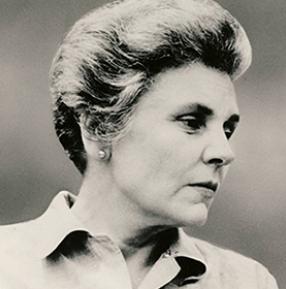
The renewed interest and celebration of Bishop’s work might be partially due to the discovery of letters made public in 2015, written by the poet to her psychiatrist and friend, Ruth Foster. In them, we learn much more about her early traumas and frustrations, her sense of abandonment, her experience with incest and physical abuse, her long struggle with alcoholism, and her consistent belief that poetry provided the one stabilizing force in her life. The satisfaction poetry gave her was more reliable, even, than love. Near the end of her life, she had this to say about her work:

“What one seems to want in art is the same thing that is necessary for its creation, a self-forgetful, perfectly useless concentration. (In this sense it is always ‘escape,’ don’t you think?)”

Elizabeth Bishop: A Miracle for Breakfast, Megan Marshall’s much-anticipated new biography of Bishop, limns not only the poet’s work for insights about what made her tick but also the more confessional mode with her psychiatrist. Those letters, quoted from extensively by Marshall, help readers understand Bishop’s sense that she was an “outsider” among the privileged class of people who surrounded her. The biographer, who studied briefly with Bishop at Harvard, also uses her training in poetry to unpack many of the allusions in the poet’s work. With both of those perspectives – confessional and professional –  the emotional core of Bishop’s poetry becomes even more powerful and accessible.

A father dead when she was eight months old; a mother institutionalized for mental illness when Bishop was just five; removal from a well-loved home in Nova Scotia; incest involving a paternal uncle; life among a privileged class of people with whom Bishop felt ill at ease: Is it any wonder the poet kept some of these insecurities and traumas hidden? Is it any surprise she searched for a “life preserver” that could help her survive her addictions as well as the string of broken relationships she had with her lovers?

Bishop began to write poetry after an exclusive prep-school upbringing and entrance to Vassar. She was very much influenced by Marianne Moore, to whom she was introduced by a Vassar librarian. Bishop admired Moore’s technical mastery and ability to write directly from experience without sentimentality. In “Efforts of Affection: A Memoir of Marianne Moore,” Bishop said that Moore’s book Observations was “the self portrait of a mind…not as a model, and not as beauty, but as experience.” Moore urged Bishop not to submit poetry for publication until it was absolutely ready to send in, or “not at all.” Bishop followed that advice throughout her life, leaving many fine, unpublished poems among her papers. Her desire for perfection comes across in the biography as almost pathological.

As important as Moore was to Bishop, it was the poet Robert Lowell who played one of the most important roles in Bishop’s life. They became fast friends after being introduced by the another poet, Randall Jarrell; Lowell was “well-positioned” to connect her with other influential poets, many of whom offered lovely places to stay and sometimes funds to go with them. It was Lowell who named Bishop to succeed him as Poet Laureate (at the time called Consultant in Poetry to the Library of Congress) when she was only thirty-eight years old and had published only one book. It was Lowell who “nudged” people at Harvard to hire her when she finally did need a job, and it was Lowell who “wangled” grant money for her from a series of organizations including the Rockefeller Foundation. He also brought her to the attention of another well-connected person, Howard Moss, poetry editor of the New Yorker, to whom Bishop sent most of her poems as she finished them.
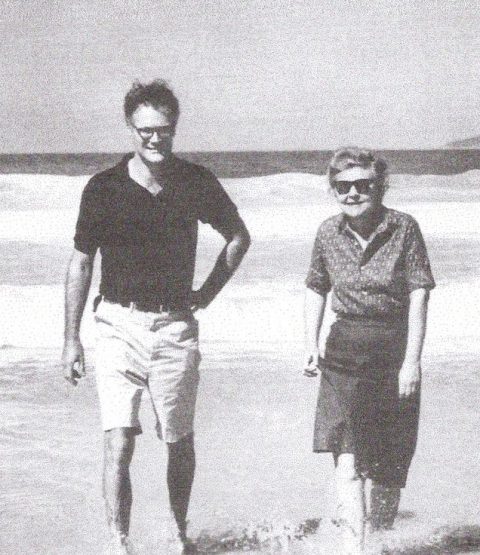
Elizabeth Bishop with Robert Lowell on the beach in Brazil, 1962

Lowell was authentic in his admiration; he carried a copy of Bishop’s poem “The Armadillo” in his wallet for years. Granted, Bishop’s work was excellent, but what might have become of her without these Good-Old-Boy connections? The list of them is long. A small trust fund from the Bishop estate to “cover rent and necessities” helped her survive for years as a non-teaching poet. But, truth be told, she depended on the loving, patient, and sometimes indulgent support (economic as well as emotional) of many friends and long-term lovers.

Marshall does a fine job of explaining Bishop’s desire not to go public with her sexual orientation. The atmosphere of tension and persecution in the United States during McCarthyism – attacking communists and “perverts” during the straight-laced 1950’s – was intense; Bishop felt no need to have her homosexuality be a factor for people reading her work. Perhaps she avoided teaching in the 50’s and 60’s because she knew what kind of price would be paid if her sexual preferences became public.

Her long-term relationship with a Brazilian landscape designer and architect named Lota Macedo de Soares (described by Wikipedia as “well connected” – a phrase which comes to mind so often in the reading of this biography) began to fail in the late 60’s. But Bishop still preferred not to align herself with “women poets,” believing the phrase to be demeaning. She refused to let her poems be published in anthologies which contained only work by women. She did not admit her lesbianism even when social tensions dissipated and persecution was becoming a thing of the past.

In a letter to her psychiatrist Bishop once wrote that when she was young, “I got to thinking that they [men] were all selfish and inconsiderate and would hurt you if you gave them a chance.” But she never went public with that feeling, and she was no feminist. In fact, she was apolitical, describing the Watergate hearings on the “god damn TV” during the summer of 1973 by saying, “If this is witnessing history – I’d rather not.”

Bishop’s 16-year relationship with Macedo de Soares was the longest sexual relationship of her life, a life sprinkled with love affairs before, during and after that time period. Most of those sixteen years, minus a few periods of time spent at friends’ homes in New England, Bishop lived in Brazil. Possibly because of her long absence from the United States, her reputation suffered.

If so, she didn’t seem to care. She believed in working hard on both poetry and her love life, less so on her reputation. She took on domestic life with a passion, fantasizing about it with some humor: “I can set myself up with a little shop in Rio, an impoverished gentlewoman, selling doughnuts and brownies.”

Impoverishment, though, was never a real threat to her in Brazil. Macedo de Soares was very wealthy, and she supported Bishop during their years together. When she and Bishop returned from New York to Brazil after a short separation, they traveled with “twenty-six pieces of luggage, as well as three barrels, four large crates, and seven trunks, packed in the ocean liner’s hold.” Hardly an impoverished poet’s baggage.

Eventually, the relationship ended (with Bishop beginning another affair before the break-up – “How could finding love again when she needed it be a sin?” Marshall asks, imagining what Bishop herself might have been thinking.) Bishop came back to the United States in need of distraction, and she began reluctantly to teach. She was the first woman to teach a creative writing course at Harvard, and the first woman to be listed in the Harvard course catalog.

Her drinking, a problem throughout her life, grew worse. She fell several times over the next few years, breaking bones and making rumors fly about her alcoholism. As Marshall says, “…poetry and alcohol had become organizing principles” in Bishop’s life. A long list of pharmaceuticals were added on – pills to wake up, pills to go to sleep.

Eventually, another new lover, a young woman more than thirty years her junior named Alice Methfessel, proved to be a loyal partner, tolerant of Bishop’s alcohol and pills. Marshall takes advantage of a collection of letters to Methfessel unavailable to biographers until after the woman’s death. There was a short period when the two separated, but once Methfessel returned to Bishop, the couple stayed together until the end of Bishop’s life. Still, they did not express affection in public – they referred to each other as friends, and they behaved as the same, never embracing, never holding hands. In fact, they seldom touched, even around close friends.

Marshall, who studied for a brief time with Bishop at Harvard, justifies a unique approach to the book’s structure by quoting this passage from The Confessions of a Biographer by Gamaliel Bradford:

Every living human being is a biographer from childhood, in that he perpetually studies the souls of those about him, detects with keen and curious thought the resemblances and differences between those souls and that still more present and puzzling entity, his own, and weighs with the most anxious care the bearing and effect of others’ thought and actions upon his own life.

The book opens with Marshall’s recollections of the Harvard memorial service for Bishop. She  then adds, in its entirety, a Bishop sestina titled “A Miracle for Breakfast,” from which the subtitle of the book is taken. The sestina – a particularly difficult and rule-heavy form involving lines with a series of six end-words repeated in a ornately strict order in six stanzas, followed by an envoy containing all six words – ends in a melancholy mood, suggesting that the “miracle” of happiness was happening just out of reach, on “the wrong balcony” – not Bishop’s.

Like the sestina, the book is organized into six chapters, using the same end-words Bishop chose for her poem (Balcony, Crumb, Coffee, River, Miracle and Sun.) Those chapters are interspersed with sketches which jump forward in time and involve Marshall’s interactions with Bishop. And like the sestina, the biography ends with an envoy.

Unlike some reviewers, I found the occasional chapters about Marshall’s first-hand experiences with Bishop to be intriguing, not disruptive. We see the poet through a different lens altogether, focused specifically on how she performed (or, sometimes, failed to perform) as a teacher. We also see the future biographer at work as a poet; we’re able to consider why poetry, for her, comes up short (and why she comes up short for poetry.)  And, as the epigraph suggests, we are given a theme: How do we read biography as a way to understand the resemblances and differences between someone else’s life and our own?

Should a biography end by focusing on the biographer rather than the biographer’s subject, as this one does? It’s unusual, but the approach stays true to the opening epigraph. Marshall clearly wanted to explore, sestina-like, the “resemblances and differences” between her choices and Bishop’s, measuring the effect Bishop might have had upon her own life. She does know how to look at Bishop’s poems intelligently and understands how to describe their word-choices and intricate rhythms. Her early training in poetry, her understanding of the poetic toolbox, makes her well-qualified to take poems apart to see how they work.

I found myself wishing occasionally that more of Bishop’s poetry had been quoted at length rather than given to us in short bits and pieces. Taken out of context, a line of poetry – especially one by Elizabeth Bishop, whose control of tone and sound was unique – can lose its author’s idiosyncratic voice, its musical qualities and its mystery. Prose from Bishop’s journals and letters also suffers too often from being taken out and quoted in phrases and small snatches.

But Marshall does do a good job of letting her readers know what early versions of Bishop’s poems sounded like. The revision process – essential to Bishop, who sometimes kept her poems “in process” for years before publishing them – is underscored, and we see how perfect the final version is.

Much of the last section of the book (“Sun”) describes the writing and revising of a villanelle that is Bishop’s most famous. Titled “One Art,” it is everything a poem should be: restrained, wise, clever, technically perfect, and (in combination with these, and most important) heart-felt. Facts gleaned from Marshall’s biography (places Bishop meant to travel, names she forgot, homes she left behind, people she loved and lost) are evident. This is a poem written from Bishop’s own experiences, less emotionally distant than many previous poems. The sorrow in it increases with each interpretation of the word “losing”:

One Art

The art of losing isn’t hard to master;
so many things seem filled with the intent
to be lost that their loss is no disaster.

Lose something every day. Accept the fluster
of lost door keys, the hour badly spent.
The art of losing isn’t hard to master.

Then practice losing farther, losing faster:
places, and names, and where it was you meant
to travel. None of these will bring disaster.

I lost my mother’s watch. And look! my last, or
next-to-last, of three loved houses went.
The art of losing isn’t hard to master.

I lost two cities, lovely ones. And, vaster,
some realms I owned, two rivers, a continent.
I miss them, but it wasn’t a disaster.

—Even losing you (the joking voice, a gesture
I love) I shan’t have lied. It’s evident
the art of losing’s not too hard to master
though it might look like (Write it!) like disaster.

The book ends with 44 pages of notes – interesting if you want to follow-up on some of the sources from which the author compiled her account of Bishop’s life.

Marshall’s research skills cannot be faulted, and this new biography makes for a revealing, if oddly structured, examination of Bishop’s complicated life and work. A fine follow-up book would be Colm Toibin’s examination of Bishop’s poetry (including biographical details) in his 2015 book On Elizabeth Bishop, part of the Writers on Writers series. You can also read a wonderful response by Toibin to the 92nd St. Y’s recording of Bishop reading her work in 1977, just two years before her death.

—Julie Larios

Julie Larios has written several reviews and essays for Numéro Cinq. You can find them archived here. She is the recipient of an Academy of American Poets Prize, a Pushcart Prize for Poetry, and a Washington State Arts Commission/Artist Trust Fellowship. She recently retired from the faculty of The Vermont College of Fine Art and currently lives in Bellingham, Washington, about ninety miles north of Seattle and forty-seven miles south of Vancouver, B.C. For approximately the next three and one-half years, until the election of 2020, she will be fantasizing about becoming a Canadian.

.
.

Dec 092011
 

Herewith a lovely, meditative essay on the conjunction of poetry, memory, and childhood from Nancy Eimers. The essay draws its inspiration from Proust and the art constructions of Joseph Cornell and draws to a close with Mary Ruefle’s Now-It, an erasure book made from an antique children’s book about Snow White. Nancy Eimers is an old friend and colleague at Vermont College of Fine Arts. In March NC published poems from her new collection, Oz, published in January from Carnegie Mellon University Press. Her three previous collections are A Grammar to Waking (Carnegie Mellon, 2006), No Moon (Purdue University Press, 1997) and Destroying Angel (Wesleyan University Press, 1991). She has been the recipient of a Nation “Discovery” Award, two National Endowment for the Arts Creative Writing Fellowships and a Whiting Writer’s Award, and her poems have appeared in numerous anthologies and literary magazines.  Nancy teaches creative writing at Western Michigan University and at the Vermont College of Fine Arts, and she lives in Kalamazoo, Michigan.

dg

 Charmed Objects: Poetry and Childhood

By Nancy Eimers


The genius of Cornell is that he sees and enables us to see with the eyes of childhood, before our vision got clouded by experience, when objects like a rubber ball or a pocket mirror seemed charged with meaning, and a marble rolling across a wooden floor could be as portentous as a passing comet.  —John Ashbery


Image from Webmuseum at ibiblio

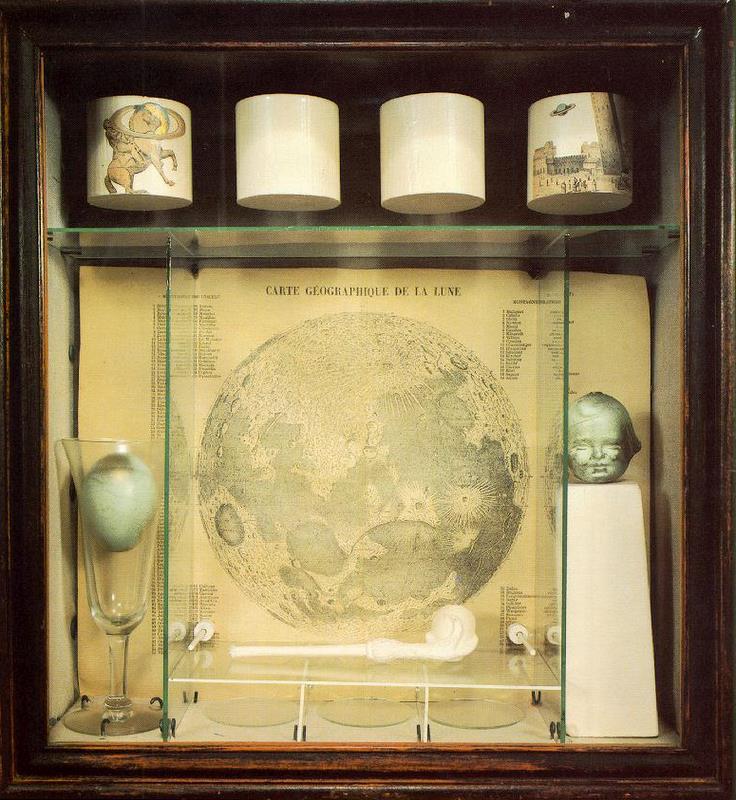
Joseph Cornell’s Untitled (Soap Bubble Set) is a brown box with metal handles on either side. Here is a list of its contents.

—blue cloth
—blue thumbtacks
—a map of the moon
—three glass discs
—light blue egg, in a cordial glass
—doll’s head, painted blue and gold
—three white wooden blocks
—white clay bubble pipe

Really, they are ordinary things, in one world or another.

If you visit Untitled (Soap Bubble Set) in the Wadsworth Atheneum Museum of Art in Hartford, Connecticut, you must keep a distance.  You will not be allowed to open the box and play with the bubble pipe.  Not even if you bring a child.

Now, a look at the box.  But not an image.  Words are the medium here.

Oh roundnesses you can feel in the palm of the hand. The moon’s at the center, silvery blue, and dominates.  Carte Geographique de la Lune.  The doll’s head, cheeks scarred, has been smiling now for how many years?  Also a silvery blue, the doll and the egg are bathed in the thought of the moon.  The discs of glass are laid at the floor of the box; if you picked one up, the rim might cut your hand.  Every circle is synonym to a bubble: doll’s head, egg, bowl of the pipe.  Even the craters of the moon.  One of the books Cornell loved was a series of lectures delivered in 1890 by a scientist, C. V. Boys, to an audience of children, on soap bubbles.  You cannot pour water from a jug or tea from a tea-pot; you cannot even do anything with a liquid of any kind, without setting in action the forces to which I am about to direct your attention.

 Image from Rocaille

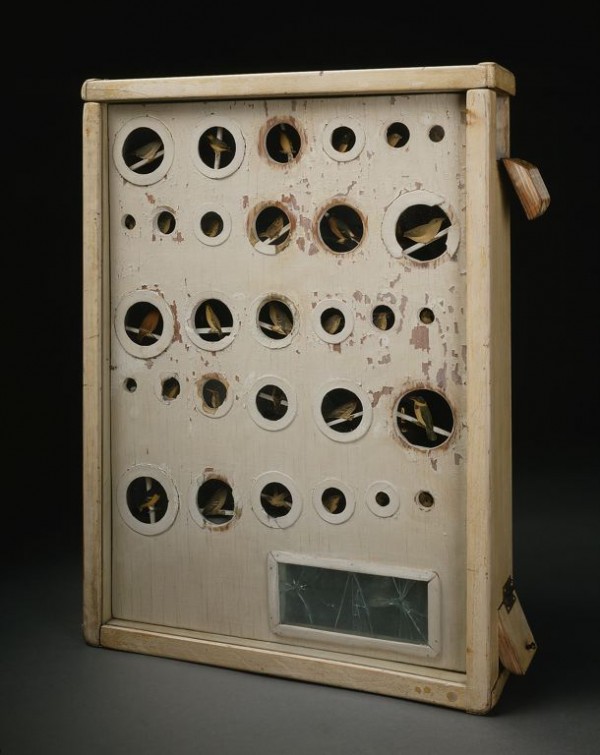
I haven’t seen that soap-bubble box except in a book, but I’ve seen Untitled (Forgotten Game) in Chicago’s Art Institute.  A pinball-like game of a box with holes behind which there are pictures of birds cut out from the pages of old books.  Inside the box there are ramps down which a ball is meant to slide.  If you could open the little door at the top and insert a blue rubber ball, if the ball were to slide down the ramps and reached the bottom, a bell would ring.  That it doesn’t ring is part of a terrible sweetness.

Forgotten game, blue-silver moon, recessed birds, egg in a cordial glass, to what forces have you drawn our attention?

“Perhaps what one wants to say,” said sculptor Barbara Hepworth, “is formed in childhood and the rest of one’s life is spent in trying to say it?”

 *

I remember a gaudy, jeweled pin worn by my grandmother.  I say “gaudy,” but I didn’t think it was gaudy then.  Costume jewelry is made of less valuable materials including base metals, glass, plastic, and synthetic stones, in place of more valuable materials such as precious metals and gems, explains Wikipedia helpfully.  But I hadn’t read and wouldn’t have been helped by this sentence then.  The jewels, their blue and pink sparkles, enchanted me.  They seemed almost to say, there is this other world.  The pin is lost forever, like Dorothy’s ruby slippers somewhere between Oz and Kansas.  But I feel the pull of a former feeling, not subject to reason, proportion, knowledge of anything likely/unlikely to happen.  In memory, where I am holding it in my hand, the invented and the real haven’t quite parted ways.  You can’t get beauty.  Still, says Jean Valentine, in its longing it flies to you.

I think this will not be an argument but a meditation—held together by asterisks, little stars—on how charmed objects, long lost, come back sometimes in poetry, present only as words, touchstone, rabbit’s foot, amulet, merrythought, calling us back, calling us forth.  What are they, now that we’ve lost them?

*

The Child Is Reading the Almanac

The child is reading the almanac beside her basket of eggs.
And, aside from the Saints’ days and the weather forecasts,
she contemplates the beautiful heavenly signs.
Goat, Bull, Ram, Fish, etcetera.

Thus, she is able to believe, this little peasant child,
that above her, in the constellations,
there are markets with donkeys,
bulls, rams, goats, fish.

Doubtless she is reading of the market of Heaven.
And, when she turns the page to the sign of the Scales,
she says to herself that in Heaven, as in the grocery store,
they weigh coffee, salt and consciences.

In an almanac there are moons, full and half and quarter, and there are new moons that look like black moons.  There are meteor showers, tides and eclipses.  Signs of the zodiac.  Questions of the Day.  Why is the ring finger sometimes called the medical finger?  Weather predictions.  Three misty mornings indicate rain.  Fact and prediction, the seen and the unseen intermingle; the strange is detected in the commonplace, and the commonplace in strangeness.  No wonder the child in this early twentieth century poem by French poet Francis Jammes has been tempted to set down her basket and read.

Jammes “wrote of simple, everyday things,” says the introductory paragraph on the torn yellow book jacket of my copy of his Selected Poems.  And inside the book, in the introduction, Rene Vallery-Radot marvels, “From a little provincial town there rises a voice that ignores all the gods, that tells of life simply, not at all systematized in theories.”  In a photograph just inside the cover Jammes, an old man in round black glasses and a long wispy beard, looks down at a page he is writing on.  For all we know he was writing this almanac poem. The child must have stopped on her way to or from the market (to sell the eggs? having just bought them?).  Perhaps she wonders if even an egg, like the animals in the market, has its counterpart in the stars.  The wondrous almanac testifies that as things are on earth, so they must be in heaven: how miraculous, how natural, that Heaven resembles an earthly grocery store on this most ordinary of days!

Still, Jammes remembers enough not to oversimplify, or presume.  On earth, scales are also associated metaphorically with justice, even by a child.  And like any child, this one must have done something, committed or contemplated committing some small act, a rebellion or peccadillo for which, in some small way, she’d paid, or feared to pay.  She spoke harshly to the donkey.  Maybe she broke an egg.  She dawdled on the way to the market.  Whatever it is, she keeps it secret.  Let us not trespass.

*

It is because I believed in things and in people while I walked along those paths that the things and the people they made known to me are the only ones that I still take seriously and that still bring me joy.  Whether it is because the faith which creates has ceased to exist in me, or because reality takes shape in the memory alone, the flowers that people show me nowadays for the first time never seem to me to be true flower. —Marcel Proust, Remembrance of Things Past

In her autobiographical story “In the Village,” Elizabeth Bishop invents or remembers this from her childhood:

We pass Mrs. Peppard’s house.  We pass Mrs. McNeil’s house.  We pass Mrs. Geddes’s house.  We pass Hill’s store.

The store is high, and a faded gray-blue, with tall windows, built on a long, high stoop of gray-blue cement with an iron hitching railing along it.  Today, in one window there are big cardboard easels, shaped like houses—complete houses and houses with the roofs lifted off to show glimpses of the rooms inside, all in different colors—with cans of paint in pyramids in the middle. But they are an old story.  In the other window is something new: shoes, single shoes, summer shoes, each sitting on top of its own box with its mate beneath it, inside, in the dark.

The child is bereaved, though she doesn’t entirely know what this means.  It is for her too new a story.  Her father—her mother’s mate—like one of those shoes, has been closed inside a box of his own, but forever, unlike the shoes.  This story is one of those houses with its roof lifted off, so the writer, so we, may look inside.  But we may not enter.

Memory affords glimpses: of a flower, a doll or a shoe in a box, a marble rolling comet-like across the floor.  “My life,” writes Tomas Transtromer:

Thinking these words, I see before me a streak of light.  On closer inspection it has the form of a comet, with head and tail.  The brightest end, the head, is childhood and growing up.  The nucleus, the densest part, is infancy, that first period, in which the most important features of our life are determined.  I try to remember, I try to penetrate there.  But it is difficult to move in these concentrated regions, it is dangerous, it feels as if I am coming close to death itself.

Maybe it is important not to explicate our childhoods.  Or simply, merely impossible?  Cornell, from a journal entry, May 13, 1944:

 . . . stopped by pond of waterworks with cool sequestered landscaping—gardens & here had one of profoundest experiences + renewal of spirit associated with childhood evoked by surroundings—it seemed to go deep through this strong sense of persistence in the lush new long grass—the most prominent feature turned out to be “no trespassing” sign

Water, hiddenness, the cool, such things return for a moment from—exactly when and where?  What did it look like there? We can’t quite know, we can’t see inside.  No trespassing.   But the grass is/was lush.

Talking about her younger brother Joseph, Betty Cornell Benton recalls this scrap from their childhood:

Late one night he woke me, shivering awfully, and asked to sit on my bed.  He was  in the grips of a panic from the sense of infinitude and the vastness of space as he was becoming aware of it from studying astronomy.

From an earthly point of view, a comet is stationary, seen at night—then remembered in daylight—then seen—then remembered—over the rooftops.  It is there for a time.  Star with a wake of light.  Then it is gone.  That too is remembered.

*

“Stove” is one of the six end-words of Elizabeth Bishop’s “Sestina.”  A Little Marvel. Brand new, that model would have been painted silver.  Through daily use, it would have grayed; open the door and it would be blackened inside.  MARVEL: the name is on the door.  It dominates like the map of the moon in Cornell’s soap bubble box.  Above, below, on either side there are swirls and curlicues forged in the cast-iron, resembling serious, stirred up clouds.  It has four legs, curving outward, stubby and braced.  In an early twentieth century village, a stove was a daily thing in anyone’s house, but to a child it must have seemed marvelous, like Saturn’s rings.

I have only seen photographs of the Marvel; but they were not photographs of the real thing.  All I found was a salesman’s sample, 16 inches high, still advertised on eBay but already sold.  That ship had sailed.  And a toy Little Marvel, complete with two ovens, burners and lifters.  Nickel plating over cast iron.  All complete and in very good all original condition.

A child in me is entranced.

September rain falls on the house.
In the failing light, the old grandmother
sits in the kitchen with the child
beside the Little Marvel Stove,
reading the jokes from the almanac,
laughing and talking to hide her tears.

House.  Grandmother.  Child.  Stove.  Almanac.  Tears.   Six end-words, like miniatures on a bracelet.  (Even the tears have their charm.)  Each time the words, all nouns, come back, they are in their original form—no juggling with word play or parts of speech, no punning or homonyms.  Simple words, like primary colors, or figures from an old storybook.

Or they are like comets, passing before us seven times from the early twentieth century, Great Village, Nova Scotia.  As in the story “In the Village,” there is death at the nucleus.

tears/house/almanac/grandmother/stove/child
child/tears/stove/house/grandmother/almanac

And so on.  In the ordinary world a grandmother is trying to amuse a child.  Each time a word comes around again it feels sadder.  Even tears get sadder; the teakettle weeps, the teacup fills with dark brown tears.  To the grandmother, tears are recurring, equinoctial. The child senses something.  Unspoken grief is working its magic: the almanac begins to resemble a bird; the stove gets philosophical; the world grows cold.  The almanac knows what it knows but won’t say what.  How much does the child know, what is she warding off?  The poet senses something.  Does the child miss the man in the drawing?  How much can even Bishop have known of the child she was?  “Early Sorrow” was the poem’s original title.  Then withdrawn.  Explication fails, or it is irrelevant.  The child sees little moons in the almanac fall down like tears.  The poem ends, as it began, in present tense.  The child draws another inscrutable house.

That moment of wonder and puzzlement goes on orbiting but it is in the past, forever out of reach.  So are the stove and the almanac, ancient tears, the worried grandmother and the inscrutable child.  All in the past, except for the house in Great Village.  (. . . it is difficult to move in these concentrated regions, it is dangerous, it feels as if I am coming close to death itself.)  That house is still there.  You can visit it; you can go inside; you can even arrange to stay.

*

In her art review of the Ann Arbor exhibition “Secret Spaces of Childhood,” Margaret Price describes certain characteristics of childhood hide-outs:

Almost always the entrance to a secret space is guarded, to protect the privacy and sometimes the fragility of what lies inside. . . .  Moving through the doorway into the space itself is often a rite of passage, and often the point of access is the most highly charged area of the whole secret space: usually elusive, always exciting, and sometimes dangerous.  Often they, or their entrances, are small . . . . being small of stature confers the privilege of access.  A hideout cannot function for a person too large to fit into it.  On the other hand, a child’s small size is a    passing attribute, and children know it.

Peering into the windows of a dollhouse, I feel almost an ache of pleasure.  I think this has to do with its smallness; the feeling is paradoxical.   I am charmed by the inaccessibility; and I yearn to be small enough to step inside.  If I could grow small enough to enter, the house and furniture would no longer seem miniaturized to mini-me and so would have lost their mystery; but I might find among the toys in its nursery (for in a dollhouse there is almost always a nursery) a tiny dollhouse, and who knows, perhaps an even tinier dollhouse inside of that dollhouse’s nursery, and so on and so on, as if longing were satisfyingly infinite.

Is remoteness integral to a certain kind of charm?  In a silk-lined box I keep my charm bracelet, a mercury-head dime and a single clip-on pearl earring.  I know they are there, but I hardly ever look.  I like the look of the hinge that fastens the lid.

from the Art Institute of Chicago

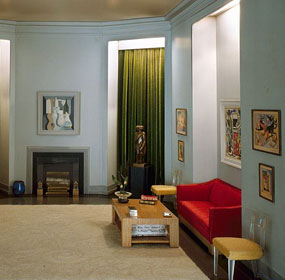
On the basement floor of the Art Institute in Chicago you can visit the Thorne Rooms, a permanent exhibit of miniature rooms behind glass.  These aren’t so much dollhouses as interiors, 68 rooms that, “painstakingly constructed,” as the museum website explains, “enable one to glimpse elements of European interiors from the late 13th century to the 1930’s and American furnishings from the 17th century to the 1930’s.”  The rooms contain exact reproductions of period furniture, carpets, wallpaper, chandeliers, other objects—all somehow failing to interest me, I finally realized with some disappointment the last time I visited.  Perhaps it was more petulance I felt than disappointment; I had come in the spirit of a former child, and being there felt more like studying than play.

What bewitched me, though, were the windows.  Out every window there was a view—an exterior—tiny, intricate gardens with bushes and flowers; patios; benches; trees; and an artificial light from a source that wasn’t visible.  I started over, room by room, looking not at interiors but out the windows, craning my neck to see as much as I could; it was tantalizing, I couldn’t see everything.  Shining faintly into miniature rooms in the basement of a grand museum, the light seemed remote, a late-fall, old-world light.  Out of every window of every one of the 68 rooms was a little world a child might just have begun imagining . . . .

Or perhaps it was simpler, perhaps I just wanted to be inside looking out.  In fact, it occurs to me that may be why (at least in part) I’m so happy when it snows: as opposed to looking into dollhouses or the windows of other people’s lighted homes at night, I finally feel as if I’m inside something.

*

A charm is a miniature object worn on a bracelet.  A sombrero.  A bell.  I am childless, who will I give it to?  You can’t hear the tinkling of the tiny bell for the tinkling of the bracelet when you pick it up.  The use of the word charm as trinket did not occur (was not recorded) until 1865.  But charm has meant “pleasing” since the 1590’s.

It wasn’t until Elizabeth Bishop arrived in Brazil and found herself, for a time, enormously happy, that she began to be able to write of her childhood in Great Village.  She says in a letter to friends, “It is funny to come to Brazil to experience total recall about Nova Scotia—geography must be more mysterious than we realize, even.”

Of course she meant some geography of the interior.

Even from the simplest, the most realistic point of view, the countries which we long for occupy, at any given moment, a far larger place in our actual life than the country in which we happen to be. —Marcel Proust

*

Ghost stories written as algebraic equations.  Little Emily at the
blackboard is very frightened. The X’s look like a graveyard at night. The
teacher wants her to poke among them with a piece of chalk. All the children
hold their breath. The white chalk squeaks once among the plus and minus
signs, and then it’s quiet again.

This is an untitled prose poem from Charles Simic’s The World Doesn’t End.  I have been that child, puzzling over the signs and portents on the blackboard, messages sent by way of math, of grammar, or even handwriting, strange row of continuous l‘s or o‘s.  In a way, it seems like a minute ago.  Did the teachers know how wildly some of us may been mistranslating what they were writing on the board?  Numbers especially, and their plusses and minuses, went beyond the explanations of words, beyond even paragraphs.  I am a teacher myself now, though white boards and dry erase markers have replaced the powdery chalk.  I am still a little frightened, like Emily, standing in front of the class.  The white boards haven’t solved or eliminated the mystery, yesterday’s propositions, assertions, and mistakes still lurking under today’s.

Though the blackboards of my childhood were almost always green, the first blackboards were black, made of slate.  For a newer generation of blackboards, the color green was chosen because it was believed it would be easier on the eyes.  As for the chalk, I can still feel the powder on my hands as I lay it back in one of the crevices of the metal rim.  I had been asked to do a problem on the board.  Or to outline a sentence.  Or maybe I hadn’t touched it at all but was sitting at my desk, watching my teacher, mentally tracing the swoops of her hand (his hand) as it held the chalk.  Oh mysteries of the chalkboard’s palimpsest, yesterday’s sums or sentences only half-erased.  And let us not forget the mystery of the chalk itself, composed partly of limestone, the sum of fossilized sea animals.

*

Vivien Greene, whose family moved repeatedly when she was a child, devoted much of her adult life to the study, collection, and restoration of Victorian dollhouses.  She had seen her own beloved house in London bombed and split open in the Blitz.  It seems that rift was decisive: after that she and her husband (the novelist Graham Greene) permanently lived apart.  (Graham, who wasn’t interested, said Vivien, in either her dollhouses or domesticity, had already formed what they used to call “another establishment.”)  “Houses have influenced my life deeply,” wrote Vivien Greene in a brief essay called “The Love of Houses”; “They have entered into dreams, made me stand enraptured, suddenly in unexpected places, filled me with a longing to possess; or they occasionally frighten.”  Fear of . . . bombs?  Of ghosts, of moving yet again?  She doesn’t explain.  In the evenings during the war, she used to sit behind blackout curtains working on her dollhouses, tearing down old wallpaper, adding the new.  Greene was the author of several excellent books on vintage English dollhouses.  They are filled with exquisitely old-fashioned and discursive descriptions of staircases, windows, doorways, furniture, even the crockery.  At one point, she writes, apropos of nothing,

 As some people ask and need to be stripped of ownership, so we can believe others are hardly fully alive, complete as persons, until certain material things, a horse, a place, a boat, have been loved and owned and afterwards remembered.

*

“In the lyric you can stop time,” said Ellen Bryant Voigt in an interview; “you pick that moment of intensity and hold it. The narrative moves through time.”  In Michael Burkard’s poem “The Sea” nothing really happens.  There is instead a kind of lyrical parallelism that advances no narrative but deepens the shades of emotion.

It could have been worse but for the sea. The watch of it. What was it
Chekhov wrote?—”Self same sea”—Yes. Yes. It was there, as was my mother’s
family, in Nova Scotia. There beyond the sloping meadow near Aunt Dorothy’s
farm, there from Cousin George’s kitchen window. The sea and its often daily fog
permeated everyone, everything. And because there was no electricity in those
days, only candles, lantern light, and no plumbing, it seemed almost a sea more in
the air than in the sea. You could not shut it out.

The poem travels sideways, or inward.  Certain words appearing numerous times, sea, there, now, as if, become on one level sheer sound, a force, a mystery.  They don’t so much stop the moment as return to its vivid pastness, over and over again.  There is something bygone and sepia about the scene described.  “There” suggests something in existence but away.   The landmarks in the poem are family names, a meadow, a kitchen window.  And the sea.  Which is also a kind of weather, an intrusive force or guest.  The residents of the poem are mired there, in a world miniaturized by memory.  Here is the rest of the poem:

And the lanterns we ate by, sat by—how small! Yet this permeated as much as
the sea, as much as the fog from the field, the conversion of one cowbell to
another cowbell in the fog, the red-yellow light flickering, now against a deck of
cards, now against faces and hands playing the cards, now being carried with one
or by one off to sleep. Sleep by the sea, as if the sleep were to last a thousand
years, as if the summer were a medium for color which could become
permanently framed, wearing only so slowly for another thousand years. Self
same lantern light shadows, sea and shadow of sea, and her face there, a thousand
years ago, only to be seen a thousand years hence and then to stay beside her face
for as long as ever is.

The fog doesn’t so much occur as seem always to have been; the family members play cards, listen to sounds, fall asleep.  Memory’s village: perhaps everything wasn’t always filmed over with sadness?  “A thousand years” means one thing to a child looking forward, and something else to an adult looking back.  Is the face that appears the face of the speaker’s mother?  On one side is there and ago, on the other hence and ever.  Stay is not an accomplishment but a plea.  Ever: at all times; always.  Matched by is, the moment stopped in time.  He doesn’t say “forever,” though.  He is, we are, outside the time that is “as long as ever”; it is already over.

Cowbells, by the way, come in various colors and sizes, but the ones I hear in the poem sound silver, and tarnished.

*

We move through time, like characters in a story.  The objects we loved with intensity seem timeless.  Is this because we let them go?  And yet, resurrecting the thought of them, don’t loss and accomplishment co-exist?  The story goes on and we go with it, but part of the story is what we’ve lost.  In “Elegy for the Departure of Pen Ink and Lamp,” Zbigniew Herbert asks forgiveness from three charmed objects:

Truly my betrayal is great and hard to forgive
for I do not remember either the day or the hour
when I abandoned you friends of my childhood . . . .

His “friends” are: a pen with a silver nib, illustrious Mr. Ink, and a blessed lamp:

when I speak of you
I would like it to be
as if I were hanging an ex-voto
on a shattered altar

Herbert’s elegy might as easily be to a soap-bubble, or a forgotten game.  But not to the story that edited them out.

I thought then
that before the deluge it was necessary
to save
one
thing
small
warm faithful

so it continues further
with ourselves inside it as in a shell

There is that moment when we touch something for the last time.  But the child can’t know, as Herbert says, still addressing his “friends,” that “you were leaving forever / / and that it will be dark.”  Against that dark, the poem saves one thing, something that, reimagined, paradoxically remains miniaturized but it holds us: it is we who dwell within.

But before we leave that dark, W. G. Sebald has something else to say about it:

. . . in the summer evenings during my childhood when I had watched from the valley as swallows circled in the last light, still in great numbers in those days, I would imagine that the world was held together by the courses they flew through the air. . . .

Some yearning of the child’s imagination, Sebald suggests, forged those patterns of meaning in the flights of swallows.  If, like the swallows that have diminished in number, some freshness in our early imaginings gets lost along the way, poetry yearns for the “half-created” in things we once perceived.  A Marvel stove, school chalk, cowbells, a blessed lamp, a silver nib, things that once ordered the dark—or were ordered by it.  If nothing can bring back the hour of splendour in the grass, still, isn’t there something swallow-like and mysterious in our yearning, resistant yet integral to the very passage of time?  Poetry imagines the traceries that might once again hold things together, lost possessions, past and present, worlds real and imagined.  It restores the lost moment, shoe, cowbell, basket of eggs or blessed lamp, utterly itself; it is we who are changed, because we know it is lost.

* (last little star)

In Now-It, a collage-and-erasure book Mary Ruefle made out of an old children’s book called Snow White or the House in the Wood, she has pasted the words “the cry of the button” beside the picture of a streaking comet.  Oh you here and there, you cry and streak, all that’s precious in the commonplace!  Now that button and comet have found each other, the child in me believes nothing more need be said.

—Nancy Eimers

———————————————

Works Cited

Art Institute of Chicago, website on Thorne Rooms.

Ashbery, John. “Joseph Cornell,” Art News, summer 1967.

Bishop, Elizabeth.  “In the Village,” in The Collected Prose.  New York: Farrar Straus Giroux, 1984.  261-2.

Bishop, Elizabeth.  “Sestina,” The Complete Poems.  New York, Farrar Straus Giroux: 1983.  123.

Boys, C.V.  Soap-Bubbles and the Forces Which Mould Them.  Memphis: General Books, 2010 (reprinted).

Burkard, Michael, “The Sea,” My Secret Boat.  New York: Norton, 1990.  22.

Cornell, Betty Benton, quoted in A Joseph Cornell Album, Dore Ashton, author.  New York: De Capo Press, 1944.

Cornell, Joseph. Theater of the Mind: Selected Diaries, Letters and Files.  Ed. Mary

Ann Caws. : New York: Thames & Hudson, 1993.  105.

Greene, Vivien.  English Dolls’ Houses of the Eighteenth and Nineteenth Centuries. New York: Charles Scribner’s Sons, 1979.  23.

Greene, Vivien.  “The Love of Houses,” The Independent (London), Nov. 29, 1998.

Hepworth, Barbara.  From notebooks.  Quoted in Barbara Hepworth Museum and Sculpture Museum, St. Ives.

Herbert, Zbigniew, “Elegy for the Departure of Pen Ink and Lamp,” Elegy for the Departure.  Trans.  John and Bogdana Carpenter.  Hopewell, NJ: Ecco, 1999. 127-132.

Jammes, Francis.  “A Child is Reading the Almanac,” Selected Poems of Francis Jammes.  Trans. Barry Gifford and Bettina Dickie.  Logan, UT: Utah State UP, 1976.  23.

Price, Margaret.  “Secret Spaces of Childhood: An Exhibition of Remembered Hide-Outs,” Michigan Quarterly Review, Spring 2000.  248-278.

Proust, Marcel.  Remembrance of Things Past: 1.  Trans. C. K. Scott Moncrieff and Terence Kilmartin.  New York: Penguin, 1954.

Ruefle, Mary.  Now-It.  Carol Haenicke Women’s Poetry Collection, Rare Book Room, Western Michigan University.

Sebald, W. G.  The Rings of Saturn.  Trans. Michael Hulce.  New York: New Directions, 1999.  67.

Simic, Charles.  “Ghost stories written,” The World Doesn’t End.  Boston: Mariner Books, 1989.  13.

Transtromer, Tomas.   For the Living and the Dead: New Poems and a Memoir. Hopewell, NJ:  Ecco, 1995.  25.

Valentine, Jean.  “Then Abraham,” Break the Glass.  Port Townsend: Copper Canyon, 2010.  16.

Vallery-Radot, Rene.  Quoted in Introduction,” Selected Poems of Francis Jammes. Logan, UT: Utah State UP, 1976.

Voigt, Ellen Bryant.  Inteview, The Atlantic Online, Nov. 24, 1999.