Nov 182013
 

Totentanz

I just discovered the post and this site through the good offices of Judith Stout on Twitter (@judithstout1). The blogger is Genese Grill, author of The World as Metaphor in Robert Musil’s The Man without Qualities: Possibility as Reality, and the site is full of fascinating items. And this is just a taste of what Grill has to say about Musil and stupidity; she has written a full length paper which you can read here in the journal Studia Austriaca.

dg

While looking for images of Death I discovered that not only is stupidity often a woman, but death (which is not a feminine noun in German) often is too. In this image (Totentanz by Karl Ritter, 1922) she may merely be death’s lure, if not herself the one condemned to die. Well, woman, at least, is effective, rousing to life, to frustration, to anger, challenging passive man to sin, to madness, leading him to distraction, destruction, eventually to death.

Read the rest at Robert Musil: “Attempts to Find Another Human Being”: Stupidity, Being Towards Death, Art (on Dostoevsky’s Idiot).

May 292012
 

“There’s only genre—the novel. It took years to discover this. There’s only three things in literature: perception, language, and form. Literature gives form, through language, to specific perceptions. And that’s it. The only possible form is narration, because the substance of perception is time.” – Juan José Saer

Scars
Juan José Saer
Translated by Steve Dolph
Open Letter Books
ISBN-13-978-1-934824-22-1

A good novel does much more than communicate the events of a story. A good novel also reflects on itself. It dabbles a bit in theory, considers genre and rediscovers form. The well-written book, what John Gardner once called the ‘serious novel,’ borrows from the traditions of the past and gestures toward the future, often in destabilizing ways. A good novel refuses simplistic labeling because it relentlessly stalks the nature of things and, in so doing, it helps resuscitate the very reason we read (and write) in the first place: to render some insight into the ineffable, to close the gap between perception and thought, to diminish the emptiness between the world we experience and the world we feel.

Though built with the bricks and mortar of fiction—point of view, plot, character, theme, etc. — the very best novels are always interrogating themselves.  They challenge. They provoke. They unsettle and confound. They ask questions about meaning rather than answering them. The reader willing to accept such books will often finish in a state of uncertainty, perplexed about what has just happened, about what has been read, about what it all means. But a door has opened in the reader’s mind, a nagging doubt exists that can only relieved over time, if at all, because the best books are always inviting us back, demanding to be reread, to be experienced again and again.

Juan José Saer’s novel Scars might well qualify as such as work. Set in the city of Santa Fe, Argentina, the novel is divided into four long sections, each narrated by a different character. Holding these disparate parts together are the events of May 1, Workers Day, a day when Luis Fiore, his wife and young daughter go duck hunting. It’s almost wintertime in the southern hemisphere, and a steady cool rain makes the hunting trip more dread than delight. Fiore and his wife argue all day, but Fiore bags two ducks anyway. He drives back into town, drops his daughter off at home and then stops in at a local pub with his wife. Inside the dingy bar, the ongoing argument between Fiore and his wife — an unnamed character with the mildly derogatory moniker Gringa—escalates. Fiore steps outside, points his shotgun in his wife’s face and pulls the trigger.

Part bildungsroman, part murder mystery, part Robbe-Grillet existentialist romp through a South American landscape, Scars refuses to be any one thing. The easiest comparison of its structure is with the game of Chinese Whispers (also known as Telephone). In the game, as in the novel, a single event is recounted by various witnesses, each with his own version. As the game and the novel unfold, the various perceptions skew the seemingly objective facts. What has been witnessed changes. As Joyce does with his theory of parallax, Saer shakes the reader’s sense of certainty. What is true? What really happened? It all depends on the position and inclination of the observer.

The novel’s opening section, titled “February, March, April, May, June,” introduces Angel, a young reporter for La Region, the local newspaper. Angel’s main responsibility is writing the weather headlines, a job he performs without actually checking the meteorology reports. “No Change in Sight,” he writes day after day. (Saer’s dry and subtle sense of humor peeks out often in the novel.) Angel lives with his young mother, a woman who struts around their small apartment in various stages of undress, more roommate than matriarch. While she goes out dancing, Angel rummages through her underwear drawer then masturbates in his room. Oedipal conflicts aside, Angel and his mother primarily argue over gin. In a brutal yet comedic scene, Angel beats the woman ruthlessly for polishing off his last bottle and not replacing it. “It’s my bottle. You drank my bottle,” he says, and then he proceeds to knock her senseless. This is truly one of the great dysfunctional relationships in literature.

But Angel is no mere brute. He reads Faulkner, Kafka, Raymond Chandler, Thomas Mann and Ian Fleming. A street-kid, raised by that promiscuous, alcoholic excuse for a mother, he survives by possessing an indomitable spirit and wit. You can’t help but root for him, out there in that big bad world. And at times, Saer’s world is both big and bad. The misery, layered thick in this novel, can make for a grim ambience. But Saer also works hard to tease out the inconsistencies, baffling us with magnificent bursts of light amidst such darkness.

Though sexually attracted to women, Angel is also the occasional lover of a ruthless judge named Ernesto (more on him below.)  After the murder and Fiore’s suicide (spoiler alert: at the inquest, Fiore jumps from the window of the courthouse in front of Angel and the judge), Saer provides one last spellbinding twist in this opening section, a twist pulled straight out of nineteenth century St. Petersburg. Angel falls into a feverish fugue state, reminiscent of Raskolnikov’s post-homicidal fever in Crime and Punishment. Wandering around the streets of Santa Fe, Angel runs into his double, a man alike in appearance, dress and action. In a lovely passage, Saer describes the moment of recognition.

It was a young man, wearing a raincoat that looked familiar. It was exactly like mine. He was coming right at me, and we stopped a half meter apart, directly under the streetlight. I tried not to look him in the face, because I had already guessed who it was. Finally I looked up and met his eyes. I saw my own face. He looked so much like me that I started wondering whether I myself was there, facing him, my flesh and bones really holding together the weak gaze I had fixed on him. Our circles had never overlapped so much, and I realized there was no reason to worry that he was living a life forbidden to me, a richer, more exalted life. Whatever his circle—that space set aside for him, which his consciousness drifted through like a wandering, flickering light—it wasn’t so different from mine that he could help but look at me through the May rain with a terrified face, marked by the fresh scars from the first wounds of disbelief and recognition.

So much for the opening act.

§

“The singular aspect of the game is its complexity,” Sergio Escalante says, describing the game of baccarat in the book’s second section. Conjuring another character from Dostoevsky — this time Alexi Ivanovich from The Gambler — Sergio is an inveterate gambler. He gambles and wins, gambles and loses, gambles and gets arrested. He gambles away his money, his friends’ money, his fourteen-year-old housecleaner’s money. Sergio gambles with a monomaniacal passion. The forays into philosophy on baccarat make up the richest writing in the book. Sergio is the consciousness of the novel. Saer’s ruminations about the game are thoughtful, elegant and unsettling. Though the subject appears to be baccarat, he might as well be talking about the novel, or about life itself.  “It (baccarat) precludes all rational behavior, and I’m forced to move through its internal confines with the groping, blind lurch of my imagination and my emotion, where the only perception available to me passes before my eyes in a quick flash, when it’s no longer useful because I’ve already had to bet blind, and then disappears.”

If Sergio is the consciousness of the novel, then the judge, Ernesto, is the book’s demonic soul. He suffers from metastatic misanthropy. Ernesto appears in the third section, and though he represents the system of justice, he hates people — all people, good and bad, guilty and innocent. He shows up late for work, shuffles his schedule around to suit his whims, and refers to other people as gorillas. There’s almost nothing human left in him. He would be utterly vile except for one thing: Ernesto is translating Oscar Wilde’s The Picture of Dorian Gray. From within the rubble of his miserable existence rises Ernesto’s work. The translation of Wilde beats like a thready pulse, barely circulating his humanity. It’s not much to go on, but the translation sections complicate the reader’s reaction.

This raises an interesting question: Is Saer evangelizing some form of literary salvation? Is he saying that even the worst among us might be saved by books? Consider that the only character who is not literary in taste or inclination is Fiore, who kills his wife, jumps out a window and orphans his only daughter. Maybe he should have read more?

Saer did much of his writing in Parisian exile. He renders his homeland with precise details and images as only an estranged citizen could, at times producing a landscape so precise, so accurate, that the technique becomes, well, awkward, in, yes,  that Robbe-Grillet sort of way. A reader (like me) unfamiliar with the city of Santa Fe and the Littoral region of Argentina is left to wonder why he writes multiple passages in the Ernesto section with the monotonous certainty of a GPS navigation system. “I cross the intersection of still on 25 de Mayo to the south, and everything is left behind. On the next corner I turn right, travel a block, then turn left onto San Martin to the south.” The exile yearns for home, so he recreates the world he left behind even in the most mundane details, in the left and right turns of his characters as they travel from one place to another. Saer is remaking the map of his home.

The novel closes with thirty-three pages from Fiore’s point of view. This section covers only the span of one day, the day of the hunting trip and the murder.  We don’t travel too deeply inside the murderer’s consciousness. He mostly narrates the events in a detached dramatic soliloquy. But we feel his agony. We see the pressure mounting.  All day his wife badgers him, relentless in her infliction of misery, to the point of  literally shining a flashlight in his eyes as she berates him over and over again.

— Turn off that flashlight right now, I say

— Turn off that flashlight, Gringa, or I’m going to shoot you, I say.

She laughs. I cock back the hammer, ready to pull the trigger—the metallic sound is heard clearly over her laughter, which for its part is the only other sound in the total silence—and the light turns off. But the laughter continues. It turns into a cough. And then into her clear voice, which echoes in the darkness.

— Help me pick up all this dogshit, she says.

Life has indeed become a pile of dog shit for Fiore. By the time he pulls the trigger, we are simply relieved to be done with this menacing woman. And yet Fiore loves his wife. She is not without her charms. Her pain and extreme anxiety emanate like the beams of the flashlight which she uses to torment her husband. “And I realize I’ve only erased part of it,” Fiore says at the end of the book, “not everything, and there’s still something left to erase so it’s all erased forever.”

The wounds in this novel run deep. Each character is scarred in his or her own way, and the novel ends without any indication that they may ever heal. The haunting image of Fiore’s orphaned daughter lingers long after the final page. In one brutal act, the little girl lost both her parents. What world awaits her? What horrible scars have been inflicted upon her?  “In this respect, all the bets in baccarat are bets of desperation,” Sergio says. “Hope is an edifying but useless accessory.” A sobering truth, perhaps, but it’s an earned one, a conclusion that resists simple formulas and summary. There are no easy answers in Scars. There aren’t even easy questions.

—Richard Farrell

——————————–

Richard Farrell is  the Creative Non-Fiction Editor at upstreet and a Senior Editor at Numéro Cinq (in fact, he is one of the original group who helped found the site). A graduate of the U.S. Naval Academy, he has worked as a high school teacher, a defense contractor, and as a Navy pilot. He is a graduate from the MFA in Writing Program at Vermont College of Fine Arts. He is currently at work on a collection of short stories. His work, including fiction, memoir, craft essays, and book reviews, has been published at Hunger Mountain, Numéro Cinq, and A Year in Ink anthology. His essay “Accidental Pugilism” (which first appeared on Numéro Cinq in a slightly different form) was nominated for a Pushcart Prize.  He lives in San Diego with his wife and children.

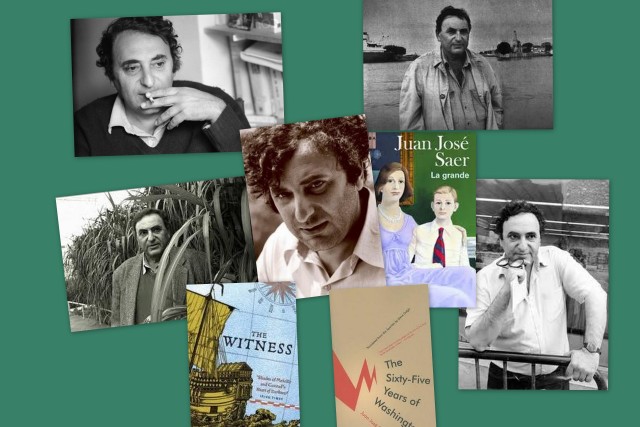
See also Richard Farrell’s review of Saer’s The Sixty-Five Years of Washington and an excerpt from that novel here.

Feb 012011
 

I was looking up the famous suicide character Kirillov in Dostoevsky’s novel The Possessed (also translated as The Demons) and came up this gem in the UK Independent, a classic example of art not mixing very well with life apparently.

For a really good selection of photographs of the murals, including one of Kirillov shooting himself, go here. I love the quote from the artist who did the murals: “What did you want? Scenes of dancing? Dostoevsky doesn’t have them.”

dg

The new station was decorated with black and white marble mosaics of scenes from Dostoevsky’s most famous novels, including Crime and Punishment, Demons, The Idiot and The Brothers Karamazov. But unsurprisingly for a writer famously preoccupied with death, the scenes include images of suicide and murder.

On one wall, Rodion Raskolnikov from Crime and Punishment brandishes an axe over the elderly pawnbroker Alyona Ivanovna and her sister, his murder victims in the novel. Near by, a character from Demons holds a pistol to his temple.

The pictures quickly caused a sensation. Bloggers and websites called the images that appeared on the internet in April “depressing” amid speculation that the images could attract suicides.

via Dostoevsky images on metro ‘could cause suicides’ – Europe, World – The Independent.

Dec 132010
 

T-34C

My first diagnosed seizure occurred in the cockpit of a Navy T-34C Mentor, on a formation flight over Pensacola, Florida.  I was 23.   Another pilot flew ‘lead’ that day, and I was the ‘wingman,’ which meant I  flew by staring straight at lead’s plane, judging distance and spacing by markers on the other fuselage and by constantly adjusting altitude, airspeed and direction to stay in formation.  We flew tucked in close, less than ten feet away, wingtip to wingtip. We were practicing a ‘turn-away,’ a maneuver where, on signal, the lead would bank sharply away and I would follow instantaneously and  in synch, maintaining tight spacing throughout the manuever.   Lead’s orange wing was so close to my cockpit that it seemed almost reachable.  I don’t remember a signal from the other pilot.   I don’t remember his plane turning away.   All I remember was coming to, his descending wing drifting rapidly away in the hazy sky, and the bellowing voice of my Marine instructor screaming at me over the intercom.  Something about me being ‘fucking nuts.’

(You can read the abstract of my case here, in an article published  by the flight surgeon who diagnosed me upon landing.)

I recently started re-reading The Pugilist at Rest, by Thom Jones, a collection of stories I read during my first semester at VCFA.   The titular story deals with the training of a young Marine during the Vietnam War.  The narrator goes through boot camp in San Diego where he assaults an abusive recruit-classmate with a rifle butt.  The narrator then ships off to Southeast Asia, survives a ferocious battle by faking his own death and receives medals for false heroism while the real hero lies dead on the battlefield. The narrator returns from the war and struggles with reintegrating into post-war civilian life.  We learn that Jones’ narrator suffers from epilepsy (as did Dostoevsky, as Jones himself does) and the story ends with the narrator preparing for an operation on this brain to help alleviate the symptoms of his disease.

The story has an odd structure, with scenes interrupted by historical and philosophical intrusions (about Greek boxers, Schopenhauer, Dostoevsky, etc.)   The eponymous pugilist is supposed to be Theogenes, a gladiator and Greek boxer who fought his opponents (to the death) while chained to a stone.

There’s a long passage in Jones’ story about the aura of seizures.  He’s thinking about his own disease and about Dostoevsky.  As a person who’s had epilepsy for almost twenty years and experienced far too many of these auras, I found this passage to be uniquely compelling:

“The peculiar and most distinctive thing about his epilepsy was that in the split second before his fit—in the aura, which is in fact officially part of the attack—Dostoyevski experienced a sense of felicity, of ecstatic well-being unlike anything an ordinary mortal could hope to imagine.  It was the experience of satori.  Not the nickel-and-dime satori of Abraham Maslow, but the Supreme.  He said that he wouldn’t trade ten years of his life for this feeling, and I, who have had it, too, would have to agree.  I can’t explain it, I don’t understand it—it becomes slippery and elusive when it gets any distance on you—but I have felt this down to the core of my being.  Yes, God exists!  But then it slides away and I lose it.  I become a doubter.”

In my experience, the aura sneaks up randomly—there are no precursors, no triggers that I can identify.  It feels like the most intense déjà vu imaginable, beginning as this prolonged sense of recurrent action, almost like a vivid memory.  In those weird seconds as the aura passes from something subtle to something more sinister, everything that’s happening—every sight, sound and sensation—seems to have happened before in the exact same order and sequence.  And here’s the kicker for me: the future feels predictable too, as if I know exactly what will happen next.  Then the aura shifts, and rises into a more and more intense, almost crippling feeling as the déjà vu spreads and becomes more pronounced, mixing with darkness, with a sensation of fear and gloominess.  In “The Pugilist at Rest”, Jones describes this as the “typical epileptic aura, which is that of terror and impending doom.”  But these darker sensations blend in delicately for me.  As loopy as this may sound, as I experience the aura, it feels life-altering, epiphanous, expansive and eerie all that the same time.   It’s both terrifying yet inexplicably peaceful.

I feel no panic in these moments, just dread and calm mixed together in an unmixable cocktail of lucid emotions that take over, then, almost as quickly, let go.

One of the more vivid of these auras happened to me about two years ago.  I was running on a deserted road in Spain (where I was living at the time).  The run felt normal and I ran that road a lot.  Nothing seemed off-kilter or indicative of any somatic disturbance.  Then I noticed the beauty of the trees along the road.  This sounds like bad poetry, I know, but that was my first sensation: “Man, those trees look beautiful.”  And the sun shone brilliantly, and the sky appeared crisp and bluer than I’d ever seen it.  The asphalt road bent around to my right and a guard rail separated the road from a low wash filled with reeds.  The moment felt dreamy, but entirely sensuous too. Like hyper-reality.  Seconds later, overcome by an intense emotional feeling of having lived through this exact experience before—the trees, the reeds, blue sky, sunshine, pavement and the curving guard rails—a wave of physical symptoms hijacked my body.  My knees went weak.  I began to sweat, then my body went cold,  then started sweating again.  I felt nauseated and light-headed.  I knelt down along the side of the road and tried to shake it off.  There was the oddest feeling  that something dramatic was about to happen, something almost indescribably sad but predestined, too.  Jones’ dread and doom here.  Then the aura simply receded.  The sensations passed completely in a minute or less, and all that lingered was a slippery sense of uncertainty over what had just taken place.  I even managed to finish my run.  As if nothing had really happened.

I would not, like Dostoevsky or Jones, trade ten years of my life to re-experience these auras.  Though I agree about their ‘slipperiness’, their ‘elusiveness with distance’, I’ve experienced them enough times that I do not long for repeat performances.   The auras I’ve experienced (and the seizures that sometimes follow) have not triggered any great religious awakenings in me.  I heard no voices of the gods, saw no window into heaven or hell. To my knowledge, I’ve never been accused of being possessed by a devil.

And I’ve been lucky.  Medication seems to manage my symptoms quite well.  And while it hurt intensely to be told at twenty-three that I would never fly again, I can look back at that moment (even at the screaming, cursing Marine instructor!) and feel thankful that my seizure happened when it did, and not out at sea or on final approach into the pitching deck of an aircraft carrier.

A long time ago, I read all of Dostoevsky’s works.  I became obsessed with his novels and stories and the critical work on him.  I’m proud to say that I even managed to read all 5 volumes of Joseph Frank’s incredible biography of the Russian author.  Few writers have a more compelling life story than Fyodor Mikhailovich Dostoevsky.   He suffered intense anxiety over his epilepsy, constantly afraid that it would strike him at any moment.  These were the days when epileptics were closely associated with mental patients, whereas now there seems to be a more clinical, medical sensibility about the disease (as, quite fortunately, there is about most types of mental illness).  Epileptics were shunned from polite society and confined to mental hospitals.  I imagine Dostoevsky worried that his disease would ruin his writing career.  Of course, his disease went almost untreated in the nineteenth century.  For Dostoevsky though, the attacks were often portals into his fiction.  This has never been the case with me.  I’ve never even written about the sensation before now.

Epilepsy has been called the “Sacred Disease.”  It’s long been associated with demonic possessions and spiritual visions.  Paul of Tarsus was said to have suffered a seizure on the road to Damascus which he took as a religious vision.  Muhammad may have suffered seizures; Joan of Arc, Joseph Smith.  I imagine that a religiously inclined person might feel some ineffable divinity in those moments.  I do not, but I can’t fully convey or describe what they do feel like.

I didn’t get up this morning to write about any of this.  I wanted to offer up some of what I’d been reading and seek suggestions from others on NC about good reads for the upcoming holidays.  Funny how these things work.  Toward the end of Jones’s story, he says this:

Good and evil are only illusions.  Still, I cannot help but wonder sometimes if my vision of the Supreme Reality was any more real than the demons visited upon schizophrenics and madmen.  Has it all been just a stupid neurochemical event?  Is there no God at all?  The human heart rebels against this.

-Richard Farrell

(All quotes are from The Pugilist At Rest, by Thom Jones, 1993)

Feb 162010
 

Lucy checking possible fox hole just before Pileated Woodpeckers appeared

Walking Lucy in the woods behind my house on the weekend, I found a pair of Pileated Woodpeckers, male and female. I’ve seen single males from time to time but never a pair–and in the same tree, the male making that strange clucking sound. This was about 15 seconds after my camera ran out of battery.

I read Witold Gombrowicz’s short story “Lawyer Kraykowski’s Dancer” (from his collection Bacacay). A weedy little semi-invalid (he suffers from epilepsy) tries to jump the ticket line at the opera. A wealthy, handsome lawyer drags him back. The semi-invalid, surprisingly, becomes obsessed with the lawyer. He stalks him, tries to imitate him, even tries to help him bed the married woman he is pursuing. When the lawyer finally manages a clandestine kiss with his sweetie in a secluded park, the narrator has a (very literary) grand mal seizure (the “dance” of the title) and is hospitalized. The lawyer escapes to the country. Deep shades of Dostoevsky and Gogol here. Notes from the Underground and “The Overcoat.” But it also, very interestingly, echoes some of the things René Girard says about the triangulation of desire in Deceit, Desire and the Novel, for example, the idea that the self is created when it identifies with the desire of the other (which is the principle upon which all modern advertising works). What is fascinating about the story is the power it generates from the protagonist’s surprise reaction to being yanked back into line. Instead of feeling anger and resentment, he falls under a kind of spell of obsequious adoration for his persecutor. Shamelessly, he debases himself, courts public humiliation. Very mysterious.

dg