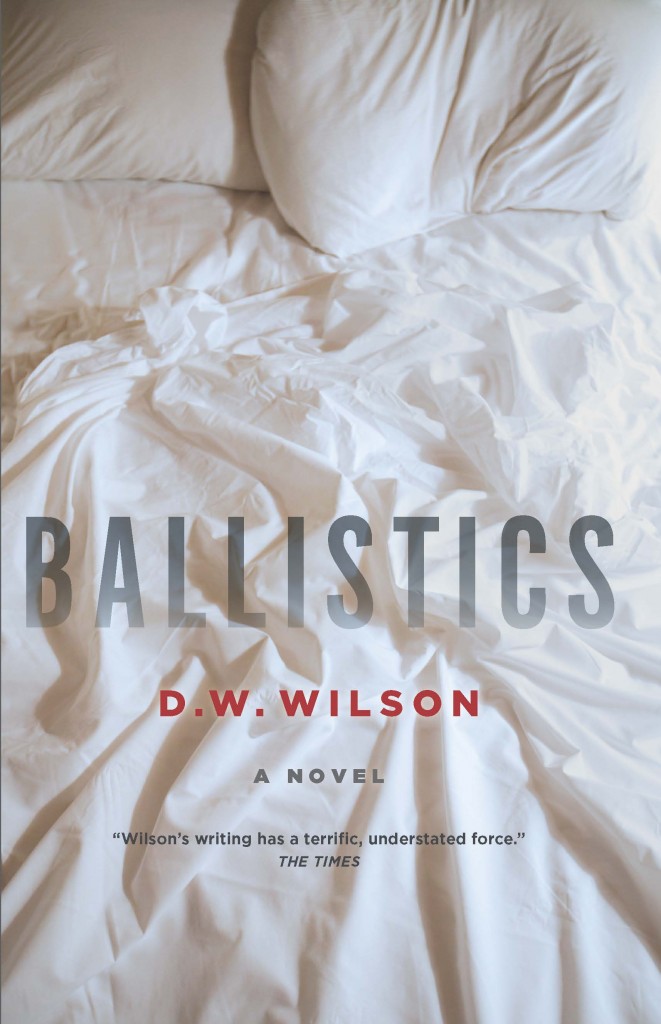
Ballistics
by D.W. Wilson
Bloomsbury Publishing (US & UK), Hamish Hamilton (Canada)
384 pages, $26.00
In a novel called Ballistics, you expect a gun to go off. The reader is satisfied in this respect very near the beginning of D. W. Wilson’s first novel. We learn about the gun from Archer Cole, one of the novel’s two narrators: teenager Jack West puts a bullet in the leg of Archer, a U.S. army deserter, as Archer is trying to break into the West’s hunting cabin. Jack’s father, Cecil West, tackles Archer (they “scramble like beasts”). Archer’s introductory story is, as his daughter Linnea says, “hyper-masculine”: Archer studs it with such phrases as “what went down,” “in your sights,” “the old bastard,” “hunched like a guerilla,” “tear-assing,” and “hearing gunfire like popcorn in my skull.” Archer describes Cecil as having “a menacing way of moving forward, as if he knows how to handle himself, as if he’s going to rip me a new asshole.”
Cecil West does not rip Archer Cole a new asshole. Instead of handing him over to the authorities, Cecil does the right thing: he sews him up, offers Archer and Linnea a place to sleep, finds him a job. Befriends him. While there is no date given for the beginning of these relationships, we know it is towards the end of the Vietnam war, as this is Archer’s third call up. Archer’s narrative throughout the book takes place in the early 1970s.
Archer Cole is looking back. The main action, in the present of 2003, is narrated by 28-year-old Alan West, the first narrator. In Alan’s story Archer Cole is a bitter old man dying of cancer. There are eight chapters in the novel, and in every chapter, Alan speaks first, then Archer speaks second. Until halfway through the novel, Archer gets about ten more pages than Alan. When the past catches up to infant Alan’s abandonment by his parents (Jack West and Linnea Cole) 30 years ago, or when the past starts to help us understand the present, Alan West’s tale takes up more pages, including the whole of the last chapter. And rightly so, because Alan is the catalyst of the action: his grandfather, Cecil West, believes he is dying. Gramps sends Alan on a quest, to fulfill his dying wish, to bring home his son Jack, whom he has not seen in three decades.
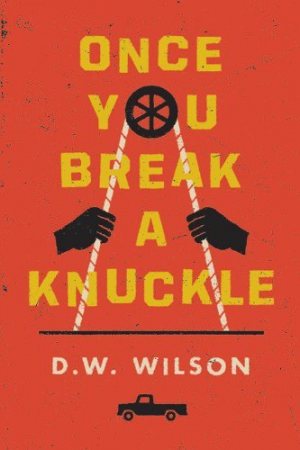
There are, of course, obstacles to Alan’s quest. The most physical is the forest fire raging between him and his destination. The setting is the Kootenay Valley in B.C. — familiar territory to D. W. Wilson, as he grew up there (and set his first book there — the short story collection Once You Break a Knuckle, 2012).
Although Alan West is the first narrator and the man on a mission, he is not the main character in the novel. Rather, the two families are. Wilson is interested in connections: how past actions affect the present, how one person’s action can affect five people even thirty years later. How the Wests could not have what they desired, and what the Coles desired caused pain to others. As Wilson’s narrators tell their stories, they also tell us what it was like to live in the Kootenay Valley, in that place at that time. Similarly, in Once You Break a Knuckle, Wilson tries to create a sense of place, of community, by having characters appear in more than one story, and through their (sometimes violent) interactions with the outdoors. In “The Dead Roads,” the story that won the BBC National Short Story Award in 2011, the landscape – bare, trees laid waste by beetles – presses itself in on the consciousness of the characters. In Ballistics, the forest fire forces Alan West to make an alliance with Archer Cole, who will guide him through the logging roads.
When Alan realizes that Archer is his maternal grandfather (Linnea’s father), he demands the truth about his parents, a truth Gramps would never talk about. This request is not only the premise for Archer’s stories (he often begins, “Here’s a story about…”) but also a motive for Alan to abandon his PhD thesis and drive towards a forest fire with an old man he doesn’t know. He wants to know why they left him to be raised by Gramps.
Archer, however, is not a reliable narrator. He lies to himself, to his best friend, to his daughter, and in the end, to Alan West. We have to pay attention to catch him at it. Sharing an unzipped sleeping bag with his 14 year old daughter, he contents himself with “I like to think I made a pretty good dad.” But there are hints that he is a bad father. He “barked” orders at her, he whistled for her to come out of hiding, he left her alone with the boy who shot him. He subdues her by his “military what’s-what.” He never tells us a good story about her, or a song she sings, or even her favourite anything. In one of Alan’s sections towards the end of the novel, Linnea’s partner calls Archer “a shitty dad” and tells him that Linnea left her father “for good reason.”
When 19-year-old Linnea informs her father that she is leaving home, she says simply, “I’m pregnant. But I can’t stick around to raise a kid with Jack. I’m sorry, Dad. You’ll have to let me go.” Straight and simple. Tough and to the point. But after she has gone, what does Archer tell Jack? “She said she didn’t think you’d make a good dad.”
Alan must extract the truth for himself. When he finds his mother, Linnea, he asks why she left. First she volunteers, “We were kids, Alan. Doesn’t matter what he [Jack] tells you. We were kids.” But when Alan insists (what drove you to leave) we see that it has nothing to do with Jack: “There are so many ways to live… So many ways life can go. And you have to pick, Alan, somehow, even though you can never know what’s right. There might not even be a right. But you have to choose. I chose to leave. It was just more terrifying to stay.”
And what is Alan West’s reaction? Someone calls someone a coward, but we are not sure who speaks, as there are no separating quotation marks, no speaker indicated. After he hears this, after all that has happened, Alan takes us back to landscape: “The wind hushed down off the Purcells, a chinook almost, and breezed over my arms, lifted the hairs like goosebumps, but I sat there and stared at nothing and wished for a beer, or sleep.”
His lack of reaction may have to do, as he admits, with not setting out to find her. She was not the purpose of his trip. Or it may be that he has already seen her as her father’s daughter. On finding Linnea, he immediately starts calling her ‘mom’ in his thoughts. When it slips out verbally, she says, “I’m not your mom.” Alan thinks, “Pettiness: Archer’s daughter.” The very first time he sees her, he thinks, “she resembled Archer in about every way a daughter can.” The way that affects him is that, like Archer, she leaves, and she takes no responsibility for how her departure might affect others. Like her father, she looks after herself first, as a teenager and as an adult. Wilson furthers this point by making Linnea and then Archer use the exact same unfeeling phrase: “It is what it is.”
Where Archer’s narrative is verb-driven, Alan’s is more thoughtful. He is given to more descriptive phrasing, such as the sentence above. Such as his offhand remark about his fight with his partner: “girlfriend drama that for many months has been only a few bubbles shy of boil-over”; or the deliberately amusing “…a poorly ventilated evening in May.” Sometimes he forces the language, which doesn’t work for me: “I smelled the pinprick sensation” (can you smell a sensation?) or the freshening of a cliche with verbosity, as in “when the emotional shit strikes the Great Oscillator.”
The young man is also hiding behind his longer descriptive sentences. At the moment that his mother rejects him again, he numbs down by talking about a breeze and sleep. At the anticlimax, he writes not of how he might feel about seeing his long-lost father, but of what he sees. He displaces his emotion onto Jack’s roof: “shingles curling up like anxious, thirsty tongues.” He notes that the smoke of the forest fire “smelled like my childhood, like good times with Gramps.” He wipes his sweaty palms on his shirt and continues to observe the clean landscaped campground: “The whole moment, all the time it took me to take it in, was like stepping into someone else’s dream: a striped canvas lawn chair had been angled at the setting sun – it looked well-sat-in; at the foot the green-wood stairs, a football tottered in the wind; inside the house, a low orange light flared up, and then went dark. I felt like I was on the verge of a memory, or on the outside of one, looking in.” Dreaming, sleeping, distancing himself. The closest we come to emotion is through his penchant for making declarations: “The saddest truth of all is that we either lose the ones we love, or they lose us.”
That last quotation, “the saddest truth” comes from Alan’s account of Archer’s reunion with Linnea. Their reunion is in the present action, and therefore Alan is in charge of that story. Alan stays outside, watching through a window, and Archer goes inside to meet his daughter after 30 years. This is part of what we get of that charged scene: “I could see Archer and my mom squirm through those first moments of reunion. His lips moved like a chastened man’s and in his lap his hands picked themselves raw. She towered above him…” The scene stays in long-shot, until Alan wanders off. The reunion concludes the next morning, when Linnea asks why Alan brought Archer, saying “It’s more mouths to feed. And he’s a cripple now.”
The father-daughter reunion is a powerful scene, yet the reader is kept distanced from it. Is this Alan’s inability to cope with so much emotion? Just as he ran away from Toronto after being dumped by his girlfriend? Or is it the young author, D. W. Wilson, who evades bringing the scene into close-up? Just as he displaces Alan’s emotion through description? Wilson is delivering the reader into an explosive story of loss and betrayal. Perhaps, then, the reader needs to step away from this scene and share a quiet moment with Alan.
Ballistics is a page turner. You want to find out not only whether Alan fulfills his quest, you also want to know if Alan understands what motivated his parents and grandparents to make the decisions they did. A large part of the enjoyment of the book comes from Wilson’s skill at lathing a well-turned phrase, fresh as the smell of cut wood, carefully shared out between the two narrators, from Archer’s muscular and verb-heavy sentences (“Jack perked forward”) to Alan’s intimate descriptions, such as this one of an outing with Gramps.
…he and I swung into his truck – an old four-by-four reeking of hides and the rusty scent of bled animals – and drove down Westside Road, past the ostrich farm, to the gravel pits where highschool kids built bonfires big as campers, and there we’d waste the day and a carton of rimfires on emptied tuna cans and paperback books Gramps had deemed uninteresting at best.
Now there’s an incentive to write a good book. Ballistics is one book Gramps would not use for target practice.
— Debra Martens
———————————-
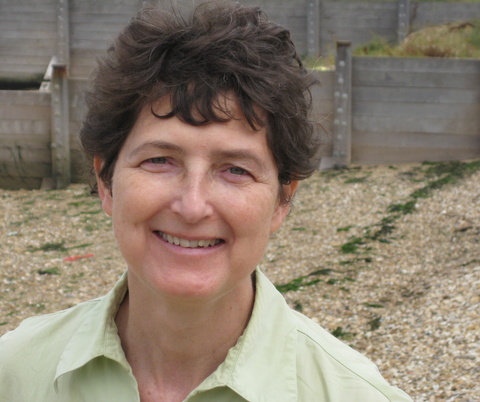 Debra Martens has published short stories in New Quarterly, Grain, Room of One’s Own, Descant and in four anthologies. Her essays and book reviews have appeared in the Montreal Gazette, the Ottawa Citizen, Descant, Paragraph, Books in Canada, Quill and Quire, and most recently in Numéro Cinq. She earns her living from freelance writing and editing.
Debra Martens previously interviewed D. W. Wilson for Canadian Writers Abroad. That interview is available here.