Jun 042017
 

Huck Out West picks up Huckleberry Finn’s adventures after he has indeed headed out to the territories and taken up a life as an itinerant in the American West. Essentially a drifter, Huck in this way fulfills the destiny inherent to his character as depicted in The Adventures of Huckleberry Finn, where he is content to float his way down the Great River to no particular destination beyond a loosely defined “freedom.” —Daniel Green

Huck Out West
Robert Coover
W. W. Norton, 2017
320 pages; $26.95

.
Robert Coover has been a presence on the American literary scene for over 50 years now. In many ways, the critical response to each new book he publishes continues to register the perception that he remains an adventurous writer who repeatedly offers challenges to convention, a perception in which Coover himself must take considerable satisfaction, as he is indeed one of the most consistently audacious and inventive of the first generation postmodernists his work partly represents. Coover’s novels and stories subvert both the abiding myths and shibboleths—sometimes outright lies—that animate American history, and the formal assumptions of literary storytelling, often by adopting the ostensible conventions of such storytelling but subjecting them to a kind of straight-faced parody. In his new novel, Huck Out West, Coover turns to such a strategy, in this case not simply mimicking the patterns or manner of an inherited narrative form, but creating a new and extended version of a specific, already existing work—a sequel, but one intended to provoke reflection on the earlier work’s cultural implications and its literary authority.

Coover has drawn on the elemental power of stories and storytelling going back to his first novel, The Origin of the Brunists, as well as the story collection Pricksongs and Descants, the latter including such stories as “The Door,” “The Gingerbread House,” and “The Magic Poker,” all of which invoke fairy tales and fables as both form and subject. Coover is one of the central figures in the rise of what came to be called “metafiction,” but where, say, John Barth wrote in books like Lost in the Funhouse a blatantly self-reflexive kind of story that proclaims its own fabrication, Coover dramatized the conditions of fiction-making allegorically, making storytelling itself the story. This is perhaps best illustrated in his novel The Universal Baseball Association, still arguably his best book and the most revealing of his fundamental preoccupations as a writer. The novel’s protagonist, J. Henry Waugh (JH Waugh), is the God-like creator of a fictional world that is ostensibly a make-believe baseball league but that de facto represents an alternative reality in which Henry can emotionally and intellectually invest apart from his unsatisfying and humdrum job as an accountant. Indeed, his investment in this reality becomes so all-encompassing that at the novel’s conclusion it would seem he has disappeared into it—albeit as the now withdrawn and omniscient deity who contemplates his creation without intervention.

Although a book like The Public Burning, probably Coover’s best-known and most controversial work, would not at first seem to feature the same sort of concerns informing The Universal Baseball Association—it is, after all, a novel about weighty issues related to politics and history, not about an obscure accountant dreaming his life away—but in fact The Public Burning is not really about politics and history—not directly, at least—but politics as representation, and the distorting effects the sensationalized and distorted forms of representation in America have on American history and culture. In both UBA and The Public Burning, we are shown how easily, even eagerly, human beings shape reality into fictions and subsequently insist on taking those fictions as reality, with predictably disastrous consequences. J. Henry Waugh exemplifies individually what American culture at large evidences more generally: the desire to refashion a recalcitrant reality into a simple, more manageable creation, in which we must force ourselves to believe or that repressed reality will disagreeably return.

A novel like The Public Burning eludes designation as a strictly “political” novel—and thus avoids seeming a dated artifact of a fading Cold War controversy—because it is not finally a representation of the Rosenberg case per se but a representation of the representations to which the Rosenberg case and its legacy have been submitted, an evocation of American depravity through the discursive forms—exemplified by the New York Times and Time magazine—and manufactured imagery—embodied in “Uncle Sam”—that shape and circulate the specific content of that depravity. If J. Henry Waugh retreats into his private invented reality to fill his own inner (and outer) void, in The Public Burning the emptiness is felt as a social loss, an absence of meaning, to be counteracted through the invented reality provided by Media myths and fantasies, myths that at their most destructive must be reinforced through the ritualized spectacle into which the Rosenbergs’ death is organized.

Since The Public Burning, Coover has published numerous, consistently lively works of fiction of various length (8 novels, including the mammoth sequel to The Origin of the Brunists, The Brunist Day of Wrath, 7 novellas, and 3 collections of short fiction). While these books never seem repetitive, they do return to a few obviously fruitful subjects—sports, fairy tales, movies—and can certainly be taken as continued variations on the self-reflexive strategies introduced in Pricksongs and Descants, Universal Baseball Association, and The Public Burning. At times this strategy is more muted, as in Gerald’s Party, which seems more purely an exercise in surrealism, while in other books the artifice is unconcealed, directly integrated into plot and setting, as in The Adventures of Lucky Pierre, one of Coover’s most underrated books that dramatizes the plight of a character caught in an ongoing fiction from which he cannot seem to escape, a fictional character aware of his own fictionality.

Coover has also produced a series of novel and novellas that foreground their own fictionality by presenting themselves as versions of a particular mode or genre of fiction. Dr. Chen’s Amazing Adventure is Coover’s take on science fiction. Ghost Town is a western, while Noir evokes the hard-boiled detective novel (as filtered through film noir). Such works could not exactly be categorized as pastiche, since they are not so much imitations as efforts to distill the genre to its most fundamental assumptions and most revealing practices. Nor could they really be called parodies, since the goal is not so much to spoof or ridicule the genre but to in a sense turn it inside out, make it disclose the specific ways a particular mode of storytelling lends its conventions toward motifs and typologies that in turn have worked to substitute themselves for the actualities those conventions were created to depict, preventing anything resembling a clear perception of historical and cultural actualities apart from these archetypal representations. In novels such as Pinocchio in Venice and now Huck Out West, Coover takes this strategy of metafictional mimicry a step farther by seizing upon a specific iconic text and reworking it, both as a kind of homage to the prior work but also to create a parallel text that echoes the original while it also sounds out the work’s tacit if partly concealed assumptions and elaborates on its latent if unspoken implications.

Huck Out West picks up Huckleberry Finn’s adventures after he has indeed headed out to the territories and taken up a life as an itinerant in the American West. Essentially a drifter, Huck in this way fulfills the destiny inherent to his character as depicted in The Adventures of Huckleberry Finn, where he is content to float his way down the Great River to no particular destination beyond a loosely defined “freedom.” If the objective in Huckleberry Finn for both Huck and his friend Jim (who seeks literal freedom from bondage) is obstructed through the auspices of Tom Sawyer, likewise in Huck Out West Tom causes his supposed best friend (“pards,” they call each other) mostly trouble for their friendship—in fact, in Huck Out West Tom threatens to hang Huck, an act only the most naïve reader would believe he does not intend to carry out. Tom, who literally rides back into Huck’s life (a little over halfway into the novel) on a white horse, again proves unreliable and self-serving, although in Huck Out West these character traits, which Coover has keenly abstracted from the portrayal of Tom in Twain’s novel, are much more deadly in their potential consequences (not only to Huck) than when expressed by Tom Sawyer the 12-year-old boy.

Before Tom makes his reappearance and ultimately sends Huck off on the same kind of open-ended adventure that concludes The Adventures of Huckleberry Finn, Huck brings us up to date on his life since his journey down the river, which includes riding along with Tom for the Pony Express. After Tom decides to head back east, nothing really captures Huck’s interest long enough for him stay in any one place, so when the novel’s present action begins he has settled into the life of a wanderer:

When [Tom] left, I carried on like before, hiring myself out to whosoever, because I didn’t know what else to do, but I was dreadful lonely. I wrangled horses, rode shotgun on coaches and wagon trains, murdered some buffaloes, worked with one or t’other army, fought some Indian wars, shooting and getting shot at, and didn’t think too much about any of it. I reckoned if I could earn some money, I could try to buy Jim’s freedom back, but I warn’t never nothing but stone broke.

Huck must decide whether to buy Jim’s freedom because shortly after heading west, Tom Sawyer consigned Jim back to slavery by selling him to a band of Cherokee Indians. Huck is regretful about this decision, but does not look for Jim after all. Eventually Huck does serendipitously encounter Jim, who has indeed attained his freedom and is now traveling with a wagon train of settlers that Huck is hired to guide. He has become a devout Christian and forgives Huck for apparently abandoning him, but this is the last we see of Jim in Huck Out West. It is on the one hand disappointing that Coover chooses not to engage with the specific racial issues raised by The Adventures of Huckleberry Finn (as John Keene does in his updating of the novel in his book Counternarratives), but on the other hand, he does in effect transfer the theme of white American treatment of racial and ethnic minorities to the eliminationist campaign against Native Americans during the post-Civil War migration to the western “territories.” This campaign is represented most directly in the character of Custer (“General Hard Ass,” as Huck refers to him), but the historical forces portrayed in all of the novel’s actions converge around a broad account of a rapacious, mercenary America determined to extend its sovereignty over all the land it can exploit, with little regard for the devastation and suffering this expansion leaves in its wake.

Ultimately Huck Out West does mirror the Huck/Jim relationship of Huckleberry Finn in Huck’s pairing with a Lakota tribesman, Eeteh, who shares with Huck a general disinclination to bear down and work hard, preferring his own kind of independence, but who is nevertheless an adept storyteller in the Lakota tradition and regales Huck with tales about the trickster figure, Coyote. It is Eeteh who directs Huck to the Black Hills in order to elude General Hard Ass, whom Huck fears wants him imprisoned, or worse, for refusing an order, even though Huck was serving only as a civilian scout. Thus Huck finds himself living in a teepee in Deadwood Gulch, a pristine creek valley when Huck arrives but soon transformed into a muddy slough overrun with prospectors, their hangers-on, and all the hastily constructed buildings erected when gold is discovered. It is into this suddenly chaotic place that Tom Sawyer arrives as well, allegedly deputized by the federal government to bring order. What Tom really seeks to do in Deadwood Gulch is seize the main chance, to use it as the opportunity for the same sort of self-aggrandizement that is always Tom Sawyer’s ultimate motivation.

Huck can never quite accept this, even after Tom has threatened to hang him for defying Tom’s wishes. Rescued from Tom’s bluster by Eeteh (who brings along a few Lakota warriors for good measure), Huck replies to Tom’s predictable apology: “You’re my pard, Tom, always was. But it ain’t tolerable here for me no more. If you want to ride together again, come along with us now.” Tom demurs, and Huck rides off with Eeteh, but in this case lighting out for a territory more informed by Eeteh’s spontaneous, generally elastic storytelling than by the “stretchers” told by Tom, lies he tries to believe are true—or tries to convince others they should believe. Huck himself has earlier indicated he already understands the difference between Tom’s stories that hide reality and the kind of story that might be truer to Huck’s sense of reality: “Tom is always living in a story he read in a book so he knows what happens next, and sometimes it does. For me it ain’t like that. Something happens and then something else happens, and I’m in trouble again.”

Huck Out West is not as purely a picaresque narrative as The Adventures of Huckleberry Finn, but Coover has certainly captured the nomadic state of Huck Finn’s soul. He has cannily discerned the essential nonconformity manifest in the character created by Mark Twain, and memorably transformed the adolescent’s lack of ambition into a more self-aware skepticism toward social expectations and cultural practices—while still preserving in Huck an ingenuous outlook that acknowledges what the world is like but remains free of malice or resentment. This quality is reflected in the colloquial eloquence of Huck’s narrative voice, which again Coover has adapted from the same quality found in Twain’s novel but has further developed into what may be the most impressive accomplishment in Huck Out West. Huck doesn’t merely sound “authentic”; his idiomatic expressiveness is sustained throughout the novel less to provide “color” than to establish Huck as a character able to render his circumstances persuasively through the integrity of his verbal presence.

If I did develop one reservation about Huck Out West while reading it, it was from the invocation of Custer as Huck’s bete noire and scourge of the West. This move threatens to make the novel too reminiscent of Thomas Berger’s Little Big Man, whose narrator also relates his peripatetic adventures in the Old West in a vernacular-laden voice. Perhaps this only indicates how much Berger himself may have been influenced by Huckleberry Finn, and the work of Mark Twain in general, but Berger’s Jack Crabb is primarily the means by which the novel effects its darkly comic burlesque of American myth-making. Huck Out West engages in its fair share of this sort of lampoonery as well, but ultimately it goes farther. Robert Coover provides a new version of the twice-told tale offering a radical representational strategy that still allows for dynamic storytelling, even as it interrogates its own process of representation.

—Daniel Green

N5

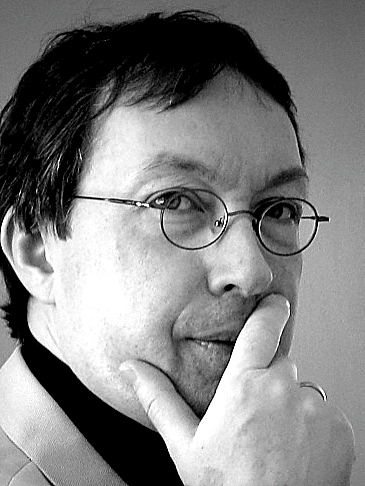
Daniel Green is a writer and literary critic whose essays, reviews, and stories have appeared in a variety of publications. He is the author of Beyond the Blurb: On Critics and Criticism (2016).

.
.
Feb 102017
 

Dan Green


Ebook-1563x2500


As a young man, Daniel Green had hopes for academic criticism, but as this excerpt — take from his essay “Blogs and Alternative Literary Criticism” — shows, he had to set those hopes aside, as more and more academic criticism tended to subordinate literature to political and theoretical agendas. Later, weblogs, too, disappointed him because they pursued sensational or trendy books instead of considering literary works in depth. —Jeff Bursey

.
I aspired to become an academic critic precisely because so much general interest criticism was focused on the “mushy middle” of literary fiction and avoided the books I was most interested in reading. Academic journals were much more likely to feature experimental and unconventional writers (some journals concentrated exclusively on such writers) and gave them more than the cursory treatment afforded by most book reviews. Academic criticism no longer manifests these virtues, however. It is as agenda-ridden as literary journalism, although its agenda emphasizes a different kind of propriety, the propriety of political and cultural analysis (in its way similar to the kind of analysis favored by the New York Intellectuals). And while academic journals continue to offer longer and more sustained commentary, this commentary is more concerned with context—historical, culture, theoretical—than with the text, the latter serving only to illuminate the former. Academic criticism of contemporary fiction no longer provides a more rigorous, expansive, open-minded alternative to the popular reviewing media. For text-based criticism, the general interest book review is what we’re stuck with.

At one time I held out hope that the “literary weblog” would provide a plausible alternative to print book reviewing. I still think that, in theory and potential, blogs could still be perfectly good sources of serious literary criticism. There is nothing in the nature of the cyber medium that precludes the blog from being the publishing vehicle for serious writing of any kind. If serious critics, facing the likely demise of newspaper and magazine reviewing in the not distant future, turn to the cyber/blogosphere as an available substitute, literary criticism will flourish well enough. Such book reviewing sites as The Quarterly Conversation and Full Stop have already demonstrated that online reviewing can be just as credible as print reviewing, in many cases going far beyond, both in length and in critical heft, what is offered in all but the most studious general interest print publications. They are also much more likely to cover experimental and translated works and books from independent presses, which are at best sporadically reviewed in mainstream print book review sections. Unfortunately, it cannot at this point be said that the literary blog has validated hopes it might sustain a form of general interest criticism that could replace, perhaps even surpass, what is left of print criticism. There are indeed some very good literary blogs offering worthwhile criticism, but on the whole the literary blogosphere has become largely an echo chamber for book business gossip, pseudo-literary trivia, and the establishment perspective. Literary blogs have become not an alternative to the established critical order but part and parcel of it.

Those blogs now calling themselves “book blogs” in particular have pledged themselves to this order. Mostly devoted to superficial appraisals of potboilers and best-sellers, these blogs actively seek to be conduits of publishing propaganda (in the guise of “promoting” books). They have apparently become the most popular type of “literary” blog, and if “book blog” eventually becomes the name applied mostly to such weblogs, the future of literary criticism online is bleak indeed. But even those still self-identifying as “literary blogs” have settled in to an overly cozy relationship with both publishers and the print reviewing media. (Many of the bloggers have themselves sought out reviewing opportunities in the print media, as if the ultimate purpose of creating a literary blog was after all to attract enough attention to catch on as a newspaper reviewer). While in general one does get from literary blogs a fuller sense of the diversity of fiction available to readers (more emphasis on independent presses) than from the print book reviews, too many of the posts devoted to specific books are discussions of the newest and hottest from mainstream publishers. Much time is spent obsessing over lists of various inane kinds (the Top 10 ____), and in preoccupation with prizes, the dispensing of which apparently substitutes for criticism absent the real thing.

Literary blogs are (unwittingly, I hope) abetting the capitalist imperative to get out “product” as quickly as possible. New books appear, are duly noted, presumably consumed, and then we’re on to the next one. While sometimes lit bloggers consider an older title, it’s usually by an already established author or a “classic” of one sort or another. Little time is spent considering more recent books that might not have gotten enough attention, or assessing a writer’s work as a whole. Once the book has passed its “sell by” date, nothing else is heard of it and every book is considered in isolation, as a piece of literary news competing for its fifteen seconds. The more potential readers come to assume that this is the main function of lit blogs, the less likely it is that the literary blogosphere will have any lasting importance. Literary blogs might let you know who reviewed what in the New York Times, but that The New York Times might not be the best place to go for intelligent writing about books is not something they’ll have the authority to suggest.

—Daniel Green

N5

Daniel Green is a literary critic and sometime fiction writer. His reviews, critical essays, and fiction have appeared in a variety of publications, both online and in print. He has a Ph.D focusing on postwar American fiction and an M.A. in creative writing. His website is http://www.thereadingexperience.net/tre/

.
.

Feb 102017
 

Dan Green

When these pieces were isolated in space and time of publication they meant one set of things; placed alongside each other they assert themselves more pointedly. In the culture wars Green refers to throughout he is a combatant, if an unwilling one. —Jeff Bursey

Ebook-1563x2500

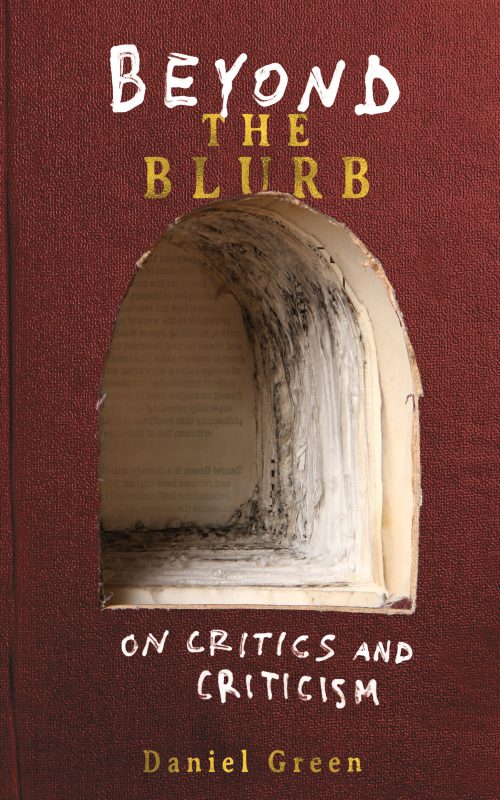
Beyond the Blurb: On Critics and Criticism
Daniel Green
Cow Eye Press, 2017
$14.95; 150 pages

.
Introduction


Many readers of critical writing and attendees of literary conferences will have been either treated or subjected to this or that paper where the literary tail of theory wags the dog of an abject author. The image is more apt when it’s changed to theory having between its slavering jaws the corpse of a work of art, or the corpus of an artist, that will be softened by Gallic or Slavic salivary glands, masticated by deconstruction, postcolonial or queer theory until it becomes digestible matter, followed by its voiding. It’s uncommon in books of criticism nowadays to not encounter references to some or all of the following: Adorno, Althusser, Bakhtin, Barthes, Benjamin, Blanchot, Cixous, Deleuze and/or Guattari, Derrida, Foucault, Kristeva, Lacan, le Man, Shklovsky, and Wittgenstein. What these figures focus on, as do those who cite them, dispute with them, rely on them, and build upon their foundations, is theory, not literature, which has become a resource to provide examples that upholds the Weltanschauung of the theorist. “To the extent that the kind of focus on the ‘literary’ qualities of poetry and fiction, that is, on those qualities that make them first of all works of art,” says Daniel Green in Beyond the Blurb: On Critics and Criticism, “for which I advocate has been dismissed as old-fashioned or superficial, new books are in danger of receiving only the most cursory notice, the most uncritical celebration or ‘takedown,’ otherwise left to fade into future obscurity.” Without dwelling on the experience of my own reviewing, I’ll simply say that I recognize his spirit as the mark of someone conscious he is writing outside the mainstream as embodied, for Green, in such venues as New York Times Book Review, The National Review, and New York Review of Books (regardless of their political leanings), but not in The Quarterly Conversation (or, I would add, The Review of Contemporary Fiction and Rain Taxi, each offering alternative points of view of little-discussed books or fields of study).

At times that first group of journals—one could include the TLS and the London Review of Books—“regard contemporary literature simply as material, sometimes ammunition, sometimes a target, to be employed in the ongoing culture war.” (66) A pirate navigating waterways ruled by this or that thalassocracy, Green nails his colours to the mast:

Readers and critics are perfectly entitled to regard literary works in any way they want, of course, but to deliberately avoid initially engaging with them for their artistic value—the value with which their creators presumably most resolutely attempted to invest them—seems hardly in keeping with the animating purpose of literature as a form of expression. Perhaps readers need not seek out what Nabokov insisted on calling “aesthetic bliss” (although why not?), but that a work of literature might in fact produce such bliss would seem to be a fact about it that a literary critic, at any rate, should need to account for.

The method Green has found that best brings out the literary aspect of a work, and what, in part, makes him think he may be “old-fashioned,” is New Criticism. Not a blind adherence to it, however, for he has the flexibility to modify it and allow other approaches, but as he says, “…I am inclined first of all to read fiction the way the New Critics read poetry, for the integrated effects of language, for the way the parts of the text make a whole and how the parts interrelate. Ultimately, of course, you can’t avoid discussing such things as characters and point of view, but those are themselves the textual artifacts of language.” That will appear untoward or restrictive, refreshing or niche, depending on how well Green defends and advocates for his position.

Beyond the Blurb is set out as follows: Introduction; Part 1: Critical Issues; Part 2: Critical Failures; Part 3: Critical Successes; Bibliography. (There isn’t an index). The Introduction is a concise explanation as to why Green has assembled this book, where the pieces have appeared, what its purpose is, and the rationale behind his thought. He offers six “core tenets” that emphasize that reading a book is the way to get to its meaning: “The experience of reading is the experience of language,” goes one tenet. Part 1 has essays on such topics as close reading, the authority of criticism and critics, and blogs. (Green has his own well-written blog.) Part 2 addresses those critics found wanting, such as James Wood, Christopher Hitchens, and academic criticism. Part 3 focuses on Susan Sontag, Harold Bloom, and William Gass, among others. Each section is packed with argument, generous quotations, and fair-mindedness.

As usual in books of this type that offer up criticism that has appeared on blogs or in the Los Angeles Review of Books there is a certain strain of modesty: “While I do not argue explicitly in these essays that reflection on such issues might be especially important in the critical discussion of current/contemporary literature, nevertheless this is a necessary and underlying assumption.” Sometimes the implicit is much stronger than it appears. When these pieces were isolated in space and time of publication they meant one set of things; placed alongside each other they assert themselves more pointedly. In the culture wars Green refers to throughout, he is a combatant, if an unwilling one.

.

I.

The essays comprising Critical Issues (as with the other parts) generally use one person to centre the argument. Daniel Mendelsohn, in “Close Reading,” comes under the gaze of Green for leaving out one vital feature of a critic: “the ability to pay attention.” This allows for an explanation as to how opinions are only that unless they are backed up by evidence taken from the text, not from such a thing as “taste,” which is a code word used by “guardians of literary culture.” Disliking or liking Jonathan Franzen or Zadie Smith is insufficient. Critics need to argue from the evidence of the work, not from a theory that embraces (or smothers) the work while speaking about anything but its language. This is a mild essay to lead off the book, to my mind, but things pick up with “The Authority of Criticism,” wherein Ron Silliman, whose views are rooted in Marxism, is praised for his “pragmatic perspective” on criticism, and for fitting himself along the Pound-Olson-Creeley axis, one that viewed New Criticism with caution. We are given a thumbnail sketch in literary history (which, like military history, has its own share of pointless wars), a grounding in the work of someone Green respects who challenges New Criticism from a learned perspective, and a rebuttal that takes on board Silliman’s negative comments on New Criticism with poise.

Johanna Drucker is the lightning rod in “Aesthetic Autonomy.” By quoting her right off Green gives readers a taste of her work: “Fine art, artists, and critics exist within a condition of complicity with the institutions and values of contemporary culture,” Drucker says in Sweet Dreams: Contemporary Art and Complicity. Green responds: “I am ultimately fine with this argument, although it’s unfortunate that a defense of aesthetic value in art has to in effect make common cause with mass culture in order to ensure that ‘art’ survives as a viable endeavor to begin with.” Here we have the commodity argument: a painter has truck with commerce (in the purchase or rent of supplies, studio space, models, and then on to labour and selling the finished product). Green’s well-reasoned objection is that this is not a new idea or particularly revelatory, for it is the interpretative framework that supplies the commodity argument, not the art work itself. Through Drucker, Green is able to address the notion of art in service to ideologies as weapons, when, for him, “their refusal to submit to the expectations of ordinary discourse” signifies the autonomy many would deny them.

“The Authority of Critics” is a title that should make us pause. We rarely think of our critical writing as authoritative, especially when it’s spread over a variety of journals that have specialized and small audiences. Yet we maintain the belief that opinions, interpretations, and eisegesis sway the hearts and minds of an unseen multitude. John Carey is the subject of this essay, and Green shows how confused his thinking is in What Good Are the Arts?, classifying it as “absurd in the extreme, essentially inane” after demolishing its principal ideas: that art doesn’t exist, but that it does and that it “does some people quite a lot of good.” It would, perhaps, have made the book stronger to leave Carey out and to focus instead on someone dismissed in the Introduction, Jonathan Franzen, due to his malign and lingering impact on how the literary world divided itself according to his Status and Contract notions. While no more valid than Carey’s, they were more pernicious and, since they drew in various figures, such as Ben Marcus, this could have widened Green’s consideration of classes of fiction.

“Blogs and Alternative Literary Criticism” sets out some arguments for and against this venue of art commentary. It begins with Richard Kostelanetz’s view, from The End of Intelligent Writing: Literary Politics in America (1974), of the “‘New York Intellectuals’” of the 1960s and 1970s as “agenda-setters [who] influenced critical discourse to the extent that challenges to their critical principles (and to their liberal anti-communism) were summarily dismissed when not simply ignored.” From the journals discussed—Partisan and Commentary—it is a short step to academic criticism, which Green once thought would be a suitable place for him. “Academic journals were much more likely to feature experimental and unconventional writers… and gave them more than the cursory treatment afforded by most book reviews.” Times changed, however, and soon academic criticism cared more for “context—historical, culture, theoretical—than with the text, the latter serving only to illuminate the former.” The result is we must find less theory in the hodgepodge of book reviews found in a handful of newspapers that are all too eager to waste column space to the same top 10 titles per season.

Green misses those earlier days, and is dismayed, too, about the online contemporary scene. Once, literary weblogs offered the possibility of “a plausible alternative to print book reviewing,” but this promise never became widespread. It should be said that his blog is substantial and varied, with much long-form writing. But The Reading Experience, as well as Stephen Mitchelmore’s This Space and Litlove’s Tales From the Reading Room, to name two others, are numerically swamped by other blogs that present “…book business gossip, pseudo-literary trivia, and the establishment perspective.” As with print journals, weblogs are haphazardly interested in books, but rarely those that are older than ten months to a year unless it’s an undisputed classic. There’s no hope on the Internet, then, for a renaissance of critical thought.

.

II.

It is beneficial to Green to write against something or someone that irritates him. In Part 2 he targets James Wood, Christopher Hitchens, Morris Dickstein, Hershel Parker, and Joseph Conte for particular failings. Two essays stand out above the others.

I agree with Green, in “James Wood,” that the subject of this essay is “a particularly pernicious influence on contemporary criticism” whose “obvious biases” towards his favoured mode, realism, exclude most fiction that does something else, especially if such works “challenge orthodoxy…” Like Green, when reading Wood I’m conscious that he is reducing the world of literature down to one preferred method of approach, that this is ungenerous to those who think in alternate ways, and that the aim of making anything different conform to a critical perspective rather than choosing to learn something new is to limit oneself needlessly. Quoting Wood on how readers analyze characters, Green states the obvious: “Why would we want to regard characters in a novel as if they were actual people, people with minds and motives and a ‘consciousness’?” This is a common thought, not a special insight Wood has; many publishers still insist they want manuscripts with characters their readers can warm to. But the common reader invoked by Wood might find it unhelpful to use their interpretation of the characters in Bleak House or The Ambassadors to negotiate with colleagues at their workplace. Figures we encounter in books are solely marks on a page, not living beings. (How a champion of realism can’t distinguish between a book, just another object in the world, and the rest of the world is not a subject that troubles Wood much.) In Green’s judgment:

Wood’s account of “how fiction works” is prescriptive, not descriptive: he wants to convince his common readers that the way of reading he presents in his book [How Fiction Works] is the one proper way of reading and that the kind of fiction that most directly satisfies the specified readerly requirements is the only kind really worthy of our attention.

Essentially, Wood regards books primarily as instruments to understand the so-called real world and that therefore impact moral decisions.

In conversation with Karl Ove Knausgaard in The Paris Review, Wood attempts to classify the Norwegian author’s six-volume My Struggle, a tremendous and deliberately unwieldy amalgam of confession, dialogue allegedly recalled from years and years ago, metaphysical conceits, realism, contradictions, airy pontifications, miserable muttering, self-lampoons, artistic manifestoes, wretchedness and hilarity, as realism of a newer kind:

I think it is a general problem. One of the interesting things that’s been happening—in Norwegian literature certainly, but also in British and American fiction—has been an insistence on breaking the forms, not because there’s a postmodern rule that one has to break the forms, but for almost the opposite reason, out of a desire to achieve greater verisimilitude, and a belief that the only way to get there is to break the grammar of realism precisely as you’re describing. In Book Two you say that you’re sick of fiction, you’re sick of the mass production of fictions that all look like the same. You write that the problem was “verisimilitude and the distance it held to reality was constant.” I think this is well put, because it doesn’t rule out fiction-making. It just makes fiction-making harder.

You can sense the strain as Wood tries to squeeze Knausgaard’s epic into a box labeled Realism by appealing to some mythical “greater verisimilitude,” as if there are levels of reality. If there are, then there’s no need for the words greater and, by implication, lesser, but if reality isn’t the same all the way through, then Wood is in serious epistemological trouble. One could also make much of how he feels supremely at ease reading the minds of writers in three countries. That’s just breathtaking.

Green has much more to say about Wood in an essay that he worries might go on for too long, but such is the general obeisance to him and the value of his imprimatur that a considered, and well-mannered, close reading of his words is welcome.

For some reason, Christopher Hitchens was considered to be a worthwhile literary critic and commentator, a low-grade Orwell. In his examination of Hitchens, whose criticism is rarely “non-political,” Green summarizes his contribution to literary criticism this way:

The poets and novelists Hitchens writes about are important to him for what they represent, for the way in which they illustrate historical movements and political ideas, for their beliefs and their habits of mind. Presumably, from Hitchens’s perspective about the most praiseworthy thing that might be said about an author is that he “conducted himself ” as a writer particularly well, not that he (or she—although Hitchens considers very few if any women writers in any of his reviews and essays) actually wrote something especially admirable.

The remainder of this cast of failures, out of one motivation or another, obscure literary works with other matter, although Green finds things to appreciate and regret in the work of the academic Joseph Conte:

If Conte’s discussions of Barth and Sorrentino illuminate qualities of their work that have not previously been as clearly identified, his chapters on White Noise, The Universal Baseball Association and Gravity’s Rainbow to some extent retrod old ground in the critical consideration of these novels. Conte uses information theory, systems theory, complexity theory, and the ideas of the mathematician Benoir Mandelbrot to map the design and debris strategy at work in these iconic postmodern texts, and while the readings that result seem perfectly cogent in elucidating that strategy, nothing very fresh is really added to the commentary on the novels themselves beyond what has already been offered in the voluminous existing criticism of them.

Conte’s final remarks on a move from print to digital reading are briefly mentioned. Green believes in the possibility that “…academic criticism will turn to electronic forms as the subject of ‘advanced’ analysis,” and it’s odd he doesn’t mention that this kind of study is going on at Electronic Book Review.

.

III.

Part 3: Critical Successes presents the literary aesthetics of Susan Sontag, Harold Bloom, Richard Poirier, William Gass, Michael Gorra, David Winters, and S.D. Chrostowska. (It’s a Parallel Lives of the Ignoble and Noble Critics, you could say). Green repeats the well-known encapsulation that Bloom’s thoughts on Shakespeare, the canon, and much else emphasizes “the evidence of influence” over the “formal or stylistic features” of a work and downplays the use of language. “There is still much to be learned from Bloom’s provocations, but probably his kind of reading can’t really be done by anyone else,” Green concludes, and this remark applies equally to Gass, whose idiosyncratic essays will find appeal for anyone who is already a proponent of this very different writer. As for Poirier, an academic critic, Green praises him for his work on Emerson and on style: “…unfortunately there are now few critics like Richard Poirier around to return us to the significance implicit in the reading experience itself, where the reader’s struggle to make the most of the text mirrors the writer’s struggle to allow language to make what sense it can.”

Susan Sontag occupies the polar opposite position in this section from James Wood. Her words are quoted at length, especially from the essay “On Style” that appeared in Against Interpretation. Daniel Mendelsohn’s criticism of Sontag clashes with Green’s own views on her work in a fruitful way as Green examines her theory of writing as erotic and containing a “‘sensuous surface.’” From the following Sontag quotation, it’s easy to see why a current proponent of New Criticism would find her ideas compelling:

To treat works of art [as statements] is not wholly irrelevant. But it is, obviously, putting art to use—for such purposes as inquiring into the history of ideas, diagnosing contemporary culture, or creating social solidarity. Such a treatment has little to do with what actually happens when a person possessing some training and aesthetic sensibility looks at a work of art appropriately. A work of art encountered as a work of art is an experience, not a statement or an answer to a question. Art is not only about something; it is something. A work of art is a thing in the world, not just a text or commentary on the world…

In keeping with his independent streak, Green is not wholly satisfied with Sontag either, for she “can’t finally unburden her argument of the criticisms of aestheticism made by the moralists she otherwise castigates.” By speaking of moral aspects to art she diminishes her own response. “‘Art is connected with morality,’” she says, and this is a needless connection in Green’s eyes. She also doesn’t spend enough time on style—linking her to Hitchens and others—which is another fault. As with Wood, he spends a great deal of time teasing out her thought, and these twin pieces are, to my mind, the best in the book when read in tandem.

Gorra and Winters come in for different types of praise, for their positions on the role criticism can play—paying attention to the art, as Winters does, through “meticulous description and analysis,” and less to the person behind it—while refraining (especially in Gorra’s case) from indulging in the personal:

Of course, very little that is actually offered to general readers in book reviews, magazines, or trade publishing could be called academic criticism. Via the latter, the only attention given to literature is through biographies of writers, which in turn become the prompt for what passes as literary criticism in periodicals such as the New York Review of Books, noodling essays in which the reviewer makes sweeping statements about a writer’s work, often simply repeating the conventional wisdom, while otherwise mostly recapitulating whatever biography is under review.

Both writers earn Green’s respect for devising refreshed approaches to literary works.

Concluding Beyond the Blurb with a sustained and enthusiastic review of S.D. Chrostowska’s Matches: A Light Book, Green takes comfort in how this collection of sharply worded and compact aphorisms is “less a specific model of what criticism might become in the digital age than simply a challenge to seriously reflect on what Matthew Arnold called ‘the function of criticism at the present time.’” It is certainly a way to bring attention to stale methods, yet to some extent I have to disagree. In the same review Green writes:

[C]ertainly readers expecting conventionally realized critical essays, close readings, or historical analyses, the kind of book Chrostowska describes in her introductory “Proem,” in which “the words, erect, line up in columns and salute from every page,” will have to adjust their assumptions about what “criticism” properly entails.

The language in “Proem,” and throughout Matches, comes from a poetic sensibility aligned with a finely tuned critical mind. Most works of literature that we consider personally important—our own canons, not a list of books we’re told we should read—contain revelations and social criticism. They can affirm what we believe in better language than we possess or upend our complacency, even if only temporarily. They undercut long-held beliefs in what can be talked about and what kind of language can be used to get across ideas. Matches is the agonized, at times wry, lament of a liberal mind watching as a general deterioration of the world is leading to a final darkness, and the liberal narrator’s mind becomes inflexible and grim. Without distortion, Green’s “conventionally realized critical essays” can be seen as a set of assays in story-telling forms: the dialogue, the homily, the lecture, the fantastic tale, the pensive meditation on the mundane, the humourous quip, and so on. While not wholly new, the form of Matches confidently includes academic criticism and novelization. “Indeed, it would not be wholly implausible to regard Matches as itself a novel of sorts,” Green admits. What is dispensed with is scenery, character (except for the persona), plot, and so on, and what is most prominent is the attention to form and language; these are hallmarks of much postmodern fiction. Matches is a Janus-faced work.

With this review we come to the abrupt end of Beyond the Blurb.

.

Conclusion

There are some questions raised by the contents of Green’s book. I wonder why Steve Moore, a critic who has redefined what the novel is, and written on many current books, is not the subject of an essay instead of (or in addition to) Michael Gorra. The same goes for Stephen Mitchelmore, whose own excellent collection of essays, This Space of Writing, came out in late 2015. Green does review that book on his site, along with others, and in that review Green describes Mitchelmore’s book as follows:

After reading the entirety of This Space of Writing readers will likely have an adequately clear understanding of what Mitchelmore means by “silence” (and why it’s missing from most conventional literary fiction) and why its lack of “horizon” makes literature uniquely rewarding, but I confess to finding his critical language at times somewhat impalpable or cryptic, at least according to my own admittedly more buttoned-down approach to criticism.

There is a definitely a restraint in Green’s language—though certainly no hesitation to point fingers when required—and it’s only a minor quibble, a matter of taste (a word I use hesitantly here), that some might prefer a more free-wheeling style. The omission of essays on Moore and Mitchelmore strike me as a missed opportunity.

If it appears that I’ve gone on rather long about a book of criticism, it’s partly because in Beyond the Blurb Daniel Green has written an accessible and contrary-minded work that is at war or in agreement (mild or strong) with prevailing trends of critical writing, and the incorporation of so many strands of thought warrants due space. As he writes about a subject that some writers would be thought to have a vested interest in—how their works are received and, potentially of less significance, used—this book can be recommended to them, as well as to the general reader who may be less and less inclined, and with good reason, to rely on the book pages in their local papers (if such a section even exists) for guidance.

—Jeff Bursey

N5

Jeff Bursey

Jeff Bursey is a literary critic and author of the picaresque novel Mirrors on which dust has fallen (Verbivoracious Press, 2015) and the political satire Verbatim: A Novel (Enfield & Wizenty, 2010), both of which take place in the same fictional Canadian province. His newest book, Centring the Margins: Essays and Reviews (Zero Books, July 2016), is a collection of literary criticism that appeared in American Book ReviewBooks in CanadaThe Review of Contemporary FictionThe Quarterly Conversation, and The Winnipeg Review, among other places. He’s a Contributing Editor at The Winnipeg Review, an Associate Editor at Lee Thompson’s Galleon, and a Special Correspondent for Numéro Cinq. He makes his home on Prince Edward Island in Canada’s Far East.

.
.