Jul 162013
 

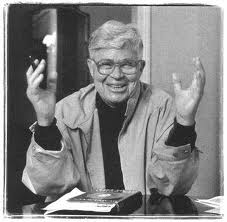
Angel Igov

 …the story is not only about fleeing one’s shame and insecurities but also about articulating one’s identity in the face of a larger, confusing society that never ceases to change. The stand-out moments of A Short Tale of Shame lie not in the resolution of the friend-love triangle, but in the characters’ semi-mythical experience of the journey. —Tom Faure

large_Short_Tale-front

A Short Tale of Shame 
Angel Igov, translated by Angela Rodel
Open Letter Books, May 2013
145 pages, $13.95

Angel Igov’s A Short Tale of Shame, translated from the Bulgarian by Angela Rodel, is a fine novel that explores how we attempt to escape grief and humiliation, often literally by fleeing through travel.

In some respects Igov has crafted a classic road story. After the death of his wife, middle-aged former musician Boril Krustev has thrown a few belongings into his shiny red car and taken off, vaguely heading south. Tellingly, he does not bring with him a guitar—has not played in months. The story opens after he picks up hitchhikers Maya, Sirma, and Spartacus. They soon recognize him as the father of their childhood friend Elena. Surprisingly, they invite him to join them for the rest of their journey. Krustev tentatively agrees, without fully knowing why—he questions at times whether to leave the younger, liberal youths to their own adventures. Elena is at the heart of each character’s shame, and her libidinous involvement with the hitchhikers is revealed gradually and with artfully-controlled pace. Her awkward inclusion into and subsequent expulsion from the students’ friend-love triangle, all referenced obliquely through their reminiscences, ultimately produces much of the tension of the novel.

Born in Sofia in 1981, Igov studied at Sofia University and was a Fulbright visiting researcher at the University of California, Berkeley. He is currently working toward a PhD in European Literature and has been nominated for awards not only for his fiction but also for his criticism and translation. He has published two short story collections and won the Southern Spring award for debuts in fiction. A Short Tale of Shame was the co-winner of the Contemporary Bulgarian Writers Contest.

 Igov’s novel is ambitious and experimental on two fronts: in its setting and in its style.

Some foreign readers will not immediately realize we are in “a country that geographically and culturally resembles Bulgaria, yet its history and ethnography seem to have gone some alternative way.”[1] This semi-fictitious “Thracian-dominated state” resembles what is known today as the historical region of Thrace—South East Bulgaria, North East Greece, and North West Turkey—a swath of land that has been invaded by everyone from the Huns to the Celts to the Romans. The setting informs an intriguing secondary theme: questions or crises of identity permeate the novel.

Today, Bulgaria’s population of 7.5 million includes ethnic Turks, Pomaks, Jews, Roma, Russians, Armenians and more. As the English-language Bulgarian magazine Vagabond puts it, “Its long history of local wars, migrations and – in later times – constant changes of national borders has complicated the picture further, turning what is now called Bulgaria into a place where a significant number of diverse minority groups live. Distinguishing between them is sometimes a strenuous task. Some of them are ethnic, others – religious. . . . The origins of most are obscure and often disputed.”[2]

Recently become a member of the European Union (in 2007), Krustev realizes he can drive around the continent at his ease. He has boldly decided to cut through the slightly sketchy Rhodope Mountains to reach the Aegean Sea. We learn more about the history of the region, fraught with ethnic and territorial feuding. Krustev is of the Slavic minority but he muses that this “was no worse than being an Illyrian or Paeonian, and it was definitely much better than being a Dacian.” The history of Balkan upheaval mirrors his anxiety about his ethnicity and his music career. The hitchhikers, who have taken a semester off from college, also experience confusion about who they are and what their futures have in store.

Igov enhances the semi-mythological setting by invoking the story of Croesus and waxing lyrical about the tragic idea of hubris—which also reinforces the compelling themes of mixed traditions and confused identity.

The road formula has offered a long list of heroes, from Gilgamesh to Hunter Thompson, various forms of escape and salvation, but A Short Tale of Shame does not suffer too greatly from treading across worn paths. It is indeed a short tale but one rich with psychological intensity, a story unraveling through reminiscence and rumination. Along with the intriguing setting, Igov’s spare yet expansive writing is what really stands out:

So Sirma was of Lydian descent. Maya couldn’t have been more surprised . . . The absurd fact that Sirma hadn’t talked about it during all the years they had known one another, not only known one another, but had become a common organism, the three of them with Spartacus. It’s like your right leg blurting out to your left hand something it had never suspected, hmm, maybe that isn’t the best comparison, but given that it was something that wasn’t important in the least, why hadn’t she mentioned it until now? . . . To keep quiet about something that didn’t matter, that wasn’t OK, because it puts you in a privileged position and Maya was taken aback by the whole pointlessness of the miscarried secret.

Those consumer readers who are growing more and more used to computer-optimized, bite-size text blocks may have difficulty with Igov’s style of unremitting paragraphs—frequently lasting five or six pages—that flit from past to present and from character to character.

It’s not that Igov is obscurantist—far from it. Rather, he approaches clarity the same way our minds do: by wandering, emotionally sometimes, open to possibility and non-linearity, much like a road tripper might be. The careless reader misses out on what I find to be the main reward of longer, lyrical paragraphs: an energy that builds and amplifies the further the writer goes, building a tension within very sentences and even clauses that in some cases better mimics the madness of the itinerant mind:

As they came out of the water together, Sirma was still shaking from fury and relief, even though, she told herself, the three of them were not supposed to be here at all, and if everything had gone according to plan they wouldn’t be here, then this whole scene would never have happened, but in that case every moment and every action gave rise to and at the same time ruled out countless possibilities, tiny grains of sand, indistinguishable from one another they all dried off with the same towel which Krustev had prudently brought along, how had the thought that he would go and drown himself ever crossed her mind, given that the man had brought a towel, and they sat down on the ground.

The book’s ten chapters interchange close third-person narrators (for the most part switching between them as seamlessly as Virginia Woolf does in Mrs. Dalloway), and perhaps it is the nature of the automobile that helps preserve the pace and flow: all four characters, borne out in an aimless jaunt in this car, are equal protagonists escaping from various troubles, each given equal value in the rhetorical structure of the novel.

Even so, Igov’s curious form of free indirect discourse can be jarring—especially when it delivers exposition that risks feeling too condensed:

But perhaps every time was strange—wasn’t it strange that he was now riding with Elena’s father, the Beautiful Elena, she was surely the only person who had seriously threatened the unity of their trinity. Maya had brought her to them. She had introduced her ecstatically as her best friend from grade school. Damn, said Sirma. Elena was pretty, artistic, and a half-Slav. Her father had once been the guitarist in Euphoria, and now he was really rich.

Though omitting explicit references to On The Road or other obvious classic road stories, Igov’s novel does allude by name to The Catcher in the Rye[3]. This is apt; in their transformative journey the characters resemble Holden Caufield rather than Sal Paradise, and the traveling at hand is not for kicks so much as to escape phonies and figure out who they are.

“. . . The established eighth graders were just eighth graders, while the new eighth graders, who really should have been preparatory. . . . Sirma had told her one day some time at the end of the fall. You know what the older kids call us? Fakes. Why fakes, Maya didn’t get it. . . . I’m not trying to fake anybody out, Maya said, and I don’t get it at all, it’s not like we decided what they’d call our classes. . . . Maya didn’t know any of the upperclassmen and had nothing to say to any of them, but she was indignant nonetheless. Why the hell fakes?”

Again, the story is not only about fleeing one’s shame and insecurities but also about articulating one’s identity in the face of a larger, confusing society that never ceases to change. The stand-out moments of A Short Tale of Shame lie not in the resolution of the friend-love triangle, but in the characters’ semi-mythical experience of the journey. The novel ends by leaving the reader with a simple image—one that, unlike the complex ethnic history of the region, is more permanent: the characters gathered on the beach, Krustev deciding to pick up a guitar, the group discussing when to head back home.

 —Tom Faure

————————————

Tom Faure

Tom Faure is an MFA in Fiction student at Vermont College of Fine Arts. His work has appeared in Zocalo Public Square, Splash of Red, and a few undergraduate magazines at Columbia University. He lives in New York, teaching English and Philosophy at the French-American School of New York.


Footnotes    (↵ returns to text)

  1. From Bulgarian Elizabeth Kostova Foundation for Creative Writing, a co-publisher of the original edition of A Short Tale of Shame.
  2. http://www.vagabond.bg/high-beam/2022-diverse-bulgaria/2022-diverse-bulgaria.html
  3. Granted, one could argue Salinger’s novel is also a “road story.”
Jul 152013
 

What about the universal human capacity to screw things up? That’s what I wonder in all this.

We are now dealing with a vast intelligence-industrial complex that is largely unaccountable to its citizens. This alarming, unchecked growth of the intelligence sector and the increasingly heavy reliance on subcontractors to carry out core intelligence tasks – now estimated to account for approximately 60% of the intelligence budget – have intensified since the 9/11 attacks and what was, arguably, our regrettable over-reaction to them.

via The NSA’s metastasised intelligence-industrial complex is ripe for abuse | Valerie Plame Wilson and Joe Wilson | Comment is free | guardian.co.uk.

Jul 152013
 

Noah Gataveckas

Style, Freud, Nietzsche, the uncanny, Poe, Trotsky and Lacan (not to mention a quiver of ressentiment in the direction of existentialism and the modern university system) — Noah Gataveckas is our Dante in a journey through an inferno of intellectual repression, suppression and return (like the corpse of Usher’s sister in the premonitory short story). Nietzsche will not stay dead, it seems, despite our best efforts.

dg

.

I continue to hope that a philosopher-doctor…will some day dare to fully develop the idea that I can only suspect or risk.

— Nietzsche[1]

Head

STYLE ISN’T EVERYTHING, but it’s not nothing either. It intrudes upon the message that one tries to communicate – from voice to ear, from one ‘soul’ to another – that comes from within the message itself. In this way, it is like that horror movie staple, the phone call that comes from somewhere inside the house. But since style operates as an automaton of figuration, it is more like an ethereal voice that only exists on the line, beaming into the receiver from the network taken as a whole, that is, the circuit-self. Style is an alien element burrowed in the voice of the other, whose words and mannerisms preflect your own by a quiver-second; you feel yourself return to them for the first time, since they originate from a place “in you more than you,”[2] a closet garden in bloom whiff perennial déjà vus. Style is the way that the Signifier stuffs,[3] clutters, before intentionality arrives on the scene to appropriate and set up an ordering of things and a connection between use-values and exchange rates.

A current understanding, which disperses the ‘soul’ into a huff of gaseous matter and takes the ‘otherness’ of the self for granted,[4] sees in style a material trace of the unconscious (individual) and evidence of subjective spirit (particular): not as a “life-style” to be purchased by mastering a pattern of consumer behaviour, but an insistent tendency which finds itself at home in its repetitive unoriginality; whose belatedness and unfashionability, lagging at the back of the pack, allows it to ease into first place in a rat-race without limits or lapcount. Style comes to the fore in an era of fascionistas and apoliticos, when the Name-of-the-Father has been effaced from the writ on the wall, marking the start of the reign of impotence-in-power. The only authority in such prevailing conditions of “ontological anarchism”[5] is what grows from the ground, like how a diamond is formed by centuries of pressure accumulating, through the labours of pain and torture, and leads up to the sublated materials as a result.

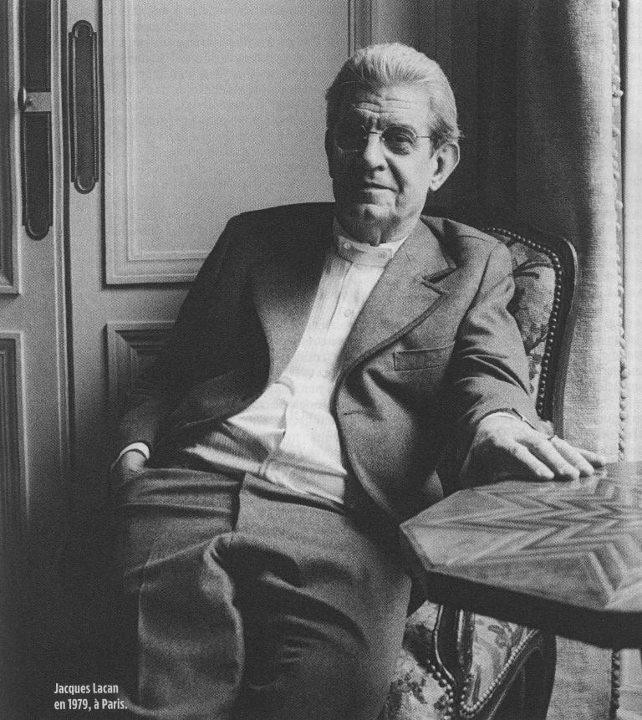
Hyper-condensation and double-displacement distinguish the style of Lacan, only once removed from Nietzsche; he does not need to “return to Freud”[6] in order to appropriate the influence of the former for his own purposes. Lacan’s distance, as we shall see, lets him get far closer to Nietzsche than Freud could ever bear. Vulgar dialectics pose the following formulation: Lacan ‘synthesizes’ (in the sense of ‘reconciles’) Freud’s logos with Nietzsche’s mythos. And yet by keeping alive the polemic tendency embodied in Nietzsche – who aims at a total critique, starting with a critique of totality – Lacan can shed new light on the scope of the Freudian discovery – “a revolution in knowledge worthy of the name of Copernicus”[7] – in order to push it to the endpoint of its radical trajectory; to overcome the undertaker who, since he could not deflect heaven, initiated the patient and tedious work of raising hell. We owe him our thanks for this. It is Lacan’s point.

Lacan1

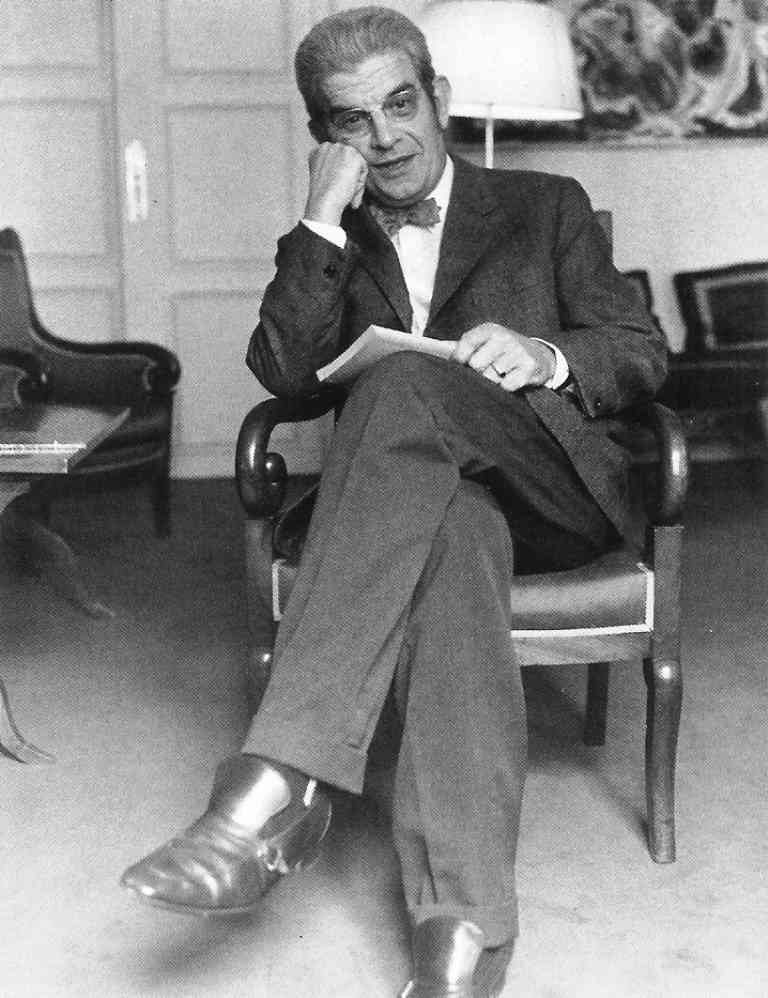
Lacan rode around in a Jaguar and partied with surrealists, not afraid to flirt a bit with the threesome of Dionysius, Aphrodite, and Hermes. But like Freud, he also hailed from the weird streets men and women walk in their dreams, the strange and twisted alleyways that spiral Escher-like into the abyss of restless desire and primordial repression. A style developed on a basis of Freudian truth deploys dialectics to devolve how, with the murder of the Anti-Christ by the scientists,[8] extremes meet in a post-modern moment: Lacan opens the season of life’s grand festival, to seat Freud at the head of the table, then proceeds to host the Old Man’s roasting; meanwhile Nietzsche remains close, with a good view of the show and, more importantly, the pit. The rest of the guest list is meticulously picked, placed, and orchestrated to compliment each other in syncopation, in tune, in rhythm. But as a result of the grossness of this reconciliation, proceedings cannot help but teeter a little towards calamity, spilling-over-the-side, upheaving, and into the shit.

Lacan’s style explodes the previous standards of evaluating and enjoying prose, of reading and writing in general, with wit and spirit that is upbuilding, uplifting to the heavens of synoptic literacy and absolute knowing, which is to say, a knowledge of the Absolute.[9] So when, in an overture to his own extra-critical tome, Lacan claims that “the style is the man…one addresses,”[10] we can be confident that Nietzsche is not to be forgotten. Rather he is to be counted in a short list of cherished others, the priority recipients of Lacan’s career-long in love-letters (to himself, to others…), and one of the still semi-secret ingredients of a rhetorical witches’ brew which, amidst a feast of stale crackers, tastes as remarkably fresh today as when it was first bottled – and really only now, for the first time, after l’âge ingrat, can be said to have begun to mature as a vintage.

Body

Nietzsche is a scandal. Contemporary thought finds it difficult to determine where he fits in the scheme of things. Yet his popularity endures. People keep reading his works. We do not want to forget him, to allow his name to fade into the obscurity of the past, at least not yet. This is what makes a problem for those who do not know what to do with his continued relevance.

Nietzsche_1882.jpg

It manifests most markedly in the environs of academia. Specifically, the academic industrial-complex has been utilized to promote a vague category called “existentialism”[11] a defensive manoeuver to contain the spread and influence of his still-untimely meditations. This countermeasure aims at preventing the unification of the various hyper-professionalized, atomized disciplines — a state of affairs which investors and rectors have had to work hard over the years to engineer — within Nietzsche’s gaping abyss of negativity and radical commitment to critique.[12]

After all, what if Nietzsche’s right? Isn’t the message that he delivers – one is tempted to say preaches – the active negation of what passes for an “education” today, humanities or otherwise? How can one trust his enemies to explain and teach him?

Nietzsche’s discourse resists spinful interpretating toward liberalism. His work upends the ridiculous idea that philosophy and critical thought are “subjects” one must go to school to get a degree in before being able to speak a word to them. Professional philosophy is an analytic contradiction, like a married bachelor. Thanks to Nietzsche (but also Marx, whose critique of capitalism dealt a theoretical deathblow to the university ideology first,[13] decades before Nietzsche ever got the opportunity to pick the fight), we now know that university institutions are a reaction to the real potential of social critique that unfolds as an immanent process within society itself. Nietzsche’s de(con)struction of “knowledge” and “truth” reflects the self-inflicted implosion of his professional career (that is, as a professor of Classics at the university of Basel in Switzerland), a development which at the same time precipitated his maturation as a thinker and writer into the Super-Nietzsche we have come to recollect today: a singular figure in the history of thought and philosophy who provokes awe and anxiety alike as a stand-in for Zarathustra himself — in spite of his all-too-humanities, foibles, flaws, and quixoddities.[14]

The school-machine generates legions of ‘experts’ in order to convince regular people not to think on the supposed ground that ‘professional,’ much more impressive people (with diplomas!) are already doing this vital ‘job’ for them, for us. We should trust them and try not to get in their way, goes the moral of our times. The control of knowledge becomes the knowledge of control. This is something Nietzsche opposed, as one who was driven out of the academy for challenging its pretensions. Its religious and market prejudices had become too outlandish, already in the second half of the nineteenth century, for him — as a self-respecting philosopher, understood in the Socratic sense, employing the methods of ironic negativity[15]– to be able to stay in school and at the same time remain a free thinker. Those who come into contact with Nietzsche’s writings over the course of an arts degree are driven to wonder what the point of it is — why higher education? — when the content they are being asked to make reports on (and get graded on!) negates the very notions of “reports,” “grades,” and “higher education” altogether, revealing these as hairshirts worn only to appease the masochism of those conformists-in-training; or as fetish-gifts, used to promote and instill the cult of “success”[16] amongst the next generation of Eichmanns.

Under a bourgeois education system, it is to be expected that Nietzsche’s message would come to be sterilized, anesthetized, fractured, and segmented into pellets, for casual consumption, like popcorn in a snack mix.[17] The unity of his thought gets dissolved into tidbits and catchphrases to be sprinkled throughout the humanities as a whole, dissipated into a mystic fog of pseudo-Zoroastrianism and neo-Thrasymichusism.[18] But the initiative of youth, hungry for answers and eager to learn the ways in which they have been betrayed by their progenitors,[19] follow one signifier after another in pursuit of elucidation. When they are not bogged down by the drills and tests designed to distract them from actually learning anything of any merit or interest to their immediate lives (as living bodies forced to engage with (political) economies in order to reproduce themselves over time), students read Nietzsche in spare hours in preparation for dropping out. Once turned on, tuning into Nietzsche’s frequency is a fast track to hitting the pavement.

Karl-Marx1

Nietzsche’s open attack on the institutionalized knowledge of the churches and universities — reminiscent of Socrates’ blistering campaign waged against the knowledge-for-profit services sold by the Sophists to aspiring tyrants — proceeds on the basis of a ruthless critique of everything (re)currently existing.[20] This means that his critique — or, as he dresses it up, his “revaluation of all values”[21]  — goes far beyond the sins and failings of the churchaversities. Even Marxists are made to feel a bit put off, if not outright uncomfortable[22] when exposed to Nietzsche’s thought: at best, adopting an aggravated ambivalence, a pat dismissal of his petit-bourgeois background and individualism; at worst, repeating some tenuous claims in an attempt to dismiss him without so much as a consideration, by insinuating the link with Hitlerism that bourgeois commentators are just as quick to point out when faced with the prospect of radicalized Nietzschean will-to-nihil.[23] After all, Nietzsche was no Marxist — but then the problem reappears once again, where to fit him? Why would Marxists appeal to the philosophy of someone whose ideas were formed, essentially, as a middle-class reaction to Marxism? Whose literary style is, although admittedly stunning, nonetheless derivative of some of the best works of Marx and Engels?[24]

Of the orthodox Marxists,[25] Leon Trotsky is probably the most confident in this arena. In a document from 1900 titled “On the Philosophy of the Superman,” he calls Nietzsche the prophet of a “proud individualism” which, Trotsky assures us, it is even possible to practice unconsciously: “being Nietzschean [does not] mean being an adventurer of finance or a vulture of the stock market. In fact, the bourgeoisie has spread its individualism beyond the borders of its own class… [Many people] probably are even unaware of Nietzsche’s existence insofar as they concentrate their intellectual activity on an entirely different sphere; on the other hand, each of them is a Nietzschean despite himself.”[26] Presumably, this means that Nietzsche’s “will to power” has spread and melded with the bourgeois ideology of present-day society. The conclusion of the article, though, rejects the philosophy of the Übermensch: “we find sterile such a literary and textual attitude towards the writing rich in paradoxes…whose aphorisms are often contradictory and in general allow for dozens of interpretations.”

Then why does Trotsky, years afterwards, continue to read and write about Nietzsche, even after the tumultuous, transformative events of 1905?[27] Credit is due to the archiphile Ross Wolfe for unearthing and translating an article from 1908 called “Starved for ‘Culture'” in which Trotsky continues to expound upon the influence of Nietzsche. It is worth quoting here at length: “In the West, he appeared as the final, most extreme word in philosophical individualism because he was also the negation and overcoming of petit-bourgeois individualism. But for us Nietzsche was forced to perform a quite different task: we smashed his lyrical philosophy into fragments of paradoxes and threw them into circulation as the hard cash of a petty, pretentious egoism… Nietzscheanism [was] the muddled, romantic, chaotic outburst of a new intellectual health… Nietzsche was the genuine negation and overcoming of Kant and the Kantians… Whereas our Kantian appeared for the sake of overcoming Nietzscheianism, he in turn was mastered — legitimized, and was legitimated… A narrow line traces out a new fissure in our social life, calling for a new ideology, such as the one Europe now casts down upon us, corresponding to the riches of its philosophy, its literature, its art: Nietzsche…Kant…the Marquis de Sade…Schopenhauer…Oscar Wilde…Renan… That which exists in the West was born in spasms and convulsions, or else was composed by imperceptible degrees, as the product of a complex cultural epoch…”[28] 

Trotsky, despite his previous reservations, kept reading Nietzsche, did not throw him out along with the rest of the dreck.[29] Indeed, Trotsky counted Nietzsche alongside the “riches” of Europe’s “philosophy, its literature, its art” (along with de Sade!!). Which returns us to the problem at hand: Whether the schools are bourgeois or proletarian, it seems, the figure of Nietzsche threatens to upset the ‘official’ curriculum, as an oddity, a leftover, outside what otherwise fits together like a completed puzzle. In a way Nietzsche is like Trotsky himself, insofar as the latter’s reputation was never resuscitated in the Soviet Union after Stalin had him smeared and assassinated (this is unlike Zinoviev and Bukharin and others, whose images were rehabilitated posthumously under the Khrushchev regime). Trotsky’s ghost still haunts the political Left[30] due to an improper burial service; in a similar way, Nietzsche’s presence is still with us, threatening to burst forth from the tomb, like a vampire, or the corpse of the sister in “The Fall of the House of Usher.”

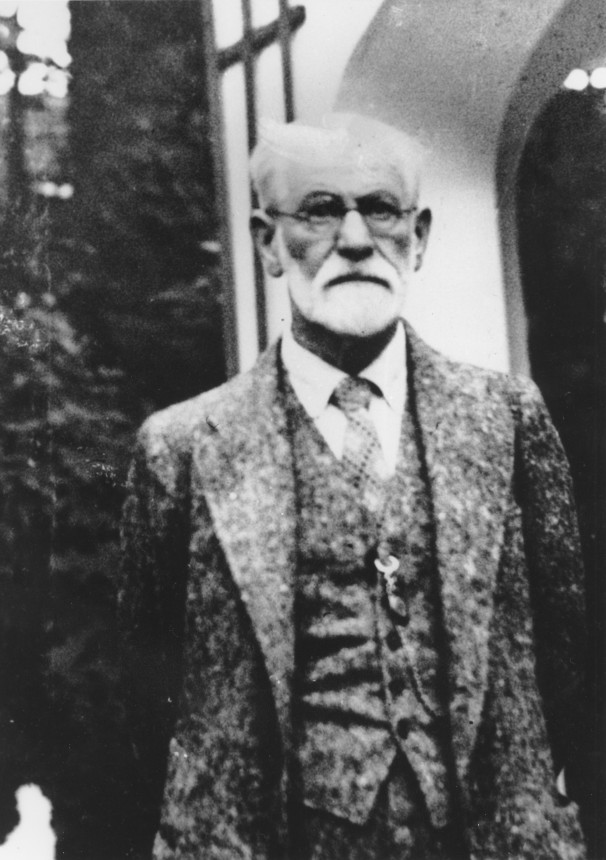
What is more: in the way that Poe’s macabre short stories are lauded by psychoanalysts for being “powerful in the mathematical sense of the term”[31]due to their eerie precognition of psychoanalytic theory, the science of psychoanalysis is also unable to escape from the gravitational pull of Nietzsche’s dark star. Here it behooves us to consider an exceptional confession that was made by Freud in 1914,[32] a confession that establishes the kind of relationship that the father of psychoanalysis had with the murderer of God: “I have denied myself the very great pleasure of reading the works of Nietzsche…with the deliberate object of not being hampered in working out the impressions received in psychoanalysis by any sort of anticipatory ideas. I had therefore to be prepared — and I am so, gladly — to forego all claims to priority in the many instances in which laborious psychoanalytic investigation can merely confirm the truths which the philosopher recognized by intuition.”[33]

In his “Autobiographical Study” from 1925, Freud is even more explicit in tracing his theoretical genealogy to Nietzsche and beyond: “I read Schopenhauer very late in my life. Nietzsche, another philosopher whose guesses and intuitions often agree in the most astonishing way with the laborious findings of psycho-analysis, was for a long time avoided by me on that very account; I was less concerned with the question of priority than with keeping my mind unembarrassed.”[34]

freud5

There is much of interest in these statements. First, Freud’s self-avowal of his “anxiety of influence”[35] in relation to Nietzsche, who he accuses of inventing “anticipatory ideas.” Second, the way that this connects to Lacan’s argument on behalf of a structuralist Freud — insofar as Freud is credited with “anticipating” Saussure.[36] Third, the flagrant openness of Freud’s avowal: what does it mean to say that Freud repressed Nietzsche’s influence on the development of his psychoanalytic thought, when Freud is the first one to admit this, as it were, “gladly”? Fourth, the attribution of the genius of Nietzsche to his “intuition,” a claim which is basically repeated by Žižek when he says: “Nietzsche possessed an unerring instinct that enabled him to discern, behind the sage who preaches the denial of the Will to Life, the ressentiment of the thwarted will…”[37] But what is this “unerring instinct,” this perfect “intuition”? Fifth and finally, it poses the question of science and its practice: what was Freud’s method, his style of empirical analysis, such that, through independent verification of the “impressions received in psychoanalysis,” he could produce a different kind of symbolic authority than that which stems from historical transmission and, ultimately, hermeneutics?

Freud appears to be aware that psychoanalysis corresponds (in the sense of coincides) with the most uncanny and insightful formations (one might call them deductions) of Nietzsche, shrouded as they are in mythical prose and slippery “paradoxes.” However, he also suggests that he must protect himself from Nietzsche’s influence, in the same way that a lab technician will prevent an experiment from being tampered with, or a judge will sequester a jury, to block them from being spoiled by outside opinions. All of this involves a construction of a deliberate ignorance, a purposeful silence, which can allow itself to be corrected, not by peers but by a qualitative in-gathering of experience that gets carried out in accordance with the best phenomenological traditions that emerged in the wake of the Germanic philosophical revolution of the 19th century, which was inaugurated by the dialectish thought of Kant and his compatriots.[38]

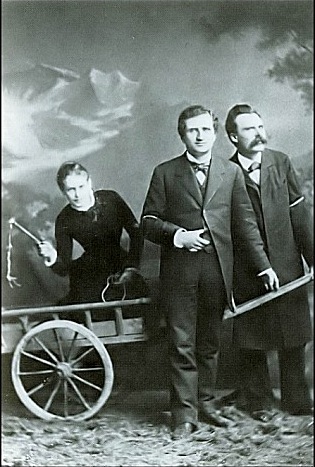
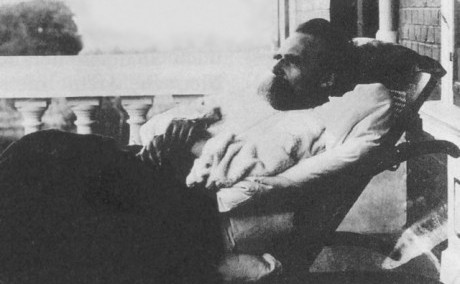
So Nietzsche appears, from this perspective, as a proto-Freudian, or rather as the Ur-Freud. On the totem, Nietzsche’s raw soil undergirds Freud’s establishment of the symbolic order of psychoanalytic knowledge, which is in the rational and scientific language of his day, free from the Goya-scenes that haunt the more feverish pages of Nietzsche. Playing the role of the primordial father in relation to Freud, he is the taboo dad whose death becomes the condition of freedom, which Freud is able to attain through employing the scientific terms of his time to develop a new mode of discourse. Nietzsche’s dream of the gay science, the joyful science (so close, the German Freund means boyfriend, lover), comes true for the first time with the founding of psychoanalysis. Before this point, it was merely a ‘scene,’ as goth and emo as the 1882 photo of Nietzsche with Lou Salomé and Paul Reé suggests.

Nietzsche_Lou_Salome

And the science of desire and jouissance, despite its frills, should be admitted to possess a much higher degree of clarity and operational value, in a medical sense, than Nietzsche’s mere appeals and parables, insofar as only one stakes itself on a concrete method which, other than Marxism, has the power to act simultaneously on the subjects and objects of historical development. We should be able to see the necessary difference between Nietzsche and Freud, and how the latter should be seen to ‘sublate’ and ‘overcome’ the former; that is, even if we wonder to the degree that the latter rests implicitly on the astral visions of prior trips; imaginings which, oracular in their reflectivity, outshine the sun, like an eclipse which magnifies the light, reflecting it and focusing it into a beam which, if met by any gaze, blinds.

Lacan5

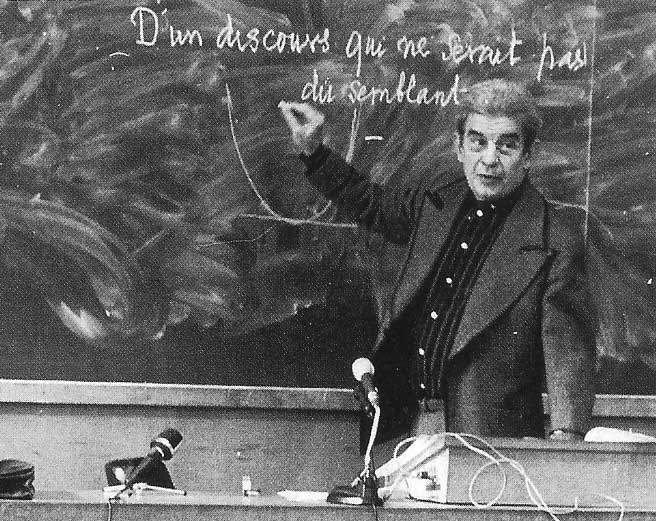
This leads us to consider Lacan’s appraisals of Nietzsche, as one more mellow about this subject than Freud. Unlike the Old Man, who refers to Nietzsche in the same way that Aquinas casually came to refer to Aristotle, as “the philosopher,” Lacan can tell a joke or two about the subject, perhaps spread some rumours, and be self-certain enough to see how the uniqueness of psychoanalysis will allow it to survive, regardless of whatever the verdict on Nietzsche shall be in the coming years. Lacan shows that Nietzsche’s “eternal recurrence” is not the same as the psychoanalytic notion of “repetition,”[39] a point which was actually first made by Freud, but needed to be repeated.[40] Still, Lacan goes farther in explaining where Nietzsche fits in, at least vis-a-vis the rest of the Eurocanon. According to Lacan, Nietzsche “is a nova as dazzling as it is short-lived.” He adds, however, that this is still not so much as Balthazar Gracian or La Rochefoucauld, who shine as “the brightest stars” of “a milky way in the heavenly vault of European culture.”[41] At another point, in his Seminar I, Lacan slights both Nietzsche and Rochefoucauld, considering them to be “insignificant” when compared to Gracian, in particular his books The Oracle and Criticón.[42]

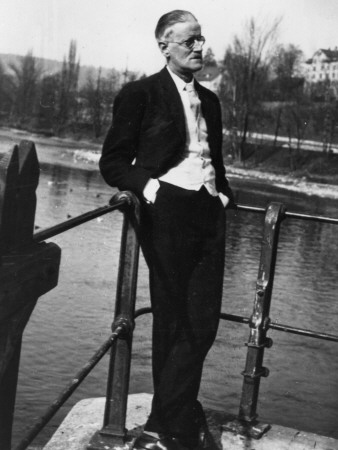
This is a paradoxical gesture: merely mentioning Nietzsche here is, to put it one way, a ‘shout-out,’ since it is also to hold him in the same company as these other “stars,” if only in a supporting role. But it is still an attack (does one dare to suggest, “displacement”?) on the commanding influence of Nietzsche, as evidenced by Lacan’s election of Gracian and, later, Joyce,[43] into the position of kingmakers in the department of what gets counted for stylistic substance today, at least, according to Lacan. He appreciates the effort, but this doesn’t save Nietzsche from not making the cut: hence his emo-ness, hence his picked-last-in-gym-class mentality. This trauma is devastating for Nietzsche, since for him there would be nothing more humiliating than finishing in fourth place at the philosophy Olympics.

Joyce

It takes psychoanalytic thinking to understand the extent of Nietzsche’s folly (however praiseworthy though it may be), insofar as his loud posturing only sells the appearance of an atheism which, unconsciously, remains betrothed to God-in-the-sky. Imagine that Nietzsche the madman runs into the street and yells, at the top of his lungs, “God is dead!” He repeats this gesture at the same time each morning, and twice on Sundays. Are we to believe that he really believes what he says? Here is where Lacan’s alternative formulation of atheism comes to the fore: “the true formula of atheism is not God is dead – even by basing the origin of the function of the father upon his murder, Freud protects the father – the true formula of atheism is God is unconscious.”[44]

While Lacan tended to deflect questions concerning the belief in God — said it didn’t matter to him, one way or another, personally — he also adopted the philosophical position of “dialectical materialism,”[45] that is, the same position of Marx and Lenin,[46] that entails a rejection of theological beliefs and religious superstitions. All of this adds up to Lacatheism, Lacanian atheism, and when taken together with Žižek’s explicitly avowed atheism,[47] it is clear that Lacanian thought, i.e. psychoanalysis, is really the sine qua non of atheism in the modern age. Lacan thus manages to accomplish something that Nietzsche set out to do but could not bring himself to fully fathom, once he got lost down the highway of his private metaphysics, a Neverland-like Pleasuredomain that he so-called, contingently, “will to power.” An immensely exalted father continued to ape in the shadows of Nietzsche’s fantasy-world, disavowed, but therefore all the more awful. Lacan in contrast was able to relieve himself from the grasp of God, able to catch a glimpse of what lies beyond secular thinking, beyond the immensely frightful shadow of the Big Buddha, and convey a bit of his vision to the rest of us still stuck in Plato’s cave. He is Nietzsche un-Nietzsched, castrator of castration, negating negation itself.

james joyce ulyssesNietzsche and Lacan emerge from the same Eurotradition of thought. It includes the “early modern” thinkers of Renaissance and Enlightenment but also the mystics and radicals of the Catholic Church, Plato and Aristotle, Sophocles and Homer, etc. etc., who all attempt to account not only for their own times but the entire “nightmare of history,” as both Marx and Joyce described it.[48] It is impossible to hold the world in your right hand, but attempting to do so produces a specific discourse, nonetheless, a discourse that reflects the conditions of its production, and is not without noteworthy features of its own. But here is where Lacan disjoints from Nietzsche. Insofar as Lacan compasses Nietzsche in his repertoire, combined with many others and taken to higher stage (since Lacan takes the tradition of Nietzsche and Schopenhauer alongside the Freudian system which — why not? — should be counted as an ontology in its own right, a materialist phenomenology of the symptom qua signifier), the equation is obvious: Lacan > Nietzsche, or, Lacan = Nietzsche + MORE (at the very least, Freud’s development upon and critique of Nietzsche’s merely mythological articulation, halfway-deduction, of what makes for modern psychology; also a more coherent politics; also Heidegger; also Saussure; also Lévi-Strauss; also Joyce; etc. etc.). Lacan holds Nietzsche as a card in a big deck, another name to be played alongside the rest, just as those writing in the present are permitted to use the Lacan card — a trump if there ever was one, or a joker.[49]

ancestralrecallblacklotus

Yet there is no card that will stop history from continuing to accumulate under the emotionless supervision of Benjamin’s angel of wreckage.[50] The relevance of the teacher corresponds to the needs of his students. Lacan is only relevant here and now, much more so than Nietzsche. Romantic appraisals of the 19th century are a reflective medium that allows you to go back to the Dionysian days of ancient hedonism, the romantic imagination flitting from one scene to the other faster than you can say desire desires desire: a Lacanian maxim, without which Nietzsche — too late, but still too early — came to psychological ruin. Although, to be fair, there goes romanticism again: the temptation to see Nietzsche’s mental collapse and ‘final’ madness as anything but a case of syphilis.

Nietzsche_Olde_101

Stuck between Marx and Freud, Nietzsche is most untimely. Despite this fact, part of the Cause Lacanienne is his redemption and resurrection by a fulfillment of his prophecy about the development of The Grand Style. Nietzsche described his vision with the following words: “Power which needs no further demonstration, which scorns to please, which answers unwillingly, which has no sense of any witness near it, which is without consciousness that there is opposition to it, which reposes in itself, fatalistic, a law among laws: that is what speaks of itself as the grand style.”[51]

This is not a description of Nietzsche’s own writing style; rather it is a prophecy that has come of age in the works and seminars of Lacan. Here the reader is privy to a style that ‘speaks to itself’ (remember how Hegel described the dialectic as “objective reason talking with itself,”[52] in other words a dialogue without characters or setting, but no shortage of voices?), not in the sense of constructing for oneself a play-park of private meaning (like Derrida does), but in allowing the power of language itself to generate the thought-forms that naturally give rise to a train of association that, for the subject, can take on an antagonistic character in its very spontaneity (insofar as talking to yourself is, at the same time, talking to someone else, an other). Instead of letting this hamper him, Lacan harnesses the objective play of the signifier as the careful contributions made by the Big Other, and adapts these gifts to the flow of his output. The way the ball (mis)bounces is a vital part of style, like an early Louis Armstrong trumpet solo, or the way Neil Young would record his mistakes into the mix.

akira

Mis-style, thus, in our age, is the precondition of the grand style: which is not to say that mistakes are all it takes, but that what goes without them is suspect. Art must now be all and nothing at once; a competition of tongues fused into a monster of speech; a permanent cultural revolution; force that is beyond control and unencumbered, even turning cancerous, explosive, like the horrific transubstantiation of Tetsuo from the classic anime Akira (1988). This capacity for mad growth into something that exceeds proportions, like the breathing furniture from the films of David Cronenberg,[53] is at home with us in the present. And our depictions of it, in the imagistic content of artistic productions, must also be met accordingly in the realm of letters, to keep honest Hegel’s assertion that language, textuality, is “the most spiritual existence of the spiritual,”[54] i.e. the Super-Spiritual substance, or God-in-the-world It-self. Hence we argue on behalf of “the supremacy of the Signifier,”[55] a phrase first offered by Lacan and located at the top of the analytical index for his Écrits, as an appeal to establish it in the minds of readers as the first rule of his guided tour for the perplexed of the present.

videodrome-dvd1nakedlunch

Still, Nietzsche and Lacan are united in the ferocity of their polemic. The former hates the entire world, while the latter hates the world so much more that, instead of (ineffectively) blaming everything all at the same time, he focuses his intense scorn on a specific group of bad psychoanalysts who sell short the teaching of Freud. Nietzsche’s macrocosmic rejection and denial of the world, which becomes the inverse basis for his joyous affirmation of life, is replaced by the prestige micro-politics of the International Psychoanalytic Association and its internecine squabbling. However, since so much does indeed depend on the reading and understanding and interpreting of Freud’s teaching, Lacan is to be thanked for adopting such a militant, “asshole”-ish identity over this disputed question: Whither Freud, in today’s era of pharmacopious drug-use, cybernetic reprogramming of ‘thought-forms,’ and hyper-sexed impotence? Who is teaching Freud today, when everything stands for it, nothing against, and yet still, no one does it?

The moral law should be rendered “Read Freud,” if only to get people to understand the multitude of problems that follow from a naive (Kantian) belief in morality, which tends to be found today in low-grade facsimiles of the categorical imperative.[56] For the first time in history, the question of Desire is posed – not in-itself but for-itself, as a self-recognizing, self-relating entity. For what is desire but the reward attached to the drive that turns the wheel of the world? And surplus-desire but the fantasy to cut class, to ‘get away from it all,’ to leave the cockpit from Rivera’s Man at the Crossroads without a pilot? The demand for research into desire is, in turn, the call for a burning desire to research, to seize the night with upturned telescopes and bottomburned candles.

A curriculum which aims to compliment Freud with Nietzsche – perhaps alongside others favourites such as Sophocles, Kant, Schopenhauer, Poe, etc. – might stand a chance at reviving what Lacan dubbed the Cause Freudienne, in the winter of our society’s anti-Freudian discontent. But we should take this open call for submissions, not to mean a return to the specific organization which went by this name, but rather the psychoanalytic movement itself, the spirit of 1895, the “project for a scientific psychology,”[57] that takes science in the dialectic sense of the word. This may add up to no more than what Alain Badiou already suggested, when he claimed that “Lacan is the Lenin of Psychoanalysis,” a relation which casts Freud as Marx,[58] and also: “Lacan is a condition of the renaissance of philosophy. A philosophy is possible today only if it is compatible with Lacan.”[59] In other words, Freud, or at the very least “Freud’s teaching,” as the teaching of Lacan, is our starting point today, even if this means that we are burdened to go back to what is inscribed in the texts and lectures of father Sigmund, rest his soul, before we can begin to make heads or tails of the Lacanian voodoo.

But Lacan, as the first one to relay a radical interpretation of Freud that went fearlessly to the root of his teaching, can nonetheless be said to add something totally original to the progression of the psychoanalytic Idea. This very erection of the name of Freud to the rank of King-Master, for Lacan, becomes a way of getting the obvious out of the way and dealing with the elephant in the room, in order to get down to business, to the work of philosophy, to a teaching of dialectics that accepts Freud’s contributions to the materialist conception of the human body and the nature of psychosexual development.[60] In the same way that Žižek belts us over the head, repeatedly, with the imperatives to “read Hegel” and “read Lacan,” shamelessly promoting the status of these figures like a fan-boy, Lacan’s constant boosting of Freud qua Freud (as opposed to Freud qua Anna, Brill, Strachey, Jones, Klein, Horney, Adler, Reich, Jung, etc. etc.) is a way of being able to develop the plot, while at the same time bringing up to speed those who tuned in late to the broadcast, and as a consequence have yet to locate the villains in the story.

Lacan6

Which brings us back to the present, not so much for resolution as to recap: without acknowledging our foundations in the dialectic (of Hegel, Marx) and Lacan’s interpretation of Freudian psychoanalysis (with Lacan himself as the self-relating, ‘doubled’ negativity that lets him stand for Freud qua Freud as well, as the radicalization of Freud), it is impossible to begin to reckon the full extent to which Nietzsche fits into our (post)modern moment. What Lacan et al., when taken as such, can show us about a one like Nietzsche, is that his very disjointed, out-of-place aspect is, at the same time, his most proper and fitting place, insofar as this replicates his position as the primordial father of the modern mind, which had to wait to be recognized officially as a Freudian creation, in order to come into conscious knowing.

As a result, Nietzsche, his own prophet, is left to bury himself. A tragic climax to a murder-suicide, which claimed the life of One God and the last man. And while Nietzsche is dead, gone for good, at least with Lacan we can learn how non-all is not lost. A new society is on the horizon and with it the creation of a new man and women. The grand style and its multiplex variations leads the way, like a Piper at the Gates of Dawn whose song is free jazz, whose style is form unleashed, revolutionized. For until structures walk the streets once more as they did in ’68,[61] there is no hope and no potential for social renewal or cultural rebirth. Just as without the reconstitution of the subject, there is no possibility of recovery. And without an organized operation to reap the grapes and ferment the wine, what’s ripe will turn rotten, left to wither on the vine.

—Noah R. Gataveckas

.

Noah R. Gataveckas is a writer and educator who lives and works in Toronto. He is currently working on a book called Symposium: A Philosophical Mash-up, a portion of which can be found here on Numéro Cinq (see “Professor O’Blivion Rides Again“). He has also written numerous articles, one play for performance (“Five Star”), and a manifesto (“Why do we burn book?; or, The Burning Question of Our Movement“) also published on NC. See the June issue of the Platypus Review for his essay: “La contra Adorno: The Sex-Economic Problem of Platypus.”

.
.

Footnotes    (↵ returns to text)

  1. See Silvia Ons, “Nietzsche, Freud, Lacan,” Lacan: The Silent Partners, ed. Slavoj Žižek (London: Verso, 2006), p. 80.
  2. See chapter 20 of Jacques Lacan, Seminar XI: The Four Fundamental Concepts of Psycho-analysis, trans. Alan Sheridan (New York: Norton, 1998), p. 263.
  3. See Lacan, Seminar XX: On Feminine Sexuality, trans. Bruce Fink (New York: Norton, 1999), p. 37.
  4. Then again, Lacan’s essay on the mirror stage (1936) noted how the ancient Sanskrit saying “Tat Tvam Asi” (Thou Art That) could be brought to accord with his psychoanalytic teaching.
  5. The worst representative of this kind of ideological indulgence is found in a lifestyle-anarchist tract by Hakim Bey from 1991, called T.A.Z.: The Temporary Autonomous Zone, Ontological-Anarchy, Poetic Terrorism, available online at: http://hermetic.com/bey/taz_cont.html.
  6. Lacan, “The Freudian Thing, or the Meaning of the Return to Freud in Psychoanalysis,” Écrits: A Selection (New York: Norton, 2002), p. 107.
  7. Lacan, “The Freudian Thing, ” Écrits: A Selection (London: Routledge, 2001), p. 87.
  8. For reference, see the myth of the primordial father from Freud’s Totem and Taboo (1918), in which the ape-man is murdered by the ‘band of brothers’ and society is subsequently founded.
  9. For a full defense of Lacan’s Hegelianism, see chapter 8 of Slavoj Žižek, Less Than Nothing (London: Verso, 2012), p. 508ff.
  10. Lacan, “Overture to this Collection,” Écrits: The First Complete Edition in English, trans. Bruce Fink (New York: Norton, 2002), p. 3.
  11. This term, popularized by Sartre in the 1950s and disowned soon afterwards, has shamefully been seized upon by the academic and media ideological state apparatuses to perpetuate a mystified account of unique authors such as Kierkegaard, Dostoyevsky, Nietzsche, Heidegger, and others; as if the differences between these disparate sources could simply be cast as ‘variants’ or ‘flavours’ of a ‘common’ project which they all worked on together, called “existentialism.”
  12. And yet Paul Feyerabend exists, whose “anarchic theory of knowledge” approximates what the sciences are missing, in terms of an avowed Nietzschean influence. Thus despite the efforts made to stem a creeping negativity, by isolating Nietzsche and pegging him in the philosophy department as an “existentialist,” the night-terror of critical criticism that he represents, like the shadow-monster from the cheesy remake of House on Haunted Hill (1999), rises from the basements of the Academy, to invade every department and eventually consume the entire schoolhouse. Nietzsche’s negativity, taken in this way, is bigger than himself, has the capacity to outgrow its historical confines.
  13. In a sentence, the ‘sanctity’ of the university discourse was forever tarnished when Marx showed “the ideas of the ruling class are in every epoch the ruling ideas, i.e. the class which is the ruling material force of society, is at the same time its ruling intellectual force.” See The German Ideology (1845), available online at: http://www.marxists.org/archive/marx/works/1845/german-ideology/ch01b.htm.
  14. The historical biography of the man, Friedrich Wilhelm Nietzsche (1844 – 1900), does not begin to resemble the (imaginary) heroic figures of action whom, over the course of his texts, he lauds with love and admiration, like an immensely exalted father in the flesh; like Marx, Nietzsche did preach a philosophy of praxis (at least in the abstract), but unlike Marx, Nietzsche’s body remained tied to the routine of passive contemplation, of sickly recovering – in this way (i.e. the form of ‘doing philosophy,’ of sheltered thought), he never broke from his roots in Schopenhauer (even if he broke with Schopenhauer in terms of content).
  15. On this point, compare Kierkegaard’s Masters thesis: The Concept of Irony with Constant Reference to Socrates (1841).
  16. It is interesting to note, from the perspective of the critique of ideology, that Lacan would regularly refer to certain words during his seminars in English, to ridicule certain ideological positions of English-speaking societies. For example, he did this with words such as “success,” “self-made man,” “the American way of life,” etc.
  17. One can imagine the advert on the packaging: “Existential’sms! All your faves in one bag! Krazy Kierkegaards! Neat Nietzsches! Dope Dostoyevskys! Hot Heidegger! Sweet Sartres! Cool Camus!”
  18. Cf. book I of the Republic of Plato, where Thrasymichus shows that the Nietzschean understanding of “justice” that in the present he is theoretically famous for, in fact, predates him by millenia.
  19. A generation of parents and guardians, due to their short-sightedness and complicity with the capitalist system, have effectively sold their children and grand-children, an entire series of cohorts, into slavery and to be used as human sacrifices to the pagan god Baal, so that they might receive an upgrade on the size of their television screens. This is how the baby-boomers of North America and Europe will come to be remembered, that is, by the survivors of the upcoming catastrophe: as the generation who saw no irony in Swift’s modest proposal, and was willing to make a deal for an all-time low, something the equivalent of a hot tub.
  20. Perhaps the most important theoretical difference between Marx and Nietzsche can be articulated along these lines, insofar as Marx’s critique was more radical than Nietzsche’s, at least when it came to the notion of history. Whereas Nietzsche lauds the nobility of the past as a mythical standpoint from which to critique the ‘degenerated’ present situation (the cause of which he tellingly displaces in Christianity as opposed to capitalism), Marx’s critique has no illusions about the ‘great men’ of ancient times. As a materialist method of combining thought and practice, Marxism’s “ruthless criticism of all that exists” (“Letter to Ruge”) does not need to rely on any kind of ‘original’ historical position, from which our current ‘misbegotten’ age has fallen into decline. On this basis, one can claim that Nietzsche’s critique is not self-reflexive to the most radical degree: while all-encompassing in terms of its scope, it does not include its own presuppositions (of “strength,” “will to power,” “Europe,” “eternal recurrence,” etc.) into its critical purview; an over-accumulation of negativity is offered in the place of the teaching about the “negation of the negation”; an infinite quantity of deconstructive analysis stands in for an infinity of infinities (Cantor) – the former of which opens the door to textual idealism a la Derrida, while the latter of which constitutes a “great materialist breakthrough” (Žižek, Less Than Nothing, p. 227).
  21. See Nietzsche, “The Anti-Christ,” The Anti-Christ, Ecce Homo, Twilight of the Idols and Other Writings, ed. Aaron Ridley and Judith Norman (Cambridge, UK: Cambridge University Press, 2005), p. 66.
  22. For example, see how uneasy Lukács is made in “The Destruction of Reason” (1952), where he describes Nietzsche as being one who possessed “a special sixth sense, an anticipatory sensitivity to what the parasitical intelligentsia would need in the imperialist age, what would inwardly move and disturb it, and what kind of answer would most appease it. Thus he was able to encompass very wide areas of culture, to illuminate the pressing questions with clever aphorisms, and to satisfy the frustrated, indeed sometimes rebellious instincts of this parasitical class of intellectuals with gestures that appeared fascinating and hyper-revolutionary.” Available online at: http://www.marxists.org/archive/lukacs/works/destruction-reason/ch03.htm
  23. Usually by way of the composer Richard Wagner, who was an anti-Semite, and whose music was used posthumously by the Third Reich. Nietzsche kept company for a time with Wagner, that is, until Nietzsche’s admiration turned to enmity. For example, see Nietzsche’s account in Nietzsche Contra Wagner, written in 1888 and first published in 1895.
  24. Nietzsche’s writing, at its most polished, is never as dazzling as Marx’s The Eighteenth Brumaire of Louis Napoleon; at its most raw and concrete, The Will to Power is not so ambitious and absorbing as the Grundrisse; and for a weird mixture of the two, see the late writings of Engels, such as his retroactive introductions to The Civil War in France and The Class Struggles in France, from 1891 and 1895 respectively. There are turns of phrase and rhetorical flourishes that Engels makes in these documents which are reminiscent of Nietzsche; and since some of Nietzsche’s works had been released by 1890, it is entirely possible that Engels could have read them and – who knows? – borrowed a trick or two. Then again, Engels seemed to have beat Nietzsche to the punch about the monumental foolishness of Dühring, with Anti-Dühring having been published first in 1877, while Nietzsche only first began to polemicize against the anti-Semitic ideologist of “heroic materialism” in the 1878 text Human, All Too Human, an engagement that extended all the way past Beyond Good and Evil (1886) and On the Genealogy of Morals (1887), to The Will to Power, which was assembled posthumously from Nietzsche’s late notes and manuscripts, and continued to batter Dühring, i.e. calling him a “barbarian” (§130).
  25. A list typically taken to include Marx, Engels, Luxemburg, Lenin, and Trotsky as the key five.
  26. Trotsky, Leon, “On the Philosophy of the Superman,” trans. Mitchell Abidor, available online at Marxists.org.
  27. See Trotsky, 1905, available online at: http://www.marxists.org/archive/trotsky/1907/1905/
  28. See “Some hitherto untranslated sections of Trotsky on Nietzsche (1908),” The Charnel-House, available online at: http://rosswolfe.wordpress.com/2013/01/06/some-hitherto-untranslated-sections-of-trotsky-on-nietzsche-1908/.
  29. As late as 1924, in Trotsky’s writings on “Literature and Revolution,” he invokes Nietzschean themes and language to describe a “new man” for a new society: “the new man of the future will want to laugh… the new man will love in a better and stronger way than did the old people, and he will think about the problems of birth and death. The new art will revive all the old forms, which arose in the course of the development of the creative spirit” (available online at: http://www.marxists.org/archive/trotsky/1924/lit_revo/ch08.htm).
  30. See Derick Varn, “Interview with Noah Gataveckas on the Ted Grant and the Specter of Trotskyism,” The (Dis)Loyal Opposition to Modernity blog (27 Mar 2013), available online at: http://skepoet.wordpress.com/2013/03/27/interview-with-noah-gataveckas-on-the-ted-grant-and-the-spectre-of-trotsky/
  31. Lacan, “Overture to this Collection,” Écrits: The First Complete Edition in English, p. 4.
  32. A pivotal year in Freud’s development. Freud’s career, in terms of its theoretical progression, can be roughly divided into four sections: pre-1895; 1895 – 1913; 1914 – 1926; 1927 – 1940. The theory that he has at the end of the journey is different than the one he starts with; he has picked up some ‘friends’ along the way – like the “death drive” – which were not present at the expedition’s outset.
  33. See Silvia Ons, “Nietzsche, Freud, Lacan,” Lacan: The Silent Partners, p. 79.
  34. See Mikkel Borch-Jacobsen and Sonu Shamdasani, The Freud Files: An Inquiry into the History of Psychoanalysis (New York: Cambridge University Press, 2012), p. 106.
  35. See Bloom, Harold, The Anxiety of Influence (New York: Oxford University Press, 1997), p. 5.
  36. See Lacan, “The Direction of the Treatment and the Principles of Its Power,” Écrits: A Selection, p. 249.
  37. See Žižek, The Ticklish Subject: The Absent Center of Political Ontology (London: Verso, 2000), p. 11.
  38. Only “ish,” insofar as antinomic thought (cf. Kant’s Critique of Pure Reason) is less than dialectical thinking. Credit for the perfection of the expression of the dialectic in a literary (stylistic) form, of course, goes to Hegel and Marx. The superiority of the combination of these two is demonstrated on a daily basis in the work of Žižek, who adopts the positive position of “dialectical materialism” by way of a radical reading of Hegel that draws out the already-materialist aspects in Hegel’s writing, thereby dissolving the traditional distinction stressed by Marx (but especially Engels), that Hegel’s “idealism” had been supplanted by Marx’s “materialism” (a claim which of course is true, if you take into account the Marxist understanding of materialism (cf. Theses on Feuerbach III), but which does not prevent it from getting used by materialists-in-name-only (faux-Marxists) to justify the outright rejection and denigration of Hegel’s contribution – that is, as the founder, cornerstone, backbone, etc. – to the science of dialectics, once it is taken as a science (which may or may not be done under the banner of “philosophy,” it doesn’t really matter)).
  39. Which is modeled on Kierkegaard’s notion of “repetition,” but at the same time should be argued to stand as an authentic contribution made by Freud to the conceptual canon of theoretical thought, insofar as Freudian repetition comes along with his theory of the “drive,” the “death drive,” i.e. urge-to-repeat. See Lacan, “On a Purpose,” Écrits: The First Complete Edition in English, p. 307.
  40. See Freud, Beyond the Pleasure Principle, ed. Todd Dufrense, trans. Gregory Richter (Peterborough, ON: Broadview Editions, 2011), p. 64.
  41. Lacan, “The Freudian Thing,” Écrits: The First Complete Edition in English, p. 339.
  42. Lacan, Seminar I: Freud’s Papers on Technique, trans. John Forrester (New York: Norton, 1991), p. 169.
  43. For example, see Lacan, Seminar XX: On Feminine Sexuality, p. 37.
  44. Lacan, Seminar XI: The Four Fundamental Concepts of Psycho-analysis, p. 59.
  45. See Žižek, Less Than Nothing, p. 780.
  46. For an exposition of this position, see V. I. Lenin, “On the Significance of Militant Materialism,” 1922, available online at: http://www.marxists.org/archive/lenin/works/1922/mar/12.htm.
  47. He has described himself as a “militant atheist” at multiple public speaking engagements, many of which are available on the internet.
  48. See Joyce, Ulysses (London: Flamingo, 1994), p. 42.
  49. If, to use relations from Magic: The Gathering, Nietzsche is Ancestral Recall, then Lacan is Black Lotus; likewise, to use relations from Pokemon, if Nietzsche is Arceus Lv. X, then Lacan is Arceus Ex.
  50. See Benjamin, “Theses on the Philosophy of History,” trans. Dennis Redmond, available online at: http://www.marxists.org/reference/archive/benjamin/1940/history.htm
  51. Nietzsche, The Twilight of the Idols, trans. Thomas Common (Mineola, NY: Dover Publications Inc., 2004), p. 45.
  52. Hegel, “A. Plato,” Lectures on the History of Philosophy, available online at: http://www.marxists.org/reference/archive/hegel/works/hp/hpplato.htm
  53. For example, see Videodrome (1983) and Naked Lunch (1991).
  54. See G.W.F. Hegel, Elements of the Philosophy of Right, ed. Allen W. Wood, trans. H. B. Nisbet (New York: Cambridge University Press, 1991), p. 204.
  55. See Lacan, “The Direction of the Treatment and the Principles of Its Power,” Écrits: A Selection, p. 359.
  56. According to Kant, the moral law is: “act only in accordance with that maxim through which you can at the same time will that it become a universal law.” See “Groundwork of the Metaphysics of Morals,” Practical Philosophy, ed. Mary J. Gregor (New York: Cambridge University Press, 1996), p. 73.
  57. Over the course of his seminars, Lacan repeatedly alludes to the importance of this document of Freud’s from 1895, which gives a prototype sketch of the way that Freud’s thought would develop along materialist, neurological and physiological, lines.
  58. See Peter Hallward, Badiou: A Subject to Truth (Minneapolis, MN: University of Minnesota Press, 2003), p. 353.
  59. See Žižek, Less Than Nothing, p. 18.
  60. See Freud, Three Essays on Sexuality (1905).
  61. See Žižek, Living in the End Times (London: Verso, 2010), p. 353.
Jul 142013
 

I love the phrase “10 percent less likely to have died.” It’s the sort of thing I often say: I am 10 percent less likely to have died since I my mocha latte the morning.

But men who reported drinking two or three cups of coffee a day were 10 percent less likely to have died than those who didn’t drink coffee, while women drinking the same amount had 13 percent less risk of dying during the study.

via This Is Your Brain on Coffee – NYTimes.com.

Jul 142013
 

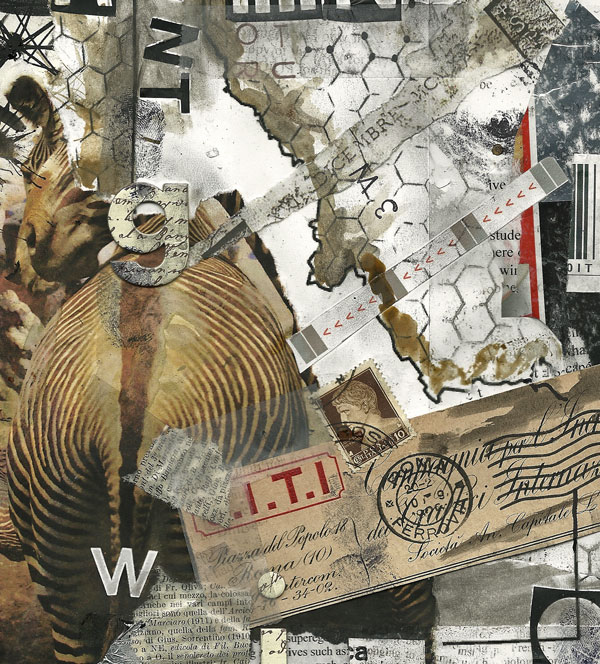
DW-Ark_Codex

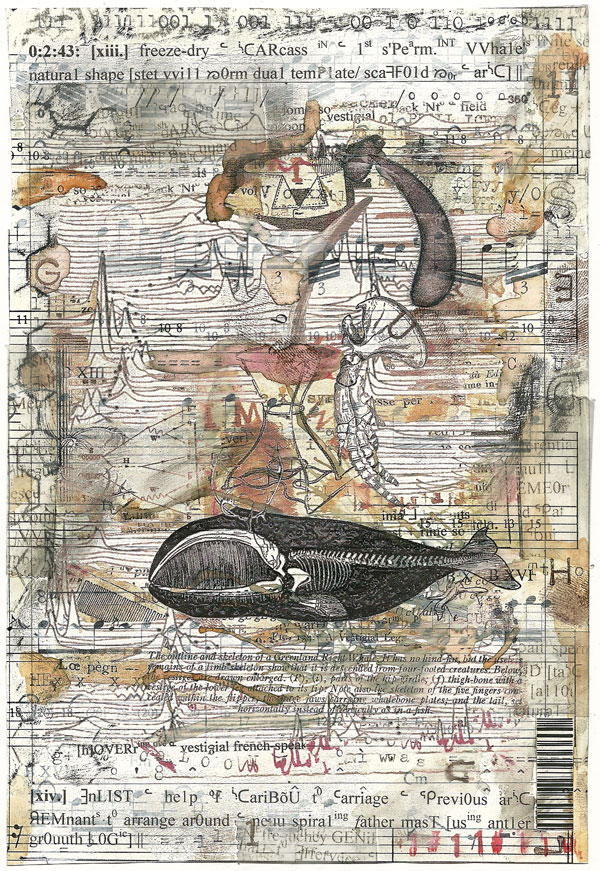
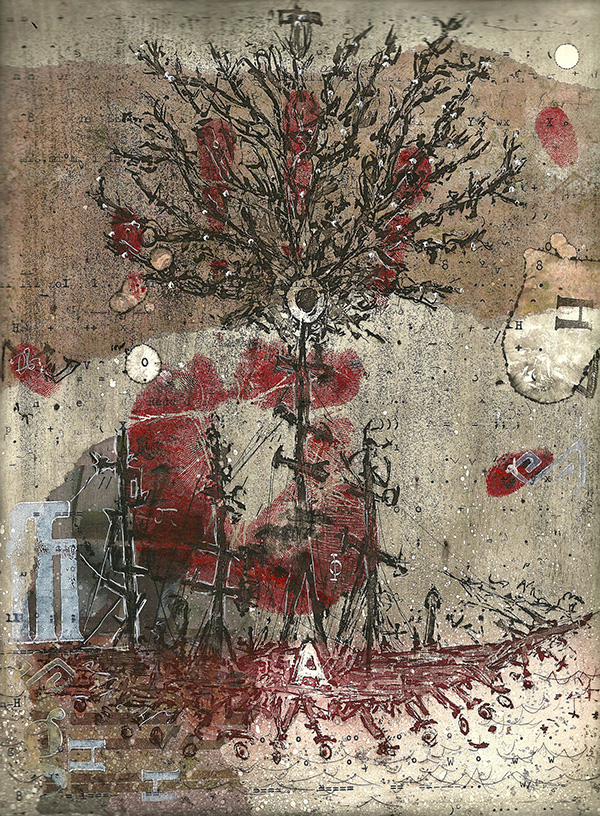
I’m happy to report in on a recent joyous dance of my reader-self and viewer-self as I turned the pages of ARK CODEX, a thoroughly engaging visual/verbal collage “novel.” My curiosity about this authorless book led me to question its shepherd, the one who goaded this “mutated goat” of a book into being. Says Derek White, “Each word is a collage in itself . . . .” Yes! And the correspondences between the bits of text and gorgeous etchings bring an unusual intrigue to the pages and to the journey of this odd ark/book.

Derek White lives in New York City where he publishes Calamari Books and Sleepingfish Magazine. Do explore more of his work via the web links. You won’t be sorry!

— Nance Van Winckel

—–.

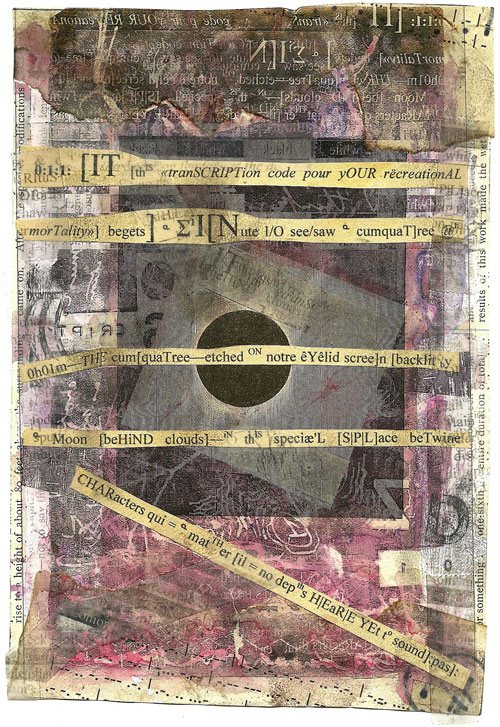
Ark Codex 0:2:43 13x19 cm, multimedia (collage/frottage) Derek White

Ark Codex 0:2:43 13×19 cm, multimedia (collage/frottage)

.

Nance Van Winckel: I know you’re interested in Derrida and his ideas that words refer primarily to other words, rather than to things and ideas, and also his view of texts as residing finally beyond authors, of literary works as collective enterprises generated by a concert of forces: reader, writer, cultural echoes surrounding them, etymologies, etc. I like how Ark Codex ±0 clearly allows the whole of itself to be “created” by those forces, and I appreciate how much I have to “bring” to the book myself. My own imagination and intellect are truly involved in furthering the book’s narrative momentum and visual journey. Could you talk a little about your own sense of authorlessness and the “concert of forces” that make the Ark Codex.

.

Ark Codex 0:1:1 13x19 cm, multimedia (collage/frottage) Derek White

Ark Codex 0:1:1 13×19 cm, multimedia (collage/frottage)

.

Derek White: Thank you, you are reading Ark Codex as i hoped it would be read. At the end of the day Ark Codex, any book, is a bound stack of paper on a shelf . . . until a reader comes along. Readers are the true “authors”—the ones who give meaning to a book. And your reading of it is just as valid and important as any other, including mine. Sure, my role is unique in that i experienced Ark Codex as it was coming together, but i think of my role more as a shepherd. Or, okay, maybe a breeder. And i personally prefer to think of goats rather than sheep, wherein the goats are other books and ideas . . . yes Derrida’s books being some of those goats. But Derrida is not one of those goats—I’ve never met Derrida. Sadly, he is dead. But his books aren’t (and in this sense, neither is he). Ark Codex is some sort of mutated goat that came about by such selective breeding. But again, don’t let me be the one to tell you what Ark Codex is or isn’t; you might have a completely different beast in mind when your eyes scan over this particular confluence of text & images, based on your own prior collective associations with certain words, phrases, images, etc.

.

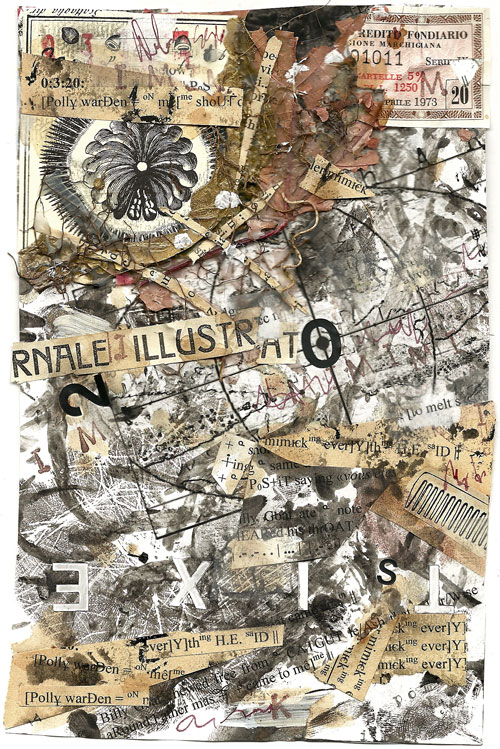
ARK_CODEX_0-3-20

Ark Codex 0:3:30 13×19 cm, multimedia (collage/frottage)

..

NVW: Collage seems both a method of creation AND a method of participation in this book. As a reader/viewer, I was fascinated by how my reader-self and my viewer-self danced about on the pages. I loved this back-and-forth interplay and how when I’d read the small passage of text at the bottom of a page, what I’d just visualized in the imagery and graphics hooked in, “enlarged,” or somehow “played with” the linguistic elements. I think the text and the visual elements achieve an amazing symbiosis or amalgamation here, and I wonder if you could comment on that interactivity of visual and verbal elements.

.

H0MEovoID_8_private_gravesite_600

h0ME(o\v/o)ID 8: GRAVE[e|it]Y helps deSign find its private tombstone ID[enTITy]

.

DW: Ark Codex actually started as a text, a somewhat linear narrative. If you look carefully in the pages you might find traces of it, but most of its original form is probably lost, embedded into the page, bleeding into the collage of image and other underlying or superimposed text. The footnoted text came as an afterthought—a sort of associative narrative that came about by re-processing the images. I think of them as abstracts, in a scientific sense. Collaging feels more like how at least my brain thinks. Language in its pure form is a beautiful thing, but it can also be debilitating in that we risk detachment, severance even. Someone like Peter Markus (a true guru of pure language) is so enamored by language that when he hears a word, like “river,” the first thing he thinks of is how the word looks on the page. While i also share this reverence of, especially written, language, in all its type-faced forms, i don’t want to lose sight of the actual river. But even staring at a river (which is what i look at when I’m not looking at my computer) we can still forget, or take for granted, what the river means, or has meant to us. I’m not so interested in photography or still lifes—capturing images, reducing them to their iconic forms. Collage allows us to breed new images, new ideas. And yes, when i say collage i don’t mean just images from magazines cut and pasted together. Even if I’m writing something purely textual, i think of it as collage—the way combinations of words interact and morph, glued together by syntax and grammar. And each word is a collage in itself, a vessel that contains an accumulative amalgamation of every instance and use before us.

.

NVWimage1

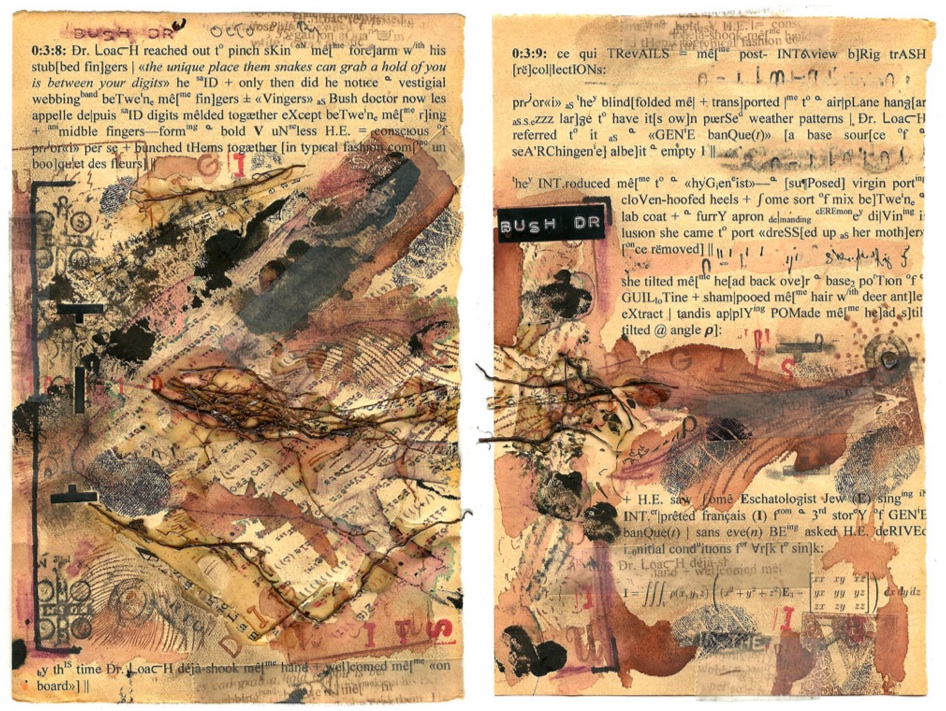
Left to right: Ark Codex 0:3:8, 13×19 cm, multimedia (collage/frottage), and Ark Codex 0:3:9, 13×19 cm, multimedia (collage/frottage)

.

NVW: For me, Ark Codex ±0 has many qualities of a novel. I’m thinking about the journey undertaken on this strange ark, an ongoing narrative that’s a kind of quirky Noah story set in realms that are by turns ancient or futuristic, metafictional or metaphysical, scientifically “steeped” or mythically enriched. I could go on and on with my list. But let’s look, for instance, at a couple of my favorite pages, these two from the third section where “we” seem to have made landfall (or are within our museum diorama) and encounter the figure of the “bush doctor.” Here’s the text which reads a bit like a ship’s log:

0:3:8: Under such sea-snaking circumstances, the bush doctor warns us to not splay our fingers. He is not counting on the fact that our <>are webbed. Before we snap out of it, he blindfolds us for continuity. We can see all the way to the end of our own nerves from within our cloth cul-de-sac. Clogged fibers branch back into the roots of palms. At this point a puncture is made to drain any misleading perceptions. Even judgment of unreliability is deemed unreliable, so we are back to square 1 with each articulation.

And from the facing page:

0:3:9: At his juncture, the kernel become clearer. A system is in place to separate trash from recyclables—organic & non-organic (& sub-divided even further). We are in a hangar now (or a diorama of 1, still in the natural history museum)—an ark house so large that isolated weather patterns form from within. It is still below freezing on this page, but the rate of the rate of change is what matters. To determine our current coordinates (& capacity for change) we integrate this rate of the rate of change in each cardinal direction.

Wow! The brevity of each of these snippets makes me feel I’m getting just a small part of a huge—HUGE!—story. Plus each piece of information makes the ark tremble. Unexpectedness in each new sentence. Where will the ark go next; what fauna and flora will we encounter; what will happen to our own physical selves? For me, it’s an adventure story in the widest possible sense of that word. If not as author or even as “authority,” but rather might you comment on the book’s behalf about its proclivities toward story in general or the novel in particular?

.

Arc-incisione_H

Incisione H from Ark Codex (incised print)

.

DW: Ha, you made landfall! That’s further than i got—in my mind, the narrator is constrained to the North Pole, waiting for the ice to melt, for the flood. So in this sense, nothing happens. But in such a landscape, cabin fever sets in, the imagination runs wild. I’m not very good at making things up. And i am far from a reliable source as to what is happening. If there is any semblance of story, it likely rose out of a dream. And dreams came from a warped union of personal experience (the hangar—Hangar One in Moffet Field, CA—i actually delivered a pizza to!) and the tapping of our collective unconscious. As Joseph Campbell and others have showed us, we are telling the same story over and over—this four-pronged cycle or journey. Noah’s story is just one variation on the theme, that particularly appeals to me because it is about more than just the human condition, but is inclusive of all animals, and the inherent drive in us to preserve and propagate our underlying code. Which is to me what writing and publishing is all about. Story to me is just a framing device, a vessel for language, a boat that gets you down (or up) the river. Ark Codex is a fleeting condensation of collective unconscious that materializes to stain the page, then dissolves when read, into liquid—rain that falls on the landscape, flows into the river, back to the sea … to do it all over again. The ‘story’ comes in the reader reading it. They become the ark, the historical act.

05-under_pressure

Under Pressure

—Derek White & Nance Van Winckel

—————————————–

Derek White lives in NYC where he publishes Calamari Press & Sleepingfish magazine and blogs at 5cense.com. More about Ark Codex may viewed here: http://calamaripress.com/ark_codex.htm. Much more of his “bookish art” may be viewed here: http://www.5cense.com/art.htm.

Nance Van Winckel

Nance Van Winckel is the author of six collections of poems, including After A Spell, winner of the 1999 Washington State Governor’s Award for Poetry, and the recently released Pacific Walkers (U. of Washington Press, 2013). She is the recipient of two NEA Poetry Fellowships and awards from the Poetry Society of America, Poetry, and Prairie Schooner. Recent poems appear in The Pushcart Prize Anthology, The Southern Review, Poetry Northwest, Crazyhorse, Field, and Gettysburg Review. She is also the author of three collections of short fiction and a recent recipient of a Christopher Isherwood Fiction Fellowship. Her stories have been published in AGNI, The Massachusetts Review, The Sun, and Kenyon Review. Boneland, her fourth collection of fiction, is forthcoming in October from U. of Oklahoma Press. Nance’s photo-collage work has appeared in Handsome Journal, The Cincinnati Review, Em, Dark Sky, Diode, Ilk, and Western Humanities Review. New visual work and an essay on poetry and photography are forthcoming in Poetry Northwest and excerpts from a collage novel are forthcoming in The Kenyon Review Online. Click this link to see a collection of Nance Van Winckel’s mash-ups of poetry and photography, which she calls photoems. She is Professor Emerita in Eastern Washington University’s graduate creative writing program, as well as a faculty member of Vermont College of Fine Arts low-residency MFA program. She lives near Spokane, Washington with her husband, the artist Rik Nelson. Her personal web page is here.


Jul 132013
 

Raymond Queneau

Oulipians are into literary bondage. Their fetish is predicated on the notion that writing is always constrained by something, be it simply time or language itself. The solution, in their view, is not to try, quixotically, to abolish constraints, but to acknowledge their presence, and embrace them proactively. For Queneau, “Inspiration which consists in blind obedience to every impulse is in reality a sort of slavery”. Italo Calvino (who was co-opted in 1973) concurred: “What Romantic terminology called genius or talent or inspiration or intuition is nothing other than finding the right road empirically”. Choosing the “right road” from the outset, instead of stumbling upon it haphazardly, is the Oulipian way: once the Apollonian structure has been circumscribed, Dionysus can work his magic. “I set myself rules in order to be totally free,” as Perec put it, echoing Queneau’s earlier definition of Oulipians as “rats who build the labyrinth from which they plan to escape”.

As Gabriel Josipovici argues in What Ever Happened to Modernism?, modern literature was forged out of a refusal to submit to external constraints, with the novel a “new form in which the individual could express himself precisely by throwing off the shackles that bound him to his fathers and to tradition”. The flipside of this emancipation of the writer (or privatisation of writing) was, as Walter Benjamin pointed out, isolation. No longer the mouthpiece of the Muses or society, novelists could only derive legitimacy from themselves. “Going back to the world of genres is not an option, any more than is a return to the world of the ancien régime,” writes Josipovici. The Oulipo escapes the Romantic cul-de-sac of unfettered imagination (or its Surrealist avatar, chance) by reintroducing external constraints, which are self-imposed.

via Oulipo: freeing literature by tightening its rules | Books | guardian.co.uk.

Jul 132013
 

anna_kim from Austrian Cultural ForumAuthor photo via www.acflondon.org

Anna Kim’s Anatomy of a Night is composed of fragments, few more than a page or two in length. The novel, translated from the German by Bradley Schmidt and just released by the Berlin-based publisher Frisch and Co., tracks the suicides of eleven members of an east-Greenlandic community within a five hour period. Kim is interested in exploring the complex connections between a place and its people. She is interested in sentences that extend and modify lines of thought (check out the sentence that begins the second fragment below – the one that starts: “Ole, who had originally befriended Magnus…” – how it keeps interrupting itself, how it never quite arrives at where it set out for, but ends someplace visceral all the same), while also painting miniature portraits.

Kim’s prose demands rereading. In the excerpt below, which comes about a third of the way through the novel, watch for the way that attributes of the setting, Amarâq, described in the first fragment as a place where “you could believe you are dead and yet still exist . . . perhaps one must say before birth,” manifest themselves in Inger’s love for Mikkel in the third fragment: “a timeless love, without space, an end . . . it would be a beginning and an end at the same time.” Note that both Keyi and Inger are thinking of a sentence, but not the same one. What initially seems arbitrary is anything but, and the more one rereads Anatomy of a Night, the more the fragments – trimmed and wedged and sanded first by the author, then by the translator, and finally in the mind of the reader – fit together.

—Eric Foley

Anatomy of a Night

The nights in Amarâq are an impenetrable black mass, what one imagines nothingness is, an image the eye cannot comprehend. And for a brief moment, you could believe you are dead and yet still exist: finding yourself at the other end of life, at a point that doesn’t yet exist, that is searching for its existence, perhaps one must say before birth, though there can be no talk of a mystic primal state, this darkness is concrete, it’s almost tangible, it’s a thicket. Day and night aren’t the same place, not in Amarâq.

As a child Keyi didn’t count the days, he counted the nights after the hunt, when the stories traveled from mouth to mouth, reappearing in similar form, the same heroes, the same monsters, but the story about the world’s creation impressed him most of all. The empty night was filled all at once when the earth fell from the sky, and with it fell the mountains, hills, valleys, rivers, lakes, and stones, they fell and landed in the darkness. Finally the first humans crept from the middle of the earth, at first they couldn’t speak, only eat and flail around, and they didn’t know how people died because there was no death in those distant nights. When from those few people too many arose, they were forced to choose between night and immortality and day and mortality, as if it was merely visibility which made them mortal. They chose day. The words were pronounced, and the first ones died, but they didn’t know how to die correctly, they stuck their heads out of their stone graves, the stone mounds that had been stacked over them, in an attempt to stand up and leave, and they had to be pushed back into their graves and be banished with words, with magic.

The tamed night, the stars and the moon, came with the day, and Keyi believes he had once heard the souls of the dead flying across the sky and becoming stars, and he was surprised he thought of that sentence, today, in this moment, and even more surprised that he remembered the voice of the person who said it, his grandmother, who spoke these words while pouring milk over cooked whale meat, to drive away the taste of liver; it was a voice he had believed he couldn’t remember—in Amarâq the nights are a reservoir for everything that has been forgotten, buried. The memory becomes invisible at the moment of forgetting, only to fall back to earth like a bolt of lightning, at the other end of life.

Ole, who had originally befriended Magnus because he had a television as large as an altar, and just as ornately decorated—with porcelain figurines (a ballet dancer, a shepherd and his sheep) and plastic roses winding their way around the base—it was more than a device, it was a view out into a world which, as it seemed to Ole, couldn’t exist in this form: wonderful, at the same time infinitely ugly and full—

and he became lost in the television pictures at first, didn’t understand the faces of those strange people as faces, he saw only pieces of faces, often just the mouths, which made familiar tones and transported him back to an earlier time, when he was reproached due to his failure to understand a language which repeatedly commanded him to be less himself—

ultimately he refused to decode these words, he gave up and was satisfied being what he should have been from the beginning: one of those who, like his parents and brothers before him, wouldn’t make it, but for that reason fit into this world, Amarâq, all the more, where being no one at all didn’t make a difference because the infinite nature of Amarâq reduced and negated every difference—

and while his parents buy beer from the welfare they collected at the post office on Fridays between nine and twelve, to maintain their inebriation until Sunday evening, because they know how to drink themselves senseless then roll around on the floor, depending on where you kicked them, Ole tries to ignore the stench of vomit that had become ensconced in the house, in the air and the walls, in his clothing, in his hair, in his skin, a stench he couldn’t wash off, even after scrubbing himself every morning in the shower at school with a piece of soap that Magnus had given him—

he can’t get rid of the puke, it had been etched into his nose along with his father’s kicks, his mother’s punches.

His stomach growls.

Are you hungry?

Ole nods.

Come.

Magnus quietly opens the door, sticks his head through the crack, to see the lay of the land. No one there. Slips into the dark hallway, the steps creak with every movement, and into the kitchen, he rummages through the cupboards, picks out a bag of toast, butter, marmalade, sausage, and orange juice.

Help yourself.

A noise from the shower room startles Inger.

Her first instinct is to hide, duck down; she quickly looks around, to see if she could crawl under the table or slip into a dark corner, but then abandons this plan and listens. She is used to listening; as a hunter’s wife, she learned to listen on a professional level. Niels, who couldn’t differentiate between his obsessions, who pursued hunting as obsessively as he pursued dreaming, loving and hating, black and white, in his world there were no shades of gray; he tracked his quarry for days, studied their habits, their preferences, to anticipate their wishes and find out when they were most vulnerable. He attacked when they were happy because he knew that they, paralyzed by happiness, wouldn’t be able to defend themselves. His strategy paid off; for a long time, he was one of Amarâq’s most successful hunters, despite his scarred eyes, he was esteemed and respected, and it was said that in his dreams he could see where the best hunting grounds were and what he would hunt next—until one day he found himself at the mercy of his prey: a polar bear which had lost its way and come close to town. It quickly recognized its mistake and slipped away, but Niels had seen it, he had been following the animal, day and night, in his dreams; and then days, weeks, months passed, and the desire to capture this creature became his sole purpose, his life dictated by his obsession: this time the hunter was the one captured.

In those lonely days, Inger thought that every hunting relationship is also a love affair, and she turned a blind eye when, after half a year, Niels returned home empty-handed, emaciated, sick, and weak, half of his gear either lost or broken, and when he recuperated, he signed up for welfare, and he never spoke of hunting again. Perhaps his hunting instincts had turned in a different direction—he concentrated on his immediate vicinity, on those who were easier to capture, his child and her mother, and every blow led necessarily to a subsequent blow, because they could still move, weren’t yet bagged—

until an outside competitor interfered, the Danish man named Mikkel Poulsen, who hunted as a hobby, chugging aimlessly around the fjord and shooting indiscriminately into the waves at everything that vaguely resembled a living creature, he taught broken English in school using broken Danish, his tongue had lost its way in this cold desert that calls itself Amarâq. This man snatched Inger, and she grabbed at him, let herself be pulled from a fragile life. And they compared the fragments, placed them next to each other, edge against edge, and discovered some of the parts complimented each other, and they trimmed the pieces that wedged, sanded down the corners, and Inger transformed herself from the wife of a hunter to the wife of a teacher. And because she could answer him in broken Danish and he could answer her in broken Greenlandic, she believed he was what people call the love of their life, a timeless love, without space, an end, because no other love could follow a love like this, it would be unmatchable, it would be a beginning and an end at the same time.

When no further noises come from the shower, Inger decides to check. She carefully opens the door and gropes for the light switch. It’s a small room, covered with tiles, the shower itself is a hose with a hook, and warm water comes out of the faucet, not from the stove, like at her house. Once white, the tiles are now a shade of yellow and some of their corners are broken. The mirror above the sink is smeared with toothpaste and soap. The window above the toilet is cracked open, and a cool breeze streams in. Before she closes it she peers outside, although she knows she won’t see anything, but she believes she hears footsteps in the darkness, steps that move away swiftly, a quick tapping of soles on stony ground, quiet smacking on the damp earth.

She turns around and returns to the laundry room, still an hour and twenty minutes, the yellow numbers glow on the washing machine display. The fact that a person ceases to be arbitrary for someone else, the beginning of this sentence has been floating around her head, and she has been trying to finish it for days, but she hadn’t been able to decide on an ending—when it emerges voluntarily: is almost a miracle.

—Anna Kim translated by Bradley Schmidt


Jul 122013
 

Apparently, Taiwanese “tradition” dictates that pregnant women can “share their luck” – increasing another’s chances of bearing children – by passing on unused towels or tampons. And the capital’s civil affairs department hopes the scheme will boost its birth-rate, reports the Taipei Times. “We hope that Taipei residents who want to get pregnant will be blessed by the lucky pads and that their wishes will come true,” it quotes department commissioner Huang Lu Ching-ju as saying.

via BBC News – Taiwan: Sanitary pad scheme ‘to help women conceive’.

Jul 122013
 

AnnaKim

“ . . . as if it were easier to die in the darkness, as if it would be shameful to die in the light.

– Anna Kim, Anatomy of a Night

Anatomy of a Night

Anatomy of a Night
Anna Kim
Translated from the German by Bradley Schmidt
Frisch & Co., ebook
361 pages, $6.99

When Anna Kim’s third book, Anatomie Einer Nacht,  came out with the venerable German publisher Surhkamp[1] last September, the website sandameer.at  called it “among the most exciting and beautiful German language texts in recent years.” This year, Bradley Schmidt’s translation of Kim’s novel is the first title to be released by Frisch & Co., a Berlin-based press devoted to publishing ebooks of contemporary literature in English-language translation. As founder E. J. Van Lanen has explained, focusing solely on ebooks allows the new press to dedicate its resources to translating a far greater number of works (Frisch & Co. will release five more titles in the next eight months).

Anna Kim was born in South Korea, but moved with her family to Germany when she was two years old. Kim studied Philosophy and Theatre at University of Vienna, where she wrote her masters thesis on the Georg LukácsTheory of the Novel. At 35 years of age, Kim is a past recipient of an Elias Canetti Scholarship, a Robert Musil Scholarship, and the European Union Prize for Literature. These awards not only provide evidence of the respect Kim has garnered thus far as a writer, but help to give a context for the type of European modernism her work is informed by – a novelistic tradition that values complexity, experimentation and ambiguity.

Anatomy of A Night is as strange a book as I have read in some time. Anna Kim takes chances; she writes in precisely the way she wishes, without concern for losing her reader. She has said in an interview that the ideal reader for this book will be “patient, willing to invest a lot of time and brain power, willing to confront themselves with a life that is so different from what we know, a life that may puzzle, confuse and cause disbelief.” 

The book is set between 10pm and 3am in Amarâq, a fictional Inuit settlement in east-Greenland, where “Everything is shared, and everyone owns only one thing: themselves.” In the course of five hours, we watch eleven townspeople commit suicide.

clip_image006Tasiilaq By Night

Amarâq is Kim’s stand-in for the real settlement of Tasiilaq, Greenland; the book was inspired by actual events. Kim first became curious about Tasiilaq in 2008, after 16 of the town’s residents tried to kill themselves on a single evening. Apparently, such “suicide waves” occur at around the same time each year in Tasiilaq: in one night, 5-20 people will attempt suicide, without prior arrangement or agreement with each other.

In Kim’s Amarâq, unlike in Tasiilaq, all suicides succeed. In addition to the eleven who die on the night in question, at least a dozen other suicides and murders are described as part of various characters’ pasts. If, as Lukács writes, “the content of the novel is the story of the soul that goes to find itself, that seeks adventures in order to be proved and tested by them, and, by proving itself, to find its own essence,” then the content of Anatomy of a Night is the story of a community of souls moving in paradoxical isolation towards the discovery of a shared essence: self-inflicted death.

There is the sense that some ominous force lurks in Amarâq, which condemns the people to their cycles of suffering and death, almost as if they were caught up in a bad dream. “The dying spread like a plague,” Kim writes in the prologue, “the victims appeared to have become infected by nothing more than a touch or a gaze—afterwards it was called a disease.”

Fog drifts in and out of scenes, and it is often difficult to place where exactly we are in the town, or even in time, as Kim switches back and forth between tenses within the same paragraph, sometimes even in the same sentence. For more than half of the novel I was certain it must actually be called Anatomy of a Nightmare – I had to keep going back to the title page to remind myself that I had added that final syllable.

A number of possible motives for the suicides appear over the course of the book. Yet, like the “iridescent icebergs” Kim so beautifully describes, these motives “float through the dimensions like images from the past, hazy, unapproachable, you can lose yourself in a desire to grasp them . . .” However much we may wish to come to a conclusion about the cause of these deaths, Kim is artist enough to let each theory stand for what it is: a possibility.

Kim’s prose style also enacts the difficulty of reaching concrete conclusions. Her beautiful sentences offer riddles as often as they clarify. Chapter 1 begins:

Sivke Carlsen has just met a stranger; he tosses his shoes into the air, and they freeze for a moment, suspended in the darkness, as if they were following an invisible path, tracks in the snow.

This mysterious opening suspends time and induces disorientation. For a reader unacquainted with gender of the name Sivke, there is the additional confusion as to who is tossing their shoes in the air. Is “he” Sivke Carlsen, or “the stranger”? More significant, though, is how the shoes “freeze for a moment, suspended in darkness.” Have we entered an alternate, surreal universe, or is Kim is simply employing metaphor? The next sentence reads:

She can’t see his face, he’s draped in a uniform, seems tall, but also very thin, his clothes hardly touch his body, rather they protrude from it, like a board.

Now we are beginning not only to see, but to understand. Sivke is a “she,” and “he” is “the stranger,” whose clothes fit him strangely. Moreover, we see this man as Sivke does, from her point of view, in what is commonly called third person limited omniscience. As a reader, things are almost getting comfortable. Then comes the third sentence:

He often finds himself on earth because in truth the sky is limitless, in flight the certainty of the plain is abolished and makes room for an ambiguity that short circuits the eyes and the brain; suddenly it’s possible to toss sleds into the air, to hang them from the firmament, ride them across the sky, a trip that feels like a ride through the snow: it’s a little quieter up here, the silence interrupted by the voices of individual birds, the rushing of the wind replacing the rushing of the sea, the runners gliding soundlessly, as if they’re passing over fresh snow.

We have jumped to a completely different point of view, inside the stranger’s head. All of a sudden it’s as if the book itself has short-circuited our eyes and brain, taking us up in the air with those shoes. And there’s that crucial word, hanging there with the sleds and the shoes: “ambiguity” (Mehrdeutigkeit Platz, Kim writes in German, literally: Ambiguity Place). The scene continues with the stranger, introduced as Jens, slipping on a pair of boots. Eventually he and Sivke embrace. But what about the shoes? Kim doesn’t describe them coming back to earth. She doesn’t even tell us why they were thrown up into the air. Such is the world we have entered.

Kim’s sentences repay close rereading, but there were also many occasions throughout the book you have to bracket comprehension and move on in the hope of further clarity ahead. Another challenge the text presents is the overwhelming number of characters that appear, one after another, in short enigmatic scenes. In the course of Anatomy of a Night’s 360 pages, no fewer than forty-eight integral personages appear. Gradually, we learn of the events – poverty, abandonment, abuse, alcoholism, death – that have led the eleven suicides to where they find themselves on this particular evening. To help the reader keep track of the characters and their connections to one another, Frisch and Co. has published this map on its website:

Kim Map

[Click on the image to make it larger.]

48 is the same number of characters in Robert Altman’s A Wedding (Altman set himself the challenge of doubling the 24 characters from his 1975 masterpiece Nashville), but Anatomy of a Night is no Altmanesque romp, bursting at the seams with life. Most of Kim’s scenes unfold with only one or two individuals present, as if to emphasize the inner solitude of these characters, the silence and space that surrounds them. Structurally, the book reminded me more of Richard Linklater’s early 90’s film Slacker, in which one vignette or set of characters gives way to the next, each of them connected, by time and geography, through the camera’s movements. Yet both Slacker and A Wedding, set over the course of a single day, are daytime films. Kim’s novel belongs to the night, full of “wind and destruction,” as an epigraph from To the Lighthouse reminds us. Kim excels most at creating the space of this night, anatomizing it, painting the haunting connections between isolated beings:

As soon as the wind’s breath has abated, the dogs howl; exposed on the banks of the river, they live in holes buried in the ground and sing in their pack, infected by soloists whose song, still isolated, still thin, belongs to the darkness like the rush of the wind and invisibility: the night permits much that appears impossible in daylight, even dying—as if it were easier to die in the darkness, as if it would be shameful to die in the light.

Eric Foley

———————–

Eric Foley holds an Honours BA in English and Literary Studies from the University of Toronto and an MFA from Guelph University. He has been a finalist for the Random House Creative Writing Award, the Hart House Literary Contest, and the winner of Geist Magazine and the White Wall Review’s postcard story contests. His writing can be found online at Numéro Cinq and Influencysalon.ca. He lives in Toronto and divides his time between his writing and teaching at Humber College.


Footnotes    (↵ returns to text)

  1. For a moving account of the role this publishing house played in the career of just one of its authors, see Holly Case’s recent article in The Nation, “Safety Net: On Thomas Bernhard and Siegried Unseld.”
Jul 112013
 

Nothing new here. I stopped working years ago and took up book-writing, which is not gainful employment in anyone’s judgement. My guess is that men in America are all turning from the assembly lines and blast furnaces to poetry, choreography and modern art.

[T]he male employment ratio reached its peak in the early 1950s-and then commenced an almost relentless descent. Today’s level is the lowest thus far-but this decline of work for men has been unfolding for decades, indeed generations. Over the past 60 years, the employment ratio for adult men has plummeted by about 20 percentage points. Which is to say: if America’s male employment ratios were back at their Eisenhower-era levels, well over 20 million more men would be at work today. At the moment, roughly 76 million men are counted as working.

How is this collapse of work to be explained? In purely arithmetic terms, the great bulk of the change is due to an exodus out of the labor force-that is to say, to a massive long-term rise in the number of adult men who are neither working nor seeking work. Over the past 60 years, the labor force participation rate for adult men has fallen by about 16 percentage points. In 1953, about 14 percent of adult men were out of the labor force-around one in seven. Today 30 percent are neither working nor seeking work-nearly one in three.

Of course population aging has something to do with this gradual but cumulatively immense male flight out of the workforce. But we should not exaggerate this effect. In the early 1950s, senior citizens 65 and older accounted for almost 12 percent of adult men, as against 16 percent today. Aging on this scale cannot explain most of the 16 percentage point shift out of the workforce that has been registered by adult men over these decades. Indeed, it cannot even explain all that much of it.

The plain fact is that men in what are generally regarded as conventional working ages have been increasingly opting out of the workforce altogether.

via RealClearMarkets – The Astonishing Collapse of Work In America.

Jul 112013
 

CV 2 cover

Jeanette Lynes is an old friend and amazing poet, also an amazing novelist. We met eons ago when I was on an east coast (Canada) reading tour and she was deputized to be my minder (sorry, I mean host) at Mount Allison University. Now, these many years later, she coordinates the new MFA in Writing Program at the University of Saskatchewan in Saskatoon (where I once, in another lifetime, worked on the newspaper). The poems here presented are absolutely fascinating, both poetically and in their subject matter — Jeanette channels the 19th century English working class poet and madman John Clare who was the son of a farm labourer, a contemporary of Keats, and ended up dying in a lunatic asylum (what they called them in those days). This is limned beautifully in the inset bio note on the first poem below — real wife/imaginary wife. Clare even imagined he was really William  Shakespeare. But what a subject. A mad poet is a poet to the 2nd power, a poet squared, a stance that allows Jeanette’s own imagination loose on the page in spectacular ways.

dg

John Clare via WikipediaJohn Clare

§

Unwritten Dictionary of Biography Entry:
John Clare, Farmer, Poet-Rock-Star

bioThe Valdy of his day, play him
a nightingale song or don’t play
him no song at all. Always on tour,
the people perpetually confused:
‘Is he still around? I thought he
was dead’. A walking house-party.
Getting down with the folk yet
ultimate loner, deuce of a paradox.
His village’s Stompin’ Tom
with a more muted stomp
due to lousy boots and fear of
fritting the birds. A one-man Byrds,
everything turn turn turned.
The original acoustic act that never
went electric. Collector of local songs.
Enthusiast. The Townes Van Zandt
of his era (minus the oil money);
Clare’s advice for Townes
might have been: after the ale
don’t just climb the rock, be the rock.
Voice of the quarry. Lamenter. Dirty
Realist (don’t let all the pretty flowers
fool you). The Steve Earl of his parish.
Writer-in-residence of his asylum.
Follower of wild things that turn
turn turn. Follower of Byron
in a spinning world where
somehow one thing remains
strung to another: day follows
night, Sancho squires Quixote,
Pokey trails the pragmatic
flares of Gumby’s legs,
Pancho shadows Lefty, death,
life, and John Clare’s only
train ride carried his body
from the cuckoo’s nest
back home to Helpston.

SPACE

Song for His Country

The stream – deemed outlaw – buried.
Blooming laburnums still drop golden ropes –
gallows for moles. Owls –
file under Pagan – the badger, Infidel.
[Yet much resists enclosure.]
Wildflowers never will
bend to some landlord’s bill.
They follow their own school.
He is more than the sum of his outrage;
He loves his country with constraint
and hard labor – each hawthorn
pruned for a few pence, every turnip field
hoed, all those hedge-gang shifts
‘til the whistle blows and he loves
a little less. And sleeps. And dreams
in rows, earth ranked, owls defiled.
He may as well wear militia buttons.

SPACE

Another Brush With Keats

Still no Keats, though close –
the doctor of Keats
plans to study my head.
To have the same medic (though not
the same ailment)
is something.

The first time I did not
meet Keats, he scribbled an address
(not mine) on one of my letters.
To Keats it was simply
scrap paper. To have the same
publisher as Keats
is something.

The second time I did not meet
Keats he was dying though sent
his opinion of my poems –
it should not take twenty lines
to describe the grass
(in so many words).

SPACESPACE The dying,
I reckon, do not have that kind
of time. The grass, I suppose
must be grass and be
quick about it.

Because Keats was dying I wished
him well at the wishing well
near Swordy Well. Had he not been
dying I might have written –
quizzed him on the nesting habits
of his nightingale and must
everything be so Grecian and
to me it matters, the weave
and awn of grass, it matters.

SPACE

Spokes; Or, the Edge of the World, A Theory

Where Glinton Steeple slips from sight
there the world stops. There must be more;
he sets out to locate the edge
of everything, to walk, his pocket
full of peas, a feather for a heart
to the horizon and back, through open
fields, commons, what the grid-builders
call waste grounds. He passes the last
standing willow, his old pin-and-thread
fishing spot, the laughing ghost-boys
with their proggling-sticks, his own ghost.
He has never seen a map. He walks
a crankled course, sometimes he soodles,
only him and the cuckoo flower.
He is careful not to climb trees (this never
turns out well). He’d like to witness
the grasses’ view. Three crows
signal the brink of everything.
The scene is familiar enough.
He turns back through fields akin
to the spokes of some great, ruined wheel –
not a grid like the mighty ones decreed –
rather, circle, spire, a rounding of home.

SPACE

The Asylum Years: A Retrospective

Who was he?
Before he was a lunatic, a poet in brimful meadows, amid rushes, and fens.

Prior to his captivity: Extreme walker until the soles fell from his shoes onto the road to ruin, leaving him lame.

From the asylum he wrote his wife to come & fetch him away (“…all the peoples brains are turned the wrong way”) & remember him to the neighbors. Why he was shut up in there he did not know. He never felt better in his life.

As for poesy, he came to see the sonnet for what it was, yet another instance of enclosure.

In the end, “the best is nothing like a good cow.”

The asylum stood in a forest but green captivity is still captivity.

He left the forest in a hurry; he escaped. Walked, leaving his soles on the road.
For several days he lived on tobacco & grass & felt quite well. Why no one believed him he did not know. (Yet every clown in his village was a politician!) How his head got sewed back on after he lost it at the Battle of Waterloo he cannot remember. He considered it a miracle. Poets have long sought miracles in brimful meadows, amid rushes.

He was Byron. He was Shakespeare. He was. He wished someone might bring him a few flowers, that is the least they could do, or a good cow, the best.


Notes on the Poems

The first quote in “The Asylum Years: A Retrospective” is taken from The Letters of John Clare, Edited by J.W. and Anne Tibble. London: Routledge & Kegan Paul, 1951, page 299. The second quote comes from the same book, page 295.

— Jeanette Lynes

———————–

Jeanette Lynes is the author of six books of poetry and one novel. Her most recent collection of poems, Archive of the Undressed (Wolsak and Wynn, 2012) was shortlisted for two Saskatchewan Book Awards. A graduate of the University of Southern Maine’s Stonecoast MFA in Writing, she is Coordinator of the MFA in Writing at the University of Saskatchewan. She lives in Saskatoon, Canada.


Jul 102013
 

Francis Fukuyama, who once famously and incorrectly predicted the End of History, is now writing about the Middle-Class Revolution and the end of authoritarian regimes around the world. Because he was so wrong before, we should be careful about jumping on Francis’s train. He has a tendency to speak the speak of the classical liberal economist and right of centre politician (monetarist, puritannical, ever hopeful that liberal democracy will eventually rule the world and bring about the End of History).  Still, he writes a good, authoritative story that only begins to fray when it’s held up against reality. Just because you own a cell phone and can tweet doesn’t mean you’re middle-class.

[In China], as in other parts of the developing world, the rise of a new middle class underlies the phenomenon described by Moises Naím of the Carnegie Endowment as the “end of power.” The middle classes have been on the front lines of opposition to abuses of power, whether by authoritarian or democratic regimes. The challenge for them is to turn their protest movements into durable political change, expressed in the form of new institutions and policies. In Latin America, Chile has been a star performer with regard to economic growth and the effectiveness of its democratic political system. Nonetheless, recent years have seen an explosion of protests by high-school students who have pointed to the failings of the country’s public education system.

The new middle class is not just a challenge for authoritarian regimes or new democracies. No established democracy should believe it can rest on its laurels, simply because it holds elections and has leaders who do well in opinion polls. The technologically empowered middle class will be highly demanding of their politicians across the board.

The U.S. and Europe are experiencing sluggish growth and persistently high unemployment, which for young people in countries like Spain reaches 50%. In the rich world, the older generation also has failed the young by bequeathing them crushing debts. No politician in the U.S. or Europe should look down complacently on the events unfolding in the streets of Istanbul and São Paulo. It would be a grave mistake to think, “It can’t happen here.”

via Francis Fukuyama The Middle-Class Revolution – WSJ.com.

Jul 102013
 

What I can’t figure out is why, if we’re not having more kids, there is still any real estate market at all. Surely we have enough houses by now.

On Tuesday, the agency reported that the total fertility rate in Canada has declined for a third year in a row, falling to just 1.61 children per woman in 2011. And while that represents an increase over a decade prior, when the rate plummeted to a historic low of 1.51, it’s nonetheless consistent with the long-term trend of multiple children becoming a rarer phenomenon.

In fact, Statistics Canada shows we haven’t met the population replacement level of roughly 2.1 children per woman since 1971.

via ‘Domestic dream’ of 2.5 children per woman long gone as fertility rate declines for third year in row | Canada | News | National Post.

Jul 102013
 

Day image1

Robert Day meets Barbara Mowat (co-editor of the Folger Shakespeare) and they go to see Coriolanus together in Washington and discuss plays, Shakespeare and politics. This is the second in Day’s must-read, intermittent “Chance Encounters of a Literary Kind” series at Numéro Cinq, a series of apparently random personal meetings and literary juxtapositions that lead to surprising intuitions. “Chance Encounters” is intelligent, literate conversation at its best — all too rare these days — written with aplomb in Day’s trademark amiable and self-ironic style.

dg

By design I am driving Barbara Mowat (who, along with Paul Werstine, is the editor of the Folger Shakespeare) to her Washington D.C. home on Capital Hill. We have been at dinner with journalist friends of mine where I shopped my theory that Sarah Palin is a plant of the Democratic Party, a deep, deep mole who was recruited as a college student when someone from the DNC saw her as Goneril in a production of King Lear.

What we have now is Sarah Palin as Rogue Sarah Palin, the woman who won the election for the Democrats in 2008 with her verbal gun-play, and even now looks through cross-haired scopes in search of anyone wanting to deprive Donald Trump of a tax break for his helicopter. Like Dustin Hoffman in Tootsie, Dame Palin will peel off her mask toward the end of the script—but not until Hilary has been elected President in 2016. Just you wait and watch.

“The Shakespeare Theatre Company is staging Coriolanus,” Barbara says as we cut across D.C. “I can get us good seats. Would you like to go? A matinee. ”

“I’ve never seen it,” I say. I am trying to remember if I’ve ever read it. “Sure.”

“It’s probably his most political play,” she says.

“In reference to my…?”

“Yes.”

Barbara and I go back. She was the Dean of Washington College in Chestertown, Maryland, when I was running a boisterous and politically incorrect literary center for student poets and writers. Barbara was amused. Most deans would not have been.

As we turn onto Connecticut Avenue I remember that I had read Coriolanus, among 13 other plays in a course called Shakespeare Rapid Reading–a play a week to the semester’s end. Coriolanus was the final one, and now that my brain is flooding (‘gurgling’ is a better word) with the details of that course, I recall that if our professor was not puzzled by Coriolanus, those of us who drank our red beers at the Gaslight Tavern after class were.

CORIOLANUS_347_resized

Coriolanus had no great flaw, only a series of arrogant mistakes; no fall from grace, in fact no grace at all but a mean-spiritedness from the start that takes on different forms as the play goes along—much like his name. And because this was the sixties, those of us listening to Joan Baez on the jukebox in the Gaslight thought Coriolanus’ trashing of the poor in want of food amounted to let them eat cake. Our revolutionary mantra was: Free Food and No Banking.

“The forty-seven percent,” I say out loud as we continue down Connecticut Avenue. “The Tea Party.”

“What?” says Barbara.

“I was just remembering how Coriolanus got all bent out of shape because the poor wanted food. And what Mitt Romney said. And how the Tea Party attacked Obama over Food Stamps.” We are quiet while I circle a circle. Twice, until I get off where I am going.

“Shakespeare calls the poor ‘Plebeians,” Barbara says. “And the nobles are the ‘Patricians.’ Coriolanus is ‘bent out of shape’—as you put it—because the Plebeians’ food riot won them tribunes in Rome’s new Senate.” Before she was a tolerant Dean, Barbara was a patient Shakespeare professor.

To continue the conversation I find myself hoping bits of flotsam from the play will rise to the surface after all these years: Something about Volumnia, Coriolanus’ mother. Wounds from battle. A Kent-like character trying to bring reason to the action (good luck). A kid who rips up butterflies. Coriolanus as traitor. Death in the final scene. That’s about it.

“Turn here,” Barbara says, taking me off Connecticut before we reach Dupont Circle. “Otherwise you’ll get entangled with traffic on Mass Avenue.” A woman who knows her way around texts and traffic.

“The play begins before Rome was Rome; have I got that right?”

“A city taking shape. Maybe the size of Washington. No empire. What it will become is up to Coriolanus. There is a scene toward the end where the Folio stage direction reads: ‘He holds her by the hand, silent.’ In that moment the fate of Rome is being decided.”

I am thinking that the only stage direction I remember from Shakespeare is ‘Exit pursued by a bear.’

“’Exit pursued by a bear,’” I say.

The Winter’s Tale,” Barbara says.

Drive on McDuff.

SPACE

coriolanus1-460x306

The canard in recent years has been how utterly modern Shakespeare’s plays are: Hamlet’s introspection is our Vietnam syndrome. Lear’s folly speaks to family values: what to do with a mad old father who won’t give out the password to his mutual fund account? There is Othello and all that goes with being a Moor in white bread America; Lady Macbeth and the dark side of feminism. Between theme and scene we’ve got it covered. And all of it imported with its modernity intact from the early 17th century to ours. Including Coriolanus.

Before we go to the Shakespeare Theatre Company production of Coriolanus, Barbara sends me the Folger edition of the play with the inscription: “For Bob, a Shakespearean in spite of himself.” Such stuff are dreams made of.

Reading it, I was struck by how much Coriolanus and his play are alike, as if he had fashioned it himself to be so. Being modern is one thing, being Post Modern is quite another. Still, there it is: our anti-hero and his play both misshapen from that disproportionately long opening scene (is it the longest opening scene in Shakespeare, I wonder?) to a plethora of mini-scenes scattered throughout, without a romantic balcony one among them. Nor a Fool to name the folly of the future should the present be prologue. Only the thoughtful Menenius as a mediator, who, like Kent fails against raging internal storms.

Then there is the brooding nature of both the text and the character. No soliloquy down stage, but instead flashes of anger to tell us who he is, not that we know for sure who he is even if he claims such knowledge himself. It is not so much what Coriolanus does that defines him as what he won’t do: show his wounds, for one; obey his mother, for another; reason when in need. The man and his play are defiant. Old fashioned ‘form and content’ gurgling up from my undergraduate studies.

I wonder where it comes from? Did our playwright get bored with the formula of his previous tragedies, replacing comic relief scenes with shards of black wit; dropping strong subplots that mirror main plots, then thinning out the plot itself until there is less of one than meets the eye? Even the memorable lines are few and not all that memorable: ‘Bid them wash their faces and keep their teeth clean.’ is no ‘To be or not to be.’ And ‘Nature teaches beasts to know their friends’ is not ‘But, soft! What light through yonder window breaks? It is the east, and Juliet is the sun.’ We Falstaffs at the Gaslight Tavern thought Coriolanus’ ‘The gods sent not corn for rich men only,’ worth memorizing until we realized it was delivered with contempt for the poor. In the end (and all through the play) you get the sense that our author, like his character, is not going to show off. Been there, done that.

SPACE

voluminacoriolanus

The play should have been a wreck to assemble because of its defiance at being well-wrought. And audiences are, after all, pulled along by what screenplay writers call ‘rooting interest.’ Other than the fate of fledgling Rome there is not much of a home team to root for. But still it was compelling, partly because of the acting and sets– and the virile violence it all conveyed. (I wondered if I were the only one afraid Coriolanus might smash the fourth wall and march his wrath off stage toward Row 26, Seats 4&5). And watching it in Washington D.C, the political heart of our country, we were struck by how, as Barbara had observed, political it was.

“It’s the extremes,” I say to Barbara afterward.

“Yes,” she says.

“Howard Baker as Menenius,” I say. I am fishing for connections.

“He, too, would fail in times like ours,” she says. “As would his wife.”

“A brief on sore losers: George Will. Fox News. Lindsey Graham?”

“Yes.”

“Obama?”

“He’s not violent; he’s not a traitor; he seeks common ground for common good, so no. But he won’t show his scars, that’s for sure.”

“Not like Lyndon Johnson.”

“Not at all.”

“Nancy Regan as Volumnia?”

“Very funny.”

“No Sarah Palin?”

“Too bad for you,” she says.

We talk on like this walking in the sunshine toward my car and discover equations are not easy to make; the play on stage became more a brew than a math problem. However, there was that moment Barbara had mentioned, the scene where Coriolanus holds his mother’s hand, a scene which I had spotted and nudged Barbara to make sure. When I bring it up, she says:

“Because the play takes place when Rome was vulnerable to the many tribes and armies nearby, had the Volscians, led by Coriolanus and Aufidius, been successful in defeating Rome, then Western history would have been a different story than the one we know.”

I have lost track of where I parked my car in thinking about what I am hearing. Barbara continues:

“Shakespeare shows Coriolanus impervious to the requests for mercy from Rome: he is determined to destroy the city. When his mother arrives, he starts out just as impervious to her pleas. Then something happens inside Coriolanus, and Shakespeare renders the moment that saves Rome not as a soliloquy but with that stage direction ‘He holds her by the hand, silent.’ This allows Rome to survive and seals Coriolanus’s fate (as Coriolanus well knows). I can’t think of any moment in drama quite like it.”

I see my car down a side street and steer us that way.

“Maybe it is not the politics we have these days that makes the play political” I say, “but fear of the politics we might one day have.”

“That too,” Barbara says, as I open the door for her and she gets in. On the way to Capitol Hill I ask:

“Who was your Shakespeare professor?”

“Fredson Bowers, at the University of Virginia. And yours?”

“Charlton Hinman,” I say. “We were told he was a great textual scholar.”

“He was,” says Barbara. “He also studied with Fredson Bowers at Virginia.”

“A chance encounter between us after all these years.”

“What fun,” she says.

Getting to Barbara’s house I explain my new theory that, like Sarah Palin, Dan Quayle was a deep mole for the Democratic Party, both of them unwittingly brought to America’s political theater by the Sol Hurok of the Conservative Movement, a.k.a. William Crystal of the Weekly Standard.

“But the Republicans won,” says Barbara.

“Somebody didn’t read the stage direction toward the end,” I say.

—Robert Day with photos by Scott Suchman,
from the Shakespeare Theatre Company production of Coriolanus

——————–

Robert Day‘s most recent book is Where I Am Now, a collection of short fiction published by the University of Missouri-Kansas City BookMark Press. Booklist wrote: “Day’s smart and lovely writing effortlessly animates his characters, hinting at their secrets and coyly dangling a glimpse of rich and story-filled lives in front of his readers.” And Publisher’s Weekly observed: “Day’s prose feels fresh and compelling making for warmly appealing stories.”

Jul 092013
 

Marcom 2

I have secret writers: or writers I want to keep secret. At the same time, want to tell everyone who will listen to go read their work. Micheline Aharonian Marcom is one of those writers. She is not an easy read by any means, even when she writes with short sentences, they are often heartbreaking and frequently morally and socially ambiguous. She is a writer of the heart—a heart in conflict with itself—and A Brief History of Yes (Dalkey Archive Press) is a very sincere novel. Modern cynicism won’t be welcomed. As in her previous novel The Mirror in the Well, I think she is trying to rehabilitate words that have lost their meaning through overuse or cliché.  Words like “love,” “lover,” and “beloved” abound in this novel, and at one point her protagonist poses the question—“What is love?” The modern reader winces at this point of inquiry because to his/her ears it’s hokey and played-out—it’s pop music lyrics appearing in a serious novel. Yet to read Marcom’s book is to ponder the question without prejudice and with seriousness.

Herewith are the opening five chapters of A Brief History of Yes.

Jason DeYoung

brief-history-yes

.

1.

So that, yes, here are the two lovers again, and their love affair spans a calendar year—August to August, dry season to dry season—and like the songbird who remains a short while in the hillside grove before he departs for the south—the lovers arrive and pass their season together and then pass on to other lovers and another season in the following summer, or autumn for the hermit thrush who returned to the girl’s hillside grove in October from the North two months after the end of the love affair, made his yearly urgent unstoppable migration, stays his three weeks, and the earth revolving around the sun, and the songbird singing his ingrained blood song and moving toward his final winter destination as the weather permits and decrees.

.

2.

He is tall, blond-haired, blue-eyed. She is tall for a Portuguese, and dark-eyed, dark-haired. She is called Maria like so many of the women of her generation for the mother of God, and he bears a deformity across his chest where the bones and cartilage did not form properly across his heart when he was a child—“There was the possibility of a surgery when I was a boy,” he tells Maria after they have removed their clothes for one another for the first time, the naked body, and made love in August and she sees his concave chest area, the hollow, in the summer eve in the window light of his bedroom, “a surgeon offered to break each rib bone in my chest and to place a steel rod through the cartilage below the sternum.” He is a man with a concave chest, he is someone who needs love she thinks when she sees him naked on this first occasion; or: he is someone who has not had it, his heart tight and duly too hemmed in by the chest cartilage which holds closely to the muscle. “My parents did not force me to have the surgery,” and he says that he is grateful to them now, “for there could have been complications,” he tells her while they lie on the wide bed in his city apartment, “the procedure has since been improved upon, and now to correct the deformity the surgeon will place an enormous magnet below the skin and one on the top of it also, here, and thereby make a force to pull the chest bones outward,” he smiles, and Maria smiles also: her brown eyes, his blue, the colors magnetic, the invisible chords which draw this particular woman, a Portuguese, across the ocean from her city on the Tagus to this man in his city by a large salt-water bay in America. I made a journey to your country to find you, she doesn’t tell him. It is also true that she has lived in his country for twenty-five years and there have been many lovers before him and a husband also, and an eight-year-old son from her marriage and I’ll fix your heart, she thinks, a little arrogant in the way that she thinks it, as women sometimes are in their desire to fix and alter and abrogate the male (I’ll wash your feet for you); my own muscle to pull yours hidden outward.

Twelve months later in August, the blue-eyed lover will tell the Portuguese girl that he would like to end their affair, “I love you, Maria, but I am not in-love with you,” he will say to her on the telephone. She cries into the black machine after he says the not-in-love-with-you words. “But last week,” she tells him, “when you said” and. And she will think at that moment on the telephone and their bodies separated by miles, by the bay waters, by the ineffable, not of him but of his ill-formed and moderately collapsed chest bones, the concavity of his body which unprotrudes below the satellites of his sternum, of love and property—and of his conventional and moderate ideas (and hers always immoderate) of love and property, for it is a small fact like a small nuisance (a small corrosive fact) that her blue-eyed lover is a rich man and his monies sit in accounts where the numbers only move skyward, and many things rise up for her lover except for his breast bone and cartilage contused and dimly knitted and hunkered down over muscle, except for love. And like a boy alone on his child’s bed, the boy who hit his head against a wooden headboard in his inability to sleep and find ease each night at bedtime, and so rocked and hit the body against wood for the rhythm it made the sleep it then brought, her lover not-thinks but learnt that succor is found in these lonely collisions. His mother told Maria of it once, “I could hear him alone in his room when he was a boy. He’d hit his head against the black board of his bed and rocked himself thereby to sleep each night.” I couldn’t stop it, I could not help him, his mother did not say to Maria, but the quiet blue-eyed, anxious-failed-look of the mother said it to the Portuguese girl: the too tightly knit mother for whom all things must needed to be proper and in their place and observant of all of the codes of the moral Protestant upper classes and the codes placed thereby above the son (which needs which desires, his terrors) when he was a boy and the mother was filled with all of her strict and proper (not love) ideas of love.

.

3.

The lovers take a walk on the beach in the third week of their affair, months before Maria met her lover’s mother, months also before he mentioned to Maria on a walk in a dark wood how he used to put himself to sleep each night by rhythmically rocking and hitting his head against the wall of his headboard when he was a child. The lovers walk together on the long beach, although they do not walk hand in hand, for the blue-eyed lover does not like to hold the hand of his beloved, “It makes me uncomfortable,” he says. The lovers walk and the waves crash against the sand and the sea water is cold and they tell each other the stories that lovers will tell at the beginning of an affair, he of his family on the Eastern Seaboard, of his schooling (although he will not yet confide that he and his family are of the upper class, just as he does not confide for many months: eight: how many women he has fucked and the prostitutes and the casual encounters he makes via the dating services; I distinguish virgin and whore), “My mother was a brat,” he says. And Maria is surprised and taken aback at the casual and critical manner in which her lover speaks of his mother, and to someone whom he has only just met, and they are walking unhand in hand on the beach, her shoulder presses against his at certain intervals.

And Maria tells her lover of her parents and of her childhood in Lisbon, and of the summers they spent at the village house in the Alentejo when she was a young girl, and of how she emigrated to America twenty-five years ago with her mother when she was fifteen years old.

Later at a Japanese restaurant he will say, “I am not like everyone else.” Or Maria says it, “I am unlike the others,” and the two lovers smile at each other: his blue and hers brown smiling look, thinking that we have found each other, that here you are: recognition in a flash of light of dialogue a phrase handed out between two perambulators first on a beach and now sitting in a Japanese restaurant, “Yes,” she says; yes he also; and the yeses make light, make something to yes to, to love alongside of in time.

.

4.

In January at her lover’s house, in her lover’s bed, Maria dreamed of the old village house in the Alentejo and of ghosts. A ghost stood in the living room in her dream, as he stood in the old house when she was a girl, and it was a frightening, lurking feeling to see him again, and the winds, the waters of the Atlantic rested tightly upon his brow, and he was a fisherman who died too early and then returned and would not leave the village house and says to Maria that he is lonely, alone, cold, and sad, that can she help him. Then Maria is in the house she lives in now in the dream, by the hillside grove of trees, except that it is a house down the street from her lover’s house and in her lover’s city and she is alone (as she was often alone in the village house in the Alentejo) and there is a different ghost and no, she says, she won’t allow it inside of this clean house. Then she walks into the garden and there is a newly dug grave, whose grave? she wonders, and sees in the dirt hole a decaying corpse but does not cannot recognize the man. And she and her lover did not fight last night, in fact there is love like a river between them now, and moves down stronger, wider than the Tagus and with pleasure—she loves him, he doesn’t leave her now, I love you, he says into the space they make between their chestbones in bed and naked.

Last night they touched their knees one to the other, and she told him a story about the beginning of their love affair and he told her how when he saw her walk into the bar the first time that he saw her (what did you think? she asked), he thought that she was beautiful. Ah, she said, I am happy now. I am happy also, he said. And the two lovers went to sleep side by side and she fell into sleep so deeply and soundly that upon waking she didn’t know where she was, only the remembered houses with ghosts and bright colors, the dead fisherman from the sea in the Alentejo in her dream in the past. Who, she wondered, and what. And does the corpse return, does death.

.

5.

He and she stand at a threshold not holding hands; they stand apart, they break apart. He says, “Maria, you are not right for me. We are no match, not a good match” like an unlighted object. Or: “Maria, your English breaks down sometimes and incorrectly turns a phrase or long vowels: why can’t you put it together more correctly.” Or: “Maria, you could laugh more; you could laugh into my ear tonight late and why don’t you laugh more and play with me and are all the Portuguese as you are—sadder?” And, “Maria, I need a happy girl, a girl for whom to be happy and to laugh come easily like a clean and organized house: easy for a woman to make it so,” (and to fix my buttons, resole my shoes, cook the meal, hold the unheld heart, laugh me up into the rising thermals; in this house all of the insides of kitchen cabinet drawers are orderly and clean and happy.)

Maria made a story about the lover and he was blond and blueeyed and he arrived into the village house in the Alentejo in a lonely white clay city at night inside a bar with twin palms painted onto the sign hanging outside of the bar premises, palms for victory and auspicious futures. You were sad; whiteshirted; I saw you could save you, Maria says in the story she made; in my country I saved thousands of men. And today she is poised on the threshold and she is going to pass through into another place without the lover, for the lover has berated her, he has turned from love, he has said to her not this. (What has the girl said; what story wrought from iron from past-tense muscles? What no?)

There are three-legged dogs in the white clay city, they jump up and down onto their lone back appendage. There is a girl, Maria is dark-eyed, dark-haired, some say that she could be beautiful in the night if the lights have not risen over the steep crevices of the lonely mind; inside of the The Twin Palms Bar where the lovers first met in August, she is the most beautiful. In the August of the following year, she is afraid. “Lover,” she turns to look at him, “Lover, do I pass over the threshold without you? Will you, will you not, miss me? (long for me?)” This is the beloved’s poorly phrased question, Maria says: “Lover, the world began with a yes.”

Sometimes I have wondered, she thinks, if in the realm of the lover, the beloved, some things must be felt, some powers wielded with knife, with mace, and it matters not who wields the weapon: just that the invisible energies of the lovers move around the girl, the boy; he berates her; she cries; she walks out of the room from him; he says you are not right for me; she says that he is blind; she then he then he then she. As if the invisible forces must have their due; as if the old gods have not disappeared into ether, although their stories no more read told or understood than the three-legged dogs, the limping and howling taciturn mongrels of the white clay city, they can dance only on the one extant hind leg.

But today, Lover, she says, we have not spoken in more than a century. The winds have passed over and into tree branches outside my window; there is a house on a hill across the saltwater bay in another city, it has windows; doors; a songbird which returned today to the grove of trees adjacent to it. Do you hear it singing? Maria asks her young son in the morning. She has not yelled her lover’s name; her son has not cried this morning to see the maenad, his mother, avenging with her black cape her black nails and ugly old eye-looks. I am old now, Maria thinks, since my lover and I parted ways.

Do I call you? What will I say to you? Return to me, for I am afraid at the loss of your scent, your blue-eyed look when it is filled-to with desire on the occasions that your fear was abated; your feet and the curvature of the nails on your feet, your hands (I could wash your feet). But which sacrifice? Have I not listened? Have I not been myself, and who is she: Maria? The beloved? A woman from Portugal’s capital city. A sexually voracious she-ox? The suffering one. Mother of god. And inside of the maze of my own thoughts and ideas, Maria thinks, did I lose the girl who said I am free I laugh the joy comes on like the next awaited season.

—Micheline Aharonian Marcom

.
.

Jul 082013
 

MAM1

A Brief History of Yes is seemingly a novel about a break-up, but it is also about an inestimable loss of something, something nameless, ancient, beyond or before language. It is a homesick novel. —Jason DeYoung

brief-history-yes


A Brief History of Yes
Micheline Aharonian Marcom
Dalkey Archive Press, 2013
119 pages, $14.00

A Brief History of Yes is a weeping novel. Its cohesion is mourning. Ineluctable sorrow manifests in its structure and grammar, in its sounds and imagery.  Its subject is one woman’s obsessive grief and despair after a break-up. But it would be impertinent to think of A Brief History of Yes as a trite break-up novel. In prose, in thought, in raw emotion it defies expectations, seeking in its disregard of traditional novel form to describe in the “language of the heart” the misery of having one’s ideals and ideas of love confronted and dashed by a lover. And Micheline Aharonian Marcom’s abiding interpretation of this language is reaching and relentless and unrestrained.

Micheline Aharonian Marcom is the author of five novels. The first three—Three Apples that Fell from Heaven (2001), The Daydreaming Boy (2004), and Draining the Sea (2008)—take as their subject genocide, and operate loosely as a trilogy. For Marcom the role of the artist is to be “concerned with the things as they are: not as they ought to be,”[1] and in these first three novels she depict characters in all their warmth and coldness, hopefulness and despair. They are intense, deeply felt novels, uninhibited by subject or style. Her new novel, A Brief History of Yes, is the companion novel (and the second in a new trilogy)[2] to The Mirror in the Well. Marcom describes these new novels as “domestic,” and they are ostensibly about love affairs. The Mirror in the Well explores physical love, ecstasy, and (very openly and beautifully) female sexuality. As Marcom told The Rumpus, in The Mirror in the Well “I wanted to write a book, in effect, from the female sex, where the word ‘cunt,’ that fine and strong old Anglo-Saxon word from Old Norse, is, I hope, a little bit rehabilitated as a word…the taboo on its use upended.”

While The Mirror in the Well burns with the rapture of an illicit affair at the edge of love, A Brief History of Yes wallows in the fizzling of a break up at the edge of madness. Its main character, Maria, is a middle-aged woman of mixed heritage—Armenian and Portuguese. She is divorced and has an eight-year old son.  She is difficult to characterize since much of the novel focuses on her inexpressible emotions and internal conflicts (at one moment she summons this disheartening reaction: “I would not like this feeling that I have now, which is a feeling without a name, not a feeling even…”). She is passionate, a woman who “loves love,” and she is flawed—she believes quite wrongly that her lover is some sort of savior.  The lover is an engineer, and we have Maria’s understanding of him to rely upon: “a man who is reasonable above all things (above love).” Between the characters lie a multitude of insurmountable dichotomies and intractable psychological wounds: Maria is from a Roman Catholic family, he: a Protestant; Maria is metaphorically the heart, the lover is the head (in fact, he has a concaved chest as if no heart can lie beneath his ribs); they are both haunted by parental abuses—she by her father’s, he by his mother’s. The polarities continue as she says “yes” to everything, while he says the decisive “no.”

It is a relationship ill-fated from the outset as Maria intuitively knows, yet she continues to believe that they were brought together because she “called” to him, as her grandmother had “called” for her husband, Maria’s grandfather. There is a mysticism that runs through this novel. Ghosts, daemons, and old-world gods inhabit Maria’s mind—holdovers from her heritage, perhaps. But they’re not to be dismissed. They give her depth and soulfulness whereas her lover denies his deeper passions and seeks “only…playful and happy girl[s] to sleep with and to love.”

The interplay of gods and spirits relates to the overall time structures of the novel, too. From the first sentence there is a sense that for the next 119 pages the reader will hear a tale that has been told before, that is perhaps both ancient and modern: “So that, yes, here are the two lovers, again…” (my itals.) Marcom steeps herself in an heirloom narrative—unrequited love—and time is elusive and recursive in A Brief History of Yes. In the timeline of the novel, the earliest chapter is just a few months before the lovers meet, and the latest one is three months after the break-up. With each chapter we shift forward and backward, shuffling vortex-wise around the night of the break-up.

Jean-Paul Sartre writes on Faulkner’s The Sound and the Fury that “the order of the past is the order of the heart,”[3]. While apt words for Faulkner’s novel, they also apply here. From the start we know that the couple has parted. We know that they were together for one year—from August to August, from “dry season to dry season.” But time is something that resides in this novel like a capricious god, giving it a semblance of arc, and Marcom does a superb job of placing the actual break-up scene close to the middle of the book. But in many ways time becomes odd, sometimes superfluous—“There is no today”—and at other moments of dire importance. We are locked in Maria’s festering memory. Some chapters straddle two timelines, some depict scenes that never occurred, and at the crux of the novel there is a breakdown of reality all together—“she pulls her own heart from her chest…” Maria in fact “puts scene together” to see what “unhappiness looks like.” At times we cannot be certain of what we are shown. Maria is smarting from grief, bewildered, and Marcom shows us how “trauma is a repetitive mode of the mind,”[4] giving the reader less of a narrative and more of a stratum of grief. Marcom is writing “into” her character’s emotion. And the suspense of the novel is whether despair will take Maria under or will she be washed ashore—“Madness either destroys you at the abyss, or from there a new form is made; something else is born.”

In counter beat to Marcom’s rendering of this language of the heart, palpitates a plaintive, commiserating music, echoing Maria’s emotions. The song of the hermit thrush reoccurs through out the novel. It is a bird, Harold Bloom writes, that “behave[s] … like a person in mourning, withdrawing from the world when overcome by grief.”[5]  It is a stunning image for Marcom to apply, and creates an enticing allusion with the fourth section of Walt Whitman’s “When Lilacs Last in the Dooryard Bloom’d”:

In the swamp in secluded recesses,
A shy and hidden bird is warbling a song.

Solitary the thrush,
The hermit withdrawn to himself, avoiding the settlements,
Sings by himself a song.

Song of the bleeding throat,
Death’s outlet song of life, (for well dear brother I know,
If thou wast not granted to sing thou would’st surely die.)

Yes, Whitman is grieving Lincoln, but Maria views the break up as a death too: the lovers have “died to one another.” The thrush’s “death carol” (Whitman) is an “ingrained [song], what sounds and song-form were made in his species millennia ago” (Marcom). Grief is old, the thrush’s warble is its serenade:

And the thrush: two ounced the song filling the tiny lungs the hillside grove and hills in the distance his brown small body brown feathers black eyes and pink grabbing feet he hops up and he cannot be seen while he sings, hides as he sings, and seeing him he does not look like a god, Maria thinks: small brown not-beautiful bird but for the melody and in his song all of the world, its beauty, its growth and decay.

Music appears elsewhere in the novel and entwines itself with language. Marcom has called her novel a “literary fado,” comparing the novel to a style of Portuguese music that is mournful, characterized by sentiments of resignation and melancholy. “Song is always a nostalgic form, the past is always its guide—the longing for home,” she writes. By the end of the novel, Maria is a woman in exile—her ex-husband and son celebrate Thanksgiving without her, her lover doesn’t want to see her, she is hundreds of miles away from her mother, even further from her native home of Portugal. Amália Rodrigues’ “Fado Português[6] plays on the radio. It is around this time the word saudade emerges:

In English you don’t have this word, and there’s no accurate translation of it. Is it nostalgia? Or yearning for the absent one? Or the love that remains after the beloved has gone? All of this could be saudade.  Have you not seen your Christ on the cross? And why does the Protestant deny the image where the knowledge can be felt.

I love that, “where the knowledge can be felt.”  It is without words, obscure, similar to the hermit thrush’s song, to Whitman walking with the “knowledge of death,” to the elegiac voice of Amália Rodrigues, to Maria’s internal place where she goes when she is feeling pain, a place without language. In fact, A Brief History of Yes, and most of Micheline Aharonian Marcom’s work, is a challenge to the sufficiency of language.  She strives through neologisms and disarticulated and run-on sentences to press the English language to do more. And despite the third person perspective, A Brief History of Yes is ultimately a private narrative, built out of one individual soul’s language, unhinged from collective rules of punctuation and meaning and time:

It is the early morning of the American holiday of the mythical meeting of the Indians and the English, and Maria is not celebrating today, she doesn’t cook the holiday fare and in any case her son is with his father in another city celebrating, eating, and the old husband fucking his American wife with the horsy face and there is nothing chosen or wrong with a horse’s face, Maria thinks, my face today is lined, aggrieved, unmalleable, and the icon suspended above my bed when I was a girl, the small palm-sized image Mãe hung on the wall above my headboard of the Madonna and Child, one of grandfather’s early icons, of the small unreal-looking Jesus child, the stiff, small-faced, thin-faced mother of Christ inviting, eventually, Maria’s own face today years later when she took the photograph of herself and saw the grief of the lost son, lost lover, husband, and father in it.

A Brief History of Yes is seemingly a novel about a break-up, but it is also about an inestimable loss of something, something nameless, ancient, beyond or before language. It is a homesick novel. As the title suggests, this is a history of a word, of the word, not a love affair or a couple or a life. “Lover, the world began with a yes.” (The echo with the Christian Bible is unmistakable, compounding the sense that Marcom is working with material that is old, elemental to the human condition.) Without yes there is nothing, we are told. It is from the Old English, the “single present subjunctive of beon, to be.”  Without yes there is no life, no richness of feeling, no good, no bad: no heartbreak, but no love.  It is yes that starts the affair, and it is yes that Maria ultimately returns to for self-salvation.

There are few living American writers who write novels as challenging, mesmerizing, and intriguing as Micheline Aharonian Marcom. She proves herself again and again to be a writer with an unremitting gaze, and her work wounds and leaves behind sacred scars as they show us a love for humanity’s spectrum—its gorgeousness and wretchedness. Since she takes on as her subject the ineffable in her characters, her novels are difficult to talk about and convey. Her characters often go to a place—whether internally or externally—that is beyond or without language. And, if they themselves have no language for their feelings, what is our hope in being able to speak about it? We offer our silent commiseration, our imperative as sincere readers. Often I sense there is something in the novels that aches to re-experience the charge and mystery of myth, and as with A Brief History of Yes, her novels read like poetry. Structured, yes, but full of sequences that don’t succumb to the dictates of prose, passages that go on unpunctuated and grow wild on the page. It is a style honest to Marcom’s characters and to her own challenge to push language, a style that brings forth originality and worthy of love.

Jason DeYoung

——————————————-

Jason DeYoung lives in Atlanta, Georgia.  His fiction has appeared or forthcoming in REAL: Regarding Art and Letters, New Orleans Review, The Los Angeles ReviewNuméro Cinq, and The Best American Mystery Stories 2012

Jason DeYoung


Footnotes    (↵ returns to text)

  1. Shushan Avagyan, “Interview with Micheline Aharonian Marcom,” Context, No. 22, Dalkey Archive Press, Date?
  2. “I think of it as a trilogy because I’ve written three ‘domestic dramas,’ different from the historical books which preceded them.” Micheline Aharonian Marcom in interview with Taylor Davis-Van Atta, “A Conversation with Micheline Aharonian Marcom,” Music & Literature, Issue 1, page 144
  3. Jean-Paul Sartre, “On The Sound and the Fury: Temporality in Faulkner,” We Have Only This Life to Live: The Selected Essays of Jean-Paul Sartre 1939 – 1975, New York Review of Books, 2013, page 21
  4. Taylor Davis-Van Atta, quoting Micheline Aharonian Marcom, “Marcom & the Possibilities of Language,” Music & Literature, Issue 1, page 164
  5. Harold Bloom, Walt Whitman, Chelsea House Publishing, 1999, page 92
  6. For those who are interested, this song is based on José Regio’s poem Fado Português.  Even if you cannot read Portuguese (as I cannot) a quick web translation reveals the precision of Marcom’s choice in this song with its reoccurring lines: que, estando triste, cantava, / que, estando triste, cantava.
Jul 072013
 

Ehtan_Rutherford1

Ethan Rutherford’s debut collection, The Peripatetic Coffin, is a funny, cutting, clever look at seclusion, often on the high seas. The title story, concerning the first Confederate submarine, was anthologized in the 2009 edition of The Best American Short Stories, while other stories originally appeared in One Story, Ploughshares, and Five Chapters. Though less than two months have passed since its publication, Rutherford’s collection has quickly gathered praise, from a longlist nomination for the Frank O’Connor award, to inclusion on several summer “must read” lists.

Though I eventually met up with the author at a reading in Providence, RI, the following interview was conducted during a long chain of emails, sometime between late May and mid-June. 

— Benjamin Woodard

Peripatetic_Coffin

Benjamin Woodard (BW): There’s a strong theme of isolation—both physical and emotional—that runs throughout the book. Did you aim for this theme, or did the thread organically appear as you assembled the collection?

Ethan Rutherford (ER): I’d like to say the thread appeared organically as I was putting the collection together—that I sat down with, say, twenty stories, and it became clear that what connected these eight particular stories was that they all orbited around the theme of what you’ve nicely identified as physical and emotional isolation (that “and” is important). But for whatever reason, isolation is a bit of an idée fixe for me as a writer. I can’t get away from it, and the result is that almost all of my stories hinge on, and address to varying degrees, the deleterious effects of spiritual, emotional, or physical isolation. If I were the sort of person who looked inward, rather than pushed these things outward, I’d be tempted to look for reasons: either that’s a sensation I’m familiar with, or the condition I fear most, or some fraught combination thereof. Or, most simply—and less all about me—I think that when a character finds herself in an isolated state, she is at her most combustible, which is an interesting place to be as a reader. And those are the sorts of moments I hustle towards, as a writer.

As for the stories that made the cut and appear in the book: the hope, with a collection, is that each story pulls its weight in order to make the whole somehow greater than the sum of its parts. You want thematic riffing between stories, but you don’t want repetition. The stories need to be in conversation with each other, even if that conversation is submerged, but you don’t want to bang the same pots and pans over and over again. The ocean; the theme of isolation; the ways in which all the characters, at some point, confront what I’ve taken to calling the Talking Heads question—David Byrne, in “Once In A Lifetime,” saying in the turn around: “You may say to yourself, My God, what have I done?” After many cuts and substitutions—giving different stories a shot in the lineup—the stories you see here were the last ones standing. 

BW: Staying on the theme of isolation, you often achieve this effect by employing large vessels to quarantine your characters. Of these, two—the Hunley and the Saint Anna—are real, and one—the Halcyon—exists in a sort of alternative Earth. I’m curious as to what drew you to write historical narratives around the Hunley and the Saint Anna, and also what spurred you to create an alternative universe in which the Halcyon exists.

ER: Ah, “quarantine” is a great way to put it. Well, the easiest answer is simply that I love boats, and the ocean, and one of the great things about writing fiction is that you can sit down and ask yourself: where do I want to go today? The answer for me is always: out to sea. But the challenge, of course, comes when you begin to interrogate what you’re doing, and ask: well, what’s interesting about this, and what makes it a story? What drew me to the historical stories—“The Peripatetic Coffin,” which is set aboard the H.L. Hunley, the first Confederate submarine, and “The Saint Anna,” a story that swims and dips into the True Arctic Disaster genre—was that the real circumstances and events of those stories were so bracing, and end in such calamity, that I was interested in trying to pull those events back down to the human scale. We know how the stories end—catastrophically—but as I read about the fate of those ships, I began to wonder what it felt like to be aboard, embarking on what anyone would eventually recognize as The End of the Line. How do you wrap your mind around something like that?  How do you square up, and to what extent does your emotional response meet or fall short of the ways in which you would’ve hoped and expected? Both of those stories end, to some degree, in failure—the ship is sunk, the crew, nevermore.

With “Dirwhals!” I was hoping to flip the scenario—it’s a successful voyage, in that they finally get what they came for, but at what cost? They’ve hunted a species to extinction, and here we are, the David Byrne question ringing out once more, but this time in a slightly different key, perhaps a more horrified register. “Dirwhals!” was supposed to be a novel—a sequel to Moby Dick—set during the waning days of the American Whaling Industry, when, after the discovery that petroleum could be distilled into kerosene, whaling seemed even more pointless. The voyages were longer, the returns diminished, the hunt increasingly senseless. But, you know, who can go up against Moby Dick? That book is a masterpiece. But the more I thought about it, the more it seemed like the concerns of that imagined story—the rolling wheel of capitalism, the senseless degradation of the environment, the squeezing of natural resources until there is simply nothing left—were still resonant, maybe even more so, today. It’s not too hard to see the way we are going with the environment, and the decision to put the story a few years in the future had to do with wanting those issues to be even starker than they are right now. So there’s the heavy thematic answer for you. On a more basic level, I just love sci-fi, and was excited to write in that genre, and build whatever world I wanted.

Ethan_Rutherford2 

BW: “The Peripatetic Coffin” quickly builds a rhythm off of a series of narrative lists. “Summer, Boys” flows thanks to a strong use of parallel construction. And “Camp Winnesaka” bounces along with a steady combination of high and low (even casual) vocabulary.  How do you approach the language of your narratives?

ER: Well, for me, the challenge of a particular story, the fun part, is sitting down and wondering: who is the best, most interesting person to tell this story? And then you’re faced with the question of how are they going to tell it. I wanted each story to be distinct, and the way I chose to do that was to vary the formal approach—the narrative nuts-n-bolts—of each story. You don’t want stylistic repetition. There may be no new stories under the sun, but there are always new ways to tell them. But the trick is trying to marry form and function. In a story about friends who view themselves as somewhat indistinguishable from one another, a parallel construction and a blurring of narrative POV is in some ways appropriate (“Summer, Boys”). In “Camp Winnesaka,” which is what Charles Baxter would call a dysfunctional narrative in that it is a story in which absolutely no one is willing to take responsibility for what has happened, a monologue that falls all over itself trying to avoid culpability, complete with sentence fragments, etc., seemed like a good mode to work in. You know, that camp counselor has a hard job, trying to convince the reader that the accidental deaths of like, 70 campers, is emblematic something other than a total debacle. The trick is in finding a way of telling that augments the themes contained within a story—brings them into sharper relief, makes the stories sail a little further than they would have otherwise. But narrative tricks, or formal experimentation for experimentation’s sake—where form is the dominant characteristic—that falls flat for me as a reader.

BW: In a story like “Saint Anna,” how do you balance the level of humor and horror in a narrative that essentially revolves around impending death?

ER: Well, I don’t know how it’s done, necessarily, and I couldn’t write a story that says [insert joke here], but I do know that tragedy without comedy isn’t tragedy at all. The characters I love, as a reader, are the ones who take the time to say: wait a second guys, did you see that? That is ridiculous. It’s about seeing. And if all you see is doom and gloom, you don’t have your eyes open very wide at all, and it comes off, on the page, as seeming less than human. Or maybe I should just say this. In every story I write, Bill Murray, who is my hero in every possible way, is sort of sitting on my shoulder, saying: sure, the ship is about to be crushed by ice, but have you tried this amazing hardtack? I like the dissonance created when someone who should be taking something seriously does not; it’s a refusal I find stubbornly humane. Here’s a quote I love, but even as it’s guided my approach to writing about bracing things, I’m not sure I fully understand: “To joke in the face of danger is the supreme politeness, a delicate refusal to cast oneself as a tragic hero.” Edmond Rostand wrote that. And I guess I have an issue with the idea of bland, tragic heroism. The world is so much more complicated than that. At a reading, someone said that the characters in “The Peripatetic Coffin,” as I’d written them, behaved heroically. And that hadn’t been my intention, at all.

BW: Your stories, while containing dialogue, do not rely on long character conversations to relay a narrative. When you write, do you construct longer passages of dialogue that get edited down, or is this sparseness there from the start?

ER: It got hammered into me pretty early that dialogue should only be used sparingly. The sparseness is there from the start, and I tend to think of dialogue more as a form of emotional punctuation in a story than anything else. Every time a character speaks, it should be in the service of revealing how that character feels about a situation, and I’ve found that if that’s your intention, you don’t need a page of conversation to get to the point. I’m happiest when exposition does most the work of moving a story forward, and dialogue daggers in either to veer the emotional content in a new direction, or reveal something about how the events feel to a character. Obviously, there’s a spectrum here, and the ratio of exposition to dialogue will change depending on the formal choices you’ve made—if the story is told in the first person, there is less dialogue than if it were, say, told in close third. But for the most part I try to keep the dialogue sparse. Action speaks louder than words, and all of that. I’m sure I’ll regret saying this, and my next story will consist of nothing but dialogue, but that’s how I felt when putting these stories together.

BW: At the beginning of “A Mugging,” your omniscient narrator pulls a very brief metafictional trick by speaking directly to the reader and admitting that he (or she) cannot do anything to stop the story from happening. What played into your decision to have the narrator make this statement, as it is the only time he (or she) makes such a move?

ER: In the original draft of that story, the narrator swoops in again at the end, to bemoan the inevitability of the fallout from the mugging and to provide a bookend for that initial meta-commentary. But it never sat right, that ending, and felt largely unnecessary, and too directive (really, it was one of those: “What you’ve just read is…” kind of things, just mortifying in retrospect). I went to chop the beginning, though, and found that I could not. And I think it has something to do with the initial invocation of the “you,” the direct address to the reader, making him/her complicit to some degree with the events that follow. One of the unsettling things for me about being a reader is that you are fundamentally passive, and though you are engaged with whatever story you’re reading, you are helpless to stop the locomotive as it rounds the bend. Making that explicit, in this particular story—I’m not sure what the effect is for other readers—but for me, in writing it, it made me care more about the dissolution about this particular marriage. The story is also told in the future tense, which also hopefully compounds the reader’s sense that something could have been done, if only someone could have cut the red-wire on the ticking bomb in time, stepped in, said “stop.” I think the characters are aware of this as well—aware that their actions are destructive to one another even as they are doing them, but they can’t bring themselves to act differently. The characters are passively watching as they unravel their own marriage. It seems only fair to spread some of that blame around. 

BW: I read “Camp Winnesaka” as an allegory for the Iraq War. Is that a fair assessment? How do you react to these kinds of interpretations of your work?

ER: Oh, yes, absolutely, and in this case, you’ve found the nerve. This story originated after I’d been reading about Pat Tillman, and the events that followed his death due to friendly fire (more specifically: the way that narrative was spun by those invested in the war effort, until the truth came out). But the hope is that the story succeeds on its own, even if the parallels aren’t picked up. People have read that story without registering the Iraq/Afghanistan/Endless War analog, and have been properly horrified, which makes me happy, because if seeing the “real world” parallel is required for the story to have any emotional heft, then it’s a failure. Just this morning, I was in the car, and “Space Oddity” by David Bowie came on the radio. For years and years I’d thought that was just a weird and beautiful song about an actual spaceman, in actual space, whose final missive, as he’s heading out of range, is to tell his wife he loves her very much (“she knoooooows!”). Then someone told me: you know that’s about drugs, right? And I was strangely flattened by that news. You can’t unhear it, and I liked the song better when I understood it literally, rather than as an elaborate junkie metaphor. Which is a long way of saying: I’m happy to hear that anyone has enjoyed that story, on any level. These stories—they’re not yours once you send them out into the world, and it doesn’t matter what your intention was as you were writing them. What matters is how they’re received. “Camp Winnesaka,” though, was the happiest I’ve ever been writing a story, though, for whatever that’s worth. It just came right out. Pure joy to write that one.

BW: In addition to writing, you play guitar in the band Pennyroyal. Do you find that your work in one medium influences the other? Have you written songs that become stories, and vice versa?

ER: The crossover has only happened once, between the story “The Saint Anna” and a song called “Captain,” which opens: “Captain, the ice it won’t break on its own / and we can’t brook the expanse all alone. / By your brow I can see you’re unhappy now. / The leads have stitched and there’s no going home.” What a chart-topper! Other than that, music and writing rarely intersect for me. I find when I write fiction, the pleasure comes from inhabiting the lives of others, and trying to bring color to experiences I’ve never had. When writing music, it tends to be more confessional, more personal, more of a direct unburdening. What I love about writing—that you are responsible for creating your own tiny universe—is the exact opposite of what I love about playing music, which is that when things are moving well, and everyone is playing and really listening to each other, what is created is always a bit of a happy surprise. You know immediately if something is working or not; whereas with writing, it might take you months to figure out you’ve hit a sour note, or were playing in the wrong key all along.

BW: Several small narrative elements in “Summer, Boys”—the Boz poster, Spokey Dokes, Garbage Pail Kids, Bambi vs. Godzilla—firmly and genuinely plant the story in the late 1980s. I’m guessing you were a kid during this time. Do you have fond memories of these knickknacks, and, if so, is it difficult to inject real elements of your childhood into a fictional story?

ER: I was a kid during the 80’s, though the references invoked in that story are a combination of the things I loved and what I understood Older Kids to love (i.e. the things I knew I should love too, but my parents either wouldn’t get for me, or wouldn’t let me watch). And it was a pleasure to allow myself to go back in time like that, remembering this or that cherished and fetishized, and now forgotten, object of childhood. Just a pleasure. All of it came right back. When you’re a kid, you love stuff. The few things that are yours are extremely important to you, emotionally and imaginatively; they link you to the world. Who am I? I’m a kid who lives for a new pack of Garbage Pail Kids. There’s always a concern out there—someone always brings it up—that if you include pop-culture touchstones in a story you are unnecessarily dating a piece of writing, ensuring that it won’t have resonance outside of the few people who cherished the exact same things you did, and therefore Won’t Become Literature. I get where that idea is coming from, but with respect, that theory of literature can go sink itself. It’s the most reductive way to think about fiction, that there are certain things you can and should be writing about. And for “Summer, Boys” in particular—a story that is about a fleeting moment in childhood, when meaning is attached to, and in many ways originates from, very specific pop-cultural flotsam—how could you not include the names? They’re not toy robots. They’re Transformers. That these things ascend as treasured objects, and then are promptly forgotten, or replaced—that’s the point of the story. And as far as that emotional sentiment also characterizes the friendship between the two boys, is where its sadness comes from.

BW: Perhaps this is a cruel question to ask someone on the week that his debut collection is released, but what are you working on now?

ER: Oh boy, you are cruel! I’m working on a novel, which is in its infancy at the moment, and may thrive, or may not. I mean: I think it’s a good idea for a book. But I’m also the guy who spent seven years trying to write a story narrated by Conan the Barbarian, so I don’t always have the best perspective on these things.

BW: Finally, what’s the best advice you received from a literary mentor?

ER: Paraphrasing here, but from Jim Shepard—take what you’re interested in seriously, push it until you find what’s weird about that, and then keep digging until you find the emotional heart of your story. More directly, from an interview he did: “Quirky without pain? Then you’re just performing.” And from Charles Baxter, who said to me once: “Nothing’s happening here.  Something has to happen.” He’s also the guy who pulled the plug, finally, on the Conan story, and the world can thank him for that forever.

— Ethan Rutherford & Benjamin Woodard

———————

Ethan Rutherford was born in Seattle, and now lives in the Midwest. His stories have appeared or are forthcoming in Ploughshares, One Story, American Short Fiction, New York Tyrant, Esopus, Five Chapters, and The Best American Short Stories. His work has received special mention in the 2009, 2010 and 2013 editions of the Pushcart Prize, and received awards from the McKnight Foundation and the Minnesota State Arts Board. He received his MFA from the University of Minnesota, and has taught creative writing at Macalester College, the University of Minnesota, and the Loft Literary Center. He is the guitarist for the band Pennyroyal, which has been assaulting the ears of its listeners with songs of the ocean and long lost love since 2010. He is currently at work on a novel set in the Alaskan wilderness.

Ben_WoodardBenjamin Woodard lives in Connecticut. His writing has been featured in, or is forthcoming from, Numéro CinqDrunken Boat, Cleaver Magazine, Rain Taxi Review of Books, and other fine publications. You can find him at benjaminjwoodard.com.

Jul 062013
 

360_abook_0223

Art is not difficult because it wishes to be difficult, but because it wishes to be art. However much the writers might long to be, in his work, simple, honest, and straightforward, these virtues are no longer available to him. He discovers that in being simple, honest, and straightforward nothing much happens: he speaks the speakable, whereas what we are looking for is the as-yet unspeakable, the as-yet unspoken.

Later…

Style is not much a matter of choice. One does not sit down to write and think: Is this poem going to be a Queen Anne poem, a Biedermeier poem, a Vienna Secession poem, or a Chinese Chippendale poem? Rather it is both a response to constraint and a seizing of opportunity. Very often a constraint is an opportunity. It would seem impossible to write Don Quixote once again, yet Borges has done so with great style, improving on the original (as he is not slow to tell us) while remaining faithful to it, faithful as a tick on a dog’s belly. I don’t mean that whim does not intrude. Why do I avoid, as much as possible, using the semicolon? Let me be plain: the semicolon is ugly, ugly as a tick on a dog’s belly. I pinch them out of my prose. The great German writer Arno Schmidt, punctuation-drunk, averages eleven to a page.

Style is of course how. And the degree to which how has become what—since, say, Flaubert—is a question that mean of conscience wax worth about, and should. If I say of my friend that on this issue his marbles are a little flat on one side, this doesn’t mean that I do not love my friend. He, on the other hand, considers that I am ridden by strange imperatives, and that the little piece I gave to the world last week, while nice enough in its own way, would have been vastly better had not my deplorable aesthetics cause me to score it for banjulele, cross between a banjo and a uke. Bless Babel.

Read the whole essay here.

—Jason DeYoung

Jul 062013
 

Amber Homeniuk

BRIGHT as in Brightleaf tobacco or, perhaps more commonly, Virginia tobacco, the contemporary variant of the ancient sacred plant of Native Americans now used for making cigarettes. Amber Homeniuk is a poet who grew up on a southwestern Ontario tobacco farm just a few miles from the tobacco farm where I grew up. We’re of different generations; I worked on one of the last field gangs in the neighbourhood to use work horses [1] — you don’t see any horses in Amber’s family photographs below. The public attitude to tobacco has undergone such a sea change that it is difficult to speak with nostalgia, but Amber does and I do. Tobacco people are a bit bemused at the sudden turn; once we were the envy of our less go-ahead neighbours; now we’re next thing to baby seal killers.

But growing up on a tobacco farm meant you were enveloped in a culture, a world, an annual cycle of event and ritual. We had our own language (kil or kill for kiln, boat for the narrow sleds drawn by horses between the rows — see the poem “Field Notes” below for a mini-glossary). At various times I was a leaf-hander, boat-driver, kill-hanger (like Lance below) and primer (a picker in the field gang). So it is a deep pleasure to present Amber’s poems; that vanished or vanishing life captured in her verse and accompanied with a selection of family photos (some of the people in the pictures are family members, but all the images are from the Homeniuk farm).

dg

—-

941534_585708704780969_318945705_n2

47998_585709008114272_1650995067_n

485535_585198824831957_994481245_n

Tying Machine Trio

swaying Mary, drunk in the morning
visor low over wet-eyed walnut face
drags her dew-soaked leaves
across the back of my neck
freezing streams seep down my shirt
with every armful

while her lit smoke sizzles at my ear
I fix Mary’s bottom layer
butt the stems against the board
crowded to the right
until I’m tripping into Tammy
all the sticks sandwiched tight
between the pegs
I dash out to the wagon
haul another 50-bundle
pop the twine

fierce Tammy minds the needle
ice-blue eyes
– like a husky, eh?
thin-lipped snarl to match
her smart mouth and sharp elbow
and god help you if I have to stop this thing
hollers this and her wedding plans
above the noise

us dirty, apron-clad, three
grim-faced Graces
rotting wrinkled hands in rubber gloves
ghost-prints on our food at break
powder-sweet, gum-bitter


kilnhanger (Lance)

kilnhanger 2 (Lance)

The Kil(n)hangers

Lance

Blonde bearded Lance fancied himself
in sun-bright angled mirrors, his antique truck
blue on the horizon
Lived for town in black jeans seamed with silver conchos
Fancy Pants Lance wrecked a washing machine
and some hearts that summer
Us kids in the kil(n), picking up leaves
lighting and passing up smokes
Hangers-on

Jim

Monosyllabic, lank-haired, plenty
of stashed bottles, slow smiles, sway
he drained my mother’s patience
with delays
“Goddammit, Jim! Hell are you doing up there?”
His prolonged pause
faint “… Redecorating!” got her
Lost in laughter, collapsed
on matted grass and scattered leaf butts
wiping tears

Chris (and Drew)

He hurdled the concrete birdbath every night
towering teenaged Chris, aloft
fresh muscles college-track ready
Drew, diminutive, tagged behind, slapped mosquitoes
bemoaned his primer’s physique:
Below pumped pecs, delts, biceps, lats
a butt yay-wide, and wasted matchstick legs

Bunny

Ecstatic, grimacing, always
caressing his cheek with a cruddy cloth
Bunny wouldn’t stop
grabbing my hand as I passed him loaded laths
Leered, “I know, I know!” when told again to fuckin’ cut it out
Apron hiked, my sister
chased him ‘round the kil(n)yard with a rake
Later, Dad marched her to the bunkhouse to apologize
Bunny whined, “Why, why Missy so mean to me?”
and spat, “I curse you! Curse you!”

Walter

On my back
blinking chunks of rust beneath my broke machine
and Walter from the Old Country shook the conveyor
jeering “Ayyy! Woman!” as metal moaned and tilted
blocked wheels rocked free onto my hat
Launched me wild-haired, teeth bared, double-fisted
with screwdriver and dull curving string-knife
It was my job to drive him home at day’s end
all harvest
claw hammer under the seat
silence

Cousin Havoc

Machines stopped. Clattering and groaning
climbing-boards dropped from tiers
Charlene shouts, “Skee-ip! Are you causin’ havoc?”
Skip’s puzzled face at the upper kil(n) door
“No, mam – I don’t got no Cousin, name Havoc.”
Ever hopeful, “… but would the ladies like to sing Bob Marley?
Back to de bunkhouse, smoke de sensi today?”
“How ’bout today!” “Yes, womans, come! Today?”

Tommy

A crew of tired filthy children
brought in Dad’s last harvest
frosty breath-clouds lit above our drooping heads
in a ring of vehicle headlights
Conveyor still sending up sticks
my brother Tom staggered ’round the corner
clutching his back, signalling stop – stop – stop
He’d fallen
All hands hours clearing the mess
that buried him in the kil(n)

5263_585709088114264_4068785_n

9409_585198951498611_1392430239_n

CEA Primer’s Primer

I ride the foggy sunrise to the field
my eyes a-stream in swollen sheet-creased face
wrapped up in yellow rain suit ‘gainst the chill
and rocked in lazy Susan’s hard embrace

I pad my seat with crumpled Pfizer bag
the feckin’ metal cracked – my ass, it aches
Stiff knuckles taped, my chafing boots, I drag
and dream of lemon squares at coffee break

I blink away the burning sour dew
whites of my eyes like blood of aphids, red
I pack the leaves, stems lined up nice for you
full baskets, ‘spite my weary pounding head

The farmer says how many leaves I pick
Machine noise hides where-up this job I’d stick

Such orn’ry hunk of steel I never seen:
machine what bears me up and down the row
from road to woods that smell of walnut green
This endless harvest, oh, back bent so low

The sand-filled humid air, it do oppress
I feel the heat of lightning on my face
This empty field and storm-rod quickly bless –
we finish out the day at cracking pace

The wind picks up and I a-fix my cap
pull down the tarps and knot my yellow ropes
A load of leaves yet cradled in my lap
I fancy my hot date with blue-grit soap

By baskets topped with flowers or juicy worms
those kil’yard gals will know this primer’s charms

Us primers we enjoy to piss and moan
and deeply foul fumes we all emit
Boat driver, bring a flask for tired bones
back out for one last load – be done with it!

My clothes all caked with tar and salt and grit
and sticky black tobacco gum, I scrub
I dunk my head again until I hit
slick bottom of the rippled metal tub

Run through white arcing pulse, we irrigate
the bunkhouse wall, and head to town for beer
Cicada song and souls reverberate
though God-damn feckin’ morning always near

‘Til next time I bolt up from sleepy fog
with arms a-priming, like a dreamin’ dog

SPACE

Farmall [2] Education

for Sean Steel

stalk-cutting time in sun so clear and hard
breathing again after tobacco harvest
the workers gone
a whole bright echoing field of stripped stakes
like tall knobbled legs in ruffled panties
with suckers coming in above their absent leaves
they fall beneath my plywood shield
in an endless deep crunching
crisp canes give to cutter-blades hitched behind

the dull red 140, smelling of barn dust, old rope, and grease
teardrop-handled levers, cracked wheel, sprung seat
stuffing and shreds of all the fertilizer bags I lifted
bent diamond-plate grit-worn to silver and rust
standing on the clutch with both feet
clanking pins, bones, and chains
the tractor’s whistling fur-edged chug
blunted by my bundled hood

and the shady peak of my dad’s green Vorlex cap
below embroidered sign of golden leaf
brown knot-buttoned sweater, caramel warmth
knit into cables and wales, heathered
grimy grey plaid pants and rubber boots

the rows, they scissor past and past
muffler lulled by flapping weather-shield
hypnotic nodding hinge and rhythmic ring
revolving treads braid loops in sandy soil
my eyes drift, fingers loosen
blurring the fountaining rain
of citrine leaves and pink trumpet blossoms
sticky flecks bitter on my lips
exhaust sweet against my face like heat

SPACE

Field Notes

Topping / suckering:
Walk the field, arms overhead
pain of impact, cracking canes /
Frisk plants with Saturday-night backseat passion
pinch budding growths
at the V of stalk and leaf

Water jug: always at the other end of the field

Harvest: in Southwestern Ontario
second week of August ‘til late September – or first frost.[3]

Tobacco gum:
Sticky black nicotine resin
accumulates through contact with tobacco plants
May dissolve from skin with solvents or bleach
piss-yellow stains remain
Tar-stiffened clothing can free-stand.

Hornworm: clingy
bloated with green juices
sausage-finger-fat
sentient devourer

Tying machine: Giant electric sewing contraption, string bucket, greasy wheel, belts, looper, pegs, cutter. Saggy tarp leaks precisely down one’s collar; pistoning needle long as your hand. Feeds stick-units of tobacco up a steep conveyor from which the kilnhanger fills the kiln. What could go wrong?

Ride-on planter, cultivator attachment, priming machine, etc.:
sisters – “Go a little faster!”
younger brother, turning – “I’m not a bastard!”

Water jug: and would ya quit puttin’ yer mouth all over the g.d. spout

— Amber Homeniuk

—————————

Amber Homeniuk works as an expressive arts therapist with youth and families and sustains a variety of individual and collaborative arts practices. Her writing has appeared in online and print journals including The Writer’s Block, the Hart House Review, and POIESIS: A Journal of the Arts and Communication, and is included in the anthology Beyond the Seventh Morning (Hidden Brook Press / SandCrab Books, 2013). Back in the day, she was awarded Honourable Mention for the E.J. Pratt Medal and Prize in Poetry, and placed second in the Hart House Literary Contest. Amber served as co-editor for the Lynn River Review, Vol. 2: Moving Earth (Norfolk Arts Centre, 2011), and was the 2012 scholarship recipient for the Words Aloud 9 spoken word festival in Durham, Ontario. She most recently completed a commissioned chapbook of ekphrastic poems and photographs in response to a sculpture installation by Mary Catherine Newcomb titled Product of Eden: Field of Mice. Though Amber maintains a personal style blog under the moniker Butane Anvil, you may spot her wandering rural Norfolk County, just outside Waterford, Ontario, wearing pyjamas and black rubber boots, trailed by a small flock of hens.

Footnotes    (↵ returns to text)

  1. Here’s an excerpt from my memoir “The Familiar Dead” (in Notes Home from a Prodigal Son):

    Tobacco defined [my father’s] days, from greenhouse preparation in the spring to planting to harvest in August and September to grading and baling through the fall. A tobacco plant stands about shoulder height with broad, lush leaves stretching from a tough, woody stalk. The flowers emerge at the top, a spray of pink and white trumpets. The leaves are always slightly lighter underneath, so when a wind comes up and the leaves begin to toss, the effect can be startlingly beautiful, like a squall moving across a lake. Mornings after a heavy dew, or after a rain shower, you can stand next to a field of tobacco and hear the soft tump-tumping of water drops falling onto the lower leaves–just silence and that sound of water hitting the leaves.

    Growing up outside Waterford in the 1950s and 1960s seemed ineluctably interwoven with the growing of tobacco. Tobacco farmers were considered smart operators, substantial individuals. We had our own language: “primers” for pickers, “boat”–as in “boat-row,” “boat-driver”–a high-sided sled dragged by horses between the rows during harvest, “kills” for kilns. Everyone worked in tobacco, or aspired to work in tobacco. It was a rite of passage: you started as a boat-unloader and worked up to primer (the most strenuous) or kiln-hanger (the riskiest). Children were let off school to help get in the harvest each September. And every girl would come to class in the fall with snapshots of a new boyfriend whose name was always Jean-Pierre or Michel or Antoine.

    When I was young, we hired southerners to cure the crop for us. The first expert my grandfather hired was a South Carolina hillbilly with overalls and a big felt hat. The story is that he couldn’t even read the numbers on the thermometer–he cured by smell. Growing up, I was to know several of his successors, elderly curemen with deep accents who were always reminiscing about coon hounds and possum hunts. Once one died in his sleep in the tiny one-room cureman’s shack by the kilns, and we had to ship his body home.

    I remember my father coming north to get me the year my parents decided I was old enough to work in tobacco harvest. And I remember my sense of excitement and self-importance on the long train ride home, my feeling of leaving childhood behind. All the subsequent summers spent working on the farm run together–one year I worked the boat row (I could run fast enough to catch the horse if it ran away) on the last field gang in the area to use a horse. One year I worked two farms and primed tobacco for forty-two straight days without a break. I remember a Seneca boy who boxed with me behind the kilns one year and swimming at the gravel pit after work and drinking Molson beer evenings at the Hotel Syracuse in Waterford, playing Creedence Clearwater Revival and the Band on the bar jukebox.

    But what I remember best is waking up in the mornings before work with my aching, swollen hands curled against my chest, and the terrible pain of the cold dew on my hands late in harvest, those chilly September mornings with the sun just coming up, and the smell of horse manure and sweat and the jingling of the harness, and being so tired that I could drop down in the dirt at the end of a row and sleep for thirty seconds, cradled in the earth, before the boat-driver raced up.

  2. from 1924 to 1963 the world’s best-selling row crop tractors, manufactured by International Harvester; 140 model in production 1958 – 1979.

    Quick, G. (2009). International Harvester. Kenthurst, NSW, AUS: Rosenberg.
    Pripps. R. (2010). The Big Book of Farmall Tractors. Minneapolis, MN, USA: Voyageur.

  3. Connors, Stompin’ Tom (1971). Tillsonburg. On My Stompin’ Grounds [vinyl record]. Toronto: Boot Records.
Jul 052013
 

Of course, no single weather event can be linked to the increased concentration of human-produced greenhouse gases in the atmosphere. And yet the increased frequency of extreme weather is a scientifically proven result of those gases. In the past month alone, floods in Canada killed four people and forced seventy-five thousand to evacuate Calgary; floods in central Europe killed eighteen; and floods in India killed a thousand. The drought in Spicewood Beach is, by comparison, mundane. Still, it is an example of an inconvenient, costly impact of climate change. And, unlike mass death and trauma, it’s a story that we can picture.

This liminal moment, when the signs are everywhere that the climate in which human civilization developed is gone, seems a natural subject for fiction, and a number of recent novels have grappled with it—Nathaniel Rich’s “Odds Against Tomorrow,” Barbara Kingsolver’s “Flight Behavior,” and Ian McEwan’s “Solar” among them. These books have been labelled “cli-fi,” but chances are that the name won’t stick. It makes the genre sound marginal, when, in fact, climate change is moving to the center of human experience.

— via The New Yorker 

— Benjamin Woodard

Jul 052013
 

Laura K. WarrellLaura K.  Warrell

.

THE DAY AFTER KOKO’S FIFTEENTH birthday, two bombs went off during the marathon in downtown Boston, eight miles from where Koko lived with her mother.  She was at the mall buying a bottle of perfume called “Reckless” with the fifty-dollar bill her grandmother had slid into a Hello Kitty birthday card when her mother phoned to see if Koko had heard from her father and to tell her to come home. Koko bicycled through the streets, her legs – made clumsy by their pubescent lengthening out – now worked effortlessly, spurred on by fear.  The television was on when she got home, her mother, Pia, chewing at the palm of her fist and watching the footage play on loop.  The crack of the blasts at the finish line made Koko jump, the gush of smoke swelling in the air reminded her of a dream she had had once of ghosts.  The shattered glass and wrecked sidewalks, the scramble of people and rupture of screams already began to haunt her until she grabbed hold and pushed the scene firmly away, like so many other awful things.  Still, the eeriness of it all made her forget for the moment that her father had forgotten her special day.

[SPACE]

Friday morning, four days after the blasts, Koko untangled herself from her bed sheets and went to the living room to watch the news.  A hunt for the suspects – two men, one in a black baseball cap, the other in a white cap – had lasted through the night.  The first suspect, the older man, had died in a shootout with police who were still searching for the second suspect.  School was cancelled and the city was on lockdown.  A manhunt, the news called it.  Koko watched the footage of the two suspects crossing the sidewalk near the marathon finish line, backpacks strapped to their shoulders.  A photo of the younger man flashed onto the screen as Koko nibbled at her thumbnail, suddenly exhilarated, as if she’d woken up on a movie set.  A warm tickle moved through her.

“Have you seen him?”  Koko sent a text message to her best friend Bree.  “The younger one.  He’s beautiful.”

“Just thinking the same thing,” Bree replied.

“No one so beautiful would do this.  He must be innocent.”

“He better hope so.”

Koko’s mother blustered into the room, a gust of breathy sobs and wet tissues tumbling from quaking hands.  Her tatty silk robe flapped behind her as she sipped an orange juice with a splash of vodka Koko could smell.  She hadn’t left the house or changed clothes since the bombings.

“I can’t get hold of your father.”  Her bird-ish trill always sounded sharper, more brittle when she was frightened or needed something, which was often.  “I keep leaving messages.  You try him.”

“He doesn’t answer me either.”

Hovering above the television, her mother pulled the phone from the pocket of her robe and dialed.  “Circus,” she whimpered.  “We need you here.  Goddamn it, look what’s happened.  Those guys are out there somewhere.  What if they come here, what would we do?  Your family needs you.”

Through the screen of her mother’s nightgown, Koko watched the footage of the blast play again on television, the crack of the bomb, the plume of smoke, the bodies rushing.  Her mother tossed the phone onto the sofa, let out a raw cry then slunk back through the hall toward her bedroom.  Koko tried to take the scene in as something real, as an actual event that had occurred a mere bicycle ride away from where she watched on television.  But a bombing couldn’t happen, not in real life.  She couldn’t sense it like her mother seemed to.

Only the face of the younger man seemed fathomable, the smooth, pale skin, the slinky mouth and crumble of beard on his chin, the mess of dark hair, shadowy eyes lit with danger.  Koko imagined he was looking back at her and blushed, hot inside and skin reddening, as if she had a fever, though this was good.  Other boys had made her feel like this – pop singers, movie stars, a boy once or twice at school.  But he was different.  Something inside of her reached out and grabbed this boy.

Impatient, she texted Bree.  “I want to find him.”

“Nuts.”

“I need to meet him.”

“As if.”

“We’re smart, we know people.  Someone we know must know him.”

“True dat.”

“Whoever finds him first wins.”

[SPACE]

The suspects were identified hours later – two brothers, nineteen and twenty-six from a town near Russia.  Soldiers searched door-to-door for the nineteen-year-old in the town where Koko lived while she looked for him online.  There were photos from the boy’s prom and wrestling matches, a picture of his family cat.  She found the high school he went to then sent messages to everyone she knew with connections there.  No one knew anything.  A post on Facebook came up with nothing and a search of the boy’s Twitter feed revealed little more than a fondness for parties, hip hop and weed.  The month before the bombing, he had posted a quote that read, “If you have the knowledge and the inspiration all that’s left is to take action.”  Koko wrote the words in permanent marker on her forearm then quickly covered them with her sleeve just as her mother called from her bedroom.

Koko grumbled and went to her.  Lying in bed with her knees at her chest like a sick child, her mother asked, “Sweetheart, will you bring me an aspirin?”

“They know their names,” Koko called on her way to the bathroom where she grabbed the aspirin bottle and a glass of water.

“Monsters.”

“I think he’s beautiful,” she said when she got back to the bedroom.

Her mother lifted her head from the pillow.  “Who?”

“The younger one.”

“You’re out of your mind.”

“We don’t know if he did anything.  And if he did, I’m sure there was a reason.”

“What possible reason could there be?”

“I don’t know.  Someone must have hurt him.”

Her mother downed the aspirin with a swig of the vodka orange juice then fell back onto the pillow.  “I haven’t slept.  I’m starving.  I haven’t eaten since yesterday.  Where’s your father?  Why isn’t he thinking of us?  I’m so, so hungry.”  She reached out and Koko loosely took her hand.  “We’re so alone, you and me, aren’t we?  I’m sorry, sweet girl, I didn’t want us to be so alone.  This wasn’t how anything was supposed to turn out.”

Koko slid her hand from her mother’s sticky fingers and folded her arms over her chest.  Even sick and drunk she was still so pretty, her mother, delicate, her long blonde hair flowing over the silk pillowcase, gold-colored and shimmering like some holy light.  “Do you want me to make you something to eat?”

Her mother sniffled.

“Tomato soup from the other night?”

“Would you do that for me?  That would be so nice.”

Koko went to the kitchen and took the pot of soup from the fridge as her mother’s phone rang.  Hoping it was her father, she ran to the living room to answer.

“Darling!”  Her grandmother’s voice always reminded Koko of clucking chickens.  “How are you?”

“Okay, I guess.”

“How absolutely terrible.”  Koko could hear her grandmother’s exhale of the expensive cigarettes she smoked that smelled like cinnamon.  “Darling, there are terrible, terrible people in the world but we mustn’t allow them to frighten us.  That’s what they want and we mustn’t give those brutes anything they want.”

“I’m not scared,” she said.  “I know one of them.”

“My God, Koko, call the police.”

“Well, I don’t really know him.  I just feel like I do.  And I don’t think he’s terrible.”

Silence on the other end of the line, an exhalation of smoke.  “Put your mother on.”

Koko brought the phone to her mother then went back to the kitchen.  “I’ve already called and he’s not answering,” she heard her mother say.  “Why do you ask when you know I have no idea where he is, mother, you just want to torture me…he missed Koko’s birthday, you know…no, she’s fine about it, but me, oh, I’m not feeling well about all of this…A woman answered when I called yesterday.  She said, ‘Pia, are you okay?’…She’s not concerned about my well-being, Mother, why do you never take my side?”

Koko slid on her headphones and listened to her favorite song of the week, the Foster the People one about kids shooting kids, the one with the easy beat, the one her dad liked to whistle.  As she stirred a dollop of cream into the tomato soup, she imagined the younger suspect at the front door.  A chill went through her as she thought of him standing there, trembling and afraid.  He would look down at her ready to defend himself then see she wasn’t afraid of him.  He would sense how she could see he was gentle deep down, that she understood him.  She would sneak him into her room and make him something to eat, watch him take a bath, wash his back.  If her mother came in, she would hide him under the bed.  At night, she would crawl under to sleep beside him.

“Did you see the latest photo?”  Bree texted.  “Oh my god, wicked hot.”

Koko turned off the burner and ran back to the living room to the television.  In the photo, the boy wore a black graduation gown with a red carnation in the lapel, handsome with a smirk on his pout of a mouth.  She was slightly sick, slightly thrilled.

“I would so do him,” Bree texted.

“Shut up,” Koko typed.  “I love him.”

“Uh-oh,” Bree wrote back.

 The next image on the screen was a photo of the blast, so Koko changed the channel.  Her mother came down the hallway, went to the front closet and put on a down winter coat.

 “Are you cold?”

“No.”  Her mother lied on the sofa, shoving her bare feet beneath a cushion.  “We should stop watching.”

“Did you hear from dad?”

“Guess.”  She used the remote to turn down the volume on the television and groaned watching the footage of the suspects crossing the sidewalk with their bomb-packed backpacks.

“Mom?”  Koko started nervously.  “Can I tell you something?  It’s kinda private but I want to tell someone.”

“Of course, honey,” her mother said with a yawn.  “You can tell me anything.”

“You won’t be mad?”

“Tell me, sweet girl.”

“Well,” there was a lump in her throat.  “I know I don’t know him but I feel like I miss him.  Is that weird?  I just miss him.”

“Miss who?”

Koko nodded toward the photo on television.

Her mother tsked.  “You don’t know what you’re talking about.”

“Don’t you feel bad for him?  Just a little bit?  I mean, he’s only nineteen.”

“He can go to hell for all I care,” her mother said.  “He’s evil.  You don’t know evil yet, but I can tell you, that’s the face of it.”

Koko’s throat thickened with tears but she swallowed them, covering her wet eyes with her fingers to stop their flow.  She’d learned early on, her mother was the crier in the family.

“Sweet girl,” her mother said.  “Come sit with me.  We can keep each other safe.”

“You don’t know how to protect anyone.”

Tears bloomed in her mother’s eyes.  “Why won’t any of you care for me?  I try so hard.”

“You don’t understand anything.”  Koko was on her feet, yelling instead of crying.  “He doesn’t have a voice.  He needs people behind him.  He needs someone to stand up for him, to believe in him.  To fucking love him.”

“Koko, the language.”

“No one’s got his back.”

“Dear God, I hope they get those boys soon.”  Her mother pinched the bridge of her nose.  “I don’t know how much more of this I can take.”

Koko’s phone buzzed.  She prayed it was her father.  He would understand.  He knew how complex life could be.  But it wasn’t a message from her father.  It was Bree.

“I found him.”

[SPACE]

Bree’s message said Jenny Parker lived near the suspects’ uncle in North Cambridge and the rumor was the boy was hiding there.  Bree sent the address.

“I’m going.”  Koko texted back.  “I want to be with him before they catch him.  Maybe they won’t catch him.”

“They’ll catch him.”

“I want him to be my first.”

“That would be so rad.  You’d be famous.”

“That’s not why I would do it.  You don’t know anything about love.”

“Drama queen.”

“It happened around my birthday, it’s a sign.”  She stared at the photo of the boy in his graduation grown.  “I want to fall asleep in his hair.  I want to hold him, to tell him everything will be okay.”

“Well, it won’t,” Bree texted.  “He’ll be in jail soon.  Or dead.”

Koko switched off her phone.

[SPACE]

She slid into a leather mini skirt and cowboy boots.  Bree called it her Fuck Me Gear, a look she cultivated in contrast to her saintly looking mother, who didn’t seem the kind of woman to be since her father barely came around.  Her mother’s faint, pretty, harmless looks had eluded her anyway.  Koko looked like her father.  Brown, thick-bodied, with messy eyebrows and unkempt black hair she let fall over her eye, looking out as if ready to pounce.  Boys liked her.  She had a quiet, explosive energy they poked at like poachers to a cornered wildcat.  She knew she scared them a little with the purple polish on her fingernails bitten to the quick, the witchy black eyeliner around her brown eyes.  She smoked cigarettes and drank bourbon in corners at parties, wouldn’t let boys kiss her on the mouth but teased them as they watched her walk through the halls at school in her skirts and cowboy boots.

The word ‘freak’ was scrawled on the front of Koko’s T-shirt, a touch she thought the boy would appreciate.  She checked herself in the mirror then went to the kitchen to make him a turkey sandwich, put the sandwich into a paper bag with a serving of tomato soup, a bag of chips and thermos of ice water.  She snuck a bottle of bourbon and a box of chocolates her mother gave her as a birthday gift, and put everything into her Hello Kitty backpack along with a map, a sweater and a box of bandages in case the boy was hurt.  She saw her mother was asleep on the sofa then went to her room to steal a twenty-dollar bill and credit card from her wallet.

Her mother’s phone rang.  Koko stood still in the other room.  If it was her father, she would consider it a sign and stay.  If not, she would go.

“Hello?”  Her mother answered sleepily.  “Yes, Mother, I’ve locked all the windows.”

Koko slipped out the back door.

[SPACE]

Koko pedaled her bicycle through the deserted streets, the brilliance of the spring day hollowed out by the stark absence of life.  Everyone was inside, she could sense the jangling of nerves behind bolted doors and windows.  The silence, punctured every few minutes with the scream of sirens in the distance, rattled her.  She focused on the smooth, peaceful grip of her bicycle tires on the road.

Koko stopped to check her map, sipping the bourbon to keep calm.  The address was in the next town over.  She continued on her bicycle, passing beside a cemetery then through a playground where she was spooked by children’s toys left in mid-play – a pair of badminton rackets, a tricycle, a basketball under a hoop.  Further on, an old woman on a cell phone watched her from the window of an apartment, mouth hanging open.  Koko’s palms were sweating on the handlebars, her pulse ticking in her neck.  But she kept going.

A fleet of police cars rushed toward her on the main road into Watertown, sirens crying. Koko steered her bicycle into an empty lot behind a gas station to wait for them to pass, fearing the boy must have heard the sirens, too.  She imagined him trembling in an alleyway praying to God.  Imagined him in the tool shed of a stranger’s house.  Maybe he was halfway to Canada.  Koko climbed onto her bicycle and raced to the address.

[SPACE]

The house was unremarkable, decayed brick and green awnings, a pale yellow door.  The porch was teeming with potted trees and plants, strands of green leaves and tangled stems crawled over the rails and banisters like the earth had opened up and sprung through the slatted floor.  On the front stoop, a dirty white cat twitched its tail then slinked away.  The windows of the house were dark, except for a light in a tiny window on the attic floor.  The boy must have been hiding there.

In a schoolyard across the street, Koko lay her bicycle in the shadows of a tree.  Her pulse pounded and made her ill as she picked at her lip and drummed up the courage to walk to the door.  She took a generous sip of the bourbon, pulled at the hem of her skirt, wishing she could cover her bare knees, then went up the steps and knocked.  When no one answered, she knocked again then backed up to see if there was movement in the attic window.  The light had been switched off.  She knocked one last time, then pulled a pen from her backpack when no one answered and scribbled onto an envelope she found in the mailbox.

‘I’m here,’ she wrote.  ‘I believe in you.  Flash the light to give me a sign and I’ll come.  Love from Koko.’

She opened the screen door and dropped the note inside then went back to her bicycle to wait.  The house remained still.  Lying in the grass, Koko watched whipped cream colored clouds slowly somersault over the roof of the house and imagined the boy with her.  She thought of him in his graduation gown, thought of him pinning his red carnation to her prom dress in a few years, imagined dancing with her head against his shoulder, his arms strung round her waist.  What was he thinking?  She wondered.  Was he thinking of his mother far away in Russia?  Was he wishing his friends were around him, wishing he was lying peacefully in his own bed?

Koko closed her eyes, giddy and slowed by the bourbon.  She peeked up at the house one last time before drifting, unwillingly, to sleep.

[SPACE]

Hours later, her stomach turned with the taste of bourbon and woke her.  Koko rolled over and threw up in the grass, reached for the thermos in her backpack and drank half of the water.  The sky was starting to find its pre-dusk blue, dreamy and cold above her.  She looked over at the house then down the streets.  Everything everywhere was still silent.  When she switched on her phone, it read half past six and chimed with messages from her mother and a text sent ninety minutes before from Bree.

“Where are you?”  The message asked.

“At the house.”

Several moments later, Bree wrote, “What house?”

“His uncle’s house.”

“Shit, Ko, didn’t you get my text?  News says the kid isn’t anywhere near there.”

“Then where is he?”

“Just go home and be safe.”

Koko tossed the phone back into her backpack, her throat swelling with tears.  She swallowed them with a sip of water then got back onto her bicycle, slowly making her way through the streets farther away from home.  Turning onto a main road, she looked through the windows of a laundromat, a convenience store, an Italian restaurant and pet shop, all of them empty.  Even the gas station at the corner was lifeless.

She saw a flickering light ahead and pedaled toward it.  A tattoo shop with curtains drawn, a neon sign out front sputtering.  A man was sitting in front of a television, she could see him through the glass door.  Koko banged on it and the man jumped before clomping over to answer.

“What are you doing out here?”  He sounded like a parent even with his hulkish body covered in tattoos and his septum pierced like a bull’s.  He pulled her inside, locking the door behind her.

Koko tugged at her earring, glancing past him instead of into his eyes.  “I want a tattoo.”

“You shouldn’t be out here.  Do your folks know where you are?”

“Yeah.”  She caught sight of the television where footage of the bombings played.  “So can I get a tattoo?”

“What the hell kinda tattoo do you want so bad to come out in this?”

Koko lifted her sleeve to show him the quotation.

“How old are you?”

“Eighteen.”

“I’ll ask you again.”

Koko blushed when she saw the boy’s photograph on the screen.  “Fifteen.”

“Well, I can’t give you a tattoo without your parents’ permission.”

“They’re alright with it.  Please,” her voice cracked.  “I need to get it.”

The man followed her stare toward the boy’s photo on the screen, the graduation gown, the carnation.  He looked back at Koko, a vein in his temple throbbing.  “Tell you what, kid.  We don’t need to tell your parents so long as you give me some basic info.  Protects me, see.  Just your name, your mother’s name, a phone number.  That’ll do.  Cool?”

He handed her a slip of paper and she wrote down her mother’s name and number.  “I’m Koko.”

“Lemme go get the equipment ready.”  On his way out of the room, the man took the television remote and flipped to a music station.  “You don’t need to see any of that.”

Koko nestled into the waiting room sofa and flipped through a magazine past photos of an Asian women with tigers and flowers inked down the length of their legs and tattooed college girls in fishnet stockings.

“Just gotta give the equipment a chance to heat up.”  The man said when he came back several minutes later.  With his elbows on his chubby knees, he looked like a bullfrog sitting in the folding chair.  “This channel cool with you?”

She nodded and took the sweater from her backpack, draping it across her knees.  Absently, she watched the music on the screen, struggling again to keep her eyes open.

“How long will it take ‘til you’re ready?”

“Haven’t used the machinery all day,” he replied.  “May be a while.”

The man didn’t say much, only chuckled every so often at text messages on his cell phone and checked a clock that looked like a compass on the wall.  Koko pulled up her sleeve and traced her fingers across the quote, picturing red roses laced through the words.

Thirty minutes later, there was a knock at the door and she turned.  The shape behind the glass seemed to cast a beam of sunshine into the room and Koko saw the towering body.  She saw the mess of dark hair and immense shoulders.  She saw a warrior, a titan, saw him as she always had.  A king.

The tattooed man unlocked the door and her father stepped into the room.

[SPACE]

The ride in the car started in silence, her father’s jaw pulsing as he kept his gaze fixed firmly, angrily to the road.  Koko toyed with the zipper of her sweater, wanting him to speak first.

“Are you mad?”  she asked.

“We’re not supposed to be on the roads,” he answered, his voice measured.  “We’re breaking the law being out here right now.  You know that, don’t you?  You’re lucky you weren’t in Watertown where the feds are looking.”

“What’d Mom tell you?”

“Who knows?  I couldn’t hear anything through the sobbing.  Barely got the address to the tattoo parlor.”

Koko gazed at the houses on the street as they passed, each of them lit with the glare of televisions beaming through windows.  “You forgot my birthday, Circus.”

“Huh?”

“My birthday was Sunday.”

“Is that why you did this?”  He tsked then cursed himself, guilt washing over his face.  “I’m sorry, baby.  I’ll make it up to you.”

“Were you worried about me?”

“Shit, of course.”

“Then why didn’t you call?  Mom tried to reach you.”

He wrapped his knuckles against the steering wheel.  Being around her always seemed to make him nervous, like she had him on a leash he wanted to chew through.  “I got a lot going on, Koko.  I think about you all the time, baby, but there’s, you know, so much going on.”  He glanced over at her.  “You’re shaken up, huh?”

“A little.”

“This kinda thing messes with grownups, too.”  He put a hand on her knee, squeezed.  “I just needed to be some place I could wrap my mind around it, you know.  Feel all right.”

“How come that place isn’t home?”

He took a toothpick from his pocket and started gnawing at it.  Let several moments of silence pass again between them.  “So, what are you, fifteen now?”

“Yeah.”

“How’s it feel?”

“Okay, I guess.”

“Fifteen.”  He let out a low, crackling chuckle.  “I remember fifteen.  Wasn’t one of my best years, but I can tell you, it gets easier.”

Koko looked up at him.

“Don’t get me wrong,” he said, his voice melodious, warm.  “There’s still lots that’s hard, but you just start to realize you’re getting closer to when you’re in control of things, you know, you’re gonna be free one day.”

As they drove in silence a bit further, Koko kept her gaze outside the window, realizing she didn’t recognize the streets.  “Where are we going?”

“I got a friend in Waltham,” he said.  “He’s got a place we can rest ‘til the streets open again.  He’s a good guy, you’ll dig him.  There’s a pool, you can dip your feet.”

“Cool,” Koko mumbled, looking around inside the old Buick.  As always, the car was cluttered with her father’s life – sheet music strewn on the floor, amplifiers and wires crammed into the deck beneath the rear window, suits in a garment bag hanging from a hook, boxes filled with copies of his demo CDs.  Only the trumpet case was set apart from the rest of the clutter.  Koko always loved to watch her father play his trumpet – she liked the sight more than the sound – imagining the horn made from elephant tusk and her father an ancient hero blowing into it to announce the hunt.  The trumpet case, strapped safely behind a seatbelt in the backseat, was like another source of life in the car.  She could sense it.

“Does your mother know you were gonna get a tattoo?”

“Not really.”

He shook his head back and forth, a slight smile on his lips.  “What were you gonna get?”

Koko pulled up her sleeve.

He stopped at a red light and read the quote.  “Where’d you hear that?”

“The second bomber.”  She was blushing again.  “The younger one.  It was on Twitter.”

The smile on her father’s face faded.  He cracked the toothpick in half with his teeth and tossed it into the ashtray.  Koko got a strange pleasure having shocked him.

“I’m in love with him,” she said, pushing harder.

 “The bomber?”

 “The younger one,” Koko said.  “I love him.”

 Her father turned away so that she stared at his face in profile, the crown of tousled black hair, the majestic shoulders and mighty jaw.  He was like a character in a comic book, a warrior draped in animal skins and wielding a sword.  She imagined crawling over the seat into his lap.

 “Well,” her father said quietly.  “I’m sure he’d love you, too.”

Koko turned away to look through the window into the dark houses on the street, settling back into her seat as the tears gently and finally came.

—Laura K. Warrell

.

Laura K. Warrell is a freelance writer living in Boston. She teaches writing at the University of Massachusetts Boston and Northeastern University and is a July, 2013, graduate of the MFA program at Vermont College. She has previously published nonfiction in Numéro Cinq.

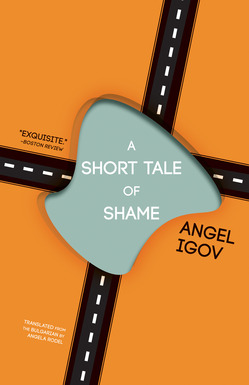
Jul 042013
 

Axelrod

{space}

George Axelrod was a great Hollywood screenwriter who defined highbrow comedy and male-female relations for an era. In truth he may not have so much defined male-female relations as reflected them, the last “classy” gasp of the postwar male dominance in a culture that was fast changing. NC Contributor Steven Axelrod offers here a gorgeous addition to our Fathers Series, his loving but frank look at his father’s life and legacy, a monumental essay from the guy who knew because he watched, as only a little boy can, his father bestriding his world like a god, like myth itself, and finally crumbling from the pedestal.

dg

——

Phobias

My father,was afraid of everything, and he passed most of his fears down to me. Some of them remain latent, drugged guard dogs stirring in their sleep at a snapping twig or a heavy footfall: moments of agoraphobia checking into a big hotel in a new city. I consider hiding out in the room, I inventory the miniature bottles of booze; then I button myself up to the neck and the feeling passes, like a chill. I hesitate before boarding an airplane, flinch before walking into an elevator and I feel the ghosts of my father’s phobias haunting me, like his voice in the back of my head, that wry half-drunk ongoing commentary: “That was a room-emptier, dear boy.”

Yet he was capable of convulsions of courage. After stalling for weeks, my step-mother Joanie running interference for him with the studio or the producer or the star (“When I say I have sixty pages, it means I’m about to start”), my father would lock himself in a room and work for thirty hours straight until he finished the script, turning it in on time and camera-ready. It might seem like mere mulish persistence, but nothing frightened my father more than a blank page and a deadline.

working dad-1

In high school he sat with the visiting football team’s fans and cheered on the opposition. Then he took a bat from the athletic department, arming himself against the drunken jocks he knew would storm his room, seeking revenge. He never graduated from high school, though he told me his P.E. teacher there gave him the best advice of his life. “You’re useless at sports,” the man said. “You should play with the girls.”

Dad told me: “I’ve been doing that ever since.”

Women never scared him, I have to give him that.

SPACE

A Self-Made Man

cool dad-1

He arrived in New York City before World War II, with no credentials, no real education and a family who disapproved of his ambitions. He walked into radio writer-producer Goodman Ace’s office looking for a job. The interview was a brief one: “Come back tomorrow with ten jokes.”

He worked for several years on “Mr. Ace and Jane” and “Easy Aces” writing the type of malapropisms that would be associated with another cunningly professional air-head, Gracie Allen, years later: “He lives on the poor side of town, in those Old Testament houses,” and “You could have knocked me over with a fender.”

My father always had faith in his own talent. He never had much beyond it to trust. His grandfather was a tyrant, his father was a tyrant’s prey who gave up his own career in show business under the threat of disinheritance. His grandfather, Jacob Axelrod, was the son of a Silesian rabbi, a Tzadic of the Hasidim, and Jacob was next in line. He fled that responsibility and arrived at Ellis island with fifty cents in his pocket. But of course he also had the steel to stand up to the absolute ruler of his fiercely insular religious sect, the arrogance to defy his father and the courage to sail away into the unknown, owning nothing and knowing no one. Fifty years later he was a different kind of king – a real estate maven who had bought and sold dizzying amounts of property in lower Manhattan. No one knows quite how he did it; or why, ten years later, he threw himself off the roof of one of his own buildings.

When my kids were little, my ex-wife took them  to the refurbished Ellis island, where my daughter found old Jacob’s name on an interactive computer list of 19th century immigrants. “That’s Daddy’s ancestor!” she said.

“Yours, too,” her mother reminded her. It was a stunning moment for a twelve year old girl. She asked me about Jacob, but I never found out much myself – how he created his empire, or came to regret it so profoundly. But his son Herman, who attended Columbia University with Oscar Hammerstein and collaborated with the great lyricist on some collegiate Varsity shows, received  an ultimatum from Jacob: if he didn’t abandon show business and join the family real estate firm, he would be disowned and disinherited. So he knuckled under.

Interestingly, Hammerstein’s father was similarly hostile to his son’s career choice. But the old man died  before Oscar graduated. Herman had to wait another thirty years for his own freedom. The day after Jacob’s funeral, Herman quit the real estate business and took up painting and sculpture. His work had been exhibited in a dozen museums by the time he died.

Unfortunately, he never learned the essential lesson about parental tyranny: quarantine it in your own generation. Almost against his will, it sometimes seemed, he passed the paternal cruelty down the line, along with his brown eyes and his creativity.

He sent George to the Hill School which the boy hated; just as George sent my brother to Hotchkiss, which was just as bad. This heartless dictatorial compulsion loomed like a Biblical curse over all of us, and my brother never had children partly because he feared it so much. Would he have sent his own kids to military school and threatened them with exile if they didn’t join the family law firm? We’ll never know. But none of us would have been surprised.

So my father launched himself away into the unknown just as his grandfather had done. Unlike Jacob, he had no gift for intimidation, no uncompromising greed, no lust for power – just a wry sense of humor and a working typewriter. It turned out to be enough.

“Just finish something,” my mother told him. “You’ll sell it.”

 SPACE

The Best Day

So he did, which led to one of the great high points, the days he always rated ‘10’, in his life. This was the best one of all.

My father’s play, The Seven Year Itch, had opened and by the time rehearsals were finished he was sure he had a useless mess on his hands: snappy first act, weak second act, disastrous finish. Emlyn Williams  — best known for writing The Corn is Green — was performing in a play about Charles Dickens a block away and helped trim Itch with something he called  “interlinear cutting”: taking out individual words, clipping the play sentence by sentence without losing any major scenes. It worked. The play improved. It got tighter, and most of all shorte, but it remained flawed. My father was terrified of the reviews, and he stayed away from the traditional Sardi’s vigil of getting quietly drunk and waiting for the New York Times to hit the street. He left the theater after the first act and went home to bed.

He woke up the next morning to find no food in the refrigerator. My mother, two months pregnant with me, was busy with my brother Peter, fussing and colicky at age four. Their bank account was over-drawn, so he pulled on his Burberry raincoat, too thin for the early winter chill, and walked out into the spitting wet snow to beg a small cash advance from the box office.

The date was November 20th, 1952. The time was eight thirty-five in the morning.

He arrived at the theater, shivering, and just stood across the street, staring at the vision of his life from that moment on, absolutely and irrevocably transformed. The line stretched from the box office down 46th street, all the way to Eighth Avenue and around the corner, men and women in their bulky coats, shuffling in the wind-whipped sleet waiting for the box office to open two hours later. The first of them must have arrived before dawn.

itch playbill-1

He stood a watched them for a long time. Then he got his advance and took a cab home to read the reviews.

Six months later he was in Hollywood.

A year later he was divorced.

SPACE

Autobiography

George  Axelrod and Marilyn Monroe

“People often ask me, which is more rewarding – parenthood or writing,” he used to tell me. “It’s funny because you and The Seven Year Itch were born in the same year. Itch is more successful than you, funnier than you, richer than you, more popular than you. It’s held up better than you. I’d say it’s no contest.” I tell people that anecdote and observe with detached amusement the shock on their faces. The remark was only incidentally cruel; much more than that it was simply an irresistible joke, one which he knew I’d get, and more importantly, one aimed more devastatingly at himself than at me.

He was a bad father, I suppose. But I inherited from him a need to be entertained and a delight at being amused that rendered his mundane failings irrelevant. He could always make me laugh.

Almost twenty-five years after Itch’s triumphant opening, he failed in his struggle to get another play, Feeling No Pain, mounted on Broadway. The gimmick of this new musical was that the protagonist had rented the theater for the night of his fiftieth birthday, to review his life in front of an audience of friends and enemies, colleagues and critics, before committing suicide on stage in the dramatic finale.

He wrote the lyrics for the songs, whose titles reveal his state of mind – “Are you Gonna Change” (The answer, emphatically no); “The Ladies Love Me” and the title number.

Jerry Lewis was committed but backed out. Jack Lemmon signed on but begged off when his wife Felicia balked at moving their kids across country for the length of the  run. With no star the project fell apart. I may have the only extant copy of the play, and even that manuscript remains incomplete.

The partial script gives some hints about why his first marriage failed. Richard Bender, the protagonist, imagines the relationship as a serialized radio soap opera. He brings out the performers and the mikes in the stripped-down stage version of a radio station recording studio:

BENDER

Okay, take it. We’re on the air.

(An ORGAN PLAYS a RADIO THEME; in the manner of radio actors, they drop the pages to the floor as they finish them)

 ACTOR

(As the announcer)

Ladies and gentlemen, once again we take you down Fifth Avenue to the corner of West Eleventh Street, up three flights and into apartment D for another heart-warming episode of ‘Our Gal Sarge’, a story which poses the problem: Can an attractive, well born, socially conscious young housewife, mother and ardent worker for the League of Women Voters find romance and happiness married to a handsome but frivolous and dissolute comedy writer so lacking in political awareness, that he would not even work for Henry Wallace?

BENDER

(He puts his hand over the mike and speaks to the audience)

These things were always written from the woman’s point of view.

My mother’s point of view? “I stuck it out for his psychoanalysis, but he wouldn’t stick it out for mine.” In fact, she thought my father’s psychiatrist was the heart of the problem. His solution to the problem of George’s phobias was “Just take a drink, it’ll calm your nerves.”

He took the advice and it almost killed him.

My mother wanted him to write something great; she wanted him to stop drinking and save his money. He wanted to write sex farces, get bombed and when he ran out of money just make more. My mother was a depression baby; my father  just thought she was depressed.

Joan Stanton, the stunning blond he met on a Fire Island beach that summer, saw things his way. When the call came from Billy Wilder, inviting George out to Los Angeles as the Seven Year Itch movie screenwriter, my mother begged him to save his soul and stay in New York.

Joanie at the B&W-1

Joanie booked the plane tickets.

She was always good at handling the details.

SPACE

The Golden Age of Hollywood

They lived quite a life, and I saw brief glimpses of it on school vacations: sitting around the pool with Tony Curtis, planning “Gemini” birthday parties, spending money in style, with houses at the beach and in town,  freezers full of steaks cooked on the built-in electric charcoal grill, the screenings and openings (Though he had to get drunk to attend them); and the movies themselves, on which his reputation still rests – Bus Stop, Breakfast and Tiffany’s, The Manchurian Candidate, How to Murder Your Wife. The banner quote in the Life magazine article about Murder, summed up his attitude in those days. Was Italian newcomer Virni Lisi a star? ”SHE’S A STAR BECAUSE I SAY SHE’S A STAR.”

Murder one sheet-1

The embedded video is from home movies taken by Roddy McDowall at Dad’s Holmby Hills house in the mid sixties. This was his glory time and you can see it in these silent sun dappled moments caught by Roddy’s ever-present 8 mm camera.

Glamor floated in the air like pollen. But it rarely merited more than a sneeze. I remember one afternoon, inspecting the wedding invitation from Frank Sinatra and Mia Farrow: a big glamor portrait of them, with the date and the RSVP inside. Mia Farrow’s mother was Maureen O’Sullivan, who played Jane in a series of Johnny Weismuller Edgar Rice Burroughs adaptations. Somehow this detail crystallized the absurdity of the affair for my father. He laughed and said “Me Tarzan, you Frank Sinatra’s mother-in-law.”

It was an immensely attractive world, a privileged realm of celebrity, warm winters and ripe orange, a sunlit David Hockney world of pale blue swimming pools and cool Mexican tile. An Architectural Digest world of dinners on the patio with views of the city lights, brilliant nights of conversation with the startlingly life-sized people most people would never meet, cashmere against the desert chill; palm trees swaying and bougainvillea blooming red among the faint smells of cut grass and eucalyptus. “One of the great pleasures of success in the movie business,” my father said to me on one of those evenings, “Is that the people you most want to meet want to meet you just as much.”

It was paradise. But it couldn’t last.

murder cartoon-1

My father started directing his own scripts, resulting in a brutal pair of flops. First came the quirky masterpiece Lord Love A Duck (“An act of pure aggression”), which “went from failure to classic, without ever passing through success,” as he liked to put it.

Roddy McDowall played Tuesday Weld’s  high school fairy godfather in that odd dark film, guiding her with faultless cynicism through the obstacle course of teen-age life, even organizing the death of her odious step-father. Ruth Gordon played the batty mother-in-law whose tart “In our family we don’t divorce our men, we bury them” summed up her caustic point of view. Ultimately Mollymauk, as Roddy’s character calls himself (“A bird thought to be extinct, but isn’t”) engineers his protégé’s rise to movie stardom, in the appropriately titled “Bikini Widow”.

The scene where Mollymauk teaches Tuesday Weld’s character to manipulate her father into buying her a load of cashmere sweaters is worth the price of admission all by itself. There’s a simple equation to remember, he explains: father + divorce x guilt2= sweaters to the 12th power.

Then came The Secret Life of an American Wife. My father judged movies by their titles as he judged champagne by how hard it was to get the cork out, with equal success. Even he knew that the film’s clumsy name boded ill. He preferred The Connecticut Look but studio marketing people worried that foreigners wouldn’t understand it. , (“What do you think she’s talking about when she refers to her ‘rapidly spreading Connecticut behind?” I remember him shouting at some studio bean-counter)

Except for a lovely one act chamber piece between Anne Jackson and Walter Matthau buried in the middle of the picture, it deserved the ignominious fate that spiteful critics and an indifferent audience forced upon it.

With the drinking getting worse and the failures piling up behind him, even Joanie, who was so good at manipulating people and bullying them, couldn’t get my father’s career back on track. She used his friends and colleagues to build her own decorating business, and would gladly tell anyone who asked (and some who didn’t) that she’d been the real breadwinner in the family for decades. She owned a shop in Beverly Hills called The Staircase, which featured the circular staircase from The Seven Year Itch as its main decorative motif. She sold Porthault sheets there and expanded her business exponentially with a Who’s Who of Hollywood celebrities. She had the glow of a pregnant woman when she was in the middle of some massive Bel Air renovation; my father used to say “She’s lovely when she’s with house.”

SPACE

“What Have You Written Lately?”

And so, after raising two children (one from Joanie previous marriage, and a daughter of their own), after flipping twelve houses (including one on Carbon beach they sold because Joanie couldn’t stand the sound of the ocean), after their opposite career trajectories, hers to the top of what you might call celebrity interior design, and his to the bottom of a world he had owned in another era, she handled his induction to the Bette Ford Centre, and paid the bill for his rehab.

They’d been separated for a while before that, and Dad had been living a different version of the high life, a mockery of his earlier glory, paying a spectacular Las Vegas hooker full time wages to act the part of his girlfriend, and later, moving back to London, almost killing himself in a savage bender after a battle with the Grosvenor Estates over the matter of a bicycle left in common hallway.

He returned from his ordeal in Palm Springs hurt and humbled, beaten but not broken, determined to stay sober for as long as he could. And I couldn’t help thinking of Neil Simon, with whom he’d toiled in writers’ rooms in the late forties, with whom he had clashed over Dad’s miscasting of Simon’s weakest play, during the winter of 1966. Walter Kerr memorably began his review of The Star Spangled Girl this way: “Neil Simon didn’t have an idea for a play this year, but he wrote one anyway.”

As alcohol scuttled my father’s career in the seventies and eighties, Neil Simon steamed along imperturbable and majestic, like some Cunard luxury liner of comedy. Even his wife’s tragic death and his private struggle to start living again generated a hit play.

Maybe his shrink said “Man up” instead of “Hit the bottle.”

It was a peculiar sad time, those decades of ruminant sobriety between Dad’s stay at Bette Ford and his reversion to white wine on his death bed. He was struggling  to start his career again, taking meetings just as I was, doing odd writing jobs for mentally defective, drug-addled producers, just as I was doing. He was a has-been, I was a never-had-been, but nevertheless, we had a lot in common.

One incident in particular sums up that era. It was the spring of 1978. He was called into a studio meeting “with a bunch of twenty year olds” who told him they wanted to do a glamorous World War II period piece thriller, full of romance and intrigue, set on a train. He told them, “It’s been done. The picture is called The Lady Vanishes.” Blank stares. “Directed by Alfred Hitchcock?” Nothing. He told them to screen the 1938 classic and get back to him. Sure enough, they called the next week and set up another meeting. “We loved it,” they told him. “It was awesome. We want you to write it.”

He explained that it had already been written, generally the first step in the film-making process.

“No, no,” the twenty year-old VP development told him. “The movie’s in black and white. We want you to write it in color.”

So he did, carefully annotating the green plush sofas and the red wine.

Dad was flown to the location to coach Cybill Shepherd on her line readings, but his ideas didn’t register and his opinions didn’t prevail. “Let’s see what she brings to it,” the director finally decreed. “As far as I could tell,” Dad told me, “She brought a nice head of hair and a Porsche.”

The near-misses and dead-ends continued: the script he wrote with Joan Rivers that the fine intellects at Universal determined to be ‘too vulgar’ (but wasn’t that the point?); another original that featured an impossibly boring Secretary of Defense (Even when warning the president of imminent threats, he’s so dull that the President nods off, the  red telephone “slipping through his nerveless fingers”). The man happens to be a separated-at-birth triplet. One of his brothers is a brilliant stand-up comedian, the other a drunken, gambling addicted sociopath. When they all get together, hi-jinks ensue. It was called The Importance of Being Irving, and like so much that Dad wrote, it fell apart in the third act. He knew it, and tried to get various writer/stand-ups to help him revise and star. He said he was ‘too proud’ to ask his pal Steve Martin, who would have been perfect for the role and could have helped with the writing also. Too bad: I really wanted to see that one.

 SPACE

Grandpa

Then there was Grandpa. Like so many abortive projects, this could have been the one that turned things around for him. He described the origin of the project in one of his famous one-page letters:

Dad's letter-1

What could go wrong? It started with a few months of radio silence from John Hughes, then a full page ad in Variety clarified the situation. Hughes was making Home Alone 3, and the subtitle was Lost in New York. Hughes had taken what he needed from George’s idea and left him with the unsalable remnants. Or so it seemed to my father. He no longer had the heart to begin again.

In 1988 my step-brother Jonathan organized the re-release of The Manchurian Candidate, and the video below — a round-table discussion with star Frank Sinatra and director John Frankenheimer — gives an invaluable glimpse of my father during this difficult period.

http://youtu.be/gH0duNvNJ8E

SPACE

Twilight of the Gods

George and Joan were back together after his boot camp stint of high-toned rehab in Palm Springs, and  the Sunday lunches remained a pleasure, a luxurious testing ground of excellent food and sophisticated talk. To this day I judge people at least part by how well they would have fit into those long tipsy afternoons overlooking the smog-bound clutter of the city and the blue desert of the Pacific. Would Joanie have said of this girlfriend or that one, “Charming girl, very bright. Wonderful addition to the life.”? Would my father have flirted with her shamelessly, asking her his patented trick questions (“When did you know you knew?”), while Joanie sipped white wine, and watched out of the corner of her eye while she discussed the seating hierarchy at Morton’s? I often think about that question and I always know the answer.

Of course Joanie ruled those gatherings with her perfect social graces and her iron will. But she let George hold court at the table. She ruled him in every way, until the very end, when she gave him an order he couldn’t follow. Dying of cancer just after the 9/11 attacks, she wanted him to take a Krevorkian-style cocktail of drugs and die with her. I know it sounds like something out of a gothic novel or some camp film with over-the-hill movie stars, Whatever Happened to Baby Jane, perhaps: a deranged, wild-haired Bette Davis, screeching “we’re going to die TOGETHER!” But if you knew Joanie, nothing could surprise you.  This was a woman who could break the lock of her teen age daughter’s diary, breeze past the pathetic note asking her not to read further, and then not only read it cover to cover, but declaim the dirty parts aloud, to her daughter’s hated boyfriend,  the next night at dinner.

My father managed to refuse her somehow, despite the giant force of her will. She actually was weakening at last, like an exiled dictator or a great writer falling into dementia, and he lived two more years after she died. They were bedridden years,  he needed help with the mortifying basics of life, but he was still able to fly an entourage of medical personnel with him to  Las Vegas for a final gambling blow-out, still able to make me laugh over a good bottle of  Pouilly Fuisee.

Of course I couldn’t help thinking that he was burning through the last of what would have been my inheritance – money saved and still coming in from both his work and Joanie’s, as projects she had initiated – like the new nursery wing in Norman Lear’s Vermont mansion – rolled on without her.

And then he died and I flew out to Los Angeles for  the memorial service.

I knew I was going to speak in front of the gallery of his surviving friends and I flew out a week early. I spent the time writing and memorizing my eulogy. I could feel the ghost of my father’s own nervous panic addressing a crowd, and I fought it down just the way he did in his later years, when he couldn’t get drunk first any more: relentless preparation and unlimited effort in the name of making the excruciating look easy.

The euology isn’t much, really — just a hint of who he was, like the menu posted outside a four star restaurant or a photograph of the Grand Canyon.

This is what I said:

 SPACE

A Brief Farewell

Old dad-1

I’ll make this short, because that’s how Dad liked it. He had a rule at dinner. Everyone wanted to tell the story of the book or comic book they had just read, or the movie or TV show they had just seen. That was fine, as long as they could do it in three sentences. It was great – all you’d hear for minutes at a time was the sound of grinding teeth as various kids tried to boil down a Star Trek episode, or Lawrence of Arabia … or Moby Dick into three sentences. You could almost hear them: “OK – there’s this whale … no. There’s this guy who was chasing the whale … no, wait …”

It was okay. You were better off listening at that table, anyway.

You could learn a lot at dinner; sometimes meals turned into informal writing seminars. My Dad loved verbs, and he hated adjectives. Once he challenged me to describe something we were eating, some little meat pastry. I said it was flaky and savory and delicious.  Three adjectives: no good. He used two nouns and a verb: “calories, lashed together with garlic.” He taught me Logan’s Law: (The theatre director Josh Logan was a great mentor for him and one of his best friends for more than thirty years)  “A hit movie or play is a series of scenes culminating in a final scene through which the hero learns something about himself, always emotionally and always for the better. “ And it’s true – from Breakfast at Tiffany’s to Rocky to The Lord of the Rings. Dad said a great thing about cutting once that always stuck with me. ‘You turn the story upside down and shake it. All the loose stuff falls out.”

He was always proud that he put a phrase into the language with the title of The Seven Year Itch. But he put a lot more phrases than that into my language. To this day I can’t look at a fattening dessert without hearing him saying “..and the best part is … it tears the weight off you.” I can’t sit looking at a blank page without his credo coming to mind: “Will write, if cornered.” I looked at the airline meal on the flight out here, and heard him say “Toy food.”

And as for the word ‘totter’, they should just retire it from the language now that he’s gone, the way they retired Wayne Gretzky’s number when he quit playing hockey.

Dad could be a tough audience. I’ll never forget watching a young comedian trying his act on him one Sunday at lunch. Dad just sat there saying, “Good. That’s funny.” But he never even cracked a smile. Finally the comic got exasperated and said “Don’t you ever just laugh?” Dad shrugged. “No,” he said. “But don’t feel bad. My eyes are twinkling merrily.”

I wrote a suspense novel and asked him to cut it. He took more than a third of it out.  When I complained, he shrugged and said, “I could cut a minute thirty from the Book of Genesis if I really had to.” The edit was a huge job and a lot of work, taken from his own busy schedule. But the gesture was typically generous. My friends and I often heard him ask, “How much money would change your life?” If you thought about it and told him, he’d give it to you. It didn’t always take much. One night when my friend Stephen Salinger was broke and waiting on tables at Ma Maison,  my Dad tipped him a hundred dollars. It did the trick; Stephen never forgot that night. Dad once ordered a bottle of Mouton Rothschild ’59 in the Oak Room at the Plaza, just to show me what great wine tasted like.  When he knew I needed it desperately, he swept me off to London for my senior year of High School … and thirty two years later, it’s  still the best year of my life.  I learned much more from him than I did in school – antiquing on the Portobello road, or at the Turner show at the Tate. He had to drag me out to see the Noel Coward tribute at the British Film Institute. Hey, I was seventeen. It was a great night as well as Coward’s last public appearance ever.

It’s strange, standing in this house without Dad and Joanie here. Not even this house exactly… there have been so many over the years. This is just the most recent one. All of them, from 1018 Benedict Canyon to 301 North Carolwood, from 56 Chester Square to Malibu to Lloydcrest Drive, all had the same spirit. And most of them had the same bar. I got drunk for the first time in my life at that bar. And I don’t think I’m the only one. Anyway … for most my life these houses have been like the world capital of wit and sophistication.  If any of them are haunted, there are going to be some great parties going on, with some very classy ghosts.

Dad was a wonderful host, but he was cripplingly shy.

He was full of contradictions, mostly between the cynical things he said and the big-hearted way he lived. He used to say there was no one as tedious as a reformed drunk. But he was one himself for the better part of two decades with no loss of charm or style. An English magazine once asked him to comment on the phrase  “All the world loves a lover.” He said, “Funny you should ask. Right now my son is in love, my daughter is in love, my cook is in love, my secretary is in love, even the man who picks up my trash is in love. They stand under my window all night long, baying about it.  So in response to your question, I would have to say that all the world does not love a lover.  In fact all the world is bored to tears by a lover.”

This from a man who was married – with a one short break – to the same woman for more than fifty years. He had nothing against love. He just couldn’t take it seriously.

If there is a heaven, and I know he didn’t believe in that stuff, I can picture him at some celestial Ma Maison (The number is still unlisted), St. Peter bringing him  a bottle of white wine to the table instantly. Dad is ordering lunch – that was his specialty just like Patrick O’Neal’s character in Secret Life. There are some old friends around the table. Maybe he’s even pausing between courses, looking down on this gathering today, listening to my little speech. Not laughing, of course.

But perhaps his eyes are twinkling merrily.

Right now, I’d be happy to settle for that.

I tried to side-step any obvious sentimentality. He hated sentimentality. He used to say every Steven Spielberg movie could be titled with the prefix, “How I spent my summer vacation” (As a sharecropper, in a Japanese internment camp, hiding an alien, chasing a shark, saving Jews from the Nazis). He would walk out of a play if the curtain rose to reveal a refrigerator on the stage (he hated ‘kitchen sink’ drama) and once dragged me out of Man of La Mancha in a theater with no center aisle.

My stepbrother was brusque and succinct at the memorial service, my brother and sister read from prepared notes, though Nina’s gesture of chucking her cell phone into the swimming pool felt spontaneous. Our father hated the telephone (“For a dime anyone in this country can ring a bell in my house”) and he especially hated cell-phones.

Everyone seemed to think I spoke extemporaneously. Dad would have liked that. And I killed.

He would have liked that best of all.

 —Steven Axelrod

————————————–

Steven AxelrodSteven Axelrod holds an MFA in writing from Vermont College of the Fine Arts and remains a member of the WGA despite a long absence from Hollywood. In addition to Numéro Cinq, his work has appeared at Salon.com and various magazines, including PulpModern and BigPulp. A father of two, he lives on Nantucket Island, Massachusetts, where he paints houses and writes, often at the same time, much to the annoyance of his customers.

Click here for the complete NC Fathers Series.

Jul 032013
 

Cynthia Sample lives in Texas and reads Lydia Davis and Jorge Luis Borges and, when she comes to write, combines genres and forms in ironic and hilarious juxtaposition. She writes little stories, microstories, that delight the eye and the mind, stories that startle you with their originality and unique angles of attack. In this one she uses the genre of the concordance to tell a  steamy tale of love, lust, adultery and divorce — it will make you smile.

dg

DANCE (danced, dancing)

Ecc      3:4          a time to d and a time to mourn
2Sa      6:14        d before the Lord
Ps        30:11      You turned my waiting into d

LUST (lusted, lusts)

Pr        6:25         Do not l in your heart
1Th     4:5           not in passionate l like the heathen
1PE     4:3           in debauchery, l, drunkenness

LOVE (beloved, loved, lovely, lover, lover’s, lovers, loves, loving, loving-kindness)

Ge       20:13       This is how you can show you l
Ge       22:2         your only son, Isaac, who you l
Jos     22:5          careful to l the Lord your God

ADULTERY (adulterers, adulteress, adulteries)

Lev      20:10      both the a and the adulteress must
Heb     13:14       for God will judge the a
Hos      3:1          she is loved by another and is an a
Jer       3:8          sent her away because of all hr a
Ex        20:14      You shall not commit a
Mt        5:32        The divorced woman commit a
Mk       10:11       marries another woman commits a
Jn         8:4         woman was caught in the act of a

DIVORCE (divorced, divorces)

Dt         22:19      He must not d her as long as he lives
Dt         24:1        and writes her a certificate of d
Mal      2:16        “I hate d,” says the Lord God
Mt        19:3        for a man to d his wife for any reason
1Co      7:27        Are you married? Do not seek a d

LOVE (beloved, loved, lovely, lover, lover’s, lovers, loves, loving, loving-kindness)

Jdg      4:16         You hate me! You don’t really l me

LIE (liar, liars lied, lies, lying)

Lev      19:11       Do not l
Nu        23:19     God is not a man that he should l
1Jn      2:21         because no l comes from the truth
Ac        5:4          You have not l to men but to God

END (ends)

Ps       119:112   to the very e
Ps       1:19          such is the e of all who go
Ps        5:4           but  in the  e she is bitter as gall
Ps        14:13      and joy may e in grief
Ps        16:25      in the e it leads to death
Ps        19:20      and in the e you will be wise

FORGIVE (forgiveness, forgave, forgives, forgiving)

Ge       50:17       I ask you to f your brothers the sins
Ex        10:17      He will not f your rebellion
Isa       15:25      f my sin and come back with me
Col      1:14         in whom we have redemption the f
Eph      4:32       to one another, f each other

SECRET (secrets, secretly)

Dt         29:29     the s things belong
Ps         90:8       our s sins in the light
Pr         21:14     a gift given in s soothes anger
Jer       23:24    Can anyone hide in s places?
Mk       4:11        the s of the kingdom
Php      4:12       I have learned the s

—Cynthia Sample

————————————–

Cynthia Sample received a MFA in Fiction from Vermont College of Fine Arts in 2005.  Her stories have appeared in Between the Lines, the Wichita Falls Literary & Arts Journal and Love After 70.  She has work forthcoming in The Summerset Literary Review and Sleet. In 2007, she was one of four Emerging Writers to present her work at the WordSpace Literary Festival in Dallas, Texas, where she is a lifelong resident.