Jul 122017
 

McCarthy’s MC Hammer-Conrad connection speaks to the collection’s willingness to not only grant credence to the highbrow and the lowbrow in equal measure, but is also a call to ignore brow-ness altogether. As a consequence, the more disparate the subject matter McCarthy chooses to splice, the more surprising, and, yes, whimsical, the results end up. — Andrew MacDonald 
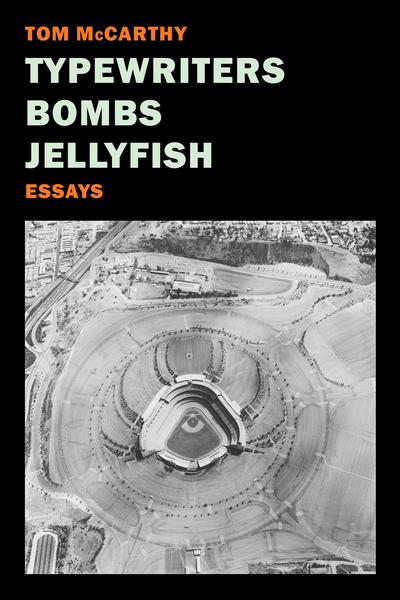
Typewriters, Bombs, Jellyfish
Tom McCarthy
New York Review Books, 2017
$16.95, 288 pages

.
Before he made the avant garde novel cool again, Tom McCarthy was having trouble getting his first book, Remainder, past the marketing departments of big publishers. It was too weird, the plot too circuitous and repetitive. Eventually Metronome, a small art house publisher, took the novel on. It became a word-of-mouth success, the buzz culminating in a Zadie Smith review, ranking it among the greatest works of the last ten years. The rest, as they say, is history, though McCarthy himself would likely object to such a fraught, limiting term. Since Remainder, McCarthy has produced a book-length critical work on TinTin, the Booker shortlisted C, described by Jennifer Egan as “Pynchonesque revelry in signs and codes with the lush psychedelics of William Burroughs,” and another Booker-shortlisted novel, Satin Island, about someone named “U” who works for “the Company.” Given the success of his novels, it’s easy to overlook the dozen plus short critical pieces McCarthy has written about literature, art, technology and culture. With the publication of Typewriters, Bombs, Jellyfish, a collection of fifteen of those brilliant, challenging, and at times frustrating essays, readers have the chance to appreciate the intellect behind McCarthy’s longer fictional work.

The essays in Jellyfish cover broad terrain, from the films of David Lynch to the novels of Jean-Philippe Toussaint. Some of the pieces, like “Why Ulysses Matters,” started as invited talks or lectures; others found their way into places like Artforum or, as is the case with “18 Semiconnected Thoughts on Michel de Certeau, On Kawara, Fly fishing, and Various Other Things,” museum catalogues accompanying exhibits at the Guggenheim. Others tread more conventional paths, becoming introductions to critical works (like Kafka’s Letter to his Father) and critical essays The Guardian. They are a potpourri of critical thought that the author likens to masses of the eponymous seafaring invertebrates that often reach “a critical mass of goo in circulation . . . coming back, lodging, sticking.”

The obsession with discursive circulation, of coming back in loops to stick, lodge, and accrete, is among the collection’s chief interests. In “From Feedback to Reflux: Kafka’s Cybernetics of Revolt,” McCarthy contends that “no other writer…has presented a more fundamentally cybernetic aesthetic than Kafka.” Lest one confuse the term “cybernetics” with computational technology, McCarthy defines the term, coined by Norbert Wiener, as “a networked mechanism formed of and driven by a set of circuits, relays and, most importantly, feedback loops.” From K, the surveyor of Kafka’s The Castle‘s endless attempts to gain access, to the mise en abyme of judicial infrastructure Josef K must face in The Trial, McCarthy sees Kafka presaging the NSA and Google – institutional structures that contain loop after loop of information within themselves.

While the feedback loops of cybernetics are “corrective,” McCarthy dubs those in Kafka’s writings as “fuckuptive” – that is, the response pattern the loops engender is self-defeating. Put another way: “the circuitry or system-architecture here is configured in such a way as to render unworkable any operation that the user (Kafka) might actually want to use it to perform.”

Among the system-architecture of which McCarthy, a champion of the avant garde, is particularly distrustful is the ism – positivism, moralism, psychologism. In “Get Real, or What Jellyfish Have to Tell Us About Literature,” he presents us with a lengthy excerpt from Ford Maddox Ford to show how conventional realism, with its compulsive urge to reshape in accordance with post-facto logic, is at odds with “how both events and memory of them proceed: associatively, digressing, sliding, jolting, looping.” By creating fertile ground for the associative, the 20th century avant-garde, McCarthy argues, gets “the real” more than their 19th century counterparts, who, to their credit (and in opposition to those writing today who take up the ‘realist’ banner) nonetheless “fully appreciate the scaffolding of artifice holding their carefully wrought edifices up.”

Scaffolding, artifices, edifices – readers will detect in McCarthy’s lexicon more than trace amounts of the post-modernist’s distrust of tautologies. In an interview with The Guardian, McCarthy tells us that “the avant garde can’t be ignored, so to ignore it – as most humanist British novelists do – is the equivalent of ignoring Darwin.” Those who do are, in McCarthy’s eyes, “just a creationist” with “ostrich-like” tendencies.

When it comes to understanding McCarthy’s modus operandi, his role as “general secretary” of the International Necronautical Society is as good a place to start as any. Together with philosopher Simon Critchley, McCarthy founded the INS, a semi-parodic, semi-serious, maybe-performance-art-but-that’s-missing-the-point organization “devoted to mind-bending projects that would do for death what the Surrealists had done for sex.” Among the INS’s more public hijinks are cryptic radio broadcasts, the hacking of the BBC website, exhibits that may be called art and hearings with committees that may, or may not, host officials and organization members with such lofty (and possibly made-up) titles as INS Chief Obituary Reviewer, and INS Chief or Propaganda (Archiving and Epistemological Critique).

Maybe.

And maybe, a reviewer of the critical work of McCarthy might be inclined to say, the blurring between the factual and the fictional is perhaps the point. Or, possibly more accurately, that the point is to reject the ism of easy dichotomies altogether, in favor of more freewheeling signification, where meanings are swapped, integrated and ousted.

Take, for example, the weather. An early essay in the collection, “Meteomedia,” draws richly from sources as diverse as Seneca and close to home as McCarthy’s own apartment to arrive at a thesis possessing unmistakable echoes of McLuhan: not only is the meteorological a medium, it also constitutes media. “Like all media,” writes McCarthy of the weather, “it bears a plethora of messages – perhaps even the message – while simultaneously supplying no more than conversational, neutral, white noise.” Moreover, like a tree falling in the woods without its audience, so too is weather as media devoid of signal without an audience to receive it.

“Stabbing the Olive,” an essay on Jean-Philippe Toussaint, poses another mind-cruncher that nobody in history, apart from McCarthy, has likely asked: do Toussaint’s novels engage in “deconstructing literary sentimentalism or sentimentalizing literary deconstruction?” For McCarthy, and, eventually, his readers too, the distinction is everything. McCarthy sees in much of the work of Toussaint a refiguring of structure, a gesture away from the ism of realism: “we don’t want plot, depth, or content,” he notes, “we want angles, arcs and intervals; we want pattern. Structure is content; geometry is everything.” He goes deeper: “We exist and assume subjectivity to the extent that we occupy a plot in or traverse a grid: an implicit philosophical assert that’s part Descartes, part Deleuze.”

Passages like that, theory-rich and many-claused, will likely alienate some readers and entice others. However, a strength of the collection, and of McCarthy-as-Teacher (separate from McCarthy-as-Critical-Theorist), is his instinct for strategic simplification; he seems to know just how far to push his reader out to sea before throwing out a floatation device. He corks the above meditation on grids and subjectivity plotted thereupon by asking if there is a “retro-move going on [in later Toussaint]? A crypto-reactionary step backwards towards humanism, sentimentalism, positivism, and the whole gamut of bad isms that the vanguard twentieth-century novel has expended so much effort overcoming.” His answer: hard to say. Challenged to the point of breathlessness, we likely feel the same way and are, at the very least, enlivened at being privy to the discussion.

Devotees to art and film will also find much to love in the collection, since many of McCarthy’s finest essays focus on art and film. His piece on the painter Gerhard Richter, for example, expertly knits complex visual theory to practical visual analysis. For McCarthy, Richter’s work resists easy categorization, “reducing these binaries” – concept vs. craft-based, abstract vs. figurative – “to rubble.” Richter’s trademark is the blur, “a corruption of an image, an assault upon its clarity, one that turns transparent lenses into opaque shower curtains, gauzy veils.” Corruption becomes clarity, the transparent becomes gauzy – McCarthy’s critical skillset allows him to reconcile inverse values, creating, as all great paradoxes (and artistic works) do, a new species of idea.

McCarthy’s finest creation might be his essay on “The Prosthetic Imagination” of David Lynch. Casual viewers may have missed the proliferation of prosthetics in Lynch; not so with McCarthy, who notes that “the continual, almost systematic replacement in [Lynch’s] films of body parts and faculties by instruments…produces is a whole prosthetic order, a world of which prosthesis is not just a feature but a fundamental term, an ontological condition.” McCarthy sees the first of Lynch’s problem films (so-called) as “the outsourcing of the self and of reality to their prostheses.” Ditto Mulholland Drive, where “technology is no longer an appendage to the human; rather, humans have become technology’s prosthesis.” In the end, the prosthete serves those very bodily additions: prosthesis becomes puppetry, the prosthete a marionette.

Big ideas are at play here, but it would be a mistake to ignore the undercurrent of whimsy, wit, irony, and playfulness that flows beneath the surface of most essays in Jellyfish.

Exhibit A: first published in an anthology of fiction inspired by Sonic Youth, “Kool Thing” bears the provocative subtitle “Why I want to Fuck Patty Hearst.” McCarthy catalogues a panoply of Hearsts, dating to when he first heard the Sonic Youth song “Kool Thing,” featuring Hearst as lead singer. We get Marxist Patty Hearsts calling her parents bourgeois pigs, Patty Hearst as pulp novel-heroine, Patty Hearst as Che’s lover, then Patty Hearst as gaming heroine Lara Croft – Patty Hearst “multiplying into a thousand different women” before attaining one of the most addictive metonyms out there – the Patty Hearst McCarthy wants to fuck as America, “all of it, sitting in a motel bedroom, watching the apocalypse on television.”

For Exhibit B (Whimsy, McCarthy’s Use Thereof), see, “Recessional, or the Time of the Hammer,” a study of fictional time, from Conrad to Pynchon. The essay features a curious aside in which McCarthy describes listening to MC Hammer during the essay’s creation and finding, on some associative level, a niggling link between Hammer’s hit, “U Can’t Touch This,” and the writing of Conrad. The collision is no accident, for, as McCarthy laconically, notes, “for doesn’t [Hammer’s “Can’t Touch This”], like Conrad’s novella, feature a black man who tells us to wait?”

Cue guffaw.

McCarthy’s MC Hammer-Conrad connection speaks to the collection’s willingness to not only grant credence to the highbrow and the lowbrow in equal measure, but is also a call to ignore brow-ness altogether. As a consequence, the more disparate the subject matter McCarthy chooses to splice, the more surprising, and, yes, whimsical, the results end up.

The intrusion of MC Hammer highlights another of McCarthy’s habits – a willingness to use meta-textual asides where the author, in mid-writing, pauses to comment on the text he is in the middle of generating.

More Exhibits for the Court to consider:

While exploring the connection between jellyfish and literature, McCarthy writes: “As I wrote this essay I couldn’t remember what it was that Van has brought Mrs. Tapirov”;

Contending with the warp-speed productivity of the French novelist Toussaint, McCarthy informs us that “in the time’s taken me to write this piece, it seems [Toussaint]’s managed to knock out yet another novel”;

Finally, another essay with fixes itself at the time of its own creation: “Alain Robbe-Grillet died while I was writing this essay”.

McCarthy the funster, meet McCarthy the astute critic and thinker.

The production of text, wherein McCarthy has, for example, forgotten a detail and makes the choice to record that forgetting, and the reanimation of the forgetting, for the reader who now takes part, however ephemerally, in the construction of the very text he or she is reading, all of which could have been avoided had McCarthy, in the editing room, simply inserted the information forgotten in the first place.

Which is, given what we’ve covered so far, a lot to wrap one’s head around.

But you don’t need to dig this deep to enjoy the collection. Eating breakfast cereal with a spoon once used by a famous person can still be used effectively to eat breakfast cereal, whether or not it possesses that extra Benjamin-ian aura that comes with close contact with celebrity or fame[1].

In his essay on Richter, McCarthy introduces us to the term ansehnlich, “or ‘considerable,’ to describe the effect of rescuing an image from the endless rush of media and paying it the attention – the devotion, we could say – of crafting it into a unique work of art.” This is, in the end, what McCarthy seems to be after when he takes on his disparate subjects; his essays are devotionals in their own right, not fawning or strict in the sense of worship, but rather in the compulsive attention paid to each of them.

— Andrew MacDonald

N5
Andrew MacDonald won a Western Magazine Award for Fiction, has been shortlisted for two Canadian National Magazine Awards for Fiction, and is a four-time finalist for the Journey Prize. He has an MFA from the University of Massachusetts, Amherst, and lives in New England and Toronto, where he’s finishing a novel.


Footnotes    (↵ returns to text)

  1. Immersion in McCarthy’s critical works will also have the pleasantly deleterious effect of making its readers search for complicated metaphors to explain the world.
Mar 022015
 

Tom McCarthy
By allowing us to extend our perception to multiple images simultaneously, the image pattern creates a sense of multiplicity, a feeling of participation in a larger, more complex process than our experience in the present allows. That is one of the great rewards of reading, and when a story is crafted with the care and attention to detail like Satin Island, then sometimes, for brief moments, we might recognize something familiar, yet beyond; something we know is true, yet are unable to express. —Frank Richardson

satin-island-cover

Satin Island
Tom McCarthy
Alfred A. Knopf
Hardcover, $24.00, 192 pages
ISBN: 978-0307593955

.

S

ATIN ISLAND BEGINS, appropriately, with an epigraph from Stéphane Mallarmé’s “Limited Action.” Beyond anticipating themes and motifs, this epigraph is felicitous for two reasons: first, Mallarme’s symbolist poetry prefigures Tom McCarthy’s multilayered, intricately patterned novels, and second, like the French poet, McCarthy is hailed as his generation’s avant-garde. Now in his mid-forties and living in London, Tom McCarthy has been described as inheriting the literary mantle of unconventional authors such as Alain Robbe-Grillet, Maurice Blanchot, and J. G. Ballard.

Author of the acclaimed novels Men in Space, Remainder (winner of the 2007 Believer Book Award), and C (shortlisted for the 2010 Man Booker Prize and Walter Scott Prize), McCarthy has also published a book of literary criticism (Tintin and the Secret of Literature) and numerous essays. In 2001 McCarthy, with friend Simon Critchley founded the International Necronautical Society, a “semi-fictitious” organization of artists, writers, and philosophers that promotes a diverse range of art projects. McCarthy calls the INS “a literary project . . . played out through the art world.” McCarthy’s newest novel, Satin Island, a palimpsest of meditations on life in the twenty-first century, is as ambitious as it is rewarding.

.

The Construct

For now, let’s call the book a novel, the only subtitle not crossed out on the cover of the US edition. Some of the nixed ones? Confession. Treatise. Report. Confession comes closest, for that is the tone that the first-person narrator, known only as U., adopts. U., a 40-something man living in London in contemporary time, an anthropologist by training, works as a corporate ethnographer for “the Company” – the type of business whose least sinister operation might be the personalized pop up ads on your web browser. Consider how U. describes the Company’s Koob-Sassen Project:

It will have had direct effects on you; in fact, there’s probably not a single area of your daily life that it hasn’t, in some way or other, touched on, penetrated, changed; although you probably don’t know this. Not that it was secret. Things like that don’t need to be. They creep under the radar by being boring. (12)

Between U.’s single-initial name and organizations like the Company, the influence of Kafka’s legacy is clear.

Apart from his daily work for the Company, U. has been charged with creating a “Great Report,” a document that will be, in the words of U.’s boss Peyman, “The First and Last Word on our age,” a summary vision of the world, a “brand-new navigation manual.” Flummoxed by his exuberant boss’s request, U. spends most of his time compiling vast dossiers on subjects as diverse as oil spills, parachuting accidents, and the rituals of native Pacific Islanders. Eventually, his research begins to merge with the assignment, and he becomes lost in a quest of anthropological hermeneutics:

What fluid, morphing hybrid could I come up with to be equal to that task? What medium, or media, would it inhabit? Would it tell a story? If so, how, and about what, or whom? If not, how would it all congeal, around what cohere? (71)

U.’s attempt to complete Peyman’s mandate is the nominal plot of the novel. The chronology moves toward a notional present from a moment a few years in the past when U. was stranded in the Turin airport. Except for a few dips into the past, the narrative time is linear. The novel’s form, although of the memoir type, feels scientific, like entries in a lab notebook: fourteen numbered chapters are subdivided into numbered paragraphs designated by decimals (e.g. 1.1, 1.2). There are no other section breaks. The only dialogue is summarized by U. or reported within his paragraphs without quotation marks. As arid as this may seem, it is this very style that McCarthy mines for this novel’s greatest rewards. Like a Chuck Close portrait composed of a thousand painted squares, McCarthy’s mosaic of paragraphs has a gestalt quality – the whole is greater than the sum of its parts.

Chuck Close, Self Portrait, 1997Chuck Close, Self Portrait, 1997

 .

Call me U.

McCarthy said in a 2011 interview (The White Review) that his character Serge in C, like Leopold Bloom in Ulysses or Slothrop in Gravity’s Rainbow, is “a kind of prism.” The same could be said of U. – he filters information. When he introduces himself, McCarthy’s protagonist borrows the form of another famous eyewitness with the sentence “Call me U.” But U.’s occupation forces him beyond mere observation of the world; Peyman expects him to synthesize a meaningful interpretation of it. Inevitably, U. fails at his Great Report, for what could U. achieve that would satisfy Peyman’s requirements? Uncertain how to proceed, U. moves from day to day through a haze of depression and mounting obsessions (a signature characteristic for McCarthy’s protagonists). Besides his boss, U.’s only interactions are with his colleague Daniel, his friend Petr, and his girlfriend Madison. U.’s tone can be terse, clinical, the tone of a scientist. For example, when Peyman texts him the news the Company won the lucrative Koob-Sassen Project, U. replies:

Good, I texted. The answer came more quickly this time: Good? That’s it? I deliberated for a few seconds, then sent back a new message: Very good. (7)

But this isn’t U.’s sole voice, and while he may be a scientist by training, his musings are by turn philosophical:

People need foundation myths, some imprint of year zero, a bolt that secures the scaffolding that in turn holds fast the entire architecture of reality . . . (3)

poetic:

as I slipped into a flecked and grainy sleep, oil seemed to lie around the very cloud-patches the wing-lights were illuminating: to lurk within and boost their volume, as though absorbed by them, and to seep out from them as well, in blobs and globules that hovered on their ledges, sat about their folds and crevasses, like so many blackened cherubs. (11)

and mystical:

That final spur, the one that carried skydivers across the threshold, out into the abyss, was faith: faith that it all—the system, in its boundless and unquantifiable entirety—worked, that they’d be gathered up and saved.[1] (78)

Although haunted by the ghost of Camus’s Meursault, especially in his apathetic interpersonal relationships, U.’s character is buoyed up by sentiments such as these and his genuine desire to find meaning.

.

A Choir of Images

Several of U.’s favorite subjects are present in the quotes above. The subjects and words McCarthy chose are not accidental. Regarding Ulysses, McCarthy said:

Everything becomes this huge network in which any division between outer space and inner space collapses. There’s a total consistency and continuity. And I love that – it’s what life is actually like. It’s what literature should try and somehow produce. (The White Review)

In Satin Island, McCarthy delineates his own network. U. is obsessed with buffer zones and with domains both outer and inner: a parachutist falls from the sky, oil bubbles up from below, and both meet in the present. Between the poles of outer and inner extremes, U. searches for connections, for the networks that link them together. He compiles dossiers and connects literal strings between images pinned to his walls. The question is, will some “this is it” coalesce? This is what Peyman wants for the Great Report. He wants U. to “name what’s taking place right now” (57).

McCarthy is a master weaver of recurring images, and he does so to great effect in Remainder and C. Repetition of words and ideas in a novel creates patterns of images that lend structural coherence to the story and suffuse it with a poetic quality. Satin Island is a tour de force of interwoven image patterns. The central image pattern is of something lying beneath, some mystery that might be revealed. On the first page, U. is shown thinking about the shroud of Turin, and how the image of Christ (or so it was supposed at the time) emerged after people examined photographic negatives. U. tells us that “We see things shroudedly, as through a veil, an over-pixellated screen” – a metaphor that recurs at the end, framing the novel. If the allusion to Corinthians is extended, then U. might hope, despite seeing the world through a glass darkly, to someday see clearly. Indeed, this is his primary conflict: how to make sense of the world, to see it clearly, to reveal the underlying, secret substrata of existence. While working in his basement office U. hears noises through the ventilation, finds patterns in them, and indulges his imagination:

Sometimes these patterns took on visual forms, like those that so enchanted eighteenth-century scientists when they scattered salt on Chladni plates and, exposing these to various acoustic stimuli, observed the intricate designs that ensued – geometric and symmetrical and so generally perfect that they seemed to betray a universal structure lurking beneath nature’s surface . . . (15) [my emphasis]

Stephen Morris, Square Chladni plateStephen Morris, Square Chladni plate

Such musings on underlying structures, on something hidden beneath a surface occur repeatedly throughout the novel. For example, U.’s job is to “lay bare some kind of inner logic” (21); regarding his hero, the anthropologist Claude Lévi-Strauss, U. writes:

Describing sunsets, he saw spun webs of lit-up vapour [sic], a whole architecture of reflective strands that both revealed and hid the source that lay behind them; even landscape seemed to him to withhold, in its layers and strata, some kind of infrastructural master-meaning of which any one layer was a partial, distorted transposition. (28)

Revealed patterns, buried layers, structures hidden beneath – this is the language of McCarthy’s central image pattern. U. imagines giving a presentation on oil spills, claiming “Beneath all these dramas . . . there lies a source code” (103). The oil image repeats often; here in context with Petr’s cancer:

the dark lumps were still pushing up from under the skin’s surface, clouding it . . . . If Petr’s flesh was turning black it was because he’d let the world get right inside him, let it saturate him, until he was so full of it that it was bursting out again . . . (133-134)

All the Company’s actions “creep under the radar,” beneath the perception of the people it affects. Even in rare descriptions of physical movement, McCarthy capitalizes on the pattern: “We pulled into a docking bay beneath this building, parked beneath huge arches and got out” (93). Intersecting with this backbone, this infrastructure, are the recurring images of a different type of mystery, the mystery of faith: parachutists and Vanuatans taking literal leaps of faith; the shroud of Turin; Muslim pilgrims performing the Hajj.

.

Mysteries

From U.’s obsessions McCarthy composes a mosaic of images that forms the backbone of the novel. This harmony of images, more than a conventional plot, gives Satin Island its coherence and its poetry. Direct assaults on the mysterious, the ineffable, rarely yield anything but sentimentality. The image patterns that McCarthy creates are a method of approaching the mysteries of the human condition – what U. tries and fails to tap – indirectly.

By allowing us to extend our perception to multiple images simultaneously, the image pattern creates a sense of multiplicity, a feeling of participation in a larger, more complex process than our experience in the present allows. That is one of the great rewards of reading, and when a story is crafted with the care and attention to detail like Satin Island, then sometimes, for brief moments, we might recognize something familiar, yet beyond; something we know is true, yet are unable to express.

McCarthy has spoken of Remainder, C, and Men in Space in terms of the protagonists’ failed transcendence (Interview Magazine). And so it goes for U. But his loss is our gain, for in the wake of his failure to write the Great Report, comes “this not-Report you’re reading now, this offslew of the real, unwritten manuscript” (114). Where U. fails, McCarthy succeeds in letting image patterns work their peculiar magic. Here we can stretch our sensory perception from oil oozing from a cracked pipeline to the cancerous tissue bubbling up under Petr’s skin; here we can imagine a parachutist plummeting to his death at the same time a Vanuatan plunges off a tower in a jungle clearing; here we begin with the image of Christ emerging from the shroud of Turin and end with the image of a ferryboat crossing the river Styx. Here we might make a connection with the mysterious, with some meaning lying beneath the surface of our lives. McCarthy leaves us, not with a confession, manifesto, treatise, or essay, but “a novel.” He might equally have borrowed another line from Mallarmé’s poem and called this peek behind the curtain “a choir of pages.”

—Frank Richardson


Frank Richardson bio pict 2

Frank Richardson lives in Houston and is pursuing his MFA in Fiction at Vermont College of Fine Arts. His poetry has appeared in Black Heart Magazine, The Montucky Review, and Do Not Look At The Sun.

.
.

Footnotes    (↵ returns to text)

  1. Hear McCarthy reading this excerpt in a clip from a promotional film made by the author in collaboration with Johan Grimonprez.
Sep 052011
 

As a riposte to the doom and gloom about writing these days, the End of Times sentiment let loose by the marketing people of the world who sense, yes, alas, that the current spasmodic writhings of capitalism bode ill for the bottom line, here’s an interview with Tom McCarthy in the magazine The Days of Yore. McCarthy is ever cheerful, smart, well-read and positive–for someone who makes a living dwelling on failure. You might say he has made a success of failure–read the McCarthy interview in the context this Zadie Smith essay in The New York Review of Books in which she contrasts the “successful” well-made middle-brow novel with McCarthy’s novel Remainder, which, as Smith says, rather “gleefully” tears apart everything we’ve come to expect from a good novel.

These aren’t particularly healthy times. A breed of lyrical Realism has had the freedom of the highway for some time now, with most other exits blocked. For Netherland, our receptive pathways are so solidly established that to read this novel is to feel a powerful, somewhat dispiriting sense of recognition. It seems perfectly done—in a sense that’s the problem. It’s so precisely the image of what we have been taught to value in fiction that it throws that image into a kind of existential crisis, as the photograph gifts a nervous breakdown to the painted portrait.

via Two Paths for the Novel by Zadie Smith | The New York Review of Books.

dg

That’s some good advice. Any other advice for young writers?

I remember seeing an interview where William Burroughs was asked this question and he said, “Learn to type.” Anything I could say would be totally bland. Read a lot. See? That’s totally bland. But that would be the best.

Go smoke hashish on a bed?

[Laughs.] Go smoke hashish on a bed in Paris! No, I don’t know. Read. Read, read, read. That would be the thing. Because, ultimately, it’s not about having something to say. It’s what Kafka said, “I write in order to affirm and re-affirm that I have nothing to say.” Writing is not about having something to say. It’s about an intense relationship with the symbolic. Which means being completely immersed in literature, which means in other literature, but also in the world and all its mediations. So, maybe that would be the advice: Go and get immersed.

Everyone is grumbling about the end of the book. What do you have to say about that?

People who proclaim the end of the book just haven’t read their literary history. I mean, the first novel, Don Quixote, is about the end of the book. That is the premise of literature.

via Tom McCarthy « Visual Artists « The Days of Yore.

Aug 242010
 

from Robert Collins, “The Novel: Rewound and Remixed,” The Sunday Times 4 July 2010

Less than a century ago, James Joyce and Virginia Woolf took the 19th-century realist novel and forged it into the blinding experimental thunderbolt of high modernism. Ninety years later, with more novels being published than ever, and most of them uniformly aiming for the same realist goal, it’s as if Ulysses, Finnegans Wake and Mrs Dalloway had never happened. Where did the zeal for unfettered innovation go? Even in the brilliantly able hands of David Mitchell, Zadie Smith or Ian McEwan, the novel has regressed almost completely to its realist origins. With commercial expectations in publishing more desperate and unforgiving than ever, the room for experimentation has shrunk to virtually nil.

A recent book, Reality Hunger, by the American author David Shields, has generated febrile literary chatter about the novel’s future. Shields argues that the form, tied to phoney invention and creaky artifice, is no longer a viable medium for the tastes of the hyperconnected age, with its urge towards hybridisation and cross-pollination. Nonfiction — memoir, the lyric essay, rap, all freed from fiction’s dusty strictures — is where it’s at.

Read the rest at Surplus Matter here.

dg