May 142017
 

Everyone knows the best conversations come on long walks, where speech naturally matches pace, and where silences are almost always comfortable. Walking was thus the ideal way for Seelig to draw out the reticent and mistrustful Walser. —Dorian Stuber

Carl Seelig
Walks with Robert Walser
Translated by Anne Posten
New Directions, 2017
$15.95; 127 pages

.
For years readers seemed regularly to be rediscovering the work of the idiosyncratic Swiss modernist writer Robert Walser (1878—1956). To be sure, Walser had always had his partisans—readers who delighted in the syntactical and tonal shifts of his quicksilver and devious prose. Already in 1929, for example, the cultural critic Walter Benjamin made Walser the subject of a perceptive and still influential essay. More recently, W. G. Sebald included a lyrical meditation on Walser in his collection of linked essays, A Place in the Country. Yet Walser remained relatively unknown. Even though the great Austrian writer Robert Musil once described Kafka as “a special writer of the Walser type,” Kafka not Walser became a literary and cultural adjective.

In the last decade, however, Walser has become a fixture, not least in the English-speaking cultural world. (This is a turn Walser himself, who never travelled further than Germany in his whole life, and who wondered, “Why should writers travel, as long as they have imagination?” could surely never have anticipated.) Yet I don’t think it’s right to say Walser is now canonical. Something more interesting has happened to him. He inspires creative homage rather than dutiful respect. His most ardent admirers aren’t academics but rather contemporary filmmakers, visual artists, and of course writers. This resurgence has been made possible by the dedication of translators like Damion Searls, Tom Whalen, and above all, Susan Bernofsky, who have made more of Walser’s work available in English than ever before.

But perhaps nothing demonstrates Walser’s unlikely ascent more than this edition of Carl Seelig’s Walks with Robert Walser, first published in 1957 and now translated into English by Anne Posten. English-speaking audiences are getting not just Walser’s own books but also books about him. And this book is definitely worth it. To use a word much favoured by Walser himself, it’s delightful. In it, Seelig resurrects the nearly forgotten Walser and lovingly shows him in all his contradictory but mostly charming moods.

Born into a wealthy family, Seelig was a writer, editor, publisher, and patron to writers across the German-speaking world. His correspondents included Joseph Roth and Kafka’s close friend Max Brod. In 1949 he helped Albert Einstein compile a best-selling autobiographical volume.

Undoubtedly, however, his greatest legacy is his friendship with Walser. Seelig, who became Walser’s literary executor, orchestrated the first Walser rediscovery: the current revival wouldn’t have been possible without Seelig’s attention to the man and his work.

Seelig first corresponded with Walser in 1922. But they didn’t meet until 1936. In the intervening years, Walser had been admitted to the psychiatric clinic Waldau near Bern and then transferred to a sanatorium in the Appenzell. He had written nothing since entering Waldau. Seelig, who “felt the need to do something for his work and for him personally,” arranged with the head doctor to be able to go for a walk with Walser.

Over the next twenty years, until the writer’s death on Christmas Day in 1956, Seelig and Walser met several times a year to go for extensive day-long rambles across eastern Switzerland. Walks with Robert Walser records their itineraries, their conversations and, indelibly, their meals. Walking in Switzerland, then as now, is a civilized affair: even on the remotest mountaintop a refreshing inn or a café awaits.

Walser had always been a passionate walker, as he described in his brilliant autobiographical novella The Walk (1913). In the 1920s, as his mental health frayed and his writing began to dry up, Walser ever more desperately sought solace in walking. He once made it from Bern to Geneva in a single night without stopping, and, another time, again in the middle of the night, from Bern to the top of a mountain in the Bernese Oberland, where, as he later told Seelig, he “blithely devoured a piece of bread and a can of sardines.”

Walking was thus the ideal way for Seelig to draw out the reticent and mistrustful Walser. Everyone knows the best conversations come on long walks, where speech naturally matches pace, and where silences are almost always comfortable. In his description of their first walk, Seelig called silence “the narrow path on which we approach[ed] each other.”

Seelig seems to have been a true mensch: gentle, kindly, and unassuming. We never see him make demands of Walser or expect anything in return for his interest other than the pleasure of the older man’s company. Seelig’s literary talents seem to have been fairly modest, but in Walks with Robert Walser he wisely sticks to a straightforward style and, as his title suggests, focuses his attention firmly on his companion rather than himself.

For the most part Seelig lets Walser be himself, though he can’t help but occasionally prod the older man to resume writing, suggesting for example that the asylum would surely make great material for a novel. (Walser dryly responds, “I should hardly think so.”) Later he asks again: if it could be arranged for Walser to leave the asylum, would he start writing again? Walser is categorically and characteristically evasive: “There is only one thing to do with this question: not answer it.”

Over and over, Walser declares himself satisfied with his life: “In the asylum I have the quiet I need… It suits me now to disappear, and inconspicuously as possible.” He rejects Seelig’s proposal to arrange for Walser to have a room to himself: “ I wish to live with the people and to disappear with them. That is the proper thing for me.” He takes seriously the work asked of him in the asylum—sorting lentils and gluing together paper bags, among other menial tasks—and becomes grumpy when it is interrupted by anything other than the chance to go walking. He seems reasonable, interested in the world, eminently sane.

Robert Walser, c. 1898

Yet he is also withdrawn, sometimes moody, unresponsive to the news of the deaths of his brother Karl and sister Lisa, the siblings he was closest to. He vividly describes the tribulations that led him to be institutionalized: “During my last years in Bern I was plagued by wild dreams—thunder, shouting, a choking in my throat, hallucinatory voices—so that I often woke screaming.” And when Seelig asserts Walser’s literary importance, the writer becomes so agitated—“Quiet, quiet! How can you say something like that! Do you really think I believe your society lies?”—that Seelig has quite a job of it to soothe him.

Seelig has more success getting Walser to talk about what he has written than anything he might write in the future. Walser proves a shrewd, though sometimes harsh reader of his own work: “That is the error of my novels. They are too whimsical and too reflexive, their composition often sloppy.” He describes his writing process, explaining he couldn’t write to commissions: “Everything must simply grow out of me without being forced.” He speaks admiringly of writers, like Dickens and Gottfried Keller, about whom “one is never quite sure whether to laugh or cry.” When Seelig rightly suggests Walser is such a writer himself, Walser begs him not to make such comparisons: “Don’t even whisper it. It makes me want to crawl into a whole, being named in such company.”

Yet Seelig is right, both about sudden shifts in register that characterize Walser’s prose and its general brilliance. Although he also wrote four novels, Walser is best known for the hundreds of miniatures he wrote for European newspapers in the decade before and after WWI. In these small prose pieces, Walser—who once called himself “a clairvoyant of the small”—considered in sometimes rhapsodic and sometimes arch prose encounters with ordinary things: one of his most beautiful pieces is called “Ash, Needle, Pencil, and Match.” He also drew liberally on his own experiences: working as a bank teller, enjoying a balloon ride with his publisher, studying at a school for would-be servants.

Example of Robert Walser’s Microscript

For this reason, to write about Walser’s writing is invariably to write about his life, even though it was by his own account singularly modest and largely undramatic. His prose, almost always told by a first person narrator who like Walser is bemused and surprised by the world’s richness, is at once autobiographical and not, neither fiction nor non-fiction. He offered a fine description of the strengths of his own work when he told Seelig:

I am immediately wary of writers who excel at plot and claim practically the whole world for their characters. Everyday things are beautiful and rich enough that we can coax poetic sparks from them.

With their vivid first-person narration, wealth of observation and reflection, and total disregard for the trappings of conventional plot or character, Walser’s texts anticipate those of contemporary writers like Lydia Davis, Teju Cole, and Ben Lerner.

But in traipsing with Walser through the Swiss landscape, Seelig reminds us that Walser is a small giant of world literature only because he is grounded in such a particular place. For me, Walser exemplifies a particularly Swiss impishness, the kind I encountered regularly in my Swiss relatives, most of whom came from the villages near Biel, the little city where Walser was born and where he spent many of his most productive years. These relatives loved to tease, to take the piss out of everyone and everything, even while they espoused a conventional morality that often descended into sententiousness. Walser’s genius is to ironize these conventional sentiments, so that readers never quite know to take what seem like ingenuous, almost artless exclamations of delight, especially since they reverse so quickly into sharp criticisms of all manner of conventional pieties, from bestsellers to car culture to banking regulations.

Yet although the ideal reader of Walks with Robert Walser will already know and love Walser’s work—anyone who doesn’t will without doubt want immediately to seek it out—and will therefore be intrigued by Walser’s assessment of that work, the real attraction here is Walser himself. By the time Seelig knew him, Walser had largely withdrawn from the world, in his younger days he had cut quite a figure in artistic and even high society. From 1905 Walser joined his brother Karl, an artist who found fame as the set designer for the theater director and impresario Max Reinhardt, in Berlin, where he spent most of the next eight years. The Walser brothers were famous for eating everything at the parties they were invited to or crashed. Their refusal to follow rules of genteel decorum extended to the literary world. Walser impressed the playwright Frank Wedekind with a canary yellow checked suit and mocked Hugo von Hoffmansthal, whom he is said to have asked whether he ever got tired of being famous.

We get glimpses of that impish young man from the provinces in Seelig’s portrayal of the much older mental patient. We watch Walser devour eight tartlets in a single sitting. We observe his horror of overcoats (even with 20 cm of snow on the ground he refuses to wear one) and his love of umbrellas (“under an umbrella one can feel quite at home”). We see him steering clear of barking farmyard dogs, adding “Have you noticed that dogs nowadays are much quieter than they used to be, as if electricity, the telephone, the radio and such robbed them of speech?” And we see him warm up to the patient and kind Seelig, revealing the excitable boy inside. At the end of their outing on April 15, 1938, Walser “shakes my hand several times, runs after my train, and waves until it disappears around the corner.”

Above all he eats. Despite the privations of the war years (on a walk in January 1943 Walser is “amazed” that he and Seelig “need ration cards for a portion of cheese”), food seems plentiful, and he and Seelig eat and drink with gusto. A typical passage reads: “Lunch at Schäfli in Trogen. We both have a huge appetite and clean every plate: the oatmeal soup, the bratwursts, the mashed potatoes, the beans, and the pear compote.” They’ll have a few drinks, smoke a cheroot or a cigar, and then walk ten more miles. None of the food and drink is particularly fancy, but it’s devoured with the gusto and glow of wellbeing of those who have been out in the fresh air no matter the weather.

Earlier I named some of the excellent translators who have tackled Walser’s difficult works in recent years. All of them follow in the footsteps of the great Christopher Middleton, the poet and scholar who was the first to translate Walser into any language. In an entry dated Good Friday, 1955, Seelig tells Walser that Middleton has translated two of his texts “with admirable subtlety,” Walser answers “with a curt ‘Really!’”(In the original, Walser says “So, so!”, a response that acknowledges the interlocutor without committing to agreeing with what he’s said; it’s the very phrase my uncle would use all the time when our conversations reached an impasse and, in its passive aggression, quintessentially Swiss.).

Robert Walser, 1949

Anne Posten—admittedly translating Seelig’s Walser rather than Walser himself—is not quite up to the high standards of English language Walser translations. Her work is more dutiful than excellent. She struggles in particular with Walser’s Swiss idioms. Some of these are impossible to translate (Znüni, literally “a little something at nine o’clock,” is a second breakfast: calling it a “morning snack” is reasonable; I don’t know anything that can capture the full sense of this lip-smacking diminutive except maybe Paddington Bear’s “elevenses,” though that is too twee even for the Swiss). Others are easier to translate, but Posten misses the mark. A Grind is a head, even, depending on context, a mug; Posten’s “noggin” sounds impossibly quaint. And the Postauto is a bus, not a mail van.

Writing this review I came across a reference to a translation of Seelig’s book in progress by a Bob Skinner. I don’t know anything about Skinner or the fate of his translation. Presumably it’s been nipped in the bud by this one. (None of the links I’ve found online to the text of his draft work anymore.) That’s too bad, because the excerpts I’ve seen are terrific, more lively and vivid than Posten’s.

Take this excerpt from the entry for February 5, 1950. Here is Skinner:

In a confectioner’s Robert rolls a shapeless cigarette which starts a little fire when it’s lit. A couple nearby snickers; they think he’s a hick. He says that in the sanitarium he’s now sorting and untying string for the Post Office. This work is all right with him; he’ll take what comes.

And here is Posten:

In a pastry shop Robert rolls a misshapen cigarette. Since it isn’t well tamped, it flares a bit when lit. The couple next to us begins to giggle; they apparently take Robert for an unworldly farmer. He tells me that now he sorts and unravels twine for the post office. But he is content with the work. He simply takes what comes.

Seelig’s original reads:

In einer Konditorei rollt sich Robert eine unförmige Zigaretten. Da sie nicht gut gestopft ist, gibt as beim Anzünden ein kleines feuer. Ein benachbartes Paar beginnt zu kichern; es halt Robert offenbar für einen weltfremden Bauern. Er erzählt mir, dass er jetzt in der Anstalt Schnüre für die Post sortiere und aufknüpfte. Aber ihm sei diese Arbeit auch recht. Er nehme eben, was komme.

Posten’s version is more faithful to the original than Skinner’s. She keeps the explanation of the poor tamping, which Skinner cuts out, and “an unworldly farmer” translates “einen weltfremden Bauern” literally. But the passage is better with the elision, and “hick” is punchy and effective. When it comes to the string, “untying” is a better translation than the portentous “unraveling.” And saying the work is “all right with him” reads better than “he is content with the work.” Skinner makes Seelig come alive. In fact, he seems to be a better writer than Seelig is himself.

But if Posten’s translation sometimes disappoints, this sensation is quickly overcome by gratitude to her and the publisher for bringing the book into English. We’re lucky to have it.

Walks with Robert Walser is a joyous and affirming book. Readers will be left feeling as Walser does when, at the end of one of their excursions, exclaiming over the beauty of the day, he tells Seelig, “Are we not returning richer than we left?”

—Dorian Stuber


Dorian Stuber teaches at Hendrix College. He has written for Open Letters Monthly, The Scofield, and Words without Borders. He blogs about books at www.eigermonchjungfrau.wordpress.com.

.
.

Aug 122013
 

Jason Lucarelli

Jason Lucarelli follows his brilliant essay on Gordon Lish, composition and consecution (published on NC in February) with an equally brilliant and challenging piece on Stein, Walser and Lipsyte and the use of repetition in constructing narrative prose. In many ways this is an extension of his earlier essay since it seems obvious that Gordon Lish and Gertrude Stein emerge from the same stream of American Modernism and play somewhat similar roles as inspirational figures in their different generations. Lish’s influence on Sam Lipsyte goes without saying. And Walser is a European avatar of that same tradition. Jason’s essay, based on a lecture he gave at Vermont College of Fine Arts in July, is cogent, erudite, intuitive and compulsively readable. He teaches you how to read.

dg


“The whole idea is that there is the pattern.”

– Diane Williams, “D. Beech and J. Beech”


Lately I have been thinking a lot about repetition.

More specifically, I have been thinking about patterns of repetition and compression and ways to compose a narrative so that certain words and phrases carry the burden of motion or narrative momentum.

This all started after I read Roland Barthes, a French literary theorist who published a book in 1953 called Writing Degree Zero. In an essay titled “Is There Any Poetic Writing?” Barthes says that written language has a “relational nature” and that “words are abstracted as much as possible in the interest of relationships” (44). Barthes continues, saying, “no word has a density by itself, it is hardly the sign of a thing, but rather the means of conveying a connection.” According to Barthes, words extend toward other words, forming, what he calls, “a superficial chain of intentions.” As a word stands for itself, it also points to other words in a “relational network” that drives narrative intention and momentum. Barthes suggests that a reading of these relations might function similarly to a mathematical language expressing either “operative equality” or “difference.”

barthes2

As I thought about patterns of repetition, specifically word patterns, this seemed very interesting to me. I started thinking about the inter-textual connections in narrative form and the need for readers to be able to derive meaning from those relationships since it is always necessary to understand where we are going, why we are going there, and what the relational elements of a narrative mean within the context of the work as a whole (47).

Barthes says that our function as writers is “not to find new words, with more body or brilliance, but to follow an order of an ancient ritual, to perfect the symmetry or conciseness of a relation,” and because I was thinking about word patterns, I took Barthes quite literally (45). I thought, what could be more concise or symmetrical than a relational network of the same words and phrases repeating throughout a narrative?

So my journey into the world of word patterns began, and I will attempt to construct that same tour for you by examining word patterns from three stories: Gertrude Stein’s “Melanctha,” Robert Walser’s “Nothing At All,” and Sam Lipsyte’s “The Wrong Arm.”

First, I would like to introduce a working definition of word patterns from the mouth of Douglas Glover. In his essay “The Mind of Alice Munro” from his book Attack of the Copula Spiders, he says, word patterns “begin with mere repetition and accumulate meaning by association and juxtaposition, splinter or ramify, sending out subsidiary branch patterns, and…discover occasions for recombination or intersection of the various branches…in tie-in lines” (95). As portions of a pattern repeat, each repetition conveys its relationship or connection to the pattern. Glover separates word patterns into categories of root pattern (identified as such by its connection to a story’s protagonist) and split-off patterns.

In an echo of the Barthes passage mentioned earlier (“no word has a density by itself…”), Glover says, “No word sits by itself; instead, each word vibrates in a dozen relationships with other words, repeating, competing, dominating, wrenching, transforming, shading, and subverting” (98). Similar to Barthes, Glover emphasizes the relationships between words and the nature of those relationships. In this way, repeating word patterns are charged with a variety of structural and thematic functions. Word patterns, for example, can initiate motive and intention, develop conflict and characterization, convey desire and resistance, action and counteraction.

Glover’s words are a contemporary explanation of word patterns, so before examining a portion of one of the many patterns in Gertrude Stein’s “Melanctha,” let’s take a step back and see what Stein herself has to say about her process since she wrote and lectured on it so extensively. In her lecture “Portraits and Repetition,” published in 1935—eighteen years before Barthes, sixty-eight years before Glover—she says “…if you like repetition, that is if you like the repeating that is the same thing, but once started expressing this thing, expressing any thing there can be no repetition because the essence is insistence, and if you insist you must each time use emphasis and if you use emphasis it is not possible while anybody is alive that they should use exactly the same emphasis” (167). In her own way, Stein is saying that repetition alone is not enough, for how can one say anything by merely repeating oneself? Rather, Stein stresses the importance of how that repetition is positioned in relation to its prior utterance. Stein unpacks this idea later in her lecture when she says, “the repetition consists in knowing that that one is a kind of one” and “each sentence is just the difference in emphasis” (198). Each repetition with variation carries its own emphasis, its own context, and as a “kind of one,” points back to the whole of where it came. As a rule, each sameness should carry its own difference.

In an examination of the work and life of Gertrude Stein, scholar and literary critic Fredrick J. Hoffman writes, “Repetition is an essential strategy in composition; it guarantees similarity and forces the consciousness upon the nature of the thing seen while at the same time it provides the avenue along which movement and change may occur” (Stein, 20). The momentum of Stein’s stories—published in the early 1900’s until the time of her death in 1946—do not rely on discernable plotlines, but rather, as Hoffman says, “subtle gradations of change” and “slow accretions of variant meaning” achieved through a careful balance of repetition with variation (21).

gertrudestein

In “Melanctha,” published in 1909, Stein builds a relational network of patterns that, as Douglas Glover might say, “controls development and meaning within the text” (96). Stein repeats a variety of words with varying emphasis as a way of progressing the emotional battle experienced by Melanctha throughout the story. The patterns in “Melanctha” are too numerous to name now in every instance, but some of the repeating words and phrases can be easily integrated into the following summary: Melanctha is a girl of mixed race who often feels “blue,” loves “too hard,” “too fast,” and can only find “new ways to be in trouble.” She “wanders,” and in her “wandering,” searches for “wisdom” and “understanding.” But poor Melanctha is “full of the excitement of many men,” and can “always only find new ways to get excited.” When her mother becomes ill, Melanctha meets Dr. Campbell. Melanctha and the doctor begin a relationship of “talking” and “listening,” and Melanctha pushes Dr. Campbell to do less “thinking” and more “feeling,” but Dr. Campbell believes Melanctha’s way of “feeling” is much too “hard” and “too fast.” Eventually Dr. Campbell comes to a new “understanding” and a new “feeling” about Melanctha, even though Dr. Campbell believes he is moving “fast” and ahead of his own “feeling.” Yet Melanctha only “suffers” and remains unsatisfied because Dr. Campbell still seems so “slow” in his “feeling.” This struggle of conflicting emotions continues between them, their “minds” and “hearts” never agreeing, until they finally end their relationship.

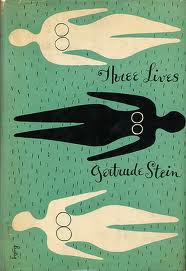
threelives“Melanctha” is told in the third person by an omniscient narrator who narrates closely beside Melanctha and other characters in the story, like Rose Johnson, Melanctha’s best friend, and Dr. Jeff Campbell, Melanctha’s love interest for most of the narrative. Much of the tension in “Melanctha” develops from and is controlled by word patterns, and I would like to look at a few patterns, a few examples, slivers really. The word patterns of “trouble,” “excited,” and “courage” are all connected to Melanctha’s character development, though these same word patterns also control aspects of the conflict between Melanctha and Dr. Campbell. The first instance of “trouble” is tied to Melanctha: “Melanctha Herbert was always seeking rest and quiet, and always she could only find new ways to be in trouble” (3). To give you a sense of its frequency, the word pattern “trouble” occurs 97 times throughout the story. The function of the pattern here is to reveal one of Melanctha’s flaws. The pattern continues on in other instances, though, most importantly, it appears in the sentence introducing Dr. Jeff Campbell: “Jeff Campbell had never yet in his life had real trouble” (14). Already, it’s easy to see the difference, the conflict, between the two characters: Melanctha is always in “trouble” and Jeff Campbell has never known “real trouble.”

Let’s look at a few instances of the intersecting patterns of “excited” and “trouble”: “Melanctha Herbert was always seeking peace and quiet, and she could always only find new ways to get excited” (3). For Melanctha, getting into “trouble” and getting “excited” are connected. One leads to the other, and Stein conveys this relationship in a sentence whose structure is parallel to that of the one with “trouble”: “Melanctha Herbert was always seeking rest and quiet, and always she could only find new ways to be in trouble”. Again, to give you a sense of its frequency, the pattern of “excited” along with its split-off pattern of “excitements” is repeated 27 times throughout the text.

During a conversation between Melanctha and Dr. Campbell early in their courtship, Melanctha suggests that Dr. Campbell do less “thinking” and more “feeling.” Dr. Campbell replies, “…I really certainly don’t ever like to get excited, and that kind of loving hard does seem always to mean just getting all the time excited. No Miss Melanctha I certainly never have mixed myself up in that kind of trouble” (18). Here, the patterns of “excited” and “trouble” intersect to reveal complication and growing tension in the relationship between Dr. Campbell and Melanctha. In this example, the patterns of “trouble” and “excited” indicate opposing viewpoints, alternate lifestyles.

 What makes Melanctha so prone to finding “new ways to be in trouble” is revealed in the following sentence: “Melanctha had always had a break neck courage…” (4) The relationship between “break neck courage” and “trouble” is defined in a later conversation between Dr. Campbell and Melanctha when she says: “…I mean real courage, to run around and not care nothing about what happens, and always be game in any kind of trouble” (37). Dr. Campbell replies, “…its all right being brave every day, just living regular and not having new ways all the time just to get excitements…I ain’t ashamed ever to say I ain’t got no longing to be brave, just to go around and look for trouble…” and, he continues, “that kind of courage makes all kind of trouble…” (38) Dr. Campbell’s idea of “brave” reflects “wisdom” that knows to keep away from certain “excitements” and “trouble.” Alternately, Melanctha’s idea of “courage” is one that leads to new “excitements” and “trouble” of all kinds. This succession of contexts forms a battle of opposites and, as Douglas Glover might say, “the competing points of view strive for interpretive primacy” (97). In other words, whose conception of love will supplant the other: Melanctha’s or Dr. Campbell’s?

Stein constructs the avenue for this struggle along threads of repetition and variation, sameness and difference, through the use of precise, complex word patterns. On “Melanctha,” Frederick J. Hoffman says, “Each of the significant phrases is repeated, again and again, in slightly new contexts, until one is aware of change within a central pattern of conscious experience” (30). Ultimately, the desired effect of Stein’s patterns, of all word patterns, is to produce some sort of change, or, in some instances, an awareness of staying the same.

robert_walser_01

In Robert Walser’s “Nothing at All,” published in 1917, the pattern making is even more transparent. Walser was a German-speaking Swiss writer who published short pieces of prose, novels, plays, and essays throughout 1901 to 1953 during the height of the Modernist period. “Nothing at All” (700 words) is much shorter than “Melanctha” (50,000 words), and while Walser’s patterning and use of repetition is equally interwoven, the compression of his narrative has much to do the transparency of his patterns.

“Nothing at All” is told by a first person narrator who narrates the story of a woman, a little “flighty” and a little “absentminded,” who goes shopping for something “good” for her and her husband to eat for supper that night. In town, the woman cannot keep her “mind on the matter,” a result of her “absentminded”-ness.  Between her inability to keep “her mind on the matter” and being a little “flighty,” the woman comes to “no decision” and goes home with “nothing at all.” At home, she explains to her husband how the “choice was too difficult,” and because her “mind wasn’t on the matter,” she bought “nothing at all.” The “good” husband accepts his wife’s explanation and that night they have “nothing at all,” which, ironically, tastes “exceptionally good to them.”

walserbook1The transparency of Walser’s patterning lends itself more easily to categories of root pattern and split-off patterns. Walser even tips off readers to the main pattern of “nothing at all” by initiating the pattern in the title of the story. Instead of tracing each pattern separately, I will trace the root pattern of “nothing at all” and its connection to the split-off patterns of “good” and variations of the phrase “mind on the matter.” As in Stein’s “Melanctha,” “Nothing at All” contains other patterns that carry all other prior utterances to the pattern they came from while relating to other patterns at work throughout the narrative.

The intersection or tie-in of all three patterns (“nothing at all,” “good,” and “mind on the matter”) occurs at the juncture, or climax, of the wife’s decision-making: “It isn’t good when minds aren’t on the matter, and, in a word, the woman finally got disgusted, and she went home with nothing at all” (110). When the woman gets home, her husband asks what “delicious and good” food she bought for supper, to which the wife responds: “nothing at all.” The woman explains: “‘I went to town and I wanted to buy something truly delicious and good for me and you, I wasn’t lacking in good will, over and over I considered, but the choice was too difficult and my mind wasn’t on the matter, and therefore I didn’t succeed, and therefore I bought nothing at all.’” Walser constructs this sentence using the ancient repetitive structures of polysyndeton and asyndeton. Asyndeton is the omission of conjunctions between phrases in favor of rhythm and speed, as in the first half of the sentence: “‘I went to town and I wanted to buy something truly delicious and good for me and you, I wasn’t lacking in good will, over and over I considered…” The final half of the sentence uses polysyndeton, a repetitive structure relying on excessive conjunctions also in the favor of rhythm: “‘…but the choice was too difficult and my mind wasn’t on the matter, and therefore I didn’t succeed, and therefore I bought nothing at all.’” In both cases, asyndeton and polysyndeton focus on the way clauses (or words and phrases) are linked. In other words, Walser uses these repetitive techniques to establish concise connections between three separate patterns: “good” and its split-off pattern “good will,” “mind on the matter,” and the root pattern of “nothing at all.”

Throughout the story, “good” is used in relation to the “something good” the wife wants to buy for supper. “Good,” in this case, represents intention or character desire. In other instances, “good” had the effect of characterization, like in connection with the “good intentions” or “good will” of the woman during her supper-search, and in the use of “good upright husband.” The woman’s motivation carried by the line, “A woman…went to town to buy something good for supper for herself and her husband,” receives its fulfillment in a tie-in line between “good” and “nothing at all” toward the end of the story: “And so they ate nothing at all and were both satisfied, for it tasted exceptionally good to them” (110). The husband is “in no way angry,” and this irony seems to suggest a resolution, because, in a way, the wife succeeds, at least until the final line of the story, which contains the final instance of the root pattern “nothing at all”: “Many other things would probably have tasted better to him than nothing at all” (111). This line reveals the only instance of judgment from the perspective of the “good” husband in the story, and extends the root pattern of “nothing at all” by complicating the narrative. This final instance also completes the circular momentum of the pattern—and the movement of the piece as a whole—as “nothing at all” moves from its connection of “good” into an implied connotation of “not good.” While “good” is a split-off pattern, it occurs more than any other pattern in the text, 17 times in all, 7 more times than the root pattern “nothing at all.” Here, the root pattern drives the avenue of progression, while the enriched pattern of “good” and all its variant meanings helps to elicit deeper meaning from the root pattern and the narrative overall.

lipsyte

The same kind of transparent pattern making is evident in Sam Lipsyte’s “The Wrong Arm,” a contemporary short story from Lipsyte’s collection Venus Drive, published in 2000.  Lipsyte’s root pattern of “the wrong arm,” initiated in the title of the story, controls the development of the narrative while the split-off patterns and repetitive phrases in the narrative initiate change.

lipsyte_venus_drive“The Wrong Arm” is told in the past tense from the first person point of view of an adolescent genderless narrator, who, for the sake of simplifying pronoun use, I will refer to as “he.” A family—consisting of a father, a mother, and three children—sets out on a road trip to see “the boats of the world” sailing up a river somewhere, but during the course of the trip, the narrator overhears his father and mother talking, and the narrator realizes there’s more to the trip than seeing “the boats.” The father says the boats are one thing and that there is another thing that they all need to talk about once they reach “the boats.” The narrator believes that what his father and mother have to tell the children has something to do with the “wrongness” in his mother, who has an arm with a visual history of “all the scars from all the times something tried to kill her in that arm.” Through the years, the mother’s arm has come to be known as the “the wrong arm.” There are strict rules against touching “the wrong arm”, or leading the mother anywhere by “the wrong arm.” Once the family arrives at the river to see “the boats,” in an effort to prove that “the wrong arm” is just like “anybody’s arm,” that they are “making it wrong by saying it was wrong,” the narrator suggests they “go closer” to the boats, and then he does “the wrong thing.”

As with Walser’s “Nothing At All,” “The Wrong Arm” contains a root pattern that centralizes the progression of the story by creating conflict, increasing narrative tension, and tying into the desires of multiple characters in various ways. The root pattern has branching associations of split-off patterns that, in one way or another, relate back to the root pattern. In Gertrude Stein’s words, each repetitive phrase, in connection to the root pattern of the story, helps to provide new insistence, new emphasis to the pattern. Lipsyte uses patternmaking as a way to compress the history of “wrongness” done to the mother’s “wrong arm” while also progressing the pattern in the present moment of the narrative.

Let’s look at an example that outlines the boundaries of the relationship between “the wrong arm” and the other family members: “All we knew about the wrong arm was that it was wrong to touch it, to pinch it, to rub it…The wrong arm was not for us to take her by and lead her. The wrong arm was not for us to tap it for her to turn” (117). This portion of the root pattern containing its split-off pattern of “wrong” wrenches with tension, and provides a source of conflict in the story. The fact that “the wrong arm” should never be touched acts as an obstacle for the narrator in his quest to discover the truth behind his mother’s mental and physical state. The root pattern of “the wrong arm” and all of its split-off patterns of “wrong,” “wronger,” and “wrongness” repeat 27 times throughout the text.

Lipsyte slowly unravels the history of hurt behind “the wrong arm” and its history of hurt through split-off patterns like “bees,” “bad nails in the porch door,” “porch-door nails,” and “scars.” Split-off patterns relate back to the root pattern in other ways, like the way “the boats” functions as the motive for the scene and the way “waste a wish” functions in the narrator’s evolving line of desire. Of course, there’s not enough time to look at examples of these patterns in any real detail, so instead, let’s look at possibly the most important connection to be drawn from the history of “the wrong arm” as seen in this example of the root pattern: “The wrong arm would never heal right.” Not only is it “wrong” to touch “the arm,” but the narrator also understands that “the wrong arm” would never heal “right.” This portion of the pattern is constructed on sameness and difference, or, as opposites, like in the instance of “good” and the implied “not good” in Walser’s story.

The next example of the split-off pattern “wrong” reveals a change in the narrator’s line of desire when the narrator says, “We were making it wrong by saying it was wrong. We should be holding it and rubbing it and taking her by it to lead her somewhere. To lead her by it to the boats” (121). This is the climax of the story, a turning point in the narrator’s understanding of his mother’s arm as he begins to form a new association in his mind. At the same time, this example recalls an earlier utterance of “the wrong arm” root pattern: “All we knew about the wrong arm was that it was wrong to touch it, to pinch it, to rub it…The wrong arm was not for us to take her by and lead her.” The change in the narrator results from his desire to deny the entire history of “the wrong arm,” to move beyond the prior association that touching “the wrong arm” is “wrong,” and so the story ends on the action of his following through: “And then I did the wrong thing.” All at once, the narrator’s actions extend the split-off pattern of “wrong,” complicate story action, and complete the circular momentum of the plot.

josipovici bookThroughout this essay I have looked at small examples of word patterns for the ways they function in narrative through a relational network of connections. On the relational nature of written language, Barthes says, “connections lead the word on, and at once carry it towards a meaning which is an ever-deferred project” (47). In these stories by Stein, Walser, and Lipsyte, the connections between words do not point immediately to one meaning, but rather, defer meaning through the act of repetition. This effect is something that contemporary British literary theorist Gabriel Josipovici, in his book Whatever Happened to Modernism?, calls the “playing off” of “forward movement against stillness and repetition,” an effect that has long been prevalent in poetry (Modernism, 87).

On the making of Three Lives, the book in which “Melanctha” was first published, Stein says, “In the first book there was a groping for a continuous present and for using everything by beginning again and again” (3). Stein’s “using everything,” her reliance on repetitions, and the varying of those repetitions allowed her to construct Melanctha out of a succession of contexts instead of a scene-by-scene based pattern of conflict. The resulting narrative seems temporally odd with a constantly churning, elliptical momentum. As readers, we move through the narrative without seeming to move at all.

In Walser’s “Nothing at All,” a story of only 700 words, 331 words span the arc of the woman’s journey into town for something good to eat, while 182 subsequent words amount to her re-telling of that journey to her husband after she returns home, a movement that is, essentially, a repeating of, or, using Stein’s words, a “beginning again.” Walser dilates the situation and achieves a complete deceleration of forward movement, or, as Josipovici might say, the staving off of forward movement in favor of “stillness” and “repetition.”

Roland Barthes says that narrative “is an act which necessarily implies a duration,” and by “duration” he means an “oriented and meaningful time” (38). In an essay by Ben Marcus in the June 2003 edition of The Believer, Marcus says, “One basic meaning of narrative [is] to create time where there was none” (2). He also says, “Fiction is the production of false time for readers to experience. Most fiction seeks to become time.” The stories by Stein, Walser, and Lipsyte are all concerned with influencing the way readers experience narrative time through using repetition and word patterning as orienting devices to compress time (in the way Lipsyte compresses a history of hurt into “the wrong arm”), or to subvert our narrative-based notion of passing time (in the way Stein carries out her concept of a “continuous present,” or in the way Walser decelerates the forward momentum of his narrative).

As writers, there’s no way to escape time, but there are alternative ways for building narratives outside of using an events-with-consequences based pattern of conflict. In word-pattern based stories, the duration of the narrative persists as long as the dominating or root pattern remains open, and in this relational temporality, the tension between a set of words behaves similarly to the way consequences separate events. Causality and consequence will always be concerns for fiction writers, but the contingencies that result from the textual connections between repeating words and phrases can also provide narrative movement or momentum, and new opportunities for finding ways in, around, and out of story.

—Jason Lucarelli

——————-

Works Cited

Barthes, Roland. Writing Degree Zero. New York: Hill and Wang. 1968.

Glover, Douglas. Attack of the Copula Spiders. Biblioasis. 2012.

Josipovici, Gabriel. Whatever Happened to Modernism?. New Haven and London: Yale University Press. 2011.

Lipsyte, Sam. “The Wrong Arm.” Venus Drive. New York: Farrar, Straus, and Giroux. 2000.

Marcus, Ben. “On the Lyric Essay.” The Believer. July 2003.

Stein, Gertrude. “Portraits and Repetition,” Lectures in America. New York: Random House. 1935. “Melanctha.” Three Lives. 1909.

Walser, Robert. “Nothing at All.” Selected Stories. New York: Farrar, Straus and Giroux. 2012.


Jason Lucarelli lives in Scranton, PA. He is a recent graduate of the MFA in Writing Program at Vermont College of Fine Arts. This is his second appearance on the pages of Numéro Cinq.


Oct 242010


Here is the reading space, the Issue Project Room, in a renovated can factory. Rather dramatic, vaguely religious ambiance with speakers hanging from the ceiling looking like incense pots. That’s Donald Breckenridge on the left. Some fascinating readings, especially Susan Bernofsky’s Robert Walser translations (here are samples published in The Brooklyn Rail) and Alyson Waters’ Emmanuel Bove translation (another sample published in the Rail). Also terrific works by Dawn Raffel and Johannah Rodgers and John Reed among others. DG read the opening paragraphs of a story called “Savage Love.”

NC contributing editor John Proctor was there with Sarah Twombly and John’s friend Meagan Brothers who wrote YA novel Debbie Harry Sings in French. We all went out to a sushi place on 5th Avenue for a drink after. It was a very NC sort of evening.

Before the reading, DG ate sumptuously at a great Mexican restaurant called Los Pollitos. See photo below.