Mar 132017
 

riiki-ducornet-resizedRikki Ducornet


1. THE VOID

Atte1mpt to imagine – and the task is futile – an absence, as when the night sky is empty of her moon, of moonshine, of stars, of starlight. Imagine a void in which you are without purchase (there is no place to stand); a night as unfathomable as a pool of ink (there is no pool, no ink) in which the vast firmament has dissolved. There is nothing but absence. (And you, the one who attempts this imagining, are nowhere to be seen.)

Imagine the beggar’s bowl once the beggar has slipped behind the trees to relieve himself – one of the many disadvantages of corporality. The empty bowl he did not submit to you is not there, having vanished into thin air, and there is nothing to fill in its absence. (You must also imagine that there is no air.) I say also recalling that when we (who are corporeal and irreversibly implicated in the material world) gaze upon all that has been seeded and aggregated, we are compelled to acquire things illicit and divine, of powers seemingly magical, to cry out; spellbound: “I’ll take that! And also: this!” Some say we are like ravens bewitched by things that catch the light. Imagine an emptiness that knows nothing of light. That all this that surrounds us is gone: the mole on your lover’s cheek, the shape of her wrists – and consider how once before time (I say once well aware of the absurdity) there was only the Void.

Now imagine he who is the Void, that eminence without name, sleeps. He is perfect, self contained, empty of dreams. And yet, unprompted, he starts, and reaching for a thing both essential and absent, murmurs: Light! (He does not eruct. Nor does he roar. The roaring comes later with Yavweh. Do not confuse him with Yavweh!) (Some will tell you he tore an egg in two and with the yolk made the universe, but no! You see: he was himself the egg!)

This light of his that surges forth the instant he speaks fills the void. Dazzled, he awakens. Or, rather, he is that Dazzlement. He is that Awakening.

That… Quickening.

As when a youth sees, not quite hidden by the leaves, a girl the color of wild honey standing in a pool of water, illumed by the lunar light. Threading the water through her black hair, she moves her limbs in the seductive manner of the willow, the water revealing and concealing forms that – if they are the vessel of light, are also the very things that lead us astray, far from the light we aspire to that initial impulse empty of confusion, limpid and marvelous. (Yet she is marvelous also; this I admit to you. She who causes Confusion! And one is left wondering: why has he who is the light, who is the Egg, engendered so many questions begging answers? The truth is, she is about to upend everything. Washing her hair!

We have acknowledged that the Void is empty beyond emptiness. A regency with nothing above, below, or to either side and so: incorruptible. At its core the Resplendent Germ burns devoid of femininity (yet harboring Her potentiality). He knows (he knows everything) that love without an object is unimaginable. She is there, immanent, standing in a pool of light that reaches her navel: Barbelo! He gazes into the generative mirror that he is and that surrounds him, and sees his reflexion burning there. In this way she is sparked – as when an ember leaps from the fire and blazes alone on the tiles before the hearth.

Enamoured from the First Instant (and this is exactly what it is!) he adores her. After all, is she not a perfect projection of himself? Only an image and yet she knows enough to praise him and ask at once for gifts. She has clout! She is the Womb of Everything. He gives her what she wants in a flash: Thought! Truth! Indestructibility! Foreknowledge! Eternal Life! Newly minted archons, they stand in gratitude, bowing and scraping: the Androgynous Pentad of the Aeons!

Everything stirs. When he gazes into her eyes, a pneumatic current penetrates two perfect irises. Quick as lightning she conceives the One who, if resplendent, will fail to save the world. The Christ! Who any second now will uncoil in Eden, his scales like prisms gleaming in the moonlight, and speak convincingly and sensibly of moral awakening to Eve and her Adam – and this to the eternal rage of Yavweh – that despicable interloper.

But before that can happen, a galaxy of superterrestrial luminaries are projected by the Pentad – they cannot help themselves. Their names are far to numerous to put down here; indeed they would demand a book, no, an entire Library (as would the names of the sublunar demons that, thanks to that malevolence: Yavweh, will any minute now appear in droves and elbow their way into every aspect of existence, disguised as beasts: aerial, aquatic and terrestrial, and hell-bent on corrupting, corroding, mortifying, and bringing everything down. But for now there is Subtlety. There is Perfection. There is Time, also. And space. Indeed the two embrace with such conviction they cannot be torn apart – as on an evening somewhere in the galaxy, lovers come together and time stands still and the flesh dissolves into heat and light. Above them the sky shimmers with powers, with alphabets of fire. These foretell everything to come.

From this bright turbulence Wisdom arises – a luminous egg of stardust quickened by a serpent of fire whose tail rends the night sky like a knife of ice. She is called The Virgin. Perfect Memory. The Lustful One. The Wanderer. Wisdom. Pistis Sophia.


2. PISTIS SOPHIA

Alone, suspended in a liminal space between perfect light and chaos, she considers how Barbelo was made, and longs for a loving image of her own to cherish. She acts without permission, and this is her error. Her impulse, born of loneliness and longing, is unlawful. To her shame and horror, she creates a monster with twelve faces – all roaring for attention. She names him Yaltaboath, but his names will be many: Abortion, Miscreation, Abomination, The Adversary of God, Saklos, Samael, Yavweh, Man Eater, Jehova. She takes him far from everything, sets him on a throne within impenetrable clouds and abandons him. Exhausted she sleeps. Her sleep is restless. The cosmos takes on weight. Opacity.

Yaltaboath’s rejection is bitter beyond bitterness. Where he sits brooding, the sky grows dim. “I am God!” He bellows into the silence. “There is no other!” And he calls forth an army of angels to do his bidding: The Reaper, Pestilence, the Keeper of the gates of Hell. Melancholy. Gangrene. There are 365 of them: one angel for every day of the year. They have the faces of wild animals, their forms scripted from the stars in the sky or, as was the bull, seeded by the moon. (It is said they have significance beyond themselves. The fish correspond to the deep waters of the soul, the birds to the soul’s longing for the light.)

But… what of Adam? Is Adam immanent? Do the stars foresee him? Or is he a projection of Yaltaboath’s pride? We know this: it takes Yaltaboath’s angels 365 days to make Adam.

.

3. ADAM

Adam is formed of red clay. He is formed of mud, of ashes. (Some call him “volcanic.”) Each of Yaltaboath’s angels make one of his 365 parts: bone soul, sinew soul, blood soul, the right testicle and the left. The angel Yeronumous makes an ear, Bedouk a buttock and Miamai the nails of his feet. (Some say Adam falls to earth from deep space like a meteor – as did that other wild man: Enkidu.)

But angels cannot proceed without demons and so Yaltaboath now summons the passions that – you will appreciate this – take hold only where there is a body to contain them. Passion such as dread and grief, agony and wrath; the kind of thwarted loving that leads to death. (These take their source from carbon, sucking it up just as the infant sucks milk.)

Once Adam is formed, his body is perfect and yet without cohesion. He cannot stand but worms his way along the ground inch by inch. At night when he rests his head on a stone, his lungs ache with dust. He is confused. In the wind he trembles. His destiny is unknown to him; he is unknowing. His life is like the death the Mesopotamians describe in which the dead kneel naked in the dark eating clay.

At last, the archons of the Upper Spheres look down and see Adam confounded in his filth and suffering. They rush to Pistis Sophia and awaken her. She is scolded and she is advised. She calls for Yaltaboath at once. As he approaches, gyring in a vortex of fever and contagion, she shudders with horror. But Yaltaboath is flattered, disarmed by the unprecedented attention. His mother has summoned him at last! And he has so much to tell her! He is the master of an army of angels and demons! Master of an entire world! Its moon and neighboring planets!

“I have seen your creature,” Pistis Sophia tells him. “I have seen how he dwells in ignorance, unable to speak or stand. Yet he could be flawless. Breathe into his nostrils and he will rise. Even the archons, the angels will envy his beauty.

Yaltaboath descends to earth at once and does as she has told him. In the instant he breathes into Adam’s nostrils, Adam stands. But there is something more. The one spark of light that was Yaltaboath’s now belongs to Adam. This gift is immeasurable, for now Adam is fully capable of transcendence.

Yaltaboath sees that he has been tricked and ignites with anger. The same anger that will torment Job and test Isaac. The same anger that will bring down the tower of Babel and cause men to speak to one another without comprehension.

.

4. EVE AND THE SERPENT

Awakened to the world, Adam explores paradise. Everything speaks, everything sings. He discerns spells on the backs of turtles, and drinks at pools of fresh water with the lions and gazelles. There are sweet grains to eat, figs, pomegranates, and bitter herbs. What is the world if it is not magic? But if all the creatures have a mate, Adam sleeps alone.

Once again the angels take up the red clay. Formed in the heat of their hands, Eve is the color of cinnamon, of ebony. Her eyes are gold, silver and pearl, and her hair falls to her shoulders like clusters of grapes. When Adam sees Eve for the first time, a veil lifts from his mind. Eve. The moon incarnate. Her perfect flesh unscarred. Reaching out he touches her for the first time. Seven days and seven nights they cling together. In the moonlight the bees move among the stars. My beloved, Adam whispers. My one and only murmurs Eve. (And it is true.)

Christ, who always hovers near, sees this unfold, and smiles. He appreciates that they are resplendent in one another’s eyes, just as Barbelo and his father were once resplendent. He is covered in iridescent scales, and as they embrace he coils around the tree, the One Tree, like a vine, singing. When at last the lovers lie quietly side by side, he approaches Eve. His voice is irresistible. (Of all the creatures in Eden, Christ is by far the most beguiling.)

That night the three of them eat apples, watching lightning strike the horizon, the comets tearing space like birds with knives in their beaks. In the sound of thunder they hear Yavweh’s insane bellowing. (He has never ceased his bellowing and his angels have never ceased their yammering!) When day breaks they run for their lives.

Later, as Adam and Eve continue on alone, they ask questions of one another such as:

Why are we punished in our bodies which are the vessels of light?

Why are we banished from Eden, longing as we do, for the light

—Rikki Ducornet

x
The author of nine novels, three collections of short fiction, two books of essays and five books of poetry, Rikki Ducornet has received both a Lannan Literary Fellowship and the Lannan Literary Award For Fiction. She has received the Bard College Arts and Letters award and, in 2008, an Academy Award in Literature. Her work is widely published abroad. Recent exhibitions of her paintings include the solo show Desirous at the Pierre Menard Gallery in Cambridge, Massachusetts, in 2007, and the group shows: O Reverso Do Olhar in Coimbra, Portugal, in 2008, and El Umbral Secreto at the Museo de la Solidaridad Salvador Allende in Santiago, Chile, in 2009. She has illustrated books by Jorge Luis Borges, Robert Coover, Forest Gander, Kate Bernheimer, Joanna Howard and Anne Waldman among others. Her collected papers, including prints and drawings, are in the permanent collection of the Ohio State University Rare Books and Manuscripts Library. Her work is in the permanent collections of the Museo de la Solidaridad Salvador Allende, Santiago Chile, the McMaster University Museum, Ontario, Canada, and the Biblioteque Nationale, Paris.

x
x

Aug 012016
 

Brightfellow1

Herewith is a passage from Brightfellow in which its main character changes identities. No longer is he known as Stub—a strange and lost figure—but as Charter, a young, Fullbright scholar. The identity of Charter is a lie, of course, but in this brief section, he sees the possibilities and promise of becoming someone new. Asthma is a daughter of one of the other professors who lives on the Circle. She has captured the imagination of Stub/Charter, who believes she is the key to recapturing his lost childhood. —Jason DeYoung

.

Everything changes. Because Billy, Professor Emeritus, lonely, long in tooth, all angles, all elbows and knees (and he has always been this way, graceful and unwieldy at the same time, his broad shoulders holding it all together), open-faced, of sunny disposition, an optimist, wearing a cotton shirt the color of Dijon mustard, hunts down Charter Chase and finds him.

“There you are!” he says. “I’ve been looking all over. Been prowling the stacks!” He puts out his hand and they shake, like gentlemen. Billy cuts to the chase. “Charter,” he says, “I’ve been wondering about . . . well. About your digs.Are they adequate?”

“Ah . . . well . . .” Charter laughs uncomfortably. “You know what it is like to be a poor student, but—”

“Of course I do!” Billy cries. “Indeed I do! So here’s the thing, son,” and he pats Charter on the shoulder paternally (or so Charter supposes, having never received anything like this from his father). “I live alone, ” Billy continues as they make their way together down the steep library steps and into the full light of day. “The house is far too big. I barely enter the upstairs. There’s an entire living space up there, bedroom, bath, study.” They approach Faculty Circle and he points to one of the several gracious faux-Tudor houses with pitched roofs and screened-in porches. The stucco façade is a pleasant shade of sand, the wooden window frames painted a rich chocolate. “The place is shipshape of course. Nicely kept up by buildings and grounds. But I imagine you are familiar with the Circle.”

Charter is not only familiar with the Circle, but with Billy’s house. It was Billy’s countertop that had once provided him with a cooling pie. Charter nods. Says, “Yes. The Provost had a little get-together for the foreign students a while ago—”

“Of course!” Billy considers his rehearsed delivery. “Uh,” he says. “Here’s the thing. Here you are, a Fulbright scholar far from home living—or so I imagine—in inadequate housing and, well, surely you can see where I am coming from.”

“Sir. I do. I do. I do not dare . . . it’s too kind, far too kind.” Charter runs his fingers through hair he knows is in need of some attention, and which Billy addresses at once.

“Have you, have you . . . been to an American barber?”

“No, sir—”

“Billy.”

“No, Billy. Short on funds and as you can see I am personally not too handy in that direction.”

“I’ll take you to town. I know a good man there. Now, the upstairs is nicely done up.” They stand together on the Circle now, looking at his house, which shares a lawn and a lilac hedge with Asthma’s.

“Terrific closets. Full use of the screen porch,” Billy says, “the kitchen. Do you cook?”

“No—”

“Of course not. You are busy. With Loon! Who could have imagined this! My own days of being busy are over. I’ll cook for the two of us. I am bored cooking for myself. Losing touch! Look at this scar.” He throws a hand into Charter’s face. “Trimming a radish.” He thrusts the tip of a thumb into his mouth and sucks it. “I am, therefore, in all simplicity, no strings attached, proposing a proper dwelling, nicely done up by Margaret, who blessedly is gone to Wisconsin and out of our hair, yours and mine. One of the perks of being a college professor—in case of divorce, the professor cannot give the spouse the house! My campus digs are…on the house! On the house!” He laughs almost to tears, raving as they pace together around the Circle. I’ll get the upstairs tidied up and then, Charter, it’s yours. In the meantime, come for supper. Are you free?” Charter nods. “Six. I’ll show you your digs, get the cleaning lady—she’ll be here later in the week—to give the place a thorough…Do you need help moving?”

“Sir, Billy. You will be amazed by the little I have. My things, such a nuisance, but it’s o.k., really, were lost in transit. The authorities… nothing doing!” (Already Charter was picking up on Billy’s manner of speech.) “Nothing doing! But, hey! I get by! On a shoestring, of course …”

“That’s my boy!” Billy slaps Charter on the back. “Till six!” And off he goes.

Charter has a new good-looking back pack purloined from Hum Hall at the final semester’s end a month earlier: solid canvas duck, color of good tobacco, hand sewn, leather trim and straps—a Brunchhauser! He will pick up a pair of serviceable rubber-soled leather boots, heavy for the season but good for walking the woods, a top-of-the-line sweater, and two handsome striped shirts, all currently in a gym locker. He makes his way to the gym and showers, thinking: This could be good. Despite the risks. The heavy price if discovered. Then, suddenly ecstatic, he roars. That night he writes:

The chapel bells guide my hours. To their chimes (every fifteen minutes!) time unspools, the seasons and their constellations spill across campus like a sea. I set off for Billy’s a few minutes before six and arrived just as the bells chimed:

Doing! Dang! Doing!

Doing! Dang! Doing!

As I walked up the Old Boy’s path holding my head high, I considered the nature of destiny. A garden snake rode the grass beside me, the smell of garlic and tomatoes stimulated every nerve in my body, and a flock of swifts disturbed the quiet blue of the sky: And let fowl fly above the earth in front of the vault of Heaven. (Vanderloon quoting the Bible.)

*

Billy could not be happier having popped the question (a silly way to put it!). Once, he had popped the question to Margaret (fatal mistake!); this time he has simply offered a few vacant rooms to a young scholar. But loneliness has been leeching the marrow from his bones and as he tends to supper, rinsing greens thoughtfully, stirring spaghetti sauce, exuberance overtakes him. The boy, he is certain, will be an easy, grateful companion. He needs attending to; there’s something unfinished about him; he’s wounded somehow, much too thin, older than his years. Billy will feed him the meals he does best: spaghetti, beef with gravy—solid American middle-class fare—along with some of the great dishes of Normandy he came to love during summers spent abroad. Billy also bakes a pie. (Once, he had baked a perfect rhubarb pie that had volatilized as it cooled on the counter. He liked to say it was a miracle: That pie was so flawless it went to Heaven! But things did have a way of going missing on the Circle. Goldie insisted it was poltergeists.)

Billy sets the table. He grates the Parmesan, sets out a small bowl of red-pepper flakes, and sprinkles a pinch of oregano into the sauce for its final fifteen minutes. Precisely at six Charter arrives and the two sit down to supper, the one facing the other. Looking into a deep white dish brimming with hot noodles and large meatballs sweating juice, Charter is moved nearly to tears.

“Biblical!” he exclaims.

“Why biblical?” Billy wonders.

“It’s ambrosial and…gives off beams of light!”

“You’ve been reading too much Loon,” Billy jokes. “I’ve only served you a dish of spaghetti.” Yet he is pleased. “Curious you say that, though…” He tells his young guest about the vanishing pie. Charter blushes, but briefly. Billy’s innocence in the matter is evident. “Are you religious?”

“No,” Charter tells him. “Although I like to consider just how horny Noah’s toenails were when he hit six hundred.”

“Moses had horns…,” Billy muses and then confides: “I am a private sort. Reclusive you could say. In this way I am much like your friend Vanderloon, although he has taken it to extremes. Perhaps campus life breeds recluses. Well. What I mean to say is you will find it quiet in the house. You will be able to work undisturbed. The Circle could not be more conducive to study. Well…there are the children and they have their games, but still…they really don’t create much disturbance. Let me show you your room!”

What impresses Charter about the house first of all is that there are no photographs, no family pictures on the mantel or sideboard, no dead parents, ancestors, pets. Apparently Billy is not only wifeless, he’s childless. This is comforting. If there had been photos everywhere Charter would have felt like an intruder. But he thinks instead that he can do well here. He will enter into a serious study of Vanderloon’s ideas, not just collect them as one collects curiosities. Not just wander in the books aimlessly.

The house is spare; apparently Margaret had brought along a great deal of family furniture that left the house when she did. Billy has gone for a certain modernist minimalism, uncommon on the Circle. The few pieces he has acquired are angular, blond, the lamps as disquieting as space aliens. On the walls are a few framed museum posters, someone named Rothko who Charter thinks must have been a house painter, and a Dalí that causes him so much anxiety he will stay clear of it during his tenure in the house. An inscrutable Boz Heiffer.

Together they climb the stairs and reach a hallway lit by a clearstory: the light! Billy leads him to a large room furnished with a desk and chair, a reading chair, and a number of those peculiar lamps, each one pointing at them accusingly. “Ah!” Billy laughs. “The cleaning lady, I don’t know why…” He redirects them into a more serviceable angle.

Above the desk is a large window. Stub’s heart leaps; his ears are ringing; he feels like singing: the room has an unobstructed view of Asthma’s own.

—Rikki Ducornet

This excerpt is reprinted by permission from Brightfellow (Coffee House Press, 2016). Copyright © 2016 by Rikki Ducornet.

N5

ducornet01_body

Rikki Ducornet is the author of eight novels as well as collections of short stories, essays, and poems. She has been a finalist for the National Book Critics Circle Award, is a two-time honoree of the Lannan Foundation, and is the recipient of an Academy Award in Literature. Widely published abroad, Ducornet is also a painter who exhibits internationally. She lives in Port Townsend, Washington.

.
.

Aug 012016
 

Rikki Ducornet photo

 Brightfellow combusts with beautiful words and sentences. It builds a narrative that burns clean to reveal the complexity of our self-made identities and misplaced desires. —Jason DeYoung

Brightfellow1

Brightfellow
Rikki Ducornet
Coffee House Press, 2016
$15.95

.

The prized vision in Brightfellow is that of youth and innocence, where the dream of life is perhaps the purest, strongest, and most vibrant. Over and over we are shown this vision along with how the adult characters long to return to this state, yet they are most twisted by life events: by cruelty, by misunderstanding, by repression, by the denial of the imagination. It is a convincing portrayal by Rikki Ducornet of what she writes about in her slim volume of essays, The Deep Zoo (a skeleton key, if you will, to how she thinks and creates): “The betrayal of infancy is ubiquitous, and its forms are many.” Our main character embodies perhaps the deepest betrayal—the denied childhood.

Brightfellow is a dynamic short novel by one of our most linguistically creative writers. I don’t believe I’ve ever come away from one of Ducornet’s novels uninspired. They are all marked by a fecundity and richness, yet not overwrought. She is the author of nine novels—including most recently Netsuke (2011) and Gazelle (2003)—as well as collections of short stories, essays, and poems. She has twice been honored by the Lannan Foundation, and she is a recipient of an Academy Award in Literature. She is also a gifted visual artist and collaborator, which Numéro Cinq was pleased to highlight in July.

Like much of Ducornet’s work, Brightfellow packs multitudes into a small number of pages. The cast of characters is few, but Ducornet’s craft is so practiced that it feels like a larger novel. Brightfellow is divided into two sections. Part one is brief, running only about sixteen pages; part two takes up the rest of the novel. The first part recounts a few particular childhood memories of the main character, Stub[1]. We meet him when he is six years old, in the midst of imaginative play, an adventure he has devised of crossing pitfalls and evading animals he envisions into the linoleum. He is a lonesome boy, but happy. His mother is a local radio personality and his father is a traveling seed salesman. Of this time the narrator writes: “If you could peel him like an orange you would find laughter all the way through.” Yet there is suffering, too. Stub’s mother shakes him when she is angry, and his father, whom he knows will never hit him, is distant. When both parents are home we are told that Stub’s “secret life” is silenced.

Around this time, Stub’s parents hire Jenny, a young woman who has spent some time in a “madhouse,” to be his afterschool nanny. She is strange and vibrant—she easily enters the imaginative worlds Stub creates for them to play in, and she tells the boy of some of her hallucinations. Their play will become so intense one day that Jenny ignores the phone when Stub’s mother calls to check up on them. This becomes the reason, perhaps, for sending Jenny away. But Stub is a child, with a childlike understanding of the world and a limited understanding of how adults operate. All he knows is that his playmate has been sent away, and later, his mother, who will want “more of the world, more of life,” will leave too. “And there they are, Stub and his dad, sitting in silence face to face, the favorite green and white dishes scolding and cold to the touch, the linoleum purged of magic…”

We catch up with Stub years later in Part Two. He is now living in the shadows on the campus of the university nearby. He isn’t a student, but just someone who haunts the university. When asked who he is, he claims to be someone else. In truth, he is there researching Verner Vanderloon, an author Jenny introduced him to years ago. He lives by hook and crook—stealing food, stealing money when he can, going through the garbage at the end of each semester to retrieve the nice things well-off students toss. It’s hard to fix a time in this novel, but it is pre-internet, set after a dimming war, television is in black and white, and the Marx Brothers are still of interest and easily present in conversation.

Two people come into Stub’s life—one by observation, the other by accident. The first is a little girl around eight years old named Asthma, one of the professors’ daughters, who is “my own fairy child,” as Stub writes in his journal. “I hope to know her as well as…I know every pop and snap the library makes in the dark after hours and the taste of canned minestrone when you have spooned it into your mouth for twenty consecutive days.” For Stub she is a marvel to behold—imaginative, innocent, energetic. In Asthma, Stub believes that if “he could play beside her, he would recover all that is lost, all that was taken from him—so long ago now—when Jenny was sent away and all the games they had played together were reduced to the worst feeling of absence.”

The other character Stub meets is Professor Emeritus William Sweetbriar, ‘Billy.’ As with most encounters with professionals on campus, Stub invents a spur-of-the-moment identity for himself. He tells Billy that his name is Charter and that he’s from South Wales, and he affects a slight Australian accent. He tells Billy that he is on a Fullbright, there to study Verner Vanderloon’s archived papers and writings. Billy, a sympathetic and kindly old professor (also gay) takes a shine to the young scholar, and insists that he come by for dinner, which leads to Stub (who is now known in the text as Charter) moving into Billy’s upstairs. Billy lives on the “Circle,” where many of the professors live. Astonishingly, by proximity and angle, the upstairs apartment provides Charter an unobstructed view of Asthma’s room.

What we see between this point and the final (but brief) cat-and-mouse game that culminates the novel, is a kind of doubling of shaded relationships—Asthma is to Stub as Charter is to Billy. These relationships don’t necessary take on an erotic coloring (or if they do, it’s faint and something not necessarily recognizable in a common sense), in fact the erotic is often denied. These relationships are built instead on imaginative play; characters are nourished by other character’s imagination, vision, creativity. Billy is enlivened by Charter’s fanciful tales of Verner Vanderloon’s more esoteric and obscure writings—all of which Charter invents. Charter/Stub is enchanted by the earthiness and wonder of Asthma: “[He] relished the proximity to her skin, her little ears, her impossible eyelashes, a vague smell of piss, of violets. He thinks she is oblivious to her beauty, which is like a flame. He thinks, That is what angers Blackie. This flame. (Blackie is Asthma’s hateful mother.) Despite the intimacy of these details, however, it doesn’t seem to be erotic love Stub feels, but the “child’s promise,” which is described as “immeasurable.”

Running like a dark wave through the novel are quoted passages from Verner Vanderloon’s works. Vanderloon was a reclusive professor at the same university, his coevals being well-known scholars such as Levi-Strauss and Geertz. Known to be eccentric and irascible, his sociological writings describe a “dark” and “cruel” world; campus legend has it that at his retirement supper, he’d asserted “our species is doom to perish cursing its own boundless absurdity.” Some of the works cited by Vanderloon are quite kooky—as this fictionalized academia takes a disrespectful view of his work—but in one quoted section we grasp something at the center of Brightfellow, which offers a philosophical backdrop to the novel:

Vanderloon divides mankind into two constants: the one who ‘knows how to play, are full of mirth and fellow feeling, and the ones who are killjoys and combustible. Play, he writes, is a powerful form of magic—sometimes white, sometimes black. But always it is born of invention and intuition. Play is about becoming human, just as it is also about becoming a lion, a tugboat, a galloping stallion. The hallway that leads away for the child’s room and into the depths of the house is a river, a glacier, a bridge to the moon’

It is this passage that Charter dwells upon while gazing at Asthma from his window, knowing that he would “never get closer to life,” despite entered the “fabric of things” by creating the fiction of Charter. He laments that his new identity will not get him closer to “true life,” which he wants. Yet what he doesn’t know is that many of the other characters live a fiction. Mirroring Charter’s struggles are the sketched subplots of the other professors living on the “Circle”—each one isolated by desire, circumstances, misunderstanding, and envy. In Brightfellow, a portrait emerges of a lonesome boy surrounded by other lonesome people, their loneliness unbeknownst to one another—not one understanding, as Dr. Santa Fofana puts it toward the end, that the “world is a dream.”

As I mentioned above, Ducornet’s prose is consistently fun to read for it rhythmic qualities and primal exuberance. There is a kind of uplift to her writing, even if it’s dark; and there a potency and passion in its more quite corners too, where she sprinkles in a odd detail or gives a new name to the mundane. It’s somehow elemental and lights the mind. Here’s a lively passage, just as Charter is becoming a little more comfortable in his new skin:

How good it is to smoke a cigarette, one’s back against a solid wall, the breeze playing in the leaves, the Circle silenced, each window the promise of a shadow-puppet play. Pathos and terror, black comedy, tenderness and loss, fire and ice, pleasure and punishment—all this surging and ebbing in those ruthless, wondrous, persistent rooms. Such sweetness! Such menace! He looks on as lives grow stale, are renewed. As kittens grow into cats; as betrayal rustles the sheets, rolls under the crib, and comes to rest there; as Death catches a glimpse of a maiden and cannot turn away.

“Beautiful words are the mind’s animating flame,” Ducornet writes in her essay “The Deep Zoo.” A delicate and airy novel, Brightfellow combusts with beautiful words and sentences. It builds a narrative that burns clean to bare the complexity of our self-made identities and misplaced desires. Albeit a tragic short novel, its scope revals a hopeful glimpse into one of the things that make us human—our ability to imagine.

—Jason DeYoung

NC
Jason DeYoung

Jason DeYoung lives in Atlanta, Georgia. His work has appeared or is forthcoming in numerous publications, including Booth, REAL: Regarding Arts & Letters, Corium, The Austin Review (web), The Los Angeles Review, New Orleans Review, Monkeybicycle, Music & Literature (web), and Houghton Mifflin Harcourt’s Best American Mystery Stories 2012. He is a Senior Editor at Numéro Cinq Magazine.


[1] You’ll notice the character names in this novel are downright Dickensian: Stub, Pea Pod, Goldie’s Rod, Verner Vanderloon, Jiggs Wiznet, William Sweetbriar, and (my favorite) Dr. Santa Fofana.

Jan 062015
 

Rikki Ducornet photo

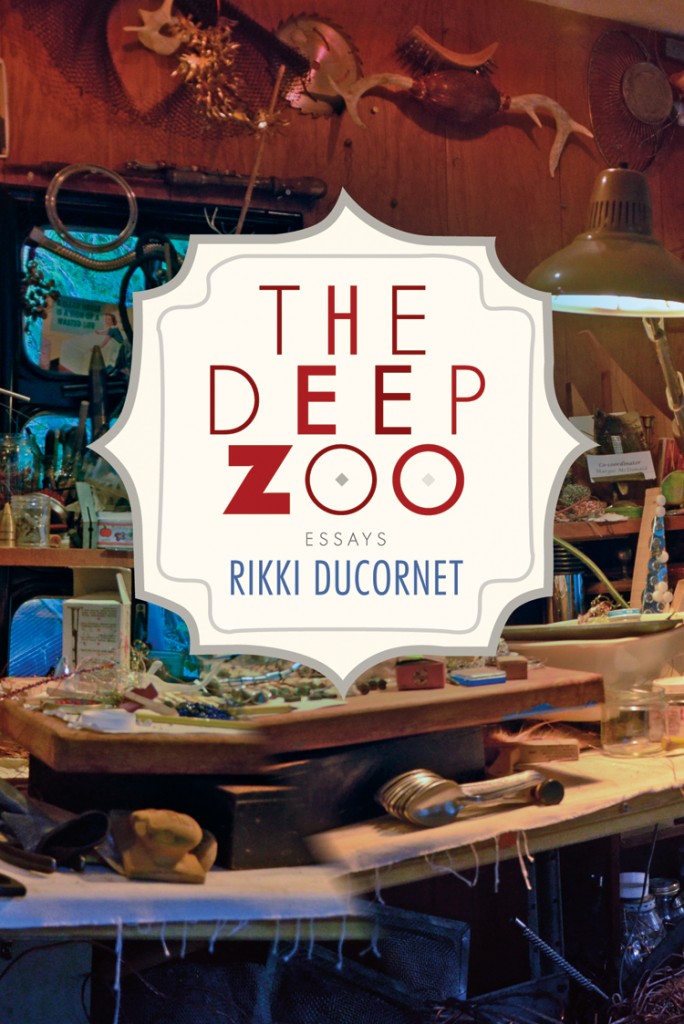
Subversive at heart and acutely perceptive, The Deep Zoo celebrates the knowledge that “Nature loves order, the beautiful, and the anomalous.” It plies us to savor the spiritual and the scatological, and not to wither in moral certitude.  —Jason DeYoung

 Layout 1

The Deep Zoo
Rikki Ducornet
Coffee House Press, 2015
119 pages, $15.95
ISBN: 978-1566893763

.

The Deep Zoo is a seed! From this seed come our initial impulses and multiplicities. Our Deep Zoo is the place from which we dream. It is this place from which you came, the place from which you interpret the world, the place from which you create. As Gaston Bachelard, Rikki Ducornet’s favored philosopher, says, “daydreams illuminate the synthesis of immemorial and recollected. In this remote region, memory and imagination remain associated, each one working from their mutual deepening.” The Deep Zoo galvanizes us. It is potency.

The author of nine novels, three short story collections, five works of poetry, and the winner of countless awards, Rikki Ducornet has long been a star shining brightly over contemporary literature. Her writing, however, often runs counters to its trends. Refusing to be part of established realism—which she skewers for its “inescapable redundancies”—she looks for something more inward, an art that fulfills the promise and richness of the imagination. Much like Robert Coover (whom she notes as influential) Ducornet’s preoccupations are mythology and metamorphosis, and it is this richness and delight in play (an art in-and-of itself) that attracts me to her work.  (Rikki Ducornet is also an accomplished painter to boot and shows internationally.)

The daughter of a Bard College professor, with extensive travels throughout the world, including Algeria, Japan, France, and Palestine, she is steeped in worldly texts and to call her an American writer seems nearly inaccurate. The depth of her knowledge and comfort with diverse subject matter is daunting, and in The Deep Zoo alone she deals with Egyptian mythology, Werner Herzog, United States foreign policy, Marquis de Sade, and Islam among others. The opening words of The Deep Zoo might well-convey the wonder and direction of this slim volume:

In the tradition of Islam, the first word that was revealed to Mohammed was Igrá (Read!) The world is a translation of the divine, and its manifestation. To write a text is to propose a reading of the world and to reveal its potencies. Writing is reading and reading a way back to the initial impulse. Both are acts of revelation.

Comprised of fifteen essays, most of which are no more than six or seven pages long, the entire text of The Deep Zoo runs only 119 pages—work cited and acknowledgements included. But while its page count is trim its capacity for insights and range of thought between its cover is sprawling.

The collection leads with its title essay, limning Ducornet’s philosophical point-of-view toward art and literature. “The Deep Zoo” acts as a kind of foundational text, a lens to view her work and the other essays through. She writes that the Deep Zoo is a way of seeing, “the recognition of a pattern that informs the mind.” From this arena of unlimited encounters come the artist’s vision, the writer’s text. Ducornet believes in the power of language to clarify, to articulate the ineffable—its most ancient task. A writer’s duty is to “access memory, reverie, and the unconscious—its powers, beauties, terrors, and perhaps above all, its rule-breaking intuitions, and to celebrate … the mind’s longing to become lighter, free of the weight of received ideas and gravity-bound redundancies.” Often her rapturous prose leads to some heady moments.

Although the essay trades in concepts that might seem somewhat abstract, the following essays reveal what Ducornet means by Deep Zoo through examples. She explores the “mixto” paintings of Linda Okazaki and the restless sculpture of Margie McDonald. She finds ineluctable life in the flickering imagery of Werner Herzog’s The Enigma of Kaspar Hauser, and delights in the gnostic vision of David Lynch. With her keen eye for the amalgamated and strange, she takes great care to highlight works awash in estrangement. In each piece of art work she analyzes, she looks for the emblematic seed, the forces which “fall into sympathy with one another,” which engenders the work, often finding them in “intangible things,” such as in Omensetter’s Luck, or in the singular “banality” of death in de Sade’s 120 Days of Sodom.


last_run_1983_smallerLinda Okazaki, Last Run

Many of the essays in The Deep Zoo recount stories of Ducornet youth, where ones Deep Zoo originates. She traces her own Deep Zoo back to a dead fox she found in the woods when she was a girl; a swarm of yellow bees around its belly. She calls this “a species of animated calligraphy”; it transformed what otherwise might have seemed horrible into a thing of beauty. In other essays, she describes more practical matters to her art. In “Water and Dreams,” Ducornet gives her clearest view into the workings of her mind and writing. Originally written for Rule of Thumb (ed. by Michael Martone), it is an analysis of her novel The Fountains of Neptune. Here Ducornet dismantles the work to spotlight the rhythms and currents running through it: a demonstration of the mechanics of the Deep Zoo. She writes that The Fountains of Neptune “is punctuated by the water’s meteoric forms… consciously associated in order to suggest the many moods of the sea.” Before writing it, she says she made lists of water and sea images, but during the process of writing, she allowed the novel’s “intention [to] evolve from within,” so “the entire process had a weather of its own.”

No, Ducornet’s advice isn’t as brusquely pragmatic as ‘write what you know’—I doubt she’d send you chasing your own tail like that. Instead, her advice is far more freeing. Subversive at heart and acutely perceptive, The Deep Zoo celebrates the knowledge that “Nature loves order, the beautiful, and the anomalous.” It plies us to savor the spiritual and the scatological, and not to wither in moral certitude. Indeed, it accomplishes what the best books I’ve read always do. It opens its reader to new concepts and stirs new ways of thinking. As Ducornet has the Marquis de Sade say in her novel The Fan-Maker’s Inquisition: “What is reading if it is not dreaming? The best books cause us to dream; the rest are not worth reading.”

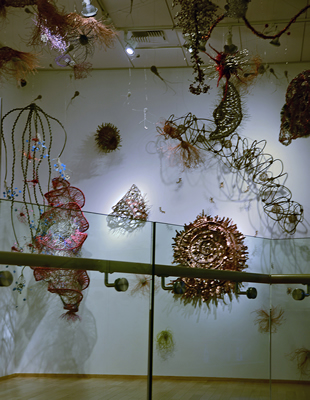
bainbridge2Margie McDonald, Sea ‘scape

Taken with and obsessed by the paradoxical and the mysterious, Ducornet’s honors the mutable heart of life, refuses to label the body as “fallen” or “vile,” and clearly worships the “divine.” Yet her outlook is clear-eyed and scientific, too. She won’t abide magical thinking or a good wallow in obscurity. At once a political book The Deep Zoo is also playful, as the essays do not follow any preordained structure and seem often to move with the currents of their author’s mind. One of the intriguing features of Ducornet’s essays is that they often end with smart quotations from writers she admires. But in fact, she has written a very quotable book herself, and I want to conclude here by sharing some of Ducornet’s own wise words:

It is the hidden significance of things that both explains and propels us forward with an eager intelligence. The paradox of hidden knowledge is that it recognizes—in ways that are wordless and intimate—an embrace as old as time, older than language. And yet it is also the force that leads to the impulse of word-making.

§

If naming and listing leads to a certain disarticulation of the world, it also articulates the experience of the ineffable; it allows us to consider and articulate causes and effects and even to cherish the anomalous, because when known patterns are disrupted, we are forced to consider (and to reconsider) the meanings of things.

§

I think of a novel as an unfolding landscape, an entire country waiting to be deciphered.

§

The creative impulse, Eros breathing and dreaming within us, is radical to the core.

§

The human imagination poses searching riddles, and the moment it does, poetry and science, philosophy and cosmology are born.

§

Hating and fearing the body, we turn away from knowledge of the other

§

Thankfully, art pays no attention and continues to subvert pieties and expectations, to rile fuddy-duddies and ride a brighter air.

§

A world worth wanting cherishes the risks of wildness.

—Jason DeYoung

g

jason

Jason DeYoung lives in Atlanta, Georgia. His work has appeared or is forthcoming in numerous publications, including Booth, REAL: Regarding Arts & Letters, Corium, The Austin Review (web), The Los Angeles Review, New Orleans Review, Monkeybicycle, Music & Literature (web), and Houghton Mifflin Harcourt’s Best American Mystery Stories 2012. He is a Senior Editor at Numéro Cinq Magazine.

/
/