May 012014
 

Davis:Theo Cote

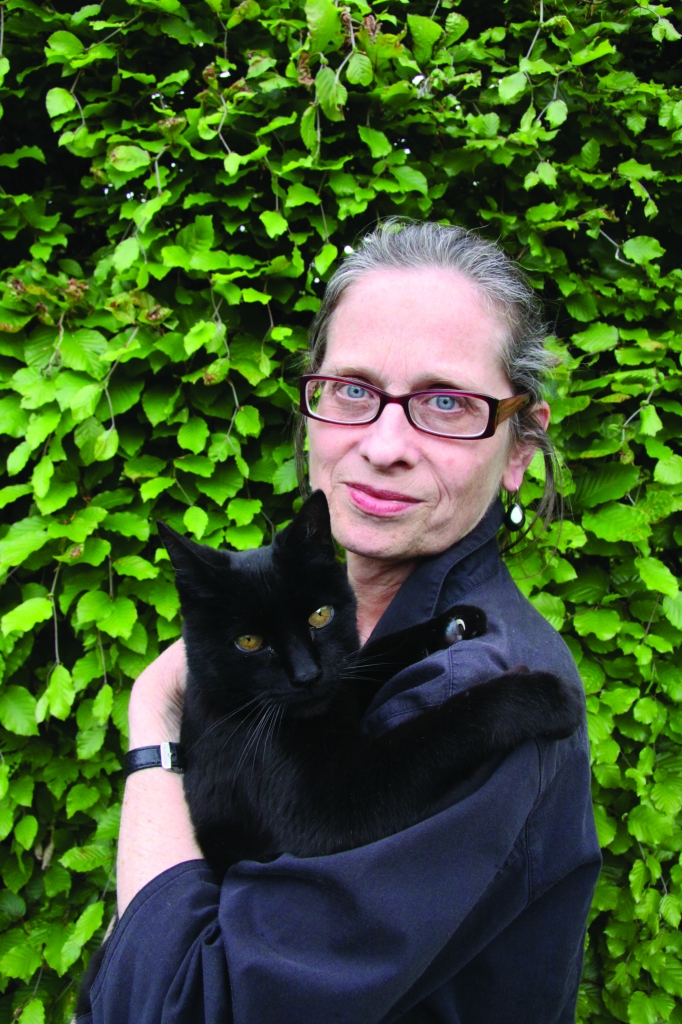
(Photo: Theo Cote)

How does one introduce Lydia Davis? By listing her accolades (which include the 2013 Man Booker International Prize)? Her acclaimed story collections, like Samuel Johnson is Indignant and Varieties of Disturbance? Her exquisite translations of Proust and Flaubert?

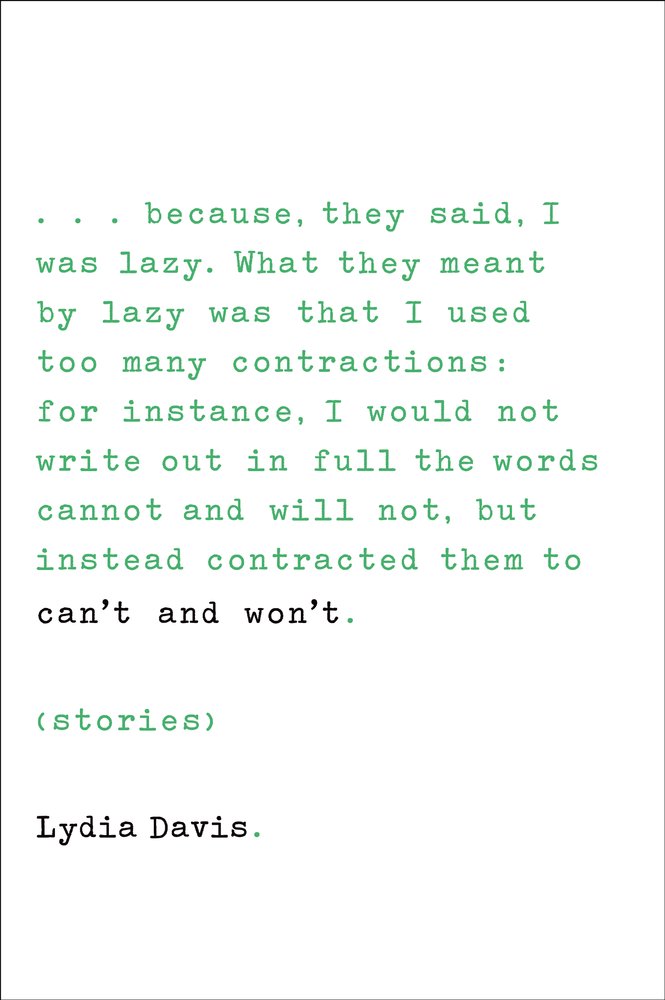
Since breaking through with Break it Down in 1986, Lydia Davis has stood at the forefront of American literature, constantly crafting fiction that both provokes reaction and mines the depths of the English language. In my review of her latest collection, Can’t and Won’t, I write, “The book is a remarkable, exhilarating beast: a collection that resumes the author’s overall style—short narratives, with the occasional longer piece—while simultaneously expanding her vision.” In addition, the translation work by Davis has both reintroduced classics (Madame Bovaryand ushered lesser known works into the libraries of avid readers.

It was a pleasure to connect with Ms. Davis for the following interview. We began speaking in February via email, and conducted this conversation over a series of electronic messages that lasted through the end of March.

— Benjamin Woodard


Benjamin Woodard (BW):
The 14 “Flaubert stories” in Can’t and Won’t feel right at home with your other narratives, often echoing ideas and themes from other stories. Were you drawn to these while translating Madame Bovary, or did they come earlier?

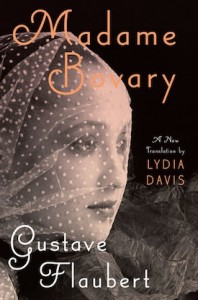
Lydia Davis (LD): Actually, I stumbled upon them as I was reading through the letters that Flaubert wrote during the time he was working on Madame Bovary. The letters were interesting for many different reasons, but the nicest reward was to come upon a little self-contained story that he was telling his correspondent, about something that had happened to him recently. I took whatever liberties I needed to—these were not meant to be “straight” translations—and shaped them into little stories.
MadameBovary

BW: How did you shape the narratives?

LD: Sometimes, I barely touched them. Usually, though, I would make little changes—combine two sentences or cut some material out of one. In the first story, about the cook, I added the phrase “and yet it has been five years since he left the throne”—because a contemporary American reader would not have the same information that Flaubert’s correspondent did as he wrote the letter. I tried to write this, and other additions, in Flaubert’s style and tone. In another story, I added some information about one of the characters, since he was otherwise unidentified. Yet another story, the one called “After You Left,” actually combines material from two letters. On his way home in the carriage, Flaubert remembers riding home on another occasion in a sleigh—in my story. In fact, he recounted that sleigh ride in another letter.

BW: Does translation work ever affect your style in English?

LD: Usually, for whatever reason, the style of the work I’m translating does not creep into my own—although I noticed when I was translating Proust that my emails became longer and more digressive. But I certainly like the little Dutch stories I’m translating at the moment, by A.L. Snijders, and I’m sure I will begin writing stories modeled on those, if I haven’t already.
CantandWont

BW: The “dream pieces” story cycle is another type of translation altogether. What prompted this cycle, and how did you decide to interpret these surreal tangents?

LD: What prompted these was a combination or confluence of two things—often the case. A French Surrealist and ethnographer, Michel Leiris, had published a book that collected his dreams over forty years. What interested me about this book was not just the dreams but that he included waking experiences that were like dreams. I had this book in an English translation by Richard Sieburth. It sat on my shelf for a long time. But then one day I had a waking experience that was so like a dream that it inspired me to see what I could do with narrating dreams so that they were dynamic and vivid, and narrating waking experiences so that they were believable as dreams.

BW: Does your approach differ when writing an extremely short piece like “Ph.D.” compared to “The Seals,” one of the collection’s longest stories?

LD: Oh, yes. Many of the shortest stories occur to me already almost complete—though not the one you mention, which was actually shortened from a longer “dream” piece. Often, all that these very short pieces need is the right title, and I take some time over finding that. But a long, fully developed narrative, like “The Seals,” requires going into a sort of trance, allowing the inner voice to begin speaking, and letting one paragraph suggest the next. There is a lot of material in a long story that was not planned in advance but that occurred during the writing. Then, there is the problem of structure, which I don’t really have in a very short story. Will one part balance another part in a good way? Is the conclusion thoughtful and strong? And in the case of that story, I had to pay attention to how often the narrator’s present situation, sitting on a train, came back into the story, so that it wasn’t lost. Much more complicated, altogether, than the shortest stories. But on the other hand, the shortest stories have that challenge of being substantial enough, in their few words, to carry full weight as finished pieces of writing.

BW: How does the idea of travel fit into your storytelling? Your characters often find themselves on physical journeys. For example, “The Seals” takes place on a train, alternating between present and past, in a way reminiscent of Thomas Bernhard’s The Loser.

LD: The simple fact is that I was traveling when I began many of these stories, since I find that sitting on a train or in an airplane is actually very conducive to letting my thoughts roam around freely in a relaxed sort of way, which sometimes produces a thought that leads to a story. At home, more stationary, I may be translating, or writing something non-fictional, like an essay. So the travel stories arise from incorporating what is going on at that moment. I like traveling—I like the feeling of suspension that one has at those times. You are between home and your destination, you are surrounded by strangers, you have a fellowship or bond with a group of strangers, for better or worse. It is very interesting. And often I am also in a foreign place, which means a foreign culture. I enjoy the contrast between that and my domestic, rural, home existence.

BW: Thematically, Can’t and Won’t plays quite a bit with the idea of capturing different forms of history, be it dreams or memories or subconscious realizations. Was this a deliberate effort on your part?

LD:  Well, your insight is interesting—I rarely stand back and look at the pieces as a group. It is true that I’m very interested in history—as I never was in school. But as for a deliberate effort, no, I do not think ahead of time about themes. Stories occur as they want to occur—I try to impose as little as possible on them. They simply reflect whatever is on my mind at that time. Only sometimes, as in the case of the Flaubert stories or the dream stories, or the letters of complaint—of which there are five in the book—I see that there is a form I like and want to explore, to see what it might yield.

BW: Finally, what are you reading now? What writing inspires you?

LD: Interesting question. Actually, two quite different questions, possibly. I do keep reading the small stories of the Dutch writer Snijders—since he sends them out by email. And they inspire me to translate him. At the same time, I’m reading a biography of Glenn Gould, because he continues to fascinate me as pianist and person, and I want to know more about him. But that book would not inspire me to any kind of writing. W.G. Sebald’s novels inspire me—I’d like to do what he does;  so do Thomas Bernhard’s, though he is so surpassingly negative about everything—but funny. There is a wonderful, probably not very well known thin book by the Canadian Elizabeth Smart with one of the best titles I know: By Grand Central Station I Sat Down and Wept. It is a story of obsessive love, and it is most eccentrically written. I know that title will seep into me and come out somewhere, sometime, and maybe the structure and style of book itself will, too.

— Lydia Davis & Benjamin Woodard

.

Lydia Davis is the author of one novel and seven story collections. Her collection Varieties of Disturbance: Stories was a finalist for the 2007 National Book Award. She is the recipient of a MacArthur fellowship, the American Academy of Arts and Letters’ Award of Merit Medal, and was named a Chevalier of the Order of the Arts and Letters by the French government for her fiction and her translations of modern writers, including Maurice Blanchot, Michel Leiris, and Marcel Proust. Lydia Davis is the winner of the 2013 Man Booker International Prize.

.

Woodard

Benjamin Woodard lives in Connecticut. His recent fiction has appeared in decomP magazinE, Cleaver Magazine, and Numéro Cinq. His reviews, interviews, and essays have been featured in Publishers Weekly, BuzzFeed Books, Numéro Cinq, Rain Taxi Review of Books, The Bygone Bureau, and other fine publications. He is a member of the National Book Critics Circle. You can find him at benjaminjwoodard.com and on Twitter @woodardwriter.
 

Mar 052014
 

LydiaDavisPhoto by Theo Cote

122 stories make up the volume, broken into 5 sections, and throughout, pockets of theme gradually surface—travel, loss, subconscious thought—and ostensibly unrelated pieces lock together to form intriguing puzzles that call into question life, happiness, and memory. — Benjamin Woodard

CantandWont

Can’t and Won’t
Lydia Davis
Farrar, Straus and Giroux
256 pages ($23.00)
ISBN 978-0-374-11858-7


T
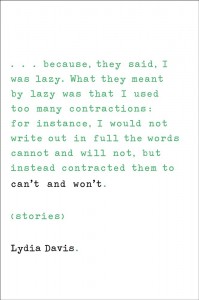
he stories of Lydia Davis tend to challenge the general notion of what most consider “story,” rarely following a recognizable structure—rising action, climax, dénouement—and instead focusing on brief moments and recollections, some of which take up no more than a single line of text. Because of this, Davis’s narratives hew closer to that of vignette or prose poem than fiction, lyrical interludes designed to impact without the fuss of narrative webbing. But while this argument holds weight visually, it falters in that it constrains the idea of fiction to that of firm rules and chartered courses, muffling the elasticity and wonder of storytelling. In a 2008 interview with The Believer, Davis defined “story” as any writing with “a bit of narrative, if only ‘she says,’ and then enough of a creation of a different time and place to transport the reader.” This classification is a fine way of looking at the oeuvre of the author herself, for though her stories always contain some form of protagonist—even if said protagonist is the speaker of the story’s lone sentence—they purposefully dodge other expectations, shuttling the reader into an unfettered territory of language and verbal exploration. In Can’t and Won’t, Davis’s fifth collection, due out next month, the author continues to push the boundaries of narrative. The book is a remarkable, exhilarating beast: a collection that resumes the author’s overall style—short narratives, with the occasional longer piece—while simultaneously expanding her vision. 122 stories make up the volume, broken into 5 sections, and throughout, pockets of theme gradually surface—travel, loss, subconscious thought—and ostensibly unrelated pieces lock together to form intriguing puzzles that call into question life, happiness, and memory.

Two story cycles, peppered throughout the text, anchor Can’t and Won’t. Both are quite strong, and in each, Davis plays with the concept of preserving the past. In the first, “dream pieces,” snippet narratives recall the nocturnal fantasies of Davis and her family and friends. These are, as one might expect, odd, but they permit Davis, so often clinging to the tangible, the opportunity to stray from reality, to bend the “regular” world. In “At the Bank,” patrons win cheap arcade prizes for guessing the correct amount of change in their deposits (“…I choose what I think is the best of them, a handsome Frisbee with its own carrying case.”). “The Piano Lesson” concerns a woman wishing to learn piano from her friend. She is given the assignment of learning several pieces, with the plan of meeting in one year’s time for the actual lesson. And “Swimming in Egypt” explores deep-sea tunnels that lead to the Mediterranean. What’s so very interesting about these stories is that, like all dreams, they contain unspoken meaning and do not follow logic. Still, Davis meets all moments of absurdity with complete seriousness, presenting each vision with little embellishment, acting as agent between the cerebral and the page, refusing to attach meaning, or to shape each discharge into a clear picture. As a result, these pieces float as if engulfed in haze, clues to an unknown psyche, snapshots of moments originally intended to not live on, but to evaporate with wakefulness.

Conversely, “Stories from Flaubert,” a 14 story sequence composed of material culled from letters between Gustave Flaubert and his lover, Louise Colet, sees Davis again seizing upon past events, but using these junctures to create parallels between old and new, breathing life into moments of universal emotion. Translated, modified, and arranged by the author, these works both capture the language of Flaubert and remain complimentary to Davis’s modern narratives. Narrative echoes between the two allow Davis to reach across 160 years and demonstrate how little human thought and reaction have matured, how, regardless of advancement, there are many questions—particularly those of the mind, of life and death—that endure, haunting the human condition. One striking example of this comes in “The Visit to the Dentist,” in which Flaubert, after travelling to have a tooth pulled, passing through a former execution ground, is haunted by his subconscious, which fills his head with images of the guillotine. This same process of storytelling—building through subconscious connection—flourishes in Davis’s non-Flaubert story, “The Force of the Subliminal,” where a conversation about birthdays sparks a series of triggers, leading the protagonist to interrogate the path in which she processes thought.

A beautiful illustration of Davis’s writing at its sharpest, and perhaps most accessible, comes in the story “The Language of Things in the House.” Here, funny, playful translations of the noises produced by household items (“Pots and dishes rattling in the sink: ‘Tobacco, tobacco.’”) find juxtaposition with italicized passages of narration trying to make sense of each translation:

Maybe the words we hear spoken by the things in our house are words already in our brain from our reading; or from what we have been hearing on the radio or talking about to each other; or from what we often read out the car window, as for instance the sign of Cumberland Farms; or they are simply words we have always liked, such as Roanoke (as in Virginia).

The result is a story with equal parts humor and gravity, one that introduces ideas of language and compels the reader to acknowledge and consider the way in which we as a people go about daily routine. Again, the concept of subconscious thought returns, creating another narrative echo, but the piece also, and this is something Davis is extraordinary at, paints a story within the blankness of the overall narrative, for the lack of information concerning the narrator (is it Davis? someone else?) creates a vacuum that requires the reader to mentally construct the life of the speaker. The point of the narrative is less that of the written text—though the written text is quite intriguing—and more that of the person writing.

Can’t and Won’t’s numerous fictional complaint letters—at 6, there are nearly enough to qualify as a third story cycle—continue to exploit the concept of “the writer” behind the story. In all but one—“The Letter to the Foundation,” at 28 pages, fills in most narrative gaps—the intention is not to present the reader with a list of why, say, a vegetable manufacturer should redesign its packaging (“Letter to a Frozen Peas Manufacturer”), or to submit to a confectionary company evidence of weight shaving in its products (“Letter to a Peppermint Candy Company”), but rather to create curiosity in who exactly would write such letters, as in “Letter to the President of the American Biographical Institute, Inc.,” where “Lydia Davis” takes umbrage with a company peddling a paid-inclusion vanity compendium:

You said that in researching my qualifications, you were assisted by a Board of Advisors consisting of 10,000 “influential” people living in seventy-five countries. Yet even after this extensive research, you have made a basic factual mistake and addressed your letter, not to Lydia Davis, which is my name, but to Lydia Danj.

The passage is deadpan comic, yet it further raises questions as to the motivations of the writer. Why, exactly, would someone take the time to write such a missive? What does this say about “Lydia Davis,” the character? Why enshrine this particular sliver of history through word? When examining these narratives with such a thought in place, each letter gains an enormous amount of dramatic heft, shaking away any coldness presented in the calculated, measured physical text. This abutment grants an immense amount of pleasure, and a slight case of uneasiness, for the unknown writer—mysterious, eccentric—lingers long after the story has completed.

At the center of Can’t and Won’t is a long story called “The Seals.” Like a distant cousin of Thomas Bernhard’s novel, The Loser, the story covers a very short amount of present time—in this case, a portion of a train ride down the East Coast—yet delves deep into memories, constructing for the reader a solid, palpable relationship between a woman and her deceased family members. As Davis’s protagonist, entombed in a train car, periodically moves or looks out the window, she recalls her sister and father, and the combination of real-time experience and remembrance is highly effective, providing Davis a showcase to meditate on the idea of bereavement. At one point, her character proclaims to the reader:

That fall, after the summer when they both died, she and my father, there was a point when I wanted to say to them, All right, you have died, I know that, and you’ve been dead for a while, we have all absorbed this and we’ve explored the feelings we had at first, in reaction to it, surprising feelings, some of them, and the feelings we’re having now that a few months have gone by—but now it’s time for you to come back. You have been away long enough.

This decree, both heartbreaking and selfish, cuts to the bone and drives the narrative, yet the sentiment acts as an umbrella shading the entirety of the collection. For with Can’t and Won’t, Davis deftly hones the art of looking backward, of calling the dead to life, of retaining the moments in life intended to remain fleeting. The result is a tapestry of method, style, and structure, all with the same objective: to possess that which has passed, to capture the lost and the unidentifiable.

Benjamin Woodard

Benjamin Woodard lives in Connecticut. His recent fiction has appeared in decomP magazinE, Cleaver Magazine, and Numéro Cinq. His reviews and interviews have been featured in Numéro Cinq, Publishers Weekly, Rain Taxi Review of Books, and other fine publications. He is a member of the National Book Critics Circle. You can find him at benjaminjwoodard.com and on Twitter.

Woodard


Sep 042012
 

Two of my favorite American writers talk. What could be better?

dg

———

Electronic Book Review: Can you speak a bit about the syntax used in the novel? Specifically, what aims were you trying to achieve by engaging in the use of very long and circular sentences? What were you hoping to create or evoke through syntax alone?

LT: First, I wanted to play with sentence structure, for my pleasure, and to see what I could do with it. At the same time, I wanted to establish her voice and find the way her mind might work, as unique to her, her ambivalence, her humor, her limits. The circularity and repetition of her thinking seemed to me the way thought, when you’re not thinking, happens. Also, if you’re an analysand, you hear your voice and watch your mind wander, stop and start, you censor it, see inhibitions, you take strange turns, words get scrambled, lead to events and incidents you couldn’t predict, and you contradict yourself often. Unlike “stream of consciousness,” which American Genius is not, the mind returns to themes and incidents again and again in different contexts, but there are fixed points, “blocks.” It’s not all about the free play of language – that’s about writing as writing – but when attached to the unconscious, written thought will represent memories and events you can’t avoid and keep going back to. Everything you know and don’t know.

via Lydia Davis Interviews Lynne Tillman | Electronic Book Review.

Oct 052011
 

0

Mucking Up the Landscape: Poetic Tendencies in Prose

by Mary Stein

.

There’s a certain trend I’ve noticed among some essays and craft books on writing fiction: It hints at the idea of a beleaguered prose writer, imprisoned at her desk—a person who narrates rather than directly experiences life for the sake of fiction, a person held hostage by the endless pursuit of the right-hand margin. It’s an idea of the prose writer as sacrificial lamb for the god that is verisimilitude. Prose and its process can be intoned with a sense of drudgery—particularly in comparison to poetry. In “Rhyming Action,” Charles Baxter jokes, “Prose writers have to spend hours and hours in chairs, facing paper, adding one brick to another brick, piling on the great heap of endless observations, going through the addled inventory of all the items they’ve laboriously paid attention to, and it makes them surly—all this dawn-until-dusk sitting for the sake of substantial books that you could prop open a door with … Fiction writers get resentful, watching poets calling it quits at 9:30am.”

Now of course I don’t agree with the literal assessment of this statement—I know poets who work at least until 10:00, maybe 10:30 in the morning. (Poets must forgive me, I have to believe this farce exists, otherwise I’ll never have anything to aspire to.) But there’s something about the spirit behind the statement, the implicit (or, I suppose, explicit) idea of drudgery inherent to the prose-writing process leading to an implicit drudgery of prose itself—an idea that the reader is led through a corridor of scenes, narratives, backstory, interior and summary to get somewhere. In an interview with Lydia Davis, Sara Manguso asks, “How do you know a story’s a story?” Davis says, “I would say a story has to have a bit of narrative, if only ‘she says,’ and then enough of a creation of a different time and place to transport the reader. But, of course, it is not a narrative poem. It is flatter, rhythmically different from a poem, and less elliptical.” This is interesting coming from Lydia Davis considering her prose often slants toward all these poetic tendencies—elliptical movement, a poetic attention to rhythm, and a use of language that certainly doesn’t flatline by any means. In fact, many of Davis’s stories exemplify how poetic attention to syntax creates resonant effects in prose.

.

.

Eileen Myles is one example of a poet crossover. Her self proclaimed “poet’s novel,” Inferno, explores the confluence of poetry and prose. In her critical essay on novel writing, “Long and Social,” Myles says, “Poets should write novels en masse and reinvent the form and really muck up the landscape.” Although I don’t intend to discuss murky genre distinctions, if genres paralyze or constrict your writing process, I’d say forget about them or invent your own—at least while you’re writing.

I want to consider how these same poetic elements might help the reader engage with the text: regardless of genre, the manipulation of or play with syntax can demand a reader to become conscious of his or her interaction with the work. I want to examine how some fiction writers use syntax to amplify image patterns and create rhythm in order to motivate narrative movement—to muck up the landscape of prose.

Continue reading »

Jun 202011
 

“They come out from behind the barn as though something is going to happen, and then nothing happens.”

— Lydia Davis, The Cows. 

(A claymation video of a line from Lydia Davis’s The Cows, by Electric Literature)

Flaubert and Cows

By Mary Stein

A few weeks ago, I ventured to my local Minneapolis bookstore on one of those rumored “quick stops” where people allegedly “swing by to pick up just one thing.” I was looking for The Cows, a new chapbook by Lydia Davis. Ultimately stymied by genre distinction, I begrudgingly asked a clerk where I could find this coveted gem, having not found it in any of the obvious places. After all, alphabetization couldn’t have become more complicated since the last time I was there, could it? The kind clerk pointed me toward the “Animal” section. The Cows was subcategorized under “Miscellaneous” where I found it wedged into near-oblivion between two door-stopper-sized books (one called Christian Lions and the other an anthology about birds).

The Cows is a fragmented story that meditates on three cows that live across the road from Davis. It was released as a chapbook in March, 2011 by Sarabande—a nonprofit literary press that releases approximately ten titles annually. Not six months earlier, Davis had embarked on an entirely different project. In September, 2010 Lydia Davis’s translation of Flaubert’s Madame Bovary was published courtesy of Viking Penguin. The scope of these two projects seem to exist in entirely different literary realms, and if “opposite” could ever be measured in gradations, Sarabande and Penguin are about as opposite as it comes. But what struck me about each publication was Davis’s search for relevance—not in the oft-overlooked crannies of daily life, but in subjects that stare us in the face: a book translated almost twenty times already; cows.

Continue reading »