Jun 072013
 

Full-cover-art Artist Mystic

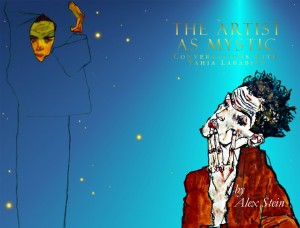
The Artist as Mystic: Conversations with Yahia Lababidi
Alex Stein & Yahia Lababidi
Onesuch Press
86 Pages, $9.98
ISBN 978-0987276049

In Alex Stein’s book, The Artist as Mystic: Conversations with Yahia Lababidi, there are two central topics—conversation and the artist-mystic. Conversation and its relation to artistic-mysticism manifests in the magical coming-together of an artist and his inspiration; Stein and Lababidi describe this inspiration as conversation or a commune. Artistic-mysticism denotes firstly a form of self-induced suffering and sequestration and, secondly, a notion of attention. Stein writes: “I kept trying to clarify to myself this idea of the artist as mystic, the artist and the mystic and their disparate ways of summoning the spirit, and I kept coming back to the idea of attention. Attention is the artist’s mode of prayer.” This is the most beautiful moment in the book. Here, we have a true convergence of the artist and the mystic in this notion of attention.  What follows is an investigation into the different mystic ways and words of several authors who have inspired or intrigued both Lababidi and Stein.

This book becomes, in effect, a homage to these masters. Stein remembers that while writing the book he could hear Lababidi’s voice telling him to: “Make of your art an offering to those spirits (“literary masters” as Yahia calls them) with whom you would commune.” Stein weaves conversations between himself and Lababidi about Nietzsche, Kafka, Bataille, Kierkegaard, and Rilke, among others into a compiling of thoughtful reflections on what it means to do art and to be an artist, or more specifically, an artist-mystic.

For Stein and Lababidi conversation is much more spiritual than a Socratic dialog or the Hegelian dialectic. The spirituality or mysticism inherent to conversation in Stein’s book is the way in which conversation is inspiring. Conversation is a moment of commune in which an exchange of spirit happens, and the duality of dialog renders down to a monad of thought. In many ways, though they are the titular aspect of the book, the conversations between Stein and Lababidi are not the focus. Rather, the implicit conversations with those dead authors for whom the book is an offering are the focus. For Stein and Lababidi these references in conversation to these late thinkers and artists is akin to a conjuring, bringing with it a revelatory or mystical magic which compels those conversing toward art.

Being an artist-mystic, like those late “literary masters,” is a specific way of life typified by self-denial and suffering. This way of living, according to Stein, “cannot be a voluntary thing”; it is duty which neglects and ignores personal happiness in service to art. To Stein, “the life of the artist may not be apparently monastic, or holy, but there is the same sense of sacrifice, of vocation, of having been entrusted with something greater and dearer than one’s own happiness.” This sentiment follows Lababidi who says that the artist is “called to service” and “exalted.” There is a great deal of play between Christian religiosity and a kind of eastern self-denial throughout this book, however I don’t think it would be right to characterize Stein’s mystic as a version of the Christian monk. Rather this artist is someone inspired and willing to suffer to create art. This investigation into personal suffering and anguish is particularly interesting in relation to the importance which both authors put on conversation and “communal destiny.” Suffering for the sake of art or in the service of art sequesters the artist from the rest of society as a sufferer, while the idea of mysticism and communing with dead “literary masters” introduces these hyper-individuals to one another. There is an implicit play, then, on the idea of the conversation between a group of people who see themselves as rejected in some sense or, at least, have removed themselves, from society and thus are not predisposed to conversation.

The thinkers and authors Stein and Lababidi mention become case studies for their overarching thesis about artist-mystics. For example, they see in the philosophy of Kierkegaard and Nietzsche the same anguish in the face of self-induced suffering for the sake of art that appears in the literary work of Baudelaire and Rilke among others. Lababidi talks about watching Bataille in an interview: “But there he was, this shifty, shifting creature who looked as though he could be anything from a pedophile to mass murderer.” Lababidi’s characterization clearly puts Bataille outside of the norm of society, an outlier of law (murderer) and of socially acceptable practices (pedophile). Thus, for Lababidi, Bataille is an artist who refuses to acquiesce to social institutions. This construction is only confirmed or at least enhanced by Bataille’s own writing which focuses on death and necrophilia among other things. Lababidi and Stein see this peculiarity as a demonstration of Bataille’s mysticism. As Lababidi says, Bataille himself refers to writing as “dabbling in the black-arts.”

Stein and Lababidi are looking for a mystic quality that manifests in the writing of the author but also comes across in his actions and biography. Stein says that “it is this detachment, in its variety of permutations, that I admired in the lives of the artists whom I would eventually take for my models.” “[Kierkegaard, for example] determines to himself that he is ill-suited for marriage. He no longer believes it would be ethical to drag another person into the inward life to which he believes he has been called.” He breaks off his engagement with the woman who will turn out to be the love of his life and retreats into a mystical inwardness necessary for him to produce thoughtful and revelatory work. Of course, there is no way of knowing if Kierkegaard’s diagnosis of love-as-distraction was correct; but the question of how much writing he would have produced had her married will forever linger. As Lababidi puts it: “Maybe [Kierkegaard] thought that because he made the sacrifice, she would be returned to him the way faithful Abraham’s son Isaac is spared and returned to Abraham.”

This conception of mysticism and self-denial returns during the discussion of Kafka. Stein includes the following aphorism by Kafka:

“There is no need for you to leave the house. Stay at your table and listen. Don’t even listen, just wait. Don’t even wait, be completely quiet and alone. The world will offer itself to you to be unmasked; it can’t do otherwise; in raptures it will writhe before you” (Kafka’s Aphorism 109).

According to Lababidi, the world Kafka refers to in this specific aphorism “is the ‘there-world’ into which he enters to write, as the yogis enter theirs to breathe.” Lababidi’s comparison between Kafka and yogis suggests that Kafka’s mysticism takes the form of a trance or meditative state, that the ‘there-world’ is an achievable form of awareness or attention. In Lababidi’s words, the ‘there-world’ is “a paradox, like the snake that swallows its own tail until it has swallowed itself entirely. A double joint in time, or a space that is only a bit of fabric that gives, and one can just slip on through it.” Thus the ‘there-world’ is an escape of sorts—a break from reality.

There are nonetheless similarities between Kierkegaard’s choice not to marry, Kafka’s world, and Bataille’s unsettling topics. These all represent modes of escape. But it is crucial that these not be seen as ways of escaping from torment or suffering. Rather they are ways of escaping from a fixedness. In these moments of escape, “inspiration is able to move with more agility and vision to engage with more dexterity.” This is not a physical escape from X to Y, but a transformation of attention; rather than travel to a new place, we are looking at the world differently.

Stein rightly notices that art is a manifestation of what the artist is paying attention to, and correspondingly the mystical moment for yogis and for Kafka, as it were, is a certain way of directing attention toward something. The artist-mystic never goes to the there-world, for we are always already inside it yet un-attuned to it. Stein and Lababidi’s book investigates the way the artist, be he a phenomenologist or a poet, “prays” to that which is already before us in a more attuned and spiritual way.

 —Jacob  Glover

————

Jacob Glover

Jacob Glover is a pursuing an MA in Classics at Dalhousie University in Halifax, Nova Scotia.

Sep 062011
 

Herewith a link to dg’s distillation of 30,000 years (give or take) of Western philosophy. The idea for this essay came from reading Witold Gombrowicz’s wonderful little book A Guide to Philosophy in Six Hours and Fifteen Minutes. DG thought six hours seemed a little long and tedious and that he could condense all the important points into about fifty minutes. This essay is a version of the lecture dg gave at Vermont College of Fine Arts last January (in the event, he was not able to get ALL of philosophy into the time slot), including his own incredibly helpful diagrams and sidebar comments which clear up the complicated points.

dg

Plato was right when he said that we can only know what we know already, that knowledge works by identity. What we cannot know, cannot access, we also cannot experience, and yet this unknowable is all around us, lies inscrutable and threatening behind everything we do know, crouches even within our hearts in a place Freud called the Unconscious. Mostly we cannot escape the feeling that it is watching us, waiting to trip us up, or sometimes bless us. At the end of the Tractatus Logico-Philosophicus, Wittgenstein threw up his hands and wrote that we must remain silent about the things whereof we cannot speak, by which he meant a long list of absolutes including God, the Good, Beauty, etc. But that sort of realism has never stopped humans whose imagination is prolific in inventing dream meetings with the Other. The history of our philosophies has been a history of such dreams.

via Mappa Mundi: The Structure of Western Thought – The Brooklyn Rail.

Mar 202010
 

kierkegaard

Jacob Glover1Jacob Glover

/

The first sentence of Søren Kierkegaard’s The Present Age is: “Our age is essentially one of understanding and reflection, without passion, momentarily bursting into enthusiasm, and shrewdly relapsing into repose”. I will argue that underlying this quote is the Platonic premise, continuous throughout Western philosophy, that there are two worlds, the world of existence (the material or phenomenal world, the world of empirical science) and the intelligible (the world of Forms, universals, God, and the Good).[1] Kierkegaard says that man in the present age finds himself no longer rationally able to conceive a relationship between himself and God or the Good (the intelligible world). (Kierkegaard’s present age was the 1840’s, but his ideas seem applicable now because they describe what was the beginning of modern industrial capitalism that exists today.) Earlier philosophical claims for interaction between the two worlds such as mediation (Hermes Trismegistus), emanations (Plotinus), or imminence (Spinoza) are no longer possible. In the present age, man cannot know anything about the intelligible world, God, or the Good. The intelligible world is radically separate from the material world. So Kierkegaard’s question is: What can or do we know? Reflection, Kierkegaard seems to be saying, is a form of thought, characteristic of this new age, which re-conceptualizes the material world without God. Kierkegaard contrasts reflection with idea of passion which seems to be a desire to know or engage with something radically unknowable. Passion, this desire, is linked to Kierkegaard’s idea of the leap of faith. Since in the present age we cannot know anything beyond the material world, the only way to live an authentic, ethical, or individual life is to passionately embrace a radical uncertainty about God or the Good. We must take a leap of faith, a leap into uncertainty.

Reflection, this process of thinking in the material world separated from the intelligible world, changes our motives and the way we value things and actions. Reflection suggests a new sort of rationality grounded solely on the material world and without regard for an intelligible world. This new rationality changes the objective and subjective value system for actions and decisions. For Kierkegaard, “eternal responsibility, and the religious singling out of the individual before God, is ignored.” Kierkegaard is referring to two effects, or characteristics, of reflection. In the present age two things are ignored: “eternal responsibility” (the drama of sin, salvation, and grace) and the “singling out of the individual” (the creation of individuals in relation to God or the Good). In other words, people in the present age, the age of reflection, now cut off from the intelligible world (and God and the Good), no longer have an “eternal” telos, or purpose; man in the present age can only perceive a purpose for himself that is dependent on, or related to, the material world. Without this “eternal” telos there is no reason to act or make decisions as if the actions or decisions have “eternal” importance, which is to say, in the age of reflection, there is no “eternal responsibility.”

People lose a sense of individual eternity as they lose or, “ignore,” this idea of “eternal responsibility” and further separate, metaphysically, from the intelligible world, God, or a greater Good. Kierkegaard calls this the “leveling process” or “the victory of abstraction over the individual.” That is to say that people in the present age, the age of reflection, lose a sense of eternal importance in what they do or think because essentially all people are so radically equal no one can capture any uniqueness, no one can conceive of themselves or what he does or thinks as eternal. People in the age of reflection are all entirely dependent on and, in a sense, enslaved to an obscure form of community. Not a community based, as I say, on anything eternal, but on pragmatic values derived from the new rationality of the age of reflection. It is a community of slaves whose master is their own interdependence. In Kierkegaard’s words, “The individual no longer belongs to God, to himself, to his beloved to his art or to his science, he is conscious of belonging in all things to an abstraction to which he is subjected by reflection, just as a serf belongs to an estate.” In the present age, the age of reflection, a person is so radically separated from anything that he can derive lasting, eternal, importance from individually that he loses his individuality and is swallowed into obscurity and dependency.

In the original quote Kierkegaard contrasts reflection with passion. According to Kierkegaard, the present age is passionless. But what is passion? The word “passion” derives from the Latin verb patior which means to suffer. I think this crucial in the discussion of what passion is to Kierkegaard because it emphasizes the inherent struggle that defines passion. Also the word probably refers to the Passion of Christ. Christ at the end of his life does not know, with any certainty, that God exists, but he wants to believe and does so anyway. Christ on the cross demonstrates what passion is: a desire to know, believe, or engage with, something you cannot rationally conclude exists, or even establish a metaphysical connection with. Passion, as Kierkegaard seems to imply, can only really exist in relation to reflection. Reflective thought occurs when people try to understand the material world, now that it is radically separated from the intelligible world, and passion is the desire to believe in an intelligible world, God or a greater Good even though you have no reason to. What’s crucial is the idea of reasons for something, something’s rationality. Like I said above, with reflection there is new rationality grounded in the material world, so of course there is no “reason” to believe in an intelligible world. But crucially this situation only exists in the age of reflection. Before Kierkegaard philosophers thought that the intelligible world was accessible in some form, knowable, and, in fact, based their rationality “in” it, thus they had “reason” to believe in its existence. So passion, to Kierkegaard, is the desire to believe in something that, rationally, you cannot, and, according to the word’s etymology, is a sort of internal suffering. To Kierkegaard, in the present age it seems unlikely that, “there is a single man left ready, for once, to commit an outrageous folly.” For Kierkegaard this “outrageous folly” is passion. It would seem outrageous, ridiculous, or foolish to want to believe in, or know, something that you cannot.

Kierkegaard gives the example of a skater on a lake. This example, to me, best demonstrates the differences between passionate and reflective thought. In a passionate age “the courage of the man” to skate out near the middle where the ice is thin, “would be applaud[ed],” but in the present age “people would think each other clever in agreeing that it was unreasonable and not even worthwhile to venture out so far.” In the present age, the age of reflection, the people don’t admire the skater at all, in fact, they admire each other as members of a group; they show dependence upon one another. The value judgments the people in the age of reflection do make are of the act of skating out so far, “an outrageous folly.” They conclude it to be unreasonable and not worthwhile. This is another example of the different rationality created by reflection that makes acts, such as are done by brave people, seem “unreasonable.” That is to say that in the age of reflection the people have no rational grounding for these sorts of actions; to them they have no purpose in the material world and are, therefore, purposeless. Furthermore these acts designate an individual and allow him, if only for a moment, not to be dependent on the others. He has found some purpose outside of the material world that is inconceivable in the age of reflection when the material is radically separate from the intelligible. Contrariwise a passionate age appreciates the individual and his attributes. The act itself seems to just demonstrate that which the man already possessed i.e. his courage. Essentially the differences stem from reflection and the lack of reflection, which is to say the separation of the intelligible world from one (the present age) and not from the other (a hypothetical passionate age).

The Present Age is essentially a thought experiment. Kierkegaard starts by describing the age of reflection when man has no rational connection to the intelligible world and finds himself radically subsumed in an abstraction of interdependence. Before the age of reflection people would derive their ways of life from ideas founded in the intelligible world. So now the question for Kierkegaard is: How do we live authentically? What do we base things like morals and ethics on, if our old fundamental principles are no longer rationally accessible? Moreover, how do we maintain any sense of self, or individuality, when we exist as eternally purposeless? Kierkegaard writes, “If you are capable of being a man, then danger and harsh judgment of existence on your thoughtlessness will help you to become one.” That is to say that, to live authentically, to have morals, to be an individual, you must do something that seems an “outrageous folly.” And in the age of reflection nothing seems more “outrageous” than assuming a connection with the intelligible world because in the age of reflection it is unknowable. But Kierkegaard insists, “Come on leap, leap cheerfully, even if it means a light hearted leap, so long as it is decisive.” In other words to live as an individual with morals, we must “leap” into belief. That is to say we must believe in something we have no reason, in the age of reflection, to believe in. We must contradict ourselves as rational beings and behave irrationally, we must embody passion, and “[our] thoughtlessness will help [us] to become” an individual.

—Jacob Glover

/
/

Footnotes    (↵ returns to text)

  1. See Mappa Mundi: The Structure of Western Thought
Mar 122010
 

I was rereading Walter Kaufmann’s Nietzsche last night, focusing on the bit about Nietzsche’s “style of decadence.” This should be interesting to any of us but especially to writers of nonfiction. Like Kierkegaard, Nietzsche is an anti-system thinker; he attacked the idea that the classic philosophical ideals of system, coherence and completeness were a guarantee of truth (recall how Kierkegaard mischievously titled his great work Concluding Unscientific Postscript). His style of decadence was aphoristic and fragmentary. Each piece was a thought experiment, not necessarily meant to reveal a truth. He called them Versuche, experiments or attempts (reflect on how this resonates with Montaigne’s essais, the root of which is the verb essayer, to attempt or try), and they varied in length from a line to several pages. He’s difficult to read because he is playful and ironic and because of this open and hypothetical quality. His style is also dialectic in the sense that he often approaches a topic by critiquing the assumptions of conventional philosophical arguments, thus trying to find a negative or backwards path to a substantive claim.

Kaufmann:

Each aphorism or sequence of aphorisms–and in Nietzsche’s later works some of these sequences are about a hundred pages long, and the aphoristic style is only superficially maintained–may be considered as a thought experiment. The discontinuity or, positively speaking, the great number of experiments, reflects the conviction that making only one experiment would be one-sided. One may here recall Kierkegaard’s comment on Hegel: “If Hegel had written the whole of his Logic and then said… that it was merely an experiment in thought…then he would certainly have been the greatest thinker who had ever lived. As it is, he is merely comic.” (Journals, ed. Alexander Dru, 134). Nietzsche insists that the philosopher must be willing to make ever new experiments; he must retain an open mind and be prepared, if necessary, “boldly at any time to declare himself against his previous opinion” (FW 296)–just as he would expect a scientist to revise his theories in the light of new experiments.

Think how liberating it must be to imagine each piece of writing as an experiment, as a trial balloon, as inquiry instead of conclusion; too many writers inhibit themselves by trying to stake out their territory, by trying to tell the truth. Instead of writing, This is what happened; you write, Is this what happened, or this, or this?

Theodor Adorno practiced Nietzsche’s dialectical and aphoristic style in spades. See his Minima Moralia. Ludwig Wittgenstein invented one totalizing systematic philosophy in the Tractatus Logico-Philosophicus and then turned around and invented a fragmentary anti-systematic philosophy in the Philosophical Investigations (fragments and thought experiments on the nature of language). See also E. M. Cioran’s books of aphorisms. e.g. The Trouble With Being Born.

dg

Feb 232010
 

Capture

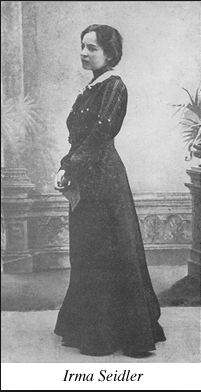
This is a revisiting of the post on Kierkegaard and Regine Olsen and the essay Georg Lukacs wrote about them. When I read the essay last week, I saw it as a cunning proto-deconstruction (ie. deconstruction before deconstruction was invented) of Kierkegaard’s gesture of renouncing Regine to ensure her future happiness. Over the weekend, I discovered a biographical essay about Lukacs, “Georg Lukacs: The Antinomies of Melancholy” by Levee Blanc in Other Voices, v.1, n.1 (March 1997). What we find out here is that while Lukacs was writing about Kierkegaard’s “real” reasons for dumping Regine, Lukacs himself was dumping Irma Seidler for the same reasons he attributes to Kierkegaard, ie. that happiness and domestic union might interfere with his philosophical work. In his notes from this period, Lukacs wrote:

Scruples: the impossible nature of marriage…Dread of the destructive influence of happiness, dread that it is beyond my capacity to get my bearings in a broader-based life.

And in a letter to Irma that positively reeks of the freshman romantic poseur and macho intellectual bravado, he writes:

There are people who understand and do not live, and their are others that live but do not understand. The first kind cannot ever really reach the second even though they understand them, and the second can never understand the essence, but then, it doesn’t matter. The feeling of love or hate, the liking somebody or the possibility of learning to like someone, exists, but the categories of understanding do not exist for them.

The message loop then is that in the Lukacs essay on Kierkegaard, Lukacs writes Kierkegaard as channeling Lukacs, but who knows what Kierkegaard really thought?

Regine Olsen eventually married and survived Kierkegaard. Irma Seidler was not so fortunate. Just a few years after Lukacs dumped her, she killed herself by jumping off a bridge in Budapest.

I am trying to draw some lessons from this.

  • No matter how hard we try, we never leave high school behind.
  • There is still something to Lukacs’s critique of the gesture, the pose: all tragic heroes will have terrible home lives because their grand gestures never take into account close human relations. Think, King Lear. Think, Oedipus.
  • There is, on the other hand, something insidious about the barely tacit premise that women and marriage somehow interfere with a man’s ability to think. I am reminded how in one of his novels Lawrence Durrell has a character say, “Women are incapable of categorical thought.” Lukacs seems to be coming close to this in his letter to Irma. There is some evidence here that testosterone causes brain damage. Many women, I think, have remarked on this in the past.
  • And this is not to mention the broken symmetry of Lukacs’s argument about gesture. Somehow deciding to renounce a woman so you can think better is a gesture, a heroic self-creating choice, while the alternative, opting to hang with a someone and think at the same time, is not a gesture, not a heroic self-creating choice, but a kind of muddled life-chaos. There is something fuzzily tautological about what he gets to call a gesture. And this is one of the basic problems with Existentialism as a philosophy; it cheats by surreptitiously applying a secondary value system. Existentialism says choice creates value. But then some choices are better (more authentic) than other choices. (Not, of course, that Lukacs was an Existentialist, but his analysis of Kierkegaard and gesture is about the roots of Existentialism and he works within the premises.)
  • Finally, avoid bridges.

dg

Feb 202010
 

My favourite part is the girl who says, “I see you. I see you. I see you.”

Though I can’t quite put my finger on it, there is something ineffably sad about this (aside from the obvious comedy). It’s a parody of a reality TV show about really stupid people re-enacting a really obvious Hollywood reiteration of the Romance of the Noble Savage old-style Euro-colonial racism, thus a parody of an imitation of an imitation of a bad idea. It reminds me of Don Quixote, of course, who is imitating characters in a romantic adventure novel about knights in armour long after people had forgotten what those thugs-in-chain mail  were really like. And Dostoevsky said Don Quixote was the saddest book of all.

Maybe it’s this: our inability to feel real unless we are acting a role, our need for a gesture or form that gives us substance. When we see this in others, it’s comic. But it’s the kind of comedy that expresses a latent fear, in this case the fear that if we look too closely the Self will seem unbearably empty.

dg

Feb 192010
 

Regine Olsen

A few posts and comments back, I counseled people to step back from taking sides in certain sorts of public cultural debates, to take the Hegelian approach and rise above and restructure the argument itself. I just reread Georg Lukacs essay “The Foundering of Form Against Life, Søren Kierkegaard and Regine Olsen” which, as you might expect given Kierkegaard’s antipathy toward Hegel, suggests the opposite view, or at least constructs an opposite view. (Full disclosure: Lukacs was an Hegelian.)  The opposite view is that the gesture (form) can crystallize or shape life, or attempts to do so, while mostly life presents itself as a muddle of motives and options. This is the germ of the  Existentialist idea of creating value by making choices, by committing oneself. The bulk of the essay is an analysis of Kierkegaard’s gesture of renouncing his beloved Regine Olsen. Not only did he renounce her, but he pretended to be a cad, an inveterate seducer, so that she could more easily give him up in her own mind and get on with her life. If there was a chance that she thought Kierkegaard really loved her, she might wait for him or be uncertain about getting into another relationship. Kierkegaard loved her all the while. The gesture was a concrete act, a kind of heroic pose, and a choice he made. But Lukacs is cagey about tracking the uncertainties and ambiguities in the situation (this is where life beclouds the gesture). Kierkegaard performed the gesture because he thought he would ruin Regine’s life, but it seems also clear that he realized that she might clutter his life with pleasure (possibly happiness) and domesticity. So the gesture wasn’t entirely self-sacrificing. Through the rest of his life Kierkegaard waffled in his heart. He never wanted to see Regine because he didn’t ever want to remind her of the happiness they had hoped for or in case she might doubt that he was a cad and seducer; but it seems clear Regine never really quite bought his story and at least sometimes suspected that it was all a pose (Kierkegaard starts to look a bit comic). And once Kierkegaard wrote her a long letter explaining everything (was he hoping to reignite the old passion?), but Regine discussed the letter with her husband and decided to send it back unopened. So the gesture, examined in its particulars, seems less monolithic, less heroic, and less pure than when viewed from afar.

Reading this story from a contemporary standpoint, one is also surprised at the male comedy of Kierkegaard presuming to decide what is right for Regine without, um, actually talking to her. We don’t ever do that today, do we?

Also this is my sly way of introducing Lukacs who was an interesting thinker. See his book The Theory of the Novel which he tells you himself not to think of as a guide.

—Douglas Glover