Jan 142014
 

Patrick J Keane 2

Pat Keane pens here a brilliant essay on Keats, Negative Capability, personality and identity. We humans are a contradictory lot. We yearn for predictability, familiarity, self, home and identity, but, equally, we yearn for vacations, distance, difference and escape from self (falling in love is one of the ways we escape the self). When Keats wrote that famous letter about his friend Dilke wherein he invented Negative Capability, he seemed, yes, to advance the idea that a poet (artist) must leave self, certainty and identity in order to create. But in other works he speaks of “soul-making” as though, rather than losing the self, the poet is creating a self. Pat Keane, vastly erudite (the man is a magician, pulling quotes from his sleeves), does the critic’s job—to make distinctions and find unity—coursing through the letters, digressing on Coleridge and giving a close reading of “Ode to a Nightingale” (among others). This is no dry argument. Keats died young; he wrote in the shadow of his self’s annihilation and yet was “capable of being in uncertainties, Mysteries, doubts, without any irritable reaching after fact & reason” in the pursuit of beauty.

dg


In early November, 2013, Robert Boyers, the founder-editor of Salmagundi (now approaching its 50th anniversary), moderated a conference at Skidmore College on the subject of “Identity.” For two days, a panel of twelve discussed the subject before an audience. Those of us on the panel were given ahead of time an “Anthology of Readings,” full of provocative materials to which, however, we adhered only peripherally since the audience had no access to them. As a sort of preamble to this anthology, Robert provided brief excerpts from Leon Wieseltier’s Against Identity (1996), among which we found this:  “Only one in possession of an identity would understand why one would wish to be rid of it.”

Wieseltier was echoing a phrase from the final section of T. S. Eliot’s “Tradition and the Individual Talent.” According to Eliot, the progress of an artist “is a continual self-sacrifice, a continual extinction of personality.” This process of “depersonalization” is further defined toward the end of the essay, where Eliot undermines the “metaphysical theory of the substantial unity of the soul” since “the poet has, not a ‘personality’ to express, but a particular medium, which is only a medium and not a personality.” Just prior to his conclusion in the short coda—that “the emotion of art is impersonal,” and that “the poet cannot reach this impersonality without surrendering himself wholly to the work to be done”—Eliot had ended the essay proper with the observation Wieseltier plays off: “Poetry is not a turning loose of emotion, but an escape from emotion; it is not the expression of personality, but an escape from personality. But, of course, only those who have personality and emotions know what it means to want to escape from these things.”

In the midst of these critical assertions, Eliot had cited Dante, Aeschylus, and a passage from Tournier. But he also referred to the “Ode of Keats,” which “contains a number of feelings which have nothing particular to do with the nightingale, but which the nightingale…served to bring together.” It’s Keats I want to focus on here, ending with that “Ode” to which Eliot refers, and concentrating on what the nightingale “served to bring together” in terms of the poet’s wanting to escape from his “identity,” and finally being tolled back “from thee to my sole self.”

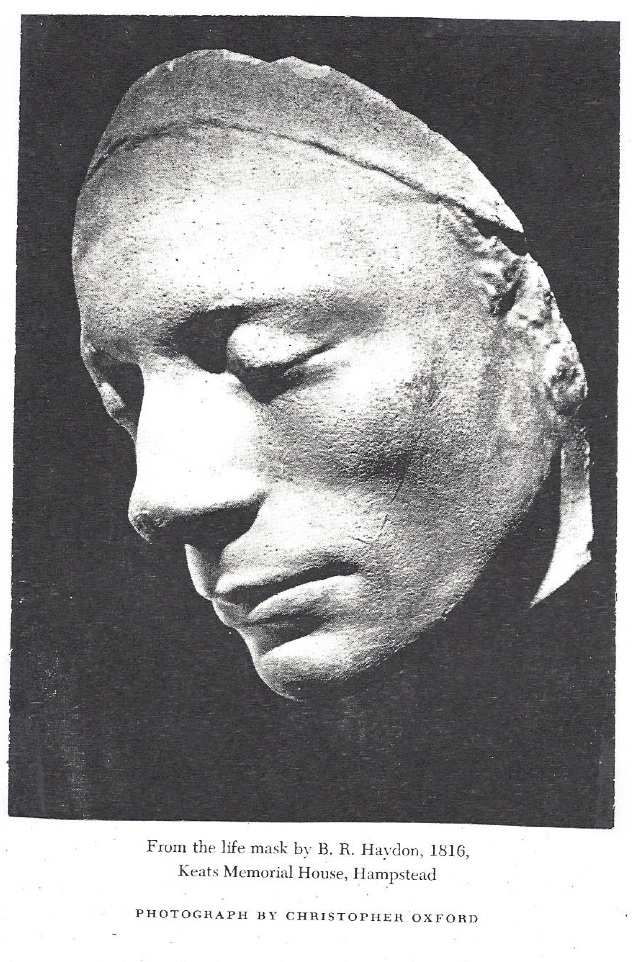
Keatspic

From the life mask by B. R. Haydon, 1816, Keats Memorial House, Hampstead; Photograph by Christopher Oxford

Unlike Eliot, but like Wieseltier, Keats spoke, not of personality, but of “Identity,” sometimes registering the loss of personal identity in the process of what William Hazlitt advocated as the “Natural Disinterestedness of the Human Mind,” the subtitle of his Essay on the Principles of Human Action (1805). Adopting and adapting Hazlitt, Keats engaged in empathetic  identification with others, whether persons or things; sometimes celebrating the absence of Identity in a poet; at other times, and finally, embracing it as an ultimate existential achievement.

In an October 27, 1818 letter to his friend Richard Woodhouse, contemplating both the massiveness and the limitations of the power of Wordsworth, Keats distinguishes between the “wordsworthian or egotistical sublime” and his own ideal of “the poetical Character,” that sort “of which, if I am anything, I am a Member.” As conceived by Keats, thinking, as always, of Shakespeare, recalling Hazlitt, and anticipating Eliot, the poetical Character

is not itself—it has no self—it is everything and nothing—It has no character—it enjoys light and shade…It has as much delight in conceiving an Iago as an Imogen. What shocks the virtuous philoso[p]her, delights the c[h]ameleon Poet. It does no harm from its relish of the dark side of things any more than from its taste for the bright one; because they both end in speculation. A Poet is the most unpoetical of anything in existence; because he has no Identity—he is continually in[forming]—and filling some other Body—The Sun, the Moon, the Sea [;] and Men and Women who are creatures of impulse are poetical and have about them an unchangeable attribute—the poet has none; no identity—he is certainly the most unpoetical of all God’s Creatures. (Letters 1:386-87)

Going further, Keats jocoseriously tells Woodhouse that, while it is “a wretched thing to confess,” it is (and here he anticipates the poststructural demystification of the “mistaken” view of the subject as cohesive and self-identical) a “very fact that not one word I ever utter can be taken for granted as an opinion growing out of my identical nature—how can it, when I have no nature?” (Letters 1:387).

This characterless adaptability, this loss of identity, the feeling of being either absorbed in, or “overwhelmed” or “annihilated” by, what is around him, recurs frequently in Keats’s letters and poems. Readers of those remarkable letters are familiar with his self-identifications: flexing his muscles so that he “looked burly,” emulating Spenser’s image of the “sea-shouldering whale”; or becoming the billiard ball rolling across the table; or “if a Sparrow come before my Window, I take part in its existence and pick about the Gravel” (Letters 1:186). There is a particularly touching instance of annihilative empathy: as his younger brother was dying of the same disease that would eventually consume him, Keats felt his own “real self” dissolving in his intense awareness of what Tom was enduring. This capacity is connected with Keats’s “Pleasure Thermometer” passage in Book I of Endymion, and, of course, with his even more famous, influential, and somewhat elusive concept of Negative Capability.

Though it must be measured by the limitations it is encompassed by, the key passage of Book I of Endymion, written in the spring and early summer of 1817, constitutes an answer to the young poet’s question, “Wherein lies happiness?” That answer, couched in poetry occasionally mawkish and marred by the rhyming demands of the couplet-form, nevertheless advances an important theme. Sending along a revision of his initial attempt, Keats, in a letter of 30 January 1818, told his publisher, John Taylor: “I assure you that when I wrote it, it was a regular stepping stone of the Imagination towards a Truth. My having written that Argument will perhaps be the greatest Service to me of anything I ever did—It set before me at once the gradations of Happiness even like a kind of Pleasure Thermometer” (Letters 1:218-19). Answering his own question in the poem, Keats tells us that happiness lies

[space] in that which becks
Our ready minds to fellowship divine,
A fellowship with essence, till we shine
Full alchemized, and free of space.
[space] (Endymion I. 777-79; italics added)

Happiness is measured by its intensity and by our selfless absorption in four ascending gradations of pleasure. The first two involve our sensuous response to natural beauty (exemplified by the tactile feel of a “rose-leaf” on fingers or lips), and to music, from the “sympathetic touch” with which the wind harp “unbinds/ Aeolian magic,” to battle’s “bronze clarions,” to the “lullaby” that occurs wherever “infant Orpheus slept” (777-94). “Feel we these things?” Keats asks rhetorically; if so,

That moment have we stepped
Into a sort of oneness, and our state   [an unrhymed line]
Is like a floating spirit’s. But there are
Richer entanglements, enthrallments far
More self-destroying, leading, by degrees,
To the chief intensity: the crown of these
Is made of love and friendship….(795-804; italics added)

He would later tell Fanny Brawne, “You absorb me in spite of myself” (Letters 2:133). In “love,” this self-annihilating absorption in beauty is so intense that, having “stepped/ Into a sort of oneness,” we melt into that “orbéd drop/ Of light” at the pinnacle of experience.

Melting into its radiance, we blend,
Mingle, and so become a part of it—
Nor with aught else can our souls interknit
So wingedly. When we combine wherewith,
Life’s self is nourished by its proper pith,
And we are nourished like a pelican brood.
(804-5, 810-15; italics added)

In legend and Christian symbolism, the pelican wounds herself to nourish her brood with her own blood. The lover sacrifices selfhood in order to attain unity, or (if one is persuaded by an Idealist or Neoplatonic reading), in order to re-attain a lost Unity. Similarly, lovers of beauty—“full alchemized” and in “fellowship with essence”—become so absorbed in the “thing of beauty” they contemplate that they melt into the object of their love. The crucial point in the passage as a whole is Keats’s emphasis on entanglements and enthrallments that are “self-destroying.”  The “sense of beauty” overcoming and obliterating every other consideration is also the crucial aesthetic point of Keats’s speculations regarding Negative Capability.

 Keatspic

In a December 1817 letter to his brothers George and Tom, Keats reports “not a dispute but a disquisition” with their mutual friend Charles Dilke:

several things dovetailed in my mind, & at once it struck me, what quality went to form a Man of Achievement especially in Literature & which Shakespeare possessed so enormously—I mean Negative Capability, that is when a man is capable of being in uncertainties, Mysteries, doubts, without any irritable reaching after fact & reason—Coleridge, for instance, would let go by a fine isolated verisimilitude caught from the Penetralium of mystery, from being incapable of remaining content with half knowledge. This pursued through Volumes would perhaps take us no further than this, that with a great poet the sense of Beauty overcomes every other consideration, or rather obliterates all consideration. (Letters 1:193-94)

Keats was wrong to cite as a counter-example Coleridge—whose system-building was forever being thwarted by his inability to “let go by” the many “isolated verisimilitudes” that became, at worst, digressions and, at best, intuitive insights that imported German Idealism to England and, in the process—as demonstrated in my own Emerson, Romanticism, and Intuitive Reason (2007) and Samantha Harvey’s Transatlantic Transcendentalism (2013)—transformed both British Romanticism and American Transcendentalism. Furthermore, Coleridge’s “Dynamic Philosophy” may, in the present context, help explain the apparent contradiction between Keats’s emphasis on the chameleon poet possessing “no Identity” and, in the “vale of Soul-making” analogy, the imperative to acquire an Identity. Keats’s “disquisition” with Dilke may call to mind, for us, if not for Keats, a seminal passage in Biographia Literaria, beginning with the assertion that “The office of philosophic disquisition consists in just distinction (Coleridge’s italics). But, Coleridge continues, the philosopher must remain

constantly aware, that distinction is not division. In order to obtain adequate notions of any truth, we must intellectually separate its distinguishable parts; and this is the technical process of philosophy. But having so done, we must then restore them in our conception to the unity, in which they actually co-exist; and this is the result of philosophy. (Biographia Literaria 2:11)

In Coleridge’s thought, based on Polarity and the harmonizing power of Intuitive Reason, ultimate unity emerges from, and depends on, the dialectical tension between opposites. Once we have set out, he says, “these two different kinds of force,” it remains for us “to elevate the Thesis,” by “contemplating intuitively this one power” combining “two…counteracting forces,” with their dynamic “interpenetration” achieved “in the process of our own self-consciousness” (Biographia Literaria 1:299). “Thus,” he remarks in a letter, “the two great Laws…of Nature would be Identity or the Law of the Ground: and Identity in the difference, or Polarity=the Manifestation of unity by opposites.” The final, if hypothetical, synthesis would be “the re-union with Nature as the apex of Individualization—the birth of the Soul, the Ego or conscious Self, into the Spirit” (Collected Letters 4:807).
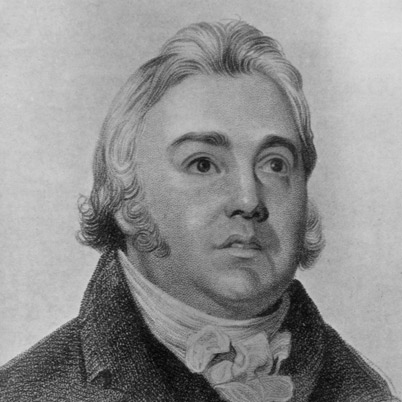
98n/10/huty/12014/28

Though that final phrase may remind us of the “vale of Soul-making,” Coleridge’s conception, no less hypothetical and dialectical than Keats’s, was, unlike Keats’s, theological. In the Biographia, a dozen pages prior to the “interpenetration” attained “in the process of our own self-consciousness,” Coleridge made Identity ultimately equivalent to the divine I AM of scripture: “We begin with the I KNOW MYSELF, in order to end with the absolute I AM. We proceed from the SELF, in order to lose and find all self in GOD” (1:282-83). That lost-and-found process would entail metaphysical self-annihilation, Negative Capability in extremis. Though I occasionally feel the spiritual pull in his poetry and letters, I cannot bring myself to read Keats, even in Endymion let alone the Odes, from a religious or Neoplatonic perspective. What has interested me enough to engage in this “Coleridgean” digression is Coleridge’s dual, apparently contradictory, use of the term “Identity,” and the potential of his Dynamic Philosophy, with its polar fusion of opposites, to help us examine and perhaps reconcile Keats’s two apparently contradictory perspectives on Identity.

To return to the letter on Negative Capability: whatever his misjudgment of Coleridge’s “method” and cognitive processes, these thoughts on Negative Capability codify Keats’s own imperative in engaging a world of “uncertainties” impervious to systemic and total explanation. Since we can rarely get beyond half-knowledge, what is called for, especially in a poet, is a mental and imaginative openness and receptivity. Adumbrating the Shakespearean “quiet power” he finally and fully attained in the ode “To Autumn,” Keats wrote his friend John Hamilton Reynolds on 18 February 1818: “Now it is more noble to sit like Jove tha[n] to fly like Mercury—let us not therefore go hurrying about and collecting honey-bee-like, buzzing here and there impatiently from a knowledge of what is to be arrived at; but let us open our leaves like a flower and be passive and receptive—budding patiently under the eye of Apollo, and taking hints from every noble insect that favors us with a visit” (Letters 1:232-33).

Such hints should be accepted gratefully, not least because they are creatively productive (As Blake put it, using “Keatsian” imagery: “The thankful receiver bears a plentiful harvest.”) To irritably reject them because they cannot be fitted into a larger scheme—“knowledge of what is to be arrived at,” a system of one’s own making—amounts to an egoistic assertion and projection of one’s own identity. Of Dilke, “disquisition” with whom launched these thoughts, Keats later said he “was a Man who cannot feel he has a personal identity unless he has made up his mind about every thing. The only means of strengthening one’s intellect is to make up one’s mind about nothing—to let the mind be a thoroughfare for all thoughts…Dilke will never come at a truth as long as he lives; because he is always trying at it.” (Letters 2:213).
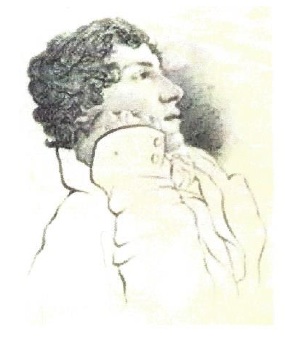
Keatspic

PencilSketch by Charles Brown 1819Pencil Sketch by Charles Brown, 1819

Reading Hazlitt’s Essay on the Principles of Human Action, Keats learned to see “identity” as a limitation of a prior anonymous subjectivity and receptivity. Cancellation of the ego enhances concern for others, a disinterestedness leading to empathy. But Keats could think of almost no one, other than Socrates and Jesus, who had attained such disinterestedness. The Self and Identity were not so easily jettisoned. Along with Hazlitt’s Essay, it seems likely that Keats also read John Locke’s chapter on “Identity and Diversity” in An Essay Concerning Human Understanding, a volume we know he owned (Keats Circle 1:255). In Book II, Chapter 27, Locke argues that “personal identity” requires “psychological continuity,” an unchanging and unique sameness produced by consciousness and memory. “For it is by the consciousness” an intelligent being “has of its present thoughts and actions, that it is self to itself now, and so will be the same self, as far as the same consciousness can extend to actions past and to come” (sect. 10, p. 451; Locke’s italics). What “preserves” a person “as the same individual,” he concludes the chapter, “is the same existence continued” (sect. 28, p.470; Locke’s italics). In his essay “On Personal Character,” published in March 1821, within weeks of Keats’s death, a now deterministic Hazlitt insisted that “No one ever changes his character from the time he is two years old; nay I might say, from the time he is two hours old….The character, the internal, original bias, remains always the same, true to itself to the very last” (Hazlitt, Complete Works, 16:23-34). By the spring of 1819—reflecting what Hyder Rollins, the editor of Keats’s letters, surmises was his reading of Chapter 27 of Locke (Letters 2:102n)—Keats would posit an identity unique to each person’s “individual existence.” But unlike Locke and, especially, Hazlitt, Keats did not see the self as unchanging and unaltered by experience. Instead he believed, in Aileen Ward’s formulation, in a “gradually developing sense of self which emerges as the individual matures, in reaction to the crises of his emotional experience and from imaginative interaction or identification with the identities of others” (John Keats: The Making of a Poet, 419n14).

The movement from one provisional ideal, that of the poet who “has no Identity,” to its polar opposite, the painful creation of an Identity forged in the experiential crucible of the world, is a Polarity that may be illuminated, as earlier suggested, by Coleridge’s emphasis on opposites requiring a creative act to transform and reconcile them: a reconciliation always potential since “distinction is not division.” Those unfamiliar with Coleridge’s emphasis on bipolar unity may think of the process in terms of Hegelian or Blakean dialectic. One or the other seems to be in the background of Stuart Sperry’s apt synopsis: if in his “expansion of the Negative Capability formulation,” Keats “envisioned poetry as an escape from or transcendence of the limits of identity, it was all the more necessary to see it as the discovery or creation of identity at a level that was more profound” (Keats the Poet, 151). The development—reminiscent of Blake’s dialectical movement from Innocence through Experience to a Higher or “organiz’d Innocence”—culminates in the analogy Keats worked out in the spring of 1819, tracing the development of the formless “intelligence” we possess at birth into a coherent “Identity.”

In the most celebrated pages of the journal-letter to his brother and sister-in-law in America, Keats rejected as “narrow and straitened” the Christian notion of “the world…as ‘a vale of tears’ from which we are to be redeemed by a certain arbitrary interposition of God and taken to Heaven.” Instead, Keats, a religious skeptic, hypothesized the existence of a soul, not because he believed the soul to have ontological status, but in order to advance his own scheme of salvation. He proposes an immanent process of “spirit-creation,” in which our experience of earthly life itself, however painful, is its own reward. “Call the world if you Please, ‘the vale of Soul-making’[.] Then you will find out the use of the world….Do you not see how necessary a World of Pains and troubles is to school an Intelligence and make it a soul? A Place where the heart must feel and suffer in a thousand diverse ways!” These intelligences do not become souls “till they acquire identities, till each one is personally itself,” possessing a “bliss peculiar to each one’s individual existence.” What, he asks, summing up his speculations, was a man’s formless soul before it came into the world and was altered and fortified: “An Intelligence—without Identity—and how is this Identity to be made? Through the Medium of the Heart? And how is the heart to become this Medium but in a world of Circumstances?” (Letters 2:102-4).

Here, Keats’s earlier sense of, even occasional longing for, self-annihilation—Wieseltier’s “wish to be rid of” an Identity, Eliot’s “extinction” of, or “escape” from, personality—is retracted, replaced by an existential, Wordsworthian, even proto-Nietzschean insistence on the crucial need to face harsh, often unregenerate reality, and a positive emphasis on the acquisition of personal Identity, shaped by experiencing a world of difficulty and suffering. The process is creative rather than destructive, a rejection of both Christian and Platonic Otherworldy soul-making, a vision of tragic humanism that is finally an affirmation.
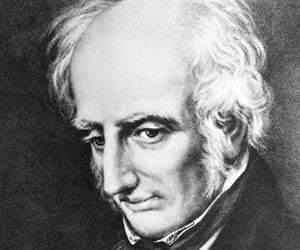
Wordsworth4

It is also Romantic in its fusion of Mind and Heart. This is precisely what Wordsworth had done in the final two stanzas of the “Ode: Intimations of Immortality from Recollections of Early Childhood.” To the penultimate stanza’s emphasis on “thought” and the “years that bring the philosophic mind”—a “necessary” development endorsed by Keats, citing the Ode (Letters 1:186)—Wordsworth added that, even though “the radiance which was once so bright/ Be now for ever taken from my sight,” he still felt the power of nature “in my heart of hearts”:

Thanks to the human heart by which we live,
Thanks to its tenderness, its joys, and fears,
To me the meanest flower that blows can give
Thoughts that do often lie too deep for tears.  (200-203)

The Ode ends with “tears,” but they are unshed since the “thoughts” evoked by that simple flower are “too deep” for tears. In an earlier letter, to John Hamilton Reynolds on 3 May 1818, Keats says that Wordsworth identifies “the human heart” as “the main region of his song” (Letters 1:279). Keats is misremembering the lines from the “Prospectus” to The Recluse, where Wordsworth identifies “the Mind of Man” as “My haunt, and the main region of my song” (40-41), because he is reading them through the prism of the final lines of the Ode, in which Wordsworth offers praise and thanks “to the human heart by which we live.”

Keats’s own fusions of Mind and Heart are rather more sensuous. He could not have known of the letter of Coleridge I earlier cited in connection with Keats’s own “vale of Soul-making” letter, where, in describing the fusion of two forms of “Identity,” Coleridge personified Polarity as “Male and female of the World of Time, in whose wooings and retirings and nuptial conciliations all other marriages…are celebrated inclusively” (Collected Letters 4:807). But Keats did know, intimately, Wordsworth’s “Prospectus” to The Recluse, which he echoes in the “Ode to Psyche,” where the fusion takes erotic even “nuptial” form in the finale. Keats, who will “build a fane/ In some untrodden region of my mind,” is remembering as well Wordsworth’s “temple in the hearts/ Of mighty Poets” (“Prospectus,” 40-41, 85-86). Echoing in order to alter the Greek myth, Keats, as the goddess’s priest and self-inspired prophet, brings Psyche and Eros together in that heart- and mind-forged temple he has made for her. In one of the most touching of all the many Romantic reconciliations of mind and heart, the poet as devotee of the forlorn goddess replaces the myth’s fatal “lamp,” whose dripping wax awakened the god and drove him away, with “A bright torch, and a casement ope at night,/ To let the warm Love in.”

In the most strikingly “Keatsian” image in the “vale of Soul-making” passage, the Heart is described as “the Mind’s Bible, it is the Mind’s experience, it is the teat from which the Mind or intelligence sucks its identity” (Letters 2:103; italics added). To adapt John Donne, one might almost say of Keats that his body thought. One conclusion is palpable. From his own struggle with a world of painful circumstances, Keats would emerge at last, heart and mind altered and fortified, and in possession of what he had earlier criticized or resisted and what, in any case, had so long eluded him: a strong sense of his own personal Identity. The thinking and feeling Heart having become a “Medium” in the experiential crucible of a “world of Pains and troubles,” the chameleon poet of “no Identity” emerges from the soul-making process with an identifiable Self.

Keatspic

This same trajectory can be traced, mutatis mutandis, in what Eliot called “the Ode of Keats,” especially when it is placed in the context of Keats’s development up to that point—the same spring of 1819 when he wrote the journal-letter we have been examining. The “Ode to a Nightingale” is generally, or at least most often, read as a poem of Romantic escape from the self or identity (a “wish to be rid of it,” in Wieseltier’s phrase), however induced.  In the most controversial, and reductive, surmise in his fact-filled new biography, Nicholas Roe reads the Ode as Keats’s “Kubla Khan,” laudanum being the “dull opiate” mentioned three lines into the opening stanza:

My heart aches, and a drowsy numbness pains
[space] My sense, as though of hemlock I had drunk,
Or emptied some dull opiate to the drains
[space] One minute past, and Lethe-wards had sunk.

The heartache and paradoxically painful numbness are a response to the “happy lot” the speaker attributes to the singer hidden in the foliage, a response intensely empathetic rather than pettily envious:

‘Tis not through envy of thy happy lot,
[space] But being too happy in thine happiness—
[space] [space] That thou, light-wingéd Dryad of the trees,
[space] [space] [space] In some melodious plot
[space] Of beechen green, and shadows numberless,
[space] [space] Singest of summer in full-throated ease.

“The Ode to a Nightingale” is, Roe asserts, “one of the greatest re-creations of a drug-induced dream-vision in English literature” (John Keats, 324). I take the Keatsian caveats seriously; the speaker says he feels “as though” he had drunk hemlock or “emptied” a dulling “opiate to the drains,” and goes on to reject not only poison and drugs but a milder and more enticing intoxicant: that “beaker full of the warm South,/ Full of the true, the blushful Hippocrene,/ With beaded bubbles winking at the brim.” There is ample reason to want to escape human “weariness, the fever, and the fret,” Keats’s restless fricatives recalling Wordsworth’s solace in nature from “the fretful stir/ Unprofitable, and the fever of the world” (“Tintern Abbey,” 52-53), itself recalling death-contemplating Hamlet’s cry, “How weary, stale, flat, and unprofitable/ Seem to me all the uses of this world!” (1.2.133-34). In any case, like the opiate, the wine is rejected as a vehicle to join the nightingale: “Away! Away! For I will fly to thee,/ Not charioted by Bacchus and his pards,/ But on the viewless wings of Poesy.” The dream-vision—escapist, imaginative, or both—is poetically induced and articulated. And, as has been said by Paul Valéry, great poet as well as great critic, “It is the very one who writes down his dream who is obliged to be extremely wide awake” (“Concerning Adonis,” in The Art of Poetry 11-12).

Echoing Hamlet’s desire, in this same opening soliloquy, “that  this too, too solid flesh would melt,/ Thaw, and resolve itself into a dew,” Keats wants to “fade far away, dissolve and quite forget” the world of mutability. Though the “dull brain perplexes and retards,” he will join the nightingale on those “viewless wings of Poesy”: the very word summoning up Keats’s earlier, Spenserian poetry of voluptuous refuge from selfhood and the world of circumstances. “Oh, for ten years,” he had cried out in “Sleep and Poetry” (1816), “that I may overwhelm/ Myself in poesy.” Even there he had anticipated three stages, a journey through the sleepy realm of “Flora and old Pan,” and an erotic paradise of natural repose, until “these joys” are bade “farewell.” For the poet, inspired by a vision of his presiding deity, charioted Apollo, knows that “I must pass them for a nobler life,/ Where I may find the agonies, the strife/ Of human hearts” (90-91, 101-2, 122-25; italics added).

In lines that anticipate the disenchantment of the final stanza of the “Ode to a Nightingale,” Keats is torn between the real and the ideal, struggling to retain, despite the gravitational pull of reality, the memory of this vision of Apollo in his chariot, a vision he skeptically doubts, yet vows to keep alive:

The visions all are fled—the car is fled
Into the light of heaven, and in their stead
A sense of real things comes doubly strong,
And, like a muddy stream, would bear along
My soul to nothingness. But I will strive
Against all doubtings and will keep alive
The thought of that same chariot… (155-61; italics added)

The threat in the Nightingale Ode will come from “the fancy” and (closely related if not identical) the beautiful yet deceptive siren-song of that “light-wingéd Dryad of the trees,/ In some melodious plot.” In “Sleep and Poetry,” the self is threatened with annihilation by a doubled (because post-visionary) sense of the trammels of phenomenal reality: a “muddy stream” reminding us again of Hamlet, this time of drowned Ophelia, whose “garments, heavy with their drink,/ Pulled [her] from her melodious lay/ To muddy death.” These antithetical pulls persist. For Keats, who will cry out later in this poem, “If I do hide myself, it sure shall be/ In the very fane, the light of Poesy” (275-76), is not yet ready for the full burden of the Apollonian vision: the need to engage with full consciousness that “nobler life” where he may find “the agonies, the strife/ Of human hearts.”

Two years later, in January 1818, in the pivotal sonnet “On Sitting Down to Read King Lear Once Again,” he will turn from Spenser to Shakespeare, from that “Siren” and “Queen of far-away,” Spenserian “golden-tongued Romance,” to engage, “once again”—in the process of re-reading Shakespeare’s deepest tragedy—“the fierce dispute/ Betwixt damnation and impassioned clay.” Once again “Must I burn through, once more humbly assay/ The bitter-sweet of this Shakespearean fruit.” By vicariously experiencing the agony of Lear, “bound upon a wheel of fire,” Keats comes to that deeper understanding of human life he adumbrated in “Sleep and Poetry.” He also anticipates emerging from the fire, reborn as a poet of self-knowledge and tragic affirmation: “Let me not wander in a barren dream,/ But, when I am consuméd in the fire,/ Give me new phoenix wings to fly at my desire.” The Lear sonnet’s advance from barren dream to tragic reality and self-knowledge extends to form and meter. Though the octave was Petrarchan, its sestet is Shakespearean, and that final line hyper-metrically enacts the poet’s liberation, its Alexandrine breaking the cage of the pentameter.

All of these stages are re-enacted in the “Ode to a Nightingale.” The opulent beauty of the Ode seems Spenserian, never more so than when, on the “viewless wings of Poesy,/ Though the dull brain perplexes and retards,” the poet suddenly (“Already with thee!”) joins the nightingale in her bower-world of “verdurous glooms and winding mossy ways,” from which mid-region, since “here there is no light,” he guesses at heaven: “Tender is the night,/ And haply [perhaps] the Queen-Moon is on her throne,/ Clustered around by all her starry fays.” In the exquisite fifth stanza, the poet guesses at earth. In “embalméd darkness,” he “cannot see what flowers are at my feet,/ Nor what soft incense hangs upon the boughs,” and so must “guess each sweet/ Wherewith the seasonable month endows” the floral and arboreal world around him. But if the absence of sight liberates the imagination, even the flowers guessed at introduce more than organic fertility and growth. Echoing Oberon’s description of Titania’s bower in Act 2, scene 1 of A Midsummer Night’s Dream (where “the nodding violet grows,” over-canopied “With sweet muske roses and with Eglantine”), Keats’s bower-litany (“the grass, the thicket, and the fruit-tree wild,/ White hawthorn and the pastoral eglantine”) ends with

Fast-fading violets covered up in leaves;
[space][space] And mid-May’s eldest child,
The coming musk-rose, full of dewy wine,
[space] The murmurous haunt of flies on summer eves.

Shakespeare’s violet “grows”; Keats’s “fast-fading” violets, the “coming” musk-rose, the projected flies of summer all evoke process, cyclical change, death. The violets’ rapid “fading” recalls, too, the poet’s desire to join the nightingale, wholly integrated into its floral and leafy world and blissfully unconscious of transience and death. Back in stanza 2, the speaker wanted a wine charged with all the joys of earth, “Tasting of Flora and the country green,/ Dance, and Provencal song, and sunburnt mirth,” in order, paradoxically, that he “might drink, and leave the world unseen,/ And with thee fade away into the forest dim.” He longed to “Fade far way, dissolve and quite forget/ What thou among the leaves hast never known”: the world of human fading—where, with Tom behind the abstraction, “youth grows pale, and spectre-thin, and dies;/ Where but to think is to be full of sorrow.” But with the turn into the sixth stanza, he must think, even though the stanza, until the abrupt turn in the final two lines, involves the ultimate dissolution and fading: the dream of escape from a death-haunted world through death itself.

The stanza begins, “Darkling, I listen,” for, along with the murmur of the rose-bosomed flies, Keats hears (as Thomas Hardy later would in “The Darkling Thrush”) the “nocturnal note” of Milton’s nightingale, that “wakeful Bird,” who “Sings darkling and in shadiest Covert hid” (Paradise Lost 3:38-40, marked by Keats in his copy of Milton).

Darkling, I listen; and, for many a time
[space] I have been half in love with easeful Death,
Called him soft names in many a muséd rhyme,
[space] [space] To take into the air my quiet breath;
Now more than ever seems it rich to die,
[space] [space] To cease upon the midnight with no pain,
[space] [space] [space] While thou art pouring forth thy soul abroad
[space] [space] [space] [space] In such an ecstasy….
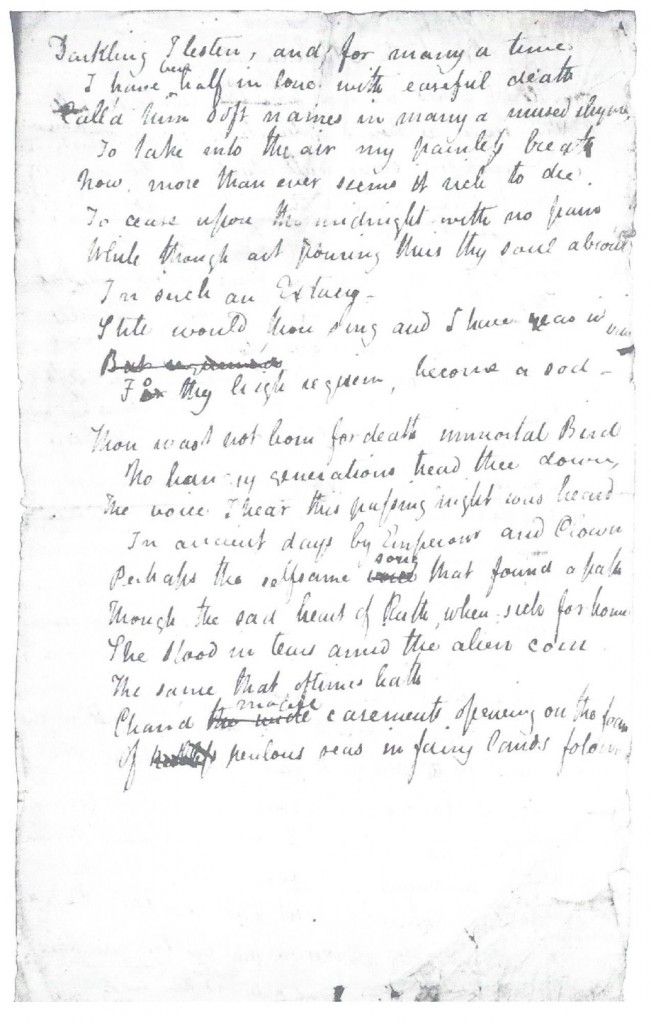
Keatsfacsimile1

With the nightingale pouring forth her own soul, still singing, precisely at midnight, of summer “in full-throated ease,” that half-loved “easeful Death” seems a consummation devoutly to be wished, a fulfillment of the old prayer that, intoxicated “by the breath/ Of flowering bays,…I may die a death/ Of luxury and my young spirit” come “to the great Apollo/ Like a fresh sacrifice” (“Sleep and Poetry,” 57-61). But in the Ode, Keats is only “half in love” with that prospect, and though he has called on Death in “many” a rhyme to “take into the air my quiet breath,” and it now appears “more than ever” a luxury, he has a second caveat: “Now more than ever seems it rich to die.” For Keats’s long-entertained death wish, his voluptuous morbidity, is here countered by his even stronger, quenchless vitality (“full” is repeated twice more in the second stanza). Having half-embraced a “midnight” death, Keats recoils, realizing the actual consequence: “Still wouldst thou sing, and I have ears in vain—/ To thy high requiem become a sod.” Actual death, not the “easeful Death” of his erotic-aesthetic fantasy, far from being “rich,” would impoverish the listener, reduced to insensate oblivion. The nightingale’s song, an outpouring from her own selfhood inviting the poet to join her in a similarly self-transcending ecstasy, has now become a “high requiem” to which he is deaf. The bird would continue to sing; he would hear nothing. The trance has ended.

The two lines anticipate a truth registered in Keats’s heartbreaking letter, written on 30 September 1820 from Yarmouth, off the Isle of Wight. Aboard the ship on which he was making his final journey, Keats, aware that he was beyond recovery, was haunted by the image of Fanny. “The thought of leaving Miss Brawne is beyond every thing horrible—the sense of darkness coming over me—I eternally see her figure eternally vanishing.” He tells his friend Brown, “I wish for death every day and night to deliver me from these pains, and then I wish death away, for death would destroy even those pains which are better than nothing. Land and Sea, weakness and decline[,] are great separators, but death is the great divorcer for ever” (Letters 2:345).

 Keatspic

With the realization, at this late turning-point of the Ode, that death, far from being the portal to union with the nightingale, would be the great divorcer forever, an unbridgeable breach opens between mortal poet and immortal bird. Precisely what had made its “happy lot” so desirable, singing “of summer in full-throated ease” because it had no consciousness of seasonal change and death, now becomes a painful contrast not just emotional but existential: “Thou wast not born for death, immortal Bird!/ No hungry generations tread thee down,” as they tread down those all-too-aware that they are “born for death.” The voice the poet hears on this particular evening was heard “in ancient days” by high and low, by “emperor and clown.” Revealingly, the nightingale’s song introduces in this, the penultimate stanza, the “forlorn” note with which the final stanza will open. The poet attributes both immortality and identity to that song, though he registers (“Perhaps”) a characteristically skeptical note at the outset of the sinuously beautiful lines that follow. The song the poet, a transient mortal, hears “this passing night,” is

Perhaps the self-same song that found a path
[space] Through the sad heart of Ruth, when, sick for home,
[space] [space] She stood in tears amid the alien corn;
[space] [space] [space] The same that oft-times hath
[space] Charmed magic casements, opening on the foam
[space] [space] Of perilous seas, in faery lands forlorn.

However permanent (“Still wouldst thou sing…”) and identical through the ages, his immortalized Bird’s “self-same song” has different listeners, and the final tonality is forlorn.

Forlorn! The very word is like a bell
[space] To toll me back from thee to my sole self!
Adieu! The fancy cannot cheat so well
[space] As she is famed to do, deceiving elf.
Adieu! Adieu! Thy plaintive anthem fades
[space] Past the near meadows, over the still stream,
[space] [space] Up the hill-side; and now ‘tis buried deep
[space] [space] [space] In the next valley-glades….
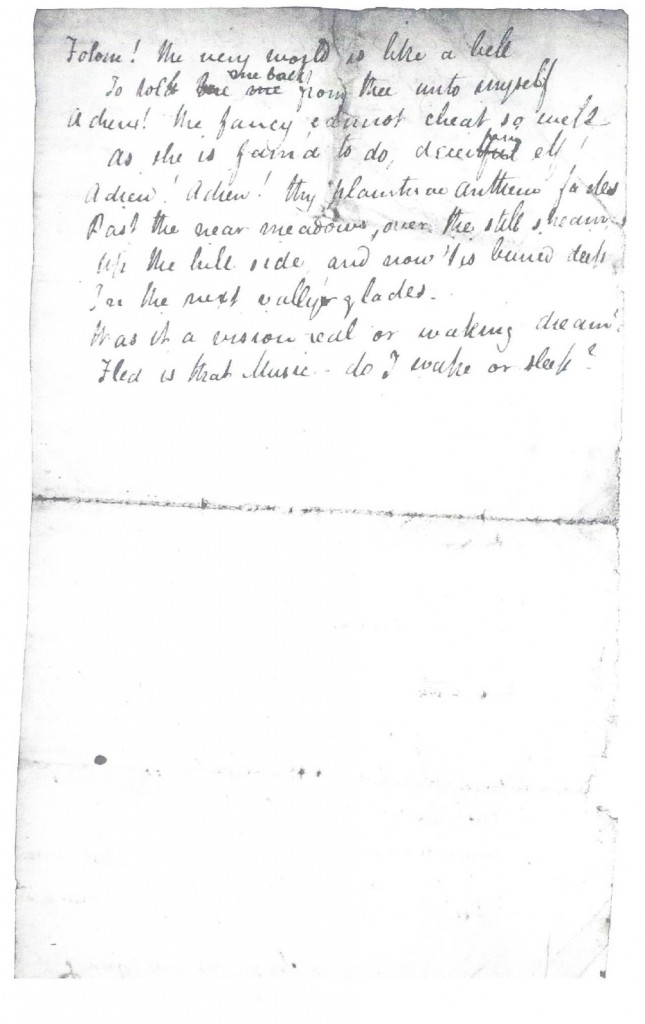
Keatsfacsimile2

Like the “fast-fading violets, covered up in leaves,” the music of the nightingale, which had seduced the poet into longing to “fade far away, dissolve,” and forget the world of transience and death, now itself becomes a “plaintive anthem” that “fades/ Past the near meadows,” over the stream, up the hill-side; “and now ‘tis buried deep/ In the next valley-glades.” As in the crucial sixth stanza, the final two lines of the concluding stanza mark a turn, this time in the form of a double-question: “Was it a vision, or a waking dream?/ Fled is that music:—Do I wake or sleep?” The only thing certain is that, like the visionary chariot of Apollo in “Sleep and Poetry,” the music has “Fled.” If  the fading and burial of the bird’s song recall Wordsworth’s “something that is gone,” in stanza 4 of the Intimations Ode, Keats’s final double-question more certainly evokes the double-question with which Wordsworth ended that stanza (for two years his final stanza): “Whither is fled the visionary gleam?/ Where is it now, the glory and the dream?”

Like Wordsworth at that point of his unfinished Ode, Keats is at a loss. “Nothing is got for nothing,” Emerson reminds us, and the ending of the “Ode to a Nightingale” is as poignant as it is perplexed.  The speaker—embodying Negative Capability, “being in uncertainties, Mysteries, doubts”—is left wondering, as are we. Was his response to the song of the nightingale “a vision real” (as he initially wrote, and, significantly, cancelled)?  Or, however glorious, was it a mere waking dream? Was he then truly awake and now in a state of sleep and torpor inferior to imaginative Reality? Or was he merely entranced then, and now once again awake to the reality of human life, however changed he has been by the intervening imaginative experience?

As in the ode it precedes, that on the Grecian Urn, the “Ode to a Nightingale” is based on antithetical pulls: between attraction to ideal beauty, authentic or escapist, and a skeptical, gravitational attraction to the truth, or the illusion, of earthly reality. In the later Ode, the Urn, speaking belatedly (and, for many readers, problematically, even notoriously) reconciles the antitheses, achieving in oracular utterance—“‘Beauty is truth, truth beauty,’—that is all/ Ye know on earth, and all ye need to know’”—what Keats struggled with, in terms of “sensation” and “knowledge,” feeling and thinking, “beauty” and “truth,” as well as in terms of his differing perspectives on Identity. Indeed, the Delphic Urn asserts what Coleridge was laboring all his life to find through philosophy: that elusive bipolar unity. Of course, the Urn speaks (including, as I read and hear the lines, both the Beauty/Truth equation and the sweepingly un-Keatsian generalization) sub specie aeternitatis, a perspective which is, paradoxically, limited. The equation, true within the urn-world, seems, at best, unconvincing in our own “world of Pains and troubles.” But debate persists; it all depends on how we interpret the variously punctuated final thirteen words. “Who says What to Whom at the End of Ode on a Grecian Urn?” as Jack Stillinger famously put it in his astute analysis of the “various possibilities, along with the objections usually raised against each” (111-12).

Our inexhaustible critical interest in Keats’s Odes lies in their opening up the possibility of contradictory, and almost equally plausible, interpretations. In the case of the “Ode to a Nightingale,” though the conflict may not be definitively resolved, the gravitational pull seems paramount. For the thrust of the final stanza is that Romantic reverie must bow before reality: “The fancy,” Keats tells himself and us, “cannot cheat so well/ As she is famed to do, deceiving elf.” While “the fancy” and the poem-long subject and object of that fancy, the nightingale, are not identical, they do seem to melt into a sort of oneness in the final stanza. Is the nightingale—just a stanza earlier, an “immortal Bird” whose changeless song had the power to magically open lofty if fragile “casements”—now reduced, like “the fancy,” to a “deceiving elf”?

The contrast to that deceptive “elf,” emphasized by the very rhyme, is the “sole self” to which the word “forlorn” had tolled back the poet “from thee,” the nightingale. Those who read this return to self negatively often cite a passage from Book II of Endymion, Keats’s first attempt at epic. In the temple of Diana (anticipating the purgatorial shrine of Moneta in the great Induction to The Fall of Hyperion), the young hero is suddenly lost, at the “maw of a wide outlet, fathomless and dim.” In that state of “wild uncertainty,”

[space] thoughts of self came on, how crude and sore
The journey homeward to habitual self!
A mad-pursuing of the fog-born elf,
Whose flitting lantern, through rude nettle-briar,
Cheats us into a swamp, into a fire,
Into the bosom of a hated thing.
[space] (Endymion II. 272-80; italics added)

Earlier in Book II, the fountain-nymph told Endymion he would have to “wander far” and through “pain” before being received “Into the gentle bosom of thy love” (123-27). Now, an elf-like ignis fatuus “cheats us” into “the bosom of a hated thing.” And yet Endymion is driven to plunge through this quest-landscape of Ordeal, even at the cost of the alienating pain of “consciousness”; and in the final book, in synopsizing his entire quest, he bids “farewell” to “visions,” vowing, “No, never more/ Shall airy voices cheat me” (II.283-90; IV.652-54). Together, the passages presage the return-journey to “self” in the “Ode to a Nightingale.” The hidden, “fog-born elf” that “cheats us” seems a negative but largely accurate anticipation of Romantic fancy, that “deceiving elf” said to “cheat.” “Forlorn! The very word is like a bell/ To toll me back from thee to my sole self!” One senses something funereal in the tolling of that bell. “But surely”—as Morris Dickstein has observed in celebrating Keats’s at last taking up “residence, as he has repeatedly promised, in the difficult domain of the ‘sole self’”—the primary meaning “is of an awakening to life; ‘forlorn’ serves as the bell that brings us back from the dream-world of the nightingale and from the faery lands” (Keats and His Poetry, 219). Paradoxically, and because of the poet’s altered response, it is the song of the allegedly “immortal” nightingale that “fades” and is finally “buried deep.” Though the conflicted poet mourns the fading of that enchanting song, in the “bitter-sweet” balance he has attained, schooled by “a World of Pains and troubles,” Keats seems, in this final stanza of the Nightingale Ode,  to endorse (as he does in the “vale of Soul-making” letter) Identity, the “sole self.”

Keatspic

“Only one in possession of an identity,” said Eliot-echoing Wieseltier, “would understand why one would wish to be rid of it.” In his earlier poetry and letters, indeed, earlier in this Ode itself, Keats, seduced by the song of the nightingale and longing to be caught up with it in a self-dissolving transport, wished to be “rid of” his own “identity.” And he remains torn between enchantment and disenchantment, allured by ravishing if dangerous music, which, like Odysseus, he audited in delight, but to which, in the end, he did not succumb. Does that make the ultimate return to the “sole self” a defeat? Paul de Man has asserted that “the condition of the ‘sole self’ is one of intolerable barrenness, the opposite of all that imagination, poetry and love can achieve. The experience of being ‘tolled back to one’s sole self’ is always profoundly negative” (John Keats, Selected Poetry, xxiii). I concur in Morris Dickstein’s adamant rejection; “that,” he says, “is simply not true” (Keats and His Poetry, 221). Despite his attempts to “dissolve,” to “fade,” to avert his eyes from human suffering; despite all the vestigial tensions in this Ode, Keats, in the final stanzas, moves beyond Spenserian Romance, which turns out to be empty and “forlorn,” returning to a grounded Shakespearean (now Keatsian) reality, and to the self-same world and “sole self” which served as the existential basis for his imaginative flight in the first place.

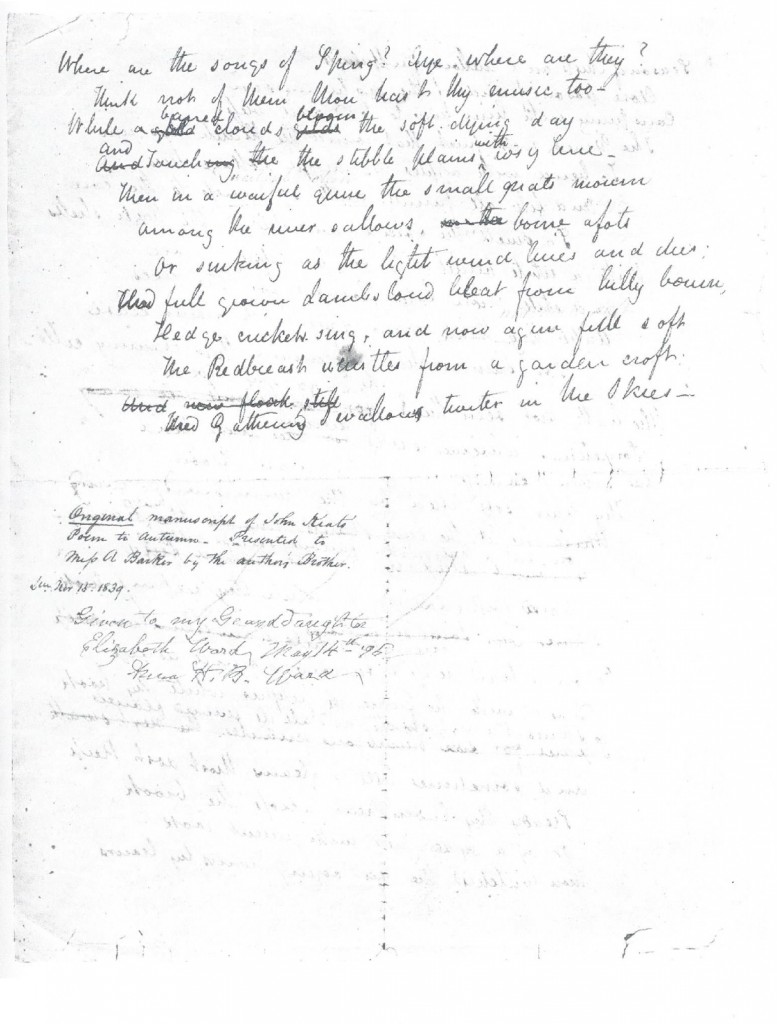
Keats has emerged, here as in the “vale of Soul-making,” from his own struggle with a world of painful circumstances in possession of a strong sense of his own personal identity. This does not mean that he has lost the capacity, the Negative Capability, to relinquish that now altered and fortified identity, “surrendering himself wholly,” in Eliot’s phrase, “to the work to be done.” In the poem he was born to write, “To Autumn,” the last of the great odes, Keats disappears into the sights and sounds of the season. In this poem, the “full-ripened grain” of Keats’s art, there is no ego, no “I.” The one fleeting moment of subjectivity—the ubi sunt double-question, “Where are the songs of spring? Aye, where are they?”—is quickly subsumed in the reassurance to Autumn herself: “Think not of them, thou hast thy music too.” And the funeral dirge for the dying day and season, though orchestrated by Keats (an elegiac diminuendo decreasing in volume, increasing in pitch and clarity), is made to seem her music, not his, even as she hymns her own harvest, her delayed but inevitable disappearance. The sun sets, making the “soft-dying” day “bloom” (life-in-death) and touching “the stubble plains with rosy hue.”

Then in a wailful choir the small gnats mourn
[space] Among the river sallows, borne aloft
[space] [space] Or sinking as the light wind lives or dies;
And full-grown lambs loud bleat from hilly bourn;
[space] Hedge-crickets sing; and now with treble soft
[space] The red-breast whistles from a garden-croft;
[space] [space] And gathering swallows twitter in the skies.
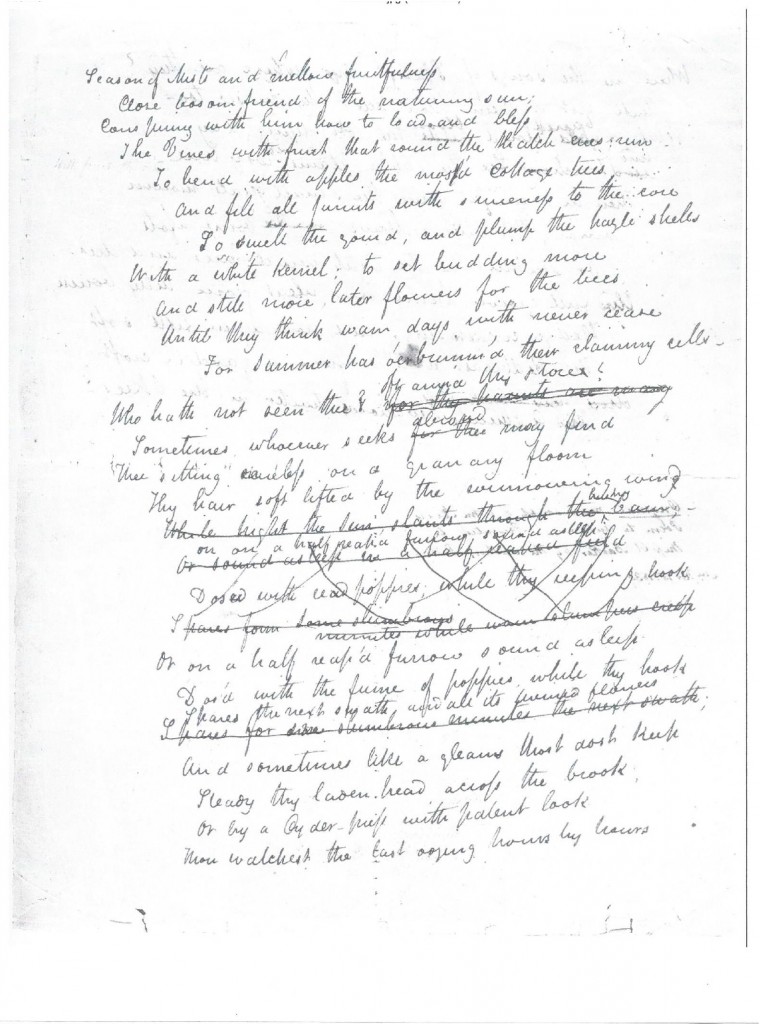
Keatsfacisimile3

SPACE

Keatsfacsimile4

In a sonnet Shakespearean both in form and Negative Capability, Keats reminds us of this ode’s unspoken but ever-present parallel: “Four seasons fill the measure of the year;/ There are four seasons in the mind of man.” Following man’s “autumn, when” he is content “to look/ On mists in idleness—to let fair things/ Pass by unheeded as a threshold brook,” the sonnet ends with a human/seasonal memento mori: “He has his winter, too, of pale misfeature,/ Or else he would forego his mortal nature.” In the ode, autumn’s “full-grown lambs” look back to spring, while the post-harvest sounds (rising from bleat, to sing, to whistle, to twitter) and the gathering swallows herald the approach of winter. But winter is merely hinted at; even the migration of the swallows is left implicit, as, gathering, they “twitter in the skies.” The poet’s own thoughts of mortality remain liminal; they never intrude. Autumn has her own music to the end.

Each season, each stage of life, has a distinct “identity and beauty which man can appreciate by disengaging his own ego” (David Perkins, The Quest for Permanence, 294). We rightly think of this ego-less, autumnal poem as essentially “objective,” and the Nightingale Ode as highly “subjective,” rounding as it does from the opening “My heart aches,” through the flight of imagination, to the rondural tolling back to the poet’s “sole self.” The last word of John Keats’s final ode may be “skies,” but “To Autumn,” moving through its own diurnal and annual cycle, is, even as its music recedes from earth, an earth-centered poem—as, in the end, is the “Ode to a Nightingale.” As Helen Vendler has noted in the “Conclusion” to her book-length study of the Odes, “Keats is unsparingly faithful to his own sense of the artifice necessary to creation; but he remains as well the greatest celebrant, in English, of the natural base without which no art and no identity would be possible” (The Odes of John Keats, 294).

In “To Autumn,” art and identity, art and the natural base, coalesce. Here, at last, beauty and truth seem as distinct yet indistinguishable as the leaf, blossom, and bole that comprise Yeats’s “chestnut-tree, great-rooted blossomer.” Nor (to cite Yeats’s final image of unity of being in “Among School Children”) “can we know the dancer from the dance,” the performer from the work of art, the Eliotic “poet” from his “particular medium.” Keats was never more identifiaby Keats than in “To Autumn,” where he is an absent presence, a poet of “no Identity.” For here, his “sense of Beauty over[coming] every other consideration,” he is “continually… filling some other body,”  having “stepped/ Into a sort of oneness” with Nature, as in Coleridge’s unrealized nuptial vision of “Identity” as alienated man’s “re-union with Nature.” Though terrestrial Keats could only half-identify with the eternal song of that light-wingéd Dryad of the trees, the immortal Nightingale, he may fully identify with the gathering swallows that twitter in the skies. Yet even here there is a poignant distinction. Keats knows that, unlike them, he will not be part of a migratory let alone eternal recurrence. Even when “no Identity” weds Identity, death is the great divorcer forever. In echoing Keats’s final cadences and imagery, Wallace Stevens, in the final lines of “Sunday Morning,” made Keats’s elegiac music less subtle but more explicit: “the quail/ Whistle about us their spontaneous cries;/ Sweet berries ripen” in the wild,

And, in the isolation of the sky,
At evening, casual flocks of pigeons make
Ambiguous undulations as they sink,
Downward to darkness, on extended wings.

[SPACE]

Coda

Montecito CA

This essay on “Keats and Identity” began with Leon Wieseltier’s observation that “Only one in possession of an identity would understand why one would wish to be rid of it.” His latest   “Washington Diarist” column (The New Republic, 9 December 2013), titled “Binocular,” is a moving meditation on things more important than politics, enough so for me to incorporate it as a coda. The essay is set in Montecito, an “impossibly lovely” town between the Santa Ynez Mountains and the sea. “Perched on a large rock facing the ocean,” and “saturated in the noontime light,” Wieseltier escapes all sense of “care.” Momentarily “rid of” his identity, he experiences an “exciting sensation of insubstantiality” a Keatsian dissolution of the self. A thin woman arrives and spreads a towel. He notes her “beautiful gray hair,” her “pleasant Californian smile,” and watches as “she lifted her face toward the light. I could see her sighing with gladness to be in the sun.” Sharing with her what Wallace Stevens, in “Sunday Morning,” has his female persona “find in comforts of the sun,” he enjoys “a moment of solidarity with her.”

But then she reaches into her bag and removes two well-thumbed and “desperate” books: The Art of Healing Cancer and A Cancer Battle Plan Sourcebook. Wieseltier “can hardly describe the shock to my mind. The entire scene was transfigured by my discovery of the woman’s circumstances… The light shone no longer upon beauty but upon tragedy. She was gaunt, she was a fugitive, and she was dying; and I felt pity. The magnificence of creation was suddenly dwarfed by this thin, doomed creature.” I read these words earlier this morning with a shock of recognition, since, in thinking and writing about the “Ode to a Nightingale,” and the magnificent final stanzas of “To Autumn” and “Sunday Morning,” I had been haunted by memories of my first girlfriend, now, like Wieseltier’s woman on the beach, battling cancer.

When that woman on the beach at Montecito got up, stepped toward the ocean, and “stood there staring at the glittering world,” Wieseltier was reminded of the Irish custom of “taking the last look.” He had first heard of the custom, he tells us, in a Mellon lecture, later incorporated into a book, a “subtle and affecting study of the poetry of dying.” The lectures and the book, Last Looks, Last Books (2011) are by Helen Vendler, whom Wieseltier goes on to quote. “How,” Vendler asked, “can…a poem do justice to both the looming presence of death and the unabated vitality of spirit?” What is required, she says, is a “binocular style”: a variation on Coleridge’s “bi-polar unity,” though, unlike Coleridge and like Keats, Wallace Stevens and the four other modern American poets Vendler discusses had to confront death without religious consolation. During his initial idyll in the sun, Wieseltier had escaped from all troubles: “beyond caring,” but “with none of the cruelty the phrase implies.” Though he realized that it was “a temporary escape,” he really “wished,” during that momentary respite, “to be emptied” of the world’s pains and troubles. Wieseltier’s short-lived illusion of “escaping” the cares of the world, as well as Helen Vendler’s exemplification of the need, in a poetry of dying, to register “both the looming presence of death and the unabated vitality of spirit,” illuminate not only “The Ode to a Nightingale” and “To Autumn,” but many of Keats’s other poems, as well as his life and letters.

They also illuminate the state of mind of my ex-girlfriend, with whom I’m still in touch and to whom I just wrote a letter. Yesterday she completed phase one of her chemo treatments, and on the day I’m writing, she is having her first stem-cell infusion. According to a mutual friend, the process is painful, with more pain to come. He knows. Both have multiple myeloma, a horrible, incurable form of cancer. My friend has survived for an astonishing nine years, a tribute to excellent medical care and to the retention of some of the extraordinary physical strength he displayed when we were getting in fights back in the Bronx. In contrast, my girlfriend was always delicate. Yet, while under no illusions, she’s facing her situation with courage, “unabated vitality of spirit,” and the same humor I remember from all those years ago, when we were in love in the Bronx. Her vision is binocular, her face lifted to the sunlight, even as she is acutely aware of the looming presence of death. With her example in mind, as well as that of Keats as a writer and as a man, I’m trying, in Vendler’s phrase, to “do justice to both.”

Wieseltier ends his meditation on mutability by noting that, as a caring person in his everyday life, “I was binocular.” At the beach, during that care-obliterating moment of noontime sun and glittering ocean, “I became monocular.” But “care” and the “identity” he wished to be “rid of” suddenly re-emerged in his Keatsian epiphany: “the entire scene was instantly transfigured by my discovery of the woman’s circumstances.” For one’s “Identity” is “made” through the medium of the heart, “and how is the Heart to become this Medium but in a world of Circumstances?” Wieseltier concludes, as Keats had, fusing restored identity with an empathetic identification with others. “When I left the beach I was binocular again. An old and frail friend was waiting for me to pick him up for lunch, and he needed help getting in and out of the car.”

[SPACE]

Keatspic

John Keats (1795-1821): A Biographical Endnote
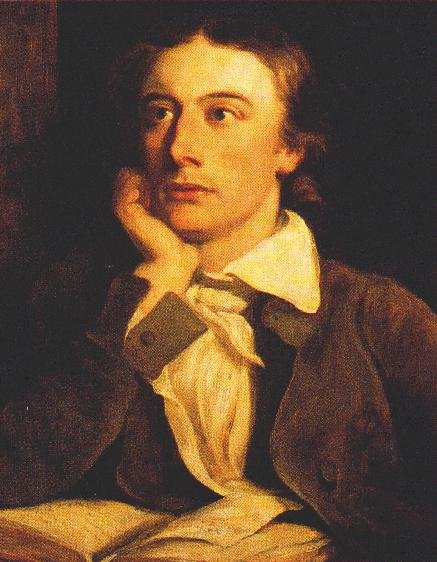
john-keats

The richness and meteoric improvement of his poetry, the intellectual brilliance and human warmth of his letters, and the tragic brevity of his life have combined to make John Keats the best loved of all poets writing in English. In one astonishing year, 1819, Keats wrote two great medieval romances (“The Eve of St. Agnes” and “La Belle Dame sans Merci”) and two powerful epic fragments (Hyperion and The Fall of Hyperion) fusing Greek myth with an inquiry into human suffering. But for most readers, the height of Keats’s achievement is the remarkable 1819 sequence of odes, culminating in the flawless ode “To Autumn,” composed in September. It was preceded by the odes written that spring: “Ode to Psyche,” “Ode to a Nightingale,” “Ode on a Grecian Urn,” and “Ode on Melancholy”: beautifully constructed poems employing language of almost unparalleled richness to explore the tensions between imaginative creativity and human mutability, between vision and reality.

It is hard to separate the poetry from the young man who wrote it. Conceiving of life heroically, not as a vale of tears but as a “vale of Soul-making,” in which an identity is forged through suffering, Keats responded courageously to his own ordeals. Both his parents died when he was a boy, his mother of the same tuberculosis that would later claim both Keats’s younger brother, Tom, whom he lovingly nursed to the end, and, three years later, Keats himself. During the months he spent in Italy wasting away from consumption, Keats alternated between hope for posthumous fame and understandable bitterness at the mortal illness that had thwarted his poetic ambitions and separated him from the young woman he loved, Fanny Brawne. (Jane Campion’s 2009 film Bright Star is based on Keats’s love letters to Fanny.)

“I think I shall be among the English poets after my death,” he said in 1818; but during the hopelessness of what he called his “posthumous life” in Italy, Keats directed that the only words to appear on his tombstone should be, “Here lies one whose name was writ in water.” He died, after much agony, on February 23, 1821. He was twenty-five, and had been unable to write for almost a year. The extraordinary swiftness and sureness of Keats’s development as a thinker and poet, a record of rapid growth unparalleled in literary history, intensify the sense of tragic waste all readers feel at the cutting short of so remarkable a genius. But what, in the few short years given him, he did accomplish, combined with the lovable personality revealed in his letters, ensure that John Keats will always have a prominent and especially cherished place “among the English poets.”

 [SPACE]

Works Cited

Coleridge, Samuel Taylor. Biographia Literaria, ed. James Engell and W. Jackson Bate. 2 vols. Princeton UP, 1983.

_____________________. Collected Letters of Samuel Taylor Coleridge, ed. E. L. Griggs. 6 vols. Oxford: Clarendon P, 1956-71.

de Man, Paul. Introduction to John Keats: Selected Poetry. New American Library, 1966.

Dickstein, Morris. Keats and His Poetry. U of Chicago Press, 1971.

Eliot, T. S. “Tradition and the Individual Talent” (pp. 3-11), in Eliot, Selected Essays. New Edition. Harcourt, Brace & World, 1964. pp. 3-11.

Harvey, Samantha. Transatlantic Transcendentalism: Coleridge, Emerson, and Nature. Edinburgh UP, 2013.

Hazlitt, William, Essay on the Principles of Human Action: The Natural Disinterestedness of the Human Mind (1805); “On Personal Character” (1821); both in The Complete Works of William Hazlitt, ed.  P. P Howe. 21 vols. Dent, 1930-34.

Keane, Patrick J. Emerson, Romanticism, and Intuitive Reason. U of Missouri P, 2007.

Keats, John. The Letters of John Keats, 2 vols., ed. Hyder E. Rollins. Harvard UP, 1958.

________. The Poems of John Keats, ed. Miriam Allott. Longman-Norton, 1970.

________. The Keats Circle, ed. Hyder E. Rollins. 2nd edn. 2 vols. Harvard UP, 1965.

Locke, John. “Identity and Diversity,” in vol. 1 (pp. 439-70), of An Essay Concerning Human Understanding, 2 vols. Collated and annotated by Alexander Campbell Fraser. Dover, 1959.

Perkins, David. The Quest for Permanence. Harvard UP, 1959.

Roe, Nicholas. John Keats: A New Life. Yale UP, 2013.

Shakespeare, William. A Midsummer Night’s Dream, Hamlet, and King Lear; in The Riverside Shakespeare. Houghton Mifflin, 1974.

Sperry, Stuart. Keats the Poet. Princeton UP, 1973.

Stevens, Wallace. Wallace Stevens: Selected Poems, ed. John N. Serio. Knopf, 2009.

Stillinger, Jack. “Appendix” (pp. 111-12) to Twentieth Century Views of Keats’s Odes, ed. Stillinger. Prentice-Hall, 1968.

Valéry, Paul. “Concerning Adonis,” in The Art of Poetry. Pantheon, 1958.

Vendler, Helen. The Odes of John Keats. The Belknap Press of Harvard University Press, 1983.

____________. Last Looks, Last Books: Stevens, Plath, Lowell, Bishop, Merrill. Princeton, 2011.

Ward, Aileen. John Keats: The Making of a Poet. Viking Press, 1963.

Weiselter, Leon. Against Identity. W. Drenttel, 1996.

____________. “Binocular.” The New Republic. 9 December 2013.

 Wordsworth, William. Wordsworth: The Poems. 2 vols., ed. John O. Hayden. Yale UP, 1981.

 Yeats, W. B. W. B. Yeats: The Poems, ed. Daniel Albright.  Everyman’s Library, 1992.

— Patrick J. Keane


Patrick J. Keane is Professor Emeritus of Le Moyne College. Though he has written on a wide range of topics, his areas of special interest have been 19th and 20th-century poetry in the Romantic tradition; Irish literature and history; the interactions of literature with philosophic, religious, and political thinking; the impact of Nietzsche on certain 20th century writers; and, most recently, Transatlantic studies, exploring the influence of German Idealist philosophy and British Romanticism on American writers. His books include William Butler Yeats: Contemporary Studies in Literature (1973), A Wild Civility: Interactions in the Poetry and Thought of Robert Graves (1980), Yeats’s Interactions with Tradition(1987), Terrible Beauty: Yeats, Joyce, Ireland and the Myth of the Devouring Female (1988), Coleridge’s Submerged Politics (1994), Emerson, Romanticism, and Intuitive Reason: The Transatlantic “Light of All Our Day” (2003), andEmily Dickinson’s Approving God: Divine Design and the Problem of Suffering(2007).
Contact: patrickjkeane@old.numerocinqmagazine.com

Oct 192012
 

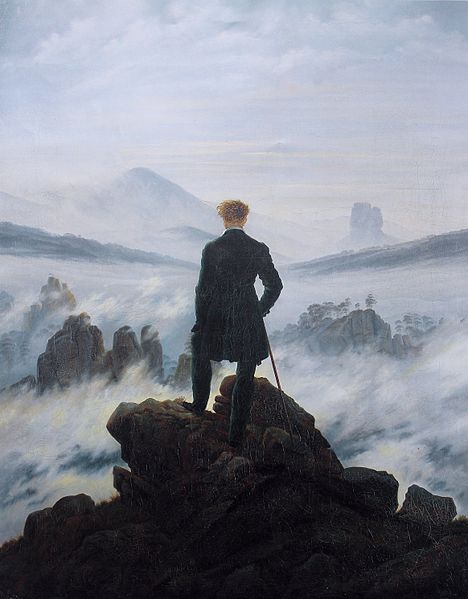
The Wanderer Above the Sea of Fog

Casper David Friedrich, The Wanderer Above the Sea of Fog, 1818, Courtesy of Wikipedia

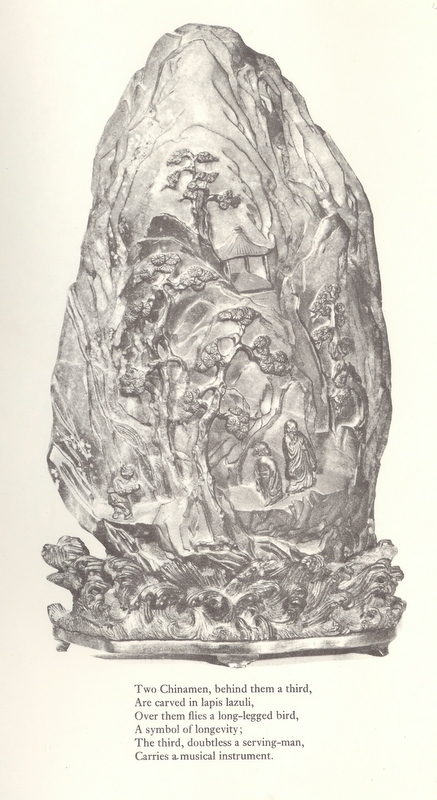
Contributing Editor Pat Keane goes from strength to strength; sometimes I feel that inviting him to write for NC I unleashed one of those Platonic demons — a torrent of thought, word, reference, and wit has erupted. This time he has outdone himself — “Mountain Visions and Imaginative Usurpations” is my favourite of his essays so far. He begins with Columbus sighting America but only uses that as an occasion, as a peg upon which to weave a gorgeous meditation on mountains, mountains in literature, sublimity, and poetry. Pat has more than a way with words and the gift of intelligence; he has vast reading and an astonishing memory — he seems to live in a house of words (in his mind), reaching this quotation and that off the shelf at will. Focused primarily on Wordsworth’s The Prelude, the essay leaps also from Petrarch (climbing a mountain) to Augustine, to Keats, to Yeats (“Lapis Lazuli” — see image below), to Emerson, to Kant and Nietzsche, and every reference is cited with intimate familiarity as if the author’s mind and the culture of ideas have somehow melded (think Vulcan mind-meld). Such feats are a deep pleasure in the reading. Hell, I am editing and publishing this AND I keep taking notes on the side for myself.

dg


1

This essay was completed on the first day of October, 2012. Five hundred and twenty years ago almost to the day, a man saw something, a kind of vision. “About 10 o’clock at night, while standing on the sterncastle, I thought I saw a light to the west. It looked like a little wax candle bobbing up and down….The moon, in its third quarter, rose in the east shortly before midnight…. Then, two hours after midnight, the Pinta fired a cannon, my prearranged signal for the sighting of land. I now believe that the light I saw earlier was a sign from God and that it was truly the first positive indication of land.” The flash of light Christopher Columbus saw from the sterncastle of the Santa Maria on the night of October 11, 1492, transformed human history, mostly if not always for good. Even for those of us open to the ideal vision of America as a City on a Hill, or as earth’s last best hope, there are moments when mindless chants of “USA! USA!,” accompanied by an increasingly jingoistic insistence on American “exceptionalism,” make us appreciate, if not quite endorse, Mark Twain’s sardonic entry for the traditional date in Pudd’nhead Wilson’s Calendar: “THE DISCOVERY. It was wonderful to find America, but it would have been even more wonderful to miss it.”

Columbus’s Diario or log reveals a man of single-minded intensity, though hardly one with the elevated perspective marking the genuine visionary. I’m interested on this occasion in what I’m calling mountain vision; and, symbolically speaking, Columbus’s shipboard tower or sterncastle simply wasn’t high enough. He took the Bahamas for China and Cuba for Japan, and can hardly be said (anymore than the Norsemen 500 years earlier) to have “discovered” a world populated for millennia by native peoples, for whom Columbus’s voyage proved to be anything but a “sign from God”—emerging, instead, as a negative form of what William Wordsworth, describing the relation between the physical sight of mountains and the transforming power of imagination, termed “usurpation.”

And yet, in the full sense of the word, it was obviously “wonderful” to find America. The European Renaissance, an exciting Age of Exploration and Discovery, had a kind of rebirth in the Romantic period, which in many ways replicated that earlier explosion of science, exploration, and wonder-struck literature. The title of Richard Holmes’s splendid 2008 book seems inevitable: The Age of Wonder: How the Romantic Generation Discovered the Beauty and Terror of Science. The discoveries discussed by Holmes—by men like Joseph Banks, William Herschel, and Humphry Davy—were, of course, anticipated by the discoveries of such Renaissance and post-Renaissance men as Robert Hooke, Andreas Vesalius, and Isaac Newton. As if to confirm the link between the two Ages, Wordsworth added some lines to the epic poem that would be posthumously published as The Prelude. Recalling the statue of Newton at Cambridge, “with his prism and his silent face,” the poet paid tribute to the range of Newton’s extraordinary and solitary genius: “The marble index of a mind for ever/ Voyaging through strange seas of Thought, alone” (III.62-63).

Wordsworth added those magnificent lines in 1838. In October, 1816, a younger Romantic poet, John Keats, evoked an adventurous quest for knowledge resembling that attributed by Wordsworth to Newton, and also connecting Romantic-era science with the age of European Discovery. Writing more than three centuries after Columbus, the young Keats unforgettably recaptured that initial sense of wondrous exploration and revelation. In the octave of his sonnet “On First Looking into Chapman’s Homer,” Keats depicts himself as an explorer of “goodly states” and islands dedicated to the god of poetry. But for a young reader ignorant of Greek a vast continent or ocean lay unexplored:

Much have I travelled in the realms of gold,
………..And many goodly states and kingdoms seen;
………..Round many western islands have I been
Which bards in fealty to Apollo hold.
Oft of one wide expanse had I been told
………..That deep-browed Homer ruled as his demesne;
………..Yet never did I breathe its pure serene
Till I heard Chapman speak out loud and bold.

Seeking analogues to express the sense of unexpected discovery he experienced on first reading Homer in the vigorous Elizabethan translation of George Chapman, Keats, in the sestet, deploys ocular images, astronomical and exploratory, of sudden revelation, stunned vision. He begins by evoking the discovery in 1781 of the planet Uranus by William Herschel, about which Keats had read in a book given him as a school prize: “Then felt I like some watcher of the skies/ When a new planet swims into his ken…”

But his second and clinching simile reflects his reading about geographical discovery in the Americas. Keats may, like Columbus, have been mistaken in details—it was not Cortez but Balboa who looked out upon the unexpected Pacific from the mountain at the Isthmus of Panama. But no one has better captured the awestruck moment of mountain vision, of revelation from the heights. Keats envisions the heroic conquistadore,

…………………….when with eagle eyes
…………..He stared at the Pacific—and all his men
Looked at each other with a wild surmise—
…………..Silent, upon a peak in Darien.

Poetic technique and form alone cannot account for that breakthrough into the Sublime—the assonance, alliteration, and double caesura that produce that final catch-in-the-breath moment, with its attendant sense of monumental tranquility. Nevertheless, it seems appropriate that Keats should cast his revelation in the form of a Petrarchan sonnet (rhymed abbaabba cdcdcd). The Italian Renaissance humanist, poet, and scholar Francesco Petrarca not only established an enduring form for the sonnet; he may be said to have initiated the modern sense of mountain vision. Keats depicts the discoverer and his men atop Mount Darien, that peak on the Isthmus of Panama. On April 26, 1336, Petrarch and his brother climbed a 6,000 foot peak, Mount Ventoux. His “only motive” for making “the ascent of the highest mountain in the region,” he writes a friend, “was the wish to see what so great an elevation had to offer.” In his letter he describes the ascent in realistic detail. Unlike his brother, Petrarch tried easier, more circuitous paths up the mountain before realizing that, ultimately, he had to face the difficult ordeal of a tough vertical climb. Suspended between Medieval allegory, Renaissance symbolism, and the sheer exertion and exhilaration of the climb and the final prospect from the heights, Petrarch gives us a version of the old dialogue between body and soul, flesh and spirit, the outer and the inner worlds. In short, the climb, as literary as it is actual, is a spiritual as well as a physical ascent; and in describing it the great humanist pays no less tribute to the classical writers of pagan antiquity than he does to Christian saints.

Appropriately, however, since the friend to whom he wrote this letter was an Augustinian monk, Petrarch emphasizes Saint Augustine, a small-sized codex copy of whose Confessions, given him by his friend, he took with him on his ascent. Once atop the mountain, Petrarch took out the book and, he swears, opened the text (as Augustine himself famously had, turning at random to Romans XIII.13:13-14, at the moment of his conversion) to a revelatory passage. The words Petrarch opened to occur at Confessions, X. viii. 15: “And men go about to wonder at the heights of the mountains, and the mighty waves of the sea, and the wide sweep of rivers, and the circuit of the ocean, and the revolution of the stars, but themselves they consider not.” Brooding on Augustine, Petrarch “thought in silence” of we who “neglect what is noblest in ourselves, scatter our energies in all directions, and waste ourselves in a vain show, because we look about us for what is to be found only within.” Clinching the analogy between his initially meandering route up the mountain and his final direct ascent, Petrarch ends his paysage moralisé by requesting his friend’s prayer that “these vague and wandering thoughts of mine may sometime become firmly fixed, and, after having been vainly tossed about from one interest to another, may direct themselves at last toward the single, true, certain, and everlasting good.” (Letter to Dionysio da Borga San Sepolcro)

.

2

For more than four centuries, for reasons elaborated in Marjorie Hope Nicolson’s Mountain Gloom and Mountain Glory (1959), the human view from and of mountains, thought to be deformed expressions of God’s wrath, was largely eclipsed in Western literature. Perhaps recalling Moses on Sinai, John Milton has several supernatural “mountain” scenes in Paradise Lost. In Book V, his archangel Raphael, describing at Adam’s request the revolt in heaven, depicts “the Father infinite,” together with his Son, announcing his decision to appoint that Son Lord and vice-regent, “as from a flaming mount, whose top/ Brightness had made invisible.” This luminous eminence is echoed later in Book V, when Raphael envisions a third of the angelic host approaching Lucifer-Satan on his “royal seat/ High on a hill, far blazing, as a mount/ Rais’d on a mount,” with the chief of the rebelling angels “Affecting all equality with God,/ In imitation of that mount whereon/ Messiah was declar’d in sight of heaven” (V.596-99, 756-58, 764-65). Still later, in the final Book, Milton’s angel Michael, a “seer blest,” reveals the far future to fallen Adam from a height, assuring him as they descend that, thanks to the redemptive sacrifice of Christ, the Eden lost by Adam and Eve despite Raphael’s warning will be replaced by a “paradise within thee, happier far” (XIV..587).

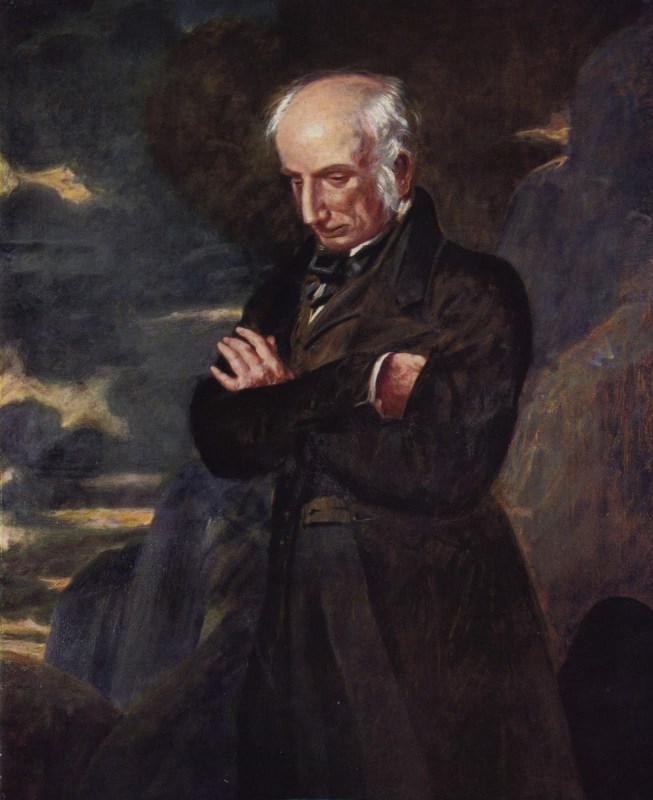
Benjamin Robert Hayden’s 1842 portrait of Wordsworth (then 72), posed against Helvellyn Peak, a Lake District mountain (the third highest in England) often climbed by the poet). The painting was inspired by a Wordsworth sonnet commemorating one such climb.

This seems a version of the Petrarchan quest for “what is to be found only within.” But it took Milton’s great heir, William Wordsworth, to return poetry to human heights and to secularly redeem the false sense of “divinity within,” an autonomous instinct that proved lethal to Adam and Eve (Paradise Lost IX. 1010), but which defines the creative Imagination for poets in the Romantic tradition. Naturalizing supernaturalism, and fusing the power of Milton, and of Edmund Burke and Immanuel Kant on the Beautiful and the Sublime, with his own climbing experiences in the mountainous Lake District of England, in Wales, and in the French Alps, Wordsworth gives us, at two climactic moments of his autobiographical epic, The Prelude, unforgettable examples of mountain vision.

Those symbolic moments (in Books VI and XIV) are foreshadowed in the opening Book. Dramatizing the fair seed-time in which he “grew up/Fostered alike by beauty and by fear,” Wordsworth describes, among his boyish sports, stealing birds’ eggs from mountain nests. Though the object was “mean,” the outcome “was not ignoble.” In a terrifying but thrilling moment of enhanced sensory apprehension, the solitary climber, hung perilously on the cliff, is caught up in that sublime “motion” that, for Wordsworth, animates the vital universe. The descriptions are virtually identical in the 1805 (lines 341-50) and 1850 (lines 330-39) versions of The Prelude. Here I cite the 1850 text:

……………….Oh! When I have hung
Above the Raven’s nest, by knots of grass
And half-inch fissures in the slippery rock
But ill-sustained; and almost (so it seemed)
Suspended by the blast that blew amain,
Shouldering the naked crag; Oh, at that time,
When on the perilous ridge, I hung alone,
With what strange utterance did the loud dry wind
Blow through my ears! The sky seemed not a sky
Of earth, and with what motion moved the clouds!

Registering the ministry of fear more than of beauty, the Jesuit poet Gerard Manley Hopkins would echo these lines in one of the “terrible sonnets” of 1885. “Pitched past pitch of grief” in the dark night of his soul, he interiorized Wordsworth’s moment “hung” on the cliff: “O the mind, mind has mountains; cliffs of fall/ Frightful, sheer, no-man fathomed. Hold them cheap/ May who ne’er hung there.” As Hopkins knew, mountain terror rears its head elsewhere in Wordsworth’s accounts of his youthful activities in this first Book of The Prelude. In the famous boat-stealing episode, the boy (whose stealth and guilt echo that of pear-thieving Augustine in the Confessions), is not only surrounded by “mountain-echoes.” As he rows farther from the shore, his changing perspective reveals “a huge peak, black and huge,” which, hitherto hidden below the horizon, now “towered up between me and the stars,” and “strode” after him, “with purpose of its own/ And measured motion.” The memory of this terrifying spectacle—self-created by the rower yet soul-fostering” and sublime in its effect—plunged him into a world of “unknown modes of being,” with no familiar or pleasant shapes, but “huge and mighty Forms” that “moved slowly through the mind/ By day, and were a trouble to my dreams” (1850: I. 356-400).

Sublimity supersedes fear in the crossing of the Simplon Pass in Book VI. Traveling in revolutionary France in the summer of 1790, Wordsworth and a fellow climber, Robert Jones, journeyed to the Alps, the majesty of the mountains further inspiring their revolutionary hopes. The great passage is foreshadowed by a brief but telling description of how they “first/ Beheld the summit of Mont Blanc, and grieved/ To have a soulless image on the eye” (the actual sight of Mont Blanc), which “had usurped upon a living thought/ That never more could be” (VI [1805]453-57). The living thought temporarily  “usurped” is Wordsworth’s imagination of the great mountain, its summit more dramatically “Unveiled” in the 1850 version, but its merely Alpine sublimity still inferior to the imaginative power of what Wordsworth’s perceptive admirer Keats would later refer to as “the Wordsworthian or egotistical sublime.”

That usurpation will be repeated, and crucially reversed, seventy lines later. Climbing along the “steep and lofty” Simplon Pass, ascending with eagerness, Wordsworth and his friend lose both their way and their comrades. At length, they encounter a peasant who tells them that they must “descend” to the spot where they first became perplexed, and that “their future course, all plain to sight,/Was downwards.” Reluctant to believe what they so “grieved” to hear, for, as Wordsworth emphasized in 1850, “still we had hopes that pointed to the clouds,” they question the peasant repeatedly, yet every word, augmented by their own feelings, ended in the fact (italicized in 1850) “that we had crossed the Alps” (524).

And here I pause to report another kind of “discovery.” On the very day I thought I had written the final version of this section of my essay, a newly-published book arrived in the mail: English Past and Present, edited by Wolfgang Viereck, consisting of papers selected from an IAUPE conference held in Malta. One essay caught my eye: “Constructions of Identity in Romanticism: The Case of William Wordsworth,” written by a distinguished German Romantic scholar and friend, Christoph Bode. To my initial dismay and eventual delight (an appropriately Wordsworthian trajectory), I discovered that he, too, was examining, with characteristic brilliance, the mountain episodes in The Prelude. Though relieved that we took the same general position, I was humbled by the ingenuity of his nuanced discussion.

For example—to return to and refocus on that crossing of the Alps—Bode persuasively argues that “it is almost as if, contrary to what the preceding lines say, Wordsworth is immensely relieved to know that from now on it is downhill.” While there is surely some disappointment (including Wordsworth’s feeling of having been betrayed by bodily senses and instincts that should have informed him when he was at the high point), compensation, though it came in retrospect, takes the form of a glorious rhetorical outpouring which is, as Bode says, “one of the most impressive apotheoses of the imagination in Wordsworth’s entire oeuvre.” The experience in the Alps was then, 1790. Now, a decade and a half later, its hidden significance is revealed in a visionary experience that apparently came to Wordsworth primarily if not exclusively in the act of writing about that Alpine crossing. Though I prefer the 1850 version, the layering of time requires citation of the 1805 text:

………………..Imagination! Lifting up itself
Before the eye and progress of my Song
Like an unfathered vapour; here that Power,
In all the might of its endowments, came
Athwart me; I was lost as in a cloud,
Halted without an effort to break through.
And now, recovering, to my Soul I say
I recognize thy glory; in such strength
Of usurpation, in such visitings
Of awful promise, when the light of sense
Goes out in flashes, that have shown to us
The invisible world, doth Greatness make abode,
There harbors, whether we be young or old.
Our destiny, our nature, and our home
Is with infinitude, and only there;
With hope it is, hope that can never die,
Effort, and expectation, and desire,
And something evermore about to be. (525-42)

What Wordsworth, that preeminent prophet of human hope, realizes in retrospect is that a man’s reach should exceed his grasp. For Romantics enlisted in the visionary company, the glory of the human spirit consists, not in attaining the attainable but in striving for the infinite, even if our mortal capabilities are necessarily finite. Reversing the previous “usurpation,” in which the physical sight of Mont Blanc imposed upon an imaginative vision, Wordsworth, “recovering,” can say to his more conscious soul: “I recognize thy glory.” It is the glory of that “awful Power” which, through “sad incompetence of human speech” (1850 version), we call “Imagination.” This is the creative Romantic Imagination, whose “strength/ Of usurpation” succeeds and supersedes the mere “light of sense,” extinguished “in flashes” that reveal to us “the invisible world.”

The lines immediately following confirm the political analogy. Once ardently committed to the French Revolution (“Bliss was it in that dawn to be alive,/ But to be young was very heaven!”), Wordsworth in effect revokes that delusory dream of a material, external Eden in favor of a paradise within:

The mind beneath such banners militant
Thinks not of spoils or trophies, nor of aught
That may attest its prowess, blest in thoughts
That are their own perfection and reward,
Strong in itself, and in the access of joy
Which hides it like the overflowing Nile. (543-48)

Later readers have often been distressed by Wordsworth’s increasingly orthodox religiosity (traceable in the 1850 version of these lines, where the “mind” becomes “the soul,” and that overflowing “access of joy” a more pious “beatitude”). Some will also deem his personal conversion of politics into a cognitive, imaginative revolution less courageous than a retreat to quietism. Here, it seems powerfully validated by those intuitive “flashes” (recalling the Intimations of Immortality Ode’s “master light of all our seeing”) revealing both the invisible world and a “greatness” that transcends any merely external triumph. The language remains martial, but, as Yeats would later ask in an unpublished lecture titled “Friends of My Youth”: “Why should we honor those that die upon the field of battle? a man may show as reckless a courage in entering into the abyss of himself.” Writing in 1805, at the apogee of the empire of Napoleon, that usurper of the Revolution, who had by then twice exploited the strategic significance of the Simplon Pass (the shortest route between Paris and Milan) by building suspended bridges across the ravine), centripetal Wordsworth is no less dismissive of external battle, its spoils and trophies, and equally insistent on inward strength. Like Paul, Milton, Blake, and Yeats himself, Wordsworth elevates spiritual or imaginative struggle over “corporeal warfare.”

Having recorded the inner reward of mountain vision, the poet returns to the initiating experience. Overcoming the “dull and heavy slackening” that ensued on hearing the peasant’s news, Wordsworth and his friend hastened down a narrow chasm, their pace slowing as they descended. What Wordsworth sees and hears (rocks muttering, crags speaking “as if a voice were in them”) in the Gorge of Gondo is at once natural and epiphanic. The clash of polar opposites is apocalyptically reconciled, natural flux ending in permanent form, tumult in a final peace:

The immeasurable height
Of woods decaying, never to be decayed,
The stationary blasts of waterfalls,
And everywhere along the hollow rent
Winds thwarting winds, bewildered and forlorn,
The torrents shooting from the clear blue sky,
The rocks that muttered close upon our ears,
Black drizzling crags that spake by the way-side
As if a voice were in them, the sick sight
And giddy prospect of the raving stream,
The unfettered clouds, the region of the Heavens,
Tumult and peace, the darkness and the light—
Were all like workings of one mind, the features
Of the same face, blossoms upon one tree,
Characters of the great Apocalypse,
The types and symbols of Eternity,
Of first and last, and midst, and without end. (VI. 556-72)

The Alpha and Omega of Revelation is fused—though, in Wordsworth’s case, with no reference to God—with Adam’s prayer (Paradise Lost V. 153-65) that the things of this world should extol their Creator, “him first, him last, him midst, and without end.” Though the revelation, at last, of the natural sublimity of the mountain landscape is revealed when Wordsworth is descending, we may be reminded of Petrarch, meditating on his ascent of the mountain and seeking his friend’s prayer that his “wandering thoughts” may become “more coherent” and, having been “cast in all directions,…may direct themselves at last to the one, true, certain, and never-ending good.” Both poets are internalizing the external mountain scenery, but while Petrarch’s terms are specifically Christian and moral, Wordsworth’s language, though echoing the Bible and Milton, remains nonsectarian, mysterious, Sublime. There is a striking resemblance (coincidental or a reflection of Coleridge’s Kantian influence on his friend) to Kant’s theory of the sublime, a feeling experienced when, however overwhelmed or even terrified as a merely sensual being, one realizes that, through the power of Reason, “a faculty of the mind surpassing every standard of Sense,” one is able to form an idea of the Infinite. As Bode notes of Wordsworth’s Alpine descent, now that the mountains, with all their “infinite grandeur,” are “identified as the external representation of something internal, they are no longer terrifying, but [in a serious pun] downright uplifting. The landscape does not praise God, it praises Mind,” in its most exalted, or intuitive, form: that of the creative Imagination.


3

Appropriately, inevitably, the final Book of The Prelude gives us, along with Wordsworth’s climactic mountain vision, his re-assertion of the even more sublime power of the creative imagination, that glorious faculty (to quote the final lines of both versions of The Prelude) almost infinitely “more beautiful than the earth” on which “man dwells, above this Frame of things,” in “beauty exalted, as it is itself/ Of substance and of fabric more divine.” Since in this case, and in both versions, the inner meaning of what was seen and heard on the mountain was recognized during the climb rather than retrospectively, and since in this case the 1850 version is rhetorically superior, I will quote the later text.

Accompanied again by his friend Jones and a third companion, the poet ascended at night the highest peak in Wales, “to see the sun/ Rise from the top of Snowdon.” Climbing with “eager pace, and no less eager thoughts,” Wordsworth was in the lead, when suddenly “at my feet the ground brightened,/And with a step or two seemed brighter still.” No time was “given to ask, or learn, the cause;/ For instantly a light upon the turf/ Fell like a flash.” Unlike the inner “flash” of Imagination revealing “the invisible world” in Book VI, this flash of light comes from above. It is not, however, the rising sun, the spectacle that motivated this nocturnal excursion, but the lunar recipient of the sun’s reflected light:

………………..lo! As I looked up,
The Moon hung naked in a firmament
Of azure without cloud, and at my feet
Rested a silent sea of hoary mist. (XIV. 5-6, 35-42)

The vapors project over headlands and promontories, “Into the main Atlantic, that appeared/ To dwindle, and give up his majesty,/Usurped upon as far as sight could reach” (46-50). But the mist does not encroach upon the heavens, dominated by “the full-orbed Moon,/Who, from her solemn elevation, gazed/ Upon the billowy ocean, as it lay/All meek and silent,” except for the noise audible through a rift in the clouds. Through that rift (in lines recalling the Gorge of Gondo, though reversing perspective) “Mounted the roar of waters, torrents, streams/ Innumerable, roaring with one voice!” (50-60). Once reflected upon with “calm thought,” what he describes as “That Vision, given to Spirits of the night,/And three chance human wanderers,” appeared to the climber “the type/ Of a majestic intellect.” As Wordsworth’s language reveals, that emblematic Mind is a secular variation on Milton’s Holy Spirit “brooding” dove-like over the “vast abyss,” making Chaos fruitful (Paradise Lost I. 20-22):

There I beheld the emblem of a Mind
That feeds upon infinity, that broods
Over the dark abyss, intent to hear
Its voices issuing forth to silent light
In one continuous stream; a mind sustained
By recognitions of transcendent power,
In sense conducting to ideal form,
In soul of more than mortal privilege. (70-77)

While the mountain scene is natural, and we mount to vision through the senses, those truly gifted recognize the transcendent power of the mind, its capacity to creatively mold and convert sensory apprehensions of the outward show of innumerable and ever-changing phenomena into ideal and emblematic forms, permanent and unified. The initial project, “to see the sun/ Rise from the top of Snowdon,” is now utterly beside the point. Even the moon, “hung in a firmament/ Of azure without cloud,” beautiful as it is, is secondary not only to its source of light, the sun, but to another power that bathes the world in luminous meaning. This transforming, or “usurping,” power is, as always, that of the human mind in its highest form, “intuitive Reason” (120), by which Wordsworth—like Milton, Coleridge, and Ralph Waldo Emerson—means what Coleridge called the “shaping spirit of Imagination.” For Coleridge and those he influenced, the Romantic Imagination—a faculty at once emotional, cognitive, and spiritual—echoes and alters the epistemological re-orientation announced in the “Transcendental Idealism” section of Kant’s Critique of Pure Reason: that “Copernican revolution” in which the shaping mind gives form to the external objects it perceives, subordinating things to thought, just as the sensual is ultimately dominated by the cognitive in Kant’s theory of the Sublime.

Reflecting his own Coleridgean reading of Kant, Emerson ended his seminal text, ironically titled Nature, by asserting “the kingdom of man over nature.” An equally Coleridgean Wordsworth, speaking directly to his friend, writes that, together, they will “instruct” others (in the concluding lines of this epic poem dedicated to Coleridge) “how the mind of Man becomes/ A thousand times more beautiful than the earth/ On which he dwells,” being “In beauty exalted, as it is itself/ Of quality and fabric more divine” (1850: XIV, 450-56). In the Snowdon passage, struggling to depict the reciprocal relationship between the mind and external Nature, Wordsworth falls back on epistemologically slippery or at least paradoxical formulations (“mutual domination,” “interchangeable supremacy”), and an emphasis on the senses and emotion  before, inevitably, celebrating the power of the all-illuminating mind:

One function, above all, of such a mind
Had Nature shadowed there, by putting forth,
‘Mid circumstances awful and sublime,
That mutual domination which she loves
To exert upon the face of outward things,
So moulded, joined, abstracted; so endowed
With interchangeable supremacy,
That men least sensitive see, hear, perceive,
And cannot choose but feel. The power which all
Acknowledge when thus moved, which Nature thus
To bodily sense exhibits, is the express
Resemblance of that glorious faculty
That higher minds bear with them as their own. (78-90)

The passage is complex, but what emerges is the supremacy of what Nature merely “shadowed there”—namely, that “glorious faculty,” the creative Imagination, in the exercise of which the highest human minds, at once reflecting and exceeding the orchestrating but limited power of Kant’s pure Reason, resemble Miltonic “angels stopped upon the wing by sound/ Of harmony from heaven’s remotest spheres” (98-99).

.

4

The Prelude has long been recognized as, next to Paradise Lost itself, the greatest poem of its length in English. Excerpts, including the crossing of the Simplon Pass, appeared during Wordsworth’s lifetime, but the poem as a whole became public only after the poet’s death, in 1850. The long poem known to his contemporaries was not his autobiographical epic, but The Excursion (1814), the poem intended to be second in the triadic structure announced in the prefatory poem:  “a kind of Prospectus of the design and scope of the whole” of his project, including the culminating epic, to be called The Recluse. This so-called “Prospectus” to The Recluse was of immense importance to Emerson, who reprinted its 107 lines in his anthology, Parnassus, under his own title, “Outline.” Emerson was also impressed by the poem it accompanied, The Excursion, a lesser epic which nevertheless contains several notable mountain visions. In his 1840 essay “Thoughts on Modern Literature,” Emerson remarked that “The Excursion awakened in every lover of nature the right feeling. We saw stars shine, we felt the awe of mountains….” He is recalling those moments in Book I (paralleling the formative personal experiences recounted in the opening Book of The Prelude) where the boy who would become the Wanderer interacted with the natural world. We encounter him, as Emerson remembered, as he “all alone/ Beheld the stars come out above his head” (128-29), and “felt the awe of mountains.” That boy knew his Bible; “But in the mountains did he feel his faith” (223), a feeling of sublimity in which “the least of things/ Seemed infinite; and there his spirit shaped/ Her prospects; nor did he believe,–he saw.”

…………..Such was the Boy—but for the growing Youth
What soul was his, when, from the naked top
Of some bold headland, he beheld the sun
Rise up, and bathe the world in light! He looked—
Ocean and earth, the solid frame of earth
And ocean’s liquid mass, in gladness lay
Beneath him:–far and wide the clouds were touched
And in their silent faces could he read
Unutterable love…his spirit drank
The spectacle: sensation soul, and form,
All melted into him…in them did he live,
And by them did he live; they were his life. (197-210)

At such times, the Wanderer was “Rapt into still communion that transcends/ The imperfect offices of prayer and praise,/ His mind was a thanksgiving to the power/ That made him; it was blessedness and love!” (215-18). It is hardly surprising that the American Transcendentalist, who most famously presents himself rapt in a still communion in which he becomes “a transparent eyeball” (recapturing as well the moment in “Tintern Abbey,” when “we see into the life of things”) should respond so intensely to such a transcendent moment, and even think that “obviously for that passage” the whole of The Excursion “was written.” Emerson had, as any one would, reservations about the didactic stretches of The Excursion (“This will never do,” Francis Jeffrey’s famous Edinburgh Review dismissal of the long-awaited epic, has resonated with more than a few readers). But there were other passages than the one for which the poem was “obviously” written that also haunted Emerson. At certain privileged and precarious moments (he recorded in his journal) the soul “in raptures unites herself to God and Wordsworth truly said, “’Tis the most difficult of tasks to keep/ Heights which the soul is competent to gain’” (Journals and Miscellaneous Notebooks 4:87). Emerson often cited these lines (Excursion IV.139-40), most memorably in his late essay “Inspiration,” where he laments the unpredictability and evanescence of such moments on the “Heights”: “with us” there is “a flash of light, then a long darkness, then a flash again…This insecurity of possession, this quick ebb of power…tantalizes us.”

Emerson was also fascinated by a related moment of “sublimity” in Book II of The Excursion, a vision experienced, as Emerson records in his journal, by “Wordsworth’s Recluse on the mountain” (JMN 8:51). The blinding mountain mist momentarily parts and the Recluse (or Solitary) glimpses “Glory beyond all glory ever seen.” He has a vision of a heavenly city, a natural phenomenon revelatory of the supernatural, an intimation of immortality (II. 827-81). Emerson, along with John Ruskin (Modern Painters, 364), thought this the most sublime of Wordsworth’s mountain visions. But Emerson was also affected by the mountain perspective with which The Excursion ends: a vision of a magnificent sunset seen from a “grassy mountain’s open side,” an “elevated spot” surrounded “by rocks impassable and mountains huge” (IX. 570-612).

All of these Wordsworthian mountain visions were consciously echoed by Emerson, striving to attain an elevated, enlarged, more affirmative perspective, especially at times when he was desperately seeking consolation in distress. Emerson suffered many familial tragedies, among them the premature death in 1836 of his closest brother, Charles. For all his alleged, even notorious “serenity,” Emerson had, five years earlier, intensely mourned the death of his nineteen-year-old wife, Ellen. In the privacy of his journal he confronted “that which passes away & never returns,” almost fearing that “this miserable apathy” will wear off, and that he will resume among his friends “a tranquil countenance.” He may even, stooping again to “little hopes & little fears,”

forget the graveyard. But will thy eye that was closed on Tuesday ever beam again in the fullness of love on me? Shall I ever be able to connect the face of outward nature, the mists of the morn, the star of eve, the flowers, & all poetry, with the heart & life of an enchanting friend. No. There is one birth & one baptism & and one first love and the affections cannot keep their youth any more than men. (JMN 3:226-27)

Retreating to the solitude of the White Mountains, and then sailing to Europe to meet Wordsworth, Coleridge, and Carlyle, Emerson had eventually recovered from that loss. But as he turned from Charles’s grave, he asked with an enigmatic laugh, what there was “worth living for.” Two weeks later, though he could say, “night rests on all sides upon the facts of our being,” he could also add: we “must own, our upper nature lies always in Day” (Letters 2:19-25). But in the immediate aftermath of the devastating loss of his brother, Emerson fell into a despondency relieved, he tells us, by intense reading of Wordsworth: “Tintern Abbey,” the Intimations Ode (his favorite poem), and, again, the speeches of the Wanderer in The Excursion. “Those who have ministered to my highest needs,” he wrote in his journal for May 9, 1836, “are to me what the Wanderer in The Excursion is to the Poet. And Wordsworth’s total value is of this kind.” Echoing the Ode, as he had in insisting that “our upper nature lies always in Day,” he describes men such as Wordsworth, who offer comfort in distress, as possessing “the true light of all our day.” Their “spirit” constitutes “the argument for the spiritual world” (JMN 5:160-61). Writing in mid-May, after ten days of “helpless mourning,” Emerson began, tentatively, to recover. “I find myself slowly….I remember states of mind that perhaps I had long lost before this grief, the native mountains whose tops reappear after we have traversed many a mile of weary region from our home. Them shall I ever revisit?” (JMN 3:77).

Here, in struggling to achieve that “most difficult of tasks,” to “keep” the Wordsworthian “Heights” or mountain tops he knew the soul was capable of gaining, Emerson was recalling, as a despairing William James later would, the mountain visions and hopeful “states of mind” dramatized by Wordsworth in The Prelude, as well as the consolation offered by his stoical yet enraptured visionary, the Wanderer, especially in the fourth and final Books of The Excursion. Comforted and “elevated” by the Wanderer’s urging of the grief-stricken to convert “sorrow” into “delight,” the “palpable oppressions of despair” into the “active Principle” of hope (Excursion IV. 1058-77; IX. 20-26), a grieving Emerson saw the “tops” of his own “native mountains” begin to reappear, to feel an influx of hope, power, and that “glad light” that is, as he says, “the true light of all our day.” In the journal-entry mourning the loss of Ellen, Emerson had feared that he was forever cut off from nature and from life itself, since there is only “one first love and the affections cannot keep their youth.” That imagery is related to his persistent evocation of the “light of all our day.” To quote the lines he repeatedly, almost obsessively, cites or paraphrases from Wordsworth’s great Ode, Emerson is struggling to recover

……………………………….those first affections,
…………………….Those shadowy recollections
…………..Which, be they what they may,
Are yet the fountain light of all our day,
Are yet a master light of all our seeing….(Ode, lines 148-52)

Since the recollection of those “first affections” and the intimations of immortality inherent in that light “Uphold us, cherish, and have power to make/ Our noisy years,” including “all that is at enmity with joy,” seem mere “moments in the being/ Of the eternal Silence: truths that wake/ To perish never,” it is not surprising that, in quoting the lines, Emerson invariably elevated “a master light of all our seeing” to “the master light of all our seeing.” There is one other reason, immediately relevant to the theme of this essay, for my emphasis on the “Ode: Intimations of Immortality from Recollections of Early Childhood.” Since we began with the “light” seen by Columbus on October 11, 1492, and have been emphasizing, beginning with Keats’s discovery-sonnet and Petrarch’s ascent of Mount Ventoux, the imaginative internalization of exploration, it seems worth adding that, for Emerson, Wordsworth’s great Ode was, above all, a momentous act of discovery. The poem was, he insisted, a “new” voyage “through the void,” representing the “high-water mark” the human mind “has reached in this age….No courage has surpassed that” of the Ode’s author, “this finer Columbus” (JMN 14:98). Emerson revisited that journal entry, reinforcing his variation on the imperial theme, a variation resembling Wordsworth’s sublimation of “banners militant” and “trophies” of war in the lines on the crossing of the Simplon Pass. Emerson concludes chapter 17 of English Traits by asserting that Wordsworth’s Ode added “new realms…to the empire of the muse.”


5

An admirer of the Ode, but a less likely reader of The Excursion, was W. B. Yeats, who set himself—as “a duty to posterity,” according to Ezra Pound, staying with him at Stone Cottage at the time—a Herculean task. He told his father in January 1915 that he had “just started to read through the whole seven volumes of Wordsworth in Dowden’s edition. I have finished The Excursion and begun The Prelude.” But the sententious Wanderer was too facilely optimistic for Yeats’s more astringently joyful taste. Locating himself among “the last Romantics,” Yeats never forgot his boyhood image of Byron’s Manfred, poised in solitude above the clouds on the narrow ledge of the mountain glacier: an image visually echoed in Caspar David Friedrich’s mountain-masterpiece, The Wanderer Above the Sea of Fog, painted the year after Byron wrote Manfred. In turn, Yeats associated the Byronic hero with Nietzsche—accurately, since the youthful Nietzsche was no less enraptured than was Yeats by the solitary and autonomous Manfred, destined to become one of the principal prototypes of the Űbermensch. Unsurprisingly, Yeats’s ultimate mountain vision, epitomizing “tragic joy,” emerges under auspices less Wordsworthian than Nietzschean. I conclude with Yeats’s superb late poem, “Lapis Lazuli,” written in 1936—precisely a century after Emerson’s journal entries and six centuries after Petrarch ascended Mount Ventoux. Appropriately enough, the poem was published on the eve of World War II.

Writing, like Wordsworth, at a moment of historical crisis, Yeats is annoyed by those who cannot abide the gaiety of artists creating amid impending catastrophe. To counter their consternation, dismissed as “hysterical,” Yeats presents a panorama of civilizations falling and being rebuilt. In his famous “Ode,” Arthur O’Shaughnessy, noting that, while one age may be dying, another is coming to birth, claimed that poets “Built Ninevah with our sighing,/ And Babel itself with our mirth.” An echoing Yeats asserts that “All things fall and are built again,/ And those that build them again are gay”: visionary artists creating out of an ineradicable joy—Homeric, Shakespearean, Nietzschean—in the  face of tragedy. Specifically countering the “hysterical women” of the opening lines, Yeats presents Shakespearean heroines—Ophelia and Cordelia, with the glorious queen of the final act of Antony and Cleopatra in the wings—who “do not break up their lines to weep.” Above all, “Hamlet and Lear are gay;/ Gaiety transfiguring all that dread.” Fusing western heroism with Eastern serenity and a more specifically Nietzschean joy, the poem turns in its final movement to the mountain-shaped lapis lazuli sculpture given to Yeats as a gift, and which, in turn, giving the poet his title, serves as the Yeatsian equivalent of Keats’s Grecian urn. He begins by describing the figures on the stone:

Two Chinamen, behind them a third,
Are carved in lapis lazuli;
Over them a long-legged bird,
A symbol of longevity;
The third, doubtless a serving man,
Carries a musical instrument.

In the “Ode on a Grecian Urn,” Keats’s empathetic imagination peaks in evoking scenes not pictured on the urn. Speculating about the origin of those in the sacrificial procession in the fourth stanza, he asks: “What little town by river or sea-shore,/ Or mountain built with peaceful citadel,” has been “emptied” of its people, now caught forever, frozen in stone and never to return. In a similar leap of imagination (even to the repeated ors), Yeats goes on to transform into natural aspects of an invented mountain scenery what were mere imperfections in the stone (accidents I almost added to some years ago, nearly dropping the piece of lapis while visiting the home of Michael and Grania Yeats):

Every discoloration of the stone;
Every accidental crack or dent,
Seems a water-course or an avalanche,
Or lofty slope where it still snows
Though doubtless plum or cherry-branch
Sweetens the little half-way house
Those Chinamen climb towards….

Adopting, as Keats had, what Wordsworth calls the “usurping” power of that “glorious faculty,” the Imagination, Yeats not only transforms defects in the stone into features of mountain scenery; in describing what is depicted on the sculpture, he creatively imagines the immobile climbers (as frozen in stone as Keats’s urn-figures) having actually attained the gazebo they are depicted climbing “towards”:

………………………………and I
Delight to imagine them seated there;
There, on the mountain and the sky
On all the tragic scene they stare….

Once “there,” they attain, thanks to the imaginative intervention of Yeats, a prospect from which, like Keats’s explorers on Darien, they “stare” out, surveying “all.” One of the two Chinese sages requests music from their companion, who, though “doubtless a serving-man,” is the poem’s musician and resident artist. “Accomplished fingers begin to play,” producing silent music from a carved instrument played by a carved man. Addressing the musical instrument carried by the piper carved on the surface of the Grecian urn, Keats insists that “Heard melodies are sweet, but those unheard/ Are sweeter; therefore, ye soft pipes, play on.” This “soft” music (just, as it were, beneath the threshold of hearing) is addressed, “Not to the sensual ear,” but, more cherished, “to the spirit.” In both poems, we have an auditory as well as a visual leap of the creative imagination, and an appeal beyond the merely sensual.

The music in “Lapis Lazuli” contributes to the softening of what might have been an austere scene. A few years earlier, in his sonnet “Meru,” Yeats had imagined other mountain visionaries: “Hermits upon Mount Meru or Everest,/ Caverned in night under the drifted snow,” or exposed to dreadful winter storms that “Beat down upon their naked bodies.” While the poet of “Lapis Lazuli” asserts that all things fall and are built again, the Hindu hermits on their sacred mountain, having entered into “the desolation of reality,” know only that “day brings round the night, that before dawn,” man’s “glory and his monuments are gone.” In “Lapis Lazuli,” where the falling “snow,” far from battering naked bodies, seems indistinguishable from cherry blossoms, the tragic vision ends in tragic affirmation.

The melodies may be “mournful,” but, again balancing East with West, the final movement also registers what Yeats perceptively identified as Nietzsche’s “curious astringent joy.” There is even a conscious echo of the gravity-defying gaya scienza of Nietzsche’s prophet, Zarathustra, who insists (I.7, “On Reading and Writing”) that “he who climbs the highest mountains laughs at all tragic plays and tragic seriousness.” Though Yeats didn’t know it, Zarathustra was echoing Wordsworth’s disciple Emerson, in turn a formative influence on the life and work of Nietzsche, who considered him the finest, and most tonic, thinker of the age. Since Emerson himself had referred to the “gay science,” it seems only appropriate that the original epigraph to Nietzsche’s The Gay Science was taken from Emerson.  In a splendid passage of Twilight of the Idols (IX.13), contrasting Emerson with his friend Carlyle, Nietzsche pronounces the former “Much more enlightened, more roving, more manifold, subtler than Carlyle; above all, happier.” Illuminating rather than caricaturing Emersonian “optimism,” Nietzsche associates his mentor with his own Zarathustrian dismissal of the spirit of gravity: “Emerson has that gracious and clever cheerfulness which discourages all seriousness.” Here, at last, are the crucial concluding lines of “Lapis Lazuli,” but they require, as context, re-quotation of the whole of the exquisite final movement:

Every discoloration of the stone;
Every accidental crack or dent,
Seems a water-course or an avalanche,
Or lofty slope where it still snows
Though doubtless plum or cherry-branch
Sweetens the little half-way house
Those Chinamen climb towards, and I
Delight to imagine them seated there;
There, on the mountain and the sky,
On all the tragic scene they stare.
One asks for mournful melodies;
Accomplished fingers begin to play.
Their eyes mid many wrinkles, their eyes,
Their ancient glittering eyes are gay.

The fact that the perspective is not quite sub specie aeternitatis, that the “little half-way house” is situated at the midpoint rather than on the summit, makes this a human rather than divine vision. But that in itself also makes it the very epitome of a modern mountain vision, an affirmation, registered in full awareness of “all the tragic scene,” in which the eyes, and the Ayes, have it. The eyes of Yeats’s Rembrandt-like Chinamen, wreathed in the wrinkles of mutability yet still glittering with tragic joy, recall another Wordsworthian “flash”—the “flash” that breaks from “the sable orbs” of the “yet-vivid eyes” of the decrepit but enduring old leech-gatherer in “Resolution and Independence,” one of Yeats’s favorite Wordsworth poems. Those “ancient glittering eyes” evoke as well the famous “glittering eye” of the Ancient Mariner of Samuel Taylor Coleridge. Appropriately enough, Coleridge was the friend to whom Wordsworth dedicated The Prelude, that epic exceeding even the passages of The Excursion that haunted Emerson as the definitive celebration of the sublime glory of mountain vision.

~

In conclusion: the thematically crucial point is that, for all the high Romantics, early and late, what makes these mountain visions, actual or carved in lapis, truly sublime is that their sensuous, external glory is enhanced—indeed, usurped—by an even greater glory, one “to be found,” as Petrarch said, “only within”: namely, the transforming power of the human imagination. Emphasized in the finales of Emerson’s Nature, Wordsworth’s Prelude, and (as we’ll see in a moment) Keats’s “Ode to Psyche,” that priority is definitively established in the poem in which (as Emerson recognized in re-titling it “Outline”) Wordsworth laid out his entire canonical project. In the “Prospectus” to The Recluse, Wordsworth announces (lines 28-41) that he intends to surpass his master Milton by locating the arena of action in neither the supernatural nor the natural worlds, but within the human mind. Wordsworth is still thinking in terms of mountain gorges and mountain peaks; but, sinking “deep” and ascending “aloft” psychologically rather than physically, he will “pass” by heaven and hell and all other external terrors “unalarmed,” for nothing

………..can breed such fear and awe
As fall upon us when we look
Into our Minds, into the Mind of Man,
My haunt, and the main region of my song.

Fittingly for an admirer of Wordsworth, when John Keats, echoing these lines from the “Prospectus” in the final stanza of the “Ode to Psyche,” declares that he will be Psyche’s solitary “priest, and build a fane/ In some untrodden region of my mind,” he surrounds the sanctuary in that interiorized mental landscape with the “branched thoughts” of “dark-clustered trees” that “Fledge the wild-ridged mountains steep by steep.”

In context, this oracular landscape is necessarily Greek, which may remind us that in the first of his two break-through poems (the second is this Ode), the young discoverer of the greatest of Greek epic poets imagined, as the climactic analogue of his experience on first looking into Chapman’s Homer, the eagle-eyed discoverer of the Pacific staring out, “Silent, upon a peak in Darien.” Keats’s poetic temple dedicated to the one neglected goddess in Greek mythology is the autonomous creation of a young poet, as he insists earlier in the Ode, “by my own eyes inspired.” Necessarily, that temple is to be found only within, in “the Mind of Man”: Wordsworth’s “haunt,” and the “main region” of his poetry. When Keats locates his shrine to Psyche in a secluded “region of my mind,” the echo reconfirms that it is a mental edifice, a dome built in air. And yet, in the poet’s imagination—a creative imagination as delighted and fecund as Yeats’s in “Lapis Lazuli”—that shrine is surrounded by “wild-ridged mountains steep by steep.” In short, no matter how interiorized the “region,” it retains, perhaps inevitably given Keats’s reverence of Wordsworth, the vestiges of yet another of his precursor’s imaginatively-transfigured mountain visions.*

————

*A sad postscript. Keats thought The Excursion, including the “Prospectus” that introduced it, one of the few things “to be wondered at in this age,” and we know, from his friend Benjamin Hayden, that the passage he preferred “to all others” was the beautiful evocation of the world of Greek mythology in Book IV, reanimating the sun-god Apollo with his “blazing chariot” and ravishing lute, and the “beaming” moon-goddess, Diana, moving “across the lawn and through the darksome groves” (850-64). Yet when Keats, urged by Hayden, read aloud to Wordsworth his early “Hymn to Pan,” the older poet famously if somewhat ambiguously responded: “a very pretty piece of paganism,” apparently condemning with faint praise. Would Keats’s hero have thought the same of the far superior “Ode to Psyche”? Though one fervently hopes not, he may have, given his hardening Christian orthodoxy by then, and what Keats perceptively and, with equal ambiguity, designated “the Wordsworthian or egotistical sublime.” The “Mind of Man” that was the “main region” of his song was, after all, first and foremost the “mind”—of William Wordsworth.

—Patrick J. Keane

—————————————————–

Patrick J. Keane is Professor Emeritus of Le Moyne College. Though he has written on a wide range of topics, his areas of special interest have been 19th and 20th-century poetry in the Romantic tradition; Irish literature and history; the interactions of literature with philosophic, religious, and political thinking; the impact of Nietzsche on certain 20th century writers; and, most recently, Transatlantic studies, exploring the influence of German Idealist philosophy and British Romanticism on American writers. His books include William Butler Yeats: Contemporary Studies in Literature (1973), A Wild Civility: Interactions in the Poetry and Thought of Robert Graves (1980), Yeats’s Interactions with Tradition (1987), Terrible Beauty: Yeats, Joyce, Ireland and the Myth of the Devouring Female (1988), Coleridge’s Submerged Politics (1994), Emerson, Romanticism, and Intuitive Reason: The Transatlantic “Light of All Our Day” (2003), and Emily Dickinson’s Approving God: Divine Design and the Problem of Suffering (2007).

Oct 042012
 

In June 2010, NC magazine challenged readers and writers in a homophonic translation competition contest to translate a passage into English, with explicit instructions to “Let go of your bourgeois yearning after sense and meaning. Forget certainty. (The judge is returning to his Sufi roots.) Think only of the sound of the words, their rhythms, and what you can invent from them.” You can read the winners of that competition here. In this issue of Numéro Cinq we feature a homophonic translation by Fredericton mathematician and poet Hugh Thomas. Following this is an essay by Sarah Bernstein,  “The Boundless Chaos of Living Speech, ” where she picks up on Numéro Cinq Magazine‘s infatuation with the play, uncertainty and absurdity and explores the possibilities of homophonic translation further.

—R W Gray


“Review”

Det virker som om visse nivåer i tekstene er mer tilgjengelige

Debt worker some advise never in texture armour til angelic

for lesing og skriving i Canada enn i Norge. Og at det

for leasing of scrivening in Canada in a north.  Or at debt

å likestille, og spleise ulike formale og tematiske nivåer er

as lifestyle, or splays unlike for male or demotic never or

langt mer integrert i skrivingen, og dermed i den lesningen

long more interrupt in scrivening, or under meds Eden lessening

tekstene forventer. Som i Angela Rawlings wide slumber for

texture for events.  Some I angela rawlings wide slumber for

lepidopterists, en legering av de ulike søvnfasene og møll,

lepidopterists, a lingering of the unlike unfastened or null,

nattsvermere, sommerfuglers utvikling fra egg, via

not swarming, summer foolers our wrinkling from egg, via

larve og puppe, til ferdig utvokst, kjønnsmodent individ,

large or puppet, til further outfoxed, consumed undivided

«imago». Legeringen finner sted på en rekke nivåer:

on the go.  Lingering finer stayed pain wreck never:

i kvasi-vitenskapelige plansjer som parallellfører

in quasi-inviting shapely plans you’re some parallel farer

søvnfasene og sommerfuglers kroppsdeler; i tekstenes

unfastened or summer foolers’ crops’ delirium; in textures

plasseringer på siden (i det hele tatt hvordan Rawling

pleasuring besides (in that whole thought warden rawlings

har tatt i bruk boka, siden, oppslaget og typografiens

hair that in broken book, siding, slagged or typo graphing

muligheter); i sammenstillingen av et «normalt» engelsk

mull lighter); in same stilling of abnormal angels

og en rekke vitenskapelige, latinske termer, som jo

or in wreck escaping, letting tremor, some gone

i utgangspunktet er ment å spesifisere, gjøre

outing spanked torment of specificity, gore

distinksjoner, men som her befester det hypotetiske

distinct shone, men some her behest order hypo fetish

slektskapet mellom disse to vitenskapene – de tilhører

slake caped melodious to escape – death til hearer

det samme språket; i anagrammer og kvasi-anagrammer

that same sprocket: I, anagrammer of quasi-anagrams,

hvor fonemer glir ut og inn av ord fra søvnforskningen

for phone more girl out or in of word for own forsaking

og lepidopterologien (som om det ene ligger

or leaped opt enroll of logging (some am that in liquor

forpuppet i det andre). Og samtidig handler det om

for puppet in detained).  Of same tiding handler that I’m

å snakke, å skrive, å samle, organisere, puste, om å

a snake, a scriber, a small organizer, paste, I’m a

holde noe inne i noe annet, og om hulrom:

holder, no inner and no ante, or I’m hull room:

pins through epidermis
                   a wall, a tooth
Place specimen under lamp to increase drying time.
             tsniaga tsurht rotcelloc a#tilps#tips nehT
                   a moth with barbed spines
          vulva, uvulva

En tekst, eller rettere sagt en bok med en usedvanlig

Intact, all her attire sang in book made in used vinyl

plastisitet.

plasticized.

A note on the text: this poem is a homophonic translation of Paal Bjelke Andersen’s review in Norwegian of the book “wide slumber for lepidopterists” by a.rawlings (from which the quoted passage is drawn).

———————–

Hugh Thomas is a poet and translator living in Fredericton, where he teaches mathematics at the Univerisity of New Brunswick. Franzlations, a collections of visual and textual riffs on images from the writings of Kafka, jointly created with Gary Barwin and Craig Conley, was recently published by New Star Books.  His poetry has also appeared in chapbooks published by BookThug, Paper Kite Press, and above/ground press.


‘The Boundless Chaos of Living Speech’: On Homophonic Translation

by Sarah Bernstein

In a 1986 interview with Werner Wögerbauer, Thomas Bernhard said of translations, “Translations? What do you mean?”

For Bernhard, all translation was impossible. “A piece of music is played the same the world over, using the written notes, but a book would always have to be played in German, in my case. With my orchestra,” he said. He even famously banned future productions of his play Der Weltverbesserer: it “was written for a specific actor because I knew he was the only one who could perform it,” he said.

Perhaps homophonic translation and the gymnastic leaps of imagination it requires would have earned Bernhard’s disdain, the same way Viennese coffeehouses, train stations, bureaucrats, actors and the Austrian state did. Probably he would have found it absurd. But concerned, as it is, precisely with sound (or “orchestration”) over semantic meaning, precise homophonic translation “plays” the same way across languages. Homophonic translation bridges the lingual lapses traditional translation creates, while at the same time making new (or original) the source text by recreating meaning.

As an erstwhile polyglot (I grew up speaking English, French, Hebrew and Yiddish) and always-Tolkien fan, I have always been interested in the confluence of languages – shared roots, the “boundless chaos of living speech,” the impossibility of fixing language, any language, of untangling it from others, and I read literature in translation – even and especially Bernhard – all the time.

But comparative literatures have fallen out of favour in academia, and for the very reasons that Bernhard himself was not interested in translations of his own work: “It has nothing to do with the original at all. It’s a book by the person who translated it.” And, indeed, when one reads the most recent Vintage translations of Bernhard’s work, masterpieces though they are, it occurs to one that there must be a kind of disconnect. It is not that the translations are not “faithful” to the original text; they are, I imagine, very much written in the same key. But, as Bernhard says, the notes are different, and there’s a flautist instead of a fiddler, as it were.

Faced with the always already note-imperfect “translation,” poets like Hugh Thomas explore and experiment with forms of “naïve translation.” Thomas, poet and professor of Mathematics at the University of New Brunswick, says that homophonic translation “fits into a spectrum of naïve translation… when you sit down with a text in a language you don’t really know, and try to produce a ‘translation’ of it.” In other words, the phonetic features of the original work are more or less preserved. There will inevitably be some words “whose translations might be clear,” says Thomas, “and then guesses guided by false cognates, parts of words, random thoughts, and also sounds.” Homophonic translation, or macaronic writing, is often associated with Oulipo writers like François le Lionnais, who wrapped up one of his manifestoes with a translation of Keats: “A thing of beauty is a joy forever” became “Un singe de beauté est un jouet pour l’hiver.” It’s a useful writing exercise for students learning to navigate metre and meaning, and it yields clever results in contests, such as the ones created and published for contests in Numero Cinq Magazine’s early years.

More recently, writers like Thomas, Christian Bök, and Gary Barwin have been interested in this particular language game. Thomas’s second chapbook, heart badly buried by five shovels, published by Paper Kite Press, includes homophonic translations of poems from a variety of languages.

So what makes a homophonic translation “work”? If a “translation” lets go of its claim to and desire for symphonic fidelity, what tethers it to the source text? For Thomas, the level of rigour and precision establishes itself as he writes. He does, typically, like to have a kind of “line-to-line correspondence” between his work and the source text. “Though,” he adds, “what exactly ‘correspondence’ entails is not clear and depends on the original piece.”

Determining what kind of tie the target text has to the original depends, in part, upon the insistence of the source text’s language. If I consider the kind of precision that, say, Ron Silliman thinks makes a successful (or more honest) homophonic translation, I see that the “pull,” as it were, of Rilke’s German is so strong that it saturates the translation. The notes and orchestration that Bernhard talks about are there – I hear the German in Silliman’s lines “Angle niche, mention niche. / Undefined again, her American is shown — / toss furniture for lace lick: zoo house sin.” It’s an odd, delightful poem, and if I close my eyes and listen, there is Rilke’s notation, his orchestra.

But what does the reader make of the German running under the seams? What does it mean for the piece? Is there a reason, some kind of resonance with this particular Rilke? “For me,” Thomas says, “thinking about fairly precise homophonic translation, there has to be some kind of reason to do it.” Like in the writing of a classical sonnet, “more is needed for success than iambic pentameter and appropriate end-rhymes, but the constraints of metre and rhyme provide inspiration for the poem’s direction. Homophonic translation can be more constraining, but I tend to think of it in the same way.”

For Bernhard, a work requires one set of notes, one specific orchestra, and it seems to me that what he means is the integrity of a piece depends upon the confluence of voice (language, tone) and meaning. So perhaps the elusive “more” a homophonic translation requires merely means staking a claim to the piece – “make it new,” someone once said.

In using the same notes, the relationship between the translation and source text becomes transformed into a dialogue between – a moving back and forth, rather than a movement away from one language to another. To continue with the metaphor, homophonic translation functions much the same way as a musical variation: the sense of the original melody is there, but it has been altered, somehow. It makes one wonder, what else can be said with this orchestra, these notes?

–S. Bernstein


Sarah Bernstein is a writer from Montreal. She currently lives in Fredericton, NB, where she edits poetry for The Fiddlehead and shelves books at a French-language library. Her poetry and fiction have appeared in CV2 and Room magazines.

Sep 072010
 

This is an excerpt from Keats’ letter (Dec 21, 1817) to his brothers:

I spent Friday evening with Wells, and went next morning to see Death on the Pale Horse. It is a wonderful picture, when West’s age is considered; But there is nothing to be intense upon; no woman one feels mad to kiss, no face swelling into reality-The excellence of every art is its intensity, capable of making all disagreeables evaporate, from their being in close relationship with Beauty and Truth. Examine ‘King Lear’, and you will find this exemplified throughout; but in this picture we have unpleasantness without any momentous depth of speculation excited, in which to bury its repulsiveness-The picture is larger than ‘Christ rejected’.

I dined with Haydon the Sunday after you left, and bad a very pleasant day, I dined too (for I have been out too much lately) with Horace Smith, and met his two Brothers, with Hill and King ston, and one Du Bois. They only served to convince me, how superior humour is to wit in respect to enjoyment-These men say things which make one start, without making one feel; they are all alike; their manners are alike; they all know fashionables; they have a mannerism in their eating and drinking, in their mere handling a Decanter-They talked of Kean and his low company -Would I were with that Company instead of yours, said I to mvself! I know such like acquaintance will never do for me and yet I am going to Reynolds on Wednesday. Brown and Dilke walked with me and back from the Christmas pantomime. I had not a dispute but a disquisition, with Dilke on various subjects; several things dove-tailed in my mind, and at once it struck me what quality went to form a Man of Achievement, especially in Literature, and which Shakespeare possessed so enormously – I mean Negative Capability, that is, when a man is capable of being in uncertainties, mysteries, doubts, without any irritable reaching after fact and reason-Coleridge, for instance, would let go by a fine isolated verisimilitude caught from the Penetralium of mystery, from being incapable of remaining content with half-knowledge. This pursued through volumes would perhaps take us no further than this, that with a great poet the sense of Beauty overcomes every other consideration, or rather obliterates all consideration.

dg

Mar 132010
 

I was just looking through Keats’ “Ode on Melancholy.” It had never occurred to me to think of it as a poem about the aftermath of a fight with your significant other, the massive, hugely depressive feeling you get when things go south in the kitchen or the bedroom and the person you thought was your nearest companion turns out not to have the faintest clue about your inner being and no sympathy whatsoever. But, of course, that couldn’t be what the poem is about, right? Compare with D. H. Lawrence’s “Kissing and Horrid Strife” discussed in an earlier post.

I love the train of poisonous medicaments in the opening stanza, the piling up of death. This appeals to the baroque and macabre side of my nature which, as you know, doesn’t come out much.

dg

Feb 042010
 

I spent all morning at the USD Law Library with my head buried in Terry Eagleton’s book, Literary Theory.  Really interesting stuff.  Some mind-blowing ideas, like what is literature, or more properly, Literature?   I liked this quote in particular:  “Literature transforms and intensifies ordinary language, deviates systematically from everyday speech.”   And this:  “Literature, by forcing us into a dramatic awareness of language, refreshes these habitual responses and renders objects more ‘perceptible.'”  (He’s paraphrasing Shklovsky’s essay in this quote.)  Then he turns all of these definitions on their heads and begins to show how none of these things can accurately define Literature.  (That’s when my head began to hurt.)  Departing from these lofty heights, I descended to attend to the daily rituals of being a stay-at-home spouse: the chores from my wife.  I spent the next two hours wandering around the grocery store, chanting “Thou still unravished bride of quietness.”  I think I’m still suffering from the post-packet flu.

—Richard Farrell