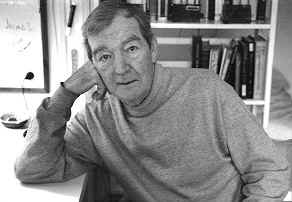
 Alastair Reid — 1926-2014
.
Scottish poet Alastair Reid died on September 21st of this year at the age of 88, just three days after the naysayers for an independent Scotland won the day and the sunstruck madmen of Reid’s poem “Scotland” crawled home in defeat. It seems fair to say Reid’s poem — with its direct title, its landscape in high relief, and its dour fish-shop matron — stands as one of the poet’s definitive takes on the culture of his homeland.
Scotland
It was a day peculiar to this piece of the planet,
when larks rose on long thin strings of singing
and the air shifted with the shimmer of actual angels.
Greenness entered the body. The grasses
shivered with presences, and sunlight
stayed like a halo on hair and heather and hills.
Walking into town, I saw, in a radiant raincoat,
the woman from the fish-shop. ‘What a day it is!’
cried I, like a sunstruck madman.
And what did she have to say for it?
Her brow grew bleak, her ancestors raged in their graves
as she spoke with their ancient misery:
‘We’ll pay for it, we’ll pay for it, we’ll pay for it!’
In the referendum of September 18th, good money was bet that Reid’s woman represented Scotland well enough to prevail — her brow bleak, her ancestors raging, her misery ancient — and that the optimistic Home-Rule voters would not prevail. They did not go down in flames; perhaps their failure was more sodden. Certainly “We’ll pay for it” was the rallying cry for those who urged a No vote and who implored Scottish voters to stick by the Queen.
 Apparently, the Union needed Scotland, and vice versa.
But what of the Scottish landscape, in contrast to the taciturn Scottish character? “…the air shifted with the singing of actual angels. / Greenness entered the body. The grasses / shivered with presences, and sunlight / stayed like a halo on hair and heather and hills.” Reid celebrated landscape. How a poet capable of writing those lines can fade into the background on the stage of British poetry is a puzzle to me. In 1954, Selden Rodman wrote an introduction to Reid’s work for Poetry magazine in which he said, “There are echoes of Dylan Thomas and Auden….[Reid] stands among these gifted contemporaries as an equal, one of the few poets writing in English to promise a continuance of their original affirmation.”
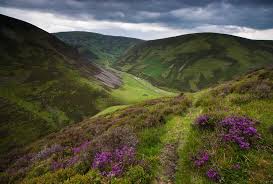 A view of the Scottish hills: “Greenness entered the body….”
Could it be that since much of Reid’s mid-career energy was spent on the translation of poets who wrote in Spanish — Borges, Neruda, Garcia Marquez, Vargas Llosa, Pacheco, Padilla — his relative obscurity as a poet in his own right was guaranteed? As with other poets in this Undersung series, Reid was not completely invested in his identity as a poet; his output of poetry was high-end but sporadic, his interests were broad, his wanderings wide, and his abilities as both essayist and translator loomed large enough to cast a shadow over his own talent as a poet. On the other hand, it might just be that Reid’s early ascendency was interrupted by something more sanguine, something described this way recently by the columnist Daniel Mendelsohn (himself a translator) in the June 3rd New York Times’ Book Review column, “Book Ends”:
As a critic, I’m often struck by the way in which so many successful writers settle into a groove by midcareer: Whatever marked them as special, new, or distinctive when they started — the “thing” that set them on their path — becomes, with time, a franchise; at worst, a straitjacket. By the end, most of us repeat ourselves. Very few — perhaps only the greatest — continue to grow.”
Over the years, Reid did not settle for a straitjacket; he wandered the world and grew as a writer, seldom repeating himself, accepting few of the categorical limitations that certain genres (and upbringings) usually insist upon us. He was restless, and his writing reflected it. He moved between poetry and prose, between memoir and travel writing and translation work and articles about sports — he even wrote two picture books for children.
He was born – his father a minister, mother a doctor – near Whithorn in the Galloway region of southwest Scotland in 1926, the year of Scotland’s debilitating General Strike, during which soldiers and tanks were used in the streets of Glasgow to disperse angry crowds of union men. The entire decade of the 20’s was one of mass emigration from Scotland, with families leaving behind high unemployment and miserable living conditions in order to head out for better highlands and lowlands in “the colonies”; the vision of so many people leaving home, longing to find a more comfortable life, might have contributed to Reid’s famously itinerant lifestyle.

“What drew me to writing was its portability,” he once wrote; “it requires essentially no more than a notebook and a pencil, and it allowed me to own my own time, to travel light, to come to rest anywhere….”
His poems often explore the pull away from, and eventual push back towards, home:
Whithorn Manse
I knew it as Eden,
that lost walled garden,
past the green edge
of priory and village;
and, beyond it, the house,
withdrawn, white,
one window alight.
Returning, I wonder,
idly, uneasily,
what eyes from inside
look out now, not in,
as once mine did,
and what might grant me,
a right of entry?
Is it never dead, then,
that need of an Eden?
Even this evening,
estranged by age,
I ogle that light
with a child’s greed,
wistfully claiming
lost prerogatives
of homecoming.
Reid understood that what the landscape offered and what the people offered could be radically different things. But he did find a number of places that came closer to what he was searching for, especially in the landscape and language of Spain and Latin America, and in the character of their people. It was this level of comfort that allowed him to focus on learning Spanish – to hunger for it, to eat it up and beg for more – and begin his highly-praised works of translation.
Over his lifetime Reid lived for extended periods in Majorca, Switzerland, Argentina, Chile, the Dominican Republic – on a ginger plantation – Mexico, England – in a houseboat on the Thames – and the Greenwich Village neighborhood of New York City, where he finally settled in (or was settled by old age) until his death. The obituary Charles McGrath wrote in The New Yorker three days after Reid’s death opens with this line: “The poet and translator Alastair Reid, who died on Monday at the age of eighty-eight, had itchy feet.” In his essay titled “Digging Up Scotland,” published in 1981 in The New Yorker, Reid makes clear that his restlessness had something to do with finding a place where he could “feel one” with his surroundings:
“I have a friend in Scotland, a painter,” he wrote, “who still lives in the fishing town he was born in, grew up in, went to school in, was married in, raised his children in, works in, and clearly intends to die in. I look on him with uncomprehending awe, for although I had much the same origins, born and sprouting in rural Scotland…I had in my head from an early age the firm notion of leaving….He has made his peace with place in a way that to me is, if not unimaginable, at least by now beyond me. ”
Reid seldom stayed in one place long enough to have what he considered a permanent address; his mail was delivered to the offices of The New Yorker, where he let stacks of it pile up for months. His unease with permanence is clearly visible in his poems, where two perceived opposites often pull against each other, interfering with any hope that the tug-of-war will be settled or the people involved come to rest, as seen in the opening stanzas of a poem titled “What Bones Say”:
The skeleton
is hardly a lesson
in human nature.
Similarly, stones
are the bones of landscapes,
and yet trees blossom
in contradiction.
We are much more
than our brittle topography.
In those lines, see how beautifully Reid handles the simple language – in the near-rhyme of “skeleton” with “lesson,” the full rhyme of “stones” with “bones,” and in the echo that chimes between “lesson,” “blossom” and “contradiction” – not overwhelming readers with musicality, but giving us just enough. I admire the courage he has to say something as large as “We are much more / than our brittle topography.” He approaches language the same way in the other poems transcribed here – the abundant alliteration in “Scotland” and its chiming verbs – “shimmer” and “shivered” – the triptych of “idly,” “eyes” and “inside” in “Whithorn Manse,” its full rhymes (“white” and “alight) and near-rhymes (“need,” “Eden” and “garden.”) Reid’s poems seem spoken at first, easy and conversational, but the music on which they rise is carefully and thoroughly composed.
In the same New Yorker essay mentioned above, Reid writes, “The natural world and the human world separated early for me. I felt them to be somehow in contradiction, and still do. The Scottish landscape – misty, muted, in constant flux and shift – intrudes its presence in the form of endlessly changing weather; the Scottish character, eroded by a bitter history and a stony morality, and perhaps in reaction to the changing turbulence of weather, subscribes to illusions of permanence, of durability, asking for a kind of submission, an obedience. I felt, from the beginning, exhilarated by the first, fettered by the second. Tramps used to stop at our house, men of the road, begging a cup of tea or an old shirt, and in my mind I was always ready to leave with them, because between Scotland and myself I saw trouble ahead.”
He traveled first to Spain; it was during his time in Majorca – six years, off and on — that he met and became friends with the poet Robert Graves (about whom I wrote in my Undersung article about poet-novelists.) Their friendship ended when Reid fell in love with – and ran away with, temporarily – Graves’s muse, Margot Callas. Though Callas eventually returned to Graves, the conversations and apprenticeship Reid once enjoyed with the older poet were finished. In an essay Reid wrote on the occasion of what would have been Graves’s 100th birthday, he chided Graves for having been “mired in domesticity” during his first marriage, but then Reid becomes more conciliatory, saying “The English have always kept Graves at a distance, as if he were an offshore island, out of the mainstream – something they often do with English writers who choose to live elsewhere and are still successful.”
 The Majorca home of Robert Graves – “an offshore island, out of the mainstream”
The same might be said of Reid himself – an offshore island in the sea of British literature. His most important books are out of print; these include his poetry collection Oases; Inside Out: Selected Poetry and Translations; Outside In: Selected Prose; Whereabouts: Notes on Being a Foreigner; and Weathering: Poems and Translations. If you subscribe to The New Yorker, you’re in luck – he contributed articles and poems there for more than forty years, and my quick search of their archives produced 152 hits.
In addition to “Scotland,” Reid’s most anthologized poem is “Curiosity,” about a dog’s and cat’s (but mostly human’s) view of the old adage “Curiosity killed the cat,” with the poet coming down hard in favor of being curious. Click here to hear it read by Reid himself over at The Poetry Archive. Rather than transcribe the poem so you can read it, I hope you will finish this essay and then go over to The Poetry Archive to listen to it. We’re lucky to have recordings of these poems(as well as three others) in Reid’s own voice, since it was voice that he valued above all other qualities in a poem.
In an essay about translating his friends Jorge Luis Borges and Pablo Neruda, he wrote, “I realized I couldn’t read a poem of Neruda’s simply as words put down on the page without hearing behind them his languid and caressing voice. The most important thing to me in translating these two poets was the sound of their voices in my memory, since this helped in finding my way in with the appropriate English….The key was voice.”
Keeping Quiet
Now we will count to twelve
and we will all keep still.
For once on the face of the earth,
let’s not speak in any language;
let’s stop for one second,
and not move our arms so much.
It would be an exotic moment
without rush, without engines;
we would all be together
in a sudden strangeness.
Fisherman in the cold sea
would not harm whales
and the man gathering salt
would look at his hurt hands.
Those who prepare green wars,
wars with gas, wars with fire,
victories with no survivors,
would put on clean clothes
and walk about with their brothers
in the shade, doing nothing.
What I want should not be confused
with total inactivity.
Life is what it is about;
I want no truck with death.
If we were not so single-minded
about keeping our lives moving,
and for once could do nothing,
perhaps a huge silence
might interrupt this sadness
of never understanding ourselves
and of threatening ourselves with death.
Perhaps the earth can teach us
as when everything seems dead
and later proves to be alive.
Now I’ll count up to twelve
and you keep quiet and I will go.
Pablo Neruda — from Extravagaria (translated by Alastair Reid)
He went on to say, “For me, Neruda’s poems were fundamentally voiced – spoken poems of direct discourse – his voice was, in a certain sense, the instrument with which he wrote.” Describing one lecture he went to at Queen Elizabeth Hall, Reid says Neruda’s voice “spread out like a balm over the English crowd; a magical sound, even without the thread of meaning.” [Note: my source for these quotations from the essay about Borges and Neruda was in Spanish – the translations are my own.]
 Pablo Neruda – “…his voice was, in a certain sense, the instrument with which he wrote.”
It was Reid who was instrumental in getting the work of both Neruda and Borges in front of English-speaking readers. About translating Borges, Reid was less lyrical than he was about Neruda: “Translating Borges was, for me, like learning a private language….” He refers to Borges’s skeptical and questioning tone, concluding that Borges’s poems were more interdependent than Neruda’s, linked as they were by a “recurring heraldry of symbols – chessboards, maps, knives, mirrors, coins, labyrinths, tigers, libraries….”

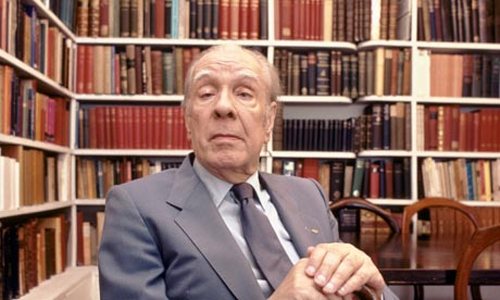
Reid (second from left) and Jorge Luis Borges (third from left)
One of Reid’s most interesting observations about Borges focused on his blindness: “After many conversations with Borges, from the most serious to the most entertaining, I came to the profound realization that for him, I existed only as a voice. Maybe this led me to the deep conviction that voice is the most long-lasting incarnation of my existence. Even more, it is in voices rather than photographs that the dead remain alive.”
 Jorge Luis Borges – “…for him, I existed only as a voice.”
At one point, Reid explains Borges’s style: “He spoke English with the respect a language well-known to him deserved, but within which he did not live – that is, with the controlled cadence of literature. On other occasions, in the company of Spanish-speakers, he was more playful, less solemn. Still, I think his bilingual upbringing gave him a sense of the arbitrary and fickle nature of language: a bilingual person is more aware of the gulf that exists between word and object than someone limited to a single language.”
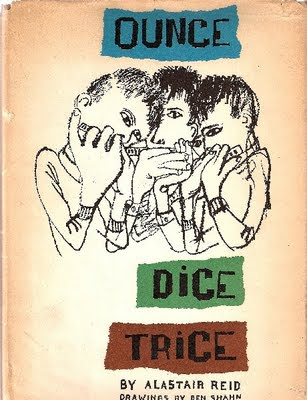
Reid’s awareness of the strange nature of words and his innate playfulness (in Charles McGrath’s obituary write-up, Reid is remembered as “cheerful, funny, and irreverent, with high expressive eyebrows that were frequently squeezed together in amusement”) show up full force in his picture book Ounce Dice Trice, a collection of nonsense – that is, a collection of real but relatively unknown words – tantony, quicklings, moonglade, etc. – revealed to us in all their strangeness, the way a talented chef might reveal the secret ingredients of a favorite dish. In the book, Reid creates several imaginative ways of counting from one to ten without numerals (“Instant, distant, tryst, catalyst, quest, sycamore, sophomore, oculist, novelist, dentist” and “Ounce, dice, trice, quartz, quince, sago, serpent, oxygen, nitrogen, denim.” The words sound like they come straight off the playground. Of course, the whole point of the book is wordplay, emphasizing that “gulf between word and object” recognized by people who have learned more than one language. Illustrations by Ben Shahn make the book a collector’s item – previously out of print, it’s now available again thanks to the New York Review Children’s Collection.
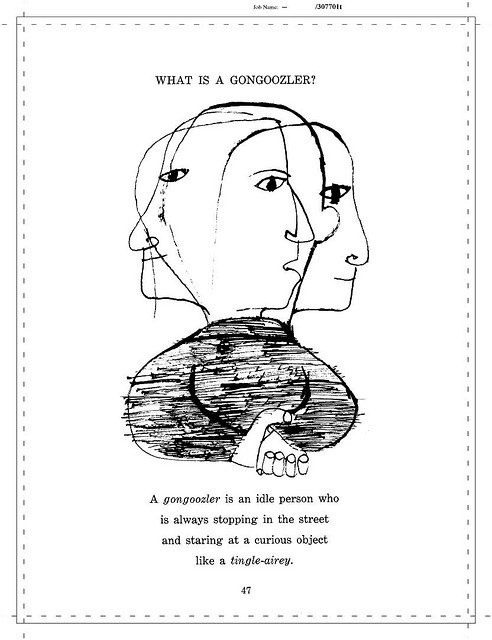 Reid himself was a gongoozler….
Reid’s origins might have been provincial — even restrictive — but as he grew his poetry and prose became more and more cosmopolitan and expansive. He regarded translation as an act resembling “bewitchment,” and he wrote that the translation of someone else’s work required “not only reading it deeply and deciphering it, but climbing on top of the scenery backstage, up onto the supports and the scaffolding.”
I often wished while getting my MFA that the program I attended had offered a translation track. Translation seems to me one of the best ways – almost acrobatic, according to Reid — to capture and understand how a poem works. Reid understood the way a poem could float out over the reader “without the thread of meaning,” though with his own poetry we are lucky enough to find both meaning and music.
Poem without Ends
One cannot take the beginning out of the air
saying ‘It is the time: the hour is here’.
The process is continuous as wind,
the bird observed, not rising, but in flight,
unrealised, in motion of the mind.
The end of everything is similar, never
actually happening, but always over.
The agony, the bent head, only tell
that already in the heart the innocent evening
is thick with the ferment of farewell.
— Julie Larios
,

Julie Larios has contributed seven previous essays in her Undersung series for Numéro Cinq, highlighting the work of George Starbuck, Robert Francis, Josephine Jacobsen, Adrien Stoutenburg, Marie Ponsot, Eugenio Montale and The Poet-Novelist; her own poems have been featured in our pages as well. She is the recipient of an Academy of American Poets prize and a Pushcart Prize, and her work has been chosen twice for The Best American Poetry series.
.
.