Aug 072013
 

John Barth

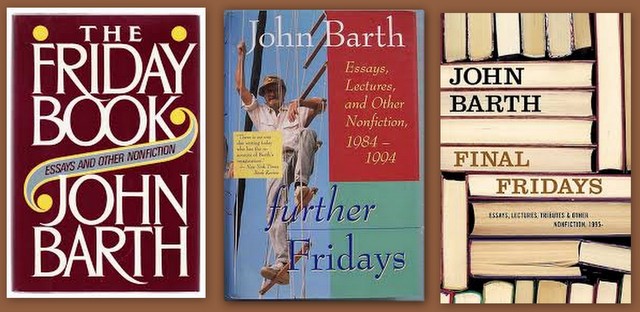
In his continuing series of chance encounter essays, Robert Day reminisces about his years long friendship with John Barth, their regular Friday lunches and the jokes they told each other. Barth once described Day in an essay as “a writer-friend from Kansas who knows about water-wells informs me of the important distinction between dry wells and gurglers.” These meetings eventuated into a trio of books by Barth: The Friday Book, Further Fridays, and Final FridaysAs always, Robert Day is an amiable and witty raconteur, slyly self-deprecating, and obviously a loyal and valuable friend. You just wish you’d been there, all those Fridays.

dg

We met by chance in the late 1970’s when Jack and I tried to convince one another that I should be the Director of the Johns Hopkins Graduate Creative Writing Program.  I was then teaching at Washington College, in Chestertown, where it turned out I stayed.  But from those first days when I toured the Hopkins Writing Seminars, meeting the faculty and students, Jack and I became friends because of — as Montaigne writes — who he is and who I am.

Not long after our pas de deux at Hopkins, Jack called to say he would be coming to Chestertown (where he and Shelly had recently bought a house) the following Friday and would I join him for lunch?  Agreed.  It was to be the beginning of scores of Friday lunches, continuing to this day.

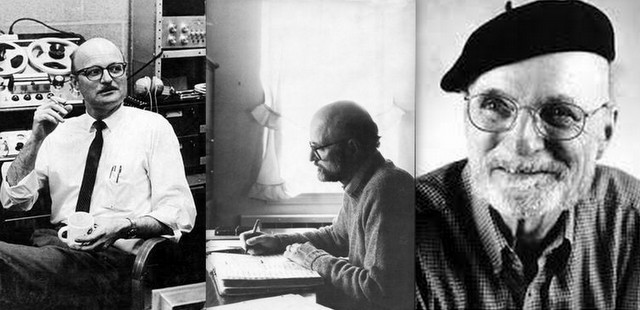
Where we met that first time I do not remember, but I do remember that our talk was rangy, ebullient, and exclusively literary.  Well, not exclusively literary because from the first we’d swap jokes — Jack beginning with a series of hillbilly pig jokes when he learned I had studied a stint at the University of Arkansas, and I, in trade, ranch jokes imported from West Jesus Land, Kansas, where I live part time. The second thing I remember is that someone must have spotted Jack (a new book of his was just out with his photograph appearing in the papers) and took our picture.

Avid readers of John Barth will know that those Friday lunches were because of, or resulted in (or some formulation thereof) his three collections of essays. The Friday Book, Further Fridays, and Final Fridays — the latter volume including a piece published in Granta titled: “The End? On Writing No Further Fiction, Probably.” Toward the conclusion of that essay I am mentioned as an anonymous co-conspirator to his muse: More on this later.
Desktop19

Thus our literary lunch Fridays commenced and continued.  Not every Friday, but many over the years until Jack stopped teaching at Hopkins and was more often in Chestertown, in which case our Fridays turned themselves into Wednesdays or Mondays—or encore, a real Friday itself.

In the beginning, one of us would pay the lunch tab then the next time the other way around, even though sometimes we’d get confused.  At one lunch I said I thought it was my turn but Jack said no, it was his, and he insisted.  To which I said, I’m not sure we’re even, to which Jack replied:  Friends are never even.   And about that time, once again, someone took our picture.

“What do you think the caption will be?” I had asked Jack. “You first,” he said.  “Nationally famous author lunching with unidentified man,” I said.  “I’ll pass,” he said, but in the moment of silence between us, I thought that his fertile and fervent literary imagination could have made an entire novel out of my minimalist caption.  And maybe yet it shall.

What my friend has accomplished with his fervent imagination is the creation of a world of fiction unlike any other American writer.  And the landscape of that fictive world is immense:  From the early realistic and nihilistic novels, The Floating Opera and The End of the Road, to the faux historical novels, The Sot Weed Factor and Giles Goat Boy, and then changing course to On With the Story, Letters, The Tidewater Tales, Lost in the Fun House, The Last Voyage of Somebody the Sailor, and back to On with the StoryComing Soon, The Development, and his most recent book: Every Third Thought, A Novel in Five Seasons.

Jack’s writing is not so much a landscape of fiction as an Ocean of Story.  But writers are not unique just because of the breadth of their oeuvre.  There has to be something else.  An editor we shared at the Washington Post Magazine called that “something else” The Pyrotechnics of Prose.

It is as if my friend’s muse is a character in his fiction, at least the muse that is his gift of language.  Surely some critic has noticed the jazz improvisations in Jack’s writing:  I have.  Those are what we who write call invention.  It comes from where we’ve been coming from in the paragraphs before.  And the chapters before that.  And it comes from where we’ve come from as readers:  In Jack’s case, back to Lawrence Stern in English and further back than that in ancient languages and oft told old tales told on a thousand and one nights.  All of these he spins into tales of his own, with his own voice and muse doing the spinning.  Like Joyce and Nabokov and Garcia Marquez and Italo Calvino,  he conjures a maelstrom into his own Ocean of Story.  He is Tradition and Individual Talent. And fireworks at sea. About his extraordinary achievement in American letters and my modest one, we never talk.  Friends are, in many ways, never even.

By design we had lunch again the other day, a Wednesday as Zeus would have it.  Before we met I read the Granta essay in which Jack muses that his muse is not musing these days. In it he writes, “A writer-friend from Kansas who knows about water-wells informs me of the important distinction between dry wells and gurglers which may cease producing for a time but eventually resume; he encourages me to believe I’m still a Gurgler.”

There is a custom among writers that we do not ask each other about work-in-progress.  It is like telling an actor “good luck” before the curtain goes up, thus the tradition of “break a leg.”  Are gurgling or non-gurgling muses covered by our custom?

Lunch was at Evergrain in Chestertown.  We took an outside table to enjoy the sunshine. After all these years we tell many of the same jokes, but sometimes I tell one Jack has told me and take credit for it, and Jack does the same.  He doesn’t recall his early hillbilly pig jokes and I need to be reminded of my Kansas parrot joke. In this way at least we are even. Then we talk about Philip Roth and how he has recently resigned from writing fiction — as opposed to—? But neither of us mention it.  About this time, someone takes our picture.

Between that first photograph and this one I have taught thousands of students at Washington College, and those students are sending their children, and in some cases, their grandchildren to Washington College.  Mothers and fathers and a few grandmothers and grandfathers were now coming back for Parents’ Weekends and Graduations.  And having lunch out. Some stopping to reintroduce themselves.

“What’s the caption?” I ask Jack.

“Locally famous professor having lunch with unidentified man,” he says. To which in the small silence between us I think:  Lucky me to have had a duel oeuvre of Friday lunches with my friend talking books and telling jokes. And lucky all who are avid readers of muse-inspired American literature to have had John Barth with his firecracker prose going off like St Elmo’s fire in his Oceans of stories.

As we walk down the street to our cars, I ask Jack if he is the one who told me the aphorism that as we get older, Sex goes, memory goes, but the memory of sex—that never goes.

 “I think you told me,” he says.

“Let’s both take credit for it,” I say.

“Co-authors?”

“We’d be even for once if you don’t mind.”

“My pleasure,” he says. In this he speaks for me.

 —Robert Day

—————————-

Robert Day‘s most recent book is Where I Am Now, a collection of short fiction published by the University of Missouri-Kansas City BookMark Press. Booklist wrote: “Day’s smart and lovely writing effortlessly animates his characters, hinting at their secrets and coyly dangling a glimpse of rich and story-filled lives in front of his readers.” And Publisher’s Weekly observed: “Day’s prose feels fresh and compelling making for warmly appealing stories.”

Nov 292011


.

Here’s a Childhood essay unlike any on NC so far, dubbed a geografictione[1] by its author, a psychogeographical meditation on suburbia by Cheryl Cowdy (who started life in Mississauga, a huge suburban agglomeration west of Toronto where many of dg’s relatives have lived from time to time).

We all live in the suburbs these days, and we’re all embarrassed by it. Here Cheryl challenges the notion that the suburbs are necessarily a cultural or imaginative dead end as she returns ambivalently to Mississauga, seeking the ghosts of untold stories – her own, but also those that might be buried within its golf course mountain of refuse.

Cheryl’s fascination with suburban spaces began long before the phenomenal success of Arcade Fire’s The Suburbs album. Her Ph.D. dissertation investigated the often conflicted meanings of the suburbs in post-war English-Canadian literature. Her essay “Ravines and the Conscious Electrified Life of Houses: Margaret Atwood’s Suburban Kunstlerromane” appears in the current issue of Studies in Canadian Literature (36.1. 2011)

dg

.

Mississauga: Cadence of Desire and Return

A Childhood Geografictione

By Cheryl Cowdy

To Aritha van Herk, for Places Far From Ellesmere,
from which this piece borrows generously,
most obviously in italics.

.

.

“I had a lot of luck, then, which saved me from all kinds of side-tracks: neuroses first off, and perhaps psychosis, and psycho-professionalization, from which many intelligent people never recover. Next, the militant path, and finally—this may seem strange—it saved me from the suburbs, universe of my childhood, kind of wonderful, but which is often, all the same, a cultural dead end.” [2]

.

Desire

Beneath the flight path of airplanes heading for or just leaving Lester B. Pearson Airport, the temptations of exile pass through your acoustic space approximately once every six minutes(58). Thankfully (perhaps) you haven’t experienced the same kind of luck as Guattari. Luck has saved you from certain undesirable side-tracks but not from the suburbs. Home: what you visit and abandon. In spite of your desire for escape, the universe of your childhood is a familiar ambivalence to which you reluctantly return, physically and psychically. Your dream geography if not the geography of your dreams.

Home: an asylum for your origins. A variety of exits off the 401, bringing your grandparents westward from Port Hope to Scarborough in the nineteen fifties. When the Empress of Canada landed in Montreal in 1966, it would have brought your mother, eighteen, blithe and bonny, to Scarborough too. The 401 a mosaic your grandfather pieced together from the air for the PSC Photographic Survey Corporation. Your  father spent his days piecing it together from the ground, laying humid asphalt over dirt, soil, concrete, then navigating the labyrinth of paved earth long nights moonlighting in a rented cab, ferrying the more privileged to invented island destinations.

The 401: Anecdotes accumulate along its paved shoulder; details get on here, merge, some leave by the next exit. Like the time a bunch of the guys got drunk after work and Dad streaked down the 401. Or the time he stopped his cab to help someone after a collision – only learning later that the guy had robbed a bank then had his face blown off by the cops in a gun fight. How could he drive without a face? Sometimes this anecdote drives in the lane beside another one; tall tales weave back and forth between lanes, stealing and sealing the gaps between stories and messing with their integrity.

What about Mum? Or your Gran, for that matter? Where are they? It’s almost always the fathers doing the driving. Not much material for a tall tale fitting women for bras in Simpson’s, although every woman must have heaved a story in her D-cup. Your mother tending the cash register evenings at the corner store after caring for you all day. Her escape from the explosives factory in Stevenston, Ayrshire, Scotland her one big story. After that, your mother’s stories occur in parentheses, take circuitous back routes, avoiding left-hand turns and never, never, getting on the 401.

Yes, highways are constructed and anecdotes accumulate. Can a “literature” be built here too? Is this a place from which to launch a world, a river, or even a short story? Can it launch itself? Mississauga is premeditated, its stories pre-fabricated. Fake lakes and mountains made out of garbage then turned into golf courses.  Can we transform ourselves if our surroundings are right? Somewhere there’s an exit-also-an-entrance that brings you back to or beyond the prequel.

A romantic child, you search optimistically for stories. The week your family moves to Meadowvale (Meadowjail) you notice the generic head of an Indian on the banner of the Mississauga News. Like Louise in Barbara Gowdy’s The Romantic, you look for Indians expectantly: Lake Wabukayne, the Credit River, Lake Aquitaine. (When you learn that “Aquitaine” is a European name, you switch allegiances; look for ladies in the fake lakes, under the stormwater collection equipment). Eventually you meet members of the Mississauga Nation who look nothing like the Indian on the local paper.  As you write this, the Six Nations are resurrecting their blockade against suburban development at Caledonia, resisting, like Oka, like Ipperwash, the suburban narratives with which we’ve barricaded them.

The Great Train Derailment of ‘79 was your own private Cuban Missile Crisis. For one night and all of the following day you watched Mississauga burn and waited for the knock on the door. Evacuation held the promise of Rapture, you could feel it in the texture of the toxic air.  You wished to join that community of the elect, the early evacuees who spent an entire week camping out on cots in the Square One Shopping Centre (every kid’s dream to be stranded in the mall after the lights go out). Instead, you are transported to more eastern points of the 401 – your familial origins – Scarborough and Agincourt and Flemingdon Park. Where it all began.

You will remember less about those 4 days of exile than you will about that one day of waiting.

You develop and move from one townhouse complex to another, somehow keeping track of all those unit numbers.

Complex/ kompleks/ n. & adj.n. 1. a building, series of rooms, network, etc. made up of related parts (the arts complex). 2. Psych. A related group of usu. repressed feelings or thoughts which cause abnormal behavior or mental states.  (inferiority complex; Oedipus complex). 3. (in general use) a preoccupation or obsession (has a complex about punctuality). 4. Chem. a compound in which molecules or ions form coordinate bonds to a metal atom or ion. – adj. 1. consisting of related parts; composite. 2. Complicated (a complex problem). 3. Math. containing real and imaginary parts. [French complexe or Latin complexus past part. of complectere embrace, assoc. with complexus braided]. [3]

There has to be a minotaur somewhere.

How to escape? Borrow more authentic addresses: Streetsville seems more small town, so for a time, you date Streetsville boys exclusively. Later you set your sights on bad boys from the city: Toronto: Downtown with a capital “D.” Whoring after strange places. Their addresses are rendered more exotic by the three-hour pilgrimage that takes you from the labyrinthine routes of the Mississauga Transit to the more pragmatic Toronto Transit Commission. Never getting on the 401, except the time dad snatched you back from an escapation attempt.

Escape artist, you look to Hollywood for familiar narratives, real and imaginary: Sixteen Candles, Pretty in Pink, The Breakfast Club. It’s the 80s – you listen to The Smiths, The Cure – and so for a time you are saved by the treacherous optimism of the cynic from certain side-tracks, seductions of the dreaming screen. You seek out copses of wood in the ravine, beside the fake lake, swamp of stolen bicycles, grocery buggies, plaid chesterfields, pizza boxes, condoms, cigarette butts and underpants, beer bottles, pop cans and PVC. You aren’t picky at that time and will accept pre-fabricated nature if that’s the best they can offer. Writing place: hiding place. You write Songs of Disaffected Innocence and Experience. They never seem right.

Next the militant path. You drop out of high school for a while, sell remainders in the record department at Woolco (Square One, at last). Miraculously, you find salvation in a secondary school for the lost. When you graduate, you pick the University with the most alien geography, Montreal a universe in which to dream a different language. You step over the homeless who sleep in front of your door. You have a Murphy bed and a rat that isn’t a pet. You are only mildly dissatisfied with your verse.When asked where you are from, you can say, “Toronto.” You think you are happy.

Four months later, you return.

Return

Return: escape to embarkation/ escapation.

You’re not exactly certain how the return was effected. Somewhere along the highway you took the wrong exit, forgot to merge, got trapped in a narrative you don’t recall writing. All exits are also entrances. You should be in exile in Toronto’s Annex neighbourhood along with everyone else in academe: you missed the Rapture again?

They cleaned up the fake lake, swamp of stolen bicycles and shopping buggies, plaid chesterfields, pizza boxes, condoms, cigarette butts and underpants, beer bottles, pop cans and PVC (evidence of your own adolescence may still be down there). Anecdotes accumulate, advertising copy trying desperately to disguise itself as his/tory:

“The 16 hectare (40 acre) Lake Aquitaine Park is one of Meadowvale Community’s best-known attractions. Designed in the late 1960s and opened in 1976, the park surrounds an artificial lake. This lake, considered a model by other cities, was the first stormwater management facility in the province to be a focus for a residential community. It is designed so the lake can significantly change water levels and store water during and after major storms.

Nature is being allowed to reclaim the edges of the lake, and new wetland and meadow areas are being nurtured. This will make the park more welcoming for fish, birds and other wildlife.”

Mississauga goes on with its falling, one molecule at a time: and you too in your ache to archive it there to read/ remember/ blame. To unhinge, and to carve with words, a reading act: this place of origins, of forbiddens and transgressions, of absence and remains.

Jeanette Winterson has a theory that “every time you make an important choice, the part of you left behind continues the other life you could have had.” [4]

In the explorations of memory and place lie unsolved murders.

Some ghosts return because the narrative demands it. What are your ghosts doing now? Do they keep each other company, the streetwise adolescent ghost roaming the culs-de-sac and walking through the McDonald’s Drive-thru window at 2am, and the urban undergrad ghost haunting your condemned bachelor apartment on rue St. Denis? There are ghosts in Ottawa, some begging for change at the intersection of Yonge and Bloor (you have had more successful escapations). Do they sneer at the soccer mom?  If you wonder too much about which routes brought you back here, not just to the same community but the very same street you lived on prior to your first defection … from 6154 to 6205, a difference of only fifty-one numbers in eighteen years…

You dream yourself breaking into unruly houses, coveting secret passageways, and hidden rooms, always their subterranean floors. Nights you don’t dream thoughts toss and turn. (Stories in parentheses). Sometimes you rise, grope for notebook on night table, tiptoe into the bathroom, the only place you can write without waking husband, kids, dog, cat. Writing place: hiding place.

“You don’t reach Serendib by plotting a course for it. You have to set out in good faith for elsewhere and lose your bearings . . . serendipitously” writes John Barth. [4]

Perhaps you can’t reach Serendib by the 401.  How then to occupy a place? Be the crack in the plaster. Persistent mushroom exploding through dirt, soil, asphalt, concrete. You must live up to your fictions, that’s all there is to it; you must help yourself achieve geografictiones of the soul. Get off the highway then, and take the back roads. Excavate the stories from parenthetical constructions. Tear down the “No Exit” sign. See/k what has been wiped off the map. Construct an asylum for your origins, a mythology, a highway of heroes.

In good faith, you’re still losing your bearings.

–Cheryl Cowdy

Footnotes    (↵ returns to text)

  1. “A fiction of geography/ geography of fiction: coming together in people and landscape and the harboured designations of fickle memory.” Aritha van Herk, Places Far From Ellesmere, Red Deer, AB: Red Deer College Press, 1990: 40.
  2. Guattari, Félix. “So What?” Chaosophy. New York, NY: Semiotext(e), 1995: 8
  3. Canadian Oxford Dictionary. Ed. Katherine Barber. Don Mills, ON: Oxford UP, 1998.
  4. Winterson, Jeanette. Oranges Are Not the Only Fruit. London, UK: Vintage, 1991.
  5. Barth, John. The Last Voyage of Somebody the Sailor. Boston:  Little, Brown, 1991.