Sep 042016
 

Naked1

toussaint

Throughout the first three novels in Jean-Philippe Toussaint’s tetralogy, the unnamed narrator and his love interest Marie have been on the verge of break-up and broken up. Yet, in some ways, they’ve never really been apart. In this passage from the fourth and final novel Naked, after returning from a trip where the couple rekindled their love, the narrator sits alone in his apartment thinking of Marie, waiting for a sign that she’s thinking of him too.

Naked was originally published in 2013, and is translated from the French by Edward Gauvin.

— Jason Lucarelli

.

IDIDN’T DARE admit it to myself outright, but what I was waiting for now at the window was—already—a phone call from Marie. I even hoped to get her call before stepping away from the window, before I had time to do anything in the apartment, go through my mail or unpack my bags, so that when I picked up I could say, the amused modesty in my voice perhaps tinged with a zest of triumph, “Already?” and the endless half-hour I spent in front of the window waiting in vain for Marie’s call was like an abridged version of the two expectant months I was about to spend waiting for any sign from her at all. In the first few moments, fervor and impatience still held sway, feelings of love the days spent together on Elba had rekindled, the intact desire to hear her voice on the phone—perhaps intimidated, tender, light-hearted, suggesting we see each other that very night—and then, as the minutes, the hours, the days, the weeks, and soon even the whole month of September went by without so much as a word from Marie, my initial impatience gradually gave way to fatalism and resignation. My feelings toward Marie went progressively from the impatient affection of those first few moments to a kind of annoyance I was still trying to get under control. After a while, I no longer held anything back and gave free rein to my resentment. Marie’s final act of fickleness, inviting me to spend two weeks with her on Elba just to ignore me and not make so much as a peep afterward, was but the ultimate demonstration of her radical nonchalance.

But now a new element, perhaps, since our return from Elba, was that Marie managed the feat of annoying me even when she wasn’t around. For up till now, whenever Marie hadn’t been around, I’d missed her immediately, nothing whetted my love for her more than distance—what to say, then, about her absence? This new annoyance, this more deeply ingrained irritation, taking shape right there at the window as I waited for her call, was perhaps the sign that I was readying myself for our separation and imperceptibly beginning to resign myself to it—except that, and here the nuance is vital, it might very well be the case that if Marie annoyed me so much when she wasn’t around, it was perhaps quite simply because she wasn’t around. There was also an odd, abiding element in my love for Marie, which was that as soon as anyone, even me, took it in mind to criticize her, and quite justifiably, with the best intentions in the world, I couldn’t keep myself from dashing to her rescue straightaway, as in certain couples where the one defending his or her partner tooth and nail is in the best position to know the extent of that partner’s shortcomings. In fact, I needed no outside detractors to come up with all the ill that could be said of Marie, I quite sufficed. I knew very well that Marie was exasperating. I knew perfectly well indeed, along with her detractors, who didn’t even know the quarter of it, that she was superficial, fickle, frivolous, and careless (and that she never shut drawers), but no sooner did I alight on this litany of deprecating qualifiers than I saw the other side to these complaints, their secret underside, concealed from view, like the precious hidden lining of too-flashy finery. For though glittering sequins sometimes kept one from seeing Marie clearly at first, to reduce her to the frothy society gossip abubble in her wake would be to underestimate her. A more substantial wave, timeless, ineluctable, carried her through life. What characterized Marie above all else was her way of being in tune with the world, those moments when she felt flooded by a feeling of pure joy: then tears would start rolling uncontrollably down her cheeks, as if she were melting with rapture. I don’t know if Marie was aware she contained, deep within, this unusual kind of exaltation, but everything in her bearing bore witness to her capacity for intimate harmony with the world. For just as there exists such a thing as oceanic feeling, so we may speak, where Marie is concerned, of oceanic affinities. Marie had a gift, that singular ability, that miraculous faculty, for being at one with the world in the moment, of knowing harmony between herself and the universe, in an utter dissolving of her own consciousness. Everything else about her personality—Marie the businesswoman and Marie the CEO, who signed contracts and closed real estate deals in Paris and China, who knew the dollar’s daily exchange rate and followed the latest market fluctuations, Marie the fashion designer who worked with dozens of assistants and collaborators the world over, Marie the woman of her time, active, overworked, and urbane, who lived in luxury hotels and dashed through airports in cream-colored trench coats, belt trailing on the floor, pushing two or three carts over owing with luggage, suitcases, clutches, portfolios, poster tubes, not to mention—dear God, I can picture it still—parakeet cages (fortunately empty, for she rarely transported living animals, apart from a thoroughbred—a trifle—as it happens, on her last trip back from Tokyo)—also characterized her, but only superficially, including her without defining her, encircling her without grasping her, nothing in the end but mist and spray beside the fundamental affinity that alone characterized her completely, the oceanic affinity. Intuitively, Marie always knew how to be in spontaneous tune with natural elements: with the sea, into which she melted with delight, naked in the salt water surrounding her body, with the earth, whose touch she loved, primitive and crude, dry or slightly slimy in her palms. Marie instinctively attained a cosmic dimension of existence, even if she sometimes seemed to spurn its social dimension entirely, and treated her every acquaintance with the same natural simplicity, ignoring age and formalities, seniority and etiquette, showing each the same considerate kindness, the same graces of sensitivity and benevolence, the charms of her smile and her figure, whether it was an ambassador having her over to dinner at his residence during a show, the cleaning lady she’d befriended, or the latest intern at the fashion house Let’s Go Daddy-O, seeing only the human being in each of them without a care in the world for rank, as if, beneath all the finery of the adult she’d become and her standing as a world-renowned artist, it was the child in her that had survived, with that child’s bottomless well of innocent generosity. There was something in her like a radical abstraction, an abrasion, a stripping-away of the social reality of things, such that she always seemed to be wandering around naked on the surface of the world, the “seemed” even being redundant with her, so often did she actually walk around naked in real life, at home or in the yard of the house on Elba, to the astonishment of creatures that watched her rapturously, a butterfly coming upon its alter ego in nature or the tiny, exhilarated fish quivering behind her in the sea, when I myself wasn’t the privileged witness to her innocent fancy for walking around nude at the drop of a hat, which was almost like her signature, her soul number, the proof of her integral harmony with the world, with what has been most permanent and essential about it for hundreds of thousands of years.

As we had just come back from Elba, these were the sunlit images of Marie that now came to mind as I stood before the window: Marie half naked under an old blue shirt of her father’s in the yard on Elba. I stared at the gray, rainy Paris street before me, and it was Marie who raced irresistibly through my mind without the slightest conscious effort on my part. I don’t know if Marie knew just how alive she was in my thoughts at that moment, as if, beside the real Marie who must have reached her apartment on Rue de La Vrillière by now, where the taxi had dropped her off, was another Marie, free, autonomous, separate from herself, existing only in my mind, where I let her come to life and move about my thoughts as she went swimming naked in my memories or took shape in the yard of her father’s house. I saw her again, then, in the little yard on Elba, that double, my personal Marie, wearing a basic swimsuit she’d pulled down and rolled around her waist because it was too hot (or even with no swimsuit at all, I kid you not). Cautiously, I drew closer to her in my mind, and through the tree branches in the little yard shivering in a light breeze made out her bare silhouette, the skin on her shoulder dappled with sun-shimmer, crouching by an earthenware jar, kneading the potting soil with both hands and tamping it down, evening out the earth around young shoots she’d just replanted and watered, watching the meager trickle from the hose intently, with a kind of meditative steadiness that seemed to wholly absorb her. I skimmed her shoulder as I joined her in the yard and told her in passing that for lack of a swimsuit, she could maybe put on a hat—people do that when they’re naked, you know (and she shrugged, didn’t dignify that with a reply). Marie, who always managed to surprise me, throw me for a loop, unpredictable Marie who, a few weeks earlier on Elba, had filched an apricot from the display at a fruit stand in Portoferraio’s old town, and kept the pit in her mouth for a long time, sucking on it dreamily in the sun, before suddenly pinning me to the wall in a shady alley near the port to press her lips abruptly against mine and dispose of the pit in my mouth.

And then I realized that I was chewing over these same happy visions time and again, the same summer images of Marie kept coming back to me, as if filtered by my mind, purified of any unpleasant elements and made more endearing still as they began to grow distant in time with my return. But since, I told myself, any true love and, more broadly speaking, any project, any undertaking, from the flowering of a bud to the growth of a tree to the realization of a work of art, has but one aim and intent, to persevere in being, doesn’t it always, inevitably, come down to chewing the same thing over? And a few weeks later, taking up this idea again of love as rumination or continual reprise, I would further refine my phrasing, asking Marie if the secret to lasting love was never to swallow.

I don’t know how much time had passed since I got back, but day was beginning to wane in Rue des Filles-Saint-Thomas, and I still hadn’t budged from the window. The street had gotten a bit livelier, a few signs were now lighted near the Bourse. One of the houses across from me was being renovated. On the fourth floor, an apartment had been laid utterly bare, the façade gone, leaving the entrails of the building exposed, as if after a hurricane or an earthquake. Under the arc lights, a few workers in helmets passed to and fro over plastic tarps covering the floorboards of what must once have been the living room. The scene had something, if not hallucinatory, then at least not very Parisian about it (or I’m no Parisian), and seemed instead to be taking place in a major Asian metropolis, by neon light and the glare of welding torches. I contemplated the building under construction across from me, and thought back to the trip Marie and I had made to Japan at the beginning of the year. That was where everything had started, or rather everything had ended for us, for that was where we’d broken up, that was where we’d made love for the last time, in the room of a luxury hotel in Shinjuku. We’d left for Japan together, and come home separately two weeks later, each to our own lives, no longer speaking, no longer bothering to stay in touch. When I got back to Paris, I finalized our breakup, in a way, by moving to Rue des Filles-Saint-Thomas, and we had barely seen each other at all till late summer, when she’d suggested I join her on Elba. But what Marie didn’t know—and still doesn’t—is that I, too, was there the night her show opened at the Contemporary Art Space in Shinagawa.

— Jean-Philippe Toussaint, translated from the French by Edward Gauvin

Excerpt from Naked appears by permission of Dalkey Archive Press.

.

Jean-Philippe Toussaint is the author of nine novels and the winner of numerous literary prizes, including the Prix Décembre for The Truth about Marie, which is available from Dalkey Archive Press. His writing has been compared to the works of Samuel Beckett, Jacques Tati, Jim Jarmusch, and even Charlie Chaplin.

§

SONY DSC

A graduate of the Iowa Writers’ Workshop, Edward Gauvin was a 2007 fellow at the American Literary Translators Association conference and received a residency from the Ban International Literary Translation Centre. His translation of Jean-Philippe Toussaint’s Urgency and Patience was published by Dalkey Archive Press in 2015.

.

Sep 042016
 

toussaint

The most mesmerizing aspect of Toussaint’s narrative logic is how he blurs the temporality between events so that major moments during the breakup recall earlier corresponding moments. His narratives are so intricate, so pleasingly recursive, that the shape they take, the choices Toussaint makes, is where readers will find reward. — Jason Lucarelli

Naked1
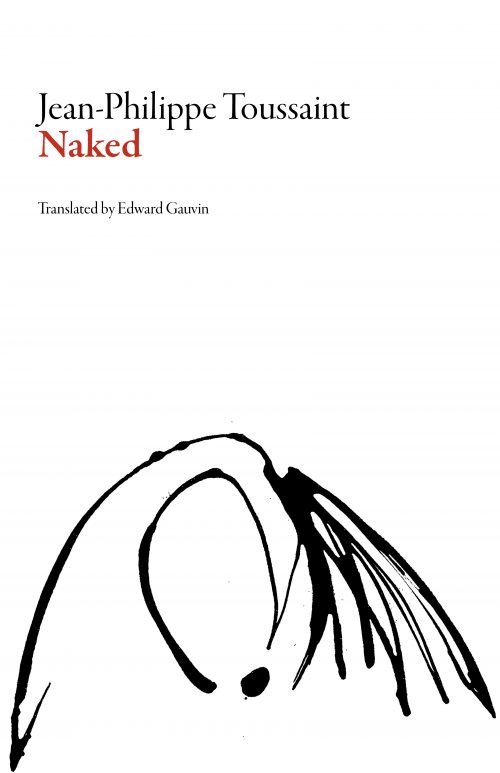
Naked
Jean-Philippe Toussaint
Translated by Edward Gauvin
Dalkey Archive Press, 2016
124 pages, $15.00

.

.Some couples are always breaking up and getting back together. Their love says no, says yes, sometimes in the same breath. Every apparent end is punctuated by a flash of renewal.

Take the unnamed narrator and Marie in Jean-Philippe Toussaint’s tetralogy—Making Love, Running Away, The Truth About Marie, and Naked—who spend all four novels (mostly) breaking up. “But breaking up, I was beginning to realize, was more a state of being than an action, more a period of mourning than a death agony,” says the narrator in Making Love. While each novel in the tetralogy follows Making Love, events do not always follow in chronological order.

In Making Love, Marie invites the narrator to accompany her during one of her exhibitions at the Contemporary Art Space in Shinagawa, and they spend most of the trip “separating for good.” Running Away occurs the summer before the breakup when the narrator travels to China on an errand for Marie, and later joins her on the island of Elba for her father’s funeral. The Truth About Marie, occurring the spring-summer after Making Love, concerns events surrounding Marie’s other lover Jean-Christophe de G. (Marie accompanying Jean-Christophe the day after her exhibition as he transports a racehorse, Marie watching Jean-Christophe have a heart attack in her apartment), and a few summer days on Elba where Marie and the narrator grow closer over crisis (a great fire burns over a section of the island). All of this is just what happens, the succession of incidents, plot stuff.

But the most mesmerizing aspect of Toussaint’s narrative logic is how he blurs the temporality between events so that major moments during the breakup recall earlier corresponding moments. His narratives are so intricate, so pleasingly recursive, that the shape they take, the choices Toussaint makes, is where readers will find reward. Describing Toussaint’s fiction, Tom McCarthy writes, “We don’t want plot, depth or content: we want angles, arcs and intervals; we want pattern. Structure is content, geometry is everything.”

Jean-Philippe Toussaint—Belgian-born writer, filmmaker, and photographer—is the author of nine novels, originally published in French by Les Éditions de Minuit, and published in English by E.P. Dutton, The New Press, and Dalkey Archive Press. He is the winner of the Prix Médicis for Fuir (Running Away) and the Prix Décembre for La Vérité sur Marie (The Truth About Marie). Early critics were quick to classify his work as part of the ‘nouveau Nouveau Roman.’ Toussaint prefers the term “infinitesimal,” which, he says, “evokes the infinitely large as much as the infinitely small…the two extremes that should always be found in my books.” He refers to Samuel Beckett as “the most important reading experience of my life” and “my only model.” While Toussaint’s earlier works contained loopy but concise narratives, detached yet analytic narrators, and plot opportunities offered but rarely exploited, his newer works give a little more, and build upon these earlier facets in exquisite and scrupulous detail. His authorial concerns for “energy,” “rhythm,” “dynamics,” and “the standards of the form” are on peak display in Naked, the conclusion to his magnum opus, translated by Edward Gauvin and published by Dalkey Archive Press.

From the beginning of Naked onward, Toussaint reaches back into the narrative, to previous novels, to reference events, and revisits them with variation in a cyclical, dizzying effect. Take for instance the beginning of Naked’s first half, as the narrator and Marie return to Paris after making love on their last night on Elba. Before separating, they share an extended exchange in the taxi. They hesitate to part. The narrator says, “…I was unable to tell Marie how I felt about her—but had I ever been able to?” It’s a sentence that recalls one from Making Love: “…I had not made the slightest declaration of love to her—but have I ever made her any declaration of love?” On the level of plot, the narrator’s passiveness is one of his primary traits. In some ways, it’s to blame for him staying on the wrong side of the breakup for so long. On the level of form, the two phrases showcase Toussaint’s signature parallel structuring of incidents.

The narrator spends the next two months waiting for Marie’s call. At his window, looking out at Paris, his mind goes back to the time they spent in Japan: “That was where everything had started, or rather everything had ended for us, for that was where we’d broken up…” Eventually he reveals that he was present during the exhibition at the Contemporary Art Space in Shinagawa and not, as Marie might have suspected, on his way back to Paris:

It was only now, more than seven months later in Paris…that I had gained the necessary distance to apprehend all the elements of the scene then underway…So where was I? Where—if not in the limbo of my own consciousness, freed from the contingencies of space and time, still and forever invoking the figure of Marie?

The narrator, “in memories or the resurrected past,” makes his way across the museum grounds as he did in Making Love, but this time on opening night as opposed to the night prior. As he tries to gain entry to the museum, a guard takes special notice of him (the same guard who caught him at the conclusion of Making Love looking for Marie), and the narrator climbs the roof to escape confrontation. On the roof, he peers through a porthole looking for Marie amongst the attendees. Searching the crowd, he sees a guest look up at the ceiling, and leans back to avoid being seen. At this point he realizes that this was the evening Marie met Jean-Christophe de G. and that he had likely been an “eyewitness to their encounter.”

In a perspective shift typical of the tetralogy—Toussaint turning first person perspective into a kind of speculative third person—the narrator describes how Jean-Christophe de G. found himself at the Contemporary Art Space in Shinagawa, how he decided to leave with Marie on his arm (a woman he had never met before), how he mistook another woman named Marie for fashion-designer Marie, and how he gazed up at the porthole to spot the narrator’s figure in the dark. Jean-Christophe, bewildered at having chosen the wrong Marie, considers:

an excuse to ditch everyone and slip out of the museum or even, if possible, to vanish from this story altogether, return to nothingness, from which it seemed he’d been plucked for a brief moment to beget, at his own expense, an evanescent ribbon of life, airborne, twirling, futile, and fleeting.

The narrator abandons Jean-Christophe and recalls the moment he finally spotted Marie through the porthole. He watches her: “I love you, Marie, I told her, but no sound came from my mouth, I couldn’t even hear myself say it, maybe I hadn’t even opened my mouth, maybe I’d only thought it…” He reveals his true feelings to no one but himself.

The flashback ends and the second half of Naked picks up back in Paris, when the narrator receives Marie’s phone call two months after returning from Elba. She says she has something to tell him and they should meet. The narrator recalls that every time Marie called him “out of the blue” was to inform him of a death: her father’s (in Running Away) and Jean-Christophe de G.’s (in The Truth About Marie). The narrator meets Marie at a cafe (he finds her looking “different”) and she informs him that Maurizio, the caretaker of her father’s house in Elba, has died (“when all was said and done, she only called me up in the event of a death,” he says), and that it would be good if they attended his funeral together. The narrator agrees, but holds on to the premonition that Marie held back what she really wanted to tell him.

Traveling to Elba by ferry, approaching shore, the narrator and Marie are greeted by the familiar sight of smoke: “It was so striking that it seemed to me the same fire as last summer, even if that was no doubt impossible, the same forest fire now finally winding down but still burning, and pursuing us, awaiting our return.” Always in the mind of the narrator the present parallels the past, every event mirrors another.

The narrator and Marie are greeted by Maurizio’s son, Giuseppe, who has been keeping watch over Marie’s father’s house. He tells them about the source of the smoke on the island, the burning chocolate factory. Instead of going directly to the house, they stop at the factory and the narrator observes Giuseppe (“…he seemed instead to know the place like the back of his hand…”). During the drive back to the house, Giuseppe explains everything he knows about the fire, “unable to hide a dark, grim satisfaction, the morbid pleasure that comes from announcing bad news when circumstances allow it.” An element of vague danger brought on by the arrival of Giuseppe’s character hovers over the second half of the novel, which chronicles the couple’s stay on Elba, Maurizio’s funeral and Marie’s withheld secret. But Toussaint is not one to tie up loose ends. A few plot options are left unresolved.

Naked is filled with constant ruminations on lost love, memory, absence, fantasy, loyalty, art. Sticking solely to its structure is to downplay its music, pacing, comedy, drama; its ability to captivate, to surprise. Take the prologue where the narrator, before addressing his relationship with Marie, depicts Marie the artist by describing her most ambitious dress design, a dress made entirely of honey:

Developing a theoretical reflection on the very idea of haute couture, she had returned to the original meaning of the word couture as the sewing of cloth using different techniques, stitching, tacking, hooking, binding, which allow fabrics to be combined on models’ bodies, twinned to the skin, and joined together, to present this year in Tokyo a haute-couture dress without a single stitch.

Later, he mixes his musings on “artistic creation” with those of love:

[A]ny true love and, more broadly speaking, any project, any undertaking, from the flowering of a bud to the growth of a tree to the realization of a work of art, has but one aim and intent, to persevere in being, doesn’t it always, inevitably, come down to chewing the same thing over? And a few weeks later, taking up this idea again of love as rumination or continual reprise, I would further refine my phrasing, asking Marie if the secret to lasting love was never to swallow.

It’s fair to say that in order to feel fully immersed in Naked is to have in mind the other books in the tetralogy. (Read at least Making Love and The Truth About Marie before proceeding.) The narrative in Naked constantly reinforces the “superimposition of simultaneous presents,” a concept spanning the entire tetralogy (see the opening of The Truth About Marie when both the narrator and Marie are “making love in Paris in two apartments” at the same time). In Naked, no passage balances this duality better than the final paragraph where Marie pulls the narrator into the guest room of her father’s house, the same room where they made love last summer (“The place was the same, the people the same, our feelings the same, only the season had changed”). They kiss and hold each other “tightly, madly,” and, in the final line, Marie says, “Then you love me?” It’s a phrase that points back to Making Love, to when Marie first accused the narrator of not loving her. The phrase creates the feeling the passage describes: being in two places at once. Now, in the present, the narrator is challenged with providing an actual answer—instead of whispering it on a rooftop—to the question Marie first posed seven months ago. But readers are left answerless, and one almost sees the entire breakup replaying, beginning all over again.

— Jason Lucarelli

N5
Jason Lucarelli

Jason Lucarelli is a graduate of the MFA in Creative Writing program at the Vermont College of Fine Arts. His work has appeared in Numéro Cinq, The Literarian, 3:AM Magazine, Litro, Squawk Back, and NANO Fiction.

N5
N5