Dec 132011
 

Kazushi Hosaka ©Yomiuri Shimbun
.

The In-Between Generation

A Review of Kazushi Hosaka’s Novel Plainsong

By Brianna Berbenuik

.
Plainsong
Kazushi Hosaka
Translated by Paul Warham
Dalkey Archive Press
176 pages; $17.95

Kazuchi Hosaka’s first novel Plainsong is full of characters who read like Japanese versions of Bret Easton Ellis’s narcissistic, directionless young Americans.

They seem trapped in limbo, on an aimless pursuit while an older generation overtakes them. They suffer from what you might call premature nostalgia, a Quixotic expectation, an empty yearning for something that doesn’t exist for their generation but was ever-present for generations before.

Hosaka’s characters are like ghosts; they are never quite fully fleshed out and remain incomplete – an eerie transience, in a sense trapped in the plight of their generation. None of the characters is particularly rebellious, though perhaps the more eccentric ones, like the jobless and outwardly childish Akira, think of themselves as rebels.  They are, after all, an “in between” generation.

Hosaka was born 1956 within the same decade as two better-known Japanese authors: Haruki Murakami (IQ84 and Kafka on the Shore) and Ryu Murakami (Almost Transparent Blue and Coin Locker Babies). Haruki Murakami established himself as a literary giant with a distinctive style often aligned with magic realism (in Plainsong the nameless protagonist mentions that he once wrote an article about Haruki Murakami); Ryu Murakami writes about sex, drugs and the disenfranchised youth of Japan; Kazushi Hosaka, in contrast, has taken on the subtle and quiet themes of everyday people, exploring relationships with a delicacy and sensitivity that gives his writing a “naked” feel without being too revealing.

Hosaka’s prose is sparse and minimalist. His slender novel is a meandering journey, almost dream-like despite the plain, everyday details.  The action takes place in 1986 (when Hosaka would have been thirty). The nameless narrator’s girlfriend has just left him; he suddenly finds himself accumulating a steady stream of strange house guests.  The novel allows you to watch the characters through the eyes of the narrator, but does not allow you intimate access to their thoughts or feelings.  They are passing acquaintances; simple, transient people entering and exiting the reader’s field of view in the course of the novel.  At the end, they are easy to let go.  Like a passing satellite view – you’re there, then you’re gone and over different terrain.

Continue reading »

Sep 302011
 

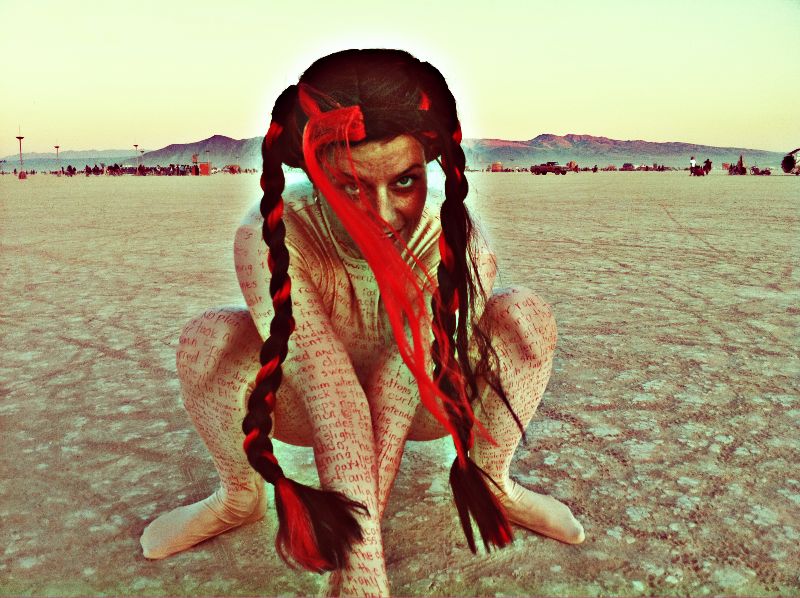
Wendy1Author Wendy Voorsanger performing literary art on the playa. Photo credit: C. Voorsanger.

Wendy2.

/

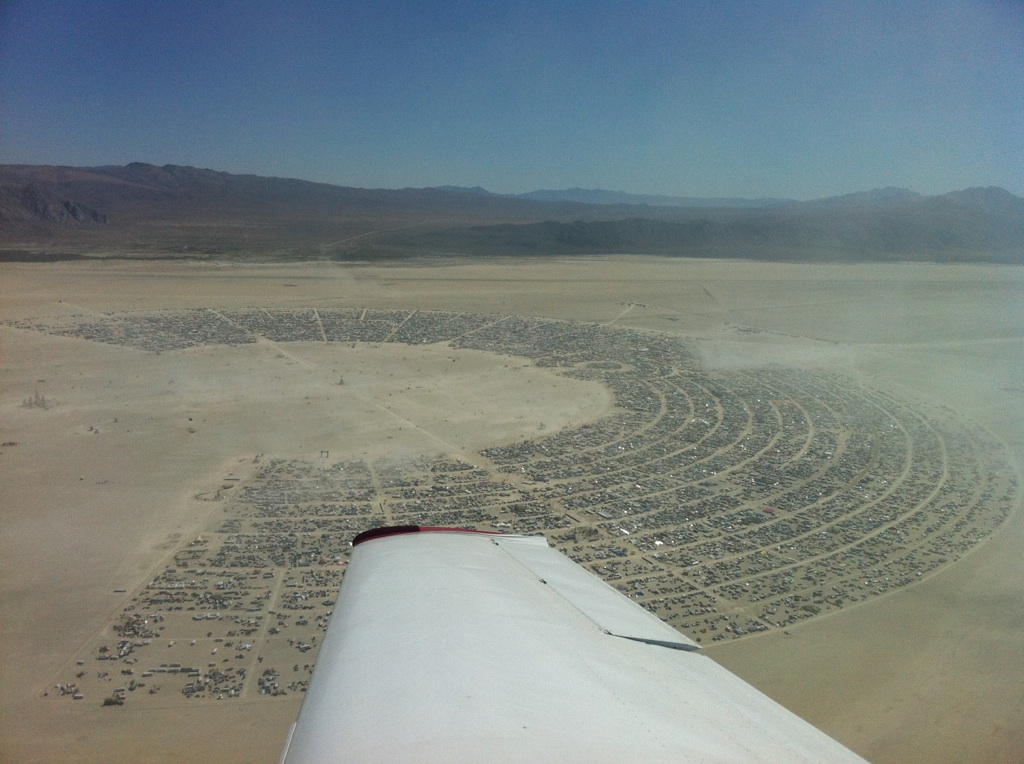
Burning Man is all about radical self-expression.  50,000 free-spirited “burners,” as they’re called, descend upon the Black Rock Desert in Nevada to create a city: an interaction, art, the performance and ultimately the whole Burning Man experience. Many burners labor all year creating stunning art installations and engineering marvels that sit surreally against the stark and eerie landscape of the playa.  Imagine Chitty Chitty Bang Bang inventions on steroids, combined with copious quantities of jet fuel.  See El Pulpo Mecanico. All commercialism is banned; creations are strangely random and come from a place deep within the mysterious subconscious. Check out this list of art on the playa.
.

img_07201Playa from a Plane. Photo Credit: C. Voorsanger

Surprisingly, there’s lack of literary presence on the playa.  Perhaps the community is too enthralled with the extraordinary visual peculiarities to meditate on the cerebral.  Perhaps the loud house music pumping from art cars and daytime raves might be incompatible for reading.  Every year a unique Burning Man theme guides camps toward a common launching point for communal offerings.  The 2011 theme “Rites of Passage” lent itself to some interesting variations on rites both familiar and fringe, such as beer pong, the Homecoming Dance, getting a tattoo.  The theme seemed a perfect platform to riff off literature in some way, “the first draft,” “first reading,” “first rejection,” “first publication,”—rites for all writers. I searched the playa but couldn’t find much in the way of literature, books, words.  I’d heard about a creative impromptu slam poetry happening in Buddha Camp at the Lotus Dome—Poetry Slam, a wee bit of poetry and spanking.  The description scared me off: This is not some ordinary poetry reading, nor is it your poetry contest with score paddles. But you will be paddled with poetry in this full contact open mic. Curious yet? So are we! Bring a poem, or be a spectator, but  stay away if you have a soft tush.

I did stumble upon a few open mic sessions in the Center Camp tent with poetry readings and spoken word performances.  One woman set up a 1950’s typewriter and composed poems on the spot with a one word prompts.  But really, words were missing from the playa.

.
img_07287Random Trojan Horse (Exploded and burned on Friday night.)

As an enthusiastic newbie burner, I wanted to embrace the Burning Man tenants, but lacked the engineering skills and pyrotechnics license.  So, I turned to my own art: literature.  I’d created my own radial self expression, writing a chapter of my first novel-in-progress Capturing the Eddy on a Japanese Zentai suit.  I’d chosen a Burning Man-appropriate chapter, entitled—A Coated Spirit.  The idea wasn’t to publicize my writing, (the novel is far from ready for prime time) but to get burners to pause and read. Meditate on the word.  Relish in a beautiful phrase.  Ponder the random sensation a sequence of sentences might stir.  I wanted to get burners to read a “novel-off-the-page,” if you will.  So the second night I pulled on my Zentai suit at sunset and walked out the playa in hopes of inspiring people to read me and enjoy a bit of literature as performance art..

img_07186Writing novel-in-progress on Zentai Suit

Turns out, I fit right in as a random object on  the playa.  I danced  and twirled wearing my  words, as the sun sank low and dust billowed  in the dusk.  When darkness oozed around, I  joined in a larger dance party and burners caught random words on my back while moving languidly to the thumping beat. “What  are you wearing?” one guy asked.  “My novel.  Wanna read me?” Responses were enthusiastic..

img_07713Wearing my words.  Photo credit: C. Voorsanger.

.img_07751Literature on the Playa.  Photo credit: C. Voorsanger.

.
Later, I caught a ride from an art car taxi through the playa and more people read random strings of words on my shoulders, ankles, and wrists.  I’d offered my creation to the Burning Man community and felt fully accepted and appreciated in my participation.
.

img_07263Pirate Art Car.

img_07493Dragon Art Car

The question I’m left with is why not more literature as performance art at Burning Man?  I ask my fellow writers: What ideas do you have for adding more a more literary influence to Black Rock City 2012? I’m thinking of something more worthwhile than a poetry slam with paddles.  What about a word labyrinth placed in the desert or signs in a selected solstice sequence that tell a story, or novel chapters embedded in the playa dust discovered randomly?  I’d love to hear ideas from you. What say you fellow writers?

.Wendy2
—Wendy Voorsanger

/
/
/